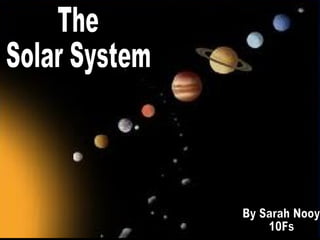
The Solar System By Sarah Nooy 10Fs
The Sun Diameter (km): 1 392 000 which is about 109 times the size of earth Composition: Gas Number of satellites: 9 Temperature: 5,505 °C Length of average year: 225 million earth years (1 cosmic year) Atmosphere: Chromospheres, photosphere, transition region, corona and heliosphere Point of interest: The sun is around 4 billion years old and is expected to live for another 4 billion years
Mercury Diameter of each planet (km):   4 878 Distance from sun (km):   58,343,169.6   Composition :   Rock Number of satellites:   None Temperature:   -180 to 430 °C Discovery date:   Prehistory Length of average day:   176 Earth Days   Length of average year:   88 Earth days Type of atmosphere:   None Point of interest:   The Hubble telescope can’t look at Mercury because it is too close to the sun
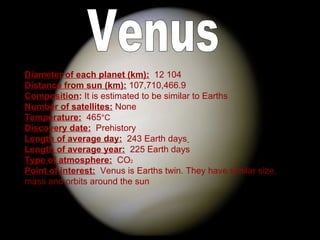
Venus Diameter of each planet (km):   12 104 Distance from sun (km):   107,710,466.9  Composition :  It is estimated to be similar to Earths  Number of satellites:  None  Temperature:   465 °C   Discovery date:   Prehistory Length of average day:   243 Earth days   Length of average year:   225 Earth days  Type of atmosphere:   CO 2 Point of interest:   Venus is Earths twin. They have similar size, mass and orbits around the sun
Earth Diameter of each planet (km):   12 756   Distance from sun (km):   149 597 870.7 Composition :  Inner core, outer core, magma and crust Number of satellites:  one Temperature:   -89 to 58 ºC Discovery date:  Earth wasn't  disco vered by anyone  Length of average day:  24 hours  Length of average year:  365 Earth  days and  in a leap year 336 earth days  Type of atmosphere:   N 2 +O 2 Point of interest:  Earth is the only known planet to have life on it
Diameter of each planet (km):   6 787 Distance from sun (km):   16 006 972.2 Composition :  Rock and Iron   Number of satellites:   2 Temperature:   -82 to 0 º C Discovery date:   Prehistory Length of average day:  1.03 earth days Length of average year:   1.88 earth days Type of atmosphere:   CO 2 Point of interest:   Mars has a grand canyon that is around the size of one side of America to the other Mars
Asteroid Belt How are asteroids formed:  Asteroids were formed in the big bang and were remains that couldn't form a planet or anything else   Number of asteroids:  Thousands Distance from sun (km):   402 336 000 Composition :  Rock and metal Number of satellites:  Thousands  Temperature:   Roughly -73 ºC   Discovery date:  1700's and 1800's Point of interest:  Most asteroids are covered in dust
Diameter of each planet (km):   142 800 Distance from sun (km):   777 908 927.6 Composition : Gas Number of satellites:  60 Temperature:   -150 °C Discovery date:   Prehistory Length of average day:  0.41 Earth days Length of average year:   11.86 earth years Type of atmosphere:   H 2 +He Point of interest:   Jupiter has clouds which are 50km thick Jupiter
Saturn Diameter of each planet (km):   120 000 Distance from sun (km):  1 427 163 686.4 Composition :   Gas Number of satellites:  31  Temperature:   -170ºC Discovery date:  Prehistory  Length of average day:  0.44 earth days  Length of average year:   29.46 Type of atmosphere:   H 2 +He Point of interest:  There could be life on one of Saturn's moons
Uranus Diameter of each planet (km):   51 118   Distance from sun (km):  2 869 287 159.8 Composition :  Gas Number of satellites:  27 Temperature:   -200ºC Discovery date:  1781 Length of average day:  0.72 earth days Length of average year:   84.01 earth days Type of atmosphere:   H 2 +He Point of interest:  Uranus was the first planet discovered in the modern age
Neptune Diameter of each planet (km):   49 528 Distance from sun (km):  4 496 911 993 Composition :   Gas Number of satellites:  13  Temperature:   -210ºC Discovery date:  1846 Length of average day:  0.72 earth days Length of average year:   164.8 earth years Type of atmosphere:   H2+He Point of interest:  Neptune has the strongest winds in the solar system. They can reach up to 2100km/hour
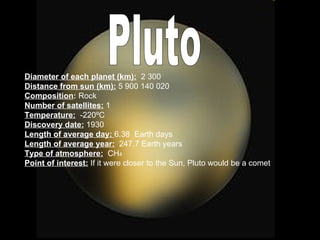
Pluto Diameter of each planet (km):   2 300 Distance from sun (km):  5 900 140 020 Composition :  Rock Number of satellites:  1 Temperature:   -220ºC Discovery date:  1930 Length of average day:  6.38  Earth days Length of average year:   247.7 Earth years Type of atmosphere:   CH 4 Point of interest:  If it were closer to the Sun, Pluto would be a comet
How are comets formed:  Comets were formed in the Big Bang. The core heated up but not enough to melt the ice on top. Where do they come from:  Comets come from the Oort cloud and the Kuiper Belt What is the tail of a comet:  The tail of a comet is the melted off dust and gas from the comet when it gets close enough to the sun.  Discovery date:  2500BC  Some Famous comets:  Halley's   comet, Hyakutake, Hale-Bopp  Comets
The inner planets are the four closest planets to the sun. They are Mercury, Venus, Earth and Mars. The inner planets are mostly made of rock and are generally smaller and denser than the outer planets. They also have less moons than the outer planets and don’t have any rings around them either.  Summary About Inner Planets
The outer planets are Jupiter, Saturn, Uranus, Neptune and Pluto. They are also known as the gas giants. They are known to have more moons than the inner planets and some have rings made out of  ice and rock. The inner and outer planets are divided by the asteroid belt. Summary About Outer Planets
What it is:  The Oort cloud is a circular region of comets that surrounds the solar system out to more than 1,000 times the distance between Pluto and the sun. Formation:  It was formed in 0001BC. It is believed that the objects in it were once close to the sun but were then pulled away by the planets gravity Location in Solar System:  It is found past Pluto. It may even extend to the end of the universe Items found in it:  Comets and other small individual things Point of interest:  The Oort cloud is the farthest from the sun that is still in the solar system Oort Cloud

Solar system

  • 1.
    The Solar SystemBy Sarah Nooy 10Fs
  • 2.
    The Sun Diameter(km): 1 392 000 which is about 109 times the size of earth Composition: Gas Number of satellites: 9 Temperature: 5,505 °C Length of average year: 225 million earth years (1 cosmic year) Atmosphere: Chromospheres, photosphere, transition region, corona and heliosphere Point of interest: The sun is around 4 billion years old and is expected to live for another 4 billion years
  • 3.
    Mercury Diameter ofeach planet (km): 4 878 Distance from sun (km): 58,343,169.6 Composition : Rock Number of satellites: None Temperature: -180 to 430 °C Discovery date: Prehistory Length of average day: 176 Earth Days Length of average year: 88 Earth days Type of atmosphere: None Point of interest: The Hubble telescope can’t look at Mercury because it is too close to the sun
  • 4.
    Venus Diameter ofeach planet (km): 12 104 Distance from sun (km): 107,710,466.9 Composition : It is estimated to be similar to Earths Number of satellites: None Temperature: 465 °C Discovery date: Prehistory Length of average day: 243 Earth days Length of average year: 225 Earth days Type of atmosphere: CO 2 Point of interest: Venus is Earths twin. They have similar size, mass and orbits around the sun
  • 5.
    Earth Diameter ofeach planet (km): 12 756 Distance from sun (km): 149 597 870.7 Composition : Inner core, outer core, magma and crust Number of satellites: one Temperature: -89 to 58 ºC Discovery date: Earth wasn't disco vered by anyone Length of average day: 24 hours Length of average year: 365 Earth days and in a leap year 336 earth days Type of atmosphere: N 2 +O 2 Point of interest: Earth is the only known planet to have life on it
  • 6.
    Diameter of eachplanet (km): 6 787 Distance from sun (km): 16 006 972.2 Composition : Rock and Iron Number of satellites: 2 Temperature: -82 to 0 º C Discovery date: Prehistory Length of average day: 1.03 earth days Length of average year: 1.88 earth days Type of atmosphere: CO 2 Point of interest: Mars has a grand canyon that is around the size of one side of America to the other Mars
  • 7.
    Asteroid Belt Howare asteroids formed: Asteroids were formed in the big bang and were remains that couldn't form a planet or anything else Number of asteroids: Thousands Distance from sun (km): 402 336 000 Composition : Rock and metal Number of satellites: Thousands Temperature: Roughly -73 ºC Discovery date: 1700's and 1800's Point of interest: Most asteroids are covered in dust
  • 8.
    Diameter of eachplanet (km): 142 800 Distance from sun (km): 777 908 927.6 Composition : Gas Number of satellites: 60 Temperature: -150 °C Discovery date: Prehistory Length of average day: 0.41 Earth days Length of average year: 11.86 earth years Type of atmosphere: H 2 +He Point of interest: Jupiter has clouds which are 50km thick Jupiter
  • 9.
    Saturn Diameter ofeach planet (km): 120 000 Distance from sun (km): 1 427 163 686.4 Composition : Gas Number of satellites: 31 Temperature: -170ºC Discovery date: Prehistory Length of average day: 0.44 earth days Length of average year: 29.46 Type of atmosphere: H 2 +He Point of interest: There could be life on one of Saturn's moons
  • 10.
    Uranus Diameter ofeach planet (km): 51 118 Distance from sun (km): 2 869 287 159.8 Composition : Gas Number of satellites: 27 Temperature: -200ºC Discovery date: 1781 Length of average day: 0.72 earth days Length of average year: 84.01 earth days Type of atmosphere: H 2 +He Point of interest: Uranus was the first planet discovered in the modern age
  • 11.
    Neptune Diameter ofeach planet (km): 49 528 Distance from sun (km): 4 496 911 993 Composition : Gas Number of satellites: 13 Temperature: -210ºC Discovery date: 1846 Length of average day: 0.72 earth days Length of average year: 164.8 earth years Type of atmosphere: H2+He Point of interest: Neptune has the strongest winds in the solar system. They can reach up to 2100km/hour
  • 12.
    Pluto Diameter ofeach planet (km): 2 300 Distance from sun (km): 5 900 140 020 Composition : Rock Number of satellites: 1 Temperature: -220ºC Discovery date: 1930 Length of average day: 6.38 Earth days Length of average year: 247.7 Earth years Type of atmosphere: CH 4 Point of interest: If it were closer to the Sun, Pluto would be a comet
  • 13.
    How are cometsformed: Comets were formed in the Big Bang. The core heated up but not enough to melt the ice on top. Where do they come from: Comets come from the Oort cloud and the Kuiper Belt What is the tail of a comet: The tail of a comet is the melted off dust and gas from the comet when it gets close enough to the sun. Discovery date: 2500BC Some Famous comets: Halley's comet, Hyakutake, Hale-Bopp Comets
  • 14.
    The inner planetsare the four closest planets to the sun. They are Mercury, Venus, Earth and Mars. The inner planets are mostly made of rock and are generally smaller and denser than the outer planets. They also have less moons than the outer planets and don’t have any rings around them either. Summary About Inner Planets
  • 15.
    The outer planetsare Jupiter, Saturn, Uranus, Neptune and Pluto. They are also known as the gas giants. They are known to have more moons than the inner planets and some have rings made out of ice and rock. The inner and outer planets are divided by the asteroid belt. Summary About Outer Planets
  • 16.
    What it is: The Oort cloud is a circular region of comets that surrounds the solar system out to more than 1,000 times the distance between Pluto and the sun. Formation: It was formed in 0001BC. It is believed that the objects in it were once close to the sun but were then pulled away by the planets gravity Location in Solar System: It is found past Pluto. It may even extend to the end of the universe Items found in it: Comets and other small individual things Point of interest: The Oort cloud is the farthest from the sun that is still in the solar system Oort Cloud