Plagiarism Marilyn Kiefer Joanna Haselhuhn
Plagiarism According to the Merriam-Webster Online Dictionary,  "plagiarize" means to steal and pass off as one’s own (the ideas or words of another): use (a created production) without crediting the source to commit literary theft: present as new and original an idea or product derived from an existing source
Pew Internet Project Finding The Digital Disconnect:  The widening gap between Internet-savvy students and their schools.  August 14, 2002  – What students think about the Internet in relation to their schooling… “ The Internet as virtual tutor and study shortcut.  Students think of the Internet as one way to receive instruction about material that interests them or about which they are confused.  Others view the Internet as a way to complete their schoolwork as quickly and painlessly as possible with minimal effort and minimal engagement.  For some, this includes viewing the Internet as a mechanism to plagiarize material or otherwise cheat .”
Further… from the Pew study “Students maintain that schools should place priority on developing programs to teach keyboarding, computer, and  Internet literacy skills .”
Extent of the Problem The growth of the Internet is phenomenal, giving us immediate access to information on any topic. Plagiarism has always existed; the Internet has only made it faster and easier. Students need to be aware that just because technology allows someone to copy and paste does not mean that this is an appropriate method of writing a paper.
Why students cheat To maintain high GPAs. To get done sooner. They are unlikely to get caught. They feel pressure from parents and peers to get into a good college. It’s no longer socially unacceptable; everyone does it. Cutting and pasting material is quick, easy, and very tempting.
They simply do not understand what plagiarism is, believing that everything on the Internet is in the public domain. Some students fear their writing ability is inadequate. Some students like the thrill of rule breaking. Some students have poor time management and planning skills.
Statistics from www.plagiarism.org “ The State of Americans:  This Generation and the Next” ( Free Press , July 1996) states that 58.3% of high school students let someone else copy their work in 1969, and 97.5% did so in 1989. According to the Gallup Organization (Oct. 6-9,2000), the top two problems facing the country today are: 1)Education and 2) Decline in Ethics A national survey published in  Education Week  found that: 54% of students admitted to plagiarizing from the Internet; 74% of students admitted that at least once during the past school year they had engaged in “serious” cheating; and 47% of students believe their teachers sometimes choose to ignore students who are cheating.
According to surveys in  U.S. News and World Report *** 80% of "high-achieving" high school students admit to cheating.  51% of high school students did not believe cheating was wrong.  95% of cheating high school students said that they had not been detected.  75% of college students admitted cheating, and 90% of college students didn't believe cheaters would be caught.  Almost 85% of college students said cheating was necessary to get ahead ***turnitin.com 2/4/03
Recognize the Signs Vocabulary, writing style, and grammar are unusually advanced and adult. Student has inserted a paragraph or sentence of his/her own creation that is remarkably less sophisticated than the rest of the paper. Gray letters appear in the text--an indication that the page was downloaded from the Web.  Color letters on a screen show up gray in a printout. A student prints out an essay directly from his Web browser, perhaps even leaving a Web address at the top or bottom of a page. The layout of the paper seems strange.  Page numbers, heading, and spacing do not correctly transfer in a hasty cut-and-paste job.
A student leaves in references to graphs, charts, or accompanying material that is missing from the body of the paper. Inactive Web sites are listed in the bibliography. Bibliographic citations are all older than 5 years. The student makes reference to historical persons or events while speaking in the present tense . A student is unable to summarize the main points of the paper or answer questions about parts of his or her writing.
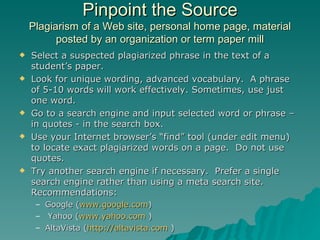
Pinpoint the Source Plagiarism of a Web site, personal home page, material posted by an organization or term paper mill Select a suspected plagiarized phrase in the text of a student’s paper. Look for unique wording, advanced vocabulary.  A phrase of 5-10 words will work effectively. Sometimes, use just one word. Go to a search engine and input selected word or phrase – in quotes - in the search box.  Use your Internet browser’s “find” tool (under edit menu) to locate exact plagiarized words on a page.  Do not use quotes. Try another search engine if necessary.  Prefer a single search engine rather than using a meta search site. Recommendations: Google ( www.google.com ) Yahoo ( www.yahoo.com  ) AltaVista ( http://altavista.com  )
Term paper sources… Become familiar with the Internet term paper sites where students can obtain research papers for free or for a fee.  See a list of over 250 sites posted at  http://www.coastal.edu/library/mills2.htm . Examples: Go to  http://screwschool.com . Try  www.a1-termpaper.com
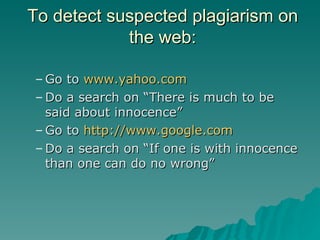
To detect suspected plagiarism on the web: Go to  www.yahoo.com Do a search on “There is much to be said about innocence” Go to  http:// www.google.com Do a search on “If one is with innocence than one can do no wrong”
Plagiarism of a journal article from an online database Example: Use InfoTrac/General Reference Center Gold  (on media center homepage)  http://hs.novi.k12.mi.us/mediacenter Perform a Relevance search, placing quotes around a suspected plagiarized phrase. Make sure you indicate that you want to “Search for words…in entire article content.”  Do a search on “you may use web site content as you wish” Infotrac retrieves “  Essential Assistant , Jan2003v16ilp6(1) Try searching for this phrase at  http:// google.com . No results found.
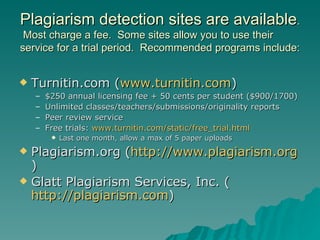
Plagiarism detection sites are available .  Most charge a fee.  Some sites allow you to use their service for a trial period.  Recommended programs include: Turnitin.com ( www.turnitin.com ) $250 annual licensing fee + 50 cents per student ($900/1700) Unlimited classes/teachers/submissions/originality reports Peer review service Free trials:  www.turnitin.com/static/free_trial.html Last one month, allow a max of 5 paper uploads Plagiarism.org ( http://www.plagiarism.org ) Glatt Plagiarism Services, Inc. ( http://plagiarism.com )
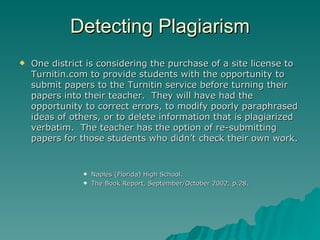
Detecting Plagiarism One district is considering the purchase of a site license to Turnitin.com to provide students with the opportunity to submit papers to the Turnitin service before turning their papers into their teacher.  They will have had the opportunity to correct errors, to modify poorly paraphrased ideas of others, or to delete information that is plagiarized verbatim.  The teacher has the option of re-submitting papers for those students who didn’t check their own work.  Naples (Florida) High School.  The Book Report, September/October 2002, p.28.
Prevention Educate your students about plagiarism.  Define it and give examples. Discuss copyright and the Internet. Require most references to be up-to-date, at least one in the last year. Provide a list of specific topics; change from semester to semester when possible. Require specific components, such as 3 Internet sources, 2 book sources, 2 journal sources, incorporate something you provide, interview, survey, graph, etc. Teach bibliographic citation and the benefits of citing sources (performed research, supports students position, etc.) Obtain a sample of the student’s in-class writing at the start of a semester in order to have a basis for comparison if plagiarism is later suspected. Structure a research assignment so that various deadlines are due at different times.  Confer with students about their progress. Require students to turn in a thesis statement/abstract, annotated bibliography, outline, rough draft, and photocopies of cited references.  Set a series of due dates.
Consider having students use a note-taking method where black text signifies ideas of others and green text represents the ideas of the student. Have students keep a journal on their progress in completing a major assignment.  Discourage projects that ask students to simply gather facts about a topic.  Prefer projects that require explanations, problem solving, choices, decision-making, and personal reflection. Emphasize essential questions – questions  about  human issues or that are at the heart of a discipline.  Encourage students to ask their own questions and formulate their own answers. Require oral reports of student papers. Make the penalties clear.
Websites http://www.indiana.edu/~wts/wts/plagiarism.html#wwwplagiarism  –what plagiarism is and how to identify it www.fno.org/may98/cov98may.html  -ways to design research projects  http://www.virtualsalt.com/antiplag.htm  strategies for research papers http://www.aresearchguide.com/6plagiar.html  hundreds of links for students & teachers http://www.nwmissouri.edu/library/courses/business/plagiarism.htm  for teachers and students http://eduscapes.com/tap/topic24b.htm  -  Plagiarism and the Internet http://www.easybib.com  provides a free, online service that creates citations in MLA or APA style.
Sources Levin, Douglas. The Digital Disconnect: The Widening Gap between Internet-Savvy Students and Their Schools.  www.pewinternet.org Harris, Robert. Anti-Plagiarism Strategies for Research Papers.  http://virtualsalt.com/antiplag.htm Willems, Harry.  Plagiarism @ Your School Library.  Library Media Connection, February 2003. Lincoln, Margaret.  Internet Plagiarism.  MultiMedia Schools, January/February 2002. Janowski, Adam.  Plagiarism:  Prevention, Not Prosecution.  The Book Report, September/October 2002.

Plagiarism Ppt Teachers

  • 1.
    Plagiarism Marilyn KieferJoanna Haselhuhn
  • 2.
    Plagiarism According tothe Merriam-Webster Online Dictionary, "plagiarize" means to steal and pass off as one’s own (the ideas or words of another): use (a created production) without crediting the source to commit literary theft: present as new and original an idea or product derived from an existing source
  • 3.
    Pew Internet ProjectFinding The Digital Disconnect: The widening gap between Internet-savvy students and their schools. August 14, 2002 – What students think about the Internet in relation to their schooling… “ The Internet as virtual tutor and study shortcut. Students think of the Internet as one way to receive instruction about material that interests them or about which they are confused. Others view the Internet as a way to complete their schoolwork as quickly and painlessly as possible with minimal effort and minimal engagement. For some, this includes viewing the Internet as a mechanism to plagiarize material or otherwise cheat .”
  • 4.
    Further… from thePew study “Students maintain that schools should place priority on developing programs to teach keyboarding, computer, and Internet literacy skills .”
  • 5.
    Extent of theProblem The growth of the Internet is phenomenal, giving us immediate access to information on any topic. Plagiarism has always existed; the Internet has only made it faster and easier. Students need to be aware that just because technology allows someone to copy and paste does not mean that this is an appropriate method of writing a paper.
  • 6.
    Why students cheatTo maintain high GPAs. To get done sooner. They are unlikely to get caught. They feel pressure from parents and peers to get into a good college. It’s no longer socially unacceptable; everyone does it. Cutting and pasting material is quick, easy, and very tempting.
  • 7.
    They simply donot understand what plagiarism is, believing that everything on the Internet is in the public domain. Some students fear their writing ability is inadequate. Some students like the thrill of rule breaking. Some students have poor time management and planning skills.
  • 8.
    Statistics from www.plagiarism.org“ The State of Americans: This Generation and the Next” ( Free Press , July 1996) states that 58.3% of high school students let someone else copy their work in 1969, and 97.5% did so in 1989. According to the Gallup Organization (Oct. 6-9,2000), the top two problems facing the country today are: 1)Education and 2) Decline in Ethics A national survey published in Education Week found that: 54% of students admitted to plagiarizing from the Internet; 74% of students admitted that at least once during the past school year they had engaged in “serious” cheating; and 47% of students believe their teachers sometimes choose to ignore students who are cheating.
  • 9.
    According to surveysin U.S. News and World Report *** 80% of "high-achieving" high school students admit to cheating. 51% of high school students did not believe cheating was wrong. 95% of cheating high school students said that they had not been detected. 75% of college students admitted cheating, and 90% of college students didn't believe cheaters would be caught. Almost 85% of college students said cheating was necessary to get ahead ***turnitin.com 2/4/03
  • 10.
    Recognize the SignsVocabulary, writing style, and grammar are unusually advanced and adult. Student has inserted a paragraph or sentence of his/her own creation that is remarkably less sophisticated than the rest of the paper. Gray letters appear in the text--an indication that the page was downloaded from the Web. Color letters on a screen show up gray in a printout. A student prints out an essay directly from his Web browser, perhaps even leaving a Web address at the top or bottom of a page. The layout of the paper seems strange. Page numbers, heading, and spacing do not correctly transfer in a hasty cut-and-paste job.
  • 11.
    A student leavesin references to graphs, charts, or accompanying material that is missing from the body of the paper. Inactive Web sites are listed in the bibliography. Bibliographic citations are all older than 5 years. The student makes reference to historical persons or events while speaking in the present tense . A student is unable to summarize the main points of the paper or answer questions about parts of his or her writing.
  • 12.
    Pinpoint the SourcePlagiarism of a Web site, personal home page, material posted by an organization or term paper mill Select a suspected plagiarized phrase in the text of a student’s paper. Look for unique wording, advanced vocabulary. A phrase of 5-10 words will work effectively. Sometimes, use just one word. Go to a search engine and input selected word or phrase – in quotes - in the search box. Use your Internet browser’s “find” tool (under edit menu) to locate exact plagiarized words on a page. Do not use quotes. Try another search engine if necessary. Prefer a single search engine rather than using a meta search site. Recommendations: Google ( www.google.com ) Yahoo ( www.yahoo.com ) AltaVista ( http://altavista.com )
  • 13.
    Term paper sources…Become familiar with the Internet term paper sites where students can obtain research papers for free or for a fee. See a list of over 250 sites posted at http://www.coastal.edu/library/mills2.htm . Examples: Go to http://screwschool.com . Try www.a1-termpaper.com
  • 14.
    To detect suspectedplagiarism on the web: Go to www.yahoo.com Do a search on “There is much to be said about innocence” Go to http:// www.google.com Do a search on “If one is with innocence than one can do no wrong”
  • 15.
    Plagiarism of ajournal article from an online database Example: Use InfoTrac/General Reference Center Gold (on media center homepage) http://hs.novi.k12.mi.us/mediacenter Perform a Relevance search, placing quotes around a suspected plagiarized phrase. Make sure you indicate that you want to “Search for words…in entire article content.” Do a search on “you may use web site content as you wish” Infotrac retrieves “ Essential Assistant , Jan2003v16ilp6(1) Try searching for this phrase at http:// google.com . No results found.
  • 16.
    Plagiarism detection sitesare available . Most charge a fee. Some sites allow you to use their service for a trial period. Recommended programs include: Turnitin.com ( www.turnitin.com ) $250 annual licensing fee + 50 cents per student ($900/1700) Unlimited classes/teachers/submissions/originality reports Peer review service Free trials: www.turnitin.com/static/free_trial.html Last one month, allow a max of 5 paper uploads Plagiarism.org ( http://www.plagiarism.org ) Glatt Plagiarism Services, Inc. ( http://plagiarism.com )
  • 17.
    Detecting Plagiarism Onedistrict is considering the purchase of a site license to Turnitin.com to provide students with the opportunity to submit papers to the Turnitin service before turning their papers into their teacher. They will have had the opportunity to correct errors, to modify poorly paraphrased ideas of others, or to delete information that is plagiarized verbatim. The teacher has the option of re-submitting papers for those students who didn’t check their own work. Naples (Florida) High School. The Book Report, September/October 2002, p.28.
  • 18.
    Prevention Educate yourstudents about plagiarism. Define it and give examples. Discuss copyright and the Internet. Require most references to be up-to-date, at least one in the last year. Provide a list of specific topics; change from semester to semester when possible. Require specific components, such as 3 Internet sources, 2 book sources, 2 journal sources, incorporate something you provide, interview, survey, graph, etc. Teach bibliographic citation and the benefits of citing sources (performed research, supports students position, etc.) Obtain a sample of the student’s in-class writing at the start of a semester in order to have a basis for comparison if plagiarism is later suspected. Structure a research assignment so that various deadlines are due at different times. Confer with students about their progress. Require students to turn in a thesis statement/abstract, annotated bibliography, outline, rough draft, and photocopies of cited references. Set a series of due dates.
  • 19.
    Consider having studentsuse a note-taking method where black text signifies ideas of others and green text represents the ideas of the student. Have students keep a journal on their progress in completing a major assignment. Discourage projects that ask students to simply gather facts about a topic. Prefer projects that require explanations, problem solving, choices, decision-making, and personal reflection. Emphasize essential questions – questions about human issues or that are at the heart of a discipline. Encourage students to ask their own questions and formulate their own answers. Require oral reports of student papers. Make the penalties clear.
  • 20.
    Websites http://www.indiana.edu/~wts/wts/plagiarism.html#wwwplagiarism –what plagiarism is and how to identify it www.fno.org/may98/cov98may.html -ways to design research projects http://www.virtualsalt.com/antiplag.htm strategies for research papers http://www.aresearchguide.com/6plagiar.html hundreds of links for students & teachers http://www.nwmissouri.edu/library/courses/business/plagiarism.htm for teachers and students http://eduscapes.com/tap/topic24b.htm - Plagiarism and the Internet http://www.easybib.com provides a free, online service that creates citations in MLA or APA style.
  • 21.
    Sources Levin, Douglas.The Digital Disconnect: The Widening Gap between Internet-Savvy Students and Their Schools. www.pewinternet.org Harris, Robert. Anti-Plagiarism Strategies for Research Papers. http://virtualsalt.com/antiplag.htm Willems, Harry. Plagiarism @ Your School Library. Library Media Connection, February 2003. Lincoln, Margaret. Internet Plagiarism. MultiMedia Schools, January/February 2002. Janowski, Adam. Plagiarism: Prevention, Not Prosecution. The Book Report, September/October 2002.