Avoiding Plagiarism Steve Bowman
Avoiding Plagiarism What is Plagiarism Icons of Plagiarism Avoiding Plagiarism
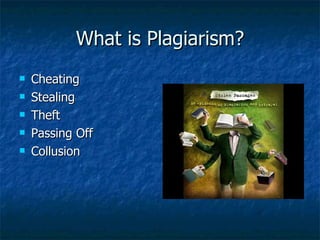
What is Plagiarism? Cheating Stealing Theft Passing Off Collusion
What is Plagiarism? Plagiarism  (from Latin  plagiare  "to kidnap") is the practice of claiming, or implying, original authorship or incorporating material from someone else's written or creative work, in whole or in part, into one’s own  without adequate acknowledgment
What is Plagiarism? OED (online): "the wrongful appropriation or purloining, and publication as one's own, of the ideas, or the expression of the ideas (literary, artistic, musical, mechanical, etc.) of another
What is Plagiarism? " to take someone else’s words or ideas and present them as your own  without proper acknowledgement." (Marshall and Rowland, 1998) Presenting someone else’s work as your own. Work means any intellectual output, and typically includes text, data, images, sound or performance. ( Office of Academic Appeals & Regulation  2005 )
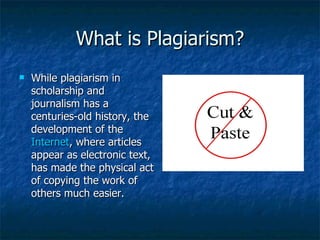
What is Plagiarism? While plagiarism in scholarship and journalism has a centuries-old history, the development of the  Internet , where articles appear as electronic text, has made the physical act of copying the work of others much easier.
What is Plagiarism? Examples of plagiarism can include: Copying and submitting the work of a fellow student.  Buying and submitting an assignment from the Internet.  Creating a piece of work by cutting and pasting various sections of text and/or images found on the Internet into a document  without referencing the sources .
What is Plagiarism? Within  academia , plagiarism by students, professors, or researchers is considered  academic dishonesty  or  academic fraud  and offenders are subject to academic censure.  In  journalism , plagiarism is considered a breach of journalistic ethics, and reporters caught  plagiarizing  typically face disciplinary measures ranging from suspension to termination.
What is Plagiarism? 19.2 Collusion  is taken to mean unauthorised collaboration to produce individually assessed work, without acknowledgement to those who have contributed to the work. It is distinct from  authorised collaboration  on projects which is strongly encouraged. 19.3 Plagiarism  is the passing off by one person of another person’s work, without acknowledgement to the original author. Any material used in a piece of work which is not original MUST be acknowledged to the original author in the approved format, or it will be treated as plagiarism, which is regarded as an extremely serious academic offence amounting to theft of ideas. Such material may be text or image, and may be derived from published or unpublished work, from any source (e.g. books, journals, newspapers, the internet, fellow students’ notes etc.).
What is Plagiarism? Plagiarism 'is fault of indulgent lecturers' Plagiarism and cheating by today's cut-and-paste generation of university students will never be stamped out unless lecturers stop spoon-feeding them a diet of handouts and PowerPoint presentations, a leading academic said yesterday. Frean, A (2006) 'Plagiarism 'is fault of indulgent lecturers'',  The Times  [Online]. Available at:  www.thetimesonline.co.uk/article/0,,3561-2409036.html  (Accessed: 19 October 2006).
What is Plagiarism? Plagiarism can also occur unconsciously; in some cultures certain forms of plagiarism are accepted because the concept can be interpreted differently.  Respondents with educational experience in  Europe viewed some aspects of collaborative working as serious offences whereas those with experience in Asia (India and Pakistan) viewed these as minor or not serious.
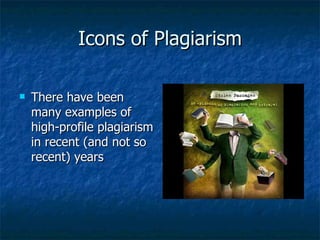
Icons of Plagiarism There have been many examples of high-profile plagiarism in recent (and not so recent) years
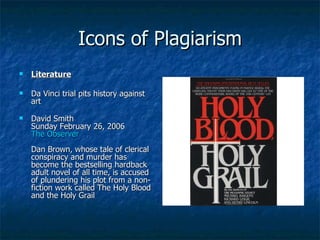
Icons of Plagiarism Literature Da Vinci trial pits history against art David Smith Sunday February 26, 2006 The Observer   Dan Brown, whose tale of clerical conspiracy and murder has become the bestselling hardback adult novel of all time, is accused of plundering his plot from a non-fiction work called The Holy Blood and the Holy Grail
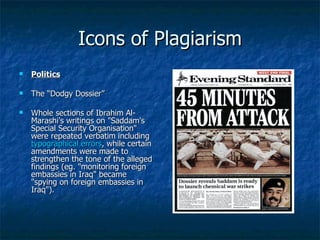
Icons of Plagiarism Politics The “Dodgy Dossier” Whole sections of Ibrahim Al-Marashi's writings on "Saddam's Special Security Organisation" were repeated verbatim including  typographical errors , while certain amendments were made to strengthen the tone of the alleged findings (eg. "monitoring foreign embassies in Iraq" became "spying on foreign embassies in Iraq").
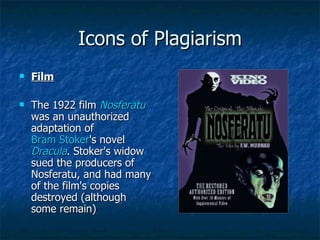
Icons of Plagiarism Film The 1922 film  Nosferatu  was an unauthorized adaptation of  Bram Stoker 's novel  Dracula . Stoker's widow sued the producers of Nosferatu, and had many of the film's copies destroyed (although some remain)
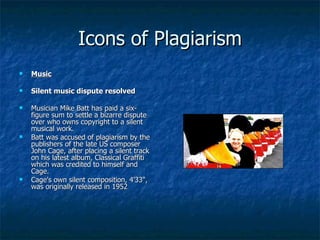
Icons of Plagiarism Music Silent music dispute resolved Musician Mike Batt has paid a six-figure sum to settle a bizarre dispute over who owns copyright to a silent musical work.  Batt was accused of plagiarism by the publishers of the late US composer John Cage, after placing a silent track on his latest album, Classical Graffiti which was credited to himself and Cage.  Cage's own silent composition, 4'33", was originally released in 1952
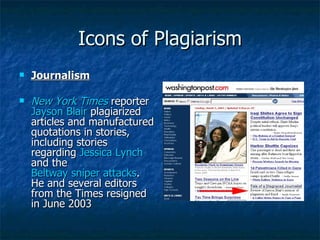
Icons of Plagiarism Journalism New York Times  reporter  Jayson Blair  plagiarized articles and manufactured quotations in stories, including stories regarding  Jessica Lynch  and the  Beltway sniper attacks . He and several editors from the Times resigned in June 2003
Avoiding Plagiarism Most cases of plagiarism can be avoided by citing sources.  Simply acknowledging that certain material has been borrowed,  and providing your audience with the information necessary to find that source , is usually enough to prevent plagiarism.
What is Citation? A "citation" is the way you tell your readers that certain material in your work came from another source. It also gives your readers the information necessary to find that source again, including:  information about the author, the title of the work, the name and location of the company that published your copy of the source, the date your copy was published, the page numbers of the material you are borrowing
When to Cite Whenever you use quotes.  Whenever you use an idea that someone else has already expressed.  Whenever you make specific reference to the work of another person.  Whenever someone else's work has been critical in developing your own ideas.
Citation You can find details of the citation method preferred here at Rave by going to the LRC intranet page at: http://intranet.rave.ac.uk/lrc/userGuides.htm And click on the link: “ LRC User Guide...How to Reference Academic Work  “
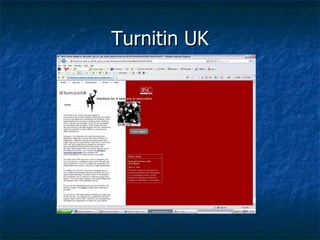
Turnitin UK
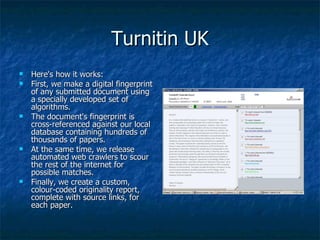
Turnitin UK Here's how it works:  First, we make a digital fingerprint of any submitted document using a specially developed set of algorithms.  The document's fingerprint is cross-referenced against our local database containing hundreds of thousands of papers.  At the same time, we release automated web crawlers to scour the rest of the internet for possible matches.  Finally, we create a custom, colour-coded originality report, complete with source links, for each paper.
References Slides 3,13 (Image):  http://www.davidjulian.com/ Slide 5:  http://www.oed.com/ Slides 4,6 (upper),7,9,17:  http://en.wikipedia.org/wiki/Plagiarism Slides 6 (lower),9,12 (lower):  http://www.lts.leeds.ac.uk/plagiarism/what_is_it.php Slide 5:  http://www.hero.ac.uk/uk/studying/studying_and_learning/plagiarism.cfm Slide 8:  http://www.jiscpas.ac.uk/newsarticle.php?n=11 Slide 10:  http://intranet.rave.ac.uk/quality/docs/ApprovedBAAssessmentRegs.doc Slide 11:  http://www.jiscpas.ac.uk/newsarticle.php?n=9 Slides 19,20,21:  http://www.turnitin.com/research_site/e_citation.html Slide 14:  http://observer.guardian.co.uk/uk_news/story/0,,1718177,00.html Slide 14 (Image):  http://nypress.com/17/28/books/books-holy-blood-28.jpg Slide 17:  http://news.bbc.co.uk/1/hi/entertainment/music/2276621.stm Slide 17 (image):  http://snarkmarket.com/blog/snarkives/wapo%20blair%20review.jpg Slide 15 (image):  http://www.nmauk.co.uk/nma/uploads/2336/45mins_hires.jpg Slide 23:  http://www.jiscpas.ac.uk/turnitinuk.php Slide 24 (Image): https://submit.ac.uk

Avoiding Plagiarism 1

  • 1.
  • 2.
    Avoiding Plagiarism Whatis Plagiarism Icons of Plagiarism Avoiding Plagiarism
  • 3.
    What is Plagiarism?Cheating Stealing Theft Passing Off Collusion
  • 4.
    What is Plagiarism?Plagiarism (from Latin plagiare "to kidnap") is the practice of claiming, or implying, original authorship or incorporating material from someone else's written or creative work, in whole or in part, into one’s own without adequate acknowledgment
  • 5.
    What is Plagiarism?OED (online): "the wrongful appropriation or purloining, and publication as one's own, of the ideas, or the expression of the ideas (literary, artistic, musical, mechanical, etc.) of another
  • 6.
    What is Plagiarism?" to take someone else’s words or ideas and present them as your own without proper acknowledgement." (Marshall and Rowland, 1998) Presenting someone else’s work as your own. Work means any intellectual output, and typically includes text, data, images, sound or performance. ( Office of Academic Appeals & Regulation 2005 )
  • 7.
    What is Plagiarism?While plagiarism in scholarship and journalism has a centuries-old history, the development of the Internet , where articles appear as electronic text, has made the physical act of copying the work of others much easier.
  • 8.
    What is Plagiarism?Examples of plagiarism can include: Copying and submitting the work of a fellow student. Buying and submitting an assignment from the Internet. Creating a piece of work by cutting and pasting various sections of text and/or images found on the Internet into a document without referencing the sources .
  • 9.
    What is Plagiarism?Within academia , plagiarism by students, professors, or researchers is considered academic dishonesty or academic fraud and offenders are subject to academic censure. In journalism , plagiarism is considered a breach of journalistic ethics, and reporters caught plagiarizing typically face disciplinary measures ranging from suspension to termination.
  • 10.
    What is Plagiarism?19.2 Collusion is taken to mean unauthorised collaboration to produce individually assessed work, without acknowledgement to those who have contributed to the work. It is distinct from authorised collaboration on projects which is strongly encouraged. 19.3 Plagiarism is the passing off by one person of another person’s work, without acknowledgement to the original author. Any material used in a piece of work which is not original MUST be acknowledged to the original author in the approved format, or it will be treated as plagiarism, which is regarded as an extremely serious academic offence amounting to theft of ideas. Such material may be text or image, and may be derived from published or unpublished work, from any source (e.g. books, journals, newspapers, the internet, fellow students’ notes etc.).
  • 11.
    What is Plagiarism?Plagiarism 'is fault of indulgent lecturers' Plagiarism and cheating by today's cut-and-paste generation of university students will never be stamped out unless lecturers stop spoon-feeding them a diet of handouts and PowerPoint presentations, a leading academic said yesterday. Frean, A (2006) 'Plagiarism 'is fault of indulgent lecturers'', The Times [Online]. Available at: www.thetimesonline.co.uk/article/0,,3561-2409036.html (Accessed: 19 October 2006).
  • 12.
    What is Plagiarism?Plagiarism can also occur unconsciously; in some cultures certain forms of plagiarism are accepted because the concept can be interpreted differently. Respondents with educational experience in Europe viewed some aspects of collaborative working as serious offences whereas those with experience in Asia (India and Pakistan) viewed these as minor or not serious.
  • 13.
    Icons of PlagiarismThere have been many examples of high-profile plagiarism in recent (and not so recent) years
  • 14.
    Icons of PlagiarismLiterature Da Vinci trial pits history against art David Smith Sunday February 26, 2006 The Observer Dan Brown, whose tale of clerical conspiracy and murder has become the bestselling hardback adult novel of all time, is accused of plundering his plot from a non-fiction work called The Holy Blood and the Holy Grail
  • 15.
    Icons of PlagiarismPolitics The “Dodgy Dossier” Whole sections of Ibrahim Al-Marashi's writings on "Saddam's Special Security Organisation" were repeated verbatim including typographical errors , while certain amendments were made to strengthen the tone of the alleged findings (eg. "monitoring foreign embassies in Iraq" became "spying on foreign embassies in Iraq").
  • 16.
    Icons of PlagiarismFilm The 1922 film Nosferatu was an unauthorized adaptation of Bram Stoker 's novel Dracula . Stoker's widow sued the producers of Nosferatu, and had many of the film's copies destroyed (although some remain)
  • 17.
    Icons of PlagiarismMusic Silent music dispute resolved Musician Mike Batt has paid a six-figure sum to settle a bizarre dispute over who owns copyright to a silent musical work. Batt was accused of plagiarism by the publishers of the late US composer John Cage, after placing a silent track on his latest album, Classical Graffiti which was credited to himself and Cage. Cage's own silent composition, 4'33", was originally released in 1952
  • 18.
    Icons of PlagiarismJournalism New York Times reporter Jayson Blair plagiarized articles and manufactured quotations in stories, including stories regarding Jessica Lynch and the Beltway sniper attacks . He and several editors from the Times resigned in June 2003
  • 19.
    Avoiding Plagiarism Mostcases of plagiarism can be avoided by citing sources. Simply acknowledging that certain material has been borrowed, and providing your audience with the information necessary to find that source , is usually enough to prevent plagiarism.
  • 20.
    What is Citation?A "citation" is the way you tell your readers that certain material in your work came from another source. It also gives your readers the information necessary to find that source again, including: information about the author, the title of the work, the name and location of the company that published your copy of the source, the date your copy was published, the page numbers of the material you are borrowing
  • 21.
    When to CiteWhenever you use quotes. Whenever you use an idea that someone else has already expressed. Whenever you make specific reference to the work of another person. Whenever someone else's work has been critical in developing your own ideas.
  • 22.
    Citation You canfind details of the citation method preferred here at Rave by going to the LRC intranet page at: http://intranet.rave.ac.uk/lrc/userGuides.htm And click on the link: “ LRC User Guide...How to Reference Academic Work “
  • 23.
  • 24.
    Turnitin UK Here'show it works: First, we make a digital fingerprint of any submitted document using a specially developed set of algorithms. The document's fingerprint is cross-referenced against our local database containing hundreds of thousands of papers. At the same time, we release automated web crawlers to scour the rest of the internet for possible matches. Finally, we create a custom, colour-coded originality report, complete with source links, for each paper.
  • 25.
    References Slides 3,13(Image): http://www.davidjulian.com/ Slide 5: http://www.oed.com/ Slides 4,6 (upper),7,9,17: http://en.wikipedia.org/wiki/Plagiarism Slides 6 (lower),9,12 (lower): http://www.lts.leeds.ac.uk/plagiarism/what_is_it.php Slide 5: http://www.hero.ac.uk/uk/studying/studying_and_learning/plagiarism.cfm Slide 8: http://www.jiscpas.ac.uk/newsarticle.php?n=11 Slide 10: http://intranet.rave.ac.uk/quality/docs/ApprovedBAAssessmentRegs.doc Slide 11: http://www.jiscpas.ac.uk/newsarticle.php?n=9 Slides 19,20,21: http://www.turnitin.com/research_site/e_citation.html Slide 14: http://observer.guardian.co.uk/uk_news/story/0,,1718177,00.html Slide 14 (Image): http://nypress.com/17/28/books/books-holy-blood-28.jpg Slide 17: http://news.bbc.co.uk/1/hi/entertainment/music/2276621.stm Slide 17 (image): http://snarkmarket.com/blog/snarkives/wapo%20blair%20review.jpg Slide 15 (image): http://www.nmauk.co.uk/nma/uploads/2336/45mins_hires.jpg Slide 23: http://www.jiscpas.ac.uk/turnitinuk.php Slide 24 (Image): https://submit.ac.uk