


Placement Preparation 
Heaps 
Varun Raj 
B.Tech, CSE
Heaps 
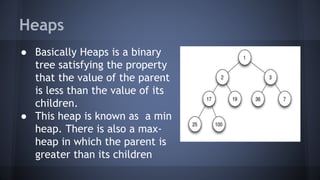
● Basically Heaps is a binary 
tree satisfying the property 
that the value of the parent 
is less than the value of its 
children. 
● This heap is known as a min 
heap. There is also a max-heap 
in which the parent is 
greater than its children
Property of Heap 
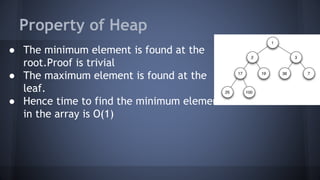
● The minimum element is found at the 
root.Proof is trivial 
● The maximum element is found at the 
leaf. 
● Hence time to find the minimum element 
in the array is O(1)
Implementing a Heap 
There are two most common ways to implement 
a heap- 
• Using an Array .We will use this since it is 
more intuitive and simpler 
• Using Linked List by struct. This is also 
another method but I personally feel this is 
an unnecessary complication
Implementation 
Some Basic Implementation Concepts 
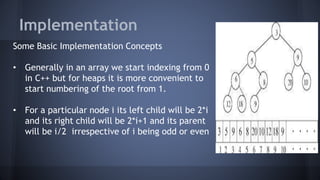
• Generally in an array we start indexing from 0 
in C++ but for heaps it is more convenient to 
start numbering of the root from 1. 
• For a particular node i its left child will be 2*i 
and its right child will be 2*i+1 and its parent 
will be i/2 irrespective of i being odd or even
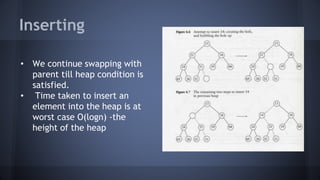
Inserting 
• We continue swapping with 
parent till heap condition is 
satisfied. 
• Time taken to insert an 
element into the heap is at 
worst case O(logn) -the 
height of the heap
Creating a heap 
Method 1 using insert 
• Starting from the insert method described 
earlier to insert elements 
• Time complexity from this method however 
comes out to be log1+log2+…logn 
=log(n!)=Theta (nlogn). Therefore we need 
something faster
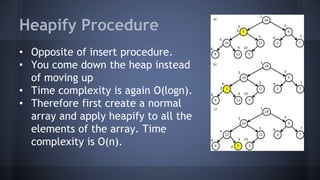
Heapify Procedure 
• Opposite of insert procedure. 
• You come down the heap instead 
of moving up 
• Time complexity is again O(logn). 
• Therefore first create a normal 
array and apply heapify to all the 
elements of the array. Time 
complexity is O(n).
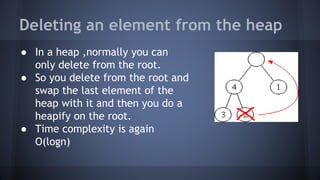
Deleting an element from the heap 
● In a heap ,normally you can 
only delete from the root. 
● So you delete from the root and 
swap the last element of the 
heap with it and then you do a 
heapify on the root. 
● Time complexity is again 
O(logn)
Heapsort 
• Since the element at the root is always the smallest we 
print the element at the top and delete the root. 
• The next element at the root will be the second 
smallest element continuing like this we can sort the 
entire array 
• Since the time taken for deletion is O(logn). Therefore 
time taken for n deletions is O(nlogn) 
• Therefore time taken for heapsort is 
O(n)+O(nlogn)=O(nlogn)
Advantages of Heaps 
• Can sort in O(nlogn) time that is as fast as merge sort 
but without using extra space 
• Can insert elements in O(logn) time compare that with 
sorted array. 
• Can remove the smallest element in O(logn) time faster 
than sorted array.
Applications of Heaps 
• Very useful if you want a data structure that is used for 
lots of insertions by value 
• Is used in the implementation of priority queue 
• Is also used for sorting
Lecture 11.1 :  heaps

Lecture 11.1 : heaps

  • 1.
    Placement Preparation Heaps Varun Raj B.Tech, CSE
  • 2.
    Heaps ● BasicallyHeaps is a binary tree satisfying the property that the value of the parent is less than the value of its children. ● This heap is known as a min heap. There is also a max-heap in which the parent is greater than its children
  • 3.
    Property of Heap ● The minimum element is found at the root.Proof is trivial ● The maximum element is found at the leaf. ● Hence time to find the minimum element in the array is O(1)
  • 4.
    Implementing a Heap There are two most common ways to implement a heap- • Using an Array .We will use this since it is more intuitive and simpler • Using Linked List by struct. This is also another method but I personally feel this is an unnecessary complication
  • 5.
    Implementation Some BasicImplementation Concepts • Generally in an array we start indexing from 0 in C++ but for heaps it is more convenient to start numbering of the root from 1. • For a particular node i its left child will be 2*i and its right child will be 2*i+1 and its parent will be i/2 irrespective of i being odd or even
  • 6.
    Inserting • Wecontinue swapping with parent till heap condition is satisfied. • Time taken to insert an element into the heap is at worst case O(logn) -the height of the heap
  • 7.
    Creating a heap Method 1 using insert • Starting from the insert method described earlier to insert elements • Time complexity from this method however comes out to be log1+log2+…logn =log(n!)=Theta (nlogn). Therefore we need something faster
  • 8.
    Heapify Procedure •Opposite of insert procedure. • You come down the heap instead of moving up • Time complexity is again O(logn). • Therefore first create a normal array and apply heapify to all the elements of the array. Time complexity is O(n).
  • 9.
    Deleting an elementfrom the heap ● In a heap ,normally you can only delete from the root. ● So you delete from the root and swap the last element of the heap with it and then you do a heapify on the root. ● Time complexity is again O(logn)
  • 10.
    Heapsort • Sincethe element at the root is always the smallest we print the element at the top and delete the root. • The next element at the root will be the second smallest element continuing like this we can sort the entire array • Since the time taken for deletion is O(logn). Therefore time taken for n deletions is O(nlogn) • Therefore time taken for heapsort is O(n)+O(nlogn)=O(nlogn)
  • 11.
    Advantages of Heaps • Can sort in O(nlogn) time that is as fast as merge sort but without using extra space • Can insert elements in O(logn) time compare that with sorted array. • Can remove the smallest element in O(logn) time faster than sorted array.
  • 12.
    Applications of Heaps • Very useful if you want a data structure that is used for lots of insertions by value • Is used in the implementation of priority queue • Is also used for sorting