Heterogeneous Resource Scheduling Using
Apache Mesos for Cloud Native Frameworks
Sharma Podila
Senior Software Engineer
Netflix
Aug 20th
MesosCon 2015
Agenda
● Context, motivation
● Fenzo scheduler library
● Usage at Netflix
● Future direction
Why use Apache Mesos in a cloud?
Resource granularity
Application start latency
A tale of two frameworks
Reactive stream processing
Container deployment and management
Reactive stream processing, Mantis
● Cloud native
● Lightweight, dynamic jobs
○ Stateful, multi-stage
○ Real time, anomaly detection, etc.
● Task placement constraints
○ Cloud constructs
○ Resource utilization
● Service and batch style
Mantis job topology
Worker
SourceApp
Stage1
Stage2
Stage3
Sink
A job is set of 1 or more stages
A stage is a set of 1 or more workers
A worker is a Mesos task
Job
Container management, Titan
● Cloud native
● Service and batch workloads
● Jobs with multiple sets of container tasks
● Container placement constraints
○ Cloud constructs
○ Resource affinity
○ Task locality
Job 2
Set 0
Set 1
Container scheduling model
Job 1
Co-locate tasks from multiple
task sets
Why develop a new framework?
Easy to write a new framework?
What about scale?
Performance?
Fault tolerance?
Availability?
Easy to write a new framework?
What about scale?
Performance?
Fault tolerance?
Availability?
And scheduling is a hard problem to solve
Long term justification is needed to
create a new Mesos framework
Our motivations for new framework
● Cloud native
(autoscaling)
Our motivations for new framework
● Cloud native
(autoscaling)
● Customizable task placement optimizations
(Mix of service, batch, and stream topologies)
Cluster autoscaling challenge
Host 1 Host 2 Host 3 Host 4
vs.
For long running stateful services
Cluster autoscaling challenge
Host 1 Host 2 Host 3 Host 4
vs.
For long running stateful services
Components of a mesos framework
API for users to interact
Components of a mesos framework
API for users to interact
Be connected to Mesos via the driver
Components of a mesos framework
API for users to interact
Be connected to Mesos via the driver
Compute resource assignments for tasks
Components of a mesos framework
API for users to interact
Be connected to Mesos via the driver
Compute resource assignments for tasks
Fenzo
A common scheduling library for Mesos
frameworks
Fenzo usage in frameworks
Mesos master
Mesos framework
Tasks
requests
Available
resource
offers
Fenzo task
scheduler
Task assignment result
• Host1
• Task1
• Task2
• Host2
• Task3
• Task4
Persistence
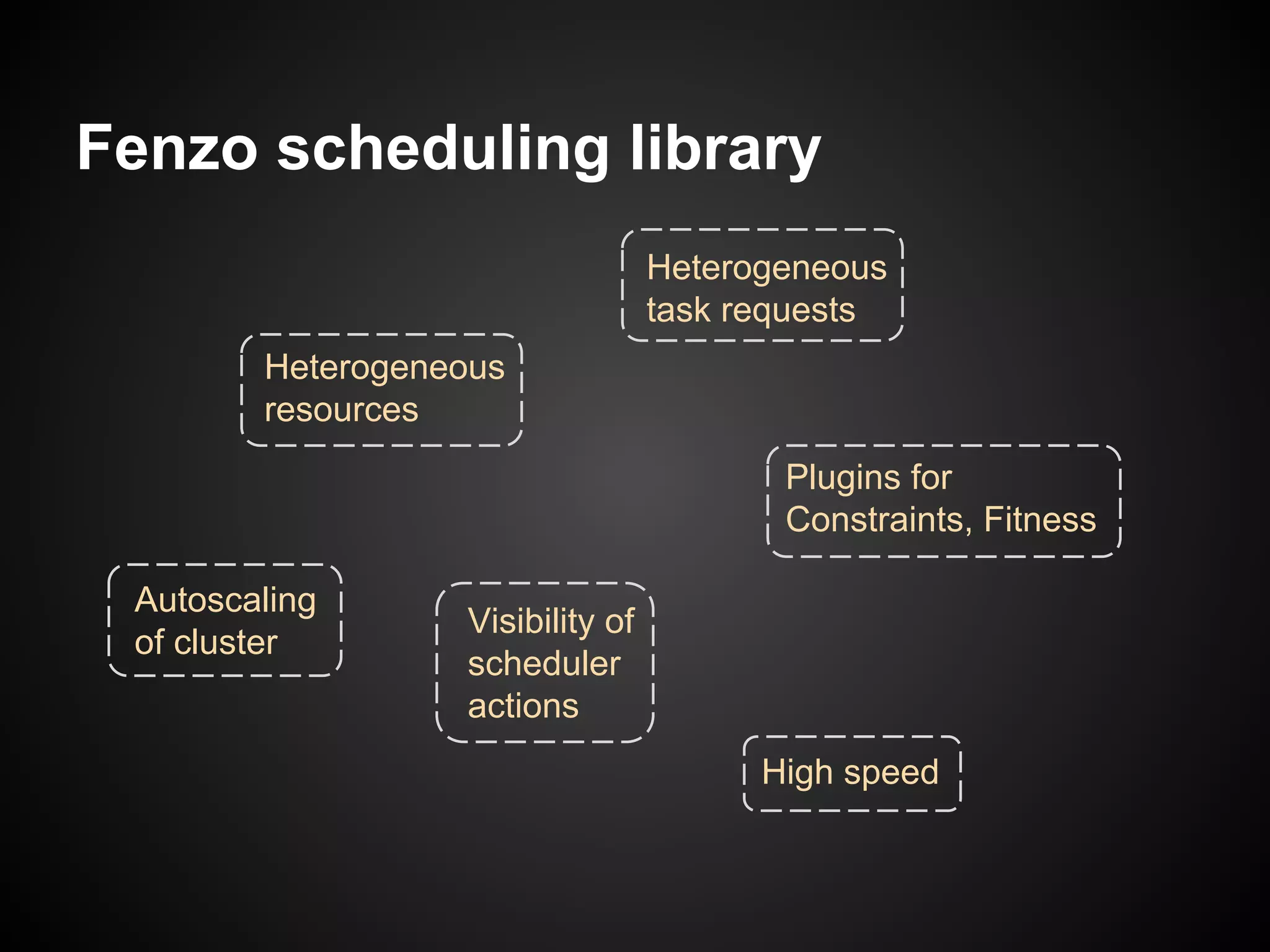
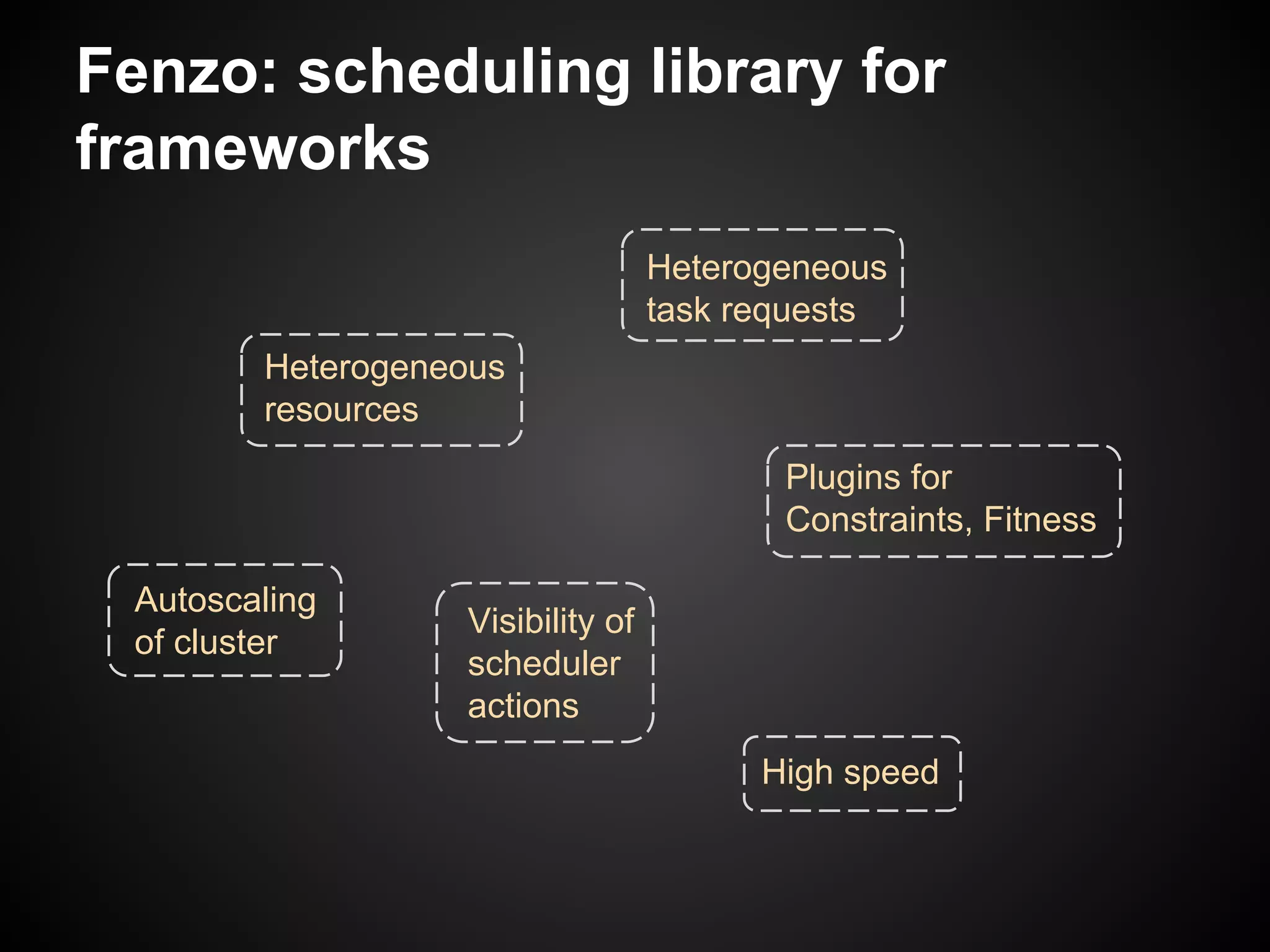
Fenzo scheduling library
Heterogeneous
resources
Autoscaling
of cluster
Visibility of
scheduler
actions
Plugins for
Constraints, Fitness
High speed
Heterogeneous
task requests
Announcing availability of Fenzo in
Netflix OSS suite
Fenzo details
Scheduling problem
Fitness
Pending
Assigned
Urgency
N tasks to assign from M possible slaves
Scheduling optimizations
Speed Accuracy
First fit assignment Optimal assignment
Real world trade-offs~ O (1) ~ O (N * M)1
1
Assuming tasks are not reassigned
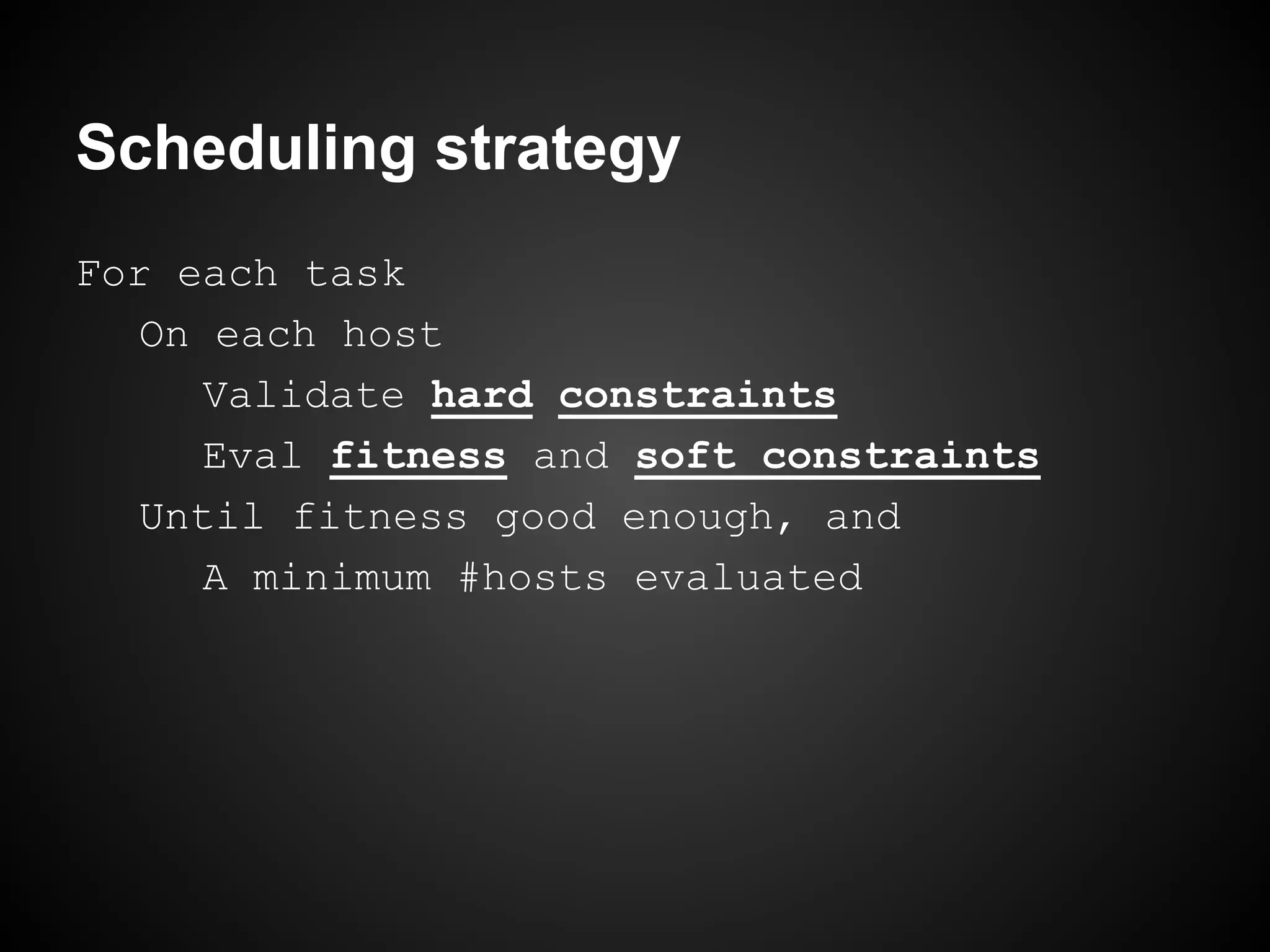
Scheduling strategy
For each task
On each host
Validate hard constraints
Eval fitness and soft constraints
Until fitness good enough, and
A minimum #hosts evaluated
Task constraints
Soft
Hard
Task constraints
Soft
Hard
Extensible
Built-in Constraints
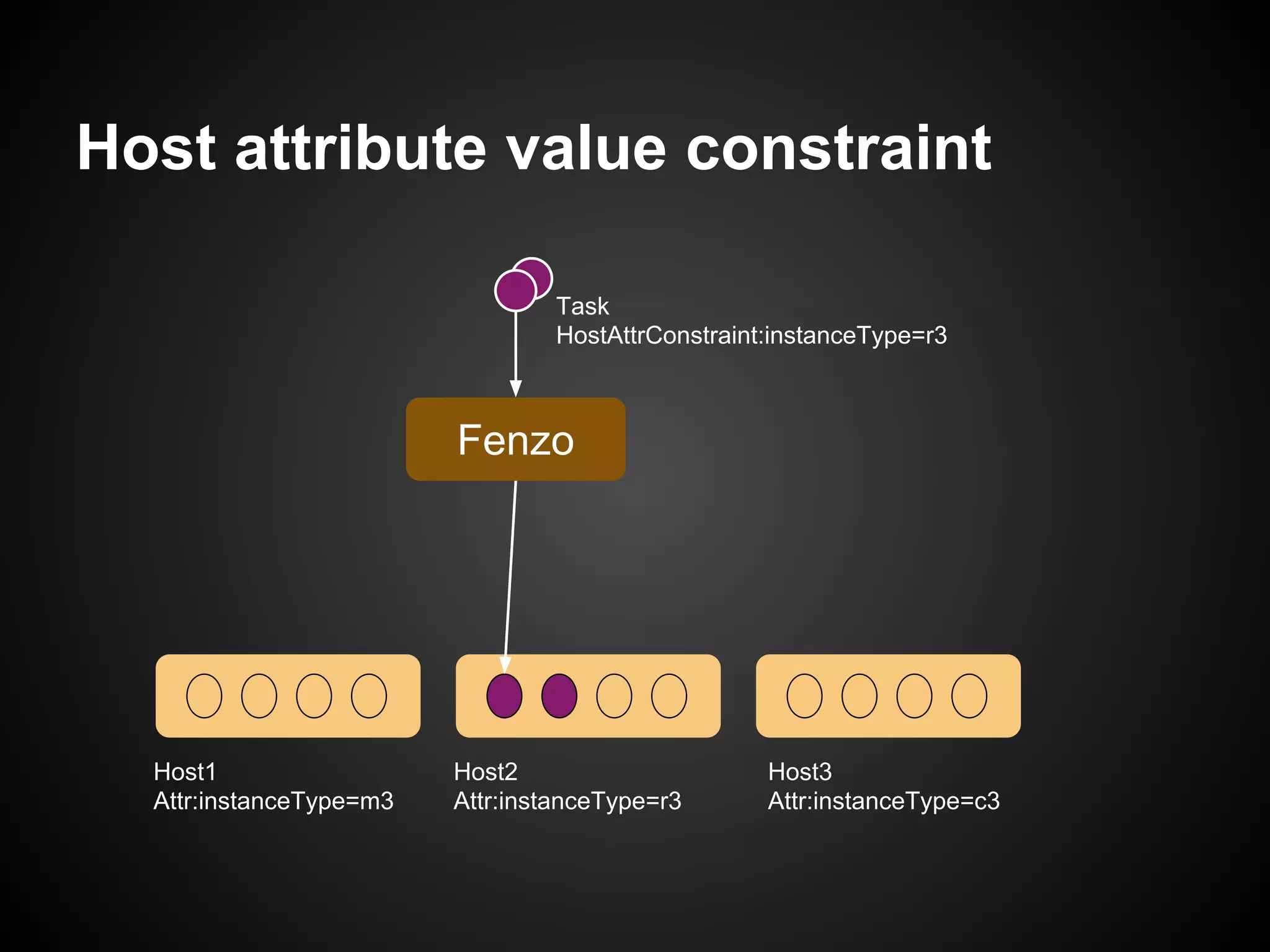
Host attribute value constraint
Task
HostAttrConstraint:instanceType=r3
Host1
Attr:instanceType=m3
Host2
Attr:instanceType=r3
Host3
Attr:instanceType=c3
Fenzo
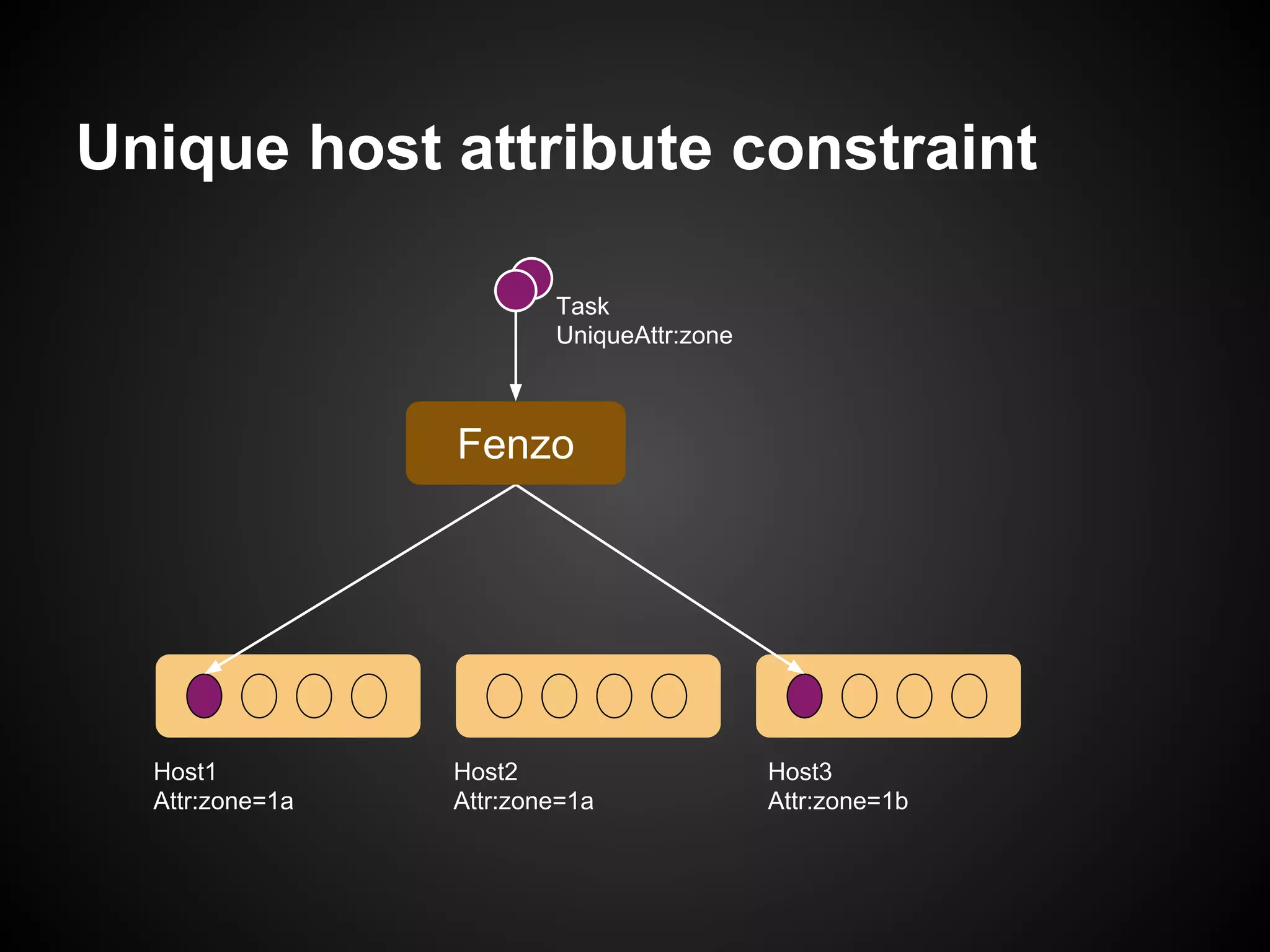
Unique host attribute constraint
Task
UniqueAttr:zone
Host1
Attr:zone=1a
Host2
Attr:zone=1a
Host3
Attr:zone=1b
Fenzo
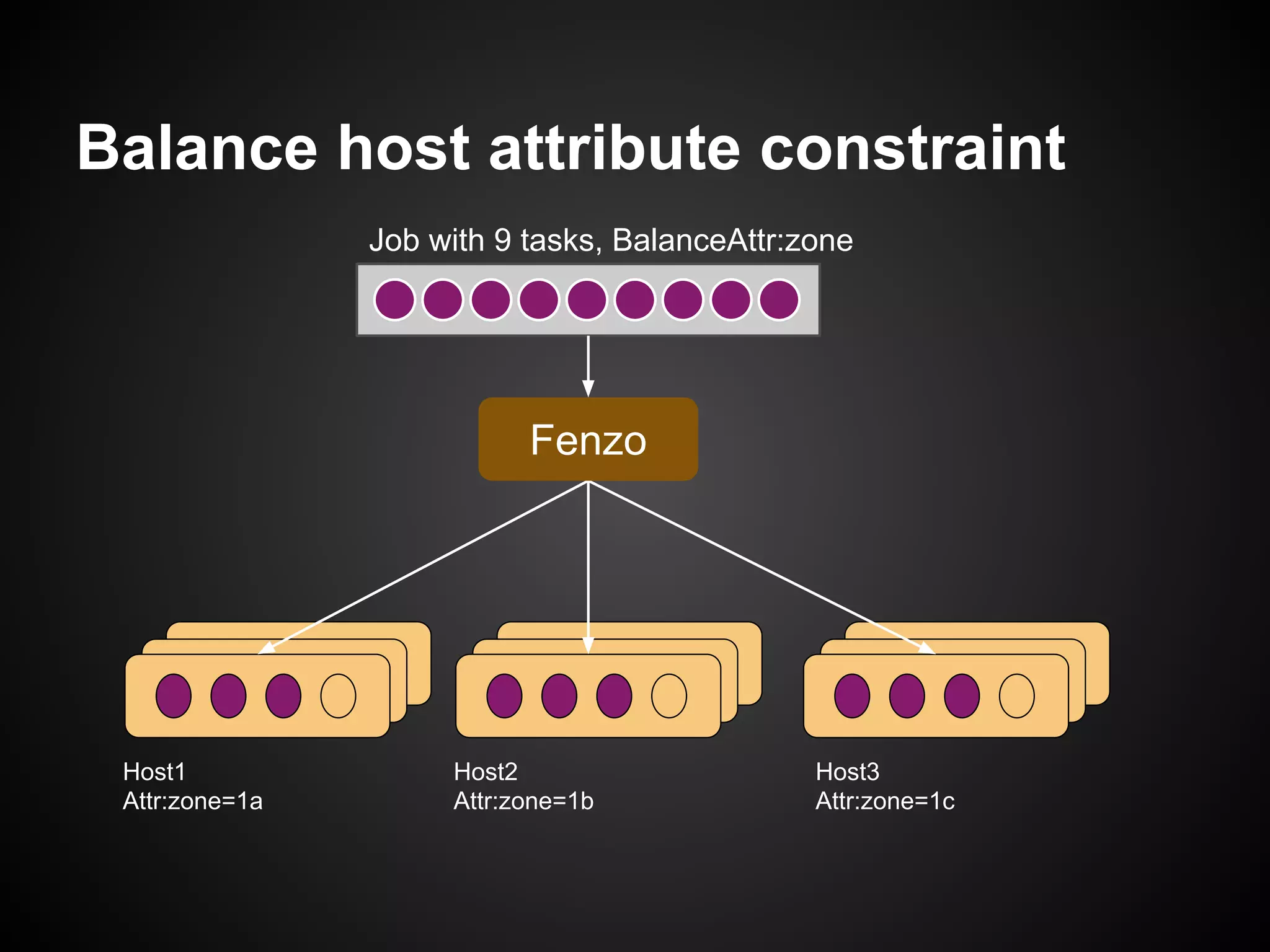
Balance host attribute constraint
Host1
Attr:zone=1a
Host2
Attr:zone=1b
Host3
Attr:zone=1c
Job with 9 tasks, BalanceAttr:zone
Fenzo
Fitness evaluation
Degree of fitness
Composable
Bin packing fitness calculator
Fitness for
Host1 Host2 Host3 Host4 Host5
fitness = usedCPUs / totalCPUs
Bin packing fitness calculator
Fitness for 0.25 0.5 0.75 1.0 0.0
fitness = usedCPUs / totalCPUs
Host1 Host2 Host3 Host4 Host5
Bin packing fitness calculator
Fitness for 0.25 0.5 0.75 1.0 0.0
✔
Host1 Host2 Host3 Host4 Host5
fitness = usedCPUs / totalCPUs
Host1 Host2 Host3 Host4 Host5
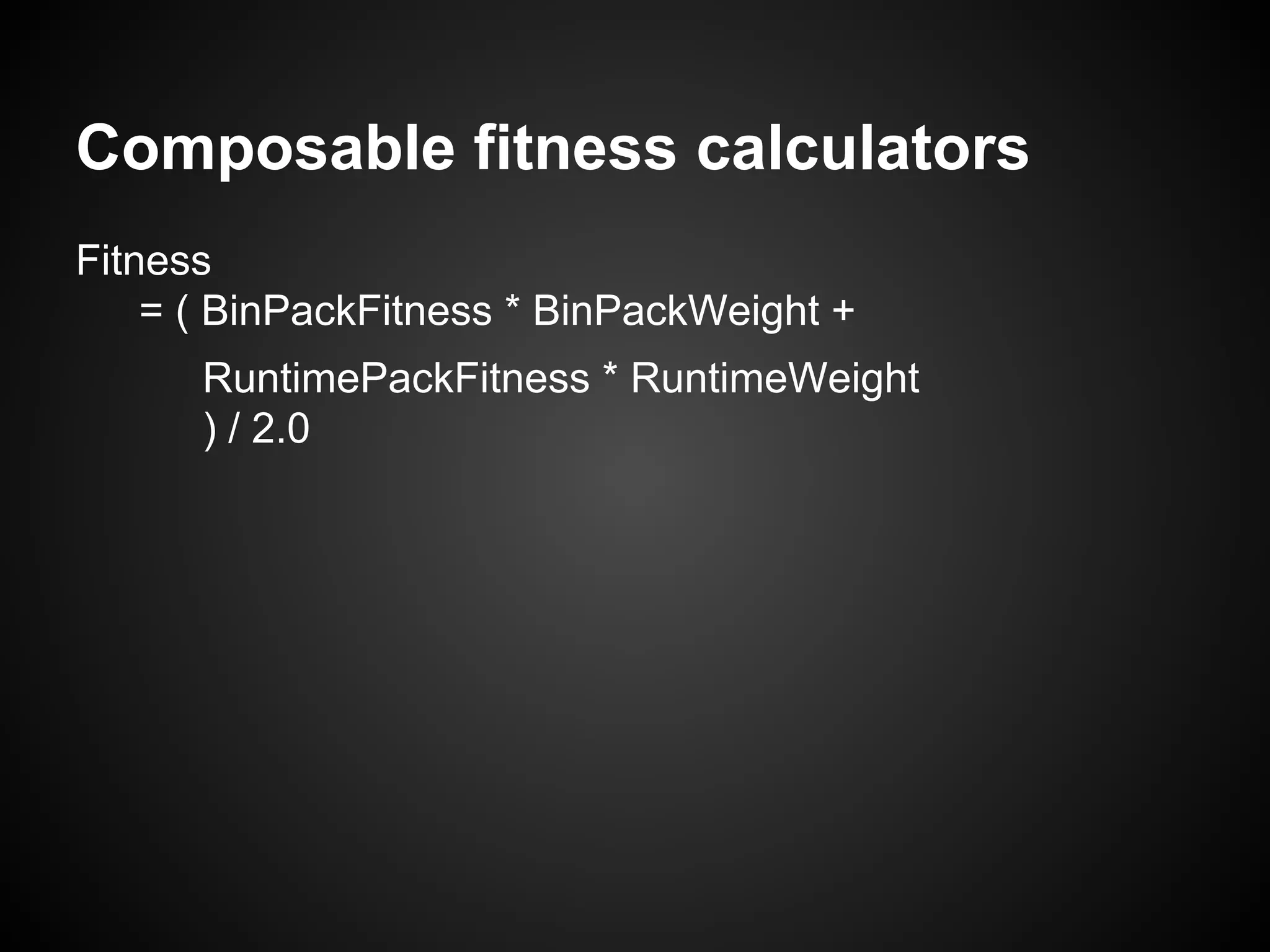
Composable fitness calculators
Fitness
= ( BinPackFitness * BinPackWeight +
RuntimePackFitness * RuntimeWeight
) / 2.0
Cluster autoscaling in Fenzo
ASG/Cluster:
mantisagent
MinIdle: 8
MaxIdle: 20
CooldownSecs:
360
ASG/Cluster:
mantisagent
MinIdle: 8
MaxIdle: 20
CooldownSecs:
360
ASG/cluster:
computeCluster
MinIdle: 8
MaxIdle: 20
CooldownSecs:
360
Fenzo
ScaleUp
action:
Cluster, N
ScaleDown
action:
Cluster,
HostList
Rules based cluster autoscaling
● Set up rules per host attribute value
○ E.g., one autoscale rule per ASG/cluster, one cluster for network-
intensive jobs, another for CPU/memory-intensive jobs
● Sample:
#Idle
hosts
Trigger down scale
Trigger up scale
min
max
Cluster Name Min Idle Count Max Idle Count Cooldown Secs
NetworkClstr 5 15 360
ComputeClstr 10 20 300
Shortfall analysis based autoscaling
● Rule-based scale up has a cool down period
○ What if there’s a surge of incoming requests?
● Pending requests trigger shortfall analysis
○ Scale up happens regardless of cool down period
○ Remembers which tasks have already been covered
Usage at Netflix
Cluster autoscaling
NumberofMesosSlaves
Time
Scheduler run time (milliseconds)
Scheduler run time in milliseconds
(over a week)
Average 2 mS
Maximum 38 mS
Note: times can vary depending on # of tasks, # and types of constraints, and # of hosts
Experimenting with Fenzo
Note: Experiments can be run without requiring a physical cluster
A bin packing experiment
Host 3
Host 2
Host 1
Mesos Slaves
Host 3000
Tasks with cpu=1
Tasks with cpu=3
Tasks with cpu=6
Fenzo
Iteratively assign
Bunch of tasks
Start with idle cluster
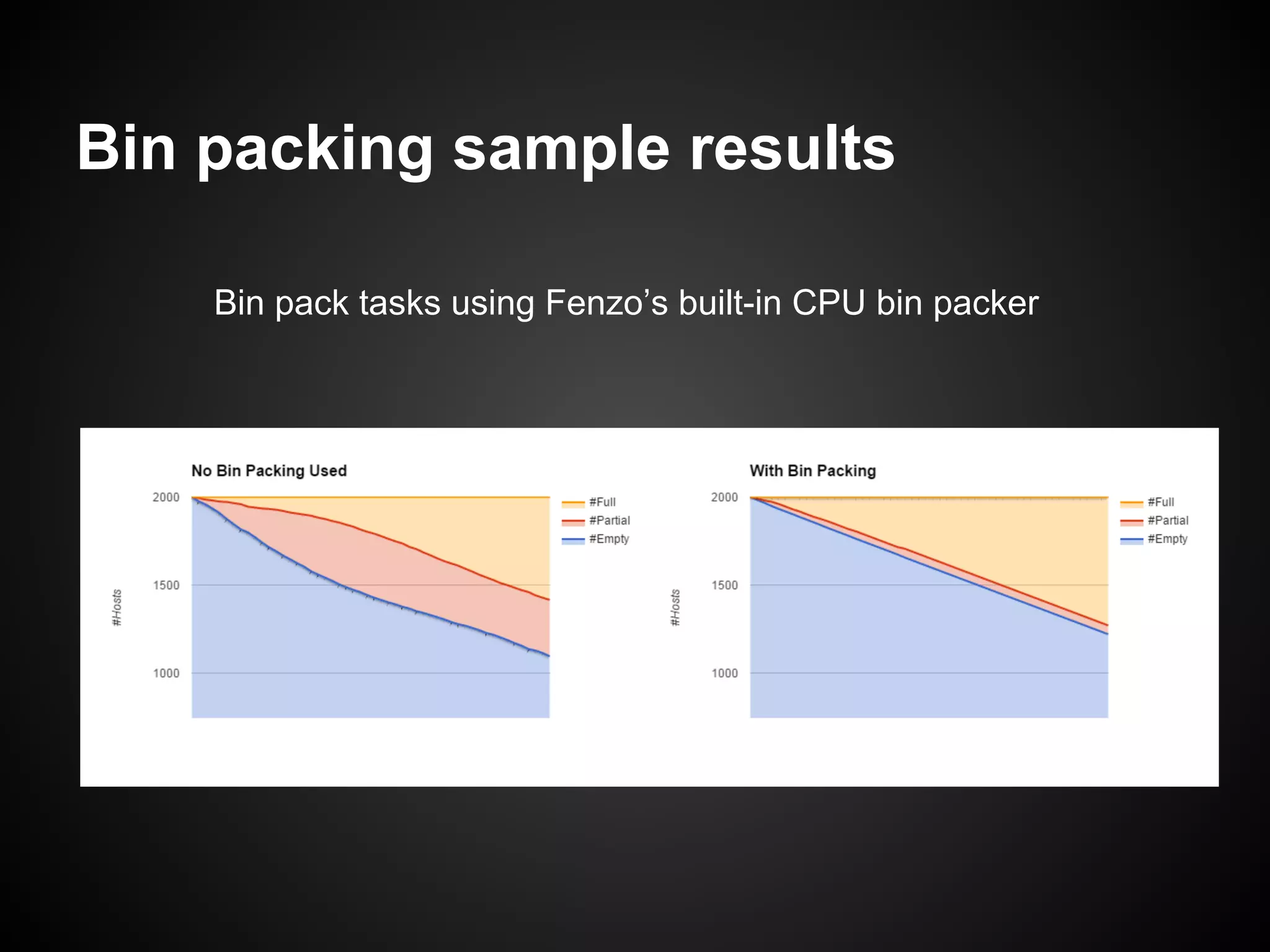
Bin packing sample results
Bin pack tasks using Fenzo’s built-in CPU bin packer
Bin packing sample results
Bin pack tasks using Fenzo’s built-in CPU bin packer
Task runtime bin packing sample
Bin pack tasks based on custom fitness calculator to pack
short vs. long run time jobs separately
Scheduler speed experiment
# of hosts # of tasks to
assign each
time
Avg time Avg time
per task
Min
time
Max time Total time
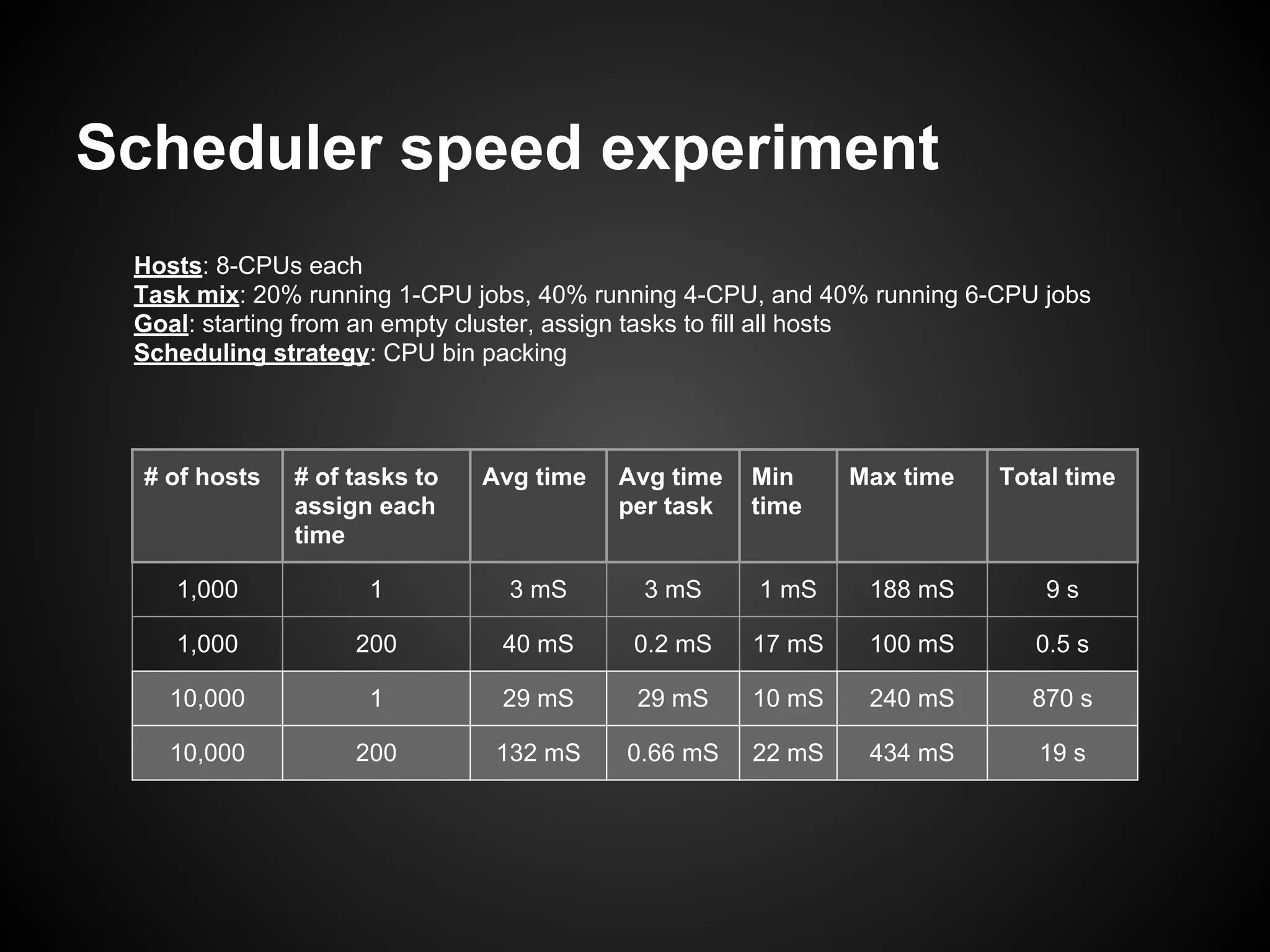
Hosts: 8-CPUs each
Task mix: 20% running 1-CPU jobs, 40% running 4-CPU, and 40% running 6-CPU jobs
Goal: starting from an empty cluster, assign tasks to fill all hosts
Scheduling strategy: CPU bin packing
Scheduler speed experiment
# of hosts # of tasks to
assign each
time
Avg time Avg time
per task
Min
time
Max time Total time
1,000 1 3 mS 3 mS 1 mS 188 mS 9 s
1,000 200 40 mS 0.2 mS 17 mS 100 mS 0.5 s
Hosts: 8-CPUs each
Task mix: 20% running 1-CPU jobs, 40% running 4-CPU, and 40% running 6-CPU jobs
Goal: starting from an empty cluster, assign tasks to fill all hosts
Scheduling strategy: CPU bin packing
Scheduler speed experiment
Hosts: 8-CPUs each
Task mix: 20% running 1-CPU jobs, 40% running 4-CPU, and 40% running 6-CPU jobs
Goal: starting from an empty cluster, assign tasks to fill all hosts
Scheduling strategy: CPU bin packing
# of hosts # of tasks to
assign each
time
Avg time Avg time
per task
Min
time
Max time Total time
1,000 1 3 mS 3 mS 1 mS 188 mS 9 s
1,000 200 40 mS 0.2 mS 17 mS 100 mS 0.5 s
10,000 1 29 mS 29 mS 10 mS 240 mS 870 s
10,000 200 132 mS 0.66 mS 22 mS 434 mS 19 s
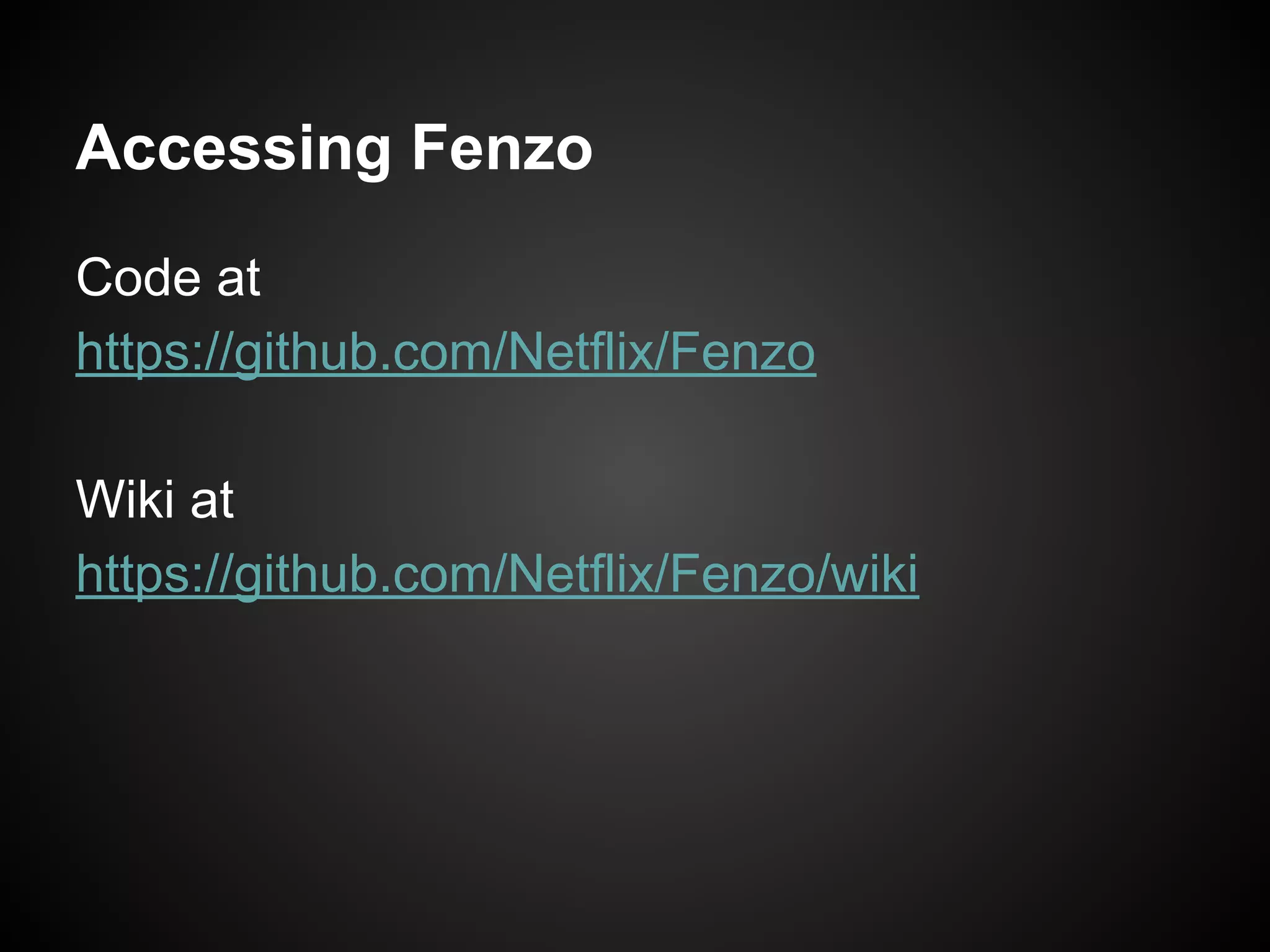
Accessing Fenzo
Code at
https://github.com/Netflix/Fenzo
Wiki at
https://github.com/Netflix/Fenzo/wiki
Future directions
● Task management SLAs
● Support for newer Mesos features
● Collaboration
To summarize...
Fenzo: scheduling library for
frameworks
Heterogeneous
resources
Autoscaling
of cluster
Visibility of
scheduler
actions
Plugins for
Constraints, Fitness
High speed
Heterogeneous
task requests
Fenzo is now available in Netflix
OSS suite at
https://github.com/Netflix/Fenzo
Questions?
Heterogeneous Resource Scheduling Using
Apache Mesos for Cloud Native Frameworks
Sharma Podila
spodila @ netflix . com
@podila

Prezo at-mesos con2015-final

  • 1.
    Heterogeneous Resource SchedulingUsing Apache Mesos for Cloud Native Frameworks Sharma Podila Senior Software Engineer Netflix Aug 20th MesosCon 2015
  • 2.
    Agenda ● Context, motivation ●Fenzo scheduler library ● Usage at Netflix ● Future direction
  • 3.
    Why use ApacheMesos in a cloud? Resource granularity Application start latency
  • 4.
    A tale oftwo frameworks Reactive stream processing Container deployment and management
  • 5.
    Reactive stream processing,Mantis ● Cloud native ● Lightweight, dynamic jobs ○ Stateful, multi-stage ○ Real time, anomaly detection, etc. ● Task placement constraints ○ Cloud constructs ○ Resource utilization ● Service and batch style
  • 6.
    Mantis job topology Worker SourceApp Stage1 Stage2 Stage3 Sink Ajob is set of 1 or more stages A stage is a set of 1 or more workers A worker is a Mesos task Job
  • 7.
    Container management, Titan ●Cloud native ● Service and batch workloads ● Jobs with multiple sets of container tasks ● Container placement constraints ○ Cloud constructs ○ Resource affinity ○ Task locality
  • 8.
    Job 2 Set 0 Set1 Container scheduling model Job 1 Co-locate tasks from multiple task sets
  • 9.
    Why develop anew framework?
  • 10.
    Easy to writea new framework?
  • 11.
    Easy to writea new framework? What about scale? Performance? Fault tolerance? Availability?
  • 12.
    Easy to writea new framework? What about scale? Performance? Fault tolerance? Availability? And scheduling is a hard problem to solve
  • 13.
    Long term justificationis needed to create a new Mesos framework
  • 14.
    Our motivations fornew framework ● Cloud native (autoscaling)
  • 15.
    Our motivations fornew framework ● Cloud native (autoscaling) ● Customizable task placement optimizations (Mix of service, batch, and stream topologies)
  • 16.
    Cluster autoscaling challenge Host1 Host 2 Host 3 Host 4 Host 1 Host 2 Host 3 Host 4 vs. For long running stateful services
  • 17.
    Cluster autoscaling challenge Host1 Host 2 Host 3 Host 4 Host 1 Host 2 Host 3 Host 4 vs. For long running stateful services
  • 18.
    Components of amesos framework API for users to interact
  • 19.
    Components of amesos framework API for users to interact Be connected to Mesos via the driver
  • 20.
    Components of amesos framework API for users to interact Be connected to Mesos via the driver Compute resource assignments for tasks
  • 21.
    Components of amesos framework API for users to interact Be connected to Mesos via the driver Compute resource assignments for tasks
  • 22.
    Fenzo A common schedulinglibrary for Mesos frameworks
  • 23.
    Fenzo usage inframeworks Mesos master Mesos framework Tasks requests Available resource offers Fenzo task scheduler Task assignment result • Host1 • Task1 • Task2 • Host2 • Task3 • Task4 Persistence
  • 24.
    Fenzo scheduling library Heterogeneous resources Autoscaling ofcluster Visibility of scheduler actions Plugins for Constraints, Fitness High speed Heterogeneous task requests
  • 25.
    Announcing availability ofFenzo in Netflix OSS suite
  • 26.
  • 27.
  • 28.
    Scheduling optimizations Speed Accuracy Firstfit assignment Optimal assignment Real world trade-offs~ O (1) ~ O (N * M)1 1 Assuming tasks are not reassigned
  • 29.
    Scheduling strategy For eachtask On each host Validate hard constraints Eval fitness and soft constraints Until fitness good enough, and A minimum #hosts evaluated
  • 30.
  • 31.
  • 32.
  • 33.
    Host attribute valueconstraint Task HostAttrConstraint:instanceType=r3 Host1 Attr:instanceType=m3 Host2 Attr:instanceType=r3 Host3 Attr:instanceType=c3 Fenzo
  • 34.
    Unique host attributeconstraint Task UniqueAttr:zone Host1 Attr:zone=1a Host2 Attr:zone=1a Host3 Attr:zone=1b Fenzo
  • 35.
    Balance host attributeconstraint Host1 Attr:zone=1a Host2 Attr:zone=1b Host3 Attr:zone=1c Job with 9 tasks, BalanceAttr:zone Fenzo
  • 36.
    Fitness evaluation Degree offitness Composable
  • 37.
    Bin packing fitnesscalculator Fitness for Host1 Host2 Host3 Host4 Host5 fitness = usedCPUs / totalCPUs
  • 38.
    Bin packing fitnesscalculator Fitness for 0.25 0.5 0.75 1.0 0.0 fitness = usedCPUs / totalCPUs Host1 Host2 Host3 Host4 Host5
  • 39.
    Bin packing fitnesscalculator Fitness for 0.25 0.5 0.75 1.0 0.0 ✔ Host1 Host2 Host3 Host4 Host5 fitness = usedCPUs / totalCPUs Host1 Host2 Host3 Host4 Host5
  • 40.
    Composable fitness calculators Fitness =( BinPackFitness * BinPackWeight + RuntimePackFitness * RuntimeWeight ) / 2.0
  • 41.
    Cluster autoscaling inFenzo ASG/Cluster: mantisagent MinIdle: 8 MaxIdle: 20 CooldownSecs: 360 ASG/Cluster: mantisagent MinIdle: 8 MaxIdle: 20 CooldownSecs: 360 ASG/cluster: computeCluster MinIdle: 8 MaxIdle: 20 CooldownSecs: 360 Fenzo ScaleUp action: Cluster, N ScaleDown action: Cluster, HostList
  • 42.
    Rules based clusterautoscaling ● Set up rules per host attribute value ○ E.g., one autoscale rule per ASG/cluster, one cluster for network- intensive jobs, another for CPU/memory-intensive jobs ● Sample: #Idle hosts Trigger down scale Trigger up scale min max Cluster Name Min Idle Count Max Idle Count Cooldown Secs NetworkClstr 5 15 360 ComputeClstr 10 20 300
  • 43.
    Shortfall analysis basedautoscaling ● Rule-based scale up has a cool down period ○ What if there’s a surge of incoming requests? ● Pending requests trigger shortfall analysis ○ Scale up happens regardless of cool down period ○ Remembers which tasks have already been covered
  • 44.
  • 45.
  • 46.
    Scheduler run time(milliseconds) Scheduler run time in milliseconds (over a week) Average 2 mS Maximum 38 mS Note: times can vary depending on # of tasks, # and types of constraints, and # of hosts
  • 47.
    Experimenting with Fenzo Note:Experiments can be run without requiring a physical cluster
  • 48.
    A bin packingexperiment Host 3 Host 2 Host 1 Mesos Slaves Host 3000 Tasks with cpu=1 Tasks with cpu=3 Tasks with cpu=6 Fenzo Iteratively assign Bunch of tasks Start with idle cluster
  • 49.
    Bin packing sampleresults Bin pack tasks using Fenzo’s built-in CPU bin packer
  • 50.
    Bin packing sampleresults Bin pack tasks using Fenzo’s built-in CPU bin packer
  • 51.
    Task runtime binpacking sample Bin pack tasks based on custom fitness calculator to pack short vs. long run time jobs separately
  • 52.
    Scheduler speed experiment #of hosts # of tasks to assign each time Avg time Avg time per task Min time Max time Total time Hosts: 8-CPUs each Task mix: 20% running 1-CPU jobs, 40% running 4-CPU, and 40% running 6-CPU jobs Goal: starting from an empty cluster, assign tasks to fill all hosts Scheduling strategy: CPU bin packing
  • 53.
    Scheduler speed experiment #of hosts # of tasks to assign each time Avg time Avg time per task Min time Max time Total time 1,000 1 3 mS 3 mS 1 mS 188 mS 9 s 1,000 200 40 mS 0.2 mS 17 mS 100 mS 0.5 s Hosts: 8-CPUs each Task mix: 20% running 1-CPU jobs, 40% running 4-CPU, and 40% running 6-CPU jobs Goal: starting from an empty cluster, assign tasks to fill all hosts Scheduling strategy: CPU bin packing
  • 54.
    Scheduler speed experiment Hosts:8-CPUs each Task mix: 20% running 1-CPU jobs, 40% running 4-CPU, and 40% running 6-CPU jobs Goal: starting from an empty cluster, assign tasks to fill all hosts Scheduling strategy: CPU bin packing # of hosts # of tasks to assign each time Avg time Avg time per task Min time Max time Total time 1,000 1 3 mS 3 mS 1 mS 188 mS 9 s 1,000 200 40 mS 0.2 mS 17 mS 100 mS 0.5 s 10,000 1 29 mS 29 mS 10 mS 240 mS 870 s 10,000 200 132 mS 0.66 mS 22 mS 434 mS 19 s
  • 55.
    Accessing Fenzo Code at https://github.com/Netflix/Fenzo Wikiat https://github.com/Netflix/Fenzo/wiki
  • 56.
    Future directions ● Taskmanagement SLAs ● Support for newer Mesos features ● Collaboration
  • 57.
  • 58.
    Fenzo: scheduling libraryfor frameworks Heterogeneous resources Autoscaling of cluster Visibility of scheduler actions Plugins for Constraints, Fitness High speed Heterogeneous task requests
  • 59.
    Fenzo is nowavailable in Netflix OSS suite at https://github.com/Netflix/Fenzo
  • 60.
    Questions? Heterogeneous Resource SchedulingUsing Apache Mesos for Cloud Native Frameworks Sharma Podila spodila @ netflix . com @podila