Placement Preparation 
Sorting and Heaps 
Varun Raj 
B.Tech, CSE
Prerequisites 
• You must know array properly. 
• You must be familiar with pointers and writing basic 
loops 
• You must have some basic idea of time complexity
Aim of Lecture 
● Selection Sort/Bubble Sort 
● Insertion Sort 
● Merge Sort 
● Heaps and Heapsort 
● Quick Sort (If possible)
Motivation 
Sorting is any process of arranging items according to value. 
In computer science, sorting is one of the most extensively 
researched subjects because of the need to speed up the operation 
on thousands or millions of records during a search operation
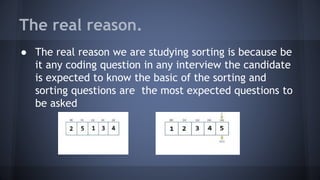
The real reason. 
● The real reason we are studying sorting is because be 
it any coding question in any interview the candidate 
is expected to know the basic of the sorting and 
sorting questions are the most expected questions to 
be asked
Selection Sort 
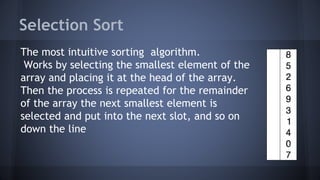
The most intuitive sorting algorithm. 
Works by selecting the smallest element of the 
array and placing it at the head of the array. 
Then the process is repeated for the remainder 
of the array the next smallest element is 
selected and put into the next slot, and so on 
down the line
Demo #1 
Code of Selection Sort
Exercise #1 
● Write a program that does selection sort on a set of 
integers 
● Some pointers- 
● You will need two loops 
● You will need a variable that stores the current 
minimum and then you will have to swap it with the 
head.
Analysing Complexity 
• In the 1st step the algorithm the for loop runs n-1 
times. 
• In the second step the for loop runs n-2 times since the 
1st element is set 
• Hence the time taken is n-1+n-2+n-3……..+1=n*(n-1)/2 
That is O(n^2) 
• The thing to note is that the complexity is O(n^2) for 
best, average and worst case. 
• The space complexity is O(1) that is no extra space is 
used since the algorithm works only on the input array
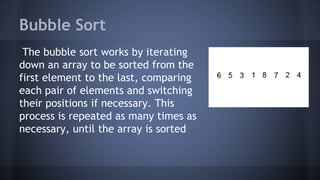
Bubble Sort 
The bubble sort works by iterating 
down an array to be sorted from the 
first element to the last, comparing 
each pair of elements and switching 
their positions if necessary. This 
process is repeated as many times as 
necessary, until the array is sorted
Demo #2 
Code For Bubble Sort
Exercise #2 
● Write a program that does bubble sort on a set of 
integers 
● Some pointers- 
● You will need two loops 
• At the end of 1st step the maximum reaches the last 
position .At the end of second step the 2nd maximum 
reaches the 2nd last position
Analysing Complexity for Bubble Sort 
• In the 1st step the algorithm the for loop runs n times. 
• In the second step the for loop runs n-1 times since the 
1st element is set 
• Hence the time taken is n+n-1+n-2……..+1=n*(n+1)/2 
That is O(n^2) 
• The thing to note is that the complexity is O(n^2) for 
best, average and worst case. 
• The space complexity is O(1) that is no extra space is 
used since the algorithm works only on the input array
Some Improvements To Bubble Sort 
On Close Observation we observe that even in the best 
case Bubble Sort takes O(n^2) time this can be reduced to 
O(n) that is in a perfectly sorted array bubble sort will 
only take O(n) time to terminate(which is already sorted) 
The idea behind this is that at each outer loop iteration 
keep a counter so that if in it’s inner loop iteration no 
swapping was done this means that the array is already 
sorted and no further outer loop iterations need to be 
done and the array is sorted.So terminate the code
Demo #3 
● This improves only the best case running time of bubble sort the 
worst case still remains O(n^2) 
● The complexity is O(n^2) for average and worst case. 
● For best case complexity is O(n) that is already sorted array
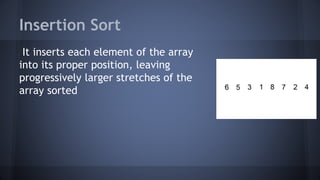
Insertion Sort 
It inserts each element of the array 
into its proper position, leaving 
progressively larger stretches of the 
array sorted
Demo 
Code for insertion sort
Analysing Complexity for Insertion 
Sort 
• In the 1st step the algorithm the for loop runs 0 times. 
• In the second step the for loop runs 1 times (worst 
case) Hence the time taken is 1+2+3….n-1=n*(n-1)/2 
That is O(n^2) (worst case) 
• The thing to note is that the complexity is O(n^2) for 
average and worst case. 
• The best case time complexity is O(n). 
• The space complexity is O(1) that is no extra space is 
used since the algorithm works only on the input array
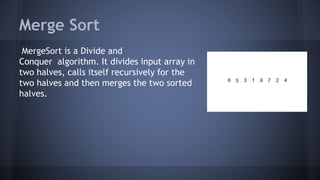
Merge Sort 
MergeSort is a Divide and 
Conquer algorithm. It divides input array in 
two halves, calls itself recursively for the 
two halves and then merges the two sorted 
halves.
Merge Sort-Intiution 
The main concept here is 
recursion 
The Merge Sort takes an 
array from 1 to n and calls 
itself on the array [1,n/2] 
and [n/2+1,n] recursively 
both these subparts are 
sorted so too sort two 
completely sorted list we 
only merge them
Demo 
Code for merge sort 
Its little complicated so I would like you to practise 
properly 
Some common errors 
• Base case of recursion 
• Problems with merging especially when one half 
crosses the midpoint (Explained)
Analysing Complexity for Merging 
Sort 
• There is some trick involved in finding the time complexity of 
Merge Sort . The time complexity is O(nlogn) Here log refers to 
base 2. 
• Proof- 
• T(n)=2*T(n/2) +cn where c is any constant 
• The solution to this equation is k*nlogn the proof follows from 
substitution and something you can look up online or I can do on 
the board. 
• The space complexity of this algorithm is O(n) since we are using 
an extra array
Some remarks about Merge Sort 
• Merge Sort is the fastest algorithm you have seen till now.Its 
complexity is O(n*logn) and for large n it is faster than any 
quadratic algorithm for large input 
• Sometimes for small input merge sort may become slower than 
insertion sort due to constant factors.Hence for small input prefer 
insertion sort 
• The space complexity is O(n) that is an extra array is required this 
is the price we had to pay for a faster algorithm. 
• We will see now that Heaps offer us time complexity of O(nlogn) 
with no extra space required but it has a little sophisticated code.
Some Concluding Remarks - 
● We learnt 3 quadratic time sorting algorithms –Selection Sort, 
Insertion Sort, Bubble Sort 
● We learnt to optimise bubble sort for best case 
● The general advice is that whenever using a quadratic time 
algorithm use insertion sort. (The reason for this is given as an 
exercise at the last slide) 
● Merge Sort trumps all the algorithm given large enough input, 
however for input as small as 10 insertion sort will be faster
Extra Questions 
I am not going to discuss the answer to these questions in the class, 
however you could ask this question on facebook group or personally 
message me. 
These questions are for personal enhancement , maybe you could 
encounter this question in the placement interview/test maybe not 
• Insertion Sort-Prove that the time complexity of insertion sort is 
O(n+x) where x is the number of inversions in the input array.Here 
inversion refers to the pair (ai, aj) with i<j but ai >aj. 
• Merge Sort- The time complexity of Merge Sort is O(nlogn) .Prove 
that no sorting algorithm in the world that uses comparision 
sorting can be asymptotically faster than this

Lecture 11.2 : sorting

  • 1.
    Placement Preparation Sortingand Heaps Varun Raj B.Tech, CSE
  • 2.
    Prerequisites • Youmust know array properly. • You must be familiar with pointers and writing basic loops • You must have some basic idea of time complexity
  • 3.
    Aim of Lecture ● Selection Sort/Bubble Sort ● Insertion Sort ● Merge Sort ● Heaps and Heapsort ● Quick Sort (If possible)
  • 4.
    Motivation Sorting isany process of arranging items according to value. In computer science, sorting is one of the most extensively researched subjects because of the need to speed up the operation on thousands or millions of records during a search operation
  • 5.
    The real reason. ● The real reason we are studying sorting is because be it any coding question in any interview the candidate is expected to know the basic of the sorting and sorting questions are the most expected questions to be asked
  • 6.
    Selection Sort Themost intuitive sorting algorithm. Works by selecting the smallest element of the array and placing it at the head of the array. Then the process is repeated for the remainder of the array the next smallest element is selected and put into the next slot, and so on down the line
  • 7.
    Demo #1 Codeof Selection Sort
  • 8.
    Exercise #1 ●Write a program that does selection sort on a set of integers ● Some pointers- ● You will need two loops ● You will need a variable that stores the current minimum and then you will have to swap it with the head.
  • 9.
    Analysing Complexity •In the 1st step the algorithm the for loop runs n-1 times. • In the second step the for loop runs n-2 times since the 1st element is set • Hence the time taken is n-1+n-2+n-3……..+1=n*(n-1)/2 That is O(n^2) • The thing to note is that the complexity is O(n^2) for best, average and worst case. • The space complexity is O(1) that is no extra space is used since the algorithm works only on the input array
  • 10.
    Bubble Sort Thebubble sort works by iterating down an array to be sorted from the first element to the last, comparing each pair of elements and switching their positions if necessary. This process is repeated as many times as necessary, until the array is sorted
  • 11.
    Demo #2 CodeFor Bubble Sort
  • 12.
    Exercise #2 ●Write a program that does bubble sort on a set of integers ● Some pointers- ● You will need two loops • At the end of 1st step the maximum reaches the last position .At the end of second step the 2nd maximum reaches the 2nd last position
  • 13.
    Analysing Complexity forBubble Sort • In the 1st step the algorithm the for loop runs n times. • In the second step the for loop runs n-1 times since the 1st element is set • Hence the time taken is n+n-1+n-2……..+1=n*(n+1)/2 That is O(n^2) • The thing to note is that the complexity is O(n^2) for best, average and worst case. • The space complexity is O(1) that is no extra space is used since the algorithm works only on the input array
  • 14.
    Some Improvements ToBubble Sort On Close Observation we observe that even in the best case Bubble Sort takes O(n^2) time this can be reduced to O(n) that is in a perfectly sorted array bubble sort will only take O(n) time to terminate(which is already sorted) The idea behind this is that at each outer loop iteration keep a counter so that if in it’s inner loop iteration no swapping was done this means that the array is already sorted and no further outer loop iterations need to be done and the array is sorted.So terminate the code
  • 15.
    Demo #3 ●This improves only the best case running time of bubble sort the worst case still remains O(n^2) ● The complexity is O(n^2) for average and worst case. ● For best case complexity is O(n) that is already sorted array
  • 16.
    Insertion Sort Itinserts each element of the array into its proper position, leaving progressively larger stretches of the array sorted
  • 17.
    Demo Code forinsertion sort
  • 18.
    Analysing Complexity forInsertion Sort • In the 1st step the algorithm the for loop runs 0 times. • In the second step the for loop runs 1 times (worst case) Hence the time taken is 1+2+3….n-1=n*(n-1)/2 That is O(n^2) (worst case) • The thing to note is that the complexity is O(n^2) for average and worst case. • The best case time complexity is O(n). • The space complexity is O(1) that is no extra space is used since the algorithm works only on the input array
  • 19.
    Merge Sort MergeSortis a Divide and Conquer algorithm. It divides input array in two halves, calls itself recursively for the two halves and then merges the two sorted halves.
  • 20.
    Merge Sort-Intiution Themain concept here is recursion The Merge Sort takes an array from 1 to n and calls itself on the array [1,n/2] and [n/2+1,n] recursively both these subparts are sorted so too sort two completely sorted list we only merge them
  • 21.
    Demo Code formerge sort Its little complicated so I would like you to practise properly Some common errors • Base case of recursion • Problems with merging especially when one half crosses the midpoint (Explained)
  • 22.
    Analysing Complexity forMerging Sort • There is some trick involved in finding the time complexity of Merge Sort . The time complexity is O(nlogn) Here log refers to base 2. • Proof- • T(n)=2*T(n/2) +cn where c is any constant • The solution to this equation is k*nlogn the proof follows from substitution and something you can look up online or I can do on the board. • The space complexity of this algorithm is O(n) since we are using an extra array
  • 23.
    Some remarks aboutMerge Sort • Merge Sort is the fastest algorithm you have seen till now.Its complexity is O(n*logn) and for large n it is faster than any quadratic algorithm for large input • Sometimes for small input merge sort may become slower than insertion sort due to constant factors.Hence for small input prefer insertion sort • The space complexity is O(n) that is an extra array is required this is the price we had to pay for a faster algorithm. • We will see now that Heaps offer us time complexity of O(nlogn) with no extra space required but it has a little sophisticated code.
  • 24.
    Some Concluding Remarks- ● We learnt 3 quadratic time sorting algorithms –Selection Sort, Insertion Sort, Bubble Sort ● We learnt to optimise bubble sort for best case ● The general advice is that whenever using a quadratic time algorithm use insertion sort. (The reason for this is given as an exercise at the last slide) ● Merge Sort trumps all the algorithm given large enough input, however for input as small as 10 insertion sort will be faster
  • 25.
    Extra Questions Iam not going to discuss the answer to these questions in the class, however you could ask this question on facebook group or personally message me. These questions are for personal enhancement , maybe you could encounter this question in the placement interview/test maybe not • Insertion Sort-Prove that the time complexity of insertion sort is O(n+x) where x is the number of inversions in the input array.Here inversion refers to the pair (ai, aj) with i<j but ai >aj. • Merge Sort- The time complexity of Merge Sort is O(nlogn) .Prove that no sorting algorithm in the world that uses comparision sorting can be asymptotically faster than this