Functions
Advantages 
• Modularizes the Code -> Code is more 
readable 
• Change in Internal Implementation of 
Functions does not propagate further changes 
in code 
• Increases re-usability of code.
Writing Functions 
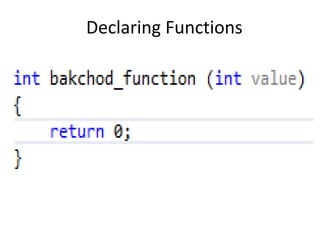
• Return_Type Function_Name ( type_1 
variable_1 , type_2 variable_2 , .. ) 
• In Functions, you can either pass parameters 
by value or by reference 
• Also, you have to declare a function prototype 
if you are about to make a call to a function 
which is written below the caller function.
Declaring Functions
Demo #1 
• Write a function which takes two integers as 
arguments and returns the value of the 
maximum.
Demo #2 
• Write a function which squares an integer.
Approach 
• Break the problem into Arguments of Function 
and the Return value of the function. 
Here the Argument to the function is a single 
Integer and the Return value is an Integer as 
well.
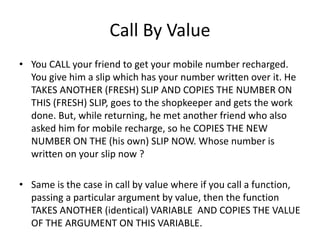
Call By Value 
• You CALL your friend to get your mobile number recharged. 
You give him a slip which has your number written over it. He 
TAKES ANOTHER (FRESH) SLIP AND COPIES THE NUMBER ON 
THIS (FRESH) SLIP, goes to the shopkeeper and gets the work 
done. But, while returning, he met another friend who also 
asked him for mobile recharge, so he COPIES THE NEW 
NUMBER ON THE (his own) SLIP NOW. Whose number is 
written on your slip now ? 
• Same is the case in call by value where if you call a function, 
passing a particular argument by value, then the function 
TAKES ANOTHER (identical) VARIABLE AND COPIES THE VALUE 
OF THE ARGUMENT ON THIS VARIABLE.
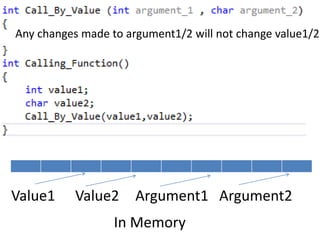
Any changes made to argument1/2 will not change value1/2 
Value1 Value2 Argument1 Argument2 
In Memory
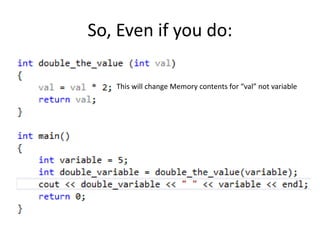
So, Even if you do: 
This will change Memory contents for “val” not variable
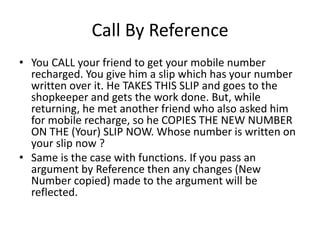
Call By Reference 
• You CALL your friend to get your mobile number 
recharged. You give him a slip which has your number 
written over it. He TAKES THIS SLIP and goes to the 
shopkeeper and gets the work done. But, while 
returning, he met another friend who also asked him 
for mobile recharge, so he COPIES THE NEW NUMBER 
ON THE (Your) SLIP NOW. Whose number is written on 
your slip now ? 
• Same is the case with functions. If you pass an 
argument by Reference then any changes (New 
Number copied) made to the argument will be 
reflected.
Call By Reference 
• If you want the function to manipulate the 
values of the arguments. 
• For ex: Sorting an array , Reversing a string etc. 
• Just use the Reference “&” operator.
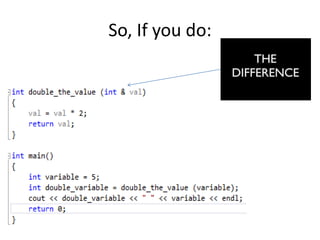
So, If you do:
Demo #3 
• Write a Function which takes two characters 
and prints them in Upper Case but the first 
character after the function call must be in 
Upper Case while the second character must 
not be changed.
Approach 
• Break the Problem into Arguments of the 
function and the return value of the function 
• Think about the “call type” for each argument as 
in Call by Value or Call by Reference. 
Here the Function should have two arguments both 
of type “char”. Pass the first argument as reference 
(i.e. using the & operator) and the second one by 
value/reference. What about return type ? “void”. 
Use “return;” in such cases if you want to force the 
program to return immediately.
Call By Reference 
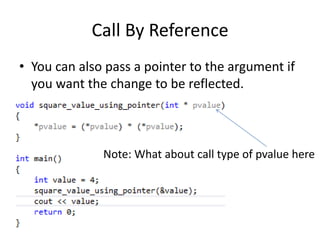
• You can also pass a pointer to the argument if 
you want the change to be reflected. 
Note: What about call type of pvalue here
Call by Value 
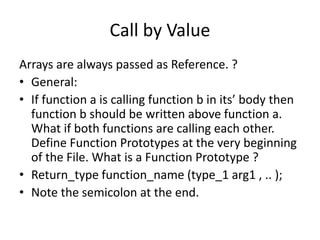
Arrays are always passed as Reference. ? 
• General: 
• If function a is calling function b in its’ body then 
function b should be written above function a. 
What if both functions are calling each other. 
Define Function Prototypes at the very beginning 
of the File. What is a Function Prototype ? 
• Return_type function_name (type_1 arg1 , .. ); 
• Note the semicolon at the end.
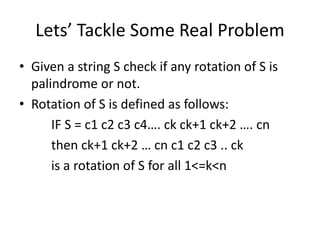
Lets’ Tackle Some Real Problem 
• Given a string S check if any rotation of S is 
palindrome or not. 
• Rotation of S is defined as follows: 
IF S = c1 c2 c3 c4…. ck ck+1 ck+2 …. cn 
then ck+1 ck+2 … cn c1 c2 c3 .. ck 
is a rotation of S for all 1<=k<n
Approach 
• First break the problem into sub-problems: 
• What all independent sub-problems need to 
be solved? 
->Palindrome Checking 
-> String Reversal 
->Substring Finding 
What about Parameters and Return Types and 
“call by” of the arguments. 
Lets’ see a naïve algorithm for the problem.
How to pass struct objects to functions 
• Pass Arguments just like any other data type.
Demo #4 
• Write getter and a setter functions for all the 
members of a struct. Assume the struct has 
only two attributes string (say name of 
student), int (student id)
Some Thoughts 
• What if we want to return more than one (or 
more) values (say minimum and maximum both 
simultaneously in an array)? 
– Hint: Can we use pointers/array ? 
• What if the data types of the values to be 
returned are different ? 
– Hint: Can we use structs? 
• What if our function has no arguments ? 
– Hint: Main itself is a function. 
– Have you seen it taking arguments ?

Lecture 4: Functions

  • 1.
  • 2.
    Advantages • Modularizesthe Code -> Code is more readable • Change in Internal Implementation of Functions does not propagate further changes in code • Increases re-usability of code.
  • 3.
    Writing Functions •Return_Type Function_Name ( type_1 variable_1 , type_2 variable_2 , .. ) • In Functions, you can either pass parameters by value or by reference • Also, you have to declare a function prototype if you are about to make a call to a function which is written below the caller function.
  • 5.
  • 6.
    Demo #1 •Write a function which takes two integers as arguments and returns the value of the maximum.
  • 7.
    Demo #2 •Write a function which squares an integer.
  • 8.
    Approach • Breakthe problem into Arguments of Function and the Return value of the function. Here the Argument to the function is a single Integer and the Return value is an Integer as well.
  • 9.
    Call By Value • You CALL your friend to get your mobile number recharged. You give him a slip which has your number written over it. He TAKES ANOTHER (FRESH) SLIP AND COPIES THE NUMBER ON THIS (FRESH) SLIP, goes to the shopkeeper and gets the work done. But, while returning, he met another friend who also asked him for mobile recharge, so he COPIES THE NEW NUMBER ON THE (his own) SLIP NOW. Whose number is written on your slip now ? • Same is the case in call by value where if you call a function, passing a particular argument by value, then the function TAKES ANOTHER (identical) VARIABLE AND COPIES THE VALUE OF THE ARGUMENT ON THIS VARIABLE.
  • 10.
    Any changes madeto argument1/2 will not change value1/2 Value1 Value2 Argument1 Argument2 In Memory
  • 11.
    So, Even ifyou do: This will change Memory contents for “val” not variable
  • 12.
    Call By Reference • You CALL your friend to get your mobile number recharged. You give him a slip which has your number written over it. He TAKES THIS SLIP and goes to the shopkeeper and gets the work done. But, while returning, he met another friend who also asked him for mobile recharge, so he COPIES THE NEW NUMBER ON THE (Your) SLIP NOW. Whose number is written on your slip now ? • Same is the case with functions. If you pass an argument by Reference then any changes (New Number copied) made to the argument will be reflected.
  • 13.
    Call By Reference • If you want the function to manipulate the values of the arguments. • For ex: Sorting an array , Reversing a string etc. • Just use the Reference “&” operator.
  • 14.
  • 15.
    Demo #3 •Write a Function which takes two characters and prints them in Upper Case but the first character after the function call must be in Upper Case while the second character must not be changed.
  • 16.
    Approach • Breakthe Problem into Arguments of the function and the return value of the function • Think about the “call type” for each argument as in Call by Value or Call by Reference. Here the Function should have two arguments both of type “char”. Pass the first argument as reference (i.e. using the & operator) and the second one by value/reference. What about return type ? “void”. Use “return;” in such cases if you want to force the program to return immediately.
  • 17.
    Call By Reference • You can also pass a pointer to the argument if you want the change to be reflected. Note: What about call type of pvalue here
  • 18.
    Call by Value Arrays are always passed as Reference. ? • General: • If function a is calling function b in its’ body then function b should be written above function a. What if both functions are calling each other. Define Function Prototypes at the very beginning of the File. What is a Function Prototype ? • Return_type function_name (type_1 arg1 , .. ); • Note the semicolon at the end.
  • 19.
    Lets’ Tackle SomeReal Problem • Given a string S check if any rotation of S is palindrome or not. • Rotation of S is defined as follows: IF S = c1 c2 c3 c4…. ck ck+1 ck+2 …. cn then ck+1 ck+2 … cn c1 c2 c3 .. ck is a rotation of S for all 1<=k<n
  • 20.
    Approach • Firstbreak the problem into sub-problems: • What all independent sub-problems need to be solved? ->Palindrome Checking -> String Reversal ->Substring Finding What about Parameters and Return Types and “call by” of the arguments. Lets’ see a naïve algorithm for the problem.
  • 21.
    How to passstruct objects to functions • Pass Arguments just like any other data type.
  • 22.
    Demo #4 •Write getter and a setter functions for all the members of a struct. Assume the struct has only two attributes string (say name of student), int (student id)
  • 23.
    Some Thoughts •What if we want to return more than one (or more) values (say minimum and maximum both simultaneously in an array)? – Hint: Can we use pointers/array ? • What if the data types of the values to be returned are different ? – Hint: Can we use structs? • What if our function has no arguments ? – Hint: Main itself is a function. – Have you seen it taking arguments ?