Development of corpus-based 
activities to improve the academic 
writing skills of chemistry 
undergraduates 
Pippa Coffer and Jacquie Robson 
Department of Chemistry, Durham University 
Megan Bruce and Simon Rees 
Foundation Centre, Durham University
The Problem 
• Level 3 students are required to write an extended essay: 
• BSc students - a 10,000 word Dissertation 
• MChem students – a 3,000 word Literature Perspective 
• Feedback indicates that students feel that they have limited 
experience in this kind of exercise 
• Generic ‘academic writing training’ already provided, but 
something more interactive and specific to chemistry is 
desirable
Solution? 
• The production and use of corpus-based activities utilising the 
resource developed in the FOCUS (FOundation CorpUS) 
project1: 
https://community.dur.ac.uk/foundation.focus/ 
• The corpus contains a wide range of Durham University 
undergraduate and postgraduate student writings 
• The corpus can be used to look at words and phrases in 
context to assist students in identifying appropriate use of 
language 
1Bruce, M & Rees, S (2013). Can I have a word please? - Supporting learning at Foundation level 
through use of a corpus of student-generated texts. Online Educational Research Journal 4(12).
Pilot Workshop 
• Chemistry-specific corpus-based activities were prepared, 
with the aim to build student confidence in scientific 
academic writing by highlighting different linguistic 
techniques 
• Activities designed to be used in a workshop, with a view to 
them being developed for use as a resource for self-study 
• Delivered in a classroom setting during ‘Dissertation’ and 
‘Literature Perspective’ training week for a small volunteer 
group of level 2 students (alongside generic training)
Activities 
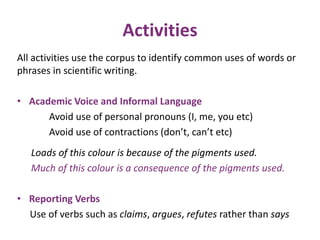
All activities use the corpus to identify common uses of words or 
phrases in scientific writing. 
• Academic Voice and Informal Language 
Avoid use of personal pronouns (I, me, you etc) 
Avoid use of contractions (don’t, can’t etc) 
Loads of this colour is because of the pigments used. 
Much of this colour is a consequence of the pigments used. 
• Reporting Verbs 
Use of verbs such as claims, argues, refutes rather than says
Activities 
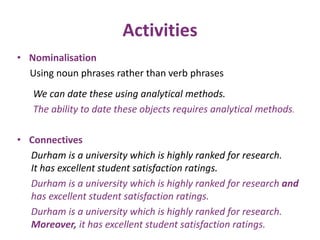
• Nominalisation 
Using noun phrases rather than verb phrases 
We can date these using analytical methods. 
The ability to date these objects requires analytical methods. 
• Connectives 
Durham is a university which is highly ranked for research. 
It has excellent student satisfaction ratings. 
Durham is a university which is highly ranked for research and 
has excellent student satisfaction ratings. 
Durham is a university which is highly ranked for research. 
Moreover, it has excellent student satisfaction ratings.
Student Feedback 
10 
9 
8 
7 
6 
5 
4 
3 
2 
1 
0 
Academic voice/informal 
language 
Affixes/Etymology Reporting Verbs Nominalisation Connectives 
Very useful 
Quite useful 
Not very useful 
Not at all useful 
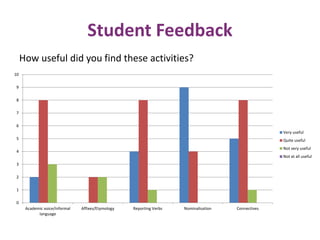
How useful did you find these activities?
Student Feedback 
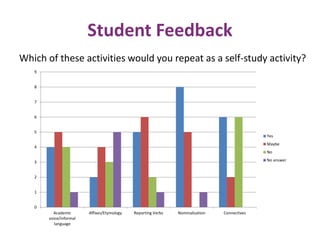
Which of these activities would you repeat as a self-study activity? 
9 
8 
7 
6 
5 
4 
3 
2 
1 
0 
Academic 
voice/informal 
language 
Affixes/Etymology Reporting Verbs Nominalisation Connectives 
Yes 
Maybe 
No 
No answer
Student Feedback 
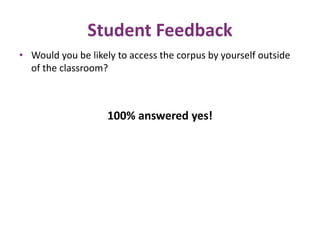
• Would you be likely to access the corpus by yourself outside 
of the classroom? 
100% answered yes!
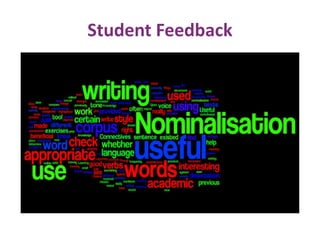
Student Feedback
Future Plans 
• Develop existing and additional Chemistry-specific activities 
for self-study use 
• Develop activities to look at punctuation 
• Run similar workshop(s) in October for remaining level 3 
students 
• Run workshop(s) annually for level 2 chemistry undergraduate 
students 
• Make all activities accessible from multiple platforms
Acknowledgements 
• Megan Bruce and Simon Rees, Foundation Centre, 
Durham University 
• Durham University, Enhancing the Student Learning 
Experience Award 
• HEA 
Thank you for listening! 
p.k.coffer@durham.ac.uk ; j.m.robson@durham.ac.uk

Development of Corpus Based Activities to improve the academic writing skills of chemistry undergraduates

  • 1.
    Development of corpus-based activities to improve the academic writing skills of chemistry undergraduates Pippa Coffer and Jacquie Robson Department of Chemistry, Durham University Megan Bruce and Simon Rees Foundation Centre, Durham University
  • 2.
    The Problem •Level 3 students are required to write an extended essay: • BSc students - a 10,000 word Dissertation • MChem students – a 3,000 word Literature Perspective • Feedback indicates that students feel that they have limited experience in this kind of exercise • Generic ‘academic writing training’ already provided, but something more interactive and specific to chemistry is desirable
  • 3.
    Solution? • Theproduction and use of corpus-based activities utilising the resource developed in the FOCUS (FOundation CorpUS) project1: https://community.dur.ac.uk/foundation.focus/ • The corpus contains a wide range of Durham University undergraduate and postgraduate student writings • The corpus can be used to look at words and phrases in context to assist students in identifying appropriate use of language 1Bruce, M & Rees, S (2013). Can I have a word please? - Supporting learning at Foundation level through use of a corpus of student-generated texts. Online Educational Research Journal 4(12).
  • 4.
    Pilot Workshop •Chemistry-specific corpus-based activities were prepared, with the aim to build student confidence in scientific academic writing by highlighting different linguistic techniques • Activities designed to be used in a workshop, with a view to them being developed for use as a resource for self-study • Delivered in a classroom setting during ‘Dissertation’ and ‘Literature Perspective’ training week for a small volunteer group of level 2 students (alongside generic training)
  • 5.
    Activities All activitiesuse the corpus to identify common uses of words or phrases in scientific writing. • Academic Voice and Informal Language Avoid use of personal pronouns (I, me, you etc) Avoid use of contractions (don’t, can’t etc) Loads of this colour is because of the pigments used. Much of this colour is a consequence of the pigments used. • Reporting Verbs Use of verbs such as claims, argues, refutes rather than says
  • 6.
    Activities • Nominalisation Using noun phrases rather than verb phrases We can date these using analytical methods. The ability to date these objects requires analytical methods. • Connectives Durham is a university which is highly ranked for research. It has excellent student satisfaction ratings. Durham is a university which is highly ranked for research and has excellent student satisfaction ratings. Durham is a university which is highly ranked for research. Moreover, it has excellent student satisfaction ratings.
  • 7.
    Student Feedback 10 9 8 7 6 5 4 3 2 1 0 Academic voice/informal language Affixes/Etymology Reporting Verbs Nominalisation Connectives Very useful Quite useful Not very useful Not at all useful How useful did you find these activities?
  • 8.
    Student Feedback Whichof these activities would you repeat as a self-study activity? 9 8 7 6 5 4 3 2 1 0 Academic voice/informal language Affixes/Etymology Reporting Verbs Nominalisation Connectives Yes Maybe No No answer
  • 9.
    Student Feedback •Would you be likely to access the corpus by yourself outside of the classroom? 100% answered yes!
  • 10.
  • 11.
    Future Plans •Develop existing and additional Chemistry-specific activities for self-study use • Develop activities to look at punctuation • Run similar workshop(s) in October for remaining level 3 students • Run workshop(s) annually for level 2 chemistry undergraduate students • Make all activities accessible from multiple platforms
  • 12.
    Acknowledgements • MeganBruce and Simon Rees, Foundation Centre, Durham University • Durham University, Enhancing the Student Learning Experience Award • HEA Thank you for listening! p.k.coffer@durham.ac.uk ; j.m.robson@durham.ac.uk

Editor's Notes

  • #4 Pressure, ‘loads of’, specific searches etc. Use originally to assist ESOL students. Now expanding its role.