1
Far-western University
Faculty of Education
B.Ed. in English Education
Course Title: Advanced Reading and Writing Semester: Fourth
Course No. : Eng.Ed.241 Full marks: 100
Credit Hour: 3 (45 hours) Pass marks: 45
1. Course Introduction
With a view to expose the studentsto the wide range of reading and writing experience, this
course offers strategic information on how to read and write effectively. By reading the
cross-cultural texts and analyzing them, students are expected to develop critical thinking
skills and writing academic papers. Students will critique arguments, analyze fiction and
engage in research activities in order to develop the higher order thinking skills. The course
consists of five units. The first unit talks about responding to reading and clustering ideas
while reading. The second unit helps students to read and write from their experience. In the
third unit the students will analyze the essays and fictions. The last two units will help
students research for writing.
2. General Objectives
General objectives of this course are to:
a) introduce students the strategies for responding to reading
b) enable them to relate reading to experience
c) help them write from their experience
d) engage them in analyzing the essays and fiction
e) offer them the ways of finding resources for writing
f) encourage them to write effectively
3. Contents in detail with Specific Objectives
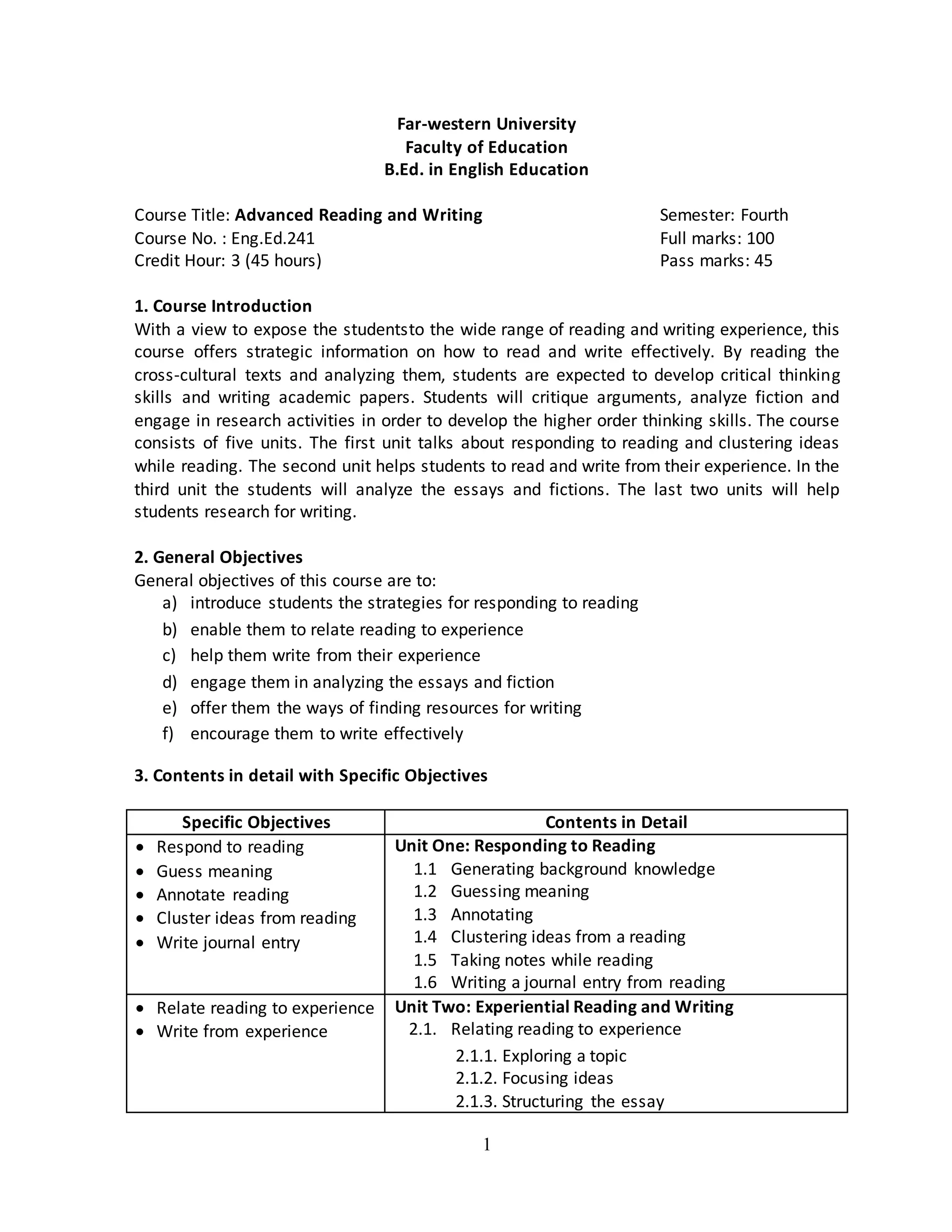
Specific Objectives Contents in Detail
 Respond to reading
 Guess meaning
 Annotate reading
 Cluster ideas from reading
 Write journal entry
Unit One: Responding to Reading
1.1 Generating background knowledge
1.2 Guessing meaning
1.3 Annotating
1.4 Clustering ideas from a reading
1.5 Taking notes while reading
1.6 Writing a journal entry from reading
 Relate reading to experience
 Write from experience
Unit Two: Experiential Reading and Writing
2.1. Relating reading to experience
2.1.1. Exploring a topic
2.1.2. Focusing ideas
2.1.3. Structuring the essay
2
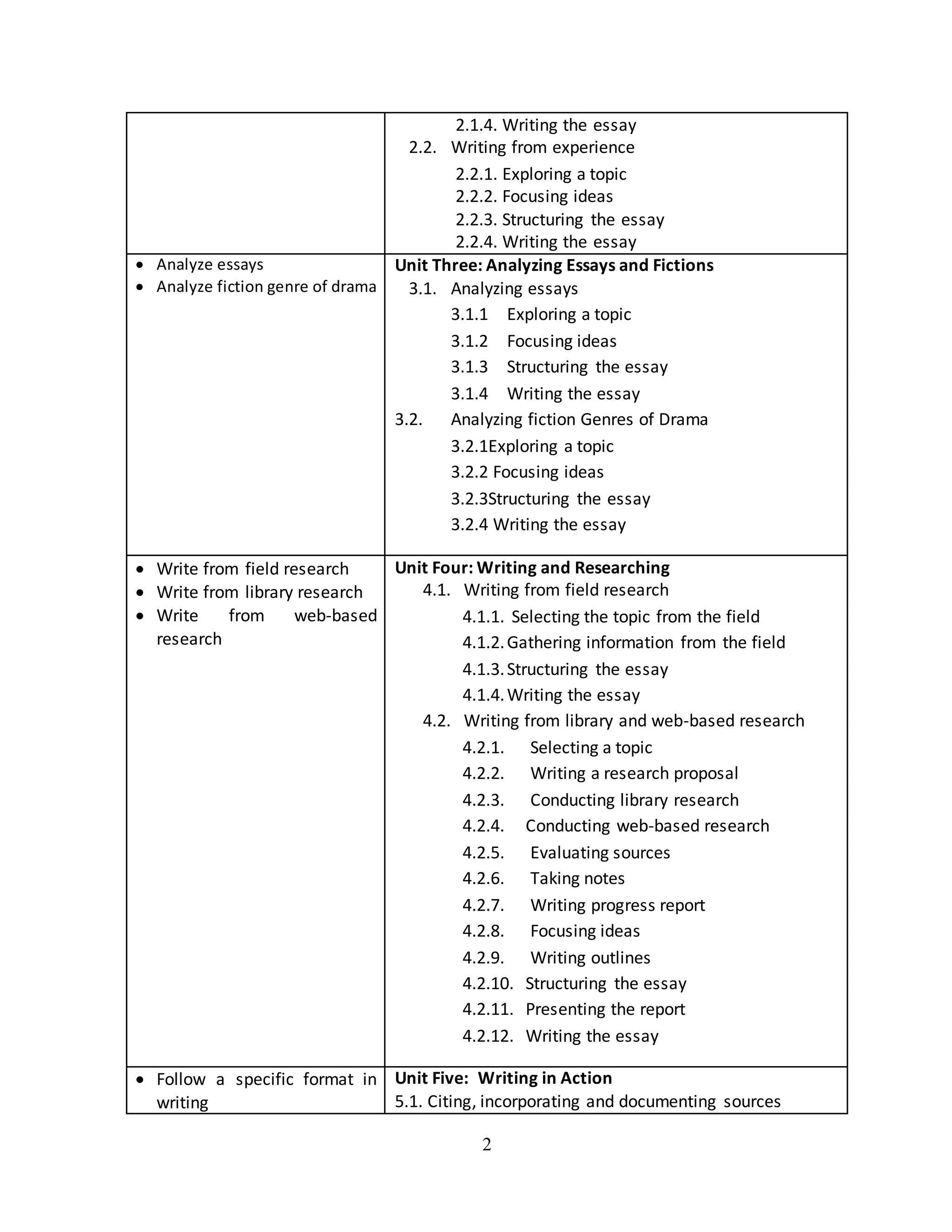
2.1.4. Writing the essay
2.2. Writing from experience
2.2.1. Exploring a topic
2.2.2. Focusing ideas
2.2.3. Structuring the essay
2.2.4. Writing the essay
 Analyze essays
 Analyze fiction genre of drama
Unit Three: Analyzing Essays and Fictions
3.1. Analyzing essays
3.1.1 Exploring a topic
3.1.2 Focusing ideas
3.1.3 Structuring the essay
3.1.4 Writing the essay
3.2. Analyzing fiction Genres of Drama
3.2.1Exploring a topic
3.2.2 Focusing ideas
3.2.3Structuring the essay
3.2.4 Writing the essay
 Write from field research
 Write from library research
 Write from web-based
research
Unit Four: Writing and Researching
4.1. Writing from field research
4.1.1. Selecting the topic from the field
4.1.2.Gathering information from the field
4.1.3.Structuring the essay
4.1.4.Writing the essay
4.2. Writing from library and web-based research
4.2.1. Selecting a topic
4.2.2. Writing a research proposal
4.2.3. Conducting library research
4.2.4. Conducting web-based research
4.2.5. Evaluating sources
4.2.6. Taking notes
4.2.7. Writing progress report
4.2.8. Focusing ideas
4.2.9. Writing outlines
4.2.10. Structuring the essay
4.2.11. Presenting the report
4.2.12. Writing the essay
 Follow a specific format in
writing
Unit Five: Writing in Action
5.1. Citing, incorporating and documenting sources
3
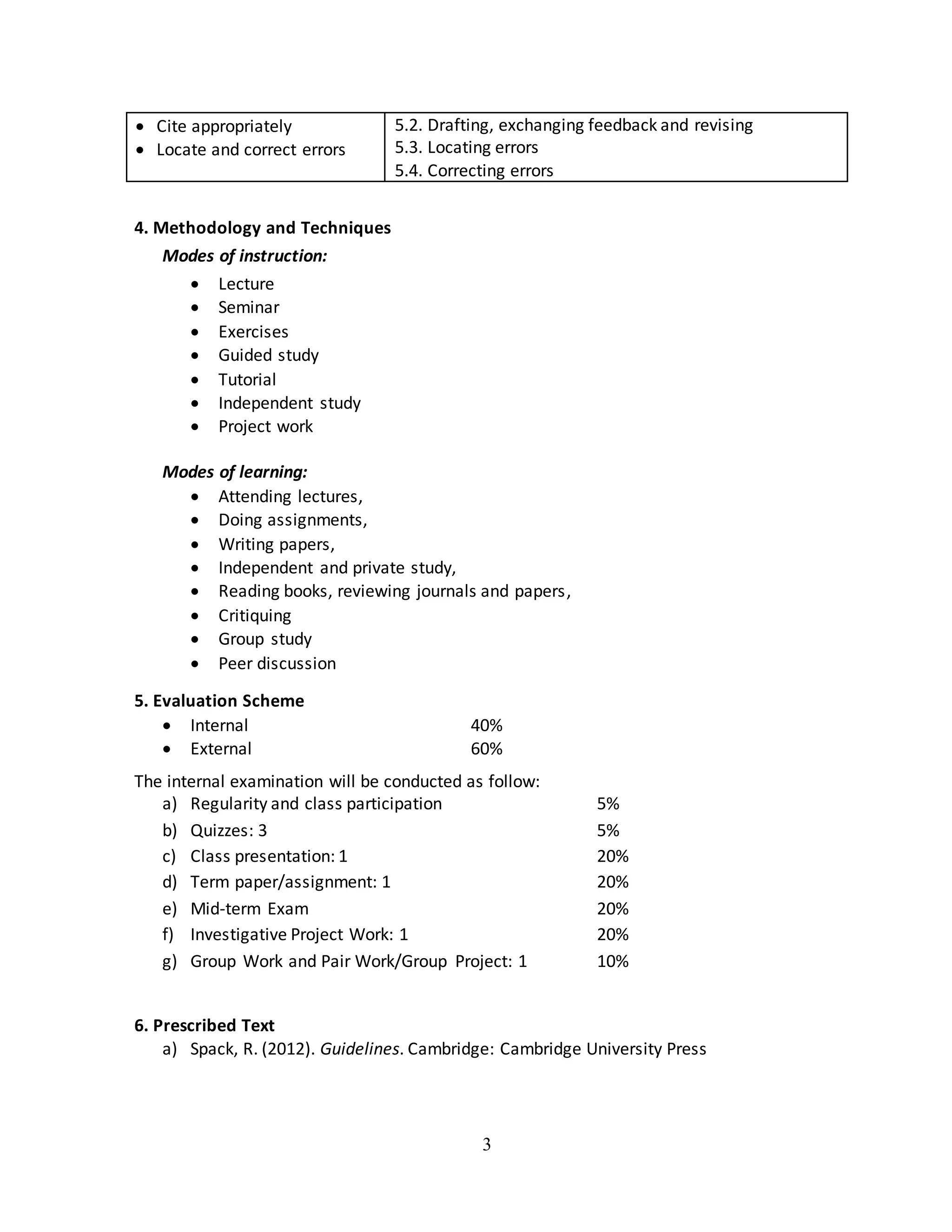
 Cite appropriately
 Locate and correct errors
5.2. Drafting, exchanging feedback and revising
5.3. Locating errors
5.4. Correcting errors
4. Methodology and Techniques
Modes of instruction:
 Lecture
 Seminar
 Exercises
 Guided study
 Tutorial
 Independent study
 Project work
Modes of learning:
 Attending lectures,
 Doing assignments,
 Writing papers,
 Independent and private study,
 Reading books, reviewing journals and papers,
 Critiquing
 Group study
 Peer discussion
5. Evaluation Scheme
 Internal 40%
 External 60%
The internal examination will be conducted as follow:
a) Regularity and class participation 5%
b) Quizzes: 3 5%
c) Class presentation: 1 20%
d) Term paper/assignment: 1 20%
e) Mid-term Exam 20%
f) Investigative Project Work: 1 20%
g) Group Work and Pair Work/Group Project: 1 10%
6. Prescribed Text
a) Spack, R. (2012). Guidelines. Cambridge: Cambridge University Press

Advanced reading and writing

  • 1.
    1 Far-western University Faculty ofEducation B.Ed. in English Education Course Title: Advanced Reading and Writing Semester: Fourth Course No. : Eng.Ed.241 Full marks: 100 Credit Hour: 3 (45 hours) Pass marks: 45 1. Course Introduction With a view to expose the studentsto the wide range of reading and writing experience, this course offers strategic information on how to read and write effectively. By reading the cross-cultural texts and analyzing them, students are expected to develop critical thinking skills and writing academic papers. Students will critique arguments, analyze fiction and engage in research activities in order to develop the higher order thinking skills. The course consists of five units. The first unit talks about responding to reading and clustering ideas while reading. The second unit helps students to read and write from their experience. In the third unit the students will analyze the essays and fictions. The last two units will help students research for writing. 2. General Objectives General objectives of this course are to: a) introduce students the strategies for responding to reading b) enable them to relate reading to experience c) help them write from their experience d) engage them in analyzing the essays and fiction e) offer them the ways of finding resources for writing f) encourage them to write effectively 3. Contents in detail with Specific Objectives Specific Objectives Contents in Detail  Respond to reading  Guess meaning  Annotate reading  Cluster ideas from reading  Write journal entry Unit One: Responding to Reading 1.1 Generating background knowledge 1.2 Guessing meaning 1.3 Annotating 1.4 Clustering ideas from a reading 1.5 Taking notes while reading 1.6 Writing a journal entry from reading  Relate reading to experience  Write from experience Unit Two: Experiential Reading and Writing 2.1. Relating reading to experience 2.1.1. Exploring a topic 2.1.2. Focusing ideas 2.1.3. Structuring the essay
  • 2.
    2 2.1.4. Writing theessay 2.2. Writing from experience 2.2.1. Exploring a topic 2.2.2. Focusing ideas 2.2.3. Structuring the essay 2.2.4. Writing the essay  Analyze essays  Analyze fiction genre of drama Unit Three: Analyzing Essays and Fictions 3.1. Analyzing essays 3.1.1 Exploring a topic 3.1.2 Focusing ideas 3.1.3 Structuring the essay 3.1.4 Writing the essay 3.2. Analyzing fiction Genres of Drama 3.2.1Exploring a topic 3.2.2 Focusing ideas 3.2.3Structuring the essay 3.2.4 Writing the essay  Write from field research  Write from library research  Write from web-based research Unit Four: Writing and Researching 4.1. Writing from field research 4.1.1. Selecting the topic from the field 4.1.2.Gathering information from the field 4.1.3.Structuring the essay 4.1.4.Writing the essay 4.2. Writing from library and web-based research 4.2.1. Selecting a topic 4.2.2. Writing a research proposal 4.2.3. Conducting library research 4.2.4. Conducting web-based research 4.2.5. Evaluating sources 4.2.6. Taking notes 4.2.7. Writing progress report 4.2.8. Focusing ideas 4.2.9. Writing outlines 4.2.10. Structuring the essay 4.2.11. Presenting the report 4.2.12. Writing the essay  Follow a specific format in writing Unit Five: Writing in Action 5.1. Citing, incorporating and documenting sources
  • 3.
    3  Cite appropriately Locate and correct errors 5.2. Drafting, exchanging feedback and revising 5.3. Locating errors 5.4. Correcting errors 4. Methodology and Techniques Modes of instruction:  Lecture  Seminar  Exercises  Guided study  Tutorial  Independent study  Project work Modes of learning:  Attending lectures,  Doing assignments,  Writing papers,  Independent and private study,  Reading books, reviewing journals and papers,  Critiquing  Group study  Peer discussion 5. Evaluation Scheme  Internal 40%  External 60% The internal examination will be conducted as follow: a) Regularity and class participation 5% b) Quizzes: 3 5% c) Class presentation: 1 20% d) Term paper/assignment: 1 20% e) Mid-term Exam 20% f) Investigative Project Work: 1 20% g) Group Work and Pair Work/Group Project: 1 10% 6. Prescribed Text a) Spack, R. (2012). Guidelines. Cambridge: Cambridge University Press