Contents
Page
Introduction
Guide to Usingthe Book
Un its
Unit 1
Unit 2
Unit 3
Unit 4
Unit 5
Unit 6
Unit 7
Unit 8
Unit 9
Unit 1 0
Unit 1 1
Unit 1 2
Unit 1 3
Unit 1 4
Unit 1 5
Unit 1 6
Unit 1 7
Unit 1 8
Unit 1 9
Append ices
Appendix 1
Appendix 2
Appendix 3
Appendix 4
Appendix 5
Key
Structure and Cohesion
Description: Process and Procedure
Description: Physical
Narrative
Definitions
Exemplification
Classification
Comparison and Contrast
Cause and Effect
Generalisation, Qualification and Caution
Interpretation of Data
Discussion
Introductions and Conclusions
Academic Style
Paraphrasing and Summarising
Quotations and Referencing
Surveys, Questionnaires and Projects
Proofreading
Examinations
Language Difficulties and Types of Error
Connectives
Research Reports
Correcting Code
Optional Questionnaire:
Your Writing and this Book
Key to Exercises and Notes
4
9
14
21
27
34
39
43
51
58
64
70
76
82
88
93
98
105
1 12
120
126
133
138
140
141
1 42
3
4.
Guide to Us i ng the Book
The Aim of the Course
1 To enable non-native speakers of English who wish to follow a
course in the medium of English at tertiary level to express
themselves coherently in writing.
2 To provide samples of academic writing and appropriate practice
material for such students and also for those students who need to
write essays or reports in English at an intermediate to advanced
level.
3 To act as a revision course for students who have previously
learned English as a foreign language at school and who probably
learned English with the sentence as the grammatical unit. These
students may now need to write in English for academic purposes.
4 To provide some practice in answering examination-type questions
for public or internal exams.
The Organisation of
Units
the Course
The book is divided into units that are self-contained but are linked in
their progression through the overall needs of students who have to
write in English for an academic purpose.
Many of the units focus on language functions that are used to
express a particular notion or idea, e.g. description and definitions.
The procedures of academic writing are also practised, e.g.
paraphrasing and summarising. The most common genre (type of
writing) that is practised is the essay. However, some practice is also
provided in writing for exams, and information is given about writing
research reports.
Written practice is given at different levels within each unit, mostly
in three stages. All the units except the first conclude with a Structure
and Vocabulary Aid to provide assistance with the words and
grammatical constructions needed in that unit.
Key
The Key at the end of the book provides additional comments on
some of the exercises and gives answers to many of the exercises.
Appendices
The Appendices act as a bank of reference material for both the
student and the teacher. Appendix 1 provides an overview of some of
the common types of language error and their causes. It also lists
some useful books that give further practice in these areas.
4
5.
Product and Process
Overall,the course provides practice in writing for a particular
purpose: often models or examples are given from academic writing.
In addition, the process of achieving the final product is considered.
Students are encouraged to discuss and compare some of their
writing, and to draft and check their writing carefully through
proofreading. The teacher's use of a correcting code ( Appendix 4)
will help in this respect.
Using the Book
It is best if the units are worked through in order. However, this
depends on the requirements of the students, who may need to
practise the content of certain units before others ( for example, Unit
1 4: Academic Style) . The Structure and Vocabulary Aids should be
referred to when necessary. Normally, the answers to each exercise
should be checked in the Key before proceeding to the next exercise.
Suggestions for
General
the Teacher
1
In a number of units there are blank-filling exercises to be done
after reading a text. These can be used with some flexibility:
students who have difficulty can look at the text again or at the
same time as they are writing. Other students can do the exercises
without referring back to the text. Advanced students can try to
do the exercises before looking at the text. In other words, they
will be trying to anticipate or predict the language needed from
the context of the sentence.
2 Students may need to practise different kinds of academic writing
(genres) in preparation for their studies of a particular subject.
Units 14 and 1 6 will be particularly useful for this. In addition, it
would be helpful if they could see examples of essays, reports, etc.
of the type they will need to write in the future. Information about
the requirements and expectations of subject departments would
be particularly useful.
3 Some groups of students may be studying the same academic
subject, e.g. one of the sciences or social sciences. If this is the
case, then it would be helpful if you could devise some questions
related to their specific subject at the end of Stage 3 for each unit.
Similarly, some students may be at undergraduate level while
others may be postgraduates. Consequently, practice at the
appropriate level would be beneficial.
4 The questionnaires in Unit 17 and Appendix S may be
photocopied for students to complete.
S
As a learning resource for students, any word processing package
can help them to edit their own texts. There are also a range of
websites which give access to learning and practice material
(guidance, models, examples) .
5
6.
Examination Practice
Some studentsmay need to practise writing answers for examination
questions, either for internal or public exams. For such practice they
need to be able to analyse the questions and decide what is needed.
In addition, they need to write concisely, fluently and accurately. Unit
19 will be especially useful for this: its Glossary of Examination and
Essay Questions will be generally useful for writing essays. Other
units that are useful for exam practice are numbers 11-15 .
One feature of writing for exams is the need to be able to write
quickly - 'against the clock': for example, one essay-type question in
one hour. Practice for this can be devised by giving a certain time
limit in which to write some of the Stage 3 exercises, particularly
those that apply to the students' own subject.
If a class is formed of students from the same subject area, it
would be useful to obtain copies of past exam papers in their subject.
The questions can be analysed with the students, noting the question
types that appear frequently. A question can be selected, discussed,
the structure agreed upon and notes put on the board to help the
students. They could then be given a time limit to write the answer.
Later in the course, the notes on the board can be removed after
discussion so that gradually help is reduced.
If the students are of mixed disciplines, they can be asked to
provide questions about their own subj ects. After suitable
preparatory work they can attempt to write the answers under
simulated exam conditions.
It is also possible to obtain information about public exams with
examples of question papers. For example, The fELTS handbook is
available from UCLES, Cambridge. Information about these exams,
as well as other aspects of academic writing, is given in English for
Academic Purposes (A guide and resource book for teachers ) by R.
R. Jordan, Cambridge University Press, 1997.
Correcting Code
Sometimes when checking students' writing, it is necessary to write in
the correct answers. However, some research has shown that if
students are actively involved in trying to correct their own mistakes,
with guidance, they are more likely to learn from them and not
repeat them. One way to help in this respect is to use a code for
correcting (see Appendix 4). With this approach, mistakes are not
corrected but are indicated - both the type of mistake and its
location.
Where a student's writing is 'good' or 'very good', it is very helpful
to the student if you can indicate which parts are good and briefly
explain why they are good. Without such comments, students may
not repeat the good features in their next writing.
In addition to the Correcting Code, an appropriate Checklist for
the type of writing (e.g. essay) can be constructed. If this is also
circulated to students it will raise their awareness of what is needed
and also remind them of what to check for. It can be used in
conj unction with Unit 18. Examples of its content might be:
- Relevance of the answer to the question or topic
- Structure and organisation of the essay, and completeness of the
writing
6
J
7.
Clear expression
Coherence ofargument
Critical evaluation of points of view
References to literaturelresearch and use of quotations and
bibliography
Other details: grammar, spelling, punctuation
Discussion and Writing
Several discussion activities have been included, and students are
encouraged to compare and discuss their answers with other
students. The purpose is to raise the level of awareness of students of
certain aspects of written English. In addition, the discussion is a
useful prelude to writing discussion-type essays in which points of
view need to be argued. It helps in the evaluation of differences
between arguments. Such discussion also helps to develop critical
thinking and self-confidence in expressing one's own views.
Pyramid Discussions
A Pyramid Discussion is an activity in which students are encouraged
to take part in discussion by gradually increasing the size of the
discussion group, starting with the individual, then building up to
two students, then four, and then the whole group. The procedure is
as follows:
1
First, students should individually select three items, as instructed,
from the list given in the activity. The order of their choices is not
important.
2 Then each student, in turn, should call out the numbers of his/her
choices. Write these on the board for all to see.
e.g. student:
choices:
A
12
14
15
B
3
7
10
C
4
7
12
D etc.
1
7
10
3 After this, put the students i n pairs s o that they have, a s far as
possible, at least one choice in common (e.g. A and C, B and D
above).
4 In pairs the students should then try to persuade each other to
make changes in their choices so that at the end of a certain time
limit (perhaps five minutes) they both agree on three choices. If
necessary, they can compromise on new choices or 'trade-off'
choices. The pairs' three choices are then noted on the board
agam.
5 Pairs should then be placed together who have at least one choice
the same . . . and so the procedure continues until all of the class
are involved.
6 If a pair or group finish their discussion before other groups, they
can prepare arguments to defend their choices so that they are
ready to meet another group.
7 While they are discussing, students will be practising the language
of persuasion: agreement, disagreement, suggestion, qualification
and compromise.
7
8.
8 At theend of the activity is a suggestion that students can add
some items of their own to the list. This may be done in pairs
instead of, or in addition to, individually.
Pyramid Discussions are included in the following units: 2, 6, 7, 8,
1 1 , 12, 1 5 , 17 and 1 9. In addition, you could compose your own
lists for extra topics, perhaps with the students suggesting items for
the list (consisting of about 1 0- 1 5 items) . If more information is
needed about Pyramid Discussions, see ELT Journal, Vol. 44 No. 1 ,
January 1 990, Oxford University Press ('Pyramid Discussions' - R.
R. Jordan, pages 46-54).
Advice for the
Student
8
With academic writing it is particularly important that you should
check to ensure that it has the appropriate formal style. Help is given
with this in Unit 14. General difficulties are covered in Unit 1 8 and
Appendix 1 . Appendix 1 also refers to some books that can help you
with further practice in areas of general difficulty.
The Pyramid Discussion in Unit 2 Stage 3 contains a list of advice
that should help to improve your a<:ademic writing. To that list could
be added the need to write at least two drafts before you write the
final version. Each draft should be revised after leaving it for a day or
more so that you can think about and check any difficulties that you
have.
If it is possible, you will find it very helpful to see examples of the
type of writing that you are aiming to prepare for, for example, essays
and reports. If the examples are good ones, they will show you the
structure of the writing, the formal style, and the referencing system.
9.
U nit 1
Unit 1
Structure and Cohesion
This unit is concerned with the general
organisation of a piece of academic writing
(e.g. a report, an essay, an assignment, a
project), its structure and particularly the
Stage 1
Struct u re
way in which the different parts are linked
together. The plan below of a piece of
writing, in this case an essay, will help to
explain the overall structure.
STRUCTURE
1
CONTENT
INTRODUCTION
sentences
t
The subject or topic. A statement of the
problem, etc. Comments on the way it is to be
treated.
paragraphs
2 DEVELOPMENT
Presentation, analysis and discussion
(involving comments on 'advantages' and
'disadvantages').
1 main idea
(+ examples, details)
2 main idea
(+ examples, details)
3 etc.
1..-
LANGUAGE
FUNCTIONS
3 CONCLUSION
Perhaps a summary of the maIn POInts In 2.
Own views/opinions and decisions.
Most pieces of formal writing are organised in a similar way introduction; development of main ideas or arguments; conclusions.
Each part of the writing will consist of language functions: particular
uses and structures of the language organised according to the
specific purpose that the writer has in mind in wishing to
communicate ideas etc. to other people - describing, defining,
exemplifying, classifying etc.
Each language function consists of sentences and/or paragraphs
that are j oined together or linked by connectives (words or phrases
that indicate a logical relationship) . These language functions will be
examined in detail in the following units. In the rest of this unit we
shall look at the linking of sentences by means of connectives.
9
10.
Unit 1
Stage 2
Conn ectives
A piece of writing or text will often have the following structure:
.--------------------------------------�
.
.
.
.
i
i
BASIC
CONNECTIVES: type
i.����:.
..
_
..... ...
.
i
i
Introduction
!
A
supporting
information
A
opposite
arguments
t
C
I
mam
development
tA
I
B
�
alternative
proposals
t
Conclusion
A The discussion, argument, or comment in the development of the
topic may be very straightforward, in which case ideas will be
added together one after the other. The basic connective and is
used here. (A number of connectives have a similar or related
meaning to and.)
B Sometimes the comments may be expressed in another way, or an
alternative proposal may be made. This is represented by the
basic connective or. (A number of other connectives have a
similar meaning. ) After the alternative has been considered, the
main argument will continue.
C There are also occasions in arguments etc. when the opposite is
considered or referred to. This is represented by the basic
connective but. (There are also a number of other connectives
with a similar meaning. ) After the opposite or opposing view has
been considered, the main argument is continued.
A list of the connectives divided into the main groups of and,
is contained in Appendix 2: Connectives.
10
or,
but
11.
Unit 1
1 'And'type: Connectives of Result (Typ e A)
Look at the fol lowi ng example:
He passed his examinations;
so,
therefore,
as a result,
accordingly,
consequently,
thus,
hence,
he had some good
news to tell his
parents.
Because he passed his examinations,
Note:
The connectives (in italics) join a cause ('he passed h i s
examinations') with a result, effect or consequence ( ' h e h a d
some good news t o tel l h i s parents').
Add a second sentence. Use a suitable con n ective from the l ist
a bove, and a resu lt, effect or consequence from the l ist below.
a
Many students find it difficult to read newspapers in
English . . .
b Most students living abroad are interested in news of their
own country . . .
c
When a student goes abroad to study he/she may have to
complete about twelve different forms . . .
Result, Effect or Consequence:
British news is found to be of most interest.
they usually read the international news first in the
newspapers.
an average of five books per month are read.
not many read one regularly.
it is useful to be able to answer questions briefly.
Complete the fol lowi ng by adding a su itable ending of you r own .
d The lecture was very difficult to understand. Consequently,
e
Carlos was only able to read very slowly in English. Therefore,
2 'Or' type: Connectives of Reformulation (Type B)
Look at the fol lowi ng example:
He said that he
had kept the
library book for
several years.
Note:
In other words
To put it more simply,
It would be better to say
he had stolen it.
The connectives (in italics) introduce a reformulation of what
has come before. The reformulation a ppears in different words
and is used to make the idea clearer or to explain or modify it.
11
12.
Unit 1
Add asecond sentence. Use a suita ble con nective from the l ist
a bove, and an a ppropriate reform ul ation from the l ist below.
a
Maria is rather slow at learning . .
.
___________
b Helen finds languages quite easy . . .
c
Anna speaks English like a native-speaker . . .
Reformulation:
she speaks it excellently.
she speaks slowly.
she is taking a long time to improve her English .
she has little difficulty in learning English.
she speaks it with great difficulty.
Complete the fol l owing by adding a suita ble ending of you r own .
d Margaret is bilingual. In other words,
e
__________
Some people say that if you are good at music you will also be
good at learning languages. In other words,
_______
3 'But' type: Connectives of Concession (Type C)
Look at the fol l owing exa mple:
The time available for
discussion was very
limited.
Note:
However,
Nevertheless,
Nonetheless,
Yet,
In spite of that,
A ll the same,
it was still possible
to produce some
interesting
arguments.
the connectives (in italics) indicate the surprising nature of
what follows in v i ew of what was said before; a kind of contrast
is indicated.
Add a second sentence. Use a su ita ble connective from the l ist
a bove, a n d a concession (or contrast) from the l i st below.
a
Some of the examination questions were very difficult . . .
b There was only limited money available for research . . .
c
12
The project was very complicated . .
.
__________
13.
Unit 1
Concession:
Dimitrios wasnot able to do it.
Juan succeeded in completing it in time.
Abdul was able to obtain a grant.
Oscar did not manage to complete them.
Ali managed to answer them satisfactorily.
Complete the fol l owing by adding a su itable end i n g of you r own .
d It seemed likely that he would fail the test. However,
e
There were a number of good reasons why he should not
finish the experiment. Nevertheless,
__________�
Stage 3
Paragraphs
It is essential to divide your writing into paragraphs. A paragraph
normally contains several sentences but they are all concerned
with the theme contained in the topic or key sentence (i.e. the
main sentence). The key sentence is usually the first one, which
contains the main idea or topic. The other sentences support it by
adding further information or examples. A paragraph is self
contained but should link logically with the previous and
following paragraphs so that the flow and cohesion of the writing
is maintained.
1 Look at the paragraph at the end of Stage 1. Which is the key
sentence?
2 The fol l owing sentences a re i n m ixed order. To form a paragra ph
they need to be reorgan ised. Underline the key sentence and put
the sentences i n the correct order by n u m beri n g them 1-5.
a
It is mainly formal, impersonal and objective.
b In most of these the writer is expected to include references to
other writing or research.
c
Academic writing is a particular kind of writing that can be
recognised by its style.
d These include essays, research reports and articles, case studies,
surveys, dissertations, theses, and examination papers.
e
Other distinctive features will depend upon the specific types of
academic writing.
Note:
Paragraphs a re either indented from the l eft marg i n (Le. they
start further in from the left) or a line of space is left at the
end of a paragraph and the next paragraph is started on the
left margin. This makes it easier for the reader to read a text.
13
14.
Unit 2
U nit 2
Description: Process and Procedure
When we describe a process or procedure,
we often use present passive verb forms
(is/are + verb stem + ed e.g. it is
manufactured) to give a general
description.
When we report a particular procedure,
we are concerned with only one particular
occasion in the past; then we often use the
past passive tense (was/were + verb stem +
ed e.g. it was heated).
Stage 1
G e n e ra l Descri pt i o n
A description that does not involve a
process or procedure is often written in the
present simple active tense (verb stem + s
e.g. it comprises).
Sequence, or order, is important in both
describing a process or reporting a
procedure.
1 Read t h e fol l owing ca refu l ly. Note particu l a rly t h e verb forms that
are used : some of the present passive verb forms a re in italics.
How paper is made
Paper is made from wood, and many of the worl d's paper m i l l s are
found in those cou ntries wh i ch have great forests - Canada,
Sweden and F i n l and.
The trees are felled or cut down.
The branches and leaves are removed.
The trees are transported to the sawm i l l .
The bark i s stripped from the trun ks.
The tru n ks are sawn i nto logs.
They are conveyed to the paper m i l l.
They are p laced i n the sh redder.
They are cut i nto sma l l ch i ps.
They are m i xed with water and ac i d .
They are heated and crushed t o a heavy pu l p.
Th i s wood pu l p is c l eaned.
It i s a l so chem i cal ly bleached to w h i ten it.
It is passed t h rough ro l lers to fl atten it.
Sheets of wet paper are prod uced.
The water is removed from the sheets.
These sheets are pressed, dried and refi ned u nti l the fi n i shed
paper is produced.
I
I,
i,
2 Read ca refu l ly through the text again and underl ine other present
passive verb forms.
N,Qte:
1 Wtien describing a process, sequence markers, e,9. first, then,
next, firrally ... are often used (see ApPlindix 2: Connectives,
Section 1 ). .They Help to lihkthe sentences.
2 Sometimes, in order to avoid repllatill9 a subject, a relative
pronoun and relative diluse are used. e.g. The bark is stripped
from the truhks. The trunks are sawn into logs becomes The
bark is stripped from the trunks, whiCh are sawn into logs.
14
15.
U nit 2
3Some of the sentences from the text have been joi ned together
below to form a paragraph. Spaces have been l eft i n the sentences.
In the spaces write a n appropriate verb (and sometimes
preposition), and, if su itable, a relative pronoun.
i n the shredder. Then they
i nto sma l l c h i ps
water and acid.
N ext they
to a heavy p u l p
It
a l so chem i ca l ly
to wh iten it.
t h rough ro l lers to fl atten it. Then,
After th i s, it
. F i na l l y, the water
sheets of wet paper
from the sheets
u nti l the
fi n i shed paper
F i rst, the l ogs
______
______
______
______
______
______
4 Look at the seq uence of pictu res below. U nderneath there a re a
n u m ber of sentences describing how a brea kfast cereal is made.
The sentences a re i n the wrong order. Write them out i n the correct
order using the sequence of pictu res to help you.
How a breakfast cereal is made
a It is stored i n the s i l os.
b These are woven i nto b i sc u i ts.
c The wheat i s harvested from the fie l d .
d Each biscuit i s ba ked u nti l brow n .
e It i s cut and formed i nto th i n strips.
f The gra i n is cooked to soften it.
g It i s packed ready to be eaten.
h The wheat gra i n is transported to the s i los.
5 Look ca refu l ly at the diagra m on page 1 6 of the stages of
man ufacture of glass bottles. Six boxes have been n u m bered and
left empty. Now read ca refu lly the sentences next to the diagra m .
They a re in t h e wrong order and a re not complete.
- Complete the sentences by putting the verb (given at the end of
each sentence) in the appropriate passive form.
- Write the sentences i n the correct order.
- Join them together by means of seq uence ma rkers (e.g. then,
next).
- F i n a l ly, from the i nformation in the sentences, write the correct
names in the six boxes in the diagram.
15
16.
rr
Unit 2
How glassbottles are made
a
b
c
d
e
f
g
h
Stage 2
S pecific Proced u re
It
i nto bottles in the mou l d . (sh ape)
Someti mes broken gl ass
. (add)
to strengthen the gl ass. (reheat
The bottl es
and coo l )
from sand, l i mestone, and soda ash.
G l ass
(make)
They are ready
. (use)
. (produce)
G l ass
strongly in a furnace. (heat)
Th i s m i xt u re
These th ree mater i a l s
together i n the right
proportions. (mix)
______
______
1 Look at the fol lowi ng ta ble ca reful ly.
Writing in English: Manchester University (50 students)
%
students
52
34
14
12
type of
writing
( average )
frequency
( average)
length
essay
report
disserta tion
thesis
5 per term
2 per term
1 per year
1 after
2-3 years
2000 words
4000 words
8000 words
300-1000 pages
The information in the table can be described (as an alternative to
using the table) . Notice the construction of the following sentence:
52 % of the students wrote essays, of an average frequency of 5
per term, of an average length of 2000 words.
Now read the fol l owing paragraph, which descri bes some of the
i nformation conta ined in the table. Complete the spaces with
i nformation from the ta ble.
A survey was conducted among
overseas
. The p urpose of the
postgradu ate students at
and
su rvey was to d i scover the type,
of academ i c writi ng that was expected of the
of the
students by their su pervisors or tutors.
students
reports, of an
2 per
average length
term,
______
______
16
17.
Unit 2
2 Belowthe steps or stages in conducti ng a su rvey a re given . In the
spaces in each sentence write an a ppropriate verb from the
fol lowi ng l ist. Use past passive forms of the verbs, e.g. was/were
asked.
Verbs: request, collect, carry out, publish, analyse, distribute
a A survey
among 50 students.
to the students.
b First, questionnaires
to write answers to the
c Then the students
questions.
d After this, the completed questionnaires
e Next, the answers
f Finally, the results
______
_
_____
_
_
_
_
_
_
_
_
_
_
_
_
Note:
Stage 3
Advice
See Unit 17 for conducting an actual survey.
1 Read ca refu l ly the fol l owing descri ption of the procedure for
writi ng an essay. It g ives advice in the form of what you should do.
(Most of the verbs are mod a l passive forms, e.g. should + passive
infin itive.) When you have fin ished rea d i ng do the exercise in 2.
The Stages of Writing an Essay
5
10
15
20
25
First, the top i c, subj ect or question shou l d be thought about
carefu l l y: what i s req u i red in the essay shou l d be understood.
Th�n a note shou l d be made of i deas, perhaps from
knowledge or experience. After th i s, any books, jou rnals, etc .
shou l d be noted that h ave been recom mended, perhaps from a
read i ng l ist or a b i b l i ograp hy. Then to the l i st shou l d be added
any other books, articles, etc. that are d i scovered wh i l e the
recom mended books are bei n g fou n d .
N ow i s t h e time for t h e books, chapters, art i c l es, etc. t o be
read, with a pu rpose, by appropriate q u estions bei ng asked
that are rel ated to the essay top i c or title. C l ear notes shou l d
b e written from t h e readi ng. I n add ition, a record o f the
sources shou ld be kept so that a b i b l i ography or l i st of
references can be com p i l ed at the end of the essay. Any
quotations shou l d be accu ratel y acknow l edged : author's
surname and i n itials, yea r of p u b l i cation, edition, publ isher,
p l ace of publ i cation, and page n u m bers of quotations.
When the notes have been fi n ished �hey should be l ooked
through in order for an overview of the subject to be obta i ned.
Then the content of the essay sho u l d be deci ded on and how it
i s to be orga n i sed or p l a n ned. The mater i a l shou l d be carefu l ly
selected: there m ay be too m uch and some may not be very
relevant to the q uestion. The mater i a l , or i deas, shou ld be
d ivi ded i nto three m a i n sections for the essay: the i ntrod uction,
the main body, and the conc l u si o n . An outl i n e of the essay
shou l d be written, with use bei ng made of head i ngs or sub
head i ngs, if they are appropriate.
The first draft shou l d be written in a su itably formal or
acade m i c sty le. Wh i le doing t h i s, the u se of co l l oq u i a l
17
18.
U nit 2
30 express ions and person a l references shou l d b e avo i ded . When
35
it has been completed, the draft shou l d be read critica l ly, and
i n particu l a r, the organ i sation, cohesi on, and l a nguage shou ld
be checked . Severa l q uestions shou l d be asked about it, for
example: Is it clear? Is it concise? Is it comprehens ive? Then
the d raft shou l d be revi sed and the fi n a l draft written - legi bly!
It shou l d be remembered that fi rst i m press ions are i m porta nt.
F i na l l y, the b i b l i ography shou ld be compi led, u s i n g the
conventional format: the references shou l d be in stri ct
a l p h abetical order. Then the b i b l i ograp hy shou l d be added to
the end of the essay.
2 A l l the sentences conta i n ing advice (should) a re l isted below. Spaces
have been left for the verbs. In each space write the a ppropriate
verb, but write it as a d i rect instruction (putti ng the verb in its
i m perative form) e.g. should be finished � finish.
The Stages of Writing an Essay
a
______
b
c
______
d
e
g
h
k
m
18
_________
carefu l l y about the top i c, subj ect or
question.
what i s req u i red i n the essay.
a note of you r i deas, perhaps from you r
know l edge or experience.
any books, journals, etc. that have been
recommended, perhaps from a rea d i n g
l i st or a b i b l i ography.
to yo u r l ist any other books, arti c les, etc .
that you d i scover wh i l e fi n d i ng the
recommended books.
the books, chapters, art i c l es, etc . with a
purpose, by asking yo u rself appropri ate
q uestions that are rel ated to the essay
topi c or title.
c lear notes from you r read i ng.
a record of your sou rces so that you can
compi le your own b i b l i ography or l i st of
references at the end of you r essay.
accu rately any quotati ons: author's
su rname and i n it i a l s, year of p u b l i cation,
edition, p u b l i s her, p l ace of p u b l i cation,
and page n u m bers of quotations.
through you r notes when yo u have
fi n i shed in order to obta i n an overvi ew of
the subject.
on the content of yo u r essay and how
you want to orga n i se it, i n oth er words,
p l a n i t.
you r material ca refully: you m ay have too
m u c h and some may not be very rel evant
to the q uestion.
you r material, or i deas, i nto th ree m a i n
sections for t h e essay: t h e i ntrod uction,
the main body, and the concl u s i o n .
19.
U n it2
Summary
of the Stages of
Writi ng an Essay
Topic
think
Reading list
-
n
o
p
q
s
u
v
w
_______________
x
y
an outl i ne of the essay, making use of
headi ngs or sub-headi ngs, if they are
appropri ate.
the fi rst d raft, in a su itably formal or
academ i c style.
the use of col l oq u i a l express ions or
personal references.
the draft critica l ly, in parti c u l a r checki ng
the orga n i sation, cohesion and language.
you rself severa l q uestions about it, for
example: Is it c l ear? Is it concise? Is it
comprehensive?
the draft.
the fi nal d raft.
sure it is legi b l e!
fi rst i mpressions are i mportant.
you r b i b l i ography, using the conventional
format.
that you r references are in stri ct
alphabetical order.
the b i b l i ography to the end of you r essay.
3 Read through 'The Stages of Writing an Essay' a g a i n . Decide what
you consider to be the most i mportant stages or advice. In very
brief note form su mma rise the stages by f i l l i n g in the boxes in the
diagram. The fi rst one has been done for you (you may change it if
you do not agree with it).
Either:
Or:
Pyramid Discussion
Wri t i n g an Essay
o r Report
Before beg i n n i ng, d iscuss with the student next to you
what you both consider to be the most important stages.
Do you agree with each other?
After you have fin ished, compare you r summary diagram
with the student next to you and discuss any differences.
Ind ividu a l ly select the three most im porta nt pieces of advice, from the
l ist below, that you th i n k will help to improve a student's academic
writi ng. The order of the three choices is not important.
1 Write precisely: clearly, accurately and explicitly.
2 Use correct language: grammar, vocabulary, spelling etc.
3 Organise the writing carefully: introduction, main body, and
conclusion.
4 Write legibly: handwriting should be easy to read.
S Write in an academic style: impersonally, without using colloquial
language.
6 Write concisely, and avoid very long sentences.
7 Adopt appropriate attitudes: be rational, critical, honest and
objective.
8 Carefully paragraph the writing.
9 Include variety in the writing: avoid too much repetition.
10 Check details carefully, both of content and of language.
1 1 Ensure that the opening paragraph is not too long and that it
creates a good impression.
19
20.
Unit 2
1 2Pay as much attention to the conclusion as to the introduction.
13 Avoid the use of cliches, j argon, propaganda, exaggeration, and
emotive language.
14 Ensure that ideas and items are arranged in a logical sequence
and are logically connected.
15 Always acknowledge the source of quotations and paraphrases.
Fina l ly add some advice of your own that is not covered in the l ist
above.
Note:
Structure and
Vocabulary Aid
A
Information about organisihg a Pyramid Diswssion in the
Classroom is given ill the Guide to Using the Book.
Commonly used verb tenses, with examples
Present Simple (Active)
Present Simple (Passive)
it carries/they carry
it is carried/they are carried
Past Simple (Active)
Past Simple ( Passive)
it carried/they carried
it was carried/they were
carried
Modal Passive
B
Imperative/instruction
it should be given/they should be
given
give
Relative pronouns and relative clauses
1
2
3
4
Who/that refers to persons.
Which/that refer to things.
Whose refers to the possessive of persons.
Whom refers to persons and is often used with a preposition.
Examples:
1 My supervisor, who seems very young, has j ust been promoted
to head of department.
2 The article which ( or that) I have just finished reading is very
clearly written.
3 The research that ( or which) I finished last year has j ust been
published.
4 The lecturer whose name I always forget was as boring as usual
this morning.
"
S The student with whom I share a room is very noisy [formal].
The student I share a room with is very noisy [informal].
20
21.
Unit 3
U nit 3
Description: Physical
In academic writing, physical description
may occur in a number of disciplines or
subjects. A description of people, family
relationships, occupations and institutions
might occur in social or physical
anthropology or sociology. A description
of apparatus and equipment might occur
in the various sciences. For nearly all these
descriptions present simple active verb
forms (e.g. she wears/they wear) and
present simple passive verb forms (e.g. it is
described/ they are described) are
commonly used. The following stages
concentrate on describing countries.
Stage 1
N
I
The U nited Kin g d o m
.....
":
. ... :
. .
1 Read the fol l owing paragraph ca refu l ly. Write the names of the
places next to the n u m bers i n the map.
The United Kingdom
5
10
B rita i n (or G reat B ri ta i n) i s an i s l a n d that l ies off the north
west coast of E u rope. The nearest cou ntry i s France, w h i c h is
20 m i l es away and from which B rita i n is separated by the
Engl ish Channe l . The i s l and i s su rrou nded by the Atlantic
Ocean to the west, and the N o rth Sea to the east. It compri ses
the m a i n lands of England, Wa l es and Scotland, that is, th ree
countries. Scotl and is i n the north, wh i l e Wa l es is in the
west. I reland, which i s a l so an i s l a nd, l ies off the west coast
of B rita i n. It consi sts of Northern I reland and the I r i s h
Rep u b l i c. Brita i n together w i t h N o rthern I reland constitute
the U n ited Ki ngdom ( U K) . Th u s, the U n ited Ki ngdom i s
21
22.
Unit
3
composed of fourcountries, the l argest of which is England.
The capital c ity i s London, which i s situated i n south-east
England.
2 Now read the second part of the text. When you have fin ished,
complete the summary below of the whole text by using
appropriate verb forms. Someti mes a preposition is needed as wel l .
15 The U K h a s a tota l area o f about 2 44, 1 00 sq u a re k i l ometres
20
25
30
35
(94,248 sq uare m i les). About 70% of the land area is devoted
to agricu lture, about 7% is wasteland, moorland and
mou nta i ns, about 1 3 % i s devoted to u rban development, and
1 0% i s forest and wood land. The northern and western
regions of B rita i n, that is Scotland and Wa l es, are m a i n l y
mounta i nous and h i l ly. Parts o f t h e north-west a n d centre of
England also consist of mounta i ns and h i l l s.
B rita i n has a genera l ly m i l d and temperate c l i mate. It is,
however, subject to frequent cha nges. It has an average
a n n u a l ra i nfa l l of about 1 2 0 centimetres (47 i nches) .
I n 1 998 the pop u l ation of the U n ited Ki ngdom was nearly
5 9 m i l l ion. The density of popu lation was approxi mately 240
peopl e per square k i l ometre. However, in England, where
83% of the pop u l ation l ive, the density was much h i gher,
about 3 63 per square k i lometre.
In the U K, E n g l i s h i s the fi rst l anguage of the vast majority
of people. However, i n western Wa l es, Wel s h is the fi rst
l anguage for many of the people. In Scotland o n l y a sma l l
n u m ber o f peopl e speak Gael i c .
I n Brita i n about 66% o f the popu lation say that they are
Ch ristian, wh i l e fewer than 5 % say that they belong to other
rel igions.
Summary
the Atlantic
Brita i n is an i s l and that ( 1 )
Ocean and the N o rth Sea. It (2)
the
ma i n l a nds of Engl and, Wa les and Scotland. I reland
(3)
the west coast of B r i ta i n . It
(4)
Northern I reland and the I rish Repu b l i c .
T h e U n i ted Ki ngdom ( 5 )
B rita i n together
with Northern I re l a n d . The capital city i s London w h i c h
(6)
south-east England.
I n 1 998 the popu lation of the U K (7)
_
nearly 59 m i l l i o n . The density of popu l ation
(8)
240 people per square ki lometre. In
the fi rst language of
the UK Engl ish (9)
most people. I n western Wa les, Wel s h ( 1 0)
many of the people, but few people i n Scotland
(1 1 )
Gael ic.
______
______
________
22
23.
U n it3
1 Look ca refu l ly at the map of Austra l i a and at the table of
Stage 2
i nformation. Then write a description of Austra l i a organ ised i n a
similar way to the description of the U K . Check the Structure and
Voca bulary Aid if necessa ry. Write four short paragraphs on:
location
size and physica l backg round
c l i mate
population, language, and rel igion
Oth e r Countries
Australia
To Indonesia
Coral Sea
Indian Ocean
.....
..
........
. . . .. .
••••••••••
.
South Pacific
Ocean
a
500
miles
a
800
Tasman Sea
Southern Ocean
km.
I
ro of
!..Pic...Capri
- . ...
. �?��
I
Capital:
�
L-______________________
Total area:
�
To New Zealand
Canberra, in the Australian Capital Territory
7,682,300 sq. km.
Land: consists largely of plains and plateaux
7% arable
14% forest
54% grassland 25% other land: desert, mountains, wasteland
Climate:
ranges from alpine to tropical
Annual rainfall:
two-thirds of the continent is arid or semi-arid
(having little or no rain) - over 80 cm. rain in the
north and eastern and southern highlands
Population ( 1996 ):
18,423,000
Density:
2 per sq. km.
States and Territories: % of population:
New South Wales
34%
South Australia
Victoria
Tasmania
25 %
Queensland
18%
Australian Capital Territory
Western Australia
10%
Northern Territory
Language: English
Religion:
8%
2.5%
1.5%
1%
(+ some others)
mainly Christian
2 Now write a brief account of you r cou ntry, divided i nto fou r
paragraphs as a bove. If you do not know t h e exact figu res, guess o r
write in genera l terms.
3 Descri be you r home town so that the reader, who does not know it,
can get a clear pictu re of it.
23
24.
U nit 3
Structureand
A Vocabulary: Countries
Vocabulary Aid
prefectures
boroughs
districts
plateaux
moorland
territories
forests
hills
provinces
ADMINISTRATIVE
AREAS
j ungles
valleys
zones
Nouns
plains
states
counties
deserts
regions
mountains
grasslands
TERRAIN
ram
sleet
flat
ICe
monsoon
grassy
snow
drought
hilly
flood
Nouns
Adjectives
rocky
mist/fog
typhoon
hurricane
cyclone
mountainous
clouds
sandy
dusty
wind
WEATHER
CONDITIONS
hot
oceanic
icy
humid
freezing
warm
Adjectives
CLIMATE
rainy
wet
cloudy
Note:
24
Mediterranean
desert
mistylfoggy
2
temperate
tropical
stormy
sunny
windy
continental
equatorial
cold
mild
dry
maritime
polar
Compare:
arid
X has a m i ld climate.
X has mild weather.
Can you thi n k of a ny more words to add to the a bove l ists? Th i n k
pa rticu la rly o f you r own cou ntry.
Are there any more categories or grou ps of words that you
wou l d find usefu l ? If so, try to make lists s i m i l a r to the a bove.
25.
U nit 3
BCompass points (and adjectives)
North
(northern)
North-West
(north-western)
North-East
(north-eastern)
West
(western)
East
(eastern)
South-East
(south-eastern)
South-West
(south-western)
South
(southern)
C Location
.
D
·n .. .
X is situated/located
y
N
r
to ...
on ..
X is in the south of the country.
Y is to the north of the country.
The north of the country is
cold.
on/near the equator.
on/near the coast/sea.
inland.
Z is a neighbouring (or adjacent) country.
e.g.
Notel
lies (to lie) Is used fdr islands, For mainlafld qained to a
eonlinentl we wO!Jld use is situated in refertif!} to location.
. )
.
D Verbs to describe the composition of a country
X
comprise(s) . .
consist(s) of . . .
constitute(s) . .
is composed of . . .
(notice the use and differences)
E Approximation
8
�
==
---':
= = = = =apprOX imateI Y
�
)
(+ figure,
measurement, etc.)
25
26.
Unit 3
F Qualification
G
Thewith names of countries, rivers and seas
1 The is not used with names of continents (e.g. Europe, not the
Europe), though it is used with some other geographical areas
(e.g. the Middle East, the Far East).
2 The + Republic of . . . (e.g. the Republic of France) .
3 The + country names in the plural (e.g. the United States o f
America, the UK, the West Indies, the United Nations).
4 Other country names are not used with the (e.g. Denmark) .
5 The + names o f oceans, seas, rivers (e.g. the Atlantic Ocean,
the Mediterranean, the Tigris) but not with names of lakes
(e.g. Lake Baikal).
6 The + names of mountain ranges (e.g. the Alps, the
Himalayas) . Some individual mountains are named with the
e.g. the Eiger, the Matterhorn. In other cases, the is not used
e.g. Mont Blanc, Everest.
26
27.
U n it4
U n it 4
Narrative
The introduction to many pieces of
academic writing contains some kind of
historical background or development.
This is usually in the form of narrative: an
account or description of events in the past
which entails following a time sequence or
Stage 1
D i ct i o n a r i es
chronological order (i.e. earliest first) . Verb
forms commonly used are the simple past
active (e.g. it organised), simple past
passive (e.g. it was created), and past
perfect active (e.g. it had developed).
1 Read the fol lowing ca refu l ly. Notice the structu re, time sequence,
dates, verb forms and prepositions used .
A History of English Dictionaries
10
15
20
25
30
Samuel Johnson
The beginnings of English dictionaries date from 1 604 when
the first 'hard-word dictionary' was pub lished . It contained
fewer than 3 000 difficu l t words, which were exp l ained by
easier ones. An important principle was introduced: that of
listing words in a l p habetica l order ( A-Z).
The first major dictionary was the Universal Etymological
English Dictionary by N athaniel Bailey, which was p u blished
in 1 72 1 . ( Etymology is the study of the origi n and history of
words and their meanings . ) This one vol u me conta i ned about
40,000 words.
One of the great landmarks in the history of dictionaries
was the publication in 1 75 5 of A Dictionary of the English
Language by Sam uel Joh nson. He built on the work of Bailey
and i l l ustrated the use of words by inc l u ding about 1 00,000
quotations from wel l -known a uthors from the 1 6th centu ry
onwa rds. Perhaps his most famous definition is that of 'oats':
'A grain, which in England is genera l ly given to horses, but in
Scotland su pports the people.'
I n America, in 1 828, Noah Webster pub lished An
American Dictionary of the English Language. Its two vol u mes
consisted of about 70, 000 words and inc l u ded scientific
terms. Webster incl u ded American pronunciation and
spel ling, for example 'co lor' for 'co l o u r' and 'center' for
'centre'.
Probably t h e most importa nt devel opment in t h e history of
dictionaries was the production of The Oxford English
Dictionary. Dr James Mu rray started to edit the enormous
work in 1 879, and the first part was p u blished in 1 884:
A - ANT, in 3 5 2 pages! It took another 44 years to com p l ete
the dictionary, i n 1 25 parts. The final work was p u blished in
1 928 in 12 vo l u mes covering 1 5 ,487 pages which inc l u ded
nearly 5 00,000 words.
2 Now make very brief notes of the most i mporta nt items of
i nformation in the passage.
27
28.
:r:
Unit 4
Stage 2
TheU n ited Nations
1 Read through the passage below, then write an a ppropriate word
i n each o f t h e spaces.
The United Nations (UN)
The
traced back
of the U N can
the League of N ations. This
which
an international
the Treaty of
created
Versail les
1 920 with the pu rpose
achieving world peace. Before 1 93 0, the
League, from its Geneva headq uarters,
international conferences and did u sefu l h u ma nita rian work.
, it fai led
deal effectivel y
internation a l aggression
forma l l y c l osed
the 1 93 0s. The League
superseded
1 946 and
the U nited N ations.
on 24th October 1 945, when
The UN was
ratified
the UN Charter
the 5 1 fou nder member cou ntries. A l most
are now members: 1 85
the cou ntries of the
in a l l .
to maintain international
The U N was
peace, and to encou rage international co-operation to overcome
economic, socia l , c u l tu ral and h u m a nitarian problems. Apart
organs of the U N
the
(The General Assem bly, The Secu rity Cou ncil etc . ) ,
o f t h e U N 's work i s done
agencies.
its specia lised bodies
are, perhaps,
of the best
the FAO, I LO, I M F, WHO, U N ESCO and U N I C E F.
D iscuss possible a lternative answers. When the text is complete,
conti nue with the fol l owing exercise.
2 Now make very brief notes of the most i m portant items of
i nformation in the passage.
Stage 3
U n ivers ities
1 Below is a passage traci ng the development of un iversities. Read it
through. When you have finished reading it do exercise 2 which
fol l ows the passage.
The Development of Universities
5
I
l,
28
The word ' u niversity' comes from the Latin word ' u niversitas'
meaning 'the whole' . Later, in Latin legal l anguage ' u niversitas'
meant 'a society, guild or corporation' . Th u s, in mediaeva l
academic use the word meant an association of teachers and
scho l a rs. The modern definition of a u niversity is 'an i nstitution
that teaches and examines students in many branches of
adva nced learning, awarding degrees and providing faci lities
for academic research' .
29.
Unit 4
The originsof u niversities can be traced back to the Midd l e
Ages, especial ly t h e twelfth t o fou rteenth centu ries. I n the
early twelfth century. long before u niversities were organised
in the modern sense, students gathered together for higher
studies at certain centres of l earn ing. The earliest centres in
Eu rope were at Bologna in Ita l y, for l aw, fou nded in 1 088;
1 5 Salerno in Italy, for medic i n e; and Paris, France, for
philosophy and theo l ogy, fou nded in 1 1 5 0. Other early ones
in E u rope were at P rague, Czechosl ovakia, fou nded in 1 3 48;
Vien na, Austria, fou nded in 1 3 6 5 ; and Heidel berg, Germany,
founded in 1 3 86.
20
The first u niversities in England were established at Oxford in
1 1 85 and at Cambridge in 1 209. The first Scottish u niversity
was fou nded at St Andrews in 1 4 1 2. By com parison, the
ol dest u niversities i n the U SA are at Harvard, fou n ded in
1 63 6 , and Ya le, established in 1 70 1 .
25
I n the fifteenth and sixteenth centu ries, th ree more
universities were fou nded in Scotla nd: at G l asgow in 1 4 1 5 ,
Aberdeen in 1 494, and Edinbu rgh in 1 5 82. The next English
university to be fou n ded was not u ntil the nineteenth centu ry
- Londo n , in 1 83 6 . This was fo l l owed, l ater in the nineteenth
3 0 and early twentieth centuries, by the fou ndation of severa l
civic u niversities. These had developed from provincia l
col leges which were mai n l y situated in industrial areas.
Manchester, for examp l e, received its charter i n 1 880, and
Birmingham in 1 900. In addition, the federa l U niversity of
3 5 Wa les was established in 1 893 comprising th ree co l leges.
Severa l other civic universities were fou nded in the 1 940s
and 1 9 5 0s, such as Nottingham in 1 948, Southampton in
1 9 54 and Exeter in 1 95 7 . However, it was in the 1 9 60s that
the largest single expansion of higher education took p l ace in
40 B ritain . This expansion took th ree basic forms: existing
universities were enlarged; new u niversities were developed
from existing col l eges; and seven comp l etel y new u niversities
were fou n ded, most ly away from town centres and in the
cou ntryside, e.g. Warwick, 1 9 65. The Open U niversity was
45 fou n ded in 1 9 69: it is non-residential and uses
correspondence cou rses combined with TV and radio
broadcasts.
A big devel opment in recent years was an Ed ucation Act in
1 992 that a l l owed former polytech nics to become u n iversities.
5 0 Before the Act there were 47 u niversities in the U K; after the
Act there were 86 u niversities.
A l l B ritish u n iversities receive some government fu nding,
except B uckingham, which is B ritain's o n l y i ndependent
u niversity, fou nded i n 1 983 . This ru ns two-year cou rses
5 5 i nstead of the usual th ree years.
10
..
t
.,
To p : Bologna Un iversity
Centre: Vienna U niversity
Bottom: Christ Church College. Oxford
29
30.
U n it4
2 Below is a summary of the passage in sentences which are given i n
the wrong order. P u t t h e sentences i n t h e correct order.
a The quarter of a century from 1 940 to 1 965 was the period
when there was a big increase in the number of universities in
Britain.
b The Open University was founded in 1 969.
c The oldest American university was founded in the
seventeenth century.
d One of the original meanings of 'university' was an association
of teachers and students.
e There is one private university in Britain: it was established in
1 98 3 .
f After three more Scottish universities were established in the
fifteenth and sixteenth centuries, the next maj or developments
were not until the foundation of a number of civic universities
in the nineteenth and early twentieth centuries.
g Oxford and Cambridge are the oldest English universities.
h Former polytechnics became universities in and after 1 992.
The first Scottish university was established in the early
fifteenth century.
There were gatherings of students at centres of learning in
Europe between the twelfth and fourteenth centuries.
3 Now make brief notes of the information relating to the
development of Engl ish u n iversities only. Put the heading
'Un iversities i n England' a bove you r notes.
4 Write a brief description in na rrative form of the development of
u n iversities in you r country. It does not matter if you do not know
precise dates or detai ls: a rough idea or an a pproxi mation wi l l be
sufficient. Refer to the Structure a n d Voca bulary Aid.
S If you a pply for a job or to study at a u n iversity etc., you norm a l ly
f i l l in an appl ication form or send a cu rricu l u m vitae (CV). This is a
brief account of you r backg round and career. Norma lly it incl udes
you r full name, date of birth, and then, u nder the hea d i ng of
'education', a summary of the secondary schools, co l leges or
u n iversities that you have attended, together with deta i l s of
exa m i nations passed and certificates and/or degrees awa rded. It is
usua lly fol l owed by a n accou nt of you r employment or career. The
i nformation is norma lly g iven in chronolog ica l order.
Write part of you r own CV. Only include i nformation under the
heading of 'education' (places of study and awa rds).
6 Write a l etter to a un iversity or a col lege applying to study there in
the next academic yea r.
30
31.
Unit 4
Structure and
ACommonly used verb tenses, with examples
Vocabulary Aid
Present Simple (Active)
Past Simple (Passive)
it created
it was established
Past Perfect (Active)
it had developed
B Useful verbs/nouns
nouns
verbs
establishment
creation
foundation
to establ ish
to create
to found
C Useful vocabulary for describing post-school education
institutes of
higher education
(polytechnics
until 1 992 in UK)
universities -----I
INSTITUTIONS OF
HIGHER AND
FURTHER
EDUCATION
Scottish central
insti tutions
further education
adult education
tertiary
other s pecialist
colleges
COLLEGES
technology
art and design
agricultural
horticultural
31
32.
U n it4
D Useful vocabulary for describing universities
Council
Senate
Chancellor
UNIVERSITY
GOVERNMENT AND
ORGANISATION
Court
Boards
Committees and
Sub-Committees
Convocation
Departments
Vice-Chancellor
Others
Deans of
Faculties
and Schools
Schools
Faculties
---
Bursar/Director
of Finance
,.,/-"
.
. .
.
.
.. .
.
.
... .
. . • ..
.
. .
.
.
..
.
.
,,/" -"" " " /
Centres and Units
/
....
/
Registrar
Librarian
vacations/holidays
loan
ACADEMIC
YEAR
Autumn!
Michaelmas
terms
award
grant
Summer/
Trinity
sponsorship
Spring/Lent!
Hilary
scholarship
fee
bursary
visiting
principal
professor
director
dean
reader
technician
senior lecturer
lecturer
demonstrator
supervisor
research
assistant
counsellor
32
i
I
' 1-
STUDENTS
tutor
full-time
part-time
33.
Unit 4
lectures
tutorials
TEACHING
first-degree
(B.A., B.Sc.)
higher degree
(M.A., M.Sc.,
Ph. D . )
practicals
certificate
QUALIFICATIONS
seminars/discussion
groups
diploma
experiments
projects
essays
tests
case study
library
continuous
viva voce
(oral)
examinations
laboratory
interviews
ASSESSMENT
thesis
computers
questionnaires
interview
disserta tion
observation
surveys
Common
room
essay
Students' Union
report
exam
answers
Refectory
Postgraduate
Society
project
Library
Health and
Welfare
societies and
clubs
paper
sports
flats
thesis
digs
article
hostels
dissertation
colleges
lodgings
halls of
residence
bed-sitter
b & b
Can you th i n k of any more words to add to the a bove l i sts?
2
Look at the Academic Writing diagra m . Make a l ist of words for
Academic Rea d i ng in the same way.
33
34.
Unit 5
U nit 5
Definitions
The previous units were concerned with
describing things. When we describe things
we sometimes need to define them as well,
especially in academic writing, so that it is
Stage 1
perfectly clear what we mean. We may also
need to give examples of what we define,
and to classify. These will be covered in the
following units.
1 If w e look i n a dictionary for the word 'school' w e may find:
S i m p l e Defi n it i o n s
school an institution where chi l d ren a re ed ucated
More formally in writing we would put:
A school is an institution where chi l d ren are educated .
Look at these other exa mples:
A doctor is a person who gives medica l treatment to people.
A l u miniu m is a metal which is produ ced from bauxite.
Note:
Who is used for persons, which is used for inani mate objects and
anima ls, where is used for places.
Complete the fol lowi ng sentences in the sa m e way as the exa mples
a bove.
a
A college
students receive higher or
professional education.
treats people's teeth.
b A dentist
c Steel
is produced from iron and carbon.
(We can also say that steel is an alloy. )
lives in Africa and Asia.
d An elephant
e A professor
works in a university.
f A library
books are kept for borrowing
or referring to.
2 Join the sentences on the left below with the correct ones from
those on the right. Use a n appropriate relative pronoun to create a
relative cla use.
e.g. Bronze is an alloy. It is produced from copper and tin.
Bronze is an alloy which is produced from copper and tin.
34
35.
Unit 5
1 Anengineer is a person
2 A microscope is an
instrument
3 A generator is a machine
4 A botanist is a person
5 A square is a geometric
figure
6 A cucumber is a vegeta ble
7 An economist is a person
8 An encyclopaedia is a book
a It produces electricity.
b He studies the way in
which industry and trade
produce and use wealth.
c He treats the diseases of
animals.
d It makes distant obj ects
a ppear nearer and larger.
e He designs machines,
buildings or public works.
It gives information on
subj ects in alphabetical
order.
g He studies plants.
h It makes very small near
objects appear targer.
i It is long and round with a
dark green skin and light
green watery flesh.
It has four equal sides and
four right angles.
3 So far, i n the definitions we have looked at, the l a ng uage
construction has bee n :
Thing t o be defined + verb + general class word +
wh -word + particular characteristics, e.g. A botanist is a
person who studies plants.
Three types of mistakes may occur when a short definition is
being written:
1 An example may be given rather than a definition. An example
may, of course, follow a definition but it should not take its
place.
2 The general class, or the particular characteristics, may be
omitted from the definition. It will then be incomplete.
3 The word to be defined, or another form of it, may be used in
the definition itself. Clearly, if the reader does not already
understand the word, he/she will not understand the repeated
use of it.
Study the fol l owing defi n itions. Each one conta ins one of the
mistakes l i sted a bove. Ana lyse the type of m ista ke ( 1 , 2 , 3 a bove)
that has been made. Write the n u mber of the type of m istake in the
col umn provided. The fi rst one has been done as an exa mple.
35
36.
Unit 5
DEFINITION
An ammeteris used to measure electric current.
Type of
mistake
2
lecturer is a person who lectures.
a
A
b
A dictionary is a book like the Longman D ictionary
of Contemporary English.
c
degree is given by a university to a student who
has passed the appropriate examinations.
A
4 Now re-write the defi n itions a bove i n a more satisfactory way.
An exa mple has been done for you .
An ammeter is an instrument which is used to measure electric
current.
Stage 2
Aca d e mic Defi n itions
1 Look at the fol lowi ng defin ition.
Plastics are compou nds made with long chains of carbon atoms.
You will notice that the wh-word has been omitted. A definition
written in this way uses a reduced relative clause. In full the
definition would be:
Plastics are compounds which are made with long chains of
carbon atoms.
Write out the fol l owing defi n itions in fu l l, putting the wh-word i n
t h e correct place.
a
Plastics are substances moulded into shape when they are
heated.
b A mineral is a structurally homogeneous solid of definite
chemical composition formed by the inorganic processes of
nature.
Write out the fol l owing defin itions om itting the wh-word so that a
reduced relative cla use is used.
c Rayons are man-made fibres which are produced from wood.
d A fossil is an inorganic trace which is buried by natural
processes and subsequently permanently preserved.
2 Often subj ects, particularly academic subjects, omit the wh-word
in the following way:
Plastics
Criminol ogy is the s tudy of crime (or i l l ega l acts).
Psychiatry is the study and treatment of menta l il l ness.
Po litics is the science of government.
Botany is the s cience of the structu re of p l a nts.
Write out definitions of the su bjects given below. Use the notes
g iven next to each su bject; write in the same styl e as a bove.
36
37.
U n it5
a Demography - study - population growth and its structure.
b Zoology - science - structure, forms and distribution of
animals.
c Biology - science - physical life of animals and plants.
3 Academic subjects may be more cautiously defined, thus:
Geography may be defined as the science of the earth's su rface.
L i ngu istics may be defined as the science of language.
Write out defi n itions of the fol lowing su bjects i n the same way as
a bove.
Sociology - science - nature and growth of s ociety and social
behaviour.
b Theology - study - religious beliefs and theories.
c Astronomy - science - sun, moon, stars and planets.
a
Write a defi n ition of you r subject in a s i m i l a r way to the a bove.
Stage 3
Exte n d e d Defi n it i o n s
1 It is possible for academic subjects to be defined more specifically.
Normally, this can only be done if more information is given.
Look at the fo l l owing exa mple (branch has the mea n i n g o f division).
Psychology may be defined as the branch of b i o logica l science
which s tudies the phenomena of conscious l ife and behav i o u r.
Write out defi n itions of the fol l owing su bjects in the same way as
a bove.
a
Criminal psychology - psychology - investigates the
psychology of crime and the criminal.
b Chemistry - science - deals with the composition and
behaviour of substances.
c Social economics - economics - is concerned with the
measurement, causes and consequences of social problems.
2 A definition may be extended in order to be more precise and/or
to give more information about the subj ect. Look carefully at the
following examples.
Sociology m ay be defi ned as the branch of sci ence wh ich stud i es
the devel opment and pri n c i p les of soc i a l orga n i sati o n . It is
concerned with group behav i o u r as d i sti nct from the behaviour of
i nd i v i d u a l s i n the group.
Econometrics may be defi ned as the branch of econom ics which
app l i es mathematica l and statistica l techn iq ues to econom ic
problems. I t i s concerned with test i n g the va l i d ity of economic
theories and provi d i ng the means of making quantitative
pred i ctions.
Now write a defi n ition of you r subject in a similar way to the a bove.
37
38.
r
Unit 5
3 Useyou r dictionary to check defin itions. Sometimes it is usefu l to
compa re defi n itions and expla nations in two or three dictiona ries:
they a re not a lways exactly the same, and they often g ive d ifferent
exa mples.
Check the defi n itions of the fol l owing:
a
b
c
d
e
standard of living
household
durable goods
consumer
perishables
These words a re usefu l for Unit 1 1 , Stage 3
Note:
Structure and
Vocabulary Aid
A Frequently used verb forms for definitions
Present Simple (Active and Passive)
IS
X
•
•
•
means . . .
describes . . .
is defined as . . .
is used . . .
e.g. A dialect is a variety of language.
It is spoken in one part of a country.
B Relative clauses
Relative clauses are often used to qualify or give extra
information, e.g.
An X is someone who sells Y.
Y is something which is produced by Z.
C Useful verbs:
x
38
is concerned with
deals with
relates to
involves
y
39.
Unit 6
Unit 6
Exemplification
The last unit was concerned with
definitions. It is often useful in definitions
to give examples: this action is known as
exemplification (or exemplifying) .
Exemplifications are often introduced by
for example or e.g.
Linguistics may be defined as the science of
l anguage, for example, its structu re, sou n d
systems and meaning systems.
Stage 1
Words
There are different ways of exemplifying,
e.g.
Geol ogy may be defined as the science of the
earth's history a s shown b y i ts crust, rocks, etc.
Geography may be defined as the science of the
earth's su rface. It is com:erned with a n u mber of
featu res, particularly physic a l , c l imate and
prod ucts.
(Here particularly has the meaning 'more
than some others' . )
Exemplification is commonly used
throughout academic writing.
1 Read the fol lowi ng ca refu l ly.
What is Language?
10
15
20
25
A l anguage is a signal ling system w h i c h operates with
symbol ic vocal sou nds, and which is u sed by a group of
people for the pu rposes of com m u nication.
Let us look at this defi n i tion in more detai l because it is
l angu age, more than anyth i ng el se, that distinguishes m a n
from the rest o f the a n i m a l world.
Other anim a l s, it is true, com m u nicate with one a nother by
means of cries: for exa m p l e, many birds u tter warning ca l l s at
the approach of danger; apes utter d i fferent cries, such as
expressions of anger, fear and p l easure. B ut these various
means of com m u nication differ i n i m portant ways from
h u man language. For insta nce, anima l s' cries are not
articu l ate. This means, basica l l y, that they lack structu re. They
l ack, for example, the k i n d of structu re given by the contrast
between vowels and consonants . They a l so l ack the kind of
structu re that enables us to divide a h u man utterance into
words.
We can change an utterance by repl acing one word in it by
another: a good i l l ustration of this is a sol dier who can say,
e.g. 'tanks approaching from the north ', or he can change one
word and say 'ai rcraft approaching from the north' or 'tanks
approaching from the west'; but a bird has a single a larm cry,
which means 'danger ! '
This is w h y t h e n u m ber o f signa l s that a n a nim a l c a n make
is very limited: the great tit is a case in po i nt; it has about
twenty different ca l l s, whereas in h u man l anguage the n u m ber
of possible utterances is infinite. It a l so exp l ains why animal
cries are very genera l in meaning.
39
40.
Unit 6
Read thepassage again and draw a I box I a round a l l the
expressions which have the same mea n i n g as for example. Notice
how they are used and the punctuation that is used with them.
Now d raw a line u nder all the examples, e.g.
I such as I
expressions of anger, fear and pleasure.
2 The fol l owi ng sentences a re based u pon the information conta i n ed
in the passage above. Complete the sentences making use of each
of the fol lowi ng words (use each one only once).
illustration
a
b
c
d
e
f
for example
a case in point
such as
for instance
an example
At the approach of danger many birds utter warning calls: this
of animals communicating with each
IS
other.
Cries,
those of anger, fear and pleasure,
are uttered by apes.
There are important differences between human language and
, animals' cries
animal communication:
are not articulate.
Animals' cries lack,
, the kind of
structure that enables us to divide a human utterance into
words.
of changing an utterance by
A good
substituting one word for another is a soldier who can say
'tanks approaching from the north' or 'tanks approaching
from the west'.
The number of signals that an animal can make is very limited:
the great tit is
_________
Stage 2
1 Look at the fol lowi ng:
Sente n ces
Language Families
Latin
I
Portuguese
I
Spanish
I
I
Romanian
French
Italian
etc.
This information can be expressed in two ways:
- There are a n u m ber of languages wh i ch a re descended from
Lati n: for example, Portuguese and Ita l i a n .
- There are a n u m ber o f l anguages, s u c h as Portuguese and
Ita l ian, which are descended from Lati n .
Write two sentences, as a bove, a bout the fol l owing information.
a
Latin
I
Romansch
40
I
Proven<;:al
I
I
Catalan
I
Sardinian
etc.
41.
Unit 6
b
Sanskrit
I
Bengali
I
Hindi
t
I
Singalese
etc.
2 Readthe fol l owing ca refu lly, espec i a l ly the pa rt in ita l ics.
There are now over two thousand different languages in the
world; an examination of them shows that m a ny of them belong
to a gro u p of rel ated l anguages, and some of t h ese groups are
very large, constituting what we can ca l l l anguage families.
An example of such a family is the Semitic group of languages.
Examples of members of the family are Arabic and Hebrew.
Now write out the last two sentences substituting the fol l owing
(not all the examples need to be l isted):
Germanic - e.g. English, German, Dutch, Swedish, Danish,
Norwegian.
b Sino-Tibetan - e.g. Thai, Burmese, Chinese, Tibetan.
a
Stage 3
Pa ra g ra p hs
1 Here a re some notes on writi ng systems. Read them ca refu l ly.
Writing Systems
Writing method of h u man interco m m u nication by means
of conventional visible marks.
=
Two main kinds of writing system :
1 ideographic (an ideogram or sign one idea/word e.g.
Chinese)
2 phonetiC: a sy l l abiC (one sign one sy l l able
e.g. Amharic, Japanese ka na)
b a l p habetic (one sign one sou nd e.g.
G reek, Arabic)
=
=
=
Now write a paragraph on writing systems based on the
i nformation i n the notes. Do not use notes i n you r writing, only
complete sentences. Beg i n the paragraph with a defi n ition of
writing. Then conti nue with a description of the writing systems,
beg i n n i n g the sentence 'The re a re . . .' Remember to use seq uence
ma rkers (connectives); practise using different expressions for e.g.
To p : Chinese
Centre: Japanese
Bottom: Greek
2 Write a defi n ition of you r own subject of study or resea rch . Describe
part of it, with exa mples.
41
42.
Unit 6
Pyramid Discussion
Knowi n g a Fore i g n
La n g u a g e
1 What a re the three main advantages of knowing a foreign
language? Select from the l ist be low. The order of the choices is not
i mporta nt.
1
2
3
4
5
6
7
8
9
10
11
12
13
14
15
enables direct communication with a foreigner
gives access to a foreign literature
helps understanding of another culture
makes it easier to live/work in another country
helps if you want to study in another country
puts your own language and culture into perspective
helps you to understand the difficulties of people learning
your language
personal satisfaction in mastering the skill
adds another dimension to education
enables you to make closer contact with other nationalities
helps understanding of other attitudes
makes it easier and cheaper to conduct business with another
country
makes interpreters and translators unnecessary
enables you to understand information in another language
makes it easier to express your ideas to others
Final ly, add some adva ntages of your own .
2 Write a brief explanation of the advantages of knowing a foreign
language, with some exam ples.
Structure a n d
A Alternatives to the word
Vocabula ry Aid
B Other commonly used verb forms and methods of expression are:
shown
exemplified
illustrated
examples are: cases, instances.
8D
B
shows
exemplifies
illustrates
the following examples,
the following are examples of X:
a and b are examples of X.
8
42
Dickens and Hardy
D
43.
U n it7
Unit 7
Cl assification
When we divide something into groups,
classes, categories, etc. we are classifying
those items. The classification is normally
Stage 1
Criteria
made according to a criterion or several
criteria (standards or principles on which
j udgements are based) .
1 Read the fol lowing ca refu l ly. Then complete the sentences below.
State Schools in England and Wales
5
10
15
20
a
The vast majority of chi l d ren in B ritain (87%) attend state
( l ocal authority) schools which provide comp u l sory education
from the age of 5 to 1 6 years . These schoo l s can be c l assified
according to the age range of the pupi l s and the type of
education provided . Basica l l y, there are two types of schoo l,
primary and secondary, a l though in some a reas there are a l so
midd le sch ools. Primary schoo l s cater for chi l d ren aged 5-1 1 ,
and secondary schoo l s for ages 1 1 - 1 6 (and in some areas u p
t o 1 8 years). Primary schoo l s can b e su b-divided into infant
schoo l s (for ages 5-7) and j u nior schoo l s (for ages 7-1 1 ) .
Secondary schoo ls are norm a l l y of one type for a l l abi lities,
viz. comprehensive schoo l s. More than 90% of children in
state schoo l s attend this kind of schoo l . In some areas middle
schoo l s exist as an extra l evel after primary school for chi l d ren
aged 8 or 9 to 1 2 or 1 3 . Pupi l s then transfer to comprehensive
schoo l s . I n a very sma l l n u m ber of areas, p u pi l s may be
gro u ped according to their ability and selected by means of
an exa m i nation at the age of 1 1 . In these areas, grammar
schoo l s cater for those who pass the exa m . Those who fail go
to another secondary schoo l .
When p u pils reach the age o f 1 6 there may b e th ree
choices open to them . Firstly, they may leave schoo l .
Secondly, they may stay on a t school for two more years i f it
has a Sixth Form. Third l y, they may transfer to a Sixth Form
Co l l ege, a Tertiary Co l l ege or a F u rther Education Co l l ege.
Schools
the pupils' ages and
type of education.
school: primary
b There are
and secondary.
into infant
c Primary schools
and junior schools.
d Secondary school pupils
their ability.
e The criterion for classifying secondary schools is whether or
not there is
______
______
_
_
_
_
_
_
_
_
_
_
_
_
Top: Primary school
Centre: Comprehensive school
Bottom: Grammar school
_
_
__
_
_
_
_
_
_
_
_
43
44.
Unit 7
2 Thesentences below summa rise the information in the passage.
However, they are i n the wrong order. Put them in the correct
order by writi ng n u m bers 1 -7.
a Most children go to comprehensive schools.
b There may be three types of school: primary, middle and
secondary.
c At the age of sixteen, pupils may stay on at school, or leave
and go to a college, or leave school altogether.
d Exceptionally, children may take a selection exam at 1 1 years
and go to a grammar school if they pass.
e Most children go to state schools.
f If children attend middle schools, they go on to comprehensive
schools afterwards.
g Primary schools comprise both infant and j unior schools.
3 Look at Diagra m 1 . It shows a diagra mmatic classification of state
schools in England and Wa les. If necessa ry read the text again and
then com plete Diagram 1 , writing on the l i nes provided.
D iagram 1: State Schools in England and Wales
primary
-----
{
(5-7 years)
j unior
(
-----
)
( 8/9-12/1 3 years)
4 Without looki n g at the text again, write a brief description of the
information conta ined i n Diagra m 1 . Begin you r description:
There are two types of school: primary and secondary. Primary
schools can be sub-divided, according to age, into . . .
Note:
J.f any help i$ needed with tile language c1assificatio!1 in this
exercise, or the fdl lowing ones, turn tCi the Structure and
Vocabulary Aid at the end Of this unit.
5 Draw a classification diagram of the education system in you r
country. When you have completed it, write a brief descri ption of it.
44
45.
U n it7
Stage 2
Cl assify i n g
1 Read the fol l owi ng ca refu l ly. Then complete Diagram 2 ('The
Classification of B i rds') below.
The Classification of B i rds
10
15
20
25
30
35
Birds are instantly recognisable creatu res. Perhaps it is their
ability to fly that causes this. Some people might consider that
their shape was the most distinguishing feature. Everyone,
however, agrees on the characteristics that a bird possesses:
two wi ngs, feathers, two legs, a toot h l ess bil l or beak, warm
blood, and it lays eggs .
The modern system of c l assifyi ng birds is like a pyramid,
with the base formed by 85 1 4 different species. A convenient
definition of species is: an interbreeding group of birds which
do not norma l l y mate with other such grou ps.
The next division above the species is the genus, a gro u p of
species show i n g strong simi larities. The scientific name of a
bird gives the gen us first, then the species. Th us, the scientific
( Latin) name of the golden eagle is 'Aq uila ch rysaetos' (eagle,
golden). When there are strong points of similarity between
one gen us and another, these rel ated genera are grou ped
together and are said to belong to the same family. The names
of the 2 1 5 families of birds always end in 'idae' . The go lden
eagle, for i n stance, is one of the ' Fa l conidae' (fa l con fam i ly).
Fami lies with broadly simi l a r characteristics are grou ped
together into 27 orders, whose names end in 'iformes' . The
golden eagl e fa l l s into the order of ' Fa l coniformes' (fa l con- like
birds) . The la rgest order is ' Passeriformes' or perching birds.
This contains 63 families, and more species than all the rest
put together. The feet are designed so that they can grip a
perch, with th ree toes in front and one behin d. I n addition, a l l
are known a s song-birds . Two large fa mi lies within this order
are spa rrows, with 1 5 5 species, and crows, with 1 00 species .
Fin a l l y, al l of the orders make up the class 'Aves' (birds).
This system of c l assification has enabled scientists to
differentiate 85 1 4 species of birds. Pl acing a bird in the right
fami ly depends upon a n u mber of featu res. Among them are
externa l characteristics, such as the shape of the beak and
feet, and the colour pattern of the feathers. However, at the
level of order, the next higher
category, distinctions are
based on such featu res as the
structu re of the sku I I , the
a rrangement of the m u sc l es in
the l egs, and the condition of
the you ng at the time of
hatching.
Top: Golden eagle
Centre: Sparrow
Bottom: Crow
Right: Skull of owl
45
46.
r-
Unit 7
Diagram 2: The Classification o f Birds
Classification
divisions or
categories
Example of
classification
of Golden Eagle
(in English)
for each division
Ord.er
Fa.lcordke
GoId.eh £a. le
.9
Number of
the divisions
35111
2 From the i nformation in the text:
a give a definition of a bird.
b give a definition of a species.
c give two criteria that are used in assigning birds to the order
of Passeriformes.
d give two examples of families of birds from the order of
Passeriformes.
e list some of the general characteristics of families of birds, and
then of orders of birds.
3 Write a brief general description of the classification of birds. Base
you r descri ption u pon the i nformation conta i n ed in Diagra m 2.
Write in a s i m i l a r way to the fol l owing classification of vegeta bles.
There are six m a i n gro u ps of vegetabl es, for exa m p l e, l egu mes.
Each group may be divided into members, such as beans, and
each member may be sub-divided into types: Scarlet R u n ners are
an example. Final ly, each type may be fu rther su b-divided into a
n u mber of varieties, e.g. Pri zewin ner.
Stage 3
D i a g ra m s
1 Look ca refu l ly at Diagram 3. It is a tree diagram classification of
drinks. What a re the th ree crite ria that a re used in the
classification?
2 Write a description of the cl assification of drinks based on the
i nformation i n Diagram 3. Beg i n your descri ption:
Drinks may be classified into two main groups: . . .
46
47.
U n it7
Diagram 3 : A Classification o f Drinks
�
DRINKS
alcoholic
�
non-alcoholic
e.g. s� Jn�er /
hot /
, cold
" tt::J,�/ �
aerated
An aerated/carbonated/sparkling drink
/I
non-aerated
e.g. le�o�a �-cola
�ers
water water
e.g. milk
squashes or fruit Juices
cordials (i.e. (i.e. normally
diluted with undiluted)
water)
3 Now draw a d iagram for the su bject, or pa rt of it, that you a re
studying. Write a brief description of the classification d i agram,
making sure that it is clear what the criteria a re. If a classification
diagra m is not a ppropriate for you r su bject, perhaps a n
organ isationa l diagra m (showi ng hierarchy etc.) wou l d b e possible.
Pyra m id Discussion
Th e Pu rposes of
Com p u lsory E d ucat i o n
1 Which three pu rposes of compulsory ed ucation a re the most
i m porta nt? Select from the l ist below. The order of the choices is
n ot i m porta nt. Final ly, add a pu rpose of you r own .
1
2
3
4
5
6
7
8
9
10
11
12
13
14
15
t o teach reading, writing and arithmetic ( 'the 3 Rs' )
t o train for employment
to create discipline
to educate generally
to develop character
to teach sharing and co-operation with others
to teach self-control
to increase knowledge
to help become a useful member of society
to help to become self-aware
to build a foundation for later studies or work
to develop the mind
to encourage independence in thinking
to teach about the world around us
to enable one to be an individual
2 Write a brief description of the criteria that ca n be or sho uld be
used for determ i n i n g if education has been successfu l .
47
48.
r-
Unit 7
A
Structure and
Classification
VocabularyAid
Useful Nouns
criterion/criteria
basis/bases
features
characteristics
categories
classes
groups
types
kinds
sorts
speCies
breeds
orders
divisions
families
members
sub-categories
sub-classes
sub-groups
sub-orders
sub-divisions
Useful Verbs
to . . .
classify
categorise
group
divide into
arrange (in)
put into
fall into
E>
place in
distinguish ( between)
differentiate ( between/from)
sub-classify
sub-categorise
sub-group
sub-divide
consists of . . .
comprises . . .
X may be classified
according to . .
on the basis of . . .
depending (up)on . .
The classification is based ( up jon . . .
Note the possible sequence:
·
. . may be divided . . .
·
. . may be sub-divided . . .
·
48
whether or not . . . there is X
whether there is X or not . . .
according to
'"-----'
.
. may be further sub-divided . . .
.
.
.
. .
49.
Unit 7
B
Schools inEngland and Wales
State: non-fee-paying
secondary modern
or other school
�/
grammar
school
pupils: age 4/5-1 1
nursery school
or class
pupils: ages
1 1- 1 6 or 1 8
examination
co-educational
(mixed)
playgroup
infant
(4/5-7 )
""
J Ullior
( 7-1 1 )
/
co-educational
no selection
single sex
/ �
comprehensive school
middle school
( ages 8-9 to 1 2-1 3 )
______________
.-
(plus 6th form)
/
(if no Sixth form)
Sixth Form CollegelTertiary Collegel
Further Education College
mathematics
English
science
core subjects
MANAGEMENT
NATIONAL
CURRICULUM
LEAs (local
education
authorities)
governing
bodies
technology
streamingl
setting
teaching
art
muslC
mixed
ability
physical
education
modern foreign
language
General Certificate
of Secondary Education
( GCSE)
age 1 6
General National
Vocational Qualification
( GNVQ)
NVQ
GNVQ
EXAMINATIONS
(secondary school)
General Certificate
of Education: Advanced
Level ( GCE: A level)
age 18
Advanced Supplementary
Levels (A-S level)
49
50.
U n it7
Independent: private, fee-paying
nursery school
pupils: ages 1 11 1 2/1 3-1 8 / 1 9
pre-preparatory
Common Entrance Examination ___
SECONDARY
PREPARATORY
day
school
'public
schools'
boarding
school
pupils: ages 7-1 1/12/1 3
Are there any other words that you wou l d find it usefu l to add to
the a bove l ists?
2
50
Make a s i m i l a r l ist for the school system in you r cou ntry.
51.
U n it8
Un it 8
Compari son and Contrast
In most academic subjects, and in life
generally, we often need to compare and
contrast things. Similarities and differences
are often noted when classifying (see the
previous unit). The language of
Stage 1
comparison and contrast is frequently
needed when studying tables and other
statistical information. The language forms
used in this unit are to be found in
Appendix 1, Section 3 .
1 Look at Ta bles 1 and 2 and complete these sentences. If necessa ry,
Compa rison
look at Appendix 1 , Section 3, Comparisons. Put one or more words
i n each space.
Table 1
a The Nile is
b The Amazon is
c The Nile is
d The Mississippi-Missouri is
e The Yangtse is
the Mississippi-Missouri.
long
the Nile.
river in the world.
the Amazon.
river in China.
______
Table 2
month
f In Beijing, January is a
December.
g July is a
month
June.
h There is ...,-rain in May
in March.
rain; in other words, July is
July has the
month.
August is
warm
July.
months.
k December and January are
I The rainfall in February is
in March.
m April is
wet
October.
in May.
n The rainfall in November is
o July is the
month, and also
month.
______
______
_______
_
_
_
_
_
_
_
_
____
______
______
_
_
_
_
_
_
_
_
______
______
______
Satellite view o f the River Nile
Table 1 : The Longest Rivers in the World
1
2
3
4
The Nile (Afriea )-4, 1 60 miles ( 6,695 kilometres)
The Amazon (South Ameriea )-4,080 miles ( 6,570 kilometres)
The Mississippi-Missouri (North Ameriea )-3,740 miles ( 6,020
kilometres)
The Yangtse (Asia: China )-3 ,430 miles ( 5 ,520 kilometres)
Table 2 : Temperatures and Rainfall in Beijing, China
Month
Temperature ( 0 C )
Rainfall (em)
J
F
M
A
M
J
J
A
S
0
N
D
-4.7
0.2
-1.5
0.5
5.0
0.5
13.7
1.5
1 9. 9
3.6
24.5
7.6
26.0
23.9
24.7
1 6 .0
19.8
6.6
12.5
1 .5
3.6
0.8
-2 .6
0.2
Note:
The first month is January (J), the last is December (D).
51
52.
U n it8
2 Look at Ta ble 3. Write at least three sentences comparing the
mou nta i ns, which a re a l l i n the H i m a l ayas,
T
able 3: The Highest Mountains in the World
1 Everest ( Nepal/Tibet)
-
2 K2 (Pakistan/India)
2 8 ,250 feet ( 8 ,6 1 1 metres)
-
29,028 feet ( 8 , 8 4 8 metres)
3 Kangchenjunga (Nepal/Sikkim)
4 Lhotse (NepallTibet)
-
5 Makalu (Nepal/Tibet)
6 Dhaulagiri (Nepal)
-
-
2 8 , 1 6 8 feet ( 8 ,5 8 6 metres)
27,923 feet ( 8 ,5 1 1 metres)
-
2 7 , 8 0 5 feet ( 8 ,475 metres )
26,795 feet ( 8 , 1 6 7 metres )
Everest
3 Tu rn back to U n it 2 Stage 2. Look at the information in the table
about Ma nchester U n iversity students. Write severa l sentences
compa ring the i nformation: e.g. M ore students write essays than
a ny other type of writi ng.
Stage 2
1 Read the fol l owing ca refu l ly.
Exte nded Co m pa rison
10
Severa l years ago, some research was conducted at
Manchester U niversity into the amount of time that overseas
postgraduate stu dents spent listening to spoken English and
speaking Englis h . Sixty students co-operated by com p l eting
q uestionnaires.
It was fou nd that an average of 22% hours per week were
spent l i steni ng to English and only 6% hours speaking English
to Engl ish people. An analysis of the time spent listening to
English showed that lectu res accou nted for 5 hou rs and
seminars 2 hours. An esti mated 2 1/2 h o u rs were spent in serious
discussion while 2 hours were devoted to everyday smal l-ta l k.
Watching tel evision acco u nted for 5 1/4 hours and listening to
the radio 41/2 h o u rs. Going to the c i nema or theatre o n l y
accou nted for an average o f % hour p e r week.
The fol lowi ng sentences a re based u pon the i nformation conta ined
i n the text a bove. Complete the sentences by choosing from the l i st
of words and ph rases below: use each word once on ly. Make sure
that you keep the same mea n ing in the sentences as in the text.
Choose from these words: biggest; as much . . . as; more . . . than
(twice); least; most; not so many . . . as; as many . . . as; the same
. . . as; greater . . . than.
a The students spent considerably
time
speaking it.
listening to English
b A
amount of time was spent in lectures
in seminars.
c Nearly
hours were spent listening to the
radio
watching television.
______
______
______
______
52
l
i
53.
Unit 8
popular wayof listening to English
d The
was by watching TV.
e
number of hours was spent in everyday
small-talk
in taking part in seminars.
The
popular way of listening to English
was by going to the cinema.
hours were spent in serious discussion
g
in watching television.
time was spent in watching
h Nearly
television
in speaking English.
time was spent in serious discussion
in everyday small-talk .
The
surprise in the survey was the small
number of hours spent speaking English to English people.
______
______
______
______
______
______
______
2 You have j ust received a l etter from a friend, or acqua i ntance,
asking for some information a bout Engl ish dictionaries and asking
you to recommend a su ita ble one to help h i m/her learn English.
Look at Table 4: Engl ish Lea rners' Dictionaries, then on the basis of
that information write a l etter recommending one of the
dictiona ries. G ive reasons for you r choice. Look at the Structure and
Voca bu l a ry Aid at the end of this u n it and at the Notes i n the Key if
you need some help with the l etter.
Table
Feature
Words and
phrases
Examples
Pages
Longman Dictionary
of Contemporary
English
80,000
62,700
1,690
Longman Active
Study Dictionary
45,000
25,000
807
Oxford Advanced
Learner's
Dictionary
63,000
90,000
1 ,428
Oxford Student's
Dictionary
42,000
23,500
1 00,000
1 1 0,000
1 ,792
75,000
100,000
1,95 1
Words
ill ustra ted
748
Dictionary
Cambridge
International
Dictionary of
English
Collins COBUILD
English
Dictionary
4:
English Learners' Dictionaries
Appendices
Level
2,300
8
upper
intermediate
- advanced
16 pages
5
intermediate
10
upper
intermediate
- advanced
4
intermediate
2
intermediate
plus
1 ,700
2,000
intermediate
- advanced
53
54.
I
I
�
U n it8
__-,,--,--,-'C
Pyramid Discussion
Reasons for U s i n g
1 What a re the th ree main reasons for using a diction a ry? Select from
the l ist below. The order of the choices is not i m porta nt.
a D i cti o n a ry
1 to find meanings
2
3
4
5
6
7
8
9
to find synonyms
to check spellings
for word pronunciation and stress
to see the differences between confused words
for information about grammar
for information about style (e.g. formal, slang)
for usage and examples
for information about abbreviations, names etc. (in the
appendices)
10 to check idioms, phrases, proverbs
1 1 to extend knowledge of vocabulary
12 for accurate information about words
F i n a l ly, add any other reasons not g iven here.
2 Write a brief comparison of the main reasons for using a dictiona ry.
Stage 3
S i m i l a rities a n d
D i ffe ren ces
1 Similarities
There are a number of language constructions that express
similarity apart from those listed in Appendix 1 , Section 3 .
Look a t the fol lowi ng exa mples based on Ta ble 5.
a
Both Belgium and Canada have a small agricultural
population.
b Belgium and Canada are similar (or alike) in that they both
have a small agricultural population.
c Belgium, like Canada, has a small agricultural population.
d Canada is similar to Nepal in its percentage of forest area.
e Canada is similar to Nepal in that it has a large forest area.
Note:
Sti l l more sentences may be com pose d by using the connectives
l isted i n Appen d i x 2: Connectives (section l A: Addition), e.g.
Belgium has a small agricultural population; so, too, does
Canada.
Now write sentences s i m i l a r to those above, basi ng you r
i nformation on Ta ble 5.
54
55.
Unit 8
Table
5:
Various Countries
�
Information
Belgium
Canada
Egypt
Ireland
Nepal
Population
10,140,000
29,972,000
64,1 00,000
3,589,000
2 1 ,953,000
Area: sq. km.
32,800
9,22 1 ,000
995,000
6 8 ,900
1 3 7,000
Density: per sq. km.
323
3
52
53
136
Forest area
21%
39%
0
4.5%
39%
Arable land (for crops)
23.5%
5%
2%
13.5%
17%
Agricultural population
2%
3%
39%
12%
91%
Main languages
Dutch!
Flemish,
French
English,
French
Arabic,
French
English,
Irish
Nepali,
Maithili
Main religions
Christianity
Christianity
Islam
Christianity
Hinduism,
Buddhism
2 Differences
For a number of ways of expressing difference, see Appendix 1 ,
Section 3 and Appendix 2, Section 3 .
Look a t the fol lowing examples based o n Table 5 .
a
Ireland and Belgium are dissimilar i n that Ireland has a much
smaller population than Belgium.
b With regard to population, Egypt is (much) bigger than
Canada.
c The main religion in Belgium is Christianity, whereas in Egypt
it is Islam.
d Belgium has the largest percentage arable land area; however,
it has the smallest percentage agricultural population.
e Although Belgium has the largest percentage arable land area,
it has the smallest percentage agricultural population.
f On the one hand, Canada has the largest population; on the
other hand, it has the lowest density of population.
Now write some sentences s i m i l a r to those a bove, basi ng you r
i nformation on Ta ble 5.
3 Tu rn to U n it 3, Stage 2. Look at the table of i nformation a bout
Austra l i a beneath the map. Write a paragraph to compare and
contrast Austra l ia with Canada i n terms of a rea, population, density,
a rable land a rea a n d forest a rea.
4 Compa re a n d contrast your country with one of the cou ntries i n
Table 5. It is not necessa ry t o refer t o a l l t h e items. If y o u do not
know some of the deta il s for you r country, g ive a rough esti mation;
but try to find out by looking in a ppropriate reference books. If
necessa ry, look at the Structure and Voca bul a ry Aid i n this u n it a n d
i n U n it 3 t o help you .
55
56.
U nit 8
Structureand
A
Vocabulary Aid
Qualification o f comparison
(X is)
considerably
a great deal
(very) much
(quite) a lot
rather
somewhat
a little
slightly
scarcely
hardly
only j ust
X is
exactly
precisely
just
virtually
practically
more or less
almost
nearly
approximately
about
exactly
entirely
quite
totally
completely
entirely
quite
the same as . . .
the same as . . .
different from Y.
X and Y are
different.
I
I
quite
I
56
X is not quite as/so
big
expensive
dear
etc.
57.
U nit 8
B
Cardinalnumbers
When writing figures involving thousands, a space is used to
separate the thousands if there are 5 or more digits:
e.g. 10 000 100 000 1 000 000 but 1 000
Alternatively a comma may be used to separate the thousands:
e.g. 1 ,000 1 0,000 1 00,000 1 ,000,000
A point is used in writing decimal fractions: e.g. 1 2 9 3 . 75
C
Ordinal numbers
Ordinal numbers are often written in abbreviated form:
1 st - first
2nd - second
3rd - third
4th - fourth
5th - fifth
'th' is used after all numbers except those ending in 1 , 2, or 3 .
D
Percentages
(%)
Figures
Language
10%
1 .5 %
0.5 %
ten per cent
one point five per cent or one and a half per cent
(nought) point five per cent or half a per cent
Note:
percentage = proportion
absol ute number = total number
57
58.
Unit 9
U nit 9
Cause and Effect
In academic writing, events and actions are
frequently linked with their cause and
effect. Look at the following diagram,
which summarises this relationship.
back in time
or sequence
cause
reason
event
situation
action
idea
problem
Now look at these examples of the cause
and effect relationship.
connective
I
Prices rose. I
Heat
forward in time
or sequence
effect
consequence
result
solution
Any marks
on the leaves
are probably
There are a large number of ways to
express the relationship shown in the
diagram above. You will need to look at
Appendix 2, Connectives (Section I E :
Result) and especially the Structure and
Vocabulary Aid at the end of this unit
before doing the exercises.
causes
iron to expand.
As a result
fewer goods were
sold.
I The cause
Note:
Sometimes the cause will be named
before the effect; sometimes the effect will
be named first. e.g.
1)
X causes
+
2)
Y i s caused by
+
effect
Y (active verb)
+
effect
X (passive verb)
+
cause
1 The parts of the sentences below have been mixed up. Join the six
Con n ect ives a n d M a rkers
pa rts on the l eft with the correct pa rts from the n i ne on the right.
There is acid in that bottle: therefore . . .
2
is in a box; the effect is
underlined.
cause
Stage 1
I the same virus
due to
a
the road was icy.
The effect of the fluctuation in temperature . . .
b
he was unsuccessful.
prolonged illness.
3
Bad labour relations caused . . .
c
4
The accident occurred because of . . .
d
it must be handled very carefully.
5
He passed his examination because . . .
e
careful storage .
6
Delayed treatment often results in . .
g
the strike.
the icy road conditions.
.
h
he worked hard.
was to kill the laboratory specimens.
58
59.
U n it9
2 Making use of the i nformation in the correct a nswers from the
previous exercise, complete the fol lowing sentences. I nside the box
write the a ppropriate con nective or verb ma rker (see the Structu re
and Vocabulary Aid). The fi rst one has been done as an example.
e.g. Icy road conditions
1
a
1
the accident
caused
he worked hard
__
_
_
_
_
_
_
_
IL
b
Prolonged illness is often
c
The strike was
d
The laboratory specimens were killed
e
That bottle must be handled very carefully
1'---
-'
_
_
_
_
__
_
-----'
____
_
_
_
_
_
_
-------
L
I
____---'
IL
_
_
_
_
---'
1 Read the fo l lowi ng ca refu l ly.
Stage 2
I dentify i n g Relationsh i ps
C l imate
10
15
20
Above: Spruce trees
For the l ast h u ndred years the climate has been growing much
warmer. This has had a n u m ber of different effects. Since the
beginning of the twentieth centu ry, gl aciers h ave been melting
very rapid ly. For example, the Muir G l acier in A l aska has
retreated two miles in ten years. Secondly, rising temperatu res
have been causing the snowline to retreat on mou ntains a l l
over the world. I n Peru, for example, i t has risen a s m uch as
2 700 feet in 60 years.
As a res u l t of this, vegetation has a lso been changing. I n
Canada, the agric u l tural cropline has shifted 5 0 to 1 00 miles
northward. I n the same way coo l -climate trees like birches and
spruce have been dying over large areas of Eastern Canada. In
Sweden the treeline has moved u p the mou ntains by as m uch
as 65 feet since 1 93 0 .
The distribution o f w i l d life has a l so been affected, many
E u ropean animals moving northwards into Scandinavia. Since
1 9 1 8, 25 new species of birds have been seen in G reen l and,
and in the U nited States birds have moved their nests to the
north .
Fina l ly, the sea has been rising at a rapid ly increasing rate,
largely due, as was mentioned above, to the melting of
gl aciers. In the l ast 1 8 years it has risen by about six inches,
which is about fou r times the average rate of rise over the l ast
9000 years.
Now look at the fol l owing cause and effect table. From the text
a bove copy i nto the ta ble where necessary the causes and effects
mentioned; a lso write in the centra l column, the a ppropriate
connective or ma rker of the cause/effect relationship. Where an
example (e.g.) is asked for, only write the fi rst one if more than one
is g iven i n the text. The fi rst section has been done as an example.
59
60.
Unit 9
Table 1: Climate
Cause
Effect
Connective or Marker
The climate has been
growing much warmer
1 glaciers have been
melting very
rapidly, e.g. the
Muir Glacier in
Alaska has retreated
2 miles in 10 years
(different) effects
2
e.g.
3
e.g.
4
e.g.
5
e.g.
2 Look at Ta ble 2 ca refu l ly. Complete the description that fo l l ows of
the i nformation it conta ins. I n the spaces write a su ita ble cause
effect connective.
Table 2 : Accidents in a large British city (1 996)
Main accident
causes
number of
accidents
1 996
percentage rise (+ )/fall (-)
compared
with 1 995
1
Drivers turning right
without due care
593
+12%
2
Pedestrians crossing
roads carelessly
402
+ 7%
3
Drivers failing to give
a signal
231
- 3%
4
Drivers losing control
o f vehicles
312
+40 %
5
Drivers improperly
overtaking other
vehicles
1 73
-10%
6
Drivers misj udging
distances
96
-20 %
Firstly, turning right without due care ( 1 )
593 accidents in 1 996. Secondly, (2)
pedestrians crossed roads carelessly, 402 accidents occurred.
Next, although there was a 3 % decrease in drivers failing to
give a signal, nevertheless there were still 23 1 accidents
this. I n 1 996, 4 0 % more drivers than in
(3)
there were
1 995 lost control of vehicles. (4)
_
_
_
_
_
_
_
_
_
_
_
_
_
_
_
_
_
60
61.
U n it9
3 1 2 accidents. In fifth place came drivers improperly overtaking
other vehicles: these (5)
1 73 accidents.
Finally, there was a 20% fall in drivers misjudging distances;
96
however, they were still the ( 6 )
accidents.
3 Now write a descri ption of Ta ble 3 in a s i m i l a r way to the previous
exercise. Practise using d ifferent connectives but ta ke ca re to use
the correct construction.
Table 3 : Accidents in a large British city (1 998)
number of
Main accident causes
percentage rise ( +)lfall (-)
accidents
compared
1 998
with 1 9 9 7
1
+ 7%
Drivers driving under the
influence o f alcohol
304
+10%
3
Drivers reversing
negligently
169
- 8%
4
Pedestrians crossing
roads in dangerous places
113
- 5%
5
M a i n Ca uses a n d Effects
347
2
Stage 3
Drivers travelling too
close to other vehicles
Drivers travelling too
quickly in bad weather
conditions
1 90
+12%
1 Look at this diagram relating to poverty. Write one or two
paragraphs describing some of the ca uses and effects of poverty i n
B rita i n o r another i ndustrial ised cou ntry that you know of. I n you r
description i nclude a defi n ition of poverty.
I
SOME CAUSES
POVERTY
(the state of being
very poor)
I
SOME EFFECTS
low wages
inadequate, insufficient
unemployment
or no -
death of the wage-earner
accommodation
large families
food
illness
clothing
old age
heating
alcohol
opportunities
gambling
amenities
lack of education
possessions or
government policies
comforts
inflation
war
natural disasters
(drought, famine, flood,
earthquake)
61
62.
Unit 9
Causes canhave m u ltiple effects, and there can be a circular
relationship between cause and effect e.g. unemployment
-> very l ittle money -> few opportun ities or amenities -> alcohol
-> i l l ness . . . ?
Note:
2 Describe poverty in you r cou ntry - its m a i n ca uses a n d effects. (Who
a re the poor? Where do they l ive? Why a re they poor? What is the
effect on them?)
3 Briefly describe the cause-effect relationship of pa rt of you r own
special ist subject or of some aspect of studies which you are fa m i l i a r
with .
Structure and
Cause-effect relationships
Voca bulary Aid
Look ca refu l ly at the connectives or ma rkers of cause-effect
relationsh i ps shown below. Notice particu la rly how they are used i n
a sentence construction. T h e shaded boxes refer t o ca uses.
E>
§
h igher prices was an increase in demand .
'---__---./
effect
consequence
result
I
of an increase in demand is .
'------'
The demand has increased (;)
Because
As
Since
' Now (that)
Therefore,
So,
result,
As a
{ consequence,
Accordingly,
Consequently,
Because of this,
Thus,
Hence,
For this reason,
" Now,
the demand has increased,
the prices are higher.
the prices are higher.
(" includes in its meaning a present time element)
An increase in demand often
62
causes
results in
leads to
produces
prices.
higher prices.
63.
U n it9
caused by
due to
because of
Higher prices are (often)
an
increase in demand.
because of
as a result of
an
The prices are higher
I
:he
:>
I
there is
an
increase in demand.
because the demand has increased.
increase in demand,
(then) prices rise.
63
64.
Unit 1 0
Un it 1 0
Generalisation, Qual ification and Caution
In some academic writing it will be
necessary simply to give and describe
factual information (similar to that in
Units 2 and 3 ) . Often, however, it is
necessary to make general comments or to
generalise about the information. The
generalisations can be made more precise
by qualifying them. When we make a
qualification we may be giving our own
Stage 1
G e n e ra I isat i o n
opinion or interpreting the information:
this will be examined in more detail in the
next unit. Additionally, in academic
writing, we often need to be careful about
any claims that we make. Such 'cautious'
language is looked at in Stage 3. For
exercises throughout this unit it will be
necessary to refer to the Structure and
Vocabulary Aid.
1 Compa re t h e fol lowi ng two paragraphs. T h e fi rst is a
straightforward description of factua l i nformation. In the second,
the fig u res have been changed to general isations. U nderl ine the
changes i n the second paragraph.
A Survey of Unemployment (1 )
A recent su rvey of people out of work a n a l ysed the type of
worker who is u nemployed . Out of the one mi l lion registered as
u nemployed, one in five were women. 60% of men who were
u nemployed were to be fo und in services and engineering. There
was a one in eight chance of being un emp l oyed in the
construction industry. One in twenty were u nemployed in
i n d u stries such as meta l goods and texti l es.
A Survey o f Unemployment (2)
A recent su rvey of people out of work a n a l ysed the type of
worker who is unemployed . Out of a l l those registered as
unemployed a minority were women . The majority of men who
were unemployed were to be fou n d in servi ces and engineering.
There was a l so a likelihood of being unemployed in the
construction industry. There was a l ittle u nemployment in
indu stries such as meta l goods and texti l es.
2 Read the paragraphs below. A n u m ber of general isations have
been made which i nvolve q u a l ifyi ng statements. With the help of
the Structure and Voca bulary Aid, identify the q u a l ifications of
q u a ntity, frequency and proba bil ity in these pa ra g raphs and in 'A
Su rvey of Unemployment (2) , a bove, and write them in the table
below. The fi rst ones have been done as exa mples.
If somebody was u nemployed from engineering, mining or
chemica ls, he cou l d usu a l l y find another job. However, an
unemployed person from agric u l tu re or constru ction seldom
found a job agai n . Job chances were genera l l y m u c h better for
manual workers than for office workers.
64
65.
U n it1 0
Most of the unemployed had been without jobs for more than
two months. A n u m ber had been u nemployed for more than a
year. U ndoubted ly the l onger a person is out of work, the more
likely it is that he wi l l not find another job. I n addition, job
prospects a re defi n itel y worse for o l der workers.
Quantity
Frequency
Probability
all
usually
possible
1 Look at the fol l owing i nformation which relates to a B ritish
Stage 2
u n iversity. It shows some of the forms that overseas students
completed during thei r fi rst few weeks in B rita in last yea r. Write a
paragraph describing the i nformation in the ta ble. Use qua ntity
qual ifications instead of percentage figures. Beg i n 'Last yea r a l l
overseas students completed U n iversity Reg istration forms . . .
Q u a l ificat i o n
'
%
100
95
80
56
35
3
Form
University Registration
University Library Membership Application
National Health Service Registration
International Student Identity Card Application
Accommodation Office Application
Magazine Subscription
2 Use the information in the ta ble to make genera l ised pred ictive
statements a bout students coming to the un iversity next yea r a n d
form-fi l l ing. Make u s e o f proba bil ity expressions i n order to do this,
as in the exa mple:
55%
someti mes
It is certain that (all) students will need to complete a University
Registration form.
25%
often
3 Recently science students were asked if they had difficulty in
obtaining their course books from libraries. The diagram indicates
their responses.
Changing the percentage figures to qua ntity qua l ifications, describe
the i nformation, e.g.
A few students were never able to obtain their course books from
libraries.
65
66.
r
r
Unit 1 0
Stage3
Ca ution
A feature of written academic English is the need to be careful or
cautious. Thus, unless there is evidence which indicates 1 0 0 %
certainty, statements o r conclusions are normally qualified in
some way to make them less definite (therefore words like all,
always, never, are usually avoided). The purpose is to be accurate
and not to make false claims, or claims that may be challenged by
others. In other words, allowance should be made for other
possible points of view. There are two basic ways of doing this:
a) through words from the lists in the Scale of Qualification,
especially the Probability list and sometimes the Frequency list;
and b) through the Impersonal verb phrases that do not declare
the writer's own attitude, and also the use of some nouns and
adverbs (see Structure and Vocabulary Aid).
1 In the sentences below there a re a n u mber o f exa mples o f cautious
language. U nderl i n e the appropriate words or write a l i st giving
the line n u m bers. If necessa ry, refer to the Structu re and Voca bu l ary
Aid.
Adjusting to H igher Education
10
15
20
25
30
66
1,
_
�
New students may refer to feelings of bewi l derment because
of the differences i n size between schoo l and a large
u niversity. The sheer variety of possib l e activities can be
confusing. Students who have chosen to cater for themselves
may, at first, have difficu lty in finding time for shopping and
housekeeping. To these domestic prob lems may be added
financia l difficu l ties when grants fai l to arrive, often in the
case of foreign stu dents who have no family at hand to assist
them.
Discussion with students in various u niversity depa rtments
suggests that a quite common comp l aint is that they do not
know what their teachers expect of them . Fai l u re to specify
and to comm u nicate aims and objectives may a l so h ave l ong
term conseq uences. I nitia l l y practice can be offered in
reading, taking notes from lectures or books and, perhaps, in
writing brief reports or paragraphs. Ski l l in skim ming artic l es
to select im portant or relevant points, and use of the index to
look up a topic in a n u m ber of books, may a l so need practice.
Science students, in particu l ar, tend to grow accu stomed to
carefu l , seq uential reading th rough a text and may need
reminding that there are other ways of reading and using
books. Students' ski l l s in writing often differ widely on entry.
Problems most freq uently arise with those who seem hard l y
literate initia l l y.
The problems of adj usti ng to life at u niversity or a co l lege
of higher education can be more acute for matu re students,
but it does not fo l l ow that this wi l l necessari l y be the case.
Nonetheless, speaking in broad terms it is pOSSible to discern
some simi larities within gro u ps of mature students that suggest
implications for teaching and l earning in higher education . It
appears, for example, from va rious studies, that there are th ree
main reasons why adu l ts take up fu l l -time study: ( 1 ) to m ake a
67.
Unit 1 0
35
changein their career; (2) to obtain a job q u a lification - for
such reasons as job promotion; (3) to seek personal and
inte l l ectua l development.
The diffic u l ties facing adult l earners can, for convenience,
be categorised into three kinds - socia l, psychologica l and
physio logica l . B u t for others such problems do not seem to
a rise.
(Based on extracts from Teaching and Learning in Higher
Education by Ruth Beard and James Hartley. )
2 Look carefu l ly at the table below. It l ists the l a ng uage difficulties of
overseas students studyi ng in B rita i n . It com pa res their problems on
a rriva l with their problems six months later.
English language problems of overseas students in Britain
Students: percentage
Language problems
understanding spoken English
speaking
writing
reading
on arrival
6 months later
66%
52%
15%
3%
28%
42%
32%
2%
Note: the percentage figures total more than 1 0 0 % because some
students listed more than one problem.
Now read the paragraph below which comments on some of the
i nformation. Com plete the final sentence by adding some possible
reasons.
On arriva l in B ritain the biggest l anguage prob lem for overseas
students is u n derstanding spoken English . It wou l d seem that the
main reasons for this are difficu l ties in u n dersta nding local
accents and the speed of speaking of B ritish people. Six months
l ater the problem has dec lined into third p l ace. It is genera l l y
agreed that the main reasons for this are . . .
3 Write th ree more paragraphs to describe the remai nder of the
i nformation in the ta ble a bove. Make use of the I m persona l verb
ph rases in the Structure and Vocabul a ry Aid to indicate that
cautious concl usions a re being reached.
Some possible reasons to account for the difficulties (not the
improvements) are: local accent, speed of speaking, lack of
fluency, limited vocabulary, lack of practice, poor teaching, lack of
opportunity, poor pronunciation, slow reading speed, literal
translation, poor grammar.
4 Briefly describe the m a in E n g l ish lang uage d ifficu lties of students
from your country.
67
68.
U nit 10
Structure and
A
Vocabulary Aid
percentage
guide
1 00 %
PROBABILITY
QUANTITY
FREQUENCY
Adverbs
Adj ectives
Verbs
all/every/each
most
a majority (of)
many/much
a lot (of)
enough
always
certainly
definitely
undoubtedly
clearly
presumably
probably
certain
definite
undoubted
clear
(un)likely
probable
will
is/are
must/have to
should
would
ought to
some
a number (of)
several
a minority ( of)
a few/a little
few/little
0%
Scale of qualification
no/none/not any
usual(ly)
normal( ly)
general(ly)
on the whole
regular(ly)
often
frequent(ly)
sometimes
occasional(ly)
rare(ly)
seldom
hardly ever
conceivably
possibly
perhaps
maybe
uncertainly
possible
may
might
can
could
uncerta in
will
is/are
can
could
never
I
+
not
If you are uncertain if a word is quantity or frequency you can
normally check by seeing if it can be used to answer the following
questions:
Quantity:
Frequency:
How many? How much ?
How often?
Some of the probability qualifications can be further qualified, e.g.
It is
I rather > I unlikely
>
I
�----)
----f
certain
I
L
,�
68
,
69.
U n it1 0
Sometimes generalisations may be introduced or qualified in the
following way:
the (vast) majority
a ( large ) number
In
B
cases . . .
most
some
a few
(+ other 'quantity' words)
Caution: Impersonal verb phrases
Other verbs:
assume
believe
estimate
indicate
It appears to/that
It would appear tolthat
It seems tolthat
It would seem to/that
It tends to be
There is a tendency tolfor
It is said that
Some of the evidence shows that
Some writers say that
It has been suggested that
It is generally agreed that
It is widely accepted that
It is now generally recognised that
It is ( very doubtful) if
I
( these indicate
stronger evidence)
- ( indicates strong
negative evidence)
Other qualifications to statements may be made by the use of certain
clauses e.g. if and unless clauses (conditions) and although and while
cla uses (concession) .
The writer's own attitude c a n b e introduced by, for example:
I think/believe/agree/doubt . . .
(See Unit 12: Structure and Vocabulary Aid)
An example of using a 'cautious verb':
Industrialisation tends to be viewed as a superior way of life.
C
Caution: Some other adverbs a n d nouns
Adverbs
Nouns
apparently
approximately
hardly
practically
presumably
relatively
scarcely
seemingly
slightly
virtually
assumption
claim
estimate
evidence
possibility
presumption
chance
likelihood
69
70.
Unit 1 1
Un it 1 1
Interpretat ion of Data
For exercises throughout this unit i t will
be necessary to refer to the Structure and
Vocabulary Aid at the end of the unit.
Comparisons and contrasts will frequently
be made: you may need to refer to the
Structure and Vocabulary Aid at the end of
Unit 8 , and to Appendix 1, Section 3 .
Unit 10 looked at ways in which we can
make generalised statements about
information. This unit looks at ways in
which we can comment on significant
features in diagrammatic information.
Discussion of important features and
conclusions that can be drawn from this
information is covered in Units 12 and 1 3 .
Stage 1
C h a rts
Although the information contained in charts and diagrams is
normally clear, it usually requires some written comment. Not all
the information should be described. It is usual to introduce the
information with a general comment and then describe or
comment on the most significant or important information.
1 Look at the fol l owing chart carefu l ly and then read the text below.
Chart 1 : Distribution of the world's population by continent
Y EARS
1 800
1 900
80
1 997
70
60
�
50
i!
dJ
40
�
30
o
a::
20
A
B
C
D
E
F
A
B
C
D
E
F
A
B
C
D
E
F
CONTI N E NTS
A
E
=
=
Asia B Africa C Europe
North America F Oceania
=
Note:
70
L
=
D
=
Latin America and Caribbean
=
Oceania - someti mes called Australasia - comprises Austral ia,
New Zealand, Papua N ew Guinea and South Pacific islands
71.
U n it1 1
Introduction
Chart 1 (a bar chart or histogram) shows the distribution of the
world's population by continent. The vertical axis shows the
percentage of world population and the horizontal axis compares
the six continents listed, divided into a comparison of three years:
1 800, 1 900 and 1 997.
Comment
As can be seen from the chart, by far the largest percentage of the
world's population lived in Asia compared with any other
continent in 1 800. In fact, Asia accounted for as much as 65 % of
the world's population. On the other hand, North America and
Oceania together accounted for only 1 % of the total.
Note:
in fact elaborates or expands
i nformation;
2
by far the largest, as much
Significant items.
as
the previous piece of
and only draw attention to
Comment on the percentage of the world's popu l ation l iving i n
E u rope i n 1 900 u s i n g t h e i nformation i n Chart 1 . Write i n a s i m i l a r
way t o t h e comment a bove, d rawing attention t o what i s
Sign ifica nt. See Notes on t h e Exercises at t h e back o f t h e book for
precise figu res.
2 Comment genera l ly on the i nformation i n Chart 1, compa ring some
conti nents and some years.
Stage 2
G ra p h s
1 The graph below shows the popu lation of the UK at intervals of
ten yea rs. The fi rst official census of popu l ation was taken i n 1 801 .
They have been taken every ten yea rs si nce (except 1 94 1 beca use of
wa r). Comment on the i nformation in the graph. Before you write,
look at the Structure and Voca bu l a ry Aid at the end of this u n it and
the Notes on the Exercises at the back of the book.
Graph
1:
Population of the UK
60
50
(/J
Z
0
•
40
•
e--
•
".
• -e
•
/-
:::; 30
...J
:il
.-
•
.'
20
r
."
e', e"
•
10
0
1 81 1
31
51
71
91
1 90 1
21
YEAR
51
71
91
2001
21
71
72.
T
Unit 1 1
2Esti mate the U K popu lation for the yea r 202 1 . Base you r pred iction
on the trend shown i n the graph.
3 Compare the popu lation of your country a nd its trend with that of
the U K.
Stage 3
D i a g ra m s a n d Ta b l es
l
One way to measure the improvement in the sta ndard of l iving of a
country, over a period of time, is to com pare the percentage of
peopl e who own, or have access to, certa i n products that improve
the way of l ife (e.g. make life easier, more comforta ble, more
enjoya ble).
Comment on the sign ificant items and trend (s) shown in the
fol l owing d iagram for the prod ucts l i sted for B rita i n - ca rs, centra l
heati ng, wash i n g machi nes, refrigerators (or fridges) a n d fridge
freezers, tel evisions and telephones.
(Ca n you g ive a satisfactory defin ition of: standard of living;
household; durable goods?)
Diagram 1 : Percentage of households with certain durable goods
J5 1 %
. 1 58 %
4PQ �
1 25 %
Jm : -
I
U
1
L
L�. _
OJ :
� �o
1 69%
1 55 %
--
1 62%
I
0 1 969
0 1 979
::::J 1996
77
L -- %
1 60%
--
1 87 %
1 91 %
. 1 9r
99%
> --�-. -
1 91%
1 96%
1 99%
1 32 %
1 67%
0-
1 93 %
2 Which other items wou l d you include in the l ist for B rita in for the
purpose of comparing living standards over a period of time?
3 Make a l ist of items su itable for your cou ntry to compa re the
sta ndard of l iving 20 or 30 years ago with today. It is not necessa ry
to g ive figures. Discuss with othe r students you r choice of items.
What differences a re there? Why?
72
73.
1
Unit 1 1
4The fol lowing diagra m (often ca l led a pie chart) g ives information
a bout fa m i ly spend ing i n Brita i n . Look at the i nformation and then
write genera l ised comments that draw attention to the most
sign ificant items.
Diagram
2:
Average weekly expenditure per family in Britain (1 996)
mJ
D
•
D
Cl
�
[d
��[:
•
�
�
D
Food
Alcoholic drink
Tobacco
Clothing
& footwear
Housing
Fuel, l i ght
&
power
Household goods
Transport
&
&
services
commun ications
Recreation, entertainment
education
Other goods
&
&
5ervice5
Other items
5 Draw a s i m i l a r diagra m of fa m i ly spending for you r own cou ntry. or
for you r fa m i ly (exact figu res a re not needed). B riefly comment on
the most sign ificant items.
6 Comment on the trend(s) shown i n the fol l owing table of fa m i ly
expend iture in B rita i n . Notice that the data for 1 996 a re shown i n
t h e p i e cha rt a bove.
Table 1 : Average family expenditure in Britain (%)
ITEM
1 967
1 977
1 996
Food
21
19
18
Alcoholic drink
7
7
4
Tobacco
6
4
2
Clothing and footwear
Housing
Fuel, light and power
9
8
6
12
14
16
5
5
4
Household goods and services
10
7
14
Transport and communications
9
14
16
Recreation, entertainment
and education
7
9
11
Other goods and services
14
12
8
-
1
1
Other items
73
74.
Unit 1 1
1Which a re the th ree most worthwh i l e leisure activities? Sel ect from
Pyram id Discussion
Worthwh i l e Le i s u re
the l ist below. The order of the choices is not i m porta nt.
Activities
1
2
3
4
5
6
7
8
9
10
11
12
watching TV and video
listening to music
reading books or magazines
going to the cinema or theatre
meeting friends and relatives
painting or drawing
singing or dancing
playing a musical instrument
dressmaking, needlework or knitting
collecting things (e.g. stamps, books)
walking or trekking
playing sports or games
Final ly, add any other popu l a r activities not l isted here.
2 Write a brief j ustification of you r choice of activities.
Structure and
A
Referring to a diagram, chart etc.
Vocabulary Aid
�8>
�
r-------�
According to
As (is) shown in
It can be seen from the
8
I Table 1
From
74
the
�:::
table
es
results
mformation
the
chart,
diagram,
table,
graph,
�--=�
75.
U n it1 1
B
Describing change
There was a ( n ) ( very)
Note:
minimal
slight
small
slow
gradual
steady
marked
large
dramatic
steep
sharp
rapid
sudden
rise
increase
fluctuation
decrease
decline
reduction
fall
drop
Not all the words above can go with each other e.g. use steady
rise, NOT steady fluctuation.
C
Comparing
E>
in relation to . . .
compared with . . .
D
6>
E>
high
large
many
percentage
number
E)
E>
Useful vocabulary for describing the information in a graph
a trend involves a direction
a curve involves a shape or position
upward trend
>C
downward trend
pl ateau
75
76.
Unit 1 2
Unit 1 2
Discussion
So far in these units we have practised
parts of the language that are useful for
particular purposes. In Units 1 2 and 1 3 we
shall practise putting together a number of
language functions in order to express our
ideas. In developing an argument or
discussion we need to express our opinion
or views, and then we need to conclude.
We shall look at introductions and
conclusions in Unit 1 3 .
When we discuss o r argue in academic
writing, we normally need to present a
balanced view. We must also ensure that
facts and opinions are clearly separated.
Stage 1
' For' a n d 'Ag a i n st'
We often look a t what other people have
already said on the same subject or we
look at other ideas. Making references to
the writing of others is considered in Units
1 5 and 1 6 .
When reading, w e probably look a t the
advantages and disadvantages of a
particular idea or proposal or action; we
look at arguments for (or in favour) and
against. Then we try to evaluate the
different opinions, comparing and
contrasting, and eventually give our own
opinions (see the Structure and Vocabulary
Aid ).
There are several different methods of teaching a subject. They
can be divided into two broad categories: teacher-centred and
student-centred. Here we shall look at one example of a teacher
centred method.
1 Look at the fol lowing notes. Can you th i n k of any other arguments
to add to the l ists? If so, write them down .
Lectu ring as a Method of Teaching
For
a Lectu res are an economica l
way of giving information to
a l a rge n u m ber of students.
b The l atest information or
views can be heard.
c It is more interesting to hear
and see a person than to
read a boo k.
d A good lectu re ca n
sti m u l ate thought and
discussion .
Against
a Lectu res are often bad ly
delivered and are boring.
b Often the same l ectu re
notes are used yea r after
year.
c It is difficu l t to take
notes in a lectu re.
d Many lectu rers j u st read
a l o u d parts of their books.
It is easier to read the
books.
2 Read the fol lowing passage ca refu l ly.
Advantages and Disadvantages of the Lectu ring Method
Lecturing as a method of teaching is so freq uently u nder
attack today from educational psychologists and by students
that some j ustification is needed to retain it. Critics believe
that it resu lts in passive methods of lea rning which tend to be
l ess effective than those which fu l ly engage the learner. They
76
77.
Unit 1 2
10
15
20
25
al so maintain that students have no opportu nity to ask
q uestions and m u st a l l receive the same content at the same
pace, that they are exposed o n l y to one teacher's
interpretation of subject matter which wi l l inevitably be
biased and th at, anyway, few lectu res rise above d u l l ness.
N evertheless, in a n u mber of inq u i ries this pessimistic
assessment of lectu ring as a teach i ng method proves not to be
general among students, a lthough they do fairly often
comment on poor l ectu ring tech n i q ues.
Students praise lectu res which are c lear, orderly synopses in
which basic princip l es are emphasised, but dis like too
n u merous digressions or lectures which consist in part of the
contents of a textbook. Stu dents of sci ence subjects consider
that a lectu re is a g oo d way to i ntrod uce a new subject,
putting it in its context, or to present m ateria l not yet incl uded
in books. They a l so appreciate its va l ue as a period of
d i scu ssion of prob lems and possible so l utions with thei r
lectu rer. They do not look for inspiration - this is more
com m o n l y mentioned by teachers - but arts stu dents look for
originality in lectu res. Medica l and dental students who h ave
reported on teach i ng methods, or specifica l l y on lectu ring,
suggest that there shou l d be fewer lectu res or that, at the least,
more wou l d be u n popu lar.
3 The writer of the passage a bove is eva l uati ng the different views
held by d i fferent groups of students. The style of writing is
i mpersona l a n d a n u m ber of genera l i sations a re used. Write a
paragraph add ing you r own view of l ectu ring. You can beg i n (in
the fol l owing i mpersona l way):
One of the m a in a rg u ments
Pyramid Discussion
Ta k i n g Notes in Lect u res
I
agai nst
i n favour of
I
lecturing is that . . .
1 Select the th ree most i m portant reasons for ta king notes in l ectu res
from the fol lowing l ist. The order of the choices is not i m porta nt.
Note:
1
2
3
4
5
6
7
8
9
10
11
12
I nformation about organising a Pyramid Discussion is given in the
Guide to Using the Book.
to remember exactly what was said
to record useful information accurately
to help understand ideas
to develop the ability to summarise quickly
to act as a reminder in the future
to keep a record of different points of view
to focus attention on certain points
to help organise information on topics
to provide brief information for revision purposes
to give guidance for writing essays
to provide an overview of a topic
to help your concentration in the lecture
77
78.
T
I
Unit 1 2
13to help increase your writing speed
14 to provide a framework for follow-up reading on the subject
1 5 to support or compare with previous information and ideas
Final ly, add some reasons of you r own that a re not incl uded i n the
l ist a bove.
2 Write a passage descri bing the main advantages and problems of
ta king notes in lectures. In the final pa ragraph g ive you r own
views.
Stage 2
Sta rt i n g with Notes
1 Some notes on advertising fol l ow. Making use of the notes, write
a bout advertising, presenting the arguments for a n d agai nst. Add
your own view at the end. You w i l l probably need to compare and
contrast and to make qua l ified genera l isations.
Advertising
For
a Advertisements give
u p-to-date information
about products.
b If there was no advertising
consu mers wo u l d only
know about goods in their
l oca l shops.
c Advertising helps to sel l to
a bigger market. Therefore,
as more goods are so ld they
are cheaper.
d Advertisements provide
revenue for newspapers etc.
Against
a Advertisements do not give
i nformation, they try to
persuade us to buy.
b They create a demand for
goods that are not
rea l l y needed.
c Advertising adds to the
cost of the goods.
d Advertisements a re
genera l l y ugly to look
at and spoi I the
enviro nment.
2 Choose one of the fol lowing topics to write a bout. Before you
beg in, make notes for and agai nst aspects of the subject. Discuss
both sides of the argument, comparing and contrasting. Where
necessa ry, make qua l ified genera l isations. You may wish to mention
cause and effect. Try to g ive reasons for you r own view at the end.
- Discuss the function of newspapers.
- 'The biggest problem that the world will face in the 2 1 st
century will be related to sources of energy.' Discuss.
'Business and pollution are synonymous.' Is this a fair
comment? Discuss.
- Evaluate the main arguments for and against the censorship of
films and TV programmes for children.
- Discuss the proposition that the stability of society is
maintained by the family unit.
- Discuss the problems associated with the recycling of waste
material such as newspapers and magazines, glass bottles and
drink cans.
78
79.
Unit 1 2
-What are the difficulties in trying to compare the standard of
living between countries ?
Are exams unfair? Is continuous assessment a fairer way to
measure progress ? Discuss.
Note:
Refer to Glossary of examination and essay qIJeStions in Unit 1 9
if necessary.
3 Choose some aspects of you r own special ised subject or a subject i n
wh ich you a r e i nterested and write a discussion.
Stage 3
Ideas from Texts
1 Sometimes we may read a n a rticle i n a journal or a passage i n a
book which may sti m u late us to th i n k and then compare our
opinions with the writer's views. If we exa m i n e the a reas where we
agree and d isagree this ca n lead to an i nteresting discussion i n
writi ng. Read the fol l owing passage from Social Principles and the
Democratic State by Benn and Peters (George Allen & U nwin,
London, 1 959). Th i n k a bout the impl ications, decide you r own
views, make notes, and then write an answer to the question: Is
there such a thing as an i nternational society?
I S T H E R E AN I N TER N AT I O N A L SOCI ETY?
The concept of an internation a l society is not, on the face of
it, one towards wh ich men are attracted by strong sentiments
or l asting traditions. There is no international 'image' to
para l lel the nation a l 'image' . The sol idarity felt by members
of a nation-state with persons or groups outside its frontiers
is genera l ly far weaker than the sentiment of nationality, and
can rarely compete with it effective ly. The over- riding
so l i darity of the internation a l proletariat, which Marx u rges
in the 'Co m m u nist Manifesto', has been shown in two World
Wars to be sti l l a wish, not a rea lity. N evertheless, there may
sti l l be an international order, though of a weaker so rt than
the national orders.
2 Th i n k of a n idea or passage i n a book or journa l that has sti m u l ated
you to th i n k strongly in su pport of it or agai nst it. Quote the idea or
passage, if possible (a nd give fu l l references), and write in favour of
it or against it, giving you r reasons.
79
80.
Unit 1 2
Structureand
Vocabulary Aid
A Marking stages in a discussion
In summarising the stages in a discussion or in presenting your
arguments, you can mark the order of the items or degrees of
importance by certain words or phrases. Some examples are:
..
First, Firstly, First of all, In the first place, The most important . .
Second, Secondly, In the second place, The next most important . .
Next, Then, After this/that, Following this/that . . .
Finally, Lastly, In conclusion . . .
Note:
Points of view may be expressed cautiously or tentatively (see
Unit 1 0), or strongly or emphatically (it depends upon your
feeli ngs and the purpose of the writi ng). Agreement or
disagreement may be total or partia l . Below are some ways of
expressing your views.
B Introducing your own point of view
The first thing
First of all,
�
we have
I should like
I The first thing to be considered is . .
.
.
I
)
�)
to consider . . .
------------
It is a fact
There is no doubt
I believe
E> -�
�---
�======�--�
One of the main arguments
I
X is that . . .
)
C Agreement
I agree with X when he
D Partial disagreement
. . but . . .
. . however, . . .
. . on the other hand, . . .
·
·
·
E Emphatic agreement
X is certainly correct
I completely agree with X
F Cautious agreement
X may be correct
80
when he says that . . .
in saying that . . .
E>
81.
Unit 1 2
GDisagreement
I I disagree with
X when he says that . .
. )
H Emphasis by grammatical inversion
One way of giving emphasis to what is written is by using a
grammatical construction sometimes known as 'negative
inversion'. Some of the introductory words are listed below. If
they are used, the word order after the introductory words should
be inverted as in the example:
Rarely had such a noise been heard.
Never . . .
Hardly . . . when . . .
Not only . . . but also . . .
Under no circumstances . .
On no account . . .
Seldom . . .
Neither . .
Few . . .
Little . . .
.
.
81
82.
Unit 1 3
Un it 1 3
Introductions and Conclusions
The introduction, especially the
introductory paragraph, is important for a
number of reasons. If it is clearly
constructed, it will create a good
impression on the reader. A good
introduction will not be too long, but its
length will vary according to the type of
writing. In an essay it may be a maximum
of half a page (divided into paragraphs); in
a dissertation it may be several pages. It
will indicate the structure of the writing by
giving an overview of the content in
sequence. It may introduce the subject,
perhaps with a definition or some
historical background.
A conclusion is needed to show that the
writing is finished. Drawing a conclusion
often involves making a summary of the
main points already made. This may
Stage 1
I ntrod uctory P a ra g ra p h s
include commenting on the implications
arising from the main body of the writing:
possibly indicating that further research is
needed in certain areas or that certain
action is needed. In addition, one's own
opinion or viewpoint may be added, if it is
appropriate to do so.
A common mistake is to add a
conclusion that does not follow logically
from what has been written before. (This is
sometimes called a 'non-sequitur' . ) Avoid
doing this! Also avoid introducing a new
argument into the conclusion and do not
give (more) examples. Before writing any
of the exercises look at the Structure and
Vocabulary Aid at the end of this unit. The
Notes on the Exercises contain comments
on some of the exercises.
1 Read t h e fol lowi ng introd uctory paragraph t o an essay a n d then
d iscuss it with other students. Why is it a poor beg i n n i n g ?
Essay title: Discuss the problems o f pollution i n your country.
Since the current trend of 'Green' polities came to the fore,
we have discovered our water is unfit for consumption; our
meat is poisoned by various bacteria; and our fruit and
vegetables are contaminated by chemicals. Not only are food
and water affected, but the land and sea are constantly
sub
ject to chemical and nuclear dumping. In addition, sewage
and various oil disasters have contributed to the increase in
the killing of wildlife. Even the air we breathe is polluted
every day by the millions of cars constantly pumping carbon
monoxide into the atmosphere.
i
l,
82
83.
U n it1 3
2 The fol l owi ng i ntrod uctory paragraph is on the same subject. Read
it and then d iscuss it. Why is it better than the one a bove?
Desprte -the inc.(eased awareness of -the p(oblems of
pollJ"tiOn in (eGent Ijea(s, 'O(i-tain c.on-tinues -to -t(ail
behind ffiOS-t of Wes-tem Eu(ope in adopiing s-t(ic.-te(
meaSJ(e5 of c.on-tcol. While i-t is almos-t impossible -to
C-onside( -the p(oblems of polilliion Wi-th (espec.-t -to one
c.o.ll""t(1j in isolaiion , -the mos-t se(ioUs pcoblems -to
affec.-t 'O(i-tain di(ec.iiIj ace pcobabllj -those of indus-t(ial
and nuc.lea( was-te, pesiic.ides and c.a( exhaus-t fumes.
In wha-t follows, eac.h of -these will be disC.Ussed
-toge-the( Wiih -thei( effec.-ts . I=-inaillj , i-t will be acgued
-tha-t -to c.oniinue -to ignore .5JCh pcoblems is a-t -the
penl nm onllj of 'On-tain '05 envi(onmen-t bJ"t of -the
envi(onmen-t in gene(al .
3 As a resu lt of read ing the two pa ragra phs and you r discussions, try
to write a better-structu red paragraph on the same topic for your
cou ntry.
4 Below are two i ntrod uctory paragraphs that might beg i n the essay
on the title given . Both of the pa ragra phs have been written by
native Engl ish-speakers. Read the paragraphs ca refu l ly a n d decide
which one you th i n k is best, and why. D iscuss your views with other
students to see if you agree.
Essay title: Discuss the present-day problems facing secondary
education in your country.
a
{heTe qTe. of cOUTse. two seCtOTS of second
qTy
ed
ucqtlon m £
ng!qnd qnd Wq!es: the prtvQte seCtOT
qnd the stQte seCtOT -rhls es/Xty {1!{!! he concerned
only with the !Qtter since It is hy fqT the !qTgeT qnd
is fqced {11th 711qny moTe proh!erns {hese Cqn he
tTqced to two I]11portqnt sourceS: q TqPi
chqngmg
SOCiety Q"nd q !qct of reSOlATces
d!y
b
This essay will examine the problems facing secondary
education in Britain today. It will examine the background
to the problems, starting with the
1 944
Education Act,
which established universal free primary and secondary
education. It will then look at problems associated with
comprehensive schools. After this, it will examine the
concept of the National Curriculum, the extended
responsibilities and powers of school governors and the
local management of schools. Finally, there will be an
analysis of the relationship between central government and
local education authorities, and a discussion of the problems
relating to the financing of schools.
83
84.
Unit 1 3
5Now write an i ntroductory paragraph for the same essay title a bout
you r cou ntry.
Stage 2
Concl u d i n g Rema rks
Look at this structu re for an essay on the topic 'Exa m i n ations h i nder
education. Discuss.' Read through the notes, decide your own views
on the subject and then write a concl uding paragraph.
Note:
hinder means delay, slow down, prevent
Essay title: Examinations hinder education. Discuss.
Notes
I.nn-odu.dion:
- 50mc o.s5essmcnt of tca.chiY91lea.rnin nccd.ed.. .
.9
.
- who.t is flnc rxost kind../Yl1Cthod?
Mva.nta.
.9Cs of cxa.ms:
- A llJIZli-esta.blished.. system.
R.elia.ble a.nd.. I.A.5LW.liy �ick .
- Ma.""ked.. a.nonymou.sly, therefore no fa.vou.ritism .
- Consta.ntly rxoir:g improved.. .
- Not 5lJ.bycnve, flncrefore fa.ir.
- Often ob
y.ctive tests a.re �.
- They prOVide a. clea.r a.im or purpose.
- An co.sy a.nd.. chco..p method of eva.hAa.ton .
1:>isa.dva.nta.
.ges of exa.ms:
.ge a.nd a.bility.
- A primitive mclhod.. of testr:g knauled..
5hculd test uJra.t you. knau, often flncy do flnc
OPPOSite .
- A test of memory, not a.bility or a.ptitu.de.
- Not �h time.
- They ca.usc a.nxidy a.nd.. u.mcccssa.ry siress.
- 5tu.dents a.re ju.d
.ged by CXa.m rcsu.lts not ed..u.ca.tion
receiVed.. .
- They resn-ict tea.chcrs ' frccd..om ; LlUSte time tea.chir:g
CXa.m techniil C5 .
U.
- They ca.usc u.mcccssa.ry a.nd.. LlUSteful competition.
POSSible conclUSion: ?
Stage 3
Concl u d i n g from Ta b l es
1 Look ca refu lly at the information in Ta bles 1 and 2 below. Are
there a ny genera l concl usions that you can draw compa ring
males and females, a n d the periods 1 950-1 955 with 1 990-1 995?
2 Select any two cou ntries you wish for the pu rpose of making a
comparison. B riefly state the com parison you a re making a n d
then draw appropriate conclusions from the data.
84
85.
U n it1 3
Table 1 : Infant mortality rates "· (Source: Philip 's Geographical
Digest 1 996-97, Heinemann Educational, 1 996)
Country
1 950-1 955
24
28
1 90
51
150
1 14
26
95
200
231
132
28
28
Australia
Denmark
India
Japan
Kenya
Mexico
New Zealand
Poland
Saudi Arabia
Sierra Leone
Thailand
UK
USA
*
Inf
ant mortality rate
=
1 990-1 995
7
6
88
5
64
36
9
17
58
1 43
24
8
8
deaths of infants under one year old per
1 000 li"e hirths.
Table 2: Life expectancy (age) (Source: Philip 's Geographical
Digest 1 996-97, Heinemann Educational, 1 996)
Country
Sex
Australia
male
female
male
female
male
female
male
female
male
female
male
female
male
female
male
female
male
female
male
female
male
female
male
female
male
female
Denmark
India
Japan
Kenya
Mexico
New Zealand
Poland
Saudi Arabia
Sierra Leone
Thailand
UK
USA
1 950-1 955
1 990-1 995
67
72
70
72
39
38
62
66
39
43
49
52
68
72
59
64
39
41
29
32
45
49
67
72
66
72
74
80
73
79
60
61
76
82
59
63
67
74
73
79
68
76
64
68
41
45
65
69
73
79
73
80
85
86.
Unit 1 3
3Study the fol lowing ta ble, which g ives i nformation a bout chil dren
k i l led i n road accidents i n B rita i n during May, June a n d July i n one
recent year. Comment on the sign ificant items a n d discuss them.
What conclusions can you draw?
Table 3: Road accidents in Britain
WhenIWhere
accidents occurred
Age
2-4
Age
5-7
Age
8-1 1
Age
1 1- 1 3
Age
1 4-16
TOTAL
Going to school
2
12
8
2
1
25
Going home from school
2
17
10
3
2
34
Playing in the street
98
81
28
5
2
214
Cycling in the street
1
10
25
8
1
45
Shopping for their parents
5
32
12
2
1
52
108
1 52
83
20
7
370
TOTAL
Structure and
Vocabulary Aid
A Introductions
A variety of ways are possible. Introductions commonly include
these elements:
staring the topic
description of - problem to be considered
- historical background
- structure of the writing and sequence of
the main points
definition and/or explanation of the subject
For example: In this essay X will be examined. First the arguments
in favour will be considered and then the arguments against.
Finally, it will be shown that Y appears to be the biggest problem.
B Summarising and concluding
In short, . .
In a word, . .
In brief, . . .
To sum up, . . .
In conclusion, . . .
On the whole, . . .
Altogether, . . .
In all, . . .
.
.
Therefore,
Thus,
On this basis,
Given this,
Note:
'-------'
8
See a lso examples of ·cautious' language used in the Structure
and Vocabulary Aid of Unit 1 0, e.g.
It would
86
[)§r;
concluded
deduced
inferred
{
seem
appear
}
that . . .
87.
U n it1 3
C Useful vocabulary
1
Stating the topic
concept
to consist
factor
hypothesis
hypothesise
Issue
to predict
premise
proposition
to speculate
thesis
topic
2 General research vocabulary
academic
anecdotal
anomaly
argument
assimilate
cogent
conform
consequent
controversy
debate
empirical
to equate
evidence
exception
explicit
feasible
findings
homogeneous
implicit
Issue
norm
pertinent
principle
relevance
reliable
research
source
study
subsequent
survey
tentative
theory
trend
valid
to
to
to
to
to
to
to
to
to
to
to
to
to
to
to
to
to
to
to
to
to
to
to
to
to
to
to
3 Reporting verbs
to
to
to
to
to
to
to
to
to
to
to
to
to
to
add
affirm
agree
argue
assert
assume
challenge
claim
clarify
comment
consider
contend
contradict
demonstrate
deny
describe
determine
disagree
discern
discuss
dispute
emphasise
enumerate
explain
imply
infer
maintain
point out
postulate
query
question
recommend
refute
reject
remark
report
repudiate
say
suggest
stipulate
view
(Based on 'Concordancing and the Teaching of the Vocabulary
of Academic English' by J. Thurstun and C.N. Candlin in
English for Specific Purposes, Vol. 1 7, No. 3, 1 99 8 )
87
88.
-I
1-
Unit 14
U nit 1 4
Academic Style
Written English, like spoken English, may
be formal or informal. The main features
of academic writing are as follows: it is
formal in an impersonal or objective style
(often using impersonal pronouns and
phrases and passive verb forms); cautious
language is frequently used in reporting
research and making claims; vocabulary
appropriate for particular academic
contexts is used (this may involve specialist
or technical words); the structure of the
writing will vary according to the
particular type (genre), for example, essay,
Stage 1
I nform a l a n d Form a l
report, thesis, etc. In addition, academic
writing often contains references to other
writers' publications, sometimes including
quotations (this will be looked at in Units
1 5 and 1 6 ) .
It i s important t o remember that writing
styles (formal and informal) should not be
mixed: there should be uniformity and
consistency. Besides this, the language
should be appropriate for the context. (See
the Structure and Vocabulary Aid at the
end of this unit for more details. )
1 Compare these two expla nations o r defi n itions o f economics. What
a re the main d ifferences?
InformaVSpoken. Economics? Yes, well, . . . economics is, I
suppose, about people trying to . . . let me see . . . match things
that are scarce, you know, with things that they want, . . . oh, yes,
and how these efforts have an effect on each other . . . through
exchange, I suppose.
FormallWritten. Economics is the social science that studies how
people attempt to accommodate scarcity to their wants and how
these attempts interact through exchange.
2 The fol l owi ng sentences a re mixed formal a n d i nform a l . Write F
(forma l) or I (i nformal) in the brackets after each sentence.
a The project will be completed next year.
b I showed that his arguments did not hold water.
c I wonder why he put up with those terrible conditions
for so long.
d Five more tests will be necessary before the experiment
can be concluded.
e It is possible to consider the results from a different
viewpoint.
f It has been proved that the arguments so far are without
foundation.
g He'll have to do another five tests before he can stop
.
the experiment.
h It isn't clear why such terrible conditions were tolerated
for so long.
There are a number of reasons why the questionnaire
should be revised.
We'll finish the job next year.
88
89.
U nit 14
3 The fol l owing sentences a re a l l i nform a l . Rewrite them in a forma l
style. (See the Structure and Voca bul a ry A i d a t the e n d o f this u n it.)
a She said it wasn't good enough.
b I thought the lecture was terribly difficult to follow.
c They've got to find out how to carry out a survey of old folks'
opinions of little kids.
d The results were a lot better than I expected.
e None of our other student friends knew the answer either.
f He said: 'It's hell being on your own.'
4 Cautious language is i mporta nt i n academic writi ng. Look at the
fol l owing sentences, which a l l conta i n defin ite statements. Rewrite
the sentences so that the statements a re more cautious. This will
involve changing the verb forms a n d/or adding a ppropriate
q u a l ifying adverbs, adjectives or nouns (see the Structure and
Voca bu l a ry Aid for U n it 10).
a
b
c
d
e
Stage 2
D ifferent Sty l es
A survey has shown that lecturers use the terms 'seminars' and
'tutorials' interchangeably.
The rate of inflation will not increase this year.
Reading is effective when it has a particular purpose.
The answer to problems is found in asking the right questions.
Countries disagree on the interpretation of democracy.
1 Look at these eight expla nations or defin itions of 'education',
written i n different styles.
-
Decide if the explanations a re spoken or written .
Match each one with the sou rce from which you th i n k it is
taken, l isted at the end.
What is education?
Education can be seen either as a battl efiel d for va l u es or a
q uestion of systems or, more simp l y, as an extension of the
bio logica l fu nction of the upbringing of chi l d ren - known
more simply as parenting. We' l l start by l ooking at how far the
ro le of teacher goes beyond being a parent.
b The process by which you r mind develops through learning at
a schoo l , co l lege, or u niversity; the know l edge and ski l l s that
you gain from being taught.
c ' Education' comes from a Latin word . One of the important
things about ed ucation is to give people a n interest in
knowledge and an ability to l earn - or strategies or tech niques
for l ea rning - and a knowledge of how to find out about things
they want to know.
d Education: teaching, schooling, training, instructio n , tuition ,
tutel age, edification , tutoring, c u l tivation , upbri nging,
indoctrination, d ri l ling; l earning, lore, know l edge, information ,
eru dition . . .
e 'Tis Education forms the common mind,
J u st as the twig is bent, the tree's inclin'd .
a
89
90.
Unit 14
Centra lto the concept of education is the devel opment of
knowledge and u nderstanding. In schoo l s and u niversities
explicit attempts a re made to do this by means of an
organised sequence of learning experiences which is ca l l ed
the cu rricu l u m . B ut what shou ld be its priorities? Shou l d the
depth of knowledge or breadth be the idea l ? . . .
g People going to school and learning.
h Education . . . has produ ced a vast pop u l ation able to read
but u n able to distinguish what is worth reading.
f
Sources:
1 Spoken - a simple explanation by an adult.
2 The Oxford Thesaurus (An A-Z Dictionary of Synonyms),
Oxford University Press, 1 9 9 1
3 Longman Dictionary o f Contemporary English, 1 995
4 English Social History, G.M. Trevelyan, Longmans Green &
Co., 1 962
5 Spoken - a considered explanation by an educated adult.
6 Spoken - an introduction to a lecture on education.
7 The Philosophy of Education - Introduction by Prof. R.S.
Peters, Oxford University Press, 1 973
8 From a poem in 1 734 by Alexander Pope ( 1 68 8- 1 744) .
2 Now write you r own explanation o f 'education' i n a n academic
style.
3 Look at these eight expla nations or defi n itions of 'poverty'. Discuss
with another student the d isti nguishing featu res of the d ifferent
expla nations (spoken or written) and try to identify the type of
sou rce for each. G ive reasons for you r decisions.
What is Poverty?
a Th e situation or experience of being poor.
b It is the inability to attain a minimal standard of living. It can
be expressed either in abso l ute terms (tota l n u m bers living
below a certain per capita income leve l ) or rel ative terms
(compared with the average standard of living of the cou ntry
as a whole). First we wi l l consider abso l u te poverty.
c When poverty comes in at the door, love flies out of the
window.
d The situation faci ng those in society whose material needs are
l east satisfied. Poverty can be defined by some abso l u te
measu re . . . or in relative terms . . . I n either case it is
necessarily an arbitrarily defi ned concept.
e It mea ns not h av i n g enough to live on in terms of food and
shelter and the other basic necessities of life.
The poor o l d man is bad l y off; he's a l ways hard up and needs
everything he can get.
g The greatest of evi l s and the worst of crimes is poverty.
h The Socia l Su rveys of London, Liverpoo l and other towns
round about 1 929 showed that there remained perhaps ten
per cent of the u rban popu l ation bel ow the ' poverty line',
even outside the depressed areas.
90
91.
Unit 14
4 Nowwrite your own explanation of 'poverty' in an academic style.
5 In a n academic style write a n explanation or defi n ition of one of
these:
democracy
boredom
happi ness
Stage 3
I na p p ro p r i ate La n g u a g e
money
crime
death
lang uage
deve lopment
The fol l owing passage is written i n a m ixed style with some
col loqu i a l isms and other i na ppropriate words. Rewrite it in an
academic style with a ppropriate voca bul a ry. structu res and cautious
lang uage.
Causes of Writing Errors
10
Structure and
Vocabulary Aid
Research has shown (james) that learners of Engl ish find
writing the most diffic u l t thing they've got to do. There are 3
main types of error that the l earner wi l l ma ke.
The biggest sort of error l eads to mis u ndersta n d i n g or a tota l
breakdown in com m u nication. There are l ots of causes of t h i s :
t h e biggest is t h e u s e o f transl ation from t h e mother tongue. B y
transl ating word for word t h e student u ses t h e wrong sentence
patterns (grammar) and the wrong words (vocab u l a ry). Another
cause is choosing to write long and complicated sentences
with far too many suppl ementary c l a u ses. The longer the
sentence the bigger is the chance of making mistakes and
fai ling to com m u nicate the meaning. Therefore, in the early
stages of you r writing, you shou l dn't write sentences longer
than 3 lines.
A Informal style
In general, informal English contains a number of colloquialisms
(conversational expressions) that are inappropriate for formal
written English. It is important not to mix styles.
Written academic English will not normally contain the following:
- Contractions (i.e. it did not would be used instead of it didn't;
they have would be used and not they've) .
- Hesitation fillers (e.g. well, you know
. ) which might be
common in the spoken language are omitted.
- A number of phrasal or prepositional verbs are more suitable
for an informal style and are therefore inappropriate in
academic writing, e.g.
.
formal
informal
conduct
discover
investigate
.
carry out
find out
look into
91
92.
U n it1 4
- Euphemisms (words which are thought to be less unpleasant
and less direct) are often used informally but should be
avoided in academic writing. For example:
direct
euphemism
to die
to tell lies/to lie
ill
old person
to pass away
to tell falsehoodslfibs
poorly
senior citizen
Personal pronouns J, you, we tend not to be used in more formal
writing (except in letters, etc. ) . Instead the style may be more
impersonal. An introductory it or there may begin sentences or
even the impersonal pronoun one; passive verb tenses may also be
used.
B Academic style
Academic English frequently uses language that is cautious or
tentative. The language forms commonly used are listed in the
Structure and Vocabulary Aid for Unit 1 0 . The main forms
covered are:
Modal verbs (e.g may, might, will, would, can, could)
- Lexical verbs (e.g. seem, appear, suggest, indicate, assume,
believe)
- Modal adverbs (e.g. perhaps, probably, possibly, apparently)
- Modal adjectives (e.g. probable, possible, (un)certain)
- Modal nouns (e.g. assumption, claim, evidence, estimate,
possibility)
92
93.
U nit 15
U n it 1 5
Paraphrasing and Sum m arising
In many types of academic writing it is
often necessary to refer to other people's
research. This may be done to give support
to your own research or ideas. Direct
quotations from books and articles are
considered in Unit 1 6 . In this unit we shall
look at and practise paraphrasing (using
your own words to report someone else's
writing, but maintaining an academic style)
and summarising (giving a brief account of
the main points of some writing) . In both
Stage 1
Pa ra p h rase
of these it will be necessary to look for
topic sentences and keywords in the original
texts (the main information/points).
References must always be given to the
sources of the texts you are making use of
(see Unit 1 6 ) , otherwise you may be accused
of plagiarism (using someone else's ideas or
words as if they were your own). Advice on
making summaries is contained in the
Structure and Vocabulary Aid at the end of
this unit.
Rewriti ng a text for the pu rpose of including it i n you r own writing
can be done i n seve ra l ways. Look at these exa mples a n d then do the
exercises.
1
By changing the vocabulary (verbs/nouns)
e.g.
She examined the difficulties that . . .
She investigated the problems that . . .
=
Rewrite the fol l owing:
Smith and Jones ( 1 99 1 ) found that the circumstances had . . .
2 By changing the verb form (e.g. from active to passive: this can
change the focus or emphasis)
e.g.
Johns ( 1 987) analysed the students' difficulties and . . .
The students' difficulties were analysed by Johns (1 987)
and . . .
=
Using a passive rather than an active verb form h ere changes the
focus from the writer to the research i.e. the students' difficu lties.
Note:
Rewrite the fol l owing:
Brown and White ( 1 994) observed the problems caused by
semmars . . .
3 By changing the word class (e.g. from verb to noun phrase)
e.g.
The reports were completed in April . . .
The completion of the reports in April ensured that the
students had time to revise before their examination.
=
Suggest a d ifferent conti nuation after:
The completion of the reports in April . . .
Note:
Changing the word class al lows you to add your own comments.
93
94.
Unit 1 5
Rewritethe fol lowing and add an appropriate comment of you r
own :
James and Harris ( 1 984) concluded that there was a need for
note-taking practice.
4 By synthesis
You may need to combine two or more viewpoints or pieces of
information from other writers in your paraphrase and summary.
Often one reference will support another, but there may be
opposing views as well.
Example of a synthesis
Johns and Dud ley-Evans ( 1 980) touched on the prob lems created
by the l ectu rers' u se of col loquial words and ph rases . . . This use
of informal l anguage was a l so noted by Jackson and Bilton ( 1 994)
who investigated geo logy l ectu res given in English . . .
Two d i rect quotations a re g iven below relating to the same topic
(note ta king). Pa raphrase and combine them in a brief report (not
using d i rect quotations). See the Structu re a nd Voca bulary Aid for a
selection of reporting verbs.
'Terseness of note taking . . . rather than mere quantity seems to
be an essential ingredient of effective . . . note taking. (Dunkel,
1 98 8 )
'several other researchers have found similar positive relationships
between " terseness " of notes and test performance . . . '
(Chaudron, Loschky and Cook, 1 994)
Note:
Stage 2
S u m m a ry
terseness here means being brief or concise.
1 Read this passage. Which is the topidm a i n sentence?
Culture Shock
'Culture shock' is the state of being confused when in contact
with a different and unfamiliar civi lization . ' S hock' suggests
something that is negative: th i s may be true, especia l l y at first.
Typica l ly, a person going to study in another cou ntry for the fi rst
time may miss family and friends and, consequently, feel
homesick. The person may have s l eeping diffic u l ties and, in
extreme cases, may become depressed or i l l .
2 Now read this summary of the passage a bove. Discuss why i t i s a
I
reasonable summary. Is there anyth ing you wou l d cha nge?
Culture shock is the confusion caused by contact with an alien
society. Initially, reactions may be negative.
I
3 Summa rise the main aspects of cu lture shock that you or you r
friends have experienced.
94
95.
Unit 1 5
4Read the fol lowin g passage on Leisure Activities. Make notes on
it and su m ma rise it: rewrite it as one sentence (maxim um length
one-th i rd of the orig i n a l ) .
Leisure Activities
I n B ritain, the most common leisu re activities take p l ace at home
and inc l u de entertaining friends and rel atives. Watching
tel evision is by far the most popu lar pasti me as 99% of homes
have a TV set, and the average viewi ng time is about 26 h o u rs a
week. I n addition, u s i n g and hiring video tapes is a l so very
pop u l a r, with 80% of homes having a video recorder. Listening to
the radio is virtu a l l y u niversa l as a l m ost every home has a radio;
it is listened to, on average, about 1 6 h o u rs a week.
5 Now very briefly describe the most popu l a r leisure activities i n you r
cou ntry.
Stage 3
D ifferent Viewpoi nts
1 Read the passage below on Rural Tourism, make notes on it and
then summa rise the advantages and disadvantages i n two
sentences.
Rural Tourism: For and Against
10
15
20
Joh nson ( 1 9 7 1 ) has listed two major advantages of tou rism in
rural areas. The first is economic: tou rism creates employment.
The jobs a re mai n l y in the travel industry, hote l s, guest houses,
restau rants and cafes. However, visitors spend their money in
a variety of ways which affect other jobs indirectl y. For
examp l e, by buying local souvenirs and gifts, tou rists h e l p to
su pport local shops. The second adva ntage of tou rism is the
su pport that the income provides for local services and
amenities. Because large n u m bers of visitors use the loca l
buses etc. it makes it possi b l e to keep these buses r u n ning for
loca l peop le.
As wel l as adva ntages there are a l so th ree main
disadvantages of tou rism (Wa l ker, 1 982) . The fi rst is erosion of
the cou ntryside by so many peop le: paths, grass and other
areas of vegetation and wood land get worn away. In addition,
tou rist traffic causes congestion and obstru ction and delays
loca l people doing their work. F i na l l y, an infl ux of tou rists
causes po l l ution prob lems in many areas. The pol l ution can
take many forms but the mai n ones are the ex h a u st fumes of
vehicl es which pol l ute the atmosphere, and the l itter that
people leave behind, such as tin cans, p l astic and paper, and
bottles.
2 Describe briefly how tou rism has affected a particu l a r place i n you r
country.
95
96.
Unit 1 5
Pyramid Discussion
To urism a n d
I nternat iona I
U n d e rsta n d i n g
1 Wh ich a re the th ree m a in ways i n which tourism helps to develop
understanding between countries? Select from the l ist below. The
order of the choices is not important.
1 contact between people helps understanding
2 increases cultural awareness
3 experience of different food, drink, etc.
4 develops a sense of historical awareness
5 cheaper travel enables more people to meet
6 national stereotypes or prejudices are broken down
7 different economic and social systems are more easily
understood
8 interest in different ways of life is stimulated
9 the sale of more goods benefits countries
1 0 people are influenced by what they see
Final ly, add any other ways you can th i n k of to the l i st a bove.
2 How i mporta nt do you th i n k tou rism is for i nternational
u ndersta nding? Write a brief d iscussion of the m a i n poi nts.
Structure and
Vocabula ry Aid
A Reporting verbs
Look at these examples of reporting verbs commonly used in
paraphrases and summaries. The verb tense can vary in many
cases to suit the nature of what you are writing.
As X
X
observes
has observed
observed
had observed
points out
remarks
says
states
affirms
argues
assumes
believes
claims
concludes
explains
finds
implies
maintains
suggests
.
.
.
that . . .
96
_l
97.
Unit 1 5
Otherstructures:
As noted by X . . .
According to X . . .
It has been argued by X that . . .
In X's view . . .
Note:
Other reporting verbs are included in the Structure and
Vocabulary Aid in U n it 1 3. These reporting verbs and structures
can be used to introduce quotations as wel l (see Unit 1 6).
B Advice and suggestions for writing summaries
At the beginning write the title of the book/journal, the author
and article, publisher and date.
Quickly read (skim) the text to get an overall idea of it.
Then read it carefully, identifying the main points.
As you read, make brief notes of the main points - note the
keywords and topic sentences (i.e. the main ones) - in your
own words as far as possible, using synonyms where
appropriate (i.e. paraphrase) .
I f certain sentences o r phrases are important and may b e useful
to quote in an essay etc., copy them exactly, word for word,
and put them in inverted commas (quotation marks) . If you
intend to abbreviate the quotation by omitting some words, put
three dots ( . . . ) in place of the words.
Remove examples and details, including dates (unless vitally
important, e.g. an invention, a change of process/procedure) .
Ensure that your summary i s accurate and neutral, i.e. d o not
add your own views to it ( these can follow later ) .
A s far a s possible condense the points into straightforward
statements and rewrite in your own words where possible.
Write clearly, concisely, coherently and logically.
Note:
A thesaurus or a dictionary of synonyms can be useful at times
when paraphrasing.
97
98.
Unit 1 6
Un it 1 6
Quotations and Referencing
Direct quotations and references to
authors' writings are often included in
essays, reports, dissertations and theses.
They are included to show that you have
read around the subject and are aware of
what has been written about it. Their
purpose is also to demonstrate support for
your own ideas, points of view and
findings, and perhaps to show examples or
evidence.
Quotations should not be overused:
your own writing is more important to
your teacher or supervisor. However, when
you do include quotations they should be
acknowledged with the correct reference
Stage 1
B i b l iography
1
conventions and listed at the end of your
writing. These conventions may vary a
little from place to place (they need to be
checked) but the main ones are practised
and shown in this unit. It is important to
acknowledge the source of the quotations
otherwise you may be accused of
plagiarism. The conventions of
paraphrasing were looked at in Unit 1 5 .
The reference system i s the same a s shown
here.
Before beginning the exercises below,
look at the information on quotations and
references in the Structure and Vocabulary
Aid at the end of this unit.
It is important that references are arranged in strict alphabetical
order. It is usually necessary to include the first names or initial
letters of authors in addition to their surnames. Surnames
beginning with Me are treated as if their spelling was Mae e.g.
McKenzie, like Mackenzie, will come before Madison.
The fol lowi ng surna mes (and in itia ls) a re those of a uthors of books.
Number the na mes in each l ist in a l phabetica l order from 1 to 1 2.
LIST A
Dawson, E.
Davidson, D.
Davey, A.C
Davies, CT.
Day, D.A.
Davey, A.M.
Dawkins, R.
Davis, A.
Davidson, G.D.
Davies, CW.
Davy, A.
Dawes, CG.
98
LIST B
Johns, T.F.
James, K .
Johnson, R .
Jones, J - F.
Johnston, S.A.
Jackson, J
Johnson, K.
James, Cv.
Johns, A.M.
Jones, C
Johns, C
James, D .V.
I
I
_l
99.
, ,
U nit 1 6
2 There are a n u m ber of errors in the bibl iogra phy or l i st of
references bel ow. These may be to do with the order of items or the
omission of some deta i ls. M a rk the places where the errors occur
and then write a description of the error and what is needed to
correct it.
Abbott, G. ( 1 9 8 1 ) . Encouraging communication in
English: a paradox. ELT Journal.
James, K. ( 1 9 84a) . The writing of theses by speakers
of English as a Foreign Language: the results of a case
study. In R. Williams, J. Swales and ]. Kirkman ( Eds. ) .
Common ground: shared interests in ESP and
communication studies. ELT documents: 1 1 7.
James ( 1 9 84 b ) . Speak to Learn.
McDonough, J. ( 1 9 8 4 ) . ESP in Perspective: A
Practical Guide. Collins ELT: London.
Mackay, R. & A . Mountford ( Eds . ) ( 1 9 78 ) . English
for Specific Purposes . London: Longman.
Zamel, V. Responding to student writing. TESOL
Quarterly, 19 ( 1 ) .
Swales, J.M. ( 1 995 ) . The role of the textbook in EAP
writing research. English for Specific Purposes, 1 4 ( 1 ) .
Swales, J . M . and G.B. Feak ( 1 9 94 ) . Academic Writing
for Graduate Students. Ann Arbor: University of
Michigan Press.
3 Write a short bibliography for yOU r su bject, l isti n g five to ten books
and articles. Ensure that a l l the deta il s a re correct.
Stage 2
Q u otations a n d
References
1 Read the fol lowing passage ca refu l ly. Notice the different ways in
which the quotations a re used and how they a re acknowledged.
Notice a l so how the references a re l isted at the end.
-
From how many d i fferent sources are di rect quotations made?
From how many d i fferent sou rces a re paraph rases made?
99
100.
Unit 1 6
Writer'sBlock and Getting Started
5
10
15
20
25
30
35
A writer's b l ock is the feel i ng of bei ng u nable to write. It i s
d i fferent from writer's cramp, w h i c h i s stiffness o f t h e h a n d
caused b y writi ng for a long ti me. Th ree d i fferent kinds of
bl ock have been d i agnosed : physical, procedu ra l and
psychological (Smith, 1 982) . Beard and H a rtley ( 1 984:258)
have neatly s u m m a rised the main d i fferences:
Phys ical blocks occ u r when the writer i s ti red and it j u st
becomes too much of an effort to conti nue. Proced u ra l
blocks occ u r w h e n t h e writer can not decide what t o write
next. Psychological blocks occ u r when the words shou l d
come, a n d cou l d come, b u t t h e writer can not bri ng
h i mself or herself to let the words appear on the paper.
One of the m a i n d i fficu lties i n writi ng for native spea kers of
Engl ish is the process of 'getti ng started' . A q uestionnai re was
sent to academ ics at a u n ivers ity in England and one i n
Canada by Hartley a n d Knapper ( 1 984: 1 5 8). They posed the
q uestion 'What do you l i ke least about writi ng?' A common
response was : 'Writing the fi rst paragraph ' . H a rtley and
Knapper com mented that 'Al most every respondent confessed
to experiencing writer's b l ocks' .
If writing the fi rst paragraph presents d i ffi cu lties for native
speakers of Eng l i s h , the problem for non-native speakers of
Engl ish m u st be at l east as great. Th i s was confi rmed by Jordan
( 1 99 3 : 7 5 ) who conducted a su rvey by questi o n na i re of
overseas students stu dy i n g at a British u n iversity. Based on
their experience i n thei r own cou ntries when writing an
essay, 67% of the students adm i tted to h avi ng d i ffi cu l ty i n
start i ng.
Va rious suggestions have been made to overcome the
problem of 'gett i n g started' in writing. One fa i r l y common
one i s to beg i n by s i m p l y jott i n g down i deas or notes on
paper (Hartley and Knapper, 1 984; Northedge, 1 990). I n other
words, to get what you want to say down o n paper as qu ickly
as poss i b l e . ' Ed iti ng, po l i s h i ng, changi ng, reseq uenc i ng and
the l i ke can be l eft u nti l l ater. At t h i s stage it does not matter i f
sentences are i ncomplete.' ( B eard and Hart ley, 1 9 84:25 3 )
References
Beard, R . M . and J . H a rtley ( 1 984: 4th ed . ) . Teaching and
Learning in Higher Education. London: Harper and Row.
40
45
Hartley, J . and C . K . Knapper ( 1 984). Academ ics and t h e i r
Writi ng. Studies i n Higher Education, 9 (2).
Jordan, R.R. ( 1 993 ) . Study Sk i l ls: Experience and Expectations.
I n C . M . B l ue (Ed.) Language, Learn ing a n d Success: Studying
through English. Developments in £LT. London: Macm i l lan,
Modern Engl ish Teacher and the B ritish Counc i l .
Northedge, A . ( 1 990). The Good Study Guide. M i l ton Keynes:
The Open U n iversity.
Smith, F. ( 1 982). Writing and the Writer. London : Hei neman n
Educationa l .
1 00
101.
U n it1 6
2
Below are va rious references, quotations, notes and pieces of
information on the topic 'Plagia rism and its history'. Write a n
account o f th is, making a ppropriate use o f what is provided.
Acknowledge the use of sou rces and l ist the references correctly at
the end, as i n the example a bove.
Plagiarism and its History
To plagiarize to take words, ideas etc. from someone else's
work and use them in your work, as if they were your own
ideas.
(Taken from the 3rd edition of Longman Dictionary of
Contemporary English, 1 995, published by Longman Group
Limited, Harlow, Essex.)
=
Tom McArthur (editor) noted in The Oxford Companion to
the English Language in 1 992, published in Oxford by
Oxford University Press: The origin of plagiarism - from the
obsolete noun 'plagiary' a 'kidnapper or a kidnapping, theft
or a thief of ideas' - from the Latin 'plagiarius' a kidnapper
or literary thief.
=
=
First recorded use of 'plagiary' late sixteenth century.
'Plagiary' and 'plagiarism' appear in the eighteenth century
dictionaries of Nathaniel Bailey and Samuel Johnson.
=
Plagiarism may be unintentional - unawareness of English
speaking academic conventions - acknowledge all sources . . .
many study guides etc. give advice, examples, and ways
sources cited.
e.g. Waters, M. and A. Waters - Study Tasks in English 1 995 - Cambridge University Press
L. Hamp-Lyons and K.B. Courter Research Matters
Cambridge, Massachusetts - Newbury House in 1 9 84
-
I. Leki, 1 9 8 9
New York
-
Academic Writing - St. Martin's Press,
Article by T. Lynch and I. McGrath (Teaching bibliographic
documentation skills in English for Specific Purposes, Vol. 1 3
No. 3 , 1 99 3 ) - clearly sets out format re bibliography - shows
different layout for books, journals and other papers.
101
102.
Unit 1 6
Structureand
Vocabulary Aid
A Quotations
When referring to a book or article, the normal procedure is to
give the author's surname, the year of publication in brackets, and
the page numbers if necessary. The full reference is then given at
the end of the text.
There are two basic ways of using quotations.
1 Quotation marks (inverted commas) are put around the
author's actual words, which are then incorporated in the text:
this is often used for short quotations, e.g.
Academic writers need to be cautious in their claims. In this
respect, vague language is important as 'it allows claims to
be made with due caution, modesty, and humility' (Hyland,
1 994 : 24 1 )
2 The quotation is indented (it starts further from the margin
than the other lines, and it may be in a different type size or
style; the quotation marks are usually omitted): this is normally
used for longer quotations (three or more lines), e.g.
Jordan ( 1 9 77 : 240 ) also draws attention to the necessity for
being careful:
A feature of academic writing is the need to be cautious in
one's claims and statements. In other words, you may
indicate your certainty and commitment in varying degrees.
This may be done in various ways . . .
Note:
Quotations a re the exact words of the author, which must be
accurate, with the same punctuation and spel ling.
B Incorporating quotations in writing
1 The main uses of quotations in writing are as follows:
- Support for an argument or point of view. As X has observed
- Exemplification o {the point being made. Thus, for example,
- Introduction of a point or viewpoint etc. According to X, ' . . .
- Conclusion of a discussion, analysis, etc. Therefore X
concludes: ' . . .'
- Explanation of a point, item, etc. X explains it as follows:
'
2 There are many verbs and phrases that can be used to introduce
quotations in writing. The verbs and structures noted in Unit 1 5
can b e used. Some o f the main structures are a s follows:
- As X observed/pointed out/suggested/noted/indicated ' . . .
- According to X, ' .
- For example, X argued that ' . . .'
- X suggests that ' . . .'
- The need for it is widely recognised: ' . . . '
- Writing i n 1 979, X commented that ' . . .
- To quote X: ' . . .
- Recent research by X shows that ' . . .'
'
.
.'
'
'
t
l
102
103.
U n it1 6
C References and bibliographies
References, at the end of an essay, for example, are arranged in
alphabetical order (A-Z) of the author's surname or the name of
the organisation. If more than one author has the same surname,
they should appear in alphabetical order of the initial of the first
name. If more than one reference is given by the same author,
then the earlier dated reference will appear first. If two or more
references by the same author appear in the same year, they will
be labelled in sequence with letters (a, b, c, etc . ) after the year.
References to one author are normally listed before those of joint
authorship of the same author.
There are differences between references to books and references
to journals.
- Note the sequence of information commonly used in references
to books: Author's surname, initials, date ( in brackets) , title
(underlined or in italics), place of publication, publisher. E.g.
Wallace, M.J. ( 1 980). Study Skills in English. Cambridge:
Cambridge University Press
- Note the sequence of information commonly used in references
to articles in journals: Author's surname, initials, date (in
brackets), title of article, name of j ournal ( underlined or in
italics), volume number, issue number, sometimes season or
month, sometimes page numbers. E.g.
West, R. ( 1 994 ) . Needs analysis in language teaching.
Language Teaching, 27 ( 1 ): 1-1 9
Note:
Volume and iSSlile numbers may a lso be written: Vol. 27 no. l
D Footnotes
A footnote is a note at the bottom (or foot) of a page in a book or
journal: it is used to explain a word or other item, or to add some
special information or a reference. Sometimes footnotes appear at
the end of the essay or article, or even at the back of a book.
A small number is written above the word or item in the text.
The explanation of the item is then given the same number. If
there are two or more footnotes, then they are numbered in
sequence 1, 2, 3, etc. If they appear at the foot of each page, the
numbering starts again on each page. If they appear at the end of
an essay, the numbering is continuous throughout the essay. There
are several systems of giving footnotes but this is the simplest:
. . . has given rise to a school of thought called neol-Marxism
-- -- - --
1
---- -- -
-
--- -
-- --
neo � a new or modern form or development of
Note:
It is generally better to alloid using footnotes in "our wiiting if
ppssibl�, but you need to urlcfE!rstarld �Heir use.
103
104.
Unit 1 6
ELatin words and abbreviations
Latin words and abbreviations are often used in citation terms or
in texts.
Latin
short for . . .
English equivalent
c./ca.
d.
e.g.
et al
etc.
et seq.
ibid. "
circa
confer
exempli gratia
et alii
et cetera
et sequens
ibidem
.e
loco cit. "
id est
loco citato
N.B.
op. cit."
nota bene
opere citato
about, approximately (e.g. c. 1 000)
compare with
for example, for instance
and others
and the rest, and all others, and so on
and the following pages
in the same place ( used to refer again
to a text just referred to)
which is to say, in other words, that is
in the places already mentioned (+
author's name)
take special note of; note well
in the work already mentioned (+
author's name and page reference)
frequently, in every part, in many
places
which may be referred to, refer to, see
(often used for cross-references in
another part of the text)
namely, that is to say, in other words
I
.
passim
q.v:-
quod vide
VIZ.
videlicet
Note:
It is i mportant to understand these abbreviations. as you wi l l see
them used in many academic texts. It is not necessary. however.
for you to use many of them in your own writing. especia l ly
those marked * .
F Common English abbreviations
Ed./Eds.
ff.
1.111.
ms./mss.
no./nos.
p./pp.
para.lparas.
ref.lrefs.
vol.!vols.
1 04
Editor(s); edited by; edition
and the following pages, lines, etc.
line(s)
manuscript(s)
number(s)
page(s)
paragraph(s)
reference( s )
volume(s)
105.
Unit 1 7
Un it 1 7
Surveys, Questionnaires and Projects
Students in humanities and social sciences
at times need to undertake surveys as part
of their studies. Questionnaires may be a
part of the survey and the results may be
incorporated in a report. This unit gives
practice in constructing questionnaires and
using them to gather information. It also
gives practice in writing up reports after
Stage 1
S u rvey of Vi ews
the questionnaires have been analysed.
Practice in conducting surveys is also given
through group proj ects. The Structure and
Vocabulary Aid draws attention to the
types of question and their purpose. It also
gives advice about constructing
questionnaires.
1 Read the report below of 'A S urvey of Genera l Personal Views'.
Notice the structure of the accou nt: the i ntrod uction, paragraphing
and the cautious concl usion. Notice a l so the verb forms used.
2 Complete the questionnaire on the next page. It can be
photocopied and col lected for a na lysis. Then write a report of the
main fi ndi ngs for you r class based on the model below.
A Survey of General Personal Views
5
10
15
20
25
On 1 5 th Febru ary 1 999, an i nstant su rvey was carried out
among 1 8 overseas postgrad uate students; 1 1 students were
m a l e and 7 were female. The pu rpose of the su rvey was to
d iscover the views of the students on a n u m ber of matters of
personal concern.
The su rvey was conducted by means of a q uesti onna i re
given to the stu dents to complete. There were five questions
(with one exception, each i nvo lved ticking items on a l i st).
The fi rst question concerned favou rite co l o u r, and the second,
favourite n u m ber. The next th ree q uestions were a l l concerned
with aspects of marri age: n u mber th ree looked at the i dea l
age to get married, n u m ber fo u r exa m i ned the q u a l ities
looked for in a partner, and n u mber five asked about the i dea l
n u m ber of c h i l d ren .
The m a i n findi ngs were as fo l l ows. B l ue was the most
popu l a r co l o u r, chosen by 28%; th i s was fo l l owed by green
and purple, each selected by 22% and red with 1 1 %. N o-one
chose brown, orange or b l ack. There was no rea l sign ificance
i n the choice of a l ucky n u mber ( n u mbers 3, 6, and 1 3 each
chosen by 1 1 %); 33% of the students sa i d they had none.
6 1 % of the students selected the age gro u p 2 6-3 0 yea rs as
idea l for marri age, fo l lowed by 2 1 -25 yea rs, chosen by 3 3 %.
O n l y one person d i d not bel i eve i n marri age. I n l oo k i n g at the
most i m portant qua l i ties i n an ideal partner, 5 6% wanted the
person to be i ntel l igent, 3 9% chose natu ral, 33% selected
lovi ng, wh i l e 28% i n d i cated attractive and honest. N o-one
chose homely, pass ionate, generous or serious. The ideal
105
U n it1 7
30
3S
40
Stage 2
S u rvey of Facts
n u m ber of ch i l d ren was 2, chosen by 5 6%, fol lowed by 3,
selected by 1 7%, and 1 chosen by 1 1 % . 4 or more than 5
ch i l d ren were each sel ected by 1 student, wh i le no-one
i nd i cated no ch i l dren .
It i s not easy to reach a n y defi n ite concl usions based u pon
such a smal l sam p l e of students from such widely d i ffering
backgrou nds. However, some genera l comments can be
made. The th ree most popu lar colou rs, in order, were bl ue,
green and p u rple. One th i rd of the students had no l ucky
n u m bers and no part i c u l a r n u mber was chosen by a majority
of stu dents. It was c l ea r that a majority favou r 2 6-3 0 as the
i deal age to get married with an i ntel l igent partner and
prod uce two c h i l d ren.
1 Read this report of a survey of the reading habits of students. Then
read the instructions that fol low.
Survey of Academic and General Reading in English
10
lS
20
25
30
On 8th February 1 9 99, a su rvey was conducted among 1 6
overseas postgraduate students at the U n iversity of England.
The pu rpose of the su rvey was to d i scover the read i n g habits
i n Engl ish of the stu dents.
The su rvey was conducted by means of a questi o n na i re
given to the students to comp l ete. The fi rst part of the
questionna i re dea lt with the type of read i n g and i ts frequency.
The second section was concerned with newspapers: the type
of items read and those that were read fi rst.
From the table of data, the most significant items are as
fo l l ows. In the fi rst section 81 % of the students regu larly read
acade m i c books, wh i l e 44% regu larly read academ i c journals.
N oth i ng else is read regu larly or often by 40% or more of the
students. The fo l low i ng com ments can be made about the
read i ng of newspapers, magaz i nes and fiction . 7 5 %
someti mes read regional or local newspapers, 6 9 % someti mes
read books of fiction, 62% someti mes read general magazi nes,
and 56% someti mes read national d a i l y newspapers. On the
other hand, 3 7% never read Su nday newspapers and 3 1 %
never read fiction.
I n the second section, not su rpri s i n g l y, 1 00% read news
about the i r own cou ntry in newspapers and 56% read t h i s
fi rst. 9 4 % read i nternational news, 2 5 % read th i s fi rst. 8 1 %
read about Brita i n and look at rad io and TV i nformation. The
o n l y other item that is usual ly read by more than 50% of the
students i s cu rrent affa i rs (read by 5 6%) .
If any conc l u sions may be drawn from the data, they are,
perhaps, as fo l lows. Overseas students presumably h ave l ittl e
t i m e for genera l readi ng: most o f thei r read i ng t i m e i s spent on
books and journals on thei r own subject. Outside the i r stud i es,
apart from read ing news about thei r own cou ntry, i nternational
news, and news about B rita i n, they probably spend most time
watch i ng TV and l i sten ing to the rad io.
1 07
108.
Unit 1 7
2Complete the question n a i re, 'Su rvey of Students' use of Study Ti me'
on the next page as part of a su rvey of the nu mber of hours you
and other students in you r class or g roup spend studyi ng.
3 When the questio nna i re has been completed, ana lyse the resu lts
and write an accou nt of the m a in findi ngs as fol l ows.
Paragraph 1 : Introduction
Paragraph 2: Breakdown into sex, age, disciplines
Paragraph 3: Analysis of the total
Paragraph 4: Main differences between disciplines
Paragraph 5: Aspects that you found unusual, unexpected, or
interesting; how you compared with the average
Paragraph 6: Main conclusions
4 Are there any changes you wou ld l i ke to make to the
question n a i re? Discuss.
Pyramid Discussion
1 Select the three most i m porta nt considerations that wi l l ensure that
O rg a n i s i n g Stu d i es
you benefit most from you r stud ies from the l ist below. The order
of choices is not im porta nt.
1
2
3
4
5
6
7
8
9
10
11
12
13
14
15
16
17
18
drawing up a personal timetable
arranging time every day for private study
having sufficient sleep every night
restricting social life
being punctual for c1assesllectures/tutorials
not leaving essays etc. until the last moment
developing a study routine and keeping to it
organising a system for keeping notes and references
borrowing books from the library as soon as they are needed
eating regularly and adequately
knowing how long it takes you to read books/journals
being realistic about your use of time
ensuring that you relax at least one day a week
having alternative interests to keep you fresh
planning each day in detail
working in a quiet environment
having an adequate supply of stationery e.g. files, notebooks
taking regular exercise or playing sports
Final ly, add some strategies of you r own that a re not incl uded i n
the l ist a bove.
2 With a partner devise a question n a i re on Organising Stud ies so that
it wi l l e l icit i nformation and views a bout the items l isted a bove.
1 08
Unit 1 7
Stage3
G ro u p Proj ects
Group projects can be a kind of mini-research exercise. You can
divide yourselves into small groups (perhaps 3-6 ) with each
person responsible for one aspect or part of the activity: you will
need to agree on who does what. Afterwards you will need to put
all your information together and write a j oint report.
Your project may contain a questionnaire that you need to
construct for a specific purpose (perhaps to collect data or to
obtain peoples' opinions on issues or matters of concern by means
of interviews) . It may involve investigating various sources of
information or references, perhaps in libraries. It may also involve
personal observation of certain matters and comparing these
observations with other people. Finally, some kind of conclusion
will need to be agreed upon.
1 I n you r group select one of the fol l owi ng projects and decide on a
fra mework for col l ecti ng the data etc. and who w i l l be responsible
for which part.
a facilities in your college/university for international students
b types of student accommodation available and any problems
ansmg
c the library system and borrowing arrangements; suggestions
for changes to benefit students
d the main subjects studied at different levels in your
college/university
e the history and development of the college/university and/or
town
f public transport available locally and transport problems in
the town
g types of pollution and resulting problems in the
town/environment
h main types of industry, services and employment locally
With the ag reement of you r teacher you cou l d mod ify the a bove
topics. Together with you r teacher you cou l d propose other projects
su ita ble for you r loca l ity.
Structure and
Vocabulary Aid
A Asking questions
When constructing a questionnaire or interviewing someone, there
are some points to consider in selecting the questions to ask:
- the purpose of the question and therefore the best type of
question to use;
- the grammatical form or pattern of the question i.e. if a
question word is necessary, verb and tense, and word order.
B Main types of questions
YeslNo questions so called because they can be answered Yes or
No. They begin with an auxiliary verb (e.g. is, are, was, were,
shall, will, do, does, did)
-
110
111.
U n it1 7
e.g. Is the library open during the vacations? Yes (it is). No (it
isn't).
Question-word questions - sometimes called wh- word questions.
They begin with: What, Which, Where, When, Who, Whose,
Why and How . ?
e.g. When is the library open? Every day except Sunday.
What time does the library open? 9 o 'clock.
.
.
Alternative questions - they contain or and normally offer a
choice of alternative answers.
e.g. Do you prefer travelling by train or (by) car?
Note:
Questions beginning with Why and How can be very open
questions (and perhaps d ifficult to answer); they a re the type to
e licit personal opinions or i nformation, e.g. Why do you prefer
the thea tre to the cinema ? How long have you lived here?
C Constructing a questionnaire
The examples of questionnaires in Stages 1 and 2 show some of
the different formats often used: ticking items in lists or boxes,
and writing numbers or brief information. In addition other types
are often used:
- a straight choice between two answers, e.g.
Do you agree . . . ? Yes/No (or plus: Don't know)
- making choices on a scale, e.g.
What is your opinion of the course? Write a number on the scale
1 -1 0 (where 1 very poor, 5 satisfactory, and 1 0 excellent).
=
=
=
- open-ended questions, e.g.
What did you enjoy most about the course? (and why?)
Note:
Remember that open-ended questions take longer to analyse
and summarise.
2 Questionnaires need to be constructed carefully so that the
q uestions a re clear, brief and not ambiguous in any way. It is
best to try a pi lot version (a small-scale test) with friends to
sort out any 'teething problems' (early m i nor problems) e.g.
the wrong question for the purpose, omitted questions.
111
112.
Unit 1 8
Un it 1 8
Proofreading
After you have produced the first draft (or
rough version) of your writing and revised
it, it will be necessary to proofread it
before submitting it to a teacher or other
academic person. This involves checking
carefully the academic style and the details
of grammar, spelling, punctuation and
capital letters. More information about
Stage 1
G ra m m a r a n d
Voca b u l a ry
this is included in the Structure and
Vocabulary Aid and in Appendix 1 .
To produce the best writing it may be
necessary to rewrite several drafts. In this
unit some practice is given in checking and
proofreading, concentrating on some of the
details that frequently cause problems.
1 In each of the fol l owing sentences there a re some errors. Most of
them a re gra m matica l but someti mes the word form or spe l l i ng is
wrong. Underline the parts of the sentences that conta in m ista kes
and write out a l l the sentences correctly. (Appendix 1 incl udes some
gu ida nce on the common types of error.)
a Table 4 is showing that most of this accidents occurs to young
childs.
b Each worker pay a small money which is deducted of salary.
c Specialist doctors in hospitals can divide in surgeons which
operate the body and another specialists which act as
consultant.
d The schools number growed gradually untill 1 96 5 and then
number rised suddenly.
e When a country apply for aids foreign, because it has no
enough resources of own.
f Is bigger and more better in country A as in country B.
g In the other hand, we looks the table of informations, we will
see this facts.
h The problem were solve by introduction of machineries.
2 In each of the fol l owing sentences choose the correct word from
those given in brackets a n d write it in an appropriate form in the
space provided.
a big effort to finish his essay
a He
yesterday. (do/make)
by a
b The painting of the university was
famous artist. (do/make)
her to prepare
c Last week her supervisor
a talk for tomorrow. ( telVsay)
d The university
students' fees by 1 0 % last
year. (rise/raise)
e The number of international students applying for entry to
by 5 % last October.
British universities
(riselraise)
112
113.
Unit 1 8
3Now choose the correct word from each pa i r of words in brackets
and write it in the space provided.
a
It is possible to
four books at a time
from the library. (lend/borrow)
b Tutors often give good
(advice/advise)
(choice/choose)
but students sometimes
not to follow it.
c People often find that
(there/their)
(affected/effected) by
general attitude is
the
(whether/weather) .
(principal/principle) said that
d The college
information about the examination was
(eminentlimminent) : it was likely to be announced in
(too/two) days' time.
(mathematics/mathematical) and
e Of
(politics/political), the former is, perhaps,
(logic/logical) than the
more
(later/latter) .
�
�
�
�
_
_
_
�
�
_
_
_
_
_
_
_
_
_
_
_
_
_
_
_
_
_
_
_
_
_
_
�
�
__
_
_
__
_
�
_
_
_
_
_
_
_
�
_
_
_
_
_
_
Stage 2
Recognition
Spel l i n g a n d
1 Each word in CAPITAL LETTERS is spe l led correctly. Find a word on
P u n ctuation
1
2
3
4
5
6
7
8
9
10
11
12
ACCOMMODATION
CRITICISM
DEVELOPMENT
DISAPPEARED
FOREIGNER
HYPOTHESIS
KNOWLEDGE
NECESSARY
OCCURRED
REFERRING
STUDYING
SUCCESSFUL
the right that is the same as the word on the l eft: e.g. 1 C If you do
not have much difficu lty with Engl ish spe l l i ng, cover the word i n
capital letters before y ou l o o k at the words i n sma l l l etters.
A
acommodation
criticicm
developement
disapeared
foreigner
hypophysis
knowlege
necessary
occured
referring
stuyding
succesful
B
accomodation
criticism
divelopment
dissappeared
foriegner
hypotheses
knowledge
necesary
ocurred
refering
studing
successful
C
accommodation
critisism
development
dissapeared
forienger
hypothesis
knoledge
neccesary
ocured
reffering
studying
sucessful
D
acomodation
critism
divelopement
disappeared
foreinger
hypophesis
nowledge
neccessary
occurred
refereeing
istudying
success full
Correction
2 The fol lowi ng 20 words a re a l l spe l l ed wrongly. Correct them.
a
b
c
d
e
f
g
abscense
accomodation
arguement
acheive
critism
dissapeared
embarassed
h exagarated
grammer
greatfuly
1
k medecine
millenium
I
m mispelled
n occured
0
p
q
r
s
pronounciation
reaserch
refered
sucussfull
transfered
withold
113
114.
U n it1 8
Identification
3 Some of the fol lowi ng 1 2 words a re spelled wrongly. Identify those
conta i n i n g errors and write the words out correctly.
a
b
c
d
e
f
aquired
begining
conceive
consiense
evidence
inavation
g interesting
h proffesional
recieved
separated
J
k useful
I
wether
Punctuation
4 A l l forms of punctuation have been om itted from the fol lowing
passage. Write it out, putting i n all the necessa ry punctuation
ma rks and capita l letters.
Academic conventions
when a student goes to study in another country some initial
problems may be caused by differences in academic
conventions or customs even the academic staffs titles can be
confusing for example the title professor does not have
exactly the same status everywhere differences can occur in
english speaking countries eg uk usa canada australia new
zealand in some it may mean the most senior of academics in
others simply a university teacher some students may be
uncertain how to use titles they may ask themselves the
question how do i address a professor when i meet one do i
say for example good morning professor smith
5 Write a brief description of some of the academic conventions of
you r cou ntry. Ensure that a l l pu nctuation deta i l s a re correct.
Stage 3
Writ i n g a n d
P roofrea d i n g
1 14
I
!
!
L
1 Write a short description of the d ifficu lties that you have when
writi ng in Engl ish. D ivide the difficu lties i nto different categories
(grammar, spe l l ing, etc.) and provide some exa mples of each type.
F i rst write the outl ine i n note form, l isting the m a i n types. Then
write the fi rst draft of you r description. Leave it for at least one day
and then proofread it ca reful ly, looking for errors i n l ayout
(pa ragra phs), g ra m m a r (incl u d i n g word order), voca bulary, spe l l i n g
and punctuation. Correct your errors.
115.
U n it1 8
2 When you have fin ished correcting you r writi ng, exchange it with
another student for his/her description of difficu lties. Read each
other's writing, looking ca refu l ly for any m ista kes that each of you
may have m issed.
Structure and
Vocabulary Aid
A Advice and suggestions for drafting and proofreading
- If possible, leave the first draft for one or two days or longer
before reading it again. Perhaps give it to a friend to read for
comments. (What do you like best? Is anything unclear? Is
anything omitted ? )
- Check for the inclusion o f signals t o help the cohesion of
the writing e.g. Firstly, . . . then . . . next . . . after this . . .
Finally, . . .
- Remember that the longer a sentence is, the more likely it is to
contain errors.
- Ensure that in any critical analysis or evaluation in the writing,
facts are separate from opinions.
- When proofreading, check for all the items mentioned in
Appendix 1 (e.g. wrong verb tense, wrong word form,
singular/plural, etc. ). A common mistake is for articles
(alanlthe) to be omitted or used wrongly.
B Spelling and pronunciation
It is important to note that if you are using a word processor
or computer for your writing, and make use of a spell-check
programme, spelling mistakes can still occur. The reason for
this is that such a spell-check does not identify places where a
wrong word has been used (perhaps because two words are
homophones - they have the same pronunciation but different
spellings e.g. theirlthere, tooltwo)
2 Problems can be caused if you always try to write a word as
you hear it: you will probably spell the word wrongly. The two
lists below highlight the problem.
1
different spellings
of the 'sh' sound
different sounds of
the spelling -ough
shoe
�ugar
I�ue
mangon
miSSIOn
nation
susplgon
ocean
conscious
machine
fuchsia
schedule
tough
though
thought
thorough
through
bough
cough
hiccough (or: hiccup)
ItAfl
logul
IS:):tl
ISArgl
ISrn:1
Ibaul
Ikufl
lhikApl
115
116.
Unit 1 8
3A number of words have silent letters: e.g.
b - when final after the sound Iml e.g. climb, comb, thumb
- before the sound It! e.g. debt, doubt, subtle
g - usually in the combination gn in initial or final position
e.g. gnaw, reign, sign
- in the combination of letters -ough e.g. though
h - before a strongly stressed vowel e.g. hour, honour, honest
- in the combinations kh, rh and gh e.g. khaki, rhyme,
ghost
k - in the initial combination kn e.g knife, knock, know
I - in a number of words before a consonant letter e.g. half,
talk, should
w - in the group wr e.g. write, wrist, wrong
- in a number of words e.g. two, answer, who
C Some spelling rules
1 i before e (the best known rule)
i before e (e.g. achieve) except after
c
(e.g. receive), when
making the long li:/ sound
e before i if other sounds are being made (e.g. leII or laii
.
. .
eight, reign, foreign, neighbour, feint, either, leisure)
Some exceptions: protein, seize, weird, ancient
2 The formation of plurals
- Usually add s e.g. book - books
- Whereas most nouns that end in 0 add s to form the plural
e.g. radio - radios, some need es to form the plural e.g.
echo - echoes, hero - heroes, mosquito - mosquitoes,
potato - potatoes, tomato - tomatoes
- Nouns which end in ch, sh, s, ss, x, z, zz, add es to form
the plural e.g. catch - catches, address - addresses
- Nouns which end in y:
If the letter before the y is a consonant, change the letter y
to i and add es, e.g. copy - copies, family - families
If there is a vowel before the y, j ust add s, e.g. delay delays, key - keys
- Most nouns which end in f or fe add s to form the plural
e.g. chief - chiefs, proof - proofs, safe - safes
However, some nouns change f to v and add es to form the
plural e.g. half - halves, knife - knives, leaf - leaves, life lives, self - selves, shelf - shelves, thief - thieves, wife wives
3
Suffix full. When adding full to the end of a word, use one I,
e.g. useful, beautiful
4 Spelling of the sound 'seed' ISI:di
- Only one word has -sede . . . supersede
- Only three words have -ceed . . . exceed, proceed, succeed
- the rest have -cede . . . precede
117.
Unit 18
o Britishand American spellings
Consistency is needed in their use: you should not switch from
one to the other. Some of the main groups of spelling differences
are exemplified below.
UK
USA
UK
USA
centre
labour
programme
to practise
catalogue
traveller
center
labor
program
to practice
catalog
traveler
cheque
tyre
licence
jewellery
kerb
check
tire
license
jewelry
curb
E Punctuation marks
The following passage shows the main punctuation marks in use.
question mark
I
inverted com mas/quotation marks semi-colon
capital letters
�'Why study E n g l i s ht, is the title
of a boo k ; i t i s also a questi o n .
An E n g l i s h�spea k i n g p u pi l , o r a
A..--
exclamation mark
apostrophe
student, m i g h t answe r " Because
I 've got to ! "--":especially if
full stop
hy phen
co mma
dash
bra ckets
they are at school (where i t
i s p a r t of the syl labu s :
colon
com p u l so ry u n t i l the age of
s ixtee n ) .
comma ( , )
Together with the full stop, the comma i s the most commonly
used punctuation mark. Basically it separates parts of a sentence.
full stop ( . )
A full stop i s used to end a sentence. The next sentence begins
with a capital letter.
colon ( : )
A colon i s a rather infrequent punctuation mark. I t indicates a
fairly close interdependence between the units it separates.
- Basically, it indicates th at what follows it is an explanation or
amplification of what precedes it.
e.g. I have some news for you: John 's father has arrived.
- It can be used to introduce a list of items, often preceded by
namely, such as, as follows, etc.
e.g. Please send the items indicated below, namely:
(i) passport (ii) visa application (iii) correct fee.
117
118.
I
Unit 1 8
semi-colon( ; )
- A semi-colon coordinates or joins two independent but related
clauses or sentences.
e.g. The lecture was badly delivered; it went on far too long as
well.
- It is used in lists to show sub-groupings.
e.g. The chief commodities are: butter, cheese, milk, eggs;
lamb, beef, veal, pork; oats, barley, rye and wheat.
hyphen (-)
- A hyphen separates, in some cases, the prefix from the second
part of the word.
e.g. co-opt
- It joins some compound words.
e.g. self-control, twenty-one
apostrophe ( ' )
- An apostrophe is most frequently used to indicate genitive
(possessive) singular and plural.
e.g. the student's, the students '
- It is also used in contractions to indicate letters omitted.
e.g. I've I have
didn't did not
=
=
question mark ( ? )
A question mark i s used after a direct question.
e.g. What time is it?
It is not used after an indirect question.
e.g. Please tell me what time it is.
dash (-)
A dash is used to indicate a break, often informally.
e.g. He received a prize - and a certificate as well.
quotation marks (quotes) or inverted commas: they may be single
( " ) or double ( " " )
They enclose the actual words o f direct speech.
e.g. He said, 'Why did you do that?'
exclamation mark ( ! )
A n exclamation mark i s not often used. I t i s usually only used
after real exclamations and sometimes after short commands.
e.g. Oh dear! Get out!
brackets (parentheses): ( )
- Brackets are used to clarify, or to avoid confusion.
e.g. He (Mr Brown) told him (Mr Jones) that he (Mr Green)
had been accepted for the job.
- They are also used for cross-references and some periods of
time, in more formal writing.
e.g. William Smith (1 9 1 0-1 969) lived first in Manchester (see
p. 70) and then . . .
1 18
119.
U n it1 8
F Capital letters
These are used:
- At the beginning of a sentence.
- For names of people, places, rivers, etc.
- For titles of people and names of things and places when
referring to particular examples.
e.g. a university, but Cambridge University, or the University
of Cambridge
e.g. Miss Smith, Mrs Brown, Ms White, Dr Green, Mr Jones,
Professor Williams
- For nations and adjectives of nationality.
e.g. the Netherlands, a Dutchman, Dutch
- For names of days, months, festivals, and historical eras.
e.g Monday, January, Christmas, Ramadan, the Middle Ages
- For titles of books, plays, works of art, etc.
e.g. Animal Farm, Hamlet, the Mona Lisa
- For many abbreviations.
e.g. R.S. v.P. , Ph.D.
119
120.
). '
I
Unit 19
U n it 1 9
Examinations
Exams or tests can be divided into two
basic types: objective and subjective.
Objective tests usually involve either
multiple-choice questions (where only one
answer is correct out of several given
answers ) or truelfalse questions. In this
unit we are concerned with subjective tests
only: these require essay-type answers.
The practice in this unit is suitable for
both internal exams (in colleges/
universities) and external exams, e.g.
IELTS (the International English Language
Testing System from the University of
Cambridge Local Examinations Syndicate,
Cambridge), UETESOL (the University
Entrance Test in English for Speakers of
Stage 1
I n struct i o n s
Other Languages from the Northern
Examinations and Assessment Board,
Manchester), and TOEFL (the Test of
English as a Foreign Language from the
Educational Testing Service, USA).
All subjective exams and tests that need
essay-type answers require students to be
able to:
understand and carry out instructions;
understand the different question types
and answer appropriately and
relevantly;
divide the time equally between the
questions;
write fairly quickly.
1 I t is i m porta nt t o read t h e instructions and questions very ca refu l ly
before you start to write anything in an exa m i n ation . For the
practice exercise below, use you r notebook or a sheet of paper.
G ive you rself only five m i n utes to finish. Read all the instructions
carefully before you begin.
a
Write your full name in BLOCK CAPITALS at the top of the
page, in the centre, and underline it.
b Under that, on the left, write the words Date of birth: and
underline them.
c Next to that, write your date of birth.
d Under that, in the centre, write the letters CV (short for the
Latin 'curriculum vitae' - a record of your education and
employment). Underline CV.
e Under that, at the top left, write the heading Education and
Qualifications.
Now list, in date order, the schools, colleges and/or universities
that you have attended.
g Next to each college/university write the qualification that you
have received, together with the year.
h If you have worked at all, add the heading Career or
Employment to the left.
Under that, in date order, list any jobs that you have had,
together with places and dates.
At the bottom, to the left, sign your name and add today's
date next to it.
k Now that you have finished reading the instructions, do a, V
and c only.
f
1 20
121.
Unit 1 9
2Look ca refu l ly at the outl i n e of the exa m paper below, then answer
the questions that fol low it.
Examination Question Paper
9 . 45
am
-
1 2 .45 pm
ANSWER THREE QUESTIONS : Question
1 and
TWO OTHERS.
AT LEAST ONE QUESTION MUST BE FROM EACH SECTION.
Section A
1.
EITHER
(a)
.
. .
OR
(b ) . . .
2.
3.
4.
5.
Section B
6.
EITHER
(a)
.
. .
.
. .
OR
7.
(b )
8.
9.
10.
a How long is the exam ?
b How many questions must be answered?
_
_
_
_
_
_
_
_
c Are any questions compulsory?
d How many questions are there altogether to choose from?
_
_
_
_
_
_
_
_
e
How many questions do you have to answer from Section A?
Is it compulsory to answer Question 6 ?
g Is it possible to answer Questions l (a ) and ( b ) ?
_
_
_
_
_
_
_
_
h Approximately how long should you spend writing each
answer (maximum) ?
_
_
_
_
_
_
_
_
Stage 2
Writ i n g Tasks
Practice is given below in describing data and answering a
discussion type of question. This type of practice is particularly
appropriate for the IELTS Test in Academic Writing (total length:
one hour). The glossary at the end of this unit will be generally
useful for understanding the different question types found in
examination and essay questions.
------ - - -
121
122.
Unit 1 9
1Write a report for you r teacher describing the information shown
below. You should spend a bout 20 m i n utes on this and write at
least 1 50 words.
Income from Donations for the biggest UK Charities:
Average percentage donations going to different types of
cha rities in a typica l yea r
%
Percentage
of donations
30
25
20
15
Key to types of cha rities
1 . Hea lth care
2. Genera l welfare
3 . I nternational aid
4. Animal protection
5. Envi ron ment and heritage
protection
6. Religious and m issionary
work
7. Children's welfare
8. Arts
9. Education
10
5
o
Types of cha rities
Note:
!
There are more than 175,QQO registered charities in the U K.
2 Present a written a rgu ment or case to an educated (non-specia l ist)
reader on the fol l owing topic. You should spend a bout 40 m i n utes
on this and write at least 250 words. You shou l d use you r own ideas
and knowledge and su pport you r a rguments with exa mples a n d
relevant evidence.
In times of crisis, more and more people around the world are
in need of international help. Both governments and charities
provide international aid.
To what extent do you think that charities should be
involved in giving aid independently of governments ?
In
-
your answer describe or comment on the fol l owi ng:
the situation
the m a i n problem
the kinds of responses there have been or cou l d be to the
problem
- how you eva l u ate the responses
- your suggested sol ution
3 Which types of cha rities a re the most popu l a r i n you r cou ntry?
What a re thei r a ims? How do peopl e help the charities? Eva l u ate
the work of the cha rities and the su pport they get. Can you suggest
any other type of charitable work that is needed and how it cou ld
be sponsored?
i
1 22
1114 '
-
1
123.
Unit 19
Pyramid Discussion
Prep a r i n g for a n
Exa m i nation
1 Select the three most i mporta nt strategies for successful
preparation for a n exa m ination from the l ist below. The order of
the choices is not importa nt.
1
2
3
4
5
6
7
8
9
10
11
12
13
14
15
Prepare a revision timetable or plan.
Revise regularly.
Analyse past exam papers and select topics for revision.
Write down key words of topics for revision.
Practise answering questions in specified time limits.
Ensure that you understand exam instructions.
Test your memory of a topic by writing notes on it.
Develop techniques for remembering items (e.g. mnemonics) .
Learn t o divide time equally between exam questions.
Check that you understand what kind of answer is expected.
Practise writing clearly, concisely, consistently and relevantly.
Ensure that you can distinguish between facts and opinions.
Revise actively by making notes as you read.
Spend most time revising the most difficult subjects.
Practise paraphrasing and summarising topics and texts.
Final ly, add some strateg ies of you r own that a re not i ncl uded in
t h e l i st a bove.
Note:
I nformation about organising a Pyramid Discussion is given in the
Guide to Using the Book.
2 The best way to prepa re for a n exa m i nation is to read through a l l
you r past essays a n d l ectu re notes. Write a d iscussion o f this poi nt of
view.
Structure and
Glossary of examination and essay questions
Vocabulary Aid
Research has shown that, in general, there tend to be four main
tasks that are required of students when they write essays in
examinations. These are to show familiarity with:
- a concept
- the relations between/among concepts
- a process
- argumentation
There is considerable variation in the question types that are used.
Remember that the question words may be qualified by the words
that follow, and thus the emphasis may be changed in the
question. Also bear in mind that question words may have
different meanings depending on the discipline in which they are
used. On the next page are the most frequently used question
types, together with their possible meanings. It is possible to cross
reference some of the words for additional explanations e.g.
enumerate has the meaning name and list; list is then explained as
put in sequence, catalogue, mention.
1 23
124.
Unit 1 9
Questionword
Meaning
Question word
account for
give reasons for; explain
explain
make clear; give reasons for
give an account of
describe
express
show, describe
analyse
divide, describe, discuss,
examine, explain
identify
point out and describe
indicate
show, explain
assess
decide the importance and
give reasons
infer
conclude something from
facts or reasoning
calculate
estimate, determine, weigh
reasons carefully
illustrate
give examples that support
your answer
characterise
describe
justify
classify
arrange into groups
give good reasons for;
explain satisfactorily
list
put in sequence; catalogue;
mention
mention
describe briefly
Meaning
comment on
explain the importance of
compare
describe similarities
consider
think carefully about
contrast
describe differences
name
identify
criticise
discuss and point out faults
outline
deduce
conclude, infer
give a short description of
the main points
define
state precisely the meaning
of; explain
prove
show that something is true
or certain; provide strong
evidence ( and examples) for
demonstrate
show clearly by giving
proof or evidence
quantify
express or measure the
amount or quantity of
describe
say what something is like
relate
give an account of
determine
find out something;
calculate
show
differentiate between
show how something is
different
indicate, give evidence of,
make clear, demonstrate,
illustrate
speculate
discuss
consider something from
different points of view, and
then give your own opinion
form an opinion without
having complete knowledge;
suggest
state
distinguish between
describe the difference
between
express carefully, fully and
clearly
suggest
elaborate
discuss in detail, with
reasons and examples
mention as a possibility;
sta te as an idea for
consideration; propose
elucidate
explain and make clear
summarise
give the main points of
enumerate
name and list, and explain
to what extent
(how far)
discuss how true facts or
arguments are
estimate
calculate, j udge, predict
evaluate
assess and explain
trace
outline and describe
examine
look at carefully; consider
verify
make sure that something is
accurate or true; check
Note:
1 24
The ten most commonly found question words in university
examinations are: Discuss, Describe, Explain, Show, Define, List,
Compare/Contrast, T what extent, Outline, Evaluate.
o
125.
Unit 1 9
Inaddition there are four other question words that are
commonly used in conjunction with other words. These are: how,
what, which, why.
e.g 1 How far to what extent
2 What are the implications of the suggested or long
term results of
What is the significance of the meaning and importance
of
What are the procedures the method and order of
doing something; the set of actions necessary
3 Which factors what are the circumstances or conditions
that bring about a result
4 Why for what reason; with what purpose
-
-
-
-
-
-
Look at some past exam i n ation pa pers for your subject. List the
question types, noting in particu l a r the ones that appear
freq uently. Using that as a basis, com pile a gl ossa ry for you r own
subject a rea.
125
126.
Appendix 1
Appe nd ix 1
Language Difficulties and Types of Error
The purpose of this Appendix is to
examine some of the common types of
error that are often made by students when
writing formal or academic English. The
first step is to be aware that an error has
been made; the second step is to recognise
Section 1
E rrors a n d Ca uses
or identify it; the third step is to correct it.
Of course, it is far better not to make an
error in the first place ! If you look
carefully at what follows it should help
you not to make some of the mistakes in
your writing.
A Some common causes of error
1
Probably the biggest cause of error is literal translation from
your own language into English. If you try to translate word
for word you will make mistakes.
For example, in Nepali, the sentence John said nothing
would be rendered as (translated) John nothing spoke. It is
easy to see that when translating into English the word order
and the sentence structure could cause difficulties, and also the
vocabulary.
Advice:
Try to remember English sentence patterns when you read them;
then use them i n your writing.
2 If you write in long complex sentences, it is easier to make
mistakes: the sentence becomes complicated and the subject
and verb tenses may become confused.
Advice:
Try to write in fairly short sentences (perhaps at most about th ree
l i nes) until you are confident that there a re no mistakes.
3 If you try to write English in the same way as you speak it, you
will probably write in the wrong style. Spoken language is
often informal. Academic writing is normally rather formal.
Advice:
Try to recognise a formal style of writing and use it. Do not mix it
with an i nformal style.
B Some common types of error
1
Subject and verb agreement (i.e. concord) ; particularly singular
and plural subject with the correct verb form. E.g. they were
(not they was) . (See Section 2 below. )
2 The use of s at the end of the third person singular, present
simple tense (i.e. stem + s). E.g. the writer says (not the writer
say).
3
-
1 26
ll,- -
This + singular noun, these + plural noun;
Other and another differences.
127.
Appendix 1
4
Uncountable nounsare often wrongly used ( as if they were
countable nouns ) . E.g. This information is useful (not These
informations are useful) .
5
When the impersonal It or There subject should be used, it is
often wrongly omitted. E.g. It seems we should . . . (not
Seems that we . . . ) .
6
Verb tense uses are confused, particularly the present
continuous (used too frequently) and present simple. E.g.
I work in the library every day (not I am working in . . . ) .
7
The formation of some verb forms is not known, particularly
the present passive. The formation of the past tenses of
irregular verbs also causes difficulty.
8
No and not differences in negative structures.
9
The formation and use of some of the comparative and
superlative forms of adjectives and adverbs are not known.
(See Unit 8, and below. )
1 0 The correct use of
-
some prepositions: (e.g. in, on, at, for)
the articles: a/an/the
relative pronouns: who, which
possessive adjectives: his, her, their
1 1 Confusion over the choice of vocabulary, e.g. make and do.
The choice of synonyms will often depend on usage (or
context) as much as on meaning. (See Section 4 below. )
1 2 Spelling mistakes. (See Unit 1 8 . )
C Practice in areas of language difficulty
1
Each time you do an exercise and practise the language you
should be as accurate as possible: copy carefully.
2
If you make a mistake, learn from it. Try not to repeat an
error.
3
Do not forget the seemingly simple or obvious elements of
writing, e.g. write as legibly or clearly as possible. Remember,
if someone cannot read your writing, it does not matter how
accurate it is!
4
Check your punctuation: if you have used a full-stop ( . ) it
indicates the end of a sentence and immediately after it the
next sentence will begin with a capital letter.
5
Do not mix capital letters and small letters within a word: it
gives the impression that you are uneducated!
6
Remember to divide your writing into paragraphs: it makes it
easier to read and creates a better impression.
1 27
128.
Appendix 1
Section 2
Su bject-Ve rb Concord
A The s is often wrongly forgotten in the 3rd person singular of the
present tense, i.e. the stem + s, e.g. not The student attend the
language course and he study hard. It should be attends and
studies.
B Frequently has and have are used wrongly, e.g. not The course
have taught me a lot. Here it should be has.
C Mistakes are also made with is and are, and was and were, e.g.
not Jose and Eduardo is from Mexico; not Some students was late
this morning. It should be are and were.
D Another common mistake is with do and does, especially in
negative sentences, e.g. not He don't study Chemistry, he study
Physics. It should be doesn't (or does not) study and studies.
You must be careful to look at the subject of the verb, decide if it
is singular or plural and then choose the appropriate verb form:
Stem + s, has, is, was or does, if singular ( all end in s). Stem, have,
are, were or do, if plural.
Other points to note
E Look at this sentence:
The number of students on the course is less than last year.
Here the subject is the number of students on the course but
the main word is number. Therefore the verb must be singular is.
Often a mistake is made by using the plural verb (are in this case)
because of the influence of a plural noun (students).
F Some nouns which are grammatically singular may be followed
by a plural verb form. These are often called collective nouns.
E.g. The government have taken an important decision. The
England football team were beaten by Italy. The class have a test
on Friday.
With collective nouns in their singular form it is usually
possible to use either a singular verb or a plural verb. Therefore,
The government has taken . . . The England football team was
beaten . . . The class has a test . . .
G Lea rn by heart these exa mples:
1 Almost always singular
(i.e. verb in singular form) : news, information, music,
mathematics, phonetics, the United States, advice, evidence,
accommodation, equipment.
e.g The news was very good.
2 Usually singular
aid, research
e.g. His research is progressing very well.
3 Always plural
(i.e. verb in plural form ) : people, police, cattle.
e.g. The police are doing their best to control the traffic.
1 28
129.
Appendix 1
4 Singularand plural
(i.e. these words do not change; but the verb may be singular
or plural according to the meaning): means, series, species,
sheep, aircraft.
e.g. The series of experiments that he conducted was very
successful.
Several species of butterfly are in danger of dying out.
Section 3
Co m pa r i sons
A Formation
1
The regular comparative and superlative forms of adjectives
and adverbs are formed as follows:
a by adding the endings -er and -est to words with one
syllable.
b by placing the words more and most in front of words with
three or more syllables.
word length
adjective or
adverb
comparative
superlative
one syllable
new
soon
newer
sooner
newest
soonest
three syllables
or more
easily
convenient
more easily
more convenient
most easily
most
convenient
c words with two syllables may be like a or b above:
Generally they will add the ending -er and -est if they
end in:
-y or -ly e.g. funny (funnier, funniest); friendly
(friendlier, friendliest)
But adverbs ending in -ly take more and most.
e.g. quickly (more quickly, most quickly)
-ow e.g. narrow (narrower, narrowest )
-Ie e.g. able ( abl er, abl est)
-er e.g. clever (cleverer, cleverest)
Most of the remaining words take more and most:
e.g. careful (more careful, most careful)
Some common two-syllable adjectives can have either
type of comparison: common, handsome, polite, quiet.
e.g. polite politer
polites t
more polite most polite
2 Irregular comparison is made by:
a a small group of very frequent adjectives:
worse
worst
e.g. bad
far
furthest/farthest
further/farther
better
best
good
more
most
many
b a small group of adverbs:
worst
worse
e.g. badly
less
least
little
most
more
much
•
•
•
1 29
130.
Appendix 1
B Usein sentence construction
There are a number of constructions using comparisons. Some of
the commonest ones are shown below in sentences:
Showing equivalence (i.e. the same)
a Ann is as clever as Tom.
b This book is the same price as that one.
c There are as many students in this room as in the other
one.
d There is as much liquid in the first test-tube as in the
second.
2 Showing non-equivalence ( i .e. not the same)
a The medical library is not as/so big as the science library.
b John's essay was longer than Peter's.
c However, Peter's essay was more carefully written than
John's and contained fewer mistakes ( than John's ) .
d There were n o t a s many students in the seminar a s a t the
lecture.
e The student did not do as much homework as his teacher
had hoped.
f This problem is less difficult than the previous one.
3 Showing one item compared with a number (i.e. the
superlative)
a He scored the high est marks in the annual examination.
b The most convenient time for him to see his tutor was in
the early afternoon.
c Some economists find that the least interesting part of their
subject is statistics.
4 Showing parallel increase (i.e. two comparatives )
The bigger the problem (was), the more interesting he found
it.
Note:
A common mistake is to confuse and mix some of the
constructions, producing, for example, the wrong construction
more . . . as which should be more . . . than.
See the list of recommended books for further explanation and
practice at the end of this Appendix.
Section 4
Voca b u l a ry
1 30
Vocabulary is a very large subject. It really requires a book to
itself; in other words a dictionary. In fact, a good monolingual
English dictionary is the best book that you, as a student of
English, can buy. Recommended ones, specially compiled for the
student of English are listed in Unit 8. A dictionary of synonyms
(or a thesaurus) can also be helpful, if used with care.
Often a wrong word is used because a wrong choice has been
made between similar words or synonyms. The choice of
synonyms will often depend on usage, or context, as much as on
meaning. A good English dictionary will give examples of usage or
context that will help you to choose the correct word.
Some attention is given below to a few words that frequently
cause difficulty to students . Read the information and examples
carefully.
131.
Appendix 1
A Verbs
1
Makeand Do
The basic meanings are:
make: construct, produce, form, shape, create.
do: perform, carry out, act.
However, there are large lists of idiomatic expressions
containing these two verbs; they can be found in the
dictionaries referred to above.
Look at these exa mples.
Considerable progress has been made with the experiment.
He found that he could not do the research.
He made a number of attempts to finish the work.
She had some difficulty in doing her homework.
Many discoveries have been made this century.
2 Rise, Arise, Raise, Increase
rise: (intransitive, i.e. without direct obj ect) go up, get up, go
higher.
e.g. Prices continue to rise.
The cost of living index rose by 1 0 % last year.
The sun usually rises at 5 a.m. in the summer.
Note:
Rise is also a noun, meaning i ncrease.
e.g. There was a rise i n prices caused by a rise in wages.
arise: (intransitive ) come into existence, appear.
e.g. A new problem has arisen in the college.
An unexpected difficulty arose when he was analysing the
results.
raise: (transitive, i.e. takes a direct object) lift up, make higher,
cause to rise.
e.g. Bus fares were raised three times last year.
The landlord said he is going to raise the rent.
Also - to bring up for discussion or attention.
e.g. He raised a new point in the seminar.
to manage to get; obtain.
e.g. He raised a loan. He tried to raise money for a
new project.
increase: (transitive and intransitive ) make or become greater
in size, number, degree, etc.
e.g. The Chancellor of the Exchequer increased the tax on
petrol in his last Budget.
The population has increased by 200,000 to a total of 5 0
million.
Note:
be used instead of raise or rise.
e.g. In the above two sentences raised cou ld be used in the
first and has risen i n the second.
Increase can sometimes
2 Increase is a lso a noun, meaning rise. e.g. There was a steady
increase in population.
131
132.
Appendix 1
B Pairsof words often confused
NOUN
practice
advice
effect
choice
VERB
practise
advise
affect
choose
ADJECTIVE
loose
ADJECTIVE
political
mathematical
statistical
logical
economic
VERB
lose
NOUN
politics
mathematics
statistics
logic
economics
The adjective economical relates to saving money, not to the
Note:
economy.
2 Two adjectives are often confused, pa rtly because of spe l l ing
m istakes: later (late, later, latest) and latter (the second of two
thi ngs a l ready mentioned; contrasted with former, meaning
the fi rst of two).
C British words and American equivalents
Occasionally confusion can be caused by being unaware that there
are some differences between British and American words. Good
English learners' dictionaries give the American equivalents of the
British words. Some examples are given below.
UK
Section 5
Reco m m e nded B ooks
USA
UK
USA
aeroplane
autumn
chemist's
cityltown
centre
flat
full stop
pavement
rubber
airplane
fall
drugstore
rubbish
tap
timetable
tin
torch
trousers
vest
waistcoat
gar bage/trash
faucet
schedule
can
flashlight
pants
undershirt
vest
downtown
apartment
period
sidewalk
eraser
The following books are recommended for further explanation and
practice:
Longman Dictionary of Common Errors N.D. Turton & J.B. Heaton
(Longman).
Right Word Wrong Word L.G. Alexander (Longman).
An A-Z of English Grammar and Usage G. Leech (Longman ) .
Practical English Usage M. Swan ( Oxford University Press) .
English Grammar i n Use R. Murphy (Cambridge University Press).
Oxford Practice Grammar J. Eastwood (Oxford University Press) .
A University Grammar o f English R. Quirk & S. Greenbaum
(Longman).
A Communicative Grammar of English G. Leech & J. Svartvik
(Longman) .
An Introduction to English Grammar S. Greenbaum (Longman) .
Longman Essential Activator (Longman).
132
133.
Appendix 2
Appe nd i x 2
Connectives
or, but. For information about their
use in sentences, you should look in a
good dictionary.
and,
The main connectives are grouped below
according to the similarity of their
meaning with the three basic connectives
1
A
enumeration
listing
2 addition
1 and
B
C
D
E
F
2
or
3 but
1
and
{
{
transition
summation
apposition
result
inference
G
H
reformulation
replacement
I
{
a reinforcement
b equation
contrast
concession
J
A Listing:
1 Enumeration indicates a cataloguing of what is being said.
Most enumerations belong to clearly defined sets:
I first, . . . ) I furthermore . . . ) I finally, . . . )
l one, . ) I two, . . . ) I three, . . . )
I first(ly ) , . . . ) I second (ly), . . ) I third(ly), . . . )
.
.
.
above all
last but not least
}
mark the end of an ascending order
first and foremost
first and most important (ly)
}
mark the beginning of a descending order
I to begin/start with, . . . ) I in the second place, . . . ) I moreover, . . . ) I and to conclude, . . . )
I next, . . . ) I then, . . . ) I afterward, . . . ) I lastlylfinally, . . . )
1 33
134.
Appendix 2
2
Addition, towhat has been previously indicated.
a
Reinforcement ( includes confirmation ) :
also
again
furthermore
further
moreover
what is more
then
in addition
besides
above all
too
as well (as)
i
I
b Equation (similarity with what has preceded):
equally
likewise
similarly
correspondingly
in the same way
Note:
From the point of view of meaning the fol lowing are often
the negative equivalents of and: either; neither; nor; not only
. . (but) also . . . ; neither . . . nor . . .
Neither leaves the series open for further additions,
whereas nor concludes it.
.
2 The truth of a previous assertion may be confirmed or
contradicted by: indeed; actually; in (actual) fact; really; in
reality
B Transition can lead to a new stage in the sequence of thought:
now
With reference/respect/regard to
regarding
let us (now) turn to . . .
often used when discussing something briefly
spoken
language
1 34
incidentally
by the way
come to think of it
indicates a digression
and an afterthought
talking/speaking of . . . (informal)
apropos . . . ( formal)
that reminds me . . .
to introduce
a digression
1
135.
Appendix 2
C Summationindicates a generalisation or summing-up of what has
preceded:
in conclusion
to conclude
to sum up briefly
in brief
to summarise
altogether
overall
then
therefore
thus
D Apposition is used to refer back to previous sentences or to
parallel or related references:
i. e. , that is, that's to say
viz. namely
in other words
or, or rather, or better
and
as follows
e.g. for example, for instance, say, such as, including, included,
especially, particularly, in particular, notably, chiefly, mainly,
mostly (of)
The relationships that these phrases can express include:
reformulation (see 2A below), exemplification and
particularisation.
E Result expresses the consequence or result of what was said
before:
so
therefore
as a result/consequence
the result/consequence is/was . . .
accordingly
consequently
now
then
because of thislthat
thus
hence
for thislthat reason
135
136.
Appendix 2
F Inferenceindicates a deduction from what is implicit in the
preceding sentence(s):
then
in other words
in that case
equivalent to a negative condition
if so/not . . .
that implies
my conclusion is
2
or
A Reformulation, to express something in another way:
better
rather
in other words
in that case
to put it (more) simply
B Replacement, to express an alternative to what has preceded:
agam
alternatively
rather
better/worse (still) . . .
on the other hand
the alternative is . . .
another possibility would be
3
but
A Contrast, with what has preceded:
instead
conversely
then
on the contrary
by (way of) contrast
in comparison
(on the one hand) . . . on the other hand . . .
136
L
137.
Appendix 2
B Concessionindicates the unexpected, surprising nature of what is
being said in view of what was said before:
besides
(or) else
however
nevertheless
nonetheless
notwithstanding
only
still
while
(al) though
Based upon Ch apter
yet
in any case
at any rate
for all that
in spite ofIdespite that
after all
at the same time
on the other hand
all the same
even if/though
10: 'Sentence Connection', in A Grammar of Contemporary
English by Quirk, Greenbaum, Leec h and Svartvik (Longman ) .
137
138.
Appendix 3
Appe nd i x 3
Research Reports
Students often need to write reports on
their research; in an extended form these
become dissertations or theses. The
Section 1
framework or structure of research reports
is as follows.
B a s i c F ra m ework for a Research Report
2
3
4
The abstract
6
Statement of the
problem
An extremely concise summary of the contents of the report,
including the conclusions. It provides an overview of the whole
report for the reader.
A brief discussion of the nature of the research and the reasons for
undertaking it. A clear declaration of proposals and hypotheses.
Review of the
literature
Design of the
investigation
9
[
5
8
Introduction
The fewest words possible that adequately describe the paper.
Thanking colleagues, supervisors, sponsors, etc. for their assistance.
The sections, in sequence, included in the report.
The sequence of charts or diagrams that appear in the text.
7
Preliminaries
The title
Acknowledgements
List of contents
List of figures!
tables
Measurement
techniques used
Main body
1 0 Results
1 1 Discussion and
conclusion
Conclusion
1 2 Summary of
conclusions
Extras
Note:
1 38
!
1 3 Bibliography
14 Appendices
A survey of selective, relevant and appropriate reading, both of
primary and secondary source materials. Evidence of original and
critical thought applied to books and journals.
A statement and discussion of the hypotheses, and the theoretical
structure in which they will be tested and examined, together with
the methods used.
Detailed descriptions and discussion of testing devices used.
Presentation of data supporting validity and reliability. A discussion
of the analysis to be applied to the results to test the hypotheses.
The presentation in a logical order of information and data on
which a decision can be made to accept or reject the hypotheses.
The presentation of principles, relationships, correlations and
generalisations shown by the results. The interpretation of the
results and their relationship to the research problem and
hypotheses. The making of deductions and inferences, and the
implications for the research. The making of recommendations.
A concise account of the main findings, and the inferences drawn
from them.
An accurate listing in strict alphabetical order of all the sources
cited in the text.
A compilation of important data and explanatory and illustrative
material, placed outside the main body of the text.
There may be slight variations to the above. For example, the abstract may be separate and appear at the
very beginning of the report. I n its place there may be a section entitled 'Outl ine of the research'. 9 may
be cal led 'Methods and procedures'. 1 1 may include 'Recommendations and suggestions for further
research'.
2 In abbreviated form, the traditional structure of a scientific or techn ical report is IMRAD ; Introduction,
Methods, Results and Discussion.
139.
Appendix 3
Section 2
Head i n gs, S u b-head i n g s
a n d N u m beri n g
The sections and sub-sections of reports are usually headed and
numbered according to the decimal numbering system. Notice how
the numbering is used below together with indentation (starting
writing further away from the left margin) . e.g.
5 . SECT ION HEADING ( bold or underlined)
5 . 1 Sub-section heading ( often underlined )
5.2. 1 .
5.2.2.
5.2.3.
Note:
sub-section
sub-section
sub-section
It is best not to use more than a total of three decimal numbers
i n the sections otherwise it becomes too complicated to read.
Not every paragraph is numbered - just sections or su b"sections.
Lists within a sub-section can be numbered simply: e.g. 1 .
2.
3.
Section 3
Checkl ists
When writing any kind of report it is important that none of the
items, contents or procedures are forgotten and omitted. To help in
this, a checklist of the details needed is extremely useful: they can be
referred to and ticked off as they are covered or included. Some of the
kinds of items to include are as follows:
-
the aim of the report
collecting information/data
noting all references
analysis of questionnaires
organising the information
providing appropriate diagrams and tables
layout of the report
1 39
140.
Appendix 4
Append ix4
Correcting Code
The following is a list of suggested
abbreviations and symbols to use when
checking students' writing. They can be
written in the margin next to the line
containing the error. If you need/wish to
give more help, the mistake can also be
underlined.
Abbreviations
Article error (wrong choice or usage)
Adjective error (wrong choice, formation or position,
or omission)
Adverb error (wrong choice, formation or position, or
omission)
Capital letter(s) needed
Grammatical error(s) - miscellaneous e.g.
countable/uncountable nouns, pronouns, negatives,
connectives
Punctuation error
Preposition error (wrong choice or usage)
Reference omitted
Spelling mistake
Structure of the sentence is wrong e.g. subject or verb
omitted
Subject-verb agreement/concord needed
Wrong verb tense or verb form
Wrong choice of words
Wrong word order
A
Adj .
Adv.
Cap.
Gram.
p
Prep.
Ref.
Sp.
Str.
SV
Vb.
Vocab.
WO
Symbols
/'
For students
If you need to request help with
your writing, you could use a help
code (you would need to discuss
this with your teacher). For
example, you could underline the
parts of your writing that you are
dissatisfied with or had difficulty
with. If you are uncertain about, for
example, the vocabulary or
expressions or sentence
construction, you could put a
question mark ( ? ) in the margin
opposite the item.
right
X
wrong
/"to.
something omitted
) the word(s)
l
in brackets should be omitted
.-r- a paragraph is needed
�
Note:
,
meaning unclear: it needs to be rewritten
The above abbreviations and symbols are suggestions. They can
be changed or added to depending on your needs. It is
i mportant t h at they are used consistently otherwise they may
cause confusion.
1 40
1
I
r
Key 1 &2
Key to Exe rci ses a n d N otes
Answers are given where the choice is
restricted. Where the exercise is 'open' and
U n it 1
Key
Answers to the Exercises
Stage 2
A choice of connectives from the list is possible,
though hence is less frequently used.
a As a result, not many read one regularly.
b Consequently, they usually read the
international news first in the newspapers.
c Therefore, it is useful to be able to answer
questions briefly.
Suggested answers:
d . . . not many students were able to take
notes.
e . . . it took him a long time to finish reading
the English textbook.
2 A choice of connectives from the list is possible,
though in other words is the most frequently
used.
a In other words, she is taking a long time to
improve her English.
b It would be better to say she has little
difficulty in learning English.
c In other words, she speaks it excellently.
1
U n it 2
there are several possible answers, a
suggested answer is given.
Suggested answers:
d . . . she speaks English and French equally
well.
e . . . if you have a sensitive 'ear' (or are
sensitive to sound changes ) you will learn
languages easily.
3 A choice of connectives from the list is possible,
though however is the most frequently used.
a Nevertheless, Ali managed to answer them
satisfactorily.
b However, Abdul was able to obtain a grant.
c In spite of that, Juan succeeded in
completing it in time.
Suggested answers:
d . . . to everyone's surprise, he passed it easily.
e . . . he insisted on continuing (with ) it and
completing it.
Stage 3
The first one, beginning: 'Each language
function consists of sentences . . .
2 I e : 'Academic writing . . .'
2a 3e 4d
1
'
5b
Key
N otes on the Exe rcises
1 0 0 % because some students did more than one
type of writing.
Phrases such as: the majority, just over
halfI50% , about one-third, less than a quarter
can be used or practised in relation to the table.
Stage 1
I and 4 to can have the meaning of in order to.
E.g . . . . to whiten it; . . . to flatten it; . . . to soften it.
Stage 2
For practice in using tables and language that
comments on significant items within the tables, see
Unit 1 1 : Interpretation of Data.
I The plural of thesis is theses; we can write
The University of X, or X University; of an
average frequency of X per term can also be
expressed as on average X per term.
The percentages in the chart total more than
I
r
I
I !
1 42
Answers to the Exe rcises
Stage 1
2
The following verbs should be underlined: is
stripped . . . are sawn . . . are conveyed . . . are
placed . . . are cut . . . are mixed . . . are heated
. . . crushed . . . is cleaned . . . is bleached . . . is
passed . . . are produced . . . is removed . . . are
pressed, dried . . . refined . . . is produced
143.
Key 3
are placed. . . are cut . . . which are mixed with
. . . are heated and crushed . . . which is cleaned
. . . is . . . bleached . . . is passed . . . are
produced . . . is removed . . . which are pressed,
dried and refined . . . is produced
4 c-h-a-f-e-b-d-g
5 d Glass is made from sand, limestone and soda
ash.
h First, these three minerals are mixed together
in the right proportions.
b Then, sometimes broken glass is added.
g Next, this mixture is heated strongly in a
furnace.
f Then, glass is produced.
a After this, it is shaped into bottles in the
mould.
c Next, the bottles are reheated and cooled to
strengthen the glass.
e Finally, they are ready to be used.
Note that a choice of sequence markers is
possible: See Appendix 2: Connectives, Section 1a.
3
Flow chart
1 sand 2 limestone
glass
5 a furnace
3 soda ash
6 the mould
Stage 3
2
a
b
c
d
e
f
g
h
i
3
Suggested answer:
Think
Understand
Make
Note
Add
Read
Write
Keep
Acknowledge
1
s Revise
Write
u Make
v Remember
w Compile
x Ensure
y Add
Topic - think
Reading list
2
"
Read - purpose
Make notes
Note sources
3
4 broken
4
"
Decide content
- select 3 sectlOns
Write outline
•
Write first draft
- academic style
Stage 2
A survey was conducted among 50 overseas
postgraduate students at Manchester University
(or: the University of Manchester) . The purpose
of the survey was to discover the type, frequency
and length of academic writing that was
expected of the students by their supervisors or
tutors. 34% of the students wrote reports, of an
average frequency of two per term, of an average
length of 4000 words.
2 a was carried out b were distributed c were
requested d were collected e were analysed
f were published
1
U n it 3
Look
k Decide
I Select
m Divide
n Write
o Write
p Avoid
q Read
r Ask
J
5
t
Read critically
Revise draft
6
t
Write final draft
- legible
7
t
Compile bibliography
Add at end
Key
composed of; comprises) ( 5 ) is composed of
(consists of; comprises) ( 6 ) is situated in (is
located in) (7) was ( 8 ) was (is) ( 9 ) is ( 1 0 ) is
spoken by ( 1 1 ) speak
Answers to the Exercises
Stage 1
1 1 The Atlantic Ocean 2 Scotland 3 Northern
Ireland 4 The Irish Republic (or: The Republic
of Ireland) 5 The North Sea 6 Wales
7 England 8 London 9 The English Channel
10 France
2 Alternatives are given in brackets:
( 1 ) is surrounded by (2) comprises (consists of;
is composed of) ( 3 ) lies off (4) consists of (is
Stage 2
1
Many answers are possible; this is an example:
Australia
Australia is an extremely large island; in fact, it
is really a continent, and it lies on the Tropic of
143
1
144.
Key 4
Capricorn. Tothe north of it are Indonesia and
Papua New Guinea, and to the south-east is New
Zealand. It is surrounded by the Indian, Southern
and South Pacific Oceans. It comprises eight
states and territories. The capital is Canberra,
which is situated in south-east Australia.
Australia has a total area of 7,6 82,300 square
kilometres. About 7% of the land is arable, 14%
is covered in forest, 54% is grassland and 25% is
desert, mountains and wasteland. The country
consists largely of plains and plateaux.
The climate ranges from alpine to tropical,
U n it 4
with a wide range of rainfall. There is little or
no rain in two-thirds of the country, while over
80 centimetres fall annually in the north, and
the eastern and southern highlands.
In 1 996 the population of Australia was
1 8,423,000. The density of population was an
average of two people per square kilometre.
More than half of the population lives in the
south-eastern part of the country. English is the
main language and Christianity is the main
religion.
Key
The UN was founded on 24th October 1 945,
when the UN Charter was ratified by the 5 1
founder member countries. Almost all the
countries of the world are now members: 1 85 in
all.
The UN was established to maintain
international peace, and to encourage
international co-operation to overcome
economic, social, cultural and humanitarian
problems. Apart from the principal organs of
the UN (The General Assembly, The Security
Council etc.), most of the UN's work is done
through its specialised bodies and agencies.
Some of the best known are, perhaps, the FAO,
ILO, IMF, WHO, UNESCO and UNICEF.
Answers to the Exercises
Stage 1
2 Suggested notes:
froM.
�
I b O lj- -'? ' � w o ,-o(s
-!.-
N- i?».. 1 �'(
•
.so....,.."
-
'/A
-
z.
11 2.. 1
!-
:) !"" ", S o ",
o
-
n s"s
A .b,Ck . of14.. �. � ..
� C<Ls
1 ..-., , &"l7-.:>
J.
v. S. A .
-
( � 2'3
N o""-f.... W e.b s r
.a...r
( 11 ''-)
Sprz...
--j
t
2
· O .f.. . l>:
12.
Stage 3
3
- /9 2..1-
� � 1 9)
Vo (S .
k ",, ; 1/.
-
1 d 2j 3 g 4i 5c 6f 7a
Suggested notes:
8b
9h
1 0e
�.. .
Stage 2
1
1 44
The United Nations
The origins of the UN can be traced back to the
League of Nations. This was an international
organisation which was created by the Treaty of
Versailles in 1 920 with the purpose of achieving
world peace. Before 1 930, the League, from its
Geneva headquarters, organised international
conferences and did useful humanitarian work.
However, it failed to deal effectively with
international aggression during the 1 93 0s. The
League was formally closed in 1 946 and was
superseded by the United Nations.
,-� !II'Vl "l;' , �I�MO..(
(�
��
- olt...t-r �
.
rJ.. o ,
v... ; VS' .
(';1 NO,*,�h.uv I')Lf8)
LW:Jew Il-,<.F ' of "",ivS'.
(�
I'}bS-)
W".,..w-.Ck,
()p�
H'!a �
Blrn-..�t,e....., f:JDO)
_�'i1<At..
V>viv,
u. Au- - p<>c.., s ,: v"-ivS. (MM '6(,
)
elY·e" 8vck. (Tk.:J i<.-.ol , V.viI"', l"Ifi3)
=
145.
Key 5 &6
U n it 5
Key
Notes on the Exercises
When giving an extended definition of a subject it
may be necessary to comment on some of the
methods, processes, techniques, stages, steps, etc.,
involved, e.g. Moulding is one of the methods of
shaping plastics. Polymerisation is the process of
turning chemicals into plastics.
Notice that the form of+ verb + ing is used here
instead of the wh- word.
The biggest difficulty in writing a definition is to
have a clear idea of the concept to be defined. This
involves careful organisation of the necessary
information. Finally, the language used to express
the concept must be correctly selected.
In definitions it is often useful to give examples.
This is the subject of Unit 6 .
Answers t o t h e Exercises
Stage I
I a is an institution where d is an animal which
e is a person who
b is a person who
c is a metal which
f is a place where
2 Ie . . . a person who designs . . .
2h . . . an instrument which makes . . .
3a . . . a machine which produces . . .
4g . . . a person who studies . . .
5j . . . a geometric figure which has . . .
6i . . . a vegetable which is . . .
7b . . . a person who studies . . .
8f . . . a book which gives . . .
3 a3 bi (and perhaps 3 ) c2
4 Suggested answers:
a A lecturer is a person who teaches students
in a college or university.
b A dictionary is a book which explains the
words of a language and is arranged in
alphabetical order.
A degree is an academic qualification which
c
is given by a university to a student who has
passed the appropriate examinations.
U n it 6
=
I
a
Plastics are substances which are moulded
into shape when they are heated.
A mineral is a structurally homogeneous
solid of definite chemical composition which
is formed by the inorganic process of nature.
Rayons are man-made fibres produced from
wood.
A fossil is an organic trace buried by natural
processes and subsequently permanently
preserved.
Demography is the study of population
growth and its structure.
Zoology is the science of the structure, forms
and distribution of anima ls.
Biology is the science of the physical life of
animals and plants.
Sociology may be defined as the science
which studies the nature and growth of
society and social behaviour.
Theology may be defined as the study of
religious beliefs and theories.
Astronomy may be defined as the science of
the sun, moon, stars and planets.
b
c
d
2
a
b
c
a
3
b
c
Stage 3
1
a
Criminal psychology may be defined as the
branch of psychology which investigates the
psychology of crime and of the criminal.
b Chemistry may be defined as the branch of
science which deals with the composition
and behaviour of substances.
c Social economics may be defined as the
branch of economics which is concerned
with the measurement, causes and
consequences of social problems.
Key
Notes on the exercises
Note the difference between the following
abbreviations which are sometimes confused:
e.g. for example (some examples from a list are
given)
I .e.
that is (to say); in other words
e.g. males i.e. men and boys . . .
=
Stage 2
namely; it is/they are
e.g. There are four language skills, viz.
listening, speaking, reading and writing.
Description, definition and exemplification are
closely linked. So also is classification: this is in
Unit 7.
VIZ.
=
145
146.
Key 6
Stage 1
1
Thereare several ways of referring to examples,
not j ust the expression for example or e.g.
(although these are the most common ).
It is safer not to use as or like as they can
easily be used wrongly.
Notice the use of the colon ( : ) and the
comma ( , ) in listing examples.
Stage 2
1
When using such as (or the alternative forms)
be careful to give only examples and not the
complete set, group or list. For example, if we
agree that there are four language skills
(listening, speaking, reading, writing) then the
following sentence would be wrong.
The language skills, for example listening,
speaking, reading and writing, need to be
practised. WRONG
However, it would be correct to put:
The language skills, for example speaking
and writing, need to be practised.
Stage 3
1
Be careful not to use for example or such as
wrongly. It would be wrong to say: There are
two main kinds of writing system, for example,
ideographic and phonetic . . because the total
number is two and here for example lists all of
them instead of only one.
.
Answers to the Exercises
Stage 1
1 VVhat is language ?
A language is a signalling system which
operates with symbolic vocal sounds, and
which is used by a group of people for the
purposes of communication.
Let us look at this definition in more detail
because it is language, more than anything else,
that distinguishes man from the rest of the
animal world.
Other animals, it is true, communicate with
one another by means of cries: for example,
many birds utter warning calls at the approach
of danger: apes utter different cries. such as
expressions of anger, fear and pleasure. But
these various means of communication differ in
important ways from human language. F or
instance, animals' cries are not articulate. This
means, basically, that they lack structure. They
lack, for example, the kind of structure given
by the contrast between vowels and consonants.
They also lack the kind of structure that enables
us to divide a human utterance into words.
i,
I'
I
I
I
I
I
I
I
1 46
I
I
We can change an utterance by replacing one
word in it by another: a good illustration of
'tanks
this is a soldier who can say,
approaching from the north', or he can change
one word and say 'aircraft approaching from
the north' or 'tanks approaching from the
west'; but a bird has a single alarm cry which
means 'danger! '
This i s why the number o f signals that an
animal can make is very limited: the great tit
is a case in point; it has about twenty different
calls, whereas in human language the number
of possible utterances is infinite. It also explains
why animal cries are very general in meaning.
2 a an example b such as c for instance/for
example d for example/for instance
e illustration f a case in point
I
ru
I
l
I
Stage 2
In these exercises different choices of language are
possible.
1 a 1 There are a number of languages which are
descended from Latin: for example, Proven<;;a l
and Catalan.
2 There are a number of languages, such as
Provew,al and Catalan, which are descended
from Latin.
b 1 There are a number of languages which are
descended from Sanskrit: for example,
Bengali and Hindi.
2 There are a number of languages, such as
Bengali and Hindi, which are descended from
Sanskrit.
2 a An example of such a family is the Germanic
group of languages. Examples of members of
the family are English and German.
b An example of such a family is the Sino
Tibetan group of languages. Examples of
members of the family are Thai and Chinese.
Stage 3
1
Suggested answer:
Writing may be defined as a (the) method of
human intercommunication by means of
conventional visible marks. There are two main
kinds of writing system: firstly, ideographic, in
which one sign represents one word, for
example, Chinese. Secondly, phonetic: this is
sub-divided into syllabic and alphabetic. In
syllabic, one sign represents one syllable:
examples are Amharic and Japanese kana. In
alphabetic, one sign represents one sound:
Greek and Arabic are examples of this system.
147.
Key 7
U nit 7
Key
(From 'Small Industry i n the Underdeveloped
Countries' by B.F. Hoselitz, in Economic Policy
for Development, edited by I. Livingstone,
Penguin 1 97 1 )
If more practice is needed in classifying items, or if
a discussion or a group writing task are required,
the following subjects might be used: animals, trees,
transport, vehicles, energy, heat, newspapers, sports
or games.
Notes on the Exercises
Stage 1
Note these useful phrases:
to
want
have
E)
o have
D
o
an academic
a practical
a technical
education
an academic ability
practical skills
enter for
sit for
pass
succeed in
fail
El
(Do not use
'give' or
'attend')
We divide something into (not to) two or more
parts; note the spelling of grammar; the plural of
criterion is criteria.
The plural of genus is genera.
Answers to the Exercises
Stage 1
1 a . . . can/may be classified according to . . .
b . . . two types of . . .
c . . . can/may be subdivided . . .
d . . . may be grouped according to . . .
e . . . an examination (at 1 1 years).
2 I e 2b 3g 4a 5f 6d 7c
3
Diagram 1 : State Schools in England and Wales
pnrnary
Stage 2
Species is the same form for singular and plural. In
the singular it can be used like this: A species is . . .
It is not necessary to fully understand the
technical vocabulary for describing birds: it is more
important to be able to use the general language of
classification.
Stage 3
It is important to remember that in order to
classify there must be clearly recognisable
criteria (e.g. age, size, number of employees).
2 The criteria being used in the classification may
be stated at the very beginning, as the choice of
criteria determines which items are placed in
which group, class etc. This may be done in a
simple way, e.g.
X may be classified according to Y (Y the
criterion)
or in a more complex way, e.g.
In classifying industrial enterprises by size,
various criteria may be used. One is the
amount of fixed assets, another the value of
annual production and a third the number of
employees. Each of these criteria of
classification has some advantages and some
drawbacks . . . (Then a discussion with
examples follows. )
1
=
_I
{
infant
JUnIor
(
(5-7 years)
7 - 'jears
)
---- ( 8/9-1 2/ 3 years)
comprehensive
4 Suggested answer:
There are two types of school: primary and
secondary. Primary schools can be sub-divided,
according to age, into infant schools and j unior
schools. Infant schools cater for children aged
5-7 and junior schools for children aged 7-1 1 .
Secondary schools are for children 1 1- 1 6 +
years and may be grouped according to whether
or not an exam is taken at the age of 1 1 . If there
is no exam, children proceed to a comprehensive
school. If there is an exam, children proceed to
a grammar school or another secondary school,
depending on their results in the exam.
147
148.
Key 8
Stage 2
1
Diagram
2:
TheClassification of Birds
Classification
Example of
Number of
divIsions or
classification
categories
of Golden Eagle
the divisIOns
(in
English)
for each division
Ord.er
Fo.Jcon
�15
G-enll.S
£"9Ie
-
Species
2
Fcdcordike
Fosnily
G-old.en £09le
S51Lj
�'7
a A bird is a creature or animal which has two
wings, feathers, two legs, a toothless bill,
warm blood, and can lay eggs. It is usually
able to fly.
b A species is an interbreeding group of birds
which do not normally mate with other such
groups.
c 1 If the feet are designed so that they can
grip a perch.
2 If they are song-birds.
d Sparrows and crows.
e 1 families: external characteristics such as
the shape of the beak and feet, and the
colour pattern of the feathers.
2 orders: features such as the structure of
the skull, the arrangement of the muscles
U n it 8
In Table 2 the months, in order, are: january,
February, March, April, May, june, july, August,
September, October, November, December.
Stage 2
A common error in using comparative forms is
to confuse some of the items, e.g. more . . . than
is sometimes confused with as much as and the
wrong form more . . . as is produced.
Care should also be taken not to confuse
l am
1 48
Stage 3
Whether or not the drinks are alcoholic.
Whether or not the drinks are cold.
Whether or not the drinks are aerated.
2 Suggested answer:
Drinks may be classified into two main groups:
alcoholic and non-alcoholic.
Alcoholic drinks may be divided into spirits,
wine, and beer. Non-alcoholic drinks may be
divided into hot and cold drinks. Examples of
hot drinks are tea, coffee, and cocoa. Cold
drinks may be grouped according to whether or
not they are aerated. Lemonade, tonic water,
soda water and Coca-Cola are examples of
aerated drinks. Non-aerated drinks may be
(sub-)divided into squashes, fruit j uices and
others.
1
Key
Notes on the Exercises
Stage 1
1
in the legs, and the condition of the
young at the time of hatching.
3 There are 27 main orders of birds, for example,
falcon-like birds. Each order may be divided
into families, such as falcons, and each family
may be sub-divided into genera: eagles are an
example. Finally, each genus may be further
sub-divided into a number of species, e.g.
golden eagle.
other items, e.g.
(a lot) more people
do not write
a lot of people
a lot of more people
2 The letter might start:
Thank you for your letter of (date) in which
you ask for some information about English
dictionaries.
The recommendation might take these forms:
I recommend you to buy X . . .
In my opinion, Y is the book to buy . . .
If I were you I would buy Z . . .
I would advise you to buy X . . .
The letter might conclude:
enclosing
attaching
sending separately
sending under separate cover
8
a/(some)
leaflet( s )
brochure( s )
catalogue(s)
I some information
about X .
>
'-------�
149.
Key 9
and toa friend it might end:
I look forward
Looking forward
I� hope to hear
I
.
�)
------
from you ( again )
soon.
�------�
g warmer/hotter! wetter
. . . than
h more . . . than
most . . . the wettest
not so/nearly as . . .
as
Stage 2
Stage 3
Generally, this stage provides some practice in using
connectives, especially when contrasting items. It is
important that unrelated items should not be
contrasted, e.g. do not compare area and religion.
Answers to the Exercises
Stage 1
1 a longer than
d shorter than/not so
b not so/not nearly as
long as
. . . as
e the longest
c the longest
f colder . . . than
U n it 9
1
a
b
c
d
e
more . . . than
f least
greater . . . than
g Not so many . . . as
h as much . . . as
as many . . . as
More . . . than
most
The same . . . as
j biggest
Other answers would be possible without the
instruction to 'use each word only once'.
2 Various replies are possible but they will
probably include reference to:
more/fewer: words, examples, pages,
appendices; bigger/smaller; higher/lower
levels.
Key
Notes on the Exercises
It is not possible here to practise all the
combinations of connectives and constructions:
there are a large number for all the cause-effect
relationships. The Structure and Vocabulary Aid
illustrates some of the main ones.
It may be useful to remember that the following
questions relate to cause-effect relations:
What caused X?
What was the effect of X ?
Why did Y happen ?
In Stage 2, 2 and 3 notice the difference in use
between e.g. crossing and crossed.
d The laboratory specimens were killed
as a result of the fluctuation in temperature.
e That bottle must be handled very carefully
there is acid in it.
I
I
�
Stage 2
1
Table 1 : Climate
C a u se
Connective
Answers to the Exercises
Stage 1
1 I d 2i 3g 4f 5h 6c
2 A variety of connectives are possible. Check
carefully with the Structure and Vocabulary Aid
to see if particular connectives etc. fit into the
particular patterns shown here. Suggested
answers:
a Because he worked hard he passed his
examination.
b Prolonged illness is often caused by delayed
treatment.
c The strike was caused by bad labour
relations.
I
I
I
I
I
Effect
or M a rker
rIsing
have hccn
temperatures
causmg
A
...
J.
resu l r
of this
I
k the driest/the coldest
the same as/as low as
m as . . . as n less than
o hottest/wettest . . . the
wettest/hottest
I
2
the snow l m e to retreat on moun
rains a l l over the world.
e.g. In Peru it has risen as m uch
as 2,700 feet i n 60 years.
3
vegeta tIOn h a s a l s o
been chang mg.
c.g. In C1l1ada, the agncultural
c[opline has shifted 50
to 1 00 miles n orth wa rd .
has also been
affected
4
The distribution of w i l d l i fe
e.g. many European a n l lll a l s
m o v i n g no rthwa rds into
Scandinavia.
the melting of
( large ly) due
glaCiers
to
5
The sea has been rIsing a t a
rapid l y IIlcrcasmg ratc,
e.g. in the last 1 8 years it has
risen by about 6 inches.
2
A variety of answers are possible. The most
likely ones are listed below.
( 1 ) caused/resulted in/led to (2) because/as/since
( 3 ) because of/as a result of/due t% n account off
owing to/through (4) consequently,! Therefore,!
As a result,!Because of this,!etc. ( 5 ) caused/
resulted inlled to ( 6 ) cause of/reason for
1 49
150.
Key 10 &1 1
U n it 1 0
Key
Notes on the Exercises
The different columns in the Scale of Qualification
in the Structure and Vocabulary Aid need to be
looked at and carefully compared. It would be
useful to look again at the Structure and
Vocabulary Aid to Unit 8 ( Qualification of
Comparison).
Stage 2
Reference is made to predictive statements or
predictions. Such generalised comments are based
upon past experience and information. You can see,
therefore, that there may be a close link between
the past and the future (this will be important for
ver b tenses) .
Answers t o t h e Exercises
Stage 1
Quantity
Frequency
Probability
all
minority
majority
a little
most
a number
usually
seldom
generally
likelihood
undoubtedly
likely
will not
definitely
Stage 1
The plural of axis is axes. It is wrong to write from
the chart 1 . It should be either: from chart 1 or
from the chart.
The organisation of information is important.
Normally there is a progression from big to small
(or vice versa) or a big/small contrast.
Sequencing markers or connectives may be used,
i.e. first, next, then, followed by, finally.
l
1 50
1
The following words should be underlined.
They are given here in the order in which they
appear in the text.
may; possible; can be; may; may be; often;
suggests; quite; may; can be; perhaps; may;
tend to; may; often; most frequently; seem;
can be; not . . . necessarily; possible; suggest;
It appears; can . . . be; do not seem
Key
Notes on the Exercises
This unit is useful for practising different
expressions associated with visual information, viz.
histogram, chart, graph, table.
I
Some flexibility is possible with the answers but
there should be a range of quantity
qualifications used, e.g. most, the majority of,
many, (a) few.
2 A range of probability qualifications will need
to be used, e.g. probable, likely, possible,
unlikely. Each one may be further qualified if
necessary by adding very in front of it.
3 Some variation is possible with the quantity
qualifications but the answers should be similar
to these:
A minority of students were rarely able to
obtain their course books from libraries.
The majority of . . . sometimes . . .
A number of . . . often . . .
A few . . . always . . .
1
Stage 3
2
U n it 1 1
Stage 2
In Chart 1 the approximate percentages are:
1 800
Asia
Africa
Europe
Latin America
and Caribbean
North America
Oceania
%
1 900
1997
1 997
millions
65
11
21
2
57
8
25
4
60
13
12
8
3,539
75 8
729
492
0.7
0.2
5
0.4
5
0.5
302
29
1 997 world population: 5,849 million
(Source: Social Trends: 28, 1 998. Office for National Statistics,
London: Stationery Office . )
151.
Key 13
Stage 2
1
assumethat the trend shown in the graph will
continue in a similar way. The basis of any
calculations used in predicting a trend should be
indicated in the answer.
In Graph 1 the actual figures are:
Year
Total in thousands
1811
1 82 1
1831
1 84 1
1851
1861
1 8 71
1881
1 891
1901
1911
1 92 1
1931
1951
1961
1971
1981
1991
1 3,368
15,472
17,835
20, 1 8 3
22,259
24,525
27,43 1
3 1 ,0 1 5
34,264
3 8 ,237
42,082
44,027
46,0 3 8
50,225
52,709
55,5 1 5
55,848
56,467
(Source: Whitaker's Almanack, 1 996. J. Whitaker & Sons,
London.)
Useful introductory phrases are:
During the period 1 8 1 1 to 1 99 1 . .
From 1 81 1 to 1 99 1 . . .
Since 1 81 1 . . .
For 1 80 years, from 1 81 1 to 1 99 1 , . . .
2 For predictions the verbs will be in the future
tense orland will involve a qualification of
probability.
It is perhaps necessary to comment that we
.
U n it 1 3
Stage 3
Different visual information is provided in order to
give further practice. Only the most significant/
interesting items should be commented on.
For an additional exercise in trends, the Stage 1
chart of the distribution of the world's population
could be described, showing the trends of the
continents over the period of nearly 200 years.
Answers to the Exercises
Stage 1
1 Suggested answer:
As can be seen from the chart, Europe had the
second-largest population in 1 900. In fact,
Europe accounted for 25% of the world's
population in that year, in second place behind
Asia's 5 7 % . It had a considerably larger popul
ation than Africa, in third place with only 8 % .
Stage 2
1
Suggested answer:
As can be seen from the graph, during the
period 1 8 1 1 to 1 9 9 1 there was a steady increase
in the population growth in the UK. At the
beginning of the period the population was 1 3 . 3
million and b y the end i t had grown t o 5 6 .4
million. The fastest growth was from 1 8 1 1 to
1 9 1 1 ; thereafter, the growth was more gradual.
Key
Notes on the Exercises
The exercises in this unit can be used for revising
some of the language functions practised in earlier
units, e.g. definitions (what is infant mortality ? ) ,
exemplification, comparison and contrast.
Stage 2
It may be of interest to see how the writer
concluded the passage 'Advantages and
Disadvantages of the Lecturing Method' in Unit 1 2
Stage 1 . The survey was concluded thus:
An aspect of lecturing rarely, if ever, mentioned
by its critics is its efficiency. With the aid of
microphones and closed circuit television it is
possible to reach large audiences within one
building; and, as we know from national television,
lectures of great interest, employing expensive
visual aids and a high standard of preparation, can
be made available to millions. Moreover, video
tapes may enable other audiences to see and discuss
the same programmes subsequently at times
convenient in their own courses. Had there been
little else to say in their favour, these advantages of
economy and availability would certainly ensure
their continuation, but even without the aid of
television, lecturing is still an economical method.
(Notice the use of inversion at the beginning of
the final sentence Had there been . . . This is used
to give greater emphasis to the advantages.)
-
151
152.
Key 14
and useslinking words: starting with . . . then
. . . after this . . . finally . . .
Stage 3
The concept of a correlation can be utilised here.
A correlation is a shared relationship or causal
connection between items, e.g. There is a high
correlation between unemployment and crime.
The cause of the accidents is not given in Table 3 .
Answers t o t h e Exercises
Stage 1
1 The introductory paragraph is poor because it
does not say which country is being discussed or
what the essay will contain or the order in which
it will be discussed. It plunges straight into
emotional and exaggerated statements about
different forms of pollution. This must create an
unfavourable impression on the reader and will
probably prejudice him/her against the rest of the
essay.
2 The language is more controlled and not as
emotive and exaggerated as in 1. In the final two
sentences it indicates what will be covered in the
essay and it refers to the conclusion.
4 Both paragraphs are possible introductions.
Personal preference will play some part in the
choice.
a The first paragraph is very short and,
perhaps, does not tell us much. It is not good
style to put of course in the first sentence.
b The second paragraph will be considered by
some to be the best as it sets out precisely,
and in sequence, what the essay will include
U n it 1 4
Stage 2
Notes for possible conclusions (to be written as a
paragraph):
a In favour of exams:
1 Often not the only way of assessing a student;
often used in conj unction with other methods.
2 Not a perfect system, but the best available.
b Against exams:
1 There must be a more effective way of
assessing ability.
2 A profitable business for examining bodies !
Some of the main points that you agree
with can be included in the paragraph as a lead-in to
your own views.
Stage 3
1
Key
Notes on the Exercises
Useful information about academic vocabulary, in
the form of university word lists, is contained in:
Teaching and Learning Vocabulary by I.S.P. Nation,
1 990 (Newbury House/Harper-Collins, New York)
Answers to the Exercises
Stage 1
2 aF bI cI dF eF fF gI hI iF jI
3 Suggested answers:
1 It was said that it was unsatisfactory.
2 It seemed that the lecture was very difficult
to understand.
3 They need to discover how to conduct a
survey of elderly people's opinions of young
children.
1 52
Some possible comments that can be made in
your conclusion are as follows:
Generally, it can be concluded that there is a
high correlation between infant mortality rate
and life expectancy. In general, countries that
have a high infant mortality rate have a lower
life expectancy.
Almost without exception, women have a
higher life expectancy than men. Overall, both
men and women live longer in 1 990-1 995
than they did in 1 950-1 955. There are some
regional variations in both infant mortality
rates and life expectancy.
4
5
6
4
1
2
3
4
5
The results appeared to be better than
expected.
It was reported that the answer was not
known by any of the students.
It was said that one man was very unhappy
at being alone.
A survey has shown that many lecturers
seem to use the terms 'seminars' and
'tutorials' frequently interchangeably.
There is an assumption that the rate of
inflation may not increase next year.
It is said that reading is most effective when
it has a particular purpose.
Perhaps the answer to problems is to be
found in asking the right questions.
Many countries appear to disagree on the
interpretation of democracy.
153.
Key 1 5
Stage2
a6 b3 c5 d2 e8 f7 gl h4
3 a A dictionary definition. This is from the
Longman Dictionary of Contemporary
English.
b An explanation by an economist. Spoken
formally in a lecture or written (in a text
book).
c A proverb - about the effects of poverty.
d A specialist economics dictionary definition.
(From the Penguin Dictionary of Economics
by Graham Bannock, R.E. Baxter and Evan
Davis. Penguin Books, London. Fifth
Edition, 1 992. )
e A spoken explanation b y a n educated adult.
f Informally spoken, or a letter written to a
friend (or relative) . It uses euphemisms
(badly off/hard up) .
g From literature. From the Preface t o the play
Major Barbara ( 1 907) by G.B. Shaw
( 1 856-1 950).
h From a history text. From The Common
People: 1 746-1 946 by G.D.H. Cole and
Raymond Postgate. Methuen, London.
Second edition, 1 95 6 )
1
Stage 3
Suggested answer:
Some research suggests (James, 1 98 8 ) that learners
U n it 1 5
Key
Answers to the Exercises
Stage 1
Suggested answers:
1 Smith and Jones ( 1 99 1 ) discovered that the
situation had . . .
2 The problems caused by seminars were observed
by Brown and White ( 1 994) . . .
3 The conclusion of James and Harris ( 1 984), that
there was a need for note-taking practice, led to
the development of appropriate exercises.
4 Dunkel ( 1 98 8 ) has pointed out that there is a
close link between taking very brief notes and
the usefulness of notes. This observation was
supported by the report of research findings by
Chaudron, Loschky and Cook ( 1 994 ) .
Stage 2
1
2
of English appear to find that writing is the most
difficult skill for them to master. There are three
main types of error that learners frequently might
make.
The most serious type of error may lead to a
misunderstanding or a total breakdown in
communication. There are many causes of this: one
of the biggest is the use of translation from the
mother tongue. By translating word for word, the
student may employ the wrong sentence patterns
and the wrong vocabulary. Another cause is
choosing to write long and complex sentences with
an excessive number of subordinate clauses. The
longer the sentence, the greater is the likelihood of
making mistakes and failing to communicate the
meaning. Consequently, in the early stages of their
writing, the advice to students is that they should
not write sentences which are longer than three
lines.
Some comments about types of error:
- a year is needed for the reference
- thing and do are too vague
- contractions (they've) are inappropriate
- avoid you - keep it impersonal
- small numbers should be put into words
- a number of the words are inappropriate: more
formal language is needed
- a number of statements need to be qualified
The first sentence.
Some possible comments are as follows:
- it contains instances of paraphrase/changing
some of the vocabulary
- it focuses on the main points
- it omits examples and expansion
4 Suggested summary (others are possible) :
The most favoured pastimes i n Britain are
home-based, with television being the most
popular, including video, followed by listening
to the radio.
Stage 3
1
Suggested answer:
There are two main advantages of tourism
(Johnson, 1 9 7 1 ) , one of which is economic, i.e.
local employment, and the other is the support
it provides for local services. However, there are
also three major disadvantages (Walker, 1 982):
firstly, erosion, then traffic congestion and,
thirdly, pollution from traffic and people.
1 53
154.
U n it1 6
Key
Answers to the Exercises
Stage 1
1
LIST A
LIST B
1 Davey, A.C
1
2 Davey, A.M.
2
3 Davidson, D.
3
4 Davidson, G.D.
4
5 Davies, CT.
5
6 Davies, CW.
6
7 Davis, A.
7
8 Davy, A.
8
9 Dawes, CG.
9
1 0 Dawkins, R .
10
1 1 Dawson, E.
11
1 2 Day, D.A.
12
2
Jackson, ].
James, CV.
James, D.Y.
James, K.
Johns, A.M.
Johns, C
Johns, T.E
Johnson, K.
Johnson, R.
Johnston, S.A.
Jones, C
Jones, ].E
The bibliography below has been corrected with
some comments about the errors.
Author's
initial needed
i.e. K.
Volume
number (and issue
number) needed
e.g. 3 5 ( 3 )
Abbott, G. ( 1 9 8 1 ) . Encouraging communication in English:
a paradox. ELT Journal
James, K. ( 1 984a). The writing of theses by speakers of
English as a Foreign Language: the results of a case study.
In R. Williams, ]. Swales and J. Kirkman (Eds.). Common
ground: shared interests in ESP and communication
studies. ELT Documents: 1 1 7.
James ( 1 984b). Speak to Learn.
_-------1--;
McDonough, J. ( 1 984). ESP in Perspective: A Practical
Guide. Collins ELT: London
��-=-:--=-��-:-
��
_
_
Mackay, R. & A. Mountford (Eds.) ( 1 97 8 ) . English for
Specific Purposes. London: Longman.
Wrong
order: should
be last. The year
of publication of
the journal is
needed e.g.
Zamel, V.
( 1 98 5 )
Zamel, V. Responding to student writing. TESOL Quarterly,
19 ( 1 ) .
Swales, ].M. ( 1 995). The role o f the textbook i n EAP writing
research. English for Specific Purposes, 14 ( 1 ) .
-.,/
_
_
Place
should come
before the name of
the publisher i.e.
London: Collins
ELT
Swales, ].M. and C.B. Feak ( 1 994). Academic Writing for
Graduate Students. Ann Arbor: University of Michigan
Press.
Comments:
McDonough comes before Mackay (McD MacD ) .
Swales, ].M. ( 1 995) comes before Swales and Feak
( 1 994) even though it is a year later - because the
names of authors alone come before two or three
names together.
=
1 54
Publisher
and place needed
e.g. London: Collins
ELT
Stage 2
1
There are two sources for quotations:
- Beard and Hartley, 1 9 84
- Hartley and Knapper, 1 9 84
There are four sources for paraphrases:
- Smith, 1 982
- Jordan, 1 993
- Hartley and Knapper, 1 9 84
- Northedge, 1 990
155.
Key 17 &
2
Suggestedanswer:
Waters, 1 995 ) . One article in particular clearly
sets out the format for a bibliography, showing
the different layout necessary for books,
journals and other papers ( Lynch and McGrath,
1 99 3 ) .
Plagiarism and its History
To plagiarize may be defined as to take words,
ideas, etc. from someone else's work and use
them in your work, as if they were your own
ideas (Longman Dictionary, 1 995 ). The origin of
plagiarism is noted in McArthur ( 1 992) as
coming from the obsolete noun plagiary
meaning a kidnapper or a kidnapping, theft or a
thief of ideas. This, in turn, came from the Latin
word plagiarius meaning a kidnapper or a
literary thief.
The first recorded use of plagiary was in the
late 1 6th century. Both plagiary and plagiarism
are included in the 1 8th century dictionaries of
Nathaniel Bailey and Samuel Johnson.
For some students, plagiarism may be
unintentional, caused by their lack of awareness
of the academic convention in English of
acknowledging all sources in their writing. For
this reason, many study guides and other books
for students give advice, examples and ways in
which sources should be cited (e.g. Hamp-Lyons
and Courter, 1 9 84; Leki, 1 9 89; Waters and
U n it 1 7
Key
Notes on the Exercises
Stage 1
Additional topics, suitable for constructing
questionnaires to obtain personal views, are as
follows:
U n it 1 8
References:
Hamp-Lyons, L. and K.B. Courter ( 1 984).
Research Matters. Cambridge, Mass.:
Newbury House.
Leki, I. ( 1 9 8 9 ) . Academic Writing. New York:
St. Martin's Press.
Longman Dictionary of Contemporary English
( 1 995: 3rd edition ) . Harlow, Essex: Longman
Group Ltd.
Lynch, T. and I. McGrath ( 1 993 ). Teaching
bibliographic documentation skills. English
for Specific Purposes, 1 2 ( 3 ) .
McArthur, T ( Ed.) ( 1 992). The Oxford
Companion to the English Language.
Oxford: Oxford University Press.
Waters, M. and A. Waters ( 1 99 5 ) . Study Tasks
in English. Cambridge: Cambridge University
Press.
- Participation in sports and games (outdoor and
indoor)
- Social activities and hobbies
- Students' backgrounds and future plans for
studies and work
Key
Answers to the Exercises
Stage 1
1 a Table 4 shows that most of these accidents
occur to young children.
b Each worker pays a small sum/amount of
money which is deducted from his/her salary
(or: their salaries) .
c
Specialist doctors in hospitals can be divided
into surgeons who operate on the body and
other specialists who act as consultants.
d The number of schools grew gradually until
(d. till) 1 965 and then the number rose
suddenly.
e
f
g
h
2
a
b
c
When a country applies for foreign aid, it is
because it has not enough resources of its
own.
It is bigger and (much ) better in country A
than in country B.
On the other hand, if we look at the table of
information, we will see these facts.
The problem was solved (or: the problems
were solved) by the introduction of
machinery (or: machines ).
d raised ( had raised)
made ( had made)
done
e rose
told (had told )
155
156.
/ l'
Key
19
_----:.:..:...:..:c
-'
:.-<-
3
a
b
c
d
e
borrow
advice .. . choose
their . . . affected . . . weather
principal . . . imminent . . . two
mathematics . . . politics . . . logical . . . latter
4
Some variations to the following may be
possible. Check with your teacher.
When a student goes to study in another
country ( , ) some initial problems may be caused
by differences in academic conventions or
customs. Even the academic staff's titles can be
confusing: for example, the title ( ' ) professor ( ' )
does not have exactly the same status
everywhere. Differences can occur in English
speaking countries ( , ) e.g. U( . ) K ( . ) , U( . ) S ( . ) A ( . ) ,
Canada, Australia, New Zealand, etc. In some it
may mean the most senior of academics, in
others simply a university teacher.
Some students may be uncertain how to use
titles. They may ask themselves the question:
'How do I address a professor when I meet one ?
Do I say, for example, " Good morning,
Professor Smith . . . " ?'
2
a
b
c
d
e
f
g
h
Stage 2
1 C 2B 3C 4D SA 6C 7B SA 9D I DA
l I C 12B
2 a absence
k medicine
b accommodation
I millennium
c argument
m misspelled (misspelt)
d achieve
n occurred
o pronunciation
e criticism
p research
f disappeared
q referred (or: refereed)
g embarrassed
r successful
h exaggerated
transferred
1 grammar
t withhold
j gratefully
h professional
3 a acquired
b beginning
received
weather or whether
d conscience
f innovation
1
U n it 1 9
Key
N otes on the Exercises
In some of the externaVpublic exams, as well as in
college/university internal exams, a fairly common
type of question involves the problem-solution
pattern. In other words, a problem is posed in the
question. Your answer needs to comment on the
problem or difficulty and to try to suggest possible
answers to it, if appropriate referring to evidence
from other writing or research. Some kind of
discussion of the possible answers is usually needed.
Practice is given in this in Stage 2.
Answers to the Exercises
Stage 1
1 You should have read everything before writing
anything. Consequently, you should only write
the answers to numbers 1, 2 and 3 (as stated in
number 1 1 ), i.e. your name and date of birth.
1 56
Three hours
Three
Yes - 1 a or 1 b
Twelve (including the choices of a or b )
At least one i.e. 1 a o r 1 b
No
No. a or b
One hour
Stage 2
Various answers to the writing tasks are possible
and need to be checked with your teacher. Some of
the writing tasks and Structure and Vocabulary
Aids from previous units (especially Units 12 and
1 3 ) will be useful in these kinds of questions which
usually involve description, discussion, analysis and
evaluation, together with your own views.
-I
Key
Acknowledgements
Photographs
Grateful acknowledgements aremade to the
following for ideas:
'What Are Science Students Expected To Write ?'
- J. Friedrichs & H. D. Pierson - in ELT Journal,
Vol. XXXV No. 4, July 1 9 8 1 . 'Essay Examination
Prompts and the Teaching of Academic Writing'
- D. Horowitz - in English for Specific Purposes,
Vol. 5 No. 2, 1 9 86. Answering Examination
Questions - P. M. Howe - Collins ELT 1 9 8 3 .
Writing Theses and Dissertations J. P. Ryan
- University of Manchester 1 9 82. 'The care and
maintenance of hedges' - .J. Skelton - in ELT
Journal, Vol. 42 No. 1 , January 1 98 8 . 'Examining
Examination Papers' - J. Swales - in English
Language Research Journal, No. 3, 1 9 82. 'Hedging
in Academic Writing and EAP Textbooks' - Ken
Hyland - in English for Specific Purposes, Vol. 1 3
No. 3, 1 994.
We are grateful to the following for permission to
reproduce copyright photographs:
Addison Wesley Longman page 5 3 (Trevor Clifford);
BBC Natural History Unit pages 45 (Mike Wilkes/
sparrow), 59 (Chris O'Reilly/silver birch), 82
( Charlie Hamilton James/bird) ; Bruce Coleman Ltd
pages 39 (Dennis Green/bird), 45 (Werner Layer!
crow, George McCarthy/skull, Hans Reinhard/eagle),
59 (Johnny johnson/glacier); Collections pages 1 6
(Paul Bryans), 6 6 (Nigel French); Greg Evans
International page 78; Mary Evans Picture Library
page 2 7; Format page 1 07 (Jacky Chapman); Robert
Harding Picture Library page 95 (Martyn F.
Chillmaid); Hulton Getty page 29 (Vienna
University, Bologna University); The Image Bank
page 120 (Terry Williams); Network Photographers
page 71 ( Gideon Mendel); Panos Pictures page 6 1
(Ron Gilling/famine); Pictor International pages 29
(Christ Church), 52, 76, 85, 1 05; Rex Features Ltd
pages 28, 39 ( Simon WalkerlTimes/Sergeant), 43
(Alexandra Caminada/primary class), 60 (Stuart
Clarke/traffic), 61 ( flood), 64 (Dave Hogan), 82
(traffic ), 1 0 7 (Jaime Abecasis); Science Photolibrary
page 5 1 (Earth Satellite Corporation/satellite
picture); Tony Stone Images pages 59 (Robert
StahUspruce trees) , 89 (David Young Wolff), 90
(Simon Norfolk); Telegraph Colour Library page
1 00 (Daniel Allan) ; John Walmsley pages 43
(comprehensive school, grammar school), 66.
Picture research by Diane Jones.
-
We are indebted to the following for permission to
reproduce copyright material:
BBC Books for an adapted extract based on
'Adjusting to Higher Education' in Illustrated
Economics by Peter Donaldson; Harper & Row Ltd
for adapted extracts from Teaching and Learning in
Higher Education by R. Beard & J. Hartley, 4th
edititJn, 1 9 84; Pan Books for an adapted extract
from The Story of Language by c.L. Barber, 1 964;
Penguin Books Ltd for adapted extracts from
Teaching and Learning in Higher Education by Ruth
Beard, 2nd edition, 1 972 and for an adapted extract
from Ornithology - An Introduction by Austin L.
Rand, 1 974; Thames & Hudson Ltd for an extract
from The Doomsday Book by G. Rattray Taylor,
1 970.
i
II
We have been unable to trace the copyright holder
of The Book of British Birds published by Drive
Publications, 1 969, and would appreciate any
information which would enable us to do so.
The tables and diagrams in Units 3, 8, 1 1 and 13 are
based upon data from the following publications
which are gratefully acknowledged: Annual Abstract
of Statistics, 1 998, Stationery Office, London;
Chambers World Gazetteer, 1 98 8 ; Philip 's
Geographical Digest, 1 996; Social Trends, 1 998,
Stationery Office, London; Whitaker's Almanack,
1 99 8 .
1 60
Photocopying
The Publisher grants permission for the
photocopying of those pages marked 'photocopiable'
according to the following conditions. Individual
purchasers may make copies for their own use by
classes they teach. School purchasers may make
copies for use by their staff and students, but this
permission does not extend to additional schools or
branches. Under no circumstances may any part of
this book be photocopied for resale.
161.
r
Academic Writing Course
R. R . Jordan
Aca d e m i c Writing Course i s designed for students embarking
o n further studies through the medium o f Engli s h .
T h i s successful course i s suitable f o r students at Cambridge
First Certificate level and above.
Acad e m i c Wri t i n g C ourse Thi rd Editi o n : has been rev i s e d to
take account o f feedback from users and recent d evelop ments
in the teaching o f writing.
Key fea t ures
• 19 units o f practice material covering all aspects of
academic writing including: structure, description, narrative,
discussio n , data interpretati o n , academic style and cauti o u s
language, p arap h rasing and summarising, referencing a n d
p ro o f-reading.
• Exercises included which follow t h e format o f the IELTS test
providing usefu l practice for those students taking t h e exa m .
• Extensive Key to exercises a n d notes to allow for
self-study where appropriate.
• Pyramid discussions help students to develop
self-confidence i n exp ress ing their views as a prelude to
writing.
• Five a p p endices p rovide a u s eful reference bank
including information o n errors and their causes, and the
categories of connective s .
ISBN 0 - 5 8 2 - 400 1 9 - 8
�
, - - -' ,
i
i
.1 .
'
• .
•
•
I -,I-
www. i o n g m a n . c o m
9 780582 400 1 9 1
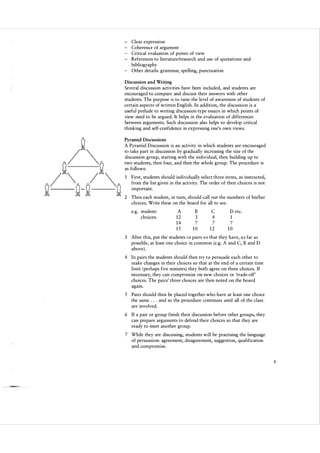
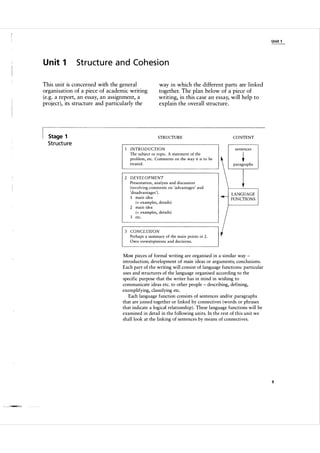
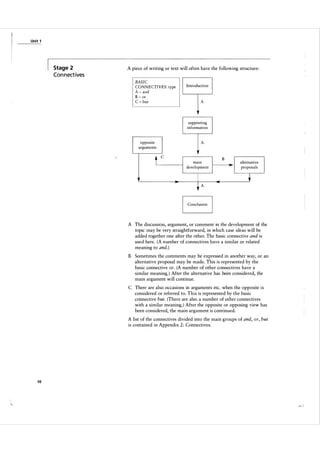
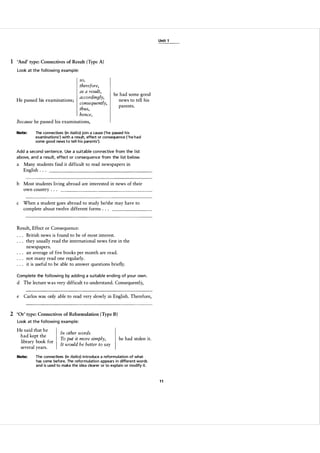
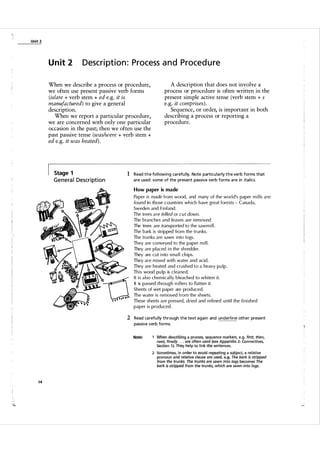
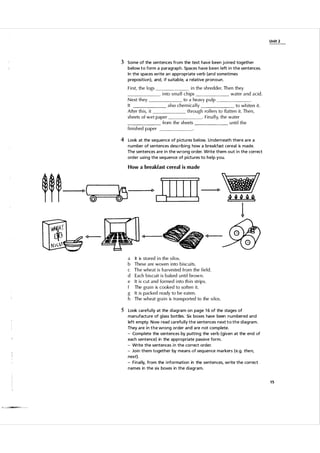
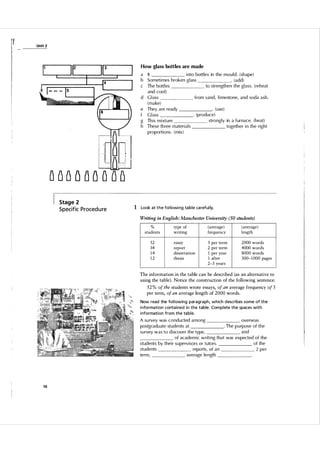
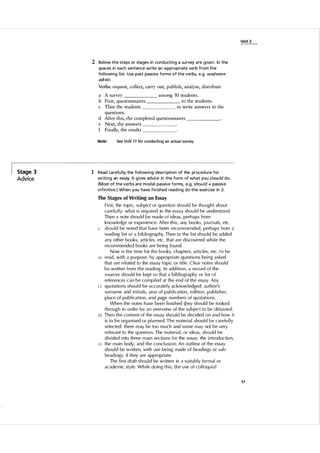
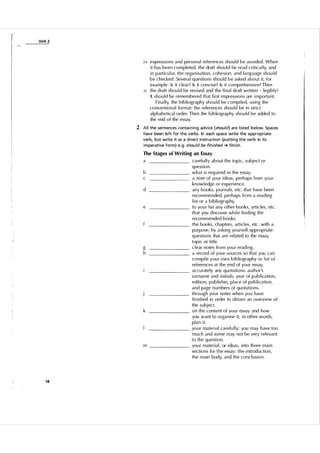
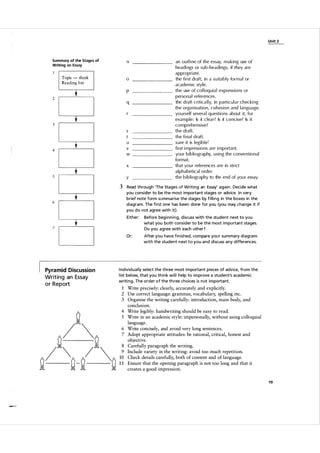
![Unit 2
1 2 Pay as much attention to the conclusion as to the introduction.
13 Avoid the use of cliches, j argon, propaganda, exaggeration, and
emotive language.
14 Ensure that ideas and items are arranged in a logical sequence
and are logically connected.
15 Always acknowledge the source of quotations and paraphrases.
Fina l ly add some advice of your own that is not covered in the l ist
above.
Note:
Structure and
Vocabulary Aid
A
Information about organisihg a Pyramid Diswssion in the
Classroom is given ill the Guide to Using the Book.
Commonly used verb tenses, with examples
Present Simple (Active)
Present Simple (Passive)
it carries/they carry
it is carried/they are carried
Past Simple (Active)
Past Simple ( Passive)
it carried/they carried
it was carried/they were
carried
Modal Passive
B
Imperative/instruction
it should be given/they should be
given
give
Relative pronouns and relative clauses
1
2
3
4
Who/that refers to persons.
Which/that refer to things.
Whose refers to the possessive of persons.
Whom refers to persons and is often used with a preposition.
Examples:
1 My supervisor, who seems very young, has j ust been promoted
to head of department.
2 The article which ( or that) I have just finished reading is very
clearly written.
3 The research that ( or which) I finished last year has j ust been
published.
4 The lecturer whose name I always forget was as boring as usual
this morning.
"
S The student with whom I share a room is very noisy [formal].
The student I share a room with is very noisy [informal].
20](https://image.slidesharecdn.com/academicwritingcourse-140115094224-phpapp02/85/Academic-writing-course-20-320.jpg)
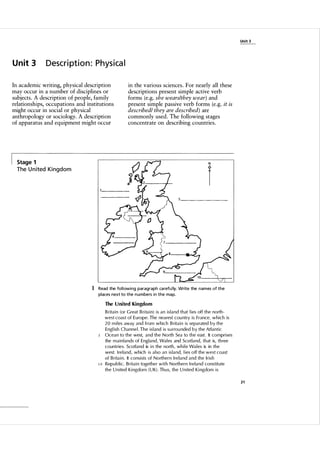
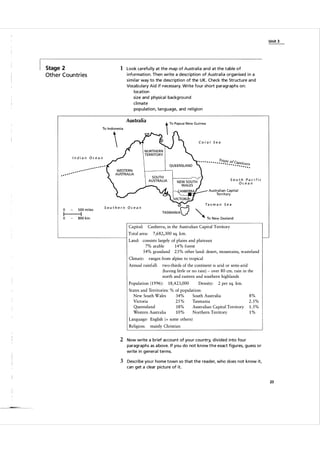
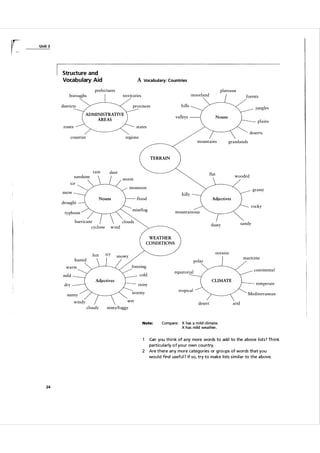
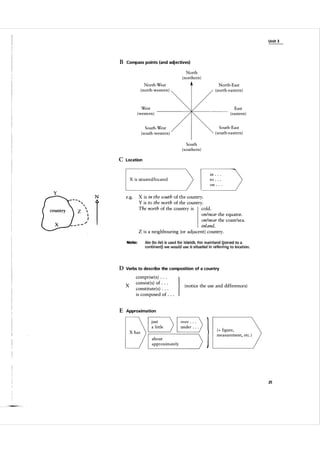
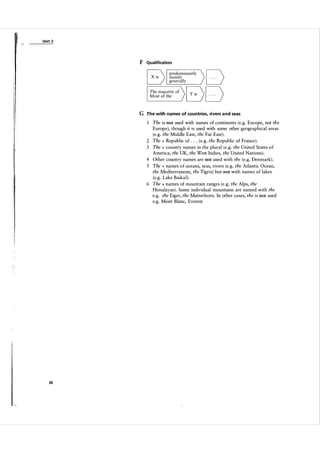
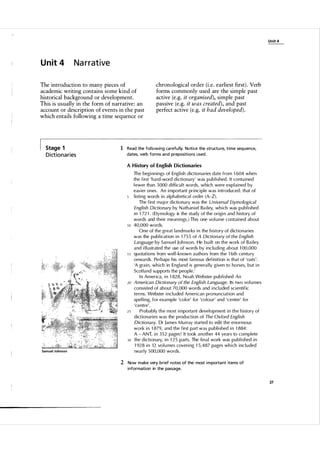
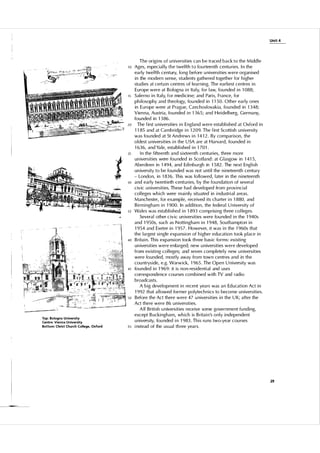
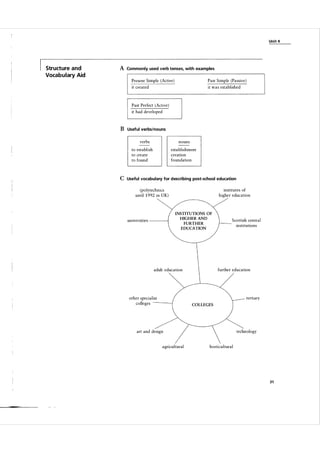
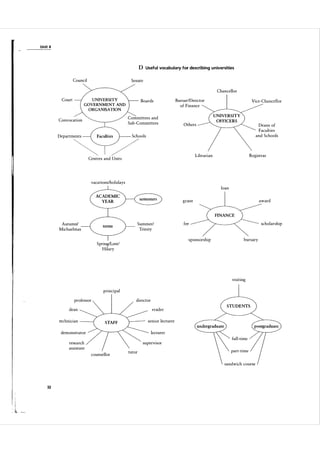
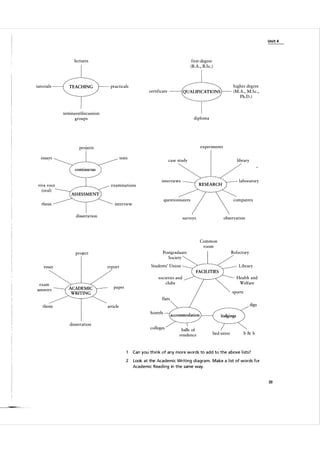
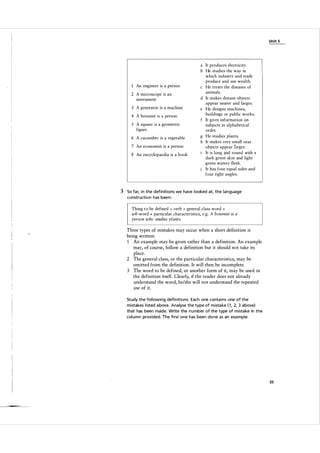
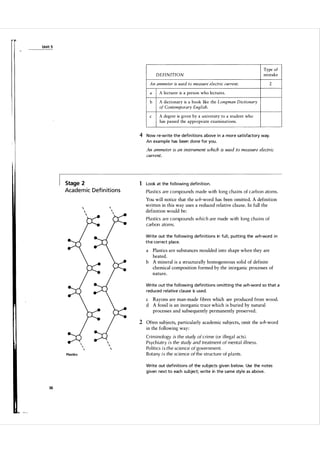
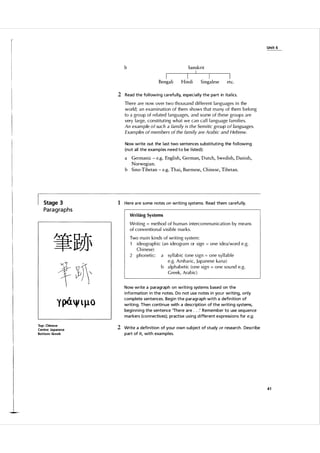
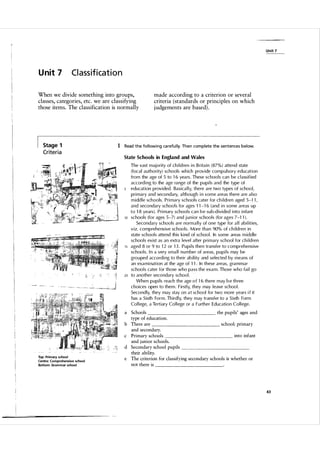
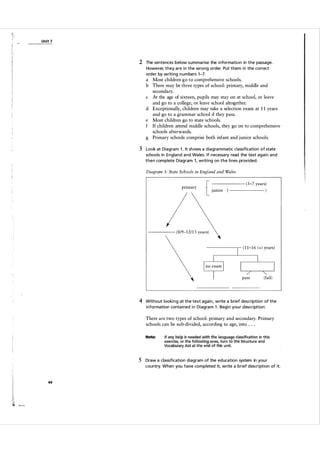
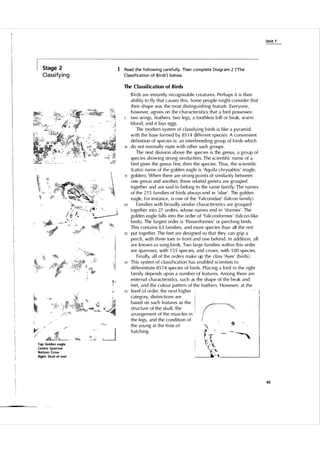
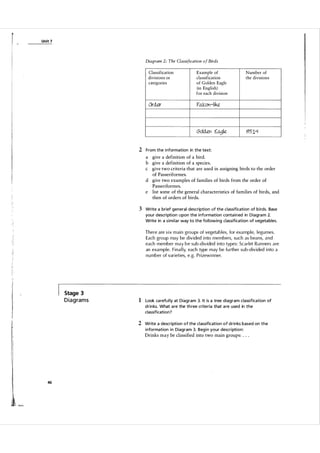
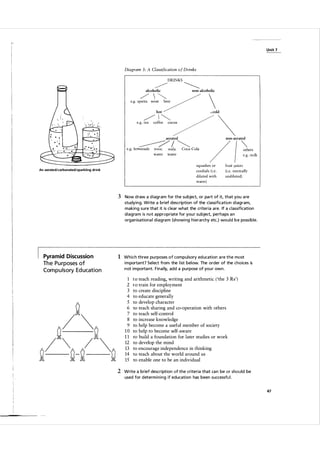
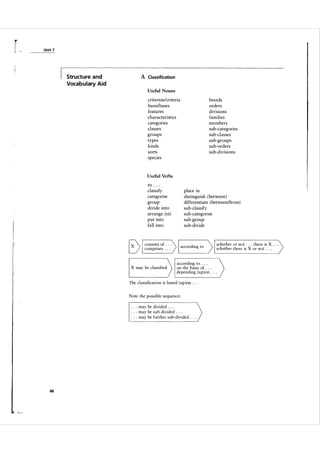
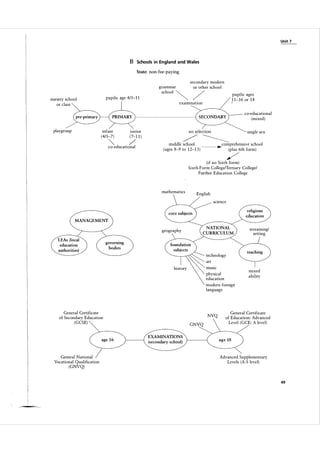
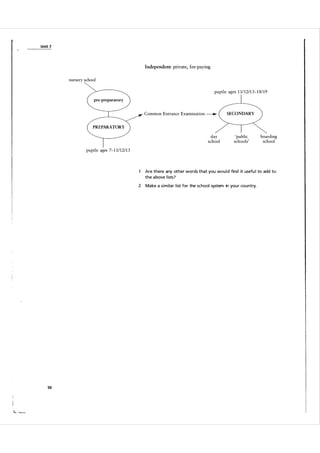
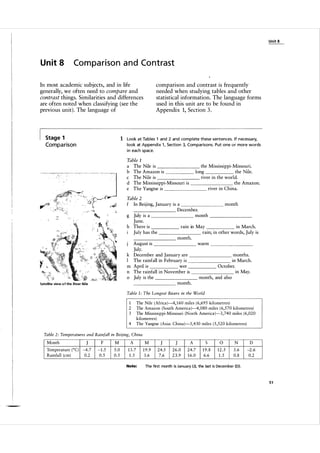
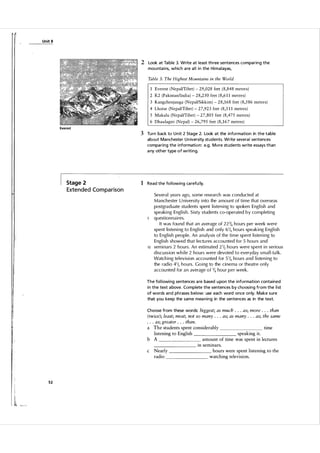
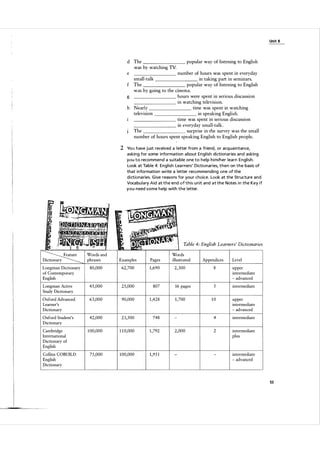
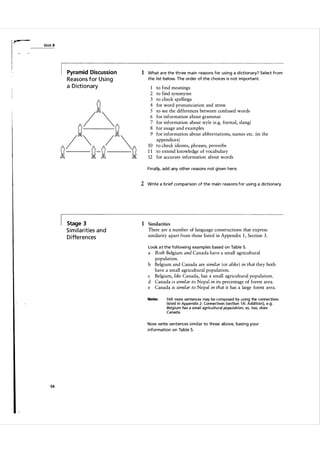
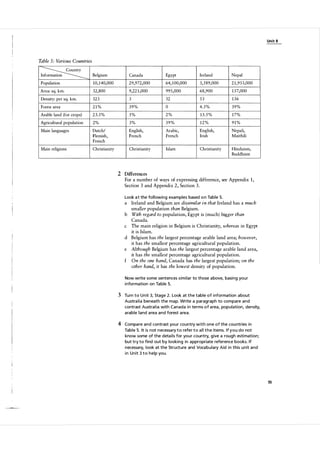
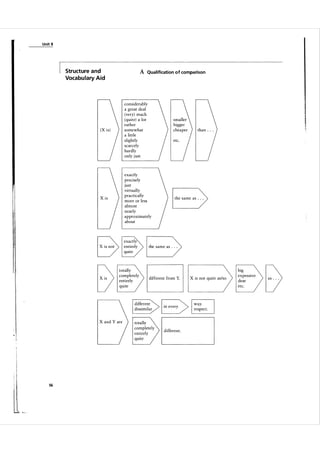
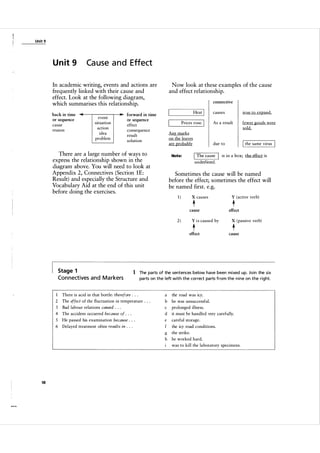
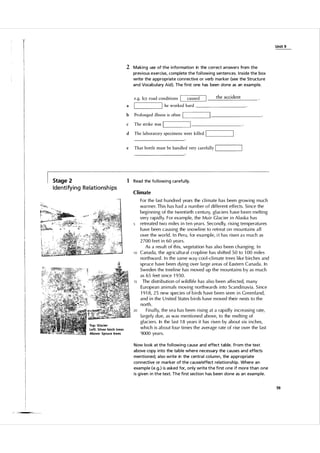
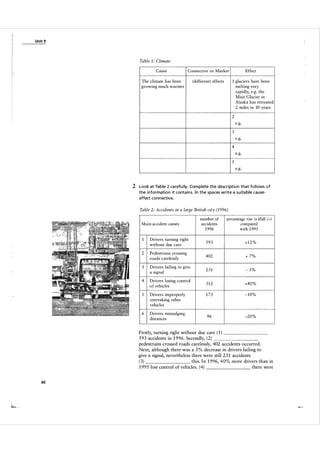
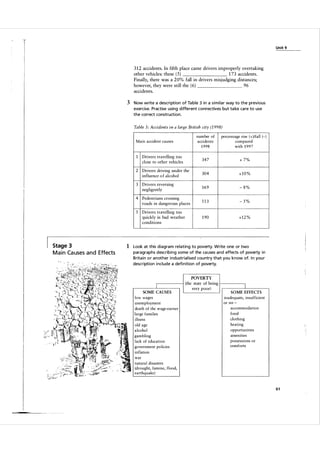
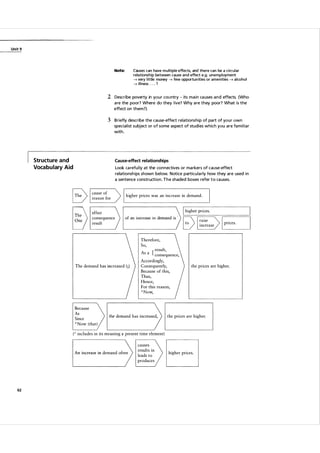
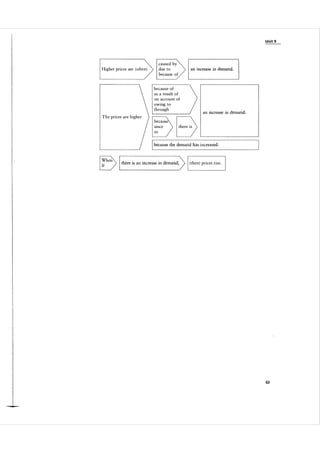
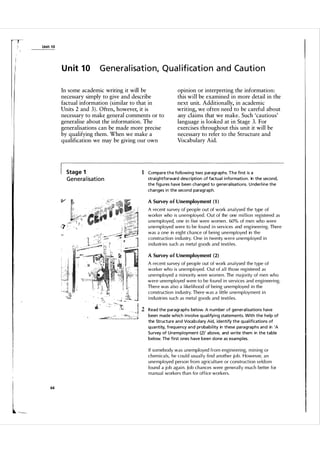
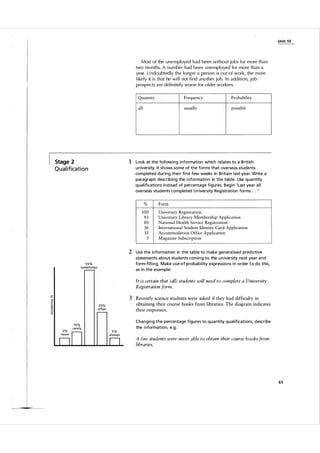
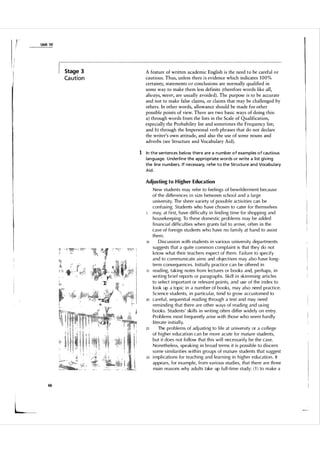
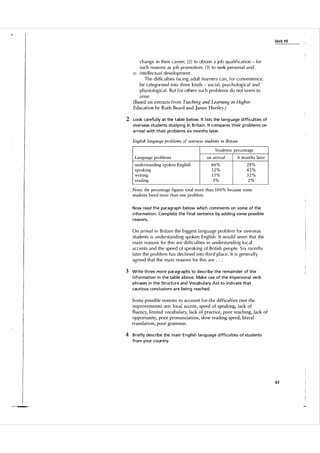
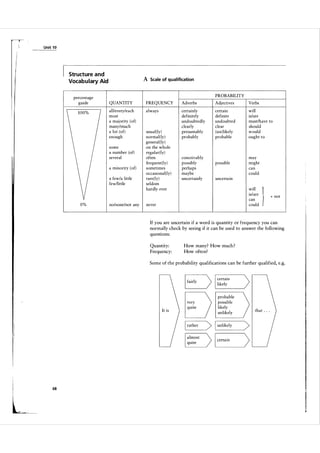
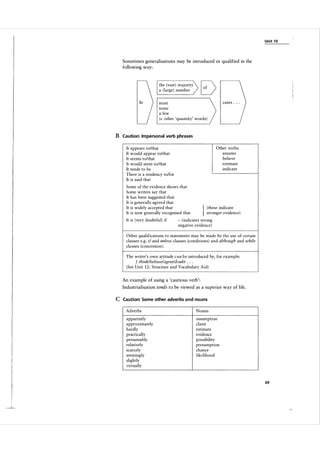
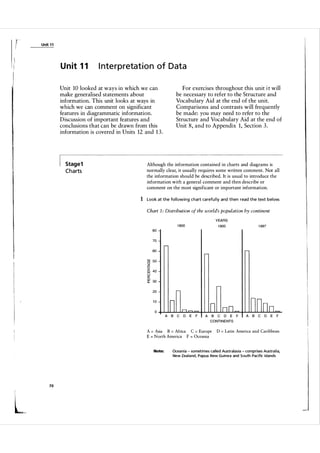
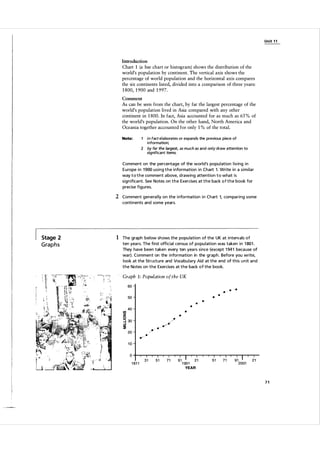
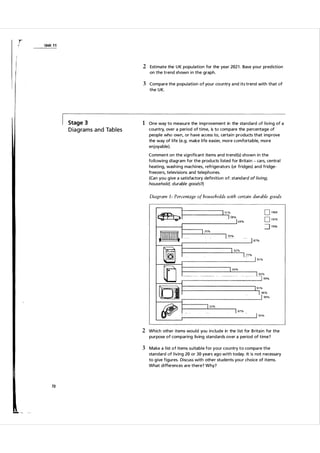
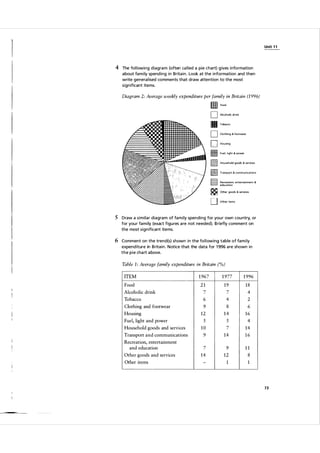
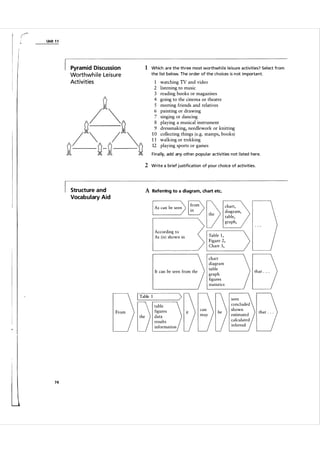
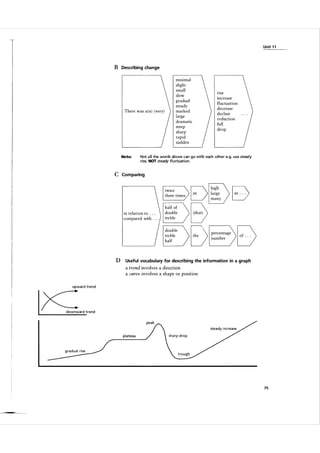
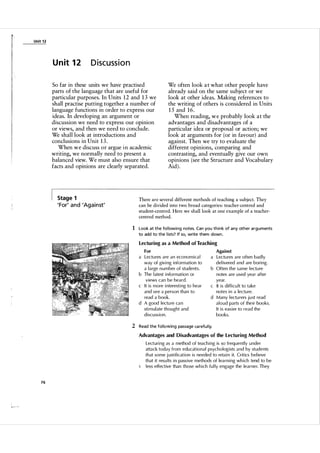
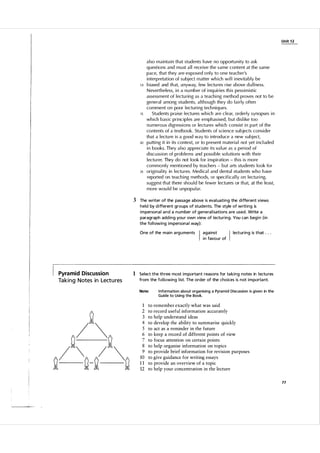
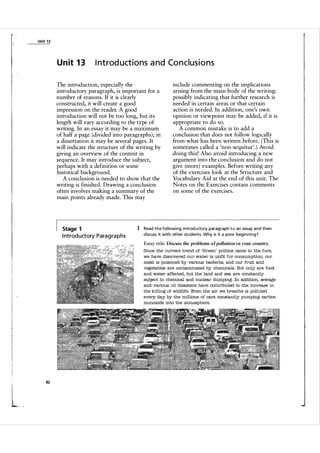
![U n it 1 3
2 The fol l owi ng i ntrod uctory paragraph is on the same subject. Read
it and then d iscuss it. Why is it better than the one a bove?
Desprte -the inc.(eased awareness of -the p(oblems of
pollJ"tiOn in (eGent Ijea(s, 'O(i-tain c.on-tinues -to -t(ail
behind ffiOS-t of Wes-tem Eu(ope in adopiing s-t(ic.-te(
meaSJ(e5 of c.on-tcol. While i-t is almos-t impossible -to
C-onside( -the p(oblems of polilliion Wi-th (espec.-t -to one
c.o.ll""t(1j in isolaiion , -the mos-t se(ioUs pcoblems -to
affec.-t 'O(i-tain di(ec.iiIj ace pcobabllj -those of indus-t(ial
and nuc.lea( was-te, pesiic.ides and c.a( exhaus-t fumes.
In wha-t follows, eac.h of -these will be disC.Ussed
-toge-the( Wiih -thei( effec.-ts . I=-inaillj , i-t will be acgued
-tha-t -to c.oniinue -to ignore .5JCh pcoblems is a-t -the
penl nm onllj of 'On-tain '05 envi(onmen-t bJ"t of -the
envi(onmen-t in gene(al .
3 As a resu lt of read ing the two pa ragra phs and you r discussions, try
to write a better-structu red paragraph on the same topic for your
cou ntry.
4 Below are two i ntrod uctory paragraphs that might beg i n the essay
on the title given . Both of the pa ragra phs have been written by
native Engl ish-speakers. Read the paragraphs ca refu l ly a n d decide
which one you th i n k is best, and why. D iscuss your views with other
students to see if you agree.
Essay title: Discuss the present-day problems facing secondary
education in your country.
a
{heTe qTe. of cOUTse. two seCtOTS of second
qTy
ed
ucqtlon m £
ng!qnd qnd Wq!es: the prtvQte seCtOT
qnd the stQte seCtOT -rhls es/Xty {1!{!! he concerned
only with the !Qtter since It is hy fqT the !qTgeT qnd
is fqced {11th 711qny moTe proh!erns {hese Cqn he
tTqced to two I]11portqnt sourceS: q TqPi
chqngmg
SOCiety Q"nd q !qct of reSOlATces
d!y
b
This essay will examine the problems facing secondary
education in Britain today. It will examine the background
to the problems, starting with the
1 944
Education Act,
which established universal free primary and secondary
education. It will then look at problems associated with
comprehensive schools. After this, it will examine the
concept of the National Curriculum, the extended
responsibilities and powers of school governors and the
local management of schools. Finally, there will be an
analysis of the relationship between central government and
local education authorities, and a discussion of the problems
relating to the financing of schools.
83](https://image.slidesharecdn.com/academicwritingcourse-140115094224-phpapp02/85/Academic-writing-course-83-320.jpg)
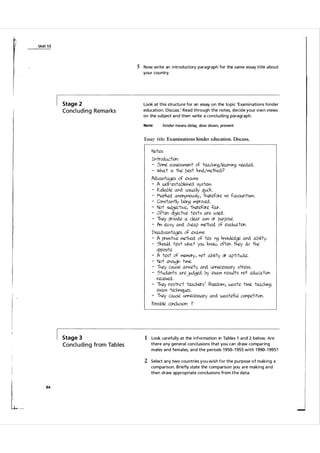
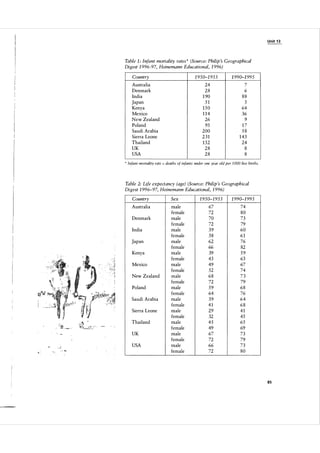
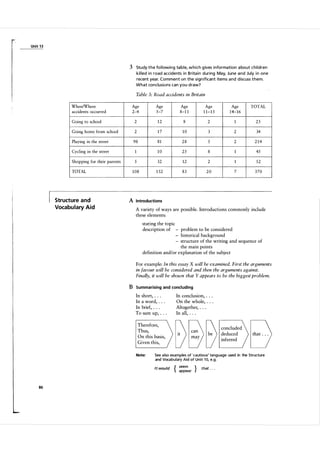
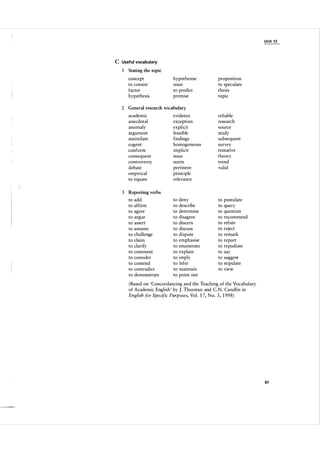
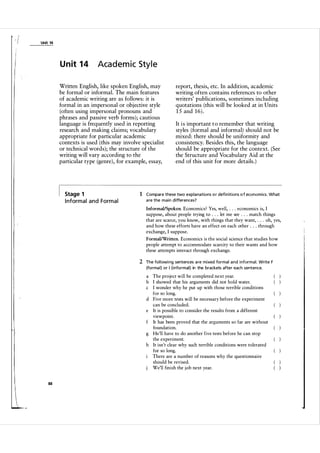
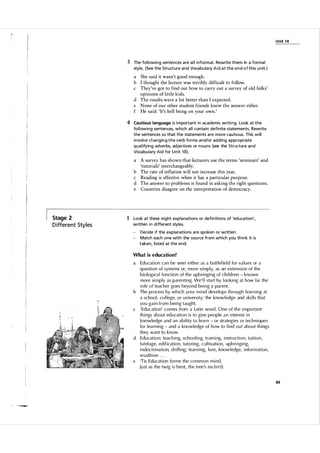
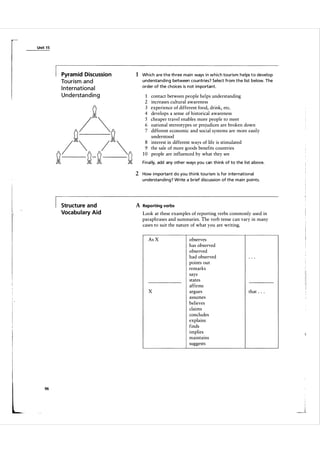
![, ,
U n it 1 6
2 There are a n u m ber of errors in the bibl iogra phy or l i st of
references bel ow. These may be to do with the order of items or the
omission of some deta i ls. M a rk the places where the errors occur
and then write a description of the error and what is needed to
correct it.
Abbott, G. ( 1 9 8 1 ) . Encouraging communication in
English: a paradox. ELT Journal.
James, K. ( 1 9 84a) . The writing of theses by speakers
of English as a Foreign Language: the results of a case
study. In R. Williams, J. Swales and ]. Kirkman ( Eds. ) .
Common ground: shared interests in ESP and
communication studies. ELT documents: 1 1 7.
James ( 1 9 84 b ) . Speak to Learn.
McDonough, J. ( 1 9 8 4 ) . ESP in Perspective: A
Practical Guide. Collins ELT: London.
Mackay, R. & A . Mountford ( Eds . ) ( 1 9 78 ) . English
for Specific Purposes . London: Longman.
Zamel, V. Responding to student writing. TESOL
Quarterly, 19 ( 1 ) .
Swales, J.M. ( 1 995 ) . The role of the textbook in EAP
writing research. English for Specific Purposes, 1 4 ( 1 ) .
Swales, J . M . and G.B. Feak ( 1 9 94 ) . Academic Writing
for Graduate Students. Ann Arbor: University of
Michigan Press.
3 Write a short bibliography for yOU r su bject, l isti n g five to ten books
and articles. Ensure that a l l the deta il s a re correct.
Stage 2
Q u otations a n d
References
1 Read the fol lowing passage ca refu l ly. Notice the different ways in
which the quotations a re used and how they a re acknowledged.
Notice a l so how the references a re l isted at the end.
-
From how many d i fferent sources are di rect quotations made?
From how many d i fferent sou rces a re paraph rases made?
99](https://image.slidesharecdn.com/academicwritingcourse-140115094224-phpapp02/85/Academic-writing-course-99-320.jpg)
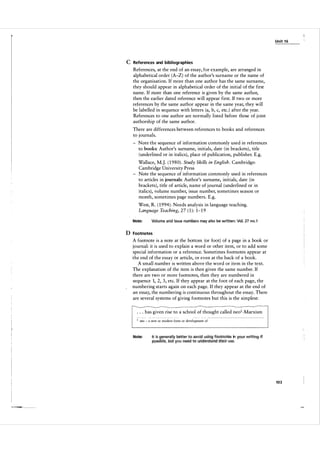
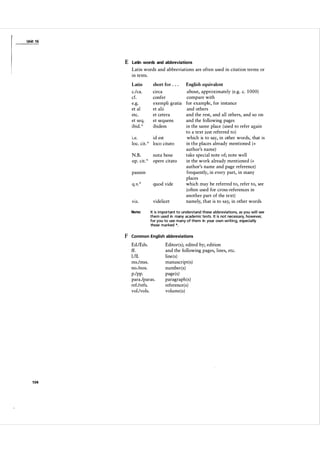
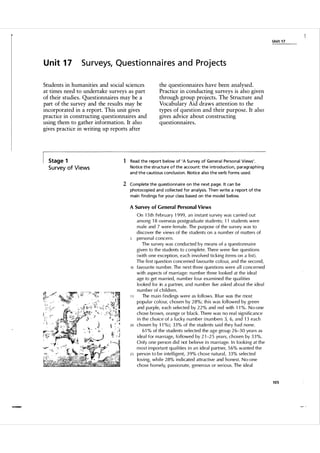
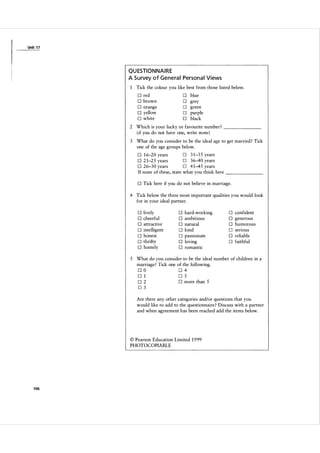
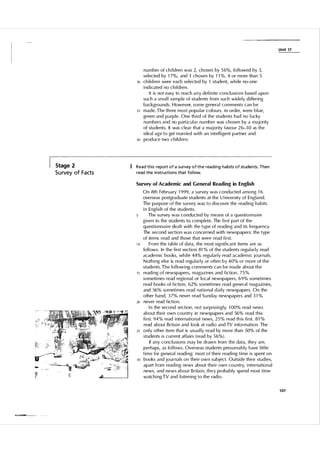
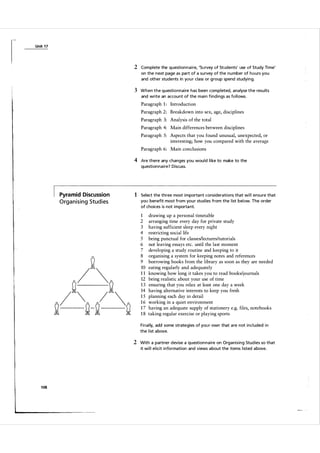
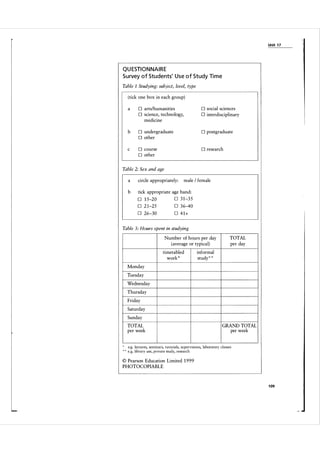
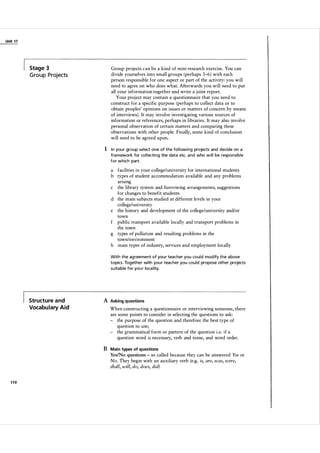
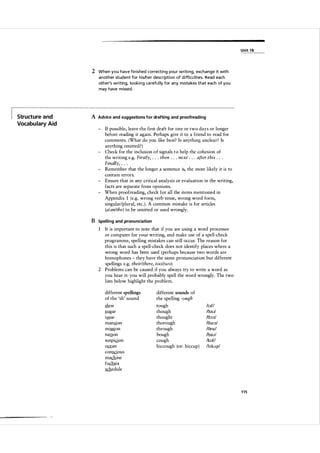
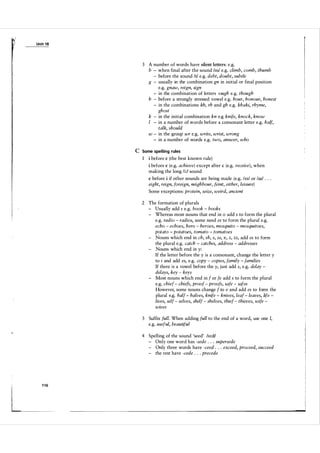
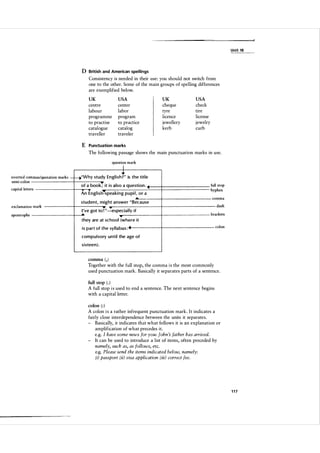
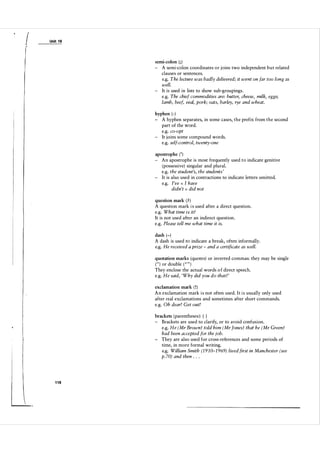
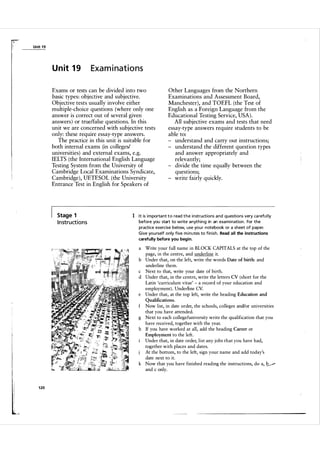
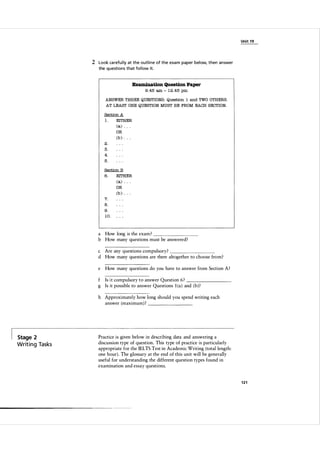
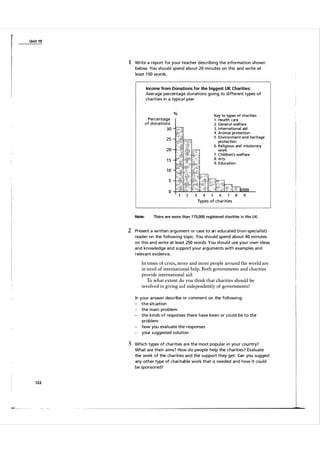
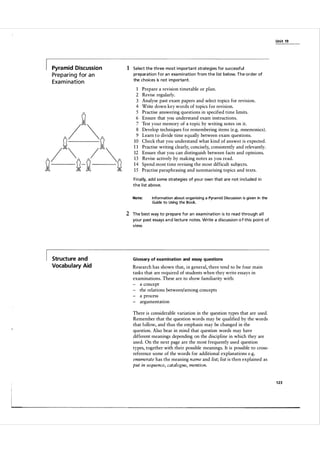
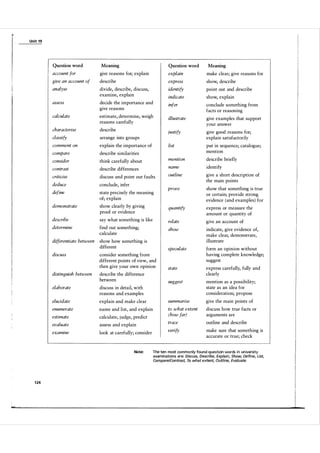
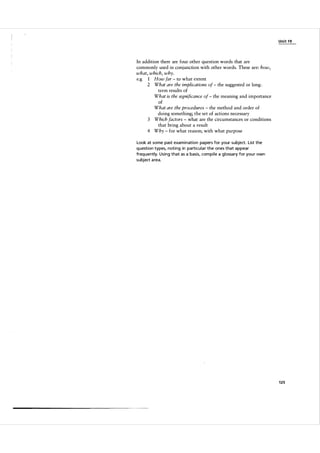
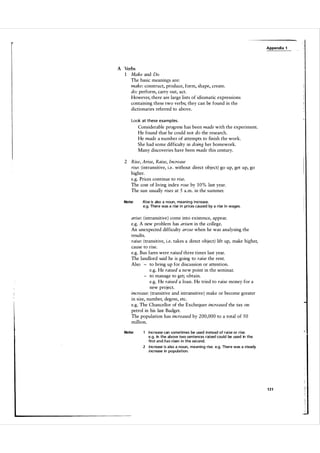
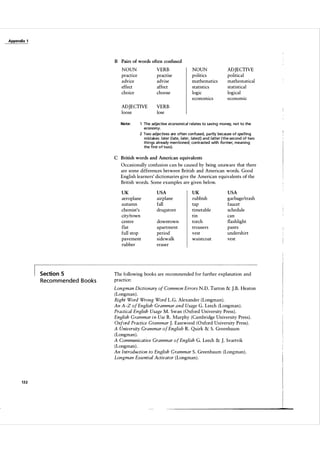
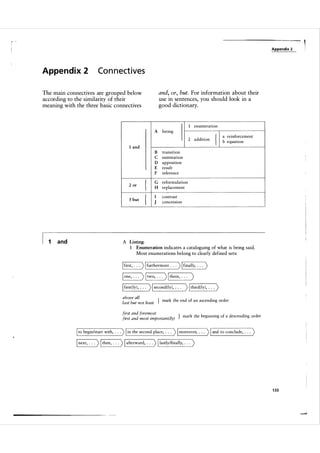
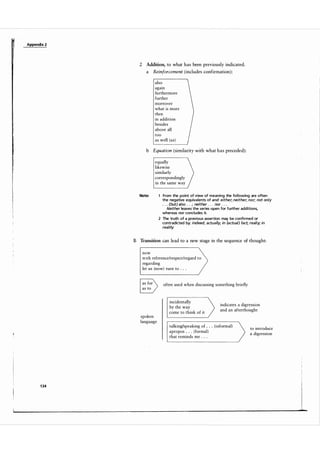
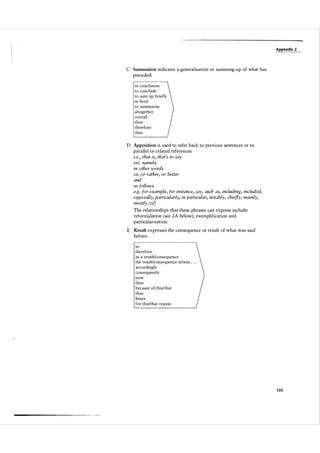
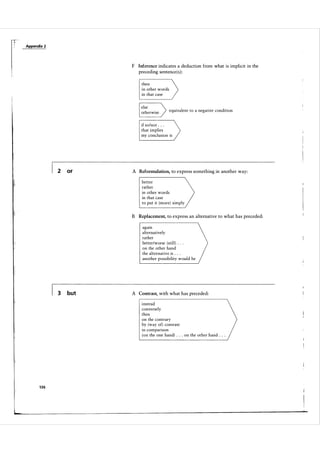
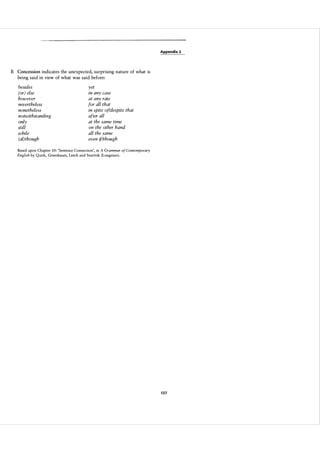
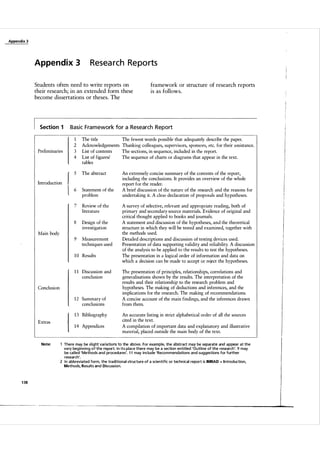
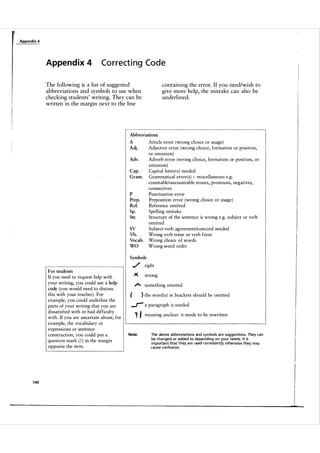
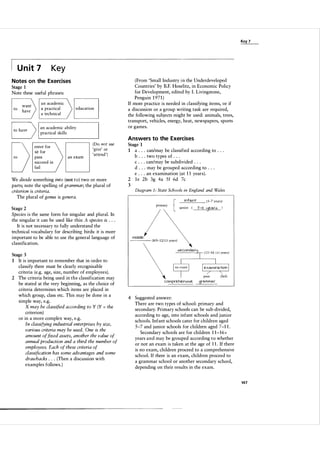
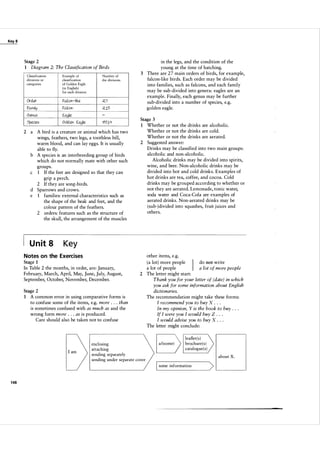
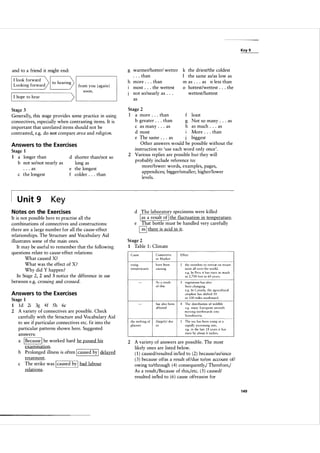
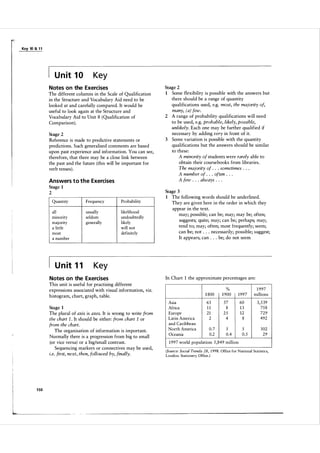
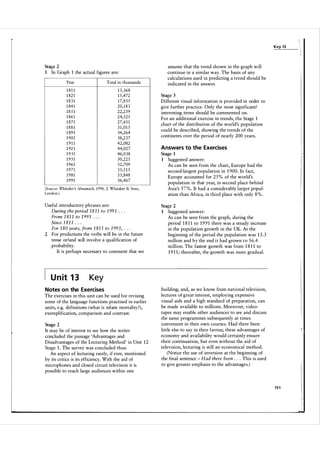
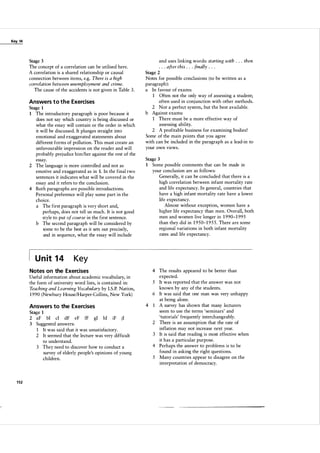
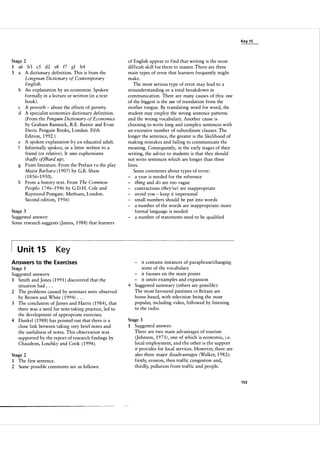
![U n it 1 6
Key
Answers to the Exercises
Stage 1
1
LIST A
LIST B
1 Davey, A.C
1
2 Davey, A.M.
2
3 Davidson, D.
3
4 Davidson, G.D.
4
5 Davies, CT.
5
6 Davies, CW.
6
7 Davis, A.
7
8 Davy, A.
8
9 Dawes, CG.
9
1 0 Dawkins, R .
10
1 1 Dawson, E.
11
1 2 Day, D.A.
12
2
Jackson, ].
James, CV.
James, D.Y.
James, K.
Johns, A.M.
Johns, C
Johns, T.E
Johnson, K.
Johnson, R.
Johnston, S.A.
Jones, C
Jones, ].E
The bibliography below has been corrected with
some comments about the errors.
Author's
initial needed
i.e. K.
Volume
number (and issue
number) needed
e.g. 3 5 ( 3 )
Abbott, G. ( 1 9 8 1 ) . Encouraging communication in English:
a paradox. ELT Journal
James, K. ( 1 984a). The writing of theses by speakers of
English as a Foreign Language: the results of a case study.
In R. Williams, ]. Swales and J. Kirkman (Eds.). Common
ground: shared interests in ESP and communication
studies. ELT Documents: 1 1 7.
James ( 1 984b). Speak to Learn.
_-------1--;
McDonough, J. ( 1 984). ESP in Perspective: A Practical
Guide. Collins ELT: London
��-=-:--=-��-:-
��
_
_
Mackay, R. & A. Mountford (Eds.) ( 1 97 8 ) . English for
Specific Purposes. London: Longman.
Wrong
order: should
be last. The year
of publication of
the journal is
needed e.g.
Zamel, V.
( 1 98 5 )
Zamel, V. Responding to student writing. TESOL Quarterly,
19 ( 1 ) .
Swales, ].M. ( 1 995). The role o f the textbook i n EAP writing
research. English for Specific Purposes, 14 ( 1 ) .
-.,/
_
_
Place
should come
before the name of
the publisher i.e.
London: Collins
ELT
Swales, ].M. and C.B. Feak ( 1 994). Academic Writing for
Graduate Students. Ann Arbor: University of Michigan
Press.
Comments:
McDonough comes before Mackay (McD MacD ) .
Swales, ].M. ( 1 995) comes before Swales and Feak
( 1 994) even though it is a year later - because the
names of authors alone come before two or three
names together.
=
1 54
Publisher
and place needed
e.g. London: Collins
ELT
Stage 2
1
There are two sources for quotations:
- Beard and Hartley, 1 9 84
- Hartley and Knapper, 1 9 84
There are four sources for paraphrases:
- Smith, 1 982
- Jordan, 1 993
- Hartley and Knapper, 1 9 84
- Northedge, 1 990](https://image.slidesharecdn.com/academicwritingcourse-140115094224-phpapp02/85/Academic-writing-course-154-320.jpg)