PIPD or ‘M5’ rigid-rod polymer
•
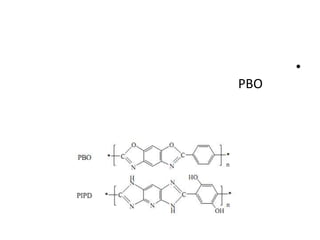
(rigid-rod polymers)PBO
•
•
PBO
• As a result of research in Akzo-Nobel
laboratories a new high-performance fibre,
known as ‘M5’, has been produced.
• The polymer is poly{2,6-diimidazo[4,5-β:4`,5`-ε]pyridinylene-
1,4-(2,5-dihydroxy)phenylene} or PIPD
• Two methods have proved effective in preparing
high modulus, high tenacity (HM-HT) polymer
fibres:
(a) perfecting the drawing technique of precursor
fibres to attain draw ratios far above ten, as in the
well-known polyethylene Dyneema and Spectra
yarns.
(b) manipulating rigid rod-like molecules into fibres
that are already very highly oriented in the as-spun
state, as in PPTA fibres.
polymerization
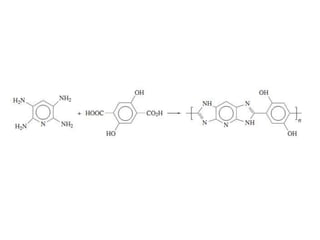
• M5 fiber is prepared by condensation polymerization
between tetraaminopyridine and dihydroxyterephtha
lic acid using diphosphorus pentoxide as a
dehydrating agent.
• A much greater step forward was achieved by
the synthesis of the TAP-DHTA 1 : 1 complex,
or TD salt.
• it precipitates in a high yield from the
combination of aqueous solutions of TAP HCl
salt and DHTA Na or K salt.
• A fast polymerisation cycle (typically 4–5 h,
rather than >24 h according to Ref. 24) now
yields high MW polymer much more
consistently than in the case where amine and
acid components are weighed separately:
• The polymerization of homopolymer consists
of taking TD salt, polyphosphoric acid and
P2O5 with a trace of tin powder into the
reactor, displacing air by nitrogen and raising
the reaction temperature to 140 °C.
• Mixing for at least 1.5 h at that temperature
before taking the mixture to 180 °C and
stirring for another 1–2 h yields the spinning
solution.
• The solution becomes liquid crystalline about
1 h after it reaches 140 °C.
• The P2O5 content of the solvent system
controls the final molecular weight, and
obviously only the highest purity TD salt will
deliver the highest MW polymers.
• The polymer mixture is then heated and
extruded to form brightly blue polymer fibers.
The fibers are then washed extensively with
water and base in order to remove
the phosphoric acid generated by the
hydration of diphosphorus pentoxide from the
polymer.
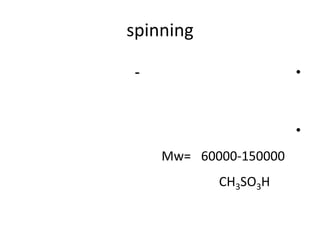
spinning
•-
•
Mw= 60000-150000
CH3SO3H
•
•
•
•
Pipd or ‘m5’ rigid rod polymer

Pipd or ‘m5’ rigid rod polymer

  • 1.
    PIPD or ‘M5’rigid-rod polymer
  • 2.
  • 3.
  • 4.
  • 5.
    • As aresult of research in Akzo-Nobel laboratories a new high-performance fibre, known as ‘M5’, has been produced.
  • 6.
    • The polymeris poly{2,6-diimidazo[4,5-β:4`,5`-ε]pyridinylene- 1,4-(2,5-dihydroxy)phenylene} or PIPD
  • 7.
    • Two methodshave proved effective in preparing high modulus, high tenacity (HM-HT) polymer fibres: (a) perfecting the drawing technique of precursor fibres to attain draw ratios far above ten, as in the well-known polyethylene Dyneema and Spectra yarns. (b) manipulating rigid rod-like molecules into fibres that are already very highly oriented in the as-spun state, as in PPTA fibres.
  • 8.
    polymerization • M5 fiberis prepared by condensation polymerization between tetraaminopyridine and dihydroxyterephtha lic acid using diphosphorus pentoxide as a dehydrating agent.
  • 10.
    • A muchgreater step forward was achieved by the synthesis of the TAP-DHTA 1 : 1 complex, or TD salt. • it precipitates in a high yield from the combination of aqueous solutions of TAP HCl salt and DHTA Na or K salt.
  • 11.
    • A fastpolymerisation cycle (typically 4–5 h, rather than >24 h according to Ref. 24) now yields high MW polymer much more consistently than in the case where amine and acid components are weighed separately:
  • 12.
    • The polymerizationof homopolymer consists of taking TD salt, polyphosphoric acid and P2O5 with a trace of tin powder into the reactor, displacing air by nitrogen and raising the reaction temperature to 140 °C. • Mixing for at least 1.5 h at that temperature before taking the mixture to 180 °C and stirring for another 1–2 h yields the spinning solution.
  • 13.
    • The solutionbecomes liquid crystalline about 1 h after it reaches 140 °C.
  • 14.
    • The P2O5content of the solvent system controls the final molecular weight, and obviously only the highest purity TD salt will deliver the highest MW polymers.
  • 15.
    • The polymermixture is then heated and extruded to form brightly blue polymer fibers. The fibers are then washed extensively with water and base in order to remove the phosphoric acid generated by the hydration of diphosphorus pentoxide from the polymer.
  • 16.
  • 17.
  • 18.