TM 1051
Introduction
In 1940, DuPont manufactured acrylic from
Acrylonitrile.
According to FTC;
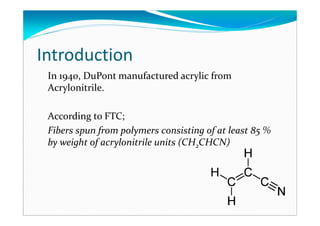
Fibers spun from polymers consisting of at least 85 %
by weight of acrylonitrile units (CH2CHCN)
Raw material:
Vinyl acetate
Acrylic monomer
Ammonium sulphate
Sodium bisulphite
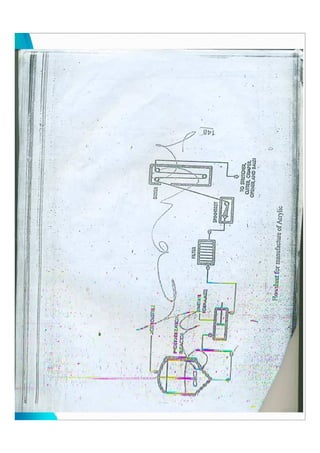
Polymerization
Ammonium sulfate and sodium bi sulfhite are
dissolved in demineralized water at 40 degree
centigrade
A mixture of acrylonitrile monomer and vinyl
acetate monomer are added slowly with stirring for
a period of 2 hours
The reaction is exothermic
Monomers are soluble in water but polymer is not
The air is replaced by inert gas like (ammonia)
Polymer is separated as slurry from the solution
The slurry is withdrawn and washed until it is free
from salts and then dried
Spinning:
Polymer powder is dissolved in solvent- dimethyl
formamide
A delustring agent is added during polymer
preparation
It is then filtered and then immediately used for
spinning
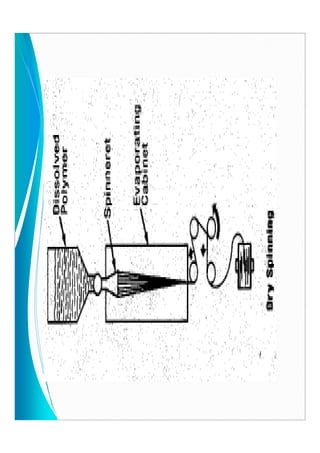
Dry spinning:
After filtration of polymer, it is heated to boiling
point and then extruded through spinneret
The fine jets of solution emerge into vertical tube
through which air is flowing at high temperature
(400 degree centigrade is flowing)
As jets fall through the tube, the solvent evaporate
and leave solid filaments of polymer
The filaments are stretched 3-10 times original
length in this hot state
The continuous filaments are spun and collected
on bobbin with speed at about 1000-1200 m/min
Filaments yarn are made in 75-200 denier range
For manufacture of staple fibers continuous
filaments are washed, are crimped and cut into
lengths 1.5-2 inch
Wet spinning:
Polymer is dissolved in solvent and then fed to
spinneret
It is then pumped through spinneret in a
coagulating bath in which solvent is soluble but
polymer is insoluble
the jets of solution coagulates into fine filaments
The filaments are passed over steam heated rollers
at 100-110 degree centigrade and rotating at high
speed
Stretching is carried out at 4-10 times to their
original lengths
the filaments are crimped and then cut into
various staple length
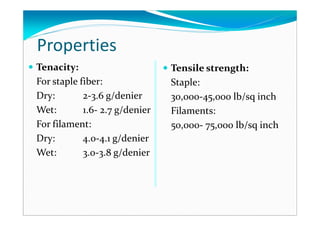
Properties
Tenacity:
For staple fiber:
Dry: 2-3.6 g/denier
Wet: 1.6- 2.7 g/denier
For filament:
Dry: 4.0-4.1 g/denier
Wet: 3.0-3.8 g/denier
Tensile strength:
Staple:
30,000-45,000 lb/sq inch
Filaments:
50,000- 75,000 lb/sq inch
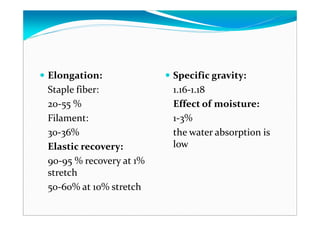
Elongation:
Staple fiber:
20-55 %
Filament:
30-36%
Elastic recovery:
90-95 % recovery at 1%
stretch
50-60% at 10% stretch
Specific gravity:
1.16-1.18
Effect of moisture:
1-3%
the water absorption is
low
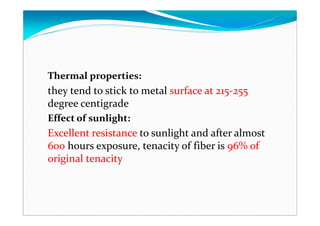
Thermal properties:
they tend to stick to metal surface at 215-255
degree centigrade
Effect of sunlight:
Excellent resistance to sunlight and after almost
600 hours exposure, tenacity of fiber is 96% of
original tenacity
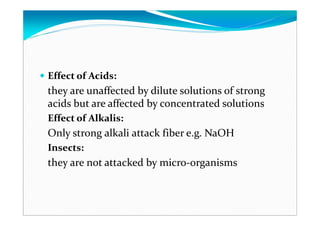
Effect of Acids:
they are unaffected by dilute solutions of strong
acids but are affected by concentrated solutions
Effect of Alkalis:
Only strong alkali attack fiber e.g. NaOH
Insects:
they are not attacked by micro-organisms
End uses:
Used for apparel, knitwea, Blankets, and carpets

Acrylic

  • 1.
  • 2.
    Introduction In 1940, DuPontmanufactured acrylic from Acrylonitrile. According to FTC; Fibers spun from polymers consisting of at least 85 % by weight of acrylonitrile units (CH2CHCN)
  • 3.
    Raw material: Vinyl acetate Acrylicmonomer Ammonium sulphate Sodium bisulphite
  • 4.
    Polymerization Ammonium sulfate andsodium bi sulfhite are dissolved in demineralized water at 40 degree centigrade A mixture of acrylonitrile monomer and vinyl acetate monomer are added slowly with stirring for a period of 2 hours The reaction is exothermic Monomers are soluble in water but polymer is not The air is replaced by inert gas like (ammonia)
  • 5.
    Polymer is separatedas slurry from the solution The slurry is withdrawn and washed until it is free from salts and then dried
  • 6.
    Spinning: Polymer powder isdissolved in solvent- dimethyl formamide A delustring agent is added during polymer preparation It is then filtered and then immediately used for spinning
  • 7.
    Dry spinning: After filtrationof polymer, it is heated to boiling point and then extruded through spinneret The fine jets of solution emerge into vertical tube through which air is flowing at high temperature (400 degree centigrade is flowing) As jets fall through the tube, the solvent evaporate and leave solid filaments of polymer
  • 8.
    The filaments arestretched 3-10 times original length in this hot state The continuous filaments are spun and collected on bobbin with speed at about 1000-1200 m/min Filaments yarn are made in 75-200 denier range For manufacture of staple fibers continuous filaments are washed, are crimped and cut into lengths 1.5-2 inch
  • 10.
    Wet spinning: Polymer isdissolved in solvent and then fed to spinneret It is then pumped through spinneret in a coagulating bath in which solvent is soluble but polymer is insoluble the jets of solution coagulates into fine filaments
  • 11.
    The filaments arepassed over steam heated rollers at 100-110 degree centigrade and rotating at high speed Stretching is carried out at 4-10 times to their original lengths the filaments are crimped and then cut into various staple length
  • 13.
    Properties Tenacity: For staple fiber: Dry:2-3.6 g/denier Wet: 1.6- 2.7 g/denier For filament: Dry: 4.0-4.1 g/denier Wet: 3.0-3.8 g/denier Tensile strength: Staple: 30,000-45,000 lb/sq inch Filaments: 50,000- 75,000 lb/sq inch
  • 14.
    Elongation: Staple fiber: 20-55 % Filament: 30-36% Elasticrecovery: 90-95 % recovery at 1% stretch 50-60% at 10% stretch Specific gravity: 1.16-1.18 Effect of moisture: 1-3% the water absorption is low
  • 15.
    Thermal properties: they tendto stick to metal surface at 215-255 degree centigrade Effect of sunlight: Excellent resistance to sunlight and after almost 600 hours exposure, tenacity of fiber is 96% of original tenacity
  • 16.
    Effect of Acids: theyare unaffected by dilute solutions of strong acids but are affected by concentrated solutions Effect of Alkalis: Only strong alkali attack fiber e.g. NaOH Insects: they are not attacked by micro-organisms
  • 17.
    End uses: Used forapparel, knitwea, Blankets, and carpets