In this research are described    answers on following questions:   - What is the composition of the Mowilith    resins? - How are they made? - What is process?  - What are costs of the materials?  - What are costs of production?  - Business plan for production.
The aim is by research proposals as:  - literature research/patent inventory  polymerisations of  the PVAc(with attention  points on Mowilith dispersions in PVa as  stabilization:  Mowilith D ca.50 %,  Mowilith DHS S1,  Mowilith LD 167 and  Mowilith SDM 4230 KL),  - Economic perspective - researches and  - Lab. tests possible polymerisation routes,  determinate the possibilities for production with possible commitment (use) present equipment at "Paramelt”.
polyvinyl acetate (PVAc) Emulsion Polymerisation
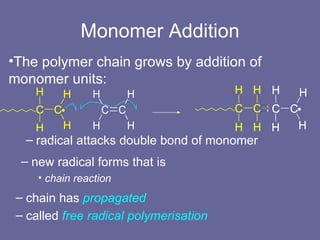
Monomer Addition radical attacks double bond of monomer new radical forms that is  one monomer unit longer chain reaction The polymer chain grows by addition of monomer units: chain has  propagated  called  free radical polymerisation
Initiation From where does the first unpaired electron come? Generated by an  initiator e.g. hydrogen peroxide (H 2 O 2 ) has O–O bond (easy to break) generates 2 OH •  radicals usually don’t use H 2 O 2  but other peroxides, e.g.: potassium persulfate  persulfate ion is: [O 3 S–O–O–SO 3 ] 2– O–O- bond breaks readily at 60 o C to initiate reaction
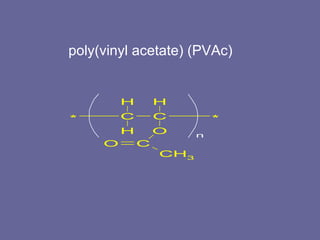
poly(vinyl acetate) (PVAc)
Polymer Colloids Polymers often prepared in colloidal form Polymer Colloids in water Called a latex Why? More environmentally friendly than organic solvents Easier to process and transport than polymer solutions Easier to get greater efficiency in process Can get up to 50/50 polymer/water
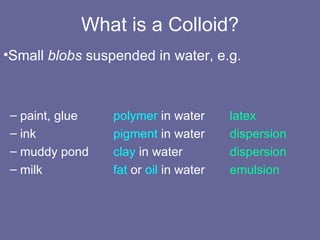
What is a Colloid? Small  blobs  suspended in water, e.g. paint, glue polymer  in water latex ink pigment  in water  dispersion muddy pond clay  in water dispersion milk fat  or  oil  in water emulsion
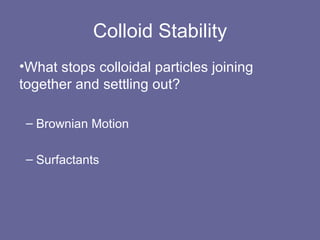
Colloid Stability What stops colloidal particles joining together and settling out? Brownian Motion Surfactants
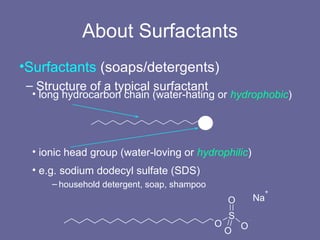
About Surfactants Surfactants  (soaps/detergents) Structure of a typical surfactant long hydrocarbon chain (water-hating or  hydrophobic ) ionic head group (water-loving or  hydrophilic ) e.g. sodium dodecyl sulfate (SDS) household detergent, soap, shampoo
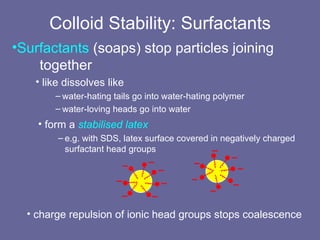
Colloid Stability: Surfactants Surfactants  (soaps) stop particles joining  together like dissolves like water-hating tails go into water-hating polymer water-loving heads go into water charge repulsion of ionic head groups stops coalescence form a  stabilised latex  e.g. with SDS, latex surface covered in negatively charged surfactant head groups
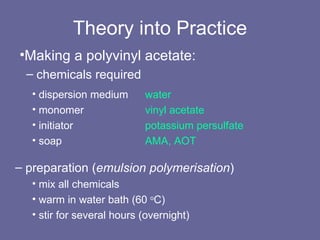
Theory into Practice Making a polyvinyl acetate: chemicals required dispersion medium water monomer  vinyl acetate initiator  potassium persulfate soap  AMA, AOT preparation ( emulsion polymerisation ) mix all chemicals warm in water bath (60  o C) stir for several hours (overnight)
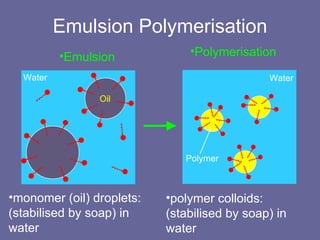
Emulsion Polymerisation Emulsion Polymerisation monomer (oil) droplets: (stabilised by soap) in water polymer colloids:  (stabilised by soap) in water  Water Polymer Water Oil
* actual polymerisation process  very  complex - area of lots of research
Project Cash Flow Project cost money, the spending  of which  usually has to be justified in terms of receiving a return or making profit.
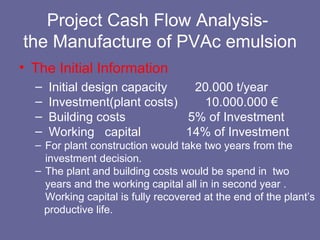
Project Cash Flow Analysis-  the Manufacture of PVAc emulsion The Initial Information Initial design capacity  20.000 t/year  Investment (plant costs)  10.000.000  € Building costs  5% of Investment  Working  capital  14% of Investment  For plant construction would take two years from the investment decision. The plant and building costs would be spend in  two years and the working capital all in in second year .  Working capital is fully recovered at the end of the plant’s productive life.
Production costs estimates Comprise the annual : -  fixed costs -  variable costs
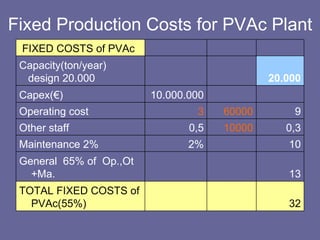
Fixed Production Costs for PVAc Plant FIXED COSTS of PVAc       Capacity(ton/year) design   20.000     20.000 Capex(€)  10.000.000     Operating cost 3 60000 9 Other staff 0,5 10000 0,3 Maintenance 2% 2%   10 General  65% of  Op.,Ot +Ma.     13 TOTAL FIXED COSTS of PVA c (55%)       32
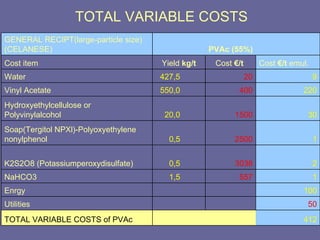
TOTAL VARIABLE COSTS GENERAL RECIPT(large-particle size)(CELANESE)   PVAc (55%) Cost item Yield  kg/t Cost   €/t  Cost   €/t   emul.  Water  427,5  20 9 Vinyl Acetate  550,0  400 220 Hydroxyethylcellulose or Polyvinylalcohol  20,0  1500 30 Soap (Tergitol NPXl)-Polyoxyethylene nonylphenol  0,5  2500 1 K2S2O8 (Potassiumperoxydisulfate) 0,5  3038 2 NaHCO3 1,5  557 1 Enrgy     100 Utilities     50 TOTAL VARIABLE COSTS of PVAc      412
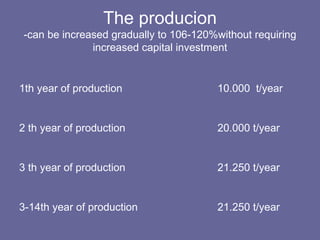
The producion - can  be  increased   gradually  to 106-120%without requiring increased capital investment 1th year of production 10.000  t/year 2 th year of production 20.000  t/year 3 th year of production 21.250  t/year 3-14th  year   of  production 21.250  t/ year
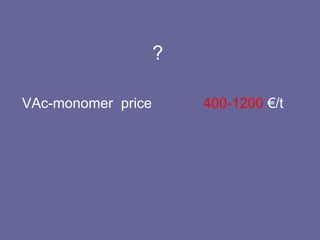
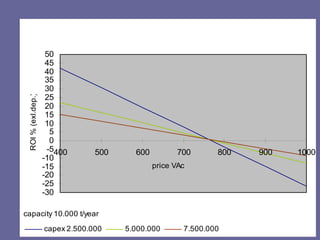
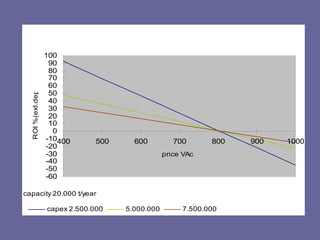
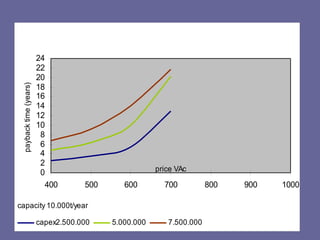
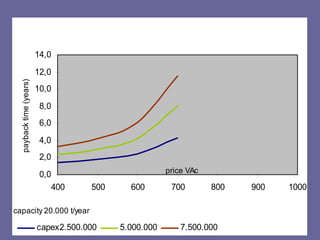
? V A c -monomer   price   400-1200  €/t
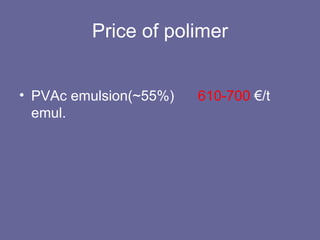
Price of polimer PVAc emulsion(~55%)  610-700  €/t emul.
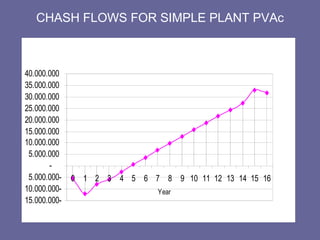
CHASH FLOWS FOR SIMPLE PLANT PVAc
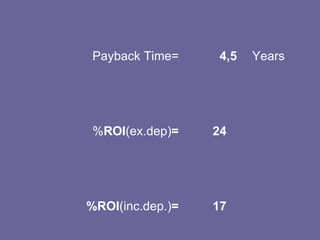
Payback Time= 4,5  Years % ROI (ex.dep) = 24  %ROI (inc.dep.) = 17


PVAc

  • 1.
    Inthis research are described answers on following questions: - What is the composition of the Mowilith resins? - How are they made? - What is process? - What are costs of the materials? - What are costs of production? - Business plan for production.
  • 2.
    The aim isby research proposals as: - literature research/patent inventory polymerisations of the PVAc(with attention points on Mowilith dispersions in PVa as stabilization: Mowilith D ca.50 %, Mowilith DHS S1, Mowilith LD 167 and Mowilith SDM 4230 KL), - Economic perspective - researches and - Lab. tests possible polymerisation routes, determinate the possibilities for production with possible commitment (use) present equipment at "Paramelt”.
  • 3.
    polyvinyl acetate (PVAc)Emulsion Polymerisation
  • 4.
    Monomer Addition radicalattacks double bond of monomer new radical forms that is one monomer unit longer chain reaction The polymer chain grows by addition of monomer units: chain has propagated called free radical polymerisation
  • 5.
    Initiation From wheredoes the first unpaired electron come? Generated by an initiator e.g. hydrogen peroxide (H 2 O 2 ) has O–O bond (easy to break) generates 2 OH • radicals usually don’t use H 2 O 2 but other peroxides, e.g.: potassium persulfate persulfate ion is: [O 3 S–O–O–SO 3 ] 2– O–O- bond breaks readily at 60 o C to initiate reaction
  • 6.
  • 7.
    Polymer Colloids Polymersoften prepared in colloidal form Polymer Colloids in water Called a latex Why? More environmentally friendly than organic solvents Easier to process and transport than polymer solutions Easier to get greater efficiency in process Can get up to 50/50 polymer/water
  • 8.
    What is aColloid? Small blobs suspended in water, e.g. paint, glue polymer in water latex ink pigment in water dispersion muddy pond clay in water dispersion milk fat or oil in water emulsion
  • 9.
    Colloid Stability Whatstops colloidal particles joining together and settling out? Brownian Motion Surfactants
  • 10.
    About Surfactants Surfactants (soaps/detergents) Structure of a typical surfactant long hydrocarbon chain (water-hating or hydrophobic ) ionic head group (water-loving or hydrophilic ) e.g. sodium dodecyl sulfate (SDS) household detergent, soap, shampoo
  • 11.
    Colloid Stability: SurfactantsSurfactants (soaps) stop particles joining together like dissolves like water-hating tails go into water-hating polymer water-loving heads go into water charge repulsion of ionic head groups stops coalescence form a stabilised latex e.g. with SDS, latex surface covered in negatively charged surfactant head groups
  • 12.
    Theory into PracticeMaking a polyvinyl acetate: chemicals required dispersion medium water monomer vinyl acetate initiator potassium persulfate soap AMA, AOT preparation ( emulsion polymerisation ) mix all chemicals warm in water bath (60 o C) stir for several hours (overnight)
  • 13.
    Emulsion Polymerisation EmulsionPolymerisation monomer (oil) droplets: (stabilised by soap) in water polymer colloids: (stabilised by soap) in water Water Polymer Water Oil
  • 14.
    * actual polymerisationprocess very complex - area of lots of research
  • 15.
    Project Cash FlowProject cost money, the spending of which usually has to be justified in terms of receiving a return or making profit.
  • 16.
    Project Cash FlowAnalysis- the Manufacture of PVAc emulsion The Initial Information Initial design capacity 20.000 t/year Investment (plant costs) 10.000.000 € Building costs 5% of Investment Working capital 14% of Investment For plant construction would take two years from the investment decision. The plant and building costs would be spend in two years and the working capital all in in second year . Working capital is fully recovered at the end of the plant’s productive life.
  • 17.
    Production costs estimatesComprise the annual : - fixed costs - variable costs
  • 18.
    Fixed Production Costsfor PVAc Plant FIXED COSTS of PVAc       Capacity(ton/year) design 20.000     20.000 Capex(€) 10.000.000     Operating cost 3 60000 9 Other staff 0,5 10000 0,3 Maintenance 2% 2%   10 General 65% of Op.,Ot +Ma.     13 TOTAL FIXED COSTS of PVA c (55%)     32
  • 19.
    TOTAL VARIABLE COSTSGENERAL RECIPT(large-particle size)(CELANESE)   PVAc (55%) Cost item Yield kg/t Cost €/t Cost €/t emul. Water 427,5 20 9 Vinyl Acetate 550,0 400 220 Hydroxyethylcellulose or Polyvinylalcohol 20,0 1500 30 Soap (Tergitol NPXl)-Polyoxyethylene nonylphenol 0,5 2500 1 K2S2O8 (Potassiumperoxydisulfate) 0,5 3038 2 NaHCO3 1,5 557 1 Enrgy     100 Utilities     50 TOTAL VARIABLE COSTS of PVAc     412
  • 20.
    The producion -can be increased gradually to 106-120%without requiring increased capital investment 1th year of production 10.000 t/year 2 th year of production 20.000 t/year 3 th year of production 21.250 t/year 3-14th year of production 21.250 t/ year
  • 21.
    ? V Ac -monomer price 400-1200 €/t
  • 22.
    Price of polimerPVAc emulsion(~55%) 610-700 €/t emul.
  • 23.
    CHASH FLOWS FORSIMPLE PLANT PVAc
  • 24.
    Payback Time= 4,5 Years % ROI (ex.dep) = 24 %ROI (inc.dep.) = 17
  • 25.
  • 26.
  • 27.
  • 28.

Editor's Notes

  • #5 lonely electron on growing chain attacks monomer 2 electrons are a bond… new radical formed by electron going onto end C propagation very fast
  • #14 actual polymerisation process very complex -- area of lots of research monomer is an oil => forms an emulsion emulsions are things like salad dressing
  • #17 Xcz csaca\\