SATYENDRA MISHRA
KAILASH INSTITUTE OF PHARMACY & MANAGEMENT, GIDA, GORAKHPUR
INDUSTRIAL PHARMACY-II
1
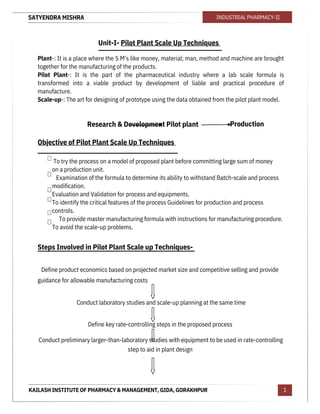
Steps Involved in Pilot Plant Scale up Techniques-
Research & Development Pilot plant
Objective of Pilot Plant Scale Up Techniques
Unit-I- Pilot Plant Scale Up Techniques
Production
Conduct laboratory studies and scale-up planning at the same time
Define product economics based on projected market size and competitive selling and provide
guidance for allowable manufacturing costs
Define key rate-controlling steps in the proposed process
Conduct preliminary larger-than-laboratory studies with equipment to be used in rate-controlling
step to aid in plant design
Plant-: It is a place where the 5 M’s like money, material; man, method and machine are brought
together for the manufacturing of the products.
Pilot Plant-: It is the part of the pharmaceutical industry where a lab scale formula is
transformed into a viable product by development of liable and practical procedure of
manufacture.
Scale-up-: The art for designing of prototype using the data obtained from the pilot plant model.
To try the process on a model of proposed plant before committing large sum of money
on a production unit.
Examination of the formula to determine its ability to withstand Batch-scale and process
modification.
Evaluation and Validation for process and equipments.
To identify the critical features of the process Guidelines for production and process
controls.
To provide master manufacturing formula with instructions for manufacturing procedure.
To avoid the scale-up problems.






SATYENDRA MISHRA
KAILASH INSTITUTE OF PHARMACY & MANAGEMENT, GIDA, GORAKHPUR
INDUSTRIAL PHARMACY-II
2
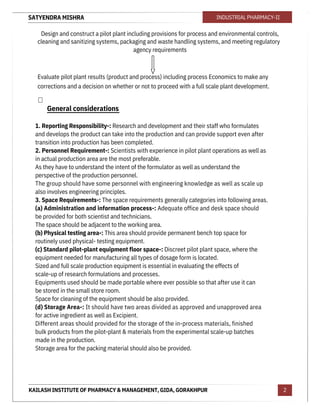
Design and construct a pilot plant including provisions for process and environmental controls,
cleaning and sanitizing systems, packaging and waste handling systems, and meeting regulatory
agency requirements
Evaluate pilot plant results (product and process) including process Economics to make any
corrections and a decision on whether or not to proceed with a full scale plant development.

1. Reporting Responsibility-: Research and development and their staff who formulates
and develops the product can take into the production and can provide support even after
transition into production has been completed.
2. Personnel Requirement-: Scientists with experience in pilot plant operations as well as
in actual production area are the most preferable.
As they have to understand the intent of the formulator as well as understand the
perspective of the production personnel.
The group should have some personnel with engineering knowledge as well as scale up
also involves engineering principles.
3. Space Requirements-: The space requirements generally categories into following areas.
(a) Administration and information process-: Adequate office and desk space should
be provided for both scientist and technicians.
The space should be adjacent to the working area.
(b) Physical testing area-: This area should provide permanent bench top space for
routinely used physical- testing equipment.
(c) Standard pilot-plant equipment floor space-: Discreet pilot plant space, where the
equipment needed for manufacturing all types of dosage form is located.
Sized and full scale production equipment is essential in evaluating the effects of
scale-up of research formulations and processes.
Equipments used should be made portable where ever possible so that after use it can
be stored in the small store room.
Space for cleaning of the equipment should be also provided.
(d) Storage Area-: It should have two areas divided as approved and unapproved area
for active ingredient as well as Excipient.
Different areas should provided for the storage of the in-process materials, finished
bulk products from the pilot-plant & materials from the experimental scale-up batches
made in the production.
Storage area for the packing material should also be provided.
General considerations
SATYENDRA MISHRA
KAILASH INSTITUTE OF PHARMACY & MANAGEMENT, GIDA, GORAKHPUR
INDUSTRIAL PHARMACY-II
3
4. Review of the formula-:
A thorough review of the each aspect of formulation is important.
The purpose of each ingredient and it contribution to the final product manufactured on the
small-scale laboratory equipment should be understood.
Then the effect of scale-up using equipment that may subject the product to stresses of
different types and degrees can more readily be predicted, or recognized.
5. Raw materials-:
One purpose of the pilot-plant is the approval & validation of the active ingredient &
Excipient of raw materials.
Raw materials used in the small scale production cannot necessarily be the representative for
the large scale production.
6. Equipment-:
The most economical and the simplest & efficient equipment which are capable of producing
product within the proposed specifications are used.
The size of the equipment should be such that the experimental trials run should be relevant
to the production sized batches.
If the equipment is too small the process developed will not scale up, whereas if equipment is
too big then the wastage of the expensive active ingredients.
7. Production Rates-:
The immediate as well as the future market trends/requirements are considered while
determining the production rates.
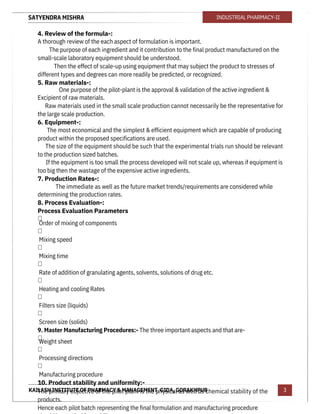
8. Process Evaluation-:
Process Evaluation Parameters

Order of mixing of components

Mixing speed

Mixing time

Rate of addition of granulating agents, solvents, solutions of drug etc.

Heating and cooling Rates

Filters size (liquids)

Screen size (solids)
9. Master Manufacturing Procedures:- The three important aspects and that are-

Weight sheet

Processing directions

Manufacturing procedure
10. Product stability and uniformity:-
The primary objective of the pilot plant is the physical as well as chemical stability of the
products.
Hence each pilot batch representing the final formulation and manufacturing procedure
SATYENDRA MISHRA
KAILASH INSTITUTE OF PHARMACY & MANAGEMENT, GIDA, GORAKHPUR
INDUSTRIAL PHARMACY-II
4
Pilot Plant Scale up considerations for Solid dosage form
Scale up techniques involved in the production of solid dosage forms
(A) Granulation Process
1. Material Handling-:
In large scale operations, mechanical means of handling materials such as mechanical devices for
lifting and tilting drums and more sophisticated methods of handling materials such as screw
feed systems, vacuum loading systems, and metering pumps become necessary unlike in the
laboratory where materials are simply scooped, dumped or poured by hand.
Any material handling system used must deliver the accurate amount of the ingredient to the
intended destination with minimal losses. Lengthy transfer lines may result in material loss, for
which these must be compensation.
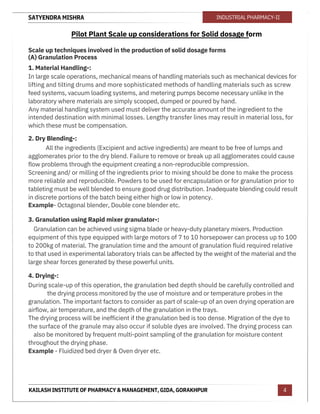
2. Dry Blending-:
All the ingredients (Excipient and active ingredients) are meant to be free of lumps and
agglomerates prior to the dry blend. Failure to remove or break up all agglomerates could cause
flow problems through the equipment creating a non-reproducible compression.
Screening and/ or milling of the ingredients prior to mixing should be done to make the process
more reliable and reproducible. Powders to be used for encapsulation or for granulation prior to
tableting must be well blended to ensure good drug distribution. Inadequate blending could result
in discrete portions of the batch being either high or low in potency.
Example- Octagonal blender, Double cone blender etc.
3. Granulation using Rapid mixer granulator-:
Granulation can be achieved using sigma blade or heavy-duty planetary mixers. Production
equipment of this type equipped with large motors of 7 to 10 horsepower can process up to 100
to 200kg of material. The granulation time and the amount of granulation fluid required relative
to that used in experimental laboratory trials can be affected by the weight of the material and the
large shear forces generated by these powerful units.
4. Drying-:
During scale-up of this operation, the granulation bed depth should be carefully controlled and
the drying process monitored by the use of moisture and or temperature probes in the
granulation. The important factors to consider as part of scale-up of an oven drying operation are
airflow, air temperature, and the depth of the granulation in the trays.
The drying process will be inefficient if the granulation bed is too dense. Migration of the dye to
the surface of the granule may also occur if soluble dyes are involved. The drying process can
also be monitored by frequent multi-point sampling of the granulation for moisture content
throughout the drying phase.
Example - Fluidized bed dryer & Oven dryer etc.
SATYENDRA MISHRA
KAILASH INSTITUTE OF PHARMACY & MANAGEMENT, GIDA, GORAKHPUR
INDUSTRIAL PHARMACY-II
5
5. Reduction of Particle Size-:
In the laboratory, hand screening or short duration handling with a small scale milling equipment
is used to obtain the desired particle size distributions prior to compression or encapsulation.
When such a process is increased in capacity to accommodate large, high-speed presses with
more elaborate feed systems, it is vital that the equipment chosen yield the desired output while
controlling the particle size and size distribution, which are important characteristics of a
granulation.
Example – Multi mill & Hammer mill etc.
6. Blending and Lubrication
Attention should be given to the scale-up of this operation so that equipment of the right design
is used, with blender loads, mixing speeds, and mixing times properly established. This is vital
because the type of blending equipment used in production operations are different from that
used in the laboratory especially in size. A good understanding of the characteristics of the
material to be blended helps to make a full-scale production processing operation successful and
more efficient. For instance, a product with fragile particles or agglomerates can be easily
abraded or crushed resulting in an excessive amount of fines.
(B) Compression Process-:
Prolonged trial runs at press speeds equal to that to be used in normal production should be tried
when evaluating the compression characteristics of a particular formulation. This is done to
identify potential problems such as sticking to punch surfaces tablet hardness, capping, and
weight variation.
These pre-production trials in the pilot plant are vital to identify these problems early in the scale
up process so that changes can easily be made. Such changes will be more difficult during later
production runs, because marketing requirements may make it difficult to interrupt production
schedules in order to modify the formulation. Compression of a granulation on a high-
speed tablet press is the ultimate test of a tablet formulation and granulation process.
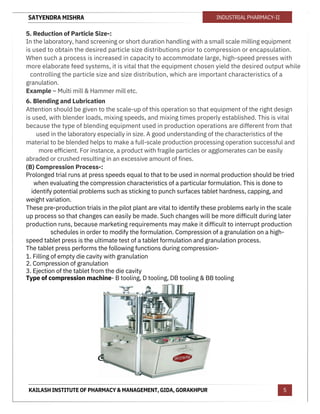
The tablet press performs the following functions during compression-
1. Filling of empty die cavity with granulation
2. Compression of granulation
3. Ejection of the tablet from the die cavity
Type of compression machine- B tooling, D tooling, DB tooling & BB tooling
SATYENDRA MISHRA
KAILASH INSTITUTE OF PHARMACY & MANAGEMENT, GIDA, GORAKHPUR
INDUSTRIAL PHARMACY-II
6
(C) Coating-:
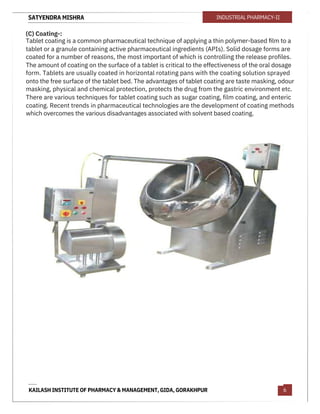
Tablet coating is a common pharmaceutical technique of applying a thin polymer-based film to a
tablet or a granule containing active pharmaceutical ingredients (APIs). Solid dosage forms are
coated for a number of reasons, the most important of which is controlling the release profiles.
The amount of coating on the surface of a tablet is critical to the effectiveness of the oral dosage
form. Tablets are usually coated in horizontal rotating pans with the coating solution sprayed
onto the free surface of the tablet bed. The advantages of tablet coating are taste masking, odour
masking, physical and chemical protection, protects the drug from the gastric environment etc.
There are various techniques for tablet coating such as sugar coating, film coating, and enteric
coating. Recent trends in pharmaceutical technologies are the development of coating methods
which overcomes the various disadvantages associated with solvent based coating.
SATYENDRA MISHRA
KAILASH INSTITUTE OF PHARMACY & MANAGEMENT, GIDA, GORAKHPUR
INDUSTRIAL PHARMACY-II
7
Pilot Plant Scale up considerations for Liquid oral dosage form
Liquid oral dosage forms-: The physical form of a drug product that is pourable displays
Newtonian or pseudo plastic flow behavior and conforms to its container at room temperature.
Liquid dosage forms may be dispersed systems or solutions.
In dispersed systems there are two or more phases, where one phase is distributed in another.
A solution refers two or more substances mixed homogeneously.
Steps of liquid manufacturing process
Planning of material requirements
Liquid preparation
Filling and Packing
Quality assurance
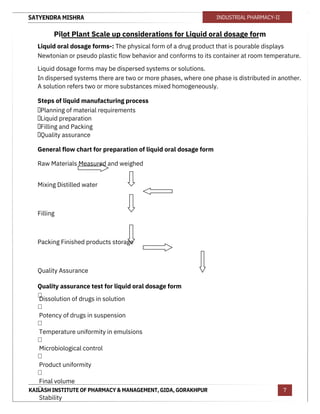
General flow chart for preparation of liquid oral dosage form
Raw Materials Measured and weighed
Mixing Distilled water
Filling
Packing Finished products storage
Quality Assurance
Quality assurance test for liquid oral dosage form

Dissolution of drugs in solution

Potency of drugs in suspension

Temperature uniformity in emulsions

Microbiological control

Product uniformity

Final volume

Stability
SATYENDRA MISHRA
KAILASH INSTITUTE OF PHARMACY & MANAGEMENT, GIDA, GORAKHPUR
INDUSTRIAL PHARMACY-II
8
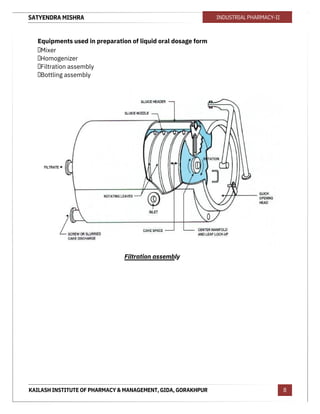
Filtration assembly
Equipments used in preparation of liquid oral dosage form
Mixer
Homogenizer
Filtration assembly
Bottling assembly
SATYENDRA MISHRA
KAILASH INSTITUTE OF PHARMACY & MANAGEMENT, GIDA, GORAKHPUR
INDUSTRIAL PHARMACY-II
9
Relevant Documentation required for Pilot Plant scale up technique.
Documentation is the key to GMP compliance and ensures traceability of all
development, manufacturing, and testing activities. Documentation provides the route
for auditors to assess the overall quality of operations within a company and the final
product.
There are various types of procedures that a Pilot plant facility can follow. Given
below is a list
of the most common types of documents, along with a brief description of each.
1. Quality manual: A global company document that describes, in paragraph form, the
regulations and/or parts of the regulations that the company is required to follow.
2. Policies: Documents that describe in general terms, and not with step-by-step
instructions, how specific GMP aspects (such as security, documentation, health, and
responsibilities) will be implemented.
3. Standard operating procedures (SOPs): Step-by-step instructions for performing
operational tasks or activities.
4. Batch records: These documents are typically used and completed by the
manufacturing
department. Batch records provide step-by-step instructions for production-related
tasks
and activities, besides including areas on the batch record itself for documenting such
tasks.
5. Test methods: These documents are typically used and completed by the quality
control
(QC) department. Test methods provide step-by-step instructions for testing supplies,
materials, products, and other production-related tasks and activities, e.g.,
environmental
monitoring of the GMP facility.
6. Specifications: Documents that list the requirements that a supply, material, or
product
must meet before being released for use or sale. The QC department will compare
their
test results to specifications to determine if they pass the test.
7. Logbooks: Bound collection of forms used to document activities. Typically,
logbooks
are used for documenting the operation, maintenance, and calibration of a piece of
equipment. Logbooks are also used to record critical activities, e.g., monitoring of
clean
rooms, solution preparation, recording of deviation, change controls and its corrective
action assignment.
SATYENDRA MISHRA
KAILASH INSTITUTE OF PHARMACY & MANAGEMENT, GIDA, GORAKHPUR
INDUSTRIAL PHARMACY-II
10
 Documents must be approved, signed, and dated by the appropriate competent and
authorized persons.
 Documents must have unambiguous contents. The title, nature, and purpose should be
clearly stated. They must be laid out in an orderly fashion and be easy to check.
Reproduced documents must be clear and legible.
 Documents must be regularly reviewed and kept up-to-date. When a document has been
revised, systems must be operated to prevent inadvertent use of superseded documents
(e.g., only current documentation should be available for use).
 Documents must not be handwritten; however, where documents require the entry of
data, these entries may be made in clear legible handwriting using a suitable indelible
medium (i.e., not a pencil). Sufficient space must be provided for such entries.
 Any correction made to a document or record must be signed or initialed and dated; the
correction must permit the reading of the original information. Where appropriate, the
reason for the correction must be recorded.
 Record must be kept at the time each action is taken and in such a way that all activities
concerning the conduct of preclinical studies, clinical trials, and the manufacture and
control of products are traceable.
 Storage of critical records must at secure place, with access limited to authorized persons.
The storage location must ensure adequate protection from loss, destruction, or
falsification, and from damage due to fire, water, etc.
 Records which are critical to regulatory compliance or to support essential business
activities must be duplicated on paper, microfilm, or electronically, and stored in a
separate, secure location in a separate building from the originals.
 It is particularly important that during the period of retention, the data can be rendered
legible within an appropriate period of time.
 If data is modified, it must be traceable.
SUPAC Guidelines.
This guidance provides recommendations to sponsors of new drug applications (NDA's),
abbreviated new drug applications (ANDA's), and abbreviated antibiotic applications (AADA's)
who intend, during the post approval period, to change that are-
1) The components or composition
2) The site of manufacture
3) The scale-up/scale-down of manufacture
4) The manufacturing (process and equipment) of an immediate release oral formulation.
Definition-: The scale-up process and changes made after in the composition, manufacturing
process, manufacturing equipments, and change of site have become known as scale up and post
approval changes or SUPAC.
SATYENDRA MISHRA
KAILASH INSTITUTE OF PHARMACY & MANAGEMENT, GIDA, GORAKHPUR
INDUSTRIAL PHARMACY-II
11
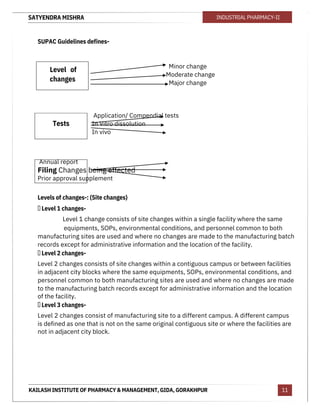
SUPAC Guidelines defines-
Minor change
Moderate change
Major change
Application/ Compendial tests
In Vitro dissolution
In vivo
Annual report
Filing Changes being effected
Prior approval supplement
Levels of changes-: (Site changes)
 Level 1 changes-
Level 1 change consists of site changes within a single facility where the same
equipments, SOPs, environmental conditions, and personnel common to both
manufacturing sites are used and where no changes are made to the manufacturing batch
records except for administrative information and the location of the facility.
 Level 2 changes-
Level 2 changes consists of site changes within a contiguous campus or between facilities
in adjacent city blocks where the same equipments, SOPs, environmental conditions, and
personnel common to both manufacturing sites are used and where no changes are made
to the manufacturing batch records except for administrative information and the location
of the facility.
 Level 3 changes-
Level 2 changes consist of manufacturing site to a different campus. A different campus
is defined as one that is not on the same original contiguous site or where the facilities are
not in adjacent city block.
Tests
Level of
changes
SATYENDRA MISHRA
KAILASH INSTITUTE OF PHARMACY & MANAGEMENT, GIDA, GORAKHPUR
INDUSTRIAL PHARMACY-II
12
Introduction to Platform Technology
Platform technologies are considered a valuable tool to improve efficiency and quality in drug
product development.
The basic idea is that a platform, in combination with a risk-based approach, is the most
systematic method to leverage prior knowledge for a given new molecule.
Furthermore, such a platform enables a continuous improvement by adding data for every new
molecule developed by this approach, increasing the robustness of the platform.
But it has often been said that access to the latest technological platforms to aid efficient drug
discovery and development is limited to Big Pharma, which can more easily justify the costs of
creating and operating these platforms.
Examples-
An example of a non-platform technology is a hammer, for it is a homogeneous system. There is
no differentiation between the system’s infrastructure and its application.
They are all just one thing. It is an instance of a hammer. It cannot generate new and different
configurations of itself. The same can be said of a car.
It is an instance of a technology.
The end-user gets and uses the whole thing. To make the comparison clearer, we could compare
the instance of a car with an automobile platform that allows a motor company to release several
vehicles built upon a common chassis, which is the platform, with different engines, interiors and
form factors, for the same or different vehicles and brands within the company.
Platform Layers-:
Probably the clearest and best example of platform technologies is personal computers. The
platform, in this case, is the computer’s operating system. But before we can get to the platform
that’s doing all the great work, we need a foundation for it to sit on, that is, a set of enabling
technologies. In this case, our foundation layer is our computer hardware and all the low-level
firmware that interfaces between it and the operating system. But within a business, our
foundation layer might be the economic system it is a part of, the public services such as
security, rule of law and maintenance of natural resources that would enable our business to
function. The same would be true of a city. It rests upon and is enabled by a national
infrastructure system.
The next layer up from the foundations or hardware is the platform itself, the computer’s
operating system in this case. It essentially manages the computer’s resources and services that
will be required by applications.
The platform takes the resources available to it from the infrastructure and creates the Lego
blocks that we will be used to build things with. These resources are presented to producers on
the application level through APIs, or application program interfaces. In an automotive factory,
the platform would be the physical technologies in the production line for creating the car’s
parts.
Our employees can rearrange this production line to create different vehicles. In the example of a
city, this platform level might be the urban utilities that contractors will interface with to build
offices and residential spaces, and there will be a standard set of procedures for them to do this.
On top of the operating system lies the application layer.
Developers draw on the services provided by the operating system and bundle them in various
different combinations to deliver a finished application to the end-user.
SATYENDRA MISHRA
KAILASH INSTITUTE OF PHARMACY & MANAGEMENT, GIDA, GORAKHPUR
INDUSTRIAL PHARMACY-II
13
Apps in the App Store, the cars coming off of our production line, the buildings in a
city or the financial products offered by a bank are examples of the application layer,
endless configurations, and reconfigurations in response to the perceived needs and
feedback of the end- user.
Importance-:
Finally, we might ask – why should we care about platform technologies? There are a
number of
reasons this architecture should be of benefit to us.
Firstly, by distributing the system across multiple layers, we can abstract away the
complexity
that users or producers of the service have to deal with.
Everything gets its own space. Secondly, we can avoid redundancies by having the
platform
provide the common services required by all components.
We can reduce the need for each component on the application layer to re-invent the
wheel. Thirdly platforms are the ideal architecture for creating user-generated
systems.
Thus, we can leverage the amplification effect we discussed earlier to do more with
less, helping
to maintain an agile core system. And lastly, the platform architecture is ideal for
building
flexible, adaptive, and evolutionary systems. Given its independence from fixed
instances, the
system can stay innovating on the application level to continue regenerating itself.
END OF THE UNIT-I