Demonstration Plant Testing
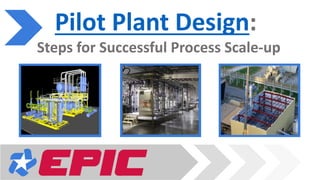
Pilot Plant Design:
Steps for Successful Process Scale-up
Process Scale-up Challenges
Reaction Kinetics & Chemical Equilibrium
Equilibrium = the point at which your reaction becomes productive
Increased chemical volume = longer time to chemical equilibrium
Kinetics = how efficiently molecules are mixing which effects how fast equilibrium is reached
Non-linear sizingMultiplying required output by five does not require a five-fold increase across the board
System sizes for equipment, chemical inputs and other factors do not increase in a 1:1 fashion
Material Properties
Material selection for equipment & instrumentation must avoid corrosion, erosion & excess expense
Fluid & Thermodynamics
Flow should be kept at the correct Reynolds number for efficient heat transfer and molecule mixing
Controlled reactions = good thermodynamics that balance heat loss with reaction speed
Agitation Challenges
Larger mixing tanks = more required horsepower to achieve the same turbulence and flow
Costs may be reduced through baffles, angled agitators or other agitation equipment
Basic Pilot Plant Design
Design Documents & Deliverables
Scope and boundary limit description
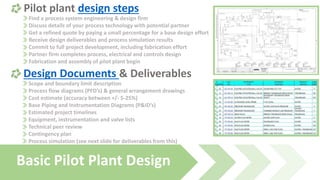
Process flow diagrams (PFD’s) & general arrangement drawings
Cost estimate (accuracy between +/- 5-25%)
Base Piping and Instrumentation Diagrams (P&ID’s)
Estimated project timelines
Equipment, instrumentation and valve lists
Technical peer review
Contingency plan
Process simulation (see next slide for deliverables from this)
Pilot plant design steps
Find a process system engineering & design firm
Discuss details of your process technology with potential partner
Get a refined quote by paying a small percentage for a base design effort
Receive design deliverables and process simulation results
Commit to full project development, including fabrication effort
Partner firm completes process, electrical and controls design
Fabrication and assembly of pilot plant begin
Demo Plant Modeling
3D Modeling & Simulations
Chemical similitude studies
Aspen/HYSYS modeling
Finite Elemental Analysis (FEA)
Computational Fluid Dynamics (CFD)
CADworx Plant & AutoCAD modeling
Deliverables from Modeling
Increased accuracy of budgetary numbers (+/- 5-15%)
Complete Piping and Instrumentation Diagrams (P&ID’s)
Mass (material) and energy balances
Material compatibility & corrosion studies
Module size form factors
Plan and elevation drawings
Fabrication & Testing
Installation & Startup
Steps Following Design
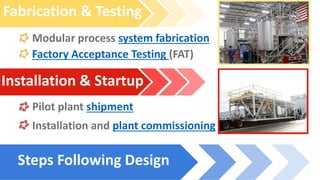
Modular process system fabrication
Factory Acceptance Testing (FAT)
Pilot plant shipment
Installation and plant commissioning
Demonstration Plant Testing
MODULAR PROCESS SYSTEMS
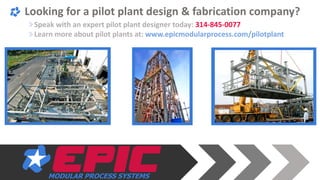
Looking for a pilot plant design & fabrication company?
Speak with an expert pilot plant designer today: 314-845-0077
Learn more about pilot plants at: www.epicmodularprocess.com/pilotplant

Pilot plant design

  • 1.
    Demonstration Plant Testing PilotPlant Design: Steps for Successful Process Scale-up
  • 2.
    Process Scale-up Challenges ReactionKinetics & Chemical Equilibrium Equilibrium = the point at which your reaction becomes productive Increased chemical volume = longer time to chemical equilibrium Kinetics = how efficiently molecules are mixing which effects how fast equilibrium is reached Non-linear sizingMultiplying required output by five does not require a five-fold increase across the board System sizes for equipment, chemical inputs and other factors do not increase in a 1:1 fashion Material Properties Material selection for equipment & instrumentation must avoid corrosion, erosion & excess expense Fluid & Thermodynamics Flow should be kept at the correct Reynolds number for efficient heat transfer and molecule mixing Controlled reactions = good thermodynamics that balance heat loss with reaction speed Agitation Challenges Larger mixing tanks = more required horsepower to achieve the same turbulence and flow Costs may be reduced through baffles, angled agitators or other agitation equipment
  • 3.
    Basic Pilot PlantDesign Design Documents & Deliverables Scope and boundary limit description Process flow diagrams (PFD’s) & general arrangement drawings Cost estimate (accuracy between +/- 5-25%) Base Piping and Instrumentation Diagrams (P&ID’s) Estimated project timelines Equipment, instrumentation and valve lists Technical peer review Contingency plan Process simulation (see next slide for deliverables from this) Pilot plant design steps Find a process system engineering & design firm Discuss details of your process technology with potential partner Get a refined quote by paying a small percentage for a base design effort Receive design deliverables and process simulation results Commit to full project development, including fabrication effort Partner firm completes process, electrical and controls design Fabrication and assembly of pilot plant begin
  • 4.
    Demo Plant Modeling 3DModeling & Simulations Chemical similitude studies Aspen/HYSYS modeling Finite Elemental Analysis (FEA) Computational Fluid Dynamics (CFD) CADworx Plant & AutoCAD modeling Deliverables from Modeling Increased accuracy of budgetary numbers (+/- 5-15%) Complete Piping and Instrumentation Diagrams (P&ID’s) Mass (material) and energy balances Material compatibility & corrosion studies Module size form factors Plan and elevation drawings
  • 5.
    Fabrication & Testing Installation& Startup Steps Following Design Modular process system fabrication Factory Acceptance Testing (FAT) Pilot plant shipment Installation and plant commissioning
  • 6.
    Demonstration Plant Testing MODULARPROCESS SYSTEMS Looking for a pilot plant design & fabrication company? Speak with an expert pilot plant designer today: 314-845-0077 Learn more about pilot plants at: www.epicmodularprocess.com/pilotplant