BASIC CHEMICAL
PROCESSING
CHEMICAL
PROCESS
Chemical process is
combination of unit
processes and Unit
operation
UNIT
OPERATIONS
involves the physical
separation of the
products obtained during
various unit processes
UNIT
OPERATIONS
UNIT
PROCESSES
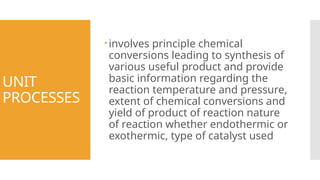
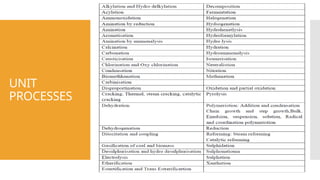
involves principle chemical
conversions leading to synthesis of
various useful product and provide
basic information regarding the
reaction temperature and pressure,
extent of chemical conversions and
yield of product of reaction nature
of reaction whether endothermic or
exothermic, type of catalyst used
UNIT
PROCESSES
BATCH
PROCESS
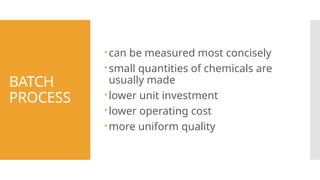
can be measured most concisely
small quantities of chemicals are
usually made
lower unit investment
lower operating cost
more uniform quality
CONTINUOU
S
PROCESS
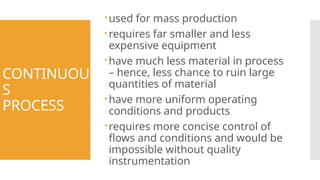
used for mass production
requires far smaller and less
expensive equipment
have much less material in process
– hence, less chance to ruin large
quantities of material
have more uniform operating
conditions and products
requires more concise control of
flows and conditions and would be
impossible without quality
instrumentation
PILOT PLANT
 step between the laboratory and the industrial
plant
 small-scale units designed to allow experiments
that obtain design data for larger plants and
sometimes to produce significant quantities of a
new product to permit user evaluation o fit
 makes use of statistical analysis of the procedures
necessary to determine the data required for
design
 should be constructed with equipment identical in
material with that to be used by the commercial
plant in order to ascertain the effects of corrosion
 cheaper to correct errors in judgment by
experimentation in the pilot plant
PLANT
LOCATION
availability of raw materials, energy,
transportation and markets
choice depends on environmental
constraints, water supply,
availability of efficient labor, cost of
land, and waste disposal facilities
CONTROL
SYSTEMS
 instead of measuring and attempting to maintain rigid
temperatures, pressure and general conditions
 adjust system variables so that the output is satisfactory
even though the inputs vary widely and are not fixed
 analyzing and optimizing systems
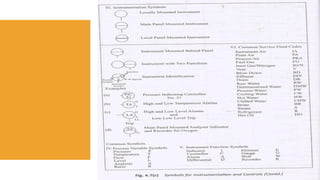
INSTRUMENTATION
takes over the running of complex
chemical processing systems
optimize plant conditions to meet
changing feed conditions
should not be chosen simply to
record process variables
function is to assure consistent
quality, usually by sensing,
controlling, recording and
maintaining desired operating
conditions
essential tool for modern
processing
FLOWCHART
show material and energy balances
show details as fire lines,
instruments and control systems,
air lines, drains, etc.
indicate the point of entrance for
raw materials and the points of
removal of the product and by-
products
PROCESS
FLOW
DIAGRAM
(PFD)
or
PROCESS
FLOW
SHEET
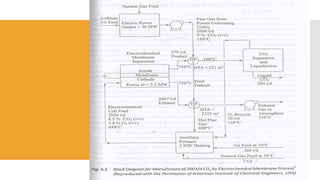
data presented in a sequential
manner with symbolic
representation of equipment
schematic illustration of the system
shows relationships between the
major components in the system
tabulates the process design values
for the components
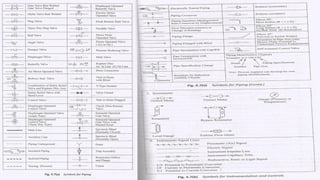
PIPING &
INSTRUMENTATIO
N DIAGRAM
(P &ID)
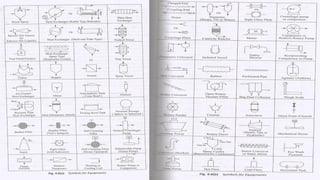
sequential presentation of flow,
piping with instrumentation and
controls that are required for
smooth operation of the process
schematic illustration of
functional relationship of piping,
instrumentation, and system
equipment components
shows all the piping including the
physical sequence of branches,
fittings, equipment,
instrumentation and control
interlocks
RESEARCH
AND
DEVELOPMEN
T
 NEW AND IMPROVED PROCESS
 LOWER COSTS AND LOWER PRICES OF
PRODUCTS
 SERVICES AND PRODUCTS NEVER BEFORE
KNOWN
 CHANGE OF RARITIES TO COMMON
COMMERCIAL SUPPLIES OF PRACTICAL
USEFULNESS
 ADEQUATE SUPPLY OF MATERIALS PREVIOUSLY
OBTAINED ONLY AS BY-PRODUCTS
 FREEDOM FROM DOMINATION BY FOREIGN
CONTROL
 STABILIZATION OF BUSINESS AND INDUSTRIAL
EMPLOYMENT
 PRODUCTS OF IMPROVED QUALITY
Basic Chemical Processing of the Basic Chemicals

  • 1.
  • 2.
    CHEMICAL PROCESS Chemical process is combinationof unit processes and Unit operation
  • 3.
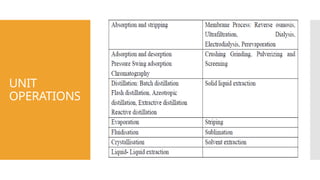
    UNIT OPERATIONS involves the physical separationof the products obtained during various unit processes
  • 4.
  • 5.
    UNIT PROCESSES involves principle chemical conversionsleading to synthesis of various useful product and provide basic information regarding the reaction temperature and pressure, extent of chemical conversions and yield of product of reaction nature of reaction whether endothermic or exothermic, type of catalyst used
  • 6.
  • 7.
    BATCH PROCESS can be measuredmost concisely small quantities of chemicals are usually made lower unit investment lower operating cost more uniform quality
  • 8.
    CONTINUOU S PROCESS used for massproduction requires far smaller and less expensive equipment have much less material in process – hence, less chance to ruin large quantities of material have more uniform operating conditions and products requires more concise control of flows and conditions and would be impossible without quality instrumentation
  • 9.
    PILOT PLANT  stepbetween the laboratory and the industrial plant  small-scale units designed to allow experiments that obtain design data for larger plants and sometimes to produce significant quantities of a new product to permit user evaluation o fit  makes use of statistical analysis of the procedures necessary to determine the data required for design  should be constructed with equipment identical in material with that to be used by the commercial plant in order to ascertain the effects of corrosion  cheaper to correct errors in judgment by experimentation in the pilot plant
  • 10.
    PLANT LOCATION availability of rawmaterials, energy, transportation and markets choice depends on environmental constraints, water supply, availability of efficient labor, cost of land, and waste disposal facilities
  • 11.
    CONTROL SYSTEMS  instead ofmeasuring and attempting to maintain rigid temperatures, pressure and general conditions  adjust system variables so that the output is satisfactory even though the inputs vary widely and are not fixed  analyzing and optimizing systems
  • 12.
    INSTRUMENTATION takes over therunning of complex chemical processing systems optimize plant conditions to meet changing feed conditions should not be chosen simply to record process variables function is to assure consistent quality, usually by sensing, controlling, recording and maintaining desired operating conditions essential tool for modern processing
  • 13.
    FLOWCHART show material andenergy balances show details as fire lines, instruments and control systems, air lines, drains, etc. indicate the point of entrance for raw materials and the points of removal of the product and by- products
  • 14.
    PROCESS FLOW DIAGRAM (PFD) or PROCESS FLOW SHEET data presented ina sequential manner with symbolic representation of equipment schematic illustration of the system shows relationships between the major components in the system tabulates the process design values for the components
  • 16.
    PIPING & INSTRUMENTATIO N DIAGRAM (P&ID) sequential presentation of flow, piping with instrumentation and controls that are required for smooth operation of the process schematic illustration of functional relationship of piping, instrumentation, and system equipment components shows all the piping including the physical sequence of branches, fittings, equipment, instrumentation and control interlocks
  • 20.
    RESEARCH AND DEVELOPMEN T  NEW ANDIMPROVED PROCESS  LOWER COSTS AND LOWER PRICES OF PRODUCTS  SERVICES AND PRODUCTS NEVER BEFORE KNOWN  CHANGE OF RARITIES TO COMMON COMMERCIAL SUPPLIES OF PRACTICAL USEFULNESS  ADEQUATE SUPPLY OF MATERIALS PREVIOUSLY OBTAINED ONLY AS BY-PRODUCTS  FREEDOM FROM DOMINATION BY FOREIGN CONTROL  STABILIZATION OF BUSINESS AND INDUSTRIAL EMPLOYMENT  PRODUCTS OF IMPROVED QUALITY