SAJJAD KHUDHUR ABBAS
Ceo , Founder & Head of SHacademy
Chemical Engineering , Al-Muthanna University, Iraq
Oil & Gas Safety and Health Professional – OSHACADEMY
Trainer of Trainers (TOT) - Canadian Center of Human
Development
Episode 55 : Conceptual
Process Synthesis-Design
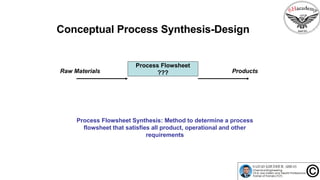
Conceptual Process Synthesis-Design
Process Flowsheet
???Raw Materials Products
Process Flowsheet Synthesis: Method to determine a process
flowsheet that satisfies all product, operational and other
requirements
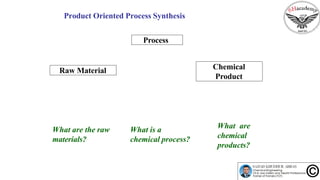
Product Oriented Process Synthesis
Chemical
Product
Process
Raw Material
What are
chemical
products?
What are the raw
materials?
What is a
chemical process?
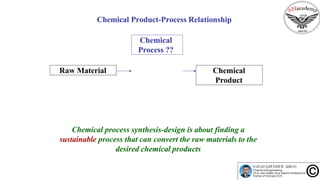
Chemical Product-Process Relationship
Chemical
Process ??
Raw Material Chemical
Product
Chemical process synthesis-design is about finding a
sustainable process that can convert the raw materials to the
desired chemical products
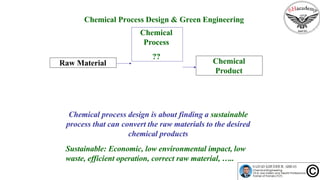
Chemical Process Design & Green Engineering
Chemical
Process
??
Chemical
Product
Raw Material
Chemical process design is about finding a sustainable
process that can convert the raw materials to the desired
chemical products
Sustainable: Economic, low environmental impact, low
waste, efficient operation, correct raw material, …..
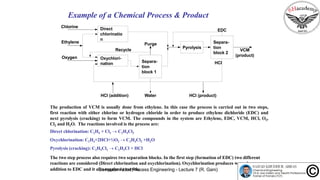
Example of a Chemical Process & Product
Oxychlori-
nation Separa-
tion
block 1
Pyrolysis
Separa-
tion
block 2
HCl (addition) Water HCl (product)
The production of VCM is usually done from ethylene. In this case the process is carried out in two steps,
first reaction with either chlorine or hydrogen chloride in order to produce ethylene dichloride (EDC) and
next pyrolysis (cracking) to form VCM. The compounds in the system are Ethylene, EDC, VCM, HCl, O2,
Cl2 and H2O. The reactions involved is the process are:
Direct chlorination: C2H4 + Cl2  C2H4Cl2
Oxychlorination: C2H4+2HCl+½O2  C2H4Cl2 +H2O
Pyrolysis (cracking): C2H4Cl2  C2H3Cl + HCl
The two step process also requires two separation blocks. In the first step (formation of EDC) two different
reactions are considered (Direct chlorination and oxychlorination). Oxychlorination produces water in
EDC
VCM
(product)
HCl
Oxygen
Ethylene
Chlorine
Recycle
addition to EDC and it aClsoomrepquutierresAaidreedcyPcrloe.cess Engineering - Lecture 7 (R. Gani)
Direct
chlorinatio
n
Purge
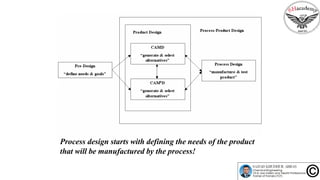
Process design starts with defining the needs of the product
that will be manufactured by the process!
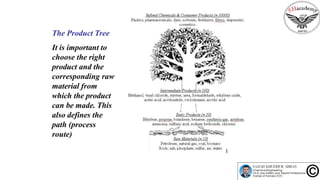
The Product Tree
It is important to
choose the right
product and the
corresponding raw
material from
which the product
can be made. This
also defines the
path (process
route)
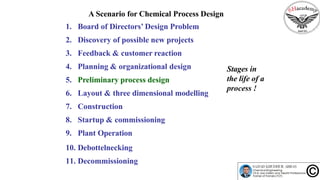
A Scenario for Chemical Process Design
1. Board of Directors’ Design Problem
2. Discovery of possible new projects
3. Feedback & customer reaction
4. Planning & organizational design
5. Preliminary process design
6. Layout & three dimensional modelling
7. Construction
8. Startup & commissioning
9. Plant Operation
10. Debottelnecking
11. Decommissioning
Stages in
the life of a
process !
Computer Aide
d Process Engineering - Le 9
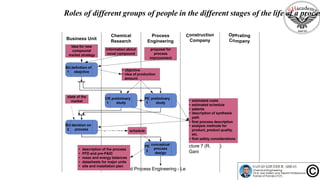
Roles of different groups of people in the different stages of the life of a proces
BU definition of
1 obejctive
PE conceptual
2
process
design
Chemical
Research
rating
mpany
Process C
Engineering
Business Unit
CR preliminary
1 study
PE preliminary
1 study
BU decision on
2 process
information about
novel compound
proposal for
process
improvement
idea for new
compound/
market strategy
state of the
market
 objective
 idea of production
amount
schedule
 description of the process
 PFD and pre-P&ID
 mass and energy balances
 datasheets for major units
 site and installation plan
onstruction
Company
Ope
Co
 estimated costs
 estimated schedule
 patents
 description of synthesis
path
 first process description
 analysis methods for
product, product quality,
etc.
 first safety considerations
cture 7 (R.
Gani
)
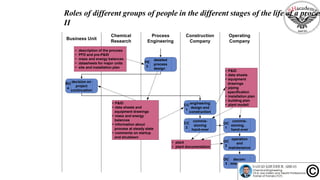
Roles of different groups of people in the different stages of the life of a proces
II
Chemical
Research
Operating
Company
Construction
Company
Process
Engineering
Business Unit
PE
3
detailed
process
design
CC
engineering
1
design and
construction
CC
2
commis-
sioning
hand-over
OC
2
operation
and
maintenance
OC
1
commis-
sioning,
hand-over
OC decom-
3 missioning
 P&ID
 data sheets and
equipment drawings
 mass and energy
balances
 information about
process at steady state
 comments on startup
and shutdown
 plant
 plant documentation
 P&ID
 data sheets
 equipment
drawings
 piping
specification
 installation plan
 building plan
 plant modell
BU
decision on
4
project
continuation
 description of the process
 PFD and pre-P&ID
 mass and energy balances
 datasheets for major units
 site and installation plan
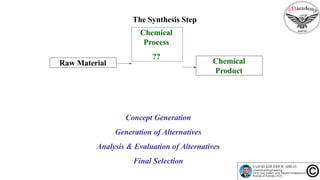
The Synthesis Step
Chemical
Process
??
Chemical
Product
Raw Material
Concept Generation
Generation of Alternatives
Analysis & Evaluation of Alternatives
Final Selection
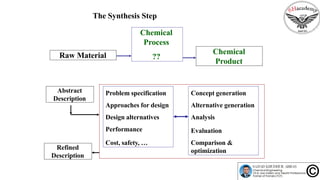
The Synthesis Step
Chemical
Process
??
Chemical
Product
Raw Material
Problem specification
Approaches for design
Design alternatives
Performance
Cost, safety, …
Concept generation
Alternative generation
Analysis
Evaluation
Comparison &
optimization
Abstract
Description
Refined
Description
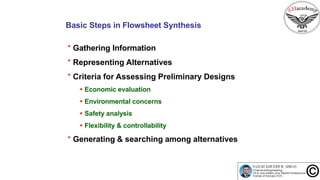
Basic Steps in Flowsheet Synthesis
* Gathering Information
* Representing Alternatives
* Criteria for Assessing Preliminary Designs
 Economic evaluation
 Environmental concerns
 Safety analysis
 Flexibility & controllability
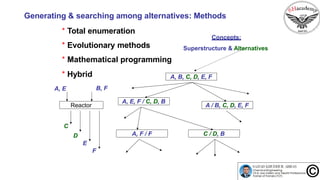
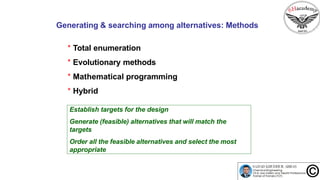
* Generating & searching among alternatives
Generating & searching among alternatives: Methods
* Total enumeration
* Evolutionary methods
* Mathematical programming
* Hybrid
Establish targets for the design
Generate (feasible) alternatives that will match the
targets
Order all the feasible alternatives and select the most
appropriate
Generating & searching among alternatives: Methods
* Total enumeration
* Evolutionary methods
* Mathematical programming
* Hybrid
Concepts:
Superstructure & Alternatives
C[1]
C[2]
1
2
3
H[1]
T[in] T[out]
C[3]
Generating & searching among alternatives: Methods
* Total enumeration
* Evolutionary methods
* Mathematical programming
* Hybrid
A, E
Concepts:
Superstructure & Alternatives
A, B, C, D, E, F
A / B, C, D, E, F
B, F
A, E, F / C, D, B
Reactor
C
D A, F / F C / D, B
E
F
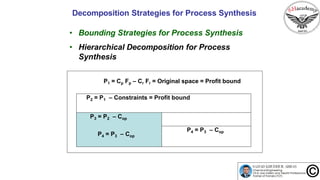
Decomposition Strategies for Process Synthesis
• Bounding Strategies for Process Synthesis
• Hierarchical Decomposition for Process
Synthesis
P1 = Cp Fp – Cr Fr = Original space = Profit bound
P2 = P1 – Constraints = Profit bound
P3 = P2 – Cop
P4 = P3 – Cop
P4 = P3 – Cop
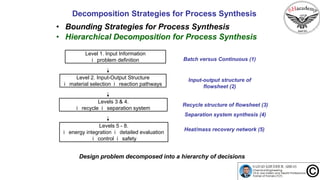
Decomposition Strategies for Process Synthesis
• Bounding Strategies for Process Synthesis
• Hierarchical Decomposition for Process Synthesis
Level 1. Input Information
i problem definition Batch versus Continuous (1)
Level 2. Input-Output Structure
i material selection i reaction pathways
Input-output structure of
flowsheet (2)
Recycle structure of flowsheet (3)
Separation system synthesis (4)
Levels 3 & 4.
i recycle i separation system
Levels 5 - 8.
i energy integration i detailed evaluation
i control i safety
Heat/mass recovery network (5)
Design problem decomposed into a hierarchy of decisions
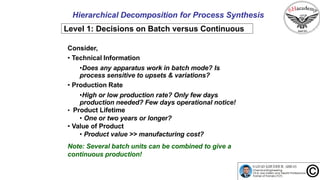
Hierarchical Decomposition for Process Synthesis
Level 1: Decisions on Batch versus Continuous
Consider,
• Technical Information
•Does any apparatus work in batch mode? Is
process sensitive to upsets & variations?
• Production Rate
•High or low production rate? Only few days
production needed? Few days operational notice!
• Product Lifetime
• One or two years or longer?
• Value of Product
• Product value >> manufacturing cost?
Note: Several batch units can be combined to give a
continuous production!
20
Hierarchical Decomposition for Process Synthesis
Level 2: Decisions on Input-Output Structure
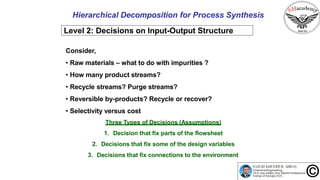
Consider,
• Raw materials – what to do with impurities ?
• How many product streams?
• Recycle streams? Purge streams?
• Reversible by-products? Recycle or recover?
• Selectivity versus cost
Three Types of Decisions (Assumptions)
1. Decision that fix parts of the flowsheet
2. Decisions that fix some of the design variables
3. Decisions that fix connections to the environment
Hierarchical Decomposition for Process Synthesis
Level 2: Decisions on Input-Output Structure
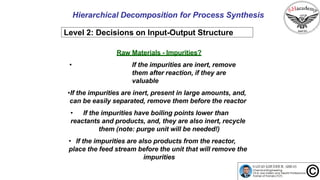
Raw Materials - Impurities?
• If the impurities are inert, remove
them after reaction, if they are
valuable
•If the impurities are inert, present in large amounts, and,
can be easily separated, remove them before the reactor
• If the impurities have boiling points lower than
reactants and products, and, they are also inert, recycle
them (note: purge unit will be needed!)
• If the impurities are also products from the reactor,
place the feed stream before the unit that will remove the
impurities
Hierarchical Decomposition for Process Synthesis
Level 2: Decisions on Input-Output Structure
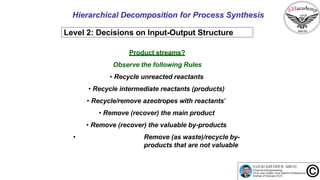
Product streams?
Observe the following Rules
• Recycle unreacted reactants
• Recycle intermediate reactants (products)
• Recycle/remove azeotropes with reactants*
• Remove (recover) the main product
• Remove (recover) the valuable by-products
• Remove (as waste)/recycle by-
products that are not valuable
Hierarchical Decomposition for Process Synthesis
Level 2: Decisions on Input-Output Structure
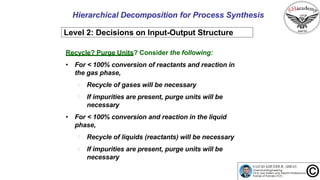
Recycle? Purge Units? Consider the following:
• For < 100% conversion of reactants and reaction in
the gas phase,
Recycle of gases will be necessary
If impurities are present, purge units will be
necessary
• For < 100% conversion and reaction in the liquid
phase,
Recycle of liquids (reactants) will be necessary
If impurities are present, purge units will be
necessary
Hierarchical Decomposition for Process Synthesis
Level 2: Decisions on Input-Output Structure
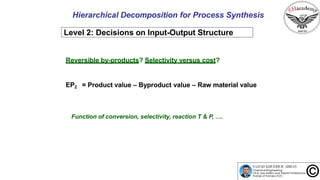
Reversible by-products? Selectivity versus cost?
EP2 = Product value – Byproduct value – Raw material value
Function of conversion, selectivity, reaction T & P, ….
Hierarchical Decomposition for Process Synthesis
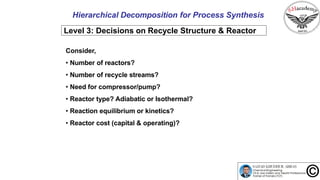
Level 3: Decisions on Recycle Structure & Reactor
Consider,
• Number of reactors?
• Number of recycle streams?
• Need for compressor/pump?
• Reactor type? Adiabatic or Isothermal?
• Reaction equilibrium or kinetics?
• Reactor cost (capital & operating)?
Hierarchical Decomposition for Process Synthesis
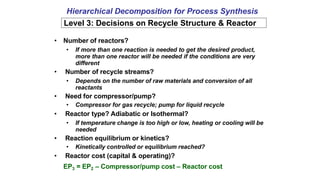
Level 3: Decisions on Recycle Structure & Reactor
• Number of reactors?
• If more than one reaction is needed to get the desired product,
more than one reactor will be needed if the conditions are very
different
• Number of recycle streams?
• Depends on the number of raw materials and conversion of all
reactants
• Need for compressor/pump?
• Compressor for gas recycle; pump for liquid recycle
• Reactor type? Adiabatic or Isothermal?
• If temperature change is too high or low, heating or cooling will be
needed
• Reaction equilibrium or kinetics?
• Kinetically controlled or equilibrium reached?
• Reactor cost (capital & operating)?
EP3 = EP2 – Compressor/pump cost – Reactor cost
Hierarchical Decomposition for Process Synthesis
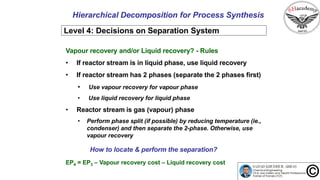
Level 4: Decisions on Separation System
Vapour recovery and/or Liquid recovery? - Rules
• If reactor stream is in liquid phase, use liquid recovery
• If reactor stream has 2 phases (separate the 2 phases first)
• Use vapour recovery for vapour phase
• Use liquid recovery for liquid phase
• Reactor stream is gas (vapour) phase
• Perform phase split (if possible) by reducing temperature (ie.,
condenser) and then separate the 2-phase. Otherwise, use
vapour recovery
How to locate & perform the separation?
EP4 = EP3 – Vapour recovery cost – Liquid recovery cost
Hierarchical Decomposition for Process Synthesis
Level 4: Decisions on Separation System
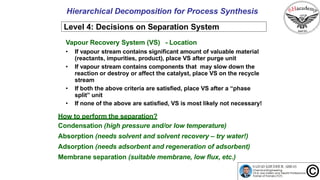
Vapour Recovery System (VS) - Location
• If vapour stream contains significant amount of valuable material
(reactants, impurities, product), place VS after purge unit
• If vapour stream contains components that may slow down the
reaction or destroy or affect the catalyst, place VS on the recycle
stream
• If both the above criteria are satisfied, place VS after a “phase
split” unit
• If none of the above are satisfied, VS is most likely not necessary!
How to perform the separation?
Condensation (high pressure and/or low temperature)
Absorption (needs solvent and solvent recovery – try water!)
Adsorption (needs adsorbent and regeneration of adsorbent)
Membrane separation (suitable membrane, low flux, etc.)
29
Hierarchical Decomposition for Process Synthesis
Level 4: Decisions on Separation System
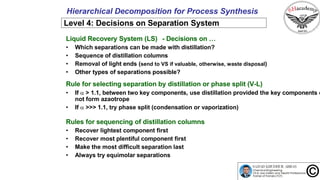
Liquid Recovery System (LS) - Decisions on …
• Which separations can be made with distillation?
• Sequence of distillation columns
• Removal of light ends (send to VS if valuable, otherwise, waste disposal)
• Other types of separations possible?
Rule for selecting separation by distillation or phase split (V-L)
• If  > 1.1, between two key components, use distillation provided the key components d
not form azaotrope
• If  >>> 1.1, try phase split (condensation or vaporization)
Rules for sequencing of distillation columns
• Recover lightest component first
• Recover most plentiful component first
• Make the most difficult separation last
• Always try equimolar separations
30
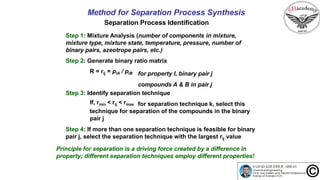
Method for Separation Process Synthesis
Separation Process Identification
Step 1: Mixture Analysis (number of components in mixture,
mixture type, mixture state, temperature, pressure, number of
binary pairs, azeotrope pairs, etc.)
Step 2: Generate binary ratio matrix
R = rij = piA / piB for property I, binary pair j
compounds A & B in pair j
Step 3: Identify separation technique
If, rmin < rij < rmax for separation technique k, select this
technique for separation of the compounds in the binary
pair j
Step 4: If more than one separation technique is feasible for binary
pair j, select the separation technique with the largest rij value
Principle for separation is a driving force created by a difference in
property; different separation techniques employ different properties!
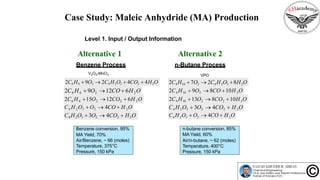
Case Study: Maleic Anhydride (MA) Production
Level 1. Input / Output Information
Alternative 1
Benzene Process
V2O5-MoO3
Alternative 2
n-Butane Process
VPO
2C6H6  9O2  2C4H2O3  4CO2  4H2O
C4 H 2O3  O2  4CO  H2O
2C6 H6  9O2 12CO  6H2O
C4H2O3  3O2  4CO2  H2O
2C6 H6 15O2 12CO2  6H 2O
2C4H10  7O2  2C4H2O3 8H2O
C4 H2O3  O2  4CO  H2O
C4 H2O3  3O2  4CO2  H2O
2C4 H10  9O2  8CO 10H2O
2C4 H10 13O2  8CO2 10H2O
Benzene conversion, 95%
MA Yield, 70%
Air/Benzene, ~ 66 (moles)
Temperature, 375°C
Pressure, 150 kPa
n-butane conversion, 85%
MA Yield, 60%
Air/n-butane, ~ 62 (moles)
Temperature, 400°C
Pressure, 150 kPa
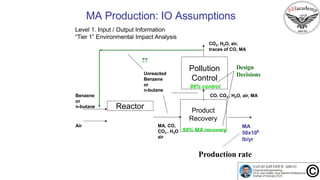
MA Production: IO Assumptions
Level 1. Input / Output Information
“Tier 1” Environmental Impact Analysis
CO2, H2O, air,
traces of CO, MA
??
Reactor
Benzene
or
n-butane
Product
Recovery
Pollution
Control
99% control
99% MA recovery
Design
DecisionsUnreacted
Benzene
or
n-butane
CO, CO2 , H2O, air, MA
Air MA, CO,
CO , H O2 2
air
MA
50x10
lb/yr
6
Production rate
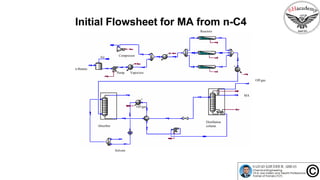
Initial Flowsheet for MA from n-C4
Reactors
Air
n-Butane
Absorber
Distillation
column
Compressor
MA
Vaporizer
Off-gas
Off-gas
Pump
Solvent
Thanks for Watching
Please follow me / SAJJAD KHUDHUR ABBAS

Episode 55 : Conceptual Process Synthesis-Design

  • 1.
    SAJJAD KHUDHUR ABBAS Ceo, Founder & Head of SHacademy Chemical Engineering , Al-Muthanna University, Iraq Oil & Gas Safety and Health Professional – OSHACADEMY Trainer of Trainers (TOT) - Canadian Center of Human Development Episode 55 : Conceptual Process Synthesis-Design
  • 2.
    Conceptual Process Synthesis-Design ProcessFlowsheet ???Raw Materials Products Process Flowsheet Synthesis: Method to determine a process flowsheet that satisfies all product, operational and other requirements
  • 3.
    Product Oriented ProcessSynthesis Chemical Product Process Raw Material What are chemical products? What are the raw materials? What is a chemical process?
  • 4.
    Chemical Product-Process Relationship Chemical Process?? Raw Material Chemical Product Chemical process synthesis-design is about finding a sustainable process that can convert the raw materials to the desired chemical products
  • 5.
    Chemical Process Design& Green Engineering Chemical Process ?? Chemical Product Raw Material Chemical process design is about finding a sustainable process that can convert the raw materials to the desired chemical products Sustainable: Economic, low environmental impact, low waste, efficient operation, correct raw material, …..
  • 6.
    Example of aChemical Process & Product Oxychlori- nation Separa- tion block 1 Pyrolysis Separa- tion block 2 HCl (addition) Water HCl (product) The production of VCM is usually done from ethylene. In this case the process is carried out in two steps, first reaction with either chlorine or hydrogen chloride in order to produce ethylene dichloride (EDC) and next pyrolysis (cracking) to form VCM. The compounds in the system are Ethylene, EDC, VCM, HCl, O2, Cl2 and H2O. The reactions involved is the process are: Direct chlorination: C2H4 + Cl2  C2H4Cl2 Oxychlorination: C2H4+2HCl+½O2  C2H4Cl2 +H2O Pyrolysis (cracking): C2H4Cl2  C2H3Cl + HCl The two step process also requires two separation blocks. In the first step (formation of EDC) two different reactions are considered (Direct chlorination and oxychlorination). Oxychlorination produces water in EDC VCM (product) HCl Oxygen Ethylene Chlorine Recycle addition to EDC and it aClsoomrepquutierresAaidreedcyPcrloe.cess Engineering - Lecture 7 (R. Gani) Direct chlorinatio n Purge
  • 7.
    Process design startswith defining the needs of the product that will be manufactured by the process!
  • 8.
    The Product Tree Itis important to choose the right product and the corresponding raw material from which the product can be made. This also defines the path (process route)
  • 9.
    A Scenario forChemical Process Design 1. Board of Directors’ Design Problem 2. Discovery of possible new projects 3. Feedback & customer reaction 4. Planning & organizational design 5. Preliminary process design 6. Layout & three dimensional modelling 7. Construction 8. Startup & commissioning 9. Plant Operation 10. Debottelnecking 11. Decommissioning Stages in the life of a process !
  • 10.
    Computer Aide d ProcessEngineering - Le 9 Roles of different groups of people in the different stages of the life of a proces BU definition of 1 obejctive PE conceptual 2 process design Chemical Research rating mpany Process C Engineering Business Unit CR preliminary 1 study PE preliminary 1 study BU decision on 2 process information about novel compound proposal for process improvement idea for new compound/ market strategy state of the market  objective  idea of production amount schedule  description of the process  PFD and pre-P&ID  mass and energy balances  datasheets for major units  site and installation plan onstruction Company Ope Co  estimated costs  estimated schedule  patents  description of synthesis path  first process description  analysis methods for product, product quality, etc.  first safety considerations cture 7 (R. Gani )
  • 11.
    Roles of differentgroups of people in the different stages of the life of a proces II Chemical Research Operating Company Construction Company Process Engineering Business Unit PE 3 detailed process design CC engineering 1 design and construction CC 2 commis- sioning hand-over OC 2 operation and maintenance OC 1 commis- sioning, hand-over OC decom- 3 missioning  P&ID  data sheets and equipment drawings  mass and energy balances  information about process at steady state  comments on startup and shutdown  plant  plant documentation  P&ID  data sheets  equipment drawings  piping specification  installation plan  building plan  plant modell BU decision on 4 project continuation  description of the process  PFD and pre-P&ID  mass and energy balances  datasheets for major units  site and installation plan
  • 12.
    The Synthesis Step Chemical Process ?? Chemical Product RawMaterial Concept Generation Generation of Alternatives Analysis & Evaluation of Alternatives Final Selection
  • 13.
    The Synthesis Step Chemical Process ?? Chemical Product RawMaterial Problem specification Approaches for design Design alternatives Performance Cost, safety, … Concept generation Alternative generation Analysis Evaluation Comparison & optimization Abstract Description Refined Description
  • 14.
    Basic Steps inFlowsheet Synthesis * Gathering Information * Representing Alternatives * Criteria for Assessing Preliminary Designs  Economic evaluation  Environmental concerns  Safety analysis  Flexibility & controllability * Generating & searching among alternatives
  • 15.
    Generating & searchingamong alternatives: Methods * Total enumeration * Evolutionary methods * Mathematical programming * Hybrid Establish targets for the design Generate (feasible) alternatives that will match the targets Order all the feasible alternatives and select the most appropriate
  • 16.
    Generating & searchingamong alternatives: Methods * Total enumeration * Evolutionary methods * Mathematical programming * Hybrid Concepts: Superstructure & Alternatives C[1] C[2] 1 2 3 H[1] T[in] T[out] C[3]
  • 17.
    Generating & searchingamong alternatives: Methods * Total enumeration * Evolutionary methods * Mathematical programming * Hybrid A, E Concepts: Superstructure & Alternatives A, B, C, D, E, F A / B, C, D, E, F B, F A, E, F / C, D, B Reactor C D A, F / F C / D, B E F
  • 18.
    Decomposition Strategies forProcess Synthesis • Bounding Strategies for Process Synthesis • Hierarchical Decomposition for Process Synthesis P1 = Cp Fp – Cr Fr = Original space = Profit bound P2 = P1 – Constraints = Profit bound P3 = P2 – Cop P4 = P3 – Cop P4 = P3 – Cop
  • 19.
    Decomposition Strategies forProcess Synthesis • Bounding Strategies for Process Synthesis • Hierarchical Decomposition for Process Synthesis Level 1. Input Information i problem definition Batch versus Continuous (1) Level 2. Input-Output Structure i material selection i reaction pathways Input-output structure of flowsheet (2) Recycle structure of flowsheet (3) Separation system synthesis (4) Levels 3 & 4. i recycle i separation system Levels 5 - 8. i energy integration i detailed evaluation i control i safety Heat/mass recovery network (5) Design problem decomposed into a hierarchy of decisions
  • 20.
    Hierarchical Decomposition forProcess Synthesis Level 1: Decisions on Batch versus Continuous Consider, • Technical Information •Does any apparatus work in batch mode? Is process sensitive to upsets & variations? • Production Rate •High or low production rate? Only few days production needed? Few days operational notice! • Product Lifetime • One or two years or longer? • Value of Product • Product value >> manufacturing cost? Note: Several batch units can be combined to give a continuous production!
  • 21.
    20 Hierarchical Decomposition forProcess Synthesis Level 2: Decisions on Input-Output Structure Consider, • Raw materials – what to do with impurities ? • How many product streams? • Recycle streams? Purge streams? • Reversible by-products? Recycle or recover? • Selectivity versus cost Three Types of Decisions (Assumptions) 1. Decision that fix parts of the flowsheet 2. Decisions that fix some of the design variables 3. Decisions that fix connections to the environment
  • 22.
    Hierarchical Decomposition forProcess Synthesis Level 2: Decisions on Input-Output Structure Raw Materials - Impurities? • If the impurities are inert, remove them after reaction, if they are valuable •If the impurities are inert, present in large amounts, and, can be easily separated, remove them before the reactor • If the impurities have boiling points lower than reactants and products, and, they are also inert, recycle them (note: purge unit will be needed!) • If the impurities are also products from the reactor, place the feed stream before the unit that will remove the impurities
  • 23.
    Hierarchical Decomposition forProcess Synthesis Level 2: Decisions on Input-Output Structure Product streams? Observe the following Rules • Recycle unreacted reactants • Recycle intermediate reactants (products) • Recycle/remove azeotropes with reactants* • Remove (recover) the main product • Remove (recover) the valuable by-products • Remove (as waste)/recycle by- products that are not valuable
  • 24.
    Hierarchical Decomposition forProcess Synthesis Level 2: Decisions on Input-Output Structure Recycle? Purge Units? Consider the following: • For < 100% conversion of reactants and reaction in the gas phase, Recycle of gases will be necessary If impurities are present, purge units will be necessary • For < 100% conversion and reaction in the liquid phase, Recycle of liquids (reactants) will be necessary If impurities are present, purge units will be necessary
  • 25.
    Hierarchical Decomposition forProcess Synthesis Level 2: Decisions on Input-Output Structure Reversible by-products? Selectivity versus cost? EP2 = Product value – Byproduct value – Raw material value Function of conversion, selectivity, reaction T & P, ….
  • 26.
    Hierarchical Decomposition forProcess Synthesis Level 3: Decisions on Recycle Structure & Reactor Consider, • Number of reactors? • Number of recycle streams? • Need for compressor/pump? • Reactor type? Adiabatic or Isothermal? • Reaction equilibrium or kinetics? • Reactor cost (capital & operating)?
  • 27.
    Hierarchical Decomposition forProcess Synthesis Level 3: Decisions on Recycle Structure & Reactor • Number of reactors? • If more than one reaction is needed to get the desired product, more than one reactor will be needed if the conditions are very different • Number of recycle streams? • Depends on the number of raw materials and conversion of all reactants • Need for compressor/pump? • Compressor for gas recycle; pump for liquid recycle • Reactor type? Adiabatic or Isothermal? • If temperature change is too high or low, heating or cooling will be needed • Reaction equilibrium or kinetics? • Kinetically controlled or equilibrium reached? • Reactor cost (capital & operating)? EP3 = EP2 – Compressor/pump cost – Reactor cost
  • 28.
    Hierarchical Decomposition forProcess Synthesis Level 4: Decisions on Separation System Vapour recovery and/or Liquid recovery? - Rules • If reactor stream is in liquid phase, use liquid recovery • If reactor stream has 2 phases (separate the 2 phases first) • Use vapour recovery for vapour phase • Use liquid recovery for liquid phase • Reactor stream is gas (vapour) phase • Perform phase split (if possible) by reducing temperature (ie., condenser) and then separate the 2-phase. Otherwise, use vapour recovery How to locate & perform the separation? EP4 = EP3 – Vapour recovery cost – Liquid recovery cost
  • 29.
    Hierarchical Decomposition forProcess Synthesis Level 4: Decisions on Separation System Vapour Recovery System (VS) - Location • If vapour stream contains significant amount of valuable material (reactants, impurities, product), place VS after purge unit • If vapour stream contains components that may slow down the reaction or destroy or affect the catalyst, place VS on the recycle stream • If both the above criteria are satisfied, place VS after a “phase split” unit • If none of the above are satisfied, VS is most likely not necessary! How to perform the separation? Condensation (high pressure and/or low temperature) Absorption (needs solvent and solvent recovery – try water!) Adsorption (needs adsorbent and regeneration of adsorbent) Membrane separation (suitable membrane, low flux, etc.)
  • 30.
    29 Hierarchical Decomposition forProcess Synthesis Level 4: Decisions on Separation System Liquid Recovery System (LS) - Decisions on … • Which separations can be made with distillation? • Sequence of distillation columns • Removal of light ends (send to VS if valuable, otherwise, waste disposal) • Other types of separations possible? Rule for selecting separation by distillation or phase split (V-L) • If  > 1.1, between two key components, use distillation provided the key components d not form azaotrope • If  >>> 1.1, try phase split (condensation or vaporization) Rules for sequencing of distillation columns • Recover lightest component first • Recover most plentiful component first • Make the most difficult separation last • Always try equimolar separations
  • 31.
    30 Method for SeparationProcess Synthesis Separation Process Identification Step 1: Mixture Analysis (number of components in mixture, mixture type, mixture state, temperature, pressure, number of binary pairs, azeotrope pairs, etc.) Step 2: Generate binary ratio matrix R = rij = piA / piB for property I, binary pair j compounds A & B in pair j Step 3: Identify separation technique If, rmin < rij < rmax for separation technique k, select this technique for separation of the compounds in the binary pair j Step 4: If more than one separation technique is feasible for binary pair j, select the separation technique with the largest rij value Principle for separation is a driving force created by a difference in property; different separation techniques employ different properties!
  • 32.
    Case Study: MaleicAnhydride (MA) Production Level 1. Input / Output Information Alternative 1 Benzene Process V2O5-MoO3 Alternative 2 n-Butane Process VPO 2C6H6  9O2  2C4H2O3  4CO2  4H2O C4 H 2O3  O2  4CO  H2O 2C6 H6  9O2 12CO  6H2O C4H2O3  3O2  4CO2  H2O 2C6 H6 15O2 12CO2  6H 2O 2C4H10  7O2  2C4H2O3 8H2O C4 H2O3  O2  4CO  H2O C4 H2O3  3O2  4CO2  H2O 2C4 H10  9O2  8CO 10H2O 2C4 H10 13O2  8CO2 10H2O Benzene conversion, 95% MA Yield, 70% Air/Benzene, ~ 66 (moles) Temperature, 375°C Pressure, 150 kPa n-butane conversion, 85% MA Yield, 60% Air/n-butane, ~ 62 (moles) Temperature, 400°C Pressure, 150 kPa
  • 33.
    MA Production: IOAssumptions Level 1. Input / Output Information “Tier 1” Environmental Impact Analysis CO2, H2O, air, traces of CO, MA ?? Reactor Benzene or n-butane Product Recovery Pollution Control 99% control 99% MA recovery Design DecisionsUnreacted Benzene or n-butane CO, CO2 , H2O, air, MA Air MA, CO, CO , H O2 2 air MA 50x10 lb/yr 6 Production rate
  • 34.
    Initial Flowsheet forMA from n-C4 Reactors Air n-Butane Absorber Distillation column Compressor MA Vaporizer Off-gas Off-gas Pump Solvent
  • 35.
    Thanks for Watching Pleasefollow me / SAJJAD KHUDHUR ABBAS