PROCESS VALIDATION
OF LIQUID ORALS
Presented by :- Sachin R. Naksakhare
Roll no: 536
M.Pharm Sem-II (QAT)
Guide by:-
Dr. Rupali Kale
Dr. D. Y. Patil Institute of Pharmaceutical Sciences and Research Pimpri , Pune-18
1
Introduction
Process Validation:-
Definition :-“It is a documented program which provides a
high degree of assurance that a specific process will
consistently produce a product, meeting its pre-determined
specifications and quality attributes”.
 Process validation starts only after the complete qualification
program (D.Q., I.Q., O.Q., and P.Q.) of facilities and
equipment is over.
2
 To conform Manufacturing to cGMP regulations.
 To avoid the possibility of rejected or recalled
batches.
 To ensure the product uniformity and quality.
Why Process Validation?
3
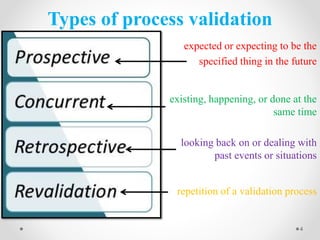
expected or expecting to be the
specified thing in the future
existing, happening, or done at the
same time
looking back on or dealing with
past events or situations
repetition of a validation process
Types of process validation
4
Objective of process validation
 Assurance of quality of the product.
 Reduces variation between various batches.
 Improve employee awareness for processes.
 Easier maintenance of equipment.
 Easier scale-up from development work.
 More rapid and reliable start-up of new equipment.
5
Advantages Of Process Validation
 Simple process
 Consistent through output.
 Reduction in rejections and reworks.
 Fewer complaints about process related failure.
 Easier maintenance of equipment.
 More rapid and accurate investigations process deviation.
 Increased confidence about process reproducibility and product
quality.
6
Critical Factors Of Process
Validation
 All the critical point of the process should be clearly
identified.
 The process should run using the extremes of the system at
the critical points.
 The quality system should support the validation effort by way
of document control, preventive maintenance, calibration, etc.
 Adequate data are required to provide statistical support to
demonstrate product consistency.
7
What Are Oral Liquids?
 Oral Liquids are homogeneous liquid preparations, usually
consisting of a solution, an emulsion or a suspension of one or
more active ingredients in a suitable vehicle.
8
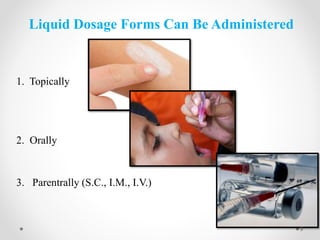
1. Topically
2. Orally
3. Parentrally (S.C., I.M., I.V.)
Liquid Dosage Forms Can Be Administered
9
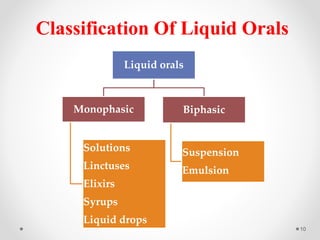
Classification Of Liquid Orals
Liquid orals
Monophasic
Solutions
Linctuses
Elixirs
Syrups
Liquid drops
Biphasic
Suspension
Emulsion
10
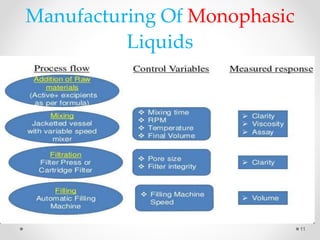
Manufacturing Of Monophasic
Liquids
11
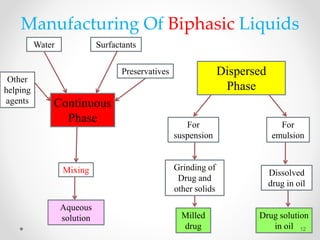
Manufacturing Of Biphasic Liquids
Water
Continuous
Phase
Other
helping
agents
Mixing
Aqueous
solution
Dispersed
Phase
For
suspension
Preservatives
Surfactants
Drug solution
in oil
Grinding of
Drug and
other solids
Dissolved
drug in oil
For
emulsion
Milled
drug 12
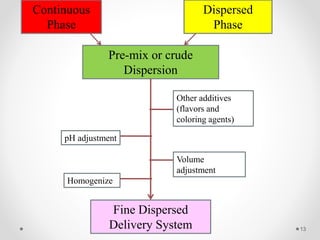
Continuous
Phase
Dispersed
Phase
Pre-mix or crude
Dispersion
Fine Dispersed
Delivery System
pH adjustment
Other additives
(flavors and
coloring agents)
Volume
adjustment
Homogenize
13
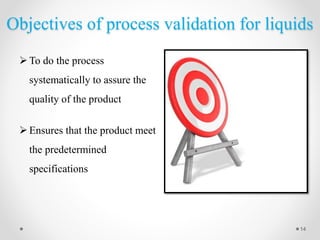
Objectives of process validation for liquids
To do the process
systematically to assure the
quality of the product
Ensures that the product meet
the predetermined
specifications
14
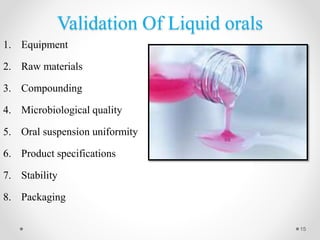
Validation Of Liquid orals
1. Equipment
2. Raw materials
3. Compounding
4. Microbiological quality
5. Oral suspension uniformity
6. Product specifications
7. Stability
8. Packaging
15
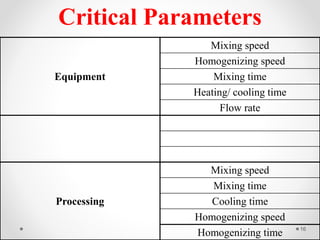
Critical Parameters
Equipment
Mixing speed
Homogenizing speed
Mixing time
Heating/ cooling time
Flow rate
Processing
Mixing speed
Mixing time
Cooling time
Homogenizing speed
Homogenizing time 16
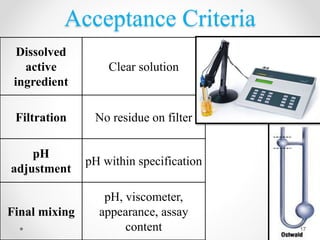
Acceptance Criteria
Dissolved
active
ingredient
Clear solution
Filtration No residue on filter
pH
adjustment
pH within specification
Final mixing
pH, viscometer,
appearance, assay
content 17
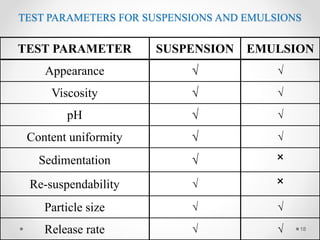
TEST PARAMETERS FOR SUSPENSIONS AND EMULSIONS
TEST PARAMETER SUSPENSION EMULSION
Appearance √ √
Viscosity √ √
pH √ √
Content uniformity √ √
Sedimentation √ ˟
Re-suspendability √ ˟
Particle size √ √
Release rate √ √ 18
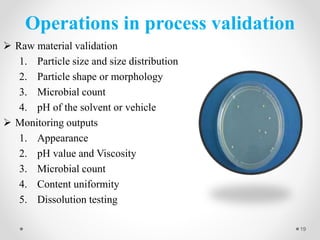
Operations in process validation
 Raw material validation
1. Particle size and size distribution
2. Particle shape or morphology
3. Microbial count
4. pH of the solvent or vehicle
 Monitoring outputs
1. Appearance
2. pH value and Viscosity
3. Microbial count
4. Content uniformity
5. Dissolution testing
19
Validation Report
 Validation Team must prepare
the report
 Report must be reviewed and
approved by QA.
 Written Notification or either
successful completion or
failure of the process
validation must be issued to
top management.
 In case of failure, an
investigation must be
completed and documented
prior to repeat the validation
study.
20
Changes and Revalidation
1. Minor
2. Intermediate
3. Major
 Change of any of the following may need revalidation
1. Formula Composition
2. Raw Material Source
3. Manufacturing Process
4. Manufacturing Location
5. Equipments
6. Batch Size
CHANGES
21
 The accurate and reliable method of estimation quality, identity,
strength, purity, stability, effectiveness and safety.
 The better acceptability of the drug.
22
References
 M. A. Potdar “Pharmaceutical Quality Assurance” Nirali
Prakashan, Thired edition, page no:- 8.20-8.22
 M. A. Potdar “ cGMP For Pharmaceuticals” page no:- 469-484
 Atmaram Pawar and R. S. Gaud “Modern Dispensing
Pharmacy” Career Publications, Page no:- 140-155
23
Thank
You
24

Process validation of oral liquid

  • 1.
    PROCESS VALIDATION OF LIQUIDORALS Presented by :- Sachin R. Naksakhare Roll no: 536 M.Pharm Sem-II (QAT) Guide by:- Dr. Rupali Kale Dr. D. Y. Patil Institute of Pharmaceutical Sciences and Research Pimpri , Pune-18 1
  • 2.
    Introduction Process Validation:- Definition :-“Itis a documented program which provides a high degree of assurance that a specific process will consistently produce a product, meeting its pre-determined specifications and quality attributes”.  Process validation starts only after the complete qualification program (D.Q., I.Q., O.Q., and P.Q.) of facilities and equipment is over. 2
  • 3.
     To conformManufacturing to cGMP regulations.  To avoid the possibility of rejected or recalled batches.  To ensure the product uniformity and quality. Why Process Validation? 3
  • 4.
    expected or expectingto be the specified thing in the future existing, happening, or done at the same time looking back on or dealing with past events or situations repetition of a validation process Types of process validation 4
  • 5.
    Objective of processvalidation  Assurance of quality of the product.  Reduces variation between various batches.  Improve employee awareness for processes.  Easier maintenance of equipment.  Easier scale-up from development work.  More rapid and reliable start-up of new equipment. 5
  • 6.
    Advantages Of ProcessValidation  Simple process  Consistent through output.  Reduction in rejections and reworks.  Fewer complaints about process related failure.  Easier maintenance of equipment.  More rapid and accurate investigations process deviation.  Increased confidence about process reproducibility and product quality. 6
  • 7.
    Critical Factors OfProcess Validation  All the critical point of the process should be clearly identified.  The process should run using the extremes of the system at the critical points.  The quality system should support the validation effort by way of document control, preventive maintenance, calibration, etc.  Adequate data are required to provide statistical support to demonstrate product consistency. 7
  • 8.
    What Are OralLiquids?  Oral Liquids are homogeneous liquid preparations, usually consisting of a solution, an emulsion or a suspension of one or more active ingredients in a suitable vehicle. 8
  • 9.
    1. Topically 2. Orally 3.Parentrally (S.C., I.M., I.V.) Liquid Dosage Forms Can Be Administered 9
  • 10.
    Classification Of LiquidOrals Liquid orals Monophasic Solutions Linctuses Elixirs Syrups Liquid drops Biphasic Suspension Emulsion 10
  • 11.
  • 12.
    Manufacturing Of BiphasicLiquids Water Continuous Phase Other helping agents Mixing Aqueous solution Dispersed Phase For suspension Preservatives Surfactants Drug solution in oil Grinding of Drug and other solids Dissolved drug in oil For emulsion Milled drug 12
  • 13.
    Continuous Phase Dispersed Phase Pre-mix or crude Dispersion FineDispersed Delivery System pH adjustment Other additives (flavors and coloring agents) Volume adjustment Homogenize 13
  • 14.
    Objectives of processvalidation for liquids To do the process systematically to assure the quality of the product Ensures that the product meet the predetermined specifications 14
  • 15.
    Validation Of Liquidorals 1. Equipment 2. Raw materials 3. Compounding 4. Microbiological quality 5. Oral suspension uniformity 6. Product specifications 7. Stability 8. Packaging 15
  • 16.
    Critical Parameters Equipment Mixing speed Homogenizingspeed Mixing time Heating/ cooling time Flow rate Processing Mixing speed Mixing time Cooling time Homogenizing speed Homogenizing time 16
  • 17.
    Acceptance Criteria Dissolved active ingredient Clear solution FiltrationNo residue on filter pH adjustment pH within specification Final mixing pH, viscometer, appearance, assay content 17
  • 18.
    TEST PARAMETERS FORSUSPENSIONS AND EMULSIONS TEST PARAMETER SUSPENSION EMULSION Appearance √ √ Viscosity √ √ pH √ √ Content uniformity √ √ Sedimentation √ ˟ Re-suspendability √ ˟ Particle size √ √ Release rate √ √ 18
  • 19.
    Operations in processvalidation  Raw material validation 1. Particle size and size distribution 2. Particle shape or morphology 3. Microbial count 4. pH of the solvent or vehicle  Monitoring outputs 1. Appearance 2. pH value and Viscosity 3. Microbial count 4. Content uniformity 5. Dissolution testing 19
  • 20.
    Validation Report  ValidationTeam must prepare the report  Report must be reviewed and approved by QA.  Written Notification or either successful completion or failure of the process validation must be issued to top management.  In case of failure, an investigation must be completed and documented prior to repeat the validation study. 20
  • 21.
    Changes and Revalidation 1.Minor 2. Intermediate 3. Major  Change of any of the following may need revalidation 1. Formula Composition 2. Raw Material Source 3. Manufacturing Process 4. Manufacturing Location 5. Equipments 6. Batch Size CHANGES 21
  • 22.
     The accurateand reliable method of estimation quality, identity, strength, purity, stability, effectiveness and safety.  The better acceptability of the drug. 22
  • 23.
    References  M. A.Potdar “Pharmaceutical Quality Assurance” Nirali Prakashan, Thired edition, page no:- 8.20-8.22  M. A. Potdar “ cGMP For Pharmaceuticals” page no:- 469-484  Atmaram Pawar and R. S. Gaud “Modern Dispensing Pharmacy” Career Publications, Page no:- 140-155 23
  • 24.