Pilonidal Sinus Surgical
Practice and Guidelines
By
Yasser Ali Orban
Lecturer of General Surgery
Faculty of Medicine, Zagazig University
objectives
 Background
 GRADE system of recommendations
 Pathogenesis
 Predisposing factors
 Presentation
 Diagnosis
 Treatments
 Guidelines
 Summary and recommendation
Background
Pilonidal disease an acute or chronic infection in the
subcutaneous tissue, mainly in the natal cleft.
Affects mainly young adults aged 15-30 years rare in
people older than 40.
 3:1 male-to-female ratio.
(Iesalnieks and Ommer, 2019)
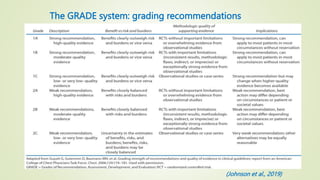
The GRADE system: grading recommendations
(Johnson et al., 2019)
Pathogenesis
Pilonidal disease is considered an acquired condition.
Free hairs perforate vulnerable, but still intact skin.
Movement of the gluteal musculature leads to negative
pressure in the natal cleft, drawing the free hairs
inward.
The interdigital PS of hairdressers supports this theory.
(Anand and Chauhan, 2020)
Predisposing factors
Obesity
prolonged daily sitting
Deep natal cleft
Family history of pilonidal disease
hirsutism
(Yildiz and Ilce, 2020)
Clinical presentation
Asymptomatic: silent pits discovered accidentally.
Pilonidal abscess.
Chronic presentation: continuous or intermittent
discharge
Recurrent abscesses (Iesalnieks and Ommer, 2019)
Diagnosis
Mostly clinical based on history clinical finding (1C).
Caudal direction may be confused with anorectal
fistulas.
Anorectatal examination and MRI to exclude
concomitant fistulas.
(Johnson et al., 2019)
Treatment
I. Nonoperative Therapy/ Adjuncts.
A. Hair removal
 Shaving, laser or cream epilation are used as
primary or adjunct treatment measure (1C).
B. Phenol
 Effective and may result in rapid healing (1B)
C. Fibrin glue
 Used as adjunct after excision to fill the wound (1B).
(Basso et al., 2021)
II. operative treatment
A. Pilonidal abscess
Simple incision and drainage
(1B).
Primary excision would be ideal
for small abcesses (1B).
(Kitchen, 2010), (Johnson et al., 2019)
B. Surgery for chronic pilonidal sinus
The appropriate surgical treatment is controversial (1B).
The choice of surgery based on surgeon and patient
preference (1B)
1. Excision is the standard treatment divided:
a. Excision with healing by secondary intention
b. Excision with primary closure (including flap techniques)
2. Less and minimally invasive techniques. (Basso et al., 2021)
1. Excision and Healing by Secondary Intension
a. Open technique
Excision of the sinus and the
wound left to heal by granulation
tissue
Disadvantages: long period off
work, daily painful dressing
Recurrence rate: 1-16% .
(Stauffer et al., 2018), (Johnson et al., 2019)
b. Excision and Marsupialization
After excision of the pilonidal
sinus, the skin edges are
sutured to the presacral fascia.
 Recurrence: 4-8%.
(Gencosmanoglu and Inceoglu,
2018)
2. Closed techniques
a. Excision and midline closure
b. Flap techniques
Karydakis
Limberg flap
Cleft lift
V-Y advancement flap
Gluteal rotational flap
Lateral advancement flap
Gluteal arteries perforator flap
(Basso et al., 2021)
Excision and midline closure
Disadvantages: wounds may be
under tension.
Recurrence rate: 2.1-25.3%
(Stauffer et al., 2018), (Bhama and Davis, 2022)
Karydakis
Obliterate the natal cleft and
provides off midline closure.
Recurrence rate: <2%
(Bhama and Davis, 2022)
Limberg flap
Rhomboid-shape excision.
A rotation of a
fasciocutaneous flap for
closure
Recurrence (0%–6%)
(Johnson et al., 2019), (Bhama and Davis, 2022)
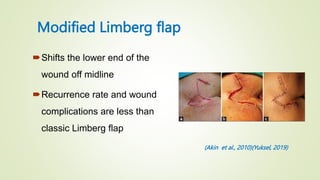
Modified Limberg flap
Shifts the lower end of the
wound off midline
Recurrence rate and wound
complications are less than
classic Limberg flap
(Akin et al., 2010)(Yuksel, 2019)
Cleft lift
Designed to “lift” the concavity of
the natal cleft
Provides off midline closure
Recurrence rate: 0.2-2.3%.
(Carapeti, 2021)
V-Y advancement flap
 Modified according to the defect
size as unilateral or bilateral
flaps.
 Recurrence rate: 0-11%.
(Sari et al., 2019).
Lateral advancement flap
Off midline closure.
Recurrence rate: 4%.
(Arora et al., 2017).
Gluteal rotational flap
Random flap for large
defects.
Flatten the natal cleft.
Recurrence rate: 6.1%.
(Sıkar and Çetin, 2019)
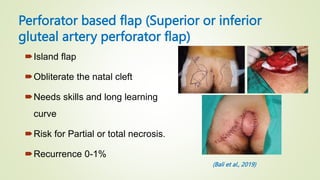
Perforator based flap (Superior or inferior
gluteal artery perforator flap)
Island flap
Obliterate the natal cleft
Needs skills and long learning
curve
Risk for Partial or total necrosis.
Recurrence 0-1%
(Bali et al., 2019)
3. Less and minimally invasive techniques.
Pit picking
Bascom’s procedure.
Sinusectomy
Sinotomy
Endoscopic pilonidal sinus treatment (EPSiT)
Sinus laser therapy (SiLaT)
(Basso et al., 2021)
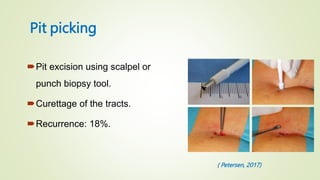
Pit picking
Pit excision using scalpel or
punch biopsy tool.
Curettage of the tracts.
Recurrence: 18%.
( Petersen, 2017)
Bascom’s procedure
excision of midline pits and
closure.
lateral incision to clean the cavity
Recurrence: 2.7- 15.6%.
(Stauffer et al., 1018), (Lee et al., 2007)
Sinusectomy
Tunnel excision of the sinus.
Recurrence: 6.5- 13.2%
(Gul et al., 2020)
Sinotomy
Under local anesthesia
Probing, lay-open and
curettage
Recurrence: 2- 12.5%
(Darwish et al., 2017)
Endoscopic pilonidal sinus treatment
(EPSiT)
Advantages: early return to
work, minimal scar and less
pain.
Disadvantage: the
fistuloscope availability.
Recurrence rate was 5-26%.
(Angerer and Königsrainer, 2020)
Sinus laser therapy (SiLaT)
Laser delivered by a radial emitting
fiber after pit excision and
curettage.
Recurrence 5% at short term follow-
up.
(Khubezov et al., 2020)
4. Complex and recurrent pilonidal sinus
Complex sinus characterized by:
 Multiple openings and repeated infections
 Lateral opening/s at least 5cm from midline
 Caudal extension
(Basso et al., 2021)
4. Complex pilonidal sinus
Open healing should be limited to complex cases
Flap-based procedures are indicated in recurrent sinus (1B)
Considering the expertise of the surgeon (1C).
(Basso et al., 2021)
Guidelines and meta-analysis
for pilonidal sinus
Diagnosis is mostly clinical (1C).
Simple incision and drainage for pilonidal abcess (1B).
The appropriate surgical treatment is controversial (1B).
The choice of surgery based on surgeon and patient preference
(1B)
Shaving, laser or cream epilation are used as primary or adjunct
measure (1C).
(Johnson et al., 2019)
Guidelines
Phenol and fibrin glue are effective adjunct (1B)
In the case of primary closure, off-midline closure should be the
treatment of choice (1B).
Drains should be tailored to the individual patient (1B).
Antibiotics have unclear benefit. Individualized consideration for
its use (2B). (Johnson et al., 2019)
Guidelines
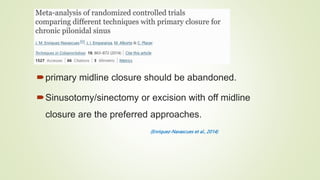
primary midline closure should be abandoned.
Sinusotomy/sinectomy or excision with off midline
closure are the preferred approaches.
(Enriquez-Navascues et al., 2014)
(Stauffer et al., 2018)
A total of 39 studies and 5,061 patients, the most
common surgical intervention was the Limberg flap.
Modified Limberg flap and off-midline closure were
associated with the lowest recurrence rate
(Bi et al., 2020)
Summary and recommendations
Pilonidal disease is a common condition with considerable
recurrence.
General principles of therapy: good hygiene, hair control, and
excision.
Minimally invasive procedures (e.g., pit picking) may be used for
small primary disease.
Flap techniques with off midline closure for complex pilonidal
disease.
Excision with midline closure should be avoided
Limberg flap and Karydakis procedure are two best described
pilonidal sinus.pptx

pilonidal sinus.pptx

  • 1.
    Pilonidal Sinus Surgical Practiceand Guidelines By Yasser Ali Orban Lecturer of General Surgery Faculty of Medicine, Zagazig University
  • 2.
    objectives  Background  GRADEsystem of recommendations  Pathogenesis  Predisposing factors  Presentation  Diagnosis  Treatments  Guidelines  Summary and recommendation
  • 3.
    Background Pilonidal disease anacute or chronic infection in the subcutaneous tissue, mainly in the natal cleft. Affects mainly young adults aged 15-30 years rare in people older than 40.  3:1 male-to-female ratio. (Iesalnieks and Ommer, 2019)
  • 4.
    The GRADE system:grading recommendations (Johnson et al., 2019)
  • 5.
    Pathogenesis Pilonidal disease isconsidered an acquired condition. Free hairs perforate vulnerable, but still intact skin. Movement of the gluteal musculature leads to negative pressure in the natal cleft, drawing the free hairs inward. The interdigital PS of hairdressers supports this theory. (Anand and Chauhan, 2020)
  • 6.
    Predisposing factors Obesity prolonged dailysitting Deep natal cleft Family history of pilonidal disease hirsutism (Yildiz and Ilce, 2020)
  • 7.
    Clinical presentation Asymptomatic: silentpits discovered accidentally. Pilonidal abscess. Chronic presentation: continuous or intermittent discharge Recurrent abscesses (Iesalnieks and Ommer, 2019)
  • 8.
    Diagnosis Mostly clinical basedon history clinical finding (1C). Caudal direction may be confused with anorectal fistulas. Anorectatal examination and MRI to exclude concomitant fistulas. (Johnson et al., 2019)
  • 9.
  • 10.
    A. Hair removal Shaving, laser or cream epilation are used as primary or adjunct treatment measure (1C). B. Phenol  Effective and may result in rapid healing (1B) C. Fibrin glue  Used as adjunct after excision to fill the wound (1B). (Basso et al., 2021)
  • 11.
  • 12.
    A. Pilonidal abscess Simpleincision and drainage (1B). Primary excision would be ideal for small abcesses (1B). (Kitchen, 2010), (Johnson et al., 2019)
  • 13.
    B. Surgery forchronic pilonidal sinus The appropriate surgical treatment is controversial (1B). The choice of surgery based on surgeon and patient preference (1B) 1. Excision is the standard treatment divided: a. Excision with healing by secondary intention b. Excision with primary closure (including flap techniques) 2. Less and minimally invasive techniques. (Basso et al., 2021)
  • 14.
    1. Excision andHealing by Secondary Intension
  • 15.
    a. Open technique Excisionof the sinus and the wound left to heal by granulation tissue Disadvantages: long period off work, daily painful dressing Recurrence rate: 1-16% . (Stauffer et al., 2018), (Johnson et al., 2019)
  • 16.
    b. Excision andMarsupialization After excision of the pilonidal sinus, the skin edges are sutured to the presacral fascia.  Recurrence: 4-8%. (Gencosmanoglu and Inceoglu, 2018)
  • 17.
    2. Closed techniques a.Excision and midline closure b. Flap techniques Karydakis Limberg flap Cleft lift V-Y advancement flap Gluteal rotational flap Lateral advancement flap Gluteal arteries perforator flap (Basso et al., 2021)
  • 18.
    Excision and midlineclosure Disadvantages: wounds may be under tension. Recurrence rate: 2.1-25.3% (Stauffer et al., 2018), (Bhama and Davis, 2022)
  • 19.
    Karydakis Obliterate the natalcleft and provides off midline closure. Recurrence rate: <2% (Bhama and Davis, 2022)
  • 20.
    Limberg flap Rhomboid-shape excision. Arotation of a fasciocutaneous flap for closure Recurrence (0%–6%) (Johnson et al., 2019), (Bhama and Davis, 2022)
  • 21.
    Modified Limberg flap Shiftsthe lower end of the wound off midline Recurrence rate and wound complications are less than classic Limberg flap (Akin et al., 2010)(Yuksel, 2019)
  • 22.
    Cleft lift Designed to“lift” the concavity of the natal cleft Provides off midline closure Recurrence rate: 0.2-2.3%. (Carapeti, 2021)
  • 23.
    V-Y advancement flap Modified according to the defect size as unilateral or bilateral flaps.  Recurrence rate: 0-11%. (Sari et al., 2019).
  • 24.
    Lateral advancement flap Offmidline closure. Recurrence rate: 4%. (Arora et al., 2017).
  • 25.
    Gluteal rotational flap Randomflap for large defects. Flatten the natal cleft. Recurrence rate: 6.1%. (Sıkar and Çetin, 2019)
  • 26.
    Perforator based flap(Superior or inferior gluteal artery perforator flap) Island flap Obliterate the natal cleft Needs skills and long learning curve Risk for Partial or total necrosis. Recurrence 0-1% (Bali et al., 2019)
  • 27.
    3. Less andminimally invasive techniques. Pit picking Bascom’s procedure. Sinusectomy Sinotomy Endoscopic pilonidal sinus treatment (EPSiT) Sinus laser therapy (SiLaT) (Basso et al., 2021)
  • 28.
    Pit picking Pit excisionusing scalpel or punch biopsy tool. Curettage of the tracts. Recurrence: 18%. ( Petersen, 2017)
  • 29.
    Bascom’s procedure excision ofmidline pits and closure. lateral incision to clean the cavity Recurrence: 2.7- 15.6%. (Stauffer et al., 1018), (Lee et al., 2007)
  • 30.
    Sinusectomy Tunnel excision ofthe sinus. Recurrence: 6.5- 13.2% (Gul et al., 2020)
  • 31.
    Sinotomy Under local anesthesia Probing,lay-open and curettage Recurrence: 2- 12.5% (Darwish et al., 2017)
  • 32.
    Endoscopic pilonidal sinustreatment (EPSiT) Advantages: early return to work, minimal scar and less pain. Disadvantage: the fistuloscope availability. Recurrence rate was 5-26%. (Angerer and Königsrainer, 2020)
  • 33.
    Sinus laser therapy(SiLaT) Laser delivered by a radial emitting fiber after pit excision and curettage. Recurrence 5% at short term follow- up. (Khubezov et al., 2020)
  • 34.
    4. Complex andrecurrent pilonidal sinus Complex sinus characterized by:  Multiple openings and repeated infections  Lateral opening/s at least 5cm from midline  Caudal extension (Basso et al., 2021)
  • 35.
    4. Complex pilonidalsinus Open healing should be limited to complex cases Flap-based procedures are indicated in recurrent sinus (1B) Considering the expertise of the surgeon (1C). (Basso et al., 2021)
  • 36.
  • 37.
    Diagnosis is mostlyclinical (1C). Simple incision and drainage for pilonidal abcess (1B). The appropriate surgical treatment is controversial (1B). The choice of surgery based on surgeon and patient preference (1B) Shaving, laser or cream epilation are used as primary or adjunct measure (1C). (Johnson et al., 2019) Guidelines
  • 38.
    Phenol and fibringlue are effective adjunct (1B) In the case of primary closure, off-midline closure should be the treatment of choice (1B). Drains should be tailored to the individual patient (1B). Antibiotics have unclear benefit. Individualized consideration for its use (2B). (Johnson et al., 2019) Guidelines
  • 39.
    primary midline closureshould be abandoned. Sinusotomy/sinectomy or excision with off midline closure are the preferred approaches. (Enriquez-Navascues et al., 2014)
  • 40.
  • 41.
    A total of39 studies and 5,061 patients, the most common surgical intervention was the Limberg flap. Modified Limberg flap and off-midline closure were associated with the lowest recurrence rate (Bi et al., 2020)
  • 42.
    Summary and recommendations Pilonidaldisease is a common condition with considerable recurrence. General principles of therapy: good hygiene, hair control, and excision. Minimally invasive procedures (e.g., pit picking) may be used for small primary disease. Flap techniques with off midline closure for complex pilonidal disease. Excision with midline closure should be avoided Limberg flap and Karydakis procedure are two best described