Summary of The Pilonidal
Disease Management
Prepared by Dr Marwan Rasheed
Specialist General Surgeon
Al-Qassimi Hospital
Objectives
 Introduction
 Etiology
 Risk Factors
 Evaluating Patients
 Physical Examination
 Non-Operative Management
 Operative Management for Acute Disease
 Operative Management for Chronic Disease
 Recurrent Pilonidal Disease
 Operative Management for Recurrent Pilonidal Disease
Introduction
 Epidemiology :
Sacrococcygeal Pilonidal sinus is common, with an
estimated prevalence of 26 cases per 100,000
population in the US. (Medscape,2017)
 The condition affects men more often than women; 80%
of patients are male. The mean age at presentation is
about 20 years, and patients are often hirsute.
Etiology
 Pilonidal sinus is caused by hair in the natal cleft and is
more common in hirsute people. It is thought that the risk of
pilonidal disease may depend on hair type, the force of
insertion created within the natal cleft, and the vulnerability
of the tissues of the natal cleft to hair insertion. Hence,
people with multiple, loose, stiff hairs within a deep, narrow
natal cleft with macerated or broken skin would theoretically
be most at risk.
 Pilonidal sinus was initially thought to be a congenital
condition. This hypothesis has been abandoned in favor of
an acquired theory. It is widely accepted that broken hair is
driven into the skin of the natal cleft by a rolling action of
the buttocks.
Risk Factors
Factors increase the risk of developing a pilonidal sinus
1. Hirsute
2. Sedentary life style
3. Obesity
4. Smoking
5. A previous injury to the skin
6. Frequent irritation of the skin
7. A family history of the condition
Evaluating Patients
 A disease-specific history and physical examination should
be performed.
 The diagnosis of pilonidal disease is most often a clinical
one, based on the patient’s history and physical findings in
the gluteal cleft, especially in patients with chronic or
recurrent disease.
 However, it is important to distinguish pilonidal disease
from alternative or concurrent diagnoses such as
hidradenitis suppurativa, infected skin furuncles, Crohn’s
disease, perianal fistula.
 The presence of characteristic midline pits in the gluteal cleft in
patients with pilonidal disease is almost always visible, sometimes
with hair or debris extruding from the openings.
 In the acute setting patients may present with cellulitis or a painful,
fluctuant mass indicating the presence of an abscess. The chronic
state is most often manifested by chronic draining sinus disease in
the intergluteal fold and/or recurrent episodes of acute infections.
 It is also important to perform a thorough anorectal examination to
evaluate for concomitant fistulous disease, Crohn’s disease, or
other anorectal pathology even though rare, a presacral mass
should be ruled out by digital rectal examination.
Physical Examination
Approach To The
Management of Pilonidal
Disease
Non-Operative Management
A. Shaving
 In the absence of an abscess, a trial of gluteal cleft shaving may
be used for both acute and chronic pilonidal disease as a primary
or adjunct treatment measure.
 Shaving along the intergluteal fold and surrounding region has
also been used as a standard component of the postoperative
treatment comparing various surgical techniques.
 Similar to shaving, successful results have been demonstrated
for laser epilation in the setting of both primary and recurrent
pilonidal disease.
B. Fibrin Glue and Phenol Injection
 Fibrin glue and phenol injection might be used in selected patients with
chronic pilonidal sinus disease.
 The use of phenol solution involves one or more injections into the sinus
tract until filled, with cautious protection of the surrounding normal skin,
removal of sinus hairs and debris with forceps, as well as local shaving.
 Small series have demonstrated success rates ranging from 60% to
95%. Even in the setting of recurrent chronic sinus disease, phenol
injection and local depilatory cream application on a weekly basis have
shown low subsequent recurrence rates (0%–11%) at extended follow-
up.
 Fibrin glue has been used in a variety of manners: after simple
curettage of the tracts, in the primary closure bed after excision, and
along the original sinus following lateral excision and primary closure.
Non-Operative Management
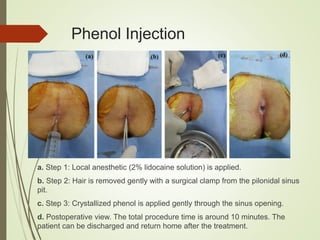
Phenol Injection
a. Step 1: Local anesthetic (2% lidocaine solution) is applied.
b. Step 2: Hair is removed gently with a surgical clamp from the pilonidal sinus
pit.
c. Step 3: Crystallized phenol is applied gently through the sinus opening.
d. Postoperative view. The total procedure time is around 10 minutes. The
patient can be discharged and return home after the treatment.
C. Antibiotics
 Antibiotics have a limited role in the treatment of either acute or
chronic pilonidal disease, although oral or intravenous agents
may be considered in patients with significant cellulites,
underlying Immunosuppression, or concomitant systemic
illness.
Non-Operative Management
 Patients with acute pilonidal disease characterized by the
presence of an abscess should be treated with incision and
drainage regardless of whether it is a primary or recurring
episode.
 For a pilonidal abscess with or without associated cellulitis,
the mainstay of treatment is adequate surgical drainage.
 Following simple incision and drainage for first-episode acute
pilonidal abscesses, overall successful healing has been
reported to be ~60%. (American Society of Colon and Rectal Surgeons, 2013)
Operative Management for Acute
Disease
Operative Management for
Acute Disease
 In a randomized trial of patients with acute abscesses undergoing
incision and drainage with or without curettage of the abscess cavity
and removal of the inflammatory debris, 36 curettage was associated
with significantly greater complete healing at 10 weeks (96% vs
79%), and lower incidence of recurrence up to 65 months
postoperatively (10% vs 54% ) (American Society of Colon and Rectal Surgeons,
2013)
 The use of local excision of both the abscess and the midline pits
during the treatment of the acute pilonidal abscess, allowing healing
by secondary intent as a way of eliminating all potential for future
disease, has not been shown to alter recurrence rates, length of
hospital stay, or overall time of healing.
 Chronic disease can encompass recurrent abscesses with
interval periods of complete resolution or a persistent
nonhealing, draining wound
 Patients who require surgery for chronic pilonidal disease
may undergo excision and primary repair (with consideration
for off-midline closure), excision with healing by secondary
intention, or excision with marsupialization, based on
surgeon and patient preference. Drain use should be
individualized..
Operative Management for
Chronic Disease
 The surgical treatment of chronic pilonidal disease is generally divided
into 2 categories:
a. excision of diseased tissue with primary closure (including various
flap techniques).
b. excision with a form of healing by secondary intention (including
marsupialization).
 In the comparison of excision with primary midline closure versus
excision with healing by secondary intention, there is a uniform
significant trend toward faster median healing rates (range, 23–65
days) following primary closure ,there is some evidence to indicate a
more rapid return to work following primary closure, although the open
group had lower recurrence rates. (American Society of Colon and Rectal Surgeons,
2013)
Operative Management for
Chronic Disease
 Comparing the efficacy of excision with marsupialization to
primary closure; primary closure, in general, is associated
with improved healing times with higher recurrence.
 The one principle that seems to provide a clear benefit is to
close the wound off-midline rather than direct midline when
performing primary repair. This has consistently
demonstrated faster healing times, lower rates of wound
morbidity, and lower recurrence rates.
Operative Management for
Chronic Disease
 Drain use has been described following primary closure, both for
removing effluent and irrigating the wound bed.
 Drain placement following primary closure was associated with
lower rates of complete wound dehiscence and faster rates of
healing, using suction drains for 2 to 6 days .
 When used in conjunction with flap techniques, drains are most
commonly associated with a decreased incidence in wound fluid
collections, but no difference in wound infections or recurrence
rates.
 Drain use may be considered on a case-by-case basis per
surgeon preference.
Operative Management for
Chronic Disease
 Flap-based procedures may be performed, especially in the
setting of complex and multiple-recurrent chronic pilonidal
disease when other techniques have failed.
 The rhomboid or limberg flap (classical or modified ), in which all
sinuses are excised down to the presacral fascia, with rotation of
a fasciocutaneous flap that results in flattening of the gluteal cleft,
has been used extensively in the treatment of refractory pilonidal
disease.
Operative Management for
Chronic Disease
Limberg Flap-Geometry
additional data indicate significantly lower recurrence after rhomboid flap
versus V-Y advancement, although no differences in wound complications,
seroma formation, or hospital admission duration
V-Y Plasty
 The Karydakis flap uses a mobilized fasciocutaneous flap
secured to the sacrococcygeal fascia with lateral suture
lines.
 Karydakis procedure has a recurrence rate less than 2%
and wound complications in 8%.
 The 2 flap procedures seem to be relatively equal clinically,
but the Karydakis flap is generally felt to be an easier
procedure to perform.
Karydakis Procedure
Karydakis Procedure
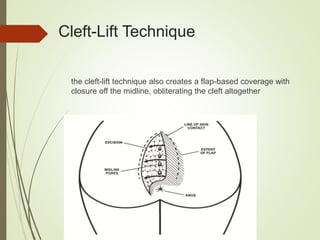
the cleft-lift technique also creates a flap-based coverage with
closure off the midline, obliterating the cleft altogether
Cleft-Lift Technique
Bascom’s technique of lateral incision and drainage with midline pit excision
and closure.
several other flaps have been used for pilonidal disease including the V-Y
advancement and Z-plasty techniques.
Bascom’s Technique
 Operative strategies for recurrent pilonidal disease
should distinguish between the presence of an acute
abscess and chronic disease, taking into account the
surgeon's experience and expertise.
 Factors such as the presence of an acute abscess or
chronic inflammation, as well as prior treatments (ie,
previous flaps), will help in the decision-making process.
Recurrent Pilonidal Disease
Operative Management for
Recurrent Pilonidal Disease
 Flap reconstruction methods for the treatment of recurrent and
large sinuses with lateral extensions
 lay open with secondary healing for small sinuses without any
lateral extensions are appropriate and efficient techniques.
 Sinuses with extensive or branching tracts, with lateral
extension from the natal cleft were managed with rhomboid
excision and Limberg flap reconstruction. Karydakis flap
reconstruction or Z-plasty were the procedures of choice for
sinuses with a tract longer than 4 cm but disease limited to
midline.
 Patients with a tract limited to the natal cleft or not longer than 4
cm underwent local excision with the wound left to the
secondary healing and lay open.
 Personal hygiene, periodical hair epilation, and daily wound
care are the keystones for preventing recurrence especially
for patients treated with open techniques, and proper patient
education.
 However, because recurrent presentations may cause a
different problem, the surgeon needs to remain vigilant to
exclude abnormal underlying causes of chronic perirectal
pathology, including IBD, immunosuppression, and cutaneous
neoplasms.
Management for Recurrent
Pilonidal Disease
Summary & Recommendations
 In conclusion, there are operative and nonoperative
management approaches to the pilonidal disease.
 Providing the best management to the pilonidal
disease will reduce total hospital admission days,
will have fewer total surgical procedures, and an
earlier return to work.
 It is best to have one uniform recommended
guideline for all surgeons in one medical facility to
follow.
References
 Iesalnieks I, Ommer A, Petersen S, Doll D, Herold A. German national guideline on the
management of pilonidal disease. Langenbecks Arch Surg. 2016;401:599–609. [PubMed]
 M Chance Spalding(2018, January 26). Pilonidal Disease Guidelines. Retrieved March 12, 2018,
from https://emedicine.medscape.com/article/192668-guidelines
 Matter, I., Kunin, J., Schein, M. and Eldar, S. (1995), Total excision versus non-resectional
methods in the treatment of acute and chronic pilonidal disease. Br J Surg, 82: 752–753.
doi:10.1002/bjs.1800820612
 Saber, A. (2014). Modified Off-Midline Closure of Pilonidal Sinus Disease. North American
Journal of Medical Sciences, 6(5), 210–214. http://doi.org/10.4103/1947-2714.132936
 Smart, P. J., Dungerwalla, M. & Heriot, A. G. Bascom’s Simple Pilonidal Sinus Surgery: Simpler
with Ultrasound Guidance.Journal of Medical Ultrasound 21, 97–
99,https://doi.org/10.1016/j.jmu.2013.04.001 (2013).
 Steele SR, Perry WB, Mills S, Buie WD, Standards Practice Task Force of the American Society
of Colon and Rectal Surgeons. Practice parameters for the management of pilonidal disease. Dis
Colon Rectum. 2013 Sep. 56 (9):1021-7
 Yoldas, T., Karaca, C., Unalp, O., Uguz, A., Caliskan, C., Akgun, E., & Korkut, M. (2013).
Recurrent Pilonidal Sinus: Lay Open or Flap Closure, Does It Differ?International Surgery, 98(4),
319–323. http://doi.org/10.9738/INTSURG-D-13-00081.1
 Yuksel, M. E. (2016). Pilonidal sinus disease can be treated with crystallized phenol using a
simple three-step technique. Acta Dermatovenerologica Alpina Pannonica et Adriatica, 26(1).
doi:10.15570/actaapa.2017.4
Pilonidal Disease Management Approach

Pilonidal Disease Management Approach

  • 1.
    Summary of ThePilonidal Disease Management Prepared by Dr Marwan Rasheed Specialist General Surgeon Al-Qassimi Hospital
  • 2.
    Objectives  Introduction  Etiology Risk Factors  Evaluating Patients  Physical Examination  Non-Operative Management  Operative Management for Acute Disease  Operative Management for Chronic Disease  Recurrent Pilonidal Disease  Operative Management for Recurrent Pilonidal Disease
  • 3.
    Introduction  Epidemiology : SacrococcygealPilonidal sinus is common, with an estimated prevalence of 26 cases per 100,000 population in the US. (Medscape,2017)  The condition affects men more often than women; 80% of patients are male. The mean age at presentation is about 20 years, and patients are often hirsute.
  • 4.
    Etiology  Pilonidal sinusis caused by hair in the natal cleft and is more common in hirsute people. It is thought that the risk of pilonidal disease may depend on hair type, the force of insertion created within the natal cleft, and the vulnerability of the tissues of the natal cleft to hair insertion. Hence, people with multiple, loose, stiff hairs within a deep, narrow natal cleft with macerated or broken skin would theoretically be most at risk.  Pilonidal sinus was initially thought to be a congenital condition. This hypothesis has been abandoned in favor of an acquired theory. It is widely accepted that broken hair is driven into the skin of the natal cleft by a rolling action of the buttocks.
  • 5.
    Risk Factors Factors increasethe risk of developing a pilonidal sinus 1. Hirsute 2. Sedentary life style 3. Obesity 4. Smoking 5. A previous injury to the skin 6. Frequent irritation of the skin 7. A family history of the condition
  • 6.
    Evaluating Patients  Adisease-specific history and physical examination should be performed.  The diagnosis of pilonidal disease is most often a clinical one, based on the patient’s history and physical findings in the gluteal cleft, especially in patients with chronic or recurrent disease.  However, it is important to distinguish pilonidal disease from alternative or concurrent diagnoses such as hidradenitis suppurativa, infected skin furuncles, Crohn’s disease, perianal fistula.
  • 7.
     The presenceof characteristic midline pits in the gluteal cleft in patients with pilonidal disease is almost always visible, sometimes with hair or debris extruding from the openings.  In the acute setting patients may present with cellulitis or a painful, fluctuant mass indicating the presence of an abscess. The chronic state is most often manifested by chronic draining sinus disease in the intergluteal fold and/or recurrent episodes of acute infections.  It is also important to perform a thorough anorectal examination to evaluate for concomitant fistulous disease, Crohn’s disease, or other anorectal pathology even though rare, a presacral mass should be ruled out by digital rectal examination. Physical Examination
  • 8.
    Approach To The Managementof Pilonidal Disease
  • 9.
    Non-Operative Management A. Shaving In the absence of an abscess, a trial of gluteal cleft shaving may be used for both acute and chronic pilonidal disease as a primary or adjunct treatment measure.  Shaving along the intergluteal fold and surrounding region has also been used as a standard component of the postoperative treatment comparing various surgical techniques.  Similar to shaving, successful results have been demonstrated for laser epilation in the setting of both primary and recurrent pilonidal disease.
  • 10.
    B. Fibrin Glueand Phenol Injection  Fibrin glue and phenol injection might be used in selected patients with chronic pilonidal sinus disease.  The use of phenol solution involves one or more injections into the sinus tract until filled, with cautious protection of the surrounding normal skin, removal of sinus hairs and debris with forceps, as well as local shaving.  Small series have demonstrated success rates ranging from 60% to 95%. Even in the setting of recurrent chronic sinus disease, phenol injection and local depilatory cream application on a weekly basis have shown low subsequent recurrence rates (0%–11%) at extended follow- up.  Fibrin glue has been used in a variety of manners: after simple curettage of the tracts, in the primary closure bed after excision, and along the original sinus following lateral excision and primary closure. Non-Operative Management
  • 11.
    Phenol Injection a. Step1: Local anesthetic (2% lidocaine solution) is applied. b. Step 2: Hair is removed gently with a surgical clamp from the pilonidal sinus pit. c. Step 3: Crystallized phenol is applied gently through the sinus opening. d. Postoperative view. The total procedure time is around 10 minutes. The patient can be discharged and return home after the treatment.
  • 12.
    C. Antibiotics  Antibioticshave a limited role in the treatment of either acute or chronic pilonidal disease, although oral or intravenous agents may be considered in patients with significant cellulites, underlying Immunosuppression, or concomitant systemic illness. Non-Operative Management
  • 13.
     Patients withacute pilonidal disease characterized by the presence of an abscess should be treated with incision and drainage regardless of whether it is a primary or recurring episode.  For a pilonidal abscess with or without associated cellulitis, the mainstay of treatment is adequate surgical drainage.  Following simple incision and drainage for first-episode acute pilonidal abscesses, overall successful healing has been reported to be ~60%. (American Society of Colon and Rectal Surgeons, 2013) Operative Management for Acute Disease
  • 14.
    Operative Management for AcuteDisease  In a randomized trial of patients with acute abscesses undergoing incision and drainage with or without curettage of the abscess cavity and removal of the inflammatory debris, 36 curettage was associated with significantly greater complete healing at 10 weeks (96% vs 79%), and lower incidence of recurrence up to 65 months postoperatively (10% vs 54% ) (American Society of Colon and Rectal Surgeons, 2013)  The use of local excision of both the abscess and the midline pits during the treatment of the acute pilonidal abscess, allowing healing by secondary intent as a way of eliminating all potential for future disease, has not been shown to alter recurrence rates, length of hospital stay, or overall time of healing.
  • 15.
     Chronic diseasecan encompass recurrent abscesses with interval periods of complete resolution or a persistent nonhealing, draining wound  Patients who require surgery for chronic pilonidal disease may undergo excision and primary repair (with consideration for off-midline closure), excision with healing by secondary intention, or excision with marsupialization, based on surgeon and patient preference. Drain use should be individualized.. Operative Management for Chronic Disease
  • 16.
     The surgicaltreatment of chronic pilonidal disease is generally divided into 2 categories: a. excision of diseased tissue with primary closure (including various flap techniques). b. excision with a form of healing by secondary intention (including marsupialization).  In the comparison of excision with primary midline closure versus excision with healing by secondary intention, there is a uniform significant trend toward faster median healing rates (range, 23–65 days) following primary closure ,there is some evidence to indicate a more rapid return to work following primary closure, although the open group had lower recurrence rates. (American Society of Colon and Rectal Surgeons, 2013) Operative Management for Chronic Disease
  • 17.
     Comparing theefficacy of excision with marsupialization to primary closure; primary closure, in general, is associated with improved healing times with higher recurrence.  The one principle that seems to provide a clear benefit is to close the wound off-midline rather than direct midline when performing primary repair. This has consistently demonstrated faster healing times, lower rates of wound morbidity, and lower recurrence rates. Operative Management for Chronic Disease
  • 18.
     Drain usehas been described following primary closure, both for removing effluent and irrigating the wound bed.  Drain placement following primary closure was associated with lower rates of complete wound dehiscence and faster rates of healing, using suction drains for 2 to 6 days .  When used in conjunction with flap techniques, drains are most commonly associated with a decreased incidence in wound fluid collections, but no difference in wound infections or recurrence rates.  Drain use may be considered on a case-by-case basis per surgeon preference. Operative Management for Chronic Disease
  • 19.
     Flap-based proceduresmay be performed, especially in the setting of complex and multiple-recurrent chronic pilonidal disease when other techniques have failed.  The rhomboid or limberg flap (classical or modified ), in which all sinuses are excised down to the presacral fascia, with rotation of a fasciocutaneous flap that results in flattening of the gluteal cleft, has been used extensively in the treatment of refractory pilonidal disease. Operative Management for Chronic Disease
  • 20.
  • 21.
    additional data indicatesignificantly lower recurrence after rhomboid flap versus V-Y advancement, although no differences in wound complications, seroma formation, or hospital admission duration V-Y Plasty
  • 22.
     The Karydakisflap uses a mobilized fasciocutaneous flap secured to the sacrococcygeal fascia with lateral suture lines.  Karydakis procedure has a recurrence rate less than 2% and wound complications in 8%.  The 2 flap procedures seem to be relatively equal clinically, but the Karydakis flap is generally felt to be an easier procedure to perform. Karydakis Procedure
  • 23.
  • 24.
    the cleft-lift techniquealso creates a flap-based coverage with closure off the midline, obliterating the cleft altogether Cleft-Lift Technique
  • 25.
    Bascom’s technique oflateral incision and drainage with midline pit excision and closure. several other flaps have been used for pilonidal disease including the V-Y advancement and Z-plasty techniques. Bascom’s Technique
  • 26.
     Operative strategiesfor recurrent pilonidal disease should distinguish between the presence of an acute abscess and chronic disease, taking into account the surgeon's experience and expertise.  Factors such as the presence of an acute abscess or chronic inflammation, as well as prior treatments (ie, previous flaps), will help in the decision-making process. Recurrent Pilonidal Disease
  • 27.
    Operative Management for RecurrentPilonidal Disease  Flap reconstruction methods for the treatment of recurrent and large sinuses with lateral extensions  lay open with secondary healing for small sinuses without any lateral extensions are appropriate and efficient techniques.  Sinuses with extensive or branching tracts, with lateral extension from the natal cleft were managed with rhomboid excision and Limberg flap reconstruction. Karydakis flap reconstruction or Z-plasty were the procedures of choice for sinuses with a tract longer than 4 cm but disease limited to midline.  Patients with a tract limited to the natal cleft or not longer than 4 cm underwent local excision with the wound left to the secondary healing and lay open.
  • 28.
     Personal hygiene,periodical hair epilation, and daily wound care are the keystones for preventing recurrence especially for patients treated with open techniques, and proper patient education.  However, because recurrent presentations may cause a different problem, the surgeon needs to remain vigilant to exclude abnormal underlying causes of chronic perirectal pathology, including IBD, immunosuppression, and cutaneous neoplasms. Management for Recurrent Pilonidal Disease
  • 29.
    Summary & Recommendations In conclusion, there are operative and nonoperative management approaches to the pilonidal disease.  Providing the best management to the pilonidal disease will reduce total hospital admission days, will have fewer total surgical procedures, and an earlier return to work.  It is best to have one uniform recommended guideline for all surgeons in one medical facility to follow.
  • 30.
    References  Iesalnieks I,Ommer A, Petersen S, Doll D, Herold A. German national guideline on the management of pilonidal disease. Langenbecks Arch Surg. 2016;401:599–609. [PubMed]  M Chance Spalding(2018, January 26). Pilonidal Disease Guidelines. Retrieved March 12, 2018, from https://emedicine.medscape.com/article/192668-guidelines  Matter, I., Kunin, J., Schein, M. and Eldar, S. (1995), Total excision versus non-resectional methods in the treatment of acute and chronic pilonidal disease. Br J Surg, 82: 752–753. doi:10.1002/bjs.1800820612  Saber, A. (2014). Modified Off-Midline Closure of Pilonidal Sinus Disease. North American Journal of Medical Sciences, 6(5), 210–214. http://doi.org/10.4103/1947-2714.132936  Smart, P. J., Dungerwalla, M. & Heriot, A. G. Bascom’s Simple Pilonidal Sinus Surgery: Simpler with Ultrasound Guidance.Journal of Medical Ultrasound 21, 97– 99,https://doi.org/10.1016/j.jmu.2013.04.001 (2013).  Steele SR, Perry WB, Mills S, Buie WD, Standards Practice Task Force of the American Society of Colon and Rectal Surgeons. Practice parameters for the management of pilonidal disease. Dis Colon Rectum. 2013 Sep. 56 (9):1021-7  Yoldas, T., Karaca, C., Unalp, O., Uguz, A., Caliskan, C., Akgun, E., & Korkut, M. (2013). Recurrent Pilonidal Sinus: Lay Open or Flap Closure, Does It Differ?International Surgery, 98(4), 319–323. http://doi.org/10.9738/INTSURG-D-13-00081.1  Yuksel, M. E. (2016). Pilonidal sinus disease can be treated with crystallized phenol using a simple three-step technique. Acta Dermatovenerologica Alpina Pannonica et Adriatica, 26(1). doi:10.15570/actaapa.2017.4