Pig and Poultry Management -ANS 213 (1+1)
Boby Basnet/Assistant Professor
Syllabus
UNIT TOPIC
1. INTRODUCTION, SCOPE AND STATISTICS OF PIG AND POULTRY
2. BREED CHARACTERISTICS OF PIG
3. MANAGEMENT: HOUSING SYSTEM AND HOUSING MATERIALS FOR SWINE, CARE AND MANAGEMENT OF PREGNANT SOW,
BREEDING BOAR AND NEWBORN PIG
4. BREED AND HOUSING BREEDS: BREEDS AND BREED CHARACTERISTICS OF LAYERS, BROILERS AND DUAL-PURPOSE BREED,
HOUSING AND HOUSING MATERIALS, DESIGN OF POULTRY HOUSING
5. BROODING: NATURAL AND ARTIFICIAL, EGG FORMATION, SELECTION OF EGGS FOR TABLE AND INCUBATION PURPOSES, FACTOR
ESSENTIAL FOR BEST HATCHING
6. MANAGEMENT PRACTICES FOR LAYERS AND BOILERS PRODUCTION
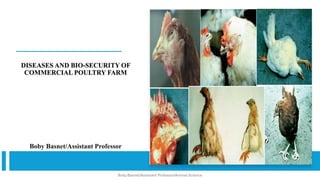
7. DISEASES AND BIO-SECURITY OF COMMERCIAL POULTRY FARM
Introduction, scope and statistics of pig and poultry
Boby Basnet/Assistant Professor
Boby Basnet/Assistant Professor/Animal Science
INTRODUCTION
❖Poultry farming is the practice of raising domesticated birds such as chickens, ducks, turkeys, and quails for
meat, eggs, and feathers. It is one of the fastest-growing agricultural sectors worldwide due to increasing
demand for poultry products.
❖Chicken is one of the most popular domesticated fowl in Nepal, widely reared for meat and eggs.
❖The domesticated chicken originated from the interbreeding of four wild species:
a. Red jungle fowl (Gallus gallus)
b. Ceylon jungle fowl (Gallus lafayetti)
c. Gray jungle fowl (Gallus sonneratti)
d. Java jungle fowl (Gallus varius)
❖Pig farming is a profitable livestock business that requires proper breed selection, housing, feeding, and
health management.
❖With proper management, pig and poultry farming can be a sustainable source of income and meat
production.
Boby Basnet/Assistant Professor/Animal Science
Origin of domestic chicken
Boby Basnet/Assistant Professor/Animal Science
Java jungle fowl Red jungle fowl
Ceylon jungle fowl Gray jungle fowl
Zoological Classification of Poultry Birds
Duck
Kingdom: Animalia
Phylum: Chordata (those having backbone)
Class: Aves
Order: Ansaiforms
Family: Antidae
Genus: Anas
Species: platychychos
Fowl
Kingdom: Animalia
Phylum: Chordata (those having backbone)
Class: Aves
Order: Galliforms
Family: Meleagridae
Genus: Melagris
Species: domesticus
Boby Basnet/Assistant Professor/Animal Science
Zoological Classification of Poultry Birds
Turkey
Kingdom: Animalia
Phylum: Chordata (those having backbone)
Class: Aves
Order: Galliforms
Family: Meleagridae
Genus: Melagris
Species: gallopavo
Japanese quail
Kingdom: Animalia
Phylum: Chordata
Class: Aves
Order: Galliforms
Family: Phasianidae
Genus: Coyunix
Species: japonica
Boby Basnet/Assistant Professor/Animal Science
Statistics of Poultry
Category 2077/78 2078/79 2079/80 Trend
Fowl 73,418,077 66,803,117 65,205,250 Decreasing
Duck 432226 605944 1,325,999 Increasing
Number
Egg Production:
1. Fowl: 1547103
2. Duck: 60229
Statistics of Pig
Category 2077/78 2078/79 2079/80 Trend
Pig 15,88,838 15,04,624 13,57,507 Decreasing
Number
Production: 32533 metric ton
Importance of Poultry Farming
1. Nutrition & Food Security
✓Provides affordable, high-quality protein through meat and eggs.
✓Reduces dependency on imported animal protein.
2. Economic Growth & Employment
✓Major agribusiness supporting farmers, traders, and processors.
✓Generates jobs, especially for youth and women.
3. Quick Returns & Low Investment
✓Requires less capital with fast-growing broilers (5-6 weeks).
✓Ensures steady income for smallholder farmers.
4. Growth of Allied Industries
✓Boosts feed, veterinary, and processing industries.
✓Poultry manure improves soil fertility.
5. Export & Sustainability Potential
✓Expanding market with export possibilities.
✓Integrated farming enhances resource use.
✓Poultry farming in Nepal drives economic growth, improves nutrition, and supports rural livelihoods.
Problems in poultry production
1. Disease Outbreaks: Newcastle, avian influenza, Gumboro.
2. High Feed Cost: Dependence on imports, poor-quality feed.
3. Poor Farm Management: Lack of technical knowledge, outdated practices.
4. Market Fluctuations: Unstable prices, middlemen exploitation.
5. Lack of Credit & Insurance: Limited access to loans, no risk coverage.
6. Poor Infrastructure: Inadequate storage, processing, transportation.
7. Import Dependency: Reliance on foreign chicks, vaccines, equipment.
8. Environmental Issues: Waste disposal, antibiotic overuse.
Scope of poultry
1. Growing Demand: Urbanization, rising incomes, and awareness about nutrition increase
the demand for chicken and eggs, driving growth in the sector.
2. Economic Impact: Poultry farming offers low-investment, high-return opportunities,
especially for small farmers, women, and marginalized communities, contributing to
poverty reduction.
3. Employment: The sector creates jobs in feed production, hatcheries, processing, and
distribution, fostering entrepreneurship in rural areas.
4. Government Support: The government supports poultry farming through training,
financial aid, and policy initiatives aimed at rural development and poverty alleviation.
5. Infrastructure & Market Access: Improved roads and transportation networks enable
better access to urban markets, ensuring fresh poultry products reach consumers.
6. Technology: Adoption of modern farming technologies, including automation and
biosecurity practices, enhances productivity and reduces losses.
7. Export Potential: Nepal can export poultry products to neighboring countries like India,
tapping into regional markets.
8. Diversification: Poultry farming can complement other agricultural activities, increasing
farmers' income and promoting sustainable practices.
Zoological classification of Pig
Pig
Kingdom: Animalia
Phylum: Chordata (those having backbone)
Class: Mammalia (milk producing)
Order: Ungulata
Family: Suidae
Genus: Sus
Species: vittatus, domesticus
Scientific name of modern pig: Sus domesticus
Boby Basnet/Assistant Professor/Animal Science
Advantages of pig raising in Nepal
1. Income Generation: Provides a profitable income for smallholder farmers.
2. Nutrient-Rich Meat: High-protein pork meets local dietary needs (18.7%).
3. Low Investment: Requires relatively low initial investment.
4. Quick Return: Fast growth and frequent reproduction offer quick returns.
5. Waste Utilization: Pigs can be fed on agricultural by-products and kitchen waste.
6. Employment Opportunities: Creates jobs in breeding, feeding, and processing.
7. Market Demand: Increasing demand for pork in local and urban markets.
8. Manure for Farming: Pig manure can be used as organic fertilizer for crops.
Demerits in Pig Raising
1. Disease Risk: Pigs are prone to diseases like swine fever.
2. Cultural Barriers: Pork is taboo in some communities.
3. High Feed Costs: Quality feed can be expensive.
4. Environmental Concerns: Poor waste management can cause pollution.
5. Space Requirements: Adequate space for housing is needed.
6. Limited Veterinary Services: Access to veterinary care is limited in rural areas.
7. Initial Investment: Start-up costs can be a barrier for some farmers.
Scope of Swine Farming
1. Growing Pork Demand: Increased urbanization and dietary changes.
2. Income Generation: Profitable livelihood for small farmers.
3. Employment Opportunities: Jobs in breeding, feeding, and processing.
4. Low Investment: Requires relatively low initial investment.
5. Waste Utilization: Pigs can be fed agricultural by-products.
6. Nutritional Value: High-protein pork improves nutrition.
7. Export Potential: Opportunities for exporting pork.
8. Sustainable Farming: Pig manure benefits crop production.
Breed Characteristics of Pig
Boby Basnet/Assistant Professor
Boby Basnet/Assistant Professor/Animal Science
Pig
Indigenous breeds
1. Chawanche
2. Hurrah
3. Bampukhe
Exotic Breeds
1. Duroc
2. Hampshire
3. Landrace
4. Tamworth
Boby Basnet/Assistant Professor/Animal Science
Chawanche Hurrah Bampudke
➢They located in low to mid hills and are
good scavenger animals.
➢They are black in color.
➢Long and straight snout .
➢Small erect ears .
➢Its barrel is dropping type .
➢Female has 8 to 12 teats .
➢Average adult weight is 35 kg ranging
from 25 to 40 kg .
➢Long and straight tail .
➢Small body size and short height.
➢The top length (from head point to the
base of tail) is 76 cm and heart girth is
86 cm.
➢They are semi-wild in nature
➢They located in terai region
(tropical and subtropical) and are
mainly used for meat.
➢Its body color is completely
grayish black or rust brown with
rough skin.
➢Small and erect ears.
➢Straight snout.
➢Hair is straight.
➢Long and strong legs.
➢Straight and long tail.
➢Female has 8 to 12 teats .
➢The average adult weight is 45 kg
ranging from 40 to 55 kg.
➢The top length (from head point
to the base of tail) is 79 cm and
heart girth is 88 cm.
➢They are semi-wild and are active
in nature
➢Found in Humla, Bajura
(Boarder to Tibet).
➢They are normally red and
brown color and sometime
found in black color .
➢Top length (from head point to
the base of tail) is 45 cm .
➢Heart girth is 52 cm.
➢Female has 8 to 12 teats .
➢Their average adult body
weight is 20 kg (ranges from 18
to 25 kg).
➢The indigenous pig breeds are
high fertility and have good
reproductive characters such
as litter size and farrowing
intervals.
Boby Basnet/Assistant Professor/Animal Science
CHAWANCHE
Boby Basnet/Assistant Professor/Animal Science
HURRAH
Boby Basnet/Assistant Professor/Animal Science
BAMPUDKE
Boby Basnet/Assistant Professor/Animal Science
PAKHRIBAS BLACK
1. Developed at Pakhribas, Dhankuta through 3 way
crossing between Saddleback, Fayun and
Tamworth.
2. Found in Eastern hilly region.
3. Age of first farrowing: 368 days.
4. Farrowing interval: 178 days.
5. Litter size: 9-10.
6. Body weight:- Male 250 kg Female 175 kg.
Boby Basnet/Assistant Professor/Animal Science
Exotic breeds of pig
1. Landrace
• Originally a Danish pig popularly bred to produce highest quality bacon in the world.
• Colour: White.
• Deep side square ham, relatively short legs with heavy lop ears (drooping ears) inclined to the
front above the eyes.
• Has a long snout.
• Breed popular for high prolificacy and for efficiency of feed utilization.
• In Nepal, it is used for cross breeding.
2. Yorkshire
• Popular English bacon breed and noted for mothering quality.
• Raises many litters at one time as the mother yields more milk.
• White in colour with moderately long head, snout broad and identical erect ears.
• Wt. of mature boar: 300-450 kg, wt. of sow: 250-350 kg.
• Widely used for cross breeding.
Boby Basnet/Assistant Professor/Animal Science
3. Duroc
• American breed, red in color with shades varying from a golden to cherry red color.
• Has two third erect and one third drooping small ears. Less aggressive.
• Popular for its excellent growth rate and feed efficiency.
• Early maturity farrowing many litters and having good mothering character.
• Wt. of mature boar: 400 kg, sow: 350 kg.
• Carcass considered quality meat, widely used for cross breeding.
4. Hampshire
• A medium type English breed popular for pork production.
• Black pig with white stripe (belt) around the shoulder and body including forelegs.
• Well known for excellent growth rate and feed efficiency.
• Early maturity and farrows 8-10 litters, has good mothering ability.
• Wt. of mature boar: 400 kg, sow: 350 kg. Carcass considered good meat.
Boby Basnet/Assistant Professor/Animal Science
5. Tamworth
➢ This breed was developed in the west England by using wild boar for fixing the golden or
chestnut color.
➢ It has coarse hair, longhead, long snout and erect ears.
➢ It is considered to be slow maturing but is very hardy, thrifty and less susceptible to sunburn
than many other temperate type breeds.
➢ This is especially good for bacon production and is very good in tropical areas where
feeding and management are substandard.
➢ The mature boar weighs as much as 300 kg and sow weights 250kg.
Boby Basnet/Assistant Professor/Animal Science
HAMPSHIRE DUROC
Management: Housing system and housing
materials for swine, care and management of
pregnant sow, breeding boar and newborn pig
Boby Basnet/Assistant Professor
Boby Basnet/Assistant Professor/Animal Science
Housing system
• Proper housing is crucial for pig
production, as it influences
growth, reproduction, and
overall health.
• A well-planned pig housing
system provides comfort,
protection from harsh weather,
and easy management
Boby Basnet/Assistant Professor/Animal Science
Free-Range (Scavenging) System for Pigs
➢Traditional method of pig farming, where pigs roam freely in open spaces and forage for
their food commonly used in rural areas where resources for commercial pig farming are
limited.
➢Utilizes local breeds with high disease resistance, Low input cost as pigs feed on kitchen
waste, crop residues, and natural vegetation, Minimal housing requirements, with basic
shelter for protection from extreme weather, Pigs act as savings or insurance, sold when
families need extra cash.
Advantages of Free-Range Pig Farming
➢Low-cost system with minimal investment in feed and housing, Better meat quality, as
pigs get exercise and natural feed, Sustainable and environment-friendly, as pigs help
recycle organic waste, Resilient local breeds adapt well to harsh conditions.
Disadvantages of Free-Range Pig Farming
➢ Lower productivity compared to intensive farming, Risk of diseases due to exposure to
parasites and infections, Predator threats from dogs, foxes, and other animals,
Uncontrolled breeding can lead to poor herd management.
Boby Basnet/Assistant Professor/Animal Science
Free-Range (Scavenging) System for Pigs
Boby Basnet/Assistant Professor/Animal Science
Semi-Intensive System
• In this system, pigs are kept in an open area
enclosed with net fencing, ensuring adequate
shade and a reliable water supply.
• This approach allows for improved feeding
and disease control, leading to healthier pigs,
faster growth rates, and larger litters.
• It requires relatively low financial investment;
it is more labor-intensive and demands
technical expertise for effective management.
Boby Basnet/Assistant Professor/Animal Science
Intensive System
• In this system, pigs are housed in well-structured enclosures with concrete floors, where bedding may be
provided for comfort. Feeding and water troughs are placed inside the housing area to ensure easy access.
This system allows for the management of a larger number of pigs while effectively controlling internal
parasites and minimizing labor costs.
• In most parts of Nepal, the ideal design follows a double-row system with a covered area on both sides, a
common passage in between, and a linked open area at the back of each covered room. This layout
facilitates efficient management and movement of pigs.
Advantages of the Intensive System:
1. Better Disease Control: Reduces the risk of infections and internal parasites.
2. Efficient Space Utilization: Allows for high stocking density in a controlled environment.
3. Lower Labor Costs: Requires minimal labor due to mechanized feeding and waste management.
4. Higher Productivity: Enables faster growth rates and increased piglet survival.
5. Improved Feeding Management: Ensures a consistent and balanced diet for optimal growth.
6. Protection from Harsh Weather: Provides shelter against extreme temperatures and rainfall.
7. Ease of Monitoring: Allows for close supervision of pig health, reproduction, and performance.
Boby Basnet/Assistant Professor/Animal Science
Intensive System
Boby Basnet/Assistant Professor/Animal Science
Housing Consideration
Boby Basnet/Assistant Professor/Animal Science
Housing design
Boby Basnet/Assistant Professor/Animal Science
Housing design
Boby Basnet/Assistant Professor/Animal Science
Housing of different animals
 Housing of Boars
Boar pen should have covered area of 6.25-7.5 m2 and open area of 8.8-12 m2 for exercise. The walls
should have a minimum height of 1.5 m.
 Housing of Female
Open yard type with partial roofing as in the case of boar may be provided. A total of 10-15 females can
be grouped in a pen. An area of 2 m2 per animal may be provided.
 Housing of Farrowing sows
Farrowing sows may be housed individually in a farrowing pen of 2.5 x 4.0 = 10.0 m2 having guard rails,
creep area, feed and water troughs.
 Housing of growing and finishing pigs
A covered concrete yard for feeding and resting having feed and water trough arranged in the front side
and an open yard in the rear will suffice for fatteners. The total space requirement may be 2 m2 per
grower/fattener pig.
Boby Basnet/Assistant Professor/Animal Science
Basic Housing Materials
Boby Basnet/Assistant Professor/Animal Science
Roofs Floor Beeding Wall
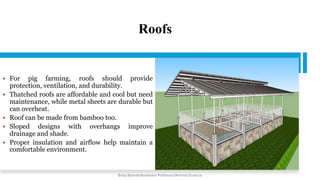
Roofs
 For pig farming, roofs should provide
protection, ventilation, and durability.
 Thatched roofs are affordable and cool but need
maintenance, while metal sheets are durable but
can overheat.
 Roof can be made from bamboo too.
 Sloped designs with overhangs improve
drainage and shade.
 Proper insulation and airflow help maintain a
comfortable environment.
Boby Basnet/Assistant Professor/Animal Science
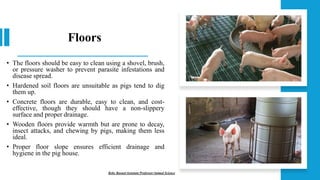
Floors
• The floors should be easy to clean using a shovel, brush,
or pressure washer to prevent parasite infestations and
disease spread.
• Hardened soil floors are unsuitable as pigs tend to dig
them up.
• Concrete floors are durable, easy to clean, and cost-
effective, though they should have a non-slippery
surface and proper drainage.
• Wooden floors provide warmth but are prone to decay,
insect attacks, and chewing by pigs, making them less
ideal.
• Proper floor slope ensures efficient drainage and
hygiene in the pig house.
Boby Basnet/Assistant Professor/Animal Science
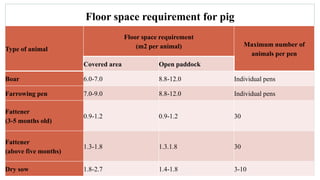
Floor space requirement for pig
Type of animal
Floor space requirement
(m2 per animal) Maximum number of
animals per pen
Covered area Open paddock
Boar 6.0-7.0 8.8-12.0 Individual pens
Farrowing pen 7.0-9.0 8.8-12.0 Individual pens
Fattener
(3-5 months old)
0.9-1.2 0.9-1.2 30
Fattener
(above five months)
1.3-1.8 1.3.1.8 30
Dry sow 1.8-2.7 1.4-1.8 3-10
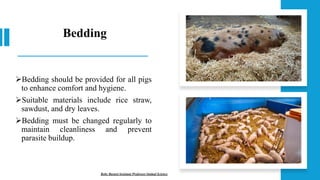
Bedding
➢Bedding should be provided for all pigs
to enhance comfort and hygiene.
➢Suitable materials include rice straw,
sawdust, and dry leaves.
➢Bedding must be changed regularly to
maintain cleanliness and prevent
parasite buildup.
Boby Basnet/Assistant Professor/Animal Science
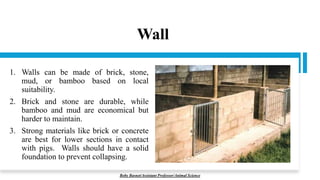
Wall
1. Walls can be made of brick, stone,
mud, or bamboo based on local
suitability.
2. Brick and stone are durable, while
bamboo and mud are economical but
harder to maintain.
3. Strong materials like brick or concrete
are best for lower sections in contact
with pigs. Walls should have a solid
foundation to prevent collapsing.
Boby Basnet/Assistant Professor/Animal Science
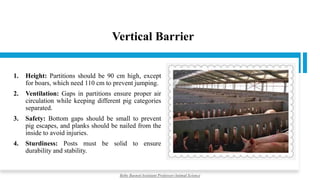
Vertical Barrier
1. Height: Partitions should be 90 cm high, except
for boars, which need 110 cm to prevent jumping.
2. Ventilation: Gaps in partitions ensure proper air
circulation while keeping different pig categories
separated.
3. Safety: Bottom gaps should be small to prevent
pig escapes, and planks should be nailed from the
inside to avoid injuries.
4. Sturdiness: Posts must be solid to ensure
durability and stability.
Boby Basnet/Assistant Professor/Animal Science
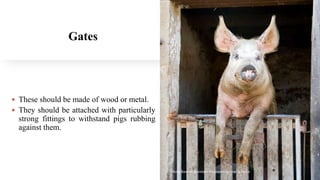
Gates
 These should be made of wood or metal.
 They should be attached with particularly
strong fittings to withstand pigs rubbing
against them.
Boby Basnet/Assistant Professor/Animal Science
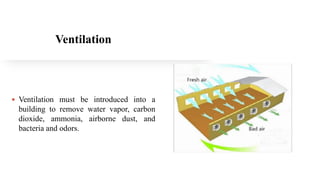
Ventilation
 Ventilation must be introduced into a
building to remove water vapor, carbon
dioxide, ammonia, airborne dust, and
bacteria and odors.
Boby Basnet/Assistant Professor/Animal Science
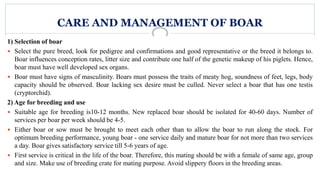
CARE AND MANAGEMENT OF PREGNANT SOW
1. The date of mating must be recorded so as to determine the date of farrowing.
2. The average gestation period of sow is about 112-115 days.
3. Should be housed separately
4. Sty must be clean, dry and non-slippery.
5. Sow should be treated kindly and fed liberally.
6. To avoid skidding and abortions pregnant sow/gilt must be kept away from other animals.
7. Pregnant sow must be allowed to graze on pasture with following conditions;
❖ -Separate pasture from other animals.
❖ -Safe from parasites
❖ -Nutritious and green grass.
❖ -Grazing must be preferred in the early hours of the day.
8. Kicking, abusing, pushing or rough handling must be avoided.
9. Bedding of 8-10 cm chapped straw under covered area must be provided.
10. Balanced ration with 16% CP, 0.8% Ca and 0.6% P must be provided for uniform litter
with more birth weight.
11. Allow free access to leguminous greens like berseems, lucerne, cowpea etc.
12. Increase the amount of feed during late gestation period because major growth of foetus
takes place in later period.
13. Deworm the pregnant females two weeks before farrowing with Piprazine adipate at the
rate1 gm/10 kg of body weight.
14. Pregnant females must be bathed with Luke warm water containing potassium
permanganate (1:1000) or allow free access to medicated wallow
15. Regular inspection of sow should be done.
CARE AND MANAGEMENT OF BOAR
1) Selection of boar
 Select the pure breed, look for pedigree and confirmations and good representative or the breed it belongs to.
Boar influences conception rates, litter size and contribute one half of the genetic makeup of his piglets. Hence,
boar must have well developed sex organs.
 Boar must have signs of masculinity. Boars must possess the traits of meaty hog, soundness of feet, legs, body
capacity should be observed. Boar lacking sex desire must be culled. Never select a boar that has one testis
(cryptorchid).
2) Age for breeding and use
 Suitable age for breeding is10-12 months. New replaced boar should be isolated for 40-60 days. Number of
services per boar per week should be 4-5.
 Either boar or sow must be brought to meet each other than to allow the boar to run along the stock. For
optimum breeding performance, young boar - one service daily and mature boar for not more than two services
a day. Boar gives satisfactory service till 5-6 years of age.
 First service is critical in the life of the boar. Therefore, this mating should be with a female of same age, group
and size. Make use of breeding crate for mating purpose. Avoid slippery floors in the breeding areas.
CARE AND MANAGEMENT OF BOAR
3)Feeding of boar
 Boar should be kept in a thrifty condition i.e. neither overfed nor underfed.
 Amount of feed per 45kg-body wt. per day should be 1.25-1.50 kg.
 The ration should contain 14% C.P.
 Boar should be fed 2-3hours before they are expected to breed.
 Fresh, clean and adequate quantity of water must be provided.
4) Housing
 Boar pen should be located where it will provide maximum exposure to the female to be breed
 The presence of female helps to stimulate the sex desire in boar.
 Each boar should be provided with 1.5m² square dry well ventilated sleeping area.
 Hogs have very few sweat glands and hence cannot dispose body heat as easily as other animals do.
Therefore, to protect from heat stress or heat induced sterility, provide bathing facility i.e. wallowing in
summer.
CARE AND MANAGEMENT OF NEWBORN PIGLETS
 Remove the piglets as soon as possible.
 Clean all piglets and make their body dry
 Breathing passage of piglets must be made clear.
 Immediately after birth piglets should have their naval dipped in tincture of iodine solution
 Naval cord must be cut with sterilized scissors or blade leaving 2.5 to 3 cms from the body and must be
disinfected by iodine solution.
 Piglets must be allowed to suckle milk from mother for about 8-10 times in 24 hour initially. First milk is
known as colostrum that contains good quality of protein, sugar, fat and sufficient vitamins and minerals
particularly calcium and phosphorus .It also provide antibodies to protect them against disease.
 If sows colostrum is not available cows colostrum can be fed.
 Piglets may die due to chilling so they are to be protected from chilliness. A pig brooder in corner of the pen
warmed with an electric light protects piglets from cold.
CARE AND MANAGEMENT OF NEWBORN PIGLETS
 Piglets must be protected from trampling by sow. A ground rail around the farrowing pen is also an effective
means of preventing sows from crushing their litters. The rail should be raised 8-10 inches from the floor .
 Prevention of anemia-
(a) Add @ 25mg Fe and 5mg of copper per day per pig.
(b) Paint the udder of sow daily with the following mixture.
Iron sulphate - 500gm
Copper sulphate-70gm
Sugar-500gram
Water -10 litres
(c) Allow free access to piglets for parasite free runs with fresh soil
(d) Intramuscular injection of iron- dextrose compound (Impheron)1ml/piglets on 4th and 14th days of age can
be given.
Feeding of piglets
Age Daily Feed/kg
Birth to 1-month Mother's milk
1 to 2 months 0.5
2 to 3 months 1.0
3 to 4 months 1.2
4 to 5 months 2.0
5 to 6 months 2 – 5
Removal of needle teeth
 At birth pigs have 4 pairs of small tusklike teeth, two on each side of upper and lower jaw.
They have no use, rather may cause injury to the mother's udder. These must be clipped by
means of tooth nipper.
Start feeding piglet/Creep feeding
 Creep feeding is the practice of feeding a solid diet to piglets while they are suckling the
sow, preparing their digestive system for weaning. Creep feeding initiates and promotes
gut and digestive enzyme development, which enables the piglet to digest nutrients from
food sources other than that of milk. This encourages feed intake, which is one of the
greatest challenges to post-weaning performance.
 Feeding starts from 2-3 weeks of age for proper growth and development.
Castration of piglets
 It is usual to castrate boar pigs at 4-6
weeks of age.
 Castration is essential for fattening of
pig for commercial purpose.
Breed and Housing Breeds: Breeds and
Breed characteristics of layers, broilers and
dual-purpose breed, housing and housing
materials, design of poultry housing
Boby Basnet/Assistant Professor
Boby Basnet/Assistant Professor/Animal Science
Breed
 The group of individuals within the species having distinct physical and
productive characteristics, which are efficiently transmitted to the decedents.
 The distinct characteristics originate from selection by man or result by
adaptation to climate and environment and may be visible like comb type, color
of the skin, shank, plumage, etc. or not externally visible like egg production,
color of the egg, growth rate, resistance, etc.
Boby Basnet/Assistant Professor/Animal Science
Commercially Available Broiler Breeds In Nepal
 Cob 500
 Marshall
 Hub bird classic
Boby Basnet/Assistant Professor/Animal Science
COBB 500
 Lowest cost of live weight produced
 Superior performance on lower cost feed rations
 Most feed efficient
 Excellent growth rate
 Best broiler uniformity for processing
Boby Basnet/Assistant Professor/Animal Science
Age(Days)
Weight for age
(gm)
Daily gain
(gm)
Daily feed
consumption (gm)
7 185 28 35
14 465 53 68
21 943 78 111
28 1524 86 152
35 2191 99 189
42 2857 93 216
Hub bird classic
 Hub bird classic broilers have strong initial
growth with very good FCR.
 Its robustness and adaptability are evident under
any temperature and feed condition.
 Its overall benefits allow it to obtain the lowest
cost price for live, whole bird or ready-to cook
market with high meat yield.
 Its adaptability to any environment makes good
performance in temperate as well as tropical
areas.
Boby Basnet/Assistant Professor/Animal Science
Age (days)
Average Body weight
(gm)
Cumulative Daily gain
(gm)
Cumulative Feed
consumption (gm)
Average Feed conversion
5 140 20 106
10 301 26 292
15 561 35 617 1.10
20 909 43 1112 1.22
25 1315 51 1773 1.35
30 1758 57 2577 1.47
35 2229 63 3505 1.57
40 2489 66 4530 1.68
Marshal
 The breed is specially designed to be
able to provide excellent feed
conversion in the hot and tropical
conditions of India and Asia.
 Trials have shown that a parent bird
consumed an average of 389gm per
broiler chick while a commercial bird
reached a body weight of 2.6kg in 42
days with a cumulative feed
consumption of 4.5kg or an FCR of 1.7.
Boby Basnet/Assistant Professor/Animal Science
Commercially available Layers breed
1. Hy-line Brown
2. H&N Brown Nick
3. Lohmann brown-classic
Boby Basnet/Assistant Professor/Animal Science
Hy-line Brown Classic
 Hy-line Brown is the world most balanced
brown egg layer. She produces over 355 rich
brown eggs upto 80 weeks, peak well and
begins lay early with optimum egg size.
 These traits combined with feed efficiency,
the best interior egg quality in the market and
excellent livability give the Hy-line Brown
the perfect balance, which means more profit
for the poultry producers.
 Body wt. at 70 weeks-2kg.
Boby Basnet/Assistant Professor/Animal Science
H&N Brown Nick
➢H&N Brown Nick is a commercial layer
that has high peak and persistent
production.
➢The egg weight is optimum with
excellence in Feed efficiency and posses
uniform brown and dark colour.
➢These breed can be used in both cage
and alternative production system.
➢Egg-360 eggs/80 weeks, with an avg. wt
of 62-65gm/egg.
Boby Basnet/Assistant Professor/Animal Science
Lohmann brown-classic
➢ Lohman breeds are distinguished by laying
peaks, a great persistency in laying
performances and good shell stability as
well as excellent health.
➢ Due to patented selection methods, all
Lohman brown layers are free from the
TMA syndrome (Thrombotic
microangiopathy is a rare but serious
condition that causes blood clots to damage
small blood vessels in vital organs) despite
the use of feed containing TMA substances,
e.g. rape seed, the eggs will still be free
from fishy odour.
➢ Egg-380/85 weeks.
Boby Basnet/Assistant Professor/Animal Science
Poultry
Indigenous breeds
1. Sakini
2. Ghatikhuile
3. Puwankh ulte
Exotic Breeds
1. Australop
2. New Hampshire
3. White Leghorn
4. Minorca
5. Kadaknath
Giriraj
Boby Basnet/Assistant Professor/Animal Science
Sakini Ghanti Khuile Pwankh ulte
➢ Sakini is an attractive breed among
three indigenous breeds of chicken in
Nepal.
➢ The feather color varies from black to
red, spotted black and white, red and
white, red and black.
➢ Skin color varies from white to yellow.
➢ Earlobe color of sakini chicken varies
from pink to red.
➢ Shank is yellow to brown in color.
➢ This breed has single or rose type
comb of red color.
➢ They have brown to black legs.
➢ The egg production capacity is 70 to
80 /year. The average adult body
weight is 1.5 to 2.0 kg.
➢ They have featherless neck i.e.
naked neck.
➢ Black to red or some times red
and black feather color.
➢ They have white to yellow skin
color.
➢ They are characterized by pink to
red ear lobe color.
➢ Shank is yellow to brown in
color.
➢ Ghanti khuile chicken have red
colored single or rose type comb.
➢ They are also characterized by
brown to black legs.
➢ The egg production capacity is
60 to 80 /year. The average adult
body weight of male is 1.6 and
female is 1.30 kg.
➢ They have ruffled feathers
(curved outwards) all over the
body.
➢ They comprise with Sakini breed
in their feather color.
➢ Skin color of Pwankh ulte
chicken is white to yellow.
➢ Have pink to red earlobe color.
➢ Shank is yellow to brown in
color.
➢ Pwankh ulte chicken have single
or rose type comb of red color.
➢ They have brown to black legs as
other indigenous breeds of
chicken.
➢ The average adult body weight
of male is 1.0 and female is 0.9
kg.
➢ The egg production capacity is
70 to 85 /year.
Boby Basnet/Assistant Professor/Animal Science
INDIGENOUS BREED OF POULTRY
Boby Basnet/Assistant Professor/Animal Science
Exotic breeds of poultry
Australorp:
This breed has been developed in Australia. This is considered as a dual purpose breed and
very suitable in the backyard farming in Nepal. This produces brown coloured egg The
standard weight of a cock of this breed is 3.8 kg and of a hen is 3 kg.
Boby Basnet/Assistant Professor/Animal Science
Giriraj is a breed of chicken developed by Karnataka Veterinary, Animal, and Fishery
Sciences University in Bengaluru, India. Giriraja females lay a large number of eggs, 130–
150 per year, with each egg weighing 52-55 grams. The eggs have a good hatchability (80–
85 per cent). Their shells are brown in color. The birds exhibit better growth compared to
local varieties, and are suited for mixed and backyard farming.
Boby Basnet/Assistant Professor/Animal Science
GIRIRAJ
This is one of the most popular egg breeds of fowl all over the world. This is an excellent
layer and has paved suitable in mid hill and terai area of Nepal. This produces white
coloured egg. The standard weight of a cock of this breed is 2.7 kg and of a hen is 2 kg.
Boby Basnet/Assistant Professor/Animal Science
WHITE LEGHORN
This is relatively a new breed developed in United States. This breed was introduced in
Nepal in the year 1957. This is a dual-purpose type of chicken and is known for its
hardiness. This breed is a good producer of large brown sized eggs. The standard weight of
a cock is 3.8 kg and of a hen is 2.7 kg.
Boby Basnet/Assistant Professor/Animal Science
NEW HAMPSHIRE
 Kadaknath is an Indian breed of chicken originated from Madhya Pradesh in India The
Kadaknath is popular for its adaptability and its grey-black meat. Its colour is caused
by melanin. The Male weigh 1.8–2 kg and the hens 1.2–1.5 kg Kadaknath hens' eggs are
brown with a slightly pink tint, they are poor setters and rarely hatch their own brood.
Eggs weigh an average of 30–35 g.
Boby Basnet/Assistant Professor/Animal Science
KADAKNATH
ASIL
Boby Basnet/Assistant Professor/Animal Science
 Physical Traits: Muscular, compact, broad shoulders, narrow stern, short hard feathers.
 Head & Comb: Small head, pea or triple-shaped comb, yellow curved beak.
 Legs: Short but strong with thick thighs.
 Temperament: Aggressive; chicks start fighting early.
 Egg Production: Seasonal layers, low egg yield, tinted shells, broody hens.
 Uses: Meat and ornamental purposes.
 Varieties: Black, White, Duckwing, Red Spangled, Pyle.
 Weight: Cock - 2.7 kg, Hen - 2.3 kg.
 Not suited for commercial production..
Dual purpose breeds of Chicken
1. Sakini
2. Ghanti Khuile
3. Dumse (Puwank Ulte)
4. New Hampshire
5. Australorp
Boby Basnet/Assistant Professor/Animal Science
Types of chicken:
Egg type: These breeds lays big size egg and are not heavy in body weight.
 Leghorn, Minorca, Ancona
 Light weight.
 Very active
Meat type: These breed lays less egg and are heavy in body weight.
 Cornish, Sussex, Orphington, Australorp, New Hampshire.
 Heavy weight, fleshy body, slightly dull
Dual purpose: These breeds lays more egg and are heavy in body weight. These are ideal breeds for small
farmers.
 Rhode Island Red, Plymouth Rock, New Hampshire, Wyandotte
 Moderate weight, quite alert
Miscellaneous: Game and ornament purpose
 Aseel, Red jungle fowl,
 Ornamental- Brahma, Cochin/ Karaknath
Chicken Breeds and Characteristics
HOUSING OF POULTRY
Need for poultry housing / Essential of good housing
1. Comfort: The best production is obtained from birds that are comfortable and happy. Comfortable house must
provide adequate accommodation, be reasonably cool in summer, free from drafts and sufficiently warm during
the winter, provide adequate supply of fresh air and sunshine, and remain always dry.
2. Protection: Poultry house provides protection theft and attack from natural enemies of the birds such as fox,
dog, cat, kite, crow, snake etc. at also provide protection against external parasites such as ticks, lice, and mites.
3. Convenience: The house should be located at a convenient place and the equipment. So arranged as to allow
clearing and other necessary operations as required.
4. Relation to other building: The poultry house not be too close to the dwelling houses. Because it creates the
unsanitary condition on the other hand it should not be too away from the dwelling houses as it require more time
in going to the poultry house for feeding, watering and collection of eggs. The poultry house should be located at
convenience distance.
5. Shady and cool environments: Poultry birds suffer much in hot weather and they require cool condition
during the daytime. Trees planted in the western and northern side of poultry house serve as windbreak in winter
and for shade in the summer. Otherwise, the soil under tree remains damp, which produces suitable condition for
disease attack.
Site selection
 Convenient location with good market access for eggs and meat.
 Availability of common poultry feeds at cheaper rates.
 Well-connected with roads and other transportation modes, with no nearby
poultry farms.
 Access to electricity and water at reasonable cost and ease.
 High land with loam soil for good drainage.
 Sufficient space for future expansion.
 Open space for proper ventilation.
Housing requirements
1.Floor space
➢ Floor space depends on age, size, breed, type, number of birds, and rearing method.
➢ Smaller houses require more square feet per hen.
➢ Larger houses can accommodate more birds with less space per hen.
➢ Ideal small unit: 15 to 20 birds.
➢ Maximum limit: 250 birds.
➢ House should be long in the east-west direction.
➢ Floor should remain dry at all times.
Ideal floor space:
- Layers: 2 sq ft per bird
- Broilers: 1-1.5 sq ft per bird.
Birds per pen Area of the house (sq. ft) Floor space per bird (sq. ft)
Light breed Heavy breed Light breed Heavy breed
25 88 100 3.5 4.0
100 200 350 3.0 3.5
200 500 600 2.5 3.0
500 1,000 1,250 2.0 2.5
Floor space requirement for poultry
2. Ventilation
❖Provides fresh air and removes moisture.
❖A 2 kg hen on full feed produces about 52 liters of carbon dioxide every 24 hours.
❖Helps eliminate carbon dioxide and other unwanted gases.
3. Temperature
❖Ideal temperature: 50°F to 70°F (10°C to 21°C).
❖Protect birds from extreme summer heat and winter cold.
❖Birds need warmer temperatures at night when they are inactive.
❖Insulation with straw or other materials keeps the house warmer in winter and cooler in summer.
4. Dryness
❖A dry poultry house is essential for bird comfort and health.
❖Dampness can lead to diseases like colds and pneumonia.
Causes of dampness:
❖Moisture rising through the floor.
❖Rainwater entering the house.
❖Leaky roof and walls.
❖Leaky water containers.
5. Light:
❖Daylight is essential for bird health and happiness.
❖Sunlight helps destroy disease germs and provides Vitamin D.
❖Light stimulates sexual development and enhances egg production.
❖Proper lighting keeps birds active, increasing feed intake and productivity.
6. Sanitation:
❖External parasites like lice, ticks, flies, and mites harm birds.
❖These pests spread diseases and reduce growth and egg-laying capacity.
❖Poultry house design should allow easy cleaning and spraying.
❖Minimize cracks and crevices to prevent pest infestation.
7. Availability of Labor:
❖ Labor is a crucial input for poultry production.
❖Poultry farming is more profitable when labor is available as needed.
❖Avoid building farms in areas with labor shortages.
8. Social Condition:
❖Consider the social environment before establishing a poultry farm.
❖Avoid areas with high theft and security issues.
❖Farms should not be located near religious areas where demand for eggs and meat is low.
Poultry House Equipment
1.Feed hopper: Feed hopper is meant for providing food to the
poultry bird. The essential features of food hopper are:
 Avoid feed wastage
 Prevent the birds for getting their feet into the feed and for
roosting on the hopper
 Easy to clean
 Make it easy to the birds to eat from the bottom of hopper
 They should be of suitable size depending on the age and size of
the birds as followings
 Different types of feeder
 linear feeder with reel
 Adjustable feeder with grill t op
 Bamboo feed hopper
 Hanging or tube feeder
 Hanging feeder with wire grill
Age of the bird Measurment of feed hopper
Length Breadth Depth
Chicks of one day to
one week old
1’ 2’’ 1’’
Chicks of one week to
45 days old
2’ 3’’ 1.5’’
Chicks of 45 days to
120 days old
4’ 5’’ 3’’
Adult birds 5’ 6’’ 4’’
2.Watering devices:
Supply of clean and fresh drinking water should be
made available at all the times for poultry birds. The
water container should be large enough for full day
supply, kept the water clean and cool in summer, easy
to empty, clean and refill.
Boby Basnet/Assistant Professor/Animal Science
3. Perches Roost
• Poultry birds start roosting at eight weeks
old. Use wooden bars (2 inches square,
rounded top, flat bottom) fixed 16 inches
above the ground, near walls, and removable
for disinfection.
• Space perches 12 inches apart, with 8 inches
of perch space per bird.
Boby Basnet/Assistant Professor/Animal Science
4. Nest box
✓ The laying birds of almost all breeds prefer dark and
separate place for laying eggs.
✓ The hen lay eggs every day at a place where she starts
laying egg at first.
✓ Each pen of laying bird should be provided with nest box
for laying eggs.
✓ The nest boxes should be roomy, cool, well ventilated, dark
and movable.
✓ The nest should be 30 cm square, 15 cm deep and with 37.5
cm head room.
✓ One nest should be provided for every 5 to 6 hens.
Boby Basnet/Assistant Professor/Animal Science
5. Grit and shell container
✓Ordinary container made either
of wood or metal can be used
for oyster shell or other grit.
✓Calcium is required for
formation of egg shell and that
can be provided through the
lime stone, oyster shell etc.
Boby Basnet/Assistant Professor/Animal Science
Housing systems of poultry
The system of housing depends on the amount of group and the capital available. There are four system of
housing generally found to follow among the poultry keepers.
1.Free range or Extensive system.
2.Semi- Intensive System.
3.Folding unit system.
4.Intensive system.
a) Battery system.
b) Deep litter system.
1) Free range system: In this system, unlimited space is provided to the birds where they can find an
appreciable amount of food in the form of herbage, seeds and insects. They are at risk from predatory animals
and infections diseases including parasitic infestation.
Advantages
➢ The poultry birds meet their food requirement from the surroundings. So feed cost is minimum.
➢ Elaborate housing is not required.
➢ Rearing cost is minimum.
Disadvantages
➢ The hen lays egg here and there. So losses of egg may be a problem.
➢ Predatory animals causes loss of poultry birds.
Free range system
2) Semi-intensive system
This system is adopted where limited free space is available. It is necessary to provide 10-15 sq. m. inside run and 20-30
sq.m. out side run per bird.
Advantages
Protection against predatory animals is possible.
The birds gets the opportunity to move in the fresh ground.
Disadvantages
 The run may get infested with the droppings.
 The poultry birds may be infected with infectious and contagious disease.
Boby Basnet/Assistant Professor/Animal Science
3) Folding unit system
In this system of housing birds are confined to one small run,
the position is changed each day, giving them fresh ground
and the birds find a considerable proportion of food from the
herbage .
Advantages
 Spreading to disease is minimum as the birds being
confined to one small run.
 No fear of predatory animals.
Disadvantages
 Labor cost is high.
 Feeding watering and collection of eggs needs more time.
Boby Basnet/Assistant Professor/Animal Science
4) Intensive system
In this system of housing the birds are confined to house entirely, with no access to land outside and it is usually adopted
where land is limited and expensive. Under this the deep litter system are most common.
a) Battery system (cage system): In this system each hen is confined to a cage just large enough to permit very limited
movement and allow her to stand and sit comfortably. The usual floor space is 14×16 inches and height of 17 inches. The
floor is of standard strong galvanized wire set at a slope from back to front, so that eggs laid by hens, roll out of the cage to a
receiving gutter. Underneath is a tray for droppings. Both food and water receptacles are outside the cage.
Advantages
 Case system of rearing allows better flock supervision.
 The performance of each bird can be noted and culling is easily carried out as and when required.
 Cage system of rearing offers economy in space, reduce feed consumption and labor, help in prevention and control of
certain disease like coccidiosis and increase the efficiency of production.
 Clean and uniform egg production throughout the year is possible.
Disadvantages
 Cage fatigue is one of the problems.
 Malnutrition may be the problem, if the feeding of birds in cages in not carefully performed.
 Feeding and watering requires more labor.
 Housing and equipment cost per bird is high.
a) Battery system (cage system):
b. Deep Litter System: In this
system poultry birds are kept in
large pens upto 250 birds each,
on floor covered with litters like
straw, saw dust or leaves upto
depth of 8-12 inchs.
Management of deep litter
1. The floor of the house should be disinfected by phenyl, Lysol, bleaching powder or lime water before
placing litter materials.
2. Do not have too many birds in the pen, one bird for every 4-5 square feet of floor space.
3. The deep litter should be kept dry. Wet litter in early stages of growth leads to the sporulation of
coccidia. Lime or super phosphate @ 500 gm lime or 1 kg superphosphate per square feet is applied
to make the litter dry.
4. Cacking of litter should avoid as far as possible by keeping the humidity low and stirring of litter at
least once in a week.
5. Fresh litter should be used for rearing pullets and new batches of birds should be placed in clean
litter. The time of starting deep litter should be in the dry period of the year.
6. The old, built up litter should be replaced after the rainy season and beginning of winter season. The
litter maybe kept for one year only.
7. The waterer should be placed in such a way to keep the litter dry. Leaking of water from waterer or
roof, upsets the whole process and it would have to start over again.
Boby Basnet/Assistant Professor/Animal Science
Advantages of Deep litter system
• Less efficiency in poultry management.
• Litter as a source of food supply.
• Labor saving.
• Valuable fertilizer.
• It provides protection against various infections disease and external parasites.
• Offers advantages of self control to birds during extreme weather conditions.
• Well, built- up deep litter can be utilizing as valuable source of fertilizer
containing 3%N 2%P and 2%K.
Boby Basnet/Assistant Professor/Animal Science
Disadvantages
• Raising layer chicken using deep litter system makes eggs dirty.
• Disease and parasites spread easily.
• Higher tending of cannibalism and peeking of feathers.
• Difficult to determine unproductive birds and difficulties in culling.
Boby Basnet/Assistant Professor/Animal Science
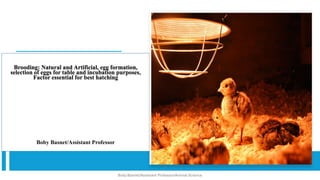
Brooding: Natural and Artificial, egg formation,
selection of eggs for table and incubation purposes,
Factor essential for best hatching
Boby Basnet/Assistant Professor
Boby Basnet/Assistant Professor/Animal Science
Egg
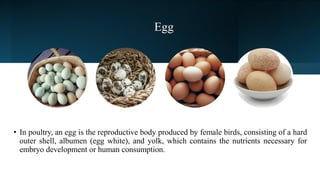
• In poultry, an egg is the reproductive body produced by female birds, consisting of a hard
outer shell, albumen (egg white), and yolk, which contains the nutrients necessary for
embryo development or human consumption.
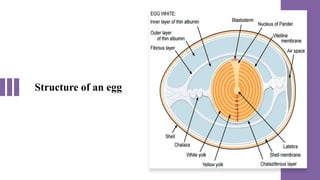
Structure of an egg
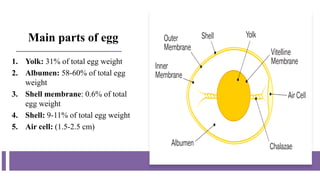
Main parts of egg
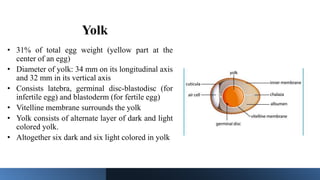
1. Yolk: 31% of total egg weight
2. Albumen: 58-60% of total egg
weight
3. Shell membrane: 0.6% of total
egg weight
4. Shell: 9-11% of total egg weight
5. Air cell: (1.5-2.5 cm)
Yolk
• 31% of total egg weight (yellow part at the
center of an egg)
• Diameter of yolk: 34 mm on its longitudinal axis
and 32 mm in its vertical axis
• Consists latebra, germinal disc-blastodisc (for
infertile egg) and blastoderm (for fertile egg)
• Vitelline membrane surrounds the yolk
• Yolk consists of alternate layer of dark and light
colored yolk.
• Altogether six dark and six light colored in yolk
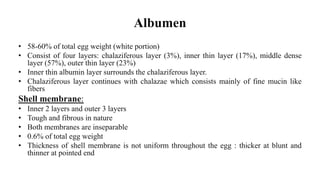
Albumen
• 58-60% of total egg weight (white portion)
• Consist of four layers: chalaziferous layer (3%), inner thin layer (17%), middle dense
layer (57%), outer thin layer (23%)
• Inner thin albumin layer surrounds the chalaziferous layer.
• Chalaziferous layer continues with chalazae which consists mainly of fine mucin like
fibers
Shell membrane:
• Inner 2 layers and outer 3 layers
• Tough and fibrous in nature
• Both membranes are inseparable
• 0.6% of total egg weight
• Thickness of shell membrane is not uniform throughout the egg : thicker at blunt and
thinner at pointed end
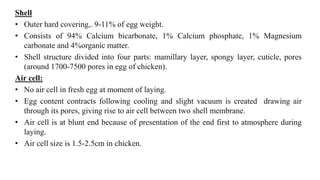
Shell
• Outer hard covering,. 9-11% of egg weight.
• Consists of 94% Calcium bicarbonate, 1% Calcium phosphate, 1% Magnesium
carbonate and 4%organic matter.
• Shell structure divided into four parts: mamillary layer, spongy layer, cuticle, pores
(around 1700-7500 pores in egg of chicken).
Air cell:
• No air cell in fresh egg at moment of laying.
• Egg content contracts following cooling and slight vacuum is created drawing air
through its pores, giving rise to air cell between two shell membrane.
• Air cell is at blunt end because of presentation of the end first to atmosphere during
laying.
• Air cell size is 1.5-2.5cm in chicken.
Chemical composition of egg
• Important source of protein, fat, minerals ;well balanced nutrient of all ages .
• Rich in proteins (2 egg daily=total protein requirement) .
• Good mineral sources: Ca, P, Fe, Na, K, I, Zn, Mg.
✓ In yolk: concentration of fat-soluble vitamin: A, D, E.
✓ 2nd richest source of Vitamin D after fish liver oil.
✓ contains all vitamins except vitamin C.
✓ water soluble vitamins: Riboflavin, Niacin, B6, B12.
• Also known for fatty acids: both saturated and unsaturated (triglycerides: 63%,
Cholesterol: 5%, Phospholipids: 30%).
• Most of/ all off essential amino acids required by humans are present in adequate
proportion.
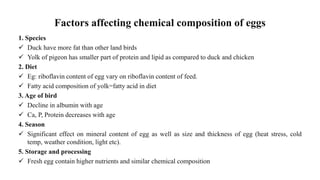
Factors affecting chemical composition of eggs
1. Species
✓ Duck have more fat than other land birds
✓ Yolk of pigeon has smaller part of protein and lipid as compared to duck and chicken
2. Diet
✓ Eg: riboflavin content of egg vary on riboflavin content of feed.
✓ Fatty acid composition of yolk=fatty acid in diet
3. Age of bird
✓ Decline in albumin with age
✓ Ca, P, Protein decreases with age
4. Season
✓ Significant effect on mineral content of egg as well as size and thickness of egg (heat stress, cold
temp, weather condition, light etc).
5. Storage and processing
✓ Fresh egg contain higher nutrients and similar chemical composition
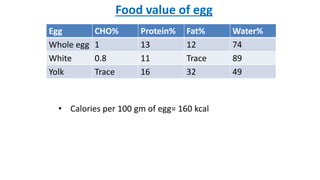
Food value of egg
Egg CHO% Protein% Fat% Water%
Whole egg 1 13 12 74
White 0.8 11 Trace 89
Yolk Trace 16 32 49
• Calories per 100 gm of egg= 160 kcal
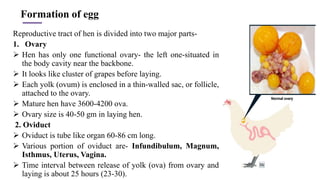
Formation of egg
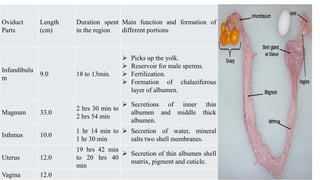
Reproductive tract of hen is divided into two major parts-
1. Ovary
➢ Hen has only one functional ovary- the left one-situated in
the body cavity near the backbone.
➢ It looks like cluster of grapes before laying.
➢ Each yolk (ovum) is enclosed in a thin-walled sac, or follicle,
attached to the ovary.
➢ Mature hen have 3600-4200 ova.
➢ Ovary size is 40-50 gm in laying hen.
2. Oviduct
➢ Oviduct is tube like organ 60-86 cm long.
➢ Various portion of oviduct are- Infundibulum, Magnum,
Isthmus, Uterus, Vagina.
➢ Time interval between release of yolk (ova) from ovary and
laying is about 25 hours (23-30).
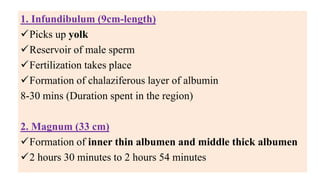
1. Infundibulum (9cm-length)
✓Picks up yolk
✓Reservoir of male sperm
✓Fertilization takes place
✓Formation of chalaziferous layer of albumin
8-30 mins (Duration spent in the region)
2. Magnum (33 cm)
✓Formation of inner thin albumen and middle thick albumen
✓2 hours 30 minutes to 2 hours 54 minutes
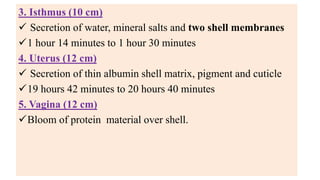
3. Isthmus (10 cm)
✓ Secretion of water, mineral salts and two shell membranes
✓1 hour 14 minutes to 1 hour 30 minutes
4. Uterus (12 cm)
✓ Secretion of thin albumin shell matrix, pigment and cuticle
✓19 hours 42 minutes to 20 hours 40 minutes
5. Vagina (12 cm)
✓Bloom of protein material over shell.
Oviduct
Parts
Length
(cm)
Duration spent
in the region
Main function and formation of
different portions
Infundibulu
m
9.0 18 to 13min.
➢ Picks up the yolk.
➢ Reservoir for male sperms.
➢ Fertilization.
➢ Formation of chalaziferous
layer of albumen.
Magnum 33.0
2 hrs 30 min to
2 hrs 54 min
➢ Secretions of inner thin
albumen and middle thick
albumen.
Isthmus 10.0
1 hr 14 min to
1 hr 30 min
➢ Secretion of water, mineral
salts two shell membranes.
Uterus 12.0
19 hrs 42 min
to 20 hrs 40
min
➢ Secretion of thin albumen shell
matrix, pigment and cuticle.
Vagina 12.0
Hatching of eggs
➢Hatching in poultry management refers to the production of baby chicks which take
average 21 days to hatch.
• Fertile eggs are called hatching eggs
• Hatching span-21 days
• Good selection of egg for good hatching
• It is best to incubate eggs within 7-10 days of their being laid.
• A hatchery is a place where eggs are hatched under artificial conditions.
Factors to be considered:
✓nutrition
✓disease free stock
✓parental age: maximum hatchability in first year of laying
Boby Basnet/Assistant Professor/Animal Science
➢Fertility and hatchability depends on:-
✓ Seasonal condition: egg production in summer and early spring is low
✓ Physical condition of breeding stock:
✓ Storage temperature: best at 50-55 deg F, high temperature is more injurious than
low temperature
✓ Storage humidity: about 80%
✓ hen to cock ratio, about 10-12: 1
Boby Basnet/Assistant Professor/Animal Science
Selection and care of hatching eggs
1.Egg size: not to small not to large: 50-55 gm for chicken, 65-
70 gm for duck and 80-85 gm for turkey egg.
2.Shell color: Incase of white egg, it should be free from tints,
For brown egg-medium or dark brown better than light brown
3.Shell texture: thick shell texture advised
4.Soiled eggs: dirt should be cleaned by rubbing with cloth,
not washed
Boby Basnet/Assistant Professor/Animal Science
5. Abnormal eggs:
✓Double yolked egg: when two ova ripening at a same time
✓Off flavor / rotten egg: excessive consumption of grasses or fish meal, poor quality
fish meal
✓Soft shelled egg: Deficiency of Ca, P, Mg or Vit D
✓Meat spot/blood spot: rupture of a blood vessel on the yolk surface
✓Pale yolk: due to anemia or lack of carotene
Boby Basnet/Assistant Professor/Animal Science
Types of hatching
• Natural Hatching
• Artificial Hatching
Natural hatching
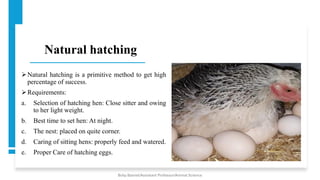
➢Natural hatching is a primitive method to get high
percentage of success.
➢Requirements:
a. Selection of hatching hen: Close sitter and owing
to her light weight.
b. Best time to set hen: At night.
c. The nest: placed on quite corner.
d. Caring of sitting hens: properly feed and watered.
e. Proper Care of hatching eggs.
Boby Basnet/Assistant Professor/Animal Science
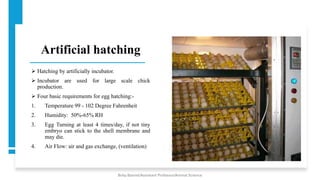
Artificial hatching
➢ Hatching by artificially incubator.
➢ Incubator are used for large scale chick
production.
➢ Four basic requirements for egg hatching:-
1. Temperature 99 - 102 Degree Fahrenheit
2. Humidity: 50%-65% RH
3. Egg Turning at least 4 times/day, if not tiny
embryo can stick to the shell membrane and
may die.
4. Air Flow: air and gas exchange, (ventilation)
Boby Basnet/Assistant Professor/Animal Science
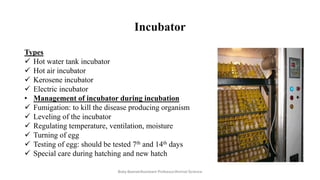
Incubator
Types
✓ Hot water tank incubator
✓ Hot air incubator
✓ Kerosene incubator
✓ Electric incubator
• Management of incubator during incubation
✓ Fumigation: to kill the disease producing organism
✓ Leveling of the incubator
✓ Regulating temperature, ventilation, moisture
✓ Turning of egg
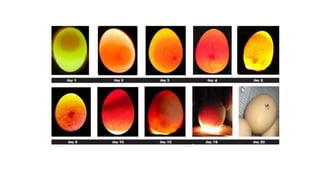
✓ Testing of egg: should be tested 7th and 14th days
✓ Special care during hatching and new hatch
Boby Basnet/Assistant Professor/Animal Science
Care of new hatch
• The chick is very weak when it first hatches and will probably lie
close to the egg for about eight hours before it starts to move around.
• The chicks which have just hatched should be kept in incubator
without providing food for at least 18-24 hrs.
• The temperature of the incubator should be gradually reduced to 95
deg F.
• Proper care is required during transferring the chicks from the
incubator to brooder.
• Culling of week, disease affected and lamb birds to be done at this
time.
Boby Basnet/Assistant Professor/Animal Science
Brooding
➢Brooding refers to the period immediately after hatch when special care and attention
must be given to chicks to ensure their health and survival i.e. 1 day to 8 weeks age.
➢Rearing refers to the remainder of life after brooding until sexual maturity.
➢Natural brooding is done by the mother hen after hatching, up to 3-4 weeks of age.
➢In artificial brooding chicks are reared by providing external source of heat.
➢Equipment used for brooding are called brooders.
➢Brooding of chicks refers to the growing of chicks from hatching to 4-6 weeks of age with
the use of artificial heat.
➢Duration of use of artificial heat depends on the season (environmental temperature).
➢During summer, brooding may be required for a short duration of 5-7 days. During winter
season it may be required for 2-3 weeks or longer.
Boby Basnet/Assistant Professor/Animal Science
The success of brooding depends mainly on the
following things.
1. Disease free chicks and healthy stock:
➢To start with, healthy high quality chicks
are of prime importance.
➢Parent stock should be free from diseases.
➢The chicks must be vaccinated with
merek’s and F1 vaccine.
Boby Basnet/Assistant Professor/Animal Science
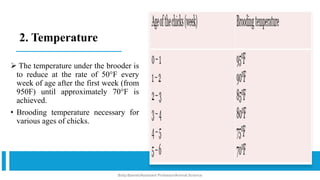
2. Temperature
➢ The temperature under the brooder is
to reduce at the rate of 50°F every
week of age after the first week (from
950F) until approximately 70°F is
achieved.
• Brooding temperature necessary for
various ages of chicks.
Boby Basnet/Assistant Professor/Animal Science
3. Fresh air and ventilation control: Fresh and pure air is essential for proper growth of
young chicks. The chicks feel discomfort in humid, hot house. So they need dry, fresh air
and pure water in the brooder.
4. Keeping the chicks busy: Chick guard of 18’’ (45 cm) high all around the brooder
about 2 ft away from the edge of brooder must be placed. Feeder and waterer should be
big enough. Otherwise, they will overcrowd to take food and drink water, leading to
cannibalism.
5. Safety from fire: Electric, gas, kerosene, hot water etc. are used to keep the brooder
and brooder house warm. Care should be taken to avoid the fire hazard.
6. Dryness: The brooder house should be clean and dry. The chick may be affected in
paralysis if they are kept in damp brooder house.
7. Sanitary condition: The poultry farm and its surroundings must keep clean.
Disinfectant solution should be kept just inside all entry doors and used to clean the
attendants boots each time be enters the building. Visitors should not allow on the farm.
The entire building including litter and all equipment should be fumigated, if the previous
flock had a serious disease problem.
8. Proper feeding and management: The growth of young chicks depends mainly
on the properly balanced diet.
Boby Basnet/Assistant Professor/Animal Science
9. Litter: Litter is spread on the floor to prevent the direct contact with the floor. Straw, wood dust, paddy husk
etc. are generally used for making the litter. The litter should be dry and free from moulds. Depth of litter should
be approximately 5cm (2 inches). Lime is used @ 500 gm/100 sq. ft to keep the litter dry and free from disease
organism. The dusty or excessive wet litter should be removed.
10. Protection enemies: Cat, rat, owls and other predatory animals etc. are the common enemies of the poultry
birds. Plies and rodents are also major source of infection. They must be controlled.
11. Skill full management: The success of farming depends on skillful management.
a. Vaccination
➢At day old stage marek’s vaccine should be given.
➢On 5th day F1 vaccine should be given.
➢At 3rd week Gumboro (IBD) vaccine should be given.
➢At the 6th week, fowl pox vaccine is to be given
➢At 7th week IBD vaccine once again is to be given.
➢At the end of 9th week, vaccination against Ranikhet (R2B stain)
➢At the end of 17th weeks once again against Ranikhet (R2B stain) is to be given.
b. Debeaking: It is done to prevent feed wastage and reduce picking. About one half of the both the lower and
upper beak is removed keeping the lower beak slightly longer than the upper. Debeaking at the 6th to 10th day
of age is ideal with less stress on birds and better labor efficiency.
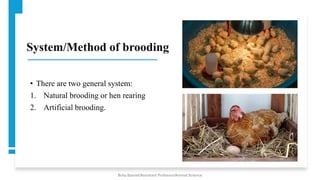
System/Method of brooding
• There are two general system:
1. Natural brooding or hen rearing
2. Artificial brooding.
Boby Basnet/Assistant Professor/Animal Science
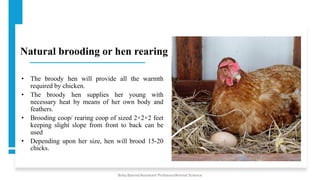
Natural brooding or hen rearing
• The broody hen will provide all the warmth
required by chicken.
• The broody hen supplies her young with
necessary heat by means of her own body and
feathers.
• Brooding coop/ rearing coop of sized 2×2×2 feet
keeping slight slope from front to back can be
used
• Depending upon her size, hen will brood 15-20
chicks.
Boby Basnet/Assistant Professor/Animal Science
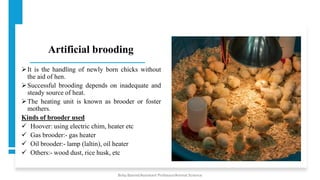
Artificial brooding
➢It is the handling of newly born chicks without
the aid of hen.
➢Successful brooding depends on inadequate and
steady source of heat.
➢The heating unit is known as brooder or foster
mothers.
Kinds of brooder used
✓ Hoover: using electric chim, heater etc
✓ Gas brooder:- gas heater
✓ Oil brooder:- lamp (laltin), oil heater
✓ Others:- wood dust, rice husk, etc
Boby Basnet/Assistant Professor/Animal Science
Management of chicks in the brooder
1. Ventilation: Ensure proper ventilation for fresh air and removal of gases/moisture while avoiding
drafts.
2. Sanitation and Hygiene: Clean and disinfect the brooder house, equipment, and surroundings before
placing chicks.
3. Litter Management: Use a 5 cm layer of sawdust or paddy husk; stir weekly to maintain dryness and
replace wet litter. Cover with newspaper for the first 3 days.
4. Temperature: Maintain 95°F in the first week, reducing by 5°F weekly until 70°F by the 6th week.
5. Brooder Space: Provide 45-65 cm² per chick; a 1.8 m hover can hold 500 chicks.
6. Brooder Guard: Place 0.9-1.2 m from the heat source; increase daily up to 1.5 m and remove after 7-
14 days.
7. Floor Space: Start with 100-120 cm² per chick; increase to 400-450 cm² by 4 weeks and 1,000 cm² by
6 weeks. Adjust space by 20% in summer and -15% in winter.
8. Water Management: Provide clean water 2-3 times daily; adjust temperature according to season; add
electrolytes, glucose, vitamins, and antibiotics as needed.
9. Feeder Space: Provide 3 cm/chick (first 2 weeks), 4.5 cm (3rd–4th week), and 7.5 cm up to 8 weeks.
10. Feeding Management: Start feeding 3–4 hours after arrival; use newspaper for feed for the first 3-4
days; gradually switch feed types over 4 days.
11. Lighting: Provide 24-hour light for the first 5-7 days, then 23 hours light/1 hour darkness daily until
marketing; ensure 6W/m² with filament bulbs or 1W/m² with fluorescent tubes.
Advantages of artificial brooding
• Large number of chicks may be brooded at a time.
• Chicks may be reared at any time of the year.
• No need of broody hen.
• Sanitary condition may be controlled.
• Temperature may be regulated as required.
• Feeding may be undertaken according to plan.
• The is no possibility of the spreading insects from the mother hen to chicken.
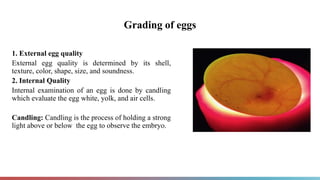
Grading of eggs
1. External egg quality
External egg quality is determined by its shell,
texture, color, shape, size, and soundness.
2. Internal Quality
Internal examination of an egg is done by candling
which evaluate the egg white, yolk, and air cells.
Candling: Candling is the process of holding a strong
light above or below the egg to observe the embryo.
MANAGEMENT PRACTICES FOR LAYERS
AND BOILERS PRODUCTION
Boby Basnet/Assistant Professor
Boby Basnet/Assistant Professor/Animal Science
Layer management
• Pullets should be housed in layer house between 16 to 18 weeks of age.
• The pullets should be housed in different pens according to their size and
growth.
• The poultry house should be well ventilated, reasonable warm in winter,
cool in summer.
• South or southeast facing house is good as it get maximum sunlight.
• The poultry house should be cheap, durable, comfortable and safe.
• In layer house, two third of the area of the side walls are kept open and
fitted with wire mesh for proper ventilation.
• Housing temperature for laying bird is 550F to 750F.
1. Floor space
• Floor space @ 2-3 sq. ft. per bird.
Boby Basnet/Assistant Professor/Animal Science
2. Feeders
 Feeder space @ 2.6 inches per bird or 4 large tube feeders per 100 birds should be provided.
 Distribution of feed is done uniformly throughout the area as quickly as possible, so that all birds get their
equal share.
 One tube feeder for shell grit/oyster shell should be provided for every 250 pullets.
 This should be provided @ 1.5 kg per 100 birds per week beginning 22nd week (148 days).
 The requirement of feed during lay depends on the rate of egg production and the body weight of layer
birds.
 The birds may need more feed in winter and less feed in summer.
 The actual feed consumption may be influenced by several factors as follows:
1. Body weight of hen.
2. Rate of egg production.
3. Season and weather condition.
4. Health and physical condition of the hen.
5. Feed quality such as protein content, caloric value of feed etc.
Boby Basnet/Assistant Professor/Animal Science
3. Lighting
 Light affects growth and reproduction of poultry birds by different physiological sections.
 Correct lighting boosts up egg production by 5 to 10 per cent
 The duration of the light period should not be decreased during laying period.
 Lighting encourages the chicks to feed more which will lead to better growth
 Irregular lighting results in drop in egg production.
 Lighting should be increased gradually from 21 weeks till it reaches 16-17 hours per day and
maintained at that level thereafter.
 Light should be 3-4 feet above the floor and good reflectors should be used to direct all light to
the birds areas.
 The light bulbs should be cleaned and checked regularly.
 The defective bulbs should be replaced immediately.
Boby Basnet/Assistant Professor/Animal Science
4.Waterer
Minimum of one inch of drinking space with trough type of waterer should be provided per
bird. The waterer should contain fresh, clean and cold water. It is necessary to provide extra
water during summer and extremely hot weather. The top edge of the waterer should be
level which helps to keep water spoilage to minimum and keep the water clean.
5.Litter
The litter should be dry and free of moulds. The extensively wet and dusty litter should not
be used for laying birds. The new litter for the layer flock should be provided unless the
birds have been grown in the same house.
6.Sanitation
Sanitation is the maintenance of surrounding conductive to good health. The poultry house
and its equipment should be cleaned and disinfected with disinfectant solution before
placing the pullets. Poultry disease are highly contagious. So the cleanliness and precautions
against disease hazard inside and outside of laying houses are essential.
Boby Basnet/Assistant Professor/Animal Science
7. Culling
Culling is the procedure of selection and rejection of unproductive and poor producers. Culling is very
important job running poultry farm profitably. Poor layer should be culled to minimize the cost of production.
The chances that should taken into consideration for distinguishing good and poor layers are as follows:
1. Appearance: we can get an idea about the health and vigor of the birds by its appearance. The healthy
birds is more active, more alert, vigorous, well fleshed but not fatty, tight feathering. Deviation of any of this
characteristics is the indication of poor layers.
2. Moulting: Moulting provides an indication about the laying capacity of a bird. It is natural and
physiological process to renew old feather at the end of first year of laying. Early moulters are usually poor
layer, where as late moulters are usually good layers.
3. Pigmentation: Yellow pigmentation of the skin surface especially vent, eye ring and ear lobes, shanks etc.
is due to carotenoid pigment known as xanthophyll coming from the ration of poultry bird containing yellow
maize. It provides an indication about the good laying ability of poultry birds.
4. Sexual maturity: Sexual maturity is meant the duration between the date a pullet is hatched and the date
she lays her first egg. The birds that mature early make good layers.
Boby Basnet/Assistant Professor/Animal Science
Broiler management
1. Broiler housing
• In modern commercial broiler production, the bird spends its entire life in one
house; i.e. it is not brooded in a special brooder house, then moved to another
house for growing for broiler raising is basically a brooding operation.
• The broiler house should be located in such a way, (i) to take advantage of
prevailing wind for ventilation and sun for light, (ii) ground elevation should be
higher than surrounding ground level to permit good water drainage away from
building, (iii) should be readily accessible to power, water supply and sewage.
• There are of course many different styles and designs of houses, and even more
variations in equipment. The important thing is that broiler house and equipment
provide comfortable conditions, including adequate feed and waters, so that the
birds can perform at the highest level of which they are genetically capable. A
satisfactory broiler house must protect against heat and cold, high winds, and
inclement weather.
Boby Basnet/Assistant Professor/Animal Science
Broiler house temperature
 Temperature is important. On the first week, 950F weekly until 700F is reached on the sixth
week. When chicks circle wide, it is too hot. If they tend to crows, under the hover it is too
cool. In either case, adjustment is needed immediately.
Ventilation of broiler house
 The main function of ventilation are to maintain oxygen, keep co2 at low level, remove dust or
moisture and ammonia from the house and maintain required temperature. Air movement
requirements are best determined by observing bird comfort, litter condition, and odour build
up. If necessary exhaust fan may be used.
2.Lighting for broilers
 May operation prefer to use all-night lights, about 15 watts to each 200 square feet of floor area
during early growing period. Growing chicks in semi-darkness by using red bulb keeps the
chicks quit, prevents cannibalism, and may have a slight effect on feed efficiency. Most broiler
growers provide light in the brooder house 24 hours a day throughout the entire growing
period. One 60 watt bulb for each 200 square feet of floor space.
Boby Basnet/Assistant Professor/Animal Science
3.Floor space requirement
 Broiler will require from 0.8 to 1.0 square feed of floor per bird.
4.Debeaking
 In addition to preventing cannibalism, debeaking usually lessens mash feed wastage.
Electric de-beakers are now available, and chickens are debeaked when only one day
old.
5.Broiler feeds
 Since feed constitutes about 70 % of the cost of producing broilers, it is important to
give special attention to it. Broilers are usually fed with two types of ration, broiler
starter and broiler finisher. The former ration is fed upto 5 weeks of age and the latter is
continued till the age of marketing. Starter ration is having more protein (23 -24 %) than
the finisher ration, 20 % protein, and both starter and fisher containing same level of
metabolizable energy i.e. 3200 ME kcal/kg of feed.
Boby Basnet/Assistant Professor/Animal Science
6.Broiler health program
 A health program is fundamental to successful broiler production.
 A suggested disease prevention and control program follows:
 Start with disease free chicks
 Vaccine chicks against Ranikhet and marek's disease at the hatchery.
 Use effective drugs in the feed, or a vaccination program to prevent coccidiosis.
 Keep feed free from aflatoxin.
 Do not allow visitors or attendants inside the broiler house unless they wear disinfected boots and clean
clothing.
 When there are several age groups on the farm, always care for the youngest birds first while performing
daily routine works.
 All caked and wet litter should be removed and replaced with fresh, clean litter before chicks arrive.
 Cover floor with clean litter at least 3 inch deep after each clean out. Wood shavings, rice hulls, straws cut
into small pieces are suitable litter materials.
7.Marketing broilers
 Most broilers are marketed when they are between 7 to 8 week of age. For the most part, marketing
involves moving the birds from the house in which they are produced to the consumers house.
Boby Basnet/Assistant Professor/Animal Science
DISEASES AND BIO-SECURITY OF
COMMERCIAL POULTRY FARM
Boby Basnet/Assistant Professor
Boby Basnet/Assistant Professor/Animal Science
Biosecurity
• Biosecurity refers to the measures and procedures used to prevent the
introduction and spread of disease-causing organisms in poultry flocks and
on farms. It reduces the risk of pathogens forming and helps prevent the
spread of diseases from one flock to another. Effective biosecurity also
minimizes the transmission of diseases to neighboring farms, protecting the
broader agricultural community.
• Disease: A disease is any abnormal condition that impairs bodily functions
in an organism. Diseases are often characterized by specific symptoms and
signs, making them identifiable. They can be caused by:
a. External factors: Such as infectious diseases caused by bacteria, viruses,
fungi, or parasites.
b. Internal dysfunctions: Like autoimmune diseases, where the body’s
immune system mistakenly attacks its own tissues.
Boby Basnet/Assistant Professor/Animal Science
Diseases Introduced, Spread or Transmitted to Poultry
1. From Birds and Flocks:
✓ Carriers within a flock.
✓ Birds recently acquired from an outside flock .
✓ Eggs from infected breeder flocks
2. Through Human and Equipment Contact:
✓ Human feet, hands, and clothes.
✓ Dust, feathers, and manure on equipment and supplies (trucks, coops, egg flats).
3. From Other Living Organisms:
✓ Predators, rodents, flies, and insects
4. Contaminated Resources:
✓ Live or contaminated vaccines.
✓ Feed contaminated at the manufacturing plant.
✓ Water
5. Environmental Factors:
✓ Air
Poultry’s Invisible Killers
Boby Basnet/Assistant Professor/Animal Science
Biosecurity in poultry farms: Personnel and activities
1. Personnel Measures:
a. Outside Personnel: Visitors should bathe and wear clean, farm-specific clothing to prevent the entry of
microorganisms. Those recently in contact with other poultry farms or showing signs of respiratory or
gastrointestinal diseases should avoid entering the farm.
b. Movement Restrictions: Farm staff should live on-site or nearby and must not work or enter
neighboring farms to prevent the spread of microorganisms.
c. Staff Health: Workers with dermatological or communicable diseases should not remain on the farm and
must report their condition and seek medical attention.
2. Hygiene and Disinfection:
a. Disinfection: All personnel must clean and disinfect their tools every time they enter different areas, like
poultry sheds.
b. Personal Hygiene: Staff must maintain good hygiene at all times and avoid behaviors like eating,
drinking, smoking, spitting, sneezing, or lying on contaminated surfaces in the sheds.
3. Training and Records:
a. Training: Regular biosecurity training sessions for all farm staff ensure proper
knowledge and implementation of good practices.
b. Record Keeping: Staff must maintain detailed records of processes such as
equipment maintenance, truck and personnel entry and exit, use of disinfectants,
mortality rates, and health status of birds.
4. Farm Cleaning and Disinfection:
a. Routine Cleaning: Staff are responsible for regular cleaning processes like
sweeping, washing with water and detergents, and maintaining overall farm
cleanliness.
b. End-of-Cycle Disinfection: Once a production cycle ends, facilities must be
emptied, washed, and disinfected. Staff should be well-trained in proper
disinfectant use to ensure the elimination of microorganisms.
5. Emergency Preparedness:
a. Emergency Equipment: The farm must have first aid kits and safety equipment
readily available. Staff should be trained to handle emergencies like accidents,
illnesses, fires, or power outages.
Boby Basnet/Assistant Professor/Animal Science
Importance of Biosecurity in Poultry Farms
1. Prevents the introduction and spread of diseases.
2. Safeguards poultry health and well-being.
3. Boosts productivity and growth rates.
4. Reduces economic losses from disease outbreaks.
5. Ensures high-quality meat and egg production.
6. Minimizes the need for antibiotics and medications.
7. Enhances food safety for consumers.
8. Protects neighboring farms from cross-infection.
9. Maintains the farm’s reputation and credibility.
10. Supports long-term sustainability of poultry farming.
Boby Basnet/Assistant Professor/Animal Science
Short Note:
A. All-in and all-out system:
it consists of the entry and exit of all the birds of the production at the same time, that is, the same
group enters and leaves.
There should be no crossings of groups of birds of different origins or ages because this facilitates the
entry of microorganisms.
Besides, it allows that, between productive periods, the entire farm can be emptied, cleaned, and
disinfected.
Boby Basnet/Assistant Professor/Animal Science
Common diseases of poultry
Boby Basnet/Assistant Professor/Animal Science
Fowl Cholera
➢Fowl Cholera is a contagious bacterial disease in poultry
caused by Pasteurella multocida.
➢It spreads through direct contact between infected and healthy
birds, as well as through contaminated feed, water, and
equipment.
➢Symptoms include sudden death, swelling of the head and
neck, discharge from the beak and nostrils, diarrhea, and
reduced egg production.
➢Diagnosis is made through laboratory tests, and treatment
involves antibiotics, though early intervention is critical.
➢Preventive measures, including strict biosecurity, disinfection,
quarantine of new birds, and vaccination, are essential for
controlling the disease.
➢Regular vaccination is an effective strategy for preventing
outbreaks.
Coccidiosis
• Coccidiosis in poultry is a parasitic disease caused
by Eimeria protozoa, affecting the intestinal tract
and leading to symptoms such as diarrhea (often
bloody), lethargy, weakness, weight loss, poor
growth, and ruffled feathers. The disease is
transmitted through ingestion of contaminated feed,
water, or litter containing Eimeria oocysts.
• Prevention relies on good management practices,
including regular cleaning and disinfecting of
poultry houses, vaccination, and proper hygiene to
minimize overcrowding and contamination. If left
unchecked, coccidiosis can significantly reduce
poultry productivity by affecting growth rates, feed
conversion, and overall health.
➢ .
Avian Influenza
• Avian influenza is a disease caused by type A
Orthomyxoviruses.
• It is commonly spread by wild aquatic birds,
which act as natural reservoirs and can transmit
the virus to domesticated poultry.
• The disease presents various symptoms,
including diarrhea, nasal discharge, coughing,
sneezing, ruffled feathers, edema in the comb
and wattles, and purple discoloration.
Chronic Respiratory Disease (CRD)
• It is a common and costly bacterial infection in chickens
and turkeys, caused by Mycoplasma gallisepticum (MG)
and often worsened by secondary infections.
• It spreads through air, contaminated food, cages, and
infected birds. Symptoms include sneezing, coughing,
wheezing, nasal discharge, and decreased appetite. CRD
reduces egg production, increases mortality, and leads to
high treatment costs.
• It’s treated with antibiotics like tetracyclines and
managed through vaccination and proper care.
• Prevention involves buying CRD-free birds,
maintaining good ventilation, disinfecting housing, and
providing clean water, quality feed, and supplements..
Fowl Pox
➢Also known as Avian Pox Fowl Pox is highly
contagious. Chickens who contract Avian Pox
can experience two different types of the
condition:
a. Dry pox
b. Wet pox
• Symptoms are characterized by distinctive
bumps that look like warts and are visible on
the wattle and comb. In addition, young birds
experienced stunted growth and egg production
decreases.
Newcastle/Ranikhet Disease
➢Newcastle Disease is an acute and highly
contagious respiratory disease that spreads
rapidly among birds caused by avian paramyxovirus-1
(APMV-1) virus.
➢It affects both wild and domestic fowl, though
domestic poultry is much more susceptible.
➢Symptoms include greenish, watery diarrhea,
coughing, and complete paralysis.
“Intelligence plus character-that is the goal of true education.”
-Martin Luther King Jr.
Best of Luck For Your Exam
Thank You!
Boby Basnet/Assistant Professor/Animal Science

Pig and Poultry Management || Assistant Prof. Boby Basnet

  • 1.
    Pig and PoultryManagement -ANS 213 (1+1) Boby Basnet/Assistant Professor
  • 2.
    Syllabus UNIT TOPIC 1. INTRODUCTION,SCOPE AND STATISTICS OF PIG AND POULTRY 2. BREED CHARACTERISTICS OF PIG 3. MANAGEMENT: HOUSING SYSTEM AND HOUSING MATERIALS FOR SWINE, CARE AND MANAGEMENT OF PREGNANT SOW, BREEDING BOAR AND NEWBORN PIG 4. BREED AND HOUSING BREEDS: BREEDS AND BREED CHARACTERISTICS OF LAYERS, BROILERS AND DUAL-PURPOSE BREED, HOUSING AND HOUSING MATERIALS, DESIGN OF POULTRY HOUSING 5. BROODING: NATURAL AND ARTIFICIAL, EGG FORMATION, SELECTION OF EGGS FOR TABLE AND INCUBATION PURPOSES, FACTOR ESSENTIAL FOR BEST HATCHING 6. MANAGEMENT PRACTICES FOR LAYERS AND BOILERS PRODUCTION 7. DISEASES AND BIO-SECURITY OF COMMERCIAL POULTRY FARM
  • 3.
    Introduction, scope andstatistics of pig and poultry Boby Basnet/Assistant Professor Boby Basnet/Assistant Professor/Animal Science
  • 4.
    INTRODUCTION ❖Poultry farming isthe practice of raising domesticated birds such as chickens, ducks, turkeys, and quails for meat, eggs, and feathers. It is one of the fastest-growing agricultural sectors worldwide due to increasing demand for poultry products. ❖Chicken is one of the most popular domesticated fowl in Nepal, widely reared for meat and eggs. ❖The domesticated chicken originated from the interbreeding of four wild species: a. Red jungle fowl (Gallus gallus) b. Ceylon jungle fowl (Gallus lafayetti) c. Gray jungle fowl (Gallus sonneratti) d. Java jungle fowl (Gallus varius) ❖Pig farming is a profitable livestock business that requires proper breed selection, housing, feeding, and health management. ❖With proper management, pig and poultry farming can be a sustainable source of income and meat production. Boby Basnet/Assistant Professor/Animal Science
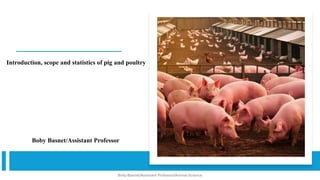
  • 5.
    Origin of domesticchicken Boby Basnet/Assistant Professor/Animal Science Java jungle fowl Red jungle fowl Ceylon jungle fowl Gray jungle fowl
  • 6.
    Zoological Classification ofPoultry Birds Duck Kingdom: Animalia Phylum: Chordata (those having backbone) Class: Aves Order: Ansaiforms Family: Antidae Genus: Anas Species: platychychos Fowl Kingdom: Animalia Phylum: Chordata (those having backbone) Class: Aves Order: Galliforms Family: Meleagridae Genus: Melagris Species: domesticus Boby Basnet/Assistant Professor/Animal Science
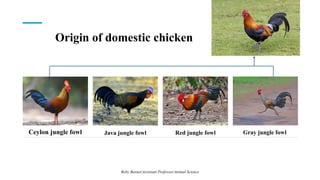
  • 7.
    Zoological Classification ofPoultry Birds Turkey Kingdom: Animalia Phylum: Chordata (those having backbone) Class: Aves Order: Galliforms Family: Meleagridae Genus: Melagris Species: gallopavo Japanese quail Kingdom: Animalia Phylum: Chordata Class: Aves Order: Galliforms Family: Phasianidae Genus: Coyunix Species: japonica Boby Basnet/Assistant Professor/Animal Science
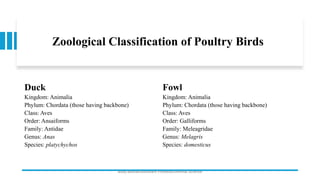
  • 8.
    Statistics of Poultry Category2077/78 2078/79 2079/80 Trend Fowl 73,418,077 66,803,117 65,205,250 Decreasing Duck 432226 605944 1,325,999 Increasing Number Egg Production: 1. Fowl: 1547103 2. Duck: 60229
  • 9.
    Statistics of Pig Category2077/78 2078/79 2079/80 Trend Pig 15,88,838 15,04,624 13,57,507 Decreasing Number Production: 32533 metric ton
  • 10.
    Importance of PoultryFarming 1. Nutrition & Food Security ✓Provides affordable, high-quality protein through meat and eggs. ✓Reduces dependency on imported animal protein. 2. Economic Growth & Employment ✓Major agribusiness supporting farmers, traders, and processors. ✓Generates jobs, especially for youth and women. 3. Quick Returns & Low Investment ✓Requires less capital with fast-growing broilers (5-6 weeks). ✓Ensures steady income for smallholder farmers. 4. Growth of Allied Industries ✓Boosts feed, veterinary, and processing industries. ✓Poultry manure improves soil fertility. 5. Export & Sustainability Potential ✓Expanding market with export possibilities. ✓Integrated farming enhances resource use. ✓Poultry farming in Nepal drives economic growth, improves nutrition, and supports rural livelihoods.
  • 11.
    Problems in poultryproduction 1. Disease Outbreaks: Newcastle, avian influenza, Gumboro. 2. High Feed Cost: Dependence on imports, poor-quality feed. 3. Poor Farm Management: Lack of technical knowledge, outdated practices. 4. Market Fluctuations: Unstable prices, middlemen exploitation. 5. Lack of Credit & Insurance: Limited access to loans, no risk coverage. 6. Poor Infrastructure: Inadequate storage, processing, transportation. 7. Import Dependency: Reliance on foreign chicks, vaccines, equipment. 8. Environmental Issues: Waste disposal, antibiotic overuse.
  • 12.
    Scope of poultry 1.Growing Demand: Urbanization, rising incomes, and awareness about nutrition increase the demand for chicken and eggs, driving growth in the sector. 2. Economic Impact: Poultry farming offers low-investment, high-return opportunities, especially for small farmers, women, and marginalized communities, contributing to poverty reduction. 3. Employment: The sector creates jobs in feed production, hatcheries, processing, and distribution, fostering entrepreneurship in rural areas. 4. Government Support: The government supports poultry farming through training, financial aid, and policy initiatives aimed at rural development and poverty alleviation. 5. Infrastructure & Market Access: Improved roads and transportation networks enable better access to urban markets, ensuring fresh poultry products reach consumers. 6. Technology: Adoption of modern farming technologies, including automation and biosecurity practices, enhances productivity and reduces losses. 7. Export Potential: Nepal can export poultry products to neighboring countries like India, tapping into regional markets. 8. Diversification: Poultry farming can complement other agricultural activities, increasing farmers' income and promoting sustainable practices.
  • 13.
    Zoological classification ofPig Pig Kingdom: Animalia Phylum: Chordata (those having backbone) Class: Mammalia (milk producing) Order: Ungulata Family: Suidae Genus: Sus Species: vittatus, domesticus Scientific name of modern pig: Sus domesticus Boby Basnet/Assistant Professor/Animal Science
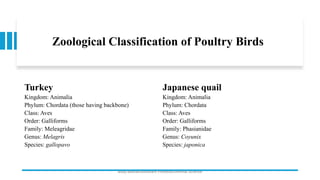
  • 14.
    Advantages of pigraising in Nepal 1. Income Generation: Provides a profitable income for smallholder farmers. 2. Nutrient-Rich Meat: High-protein pork meets local dietary needs (18.7%). 3. Low Investment: Requires relatively low initial investment. 4. Quick Return: Fast growth and frequent reproduction offer quick returns. 5. Waste Utilization: Pigs can be fed on agricultural by-products and kitchen waste. 6. Employment Opportunities: Creates jobs in breeding, feeding, and processing. 7. Market Demand: Increasing demand for pork in local and urban markets. 8. Manure for Farming: Pig manure can be used as organic fertilizer for crops.
  • 15.
    Demerits in PigRaising 1. Disease Risk: Pigs are prone to diseases like swine fever. 2. Cultural Barriers: Pork is taboo in some communities. 3. High Feed Costs: Quality feed can be expensive. 4. Environmental Concerns: Poor waste management can cause pollution. 5. Space Requirements: Adequate space for housing is needed. 6. Limited Veterinary Services: Access to veterinary care is limited in rural areas. 7. Initial Investment: Start-up costs can be a barrier for some farmers.
  • 16.
    Scope of SwineFarming 1. Growing Pork Demand: Increased urbanization and dietary changes. 2. Income Generation: Profitable livelihood for small farmers. 3. Employment Opportunities: Jobs in breeding, feeding, and processing. 4. Low Investment: Requires relatively low initial investment. 5. Waste Utilization: Pigs can be fed agricultural by-products. 6. Nutritional Value: High-protein pork improves nutrition. 7. Export Potential: Opportunities for exporting pork. 8. Sustainable Farming: Pig manure benefits crop production.
  • 17.
    Breed Characteristics ofPig Boby Basnet/Assistant Professor Boby Basnet/Assistant Professor/Animal Science
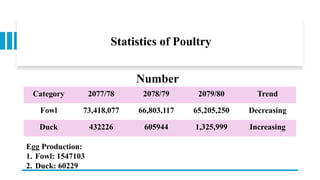
  • 18.
    Pig Indigenous breeds 1. Chawanche 2.Hurrah 3. Bampukhe Exotic Breeds 1. Duroc 2. Hampshire 3. Landrace 4. Tamworth Boby Basnet/Assistant Professor/Animal Science
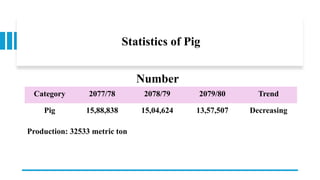
  • 19.
    Chawanche Hurrah Bampudke ➢Theylocated in low to mid hills and are good scavenger animals. ➢They are black in color. ➢Long and straight snout . ➢Small erect ears . ➢Its barrel is dropping type . ➢Female has 8 to 12 teats . ➢Average adult weight is 35 kg ranging from 25 to 40 kg . ➢Long and straight tail . ➢Small body size and short height. ➢The top length (from head point to the base of tail) is 76 cm and heart girth is 86 cm. ➢They are semi-wild in nature ➢They located in terai region (tropical and subtropical) and are mainly used for meat. ➢Its body color is completely grayish black or rust brown with rough skin. ➢Small and erect ears. ➢Straight snout. ➢Hair is straight. ➢Long and strong legs. ➢Straight and long tail. ➢Female has 8 to 12 teats . ➢The average adult weight is 45 kg ranging from 40 to 55 kg. ➢The top length (from head point to the base of tail) is 79 cm and heart girth is 88 cm. ➢They are semi-wild and are active in nature ➢Found in Humla, Bajura (Boarder to Tibet). ➢They are normally red and brown color and sometime found in black color . ➢Top length (from head point to the base of tail) is 45 cm . ➢Heart girth is 52 cm. ➢Female has 8 to 12 teats . ➢Their average adult body weight is 20 kg (ranges from 18 to 25 kg). ➢The indigenous pig breeds are high fertility and have good reproductive characters such as litter size and farrowing intervals. Boby Basnet/Assistant Professor/Animal Science
  • 20.
  • 21.
  • 22.
  • 23.
    PAKHRIBAS BLACK 1. Developedat Pakhribas, Dhankuta through 3 way crossing between Saddleback, Fayun and Tamworth. 2. Found in Eastern hilly region. 3. Age of first farrowing: 368 days. 4. Farrowing interval: 178 days. 5. Litter size: 9-10. 6. Body weight:- Male 250 kg Female 175 kg. Boby Basnet/Assistant Professor/Animal Science
  • 24.
    Exotic breeds ofpig 1. Landrace • Originally a Danish pig popularly bred to produce highest quality bacon in the world. • Colour: White. • Deep side square ham, relatively short legs with heavy lop ears (drooping ears) inclined to the front above the eyes. • Has a long snout. • Breed popular for high prolificacy and for efficiency of feed utilization. • In Nepal, it is used for cross breeding. 2. Yorkshire • Popular English bacon breed and noted for mothering quality. • Raises many litters at one time as the mother yields more milk. • White in colour with moderately long head, snout broad and identical erect ears. • Wt. of mature boar: 300-450 kg, wt. of sow: 250-350 kg. • Widely used for cross breeding. Boby Basnet/Assistant Professor/Animal Science
  • 25.
    3. Duroc • Americanbreed, red in color with shades varying from a golden to cherry red color. • Has two third erect and one third drooping small ears. Less aggressive. • Popular for its excellent growth rate and feed efficiency. • Early maturity farrowing many litters and having good mothering character. • Wt. of mature boar: 400 kg, sow: 350 kg. • Carcass considered quality meat, widely used for cross breeding. 4. Hampshire • A medium type English breed popular for pork production. • Black pig with white stripe (belt) around the shoulder and body including forelegs. • Well known for excellent growth rate and feed efficiency. • Early maturity and farrows 8-10 litters, has good mothering ability. • Wt. of mature boar: 400 kg, sow: 350 kg. Carcass considered good meat. Boby Basnet/Assistant Professor/Animal Science
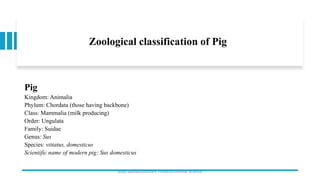
  • 26.
    Boby Basnet/Assistant Professor/AnimalScience 5. Tamworth ➢ This breed was developed in the west England by using wild boar for fixing the golden or chestnut color. ➢ It has coarse hair, longhead, long snout and erect ears. ➢ It is considered to be slow maturing but is very hardy, thrifty and less susceptible to sunburn than many other temperate type breeds. ➢ This is especially good for bacon production and is very good in tropical areas where feeding and management are substandard. ➢ The mature boar weighs as much as 300 kg and sow weights 250kg.
  • 27.
  • 28.
  • 29.
    Management: Housing systemand housing materials for swine, care and management of pregnant sow, breeding boar and newborn pig Boby Basnet/Assistant Professor Boby Basnet/Assistant Professor/Animal Science
  • 30.
    Housing system • Properhousing is crucial for pig production, as it influences growth, reproduction, and overall health. • A well-planned pig housing system provides comfort, protection from harsh weather, and easy management Boby Basnet/Assistant Professor/Animal Science
  • 31.
    Free-Range (Scavenging) Systemfor Pigs ➢Traditional method of pig farming, where pigs roam freely in open spaces and forage for their food commonly used in rural areas where resources for commercial pig farming are limited. ➢Utilizes local breeds with high disease resistance, Low input cost as pigs feed on kitchen waste, crop residues, and natural vegetation, Minimal housing requirements, with basic shelter for protection from extreme weather, Pigs act as savings or insurance, sold when families need extra cash. Advantages of Free-Range Pig Farming ➢Low-cost system with minimal investment in feed and housing, Better meat quality, as pigs get exercise and natural feed, Sustainable and environment-friendly, as pigs help recycle organic waste, Resilient local breeds adapt well to harsh conditions. Disadvantages of Free-Range Pig Farming ➢ Lower productivity compared to intensive farming, Risk of diseases due to exposure to parasites and infections, Predator threats from dogs, foxes, and other animals, Uncontrolled breeding can lead to poor herd management. Boby Basnet/Assistant Professor/Animal Science
  • 32.
    Free-Range (Scavenging) Systemfor Pigs Boby Basnet/Assistant Professor/Animal Science
  • 33.
    Semi-Intensive System • Inthis system, pigs are kept in an open area enclosed with net fencing, ensuring adequate shade and a reliable water supply. • This approach allows for improved feeding and disease control, leading to healthier pigs, faster growth rates, and larger litters. • It requires relatively low financial investment; it is more labor-intensive and demands technical expertise for effective management. Boby Basnet/Assistant Professor/Animal Science
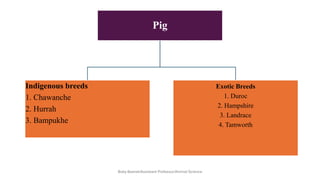
  • 34.
    Intensive System • Inthis system, pigs are housed in well-structured enclosures with concrete floors, where bedding may be provided for comfort. Feeding and water troughs are placed inside the housing area to ensure easy access. This system allows for the management of a larger number of pigs while effectively controlling internal parasites and minimizing labor costs. • In most parts of Nepal, the ideal design follows a double-row system with a covered area on both sides, a common passage in between, and a linked open area at the back of each covered room. This layout facilitates efficient management and movement of pigs. Advantages of the Intensive System: 1. Better Disease Control: Reduces the risk of infections and internal parasites. 2. Efficient Space Utilization: Allows for high stocking density in a controlled environment. 3. Lower Labor Costs: Requires minimal labor due to mechanized feeding and waste management. 4. Higher Productivity: Enables faster growth rates and increased piglet survival. 5. Improved Feeding Management: Ensures a consistent and balanced diet for optimal growth. 6. Protection from Harsh Weather: Provides shelter against extreme temperatures and rainfall. 7. Ease of Monitoring: Allows for close supervision of pig health, reproduction, and performance. Boby Basnet/Assistant Professor/Animal Science
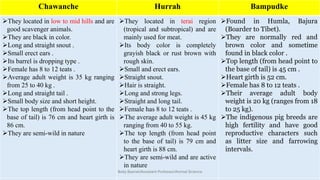
  • 35.
  • 36.
  • 37.
    Housing design Boby Basnet/AssistantProfessor/Animal Science
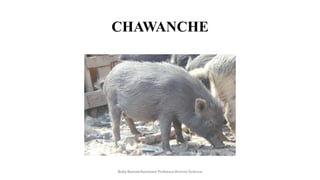
  • 38.
    Housing design Boby Basnet/AssistantProfessor/Animal Science
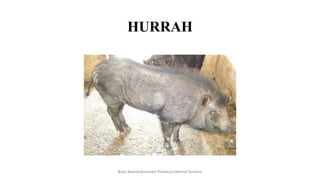
  • 39.
    Housing of differentanimals  Housing of Boars Boar pen should have covered area of 6.25-7.5 m2 and open area of 8.8-12 m2 for exercise. The walls should have a minimum height of 1.5 m.  Housing of Female Open yard type with partial roofing as in the case of boar may be provided. A total of 10-15 females can be grouped in a pen. An area of 2 m2 per animal may be provided.  Housing of Farrowing sows Farrowing sows may be housed individually in a farrowing pen of 2.5 x 4.0 = 10.0 m2 having guard rails, creep area, feed and water troughs.  Housing of growing and finishing pigs A covered concrete yard for feeding and resting having feed and water trough arranged in the front side and an open yard in the rear will suffice for fatteners. The total space requirement may be 2 m2 per grower/fattener pig. Boby Basnet/Assistant Professor/Animal Science
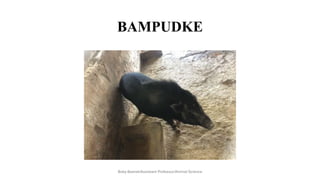
  • 40.
    Basic Housing Materials BobyBasnet/Assistant Professor/Animal Science Roofs Floor Beeding Wall
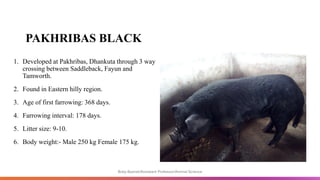
  • 41.
    Roofs  For pigfarming, roofs should provide protection, ventilation, and durability.  Thatched roofs are affordable and cool but need maintenance, while metal sheets are durable but can overheat.  Roof can be made from bamboo too.  Sloped designs with overhangs improve drainage and shade.  Proper insulation and airflow help maintain a comfortable environment. Boby Basnet/Assistant Professor/Animal Science
  • 42.
    Floors • The floorsshould be easy to clean using a shovel, brush, or pressure washer to prevent parasite infestations and disease spread. • Hardened soil floors are unsuitable as pigs tend to dig them up. • Concrete floors are durable, easy to clean, and cost- effective, though they should have a non-slippery surface and proper drainage. • Wooden floors provide warmth but are prone to decay, insect attacks, and chewing by pigs, making them less ideal. • Proper floor slope ensures efficient drainage and hygiene in the pig house. Boby Basnet/Assistant Professor/Animal Science
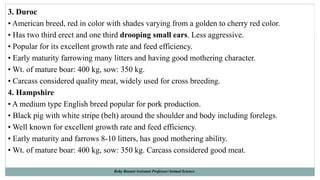
  • 43.
    Floor space requirementfor pig Type of animal Floor space requirement (m2 per animal) Maximum number of animals per pen Covered area Open paddock Boar 6.0-7.0 8.8-12.0 Individual pens Farrowing pen 7.0-9.0 8.8-12.0 Individual pens Fattener (3-5 months old) 0.9-1.2 0.9-1.2 30 Fattener (above five months) 1.3-1.8 1.3.1.8 30 Dry sow 1.8-2.7 1.4-1.8 3-10
  • 44.
    Bedding ➢Bedding should beprovided for all pigs to enhance comfort and hygiene. ➢Suitable materials include rice straw, sawdust, and dry leaves. ➢Bedding must be changed regularly to maintain cleanliness and prevent parasite buildup. Boby Basnet/Assistant Professor/Animal Science
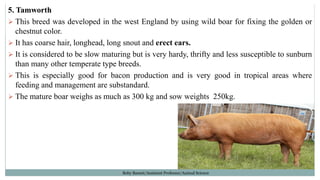
  • 45.
    Wall 1. Walls canbe made of brick, stone, mud, or bamboo based on local suitability. 2. Brick and stone are durable, while bamboo and mud are economical but harder to maintain. 3. Strong materials like brick or concrete are best for lower sections in contact with pigs. Walls should have a solid foundation to prevent collapsing. Boby Basnet/Assistant Professor/Animal Science
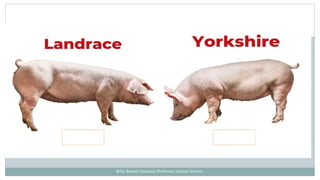
  • 46.
    Vertical Barrier 1. Height:Partitions should be 90 cm high, except for boars, which need 110 cm to prevent jumping. 2. Ventilation: Gaps in partitions ensure proper air circulation while keeping different pig categories separated. 3. Safety: Bottom gaps should be small to prevent pig escapes, and planks should be nailed from the inside to avoid injuries. 4. Sturdiness: Posts must be solid to ensure durability and stability. Boby Basnet/Assistant Professor/Animal Science
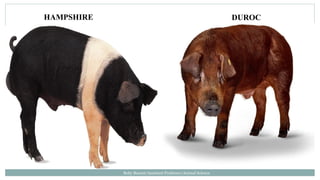
  • 47.
    Gates  These shouldbe made of wood or metal.  They should be attached with particularly strong fittings to withstand pigs rubbing against them. Boby Basnet/Assistant Professor/Animal Science
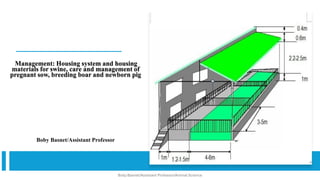
  • 48.
    Ventilation  Ventilation mustbe introduced into a building to remove water vapor, carbon dioxide, ammonia, airborne dust, and bacteria and odors. Boby Basnet/Assistant Professor/Animal Science
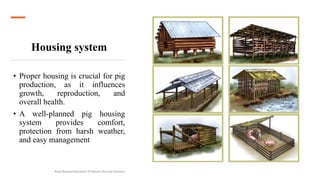
  • 49.
    CARE AND MANAGEMENTOF PREGNANT SOW 1. The date of mating must be recorded so as to determine the date of farrowing. 2. The average gestation period of sow is about 112-115 days. 3. Should be housed separately 4. Sty must be clean, dry and non-slippery. 5. Sow should be treated kindly and fed liberally. 6. To avoid skidding and abortions pregnant sow/gilt must be kept away from other animals. 7. Pregnant sow must be allowed to graze on pasture with following conditions; ❖ -Separate pasture from other animals. ❖ -Safe from parasites ❖ -Nutritious and green grass. ❖ -Grazing must be preferred in the early hours of the day.
  • 50.
    8. Kicking, abusing,pushing or rough handling must be avoided. 9. Bedding of 8-10 cm chapped straw under covered area must be provided. 10. Balanced ration with 16% CP, 0.8% Ca and 0.6% P must be provided for uniform litter with more birth weight. 11. Allow free access to leguminous greens like berseems, lucerne, cowpea etc. 12. Increase the amount of feed during late gestation period because major growth of foetus takes place in later period. 13. Deworm the pregnant females two weeks before farrowing with Piprazine adipate at the rate1 gm/10 kg of body weight. 14. Pregnant females must be bathed with Luke warm water containing potassium permanganate (1:1000) or allow free access to medicated wallow 15. Regular inspection of sow should be done.
  • 51.
    CARE AND MANAGEMENTOF BOAR 1) Selection of boar  Select the pure breed, look for pedigree and confirmations and good representative or the breed it belongs to. Boar influences conception rates, litter size and contribute one half of the genetic makeup of his piglets. Hence, boar must have well developed sex organs.  Boar must have signs of masculinity. Boars must possess the traits of meaty hog, soundness of feet, legs, body capacity should be observed. Boar lacking sex desire must be culled. Never select a boar that has one testis (cryptorchid). 2) Age for breeding and use  Suitable age for breeding is10-12 months. New replaced boar should be isolated for 40-60 days. Number of services per boar per week should be 4-5.  Either boar or sow must be brought to meet each other than to allow the boar to run along the stock. For optimum breeding performance, young boar - one service daily and mature boar for not more than two services a day. Boar gives satisfactory service till 5-6 years of age.  First service is critical in the life of the boar. Therefore, this mating should be with a female of same age, group and size. Make use of breeding crate for mating purpose. Avoid slippery floors in the breeding areas.
  • 52.
    CARE AND MANAGEMENTOF BOAR 3)Feeding of boar  Boar should be kept in a thrifty condition i.e. neither overfed nor underfed.  Amount of feed per 45kg-body wt. per day should be 1.25-1.50 kg.  The ration should contain 14% C.P.  Boar should be fed 2-3hours before they are expected to breed.  Fresh, clean and adequate quantity of water must be provided. 4) Housing  Boar pen should be located where it will provide maximum exposure to the female to be breed  The presence of female helps to stimulate the sex desire in boar.  Each boar should be provided with 1.5m² square dry well ventilated sleeping area.  Hogs have very few sweat glands and hence cannot dispose body heat as easily as other animals do. Therefore, to protect from heat stress or heat induced sterility, provide bathing facility i.e. wallowing in summer.
  • 53.
    CARE AND MANAGEMENTOF NEWBORN PIGLETS  Remove the piglets as soon as possible.  Clean all piglets and make their body dry  Breathing passage of piglets must be made clear.  Immediately after birth piglets should have their naval dipped in tincture of iodine solution  Naval cord must be cut with sterilized scissors or blade leaving 2.5 to 3 cms from the body and must be disinfected by iodine solution.  Piglets must be allowed to suckle milk from mother for about 8-10 times in 24 hour initially. First milk is known as colostrum that contains good quality of protein, sugar, fat and sufficient vitamins and minerals particularly calcium and phosphorus .It also provide antibodies to protect them against disease.  If sows colostrum is not available cows colostrum can be fed.  Piglets may die due to chilling so they are to be protected from chilliness. A pig brooder in corner of the pen warmed with an electric light protects piglets from cold.
  • 54.
    CARE AND MANAGEMENTOF NEWBORN PIGLETS  Piglets must be protected from trampling by sow. A ground rail around the farrowing pen is also an effective means of preventing sows from crushing their litters. The rail should be raised 8-10 inches from the floor .  Prevention of anemia- (a) Add @ 25mg Fe and 5mg of copper per day per pig. (b) Paint the udder of sow daily with the following mixture. Iron sulphate - 500gm Copper sulphate-70gm Sugar-500gram Water -10 litres (c) Allow free access to piglets for parasite free runs with fresh soil (d) Intramuscular injection of iron- dextrose compound (Impheron)1ml/piglets on 4th and 14th days of age can be given.
  • 55.
    Feeding of piglets AgeDaily Feed/kg Birth to 1-month Mother's milk 1 to 2 months 0.5 2 to 3 months 1.0 3 to 4 months 1.2 4 to 5 months 2.0 5 to 6 months 2 – 5
  • 56.
    Removal of needleteeth  At birth pigs have 4 pairs of small tusklike teeth, two on each side of upper and lower jaw. They have no use, rather may cause injury to the mother's udder. These must be clipped by means of tooth nipper.
  • 57.
    Start feeding piglet/Creepfeeding  Creep feeding is the practice of feeding a solid diet to piglets while they are suckling the sow, preparing their digestive system for weaning. Creep feeding initiates and promotes gut and digestive enzyme development, which enables the piglet to digest nutrients from food sources other than that of milk. This encourages feed intake, which is one of the greatest challenges to post-weaning performance.  Feeding starts from 2-3 weeks of age for proper growth and development.
  • 58.
    Castration of piglets It is usual to castrate boar pigs at 4-6 weeks of age.  Castration is essential for fattening of pig for commercial purpose.
  • 59.
    Breed and HousingBreeds: Breeds and Breed characteristics of layers, broilers and dual-purpose breed, housing and housing materials, design of poultry housing Boby Basnet/Assistant Professor Boby Basnet/Assistant Professor/Animal Science
  • 60.
    Breed  The groupof individuals within the species having distinct physical and productive characteristics, which are efficiently transmitted to the decedents.  The distinct characteristics originate from selection by man or result by adaptation to climate and environment and may be visible like comb type, color of the skin, shank, plumage, etc. or not externally visible like egg production, color of the egg, growth rate, resistance, etc. Boby Basnet/Assistant Professor/Animal Science
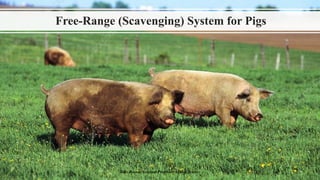
  • 61.
    Commercially Available BroilerBreeds In Nepal  Cob 500  Marshall  Hub bird classic Boby Basnet/Assistant Professor/Animal Science
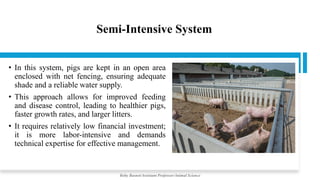
  • 62.
    COBB 500  Lowestcost of live weight produced  Superior performance on lower cost feed rations  Most feed efficient  Excellent growth rate  Best broiler uniformity for processing Boby Basnet/Assistant Professor/Animal Science Age(Days) Weight for age (gm) Daily gain (gm) Daily feed consumption (gm) 7 185 28 35 14 465 53 68 21 943 78 111 28 1524 86 152 35 2191 99 189 42 2857 93 216
  • 63.
    Hub bird classic Hub bird classic broilers have strong initial growth with very good FCR.  Its robustness and adaptability are evident under any temperature and feed condition.  Its overall benefits allow it to obtain the lowest cost price for live, whole bird or ready-to cook market with high meat yield.  Its adaptability to any environment makes good performance in temperate as well as tropical areas. Boby Basnet/Assistant Professor/Animal Science Age (days) Average Body weight (gm) Cumulative Daily gain (gm) Cumulative Feed consumption (gm) Average Feed conversion 5 140 20 106 10 301 26 292 15 561 35 617 1.10 20 909 43 1112 1.22 25 1315 51 1773 1.35 30 1758 57 2577 1.47 35 2229 63 3505 1.57 40 2489 66 4530 1.68
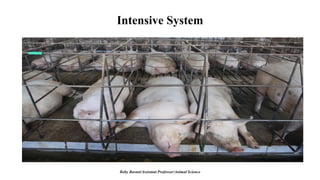
  • 64.
    Marshal  The breedis specially designed to be able to provide excellent feed conversion in the hot and tropical conditions of India and Asia.  Trials have shown that a parent bird consumed an average of 389gm per broiler chick while a commercial bird reached a body weight of 2.6kg in 42 days with a cumulative feed consumption of 4.5kg or an FCR of 1.7. Boby Basnet/Assistant Professor/Animal Science
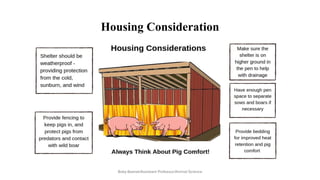
  • 65.
    Commercially available Layersbreed 1. Hy-line Brown 2. H&N Brown Nick 3. Lohmann brown-classic Boby Basnet/Assistant Professor/Animal Science
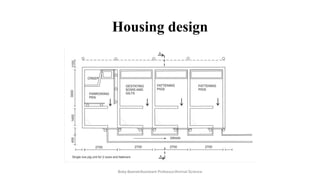
  • 66.
    Hy-line Brown Classic Hy-line Brown is the world most balanced brown egg layer. She produces over 355 rich brown eggs upto 80 weeks, peak well and begins lay early with optimum egg size.  These traits combined with feed efficiency, the best interior egg quality in the market and excellent livability give the Hy-line Brown the perfect balance, which means more profit for the poultry producers.  Body wt. at 70 weeks-2kg. Boby Basnet/Assistant Professor/Animal Science
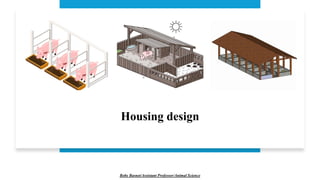
  • 67.
    H&N Brown Nick ➢H&NBrown Nick is a commercial layer that has high peak and persistent production. ➢The egg weight is optimum with excellence in Feed efficiency and posses uniform brown and dark colour. ➢These breed can be used in both cage and alternative production system. ➢Egg-360 eggs/80 weeks, with an avg. wt of 62-65gm/egg. Boby Basnet/Assistant Professor/Animal Science
  • 68.
    Lohmann brown-classic ➢ Lohmanbreeds are distinguished by laying peaks, a great persistency in laying performances and good shell stability as well as excellent health. ➢ Due to patented selection methods, all Lohman brown layers are free from the TMA syndrome (Thrombotic microangiopathy is a rare but serious condition that causes blood clots to damage small blood vessels in vital organs) despite the use of feed containing TMA substances, e.g. rape seed, the eggs will still be free from fishy odour. ➢ Egg-380/85 weeks. Boby Basnet/Assistant Professor/Animal Science
  • 69.
    Poultry Indigenous breeds 1. Sakini 2.Ghatikhuile 3. Puwankh ulte Exotic Breeds 1. Australop 2. New Hampshire 3. White Leghorn 4. Minorca 5. Kadaknath Giriraj Boby Basnet/Assistant Professor/Animal Science
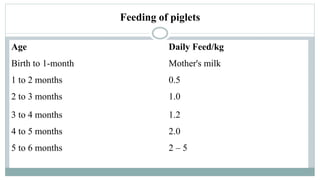
  • 70.
    Sakini Ghanti KhuilePwankh ulte ➢ Sakini is an attractive breed among three indigenous breeds of chicken in Nepal. ➢ The feather color varies from black to red, spotted black and white, red and white, red and black. ➢ Skin color varies from white to yellow. ➢ Earlobe color of sakini chicken varies from pink to red. ➢ Shank is yellow to brown in color. ➢ This breed has single or rose type comb of red color. ➢ They have brown to black legs. ➢ The egg production capacity is 70 to 80 /year. The average adult body weight is 1.5 to 2.0 kg. ➢ They have featherless neck i.e. naked neck. ➢ Black to red or some times red and black feather color. ➢ They have white to yellow skin color. ➢ They are characterized by pink to red ear lobe color. ➢ Shank is yellow to brown in color. ➢ Ghanti khuile chicken have red colored single or rose type comb. ➢ They are also characterized by brown to black legs. ➢ The egg production capacity is 60 to 80 /year. The average adult body weight of male is 1.6 and female is 1.30 kg. ➢ They have ruffled feathers (curved outwards) all over the body. ➢ They comprise with Sakini breed in their feather color. ➢ Skin color of Pwankh ulte chicken is white to yellow. ➢ Have pink to red earlobe color. ➢ Shank is yellow to brown in color. ➢ Pwankh ulte chicken have single or rose type comb of red color. ➢ They have brown to black legs as other indigenous breeds of chicken. ➢ The average adult body weight of male is 1.0 and female is 0.9 kg. ➢ The egg production capacity is 70 to 85 /year. Boby Basnet/Assistant Professor/Animal Science
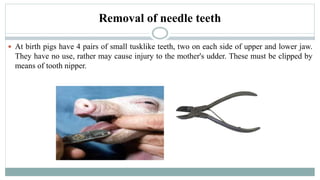
  • 71.
    INDIGENOUS BREED OFPOULTRY Boby Basnet/Assistant Professor/Animal Science
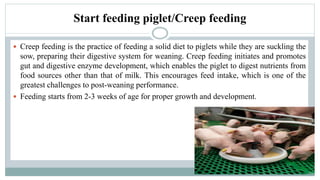
  • 72.
    Exotic breeds ofpoultry Australorp: This breed has been developed in Australia. This is considered as a dual purpose breed and very suitable in the backyard farming in Nepal. This produces brown coloured egg The standard weight of a cock of this breed is 3.8 kg and of a hen is 3 kg. Boby Basnet/Assistant Professor/Animal Science
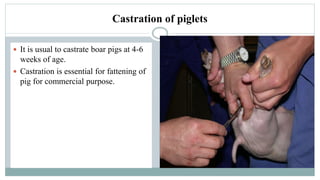
  • 73.
    Giriraj is abreed of chicken developed by Karnataka Veterinary, Animal, and Fishery Sciences University in Bengaluru, India. Giriraja females lay a large number of eggs, 130– 150 per year, with each egg weighing 52-55 grams. The eggs have a good hatchability (80– 85 per cent). Their shells are brown in color. The birds exhibit better growth compared to local varieties, and are suited for mixed and backyard farming. Boby Basnet/Assistant Professor/Animal Science GIRIRAJ
  • 74.
    This is oneof the most popular egg breeds of fowl all over the world. This is an excellent layer and has paved suitable in mid hill and terai area of Nepal. This produces white coloured egg. The standard weight of a cock of this breed is 2.7 kg and of a hen is 2 kg. Boby Basnet/Assistant Professor/Animal Science WHITE LEGHORN
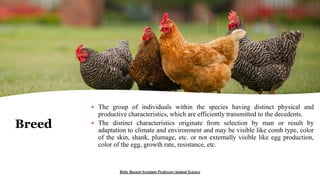
  • 75.
    This is relativelya new breed developed in United States. This breed was introduced in Nepal in the year 1957. This is a dual-purpose type of chicken and is known for its hardiness. This breed is a good producer of large brown sized eggs. The standard weight of a cock is 3.8 kg and of a hen is 2.7 kg. Boby Basnet/Assistant Professor/Animal Science NEW HAMPSHIRE
  • 76.
     Kadaknath isan Indian breed of chicken originated from Madhya Pradesh in India The Kadaknath is popular for its adaptability and its grey-black meat. Its colour is caused by melanin. The Male weigh 1.8–2 kg and the hens 1.2–1.5 kg Kadaknath hens' eggs are brown with a slightly pink tint, they are poor setters and rarely hatch their own brood. Eggs weigh an average of 30–35 g. Boby Basnet/Assistant Professor/Animal Science KADAKNATH
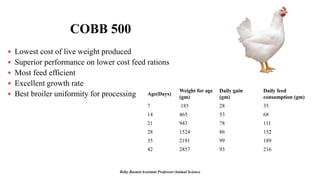
  • 77.
    ASIL Boby Basnet/Assistant Professor/AnimalScience  Physical Traits: Muscular, compact, broad shoulders, narrow stern, short hard feathers.  Head & Comb: Small head, pea or triple-shaped comb, yellow curved beak.  Legs: Short but strong with thick thighs.  Temperament: Aggressive; chicks start fighting early.  Egg Production: Seasonal layers, low egg yield, tinted shells, broody hens.  Uses: Meat and ornamental purposes.  Varieties: Black, White, Duckwing, Red Spangled, Pyle.  Weight: Cock - 2.7 kg, Hen - 2.3 kg.  Not suited for commercial production..
  • 78.
    Dual purpose breedsof Chicken 1. Sakini 2. Ghanti Khuile 3. Dumse (Puwank Ulte) 4. New Hampshire 5. Australorp Boby Basnet/Assistant Professor/Animal Science
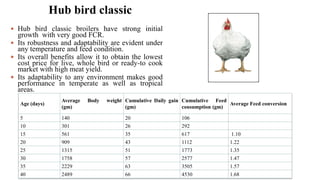
  • 79.
    Types of chicken: Eggtype: These breeds lays big size egg and are not heavy in body weight.  Leghorn, Minorca, Ancona  Light weight.  Very active Meat type: These breed lays less egg and are heavy in body weight.  Cornish, Sussex, Orphington, Australorp, New Hampshire.  Heavy weight, fleshy body, slightly dull Dual purpose: These breeds lays more egg and are heavy in body weight. These are ideal breeds for small farmers.  Rhode Island Red, Plymouth Rock, New Hampshire, Wyandotte  Moderate weight, quite alert Miscellaneous: Game and ornament purpose  Aseel, Red jungle fowl,  Ornamental- Brahma, Cochin/ Karaknath
  • 80.
    Chicken Breeds andCharacteristics
  • 82.
    HOUSING OF POULTRY Needfor poultry housing / Essential of good housing 1. Comfort: The best production is obtained from birds that are comfortable and happy. Comfortable house must provide adequate accommodation, be reasonably cool in summer, free from drafts and sufficiently warm during the winter, provide adequate supply of fresh air and sunshine, and remain always dry. 2. Protection: Poultry house provides protection theft and attack from natural enemies of the birds such as fox, dog, cat, kite, crow, snake etc. at also provide protection against external parasites such as ticks, lice, and mites. 3. Convenience: The house should be located at a convenient place and the equipment. So arranged as to allow clearing and other necessary operations as required. 4. Relation to other building: The poultry house not be too close to the dwelling houses. Because it creates the unsanitary condition on the other hand it should not be too away from the dwelling houses as it require more time in going to the poultry house for feeding, watering and collection of eggs. The poultry house should be located at convenience distance. 5. Shady and cool environments: Poultry birds suffer much in hot weather and they require cool condition during the daytime. Trees planted in the western and northern side of poultry house serve as windbreak in winter and for shade in the summer. Otherwise, the soil under tree remains damp, which produces suitable condition for disease attack.
  • 83.
    Site selection  Convenientlocation with good market access for eggs and meat.  Availability of common poultry feeds at cheaper rates.  Well-connected with roads and other transportation modes, with no nearby poultry farms.  Access to electricity and water at reasonable cost and ease.  High land with loam soil for good drainage.  Sufficient space for future expansion.  Open space for proper ventilation.
  • 84.
    Housing requirements 1.Floor space ➢Floor space depends on age, size, breed, type, number of birds, and rearing method. ➢ Smaller houses require more square feet per hen. ➢ Larger houses can accommodate more birds with less space per hen. ➢ Ideal small unit: 15 to 20 birds. ➢ Maximum limit: 250 birds. ➢ House should be long in the east-west direction. ➢ Floor should remain dry at all times. Ideal floor space: - Layers: 2 sq ft per bird - Broilers: 1-1.5 sq ft per bird. Birds per pen Area of the house (sq. ft) Floor space per bird (sq. ft) Light breed Heavy breed Light breed Heavy breed 25 88 100 3.5 4.0 100 200 350 3.0 3.5 200 500 600 2.5 3.0 500 1,000 1,250 2.0 2.5 Floor space requirement for poultry
  • 85.
    2. Ventilation ❖Provides freshair and removes moisture. ❖A 2 kg hen on full feed produces about 52 liters of carbon dioxide every 24 hours. ❖Helps eliminate carbon dioxide and other unwanted gases. 3. Temperature ❖Ideal temperature: 50°F to 70°F (10°C to 21°C). ❖Protect birds from extreme summer heat and winter cold. ❖Birds need warmer temperatures at night when they are inactive. ❖Insulation with straw or other materials keeps the house warmer in winter and cooler in summer. 4. Dryness ❖A dry poultry house is essential for bird comfort and health. ❖Dampness can lead to diseases like colds and pneumonia. Causes of dampness: ❖Moisture rising through the floor. ❖Rainwater entering the house. ❖Leaky roof and walls. ❖Leaky water containers.
  • 86.
    5. Light: ❖Daylight isessential for bird health and happiness. ❖Sunlight helps destroy disease germs and provides Vitamin D. ❖Light stimulates sexual development and enhances egg production. ❖Proper lighting keeps birds active, increasing feed intake and productivity. 6. Sanitation: ❖External parasites like lice, ticks, flies, and mites harm birds. ❖These pests spread diseases and reduce growth and egg-laying capacity. ❖Poultry house design should allow easy cleaning and spraying. ❖Minimize cracks and crevices to prevent pest infestation. 7. Availability of Labor: ❖ Labor is a crucial input for poultry production. ❖Poultry farming is more profitable when labor is available as needed. ❖Avoid building farms in areas with labor shortages. 8. Social Condition: ❖Consider the social environment before establishing a poultry farm. ❖Avoid areas with high theft and security issues. ❖Farms should not be located near religious areas where demand for eggs and meat is low.
  • 87.
    Poultry House Equipment 1.Feedhopper: Feed hopper is meant for providing food to the poultry bird. The essential features of food hopper are:  Avoid feed wastage  Prevent the birds for getting their feet into the feed and for roosting on the hopper  Easy to clean  Make it easy to the birds to eat from the bottom of hopper  They should be of suitable size depending on the age and size of the birds as followings  Different types of feeder  linear feeder with reel  Adjustable feeder with grill t op  Bamboo feed hopper  Hanging or tube feeder  Hanging feeder with wire grill Age of the bird Measurment of feed hopper Length Breadth Depth Chicks of one day to one week old 1’ 2’’ 1’’ Chicks of one week to 45 days old 2’ 3’’ 1.5’’ Chicks of 45 days to 120 days old 4’ 5’’ 3’’ Adult birds 5’ 6’’ 4’’
  • 88.
    2.Watering devices: Supply ofclean and fresh drinking water should be made available at all the times for poultry birds. The water container should be large enough for full day supply, kept the water clean and cool in summer, easy to empty, clean and refill. Boby Basnet/Assistant Professor/Animal Science
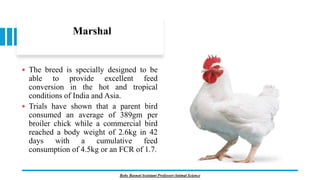
  • 89.
    3. Perches Roost •Poultry birds start roosting at eight weeks old. Use wooden bars (2 inches square, rounded top, flat bottom) fixed 16 inches above the ground, near walls, and removable for disinfection. • Space perches 12 inches apart, with 8 inches of perch space per bird. Boby Basnet/Assistant Professor/Animal Science
  • 90.
    4. Nest box ✓The laying birds of almost all breeds prefer dark and separate place for laying eggs. ✓ The hen lay eggs every day at a place where she starts laying egg at first. ✓ Each pen of laying bird should be provided with nest box for laying eggs. ✓ The nest boxes should be roomy, cool, well ventilated, dark and movable. ✓ The nest should be 30 cm square, 15 cm deep and with 37.5 cm head room. ✓ One nest should be provided for every 5 to 6 hens. Boby Basnet/Assistant Professor/Animal Science
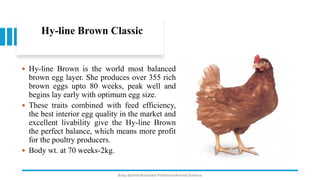
  • 91.
    5. Grit andshell container ✓Ordinary container made either of wood or metal can be used for oyster shell or other grit. ✓Calcium is required for formation of egg shell and that can be provided through the lime stone, oyster shell etc. Boby Basnet/Assistant Professor/Animal Science
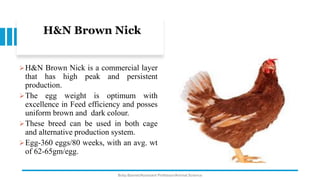
  • 92.
    Housing systems ofpoultry The system of housing depends on the amount of group and the capital available. There are four system of housing generally found to follow among the poultry keepers. 1.Free range or Extensive system. 2.Semi- Intensive System. 3.Folding unit system. 4.Intensive system. a) Battery system. b) Deep litter system. 1) Free range system: In this system, unlimited space is provided to the birds where they can find an appreciable amount of food in the form of herbage, seeds and insects. They are at risk from predatory animals and infections diseases including parasitic infestation. Advantages ➢ The poultry birds meet their food requirement from the surroundings. So feed cost is minimum. ➢ Elaborate housing is not required. ➢ Rearing cost is minimum. Disadvantages ➢ The hen lays egg here and there. So losses of egg may be a problem. ➢ Predatory animals causes loss of poultry birds.
  • 93.
  • 94.
    2) Semi-intensive system Thissystem is adopted where limited free space is available. It is necessary to provide 10-15 sq. m. inside run and 20-30 sq.m. out side run per bird. Advantages Protection against predatory animals is possible. The birds gets the opportunity to move in the fresh ground. Disadvantages  The run may get infested with the droppings.  The poultry birds may be infected with infectious and contagious disease. Boby Basnet/Assistant Professor/Animal Science
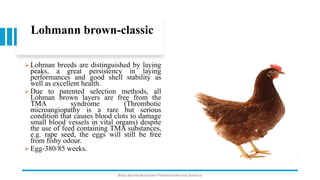
  • 95.
    3) Folding unitsystem In this system of housing birds are confined to one small run, the position is changed each day, giving them fresh ground and the birds find a considerable proportion of food from the herbage . Advantages  Spreading to disease is minimum as the birds being confined to one small run.  No fear of predatory animals. Disadvantages  Labor cost is high.  Feeding watering and collection of eggs needs more time. Boby Basnet/Assistant Professor/Animal Science
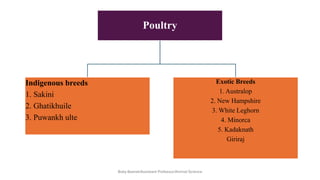
  • 96.
    4) Intensive system Inthis system of housing the birds are confined to house entirely, with no access to land outside and it is usually adopted where land is limited and expensive. Under this the deep litter system are most common. a) Battery system (cage system): In this system each hen is confined to a cage just large enough to permit very limited movement and allow her to stand and sit comfortably. The usual floor space is 14×16 inches and height of 17 inches. The floor is of standard strong galvanized wire set at a slope from back to front, so that eggs laid by hens, roll out of the cage to a receiving gutter. Underneath is a tray for droppings. Both food and water receptacles are outside the cage. Advantages  Case system of rearing allows better flock supervision.  The performance of each bird can be noted and culling is easily carried out as and when required.  Cage system of rearing offers economy in space, reduce feed consumption and labor, help in prevention and control of certain disease like coccidiosis and increase the efficiency of production.  Clean and uniform egg production throughout the year is possible. Disadvantages  Cage fatigue is one of the problems.  Malnutrition may be the problem, if the feeding of birds in cages in not carefully performed.  Feeding and watering requires more labor.  Housing and equipment cost per bird is high.
  • 97.
    a) Battery system(cage system):
  • 98.
    b. Deep LitterSystem: In this system poultry birds are kept in large pens upto 250 birds each, on floor covered with litters like straw, saw dust or leaves upto depth of 8-12 inchs.
  • 99.
    Management of deeplitter 1. The floor of the house should be disinfected by phenyl, Lysol, bleaching powder or lime water before placing litter materials. 2. Do not have too many birds in the pen, one bird for every 4-5 square feet of floor space. 3. The deep litter should be kept dry. Wet litter in early stages of growth leads to the sporulation of coccidia. Lime or super phosphate @ 500 gm lime or 1 kg superphosphate per square feet is applied to make the litter dry. 4. Cacking of litter should avoid as far as possible by keeping the humidity low and stirring of litter at least once in a week. 5. Fresh litter should be used for rearing pullets and new batches of birds should be placed in clean litter. The time of starting deep litter should be in the dry period of the year. 6. The old, built up litter should be replaced after the rainy season and beginning of winter season. The litter maybe kept for one year only. 7. The waterer should be placed in such a way to keep the litter dry. Leaking of water from waterer or roof, upsets the whole process and it would have to start over again. Boby Basnet/Assistant Professor/Animal Science
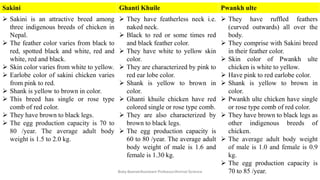
  • 100.
    Advantages of Deeplitter system • Less efficiency in poultry management. • Litter as a source of food supply. • Labor saving. • Valuable fertilizer. • It provides protection against various infections disease and external parasites. • Offers advantages of self control to birds during extreme weather conditions. • Well, built- up deep litter can be utilizing as valuable source of fertilizer containing 3%N 2%P and 2%K. Boby Basnet/Assistant Professor/Animal Science
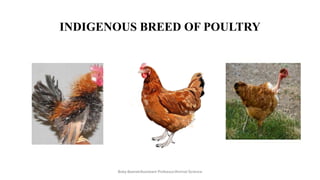
  • 101.
    Disadvantages • Raising layerchicken using deep litter system makes eggs dirty. • Disease and parasites spread easily. • Higher tending of cannibalism and peeking of feathers. • Difficult to determine unproductive birds and difficulties in culling. Boby Basnet/Assistant Professor/Animal Science
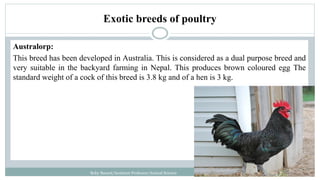
  • 102.
    Brooding: Natural andArtificial, egg formation, selection of eggs for table and incubation purposes, Factor essential for best hatching Boby Basnet/Assistant Professor Boby Basnet/Assistant Professor/Animal Science
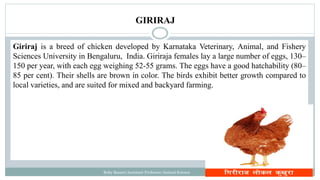
  • 103.
    Egg • In poultry,an egg is the reproductive body produced by female birds, consisting of a hard outer shell, albumen (egg white), and yolk, which contains the nutrients necessary for embryo development or human consumption.
  • 104.
  • 105.
    Main parts ofegg 1. Yolk: 31% of total egg weight 2. Albumen: 58-60% of total egg weight 3. Shell membrane: 0.6% of total egg weight 4. Shell: 9-11% of total egg weight 5. Air cell: (1.5-2.5 cm)
  • 106.
    Yolk • 31% oftotal egg weight (yellow part at the center of an egg) • Diameter of yolk: 34 mm on its longitudinal axis and 32 mm in its vertical axis • Consists latebra, germinal disc-blastodisc (for infertile egg) and blastoderm (for fertile egg) • Vitelline membrane surrounds the yolk • Yolk consists of alternate layer of dark and light colored yolk. • Altogether six dark and six light colored in yolk
  • 107.
    Albumen • 58-60% oftotal egg weight (white portion) • Consist of four layers: chalaziferous layer (3%), inner thin layer (17%), middle dense layer (57%), outer thin layer (23%) • Inner thin albumin layer surrounds the chalaziferous layer. • Chalaziferous layer continues with chalazae which consists mainly of fine mucin like fibers Shell membrane: • Inner 2 layers and outer 3 layers • Tough and fibrous in nature • Both membranes are inseparable • 0.6% of total egg weight • Thickness of shell membrane is not uniform throughout the egg : thicker at blunt and thinner at pointed end
  • 108.
    Shell • Outer hardcovering,. 9-11% of egg weight. • Consists of 94% Calcium bicarbonate, 1% Calcium phosphate, 1% Magnesium carbonate and 4%organic matter. • Shell structure divided into four parts: mamillary layer, spongy layer, cuticle, pores (around 1700-7500 pores in egg of chicken). Air cell: • No air cell in fresh egg at moment of laying. • Egg content contracts following cooling and slight vacuum is created drawing air through its pores, giving rise to air cell between two shell membrane. • Air cell is at blunt end because of presentation of the end first to atmosphere during laying. • Air cell size is 1.5-2.5cm in chicken.
  • 109.
    Chemical composition ofegg • Important source of protein, fat, minerals ;well balanced nutrient of all ages . • Rich in proteins (2 egg daily=total protein requirement) . • Good mineral sources: Ca, P, Fe, Na, K, I, Zn, Mg. ✓ In yolk: concentration of fat-soluble vitamin: A, D, E. ✓ 2nd richest source of Vitamin D after fish liver oil. ✓ contains all vitamins except vitamin C. ✓ water soluble vitamins: Riboflavin, Niacin, B6, B12. • Also known for fatty acids: both saturated and unsaturated (triglycerides: 63%, Cholesterol: 5%, Phospholipids: 30%). • Most of/ all off essential amino acids required by humans are present in adequate proportion.
  • 110.
    Factors affecting chemicalcomposition of eggs 1. Species ✓ Duck have more fat than other land birds ✓ Yolk of pigeon has smaller part of protein and lipid as compared to duck and chicken 2. Diet ✓ Eg: riboflavin content of egg vary on riboflavin content of feed. ✓ Fatty acid composition of yolk=fatty acid in diet 3. Age of bird ✓ Decline in albumin with age ✓ Ca, P, Protein decreases with age 4. Season ✓ Significant effect on mineral content of egg as well as size and thickness of egg (heat stress, cold temp, weather condition, light etc). 5. Storage and processing ✓ Fresh egg contain higher nutrients and similar chemical composition
  • 111.
    Food value ofegg Egg CHO% Protein% Fat% Water% Whole egg 1 13 12 74 White 0.8 11 Trace 89 Yolk Trace 16 32 49 • Calories per 100 gm of egg= 160 kcal
  • 112.
    Formation of egg Reproductivetract of hen is divided into two major parts- 1. Ovary ➢ Hen has only one functional ovary- the left one-situated in the body cavity near the backbone. ➢ It looks like cluster of grapes before laying. ➢ Each yolk (ovum) is enclosed in a thin-walled sac, or follicle, attached to the ovary. ➢ Mature hen have 3600-4200 ova. ➢ Ovary size is 40-50 gm in laying hen. 2. Oviduct ➢ Oviduct is tube like organ 60-86 cm long. ➢ Various portion of oviduct are- Infundibulum, Magnum, Isthmus, Uterus, Vagina. ➢ Time interval between release of yolk (ova) from ovary and laying is about 25 hours (23-30).
  • 113.
    1. Infundibulum (9cm-length) ✓Picksup yolk ✓Reservoir of male sperm ✓Fertilization takes place ✓Formation of chalaziferous layer of albumin 8-30 mins (Duration spent in the region) 2. Magnum (33 cm) ✓Formation of inner thin albumen and middle thick albumen ✓2 hours 30 minutes to 2 hours 54 minutes
  • 114.
    3. Isthmus (10cm) ✓ Secretion of water, mineral salts and two shell membranes ✓1 hour 14 minutes to 1 hour 30 minutes 4. Uterus (12 cm) ✓ Secretion of thin albumin shell matrix, pigment and cuticle ✓19 hours 42 minutes to 20 hours 40 minutes 5. Vagina (12 cm) ✓Bloom of protein material over shell.
  • 115.
    Oviduct Parts Length (cm) Duration spent in theregion Main function and formation of different portions Infundibulu m 9.0 18 to 13min. ➢ Picks up the yolk. ➢ Reservoir for male sperms. ➢ Fertilization. ➢ Formation of chalaziferous layer of albumen. Magnum 33.0 2 hrs 30 min to 2 hrs 54 min ➢ Secretions of inner thin albumen and middle thick albumen. Isthmus 10.0 1 hr 14 min to 1 hr 30 min ➢ Secretion of water, mineral salts two shell membranes. Uterus 12.0 19 hrs 42 min to 20 hrs 40 min ➢ Secretion of thin albumen shell matrix, pigment and cuticle. Vagina 12.0
  • 116.
    Hatching of eggs ➢Hatchingin poultry management refers to the production of baby chicks which take average 21 days to hatch. • Fertile eggs are called hatching eggs • Hatching span-21 days • Good selection of egg for good hatching • It is best to incubate eggs within 7-10 days of their being laid. • A hatchery is a place where eggs are hatched under artificial conditions. Factors to be considered: ✓nutrition ✓disease free stock ✓parental age: maximum hatchability in first year of laying Boby Basnet/Assistant Professor/Animal Science
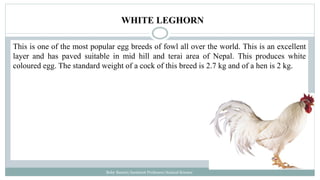
  • 117.
    ➢Fertility and hatchabilitydepends on:- ✓ Seasonal condition: egg production in summer and early spring is low ✓ Physical condition of breeding stock: ✓ Storage temperature: best at 50-55 deg F, high temperature is more injurious than low temperature ✓ Storage humidity: about 80% ✓ hen to cock ratio, about 10-12: 1 Boby Basnet/Assistant Professor/Animal Science
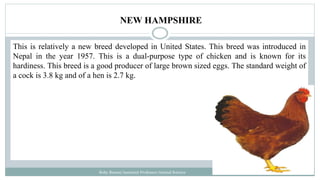
  • 118.
    Selection and careof hatching eggs 1.Egg size: not to small not to large: 50-55 gm for chicken, 65- 70 gm for duck and 80-85 gm for turkey egg. 2.Shell color: Incase of white egg, it should be free from tints, For brown egg-medium or dark brown better than light brown 3.Shell texture: thick shell texture advised 4.Soiled eggs: dirt should be cleaned by rubbing with cloth, not washed Boby Basnet/Assistant Professor/Animal Science
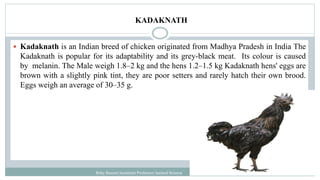
  • 119.
    5. Abnormal eggs: ✓Doubleyolked egg: when two ova ripening at a same time ✓Off flavor / rotten egg: excessive consumption of grasses or fish meal, poor quality fish meal ✓Soft shelled egg: Deficiency of Ca, P, Mg or Vit D ✓Meat spot/blood spot: rupture of a blood vessel on the yolk surface ✓Pale yolk: due to anemia or lack of carotene Boby Basnet/Assistant Professor/Animal Science
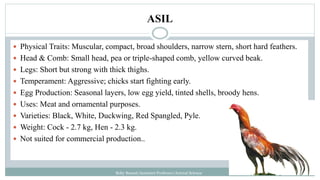
  • 120.
    Types of hatching •Natural Hatching • Artificial Hatching
  • 121.
    Natural hatching ➢Natural hatchingis a primitive method to get high percentage of success. ➢Requirements: a. Selection of hatching hen: Close sitter and owing to her light weight. b. Best time to set hen: At night. c. The nest: placed on quite corner. d. Caring of sitting hens: properly feed and watered. e. Proper Care of hatching eggs. Boby Basnet/Assistant Professor/Animal Science
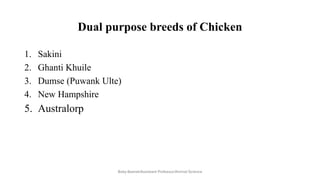
  • 122.
    Artificial hatching ➢ Hatchingby artificially incubator. ➢ Incubator are used for large scale chick production. ➢ Four basic requirements for egg hatching:- 1. Temperature 99 - 102 Degree Fahrenheit 2. Humidity: 50%-65% RH 3. Egg Turning at least 4 times/day, if not tiny embryo can stick to the shell membrane and may die. 4. Air Flow: air and gas exchange, (ventilation) Boby Basnet/Assistant Professor/Animal Science
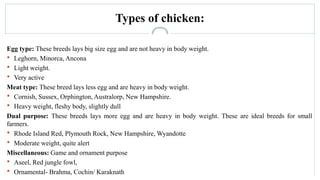
  • 123.
    Incubator Types ✓ Hot watertank incubator ✓ Hot air incubator ✓ Kerosene incubator ✓ Electric incubator • Management of incubator during incubation ✓ Fumigation: to kill the disease producing organism ✓ Leveling of the incubator ✓ Regulating temperature, ventilation, moisture ✓ Turning of egg ✓ Testing of egg: should be tested 7th and 14th days ✓ Special care during hatching and new hatch Boby Basnet/Assistant Professor/Animal Science
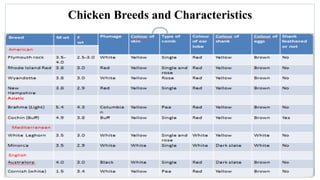
  • 124.
    Care of newhatch • The chick is very weak when it first hatches and will probably lie close to the egg for about eight hours before it starts to move around. • The chicks which have just hatched should be kept in incubator without providing food for at least 18-24 hrs. • The temperature of the incubator should be gradually reduced to 95 deg F. • Proper care is required during transferring the chicks from the incubator to brooder. • Culling of week, disease affected and lamb birds to be done at this time. Boby Basnet/Assistant Professor/Animal Science
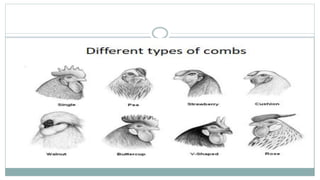
  • 125.
    Brooding ➢Brooding refers tothe period immediately after hatch when special care and attention must be given to chicks to ensure their health and survival i.e. 1 day to 8 weeks age. ➢Rearing refers to the remainder of life after brooding until sexual maturity. ➢Natural brooding is done by the mother hen after hatching, up to 3-4 weeks of age. ➢In artificial brooding chicks are reared by providing external source of heat. ➢Equipment used for brooding are called brooders. ➢Brooding of chicks refers to the growing of chicks from hatching to 4-6 weeks of age with the use of artificial heat. ➢Duration of use of artificial heat depends on the season (environmental temperature). ➢During summer, brooding may be required for a short duration of 5-7 days. During winter season it may be required for 2-3 weeks or longer. Boby Basnet/Assistant Professor/Animal Science
  • 126.
    The success ofbrooding depends mainly on the following things. 1. Disease free chicks and healthy stock: ➢To start with, healthy high quality chicks are of prime importance. ➢Parent stock should be free from diseases. ➢The chicks must be vaccinated with merek’s and F1 vaccine. Boby Basnet/Assistant Professor/Animal Science
  • 127.
    2. Temperature ➢ Thetemperature under the brooder is to reduce at the rate of 50°F every week of age after the first week (from 950F) until approximately 70°F is achieved. • Brooding temperature necessary for various ages of chicks. Boby Basnet/Assistant Professor/Animal Science
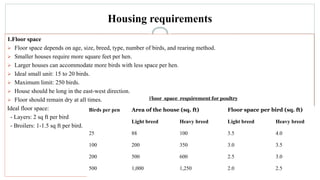
  • 128.
    3. Fresh airand ventilation control: Fresh and pure air is essential for proper growth of young chicks. The chicks feel discomfort in humid, hot house. So they need dry, fresh air and pure water in the brooder. 4. Keeping the chicks busy: Chick guard of 18’’ (45 cm) high all around the brooder about 2 ft away from the edge of brooder must be placed. Feeder and waterer should be big enough. Otherwise, they will overcrowd to take food and drink water, leading to cannibalism. 5. Safety from fire: Electric, gas, kerosene, hot water etc. are used to keep the brooder and brooder house warm. Care should be taken to avoid the fire hazard. 6. Dryness: The brooder house should be clean and dry. The chick may be affected in paralysis if they are kept in damp brooder house. 7. Sanitary condition: The poultry farm and its surroundings must keep clean. Disinfectant solution should be kept just inside all entry doors and used to clean the attendants boots each time be enters the building. Visitors should not allow on the farm. The entire building including litter and all equipment should be fumigated, if the previous flock had a serious disease problem. 8. Proper feeding and management: The growth of young chicks depends mainly on the properly balanced diet. Boby Basnet/Assistant Professor/Animal Science
  • 129.
    9. Litter: Litteris spread on the floor to prevent the direct contact with the floor. Straw, wood dust, paddy husk etc. are generally used for making the litter. The litter should be dry and free from moulds. Depth of litter should be approximately 5cm (2 inches). Lime is used @ 500 gm/100 sq. ft to keep the litter dry and free from disease organism. The dusty or excessive wet litter should be removed. 10. Protection enemies: Cat, rat, owls and other predatory animals etc. are the common enemies of the poultry birds. Plies and rodents are also major source of infection. They must be controlled. 11. Skill full management: The success of farming depends on skillful management. a. Vaccination ➢At day old stage marek’s vaccine should be given. ➢On 5th day F1 vaccine should be given. ➢At 3rd week Gumboro (IBD) vaccine should be given. ➢At the 6th week, fowl pox vaccine is to be given ➢At 7th week IBD vaccine once again is to be given. ➢At the end of 9th week, vaccination against Ranikhet (R2B stain) ➢At the end of 17th weeks once again against Ranikhet (R2B stain) is to be given. b. Debeaking: It is done to prevent feed wastage and reduce picking. About one half of the both the lower and upper beak is removed keeping the lower beak slightly longer than the upper. Debeaking at the 6th to 10th day of age is ideal with less stress on birds and better labor efficiency.
  • 130.
    System/Method of brooding •There are two general system: 1. Natural brooding or hen rearing 2. Artificial brooding. Boby Basnet/Assistant Professor/Animal Science
  • 131.
    Natural brooding orhen rearing • The broody hen will provide all the warmth required by chicken. • The broody hen supplies her young with necessary heat by means of her own body and feathers. • Brooding coop/ rearing coop of sized 2×2×2 feet keeping slight slope from front to back can be used • Depending upon her size, hen will brood 15-20 chicks. Boby Basnet/Assistant Professor/Animal Science
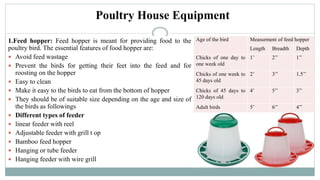
  • 132.
    Artificial brooding ➢It isthe handling of newly born chicks without the aid of hen. ➢Successful brooding depends on inadequate and steady source of heat. ➢The heating unit is known as brooder or foster mothers. Kinds of brooder used ✓ Hoover: using electric chim, heater etc ✓ Gas brooder:- gas heater ✓ Oil brooder:- lamp (laltin), oil heater ✓ Others:- wood dust, rice husk, etc Boby Basnet/Assistant Professor/Animal Science
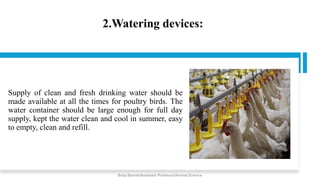
  • 133.
    Management of chicksin the brooder 1. Ventilation: Ensure proper ventilation for fresh air and removal of gases/moisture while avoiding drafts. 2. Sanitation and Hygiene: Clean and disinfect the brooder house, equipment, and surroundings before placing chicks. 3. Litter Management: Use a 5 cm layer of sawdust or paddy husk; stir weekly to maintain dryness and replace wet litter. Cover with newspaper for the first 3 days. 4. Temperature: Maintain 95°F in the first week, reducing by 5°F weekly until 70°F by the 6th week. 5. Brooder Space: Provide 45-65 cm² per chick; a 1.8 m hover can hold 500 chicks. 6. Brooder Guard: Place 0.9-1.2 m from the heat source; increase daily up to 1.5 m and remove after 7- 14 days. 7. Floor Space: Start with 100-120 cm² per chick; increase to 400-450 cm² by 4 weeks and 1,000 cm² by 6 weeks. Adjust space by 20% in summer and -15% in winter. 8. Water Management: Provide clean water 2-3 times daily; adjust temperature according to season; add electrolytes, glucose, vitamins, and antibiotics as needed. 9. Feeder Space: Provide 3 cm/chick (first 2 weeks), 4.5 cm (3rd–4th week), and 7.5 cm up to 8 weeks. 10. Feeding Management: Start feeding 3–4 hours after arrival; use newspaper for feed for the first 3-4 days; gradually switch feed types over 4 days. 11. Lighting: Provide 24-hour light for the first 5-7 days, then 23 hours light/1 hour darkness daily until marketing; ensure 6W/m² with filament bulbs or 1W/m² with fluorescent tubes.
  • 134.
    Advantages of artificialbrooding • Large number of chicks may be brooded at a time. • Chicks may be reared at any time of the year. • No need of broody hen. • Sanitary condition may be controlled. • Temperature may be regulated as required. • Feeding may be undertaken according to plan. • The is no possibility of the spreading insects from the mother hen to chicken.
  • 135.
    Grading of eggs 1.External egg quality External egg quality is determined by its shell, texture, color, shape, size, and soundness. 2. Internal Quality Internal examination of an egg is done by candling which evaluate the egg white, yolk, and air cells. Candling: Candling is the process of holding a strong light above or below the egg to observe the embryo.
  • 137.
    MANAGEMENT PRACTICES FORLAYERS AND BOILERS PRODUCTION Boby Basnet/Assistant Professor Boby Basnet/Assistant Professor/Animal Science
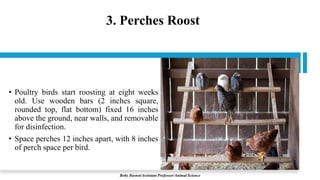
  • 138.
    Layer management • Pulletsshould be housed in layer house between 16 to 18 weeks of age. • The pullets should be housed in different pens according to their size and growth. • The poultry house should be well ventilated, reasonable warm in winter, cool in summer. • South or southeast facing house is good as it get maximum sunlight. • The poultry house should be cheap, durable, comfortable and safe. • In layer house, two third of the area of the side walls are kept open and fitted with wire mesh for proper ventilation. • Housing temperature for laying bird is 550F to 750F. 1. Floor space • Floor space @ 2-3 sq. ft. per bird. Boby Basnet/Assistant Professor/Animal Science
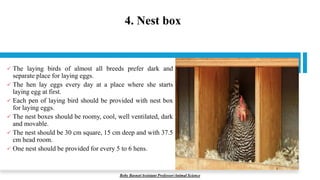
  • 139.
    2. Feeders  Feederspace @ 2.6 inches per bird or 4 large tube feeders per 100 birds should be provided.  Distribution of feed is done uniformly throughout the area as quickly as possible, so that all birds get their equal share.  One tube feeder for shell grit/oyster shell should be provided for every 250 pullets.  This should be provided @ 1.5 kg per 100 birds per week beginning 22nd week (148 days).  The requirement of feed during lay depends on the rate of egg production and the body weight of layer birds.  The birds may need more feed in winter and less feed in summer.  The actual feed consumption may be influenced by several factors as follows: 1. Body weight of hen. 2. Rate of egg production. 3. Season and weather condition. 4. Health and physical condition of the hen. 5. Feed quality such as protein content, caloric value of feed etc. Boby Basnet/Assistant Professor/Animal Science
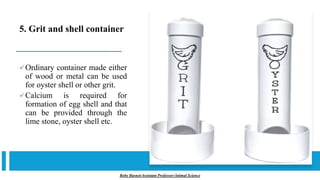
  • 140.
    3. Lighting  Lightaffects growth and reproduction of poultry birds by different physiological sections.  Correct lighting boosts up egg production by 5 to 10 per cent  The duration of the light period should not be decreased during laying period.  Lighting encourages the chicks to feed more which will lead to better growth  Irregular lighting results in drop in egg production.  Lighting should be increased gradually from 21 weeks till it reaches 16-17 hours per day and maintained at that level thereafter.  Light should be 3-4 feet above the floor and good reflectors should be used to direct all light to the birds areas.  The light bulbs should be cleaned and checked regularly.  The defective bulbs should be replaced immediately. Boby Basnet/Assistant Professor/Animal Science
  • 141.
    4.Waterer Minimum of oneinch of drinking space with trough type of waterer should be provided per bird. The waterer should contain fresh, clean and cold water. It is necessary to provide extra water during summer and extremely hot weather. The top edge of the waterer should be level which helps to keep water spoilage to minimum and keep the water clean. 5.Litter The litter should be dry and free of moulds. The extensively wet and dusty litter should not be used for laying birds. The new litter for the layer flock should be provided unless the birds have been grown in the same house. 6.Sanitation Sanitation is the maintenance of surrounding conductive to good health. The poultry house and its equipment should be cleaned and disinfected with disinfectant solution before placing the pullets. Poultry disease are highly contagious. So the cleanliness and precautions against disease hazard inside and outside of laying houses are essential. Boby Basnet/Assistant Professor/Animal Science
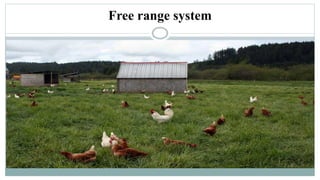
  • 142.
    7. Culling Culling isthe procedure of selection and rejection of unproductive and poor producers. Culling is very important job running poultry farm profitably. Poor layer should be culled to minimize the cost of production. The chances that should taken into consideration for distinguishing good and poor layers are as follows: 1. Appearance: we can get an idea about the health and vigor of the birds by its appearance. The healthy birds is more active, more alert, vigorous, well fleshed but not fatty, tight feathering. Deviation of any of this characteristics is the indication of poor layers. 2. Moulting: Moulting provides an indication about the laying capacity of a bird. It is natural and physiological process to renew old feather at the end of first year of laying. Early moulters are usually poor layer, where as late moulters are usually good layers. 3. Pigmentation: Yellow pigmentation of the skin surface especially vent, eye ring and ear lobes, shanks etc. is due to carotenoid pigment known as xanthophyll coming from the ration of poultry bird containing yellow maize. It provides an indication about the good laying ability of poultry birds. 4. Sexual maturity: Sexual maturity is meant the duration between the date a pullet is hatched and the date she lays her first egg. The birds that mature early make good layers. Boby Basnet/Assistant Professor/Animal Science
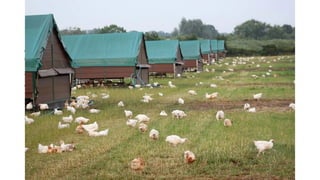
  • 143.
    Broiler management 1. Broilerhousing • In modern commercial broiler production, the bird spends its entire life in one house; i.e. it is not brooded in a special brooder house, then moved to another house for growing for broiler raising is basically a brooding operation. • The broiler house should be located in such a way, (i) to take advantage of prevailing wind for ventilation and sun for light, (ii) ground elevation should be higher than surrounding ground level to permit good water drainage away from building, (iii) should be readily accessible to power, water supply and sewage. • There are of course many different styles and designs of houses, and even more variations in equipment. The important thing is that broiler house and equipment provide comfortable conditions, including adequate feed and waters, so that the birds can perform at the highest level of which they are genetically capable. A satisfactory broiler house must protect against heat and cold, high winds, and inclement weather. Boby Basnet/Assistant Professor/Animal Science
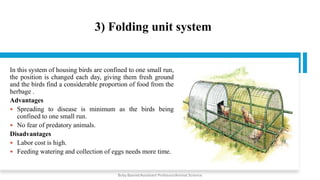
  • 144.
    Broiler house temperature Temperature is important. On the first week, 950F weekly until 700F is reached on the sixth week. When chicks circle wide, it is too hot. If they tend to crows, under the hover it is too cool. In either case, adjustment is needed immediately. Ventilation of broiler house  The main function of ventilation are to maintain oxygen, keep co2 at low level, remove dust or moisture and ammonia from the house and maintain required temperature. Air movement requirements are best determined by observing bird comfort, litter condition, and odour build up. If necessary exhaust fan may be used. 2.Lighting for broilers  May operation prefer to use all-night lights, about 15 watts to each 200 square feet of floor area during early growing period. Growing chicks in semi-darkness by using red bulb keeps the chicks quit, prevents cannibalism, and may have a slight effect on feed efficiency. Most broiler growers provide light in the brooder house 24 hours a day throughout the entire growing period. One 60 watt bulb for each 200 square feet of floor space. Boby Basnet/Assistant Professor/Animal Science
  • 145.
    3.Floor space requirement Broiler will require from 0.8 to 1.0 square feed of floor per bird. 4.Debeaking  In addition to preventing cannibalism, debeaking usually lessens mash feed wastage. Electric de-beakers are now available, and chickens are debeaked when only one day old. 5.Broiler feeds  Since feed constitutes about 70 % of the cost of producing broilers, it is important to give special attention to it. Broilers are usually fed with two types of ration, broiler starter and broiler finisher. The former ration is fed upto 5 weeks of age and the latter is continued till the age of marketing. Starter ration is having more protein (23 -24 %) than the finisher ration, 20 % protein, and both starter and fisher containing same level of metabolizable energy i.e. 3200 ME kcal/kg of feed. Boby Basnet/Assistant Professor/Animal Science
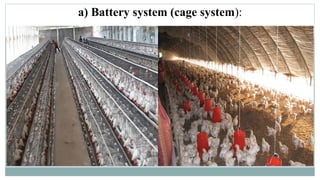
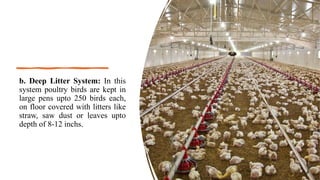
  • 146.
    6.Broiler health program A health program is fundamental to successful broiler production.  A suggested disease prevention and control program follows:  Start with disease free chicks  Vaccine chicks against Ranikhet and marek's disease at the hatchery.  Use effective drugs in the feed, or a vaccination program to prevent coccidiosis.  Keep feed free from aflatoxin.  Do not allow visitors or attendants inside the broiler house unless they wear disinfected boots and clean clothing.  When there are several age groups on the farm, always care for the youngest birds first while performing daily routine works.  All caked and wet litter should be removed and replaced with fresh, clean litter before chicks arrive.  Cover floor with clean litter at least 3 inch deep after each clean out. Wood shavings, rice hulls, straws cut into small pieces are suitable litter materials. 7.Marketing broilers  Most broilers are marketed when they are between 7 to 8 week of age. For the most part, marketing involves moving the birds from the house in which they are produced to the consumers house. Boby Basnet/Assistant Professor/Animal Science
  • 147.
    DISEASES AND BIO-SECURITYOF COMMERCIAL POULTRY FARM Boby Basnet/Assistant Professor Boby Basnet/Assistant Professor/Animal Science
  • 148.
    Biosecurity • Biosecurity refersto the measures and procedures used to prevent the introduction and spread of disease-causing organisms in poultry flocks and on farms. It reduces the risk of pathogens forming and helps prevent the spread of diseases from one flock to another. Effective biosecurity also minimizes the transmission of diseases to neighboring farms, protecting the broader agricultural community. • Disease: A disease is any abnormal condition that impairs bodily functions in an organism. Diseases are often characterized by specific symptoms and signs, making them identifiable. They can be caused by: a. External factors: Such as infectious diseases caused by bacteria, viruses, fungi, or parasites. b. Internal dysfunctions: Like autoimmune diseases, where the body’s immune system mistakenly attacks its own tissues. Boby Basnet/Assistant Professor/Animal Science
  • 149.
    Diseases Introduced, Spreador Transmitted to Poultry 1. From Birds and Flocks: ✓ Carriers within a flock. ✓ Birds recently acquired from an outside flock . ✓ Eggs from infected breeder flocks 2. Through Human and Equipment Contact: ✓ Human feet, hands, and clothes. ✓ Dust, feathers, and manure on equipment and supplies (trucks, coops, egg flats). 3. From Other Living Organisms: ✓ Predators, rodents, flies, and insects 4. Contaminated Resources: ✓ Live or contaminated vaccines. ✓ Feed contaminated at the manufacturing plant. ✓ Water 5. Environmental Factors: ✓ Air
  • 150.
    Poultry’s Invisible Killers BobyBasnet/Assistant Professor/Animal Science
  • 151.
    Biosecurity in poultryfarms: Personnel and activities 1. Personnel Measures: a. Outside Personnel: Visitors should bathe and wear clean, farm-specific clothing to prevent the entry of microorganisms. Those recently in contact with other poultry farms or showing signs of respiratory or gastrointestinal diseases should avoid entering the farm. b. Movement Restrictions: Farm staff should live on-site or nearby and must not work or enter neighboring farms to prevent the spread of microorganisms. c. Staff Health: Workers with dermatological or communicable diseases should not remain on the farm and must report their condition and seek medical attention. 2. Hygiene and Disinfection: a. Disinfection: All personnel must clean and disinfect their tools every time they enter different areas, like poultry sheds. b. Personal Hygiene: Staff must maintain good hygiene at all times and avoid behaviors like eating, drinking, smoking, spitting, sneezing, or lying on contaminated surfaces in the sheds.
  • 152.
    3. Training andRecords: a. Training: Regular biosecurity training sessions for all farm staff ensure proper knowledge and implementation of good practices. b. Record Keeping: Staff must maintain detailed records of processes such as equipment maintenance, truck and personnel entry and exit, use of disinfectants, mortality rates, and health status of birds. 4. Farm Cleaning and Disinfection: a. Routine Cleaning: Staff are responsible for regular cleaning processes like sweeping, washing with water and detergents, and maintaining overall farm cleanliness. b. End-of-Cycle Disinfection: Once a production cycle ends, facilities must be emptied, washed, and disinfected. Staff should be well-trained in proper disinfectant use to ensure the elimination of microorganisms. 5. Emergency Preparedness: a. Emergency Equipment: The farm must have first aid kits and safety equipment readily available. Staff should be trained to handle emergencies like accidents, illnesses, fires, or power outages. Boby Basnet/Assistant Professor/Animal Science
  • 153.
    Importance of Biosecurityin Poultry Farms 1. Prevents the introduction and spread of diseases. 2. Safeguards poultry health and well-being. 3. Boosts productivity and growth rates. 4. Reduces economic losses from disease outbreaks. 5. Ensures high-quality meat and egg production. 6. Minimizes the need for antibiotics and medications. 7. Enhances food safety for consumers. 8. Protects neighboring farms from cross-infection. 9. Maintains the farm’s reputation and credibility. 10. Supports long-term sustainability of poultry farming. Boby Basnet/Assistant Professor/Animal Science
  • 154.
    Short Note: A. All-inand all-out system: it consists of the entry and exit of all the birds of the production at the same time, that is, the same group enters and leaves. There should be no crossings of groups of birds of different origins or ages because this facilitates the entry of microorganisms. Besides, it allows that, between productive periods, the entire farm can be emptied, cleaned, and disinfected. Boby Basnet/Assistant Professor/Animal Science
  • 155.
    Common diseases ofpoultry Boby Basnet/Assistant Professor/Animal Science
  • 156.
    Fowl Cholera ➢Fowl Cholerais a contagious bacterial disease in poultry caused by Pasteurella multocida. ➢It spreads through direct contact between infected and healthy birds, as well as through contaminated feed, water, and equipment. ➢Symptoms include sudden death, swelling of the head and neck, discharge from the beak and nostrils, diarrhea, and reduced egg production. ➢Diagnosis is made through laboratory tests, and treatment involves antibiotics, though early intervention is critical. ➢Preventive measures, including strict biosecurity, disinfection, quarantine of new birds, and vaccination, are essential for controlling the disease. ➢Regular vaccination is an effective strategy for preventing outbreaks.
  • 157.
    Coccidiosis • Coccidiosis inpoultry is a parasitic disease caused by Eimeria protozoa, affecting the intestinal tract and leading to symptoms such as diarrhea (often bloody), lethargy, weakness, weight loss, poor growth, and ruffled feathers. The disease is transmitted through ingestion of contaminated feed, water, or litter containing Eimeria oocysts. • Prevention relies on good management practices, including regular cleaning and disinfecting of poultry houses, vaccination, and proper hygiene to minimize overcrowding and contamination. If left unchecked, coccidiosis can significantly reduce poultry productivity by affecting growth rates, feed conversion, and overall health. ➢ .
  • 158.
    Avian Influenza • Avianinfluenza is a disease caused by type A Orthomyxoviruses. • It is commonly spread by wild aquatic birds, which act as natural reservoirs and can transmit the virus to domesticated poultry. • The disease presents various symptoms, including diarrhea, nasal discharge, coughing, sneezing, ruffled feathers, edema in the comb and wattles, and purple discoloration.
  • 159.
    Chronic Respiratory Disease(CRD) • It is a common and costly bacterial infection in chickens and turkeys, caused by Mycoplasma gallisepticum (MG) and often worsened by secondary infections. • It spreads through air, contaminated food, cages, and infected birds. Symptoms include sneezing, coughing, wheezing, nasal discharge, and decreased appetite. CRD reduces egg production, increases mortality, and leads to high treatment costs. • It’s treated with antibiotics like tetracyclines and managed through vaccination and proper care. • Prevention involves buying CRD-free birds, maintaining good ventilation, disinfecting housing, and providing clean water, quality feed, and supplements..
  • 160.
    Fowl Pox ➢Also knownas Avian Pox Fowl Pox is highly contagious. Chickens who contract Avian Pox can experience two different types of the condition: a. Dry pox b. Wet pox • Symptoms are characterized by distinctive bumps that look like warts and are visible on the wattle and comb. In addition, young birds experienced stunted growth and egg production decreases.
  • 161.
    Newcastle/Ranikhet Disease ➢Newcastle Diseaseis an acute and highly contagious respiratory disease that spreads rapidly among birds caused by avian paramyxovirus-1 (APMV-1) virus. ➢It affects both wild and domestic fowl, though domestic poultry is much more susceptible. ➢Symptoms include greenish, watery diarrhea, coughing, and complete paralysis.
  • 162.
    “Intelligence plus character-thatis the goal of true education.” -Martin Luther King Jr. Best of Luck For Your Exam Thank You! Boby Basnet/Assistant Professor/Animal Science