Aquaculture
Boby Basnet
Assistant Professor/Animal Science
Ilam Community Agriculture Campus
Purbanchal University
Boby Basnet || Asst. Prof. 1
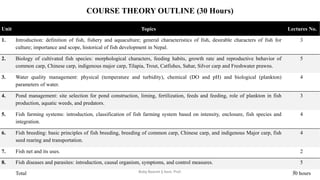
COURSE THEORY OUTLINE (30 Hours)
Unit Topics Lectures No.
1. Introduction: definition of fish, fishery and aquaculture; general characteristics of fish, desirable characters of fish for
culture; importance and scope, historical of fish development in Nepal.
3
2. Biology of cultivated fish species: morphological characters, feeding habits, growth rate and reproductive behavior of
common carp, Chinese carp, indigenous major carp, Tilapia, Trout, Catfishes, Sahar, Silver carp and Freshwater prawns.
5
3. Water quality management: physical (temperature and turbidity), chemical (DO and pH) and biological (plankton)
parameters of water.
4
4. Pond management: site selection for pond construction, liming, fertilization, feeds and feeding, role of plankton in fish
production, aquatic weeds, and predators.
3
5. Fish farming systems: introduction, classification of fish farming system based on intensity, enclosure, fish species and
integration.
4
6. Fish breeding: basic principles of fish breeding, breeding of common carp, Chinese carp, and indigenous Major carp, fish
seed rearing and transportation.
4
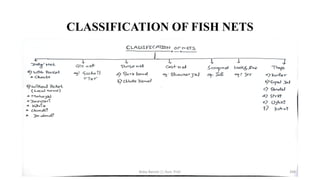
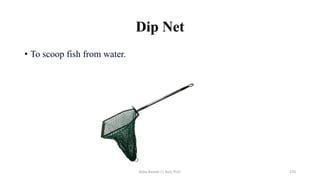
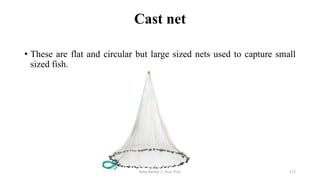
7. Fish net and its uses. 2
8. Fish diseases and parasites: introduction, causal organism, symptoms, and control measures. 5
Total 30 hours
Boby Basnet || Asst. Prof. 2
BOBY BASNET
ASSISTANT PROF. (ANIMAL SCIENCE)
ILAM COMMUNITYAGRICULTURE CAMPUS
PURBANCHAL UNIVERSITY
boby.iaas333@gmail.com
INTRODUCTION: DEFINITION OF FISH, FISHERY AND AQUACULTURE;
GENERAL CHARACTERISTICS OF FISH, DESIRABLE CHARACTERS OF FISH
FOR CULTURE; IMPORTANCE AND SCOPE, HISTORICAL OF FISH
DEVELOPMENT IN NEPAL.
3
Fish
➢Fishes are cold blooded aquatic vertebrates which breathe by means of pharyngeal gills and propelling and
balancing themselves by means of fins. Fish usually have streamlined body but some are elongated, snake
like and dorsoventrally suppressed.
➢They have a paired and unpaired fins supported by soft and spiny fin rays.
➢The size of fish varies from few cm to 18 meter or more in long.
➢The largest fish of the world is Rhinocodon typus (70 feet) and smallest is Paedocypris progenetica (7.9
mm). Fishes are the first successful class of chordates.
➢There are over 22,000 species of fish, comprising more than 50% of all are vertebrate species.
➢Fish includes animals belong to only super-class ‘Pisces’.
➢ Fish are also called ‘Pisces’ or ‘Ichthys’. Fishes are the first successful class of chordates.
➢Many types of aquatic animals named ‘fish’, such as shellfish, Crayfish, Jellyfish, Starfish, Cuttlefish, etc.
are not a true fish.
Boby Basnet || Asst. Prof. 4
Ichthyology (Definition)
➢Ichthyology is the study of the physiology, history, economic importance, etc. of
fishes.
➢Ichthyology is the scientific study of fishes, including, as usual with a science that is
concerned with a large group of organisms, a number of specialized subdisciplines:
e.g. Taxonomy, Anatomy (or Morphology), Behavioral science (Etiology), Ecology,
Physiology, Pathology and Genetics etc.
➢Ichthyology is derived (from Greek: ikhthus, means "fish"; and logos, means "study")
is the branch of zoology devoted to the study of fish.
➢This includes skeletal fish (Osteichthyes), cartilaginous fish (Chondrichthyes), and
jawless fish (Agnatha).
➢The modern fish relates to Agnatha and Gnathostomata are division of vertebrates.
Boby Basnet || Asst. Prof. 5
Some interesting facts about fish
1. Ichthyology: The scientific study of fish. Father of aquaculture: Fan Lai. Heart is 2 chambered.
2. Respiration by gills. Fastest fish: Sail fish. Most beautiful fish: Zebra fish.
3. Most poisonous fish: Stone fish. Urinary bladder is absent in fish.
4. Protein of fish: <30%, 0.6 to 7.5% fat.
5. The optimum temperature of water for carp fish culture is 20 °C
6. There are 252 species of fish found in Nepal.
7. The most common cultured fish of Nepal categorized as:
a. Major carp : Rohu, Mrigal, Catla-catla
b. Common exotic carps: Common carp, Chinese carp (Silver carp, Bighead carp and Grass carp).
c. Other Exotic Fish : Rainbow trout, Tilapia, Pangas
d. Decorative fish: Gold fish, Koi Fish, Angel Fish
Boby Basnet || Asst. Prof. 6
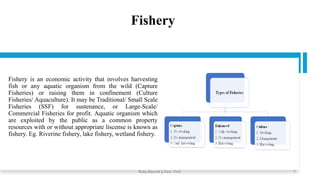
Fishery
Fishery is an economic activity that involves harvesting
fish or any aquatic organism from the wild (Capture
Fisheries) or raising them in confinement (Culture
Fisheries/ Aquaculture). It may be Traditional/ Small Scale
Fisheries (SSF) for sustenance, or Large-Scale/
Commercial Fisheries for profit. Aquatic organism which
are exploited by the public as a common property
resources with or without appropriate liscense is known as
fishery. Eg. Riverine fishery, lake fishery, wetland fishery.
Boby Basnet || Asst. Prof. 7
a. Capture fisheries:
✓ No stocking, Only harvesting.
✓ No management practices (e.g. feeding, fertilization, liming, monitoring etc.).
✓ Provides table fish for consumption, seed and feed for aquaculture, and seed for enhanced fisheries.
b. Enhanced fisheries:
✓ Only stocking.
✓ No management practices (e.g. feeding, fertilization, liming, monitoring etc.).
✓ Harvesting. Provides table fish for consumption and feed for aquaculture.
c. Culture fisheries (Aquaculture):
✓ The term aquaculture is derived from two Greek words: aqua means water and culture means farming.
✓ Aquaculture may be defined simply as farming in water.
✓ It is the aquatic equivalent of farming on land or agriculture, agri (field) and culture (farming).
✓ Aquaculture means the organized culture or cultivation of useful aquatic animals and plants in enclosed water bodies.
✓ Aquaculture includes farming of both plants and animals in both inland (freshwater) and coastal (seawater) waters.
Boby Basnet || Asst. Prof. 8
Aquaculture
➢Aquaculture is the farming of aquatic organisms, including fish, molluscs,
crustaceans and aquatic plants.
➢Aquaculture, also known as fish farming, is the practice of breeding, raising,
and harvesting aquatic organisms such as fish, shellfish, and aquatic plants in
controlled environments.
➢Farming implies some form of intervention in the rearing process to enhance
production, such as regular stocking, feeding, protection from predators, etc.
➢Farming also implies individual or corporate ownership of the stock being cultivated.
Boby Basnet || Asst. Prof. 9
General characteristics of fish
1. Fishes are aquatic, cold-blooded vertebrates.
2. Body of fish is generally fusiform and streamlined but also in globiform, puffers the
body is globe shape and in eels is of serpentine form. In spite of many variations in
shape the ground plan of body is bilateral symmetrical with prominent lateral line
system.
3. The body of the fish generally covered by tough skin armored by variety of scales with
anterior cephalization (concentration of sensory and brain structure in the anterior
region).
4. The appendages of the fish comprise of the fins, which are generally paired (pectoral
and pelvic fins) unpaired dorsal, anal and caudal fins. All supported by dermal fin rays.
These fins constitute the main locomotary organs.
Boby Basnet || Asst. Prof. 10
1. Mouth generally situated anteriorly in the head and the anus is in the second
half of the over all length of the individual behind the bases of the pelvic fins &
just in front of the anal fin.
2. Respiratory organs generally in the form of gills and other accessory respiratory
organs.
3. Nostrils are paired and do not open into the pharynx, except in lung-fishes and
lobed fishes.
4. Skeletal of the fishes are in form of notochord, connective tissues, bones,
cartilage & non-bony scales.
5. The digestive tract of fish is well developed (with mouth, oral cavity, pharynx,
esophagus, stomach, intestine & anus).
6. Heart is generally valved pump with one auricle & one ventricle, which is of
venous type that forces the blood forward towards the gills for aeration.
Boby Basnet || Asst. Prof. 11
7. The kidneys of fish are paired, longitudinal structures that lie above the
body cavity.
8. Brain is well developed with ten pairs of cranial nerves.
9. Middle ear is completely absent but internal ear with well-developed semi-
circular canals.
10. Sexes are separate (male with claspers).
11. Some are viviparous (scoliodon or spadenose shar) and many are
oviparous.
12. Generally fertilization is external (In some carps fertilization is internal).
13. Roe/Eggs are large with much yolk i.e. 0.5 to 5.5 mm.
12. Development is direct (without any metamorphosis).
Boby Basnet || Asst. Prof. 12
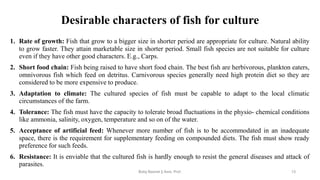
Desirable characters of fish for culture
1. Rate of growth: Fish that grow to a bigger size in shorter period are appropriate for culture. Natural ability
to grow faster. They attain marketable size in shorter period. Small fish species are not suitable for culture
even if they have other good characters. E.g., Carps.
2. Short food chain: Fish being raised to have short food chain. The best fish are herbivorous, plankton eaters,
omnivorous fish which feed on detritus. Carnivorous species generally need high protein diet so they are
considered to be more expensive to produce.
3. Adaptation to climate: The cultured species of fish must be capable to adapt to the local climatic
circumstances of the farm.
4. Tolerance: The fish must have the capacity to tolerate broad fluctuations in the physio- chemical conditions
like ammonia, salinity, oxygen, temperature and so on of the water.
5. Acceptance of artificial feed: Whenever more number of fish is to be accommodated in an inadequate
space, there is the requirement for supplementary feeding on compounded diets. The fish must show ready
preference for such feeds.
6. Resistance: It is enviable that the cultured fish is hardly enough to resist the general diseases and attack of
parasites.
Boby Basnet || Asst. Prof. 13
7. Amiability and compatibility: The fishes proposed to be cultured altogether (‘poly
culture’) must be able to live altogether without interfering or aggressive the other. The fish
should reproduce in captivity. A fish that does not fulfill this condition cannot really be
domesticated.
8. Feed conversion efficiency: The species of fish that give more edible flesh per unit of
food consumed is favored. The species of fish which will give more edible flesh per unit of
food consumed is preferred than which gives less flesh per unit weight.
• Feed efficiency %= weight gain(kg)/Feed Intake*100
9. Consumer’s preference: Food preference of people differs with the geographic areas.
Therefore, the species cultured must be simply marketable locally or to the targeted
consumers. Reared fish should have high meat quality and suit the taste of consumers.
10. High fecundity: Fecundity refers to the number of eggs in the ovary of female prior to
the spawning period. It is essential that reared fish should have high fecundity.
11. Economic and market consideration: Economically viable and easy to market. The
chinese and Indigenous major carps possess most of these characters.
Boby Basnet || Asst. Prof. 14
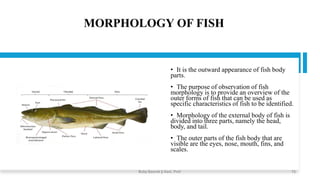
MORPHOLOGY OF FISH
• It is the outward appearance of fish body
parts.
• The purpose of observation of fish
morphology is to provide an overview of the
outer forms of fish that can be used as
specific characteristics of fish to be identified.
• Morphology of the external body of fish is
divided into three parts, namely the head,
body, and tail.
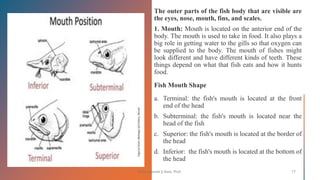
• The outer parts of the fish body that are
visible are the eyes, nose, mouth, fins, and
scales.
Boby Basnet || Asst. Prof. 15
Parts of Fish Body
In general, fish body is divided into three parts, namely:
A. Head: The head, which starts from the tip of the muzzle to the end of the tip of the gill at the back. In
the head there are mouth, upper jaw, lower jaw, teeth, nose, eye, gills, gill cover, brain, heart, and so
on.
B. Trunk: The body part, i.e. from the end of the gill cap to the back of the rectal fin begins. In the body
there are dorsal fins, pectoral fins, abdominal fins, and internal organs such as liver, gall, stomach,
intestine, gonads, bubbles, kidneys, spleen, and so on.
C. Tail: The tail, i.e. from the beginning of the anal fin to the tip of the rear tail fin. In the tail there is
anus, anal fin, tail fin, and sometimes there are also scutes and finlets.
Boby Basnet || Asst. Prof. 16
Boby Basnet || Asst. Prof. 17
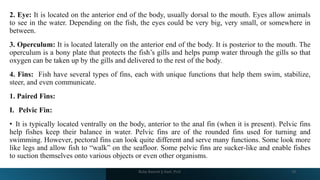
2. Eye: It is located on the anterior end of the body, usually dorsal to the mouth. Eyes allow animals
to see in the water. Depending on the fish, the eyes could be very big, very small, or somewhere in
between.
3. Operculum: It is located laterally on the anterior end of the body. It is posterior to the mouth. The
operculum is a bony plate that protects the fish’s gills and helps pump water through the gills so that
oxygen can be taken up by the gills and delivered to the rest of the body.
4. Fins: Fish have several types of fins, each with unique functions that help them swim, stabilize,
steer, and even communicate.
1. Paired Fins:
I. Pelvic Fin:
• It is typically located ventrally on the body, anterior to the anal fin (when it is present). Pelvic fins
help fishes keep their balance in water. Pelvic fins are of the rounded fins used for turning and
swimming. However, pectoral fins can look quite different and serve many functions. Some look more
like legs and allow fish to “walk” on the seafloor. Some pelvic fins are sucker‐like and enable fishes
to suction themselves onto various objects or even other organisms.
Boby Basnet || Asst. Prof. 18
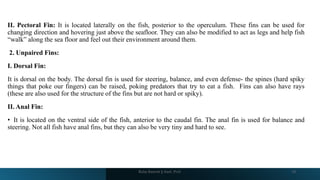
II. Pectoral Fin: It is located laterally on the fish, posterior to the operculum. These fins can be used for
changing direction and hovering just above the seafloor. They can also be modified to act as legs and help fish
“walk” along the sea floor and feel out their environment around them.
2. Unpaired Fins:
I. Dorsal Fin:
It is dorsal on the body. The dorsal fin is used for steering, balance, and even defense‐ the spines (hard spiky
things that poke our fingers) can be raised, poking predators that try to eat a fish. Fins can also have rays
(these are also used for the structure of the fins but are not hard or spiky).
II. Anal Fin:
• It is located on the ventral side of the fish, anterior to the caudal fin. The anal fin is used for balance and
steering. Not all fish have anal fins, but they can also be very tiny and hard to see.
Boby Basnet || Asst. Prof. 19
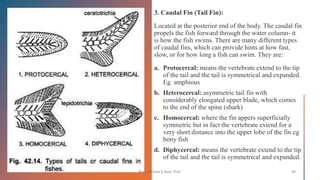
Boby Basnet || Asst. Prof. 20
5. Lateral Line:
➢It is located laterally on each side of the body. The lateral line is a sensory system
that enables fish to feel the vibrations and movement of the water. Fishes can feel
where other animals, including a predator, are coming from even if they cannot see
it.
6. Scales:
➢They are located laterally on the body. They protect fishes from attacks, parasites,
and injuries they could receive from brushing up against hard substrates. Scales are
covered in something called the slime layer. The slime layer is very important to the
health of fishes. Based on the shape and material contained therein, the scales can be
divided into 5 types:
Boby Basnet || Asst. Prof. 21
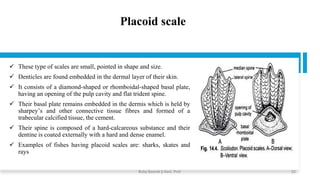
Placoid scale
✓ These type of scales are small, pointed in shape and size.
✓ Denticles are found embedded in the dermal layer of their skin.
✓ It consists of a diamond-shaped or rhomboidal-shaped basal plate,
having an opening of the pulp cavity and flat trident spine.
✓ Their basal plate remains embedded in the dermis which is held by
sharpey’s and other connective tissue fibres and formed of a
trabecular calcified tissue, the cement.
✓ Their spine is composed of a hard-calcareous substance and their
dentine is coated externally with a hard and dense enamel.
✓ Examples of fishes having placoid scales are: sharks, skates and
rays
Boby Basnet || Asst. Prof. 22
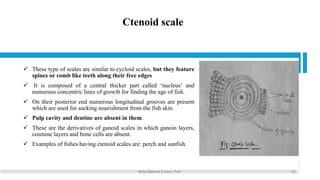
Ctenoid scale
✓ These type of scales are similar to cycloid scales, but they feature
spines or comb like teeth along their free edges
✓ It is composed of a central thicker part called ‘nucleus’ and
numerous concentric lines of growth for finding the age of fish.
✓ On their posterior end numerous longitudinal grooves are present
which are used for sucking nourishment from the fish skin.
✓ Pulp cavity and dentine are absent in them.
✓ These are the derivatives of ganoid scales in which ganoin layers,
cosmine layers and bone cells are absent.
✓ Examples of fishes having ctenoid scales are: perch and sunfish.
Boby Basnet || Asst. Prof. 23
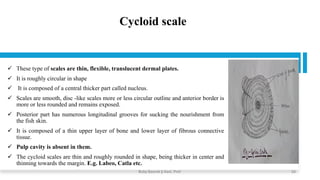
Cycloid scale
✓ These type of scales are thin, flexible, translucent dermal plates.
✓ It is roughly circular in shape
✓ It is composed of a central thicker part called nucleus.
✓ Scales are smooth, disc -like scales more or less circular outline and anterior border is
more or less rounded and remains exposed.
✓ Posterior part has numerous longitudinal grooves for sucking the nourishment from
the fish skin.
✓ It is composed of a thin upper layer of bone and lower layer of fibrous connective
tissue.
✓ Pulp cavity is absent in them.
✓ The cycloid scales are thin and roughly rounded in shape, being thicker in center and
thinning towards the margin. E.g. Labeo, Catla etc.
Boby Basnet || Asst. Prof. 24
Ganoid scale:
✓ They are diamond-shaped and interconnected.
✓ They act like armour to form a nearly impenetrable barrier to predators.
✓ Examples of fishes having ganoid scale are: gars, bichirs and reed fish.
Cosmoid scale:
✓ Example of fishes having cosmoid scale are: lobefins and lungfish
✓ Difference between cycloid and ctenoid scales: Assignment
Boby Basnet || Asst. Prof. 25
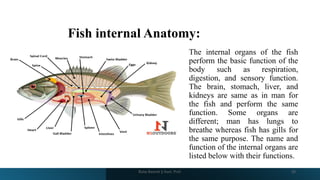
Fish internal Anatomy:
The internal organs of the fish
perform the basic function of the
body such as respiration,
digestion, and sensory function.
The brain, stomach, liver, and
kidneys are same as in man for
the fish and perform the same
function. Some organs are
different; man has lungs to
breathe whereas fish has gills for
the same purpose. The name and
function of the internal organs are
listed below with their functions.
Boby Basnet || Asst. Prof. 26
1. Spine
The fish body is built on this main structural framework. This unit is connected to the skull at the front and
to the tail at the back. Numerous vertebrae that are hollow make up the spine. These vertebrae house and
protect the subtle spinal cord.
2. Swim Bladder or Air Bladder
Swim bladder is hollow and gas filled organ. It allows the fish to conserve energy by enabling neutral
resilience in water. Fishes that is deep in the water needs to release air from their swim ladder when they
come up this is due to the difference in atmospheric pressure that circulate in the water surface. Fishes that
do not possess an air bladder sink to the bottom of the water if they stop swimming.
3. Gills
Gills help the fish to breathe under the water. Gills are the weak organ and it should not be touched by the
hand when the fish is alive.
Boby Basnet || Asst. Prof. 27
4. Pyloric Caeca
This organ is present at the junction of the stomach and intestine. It has a finger like projection and its
function is to secrete enzymes that help in digestion. It also helps to absorb the digested food.
5. Vent
This organ is used to eliminate the waste from the fish body.
6. Gonads
Gonads are the reproductive organs for the fish. In female fishes the bright organ that contains collection of
eggs is clearly identifiable during the spawning period. The male reproductive organ is much smaller and
less white in color. It produces milt for fertilizing the eggs.
7. Muscles
This organ is also used for locomotion. This part is usually eaten by man as it contains certain vitamin
deposits. Muscles compose the bone of the fish.
•
Boby Basnet || Asst. Prof. 28
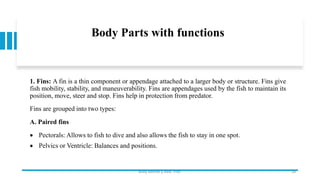
Body Parts with functions
1. Fins: A fin is a thin component or appendage attached to a larger body or structure. Fins give
fish mobility, stability, and maneuverability. Fins are appendages used by the fish to maintain its
position, move, steer and stop. Fins help in protection from predator.
Fins are grouped into two types:
A. Paired fins
• Pectorals: Allows to fish to dive and also allows the fish to stay in one spot.
• Pelvics or Ventricle: Balances and positions.
Boby Basnet || Asst. Prof. 29
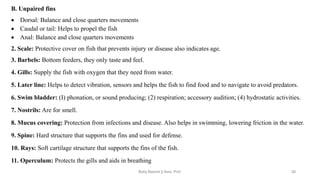
B. Unpaired fins
• Dorsal: Balance and close quarters movements
• Caudal or tail: Helps to propel the fish
• Anal: Balance and close quarters movements
2. Scale: Protective cover on fish that prevents injury or disease also indicates age.
3. Barbels: Bottom feeders, they only taste and feel.
4. Gills: Supply the fish with oxygen that they need from water.
5. Later line: Helps to detect vibration, sensors and helps the fish to find food and to navigate to avoid predators.
6. Swim bladder: (I) phonation, or sound producing; (2) respiration; accessory audition; (4) hydrostatic activities.
7. Nostrils: Are for smell.
8. Mucus covering: Protection from infections and disease. Also helps in swimming, lowering friction in the water.
9. Spine: Hard structure that supports the fins and used for defense.
10. Rays: Soft cartilage structure that supports the fins of the fish.
11. Operculum: Protects the gills and aids in breathing
Boby Basnet || Asst. Prof. 30
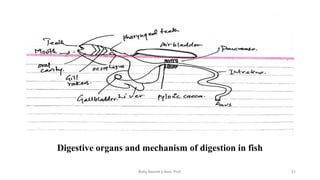
Digestive organs and mechanism of digestion in fish
Boby Basnet || Asst. Prof. 31
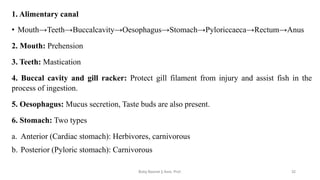
1. Alimentary canal
• Mouth→Teeth→Buccalcavity→Oesophagus→Stomach→Pyloriccaeca→Rectum→Anus
2. Mouth: Prehension
3. Teeth: Mastication
4. Buccal cavity and gill racker: Protect gill filament from injury and assist fish in the
process of ingestion.
5. Oesophagus: Mucus secretion, Taste buds are also present.
6. Stomach: Two types
a. Anterior (Cardiac stomach): Herbivores, carnivorous
b. Posterior (Pyloric stomach): Carnivorous
Boby Basnet || Asst. Prof. 32
• True stomach is absent in herbivores but present in carnivores, sac-like
• Omnivorous: sac-like, somewhat gizzard like to grind feed.
8. Pyloric caeca: Anterior part of intestine, Fingerlike growth, Accessory food reservoirs,
Enhance the absorptive area.
9. Intestine: Two parts
a. Anterior part- small intestine
b. Posterior part- large intestine
➢ The small intestine just behind the stomach receives ducts from the liver and pancreas is
called as duodenum while rest part is called ileum.
➢ There is no clear out demarcation between small and large intestine and large intestine.
➢ The length of the intestine depends upon the feeding habit of the fish i.e. herbivore have
long. Boby Basnet || Asst. Prof. 33
Mechanism:
➢Digestion is the process of food degradation that allows the animal to absorb the
nutrients present in it. As in the rest of vertebrates digestion is divided into two phases:
mechanical digestion, where the feed is crushed, and chemical digestion, in which the
digestive enzymes degrade food to nutrients that the animal is able to absorb.
1. Mechanical digestion:
➢Unlike other vertebrates, fish lack of salivary glands in the oral cavity, so that their
function is limited to capture and crush the food. In some species, the secretory glands
are replaced by mucus-producing ones, which favors the transit of food. The mouth is
continued with the pharynx, which is perforated laterally by the gill arches. In some
species, like most Cyprinids, dentiform structures appear in the fifth gill arch, which
favor the crushing. The esophagus is responsible for regulating the entry of water and
food, sometimes it has salivary glands. It has striated muscles to regurgitate the
ingested food. The stomach is responsible for initiating chemical digestion and stores
and mixes the food. In some herbivorous species, the stomach has a highly developed
and circular musculature that crushes vegetal material, acting as the gizzard of birds.
Boby Basnet || Asst. Prof. 34
2. Chemical digestion
➢As mentioned above, fish lack of salivary glands in the oral cavity and, therefore,
chemical digestion begins in the stomach, or directly in the intestine if the species
lack of the former. The stomach has cells that secrete hydrochloric acid, which
hydrolyzes the food and promotes enzymatic activity by decreasing pH.
➢Pepsin is the main enzyme secreted in the stomach and is responsible for the
degradation of proteins by hydrolysis of peptide bonds. Those species that feed on
crustaceans have, in addition to pepsin, other enzymes of great importance:
chitinases, enzymes responsible for the degradation of the exoskeleton of
crustaceans. In the gut, most of the digestion and absorption of nutrients is
performed. Although the absorption of nutrients is similar throughout the entire
digestive tract, lipid digestion tends to occur in the anterior region and protein
digestion in the posterior region.
Boby Basnet || Asst. Prof. 35
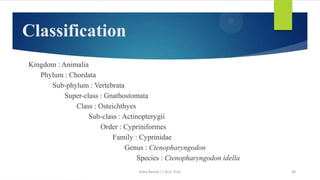
Taxonomical classification of Fish:
1.Kingdom: Animalia
2.Phylum: Chordata
3.Class: Teleosteii
4.Order
5.Family
8. Genus
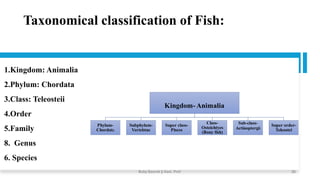
6. Species
Kingdom- Animalia
Phylum-
Chordata
Subphylum-
Vertebtae
Super class-
Pisces
Class-
Osteichtyes
(Bony fish)
Sub-class-
Actinoptergii
Super order-
Teleostei
Boby Basnet || Asst. Prof. 36
S.N. Order Families Species Characteristics
1. Anguliforms Anguellidae Anguilla bengalensis (Raj bam) Serpentine body
2. Beloniforms Belonidae Xenetodon cancila (Kauwa maccha) Beak like structure
3. Clupeiformes a. Clupedia
b. Engraulidae
Gudusia chapra
Setipinna phase
Lateral line absent
4. Cypriniforms a. Cyprinidae a. Labeo rohita (Rohu), Cirrhina mrigala (Naini), Catla catla
(Bhakur)
Head is without scale and gills opening are side.
5. Cypriodontoforms Aplocheilus
Poecillidae
Aplocheilus spp.
Gambusia spp.
Adipose fin is absent.
6. Muguliforms a. Mugilidae Rhinomugli Ventral part of body silivery, paleor yellowish while dorsal and caudal
part are dusky.
7. Osteoglossiforms a. Notopteridae a. Notopterus spp./Chitala spp.
8. Percifoms a. Ambassidae a. Chanda The jaws are provided with teeth.
9. Siliuriforms a. Siliuridae Wallago attu Adipose fin may be present or absent.
Dorsal fin spineless and short
Anal fin is long, Nasal barbel absent.
10. Synbranciforms a. Astacembelidae
b. Synbranchidae
Macrognathus (gaichi), Mastacembelus
Monopterous cuchia
✓ The eyes are small. Ventral fin is absent.
✓ Body enlarged and eel shaped. Low jaw is longer.
11. Tetraodontiforms Tetraodontidae Tetraodon spp. Small mouth and gill opening.
No anal fins.
Boby Basnet || Asst. Prof. 37
IMPORTANCE
Fishes are very important to man economically
1. As food-Nutritional value
2. Fish by-products
3. Biological Control (To control diseases)
4. Recreational Value
5. Industrial value
6. Decorative Value
7. Ecological balance
8. Employment opportunities
9. Medicinal importance
10. Other uses Boby Basnet || Asst. Prof. 38
1. Fishes as Food: Fish has been a key part of the human diet since ancient times, valued for
its rich protein, fat, vitamins A and D, and easy digestibility. Fish can be preserved by
smoking, salting, freezing, or quick refrigeration. Both marine and freshwater species, such as
Labeo, Catla, and Trygon, are consumed. Shark fins are notably used to make soup.
2. Fish By-Products: Fish by-products include fish liver oil, rich in vitamins A and D, and
fish body oil, which contains traces of these vitamins. Liver oil has medicinal uses due to its
vitamin content. Fish are a rich source of protein, vitamins, minerals, and omega-3 fatty acids,
which support heart health and reduce the risk of heart disease.
3. Fish as food for livestock: Fish meal, a dried fish product, is a highly nutritious feed for
poultry, pigs, and cattle. It contains 55-70% protein, 2-15% fat, and 10-20% minerals, along
with vitamins A, B, D, E, K, and B12. Rich in calcium (5%), phosphorus (4%), and iodine,
fish meal supports tissue and bone growth in livestock.
4. Biological Control: Larvivorous fishes like Puntius, Gambusia, and Danio prey on insect
larvae, including mosquito larvae, helping to control diseases like malaria by reducing
mosquito populations.
Boby Basnet || Asst. Prof. 39
5. Recreational Value: Fishing is a popular outdoor activity, with species like Schizothorax,
Tor tor, and Catla commonly caught in Nepal's scenic river valleys, offering adventure and
enjoyment.
6. Industrial Value: Fish serves as a vital protein source, supporting livelihoods through
fishing, marketing, and industries like refrigeration, preservation, canning, and fish by-product
production.
7. Fish Glue and Isinglass: Fish connective tissue is used to make liquid glue for paper, wood,
and glass. Air bladders are processed to produce isinglass, a pure gelatin used to clarify wine,
beer, make jelly, and adhesives.
8. Fish Leather: The skin of sharks and rays is used to make polishing materials and products
like shoes, bags, and belts. Dried shark skin, known as shagreen, serves as an abrasive.
9. Decorative and Industrial Uses: Fish body oil is used in paints, varnishes, soaps, leather
dressing, tanning, lubricants, candles, printing inks, plastics, and boat preservation. Fish liver
oils, like cod and shark liver oil, are rich in vitamins A and D. Shark liver oil from Bombay
duck is especially used in paints.
Boby Basnet || Asst. Prof. 40
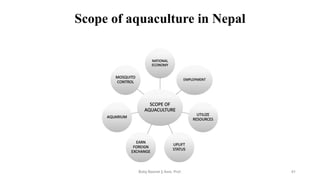
Scope of aquaculture in Nepal
Boby Basnet || Asst. Prof. 41
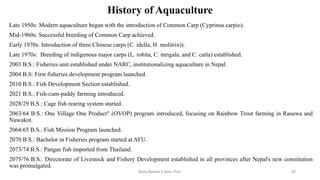
History of Aquaculture
Late 1950s: Modern aquaculture began with the introduction of Common Carp (Cyprinus carpio).
Mid-1960s: Successful breeding of Common Carp achieved.
Early 1970s: Introduction of three Chinese carps (C. idella, H. molitrix)).
Late 1970s: Breeding of indigenous major carps (L. rohita, C. mrigala, and C. catla) established.
2003 B.S.: Fisheries unit established under NARC, institutionalizing aquaculture in Nepal.
2004 B.S: First fisheries development program launched.
2010 B.S.: Fish Development Section established.
2021 B.S.: Fish-cum-paddy farming introduced.
2028/29 B.S.: Cage fish rearing system started.
2063/64 B.S.: One Village One Product" (OVOP) program introduced, focusing on Rainbow Trout farming in Rasuwa and
Nuwakot.
2064/65 B.S.: Fish Mission Program launched.
2070 B.S.: Bachelor in Fisheries program started at AFU.
2073/74 B.S.: Pangas fish imported from Thailand.
2075/76 B.S.: Directorate of Livestock and Fishery Development established in all provinces after Nepal's new constitution
was promulgated.
Boby Basnet || Asst. Prof. 42
BOBY BASNET
ASSISTANT PROF. (ANIMAL SCIENCE)
ILAM COMMUNITYAGRICULTURE CAMPUS
PURBANCHAL UNIVERSITY
boby.iaas333@gmail.com
INTRODUCTION: BIOLOGY OF CULTIVATED FISH SPECIES: MORPHOLOGICAL
CHARACTERS, FEEDING HABITS, GROWTH RATE AND REPRODUCTIVE BEHAVIOR
OF COMMON CARP, CHINESE CARP, INDIGENOUS MAJOR CARP, TILAPIA, TROUT,
CATFISHES, SAHAR, SILVER CARPAND FRESHWATER PRAWNS.
43
Boby Basnet || Asst. Prof.
44
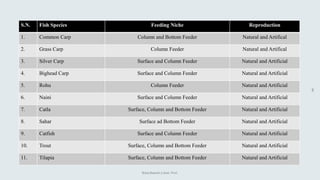
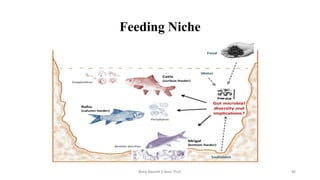
S.N. Fish Species Feeding Niche Reproduction
1. Common Carp Column and Bottom Feeder Natural and Artifical
2. Grass Carp Column Feeder Natural and Artifical
3. Silver Carp Surface and Column Feeder Natural and Artificial
4. Bighead Carp Surface and Column Feeder Natural and Artificial
5. Rohu Column Feeder Natural and Artificial
6. Naini Surface and Column Feeder Natural and Artificial
7. Catla Surface, Column and Bottom Feeder Natural and Artificial
8. Sahar Surface ad Bottom Feeder Natural and Artificial
9. Catfish Surface and Column Feeder Natural and Artificial
10. Trout Surface, Column and Bottom Feeder Natural and Artificial
11. Tilapia Surface, Column and Bottom Feeder Natural and Artificial
Feeding Niche
Boby Basnet || Asst. Prof. 45
CHINESE CARP
1. Grass carp (Ctenopharyngodon idella)
2. Silver carp (Hypophthalmichthys molitrix)
3. Marble carp or bighead (Aristichthys nobilis)
Boby Basnet || Asst. Prof. 46
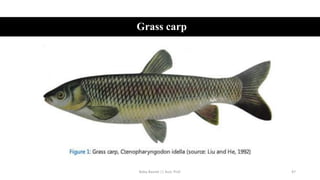
Grass carp
Boby Basnet || Asst. Prof. 47
Boby Basnet || Asst. Prof. 48
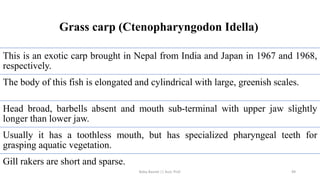
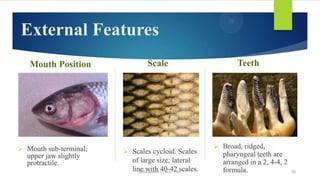
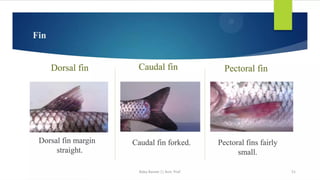
Grass carp (Ctenopharyngodon Idella)
This is an exotic carp brought in Nepal from India and Japan in 1967 and 1968,
respectively.
The body of this fish is elongated and cylindrical with large, greenish scales.
Head broad, barbells absent and mouth sub-terminal with upper jaw slightly
longer than lower jaw.
Usually it has a toothless mouth, but has specialized pharyngeal teeth for
grasping aquatic vegetation.
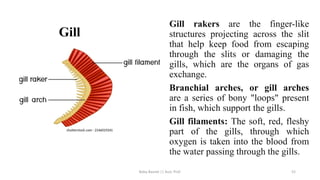
Gill rakers are short and sparse.
Boby Basnet || Asst. Prof. 49
Boby Basnet || Asst. Prof. 50
Boby Basnet || Asst. Prof. 51
Gill rakers are the finger-like
structures projecting across the slit
that help keep food from escaping
through the slits or damaging the
gills, which are the organs of gas
exchange.
Branchial arches, or gill arches
are a series of bony "loops" present
in fish, which support the gills.
Gill filaments: The soft, red, fleshy
part of the gills, through which
oxygen is taken into the blood from
the water passing through the gills.
Gill
Boby Basnet || Asst. Prof. 52
Feeding habits
• Grass carp is a column/marginal feeder, herbivorous and feed on wide variety
of aquatic macro-vegetation including certain terrestrial plants.
• The nature of food of grass carp fry is protozoa, rotifers, nauplius larvae and
minute aquatic plants.
• It is a voracious feeder and can consume 50-60% weight of grass per day of
its body weight.
• But digestion of fish is said to be incomplete and about half the food material
ingested is excreted as faeces.
• The fry and longer fish takes substances like cereals brans, silkworm pupae.
Boby Basnet || Asst. Prof. 53
Growth rate
It is one of the fast
growing fish attains 1-2
kg in the first year.
Largest size attains is 1.5
m and 50 kg.
It is of large, turbid
rivers and associated
floodplain lakes, with a
wide degree of
temperature tolerance
(about 20 to 30 °C).
Boby Basnet || Asst. Prof. 54
Reproductive behavior fish
• It is seasonal breeder, matured in 2-3 years and artificial breeding is done by
hypophysation.
• The breeding season is April/May when the water temperature is 22-27°C.
Boby Basnet || Asst. Prof. 55
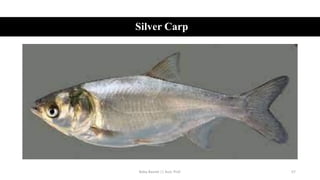
Silver carp (Hypophthalmichthys molitrix)
This is an exotic fish introduced to Nepal from India and Japan in 1967 and
1968, respectively.
This fish is characterized by flat and laterally compressed body covered by small
slivery scales.
Head small, barbells absent, mouth upturned with lower jaw longer than upper
and the abdominal keel is complete.
The posterior margin of the pectoral fin does not extend beyond the base of the
pelvic fin.
Gill rakers are dense, interlaced, connected and covered with a spongy sieve
membrane.
Boby Basnet || Asst. Prof. 56
Silver Carp
Boby Basnet || Asst. Prof. 57
Feeding Behavior: It is surface, phytoplankton feeder but young fry feed zooplankton such
as rotifers and nauplius larvae.
Growth rate: Its growth in the first year is 1-2 kg, largest size attains 40-50 kg.
Reproductive Behavior:
• It is a seasonal breeder, matured in 2-3 years and artificial breeding is done by
hypophysation.
• The breeding season is April to July when the temperature is 22-28°C.
• The major problem with this species is stress intolerance, highly nervous and active fish
during handling.
• Due to handling stress sometimes, high mortality can occur.
• So requires careful handling should be done.
Boby Basnet || Asst. Prof. 58
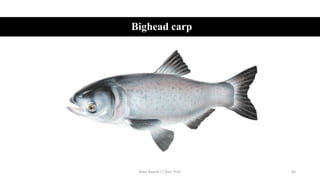
Bighead carp (Aristichthys nobilis)
This is an exotic fish introduced to Nepal from America and Hungury in 1969
and 1972, respectively.
This fish is characterized by flat and laterally compressed body covered by small
slivery scales brownish above.
Head long and massive, barbells absent, mouth large, upturned with lower jaw
longer than upper and the abdominal keel is incomplete.
The posterior margin of the pectoral fin does not extend beyond the base of the
pelvic fin.
Gill rakers are dense, interlaced, connected and covered with a spongy sieve
membrane
Boby Basnet || Asst. Prof. 59
Bighead carp
Boby Basnet || Asst. Prof. 60
Feeding Habit: It is surface, zooplankton feeder but young fry feed on unicellular
phytoplankton, rotifers and nauplii such as rotifers and nauplius larvae.
Growth Rate: Its growth in the first year is 1-2 kg, largest size attains 40-50 kg.
Boby Basnet || Asst. Prof. 61
Reproductive Behavior
It is a seasonal
breeder, matured in 2-
3 years and artificial
breeding is done by
hypophysation.
The breeding season
is May to July when
the temperature is 22-
28°C.
This is docile and
hardy fish for
transportation and
handling
Boby Basnet || Asst. Prof. 62
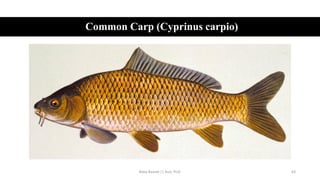
Common Carp (Cyprinus carpio)
Boby Basnet || Asst. Prof. 63
Morphology
• Common carp is the most important cultivated fish in the world which was introduced to Nepal
in 1956 and 1960 from India and Israel, respectively.
• It belongs to Order Cypriniformes and family Cyprinidae.
• It is native to Central Asia and is very widely distributed all over the world.
• It is an ideal fish for aquaculture.
• There are lots of morphological variations through artificial breeding and natural selection of
this species. Among many varieties of common carp, two varieties are under culture in Nepal:
the scale carp or German carp (Cyprinus carpio var. communis) with the body completely and
uniformly covered with golden scales in regular rows; and the mirror carp or Israeli carp
(Cyprinus carpio var. specularis with the body covered unevenly with few large shiny scales.
• Common carp characterized by flat and deep body, short and small head, protractile mouth and
two pairs of maxillary barbells.
• The dorsal fin is long with a sharp spine.Boby Basnet || Asst. Prof. 64
• Body elongated and somewhat compressed.
• Lips thick. Two pairs of barbels at angle of mouth, shorter ones on the upper lip.
• Dorsal fin base long with 17-22 branched rays and a strong, toothed spine in front; dorsal fin
outline concave anteriorly. Anal fin with 6-7 soft rays; posterior edge of 3rd dorsal and anal fin
spines with sharp spinules.
• Lateral line with 32 to 38 scales. Pharyngeal teeth 5:5, teeth with flattened crowns.
• Color variable, wild carp are brownish-green on the back and upper sides, shading to golden
yellow ventrally.
• The fins are dusky, ventrally with a reddish tinge.
• Golden carp are bred for ornamental purposes.
• Common carp is the first domesticated fish species in the world, which is the main fish
candidate for being cocultured with rice in paddy fields
Boby Basnet || Asst. Prof. 65
Feeding Habits
• It is a bottom feeder, omnivorous and feeds on insect larvae, worms, molluscs,
detritus, fresh and decayed vegetation and accepts formulated feed also.
• Carp are omnivorous, with a high tendency towards the consumption of animal
food, such as water insects, larvae of insects, worms, molluscs, and zooplankton.
• Common carp and Grass carp are mostly cultured in Nepal.
• Common carp dwells in the bottom and feed on the bottom insects, insect larvae,
zooplankton, dead and decayed vegetation whereas grass carp dwells in the middle
layer and feeds on aquatic vegetation, terrestrial plants and plankton in the water
column.
• Voracious in nature.
Boby Basnet || Asst. Prof. 66
Growth Rate
• The growth of scale carp in the first year is 1-2 kg and that of mirror carp is 2-3 kg.
Largest size attains is 50 cm and 18 kg. common carp is multiple breeder and can
breed up to 5 times a year.
• Carps can reach 0.6 to 1.0 kg body weight within one season in the polycultural fish
ponds of subtropical/tropical areas.
• Growth is much slower in the temperate zone: here the fish reach the 1 to 2 kg body
weight after 2 to 4 rearing seasons.
• Growth is much slower in the temperate zone: Male carp are matured within a period
that is 25-35 percent shorter.
Boby Basnet || Asst. Prof. 67
Reproductive Behavior
Sexual maturity attains in the first or second year.
It breeds easily in ponds without hypophysation.
Artificial breeding with hypophysation is also common
The embryonic development of carp takes about 3 days at 20-23 °C
However the peak breeding season in Nepal is March/April in terai and
April/May in the hills.
Boby Basnet || Asst. Prof. 68
BIOLOGY OF CULTIVATED INDIGENOUS FISH
Important indigenous cultured fishes of Nepal
✓ A native fish species that is indigenous to a
specific place or regions.
✓ Favorable and suitable to that environment.
✓ Exist from a long period of time is known as
indigenous fish species.
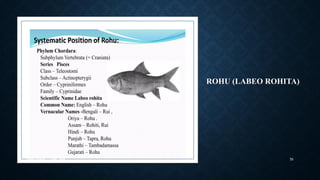
a. Rohu (Labeo rohita)
b. Catla/Bhakur (Catla catla)
c. Mrigal/Naini (Cirrhinus mrigala)
Boby Basnet || Asst. Prof. 69
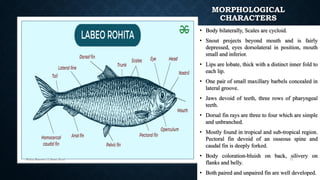
ROHU (LABEO ROHITA)
Boby Basnet || Asst. Prof. 70
MORPHOLOGICAL
CHARACTERS
• Body bilaterally, Scales are cycloid.
• Snout projects beyond mouth and is fairly
depressed, eyes dorsolateral in position, mouth
small and inferior.
• Lips are lobate, thick with a distinct inner fold to
each lip.
• One pair of small maxillary barbels concealed in
lateral groove.
• Jaws devoid of teeth, three rows of pharyngeal
teeth.
• Dorsal fin rays are three to four which are simple
and unbranched.
• Mostly found in tropical and sub-tropical region.
Pectoral fin devoid of an osseous spine and
caudal fin is deeply forked.
• Body coloration-bluish on back, silivery on
flanks and belly.
• Both paired and unpaired fin are well developed.
Boby Basnet || Asst. Prof. 71
FEEDING HABITS
• In its early stage of life rohu prefer zooplankton, mainly rotifers
and cladocerans and phytoplankton comprise to form its
emergency food.
• In the fingerling stage, it prefer to feed on all the zooplanktonic
organism and few smaller phytoplankters like desmids,
phyflagellates and algal spores.
• On the other hand, adults show strong positive selection for the
most of the phytoplankton.
• In juvenile and adult stages rohu is essential an herbivores
column feeder and prefer algae and submerged vegetation.
• However the gut analysis, indicates its bottom feeding habits
due to occurrence of decayed organic matter, mud and sand in
its gut.
Boby Basnet || Asst. Prof. 72
GROWTH RATE
• Rohu is eurythermal species and does not survive below 14°C.
• It is fast growing species.
• It attains about 35-45 cm total length and 700-800g in one year under normal
culture condition.
• It is observed that in polyculture, its growth rate is higher than that of mrigal but
lower than catla.
• Rohu is cultured along with Catla catla and Cirrhinus mrigala
Boby Basnet || Asst. Prof. 73
REPRODUCTIVE BEHAVIOR
• It attains first maturity at the age of two years in both the sexes, whereas complete maturity is attained
after four years in males and five years in females.
• The spawning season of rohu generally from April to September.
• In natural conditions, spawning occurs in the shallow and marginal areas of flooded rivers.
• The optimum temperature for spawning is 22-31°C.
• However breeding does not take place in such lentic pond environments; thus induced breeding becomes
necessary.
• Rohu is seasonal breeder and artificial breeding is done by hypophysation.
• The fecundity is 271 egg/gms body weight
• Rohu is a polygamous fish and also seems to be promiscuous.
Boby Basnet || Asst. Prof. 74
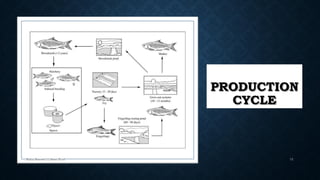
PRODUCTION
CYCLE
Boby Basnet || Asst. Prof. 75
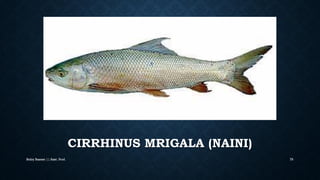
CIRRHINUS MRIGALA (NAINI)
Boby Basnet || Asst. Prof. 76
MORPHOLOGICAL CHARACTERS
• Body bilaterally symmetrical and streamlined, its depth about equal to length of head.
• Scales are cycloid and present on whole body except head region.
• Snout is blunt, often with pores.
• Broad mouth, transverse, upper lip is entire and not continuous with lower lip, lower lip most indistinct.
• One pair of short barbel.
• Pharyngeal teeth in three rows
• Dorsal fin as high as body with 12 or 13 branched rays.
• Pectoral fins shorter than dorsal and caudal fin deeply forked/divided.
• Body coloration-usually dark grey above, slivery beneath.
• Dorsal fin greyish and pectoral, pelvic and anal fins orange-tipped during breeding season.
Boby Basnet || Asst. Prof. 77
FEEDING HABITS
• Hatchlings of mrigal normally confine themselves to the surface or sub-surface
waters.
• The fry and fingerling tend to move to deeper water.
• Adult are bottom dwellers
• It is stenophagus ( feeding insect) and illiophage (typically feed on mud) fish in its
feeding habit.
• The principal food components of its diet are detritus and decayed vegetation, at
the same time phytoplankton and zooplankton comprises the rest
• Phytoplankton, Zooplankton
Boby Basnet || Asst. Prof. 78
GROWTH RATE
• Eurythermal in nature and is reported to tolerate a minimum temperature of 14 ºC
• It attains 700-800g in one year under normal culture condition.
• Among the three Indian major carps, mrigal is normally considered as a slow grower then catla
and rohu.
• As the growth rate reduces after two years the rearing period is usually confined to maximum of
two years, only.
• However, mrigala is reported to survive for about twelve years in natural waters.
• It is observed that in polyculture, its growth rate is lower than that of rohu and catla.
• Cirrhinus mrigala is cultured along with Catla catla and Rohu.
Boby Basnet || Asst. Prof. 79
REPRODUCTIVE BEHAVIOR
• Maturity is attained in two years in captivity.
• Mrigal does not breed in ponds as it needs a fluviatile environment for it.
• Induced breeding by hypophysation and the use of synthetic hormones.
• Mrigal is a highly fecund fish i.e. 147 eggs/gms body weight.
• Fecundity increases with age and normally ranges from 100000-150000 eggs/kg body weight.
• The spawning season is May to September.
• Mrigal usually breeds at a temperature of 24-31 ºC
• As mrigal does not breed in confined waters, injections of pituitary extract and other synthetic
commercial formulations: ovaparim.
Boby Basnet || Asst. Prof. 80
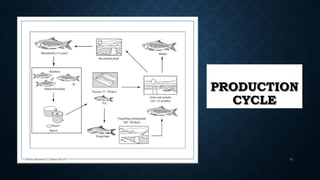
PRODUCTION
CYCLE
Boby Basnet || Asst. Prof. 81
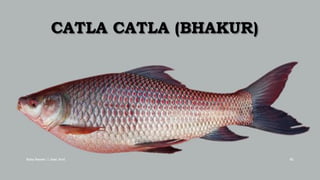
CATLA CATLA (BHAKUR)
Boby Basnet || Asst. Prof. 82
MORPHOLOGICAL CHARACTERS
• Lips prominent and thick.
• Barbels absent.
• Body coloration: grayish on dorsal and silivery on the lateral and ventral side.
• Fins colour: blackish overall but pectoral, ventral and anal fins have orange tings at the base.
• Scales: cycloid except on mouth and head.
• Lips: thick, fringed
• Head: Large and broad. Length of head ranges from 4 cm to 7 cm.
• Size: It reaches upto 182 cm length.
Boby Basnet || Asst. Prof. 83
FEEDING HABIT
• Catle catle is a planktivorous carp. A planktivore is an aquatic organism that feeds on planktonic food,
including zooplankton and phytoplankton.
• Preferably feeding on zooplankton.
• It is freshwater surface feeder.
• Feeding preferences and nutritional requirements change according to the development stage.
• Maximum feeding activity is seen during the morning hours (6 to 9 am).
• Larvae of Catla start feeding after 4 days of hatching on Brachionus and napuli.
• Feeds on large sized prey once the mouth gap increases.
• Fingerlings feeds on planktonic algae, vegetable debris along with larger size zooplankton.
• Adults predominantly feeds on surface and mid-water.
Boby Basnet || Asst. Prof. 84
GROWTH RATE
• The average size of freshly hatched catla larvae is 4.7 mm.
• After 5 days- average size 9 mm.
• After 10 days- average size 15.6 mm
• After 15 days- average size 27 mm respectively.
• Growth dependents on the density of the fishes stalked.
• Fast growing species.
• 300-400g in the first year, over 2 kg at the end of the second year, and 5-6 kg after
3 years.
Boby Basnet || Asst. Prof. 85
REPRODUCTIVE BEHAVIOR
• Catla attains sexual maturity at an average age of two years and an average weight of 2 kg.
• Catla breed during the monsoon season in rivers.
• Induced breeding by hypophysation and the use of synthetic hormones.
• Fecundity increases with age and normally ranges from 80000-120000 eggs/kg body weight.
• The spawning season is May to September.
• Catla usually breeds at a temperature of 25-32 ºC
• As Catla catla does not breed in confined waters, injections of pituitary extract and other
synthetic commercial formulations: ovaparim.
Boby Basnet || Asst. Prof. 86
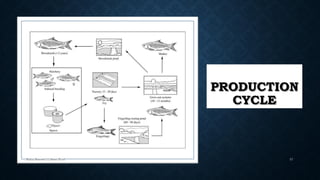
PRODUCTION
CYCLE
Boby Basnet || Asst. Prof. 87
HORMONES USED FOR ARTIFICIAL
BREEDING
• Ova prim
• Pituitary gland
• Luteinizing releasing hormone-analogue
• Human chorionic gonadotropin
Boby Basnet || Asst. Prof. 88
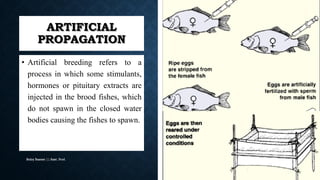
ARTIFICIAL
PROPAGATION
• Artificial breeding refers to a
process in which some stimulants,
hormones or pituitary extracts are
injected in the brood fishes, which
do not spawn in the closed water
bodies causing the fishes to spawn.
Boby Basnet || Asst. Prof. 89
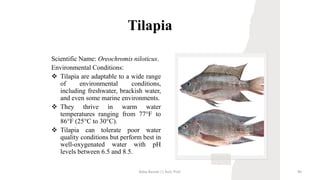
Tilapia
Scientific Name: Oreochromis niloticus.
Environmental Conditions:
❖ Tilapia are adaptable to a wide range
of environmental conditions,
including freshwater, brackish water,
and even some marine environments.
❖ They thrive in warm water
temperatures ranging from 77°F to
86°F (25°C to 30°C).
❖ Tilapia can tolerate poor water
quality conditions but perform best in
well-oxygenated water with pH
levels between 6.5 and 8.5.
Boby Basnet || Asst. Prof. 90
Pond culture: Tilapia are commonly raised in earthen or concrete ponds designed with
proper depth, size, and water circulation for optimal growth. Adequate aeration, water
exchange, and moderate water turbidity are essential to maintain quality and fish health.
Tilapia thrive in a pH range of 6.8–7.8, so monitoring pH levels is critical.
Feeding Habit: Tilapia are omnivorous, feeding on zooplankton, phytoplankton, and
balanced commercial diets rich in protein, carbohydrates, lipids, vitamins, and minerals.
Feeding frequency and quantity are adjusted based on fish size, water temperature, and
growth rates.
Harvesting: Tilapia reach market size in 6 to 9 months, depending on conditions and
feeding. Harvesting methods include seining, netting, or draining ponds. Fish are processed
on-site or transported live for cleaning, gutting, and packaging.
Reproduction: Artificial Breeding
Boby Basnet || Asst. Prof. 91
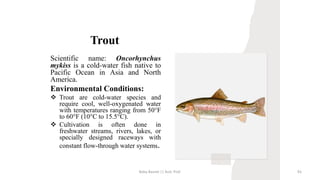
Trout
Scientific name: Oncorhynchus
mykiss is a cold-water fish native to
Pacific Ocean in Asia and North
America.
Environmental Conditions:
❖ Trout are cold-water species and
require cool, well-oxygenated water
with temperatures ranging from 50°F
to 60°F (10°C to 15.5°C).
❖ Cultivation is often done in
freshwater streams, rivers, lakes, or
specially designed raceways with
constant flow-through water systems.
Boby Basnet || Asst. Prof. 92
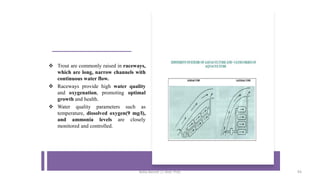
❖ Trout are commonly raised in raceways,
which are long, narrow channels with
continuous water flow.
❖ Raceways provide high water quality
and oxygenation, promoting optimal
growth and health.
❖ Water quality parameters such as
temperature, dissolved oxygen(9 mg/l),
and ammonia levels are closely
monitored and controlled.
Boby Basnet || Asst. Prof. 93
Feeding and Nutrition:
• Trout are carnivorous and require high-protein diets rich in fishmeal or other
protein sources.
• Feeding practices involve providing floating pellets or extruded feeds several
times a day to match the fish's metabolic needs.
Harvesting and Processing:
❖ Trout are typically harvested when they reach market size, which varies
depending on the strain and farming conditions.
❖ Harvesting methods include netting, electrofishing, or draining raceways.
❖ Fish are processed on-site or transported to processing facilities for gutting,
filleting, and packaging.
Reproduction: Artificial Breeding.
Boby Basnet || Asst. Prof. 94
CATFISHES, SAHAR AND FRESHWATER PRAWNS
ASSIGNMENT
Boby Basnet || Asst. Prof. 95
BOBY BASNET
ASSISTANT PROF. (ANIMAL SCIENCE)
ILAM COMMUNITYAGRICULTURE CAMPUS
PURBANCHAL UNIVERSITY
boby.iaas333@gmail.com
WATER QUALITY MANAGEMENT: PHYSICAL (TEMPERATURE AND TURBIDITY), CHEMICAL
(DO AND PH) AND BIOLOGICAL (PLANKTON) PARAMETERS OF WATER.
96
Water
• Water is common substance.
• It fills the oceans, rivers, and lakes.
• It is in the ground and also in the air we breathe.
• Water is used for drinking, all domestic purposes, agriculture, industrial applications,
cleaning and recreation.
• On average, each person in the a developed country uses about 260 liters of water a
day in the home.
• The quality of water is equally important than quantity.
• Even if present in huge amounts, we cannot use salt water in many life support
activities.
Boby Basnet || Asst. Prof. 97
Water Quality Parameters
Boby Basnet || Asst. Prof. 98
Physical Properties
Boby Basnet || Asst. Prof. 99
Temperature
• Water temperatures in the ponds are related to solar radiation and air temperatures.
• Water temperatures closely follow air temperatures.
• The absorption of solar energy as light passes through water heats the water.
• Light energy is absorbed exponentially with depth so most heat is absorbed within the upper
layer of water.
• This is particularly true in fishponds because high concentrations of dissolved organic matter
and particulate matter greatly increases the absorption of energy as compared to less turbid
water.
• The transfer of heat from upper to lower layer of water depends largely upon mixing by wind.
The density of water is dependent upon water temperature.
• Ponds and lakes may stratify thermally, because heat is absorbed more rapidly near the
surface of water body and the warm upper waters are less dense than cool lower waters.
Boby Basnet || Asst. Prof. 100
Thermal stratification
• Thermal stratification refers to the horizontal
separation of a relatively warmer surface layer of
water from cooler bottom waters.
• The principle behind thermal stratification is that
water increases in density as it gets colder to about
4 °C
• Stratification occurs when there is differentiation in
density of upper and lower strata.
• Upper stratum- Epilimnion
• Lower stratum- Hypolimnion
• Between stratum- Thermocline/metalimnion
Boby Basnet || Asst. Prof. 101
Epilimnion
➢The top-most layer in a thermally stratified pond.
➢It is warmer and typically has a higher pH and
higher dissolve oxygen concentration.
➢It contains the most Phytoplankton.
Boby Basnet || Asst. Prof. 102
Metalimnion
➢ A thin but distinct layer.
➢ Also called thermocline.
➢ Temperature changes more rapidly with depth than
it does in the layers above or below.
➢Factors: seasonal weather variations, latitude and
local environmental conditions, such as tides and
currents etc.
Boby Basnet || Asst. Prof. 103
Hypolimnion
• Bottom layer of water in a thermally-stratified lake.
• Hypolimnion is the coldest layer of a pond in
summer, and the warmest layer during winter.
• Insufficient light for photosynthesis.
• It is isolated from surface wind-mixing.
Boby Basnet || Asst. Prof. 104
• The ordinary warm water fish pond seldom has an average depth of more
than two meters and surface area of more than few hectares.
• However, marked thermal stratification may develop even in very shallow
ponds because turbid condition result in rapid heating of surface water in
the calm sunny days.
• Stratification prolongs for a season for large lakes while pond stratify
during daylight hours in warm months and destratify at night when the
upper layer of water cool by conduction. Heavy wind and disappearance of
heavy plankton bloom may cause the destratification
Boby Basnet || Asst. Prof. 105
Destratification
Mixing of layers of water due to air
turbulence, disappearance of heavy
plankton bloom, mixing of two
water mass with different properties.
Boby Basnet || Asst. Prof. 106
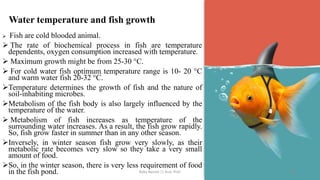
Water temperature and fish growth
➢ Fish are cold blooded animal.
➢ The rate of biochemical process in fish are temperature
dependents, oxygen consumption increased with temperature.
➢ Maximum growth might be from 25-30 °C.
➢ For cold water fish optimum temperature range is 10- 20 °C
and warm water fish 20-32 °C.
➢Temperature determines the growth of fish and the nature of
soil-inhabiting microbes.
➢Metabolism of the fish body is also largely influenced by the
temperature of the water.
➢ Metabolism of fish increases as temperature of the
surrounding water increases. As a result, the fish grow rapidly.
So, fish grow faster in summer than in any other season.
➢Inversely, in winter season fish grow very slowly, as their
metabolic rate becomes very slow so they take a very small
amount of food.
➢So, in the winter season, there is very less requirement of food
in the fish pond. Boby Basnet || Asst. Prof. 107
Temperature management in fish ponds
Maintain the pond water depth (not less than 1m)
Maintain
Provide temporary shade to the ponds in hot months.
Provide
Avoid fish shading in cold month.
Avoid
Avoid fish handling during very high and low temperature.
Avoid
Exchange pond water whenever required
Exchange
Boby Basnet || Asst. Prof. 108
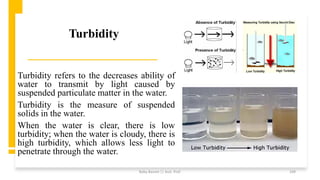
Turbidity
Turbidity refers to the decreases ability of
water to transmit by light caused by
suspended particulate matter in the water.
Turbidity is the measure of suspended
solids in the water.
When the water is clear, there is low
turbidity; when the water is cloudy, there is
high turbidity, which allows less light to
penetrate through the water.
Boby Basnet || Asst. Prof. 109
TYPES OF TURBIDITY
A. Mineral turbidity
▪ High content of silt and/or clay particles, water a light brown,
sometimes reddish colour
B. Plankton turbidity
▪ High content of minute plants and animals brown, green, blue-green or
yellow-green, depending on which plankton species is dominant.
C. Humic turbidity
▪ Presence of humus, which turns the water a dark brownish colour.
Boby Basnet || Asst. Prof. 110
METHODS TO MEASURE THE TURBIDITY OF WATER
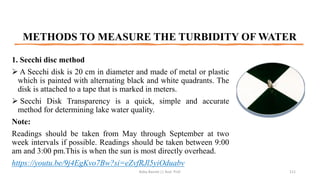
1. Secchi disc method
➢ A Secchi disk is 20 cm in diameter and made of metal or plastic
which is painted with alternating black and white quadrants. The
disk is attached to a tape that is marked in meters.
➢ Secchi Disk Transparency is a quick, simple and accurate
method for determining lake water quality.
Note:
Readings should be taken from May through September at two
week intervals if possible. Readings should be taken between 9:00
am and 3:00 pm.This is when the sun is most directly overhead.
https://youtu.be/9j4EgKvo7Bw?si=eZvfRJl5yiOduabv
Boby Basnet || Asst. Prof. 111
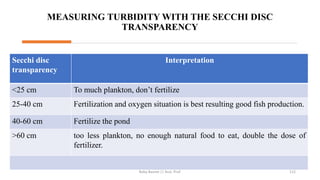
MEASURING TURBIDITY WITH THE SECCHI DISC
TRANSPARENCY
Secchi disc
transparency
Interpretation
<25 cm To much plankton, don’t fertilize
25-40 cm Fertilization and oxygen situation is best resulting good fish production.
40-60 cm Fertilize the pond
>60 cm too less plankton, no enough natural food to eat, double the dose of
fertilizer.
Boby Basnet || Asst. Prof. 112
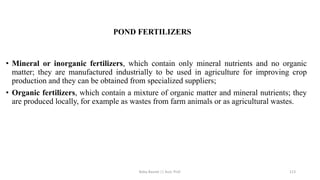
POND FERTILIZERS
• Mineral or inorganic fertilizers, which contain only mineral nutrients and no organic
matter; they are manufactured industrially to be used in agriculture for improving crop
production and they can be obtained from specialized suppliers;
• Organic fertilizers, which contain a mixture of organic matter and mineral nutrients; they
are produced locally, for example as wastes from farm animals or as agricultural wastes.
Boby Basnet || Asst. Prof. 113
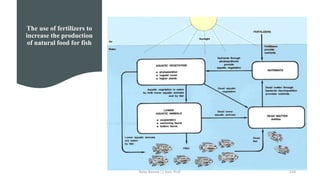
The use of fertilizers to
increase the production
of natural food for fish
Boby Basnet || Asst. Prof. 114
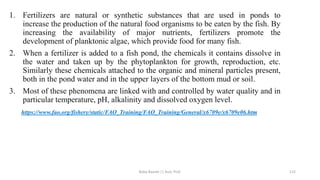
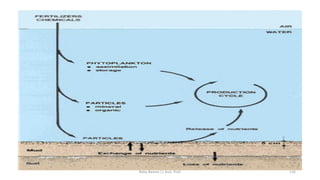
1. Fertilizers are natural or synthetic substances that are used in ponds to
increase the production of the natural food organisms to be eaten by the fish. By
increasing the availability of major nutrients, fertilizers promote the
development of planktonic algae, which provide food for many fish.
2. When a fertilizer is added to a fish pond, the chemicals it contains dissolve in
the water and taken up by the phytoplankton for growth, reproduction, etc.
Similarly these chemicals attached to the organic and mineral particles present,
both in the pond water and in the upper layers of the bottom mud or soil.
3. Most of these phenomena are linked with and controlled by water quality and in
particular temperature, pH, alkalinity and dissolved oxygen level.
https://www.fao.org/fishery/static/FAO_Training/FAO_Training/General/x6709e/x6709e06.htm
Boby Basnet || Asst. Prof. 115
Boby Basnet || Asst. Prof. 116
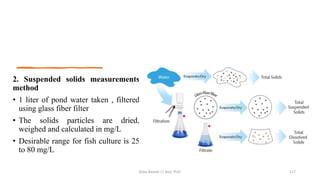
2. Suspended solids measurements
method
• 1 liter of pond water taken , filtered
using glass fiber filter
• The solids particles are dried,
weighed and calculated in mg/L
• Desirable range for fish culture is 25
to 80 mg/L
Boby Basnet || Asst. Prof. 117
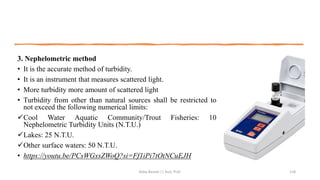
3. Nephelometric method
• It is the accurate method of turbidity.
• It is an instrument that measures scattered light.
• More turbidity more amount of scattered light
• Turbidity from other than natural sources shall be restricted to
not exceed the following numerical limits:
✓Cool Water Aquatic Community/Trout Fisheries: 10
Nephelometric Turbidity Units (N.T.U.)
✓Lakes: 25 N.T.U.
✓Other surface waters: 50 N.T.U.
• https://youtu.be/PCsWGxsZWoQ?si=Ff1iPi7tOtNCuEJH
Boby Basnet || Asst. Prof. 118
EFFECT OF TURBIDITY
• Reduce light penetration caused siltation of bottom of substrate ,effect
vision of fish.
• Turbidity has little direct effect on fish but excessive turbidity may
cause interfere gill function that cause respiration problem.
• Cause siltation of bottom substrate- reduce pond depth.
• Adsorbs and desorbs the nutrients of pond water.
• High turbidity also clogs fish gills, destroys fish habitat, and impairs
water for drinking use.
Boby Basnet || Asst. Prof. 119
Electrical Conductivity
➢ Electrical conductivity measures the ability of water to conduct an electrical
current. The higher the concentration of dissolved charged chemicals (also known
as salts) in the water, the greater the electrical current that can be conducted.
Examples of charged ions that naturally occur in river water include calcium,
potassium, chloride, sulphate and nitrate.
➢ Conductivity is a vital parameter when determining water quality.
➢As salinity and temperature increase, conductivity also increases, which can have
a negative effect on the quality of water. This is because the higher the
conductivity, the higher amount of impurities (dissolved substances, chemicals,
and minerals) are in the water.
➢https://atlas-scientific.com/blog/how-does-conductivity-affect-water-quality/
Boby Basnet || Asst. Prof. 120
Water Depth
S.N. Water depth Depth Area
1. Nursery Pond 0.8-1 m 100-200m² Hatchling for 2-3 weeks
2. Rearing Pond 0.8-1m 200-400m² Fry for 2 month
3. Production Pond 1-1.5m 2000-4000m² Fingerling rearing for market
4. Segregation Pond 1.5-2m 2000-4000m² Rearing for brood fish
5. Spawning Pond 0.1-1m 5-10m² Pond for only Breeding
Boby Basnet || Asst. Prof. 121
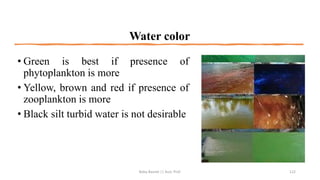
Water color
• Green is best if presence of
phytoplankton is more
• Yellow, brown and red if presence of
zooplankton is more
• Black silt turbid water is not desirable
Boby Basnet || Asst. Prof. 122
Chemical Properties
• Dissolved oxygen
• pH
Boby Basnet || Asst. Prof. 123
Dissolve Oxygen (DO)
Dissolved oxygen is the most critical water quality
parameter in aquaculture. Dissolved oxygen (DO) is a
measure of how much oxygen is dissolved in the water.
It is essential to most aquatic organisms for their
respiration.
It is also necessary during the process of decomposition.
Growth rate and food conversion efficiency will suffer
and feed will be wasted if fish suffered from DO
deficiency. Epilimnion has higher DO concentration than
hypolimnion.
Boby Basnet || Asst. Prof. 124
Dissolved oxygen requirement
• Cold fish Species has less capacity to extract oxygen from water than water. So
more DO (8 mg/l) is needed for cold species than warm water fish species (5mg/l).
• Method: Dissolved oxygen levels can be measured by a basic chemical analysis
method (titration method), an electrochemical analysis method (diaphragm
electrode method), and a photochemical analysis method (fluorescence method).
The diaphragm electrode method is the most widely used method.
• https://youtu.be/XsU8eJjwFmc?si=KXIacGgk2QV3jYAa
Boby Basnet || Asst. Prof. 125
Diel fluctuation
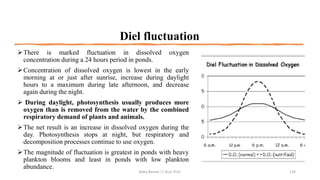
➢There is marked fluctuation in dissolved oxygen
concentration during a 24 hours period in ponds.
➢Concentration of dissolved oxygen is lowest in the early
morning at or just after sunrise, increase during daylight
hours to a maximum during late afternoon, and decrease
again during the night.
➢ During daylight, photosynthesis usually produces more
oxygen than is removed from the water by the combined
respiratory demand of plants and animals.
➢The net result is an increase in dissolved oxygen during the
day. Photosynthesis stops at night, but respiratory and
decomposition processes continue to use oxygen.
➢The magnitude of fluctuation is greatest in ponds with heavy
plankton blooms and least in ponds with low plankton
abundance.
Boby Basnet || Asst. Prof. 126
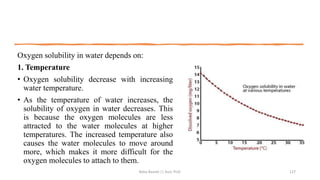
Oxygen solubility in water depends on:
1. Temperature
• Oxygen solubility decrease with increasing
water temperature.
• As the temperature of water increases, the
solubility of oxygen in water decreases. This
is because the oxygen molecules are less
attracted to the water molecules at higher
temperatures. The increased temperature also
causes the water molecules to move around
more, which makes it more difficult for the
oxygen molecules to attach to them.
Boby Basnet || Asst. Prof. 127
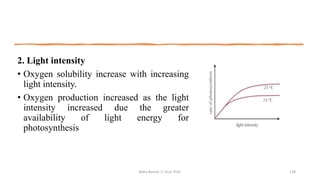
2. Light intensity
• Oxygen solubility increase with increasing
light intensity.
• Oxygen production increased as the light
intensity increased due the greater
availability of light energy for
photosynthesis
Boby Basnet || Asst. Prof. 128
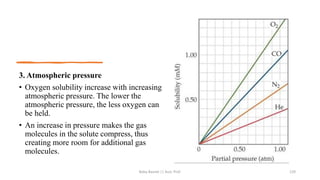
3. Atmospheric pressure
• Oxygen solubility increase with increasing
atmospheric pressure. The lower the
atmospheric pressure, the less oxygen can
be held.
• An increase in pressure makes the gas
molecules in the solute compress, thus
creating more room for additional gas
molecules.
Boby Basnet || Asst. Prof. 129
4. Water depth
• Oxygen solubility increases with water depth and volume.
• At deeper depths, oxygen gradually increases as lower temperatures increase the solubility of oxygen.
5. Salinity
• Oxygen solubility decrease with increasing salinity.
• The more saline the water, the less oxygen it can hold because saltwater has less space for oxygen
molecules due to the sodium and chloride ions it contains.
6. Current Velocity
• The faster water flows, the more atmospheric oxygen is mixed into the water.
• Fast-moving water generally has more oxygen than still water, because the movement mixes the air into
the water.
Boby Basnet || Asst. Prof. 130
Source and Sink of oxygen in the pond
Sources
• Photosynthesis
• Diffusion
Sinks
• Respiration
• Diffusion
• Decomposition
Boby Basnet || Asst. Prof. 131
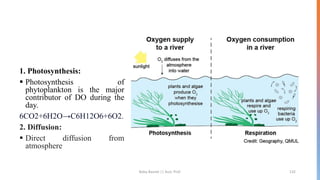
1. Photosynthesis:
▪ Photosynthesis of
phytoplankton is the major
contributor of DO during the
day.
6CO2+6H2O→C6H12O6+6O2.
2. Diffusion:
▪ Direct diffusion from
atmosphere
Boby Basnet || Asst. Prof. 132
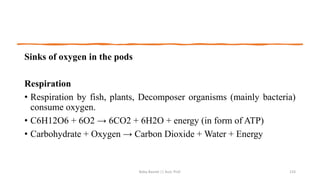
Sinks of oxygen in the pods
Respiration
• Respiration by fish, plants, Decomposer organisms (mainly bacteria)
consume oxygen.
• C6H12O6 + 6O2 → 6CO2 + 6H2O + energy (in form of ATP)
• Carbohydrate + Oxygen → Carbon Dioxide + Water + Energy
Boby Basnet || Asst. Prof. 133
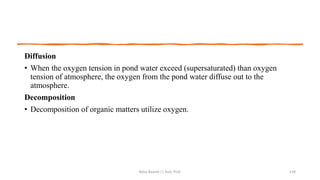
Diffusion
• When the oxygen tension in pond water exceed (supersaturated) than oxygen
tension of atmosphere, the oxygen from the pond water diffuse out to the
atmosphere.
Decomposition
• Decomposition of organic matters utilize oxygen.
Boby Basnet || Asst. Prof. 134
Dissolved Oxygen lacking conditions in ponds
• If biochemical oxygen demand (B.O.D.) of the pond is high, this is due to high organic
load. Decaying plant and animal matter consume substantial amounts of oxygen in the
decaying process.
• Cloudy day with little sunlight will reduce the photosynthetic oxygen contribution to
dissolved oxygen resulting lacking DO in the pond.
• Unusually high temperatures will lower the solubility of oxygen in water and hence low
dissolved oxygen.
• If too much fishes are stocked.
Boby Basnet || Asst. Prof. 135
Sign of low dissolve oxygen in
the fish ponds
• Piping: Fish come to the water
surface and gulp air bubbles
very frequently.
• Fish aggregate at the water inlet.
• Fish not feeding well of even
stop feeding.
Boby Basnet || Asst. Prof. 136
Maintaining DO in the pond
• Add oxygenated/ cool water
• Stirring of pond water; using mechanical aerator, boating etc.
• Use chemical like potassium permanganate 1kg/1.5 bigha land. https://fb.watch/oN2ZDQWBJu/
• Increase photosynthesis
• Increase sun light availability
• Thinning out of fishes
• Reducing/stop feeding
• Reduction decomposition
• Avoid over feeding
• Avoid over fertilization
• Liming (500kg/ha)
• Remove the pond bottom mud if it exceed above one feet.
Boby Basnet || Asst. Prof. 137
Preventive measure
• Avoid planting large tree on dike
• Avoid overstocking
• Avoid overfeeding
• Stop feeding and fertilization in cloudy and rainy days.
Boby Basnet || Asst. Prof. 138
pH
➢The pH is defined as negative logarithm of hydrogen ion concentration
and indicate whether water is acidic or alkaline in reaction and is measured
on a scale of 0-14.
pH = -log[H⁺]
Where (H⁺) is the amount of hydrogen ions in a solution in moles per liter.
➢Pure water has 0.0000001 mole per liter of free H+ and OH ion.
➢For any aqueous solution, the product [H+ ] [OH- ] must equal to 10-14 at
25 °C.
Boby Basnet || Asst. Prof. 139
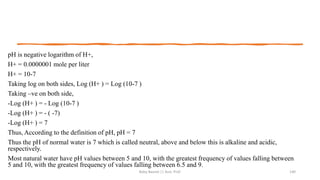
pH is negative logarithm of H+,
H+ = 0.0000001 mole per liter
H+ = 10-7
Taking log on both sides, Log (H+ ) = Log (10-7 )
Taking –ve on both side,
-Log (H+ ) = - Log (10-7 )
-Log (H+ ) = - ( -7)
-Log (H+ ) = 7
Thus, According to the definition of pH, pH = 7
Thus the pH of normal water is 7 which is called neutral, above and below this is alkaline and acidic,
respectively.
Most natural water have pH values between 5 and 10, with the greatest frequency of values falling between
5 and 10, with the greatest frequency of values falling between 6.5 and 9.
Boby Basnet || Asst. Prof. 140
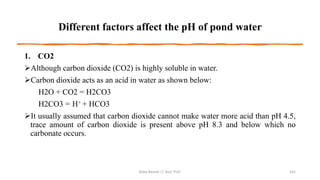
Different factors affect the pH of pond water
1. CO2
➢Although carbon dioxide (CO2) is highly soluble in water.
➢Carbon dioxide acts as an acid in water as shown below:
H2O + CO2 = H2CO3
H2CO3 = H+ + HCO3
➢It usually assumed that carbon dioxide cannot make water more acid than pH 4.5,
trace amount of carbon dioxide is present above pH 8.3 and below which no
carbonate occurs.
Boby Basnet || Asst. Prof. 141
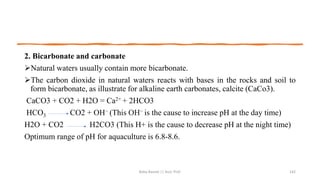
2. Bicarbonate and carbonate
➢Natural waters usually contain more bicarbonate.
➢The carbon dioxide in natural waters reacts with bases in the rocks and soil to
form bicarbonate, as illustrate for alkaline earth carbonates, calcite (CaCo3).
CaCO3 + CO2 + H2O = Ca2+ + 2HCO3
HCO3 CO2 + OH− (This OH− is the cause to increase pH at the day time)
H2O + CO2 H2CO3 (This H+ is the cause to decrease pH at the night time)
Optimum range of pH for aquaculture is 6.8-8.6.
Boby Basnet || Asst. Prof. 142
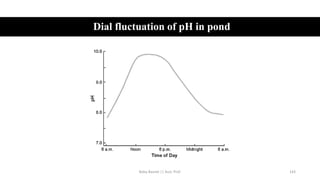
Dial fluctuation of pH in pond
Boby Basnet || Asst. Prof. 143
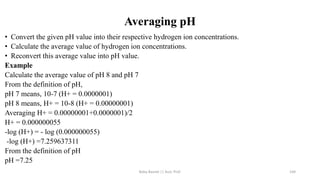
Averaging pH
• Convert the given pH value into their respective hydrogen ion concentrations.
• Calculate the average value of hydrogen ion concentrations.
• Reconvert this average value into pH value.
Example
Calculate the average value of pH 8 and pH 7
From the definition of pH,
pH 7 means, 10-7 (H+ = 0.0000001)
pH 8 means, H+ = 10-8 (H+ = 0.00000001)
Averaging H+ = 0.00000001+0.0000001)/2
H+ = 0.000000055
-log (H+) = - log (0.000000055)
-log (H+) =7.259637311
From the definition of pH
pH =7.25
Boby Basnet || Asst. Prof. 144
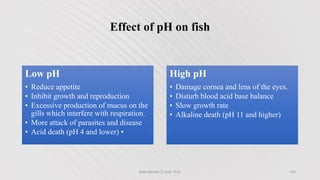
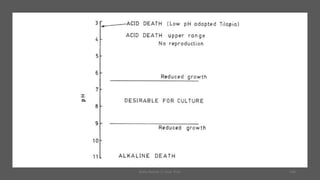
Effect of pH on fish
Low pH
• Reduce appetite
• Inhibit growth and reproduction
• Excessive production of mucus on the
gills which interfere with respiration.
• More attack of parasites and disease
• Acid death (pH 4 and lower) •
High pH
• Damage cornea and lens of the eyes.
• Disturb blood acid base balance
• Slow growth rate
• Alkaline death (pH 11 and higher)
Boby Basnet || Asst. Prof. 145
Boby Basnet || Asst. Prof. 146
pH management in the ponds
➢Liming of acidic pond
➢Low pH: Liming the pond @ 500-1000 kg/ha/yr depending upon pH.
➢High pH: Use carbonic fertilizer (compost), nitrogenous fertilizer
(urea, ammonium sulphate), gypsum (calcium sulphate) in alkaline
ponds.
Boby Basnet || Asst. Prof. 147
Method of pH measurement
A. pH indicator paper
• A thin strip of paper (such as chemically
treated litmus paper) is partly dipped
into water to be tested.
• The colour of the paper changes and this
new colour is compared to color chart,
which gives the pH value according to
the colour obtained.
(Note: Litmus paper is divided into two categories: red litmus
paper and blue litmus paper. If the material is acidic, the blue
litmus paper turns red. If the material is basic or alkaline, the
red litmus paper turns blue)
Boby Basnet || Asst. Prof. 148
B. Color comparator
➢Cheap water-testing kits can be bought from
special chemical suppliers.
➢They usually include a number of liquid
indicators.
➢A few drops of one of these colour indicators
are added to a small water sample, and new
colour of the solution is compared with a set of
standard colours supplied with the testing kit.
➢https://youtu.be/We1NV6aHycU?si=SCbnJEcoJxNUrYUy
Boby Basnet || Asst. Prof. 149
pH meter
• pH provides the easiest way for determining
the water pH, even in the field, but it is
relatively expensive.
• The pH value is directly read from the meter
after placing the glass electrodes in a water
sample.
• Such electrodes are very fragile and should be
well protected when being transported.
• They should be accurately calibrated in buffer
solutions of known pH, at regular intervals.
Boby Basnet || Asst. Prof. 150
Biological Properties
Plankton
➢Plankton is the community of minute plants or
animals suspended, floating or weakly
swimming in open water.
➢Plankton are of two ecological groups
a. Phytoplankton: Plant origin (Autotrophs)
b. Zooplankton: Animal origin (Heterotrophs)
Boby Basnet || Asst. Prof. 151
• Plankton, especially phytoplankton is an important part of the fish
pond.
• Phytoplankton is the base of the food web, and fish production is
directly related to phytoplankton abundance.
• But unmanaged growth of phytoplankton may cause the water quality
problem in fish ponds.
Boby Basnet || Asst. Prof. 152
Types of phytoplankton
1. Cyanophyta
2. Chlorophyta
3. Euglenaophyta
4. Chrysophyta
5. Xanthophyta
6. Bacillariophyta
7. Pyrophyta
Boby Basnet || Asst. Prof. 153
Cyanophyta (Blue green algae)
• Usually blue green in colour with
homogeneous cell contents.
• Example Nostoc, Anabaena,
Oscillatoria, Mycrocystis
Boby Basnet || Asst. Prof. 154
Chlorophyta (Green algae)
➢Larger cells than blue green algae with
distinct contents and are green in colour.
➢Cells with two or more flagella.
➢Example: Chlamydomonas, Pandorina,
Eudorina, Volvox, Chlorella, Cosmarium
Boby Basnet || Asst. Prof. 155
Euglenophyta (Euglenoids algae)
• Slow moving euglenoids algae
having single flagella.
• Numerous disc shaped chloroplasts
present.
• Example: Euglena, Phacus,
Trachelomonas, Leptoconclis
Boby Basnet || Asst. Prof. 156
Chrysophyta (Golden algae)
• Cells with no transverse furrows.
• Example: Danobryon, Ochromonas,
Mallomonas
Boby Basnet || Asst. Prof. 157
Xanthophyta (Yellow algae)
Example: Botryococcus, Tribonema
Boby Basnet || Asst. Prof. 158
Bacillariophyta (Diatoms)
• Cells walls ornamental
with punctate or striae
(rows of holes).
• Examples: Melonsira,
Cyclotella, Fragillaria,
Tabellaria, Navicula,
Diatoma
Boby Basnet || Asst. Prof. 159
Pyrrophyta (Dinoflagelletes)
• Cells with transverse furrow.
• Chromatophores brown.
• Cells globular of top-shaped.
• Example: Ceratium,
Gymnodium, Peridinium
Boby Basnet || Asst. Prof. 160
Different types of zooplankton
Boby Basnet || Asst. Prof. 161
Protozoa
• The unicellular animals with extreme
diversity.
• Protozoa exhibit various modes of
movement, including cilia, flagella, or
pseudopodia (temporary extensions of
the cell membrane).
• Protozoa are generally heterotrophic,
meaning they obtain their food by
ingesting other microorganisms or
organic matter. Some are predators,
while others are parasites.
• Examples: Arcella, Paramecium,
Verticella, Didinium
• https://www.britannica.com/video/22036/beating-
cilia-protozoans-water Boby Basnet || Asst. Prof. 162
Rotifer
• Rotifer (commonly known as rotifers) is a
phylum of microscopic, multicellular
organisms that are mainly found in
freshwater environments, although some
species can also be found in marine and
terrestrial habitats. Rotifers are notable for
their unique wheel-like structure called the
corona, which is used for feeding and
locomotion. Here are some key
characteristics and information about Rotifer.
• Rotifers are typically small, ranging from
less than 0.1 mm to a few millimeters in size.
• They have a bilaterally symmetrical body
with a head, trunk, and foot.
Boby Basnet || Asst. Prof. 163
Cladocera (Water Fleas)
• Cladocera's are small,
freshwater zooplankton with
a protective carapace.
• They have a distinct jerky
swimming motion,
resembling a hopping flea.
• Example: Sida, Daphina
Moina, Bosmina, Leptodora.
Boby Basnet || Asst. Prof. 164
Copepods
• Copepods are one of the most abundant
and diverse groups of zooplankton.
• They have a single eye and a segmented
body, often transparent or translucent.
• Example: Cyclops, Macrocyclops,
Mesocyclops, Microcyclops,
Eucyclops.
Boby Basnet || Asst. Prof. 165
Ostracoda
➢Found in a wide range of aquatic environments,
including fresh, marine, and brackish waters.
➢They are minute bean-shaped crustaceans,
common in all types of fresh water.
➢Size: small from less than 1 mm to a few
millimeters.
➢Some ostracods are free swimming, some move
about on the surface of the water while others are
creeping forms that live amount plants or burrow
in the mud at the bottom of the pond.
➢Examples: Cypris
Boby Basnet || Asst. Prof. 166
Worm like zooplanktons
• Mainly insect larvae or nymph.
• The midges and the mosquitoes
are the most abundance groups of
animals.
• Example: Chironomus (eggs,
larvae, pupae), Culex (eggs,
larvae, pupae).
Boby Basnet || Asst. Prof. 167
Role of phytoplankton
1. Primary Producers:
• Phytoplankton are primary producers, utilizing sunlight through
photosynthesis to convert carbon dioxide and nutrients into organic
matter. They form the base of the marine and freshwater food webs,
providing essential energy for other organisms.
2. Oxygen Production:
• During photosynthesis, phytoplankton release oxygen as a byproduct.
They contribute a substantial portion of the Earth's oxygen production,
making them essential for the global oxygen cycle
Boby Basnet || Asst. Prof. 168
3. Nutrient Cycling:
Phytoplankton play a crucial role in nutrient cycling, particularly in marine
ecosystems. They take up nutrients such as nitrogen, phosphorus, and silica
from the water, incorporating them into their biomass. When phytoplankton
die, sink, or are consumed, these nutrients are released back into the water,
fueling further growth.
4. Base of the Food Web:
Phytoplankton form the primary trophic level in aquatic food webs.
Zooplankton, small fish, and other marine organisms feed on phytoplankton,
initiating the transfer of energy through the food chain.
5. Support for Fisheries:
Phytoplankton productivity influences the abundance and distribution of
zooplankton and small fish, which, in turn, support larger fish populations.
Many commercially important fish species depend on phytoplankton-driven
productivity for their survival. Boby Basnet || Asst. Prof. 169
Role of zooplankton
• Major food for zooplankton feeder.
• Major food item for larvae or juveniles of most fish species.
Boby Basnet || Asst. Prof. 170
Estimation of Plankton
• Estimation of plankton abundance are used to asses the effect of pond
management practices on phytoplankton or zooplankton communities
to predict changes in dissolved oxygen concentration at night and to
evaluate the need for water exchange in intensive fish culture ponds.
• Many different techniques have been used to estimate plankton
abundance, but only few methods have found wide use in fish culture.
• The most popular measure of phytoplankton and zooplankton
abundance are listed below:
Boby Basnet || Asst. Prof. 171
Phytoplankton
➢Secchi disk visibility
➢Chlorophyll-a determination
➢Primary productivity
➢Direct enumeration
Zooplankton
➢Direct enumeration
Boby Basnet || Asst. Prof. 172
Phytoplankton control
• Algicides: Copper sulphate @ 1-2 mg/L (photosynthesis and
respiration inhibitor), Simazine @ 0.2 mg/L (photosynthesis inhibitor).
• Plankton feeding fish: Siliver carp, Nile tilapia.
• Macrophytes: Culture of aquatic macrophytes to utilize nutrients.
• Dyes: Reduce light penetration.
• Water exchange: 5-10% water exchange per day.
Boby Basnet || Asst. Prof. 173
BOBY BASNET
ASSISTANT PROF. (ANIMAL SCIENCE)
ILAM COMMUNITYAGRICULTURE CAMPUS
PURBANCHAL UNIVERSITY
boby.iaas333@gmail.com
POND MANAGEMENT: SITE SELECTION FOR POND CONSTRUCTION, LIMING,
FERTILIZATION, FEEDS AND FEEDING, ROLE OF PLANKTON IN FISH
PRODUCTION, AQUATIC WEEDS, AND PREDATORS.
174
POND MANAGEMENT
Management of a pond is based on the purposes of the pond, whether it
is for fishing, wildlife, swimming, aesthetics, or other purposes. It
includes;
1. Site selection for pond construction
2. Pond Liming,
3. Pond fertilization
4. Feed and Feeding
5. Wild and Predatory fishes
6. Aquatic weeds control
Boby Basnet || Asst. Prof. 175
SITE SELECTION
Right selection of site is probably the most important factor in determining the
feasibility of viable operations.
Site selection will be based on the species to be cultured and the technology to be
employed.
It may be possible to find solutions when factors are unfavorable and present problems,
but it would involve increased investment and operating cost and would affect the
profitability.
In land based aquaculture, like Nepal, the most farms have earthen ponds, soil
characteristics, quality and quantity of available water and ease of filling and drainage,
especially by gravity, are basic considerations.
Boby Basnet || Asst. Prof. 176
Flooding: Do not have flood problem from last 10 years data
Land slope: Land should not steeper than 2%. Steeper land limit the pond size, increase the excavating
cost and increase the risk of erosion.
Room for further expansion: The increasing farm site will increase the management cost.
Vegetation: Dense vegetation particularly tall trees makes cleaning more difficult and expensive. Land
under grass or low shrubs is much better suited in this respect. In the wind prone area tall tree near the
pond may act as an effective wind breaker but side by side it provides the niche for fishing birds.
Water table: The water table just below the bottom of the pond is suitable for aquaculture.
Soil characteristics: Sandy clay to clay loam soil are considered suitable for pond construction.
Source and nature of pollution: Crop land that would have treated for long period with pesticides may
have residue that are harmful to fish and shell fish.
Accessibility: The farm should have access to the electricity, road, input market etc. to run the business
well.
Social security: The community around the proposed site should be business friendly and have positive
attitude to industrialization.
Boby Basnet || Asst. Prof. 177
POND LIMING
• Liming is a part of pond management
which has several beneficial effects
on the pond and health of fish.
• Though application of lime is not a
type of fertilization, but it usually
applied to ponds for correction of soil
acidity and other several purposes.
Boby Basnet || Asst. Prof. 178
Advantages of Liming in Pond
• In general, it enhances pond productivity, improves sanitation and acts as
prophylactic and therapeutic,
• Kills pond bacteria, fish parasites and their intermediate lifecycle stages.
• Build up alkaline resources and effectively stops the fluctuation of pH by its
buffering action.
• Renders acidic water unsuitable for aquaculture by raising pH to alkaline
level.
• Improves pond soil quality by promoting mineralization.
Boby Basnet || Asst. Prof. 179
• Precipitates excess dissolved organic matter and reduces chances of
oxygen depletion.
• Supplies Calcium (Ca) needed for plant growth and for bone and
scales formation in fish.
• Reduces the poisonous effect of Iron compounds and, Magnesium
(Mg), Potassium (K), and Sodium (Na) ions.
• Increase the pH of bottom mud and thereby increases the availability
of phosphorus added in water.
Boby Basnet || Asst. Prof. 180
Time of liming in Pond
• Liming fish ponds is not always necessary.
• In certain case, it may not only be a waste of money but it can also be
harmful to the fish.
• Thus, before making any decision, the pond should be carefully
studied in particular of water any decision, the pond should be
carefully studied in particular of water quality and bottom soil
characteristics.
Boby Basnet || Asst. Prof. 181
➢When pH is too low: if the pH of the pond water and bottom soil is less than
6.5, liming is justified.
➢When alkalinity is too low
➢When organic matter content is too high
➢When the deposition of pond bottom mud is too high and water gives foul
odour.
➢When there is threat of oxygen depletion.
➢When there is a threat of outbreak of contagious disease or parasites.
➢When prophylactic measures are needed.
➢When fertilization fails to produce an adequate plankton bloom.
Boby Basnet || Asst. Prof. 182
Liming materials
• Compounds useful as liming materials contain either calcium or calcium and
magnesium associated with an anionic radical that will neutralize acidity.
• Three basic chemicals are commonly used for liming fish ponds.
1. Agricultural lime
➢Calcite, CaCO3
➢Dolomite, CaMg(CO3 )2
2. Hydrated lime or Slaked lime or Builder’s lime
➢Calcium hydroxide, Ca (OH)2
3. Quick lime or Burnt lime
➢Calcium oxide, CaO
Boby Basnet || Asst. Prof. 183
How to increase pH
Boby Basnet || Asst. Prof. 184
Neutralizing Value and Fineness
• The term neutralizing value refers to the relative abilities of liming
materials to neutralize acidity.
• Pure CaCO3 is assigned a neutralizing value of 100% and is the
standared against which other materials are compared.
• For example, the molecular weight of CaCO3 is 100 and that of CaO
is 56. 56 units of CaO equals to 100 units of CaCO3.100 units of CaO
equals to 100/56* 100= 179 units of CaCO3.
• Thus, the neutralizing value of CaO relative to the CaCO3 standard is
179 percent.
Boby Basnet || Asst. Prof. 185
Methods of Liming
• Water-filled pond: Through inlet or broadcast
• Dried pond: By broadcasting
Boby Basnet || Asst. Prof. 186
Liming dose
• It is based on soil pH.
• If the soil pH is low, high
amount of lime is required and
vice-versa.
• Liming dose at different pH
value is given below:
pH value 4-5 5-6.5 6.5-
7.5
7.5-
8
8 or
more
Amount of lime
(kg/ha/yr)
2000 1000 500 200 No need
of
limimg
Boby Basnet || Asst. Prof. 187
POND FERTILIZATION
• Pond fertilization is one of the key factors in increasing the productivity and maximum carrying
capacity.
• In ponds fertilization is aimed at developing natural food and saving formulated feeds.
• It provides nutrients to encourage rapid growth of phytoplankton which are the primary producer in
the ponds.
• Fertilizers are natural or synthetic substances that are used in ponds to increase the production of the
natural organisms to be eaten by the fish.
• The fertilizers used in fish culture ponds are of two categories:
1. Organic fertilizers
2. Inorganic fertilizers
Boby Basnet || Asst. Prof. 188
Organic fertilizers
• Heaping at corner of the pond with a sunny exposure.
• Making platforms about 30 cm under water.
Boby Basnet || Asst. Prof. 189
Inorganic fertilizers
The different inorganic fertilizer used in the
fishponds are classified as:
• Nitrogenous fertilizer: Urea-46% N-
Ammonium Sulphate, 20-21%N
• Phosphorus fertilizer: SSP 18-20% P2O5
TSP 44-54% P2O5
• Potassium fertilizer: Muriate of potash
(MoP) 60% K2O
• Compound fertilizer: DAP 18% N, 48%
P2O
Boby Basnet || Asst. Prof. 190
Organic Fertilizer
➢Organic fertilizer are composite in nature and contain all the natural
elements required for the metabolic cycle.
➢Organic fertilizers may be of following types:
a. Livestock manure
b. Compost
c. Green Manure
d. Night soil
Boby Basnet || Asst. Prof. 191
Advantage
• Improve the pond soil water holding
capacity
• Relatively inexpensive
• Readily available on-farm
• Slow nutrient release for long time
• Also provide micronutrients
• Also serve as direct source of food for
certain fish species
• Encourage bacterial growth and
zooplankton bloom
Disadvantage
• Difficult to transport
• Low content of primary nutrient (N,P,K).
• High demand of BOD which may cause
oxygen depletion of pond water when
applied at high rates
Boby Basnet || Asst. Prof. 192
Time of fertilization in pond
➢New pond, don’t formed good bottoms muds.
➢Low turbidity ( >40 cm secchidisk visibility)
➢ When pond is not green
➢Periodic basis (weekly or forthnightly).
Boby Basnet || Asst. Prof. 193
Fertilizer Application method
Chemical fertilizer
➢Dissolve in the water and spray all over the pond.
➢Large application of fertilizer at ling interval is wasteful because much of the
phosphorus is adsorbed by the pond muds and nitrogen is lost through denitrification.
➢Never throw solid fertilizers directly into the pond water especially phosphate fertilizer,
because the bottom mud can quickly absorb and turn the soluble phosphate into
insoluble compounds, which are than limited use for the pond water.
Organic Fertilizer
➢Heaping at the corner of the pond with a sunny exposure by making platforms about 30
cm under water.
➢Fertilizer should be applied in the early hours of the day, about 2-3 hr after sun rise.
Boby Basnet || Asst. Prof. 194
Fertilizer dose
➢Nitrogen – 0.2 – 0.4g N/m2 /day
➢Phosphorus fertilizer – 0.1 – 0.2 g P/m2 /day
➢Manure – 120 -150 kg/ha/day
Boby Basnet || Asst. Prof. 195
Boby Basnet || Asst. Prof. 196
FEED AND FEEDING
• The growth of fish in ponds is directly related to the amount of food
available in the pond.
• Natural pond food is usually the most economical source of nutrients,
but these foods only are not sufficient to produce maximum fish
growth.
• Thus , proper management of feeding is important to maximize yield.
• On the basis of nature of food it may be classified as
1. Natural food
2. Formulated feed
Boby Basnet || Asst. Prof. 197
1. Natural food
• Natural food refers to plankton, aquatic animals and plants.
• It consists of live, or fresh, whole organisms.
• These are naturally produced in the pond and are considered best food
for fish.
• These foods can be maintained in the pond by proper fertilization.
Boby Basnet || Asst. Prof. 198
Plankton
• Plankton are an essential food for all fishes and crustaceans during
their early life history stages and are especially important as food for
the adults of siliver carp, bighead carp, catla and tilapia.
• Plankton consists of two ecological groups:
1. Phytoplankton
2. Zooplankton.
Boby Basnet || Asst. Prof. 199
Aquatic animals
• Other aquatic animals commonly used as fish are snails, clams,
insects, aquatic worms and small crustaceans.
• Aquatic animal feeds are nutritionally complete, rich in protein, and
are considered to be best natural food for omnivorous and carnivorous
fishes.
Boby Basnet || Asst. Prof. 200
Detritus
• Living algae/aquatic plants of the pond, if not fed upon by animals, die
and slowly settle down to the bottom of the pond.
• These non-living particulate organic matter covered by microorganism
is called detritus.
• Detritus generally represents a good source of food for fish.
• The nutritional value of the detritus is enhanced by living bacteria,
fungi, attached algae and microinvertibrates which colonize dead algae
and detritus aggregates.
Boby Basnet || Asst. Prof. 201
Aquatic and terrestrial plants
• Aquatic and terrestrial plants are not only used as green manure and
compost, but also ingested directly by herbivorous fishes. There are
many aquatic plants which directly serve a fish feeds, including
Wilffia, Spirodela, Lemna, Hydrilla and Pistia.
• The main terrestrial plants used are napier, mulberry, banana, Ipil-Ipil,
peas and beans leaves, etc.
• However, those terrestrial plants may not be considered as natural food
because it needs to cut and carry to feed fish.
• The nutritional value of both aquatic and terrestrial plants for fish
depends on the palatability and digestibility of the plant, as well as its
nutrient composition.
Boby Basnet || Asst. Prof. 202
2. Formulated food
• Formulated feed refers to food that is derived from plants and animal
sources but is processed in some way.
• These foodstuffs are supplemented in the pond to promote the growth
of fish in a direct way and they may vary depending on the fish
species.
• When using formulated feed following points should be considered:
• Easily available on reasonably low cost.
• Proteinous and readily acceptability and keeping quality.
• Easy digestibility, easy to transport
• High conversion value
Boby Basnet || Asst. Prof. 203
Plant based feeds
• Oil cakes-mustard oil cake, soybean cake, cotton seed cake, peanut
cake, sesame cake, and sunflower seed cake.
• Grains- rice bran, wheat bran, and wheat flour.
Boby Basnet || Asst. Prof. 204
Animal based feeds
• Shrimp meal
• Bone powder
• Blood powder
• Feather powder
Boby Basnet || Asst. Prof. 205
Nutritional
value
Boby Basnet || Asst. Prof. 206
Feed formulation
The procedure for feed formulation is as follows:
1. Select the local ingredients and determine their proteins percentage.
2. Use least cost analysis to select protein and energy sources.
3. Balance the digestible energy level.
4. Check the levels of essential amino acids and essential fatty acids in
the finished feed (if possible) and if these do not satisfy the
requirement of the fish, repeat step 3 and 4.
Boby Basnet || Asst. Prof. 207
Management of feeding
• Through knowledge of food and feeding habits of cultivated fish is
essential for successful fish farming.
• The food and feeding habits of fish vary with species, season, size and
age.
• Newly hatched larvae have God-gifted yolk sac, on which they subsit
for at least two days.
• After 2 days they start feeding on organism found in water.
• Food habits of all cultivated fish species of Nepal are identical at fry
stage.
• They all start feeding primarily on zooplankton.
Boby Basnet || Asst. Prof. 208
• As they approach towards fingerlings size, there is definite change in
their food and feeding habits according to species.
• Natural foods produced in ponds are not sufficient to produce
maximum fish growth.
• Thus, suitable formulated feeds have to be provided for healthy
growth of fish.
• In Nepal , rice bran and mustard oil cake are usually used as feed for
carps.
• Normally the powered ricebran and mustard oil cake are mixed in the
ratio of 1:1 and soaked in water for sometime.
• Then it is made into small balls or pellet for the purpose of feeding.
• Furthermore growth promoting substances such vitamin B complex,
yeast etc. may also be added in the feeds in traces to increase the
growth of fish.
Boby Basnet || Asst. Prof. 209
• It is reported that formulated feed containing 20-25% CP is suitable
for a good growth of carps.
• The feeding rate and frequency vary with the species, size of fish,
water temperature and dietary energy level in the feed.
• Daily feeding rates can be calculated based on percentage of the
biomass to be fed daily, or the fishes can be fed ad libtium; i.e. feed
can be offered until the animals become satisfied.
• Initial weight of fish at the time of stocking may be used for
calculation of food requirements.
• Carps are generally fed at a rate of 2-5% body weight daily under
optimum temperature condition.
• Adult grass carp are to fed daily on tender grass (Mulberry, Ipil Ipil,
Banana Leaves, Napier, Para, Vegetables leaves, etc.) at rate of 40-
50% body weight.
Boby Basnet || Asst. Prof. 210
• The feed should be given at the fixed place and fixed time once or
twice daily making feeding tray or a fixed feeding platform in the
pond.
• The fish are usually fed in the morning after dissolved oxygen level in
the pond has begun to rise.
• Feeding should not be done late in the evening so that maximum
oxygen consumption of the fish will not coincide with a decrease in
dissolved oxygen level in the ponds, as occurs when photosynthesis
stops.
• Regular inspection should be done to know the degree of food
utilization by fish.
• Feeding should be avoided in cloudy days and when the temperature
drops below 15° C (in case of carps). The amount of fedd should be
adjusted by sampling the fish at regular interval of 2-4 weeks.
Boby Basnet || Asst. Prof. 211
PREDATORY AND WEED FISHES
• Predatory fish prey upon the spawn, fry and fingerlings of carps. E.g: Heteropneustes
fossilis, Channa spp., Clarias batrachus, Wallago attu
• Weed fish compete with carp for food, space and oxygen. Therefore predatory and weed
fish should be completely eradicated from nursery, rearing and stocking ponds before
these ponds are stocked. E.g: Puntius spp Gudusia chapra
• Removal of these unwanted fish repeated netting is not possible and hence dewatering
and poisoning the pond are the only alternative methods.
• From an economic point of view the poisoning should be done during pre-monsoon
season when the water level is usually low, requiring the minimum quantity of poison
material.
• The date of poisoning, however, should be fixed about three weeks before the anticipated
date of stocking.
• Seasonal ponds which dry up during summer months need not be treated with fish
toxicants. Boby Basnet || Asst. Prof. 212
Application of toxicants in ponds
• Mohua oilcake: It kills all the fish species within a few hours when applied at the rate
of 250 ppm. It contains about 4–6% of active ingredient, the saponia, which on
dissolving in water haemolyses the red blood cells and thus kills the fish.
• Bleaching powder: It kills all the predatory and weed fish of the pond when applied at
the rate of 25–30 ppm. Fish kill occurs within 1–3 hours and the toxicity lasts for 3–5
days. Chlorine content of the bleaching powder thoroughly disinfects the pond which is
essential in undrainable ponds where disinfection by sun drying is not at all possible.
Disinfection of the pond is one of the essential measures for maintaining proper health
condition of the fish. Besides, it also satisfies the lime requirement of the pond soil.
• The method of application is also relatively simple. The powder is mixed with water
and uniformly spread over the entire water surface. Distressed and dead fish are
removed by netting. Chlorine killed fish are safe for human consumption.
• Ammonia: Anhydrous ammonia when applied at the rate of 20–25 ppm kills the
predatory and weed fishes. Besides, it also controls the aquatic weeds and later acts as
nitrogenous fertilizer. Toxicity of ammonia lasts for 4–6 weeks.
Boby Basnet || Asst. Prof. 213
AQUATIC WEEDS CONTROL
• Aquatic weeds are unwanted plants that grow within the water body and along
the margins.
• They remove a large quantity of nutrients from the water.
• Even the poor fish crop that is produced in weed chocked water is difficult to
harvest.
• The fishes are subjected to stress due to dissolved oxygen depletion and wide
fluctuation between the dissolved oxygen values of the day and night.
• Decomposition of the dead aquatic weeds further creates the oxygen problem.
• Dense growth of the submerged weeds restrict fish movement and interfere with
fishing operations.
• Filamentous algae often get entangled in the gills of the fish and suffocate them
to death.
Boby Basnet || Asst. Prof. 214
Common aquatic weeds
• Spirodela polyrrhiza (duck weed)
• Hydrilla verticillate (Hydrilla)
• Eichhornia crassipes (Water hyacinth)
• Pistia stratiotes (water lettuce)
• Salvinia cucullate (Water fern)
Boby Basnet || Asst. Prof. 215
Preventive control
• Trimming of pond margins, dewatering and desilting of old ponds, uprooting or
burning of dried marginal weeds during the summer and providing barriers to prevent
the entry of floating weeds.
Manual and mechanical control
• Pulled by hand or hand-drawn bottom rakes or uprooted with bamboo poles having a
cross piece tied strongly at the terminal end.
• Repeated cutting of the aerial shoots and leaves of rooted emergent plants are also
useful.
• Mechanical devices used for clearance of rooted submerged weeds are steel cables,
cutting chains and diesel operated winches.
Chemical control
• Herbicides Boby Basnet || Asst. Prof. 216
BOBY BASNET
ASSISTANT PROF. (ANIMAL SCIENCE)
ILAM COMMUNITYAGRICULTURE CAMPUS
PURBANCHAL UNIVERSITY
boby.iaas333@gmail.com
FISH FARMING SYSTEMS: INTRODUCTION, CLASSIFICATION OF FISH
FARMING SYSTEM BASED ON INTENSITY, ENCLOSURE, FISH SPECIES AND
INTEGRATION.
217
Introduction
System: System means anything formed of parts that are placed
together and function as a whole. Therefore, system is defined as
assemblage of elements contained within a boundary and elements
within the boundary have strong functional relationship with each other.
In this definition, there are three key words:
1. System has boundary.
2. The elements within the boundary have strong functional
relationship with each other.
3. The system responds to stimuli as a whole .
Boby Basnet || Asst. Prof. 218
Farming
• Farming implies some form of intervention in the rearing process such
as regular stocking, liming, manuring, feeding, protection from
predators and finally harvesting.
Boby Basnet || Asst. Prof. 219
Classification of Fish Farming System
Classification of fish farming system on the basis of
1. Intensity/level of intensification
2. Enclosure
3. Fish species
4. Integration
Boby Basnet || Asst. Prof. 220
1. Based on level of intensification
• It is defined in terms of nutrition, capital, labor, stocking density, water
quality.
i. Extensive
ii. Semi-intensive
iii. Intensive
iv. Super intensive
Boby Basnet || Asst. Prof. 221
Extensive
➢Extensive fish farming system is the least managed
form of fish farming in which little care is taken with
regard to its improvement.
➢This system involves large ponds measuring 1 to 5 ha
in are with stocking density limited to only less than
7000 fish/ha.
➢No fertilizer/ feed input
➢Low stocking density because of little food
➢Low yield/ unit area/unit time
➢Yield is poor (1 to 2 ton/ha/yr) and survival is low.
➢Investment cost are low.
Boby Basnet || Asst. Prof. 222
Advantage
i. Less investment is required.
ii. Less labor is required
iii. Low risk of oxygen depletion
iv. Low chances of diseases and parasites outbreak.
Disadvantage
I. Low production
II. Less control on size of fish.
III. Large water surface area required.
IV. Risk of predation.
V. Difficult to control of weeds and diseases.
VI. Difficult to harvest.
Boby Basnet || Asst. Prof. 223
Semi Intensive
• Semi intensive fish culture system is more prevalent and is comes in
between the intensive and extensive fish culture systems.
• It involves rather small ponds (0.2 to 0.3 ha in area) with higher
stocking density (7000 to 10000 fish/ha).
• In this system care is taken to develop natural foods by fertilization
and fed supplemented.
• Use of fertilizer to increase natural food products and or supplemental
feed, but natural food is important
• Yield is moderate (3 to 10 ton/ha/yar) and survival is high.
Boby Basnet || Asst. Prof. 224
Intensive
• Well-managed form of fish farming to achieve maximum
production of fish from a minimum quantity of water.
• Fish given lots of feed and high stocking density
• Natural feed is minor importance
• Complete diets has all nutritional requirements, well studied fish
are trout, salmon, common carp, Tilapia
• Stocking density: 10-15 fish/m3 of water.
• Fish are fed on complete formulated feed and natura feed is of
minor importance.
• Good management is undertaken to control water quality by
use of aerator and nutrition.
• Yield: 15 to 100 ton/ha/yr
Boby Basnet || Asst. Prof. 225
Advantages
• High production per unit area.
• Permits great control over size of the fish to be produced.
• Less water surface area required.
• High food conversion ration (FCR).
• Control of weeds and disease is easier.
• Easy to harvest.
Disadvantages
• High investment per unit area and level of cost.
• More risk of oxygen depletion
• More chances of epizootic diseases and parasites due to overcrowding.
• Large nutrient load in effluents.
• Risky business.
• Skilled manpower is required. Boby Basnet || Asst. Prof. 226
Classification on the basis of fish species
• Monoculture
• Polyculture
Boby Basnet || Asst. Prof. 227
Monoculture
• A monoculture is a fish production system in which
only one fish species is reared in a water body.
• The typical fish reared in this way are trout, tilapia,
catfishes, carps etc.
• Monoculture of high-value, market-oriented fish
species in intensive system is a common practice
throughout the world.
• Complete feeding is compulsory to ensured
production.
• Only controlled, high- input systems will give
better results with monoculture.
Boby Basnet || Asst. Prof. 228
• Since a water body contains different
forms of life at different levels
natural food based production
system, it cannot be utilized by a
single fish species.
• Water quality is more problem and
monoculture of some species like
grass carp (Ctenopharyngodon
Idella) in stagnant water is risky and
almost unsuccessful.
Boby Basnet || Asst. Prof. 229
Advantage
• Easy to feeding.
• Permits great control over age, size and sex of the fish.
• Easy to operate.
• Selective harvest of marketable fish can be employed.
• Suitable for farmers having limited land resources.
Disadvantage
• Natural productivity of the pond is not fully utilized.
• Available space in the water column is not utilized.
• More chances of epizootic diseases and parasites.
• More risk of water quality problem like dissolved oxygen depletion.
Boby Basnet || Asst. Prof. 230
Polyculture
• A polyculture is a fish production system in which
two or more fish species with different habitats and
different food preferences, are stocked together in
such densities that there will be almost no food or
space competition.
• In polyculture, the available water volume with the
food that it contains is put to optimum use.
• Polyculture give higher yields than monoculture
under the same conditions.
• The success of polyculture depends on food supply
(manure and feeds), the stocking densities and on
whether or not the different species have a
stimulating effect on each other (synergism).
Boby Basnet || Asst. Prof. 231
Biological basis of polyculture
• Chinese polyculture species are grass carp, silver carp, bighead carp, black carp,
common carp, mud carp, tilapia.
• Indian polyculture species are catla, rohu, mrigal, siliver carp, grass carp and common
carp and this system is sometimes called as composite fish culture.
➢The number and ratio of species in polyculture vary according to the local climate,
marketing demands and availability of fingerlings.
➢The principal requirements of the different species in combination for polyculture are:
• They must be different in feeding habits.
• They should occupy different columns in a pond system.
• They should attain marketable size at the same time.
• They should be non predatory in behavior.
Boby Basnet || Asst. Prof. 232
Principle requirements of the different species in the combination
are the following
• They have complementary feeding habits.
• They occupy different ecological niches,
• They attain marketable size at the same time.
• They should tolerate each other.
• They should all be non predatory.
Boby Basnet || Asst. Prof. 233
Advantage
• Full utilization of feeding niche, formulated feed, space and compatibility of
species
• Less chances to fail the enterprises.
• A variety of products available in the market.
• More economic return than monoculture under similar conditions.
• Less chances of epizootic disease and parasites.
• Maintain ecological balance
Disadvantage
• Difficult to harvest
• Difficult to maintain the food for all species of fish.
• Need of high technical know-how
Boby Basnet || Asst. Prof. 234
Classification on the basis of enclosure
• Pond culture
• Cage culture
• Pen culture
• Raceway culture
Boby Basnet || Asst. Prof. 235
Pond culture
• Most common method of fish culture.
• In this case water mass is maintained by artificially
erected dike where fishes are grown.
• Ponds are usually filled by rainfall, canal or spring
water.
• They differ widely in shape, size, topography, water and
soil qualities.
• Culture systems may also vary as extensive, intensive,
semi-intensive, mono or polyculture etc. and production
of fish in ponds mainly depends according to these
practices adopted by fish culturists.
Boby Basnet || Asst. Prof. 236
Cage culture
Cage culture is defined as
raising of fish from juvenile
stage to commercial size in a
volume of water enclosed on all
sides including bottom, while
permitting the free circulation of
water through the rearing units.
Boby Basnet || Asst. Prof. 237
Cage culture
Boby Basnet || Asst. Prof. 238
• Cage culture adapted to water areas which cannot be drained or otherwise harvested.
• Fish culture in cages in Nepal started in 1972 at Phewa lake, Pokhara valley as a facility
for holding common carp (Cyprinus carpio) brood stock.
• Cage fish culture is carried in lakes and reservoir of mid hill and terai region in Nepal.
• Suitable species for cage culture are: carps, tilapia, trout, catfishes, etc.
Some of the salient feature of fish suitable for cage culture are as follows:
• Natural ability to grow fast.
• Food habits adapted to types of organisms living in or around the water bodies.
• Ability to adapt to crowded conditions.
• Controlled propagation.
• Easy handling and harvest.
• Tolerance of dissolved oxygen and temperature fluctuation.
Boby Basnet || Asst. Prof. 239
Advantage of cage culture
• Economic use of natural water resources which are unsuitable for other means of
fish culture.
• Removal of organic matter and nutrients accumulated in plankton as fish flesh.
• Low investment but high return.
• Easy prevention and control on fish disease and predators.
• Easy harvest at desirable quantity within the stock and time.
• As it covers only a fraction of water area the rest of the area can be used in the
normal way.
• At the time of emergencies cages and be removed from one place to another.
Boby Basnet || Asst. Prof. 240
Types of cage used in Nepal
1. Floating system:
• A simple cage can be framed and floated by using four
bamboo logs.
• Empty oil drums or Syrofoam blocks can be used to float
the bamboo frames if more cages are set together.
• Size: 50-62.5 m3 (5×5×2-2.5 m) because they are
convenient for handling.
• However, a few large cages of 100-150 m3 are also in
operation.
• The nylon of polythene cage has demonstrated their life
expectancy more than 18 years.
Boby Basnet || Asst. Prof. 241
2. Anchoring System:
• It is essential to securely anchor the cage to maintain
its position, shape, and size.
• Different types of anchors are used basedthe nature
of bottom, depth and water current.
• Stones can be used as anchor but preferably concrete
block or iron anchors are recommended to use.
• The length of the anchoring rope should be about
three times longer than the depth of the water
column.
Boby Basnet || Asst. Prof. 242
Harvesting
Harvesting can be done by two ways:
a. Partial harvest
➢Only certain number of selected fish are removed.
➢In such case, harvested fish are usually the largest or the unhealthy individuals.
➢Their removal reduces competition for food and space, and thereby allowing small fish to reach
marketable size faster.
b. Total harvest
➢The total biomass of fish is removed.
➢A complete harvest is advised when over production is planned to improve by replacing old stock with
new fingerlings.
➢The cage is restocked immediately after harvest.
Boby Basnet || Asst. Prof. 243
Pen culture
• Pen culture which is also known as enclosure culture in Nepal is defined as raising of
fish in a volume of water enclosed on all sides except bottom, permitting the free
circulation of water at least from one side.
• This system can be considered a hybrid between pond culture and cage culture.
• Mostly shallow regions along shores and banks of the lakes and reservoirs are used in
making pen/enclosure from net materials where fish can be raised.
• The environment in fish pen characterized by a free exchange of water with the enclosing
water body and high dissolved oxygen concentrations.
• Fish culture in pens in Nepal started in 1984 at the lakes of Pokhara Valley.
• Suitable species are silver carp, bighead carp, and grass carp.
• Stocking density: 5000-10000/ha.
Boby Basnet || Asst. Prof. 244
Advantages
• Economic use of natural water resources which are unsuitable for other means of fish
culture.
• Greater production in limited space has been possible in pens owing to continue water
movements with rich food supply and oxygen besides maintaining good water supply.
• Removal of organic matter and nutrients accumulated in plankton as fish flesh.
• Low investment but high return.
• Pen culture plays an important sociological role in providing alternate employment to
landless, marginal people and fishermen or small farming families who are facing serious
fishing problems and low economic returns.
• No need of fertilization as in pond, so reduce investment.
Boby Basnet || Asst. Prof. 245
Site selection
• Careful site selection and proper pen design are essential to make the pen culture.
• Shallow region along the banks of lakes and reservoirs are suitable for pen culture.
• The location is determined upon water quality, water depth and water circulation.
• The lake or reservoir bottom should be relatively flat and free from ease in pen construction.
• Maximum depth in the pen should be less than 2 m, otherwise pen construction, operational
management and harvest are too difficult.
• The site which is subject to high water currents, storms, landslide, and extreme climatic
conditions should be avoided for pen culture.
Boby Basnet || Asst. Prof. 246
Pen size, structure and construction: Pen size is directly related to the rate of water
exchange and the cost per unit area. Materials used in pen construction include
polyethylene netting, ropes, bamboo or wooden logs, concrete blocks and rod anchors.
Wall net: The main body of the pen is the wall net. Nets used in pens are made of 10
mm polyethylene threads with a mesh size of 2-2.5 cm. The height of net above the
maximum water level of the lake should be about 90-120 cm.
Bamboo or wooden stakes: These are used to support the wall net. Bamboo poles of
8-9 cm in diameter or wooden poles of 3’’×4’’ are driven into the mud to a depth of
30-60 cm. These are several types: main stakes, pair stakes, supporting stakes and
protecting stakes. The main stake, used for hanging the wall net, is spaced every 1.5-
2.0 m.
Concrete Block: Concrete blocks of 3-5 kg weight are to be put into the bottom line
of the wall net to prevent fish escaping near the bottom. Sometimes U-shaped iron
anchors are placed into 20 cm depth of silt with a distance of 0.5 m for reinforcing the
pen.
Boby Basnet || Asst. Prof. 247
Harvesting
• Pen is un-drainable, so the most common means of harvesting fish in pen is by
seining. https://www.youtube.com/watch?v=GtBnPfZBEd4
• Seining should be done very carefully.
• The mesh size of the net depends on the size of the fish to be harvested.
• Seining generally starts at the deeper end of the pen and end at the shallow end.
• In multiple stocking and harvesting systems, the pen will contaoin different size
groups of fishes and therefore special care has to be taken to return to the pen any
undesired ones in the net.
Boby Basnet || Asst. Prof. 248
Raceway culture
• Raceway culture is defined as raising of fish in running water i.e. Rainbow Trout.
• It is a high production system in which fish are grown in higher stocking density.
• Raceways are designed to provide a flow through system to enable rearing of much
denser population of fishes.
• An abundant flow of good quality, well- oxygenated water is essential to provide
respiratory requirements of high-density fish and to flush out the metabolic wastes
from fish and feed.
Types of Raceway ponds
1. Linear type with ponds arranged in sequence.
2. Lateral type with ponds layout in parallel.
Boby Basnet || Asst. Prof. 249
Linear type
Ponds arranged in sequence. In a linear
type, the volume of water entering each
pond is larger and as the same water is
used repeatedly from pond to pond,
occurrence of disease in initial ponds may
directly affect the other connected ponds
Boby Basnet || Asst. Prof. 250
Lateral type
Ponds laid out in parallel. Lateral
or parallel type the volume of
water entering each pond is smaller
but a fresh supply of water is
always ensured, and no transfer of
disease from one pond to another
Boby Basnet || Asst. Prof. 251
Rainbow trout culture technology in Nepal
• Clean and cold water is essential for trout culture.
• Temperature requirement10 to 20°C.
• Dissolved oxygen equal or greater than 8mg/L.
• Construct the raceway ponds rectangular with sufficient slope (2-3%).
• 35-40% crude protein (CP) is necessary.
• Stocking density varies from 50-100 fry/m²
• Area 50-150m² and water depth is 60-90 cm.
Boby Basnet || Asst. Prof. 252
Classification on the basis of Integration
• Rice-fish farming
• Horticulture-fish farming
• Livestock-fish farming
• Pig-fish farming
• Duck-fish farming
• Poultry-fish farming
• Dairy-fish farming
• Cage-pond fish farming
Boby Basnet || Asst. Prof. 253
Rice-fish farming
• Rice-fish culture is an integrated farming practice
in which fish is cultured in rice field along or
simultaneously with rice crop.
• Rice varieties:Sawa Masuli Sub-1: late maturity
(155 days) and Radha-4: Early maturity (125
days).
• Stocking Density: 6000 fingerlings per ha of
common carp or 9000 fingerlings per ha of Nile
tilapia.
Boby Basnet || Asst. Prof. 254
Suitable species for rice-culture
They must thrive in shallow water.
They must tolerate high water temperature.
They must tolerate low dissolved oxygen.
They must withstand fairly high turbidity.
They must have to grow rapidly to marketable size.
They must not show escaping tendency as shown by wild fishes.
Boby Basnet || Asst. Prof. 255
Advantages:
• Utilization of land resources and enable the farmers to diversify their harvest.
• Productivity of rice increases.
• Fish controls the weeds, disease, snails and harmful insects.
• Rodent control due to sufficient water in rice field.
• If rice crop is failed, it is compensated by the fish.
• More income per unit area.
Techniques of fish culture in rice fields:
a. Site selection: adequate supply of water, loamy soil, pH 7-9.
b. Dike/Bund construction: 50 cm wide, 50 cm high with 30 cm top width so that it can
hold at least 15 cm of water.
c. Size of rice plots: The recommended size of rice-fish plot is from 200-2000 m².
d. Inlet and outlet construction: The water in a rice field must be drainable. The inlet and
outlet are diagonally opposite so that there is more circulation of water in the rice field.
Boby Basnet || Asst. Prof. 256
e. Preparation of rice field and plantation
• Methods for rice-fish field preparation are similar to that of normal rice field
preparation.
• Rice seedlings are planted at a distance of 20-25 cm.
• This allows enough space for fish movement.
• The depth of water should be about 15-25 cm.
f. Fish Feed
• The rice field is a rich source of natural organisms; however production can be
enhanced by supplementary feeding.
• Rice bran and mustard oil cake 1:1 @ 2-4% body weight of fish per day is provided.
Boby Basnet || Asst. Prof. 257
Care and Management
• Snake control: Using snake trap
• Bird control: Using flash guns, sirens, bamboo rattles and baits.
• Prevent water leakage.
• Do not use pesticides as far possible. If necessary, care should be taken that fish are not
killed.
Harvesting
• Fish should be harvested before a week of rice harvest.
• For harvesting the water of rice field should be drained gradually and fish are harvested
from the trench.
Yield
Fish yield in rice field varies considerably and depends much on the species cultivated,
the time and duration of culture, the depth of water, the soil fertility and feed supplied. In
Nepal the production of fish in rice varies from 200 to 500 kg per ha per year.
Boby Basnet || Asst. Prof. 258
Horticulture Fish farming
• Fish farming can also be done along with the
fruits, vegetables and flowers.
• In one ha pond area 0.3 ha land is available in
shape of dikes on which any banana, papaya, or
citrus plants having low root system can be
cultivated.
• Flowers and vegetables can be used as a feed for
fish while pond water can be used for irrigation
and pond bottom soil can be used as a good
fertilizer for the plantation.
Boby Basnet || Asst. Prof. 259
Livestock-fish farming
• Fish farming can be integrated with almost all kinds of
livestock.
• The highest production obtained so far in integrated fish
farming are with pigs, ducks and poultry a very
widespread techniques in Asia.
• In some countries, fish farmers also integrated geese,
rabbits, sheep, cattle and buffalo with fish culture on a
smaller scale.
• The main fish species stocked in animal fish pond
systems either in mono or polyculture are the common
carp, the Chinese and Indigenous Carp and Nile Tilapia.
Boby Basnet || Asst. Prof. 260
Pig-fish farming
• The integration of pig with fish farming is highly
profitable.
• Chinese consider a pig as a costless fertilizer factory
moving on hooves.
• The digestion of pig is incomplete and about 30% of
the undigested feed is excreted in feces which serves as
direct food for fishes.
• In this system supplementary fertilization and feeding
are not required for fish culture.
• The number of pigs per ha of ponds area varies from
40 to 300.
Boby Basnet || Asst. Prof. 261
Duck-Fish Farming
• Duck droppings as fish feed and pond fertilizer, reducing costs by 60%.
• Ducks act as natural pond aerators.
• Feed on organisms like insect larvae and weeds, not consumed by fish.
• A 20 m² shed can house 300-400 ducks; 500-800 ducks are suitable for 1
ha of pond.
• Fish fingerlings above 10 cm are recommended to prevent ducks from
eating them.
• Duck manure enhances plankton, benefiting plankton-feeding fish like
silver carp, bighead carp, and catla, alongside common carp.
Boby Basnet || Asst. Prof. 262
Poultry fish farming
• Poultry are reared in pens beside or over the ponds, at a
density of 1000-6000 birds per ha.
• Approximately 1200-1500 poultry birds are enough to serve
the needs of one ha of fish culture pond.
• The reported number of fingerlings into fish ponds is
similar to that of duck-fish farming.
• The fish culture is done in ordinary manner but fertilization
and feeding is not done except putting the poultry dropping.
Boby Basnet || Asst. Prof. 263
Dairy-fish farming
• Fish culture with dairy cattle and buffalo can be done
successfully.
• 5 to 7 dairy cattle/buffalo rearing near one ha fish pond is
sufficient to fertilize it and also give good remuneration prices.
• The raw cattle dung would be utilized for the fertilization of
fish pond and in turn the humus from the ponds would give a
good fertilizer for growing of fodder on the dikes of the ponds.
• The ponds dikes having area of 0.3 ha would be sufficient to
raise the fodders like berseem, napier, maize.
Boby Basnet || Asst. Prof. 264
Cage-pond fish farming
• The cage pond fish farming system is an integrated of caged fish with
pond fish.
• In this system, high-valued or feed response fish such as catfish,
fattening tilapia, Sahar are grown in cages and feed with artificial
diets while filter-feeding fish such as carp and tilapia are stocked in
the ponds to utilize natural foods derived from cage wastes.
• The cage-pond fish farming system was developed to increase fish
production and to improve feed utilization and the recycling of
nutrients within the pond system
Boby Basnet || Asst. Prof. 265
BOBY BASNET
ASSISTANT PROF. (ANIMAL SCIENCE)
ILAM COMMUNITYAGRICULTURE CAMPUS
PURBANCHAL UNIVERSITY
boby.iaas333@gmail.com
Fish net and its uses.
FISH NET AND ITS USES.
266
Fish net
• A fishnet is the net that is used for fishing.
• They are meshes usually formed by knotting a relatively thin thread.
https://www.newworldencyclopedia.org/entry/Fishing_net
Boby Basnet || Asst. Prof. 267
CLASSIFICATION OF FISH NETS
Boby Basnet || Asst. Prof. 268
Fish net and its Uses
• Dip net
• Cast net
• Drift net
• Gill net
• Scoop net
• Long Lines and Hooks
• Drag net
Boby Basnet || Asst. Prof. 269
Dip Net
• To scoop fish from water.
Boby Basnet || Asst. Prof. 270
Cast net
• These are flat and circular but large sized nets used to capture small
sized fish.
Boby Basnet || Asst. Prof. 271
Drift nets and gill nets
• Drag net is categorized into drift and gill net.
• Drift nets are large sized nets that remain hanging in water.
• Gill net are two types: floating gill net and bottom gill net.
• To collect the entangled fish.
Boby Basnet || Asst. Prof. 272
Trawl nets
• For capturing bottom living fishes and prawns.
Boby Basnet || Asst. Prof. 273
Drag net
• Drag net are used in a large skills fishing.
• Legal size: 6m wide
Boby Basnet || Asst. Prof. 274
Hooks and Lines
Boby Basnet || Asst. Prof. 275
Scoop Net
• Shallow dip net on a handle used in fishing.
Boby Basnet || Asst. Prof. 276
BOBY BASNET
ASSISTANT PROF. (ANIMAL SCIENCE)
ILAM COMMUNITYAGRICULTURE CAMPUS
PURBANCHAL UNIVERSITY
boby.iaas333@gmail.com
FISH BREEDING: BASIC PRINCIPLES OF FISH BREEDING, BREEDING OF COMMON CARP,
CHINESE CARP, AND INDIGENOUS MAJOR CARP, FISH SEED REARING AND
TRANSPORTATION.
277
Fish breeding
Fish breeding refers to the deliberate facilitation or induction of reproductive processes in fish to
produce viable offspring. This practice is integral to aquaculture, stock enhancement, and
conservation efforts.
Importance
1. Ensures a consistent supply of fish seed for farming.
2. Restores fish populations in natural habitats.
3. Protects and revives endangered fish species.
4. Enhances livelihoods through increased fish production.
5. Supports breeding for desirable traits like growth and disease resistance.
6. Contributes to meeting the growing protein demand.
278
Methods of Fish Breeding
Natural
breeding
Semi-artificial breeding Artificial breeding
Boby Basnet || Asst. Prof. 279
Natural Breeding
➢Fish breeding in
natural environment
with initiation of
maturity and proper
breeding season is
called natural breeding
of fish.
Boby Basnet || Asst. Prof. 280
Artificial breeding
➢Fish breeding in artificial environment generally under induced condition is known as
artificial breeding of fish.
➢Artificial breeding involves human intervention in the process of natural propagation:
a. To improve fertilization and hatching.
b. Protection against enemies and unfavorable conditions.
c. Better condition for growth and survival .
➢Aimed at producing plenty of fish seed for culture and stock enhancement in natural
water It can be done in two systems i.e. semi-artificial and induced breeding.
Boby Basnet || Asst. Prof. 281
Requirements for artificial breeding
a. Good source of clean oxygenated water
➢ Overhead tank should be established to store water.
➢ Water from stream should be settled and filtered before use.
➢ Underground deoxygenated water should be dissolved with oxygen.
➢ Underground water have high iron content which undesirable for hatchery so iron
should be filtered out .
Boby Basnet || Asst. Prof. 282
Water filter structure to settle down waste particles and to provide clean water
Boby Basnet || Asst. Prof. 283
Filter structure above overhead tank for oxygenating underground source water
and minimizing iron particles from water
Boby Basnet || Asst. Prof. 284
b. Fish hatchery
➢A fish hatchery is a place for artificial breeding where fish eggs are hatched and the fry
raised, especially to sustain aquaculture.
➢Structures needed for a hatchery are shown in layout of fish hatchery below.
Boby Basnet || Asst. Prof. 285
c. Conditioning and holding tank
➢ The main purpose of this tank is to acclimatize brood till giving hormone injection after
bringing brood inside hatchery.
➢ Pond having area of 8-10 m X 15-20 m² is recommended which can hold 15-25 sets of
broods @ 2:1 male and female ratio (total 30-50 male and 15-25 female). Depth: 1-1.5m
d. Spawning tank
➢ This pond is constructed for creating controlled environment to facilitate natural spawning.
➢ Circular pond area: 6-10 m diameter; 80 cm depth; Capacity: 15-35 broods
➢ Water flow is continuously maintained in circular motion.
Boby Basnet || Asst. Prof. 286
Holding tank Spawning tank
Boby Basnet || Asst. Prof. 287
e. Incubation tank
➢ This pond is constructed for incubating fertilized eggs.
➢ Circular pond area: 1-1.5m diameter; 1 m3 volume can hold 6-10 lakh spawn .
➢ Water flow is continuously maintained in circular motion.
f. Hatchling Nursing tank
➢ This pond is constructed for nursing hatchlings for 5-7 days before transferring them to
nursery pond.
➢ Tank water depth: 50 cm
Boby Basnet || Asst. Prof. 288
➢Spawning pond is cleaned, limed and dried for few days.
➢During morning of breeding date, pond is filled with water
maintaining 70-80 cm depth.
➢Kakaban is fixed at about 20-30 cm below water surface.
➢Stock male and female maintaining 1-1.5:2 ratio or 2:1 ratio.
➢Gentle flow of water is maintained after stocking brood.
➢Spawning is over by next morning.
➢Kakaban with eggs should be covered with wet muslin cloth
and transferred to incubation tank for hatching.
➢Hatching occurs within 48 hours at 28-31°C water temperature.
❑ Steps of semi-artificial breeding
➢It is done by creating only the
natural condition in pond by
utilizing local resource.
➢In this system, semi-controlled
environment are created like
▪ Suitable water temperature (18-
22°C)
▪ Spawning substrate (Kakaban)
▪ Presence of opposite sex
▪ Gentle flow of water
i. Semi-artificial breeding
Types of artificial breeding
Boby Basnet || Asst. Prof. 289
Boby Basnet || Asst. Prof. 290
Boby Basnet || Asst. Prof. 291
Boby Basnet || Asst. Prof. 292
ii. Induced Breeding or Hypophysation
➢Fish breeding done by injecting the matured brood fish with inducing agents like pituitary
gland extract (PG), Luteinizing Releasing Hormone (LRH) etc. is known as induced
breeding.
➢It is done during unfavorable conditions for natural spawning.
➢Also done when large quantities of fry have to be produced.
❑ Steps of induced breeding of carps
➢ Mature brood fish are anesthetized by dipping broods in clove oil mixture.
Silver carp: 0.4-0.5 ml per 10 liter water
Bighead carp & IMC: 0.6-0.7 ml per 10 liter water
Common carp: 1 ml per 10 liter water
Boby Basnet || Asst. Prof. 293
Boby Basnet || Asst. Prof. 294
Steps of induced breeding
➢At dusk, female brood is intramuscularly or intraperitoneally injected with Ovaprim @ 0.3-
0.5 ml/kg body weight, in the same way male brood receives half dose of female.
➢Injected male and female are kept in spawning tanks (in case of common carp keep in separate
tanks)
➢ Broods become ready for stripping after 8-12 hours at 22-28°C water temperature.
Generally in female, total amount of required hormone is injected in two dose i.e. 10-20% as first dose
and remaining as second dose. But in male total dose is injected once while providing second dose to
female. Time gap between two dose in female depends on fish species and water temp.
▪ IMC: 6-8 hours interval
▪ Common carp: 8-10 hour interval
▪ Chinese carp: 9-12 hours interval
Boby Basnet || Asst. Prof. 295
Injection routes
➢ The intramuscular route is effective when the dose is less than 2-3 ml.
➢ For greater volume, the intraperitoneal route is more appropriate because the peritoneal cavity has
much more space in which to hold the injected fluid than muscular tissue.
Boby Basnet || Asst. Prof. 296
Boby Basnet || Asst. Prof. 297
➢ The act of depositing eggs or sperm is known as spawning.
➢ The time period between injection and spawning time is called latency period. This period
depends upon fish species, hormone type, dose and water temperature.
➢ Especially, silver and bighead carp needs hand stripping at specified time after injection.
➢ Female common carp self releases egg in spawning pond which should be prevented by stitching
it’s genital pore with waxed thread.
Boby Basnet || Asst. Prof. 298
➢ Then eggs from female are collected on plastic bowl by hand stripping.
➢ Later male are stripped and milt is poured on eggs. (Milt of 2 male is poured on eggs of 1
female or milt of 3 male is poured on eggs of 2 female)
➢ Eggs and milt are mixed immediately with feather to ensure high fertilization rate.
➢ For removing stickiness of eggs rinse them with full cream powdered milk @ 12-24
gm/liter water, till eggs become water hardened.
➢ Then, eggs are washed 2-3 times with clean tap water and becomes ready for incubation.
➢ Transfer fertilized eggs in circular incubating tanks maintaining gentle flow of water.
➢ Later eggs will hatch after 20-48 hours at 28-31°C water temperature.
Steps of induced breeding
Boby Basnet || Asst. Prof. 299
Steps of induced breeding
Mixing milt and eggs with feather
Fertilizing solution for sticky eggs of common carp
➢ Carbamide-salt 1st solution: 3 gm urea and 4 gm salt per liter water
➢ Carbamide-salt 2nd solution: 4 gram salt and 16 gram urea per liter water
➢ Tannin (कत्था) solution: 0.5 gm tannin per liter water
Boby Basnet || Asst. Prof. 300
Steps of induced breeding especially for common carp
➢ The process of water hardening of common carp eggs take about 60 minutes and hardened
egg swells 6-9 times the original.
➢ Eggs are stirred continuously and cleaned 3-5 times with 1st solution for first 10-15
minutes. Later eggs are cleaned with 2nd solution.
➢ Then after full water hardening, eggs are cleaned with tannin solution for completely
removing stickiness of egg.
➢ One liter tannin solution is used to clean 4-5 liter eggs. Eggs are cleaned in fast manner
with tannin solution.
➢ Then after finally eggs are cleaned 2-3 times with clean aerated water.
➢ Then eggs are transferred to incubation tank.
Boby Basnet || Asst. Prof. 301
➢It includes the process by which the fertilized
egg develops through smooth embryonic
development to hatchling and subsequent stages.
➢The fertilized eggs are generally collected after
water hardening and transferred to special
incubating devices for hatching.
➢Various types of hatching devices or incubators
are in practice, ranging from simple hapa to
Zoug jars, circular incubation tank etc.
➢Incubation period varies with species and water
temperature.
Incubation and hatching
Zoug jars
Hapas
Boby Basnet || Asst. Prof. 302
Boby Basnet || Asst. Prof. 303
Hatching and fry rearing
➢After hatching, the hatchlings are left undisturbed until the third day after hatching.
➢During this period, they survive on their yolk sacs and don’t need external feeding.
➢By that time, the yolk is almost completely absorbed and the larvae (hatchlings) starts
feeding. Then the hatchlings are transferred to the nursing ponds.
➢The nursery pond should have natural food of zooplankton in abundance, which forms the
main food of the young fry. Artificial food in the form of oil cake (e.g. rapeseed) and rice
bran in 1:1 ration 4-5 times daily.
➢The nursery ponds are usually netted out after 3-4 weeks of stocking and the fry are
transferred to rearing ponds in combination with compatible species for fingerling rearing.
Boby Basnet || Asst. Prof. 304
Time Feed Feed size Feeding dose Feeding rate
1st week Rotifer, Egg mixture, 30-
35% protein powder
(Soyabean powder, Oilseed
cake, Wheat barn, Fish meal)
<300 microgram 15-20% of body weight (For 1
lakh hatchlings 4 yolk mixture,
10-15 gm prepared powder)
3 times (required amount is
divided into 6 parts) and fed
2:2:2 part at morning,
afternoon and evening
respectively
2nd week Large zooplankton, 30-35 %
protein crumble no.1
(Soybean powder, Oilseed
cake, Wheat barn, Fish meal)
300-500
microgram
15-20% of body weight (250 gm
prepared powder/ 1 lakh
hatchlings)
3 times (required amount is
divided into 5 parts) and fed
2:1:2 part at morning,
afternoon and evening
respectively
3rd week Large zooplankton, 30-35%
protein crumble no.2
(Soybean powder, Oilseed
cake, Wheat barn, Fish meal)
400-800
microgram
8-10% of body weight (For 1 lakh
hatchlings 500 gm prepared
powder)
3 times (required amount is
divided into 5 parts) and fed
2:1:2 part at morning,
afternoon and evening
respectively
4th week 30-35% protein crumble no.3
(Soyabean powder, Oilseed
cake, Wheat barn, Fish meal)
600-1000
microgram
5-10% of body weight (For 1 lakh
hatchlings 500 gm prepared
powder)
2 times at morning and
evening
Boby Basnet || Asst. Prof. 305
Figure: Appropriate feed size for different fish species
Boby Basnet || Asst. Prof. 306
Inducing agents
1. Pituitary gland extract (PG)
➢Pituitary gland extract is important for stimulating maturation and ovulation of fish.
➢Common carp pituitary serves as a common donor of PG for breeding different species of
cultivable carps.
2. Human chorionic gonadotrophin (HCG)
➢This is a pure gonadotropin hormone extracted from the urine of pregnant women and
contains LH and FSH.
➢It can be purchased as freeze-dried powder sealed in glass ampoules. It is measured in I.U.
(International Unit).
➢Only one injection of HCG is required to stimulate egg release from female fish.
Boby Basnet || Asst. Prof. 307
2. Human chorionic gonadotrophin (HCG)
➢The dose rate is 400-1000 I.U. of HCG to 1 kg of female and 150-400 I.U. of HCG to 1 kg
of male brood stock.
3. Luteinizing releasing hormone-analogue (LRH-A)
➢This hormone is also known as Luteinizing Hormone Releasing Hormone analogue
(LHRH-A). This is a synthetic hormone made up from different amino acid chains.
➢It can be purchased as freeze dried powder sealed in glass ampoules.
➢Although very expensive, the doses of LRH-A needed to induce ovulation in fish are very
low in comparison to other hormones.
➢This hormone is very effective on Chinese carps.
Boby Basnet || Asst. Prof. 308
Boby Basnet || Asst. Prof. 309
Nursing of Fish
It involves the rearing of fish fry (young fish) into fingerlings (juvenile fish) before transferring them to
grow-out ponds.
Steps in Fish Nursing:
1.Selection of Fry: Use healthy, active fry from reliable hatcheries and ensure uniform size and avoid
deformed fry.
2.Preparation of Nursing Ponds:
1. Size: Small ponds (0.02-0.1 ha) are ideal.
2. Cleaning: Remove predators, unwanted aquatic weeds, and debris.
3. Manuring and Fertilization: Apply organic manure (e.g., cow dung) to boost growth.
4. Liming: Apply lime to regulate pH and control pathogens.
Boby Basnet || Asst. Prof. 310
3. Stocking: Stock 1-3 million fry per hectare, depending on species in the early morning or late
evening to reduce stress.
4. Feeding: Supplement natural and artificial feed rich in protein (e.g., rice bran, fishmeal).
5. Water Quality Management: Maintain optimal dissolved oxygen levels (>5 mg/L).
Regularly check temperature (25-30°C), pH (6.5-8.5), and ammonia levels. Replace 10-15% of
water weekly, if possible.
6. Monitoring: Observe fish behavior, feeding response, and growth weekly. Remove weak or
diseased fry immediately to prevent disease spread.
7. Harvesting Fingerlings: After 3-4 weeks, fry reach 3-4 cm and are ready for transfer to
grow-out ponds. Harvest early in the morning using nets to reduce stress.
Boby Basnet || Asst. Prof. 311
Seed Transportation
Seed transportation of fish involves safely moving fish fry or fingerlings (juvenile
fish) from hatcheries to grow-out ponds or farms. Proper techniques ensure the
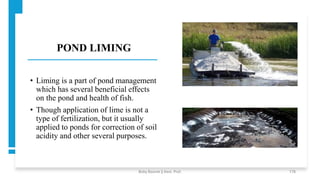
survival and health of the fish during transport.
Methods: Plastic bags with pure oxygen, closed tanks.
Optimal bag size: 30% water, 70% oxygen.
Preparation: Pre-test packing, oxygen sealing.
Boby Basnet || Asst. Prof. 312
Seed Transportation includes
1. Shipment in plastic bags under pure oxygen: Fish are conditioned by
starving for 12-24 hours, placed in double-layered bags with 25-30% water,
and filled with 70-75% pure oxygen. The bags are sealed, packed in insulated
containers, and acclimated at the destination to reduce stress and mortality.
2. Fish transport in open systems: Fish transport in open systems involves
using containers like tanks or buckets filled with water, where aeration is
provided manually or through devices to maintain oxygen levels. It is suitable
for short distances, with low stocking densities to minimize stress and
mortality.
3. Transport of fish in closed tanks: Transport of fish in closed tanks involves
sealed, water-filled containers equipped with oxygen supply systems, ensuring
stable oxygen levels and water quality. This method is ideal for long distances,
accommodating higher fish densities with minimal stress and mortality.
Boby Basnet || Asst. Prof. 313
Guide for Shipment
• Temperature and duration affect capacity.
• Example: Common carp (50 larvae at 25-30°C
for 12 hours).
• Use appropriate plastic thickness for fish size.
Boby Basnet || Asst. Prof. 314
BOBY BASNET
ASSISTANT PROF. (ANIMAL SCIENCE)
ILAM COMMUNITYAGRICULTURE CAMPUS
PURBANCHAL UNIVERSITY
boby.iaas333@gmail.com
FISH DISEASES AND PARASITES: INTRODUCTION, CAUSAL ORGANISM,
SYMPTOMS, AND CONTROL MEASURES.
315
Fish Diseases
Any alteration of the body or one of its organs so as to disturb normal physiological function.
Types of Diseases:
1. Infectious: Diseases due to the action of microorganisms (animal or plant).
a. Viruses: e.g. viral haemorrhagic septisemia, Carp pox, Infectous dropsy of carp (IDC)
b. Bacteria: Furuncolosis, Columnaris (tail of fin rot), Gill rot.
c. Fungi: Saprolegniasis
d. Protozoans: Ichthyophthiriasis or white spot disease, whiriling disease.
e. Metazoans: Dactylogyrosis
f. Crustaceans: Argulosis
2. Non-infectious: Diseases due to non-living causes (environmental, other).
• A very adverse environment can cause disease and mortalities directly (e.g., asphyxiation, gas
bubble disease, brown blood disease)
• The other category refers to nutritional, genetic and developmental diseases.
Boby Basnet || Asst. Prof. 316
Bacterial disease
1. Columnaris disease is a bacterial infection caused by
Flexibacter columnaris.
2. Symptoms: It causes skin lesions, fin rot, hemorrhages,
and rapid breathing in fish.
3. Treatment involves antibiotics and improving water
quality.
4. Prevention includes maintaining good water conditions,
reducing stress, and avoiding overcrowding. Early
intervention is crucial for controlling the disease.
Boby Basnet || Asst. Prof. 317
Saprolegniasis /water mold/ Cotton wool disease
1. Saprolegniasis (Water Mold or Cotton Wool Disease) is a
fungal infection caused by Saprolegnia, affecting fish,
especially when stressed or injured.
2. Symptoms include white, cotton-like growth on the skin,
gills, or fins, and lethargy. The fungus spreads through
wounds and poor water quality.
3. Treatment includes antifungal treatments (e.g., potassium
permanganate) and improving water quality.
4. Prevention involves maintaining clean water, minimizing
injuries, and quarantining new fish. Early intervention is
key to controlling the disease.
Boby Basnet || Asst. Prof. 318
Protozoan Disease: White spot disease
1. Ichthyophthiriasis (Ich Disease or White Spot
Disease) is a protozoan infection caused by
Ichthyophthirius multifiliis.
2. It causes white cysts on the skin, gills, and fins,
along with erratic swimming and rapid breathing.
3. Treatment includes copper-based medications,
formalin, and raising water temperature to speed up
the parasite's life cycle.
4. Prevention involves maintaining good water quality,
reducing stress, and quarantining new fish. Early
detection and treatment are crucial for controlling the
disease.
Boby Basnet || Asst. Prof. 319
Metazoan Disease-Dactylogyrosis
1. It is a parasitic disease caused by the flatworm Dactylogyrus,
affecting the gills of freshwater fish.
2. Symptoms include gill damage, excessive mucus production,
and abnormal swimming behavior.
3. Treatment involves anti-parasitic medications like formalin or
praziquantel, along with improving water quality.
4. Prevention includes quarantining new fish, maintaining clean
water, and reducing overcrowding. Early treatment and proper
care are crucial for controlling the disease.
Boby Basnet || Asst. Prof. 320
Diseases caused by crustaceans-
Argulosis
1. Argulosis is caused by Argulus (fish lice), crustaceans
that attach to fish, causing wounds, distress, and anemia.
2. Treatment includes anti-parasitic medications like
formalin or copper sulfate, and manual removal of
parasites.
3. Prevention involves quarantining new fish, maintaining
clean water, and reducing overcrowding. Early detection
and treatment are key to controlling the disease.
Boby Basnet || Asst. Prof. 321
Boby Basnet || Asst. Prof. 322

Aquaculture Full Note || Assistant Professor || Boby Basnet ||

  • 1.
    Aquaculture Boby Basnet Assistant Professor/AnimalScience Ilam Community Agriculture Campus Purbanchal University Boby Basnet || Asst. Prof. 1
  • 2.
    COURSE THEORY OUTLINE(30 Hours) Unit Topics Lectures No. 1. Introduction: definition of fish, fishery and aquaculture; general characteristics of fish, desirable characters of fish for culture; importance and scope, historical of fish development in Nepal. 3 2. Biology of cultivated fish species: morphological characters, feeding habits, growth rate and reproductive behavior of common carp, Chinese carp, indigenous major carp, Tilapia, Trout, Catfishes, Sahar, Silver carp and Freshwater prawns. 5 3. Water quality management: physical (temperature and turbidity), chemical (DO and pH) and biological (plankton) parameters of water. 4 4. Pond management: site selection for pond construction, liming, fertilization, feeds and feeding, role of plankton in fish production, aquatic weeds, and predators. 3 5. Fish farming systems: introduction, classification of fish farming system based on intensity, enclosure, fish species and integration. 4 6. Fish breeding: basic principles of fish breeding, breeding of common carp, Chinese carp, and indigenous Major carp, fish seed rearing and transportation. 4 7. Fish net and its uses. 2 8. Fish diseases and parasites: introduction, causal organism, symptoms, and control measures. 5 Total 30 hours Boby Basnet || Asst. Prof. 2
  • 3.
    BOBY BASNET ASSISTANT PROF.(ANIMAL SCIENCE) ILAM COMMUNITYAGRICULTURE CAMPUS PURBANCHAL UNIVERSITY boby.iaas333@gmail.com INTRODUCTION: DEFINITION OF FISH, FISHERY AND AQUACULTURE; GENERAL CHARACTERISTICS OF FISH, DESIRABLE CHARACTERS OF FISH FOR CULTURE; IMPORTANCE AND SCOPE, HISTORICAL OF FISH DEVELOPMENT IN NEPAL. 3
  • 4.
    Fish ➢Fishes are coldblooded aquatic vertebrates which breathe by means of pharyngeal gills and propelling and balancing themselves by means of fins. Fish usually have streamlined body but some are elongated, snake like and dorsoventrally suppressed. ➢They have a paired and unpaired fins supported by soft and spiny fin rays. ➢The size of fish varies from few cm to 18 meter or more in long. ➢The largest fish of the world is Rhinocodon typus (70 feet) and smallest is Paedocypris progenetica (7.9 mm). Fishes are the first successful class of chordates. ➢There are over 22,000 species of fish, comprising more than 50% of all are vertebrate species. ➢Fish includes animals belong to only super-class ‘Pisces’. ➢ Fish are also called ‘Pisces’ or ‘Ichthys’. Fishes are the first successful class of chordates. ➢Many types of aquatic animals named ‘fish’, such as shellfish, Crayfish, Jellyfish, Starfish, Cuttlefish, etc. are not a true fish. Boby Basnet || Asst. Prof. 4
  • 5.
    Ichthyology (Definition) ➢Ichthyology isthe study of the physiology, history, economic importance, etc. of fishes. ➢Ichthyology is the scientific study of fishes, including, as usual with a science that is concerned with a large group of organisms, a number of specialized subdisciplines: e.g. Taxonomy, Anatomy (or Morphology), Behavioral science (Etiology), Ecology, Physiology, Pathology and Genetics etc. ➢Ichthyology is derived (from Greek: ikhthus, means "fish"; and logos, means "study") is the branch of zoology devoted to the study of fish. ➢This includes skeletal fish (Osteichthyes), cartilaginous fish (Chondrichthyes), and jawless fish (Agnatha). ➢The modern fish relates to Agnatha and Gnathostomata are division of vertebrates. Boby Basnet || Asst. Prof. 5
  • 6.
    Some interesting factsabout fish 1. Ichthyology: The scientific study of fish. Father of aquaculture: Fan Lai. Heart is 2 chambered. 2. Respiration by gills. Fastest fish: Sail fish. Most beautiful fish: Zebra fish. 3. Most poisonous fish: Stone fish. Urinary bladder is absent in fish. 4. Protein of fish: <30%, 0.6 to 7.5% fat. 5. The optimum temperature of water for carp fish culture is 20 °C 6. There are 252 species of fish found in Nepal. 7. The most common cultured fish of Nepal categorized as: a. Major carp : Rohu, Mrigal, Catla-catla b. Common exotic carps: Common carp, Chinese carp (Silver carp, Bighead carp and Grass carp). c. Other Exotic Fish : Rainbow trout, Tilapia, Pangas d. Decorative fish: Gold fish, Koi Fish, Angel Fish Boby Basnet || Asst. Prof. 6
  • 7.
    Fishery Fishery is aneconomic activity that involves harvesting fish or any aquatic organism from the wild (Capture Fisheries) or raising them in confinement (Culture Fisheries/ Aquaculture). It may be Traditional/ Small Scale Fisheries (SSF) for sustenance, or Large-Scale/ Commercial Fisheries for profit. Aquatic organism which are exploited by the public as a common property resources with or without appropriate liscense is known as fishery. Eg. Riverine fishery, lake fishery, wetland fishery. Boby Basnet || Asst. Prof. 7
  • 8.
    a. Capture fisheries: ✓No stocking, Only harvesting. ✓ No management practices (e.g. feeding, fertilization, liming, monitoring etc.). ✓ Provides table fish for consumption, seed and feed for aquaculture, and seed for enhanced fisheries. b. Enhanced fisheries: ✓ Only stocking. ✓ No management practices (e.g. feeding, fertilization, liming, monitoring etc.). ✓ Harvesting. Provides table fish for consumption and feed for aquaculture. c. Culture fisheries (Aquaculture): ✓ The term aquaculture is derived from two Greek words: aqua means water and culture means farming. ✓ Aquaculture may be defined simply as farming in water. ✓ It is the aquatic equivalent of farming on land or agriculture, agri (field) and culture (farming). ✓ Aquaculture means the organized culture or cultivation of useful aquatic animals and plants in enclosed water bodies. ✓ Aquaculture includes farming of both plants and animals in both inland (freshwater) and coastal (seawater) waters. Boby Basnet || Asst. Prof. 8
  • 9.
    Aquaculture ➢Aquaculture is thefarming of aquatic organisms, including fish, molluscs, crustaceans and aquatic plants. ➢Aquaculture, also known as fish farming, is the practice of breeding, raising, and harvesting aquatic organisms such as fish, shellfish, and aquatic plants in controlled environments. ➢Farming implies some form of intervention in the rearing process to enhance production, such as regular stocking, feeding, protection from predators, etc. ➢Farming also implies individual or corporate ownership of the stock being cultivated. Boby Basnet || Asst. Prof. 9
  • 10.
    General characteristics offish 1. Fishes are aquatic, cold-blooded vertebrates. 2. Body of fish is generally fusiform and streamlined but also in globiform, puffers the body is globe shape and in eels is of serpentine form. In spite of many variations in shape the ground plan of body is bilateral symmetrical with prominent lateral line system. 3. The body of the fish generally covered by tough skin armored by variety of scales with anterior cephalization (concentration of sensory and brain structure in the anterior region). 4. The appendages of the fish comprise of the fins, which are generally paired (pectoral and pelvic fins) unpaired dorsal, anal and caudal fins. All supported by dermal fin rays. These fins constitute the main locomotary organs. Boby Basnet || Asst. Prof. 10
  • 11.
    1. Mouth generallysituated anteriorly in the head and the anus is in the second half of the over all length of the individual behind the bases of the pelvic fins & just in front of the anal fin. 2. Respiratory organs generally in the form of gills and other accessory respiratory organs. 3. Nostrils are paired and do not open into the pharynx, except in lung-fishes and lobed fishes. 4. Skeletal of the fishes are in form of notochord, connective tissues, bones, cartilage & non-bony scales. 5. The digestive tract of fish is well developed (with mouth, oral cavity, pharynx, esophagus, stomach, intestine & anus). 6. Heart is generally valved pump with one auricle & one ventricle, which is of venous type that forces the blood forward towards the gills for aeration. Boby Basnet || Asst. Prof. 11
  • 12.
    7. The kidneysof fish are paired, longitudinal structures that lie above the body cavity. 8. Brain is well developed with ten pairs of cranial nerves. 9. Middle ear is completely absent but internal ear with well-developed semi- circular canals. 10. Sexes are separate (male with claspers). 11. Some are viviparous (scoliodon or spadenose shar) and many are oviparous. 12. Generally fertilization is external (In some carps fertilization is internal). 13. Roe/Eggs are large with much yolk i.e. 0.5 to 5.5 mm. 12. Development is direct (without any metamorphosis). Boby Basnet || Asst. Prof. 12
  • 13.
    Desirable characters offish for culture 1. Rate of growth: Fish that grow to a bigger size in shorter period are appropriate for culture. Natural ability to grow faster. They attain marketable size in shorter period. Small fish species are not suitable for culture even if they have other good characters. E.g., Carps. 2. Short food chain: Fish being raised to have short food chain. The best fish are herbivorous, plankton eaters, omnivorous fish which feed on detritus. Carnivorous species generally need high protein diet so they are considered to be more expensive to produce. 3. Adaptation to climate: The cultured species of fish must be capable to adapt to the local climatic circumstances of the farm. 4. Tolerance: The fish must have the capacity to tolerate broad fluctuations in the physio- chemical conditions like ammonia, salinity, oxygen, temperature and so on of the water. 5. Acceptance of artificial feed: Whenever more number of fish is to be accommodated in an inadequate space, there is the requirement for supplementary feeding on compounded diets. The fish must show ready preference for such feeds. 6. Resistance: It is enviable that the cultured fish is hardly enough to resist the general diseases and attack of parasites. Boby Basnet || Asst. Prof. 13
  • 14.
    7. Amiability andcompatibility: The fishes proposed to be cultured altogether (‘poly culture’) must be able to live altogether without interfering or aggressive the other. The fish should reproduce in captivity. A fish that does not fulfill this condition cannot really be domesticated. 8. Feed conversion efficiency: The species of fish that give more edible flesh per unit of food consumed is favored. The species of fish which will give more edible flesh per unit of food consumed is preferred than which gives less flesh per unit weight. • Feed efficiency %= weight gain(kg)/Feed Intake*100 9. Consumer’s preference: Food preference of people differs with the geographic areas. Therefore, the species cultured must be simply marketable locally or to the targeted consumers. Reared fish should have high meat quality and suit the taste of consumers. 10. High fecundity: Fecundity refers to the number of eggs in the ovary of female prior to the spawning period. It is essential that reared fish should have high fecundity. 11. Economic and market consideration: Economically viable and easy to market. The chinese and Indigenous major carps possess most of these characters. Boby Basnet || Asst. Prof. 14
  • 15.
    MORPHOLOGY OF FISH •It is the outward appearance of fish body parts. • The purpose of observation of fish morphology is to provide an overview of the outer forms of fish that can be used as specific characteristics of fish to be identified. • Morphology of the external body of fish is divided into three parts, namely the head, body, and tail. • The outer parts of the fish body that are visible are the eyes, nose, mouth, fins, and scales. Boby Basnet || Asst. Prof. 15
  • 16.
    Parts of FishBody In general, fish body is divided into three parts, namely: A. Head: The head, which starts from the tip of the muzzle to the end of the tip of the gill at the back. In the head there are mouth, upper jaw, lower jaw, teeth, nose, eye, gills, gill cover, brain, heart, and so on. B. Trunk: The body part, i.e. from the end of the gill cap to the back of the rectal fin begins. In the body there are dorsal fins, pectoral fins, abdominal fins, and internal organs such as liver, gall, stomach, intestine, gonads, bubbles, kidneys, spleen, and so on. C. Tail: The tail, i.e. from the beginning of the anal fin to the tip of the rear tail fin. In the tail there is anus, anal fin, tail fin, and sometimes there are also scutes and finlets. Boby Basnet || Asst. Prof. 16
  • 17.
    Boby Basnet ||Asst. Prof. 17
  • 18.
    2. Eye: Itis located on the anterior end of the body, usually dorsal to the mouth. Eyes allow animals to see in the water. Depending on the fish, the eyes could be very big, very small, or somewhere in between. 3. Operculum: It is located laterally on the anterior end of the body. It is posterior to the mouth. The operculum is a bony plate that protects the fish’s gills and helps pump water through the gills so that oxygen can be taken up by the gills and delivered to the rest of the body. 4. Fins: Fish have several types of fins, each with unique functions that help them swim, stabilize, steer, and even communicate. 1. Paired Fins: I. Pelvic Fin: • It is typically located ventrally on the body, anterior to the anal fin (when it is present). Pelvic fins help fishes keep their balance in water. Pelvic fins are of the rounded fins used for turning and swimming. However, pectoral fins can look quite different and serve many functions. Some look more like legs and allow fish to “walk” on the seafloor. Some pelvic fins are sucker‐like and enable fishes to suction themselves onto various objects or even other organisms. Boby Basnet || Asst. Prof. 18
  • 19.
    II. Pectoral Fin:It is located laterally on the fish, posterior to the operculum. These fins can be used for changing direction and hovering just above the seafloor. They can also be modified to act as legs and help fish “walk” along the sea floor and feel out their environment around them. 2. Unpaired Fins: I. Dorsal Fin: It is dorsal on the body. The dorsal fin is used for steering, balance, and even defense‐ the spines (hard spiky things that poke our fingers) can be raised, poking predators that try to eat a fish. Fins can also have rays (these are also used for the structure of the fins but are not hard or spiky). II. Anal Fin: • It is located on the ventral side of the fish, anterior to the caudal fin. The anal fin is used for balance and steering. Not all fish have anal fins, but they can also be very tiny and hard to see. Boby Basnet || Asst. Prof. 19
  • 20.
    Boby Basnet ||Asst. Prof. 20
  • 21.
    5. Lateral Line: ➢Itis located laterally on each side of the body. The lateral line is a sensory system that enables fish to feel the vibrations and movement of the water. Fishes can feel where other animals, including a predator, are coming from even if they cannot see it. 6. Scales: ➢They are located laterally on the body. They protect fishes from attacks, parasites, and injuries they could receive from brushing up against hard substrates. Scales are covered in something called the slime layer. The slime layer is very important to the health of fishes. Based on the shape and material contained therein, the scales can be divided into 5 types: Boby Basnet || Asst. Prof. 21
  • 22.
    Placoid scale ✓ Thesetype of scales are small, pointed in shape and size. ✓ Denticles are found embedded in the dermal layer of their skin. ✓ It consists of a diamond-shaped or rhomboidal-shaped basal plate, having an opening of the pulp cavity and flat trident spine. ✓ Their basal plate remains embedded in the dermis which is held by sharpey’s and other connective tissue fibres and formed of a trabecular calcified tissue, the cement. ✓ Their spine is composed of a hard-calcareous substance and their dentine is coated externally with a hard and dense enamel. ✓ Examples of fishes having placoid scales are: sharks, skates and rays Boby Basnet || Asst. Prof. 22
  • 23.
    Ctenoid scale ✓ Thesetype of scales are similar to cycloid scales, but they feature spines or comb like teeth along their free edges ✓ It is composed of a central thicker part called ‘nucleus’ and numerous concentric lines of growth for finding the age of fish. ✓ On their posterior end numerous longitudinal grooves are present which are used for sucking nourishment from the fish skin. ✓ Pulp cavity and dentine are absent in them. ✓ These are the derivatives of ganoid scales in which ganoin layers, cosmine layers and bone cells are absent. ✓ Examples of fishes having ctenoid scales are: perch and sunfish. Boby Basnet || Asst. Prof. 23
  • 24.
    Cycloid scale ✓ Thesetype of scales are thin, flexible, translucent dermal plates. ✓ It is roughly circular in shape ✓ It is composed of a central thicker part called nucleus. ✓ Scales are smooth, disc -like scales more or less circular outline and anterior border is more or less rounded and remains exposed. ✓ Posterior part has numerous longitudinal grooves for sucking the nourishment from the fish skin. ✓ It is composed of a thin upper layer of bone and lower layer of fibrous connective tissue. ✓ Pulp cavity is absent in them. ✓ The cycloid scales are thin and roughly rounded in shape, being thicker in center and thinning towards the margin. E.g. Labeo, Catla etc. Boby Basnet || Asst. Prof. 24
  • 25.
    Ganoid scale: ✓ Theyare diamond-shaped and interconnected. ✓ They act like armour to form a nearly impenetrable barrier to predators. ✓ Examples of fishes having ganoid scale are: gars, bichirs and reed fish. Cosmoid scale: ✓ Example of fishes having cosmoid scale are: lobefins and lungfish ✓ Difference between cycloid and ctenoid scales: Assignment Boby Basnet || Asst. Prof. 25
  • 26.
    Fish internal Anatomy: Theinternal organs of the fish perform the basic function of the body such as respiration, digestion, and sensory function. The brain, stomach, liver, and kidneys are same as in man for the fish and perform the same function. Some organs are different; man has lungs to breathe whereas fish has gills for the same purpose. The name and function of the internal organs are listed below with their functions. Boby Basnet || Asst. Prof. 26
  • 27.
    1. Spine The fishbody is built on this main structural framework. This unit is connected to the skull at the front and to the tail at the back. Numerous vertebrae that are hollow make up the spine. These vertebrae house and protect the subtle spinal cord. 2. Swim Bladder or Air Bladder Swim bladder is hollow and gas filled organ. It allows the fish to conserve energy by enabling neutral resilience in water. Fishes that is deep in the water needs to release air from their swim ladder when they come up this is due to the difference in atmospheric pressure that circulate in the water surface. Fishes that do not possess an air bladder sink to the bottom of the water if they stop swimming. 3. Gills Gills help the fish to breathe under the water. Gills are the weak organ and it should not be touched by the hand when the fish is alive. Boby Basnet || Asst. Prof. 27
  • 28.
    4. Pyloric Caeca Thisorgan is present at the junction of the stomach and intestine. It has a finger like projection and its function is to secrete enzymes that help in digestion. It also helps to absorb the digested food. 5. Vent This organ is used to eliminate the waste from the fish body. 6. Gonads Gonads are the reproductive organs for the fish. In female fishes the bright organ that contains collection of eggs is clearly identifiable during the spawning period. The male reproductive organ is much smaller and less white in color. It produces milt for fertilizing the eggs. 7. Muscles This organ is also used for locomotion. This part is usually eaten by man as it contains certain vitamin deposits. Muscles compose the bone of the fish. • Boby Basnet || Asst. Prof. 28
  • 29.
    Body Parts withfunctions 1. Fins: A fin is a thin component or appendage attached to a larger body or structure. Fins give fish mobility, stability, and maneuverability. Fins are appendages used by the fish to maintain its position, move, steer and stop. Fins help in protection from predator. Fins are grouped into two types: A. Paired fins • Pectorals: Allows to fish to dive and also allows the fish to stay in one spot. • Pelvics or Ventricle: Balances and positions. Boby Basnet || Asst. Prof. 29
  • 30.
    B. Unpaired fins •Dorsal: Balance and close quarters movements • Caudal or tail: Helps to propel the fish • Anal: Balance and close quarters movements 2. Scale: Protective cover on fish that prevents injury or disease also indicates age. 3. Barbels: Bottom feeders, they only taste and feel. 4. Gills: Supply the fish with oxygen that they need from water. 5. Later line: Helps to detect vibration, sensors and helps the fish to find food and to navigate to avoid predators. 6. Swim bladder: (I) phonation, or sound producing; (2) respiration; accessory audition; (4) hydrostatic activities. 7. Nostrils: Are for smell. 8. Mucus covering: Protection from infections and disease. Also helps in swimming, lowering friction in the water. 9. Spine: Hard structure that supports the fins and used for defense. 10. Rays: Soft cartilage structure that supports the fins of the fish. 11. Operculum: Protects the gills and aids in breathing Boby Basnet || Asst. Prof. 30
  • 31.
    Digestive organs andmechanism of digestion in fish Boby Basnet || Asst. Prof. 31
  • 32.
    1. Alimentary canal •Mouth→Teeth→Buccalcavity→Oesophagus→Stomach→Pyloriccaeca→Rectum→Anus 2. Mouth: Prehension 3. Teeth: Mastication 4. Buccal cavity and gill racker: Protect gill filament from injury and assist fish in the process of ingestion. 5. Oesophagus: Mucus secretion, Taste buds are also present. 6. Stomach: Two types a. Anterior (Cardiac stomach): Herbivores, carnivorous b. Posterior (Pyloric stomach): Carnivorous Boby Basnet || Asst. Prof. 32
  • 33.
    • True stomachis absent in herbivores but present in carnivores, sac-like • Omnivorous: sac-like, somewhat gizzard like to grind feed. 8. Pyloric caeca: Anterior part of intestine, Fingerlike growth, Accessory food reservoirs, Enhance the absorptive area. 9. Intestine: Two parts a. Anterior part- small intestine b. Posterior part- large intestine ➢ The small intestine just behind the stomach receives ducts from the liver and pancreas is called as duodenum while rest part is called ileum. ➢ There is no clear out demarcation between small and large intestine and large intestine. ➢ The length of the intestine depends upon the feeding habit of the fish i.e. herbivore have long. Boby Basnet || Asst. Prof. 33
  • 34.
    Mechanism: ➢Digestion is theprocess of food degradation that allows the animal to absorb the nutrients present in it. As in the rest of vertebrates digestion is divided into two phases: mechanical digestion, where the feed is crushed, and chemical digestion, in which the digestive enzymes degrade food to nutrients that the animal is able to absorb. 1. Mechanical digestion: ➢Unlike other vertebrates, fish lack of salivary glands in the oral cavity, so that their function is limited to capture and crush the food. In some species, the secretory glands are replaced by mucus-producing ones, which favors the transit of food. The mouth is continued with the pharynx, which is perforated laterally by the gill arches. In some species, like most Cyprinids, dentiform structures appear in the fifth gill arch, which favor the crushing. The esophagus is responsible for regulating the entry of water and food, sometimes it has salivary glands. It has striated muscles to regurgitate the ingested food. The stomach is responsible for initiating chemical digestion and stores and mixes the food. In some herbivorous species, the stomach has a highly developed and circular musculature that crushes vegetal material, acting as the gizzard of birds. Boby Basnet || Asst. Prof. 34
  • 35.
    2. Chemical digestion ➢Asmentioned above, fish lack of salivary glands in the oral cavity and, therefore, chemical digestion begins in the stomach, or directly in the intestine if the species lack of the former. The stomach has cells that secrete hydrochloric acid, which hydrolyzes the food and promotes enzymatic activity by decreasing pH. ➢Pepsin is the main enzyme secreted in the stomach and is responsible for the degradation of proteins by hydrolysis of peptide bonds. Those species that feed on crustaceans have, in addition to pepsin, other enzymes of great importance: chitinases, enzymes responsible for the degradation of the exoskeleton of crustaceans. In the gut, most of the digestion and absorption of nutrients is performed. Although the absorption of nutrients is similar throughout the entire digestive tract, lipid digestion tends to occur in the anterior region and protein digestion in the posterior region. Boby Basnet || Asst. Prof. 35
  • 36.
    Taxonomical classification ofFish: 1.Kingdom: Animalia 2.Phylum: Chordata 3.Class: Teleosteii 4.Order 5.Family 8. Genus 6. Species Kingdom- Animalia Phylum- Chordata Subphylum- Vertebtae Super class- Pisces Class- Osteichtyes (Bony fish) Sub-class- Actinoptergii Super order- Teleostei Boby Basnet || Asst. Prof. 36
  • 37.
    S.N. Order FamiliesSpecies Characteristics 1. Anguliforms Anguellidae Anguilla bengalensis (Raj bam) Serpentine body 2. Beloniforms Belonidae Xenetodon cancila (Kauwa maccha) Beak like structure 3. Clupeiformes a. Clupedia b. Engraulidae Gudusia chapra Setipinna phase Lateral line absent 4. Cypriniforms a. Cyprinidae a. Labeo rohita (Rohu), Cirrhina mrigala (Naini), Catla catla (Bhakur) Head is without scale and gills opening are side. 5. Cypriodontoforms Aplocheilus Poecillidae Aplocheilus spp. Gambusia spp. Adipose fin is absent. 6. Muguliforms a. Mugilidae Rhinomugli Ventral part of body silivery, paleor yellowish while dorsal and caudal part are dusky. 7. Osteoglossiforms a. Notopteridae a. Notopterus spp./Chitala spp. 8. Percifoms a. Ambassidae a. Chanda The jaws are provided with teeth. 9. Siliuriforms a. Siliuridae Wallago attu Adipose fin may be present or absent. Dorsal fin spineless and short Anal fin is long, Nasal barbel absent. 10. Synbranciforms a. Astacembelidae b. Synbranchidae Macrognathus (gaichi), Mastacembelus Monopterous cuchia ✓ The eyes are small. Ventral fin is absent. ✓ Body enlarged and eel shaped. Low jaw is longer. 11. Tetraodontiforms Tetraodontidae Tetraodon spp. Small mouth and gill opening. No anal fins. Boby Basnet || Asst. Prof. 37
  • 38.
    IMPORTANCE Fishes are veryimportant to man economically 1. As food-Nutritional value 2. Fish by-products 3. Biological Control (To control diseases) 4. Recreational Value 5. Industrial value 6. Decorative Value 7. Ecological balance 8. Employment opportunities 9. Medicinal importance 10. Other uses Boby Basnet || Asst. Prof. 38
  • 39.
    1. Fishes asFood: Fish has been a key part of the human diet since ancient times, valued for its rich protein, fat, vitamins A and D, and easy digestibility. Fish can be preserved by smoking, salting, freezing, or quick refrigeration. Both marine and freshwater species, such as Labeo, Catla, and Trygon, are consumed. Shark fins are notably used to make soup. 2. Fish By-Products: Fish by-products include fish liver oil, rich in vitamins A and D, and fish body oil, which contains traces of these vitamins. Liver oil has medicinal uses due to its vitamin content. Fish are a rich source of protein, vitamins, minerals, and omega-3 fatty acids, which support heart health and reduce the risk of heart disease. 3. Fish as food for livestock: Fish meal, a dried fish product, is a highly nutritious feed for poultry, pigs, and cattle. It contains 55-70% protein, 2-15% fat, and 10-20% minerals, along with vitamins A, B, D, E, K, and B12. Rich in calcium (5%), phosphorus (4%), and iodine, fish meal supports tissue and bone growth in livestock. 4. Biological Control: Larvivorous fishes like Puntius, Gambusia, and Danio prey on insect larvae, including mosquito larvae, helping to control diseases like malaria by reducing mosquito populations. Boby Basnet || Asst. Prof. 39
  • 40.
    5. Recreational Value:Fishing is a popular outdoor activity, with species like Schizothorax, Tor tor, and Catla commonly caught in Nepal's scenic river valleys, offering adventure and enjoyment. 6. Industrial Value: Fish serves as a vital protein source, supporting livelihoods through fishing, marketing, and industries like refrigeration, preservation, canning, and fish by-product production. 7. Fish Glue and Isinglass: Fish connective tissue is used to make liquid glue for paper, wood, and glass. Air bladders are processed to produce isinglass, a pure gelatin used to clarify wine, beer, make jelly, and adhesives. 8. Fish Leather: The skin of sharks and rays is used to make polishing materials and products like shoes, bags, and belts. Dried shark skin, known as shagreen, serves as an abrasive. 9. Decorative and Industrial Uses: Fish body oil is used in paints, varnishes, soaps, leather dressing, tanning, lubricants, candles, printing inks, plastics, and boat preservation. Fish liver oils, like cod and shark liver oil, are rich in vitamins A and D. Shark liver oil from Bombay duck is especially used in paints. Boby Basnet || Asst. Prof. 40
  • 41.
    Scope of aquaculturein Nepal Boby Basnet || Asst. Prof. 41
  • 42.
    History of Aquaculture Late1950s: Modern aquaculture began with the introduction of Common Carp (Cyprinus carpio). Mid-1960s: Successful breeding of Common Carp achieved. Early 1970s: Introduction of three Chinese carps (C. idella, H. molitrix)). Late 1970s: Breeding of indigenous major carps (L. rohita, C. mrigala, and C. catla) established. 2003 B.S.: Fisheries unit established under NARC, institutionalizing aquaculture in Nepal. 2004 B.S: First fisheries development program launched. 2010 B.S.: Fish Development Section established. 2021 B.S.: Fish-cum-paddy farming introduced. 2028/29 B.S.: Cage fish rearing system started. 2063/64 B.S.: One Village One Product" (OVOP) program introduced, focusing on Rainbow Trout farming in Rasuwa and Nuwakot. 2064/65 B.S.: Fish Mission Program launched. 2070 B.S.: Bachelor in Fisheries program started at AFU. 2073/74 B.S.: Pangas fish imported from Thailand. 2075/76 B.S.: Directorate of Livestock and Fishery Development established in all provinces after Nepal's new constitution was promulgated. Boby Basnet || Asst. Prof. 42
  • 43.
    BOBY BASNET ASSISTANT PROF.(ANIMAL SCIENCE) ILAM COMMUNITYAGRICULTURE CAMPUS PURBANCHAL UNIVERSITY boby.iaas333@gmail.com INTRODUCTION: BIOLOGY OF CULTIVATED FISH SPECIES: MORPHOLOGICAL CHARACTERS, FEEDING HABITS, GROWTH RATE AND REPRODUCTIVE BEHAVIOR OF COMMON CARP, CHINESE CARP, INDIGENOUS MAJOR CARP, TILAPIA, TROUT, CATFISHES, SAHAR, SILVER CARPAND FRESHWATER PRAWNS. 43
  • 44.
    Boby Basnet ||Asst. Prof. 44 S.N. Fish Species Feeding Niche Reproduction 1. Common Carp Column and Bottom Feeder Natural and Artifical 2. Grass Carp Column Feeder Natural and Artifical 3. Silver Carp Surface and Column Feeder Natural and Artificial 4. Bighead Carp Surface and Column Feeder Natural and Artificial 5. Rohu Column Feeder Natural and Artificial 6. Naini Surface and Column Feeder Natural and Artificial 7. Catla Surface, Column and Bottom Feeder Natural and Artificial 8. Sahar Surface ad Bottom Feeder Natural and Artificial 9. Catfish Surface and Column Feeder Natural and Artificial 10. Trout Surface, Column and Bottom Feeder Natural and Artificial 11. Tilapia Surface, Column and Bottom Feeder Natural and Artificial
  • 45.
    Feeding Niche Boby Basnet|| Asst. Prof. 45
  • 46.
    CHINESE CARP 1. Grasscarp (Ctenopharyngodon idella) 2. Silver carp (Hypophthalmichthys molitrix) 3. Marble carp or bighead (Aristichthys nobilis) Boby Basnet || Asst. Prof. 46
  • 47.
    Grass carp Boby Basnet|| Asst. Prof. 47
  • 48.
    Boby Basnet ||Asst. Prof. 48
  • 49.
    Grass carp (CtenopharyngodonIdella) This is an exotic carp brought in Nepal from India and Japan in 1967 and 1968, respectively. The body of this fish is elongated and cylindrical with large, greenish scales. Head broad, barbells absent and mouth sub-terminal with upper jaw slightly longer than lower jaw. Usually it has a toothless mouth, but has specialized pharyngeal teeth for grasping aquatic vegetation. Gill rakers are short and sparse. Boby Basnet || Asst. Prof. 49
  • 50.
    Boby Basnet ||Asst. Prof. 50
  • 51.
    Boby Basnet ||Asst. Prof. 51
  • 52.
    Gill rakers arethe finger-like structures projecting across the slit that help keep food from escaping through the slits or damaging the gills, which are the organs of gas exchange. Branchial arches, or gill arches are a series of bony "loops" present in fish, which support the gills. Gill filaments: The soft, red, fleshy part of the gills, through which oxygen is taken into the blood from the water passing through the gills. Gill Boby Basnet || Asst. Prof. 52
  • 53.
    Feeding habits • Grasscarp is a column/marginal feeder, herbivorous and feed on wide variety of aquatic macro-vegetation including certain terrestrial plants. • The nature of food of grass carp fry is protozoa, rotifers, nauplius larvae and minute aquatic plants. • It is a voracious feeder and can consume 50-60% weight of grass per day of its body weight. • But digestion of fish is said to be incomplete and about half the food material ingested is excreted as faeces. • The fry and longer fish takes substances like cereals brans, silkworm pupae. Boby Basnet || Asst. Prof. 53
  • 54.
    Growth rate It isone of the fast growing fish attains 1-2 kg in the first year. Largest size attains is 1.5 m and 50 kg. It is of large, turbid rivers and associated floodplain lakes, with a wide degree of temperature tolerance (about 20 to 30 °C). Boby Basnet || Asst. Prof. 54
  • 55.
    Reproductive behavior fish •It is seasonal breeder, matured in 2-3 years and artificial breeding is done by hypophysation. • The breeding season is April/May when the water temperature is 22-27°C. Boby Basnet || Asst. Prof. 55
  • 56.
    Silver carp (Hypophthalmichthysmolitrix) This is an exotic fish introduced to Nepal from India and Japan in 1967 and 1968, respectively. This fish is characterized by flat and laterally compressed body covered by small slivery scales. Head small, barbells absent, mouth upturned with lower jaw longer than upper and the abdominal keel is complete. The posterior margin of the pectoral fin does not extend beyond the base of the pelvic fin. Gill rakers are dense, interlaced, connected and covered with a spongy sieve membrane. Boby Basnet || Asst. Prof. 56
  • 57.
    Silver Carp Boby Basnet|| Asst. Prof. 57
  • 58.
    Feeding Behavior: Itis surface, phytoplankton feeder but young fry feed zooplankton such as rotifers and nauplius larvae. Growth rate: Its growth in the first year is 1-2 kg, largest size attains 40-50 kg. Reproductive Behavior: • It is a seasonal breeder, matured in 2-3 years and artificial breeding is done by hypophysation. • The breeding season is April to July when the temperature is 22-28°C. • The major problem with this species is stress intolerance, highly nervous and active fish during handling. • Due to handling stress sometimes, high mortality can occur. • So requires careful handling should be done. Boby Basnet || Asst. Prof. 58
  • 59.
    Bighead carp (Aristichthysnobilis) This is an exotic fish introduced to Nepal from America and Hungury in 1969 and 1972, respectively. This fish is characterized by flat and laterally compressed body covered by small slivery scales brownish above. Head long and massive, barbells absent, mouth large, upturned with lower jaw longer than upper and the abdominal keel is incomplete. The posterior margin of the pectoral fin does not extend beyond the base of the pelvic fin. Gill rakers are dense, interlaced, connected and covered with a spongy sieve membrane Boby Basnet || Asst. Prof. 59
  • 60.
    Bighead carp Boby Basnet|| Asst. Prof. 60
  • 61.
    Feeding Habit: Itis surface, zooplankton feeder but young fry feed on unicellular phytoplankton, rotifers and nauplii such as rotifers and nauplius larvae. Growth Rate: Its growth in the first year is 1-2 kg, largest size attains 40-50 kg. Boby Basnet || Asst. Prof. 61
  • 62.
    Reproductive Behavior It isa seasonal breeder, matured in 2- 3 years and artificial breeding is done by hypophysation. The breeding season is May to July when the temperature is 22- 28°C. This is docile and hardy fish for transportation and handling Boby Basnet || Asst. Prof. 62
  • 63.
    Common Carp (Cyprinuscarpio) Boby Basnet || Asst. Prof. 63
  • 64.
    Morphology • Common carpis the most important cultivated fish in the world which was introduced to Nepal in 1956 and 1960 from India and Israel, respectively. • It belongs to Order Cypriniformes and family Cyprinidae. • It is native to Central Asia and is very widely distributed all over the world. • It is an ideal fish for aquaculture. • There are lots of morphological variations through artificial breeding and natural selection of this species. Among many varieties of common carp, two varieties are under culture in Nepal: the scale carp or German carp (Cyprinus carpio var. communis) with the body completely and uniformly covered with golden scales in regular rows; and the mirror carp or Israeli carp (Cyprinus carpio var. specularis with the body covered unevenly with few large shiny scales. • Common carp characterized by flat and deep body, short and small head, protractile mouth and two pairs of maxillary barbells. • The dorsal fin is long with a sharp spine.Boby Basnet || Asst. Prof. 64
  • 65.
    • Body elongatedand somewhat compressed. • Lips thick. Two pairs of barbels at angle of mouth, shorter ones on the upper lip. • Dorsal fin base long with 17-22 branched rays and a strong, toothed spine in front; dorsal fin outline concave anteriorly. Anal fin with 6-7 soft rays; posterior edge of 3rd dorsal and anal fin spines with sharp spinules. • Lateral line with 32 to 38 scales. Pharyngeal teeth 5:5, teeth with flattened crowns. • Color variable, wild carp are brownish-green on the back and upper sides, shading to golden yellow ventrally. • The fins are dusky, ventrally with a reddish tinge. • Golden carp are bred for ornamental purposes. • Common carp is the first domesticated fish species in the world, which is the main fish candidate for being cocultured with rice in paddy fields Boby Basnet || Asst. Prof. 65
  • 66.
    Feeding Habits • Itis a bottom feeder, omnivorous and feeds on insect larvae, worms, molluscs, detritus, fresh and decayed vegetation and accepts formulated feed also. • Carp are omnivorous, with a high tendency towards the consumption of animal food, such as water insects, larvae of insects, worms, molluscs, and zooplankton. • Common carp and Grass carp are mostly cultured in Nepal. • Common carp dwells in the bottom and feed on the bottom insects, insect larvae, zooplankton, dead and decayed vegetation whereas grass carp dwells in the middle layer and feeds on aquatic vegetation, terrestrial plants and plankton in the water column. • Voracious in nature. Boby Basnet || Asst. Prof. 66
  • 67.
    Growth Rate • Thegrowth of scale carp in the first year is 1-2 kg and that of mirror carp is 2-3 kg. Largest size attains is 50 cm and 18 kg. common carp is multiple breeder and can breed up to 5 times a year. • Carps can reach 0.6 to 1.0 kg body weight within one season in the polycultural fish ponds of subtropical/tropical areas. • Growth is much slower in the temperate zone: here the fish reach the 1 to 2 kg body weight after 2 to 4 rearing seasons. • Growth is much slower in the temperate zone: Male carp are matured within a period that is 25-35 percent shorter. Boby Basnet || Asst. Prof. 67
  • 68.
    Reproductive Behavior Sexual maturityattains in the first or second year. It breeds easily in ponds without hypophysation. Artificial breeding with hypophysation is also common The embryonic development of carp takes about 3 days at 20-23 °C However the peak breeding season in Nepal is March/April in terai and April/May in the hills. Boby Basnet || Asst. Prof. 68
  • 69.
    BIOLOGY OF CULTIVATEDINDIGENOUS FISH Important indigenous cultured fishes of Nepal ✓ A native fish species that is indigenous to a specific place or regions. ✓ Favorable and suitable to that environment. ✓ Exist from a long period of time is known as indigenous fish species. a. Rohu (Labeo rohita) b. Catla/Bhakur (Catla catla) c. Mrigal/Naini (Cirrhinus mrigala) Boby Basnet || Asst. Prof. 69
  • 70.
    ROHU (LABEO ROHITA) BobyBasnet || Asst. Prof. 70
  • 71.
    MORPHOLOGICAL CHARACTERS • Body bilaterally,Scales are cycloid. • Snout projects beyond mouth and is fairly depressed, eyes dorsolateral in position, mouth small and inferior. • Lips are lobate, thick with a distinct inner fold to each lip. • One pair of small maxillary barbels concealed in lateral groove. • Jaws devoid of teeth, three rows of pharyngeal teeth. • Dorsal fin rays are three to four which are simple and unbranched. • Mostly found in tropical and sub-tropical region. Pectoral fin devoid of an osseous spine and caudal fin is deeply forked. • Body coloration-bluish on back, silivery on flanks and belly. • Both paired and unpaired fin are well developed. Boby Basnet || Asst. Prof. 71
  • 72.
    FEEDING HABITS • Inits early stage of life rohu prefer zooplankton, mainly rotifers and cladocerans and phytoplankton comprise to form its emergency food. • In the fingerling stage, it prefer to feed on all the zooplanktonic organism and few smaller phytoplankters like desmids, phyflagellates and algal spores. • On the other hand, adults show strong positive selection for the most of the phytoplankton. • In juvenile and adult stages rohu is essential an herbivores column feeder and prefer algae and submerged vegetation. • However the gut analysis, indicates its bottom feeding habits due to occurrence of decayed organic matter, mud and sand in its gut. Boby Basnet || Asst. Prof. 72
  • 73.
    GROWTH RATE • Rohuis eurythermal species and does not survive below 14°C. • It is fast growing species. • It attains about 35-45 cm total length and 700-800g in one year under normal culture condition. • It is observed that in polyculture, its growth rate is higher than that of mrigal but lower than catla. • Rohu is cultured along with Catla catla and Cirrhinus mrigala Boby Basnet || Asst. Prof. 73
  • 74.
    REPRODUCTIVE BEHAVIOR • Itattains first maturity at the age of two years in both the sexes, whereas complete maturity is attained after four years in males and five years in females. • The spawning season of rohu generally from April to September. • In natural conditions, spawning occurs in the shallow and marginal areas of flooded rivers. • The optimum temperature for spawning is 22-31°C. • However breeding does not take place in such lentic pond environments; thus induced breeding becomes necessary. • Rohu is seasonal breeder and artificial breeding is done by hypophysation. • The fecundity is 271 egg/gms body weight • Rohu is a polygamous fish and also seems to be promiscuous. Boby Basnet || Asst. Prof. 74
  • 75.
  • 76.
    CIRRHINUS MRIGALA (NAINI) BobyBasnet || Asst. Prof. 76
  • 77.
    MORPHOLOGICAL CHARACTERS • Bodybilaterally symmetrical and streamlined, its depth about equal to length of head. • Scales are cycloid and present on whole body except head region. • Snout is blunt, often with pores. • Broad mouth, transverse, upper lip is entire and not continuous with lower lip, lower lip most indistinct. • One pair of short barbel. • Pharyngeal teeth in three rows • Dorsal fin as high as body with 12 or 13 branched rays. • Pectoral fins shorter than dorsal and caudal fin deeply forked/divided. • Body coloration-usually dark grey above, slivery beneath. • Dorsal fin greyish and pectoral, pelvic and anal fins orange-tipped during breeding season. Boby Basnet || Asst. Prof. 77
  • 78.
    FEEDING HABITS • Hatchlingsof mrigal normally confine themselves to the surface or sub-surface waters. • The fry and fingerling tend to move to deeper water. • Adult are bottom dwellers • It is stenophagus ( feeding insect) and illiophage (typically feed on mud) fish in its feeding habit. • The principal food components of its diet are detritus and decayed vegetation, at the same time phytoplankton and zooplankton comprises the rest • Phytoplankton, Zooplankton Boby Basnet || Asst. Prof. 78
  • 79.
    GROWTH RATE • Eurythermalin nature and is reported to tolerate a minimum temperature of 14 ºC • It attains 700-800g in one year under normal culture condition. • Among the three Indian major carps, mrigal is normally considered as a slow grower then catla and rohu. • As the growth rate reduces after two years the rearing period is usually confined to maximum of two years, only. • However, mrigala is reported to survive for about twelve years in natural waters. • It is observed that in polyculture, its growth rate is lower than that of rohu and catla. • Cirrhinus mrigala is cultured along with Catla catla and Rohu. Boby Basnet || Asst. Prof. 79
  • 80.
    REPRODUCTIVE BEHAVIOR • Maturityis attained in two years in captivity. • Mrigal does not breed in ponds as it needs a fluviatile environment for it. • Induced breeding by hypophysation and the use of synthetic hormones. • Mrigal is a highly fecund fish i.e. 147 eggs/gms body weight. • Fecundity increases with age and normally ranges from 100000-150000 eggs/kg body weight. • The spawning season is May to September. • Mrigal usually breeds at a temperature of 24-31 ºC • As mrigal does not breed in confined waters, injections of pituitary extract and other synthetic commercial formulations: ovaparim. Boby Basnet || Asst. Prof. 80
  • 81.
  • 82.
    CATLA CATLA (BHAKUR) BobyBasnet || Asst. Prof. 82
  • 83.
    MORPHOLOGICAL CHARACTERS • Lipsprominent and thick. • Barbels absent. • Body coloration: grayish on dorsal and silivery on the lateral and ventral side. • Fins colour: blackish overall but pectoral, ventral and anal fins have orange tings at the base. • Scales: cycloid except on mouth and head. • Lips: thick, fringed • Head: Large and broad. Length of head ranges from 4 cm to 7 cm. • Size: It reaches upto 182 cm length. Boby Basnet || Asst. Prof. 83
  • 84.
    FEEDING HABIT • Catlecatle is a planktivorous carp. A planktivore is an aquatic organism that feeds on planktonic food, including zooplankton and phytoplankton. • Preferably feeding on zooplankton. • It is freshwater surface feeder. • Feeding preferences and nutritional requirements change according to the development stage. • Maximum feeding activity is seen during the morning hours (6 to 9 am). • Larvae of Catla start feeding after 4 days of hatching on Brachionus and napuli. • Feeds on large sized prey once the mouth gap increases. • Fingerlings feeds on planktonic algae, vegetable debris along with larger size zooplankton. • Adults predominantly feeds on surface and mid-water. Boby Basnet || Asst. Prof. 84
  • 85.
    GROWTH RATE • Theaverage size of freshly hatched catla larvae is 4.7 mm. • After 5 days- average size 9 mm. • After 10 days- average size 15.6 mm • After 15 days- average size 27 mm respectively. • Growth dependents on the density of the fishes stalked. • Fast growing species. • 300-400g in the first year, over 2 kg at the end of the second year, and 5-6 kg after 3 years. Boby Basnet || Asst. Prof. 85
  • 86.
    REPRODUCTIVE BEHAVIOR • Catlaattains sexual maturity at an average age of two years and an average weight of 2 kg. • Catla breed during the monsoon season in rivers. • Induced breeding by hypophysation and the use of synthetic hormones. • Fecundity increases with age and normally ranges from 80000-120000 eggs/kg body weight. • The spawning season is May to September. • Catla usually breeds at a temperature of 25-32 ºC • As Catla catla does not breed in confined waters, injections of pituitary extract and other synthetic commercial formulations: ovaparim. Boby Basnet || Asst. Prof. 86
  • 87.
  • 88.
    HORMONES USED FORARTIFICIAL BREEDING • Ova prim • Pituitary gland • Luteinizing releasing hormone-analogue • Human chorionic gonadotropin Boby Basnet || Asst. Prof. 88
  • 89.
    ARTIFICIAL PROPAGATION • Artificial breedingrefers to a process in which some stimulants, hormones or pituitary extracts are injected in the brood fishes, which do not spawn in the closed water bodies causing the fishes to spawn. Boby Basnet || Asst. Prof. 89
  • 90.
    Tilapia Scientific Name: Oreochromisniloticus. Environmental Conditions: ❖ Tilapia are adaptable to a wide range of environmental conditions, including freshwater, brackish water, and even some marine environments. ❖ They thrive in warm water temperatures ranging from 77°F to 86°F (25°C to 30°C). ❖ Tilapia can tolerate poor water quality conditions but perform best in well-oxygenated water with pH levels between 6.5 and 8.5. Boby Basnet || Asst. Prof. 90
  • 91.
    Pond culture: Tilapiaare commonly raised in earthen or concrete ponds designed with proper depth, size, and water circulation for optimal growth. Adequate aeration, water exchange, and moderate water turbidity are essential to maintain quality and fish health. Tilapia thrive in a pH range of 6.8–7.8, so monitoring pH levels is critical. Feeding Habit: Tilapia are omnivorous, feeding on zooplankton, phytoplankton, and balanced commercial diets rich in protein, carbohydrates, lipids, vitamins, and minerals. Feeding frequency and quantity are adjusted based on fish size, water temperature, and growth rates. Harvesting: Tilapia reach market size in 6 to 9 months, depending on conditions and feeding. Harvesting methods include seining, netting, or draining ponds. Fish are processed on-site or transported live for cleaning, gutting, and packaging. Reproduction: Artificial Breeding Boby Basnet || Asst. Prof. 91
  • 92.
    Trout Scientific name: Oncorhynchus mykissis a cold-water fish native to Pacific Ocean in Asia and North America. Environmental Conditions: ❖ Trout are cold-water species and require cool, well-oxygenated water with temperatures ranging from 50°F to 60°F (10°C to 15.5°C). ❖ Cultivation is often done in freshwater streams, rivers, lakes, or specially designed raceways with constant flow-through water systems. Boby Basnet || Asst. Prof. 92
  • 93.
    ❖ Trout arecommonly raised in raceways, which are long, narrow channels with continuous water flow. ❖ Raceways provide high water quality and oxygenation, promoting optimal growth and health. ❖ Water quality parameters such as temperature, dissolved oxygen(9 mg/l), and ammonia levels are closely monitored and controlled. Boby Basnet || Asst. Prof. 93
  • 94.
    Feeding and Nutrition: •Trout are carnivorous and require high-protein diets rich in fishmeal or other protein sources. • Feeding practices involve providing floating pellets or extruded feeds several times a day to match the fish's metabolic needs. Harvesting and Processing: ❖ Trout are typically harvested when they reach market size, which varies depending on the strain and farming conditions. ❖ Harvesting methods include netting, electrofishing, or draining raceways. ❖ Fish are processed on-site or transported to processing facilities for gutting, filleting, and packaging. Reproduction: Artificial Breeding. Boby Basnet || Asst. Prof. 94
  • 95.
    CATFISHES, SAHAR ANDFRESHWATER PRAWNS ASSIGNMENT Boby Basnet || Asst. Prof. 95
  • 96.
    BOBY BASNET ASSISTANT PROF.(ANIMAL SCIENCE) ILAM COMMUNITYAGRICULTURE CAMPUS PURBANCHAL UNIVERSITY boby.iaas333@gmail.com WATER QUALITY MANAGEMENT: PHYSICAL (TEMPERATURE AND TURBIDITY), CHEMICAL (DO AND PH) AND BIOLOGICAL (PLANKTON) PARAMETERS OF WATER. 96
  • 97.
    Water • Water iscommon substance. • It fills the oceans, rivers, and lakes. • It is in the ground and also in the air we breathe. • Water is used for drinking, all domestic purposes, agriculture, industrial applications, cleaning and recreation. • On average, each person in the a developed country uses about 260 liters of water a day in the home. • The quality of water is equally important than quantity. • Even if present in huge amounts, we cannot use salt water in many life support activities. Boby Basnet || Asst. Prof. 97
  • 98.
    Water Quality Parameters BobyBasnet || Asst. Prof. 98
  • 99.
  • 100.
    Temperature • Water temperaturesin the ponds are related to solar radiation and air temperatures. • Water temperatures closely follow air temperatures. • The absorption of solar energy as light passes through water heats the water. • Light energy is absorbed exponentially with depth so most heat is absorbed within the upper layer of water. • This is particularly true in fishponds because high concentrations of dissolved organic matter and particulate matter greatly increases the absorption of energy as compared to less turbid water. • The transfer of heat from upper to lower layer of water depends largely upon mixing by wind. The density of water is dependent upon water temperature. • Ponds and lakes may stratify thermally, because heat is absorbed more rapidly near the surface of water body and the warm upper waters are less dense than cool lower waters. Boby Basnet || Asst. Prof. 100
  • 101.
    Thermal stratification • Thermalstratification refers to the horizontal separation of a relatively warmer surface layer of water from cooler bottom waters. • The principle behind thermal stratification is that water increases in density as it gets colder to about 4 °C • Stratification occurs when there is differentiation in density of upper and lower strata. • Upper stratum- Epilimnion • Lower stratum- Hypolimnion • Between stratum- Thermocline/metalimnion Boby Basnet || Asst. Prof. 101
  • 102.
    Epilimnion ➢The top-most layerin a thermally stratified pond. ➢It is warmer and typically has a higher pH and higher dissolve oxygen concentration. ➢It contains the most Phytoplankton. Boby Basnet || Asst. Prof. 102
  • 103.
    Metalimnion ➢ A thinbut distinct layer. ➢ Also called thermocline. ➢ Temperature changes more rapidly with depth than it does in the layers above or below. ➢Factors: seasonal weather variations, latitude and local environmental conditions, such as tides and currents etc. Boby Basnet || Asst. Prof. 103
  • 104.
    Hypolimnion • Bottom layerof water in a thermally-stratified lake. • Hypolimnion is the coldest layer of a pond in summer, and the warmest layer during winter. • Insufficient light for photosynthesis. • It is isolated from surface wind-mixing. Boby Basnet || Asst. Prof. 104
  • 105.
    • The ordinarywarm water fish pond seldom has an average depth of more than two meters and surface area of more than few hectares. • However, marked thermal stratification may develop even in very shallow ponds because turbid condition result in rapid heating of surface water in the calm sunny days. • Stratification prolongs for a season for large lakes while pond stratify during daylight hours in warm months and destratify at night when the upper layer of water cool by conduction. Heavy wind and disappearance of heavy plankton bloom may cause the destratification Boby Basnet || Asst. Prof. 105
  • 106.
    Destratification Mixing of layersof water due to air turbulence, disappearance of heavy plankton bloom, mixing of two water mass with different properties. Boby Basnet || Asst. Prof. 106
  • 107.
    Water temperature andfish growth ➢ Fish are cold blooded animal. ➢ The rate of biochemical process in fish are temperature dependents, oxygen consumption increased with temperature. ➢ Maximum growth might be from 25-30 °C. ➢ For cold water fish optimum temperature range is 10- 20 °C and warm water fish 20-32 °C. ➢Temperature determines the growth of fish and the nature of soil-inhabiting microbes. ➢Metabolism of the fish body is also largely influenced by the temperature of the water. ➢ Metabolism of fish increases as temperature of the surrounding water increases. As a result, the fish grow rapidly. So, fish grow faster in summer than in any other season. ➢Inversely, in winter season fish grow very slowly, as their metabolic rate becomes very slow so they take a very small amount of food. ➢So, in the winter season, there is very less requirement of food in the fish pond. Boby Basnet || Asst. Prof. 107
  • 108.
    Temperature management infish ponds Maintain the pond water depth (not less than 1m) Maintain Provide temporary shade to the ponds in hot months. Provide Avoid fish shading in cold month. Avoid Avoid fish handling during very high and low temperature. Avoid Exchange pond water whenever required Exchange Boby Basnet || Asst. Prof. 108
  • 109.
    Turbidity Turbidity refers tothe decreases ability of water to transmit by light caused by suspended particulate matter in the water. Turbidity is the measure of suspended solids in the water. When the water is clear, there is low turbidity; when the water is cloudy, there is high turbidity, which allows less light to penetrate through the water. Boby Basnet || Asst. Prof. 109
  • 110.
    TYPES OF TURBIDITY A.Mineral turbidity ▪ High content of silt and/or clay particles, water a light brown, sometimes reddish colour B. Plankton turbidity ▪ High content of minute plants and animals brown, green, blue-green or yellow-green, depending on which plankton species is dominant. C. Humic turbidity ▪ Presence of humus, which turns the water a dark brownish colour. Boby Basnet || Asst. Prof. 110
  • 111.
    METHODS TO MEASURETHE TURBIDITY OF WATER 1. Secchi disc method ➢ A Secchi disk is 20 cm in diameter and made of metal or plastic which is painted with alternating black and white quadrants. The disk is attached to a tape that is marked in meters. ➢ Secchi Disk Transparency is a quick, simple and accurate method for determining lake water quality. Note: Readings should be taken from May through September at two week intervals if possible. Readings should be taken between 9:00 am and 3:00 pm.This is when the sun is most directly overhead. https://youtu.be/9j4EgKvo7Bw?si=eZvfRJl5yiOduabv Boby Basnet || Asst. Prof. 111
  • 112.
    MEASURING TURBIDITY WITHTHE SECCHI DISC TRANSPARENCY Secchi disc transparency Interpretation <25 cm To much plankton, don’t fertilize 25-40 cm Fertilization and oxygen situation is best resulting good fish production. 40-60 cm Fertilize the pond >60 cm too less plankton, no enough natural food to eat, double the dose of fertilizer. Boby Basnet || Asst. Prof. 112
  • 113.
    POND FERTILIZERS • Mineralor inorganic fertilizers, which contain only mineral nutrients and no organic matter; they are manufactured industrially to be used in agriculture for improving crop production and they can be obtained from specialized suppliers; • Organic fertilizers, which contain a mixture of organic matter and mineral nutrients; they are produced locally, for example as wastes from farm animals or as agricultural wastes. Boby Basnet || Asst. Prof. 113
  • 114.
    The use offertilizers to increase the production of natural food for fish Boby Basnet || Asst. Prof. 114
  • 115.
    1. Fertilizers arenatural or synthetic substances that are used in ponds to increase the production of the natural food organisms to be eaten by the fish. By increasing the availability of major nutrients, fertilizers promote the development of planktonic algae, which provide food for many fish. 2. When a fertilizer is added to a fish pond, the chemicals it contains dissolve in the water and taken up by the phytoplankton for growth, reproduction, etc. Similarly these chemicals attached to the organic and mineral particles present, both in the pond water and in the upper layers of the bottom mud or soil. 3. Most of these phenomena are linked with and controlled by water quality and in particular temperature, pH, alkalinity and dissolved oxygen level. https://www.fao.org/fishery/static/FAO_Training/FAO_Training/General/x6709e/x6709e06.htm Boby Basnet || Asst. Prof. 115
  • 116.
    Boby Basnet ||Asst. Prof. 116
  • 117.
    2. Suspended solidsmeasurements method • 1 liter of pond water taken , filtered using glass fiber filter • The solids particles are dried, weighed and calculated in mg/L • Desirable range for fish culture is 25 to 80 mg/L Boby Basnet || Asst. Prof. 117
  • 118.
    3. Nephelometric method •It is the accurate method of turbidity. • It is an instrument that measures scattered light. • More turbidity more amount of scattered light • Turbidity from other than natural sources shall be restricted to not exceed the following numerical limits: ✓Cool Water Aquatic Community/Trout Fisheries: 10 Nephelometric Turbidity Units (N.T.U.) ✓Lakes: 25 N.T.U. ✓Other surface waters: 50 N.T.U. • https://youtu.be/PCsWGxsZWoQ?si=Ff1iPi7tOtNCuEJH Boby Basnet || Asst. Prof. 118
  • 119.
    EFFECT OF TURBIDITY •Reduce light penetration caused siltation of bottom of substrate ,effect vision of fish. • Turbidity has little direct effect on fish but excessive turbidity may cause interfere gill function that cause respiration problem. • Cause siltation of bottom substrate- reduce pond depth. • Adsorbs and desorbs the nutrients of pond water. • High turbidity also clogs fish gills, destroys fish habitat, and impairs water for drinking use. Boby Basnet || Asst. Prof. 119
  • 120.
    Electrical Conductivity ➢ Electricalconductivity measures the ability of water to conduct an electrical current. The higher the concentration of dissolved charged chemicals (also known as salts) in the water, the greater the electrical current that can be conducted. Examples of charged ions that naturally occur in river water include calcium, potassium, chloride, sulphate and nitrate. ➢ Conductivity is a vital parameter when determining water quality. ➢As salinity and temperature increase, conductivity also increases, which can have a negative effect on the quality of water. This is because the higher the conductivity, the higher amount of impurities (dissolved substances, chemicals, and minerals) are in the water. ➢https://atlas-scientific.com/blog/how-does-conductivity-affect-water-quality/ Boby Basnet || Asst. Prof. 120
  • 121.
    Water Depth S.N. Waterdepth Depth Area 1. Nursery Pond 0.8-1 m 100-200m² Hatchling for 2-3 weeks 2. Rearing Pond 0.8-1m 200-400m² Fry for 2 month 3. Production Pond 1-1.5m 2000-4000m² Fingerling rearing for market 4. Segregation Pond 1.5-2m 2000-4000m² Rearing for brood fish 5. Spawning Pond 0.1-1m 5-10m² Pond for only Breeding Boby Basnet || Asst. Prof. 121
  • 122.
    Water color • Greenis best if presence of phytoplankton is more • Yellow, brown and red if presence of zooplankton is more • Black silt turbid water is not desirable Boby Basnet || Asst. Prof. 122
  • 123.
    Chemical Properties • Dissolvedoxygen • pH Boby Basnet || Asst. Prof. 123
  • 124.
    Dissolve Oxygen (DO) Dissolvedoxygen is the most critical water quality parameter in aquaculture. Dissolved oxygen (DO) is a measure of how much oxygen is dissolved in the water. It is essential to most aquatic organisms for their respiration. It is also necessary during the process of decomposition. Growth rate and food conversion efficiency will suffer and feed will be wasted if fish suffered from DO deficiency. Epilimnion has higher DO concentration than hypolimnion. Boby Basnet || Asst. Prof. 124
  • 125.
    Dissolved oxygen requirement •Cold fish Species has less capacity to extract oxygen from water than water. So more DO (8 mg/l) is needed for cold species than warm water fish species (5mg/l). • Method: Dissolved oxygen levels can be measured by a basic chemical analysis method (titration method), an electrochemical analysis method (diaphragm electrode method), and a photochemical analysis method (fluorescence method). The diaphragm electrode method is the most widely used method. • https://youtu.be/XsU8eJjwFmc?si=KXIacGgk2QV3jYAa Boby Basnet || Asst. Prof. 125
  • 126.
    Diel fluctuation ➢There ismarked fluctuation in dissolved oxygen concentration during a 24 hours period in ponds. ➢Concentration of dissolved oxygen is lowest in the early morning at or just after sunrise, increase during daylight hours to a maximum during late afternoon, and decrease again during the night. ➢ During daylight, photosynthesis usually produces more oxygen than is removed from the water by the combined respiratory demand of plants and animals. ➢The net result is an increase in dissolved oxygen during the day. Photosynthesis stops at night, but respiratory and decomposition processes continue to use oxygen. ➢The magnitude of fluctuation is greatest in ponds with heavy plankton blooms and least in ponds with low plankton abundance. Boby Basnet || Asst. Prof. 126
  • 127.
    Oxygen solubility inwater depends on: 1. Temperature • Oxygen solubility decrease with increasing water temperature. • As the temperature of water increases, the solubility of oxygen in water decreases. This is because the oxygen molecules are less attracted to the water molecules at higher temperatures. The increased temperature also causes the water molecules to move around more, which makes it more difficult for the oxygen molecules to attach to them. Boby Basnet || Asst. Prof. 127
  • 128.
    2. Light intensity •Oxygen solubility increase with increasing light intensity. • Oxygen production increased as the light intensity increased due the greater availability of light energy for photosynthesis Boby Basnet || Asst. Prof. 128
  • 129.
    3. Atmospheric pressure •Oxygen solubility increase with increasing atmospheric pressure. The lower the atmospheric pressure, the less oxygen can be held. • An increase in pressure makes the gas molecules in the solute compress, thus creating more room for additional gas molecules. Boby Basnet || Asst. Prof. 129
  • 130.
    4. Water depth •Oxygen solubility increases with water depth and volume. • At deeper depths, oxygen gradually increases as lower temperatures increase the solubility of oxygen. 5. Salinity • Oxygen solubility decrease with increasing salinity. • The more saline the water, the less oxygen it can hold because saltwater has less space for oxygen molecules due to the sodium and chloride ions it contains. 6. Current Velocity • The faster water flows, the more atmospheric oxygen is mixed into the water. • Fast-moving water generally has more oxygen than still water, because the movement mixes the air into the water. Boby Basnet || Asst. Prof. 130
  • 131.
    Source and Sinkof oxygen in the pond Sources • Photosynthesis • Diffusion Sinks • Respiration • Diffusion • Decomposition Boby Basnet || Asst. Prof. 131
  • 132.
    1. Photosynthesis: ▪ Photosynthesisof phytoplankton is the major contributor of DO during the day. 6CO2+6H2O→C6H12O6+6O2. 2. Diffusion: ▪ Direct diffusion from atmosphere Boby Basnet || Asst. Prof. 132
  • 133.
    Sinks of oxygenin the pods Respiration • Respiration by fish, plants, Decomposer organisms (mainly bacteria) consume oxygen. • C6H12O6 + 6O2 → 6CO2 + 6H2O + energy (in form of ATP) • Carbohydrate + Oxygen → Carbon Dioxide + Water + Energy Boby Basnet || Asst. Prof. 133
  • 134.
    Diffusion • When theoxygen tension in pond water exceed (supersaturated) than oxygen tension of atmosphere, the oxygen from the pond water diffuse out to the atmosphere. Decomposition • Decomposition of organic matters utilize oxygen. Boby Basnet || Asst. Prof. 134
  • 135.
    Dissolved Oxygen lackingconditions in ponds • If biochemical oxygen demand (B.O.D.) of the pond is high, this is due to high organic load. Decaying plant and animal matter consume substantial amounts of oxygen in the decaying process. • Cloudy day with little sunlight will reduce the photosynthetic oxygen contribution to dissolved oxygen resulting lacking DO in the pond. • Unusually high temperatures will lower the solubility of oxygen in water and hence low dissolved oxygen. • If too much fishes are stocked. Boby Basnet || Asst. Prof. 135
  • 136.
    Sign of lowdissolve oxygen in the fish ponds • Piping: Fish come to the water surface and gulp air bubbles very frequently. • Fish aggregate at the water inlet. • Fish not feeding well of even stop feeding. Boby Basnet || Asst. Prof. 136
  • 137.
    Maintaining DO inthe pond • Add oxygenated/ cool water • Stirring of pond water; using mechanical aerator, boating etc. • Use chemical like potassium permanganate 1kg/1.5 bigha land. https://fb.watch/oN2ZDQWBJu/ • Increase photosynthesis • Increase sun light availability • Thinning out of fishes • Reducing/stop feeding • Reduction decomposition • Avoid over feeding • Avoid over fertilization • Liming (500kg/ha) • Remove the pond bottom mud if it exceed above one feet. Boby Basnet || Asst. Prof. 137
  • 138.
    Preventive measure • Avoidplanting large tree on dike • Avoid overstocking • Avoid overfeeding • Stop feeding and fertilization in cloudy and rainy days. Boby Basnet || Asst. Prof. 138
  • 139.
    pH ➢The pH isdefined as negative logarithm of hydrogen ion concentration and indicate whether water is acidic or alkaline in reaction and is measured on a scale of 0-14. pH = -log[H⁺] Where (H⁺) is the amount of hydrogen ions in a solution in moles per liter. ➢Pure water has 0.0000001 mole per liter of free H+ and OH ion. ➢For any aqueous solution, the product [H+ ] [OH- ] must equal to 10-14 at 25 °C. Boby Basnet || Asst. Prof. 139
  • 140.
    pH is negativelogarithm of H+, H+ = 0.0000001 mole per liter H+ = 10-7 Taking log on both sides, Log (H+ ) = Log (10-7 ) Taking –ve on both side, -Log (H+ ) = - Log (10-7 ) -Log (H+ ) = - ( -7) -Log (H+ ) = 7 Thus, According to the definition of pH, pH = 7 Thus the pH of normal water is 7 which is called neutral, above and below this is alkaline and acidic, respectively. Most natural water have pH values between 5 and 10, with the greatest frequency of values falling between 5 and 10, with the greatest frequency of values falling between 6.5 and 9. Boby Basnet || Asst. Prof. 140
  • 141.
    Different factors affectthe pH of pond water 1. CO2 ➢Although carbon dioxide (CO2) is highly soluble in water. ➢Carbon dioxide acts as an acid in water as shown below: H2O + CO2 = H2CO3 H2CO3 = H+ + HCO3 ➢It usually assumed that carbon dioxide cannot make water more acid than pH 4.5, trace amount of carbon dioxide is present above pH 8.3 and below which no carbonate occurs. Boby Basnet || Asst. Prof. 141
  • 142.
    2. Bicarbonate andcarbonate ➢Natural waters usually contain more bicarbonate. ➢The carbon dioxide in natural waters reacts with bases in the rocks and soil to form bicarbonate, as illustrate for alkaline earth carbonates, calcite (CaCo3). CaCO3 + CO2 + H2O = Ca2+ + 2HCO3 HCO3 CO2 + OH− (This OH− is the cause to increase pH at the day time) H2O + CO2 H2CO3 (This H+ is the cause to decrease pH at the night time) Optimum range of pH for aquaculture is 6.8-8.6. Boby Basnet || Asst. Prof. 142
  • 143.
    Dial fluctuation ofpH in pond Boby Basnet || Asst. Prof. 143
  • 144.
    Averaging pH • Convertthe given pH value into their respective hydrogen ion concentrations. • Calculate the average value of hydrogen ion concentrations. • Reconvert this average value into pH value. Example Calculate the average value of pH 8 and pH 7 From the definition of pH, pH 7 means, 10-7 (H+ = 0.0000001) pH 8 means, H+ = 10-8 (H+ = 0.00000001) Averaging H+ = 0.00000001+0.0000001)/2 H+ = 0.000000055 -log (H+) = - log (0.000000055) -log (H+) =7.259637311 From the definition of pH pH =7.25 Boby Basnet || Asst. Prof. 144
  • 145.
    Effect of pHon fish Low pH • Reduce appetite • Inhibit growth and reproduction • Excessive production of mucus on the gills which interfere with respiration. • More attack of parasites and disease • Acid death (pH 4 and lower) • High pH • Damage cornea and lens of the eyes. • Disturb blood acid base balance • Slow growth rate • Alkaline death (pH 11 and higher) Boby Basnet || Asst. Prof. 145
  • 146.
    Boby Basnet ||Asst. Prof. 146
  • 147.
    pH management inthe ponds ➢Liming of acidic pond ➢Low pH: Liming the pond @ 500-1000 kg/ha/yr depending upon pH. ➢High pH: Use carbonic fertilizer (compost), nitrogenous fertilizer (urea, ammonium sulphate), gypsum (calcium sulphate) in alkaline ponds. Boby Basnet || Asst. Prof. 147
  • 148.
    Method of pHmeasurement A. pH indicator paper • A thin strip of paper (such as chemically treated litmus paper) is partly dipped into water to be tested. • The colour of the paper changes and this new colour is compared to color chart, which gives the pH value according to the colour obtained. (Note: Litmus paper is divided into two categories: red litmus paper and blue litmus paper. If the material is acidic, the blue litmus paper turns red. If the material is basic or alkaline, the red litmus paper turns blue) Boby Basnet || Asst. Prof. 148
  • 149.
    B. Color comparator ➢Cheapwater-testing kits can be bought from special chemical suppliers. ➢They usually include a number of liquid indicators. ➢A few drops of one of these colour indicators are added to a small water sample, and new colour of the solution is compared with a set of standard colours supplied with the testing kit. ➢https://youtu.be/We1NV6aHycU?si=SCbnJEcoJxNUrYUy Boby Basnet || Asst. Prof. 149
  • 150.
    pH meter • pHprovides the easiest way for determining the water pH, even in the field, but it is relatively expensive. • The pH value is directly read from the meter after placing the glass electrodes in a water sample. • Such electrodes are very fragile and should be well protected when being transported. • They should be accurately calibrated in buffer solutions of known pH, at regular intervals. Boby Basnet || Asst. Prof. 150
  • 151.
    Biological Properties Plankton ➢Plankton isthe community of minute plants or animals suspended, floating or weakly swimming in open water. ➢Plankton are of two ecological groups a. Phytoplankton: Plant origin (Autotrophs) b. Zooplankton: Animal origin (Heterotrophs) Boby Basnet || Asst. Prof. 151
  • 152.
    • Plankton, especiallyphytoplankton is an important part of the fish pond. • Phytoplankton is the base of the food web, and fish production is directly related to phytoplankton abundance. • But unmanaged growth of phytoplankton may cause the water quality problem in fish ponds. Boby Basnet || Asst. Prof. 152
  • 153.
    Types of phytoplankton 1.Cyanophyta 2. Chlorophyta 3. Euglenaophyta 4. Chrysophyta 5. Xanthophyta 6. Bacillariophyta 7. Pyrophyta Boby Basnet || Asst. Prof. 153
  • 154.
    Cyanophyta (Blue greenalgae) • Usually blue green in colour with homogeneous cell contents. • Example Nostoc, Anabaena, Oscillatoria, Mycrocystis Boby Basnet || Asst. Prof. 154
  • 155.
    Chlorophyta (Green algae) ➢Largercells than blue green algae with distinct contents and are green in colour. ➢Cells with two or more flagella. ➢Example: Chlamydomonas, Pandorina, Eudorina, Volvox, Chlorella, Cosmarium Boby Basnet || Asst. Prof. 155
  • 156.
    Euglenophyta (Euglenoids algae) •Slow moving euglenoids algae having single flagella. • Numerous disc shaped chloroplasts present. • Example: Euglena, Phacus, Trachelomonas, Leptoconclis Boby Basnet || Asst. Prof. 156
  • 157.
    Chrysophyta (Golden algae) •Cells with no transverse furrows. • Example: Danobryon, Ochromonas, Mallomonas Boby Basnet || Asst. Prof. 157
  • 158.
    Xanthophyta (Yellow algae) Example:Botryococcus, Tribonema Boby Basnet || Asst. Prof. 158
  • 159.
    Bacillariophyta (Diatoms) • Cellswalls ornamental with punctate or striae (rows of holes). • Examples: Melonsira, Cyclotella, Fragillaria, Tabellaria, Navicula, Diatoma Boby Basnet || Asst. Prof. 159
  • 160.
    Pyrrophyta (Dinoflagelletes) • Cellswith transverse furrow. • Chromatophores brown. • Cells globular of top-shaped. • Example: Ceratium, Gymnodium, Peridinium Boby Basnet || Asst. Prof. 160
  • 161.
    Different types ofzooplankton Boby Basnet || Asst. Prof. 161
  • 162.
    Protozoa • The unicellularanimals with extreme diversity. • Protozoa exhibit various modes of movement, including cilia, flagella, or pseudopodia (temporary extensions of the cell membrane). • Protozoa are generally heterotrophic, meaning they obtain their food by ingesting other microorganisms or organic matter. Some are predators, while others are parasites. • Examples: Arcella, Paramecium, Verticella, Didinium • https://www.britannica.com/video/22036/beating- cilia-protozoans-water Boby Basnet || Asst. Prof. 162
  • 163.
    Rotifer • Rotifer (commonlyknown as rotifers) is a phylum of microscopic, multicellular organisms that are mainly found in freshwater environments, although some species can also be found in marine and terrestrial habitats. Rotifers are notable for their unique wheel-like structure called the corona, which is used for feeding and locomotion. Here are some key characteristics and information about Rotifer. • Rotifers are typically small, ranging from less than 0.1 mm to a few millimeters in size. • They have a bilaterally symmetrical body with a head, trunk, and foot. Boby Basnet || Asst. Prof. 163
  • 164.
    Cladocera (Water Fleas) •Cladocera's are small, freshwater zooplankton with a protective carapace. • They have a distinct jerky swimming motion, resembling a hopping flea. • Example: Sida, Daphina Moina, Bosmina, Leptodora. Boby Basnet || Asst. Prof. 164
  • 165.
    Copepods • Copepods areone of the most abundant and diverse groups of zooplankton. • They have a single eye and a segmented body, often transparent or translucent. • Example: Cyclops, Macrocyclops, Mesocyclops, Microcyclops, Eucyclops. Boby Basnet || Asst. Prof. 165
  • 166.
    Ostracoda ➢Found in awide range of aquatic environments, including fresh, marine, and brackish waters. ➢They are minute bean-shaped crustaceans, common in all types of fresh water. ➢Size: small from less than 1 mm to a few millimeters. ➢Some ostracods are free swimming, some move about on the surface of the water while others are creeping forms that live amount plants or burrow in the mud at the bottom of the pond. ➢Examples: Cypris Boby Basnet || Asst. Prof. 166
  • 167.
    Worm like zooplanktons •Mainly insect larvae or nymph. • The midges and the mosquitoes are the most abundance groups of animals. • Example: Chironomus (eggs, larvae, pupae), Culex (eggs, larvae, pupae). Boby Basnet || Asst. Prof. 167
  • 168.
    Role of phytoplankton 1.Primary Producers: • Phytoplankton are primary producers, utilizing sunlight through photosynthesis to convert carbon dioxide and nutrients into organic matter. They form the base of the marine and freshwater food webs, providing essential energy for other organisms. 2. Oxygen Production: • During photosynthesis, phytoplankton release oxygen as a byproduct. They contribute a substantial portion of the Earth's oxygen production, making them essential for the global oxygen cycle Boby Basnet || Asst. Prof. 168
  • 169.
    3. Nutrient Cycling: Phytoplanktonplay a crucial role in nutrient cycling, particularly in marine ecosystems. They take up nutrients such as nitrogen, phosphorus, and silica from the water, incorporating them into their biomass. When phytoplankton die, sink, or are consumed, these nutrients are released back into the water, fueling further growth. 4. Base of the Food Web: Phytoplankton form the primary trophic level in aquatic food webs. Zooplankton, small fish, and other marine organisms feed on phytoplankton, initiating the transfer of energy through the food chain. 5. Support for Fisheries: Phytoplankton productivity influences the abundance and distribution of zooplankton and small fish, which, in turn, support larger fish populations. Many commercially important fish species depend on phytoplankton-driven productivity for their survival. Boby Basnet || Asst. Prof. 169
  • 170.
    Role of zooplankton •Major food for zooplankton feeder. • Major food item for larvae or juveniles of most fish species. Boby Basnet || Asst. Prof. 170
  • 171.
    Estimation of Plankton •Estimation of plankton abundance are used to asses the effect of pond management practices on phytoplankton or zooplankton communities to predict changes in dissolved oxygen concentration at night and to evaluate the need for water exchange in intensive fish culture ponds. • Many different techniques have been used to estimate plankton abundance, but only few methods have found wide use in fish culture. • The most popular measure of phytoplankton and zooplankton abundance are listed below: Boby Basnet || Asst. Prof. 171
  • 172.
    Phytoplankton ➢Secchi disk visibility ➢Chlorophyll-adetermination ➢Primary productivity ➢Direct enumeration Zooplankton ➢Direct enumeration Boby Basnet || Asst. Prof. 172
  • 173.
    Phytoplankton control • Algicides:Copper sulphate @ 1-2 mg/L (photosynthesis and respiration inhibitor), Simazine @ 0.2 mg/L (photosynthesis inhibitor). • Plankton feeding fish: Siliver carp, Nile tilapia. • Macrophytes: Culture of aquatic macrophytes to utilize nutrients. • Dyes: Reduce light penetration. • Water exchange: 5-10% water exchange per day. Boby Basnet || Asst. Prof. 173
  • 174.
    BOBY BASNET ASSISTANT PROF.(ANIMAL SCIENCE) ILAM COMMUNITYAGRICULTURE CAMPUS PURBANCHAL UNIVERSITY boby.iaas333@gmail.com POND MANAGEMENT: SITE SELECTION FOR POND CONSTRUCTION, LIMING, FERTILIZATION, FEEDS AND FEEDING, ROLE OF PLANKTON IN FISH PRODUCTION, AQUATIC WEEDS, AND PREDATORS. 174
  • 175.
    POND MANAGEMENT Management ofa pond is based on the purposes of the pond, whether it is for fishing, wildlife, swimming, aesthetics, or other purposes. It includes; 1. Site selection for pond construction 2. Pond Liming, 3. Pond fertilization 4. Feed and Feeding 5. Wild and Predatory fishes 6. Aquatic weeds control Boby Basnet || Asst. Prof. 175
  • 176.
    SITE SELECTION Right selectionof site is probably the most important factor in determining the feasibility of viable operations. Site selection will be based on the species to be cultured and the technology to be employed. It may be possible to find solutions when factors are unfavorable and present problems, but it would involve increased investment and operating cost and would affect the profitability. In land based aquaculture, like Nepal, the most farms have earthen ponds, soil characteristics, quality and quantity of available water and ease of filling and drainage, especially by gravity, are basic considerations. Boby Basnet || Asst. Prof. 176
  • 177.
    Flooding: Do nothave flood problem from last 10 years data Land slope: Land should not steeper than 2%. Steeper land limit the pond size, increase the excavating cost and increase the risk of erosion. Room for further expansion: The increasing farm site will increase the management cost. Vegetation: Dense vegetation particularly tall trees makes cleaning more difficult and expensive. Land under grass or low shrubs is much better suited in this respect. In the wind prone area tall tree near the pond may act as an effective wind breaker but side by side it provides the niche for fishing birds. Water table: The water table just below the bottom of the pond is suitable for aquaculture. Soil characteristics: Sandy clay to clay loam soil are considered suitable for pond construction. Source and nature of pollution: Crop land that would have treated for long period with pesticides may have residue that are harmful to fish and shell fish. Accessibility: The farm should have access to the electricity, road, input market etc. to run the business well. Social security: The community around the proposed site should be business friendly and have positive attitude to industrialization. Boby Basnet || Asst. Prof. 177
  • 178.
    POND LIMING • Limingis a part of pond management which has several beneficial effects on the pond and health of fish. • Though application of lime is not a type of fertilization, but it usually applied to ponds for correction of soil acidity and other several purposes. Boby Basnet || Asst. Prof. 178
  • 179.
    Advantages of Limingin Pond • In general, it enhances pond productivity, improves sanitation and acts as prophylactic and therapeutic, • Kills pond bacteria, fish parasites and their intermediate lifecycle stages. • Build up alkaline resources and effectively stops the fluctuation of pH by its buffering action. • Renders acidic water unsuitable for aquaculture by raising pH to alkaline level. • Improves pond soil quality by promoting mineralization. Boby Basnet || Asst. Prof. 179
  • 180.
    • Precipitates excessdissolved organic matter and reduces chances of oxygen depletion. • Supplies Calcium (Ca) needed for plant growth and for bone and scales formation in fish. • Reduces the poisonous effect of Iron compounds and, Magnesium (Mg), Potassium (K), and Sodium (Na) ions. • Increase the pH of bottom mud and thereby increases the availability of phosphorus added in water. Boby Basnet || Asst. Prof. 180
  • 181.
    Time of limingin Pond • Liming fish ponds is not always necessary. • In certain case, it may not only be a waste of money but it can also be harmful to the fish. • Thus, before making any decision, the pond should be carefully studied in particular of water any decision, the pond should be carefully studied in particular of water quality and bottom soil characteristics. Boby Basnet || Asst. Prof. 181
  • 182.
    ➢When pH istoo low: if the pH of the pond water and bottom soil is less than 6.5, liming is justified. ➢When alkalinity is too low ➢When organic matter content is too high ➢When the deposition of pond bottom mud is too high and water gives foul odour. ➢When there is threat of oxygen depletion. ➢When there is a threat of outbreak of contagious disease or parasites. ➢When prophylactic measures are needed. ➢When fertilization fails to produce an adequate plankton bloom. Boby Basnet || Asst. Prof. 182
  • 183.
    Liming materials • Compoundsuseful as liming materials contain either calcium or calcium and magnesium associated with an anionic radical that will neutralize acidity. • Three basic chemicals are commonly used for liming fish ponds. 1. Agricultural lime ➢Calcite, CaCO3 ➢Dolomite, CaMg(CO3 )2 2. Hydrated lime or Slaked lime or Builder’s lime ➢Calcium hydroxide, Ca (OH)2 3. Quick lime or Burnt lime ➢Calcium oxide, CaO Boby Basnet || Asst. Prof. 183
  • 184.
    How to increasepH Boby Basnet || Asst. Prof. 184
  • 185.
    Neutralizing Value andFineness • The term neutralizing value refers to the relative abilities of liming materials to neutralize acidity. • Pure CaCO3 is assigned a neutralizing value of 100% and is the standared against which other materials are compared. • For example, the molecular weight of CaCO3 is 100 and that of CaO is 56. 56 units of CaO equals to 100 units of CaCO3.100 units of CaO equals to 100/56* 100= 179 units of CaCO3. • Thus, the neutralizing value of CaO relative to the CaCO3 standard is 179 percent. Boby Basnet || Asst. Prof. 185
  • 186.
    Methods of Liming •Water-filled pond: Through inlet or broadcast • Dried pond: By broadcasting Boby Basnet || Asst. Prof. 186
  • 187.
    Liming dose • Itis based on soil pH. • If the soil pH is low, high amount of lime is required and vice-versa. • Liming dose at different pH value is given below: pH value 4-5 5-6.5 6.5- 7.5 7.5- 8 8 or more Amount of lime (kg/ha/yr) 2000 1000 500 200 No need of limimg Boby Basnet || Asst. Prof. 187
  • 188.
    POND FERTILIZATION • Pondfertilization is one of the key factors in increasing the productivity and maximum carrying capacity. • In ponds fertilization is aimed at developing natural food and saving formulated feeds. • It provides nutrients to encourage rapid growth of phytoplankton which are the primary producer in the ponds. • Fertilizers are natural or synthetic substances that are used in ponds to increase the production of the natural organisms to be eaten by the fish. • The fertilizers used in fish culture ponds are of two categories: 1. Organic fertilizers 2. Inorganic fertilizers Boby Basnet || Asst. Prof. 188
  • 189.
    Organic fertilizers • Heapingat corner of the pond with a sunny exposure. • Making platforms about 30 cm under water. Boby Basnet || Asst. Prof. 189
  • 190.
    Inorganic fertilizers The differentinorganic fertilizer used in the fishponds are classified as: • Nitrogenous fertilizer: Urea-46% N- Ammonium Sulphate, 20-21%N • Phosphorus fertilizer: SSP 18-20% P2O5 TSP 44-54% P2O5 • Potassium fertilizer: Muriate of potash (MoP) 60% K2O • Compound fertilizer: DAP 18% N, 48% P2O Boby Basnet || Asst. Prof. 190
  • 191.
    Organic Fertilizer ➢Organic fertilizerare composite in nature and contain all the natural elements required for the metabolic cycle. ➢Organic fertilizers may be of following types: a. Livestock manure b. Compost c. Green Manure d. Night soil Boby Basnet || Asst. Prof. 191
  • 192.
    Advantage • Improve thepond soil water holding capacity • Relatively inexpensive • Readily available on-farm • Slow nutrient release for long time • Also provide micronutrients • Also serve as direct source of food for certain fish species • Encourage bacterial growth and zooplankton bloom Disadvantage • Difficult to transport • Low content of primary nutrient (N,P,K). • High demand of BOD which may cause oxygen depletion of pond water when applied at high rates Boby Basnet || Asst. Prof. 192
  • 193.
    Time of fertilizationin pond ➢New pond, don’t formed good bottoms muds. ➢Low turbidity ( >40 cm secchidisk visibility) ➢ When pond is not green ➢Periodic basis (weekly or forthnightly). Boby Basnet || Asst. Prof. 193
  • 194.
    Fertilizer Application method Chemicalfertilizer ➢Dissolve in the water and spray all over the pond. ➢Large application of fertilizer at ling interval is wasteful because much of the phosphorus is adsorbed by the pond muds and nitrogen is lost through denitrification. ➢Never throw solid fertilizers directly into the pond water especially phosphate fertilizer, because the bottom mud can quickly absorb and turn the soluble phosphate into insoluble compounds, which are than limited use for the pond water. Organic Fertilizer ➢Heaping at the corner of the pond with a sunny exposure by making platforms about 30 cm under water. ➢Fertilizer should be applied in the early hours of the day, about 2-3 hr after sun rise. Boby Basnet || Asst. Prof. 194
  • 195.
    Fertilizer dose ➢Nitrogen –0.2 – 0.4g N/m2 /day ➢Phosphorus fertilizer – 0.1 – 0.2 g P/m2 /day ➢Manure – 120 -150 kg/ha/day Boby Basnet || Asst. Prof. 195
  • 196.
    Boby Basnet ||Asst. Prof. 196
  • 197.
    FEED AND FEEDING •The growth of fish in ponds is directly related to the amount of food available in the pond. • Natural pond food is usually the most economical source of nutrients, but these foods only are not sufficient to produce maximum fish growth. • Thus , proper management of feeding is important to maximize yield. • On the basis of nature of food it may be classified as 1. Natural food 2. Formulated feed Boby Basnet || Asst. Prof. 197
  • 198.
    1. Natural food •Natural food refers to plankton, aquatic animals and plants. • It consists of live, or fresh, whole organisms. • These are naturally produced in the pond and are considered best food for fish. • These foods can be maintained in the pond by proper fertilization. Boby Basnet || Asst. Prof. 198
  • 199.
    Plankton • Plankton arean essential food for all fishes and crustaceans during their early life history stages and are especially important as food for the adults of siliver carp, bighead carp, catla and tilapia. • Plankton consists of two ecological groups: 1. Phytoplankton 2. Zooplankton. Boby Basnet || Asst. Prof. 199
  • 200.
    Aquatic animals • Otheraquatic animals commonly used as fish are snails, clams, insects, aquatic worms and small crustaceans. • Aquatic animal feeds are nutritionally complete, rich in protein, and are considered to be best natural food for omnivorous and carnivorous fishes. Boby Basnet || Asst. Prof. 200
  • 201.
    Detritus • Living algae/aquaticplants of the pond, if not fed upon by animals, die and slowly settle down to the bottom of the pond. • These non-living particulate organic matter covered by microorganism is called detritus. • Detritus generally represents a good source of food for fish. • The nutritional value of the detritus is enhanced by living bacteria, fungi, attached algae and microinvertibrates which colonize dead algae and detritus aggregates. Boby Basnet || Asst. Prof. 201
  • 202.
    Aquatic and terrestrialplants • Aquatic and terrestrial plants are not only used as green manure and compost, but also ingested directly by herbivorous fishes. There are many aquatic plants which directly serve a fish feeds, including Wilffia, Spirodela, Lemna, Hydrilla and Pistia. • The main terrestrial plants used are napier, mulberry, banana, Ipil-Ipil, peas and beans leaves, etc. • However, those terrestrial plants may not be considered as natural food because it needs to cut and carry to feed fish. • The nutritional value of both aquatic and terrestrial plants for fish depends on the palatability and digestibility of the plant, as well as its nutrient composition. Boby Basnet || Asst. Prof. 202
  • 203.
    2. Formulated food •Formulated feed refers to food that is derived from plants and animal sources but is processed in some way. • These foodstuffs are supplemented in the pond to promote the growth of fish in a direct way and they may vary depending on the fish species. • When using formulated feed following points should be considered: • Easily available on reasonably low cost. • Proteinous and readily acceptability and keeping quality. • Easy digestibility, easy to transport • High conversion value Boby Basnet || Asst. Prof. 203
  • 204.
    Plant based feeds •Oil cakes-mustard oil cake, soybean cake, cotton seed cake, peanut cake, sesame cake, and sunflower seed cake. • Grains- rice bran, wheat bran, and wheat flour. Boby Basnet || Asst. Prof. 204
  • 205.
    Animal based feeds •Shrimp meal • Bone powder • Blood powder • Feather powder Boby Basnet || Asst. Prof. 205
  • 206.
  • 207.
    Feed formulation The procedurefor feed formulation is as follows: 1. Select the local ingredients and determine their proteins percentage. 2. Use least cost analysis to select protein and energy sources. 3. Balance the digestible energy level. 4. Check the levels of essential amino acids and essential fatty acids in the finished feed (if possible) and if these do not satisfy the requirement of the fish, repeat step 3 and 4. Boby Basnet || Asst. Prof. 207
  • 208.
    Management of feeding •Through knowledge of food and feeding habits of cultivated fish is essential for successful fish farming. • The food and feeding habits of fish vary with species, season, size and age. • Newly hatched larvae have God-gifted yolk sac, on which they subsit for at least two days. • After 2 days they start feeding on organism found in water. • Food habits of all cultivated fish species of Nepal are identical at fry stage. • They all start feeding primarily on zooplankton. Boby Basnet || Asst. Prof. 208
  • 209.
    • As theyapproach towards fingerlings size, there is definite change in their food and feeding habits according to species. • Natural foods produced in ponds are not sufficient to produce maximum fish growth. • Thus, suitable formulated feeds have to be provided for healthy growth of fish. • In Nepal , rice bran and mustard oil cake are usually used as feed for carps. • Normally the powered ricebran and mustard oil cake are mixed in the ratio of 1:1 and soaked in water for sometime. • Then it is made into small balls or pellet for the purpose of feeding. • Furthermore growth promoting substances such vitamin B complex, yeast etc. may also be added in the feeds in traces to increase the growth of fish. Boby Basnet || Asst. Prof. 209
  • 210.
    • It isreported that formulated feed containing 20-25% CP is suitable for a good growth of carps. • The feeding rate and frequency vary with the species, size of fish, water temperature and dietary energy level in the feed. • Daily feeding rates can be calculated based on percentage of the biomass to be fed daily, or the fishes can be fed ad libtium; i.e. feed can be offered until the animals become satisfied. • Initial weight of fish at the time of stocking may be used for calculation of food requirements. • Carps are generally fed at a rate of 2-5% body weight daily under optimum temperature condition. • Adult grass carp are to fed daily on tender grass (Mulberry, Ipil Ipil, Banana Leaves, Napier, Para, Vegetables leaves, etc.) at rate of 40- 50% body weight. Boby Basnet || Asst. Prof. 210
  • 211.
    • The feedshould be given at the fixed place and fixed time once or twice daily making feeding tray or a fixed feeding platform in the pond. • The fish are usually fed in the morning after dissolved oxygen level in the pond has begun to rise. • Feeding should not be done late in the evening so that maximum oxygen consumption of the fish will not coincide with a decrease in dissolved oxygen level in the ponds, as occurs when photosynthesis stops. • Regular inspection should be done to know the degree of food utilization by fish. • Feeding should be avoided in cloudy days and when the temperature drops below 15° C (in case of carps). The amount of fedd should be adjusted by sampling the fish at regular interval of 2-4 weeks. Boby Basnet || Asst. Prof. 211
  • 212.
    PREDATORY AND WEEDFISHES • Predatory fish prey upon the spawn, fry and fingerlings of carps. E.g: Heteropneustes fossilis, Channa spp., Clarias batrachus, Wallago attu • Weed fish compete with carp for food, space and oxygen. Therefore predatory and weed fish should be completely eradicated from nursery, rearing and stocking ponds before these ponds are stocked. E.g: Puntius spp Gudusia chapra • Removal of these unwanted fish repeated netting is not possible and hence dewatering and poisoning the pond are the only alternative methods. • From an economic point of view the poisoning should be done during pre-monsoon season when the water level is usually low, requiring the minimum quantity of poison material. • The date of poisoning, however, should be fixed about three weeks before the anticipated date of stocking. • Seasonal ponds which dry up during summer months need not be treated with fish toxicants. Boby Basnet || Asst. Prof. 212
  • 213.
    Application of toxicantsin ponds • Mohua oilcake: It kills all the fish species within a few hours when applied at the rate of 250 ppm. It contains about 4–6% of active ingredient, the saponia, which on dissolving in water haemolyses the red blood cells and thus kills the fish. • Bleaching powder: It kills all the predatory and weed fish of the pond when applied at the rate of 25–30 ppm. Fish kill occurs within 1–3 hours and the toxicity lasts for 3–5 days. Chlorine content of the bleaching powder thoroughly disinfects the pond which is essential in undrainable ponds where disinfection by sun drying is not at all possible. Disinfection of the pond is one of the essential measures for maintaining proper health condition of the fish. Besides, it also satisfies the lime requirement of the pond soil. • The method of application is also relatively simple. The powder is mixed with water and uniformly spread over the entire water surface. Distressed and dead fish are removed by netting. Chlorine killed fish are safe for human consumption. • Ammonia: Anhydrous ammonia when applied at the rate of 20–25 ppm kills the predatory and weed fishes. Besides, it also controls the aquatic weeds and later acts as nitrogenous fertilizer. Toxicity of ammonia lasts for 4–6 weeks. Boby Basnet || Asst. Prof. 213
  • 214.
    AQUATIC WEEDS CONTROL •Aquatic weeds are unwanted plants that grow within the water body and along the margins. • They remove a large quantity of nutrients from the water. • Even the poor fish crop that is produced in weed chocked water is difficult to harvest. • The fishes are subjected to stress due to dissolved oxygen depletion and wide fluctuation between the dissolved oxygen values of the day and night. • Decomposition of the dead aquatic weeds further creates the oxygen problem. • Dense growth of the submerged weeds restrict fish movement and interfere with fishing operations. • Filamentous algae often get entangled in the gills of the fish and suffocate them to death. Boby Basnet || Asst. Prof. 214
  • 215.
    Common aquatic weeds •Spirodela polyrrhiza (duck weed) • Hydrilla verticillate (Hydrilla) • Eichhornia crassipes (Water hyacinth) • Pistia stratiotes (water lettuce) • Salvinia cucullate (Water fern) Boby Basnet || Asst. Prof. 215
  • 216.
    Preventive control • Trimmingof pond margins, dewatering and desilting of old ponds, uprooting or burning of dried marginal weeds during the summer and providing barriers to prevent the entry of floating weeds. Manual and mechanical control • Pulled by hand or hand-drawn bottom rakes or uprooted with bamboo poles having a cross piece tied strongly at the terminal end. • Repeated cutting of the aerial shoots and leaves of rooted emergent plants are also useful. • Mechanical devices used for clearance of rooted submerged weeds are steel cables, cutting chains and diesel operated winches. Chemical control • Herbicides Boby Basnet || Asst. Prof. 216
  • 217.
    BOBY BASNET ASSISTANT PROF.(ANIMAL SCIENCE) ILAM COMMUNITYAGRICULTURE CAMPUS PURBANCHAL UNIVERSITY boby.iaas333@gmail.com FISH FARMING SYSTEMS: INTRODUCTION, CLASSIFICATION OF FISH FARMING SYSTEM BASED ON INTENSITY, ENCLOSURE, FISH SPECIES AND INTEGRATION. 217
  • 218.
    Introduction System: System meansanything formed of parts that are placed together and function as a whole. Therefore, system is defined as assemblage of elements contained within a boundary and elements within the boundary have strong functional relationship with each other. In this definition, there are three key words: 1. System has boundary. 2. The elements within the boundary have strong functional relationship with each other. 3. The system responds to stimuli as a whole . Boby Basnet || Asst. Prof. 218
  • 219.
    Farming • Farming impliessome form of intervention in the rearing process such as regular stocking, liming, manuring, feeding, protection from predators and finally harvesting. Boby Basnet || Asst. Prof. 219
  • 220.
    Classification of FishFarming System Classification of fish farming system on the basis of 1. Intensity/level of intensification 2. Enclosure 3. Fish species 4. Integration Boby Basnet || Asst. Prof. 220
  • 221.
    1. Based onlevel of intensification • It is defined in terms of nutrition, capital, labor, stocking density, water quality. i. Extensive ii. Semi-intensive iii. Intensive iv. Super intensive Boby Basnet || Asst. Prof. 221
  • 222.
    Extensive ➢Extensive fish farmingsystem is the least managed form of fish farming in which little care is taken with regard to its improvement. ➢This system involves large ponds measuring 1 to 5 ha in are with stocking density limited to only less than 7000 fish/ha. ➢No fertilizer/ feed input ➢Low stocking density because of little food ➢Low yield/ unit area/unit time ➢Yield is poor (1 to 2 ton/ha/yr) and survival is low. ➢Investment cost are low. Boby Basnet || Asst. Prof. 222
  • 223.
    Advantage i. Less investmentis required. ii. Less labor is required iii. Low risk of oxygen depletion iv. Low chances of diseases and parasites outbreak. Disadvantage I. Low production II. Less control on size of fish. III. Large water surface area required. IV. Risk of predation. V. Difficult to control of weeds and diseases. VI. Difficult to harvest. Boby Basnet || Asst. Prof. 223
  • 224.
    Semi Intensive • Semiintensive fish culture system is more prevalent and is comes in between the intensive and extensive fish culture systems. • It involves rather small ponds (0.2 to 0.3 ha in area) with higher stocking density (7000 to 10000 fish/ha). • In this system care is taken to develop natural foods by fertilization and fed supplemented. • Use of fertilizer to increase natural food products and or supplemental feed, but natural food is important • Yield is moderate (3 to 10 ton/ha/yar) and survival is high. Boby Basnet || Asst. Prof. 224
  • 225.
    Intensive • Well-managed formof fish farming to achieve maximum production of fish from a minimum quantity of water. • Fish given lots of feed and high stocking density • Natural feed is minor importance • Complete diets has all nutritional requirements, well studied fish are trout, salmon, common carp, Tilapia • Stocking density: 10-15 fish/m3 of water. • Fish are fed on complete formulated feed and natura feed is of minor importance. • Good management is undertaken to control water quality by use of aerator and nutrition. • Yield: 15 to 100 ton/ha/yr Boby Basnet || Asst. Prof. 225
  • 226.
    Advantages • High productionper unit area. • Permits great control over size of the fish to be produced. • Less water surface area required. • High food conversion ration (FCR). • Control of weeds and disease is easier. • Easy to harvest. Disadvantages • High investment per unit area and level of cost. • More risk of oxygen depletion • More chances of epizootic diseases and parasites due to overcrowding. • Large nutrient load in effluents. • Risky business. • Skilled manpower is required. Boby Basnet || Asst. Prof. 226
  • 227.
    Classification on thebasis of fish species • Monoculture • Polyculture Boby Basnet || Asst. Prof. 227
  • 228.
    Monoculture • A monocultureis a fish production system in which only one fish species is reared in a water body. • The typical fish reared in this way are trout, tilapia, catfishes, carps etc. • Monoculture of high-value, market-oriented fish species in intensive system is a common practice throughout the world. • Complete feeding is compulsory to ensured production. • Only controlled, high- input systems will give better results with monoculture. Boby Basnet || Asst. Prof. 228
  • 229.
    • Since awater body contains different forms of life at different levels natural food based production system, it cannot be utilized by a single fish species. • Water quality is more problem and monoculture of some species like grass carp (Ctenopharyngodon Idella) in stagnant water is risky and almost unsuccessful. Boby Basnet || Asst. Prof. 229
  • 230.
    Advantage • Easy tofeeding. • Permits great control over age, size and sex of the fish. • Easy to operate. • Selective harvest of marketable fish can be employed. • Suitable for farmers having limited land resources. Disadvantage • Natural productivity of the pond is not fully utilized. • Available space in the water column is not utilized. • More chances of epizootic diseases and parasites. • More risk of water quality problem like dissolved oxygen depletion. Boby Basnet || Asst. Prof. 230
  • 231.
    Polyculture • A polycultureis a fish production system in which two or more fish species with different habitats and different food preferences, are stocked together in such densities that there will be almost no food or space competition. • In polyculture, the available water volume with the food that it contains is put to optimum use. • Polyculture give higher yields than monoculture under the same conditions. • The success of polyculture depends on food supply (manure and feeds), the stocking densities and on whether or not the different species have a stimulating effect on each other (synergism). Boby Basnet || Asst. Prof. 231
  • 232.
    Biological basis ofpolyculture • Chinese polyculture species are grass carp, silver carp, bighead carp, black carp, common carp, mud carp, tilapia. • Indian polyculture species are catla, rohu, mrigal, siliver carp, grass carp and common carp and this system is sometimes called as composite fish culture. ➢The number and ratio of species in polyculture vary according to the local climate, marketing demands and availability of fingerlings. ➢The principal requirements of the different species in combination for polyculture are: • They must be different in feeding habits. • They should occupy different columns in a pond system. • They should attain marketable size at the same time. • They should be non predatory in behavior. Boby Basnet || Asst. Prof. 232
  • 233.
    Principle requirements ofthe different species in the combination are the following • They have complementary feeding habits. • They occupy different ecological niches, • They attain marketable size at the same time. • They should tolerate each other. • They should all be non predatory. Boby Basnet || Asst. Prof. 233
  • 234.
    Advantage • Full utilizationof feeding niche, formulated feed, space and compatibility of species • Less chances to fail the enterprises. • A variety of products available in the market. • More economic return than monoculture under similar conditions. • Less chances of epizootic disease and parasites. • Maintain ecological balance Disadvantage • Difficult to harvest • Difficult to maintain the food for all species of fish. • Need of high technical know-how Boby Basnet || Asst. Prof. 234
  • 235.
    Classification on thebasis of enclosure • Pond culture • Cage culture • Pen culture • Raceway culture Boby Basnet || Asst. Prof. 235
  • 236.
    Pond culture • Mostcommon method of fish culture. • In this case water mass is maintained by artificially erected dike where fishes are grown. • Ponds are usually filled by rainfall, canal or spring water. • They differ widely in shape, size, topography, water and soil qualities. • Culture systems may also vary as extensive, intensive, semi-intensive, mono or polyculture etc. and production of fish in ponds mainly depends according to these practices adopted by fish culturists. Boby Basnet || Asst. Prof. 236
  • 237.
    Cage culture Cage cultureis defined as raising of fish from juvenile stage to commercial size in a volume of water enclosed on all sides including bottom, while permitting the free circulation of water through the rearing units. Boby Basnet || Asst. Prof. 237
  • 238.
    Cage culture Boby Basnet|| Asst. Prof. 238
  • 239.
    • Cage cultureadapted to water areas which cannot be drained or otherwise harvested. • Fish culture in cages in Nepal started in 1972 at Phewa lake, Pokhara valley as a facility for holding common carp (Cyprinus carpio) brood stock. • Cage fish culture is carried in lakes and reservoir of mid hill and terai region in Nepal. • Suitable species for cage culture are: carps, tilapia, trout, catfishes, etc. Some of the salient feature of fish suitable for cage culture are as follows: • Natural ability to grow fast. • Food habits adapted to types of organisms living in or around the water bodies. • Ability to adapt to crowded conditions. • Controlled propagation. • Easy handling and harvest. • Tolerance of dissolved oxygen and temperature fluctuation. Boby Basnet || Asst. Prof. 239
  • 240.
    Advantage of cageculture • Economic use of natural water resources which are unsuitable for other means of fish culture. • Removal of organic matter and nutrients accumulated in plankton as fish flesh. • Low investment but high return. • Easy prevention and control on fish disease and predators. • Easy harvest at desirable quantity within the stock and time. • As it covers only a fraction of water area the rest of the area can be used in the normal way. • At the time of emergencies cages and be removed from one place to another. Boby Basnet || Asst. Prof. 240
  • 241.
    Types of cageused in Nepal 1. Floating system: • A simple cage can be framed and floated by using four bamboo logs. • Empty oil drums or Syrofoam blocks can be used to float the bamboo frames if more cages are set together. • Size: 50-62.5 m3 (5×5×2-2.5 m) because they are convenient for handling. • However, a few large cages of 100-150 m3 are also in operation. • The nylon of polythene cage has demonstrated their life expectancy more than 18 years. Boby Basnet || Asst. Prof. 241
  • 242.
    2. Anchoring System: •It is essential to securely anchor the cage to maintain its position, shape, and size. • Different types of anchors are used basedthe nature of bottom, depth and water current. • Stones can be used as anchor but preferably concrete block or iron anchors are recommended to use. • The length of the anchoring rope should be about three times longer than the depth of the water column. Boby Basnet || Asst. Prof. 242
  • 243.
    Harvesting Harvesting can bedone by two ways: a. Partial harvest ➢Only certain number of selected fish are removed. ➢In such case, harvested fish are usually the largest or the unhealthy individuals. ➢Their removal reduces competition for food and space, and thereby allowing small fish to reach marketable size faster. b. Total harvest ➢The total biomass of fish is removed. ➢A complete harvest is advised when over production is planned to improve by replacing old stock with new fingerlings. ➢The cage is restocked immediately after harvest. Boby Basnet || Asst. Prof. 243
  • 244.
    Pen culture • Penculture which is also known as enclosure culture in Nepal is defined as raising of fish in a volume of water enclosed on all sides except bottom, permitting the free circulation of water at least from one side. • This system can be considered a hybrid between pond culture and cage culture. • Mostly shallow regions along shores and banks of the lakes and reservoirs are used in making pen/enclosure from net materials where fish can be raised. • The environment in fish pen characterized by a free exchange of water with the enclosing water body and high dissolved oxygen concentrations. • Fish culture in pens in Nepal started in 1984 at the lakes of Pokhara Valley. • Suitable species are silver carp, bighead carp, and grass carp. • Stocking density: 5000-10000/ha. Boby Basnet || Asst. Prof. 244
  • 245.
    Advantages • Economic useof natural water resources which are unsuitable for other means of fish culture. • Greater production in limited space has been possible in pens owing to continue water movements with rich food supply and oxygen besides maintaining good water supply. • Removal of organic matter and nutrients accumulated in plankton as fish flesh. • Low investment but high return. • Pen culture plays an important sociological role in providing alternate employment to landless, marginal people and fishermen or small farming families who are facing serious fishing problems and low economic returns. • No need of fertilization as in pond, so reduce investment. Boby Basnet || Asst. Prof. 245
  • 246.
    Site selection • Carefulsite selection and proper pen design are essential to make the pen culture. • Shallow region along the banks of lakes and reservoirs are suitable for pen culture. • The location is determined upon water quality, water depth and water circulation. • The lake or reservoir bottom should be relatively flat and free from ease in pen construction. • Maximum depth in the pen should be less than 2 m, otherwise pen construction, operational management and harvest are too difficult. • The site which is subject to high water currents, storms, landslide, and extreme climatic conditions should be avoided for pen culture. Boby Basnet || Asst. Prof. 246
  • 247.
    Pen size, structureand construction: Pen size is directly related to the rate of water exchange and the cost per unit area. Materials used in pen construction include polyethylene netting, ropes, bamboo or wooden logs, concrete blocks and rod anchors. Wall net: The main body of the pen is the wall net. Nets used in pens are made of 10 mm polyethylene threads with a mesh size of 2-2.5 cm. The height of net above the maximum water level of the lake should be about 90-120 cm. Bamboo or wooden stakes: These are used to support the wall net. Bamboo poles of 8-9 cm in diameter or wooden poles of 3’’×4’’ are driven into the mud to a depth of 30-60 cm. These are several types: main stakes, pair stakes, supporting stakes and protecting stakes. The main stake, used for hanging the wall net, is spaced every 1.5- 2.0 m. Concrete Block: Concrete blocks of 3-5 kg weight are to be put into the bottom line of the wall net to prevent fish escaping near the bottom. Sometimes U-shaped iron anchors are placed into 20 cm depth of silt with a distance of 0.5 m for reinforcing the pen. Boby Basnet || Asst. Prof. 247
  • 248.
    Harvesting • Pen isun-drainable, so the most common means of harvesting fish in pen is by seining. https://www.youtube.com/watch?v=GtBnPfZBEd4 • Seining should be done very carefully. • The mesh size of the net depends on the size of the fish to be harvested. • Seining generally starts at the deeper end of the pen and end at the shallow end. • In multiple stocking and harvesting systems, the pen will contaoin different size groups of fishes and therefore special care has to be taken to return to the pen any undesired ones in the net. Boby Basnet || Asst. Prof. 248
  • 249.
    Raceway culture • Racewayculture is defined as raising of fish in running water i.e. Rainbow Trout. • It is a high production system in which fish are grown in higher stocking density. • Raceways are designed to provide a flow through system to enable rearing of much denser population of fishes. • An abundant flow of good quality, well- oxygenated water is essential to provide respiratory requirements of high-density fish and to flush out the metabolic wastes from fish and feed. Types of Raceway ponds 1. Linear type with ponds arranged in sequence. 2. Lateral type with ponds layout in parallel. Boby Basnet || Asst. Prof. 249
  • 250.
    Linear type Ponds arrangedin sequence. In a linear type, the volume of water entering each pond is larger and as the same water is used repeatedly from pond to pond, occurrence of disease in initial ponds may directly affect the other connected ponds Boby Basnet || Asst. Prof. 250
  • 251.
    Lateral type Ponds laidout in parallel. Lateral or parallel type the volume of water entering each pond is smaller but a fresh supply of water is always ensured, and no transfer of disease from one pond to another Boby Basnet || Asst. Prof. 251
  • 252.
    Rainbow trout culturetechnology in Nepal • Clean and cold water is essential for trout culture. • Temperature requirement10 to 20°C. • Dissolved oxygen equal or greater than 8mg/L. • Construct the raceway ponds rectangular with sufficient slope (2-3%). • 35-40% crude protein (CP) is necessary. • Stocking density varies from 50-100 fry/m² • Area 50-150m² and water depth is 60-90 cm. Boby Basnet || Asst. Prof. 252
  • 253.
    Classification on thebasis of Integration • Rice-fish farming • Horticulture-fish farming • Livestock-fish farming • Pig-fish farming • Duck-fish farming • Poultry-fish farming • Dairy-fish farming • Cage-pond fish farming Boby Basnet || Asst. Prof. 253
  • 254.
    Rice-fish farming • Rice-fishculture is an integrated farming practice in which fish is cultured in rice field along or simultaneously with rice crop. • Rice varieties:Sawa Masuli Sub-1: late maturity (155 days) and Radha-4: Early maturity (125 days). • Stocking Density: 6000 fingerlings per ha of common carp or 9000 fingerlings per ha of Nile tilapia. Boby Basnet || Asst. Prof. 254
  • 255.
    Suitable species forrice-culture They must thrive in shallow water. They must tolerate high water temperature. They must tolerate low dissolved oxygen. They must withstand fairly high turbidity. They must have to grow rapidly to marketable size. They must not show escaping tendency as shown by wild fishes. Boby Basnet || Asst. Prof. 255
  • 256.
    Advantages: • Utilization ofland resources and enable the farmers to diversify their harvest. • Productivity of rice increases. • Fish controls the weeds, disease, snails and harmful insects. • Rodent control due to sufficient water in rice field. • If rice crop is failed, it is compensated by the fish. • More income per unit area. Techniques of fish culture in rice fields: a. Site selection: adequate supply of water, loamy soil, pH 7-9. b. Dike/Bund construction: 50 cm wide, 50 cm high with 30 cm top width so that it can hold at least 15 cm of water. c. Size of rice plots: The recommended size of rice-fish plot is from 200-2000 m². d. Inlet and outlet construction: The water in a rice field must be drainable. The inlet and outlet are diagonally opposite so that there is more circulation of water in the rice field. Boby Basnet || Asst. Prof. 256
  • 257.
    e. Preparation ofrice field and plantation • Methods for rice-fish field preparation are similar to that of normal rice field preparation. • Rice seedlings are planted at a distance of 20-25 cm. • This allows enough space for fish movement. • The depth of water should be about 15-25 cm. f. Fish Feed • The rice field is a rich source of natural organisms; however production can be enhanced by supplementary feeding. • Rice bran and mustard oil cake 1:1 @ 2-4% body weight of fish per day is provided. Boby Basnet || Asst. Prof. 257
  • 258.
    Care and Management •Snake control: Using snake trap • Bird control: Using flash guns, sirens, bamboo rattles and baits. • Prevent water leakage. • Do not use pesticides as far possible. If necessary, care should be taken that fish are not killed. Harvesting • Fish should be harvested before a week of rice harvest. • For harvesting the water of rice field should be drained gradually and fish are harvested from the trench. Yield Fish yield in rice field varies considerably and depends much on the species cultivated, the time and duration of culture, the depth of water, the soil fertility and feed supplied. In Nepal the production of fish in rice varies from 200 to 500 kg per ha per year. Boby Basnet || Asst. Prof. 258
  • 259.
    Horticulture Fish farming •Fish farming can also be done along with the fruits, vegetables and flowers. • In one ha pond area 0.3 ha land is available in shape of dikes on which any banana, papaya, or citrus plants having low root system can be cultivated. • Flowers and vegetables can be used as a feed for fish while pond water can be used for irrigation and pond bottom soil can be used as a good fertilizer for the plantation. Boby Basnet || Asst. Prof. 259
  • 260.
    Livestock-fish farming • Fishfarming can be integrated with almost all kinds of livestock. • The highest production obtained so far in integrated fish farming are with pigs, ducks and poultry a very widespread techniques in Asia. • In some countries, fish farmers also integrated geese, rabbits, sheep, cattle and buffalo with fish culture on a smaller scale. • The main fish species stocked in animal fish pond systems either in mono or polyculture are the common carp, the Chinese and Indigenous Carp and Nile Tilapia. Boby Basnet || Asst. Prof. 260
  • 261.
    Pig-fish farming • Theintegration of pig with fish farming is highly profitable. • Chinese consider a pig as a costless fertilizer factory moving on hooves. • The digestion of pig is incomplete and about 30% of the undigested feed is excreted in feces which serves as direct food for fishes. • In this system supplementary fertilization and feeding are not required for fish culture. • The number of pigs per ha of ponds area varies from 40 to 300. Boby Basnet || Asst. Prof. 261
  • 262.
    Duck-Fish Farming • Duckdroppings as fish feed and pond fertilizer, reducing costs by 60%. • Ducks act as natural pond aerators. • Feed on organisms like insect larvae and weeds, not consumed by fish. • A 20 m² shed can house 300-400 ducks; 500-800 ducks are suitable for 1 ha of pond. • Fish fingerlings above 10 cm are recommended to prevent ducks from eating them. • Duck manure enhances plankton, benefiting plankton-feeding fish like silver carp, bighead carp, and catla, alongside common carp. Boby Basnet || Asst. Prof. 262
  • 263.
    Poultry fish farming •Poultry are reared in pens beside or over the ponds, at a density of 1000-6000 birds per ha. • Approximately 1200-1500 poultry birds are enough to serve the needs of one ha of fish culture pond. • The reported number of fingerlings into fish ponds is similar to that of duck-fish farming. • The fish culture is done in ordinary manner but fertilization and feeding is not done except putting the poultry dropping. Boby Basnet || Asst. Prof. 263
  • 264.
    Dairy-fish farming • Fishculture with dairy cattle and buffalo can be done successfully. • 5 to 7 dairy cattle/buffalo rearing near one ha fish pond is sufficient to fertilize it and also give good remuneration prices. • The raw cattle dung would be utilized for the fertilization of fish pond and in turn the humus from the ponds would give a good fertilizer for growing of fodder on the dikes of the ponds. • The ponds dikes having area of 0.3 ha would be sufficient to raise the fodders like berseem, napier, maize. Boby Basnet || Asst. Prof. 264
  • 265.
    Cage-pond fish farming •The cage pond fish farming system is an integrated of caged fish with pond fish. • In this system, high-valued or feed response fish such as catfish, fattening tilapia, Sahar are grown in cages and feed with artificial diets while filter-feeding fish such as carp and tilapia are stocked in the ponds to utilize natural foods derived from cage wastes. • The cage-pond fish farming system was developed to increase fish production and to improve feed utilization and the recycling of nutrients within the pond system Boby Basnet || Asst. Prof. 265
  • 266.
    BOBY BASNET ASSISTANT PROF.(ANIMAL SCIENCE) ILAM COMMUNITYAGRICULTURE CAMPUS PURBANCHAL UNIVERSITY boby.iaas333@gmail.com Fish net and its uses. FISH NET AND ITS USES. 266
  • 267.
    Fish net • Afishnet is the net that is used for fishing. • They are meshes usually formed by knotting a relatively thin thread. https://www.newworldencyclopedia.org/entry/Fishing_net Boby Basnet || Asst. Prof. 267
  • 268.
    CLASSIFICATION OF FISHNETS Boby Basnet || Asst. Prof. 268
  • 269.
    Fish net andits Uses • Dip net • Cast net • Drift net • Gill net • Scoop net • Long Lines and Hooks • Drag net Boby Basnet || Asst. Prof. 269
  • 270.
    Dip Net • Toscoop fish from water. Boby Basnet || Asst. Prof. 270
  • 271.
    Cast net • Theseare flat and circular but large sized nets used to capture small sized fish. Boby Basnet || Asst. Prof. 271
  • 272.
    Drift nets andgill nets • Drag net is categorized into drift and gill net. • Drift nets are large sized nets that remain hanging in water. • Gill net are two types: floating gill net and bottom gill net. • To collect the entangled fish. Boby Basnet || Asst. Prof. 272
  • 273.
    Trawl nets • Forcapturing bottom living fishes and prawns. Boby Basnet || Asst. Prof. 273
  • 274.
    Drag net • Dragnet are used in a large skills fishing. • Legal size: 6m wide Boby Basnet || Asst. Prof. 274
  • 275.
    Hooks and Lines BobyBasnet || Asst. Prof. 275
  • 276.
    Scoop Net • Shallowdip net on a handle used in fishing. Boby Basnet || Asst. Prof. 276
  • 277.
    BOBY BASNET ASSISTANT PROF.(ANIMAL SCIENCE) ILAM COMMUNITYAGRICULTURE CAMPUS PURBANCHAL UNIVERSITY boby.iaas333@gmail.com FISH BREEDING: BASIC PRINCIPLES OF FISH BREEDING, BREEDING OF COMMON CARP, CHINESE CARP, AND INDIGENOUS MAJOR CARP, FISH SEED REARING AND TRANSPORTATION. 277
  • 278.
    Fish breeding Fish breedingrefers to the deliberate facilitation or induction of reproductive processes in fish to produce viable offspring. This practice is integral to aquaculture, stock enhancement, and conservation efforts. Importance 1. Ensures a consistent supply of fish seed for farming. 2. Restores fish populations in natural habitats. 3. Protects and revives endangered fish species. 4. Enhances livelihoods through increased fish production. 5. Supports breeding for desirable traits like growth and disease resistance. 6. Contributes to meeting the growing protein demand. 278
  • 279.
    Methods of FishBreeding Natural breeding Semi-artificial breeding Artificial breeding Boby Basnet || Asst. Prof. 279
  • 280.
    Natural Breeding ➢Fish breedingin natural environment with initiation of maturity and proper breeding season is called natural breeding of fish. Boby Basnet || Asst. Prof. 280
  • 281.
    Artificial breeding ➢Fish breedingin artificial environment generally under induced condition is known as artificial breeding of fish. ➢Artificial breeding involves human intervention in the process of natural propagation: a. To improve fertilization and hatching. b. Protection against enemies and unfavorable conditions. c. Better condition for growth and survival . ➢Aimed at producing plenty of fish seed for culture and stock enhancement in natural water It can be done in two systems i.e. semi-artificial and induced breeding. Boby Basnet || Asst. Prof. 281
  • 282.
    Requirements for artificialbreeding a. Good source of clean oxygenated water ➢ Overhead tank should be established to store water. ➢ Water from stream should be settled and filtered before use. ➢ Underground deoxygenated water should be dissolved with oxygen. ➢ Underground water have high iron content which undesirable for hatchery so iron should be filtered out . Boby Basnet || Asst. Prof. 282
  • 283.
    Water filter structureto settle down waste particles and to provide clean water Boby Basnet || Asst. Prof. 283
  • 284.
    Filter structure aboveoverhead tank for oxygenating underground source water and minimizing iron particles from water Boby Basnet || Asst. Prof. 284
  • 285.
    b. Fish hatchery ➢Afish hatchery is a place for artificial breeding where fish eggs are hatched and the fry raised, especially to sustain aquaculture. ➢Structures needed for a hatchery are shown in layout of fish hatchery below. Boby Basnet || Asst. Prof. 285
  • 286.
    c. Conditioning andholding tank ➢ The main purpose of this tank is to acclimatize brood till giving hormone injection after bringing brood inside hatchery. ➢ Pond having area of 8-10 m X 15-20 m² is recommended which can hold 15-25 sets of broods @ 2:1 male and female ratio (total 30-50 male and 15-25 female). Depth: 1-1.5m d. Spawning tank ➢ This pond is constructed for creating controlled environment to facilitate natural spawning. ➢ Circular pond area: 6-10 m diameter; 80 cm depth; Capacity: 15-35 broods ➢ Water flow is continuously maintained in circular motion. Boby Basnet || Asst. Prof. 286
  • 287.
    Holding tank Spawningtank Boby Basnet || Asst. Prof. 287
  • 288.
    e. Incubation tank ➢This pond is constructed for incubating fertilized eggs. ➢ Circular pond area: 1-1.5m diameter; 1 m3 volume can hold 6-10 lakh spawn . ➢ Water flow is continuously maintained in circular motion. f. Hatchling Nursing tank ➢ This pond is constructed for nursing hatchlings for 5-7 days before transferring them to nursery pond. ➢ Tank water depth: 50 cm Boby Basnet || Asst. Prof. 288
  • 289.
    ➢Spawning pond iscleaned, limed and dried for few days. ➢During morning of breeding date, pond is filled with water maintaining 70-80 cm depth. ➢Kakaban is fixed at about 20-30 cm below water surface. ➢Stock male and female maintaining 1-1.5:2 ratio or 2:1 ratio. ➢Gentle flow of water is maintained after stocking brood. ➢Spawning is over by next morning. ➢Kakaban with eggs should be covered with wet muslin cloth and transferred to incubation tank for hatching. ➢Hatching occurs within 48 hours at 28-31°C water temperature. ❑ Steps of semi-artificial breeding ➢It is done by creating only the natural condition in pond by utilizing local resource. ➢In this system, semi-controlled environment are created like ▪ Suitable water temperature (18- 22°C) ▪ Spawning substrate (Kakaban) ▪ Presence of opposite sex ▪ Gentle flow of water i. Semi-artificial breeding Types of artificial breeding Boby Basnet || Asst. Prof. 289
  • 290.
    Boby Basnet ||Asst. Prof. 290
  • 291.
    Boby Basnet ||Asst. Prof. 291
  • 292.
    Boby Basnet ||Asst. Prof. 292
  • 293.
    ii. Induced Breedingor Hypophysation ➢Fish breeding done by injecting the matured brood fish with inducing agents like pituitary gland extract (PG), Luteinizing Releasing Hormone (LRH) etc. is known as induced breeding. ➢It is done during unfavorable conditions for natural spawning. ➢Also done when large quantities of fry have to be produced. ❑ Steps of induced breeding of carps ➢ Mature brood fish are anesthetized by dipping broods in clove oil mixture. Silver carp: 0.4-0.5 ml per 10 liter water Bighead carp & IMC: 0.6-0.7 ml per 10 liter water Common carp: 1 ml per 10 liter water Boby Basnet || Asst. Prof. 293
  • 294.
    Boby Basnet ||Asst. Prof. 294
  • 295.
    Steps of inducedbreeding ➢At dusk, female brood is intramuscularly or intraperitoneally injected with Ovaprim @ 0.3- 0.5 ml/kg body weight, in the same way male brood receives half dose of female. ➢Injected male and female are kept in spawning tanks (in case of common carp keep in separate tanks) ➢ Broods become ready for stripping after 8-12 hours at 22-28°C water temperature. Generally in female, total amount of required hormone is injected in two dose i.e. 10-20% as first dose and remaining as second dose. But in male total dose is injected once while providing second dose to female. Time gap between two dose in female depends on fish species and water temp. ▪ IMC: 6-8 hours interval ▪ Common carp: 8-10 hour interval ▪ Chinese carp: 9-12 hours interval Boby Basnet || Asst. Prof. 295
  • 296.
    Injection routes ➢ Theintramuscular route is effective when the dose is less than 2-3 ml. ➢ For greater volume, the intraperitoneal route is more appropriate because the peritoneal cavity has much more space in which to hold the injected fluid than muscular tissue. Boby Basnet || Asst. Prof. 296
  • 297.
    Boby Basnet ||Asst. Prof. 297
  • 298.
    ➢ The actof depositing eggs or sperm is known as spawning. ➢ The time period between injection and spawning time is called latency period. This period depends upon fish species, hormone type, dose and water temperature. ➢ Especially, silver and bighead carp needs hand stripping at specified time after injection. ➢ Female common carp self releases egg in spawning pond which should be prevented by stitching it’s genital pore with waxed thread. Boby Basnet || Asst. Prof. 298
  • 299.
    ➢ Then eggsfrom female are collected on plastic bowl by hand stripping. ➢ Later male are stripped and milt is poured on eggs. (Milt of 2 male is poured on eggs of 1 female or milt of 3 male is poured on eggs of 2 female) ➢ Eggs and milt are mixed immediately with feather to ensure high fertilization rate. ➢ For removing stickiness of eggs rinse them with full cream powdered milk @ 12-24 gm/liter water, till eggs become water hardened. ➢ Then, eggs are washed 2-3 times with clean tap water and becomes ready for incubation. ➢ Transfer fertilized eggs in circular incubating tanks maintaining gentle flow of water. ➢ Later eggs will hatch after 20-48 hours at 28-31°C water temperature. Steps of induced breeding Boby Basnet || Asst. Prof. 299
  • 300.
    Steps of inducedbreeding Mixing milt and eggs with feather Fertilizing solution for sticky eggs of common carp ➢ Carbamide-salt 1st solution: 3 gm urea and 4 gm salt per liter water ➢ Carbamide-salt 2nd solution: 4 gram salt and 16 gram urea per liter water ➢ Tannin (कत्था) solution: 0.5 gm tannin per liter water Boby Basnet || Asst. Prof. 300
  • 301.
    Steps of inducedbreeding especially for common carp ➢ The process of water hardening of common carp eggs take about 60 minutes and hardened egg swells 6-9 times the original. ➢ Eggs are stirred continuously and cleaned 3-5 times with 1st solution for first 10-15 minutes. Later eggs are cleaned with 2nd solution. ➢ Then after full water hardening, eggs are cleaned with tannin solution for completely removing stickiness of egg. ➢ One liter tannin solution is used to clean 4-5 liter eggs. Eggs are cleaned in fast manner with tannin solution. ➢ Then after finally eggs are cleaned 2-3 times with clean aerated water. ➢ Then eggs are transferred to incubation tank. Boby Basnet || Asst. Prof. 301
  • 302.
    ➢It includes theprocess by which the fertilized egg develops through smooth embryonic development to hatchling and subsequent stages. ➢The fertilized eggs are generally collected after water hardening and transferred to special incubating devices for hatching. ➢Various types of hatching devices or incubators are in practice, ranging from simple hapa to Zoug jars, circular incubation tank etc. ➢Incubation period varies with species and water temperature. Incubation and hatching Zoug jars Hapas Boby Basnet || Asst. Prof. 302
  • 303.
    Boby Basnet ||Asst. Prof. 303
  • 304.
    Hatching and fryrearing ➢After hatching, the hatchlings are left undisturbed until the third day after hatching. ➢During this period, they survive on their yolk sacs and don’t need external feeding. ➢By that time, the yolk is almost completely absorbed and the larvae (hatchlings) starts feeding. Then the hatchlings are transferred to the nursing ponds. ➢The nursery pond should have natural food of zooplankton in abundance, which forms the main food of the young fry. Artificial food in the form of oil cake (e.g. rapeseed) and rice bran in 1:1 ration 4-5 times daily. ➢The nursery ponds are usually netted out after 3-4 weeks of stocking and the fry are transferred to rearing ponds in combination with compatible species for fingerling rearing. Boby Basnet || Asst. Prof. 304
  • 305.
    Time Feed Feedsize Feeding dose Feeding rate 1st week Rotifer, Egg mixture, 30- 35% protein powder (Soyabean powder, Oilseed cake, Wheat barn, Fish meal) <300 microgram 15-20% of body weight (For 1 lakh hatchlings 4 yolk mixture, 10-15 gm prepared powder) 3 times (required amount is divided into 6 parts) and fed 2:2:2 part at morning, afternoon and evening respectively 2nd week Large zooplankton, 30-35 % protein crumble no.1 (Soybean powder, Oilseed cake, Wheat barn, Fish meal) 300-500 microgram 15-20% of body weight (250 gm prepared powder/ 1 lakh hatchlings) 3 times (required amount is divided into 5 parts) and fed 2:1:2 part at morning, afternoon and evening respectively 3rd week Large zooplankton, 30-35% protein crumble no.2 (Soybean powder, Oilseed cake, Wheat barn, Fish meal) 400-800 microgram 8-10% of body weight (For 1 lakh hatchlings 500 gm prepared powder) 3 times (required amount is divided into 5 parts) and fed 2:1:2 part at morning, afternoon and evening respectively 4th week 30-35% protein crumble no.3 (Soyabean powder, Oilseed cake, Wheat barn, Fish meal) 600-1000 microgram 5-10% of body weight (For 1 lakh hatchlings 500 gm prepared powder) 2 times at morning and evening Boby Basnet || Asst. Prof. 305
  • 306.
    Figure: Appropriate feedsize for different fish species Boby Basnet || Asst. Prof. 306
  • 307.
    Inducing agents 1. Pituitarygland extract (PG) ➢Pituitary gland extract is important for stimulating maturation and ovulation of fish. ➢Common carp pituitary serves as a common donor of PG for breeding different species of cultivable carps. 2. Human chorionic gonadotrophin (HCG) ➢This is a pure gonadotropin hormone extracted from the urine of pregnant women and contains LH and FSH. ➢It can be purchased as freeze-dried powder sealed in glass ampoules. It is measured in I.U. (International Unit). ➢Only one injection of HCG is required to stimulate egg release from female fish. Boby Basnet || Asst. Prof. 307
  • 308.
    2. Human chorionicgonadotrophin (HCG) ➢The dose rate is 400-1000 I.U. of HCG to 1 kg of female and 150-400 I.U. of HCG to 1 kg of male brood stock. 3. Luteinizing releasing hormone-analogue (LRH-A) ➢This hormone is also known as Luteinizing Hormone Releasing Hormone analogue (LHRH-A). This is a synthetic hormone made up from different amino acid chains. ➢It can be purchased as freeze dried powder sealed in glass ampoules. ➢Although very expensive, the doses of LRH-A needed to induce ovulation in fish are very low in comparison to other hormones. ➢This hormone is very effective on Chinese carps. Boby Basnet || Asst. Prof. 308
  • 309.
    Boby Basnet ||Asst. Prof. 309
  • 310.
    Nursing of Fish Itinvolves the rearing of fish fry (young fish) into fingerlings (juvenile fish) before transferring them to grow-out ponds. Steps in Fish Nursing: 1.Selection of Fry: Use healthy, active fry from reliable hatcheries and ensure uniform size and avoid deformed fry. 2.Preparation of Nursing Ponds: 1. Size: Small ponds (0.02-0.1 ha) are ideal. 2. Cleaning: Remove predators, unwanted aquatic weeds, and debris. 3. Manuring and Fertilization: Apply organic manure (e.g., cow dung) to boost growth. 4. Liming: Apply lime to regulate pH and control pathogens. Boby Basnet || Asst. Prof. 310
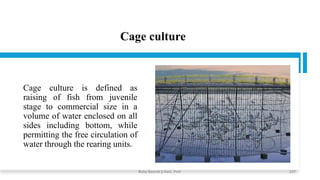
  • 311.
    3. Stocking: Stock1-3 million fry per hectare, depending on species in the early morning or late evening to reduce stress. 4. Feeding: Supplement natural and artificial feed rich in protein (e.g., rice bran, fishmeal). 5. Water Quality Management: Maintain optimal dissolved oxygen levels (>5 mg/L). Regularly check temperature (25-30°C), pH (6.5-8.5), and ammonia levels. Replace 10-15% of water weekly, if possible. 6. Monitoring: Observe fish behavior, feeding response, and growth weekly. Remove weak or diseased fry immediately to prevent disease spread. 7. Harvesting Fingerlings: After 3-4 weeks, fry reach 3-4 cm and are ready for transfer to grow-out ponds. Harvest early in the morning using nets to reduce stress. Boby Basnet || Asst. Prof. 311
  • 312.
    Seed Transportation Seed transportationof fish involves safely moving fish fry or fingerlings (juvenile fish) from hatcheries to grow-out ponds or farms. Proper techniques ensure the survival and health of the fish during transport. Methods: Plastic bags with pure oxygen, closed tanks. Optimal bag size: 30% water, 70% oxygen. Preparation: Pre-test packing, oxygen sealing. Boby Basnet || Asst. Prof. 312
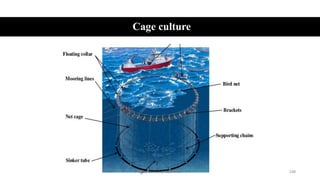
  • 313.
    Seed Transportation includes 1.Shipment in plastic bags under pure oxygen: Fish are conditioned by starving for 12-24 hours, placed in double-layered bags with 25-30% water, and filled with 70-75% pure oxygen. The bags are sealed, packed in insulated containers, and acclimated at the destination to reduce stress and mortality. 2. Fish transport in open systems: Fish transport in open systems involves using containers like tanks or buckets filled with water, where aeration is provided manually or through devices to maintain oxygen levels. It is suitable for short distances, with low stocking densities to minimize stress and mortality. 3. Transport of fish in closed tanks: Transport of fish in closed tanks involves sealed, water-filled containers equipped with oxygen supply systems, ensuring stable oxygen levels and water quality. This method is ideal for long distances, accommodating higher fish densities with minimal stress and mortality. Boby Basnet || Asst. Prof. 313
  • 314.
    Guide for Shipment •Temperature and duration affect capacity. • Example: Common carp (50 larvae at 25-30°C for 12 hours). • Use appropriate plastic thickness for fish size. Boby Basnet || Asst. Prof. 314
  • 315.
    BOBY BASNET ASSISTANT PROF.(ANIMAL SCIENCE) ILAM COMMUNITYAGRICULTURE CAMPUS PURBANCHAL UNIVERSITY boby.iaas333@gmail.com FISH DISEASES AND PARASITES: INTRODUCTION, CAUSAL ORGANISM, SYMPTOMS, AND CONTROL MEASURES. 315
  • 316.
    Fish Diseases Any alterationof the body or one of its organs so as to disturb normal physiological function. Types of Diseases: 1. Infectious: Diseases due to the action of microorganisms (animal or plant). a. Viruses: e.g. viral haemorrhagic septisemia, Carp pox, Infectous dropsy of carp (IDC) b. Bacteria: Furuncolosis, Columnaris (tail of fin rot), Gill rot. c. Fungi: Saprolegniasis d. Protozoans: Ichthyophthiriasis or white spot disease, whiriling disease. e. Metazoans: Dactylogyrosis f. Crustaceans: Argulosis 2. Non-infectious: Diseases due to non-living causes (environmental, other). • A very adverse environment can cause disease and mortalities directly (e.g., asphyxiation, gas bubble disease, brown blood disease) • The other category refers to nutritional, genetic and developmental diseases. Boby Basnet || Asst. Prof. 316
  • 317.
    Bacterial disease 1. Columnarisdisease is a bacterial infection caused by Flexibacter columnaris. 2. Symptoms: It causes skin lesions, fin rot, hemorrhages, and rapid breathing in fish. 3. Treatment involves antibiotics and improving water quality. 4. Prevention includes maintaining good water conditions, reducing stress, and avoiding overcrowding. Early intervention is crucial for controlling the disease. Boby Basnet || Asst. Prof. 317
  • 318.
    Saprolegniasis /water mold/Cotton wool disease 1. Saprolegniasis (Water Mold or Cotton Wool Disease) is a fungal infection caused by Saprolegnia, affecting fish, especially when stressed or injured. 2. Symptoms include white, cotton-like growth on the skin, gills, or fins, and lethargy. The fungus spreads through wounds and poor water quality. 3. Treatment includes antifungal treatments (e.g., potassium permanganate) and improving water quality. 4. Prevention involves maintaining clean water, minimizing injuries, and quarantining new fish. Early intervention is key to controlling the disease. Boby Basnet || Asst. Prof. 318
  • 319.
    Protozoan Disease: Whitespot disease 1. Ichthyophthiriasis (Ich Disease or White Spot Disease) is a protozoan infection caused by Ichthyophthirius multifiliis. 2. It causes white cysts on the skin, gills, and fins, along with erratic swimming and rapid breathing. 3. Treatment includes copper-based medications, formalin, and raising water temperature to speed up the parasite's life cycle. 4. Prevention involves maintaining good water quality, reducing stress, and quarantining new fish. Early detection and treatment are crucial for controlling the disease. Boby Basnet || Asst. Prof. 319
  • 320.
    Metazoan Disease-Dactylogyrosis 1. Itis a parasitic disease caused by the flatworm Dactylogyrus, affecting the gills of freshwater fish. 2. Symptoms include gill damage, excessive mucus production, and abnormal swimming behavior. 3. Treatment involves anti-parasitic medications like formalin or praziquantel, along with improving water quality. 4. Prevention includes quarantining new fish, maintaining clean water, and reducing overcrowding. Early treatment and proper care are crucial for controlling the disease. Boby Basnet || Asst. Prof. 320
  • 321.
    Diseases caused bycrustaceans- Argulosis 1. Argulosis is caused by Argulus (fish lice), crustaceans that attach to fish, causing wounds, distress, and anemia. 2. Treatment includes anti-parasitic medications like formalin or copper sulfate, and manual removal of parasites. 3. Prevention involves quarantining new fish, maintaining clean water, and reducing overcrowding. Early detection and treatment are key to controlling the disease. Boby Basnet || Asst. Prof. 321
  • 322.
    Boby Basnet ||Asst. Prof. 322