By:
ANURADHA
VIKASH KUMAR
VIVEK SAJAN
SUMIT KUMAR
INTRODUCTION
 Piezoelectricity was discovered by Curie brothers in 1880.
 It is the generation of electric field from applied pressure.
 It is observed in crystalline materials with no inversion
symmetry.
 The materials exhibiting the direct piezoelectric also
exhibit the reverse piezoelectric effect (the internal
generation of a mechanical strain resulting from an
applied electrical field).
MATERIALS
NATURAL SYNTHETIC
Quartz Lead zirconate titanate (PZT)
Rochelle Salt Zinc oxide (ZnO)
Topaz Barium titanate (BaTiO3)
Sucrose Gallium orthophosphate (GaPO4)
Tendon Potassium niobate (KNbO3)
Silk Lead titanate (PbTiO3)
Enamel Lithium tantalate (LiTaO3)
Dentin Langasite (La3Ga5SiO14)
DNA Sodium tungstate (Na2WO3)
WORKING
 The positive & negative charges are symmetrically
distributed in a crystal.
 Piezoelectric ceramic materials are not piezoelectric
until the random ferroelectric domains are aligned by
a process known as POLING.
 Poling consists of inducing a DC voltage across the
material.
Fig: (a) Random orientation of domains prior to poling
(b) Poling in DC Electric Field
(c) Remanent polarization after field is removed
 When pressure is applied to an object, a negative
charge is produced on the expanded side and a
positive charge on the compressed side.
 Once the pressure is relieved, electrical current flows
across the material.
PIEZO TRANSDUCER
piezoelectric sensor
A piezoelectric sensor is a device that uses
the piezoelectric effect to
measure pressure, acceleration, strain or force by
converting them to an electricalsignal.
Inverter
An inverter is an electrical
device that converts direct
current (DC) to alternating
current (AC); the converted
AC can be at any required
voltage and frequency with
the use of appropriate
transformers, switching, and
control circuits.
Block Diagram
Lead Acid Battery
 Specifications
12V 1.3Ah sealed lead acid battery
1. CE and RoHs
2. high quality and reliability
3. maintenance free
4. long life cycle
General Features:
 Sealed and maintenance free operation.
 ABS containers and covers(UL94HB, UL94-0)optional.
 Safety valve installation for explosion proof.
 High quality and high reliability.
 Exceptional deep discharge recovery performance.
 Low self discharge characteristic.
Working
 When ever force is applied on piezo electric crystals
that force is converted to Electrical energy is used to
drive DC loads. And that minute voltage Which is
stored in the Lead Acid battery. The battery is
connected to the inverter.
 This inverter is used to convert the 12 Volt D.C to the
230 Volt A.C. This 230 Volt A.C voltage is used to
activate the loads.
 We are using conventional battery charging unit also
for giving supply to the circuitry.
PIEZOELECTRIC ENERGY HARVESTING
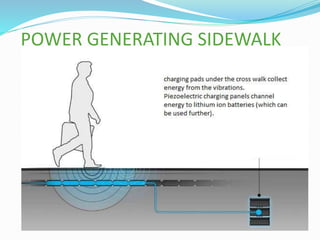
POWER GENERATING SIDEWALK
GYMS AND WORKPLACES
 Vibrations caused from
machines in the gym.
 At workplaces,
piezoelectric crystal are
laid in the chairs for
storing energy.
 Utilizing the vibrations in
the vehicle like clutches,
gears etc.
MOBILE KEYPADS & KEYBOARDS
 Crystals laid down under
keys of mobile unit and
keyboard.
 For every key pressed
vibrations are created.
 These vibrations can be
used for charging
purposes.
POWER GENERATING BOOTS OR SHOES
 Idea was researched in
US.
 To power the battlefield
equipment by generators
embedded in soldier
boots.
 Idea was abandoned due
to the discomfort.
FLOOR MATS AND PEOPLE
POWERED DANCE CLUBS
 Series of crystals can be laid below the floor mats, tiles
and carpets.
 One footstep can only provide enough electrical current
to light two 60-watt bulbs for one second.
[source: Christian Science Monitor].
 When mob uses the dance floor, an enormous voltage is
generated.
 This energy is used to power the equipment of nightclubs.
OUTPUT POWER
 The output voltage obtained from a single
piezoelectric crystal is in millivolt(mV) range, which is
different for different crystals.
 And the wattage is in microwatt(µW) range.
 In order to achieve higher voltages, the piezoelectric
crystals can be arranged in series.
 Used to charge batteries for backup supplies or to
power low-power microprocessors.
OTHER APPLICATIONS:
 Electric cigarette lighter:
Pressing the button of the lighter causes a spring-loaded
hammer to hit a piezoelectric crystal, producing a sufficiently
high voltage that electric current flows across a small spark gap,
thus heating and igniting the gas.
 As sensing elements:
Detection of pressure variations in the form of sound is the
most common sensor application, e.g. piezoelectric
microphones. Sound waves bend the piezoelectric material,
creating a changing voltage.
ADVANTAGES DISADVANTAGES
Unaffected by external
electromagnetic fields.
They cannot be used for truly
static measurements
Pollution Free
Can pick up stray voltages in
connecting wires.
Low Maintenance Crystal is prone to crack if
overstressed.
Easy replacement of
equipment.
May get affected by long use
at high temperatures.
CONCLUSION
 Piezoelectricity is a revolutionary source for “GREEN
ENERGY”.
 Flexible piezoelectric materials are attractive for power
harvesting applications because of their ability to
withstand large amounts of strain.
 Convert the ambient vibration energy surrounding them
into electrical energy.
 Electrical energy can then be used to power other devices
or stored for later use.
THANK
YOU

Ppt group 48

  • 1.
  • 3.
    INTRODUCTION  Piezoelectricity wasdiscovered by Curie brothers in 1880.  It is the generation of electric field from applied pressure.  It is observed in crystalline materials with no inversion symmetry.  The materials exhibiting the direct piezoelectric also exhibit the reverse piezoelectric effect (the internal generation of a mechanical strain resulting from an applied electrical field).
  • 4.
    MATERIALS NATURAL SYNTHETIC Quartz Leadzirconate titanate (PZT) Rochelle Salt Zinc oxide (ZnO) Topaz Barium titanate (BaTiO3) Sucrose Gallium orthophosphate (GaPO4) Tendon Potassium niobate (KNbO3) Silk Lead titanate (PbTiO3) Enamel Lithium tantalate (LiTaO3) Dentin Langasite (La3Ga5SiO14) DNA Sodium tungstate (Na2WO3)
  • 5.
    WORKING  The positive& negative charges are symmetrically distributed in a crystal.  Piezoelectric ceramic materials are not piezoelectric until the random ferroelectric domains are aligned by a process known as POLING.  Poling consists of inducing a DC voltage across the material.
  • 6.
    Fig: (a) Randomorientation of domains prior to poling (b) Poling in DC Electric Field (c) Remanent polarization after field is removed
  • 7.
     When pressureis applied to an object, a negative charge is produced on the expanded side and a positive charge on the compressed side.  Once the pressure is relieved, electrical current flows across the material.
  • 8.
  • 9.
    piezoelectric sensor A piezoelectricsensor is a device that uses the piezoelectric effect to measure pressure, acceleration, strain or force by converting them to an electricalsignal.
  • 10.
    Inverter An inverter isan electrical device that converts direct current (DC) to alternating current (AC); the converted AC can be at any required voltage and frequency with the use of appropriate transformers, switching, and control circuits.
  • 11.
  • 12.
    Lead Acid Battery Specifications 12V 1.3Ah sealed lead acid battery 1. CE and RoHs 2. high quality and reliability 3. maintenance free 4. long life cycle General Features:  Sealed and maintenance free operation.  ABS containers and covers(UL94HB, UL94-0)optional.  Safety valve installation for explosion proof.  High quality and high reliability.  Exceptional deep discharge recovery performance.  Low self discharge characteristic.
  • 13.
    Working  When everforce is applied on piezo electric crystals that force is converted to Electrical energy is used to drive DC loads. And that minute voltage Which is stored in the Lead Acid battery. The battery is connected to the inverter.  This inverter is used to convert the 12 Volt D.C to the 230 Volt A.C. This 230 Volt A.C voltage is used to activate the loads.  We are using conventional battery charging unit also for giving supply to the circuitry.
  • 14.
  • 15.
  • 16.
    GYMS AND WORKPLACES Vibrations caused from machines in the gym.  At workplaces, piezoelectric crystal are laid in the chairs for storing energy.  Utilizing the vibrations in the vehicle like clutches, gears etc.
  • 17.
    MOBILE KEYPADS &KEYBOARDS  Crystals laid down under keys of mobile unit and keyboard.  For every key pressed vibrations are created.  These vibrations can be used for charging purposes.
  • 18.
    POWER GENERATING BOOTSOR SHOES  Idea was researched in US.  To power the battlefield equipment by generators embedded in soldier boots.  Idea was abandoned due to the discomfort.
  • 19.
    FLOOR MATS ANDPEOPLE POWERED DANCE CLUBS  Series of crystals can be laid below the floor mats, tiles and carpets.  One footstep can only provide enough electrical current to light two 60-watt bulbs for one second. [source: Christian Science Monitor].  When mob uses the dance floor, an enormous voltage is generated.  This energy is used to power the equipment of nightclubs.
  • 20.
    OUTPUT POWER  Theoutput voltage obtained from a single piezoelectric crystal is in millivolt(mV) range, which is different for different crystals.  And the wattage is in microwatt(µW) range.  In order to achieve higher voltages, the piezoelectric crystals can be arranged in series.  Used to charge batteries for backup supplies or to power low-power microprocessors.
  • 21.
    OTHER APPLICATIONS:  Electriccigarette lighter: Pressing the button of the lighter causes a spring-loaded hammer to hit a piezoelectric crystal, producing a sufficiently high voltage that electric current flows across a small spark gap, thus heating and igniting the gas.  As sensing elements: Detection of pressure variations in the form of sound is the most common sensor application, e.g. piezoelectric microphones. Sound waves bend the piezoelectric material, creating a changing voltage.
  • 22.
    ADVANTAGES DISADVANTAGES Unaffected byexternal electromagnetic fields. They cannot be used for truly static measurements Pollution Free Can pick up stray voltages in connecting wires. Low Maintenance Crystal is prone to crack if overstressed. Easy replacement of equipment. May get affected by long use at high temperatures.
  • 23.
    CONCLUSION  Piezoelectricity isa revolutionary source for “GREEN ENERGY”.  Flexible piezoelectric materials are attractive for power harvesting applications because of their ability to withstand large amounts of strain.  Convert the ambient vibration energy surrounding them into electrical energy.  Electrical energy can then be used to power other devices or stored for later use.
  • 24.