BY
HUZAIFA UMAR
STUDENT NO: 20142894
Dept. 0f Biogineering
Cyprus international university
26th December, 2014
Phytoremediation: An Overview
Methods of Phytoremdiation
Phytoaccumulation/Phytoextraction
Versions of Phytoaccumulation
Advantages and Disadvantages of Phytoaccumulation
Heavy Metals and Biological Systems
Process of Phytoaccumulation
Quantification of Phytoaccumulation Efficiancy
Conclusion
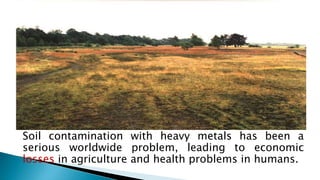
Soil contamination with heavy metals has been a
serious worldwide problem, leading to economic
losses in agriculture and health problems in humans.
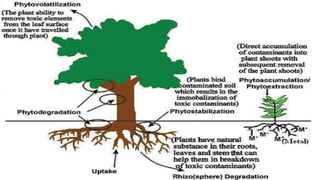
Phytoremediation is a bioremediation process that
uses various plants to remove, transfer, stabilize
and/or destroy contaminants in the soil and ground
water.
Phytoremediation is an integrated multidisciplinary
approach to the cleanup of contaminated soils, which
combines the disciplines of plant physiology, soil
chemistry, and soil microbiology. And is a cost
efficient and environmentally compatible process that
uses plants to remove heavy metal from the
environment by uptake, accumulation or
transformation of these metals in vegetal biomass
(McCutcheon and Schnoor, 2003).
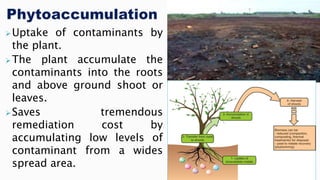
Uptake of contaminants by
the plant.
The plant accumulate the
contaminants into the roots
and above ground shoot or
leaves.
Saves tremendous
remediation cost by
accumulating low levels of
contaminant from a wides
spread area.
 Phytoextraction (or phytoaccumulation) uses plants or algae to
remove contaminants from soils, sediments or water into
harvestable plant biomass (organisms that take larger-than-
normal amounts of contaminants from the soil are called
hyperaccumulators).
 Phytoextraction has been growing rapidly in popularity
worldwide for the last twenty years or so.
 In general, this process has been tried more often for
extracting heavy metals than for organics.
 A living plant may continue to absorb contaminants until it is
harvested. After harvest, a lower level of the contaminant will
remain in the soil, so the growth/harvest cycle must usually be
repeated through several crops to achieve a significant cleanup.
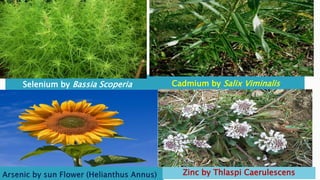
Selenium by Bassia Scoperia Cadmium by Salix Viminalis
Zinc by Thlaspi Caerulescens
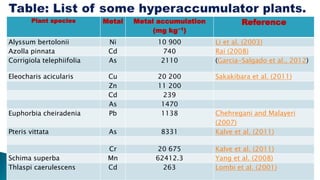
Plant species Metal Metal accumulation
(mg kg−1)
Reference
Alyssum bertolonii Ni 10 900 Li et al. (2003)
Azolla pinnata Cd 740 Rai (2008)
Corrigiola telephiifolia As 2110 (Garcia-Salgado et al., 2012)
Eleocharis acicularis Cu 20 200 Sakakibara et al. (2011)
Zn 11 200
Cd 239
As 1470
Euphorbia cheiradenia Pb 1138 Chehregani and Malayeri
(2007)
Pteris vittata As 8331 Kalve et al. (2011)
Cr 20 675 Kalve et al. (2011)
Schima superba Mn 62412.3 Yang et al. (2008)
Thlaspi caerulescens Cd 263 Lombi et al. (2001)
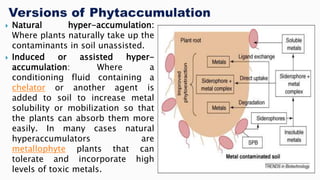
 Natural hyper-accumulation:
Where plants naturally take up the
contaminants in soil unassisted.
 Induced or assisted hyper-
accumulation: Where a
conditioning fluid containing a
chelator or another agent is
added to soil to increase metal
solubility or mobilization so that
the plants can absorb them more
easily. In many cases natural
hyperaccumulators are
metallophyte plants that can
tolerate and incorporate high
levels of toxic metals.
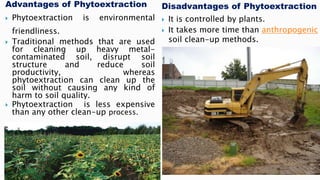
Advantages of Phytoextraction
 Phytoextraction is environmental
friendliness.
 Traditional methods that are used
for cleaning up heavy metal-
contaminated soil, disrupt soil
structure and reduce soil
productivity, whereas
phytoextraction can clean up the
soil without causing any kind of
harm to soil quality.
 Phytoextraction is less expensive
than any other clean-up process.
Disadvantages of Phytoextraction
 It is controlled by plants.
 It takes more time than anthropogenic
soil clean-up methods.
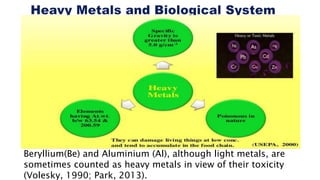
Beryllium(Be) and Aluminium (Al), although light metals, are
sometimes counted as heavy metals in view of their toxicity
(Volesky, 1990; Park, 2013).
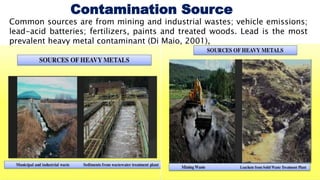
Contamination Source
Common sources are from mining and industrial wastes; vehicle emissions;
lead-acid batteries; fertilizers, paints and treated woods. Lead is the most
prevalent heavy metal contaminant (Di Maio, 2001),
Heavy metals enter plant, animal and human tissues
via air inhalation, diet and manual handling.
Water sources (groundwater, lakes, streams and
rivers) can be polluted by heavy metals leaching from
industrial and consumer waste.
Plants are exposed to heavy metals through the
uptake of water; animals eat these plants; ingestion
of plant- and animal-based foods are the largest
sources of heavy metals in humans (Radojevic and
Bashkin, 1999).
 They can be a major problem for any biological organism
as they may be reactive with a number of chemicals
essential to biological processes (Lanids, Sofied and Yu,
2000).
 They can also break apart other molecules into even more
reactive species (such as: Reactive Oxygen Species) which
will also disrupt biological processes.
 Non-hyperaccumulators also absorb some concentration of
heavy metals, as many heavy metals are chemically similar
to other metals that are essential to the plants life.
1. Dissolution: The metal needs to be dissolved in something (as
an ion in solution), so that, the plant roots can absorb (Misra et
al., 2009).
2. Root absortion: The plant needs to absorb the metal from the
root cell wall to the root (Clemes et al., 2002)
3. Root-to-shoot transport: The Plants need to chelate the metal
in order to both protect itself and make the metal mobile
(Rascio, 2011).
4. Storage:The plant moves the chelated metal to a place to safely
store it.
5. Adaptation: Finally, the plant must adapt to any damages the
metals cause during transportation and storage.
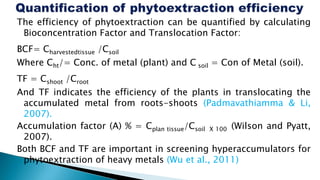
The efficiency of phytoextraction can be quantified by calculating
Bioconcentration Factor and Translocation Factor:
BCF= Charvestedtissue /Csoil
Where Cht/= Conc. of metal (plant) and C soil = Con of Metal (soil).
TF = Cshoot /Croot
And TF indicates the efficiency of the plants in translocating the
accumulated metal from roots-shoots (Padmavathiamma & Li,
2007).
Accumulation factor (A) % = Cplan tissue/Csoil X 100 (Wilson and Pyatt,
2007).
Both BCF and TF are important in screening hyperaccumulators for
phytoextraction of heavy metals (Wu et al., 2011)
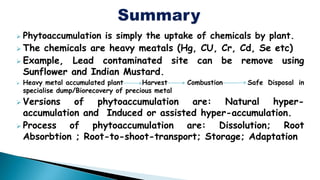
 Phytoaccumulation is simply the uptake of chemicals by plant.
 The chemicals are heavy meatals (Hg, CU, Cr, Cd, Se etc)
 Example, Lead contaminated site can be remove using
Sunflower and Indian Mustard.
 Heavy metal accumulated plant Harvest Combustion Safe Disposal in
specialise dump/Biorecovery of precious metal
 Versions of phytoaccumulation are: Natural hyper-
accumulation and Induced or assisted hyper-accumulation.
 Process of phytoaccumulation are: Dissolution; Root
Absorbtion ; Root-to-shoot-transport; Storage; Adaptation
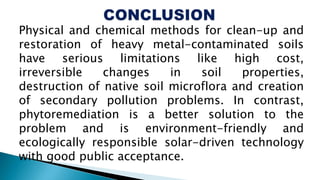
Physical and chemical methods for clean-up and
restoration of heavy metal-contaminated soils
have serious limitations like high cost,
irreversible changes in soil properties,
destruction of native soil microflora and creation
of secondary pollution problems. In contrast,
phytoremediation is a better solution to the
problem and is environment-friendly and
ecologically responsible solar-driven technology
with good public acceptance.
1. Clemens S., Palmgren M.G. & Krämer U. (2002) A long way ahead:
understanding and engineering plant metal accumulation. Trends in Plant
Science 7, 309–315.
2. Landis WG, Sofield RM & Yu M-H 2000, Introduction to Environmental
Toxicology: Molecular Substructures to Ecological Landscapes, 4th ed., CRC
Press, Boca Raton, Florida, ISBN 9781439804100
3. McCutcheon, S.C., Schnoor, J.L. (Eds.), 2003. Phytoremediation: Transformation
and Control of Contaminants.
4. Misra V., Tiwari A., Shukla B. & Seth C.S. (2009). Effects of soil amendments on
the bioavailability of heavy metals from zinc mine tailings. Environmental
Monitoring Assessment 155, 467–475.
5. Padmavathiamma P.K., L.Y. Li., (2007). Phytoremediation technology: hyper-
accumulation metals in plants. Water Air Soil Pollut., 184 (2007), pp. 105–126
6. Rascio, N., and F. Navari-Izzo. (2011) "Heavy Metal Hyper-accumulating Plants:
How and Why do they do it? and what Makes them so Interesting?" Plant
Science 180.2: 169-81. SCOPUS. Web. 16 October 2011
7. Radojevic M & Bashkin VN 1999, Practical Environmental Analysis, Royal Society
of Chemistry, Cambridge, ISBN 0854045945
8. Wu, Q., S. Wang, P. Thangavel, Q. Li, H. Zheng, J. Bai, R. Qiu, (2011).
Phytostabilization potential of Jatropha curcas L. in polymetallic acid mine
tailings. Int. J. Phytorem., 13 (2011), pp. 788–804
THANK YOU
TEŞEKKÜR EDERIM
‫إلصغائكم‬ ‫شكرا‬
Спасибо
NAGODE
Questions?
Comments/Observations

Phytoaccumulation

  • 1.
    BY HUZAIFA UMAR STUDENT NO:20142894 Dept. 0f Biogineering Cyprus international university 26th December, 2014
  • 2.
    Phytoremediation: An Overview Methodsof Phytoremdiation Phytoaccumulation/Phytoextraction Versions of Phytoaccumulation Advantages and Disadvantages of Phytoaccumulation Heavy Metals and Biological Systems Process of Phytoaccumulation Quantification of Phytoaccumulation Efficiancy Conclusion
  • 3.
    Soil contamination withheavy metals has been a serious worldwide problem, leading to economic losses in agriculture and health problems in humans.
  • 4.
    Phytoremediation is abioremediation process that uses various plants to remove, transfer, stabilize and/or destroy contaminants in the soil and ground water. Phytoremediation is an integrated multidisciplinary approach to the cleanup of contaminated soils, which combines the disciplines of plant physiology, soil chemistry, and soil microbiology. And is a cost efficient and environmentally compatible process that uses plants to remove heavy metal from the environment by uptake, accumulation or transformation of these metals in vegetal biomass (McCutcheon and Schnoor, 2003).
  • 6.
    Uptake of contaminantsby the plant. The plant accumulate the contaminants into the roots and above ground shoot or leaves. Saves tremendous remediation cost by accumulating low levels of contaminant from a wides spread area.
  • 7.
     Phytoextraction (orphytoaccumulation) uses plants or algae to remove contaminants from soils, sediments or water into harvestable plant biomass (organisms that take larger-than- normal amounts of contaminants from the soil are called hyperaccumulators).  Phytoextraction has been growing rapidly in popularity worldwide for the last twenty years or so.  In general, this process has been tried more often for extracting heavy metals than for organics.  A living plant may continue to absorb contaminants until it is harvested. After harvest, a lower level of the contaminant will remain in the soil, so the growth/harvest cycle must usually be repeated through several crops to achieve a significant cleanup.
  • 8.
    Selenium by BassiaScoperia Cadmium by Salix Viminalis Zinc by Thlaspi Caerulescens
  • 9.
    Plant species MetalMetal accumulation (mg kg−1) Reference Alyssum bertolonii Ni 10 900 Li et al. (2003) Azolla pinnata Cd 740 Rai (2008) Corrigiola telephiifolia As 2110 (Garcia-Salgado et al., 2012) Eleocharis acicularis Cu 20 200 Sakakibara et al. (2011) Zn 11 200 Cd 239 As 1470 Euphorbia cheiradenia Pb 1138 Chehregani and Malayeri (2007) Pteris vittata As 8331 Kalve et al. (2011) Cr 20 675 Kalve et al. (2011) Schima superba Mn 62412.3 Yang et al. (2008) Thlaspi caerulescens Cd 263 Lombi et al. (2001)
  • 10.
     Natural hyper-accumulation: Whereplants naturally take up the contaminants in soil unassisted.  Induced or assisted hyper- accumulation: Where a conditioning fluid containing a chelator or another agent is added to soil to increase metal solubility or mobilization so that the plants can absorb them more easily. In many cases natural hyperaccumulators are metallophyte plants that can tolerate and incorporate high levels of toxic metals.
  • 11.
    Advantages of Phytoextraction Phytoextraction is environmental friendliness.  Traditional methods that are used for cleaning up heavy metal- contaminated soil, disrupt soil structure and reduce soil productivity, whereas phytoextraction can clean up the soil without causing any kind of harm to soil quality.  Phytoextraction is less expensive than any other clean-up process. Disadvantages of Phytoextraction  It is controlled by plants.  It takes more time than anthropogenic soil clean-up methods.
  • 12.
    Beryllium(Be) and Aluminium(Al), although light metals, are sometimes counted as heavy metals in view of their toxicity (Volesky, 1990; Park, 2013).
  • 13.
    Contamination Source Common sourcesare from mining and industrial wastes; vehicle emissions; lead-acid batteries; fertilizers, paints and treated woods. Lead is the most prevalent heavy metal contaminant (Di Maio, 2001),
  • 14.
    Heavy metals enterplant, animal and human tissues via air inhalation, diet and manual handling. Water sources (groundwater, lakes, streams and rivers) can be polluted by heavy metals leaching from industrial and consumer waste. Plants are exposed to heavy metals through the uptake of water; animals eat these plants; ingestion of plant- and animal-based foods are the largest sources of heavy metals in humans (Radojevic and Bashkin, 1999).
  • 15.
     They canbe a major problem for any biological organism as they may be reactive with a number of chemicals essential to biological processes (Lanids, Sofied and Yu, 2000).  They can also break apart other molecules into even more reactive species (such as: Reactive Oxygen Species) which will also disrupt biological processes.  Non-hyperaccumulators also absorb some concentration of heavy metals, as many heavy metals are chemically similar to other metals that are essential to the plants life.
  • 16.
    1. Dissolution: Themetal needs to be dissolved in something (as an ion in solution), so that, the plant roots can absorb (Misra et al., 2009). 2. Root absortion: The plant needs to absorb the metal from the root cell wall to the root (Clemes et al., 2002) 3. Root-to-shoot transport: The Plants need to chelate the metal in order to both protect itself and make the metal mobile (Rascio, 2011). 4. Storage:The plant moves the chelated metal to a place to safely store it. 5. Adaptation: Finally, the plant must adapt to any damages the metals cause during transportation and storage.
  • 17.
    The efficiency ofphytoextraction can be quantified by calculating Bioconcentration Factor and Translocation Factor: BCF= Charvestedtissue /Csoil Where Cht/= Conc. of metal (plant) and C soil = Con of Metal (soil). TF = Cshoot /Croot And TF indicates the efficiency of the plants in translocating the accumulated metal from roots-shoots (Padmavathiamma & Li, 2007). Accumulation factor (A) % = Cplan tissue/Csoil X 100 (Wilson and Pyatt, 2007). Both BCF and TF are important in screening hyperaccumulators for phytoextraction of heavy metals (Wu et al., 2011)
  • 18.
     Phytoaccumulation issimply the uptake of chemicals by plant.  The chemicals are heavy meatals (Hg, CU, Cr, Cd, Se etc)  Example, Lead contaminated site can be remove using Sunflower and Indian Mustard.  Heavy metal accumulated plant Harvest Combustion Safe Disposal in specialise dump/Biorecovery of precious metal  Versions of phytoaccumulation are: Natural hyper- accumulation and Induced or assisted hyper-accumulation.  Process of phytoaccumulation are: Dissolution; Root Absorbtion ; Root-to-shoot-transport; Storage; Adaptation
  • 19.
    Physical and chemicalmethods for clean-up and restoration of heavy metal-contaminated soils have serious limitations like high cost, irreversible changes in soil properties, destruction of native soil microflora and creation of secondary pollution problems. In contrast, phytoremediation is a better solution to the problem and is environment-friendly and ecologically responsible solar-driven technology with good public acceptance.
  • 20.
    1. Clemens S.,Palmgren M.G. & Krämer U. (2002) A long way ahead: understanding and engineering plant metal accumulation. Trends in Plant Science 7, 309–315. 2. Landis WG, Sofield RM & Yu M-H 2000, Introduction to Environmental Toxicology: Molecular Substructures to Ecological Landscapes, 4th ed., CRC Press, Boca Raton, Florida, ISBN 9781439804100 3. McCutcheon, S.C., Schnoor, J.L. (Eds.), 2003. Phytoremediation: Transformation and Control of Contaminants. 4. Misra V., Tiwari A., Shukla B. & Seth C.S. (2009). Effects of soil amendments on the bioavailability of heavy metals from zinc mine tailings. Environmental Monitoring Assessment 155, 467–475. 5. Padmavathiamma P.K., L.Y. Li., (2007). Phytoremediation technology: hyper- accumulation metals in plants. Water Air Soil Pollut., 184 (2007), pp. 105–126 6. Rascio, N., and F. Navari-Izzo. (2011) "Heavy Metal Hyper-accumulating Plants: How and Why do they do it? and what Makes them so Interesting?" Plant Science 180.2: 169-81. SCOPUS. Web. 16 October 2011 7. Radojevic M & Bashkin VN 1999, Practical Environmental Analysis, Royal Society of Chemistry, Cambridge, ISBN 0854045945 8. Wu, Q., S. Wang, P. Thangavel, Q. Li, H. Zheng, J. Bai, R. Qiu, (2011). Phytostabilization potential of Jatropha curcas L. in polymetallic acid mine tailings. Int. J. Phytorem., 13 (2011), pp. 788–804
  • 21.
    THANK YOU TEŞEKKÜR EDERIM ‫إلصغائكم‬‫شكرا‬ Спасибо NAGODE
  • 22.