

BASIC CONCEPTS
• Toxicology deals with the study of the harmful effects of
chemicals on living beings.
• This branch of science has been equally recognised in
medical as well as scientific field.
• In Greek and Roman civilizations, such substances or
chemicals with poisonous effects were used in various
activities like hunting, defence, wars. Killings or suicides.
HISTORY OF TOXICITY STUDIES
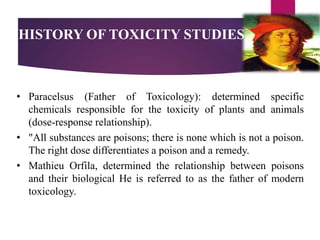
• Paracelsus (Father of Toxicology): determined specific
chemicals responsible for the toxicity of plants and animals
(dose-response relationship).
• "All substances are poisons; there is none which is not a poison.
The right dose differentiates a poison and a remedy.
• Mathieu Orfila, determined the relationship between poisons
and their biological He is referred to as the father of modern
toxicology.
CLASSIFICATION
 Important aspects include the following: (Modes of Toxic action)
 Biochemical and molecular toxicology : consider events at the
biochemical and molecular levels, including enzymes that
metabolize xenobiotics, generation of reactive intermediates,
interaction of xenobiotics or their metabolites with macro
molecules , gene expression in metabolism and modes of action
and signaling pathways in toxic action.
 Behavioral Toxicology : deals with the effects of toxicants on
animal and human behaviour, which is the final integrated
expression of nervous function in the intact animal.
 This involves both the peripheral and central nervous systems, as
well as effects mediated by other organ systems, such as the
endocrine glands.
Contd..
 Nutritional Toxicology: deals with the effects of diet on the
expression of toxicity and with the mechanisms of these
effects.
 Carcinogenesis: includes the chemical, biochemical and
molecular events that lead to the large no of effects on cell
growth collectively known as cancer.
 Teratogenesis: includes the chemical, biochemical and
molecular events that lead to deleterious effects on
development.
 Mutagenesis: is concerned with toxic effects on the genetic
material and the inheritance of these effects.
Contd..
 Organ toxicity: Considers effects at the level of organ function
(neurotoxicity, hepatotoxicity, nephrotoxicity etc.
 B. Measurement of Toxicants and Toxicity: These important aspects deal
primarily with analytical chemistry, bioassay and applied mathematics,
they are designated to provide the methodology to answer certain critically
important questions. Is the substance likely to be toxic? What is its
chemical identify? How much of it is present? How can we assay its toxic
effect, and what is the minimum level at which this toxic effect can be
detected ? A number of important fields are included:
1. Analytical toxicology : is a branch of analytical chemistry concerned with
the identification and assay of toxic chemicals and their metabolites in
biological and environmental materials.
2. Toxicity testing : involves the use of living systems to estimate toxic
effects .
Contd..
3. Toxicologic pathology : is the branch of pathology that deals
with the effects of toxic agents manifested as changes in
subcellular, cellular, tissue or organ morphology.
4. Structure-activity studies are concerned with the relationship
between the chemical and physical properties of a chemical
and toxicity and particularly, the use of such relationships as
predictors of toxicity.
5. Biomathematics and statistics relate to many areas of
toxicology. They deal with data analysis, the determination of
significance, and the formulation of risk estimates and
predictive models.
Contd..
6. Epidemiology as it supplies to toxicology, is of great importance as
it deals with the relationship between chemical exposure and
human disease in actual populations rather than in experimental
settings.
C. Applied Toxicity. This includes the various aspects of toxicology
as they apply in the field or the development between chemical
exposure and human disease in actual populations rather than in
experimental settings.
1. Clinical toxicology is the diagnosis and treatment of human
poisoning.
2. Veterinary toxicology is the diagnosis and treatment of
poisoning in animals other than humans, particularly livestock
and companion animals, but not excluding feral species.
Contd…
 Other important concerns of veterianary toxicology are the possible
transmission of toxins to the human population in meat, fish, milk and
other foodstuffs and the care and ethical treatment of experimental
animals.
3. Forensic toxicology concerns the medico legal aspects, including
detection of poisons in clinical and other samples.
4. Environmental toxicology is concerned with the movement of
toxicants and their metabolites and degradation products in the
environment and in food chains and with the effect of such
contaminants on individuals and especially populations.
5. Industrial toxicology :is a specific area of environmental toxicology
that deals with the work environment and constitutes a significant part
of industrial hygiene.
DOSE RESPONSE RELATIONSHIP
 Toxicologists have proven the fact that under controlled
conditions, the amount of toxicant administered to a group is
closely related with the response produced by it.
 It has also been observed that same amount of toxicant
produces different responses in different groups of animals.
 As the amount of toxicant (dose) increases the number of
affected individuals of a population along with magnitude of
effect also increases.
 Therefore, the quantity (dose) of the given toxicant is
specifically significant in evaluating the toxicity.
Contd.
 The term Dose is used to indicate that amount of toxicant which is
given to an organism or the test system where as the word Dosage is
used for that amount of toxicant which is administered on the basis
of certain specific characters of the recipient such as weight.
 For example, if 500mg of a toxicant is being administered to a mice
of 250gm, it is expressed in terms of 2 gm/kg dosage.
 The interrelationship between the characteristics of exposure of
any chemical and the effects produced by it is called as dose-
response relationship.
 From practical point of view, the dose response relationships are of
two types:-
TYPES
 Graded Response- Such responses which are caused in an individual as a
result of administering varying doses of a chemical are called Graded
response because the magnitude of effects produced depends upon the
extent of doses.
 This actually happens due to certain changes in some bio-chemical
process.
 Quantal Response- Such response which are produced in a population
of an individual as a result of administering varying doses of a chemical
are called Quantal Response.
 In such studies, an end point such as death or tumour is recognized and
the dose which produces that end point in each individual of that
population is determined.
NATURE OF DOSAGE-RESPONSE
RELATIONSHIP
 There has been found quantitative variability in sensitivity for a
chemical on different individuals of a given population.
 Hence, as the dose is increased, the toxic effects produced by it
also increases.
 To study the toxic effects of any substance, a graph is drawn in
which number of individuals responding are plotted against
the dosage (log₁₀ dosage).
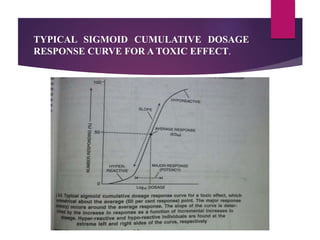
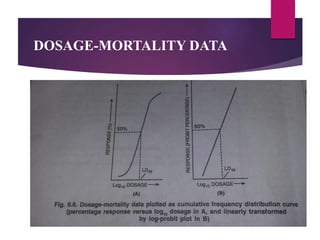
 Thus, a sigmoid curve is obtained which is called dosage-response
curve.
 It is clear from the analysis of this curve that response is
symmetrical near the mid point or 50 % response value and is
called average response.
TYPICAL SIGMOID CUMULATIVE DOSAGE
RESPONSE CURVE FOR A TOXIC EFFECT.
Contd.
 The dosage at which 50% response is observed is called median
effective dose or ED₅₀ and if mortality is supposed to be the last
point, it is then called median lethal dose or LD₅₀
 At the left hand side of the dosage-response curve, a small part of
the population shows the response even at low dosage, the group
of individuals constituting such part or segment of population is
called hyper reacting or hyper susceptible.
 Similarly, at the right hand side of the curve a small part of
population does not show response till the high dosage is
administered. Such a group is called Hyporeactive or
Hyposusceptible.
 The shape of dosage-response curve also depends on many
endogenous and exogenous factors which include cellular
defence mechanisms and reserve biochemical function.
CONCENTRATION –RESPONSE
RELATIONSHIP
 The response against the same dose of a toxicant is not the same in
all organisms. Some organisms die at a specific concentration of a
toxicant whereas others do not show any adverse sign against it
and remain alive.
 So, for evaluating the toxicogenic effect of a toxicant, that range of
its concentration is found out which produces a visible or
quantitative response in test system.
 A graph is drawn between concentration of the chemical versus
the percent of affected organisms and is called concentration-
response curve.
 The minimum concentration of the chemical agent which can cause
harmful response is called Threshold concentration.
Contd..
 If administered concentration of the toxicant is below the
threshold concentration, it does not produce any harmful effect
on the test organism.
 In the same way, a graph can be drawn between percent
mortality versus the concentration of the test chemical i.e.,
dosage and the lethal toxicity can be calculated .
 Lethal toxicity toxicity is calculated normally in terms of
median lethal dose LD₅₀
 The dosage of a chemical applied for a specified period which
results into death of 50%of the population of test animals is
called median lethal dose or LD₅₀.
Contd.
 Similarly, the concentration of the chemical applied for a
specific period resulting into 50 percent mortality is called
median lethal concentration or LD₅₀.
 For determining the relative toxicity, LD₅₀ value is necessary.
 The LD₅₀ hypothesis was first of all proposed by Trevan in
1927.
DOSAGE-MORTALITY DATA
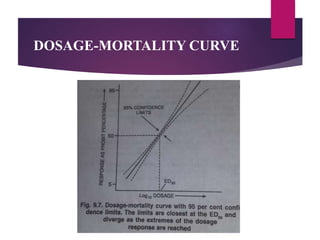
DOSAGE-MORTALITY CURVE
Toxicology

Toxicology

  • 2.
    BASIC CONCEPTS • Toxicologydeals with the study of the harmful effects of chemicals on living beings. • This branch of science has been equally recognised in medical as well as scientific field. • In Greek and Roman civilizations, such substances or chemicals with poisonous effects were used in various activities like hunting, defence, wars. Killings or suicides.
  • 3.
    HISTORY OF TOXICITYSTUDIES • Paracelsus (Father of Toxicology): determined specific chemicals responsible for the toxicity of plants and animals (dose-response relationship). • "All substances are poisons; there is none which is not a poison. The right dose differentiates a poison and a remedy. • Mathieu Orfila, determined the relationship between poisons and their biological He is referred to as the father of modern toxicology.
  • 4.
    CLASSIFICATION  Important aspectsinclude the following: (Modes of Toxic action)  Biochemical and molecular toxicology : consider events at the biochemical and molecular levels, including enzymes that metabolize xenobiotics, generation of reactive intermediates, interaction of xenobiotics or their metabolites with macro molecules , gene expression in metabolism and modes of action and signaling pathways in toxic action.  Behavioral Toxicology : deals with the effects of toxicants on animal and human behaviour, which is the final integrated expression of nervous function in the intact animal.  This involves both the peripheral and central nervous systems, as well as effects mediated by other organ systems, such as the endocrine glands.
  • 5.
    Contd..  Nutritional Toxicology:deals with the effects of diet on the expression of toxicity and with the mechanisms of these effects.  Carcinogenesis: includes the chemical, biochemical and molecular events that lead to the large no of effects on cell growth collectively known as cancer.  Teratogenesis: includes the chemical, biochemical and molecular events that lead to deleterious effects on development.  Mutagenesis: is concerned with toxic effects on the genetic material and the inheritance of these effects.
  • 6.
    Contd..  Organ toxicity:Considers effects at the level of organ function (neurotoxicity, hepatotoxicity, nephrotoxicity etc.  B. Measurement of Toxicants and Toxicity: These important aspects deal primarily with analytical chemistry, bioassay and applied mathematics, they are designated to provide the methodology to answer certain critically important questions. Is the substance likely to be toxic? What is its chemical identify? How much of it is present? How can we assay its toxic effect, and what is the minimum level at which this toxic effect can be detected ? A number of important fields are included: 1. Analytical toxicology : is a branch of analytical chemistry concerned with the identification and assay of toxic chemicals and their metabolites in biological and environmental materials. 2. Toxicity testing : involves the use of living systems to estimate toxic effects .
  • 7.
    Contd.. 3. Toxicologic pathology: is the branch of pathology that deals with the effects of toxic agents manifested as changes in subcellular, cellular, tissue or organ morphology. 4. Structure-activity studies are concerned with the relationship between the chemical and physical properties of a chemical and toxicity and particularly, the use of such relationships as predictors of toxicity. 5. Biomathematics and statistics relate to many areas of toxicology. They deal with data analysis, the determination of significance, and the formulation of risk estimates and predictive models.
  • 8.
    Contd.. 6. Epidemiology asit supplies to toxicology, is of great importance as it deals with the relationship between chemical exposure and human disease in actual populations rather than in experimental settings. C. Applied Toxicity. This includes the various aspects of toxicology as they apply in the field or the development between chemical exposure and human disease in actual populations rather than in experimental settings. 1. Clinical toxicology is the diagnosis and treatment of human poisoning. 2. Veterinary toxicology is the diagnosis and treatment of poisoning in animals other than humans, particularly livestock and companion animals, but not excluding feral species.
  • 9.
    Contd…  Other importantconcerns of veterianary toxicology are the possible transmission of toxins to the human population in meat, fish, milk and other foodstuffs and the care and ethical treatment of experimental animals. 3. Forensic toxicology concerns the medico legal aspects, including detection of poisons in clinical and other samples. 4. Environmental toxicology is concerned with the movement of toxicants and their metabolites and degradation products in the environment and in food chains and with the effect of such contaminants on individuals and especially populations. 5. Industrial toxicology :is a specific area of environmental toxicology that deals with the work environment and constitutes a significant part of industrial hygiene.
  • 10.
    DOSE RESPONSE RELATIONSHIP Toxicologists have proven the fact that under controlled conditions, the amount of toxicant administered to a group is closely related with the response produced by it.  It has also been observed that same amount of toxicant produces different responses in different groups of animals.  As the amount of toxicant (dose) increases the number of affected individuals of a population along with magnitude of effect also increases.  Therefore, the quantity (dose) of the given toxicant is specifically significant in evaluating the toxicity.
  • 11.
    Contd.  The termDose is used to indicate that amount of toxicant which is given to an organism or the test system where as the word Dosage is used for that amount of toxicant which is administered on the basis of certain specific characters of the recipient such as weight.  For example, if 500mg of a toxicant is being administered to a mice of 250gm, it is expressed in terms of 2 gm/kg dosage.  The interrelationship between the characteristics of exposure of any chemical and the effects produced by it is called as dose- response relationship.  From practical point of view, the dose response relationships are of two types:-
  • 12.
    TYPES  Graded Response-Such responses which are caused in an individual as a result of administering varying doses of a chemical are called Graded response because the magnitude of effects produced depends upon the extent of doses.  This actually happens due to certain changes in some bio-chemical process.  Quantal Response- Such response which are produced in a population of an individual as a result of administering varying doses of a chemical are called Quantal Response.  In such studies, an end point such as death or tumour is recognized and the dose which produces that end point in each individual of that population is determined.
  • 13.
    NATURE OF DOSAGE-RESPONSE RELATIONSHIP There has been found quantitative variability in sensitivity for a chemical on different individuals of a given population.  Hence, as the dose is increased, the toxic effects produced by it also increases.  To study the toxic effects of any substance, a graph is drawn in which number of individuals responding are plotted against the dosage (log₁₀ dosage).  Thus, a sigmoid curve is obtained which is called dosage-response curve.  It is clear from the analysis of this curve that response is symmetrical near the mid point or 50 % response value and is called average response.
  • 14.
    TYPICAL SIGMOID CUMULATIVEDOSAGE RESPONSE CURVE FOR A TOXIC EFFECT.
  • 15.
    Contd.  The dosageat which 50% response is observed is called median effective dose or ED₅₀ and if mortality is supposed to be the last point, it is then called median lethal dose or LD₅₀  At the left hand side of the dosage-response curve, a small part of the population shows the response even at low dosage, the group of individuals constituting such part or segment of population is called hyper reacting or hyper susceptible.  Similarly, at the right hand side of the curve a small part of population does not show response till the high dosage is administered. Such a group is called Hyporeactive or Hyposusceptible.
  • 16.
     The shapeof dosage-response curve also depends on many endogenous and exogenous factors which include cellular defence mechanisms and reserve biochemical function.
  • 17.
    CONCENTRATION –RESPONSE RELATIONSHIP  Theresponse against the same dose of a toxicant is not the same in all organisms. Some organisms die at a specific concentration of a toxicant whereas others do not show any adverse sign against it and remain alive.  So, for evaluating the toxicogenic effect of a toxicant, that range of its concentration is found out which produces a visible or quantitative response in test system.  A graph is drawn between concentration of the chemical versus the percent of affected organisms and is called concentration- response curve.  The minimum concentration of the chemical agent which can cause harmful response is called Threshold concentration.
  • 18.
    Contd..  If administeredconcentration of the toxicant is below the threshold concentration, it does not produce any harmful effect on the test organism.  In the same way, a graph can be drawn between percent mortality versus the concentration of the test chemical i.e., dosage and the lethal toxicity can be calculated .  Lethal toxicity toxicity is calculated normally in terms of median lethal dose LD₅₀  The dosage of a chemical applied for a specified period which results into death of 50%of the population of test animals is called median lethal dose or LD₅₀.
  • 19.
    Contd.  Similarly, theconcentration of the chemical applied for a specific period resulting into 50 percent mortality is called median lethal concentration or LD₅₀.  For determining the relative toxicity, LD₅₀ value is necessary.  The LD₅₀ hypothesis was first of all proposed by Trevan in 1927.
  • 20.
  • 21.