PHYSICAL METHOD OF WASTE DISPOSAL
17-06-2017 1
Mujahid Hussain (M.Phil Botany) Department of
Botany, University of Sargodha
(mujahid.hussain7877@gmail.com)
17-06-2017 2
Mujahid Hussain (M.Phil Botany) Department of
Botany, University of Sargodha
(mujahid.hussain7877@gmail.com)
Waste are generated during the extraction of raw materials, the processing
of raw materials into intermediate and final products, the consumption of
final products, or other human activities.
17-06-2017 3
Mujahid Hussain (M.Phil Botany) Department of
Botany, University of Sargodha
(mujahid.hussain7877@gmail.com)
Mujahid
Hussain
(M.Phil
Botany)
Department
of Botany,
University of
Sargodha
(mujahid.hus
sain7877@g
mail.com)
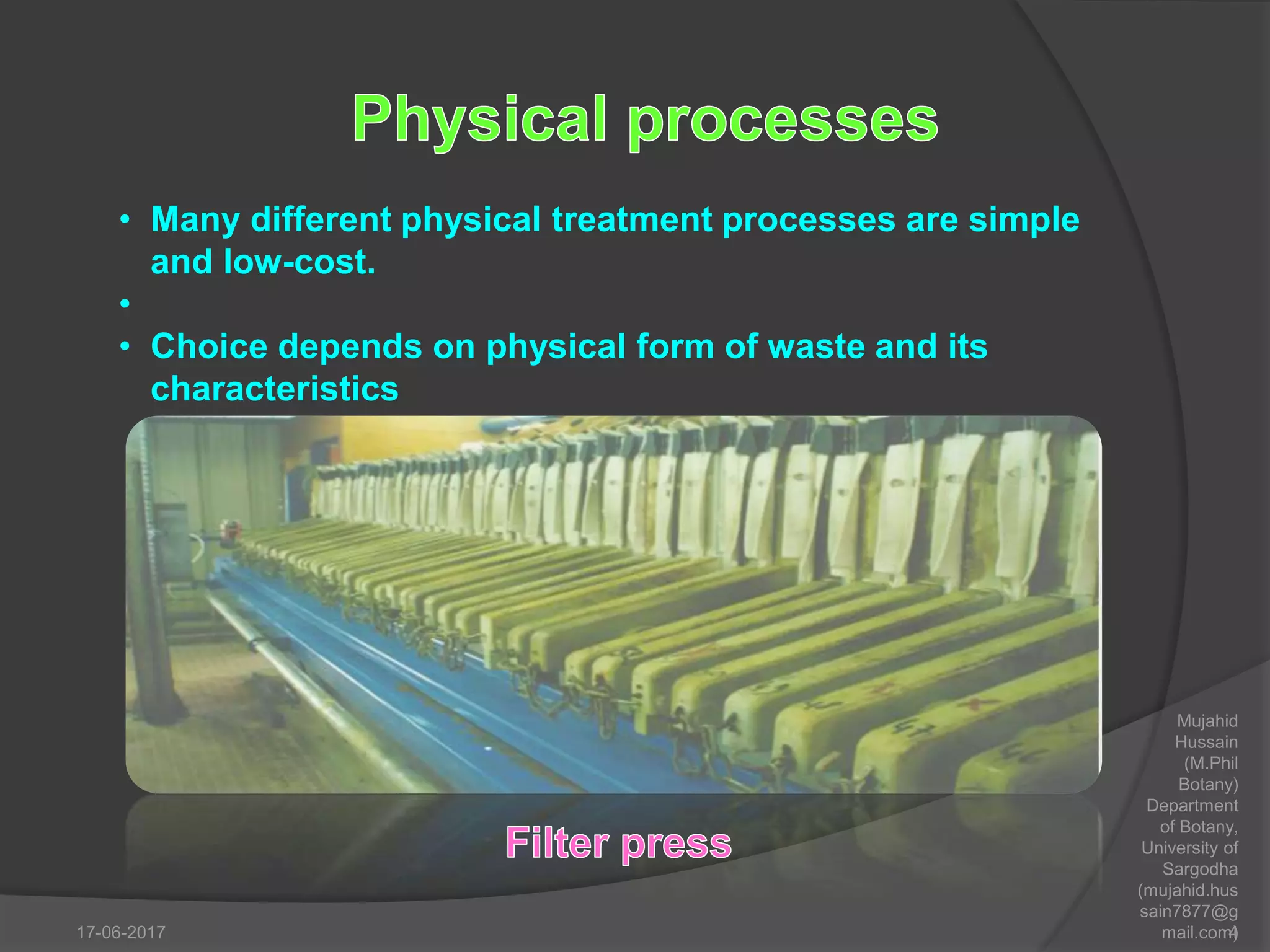
• Many different physical treatment processes are simple
and low-cost.
•
• Choice depends on physical form of waste and its
characteristics
17-06-2017 4
7. Sedimentation
17-06-2017 5
Mujahid Hussain (M.Phil Botany) Department of
Botany, University of Sargodha
(mujahid.hussain7877@gmail.com)
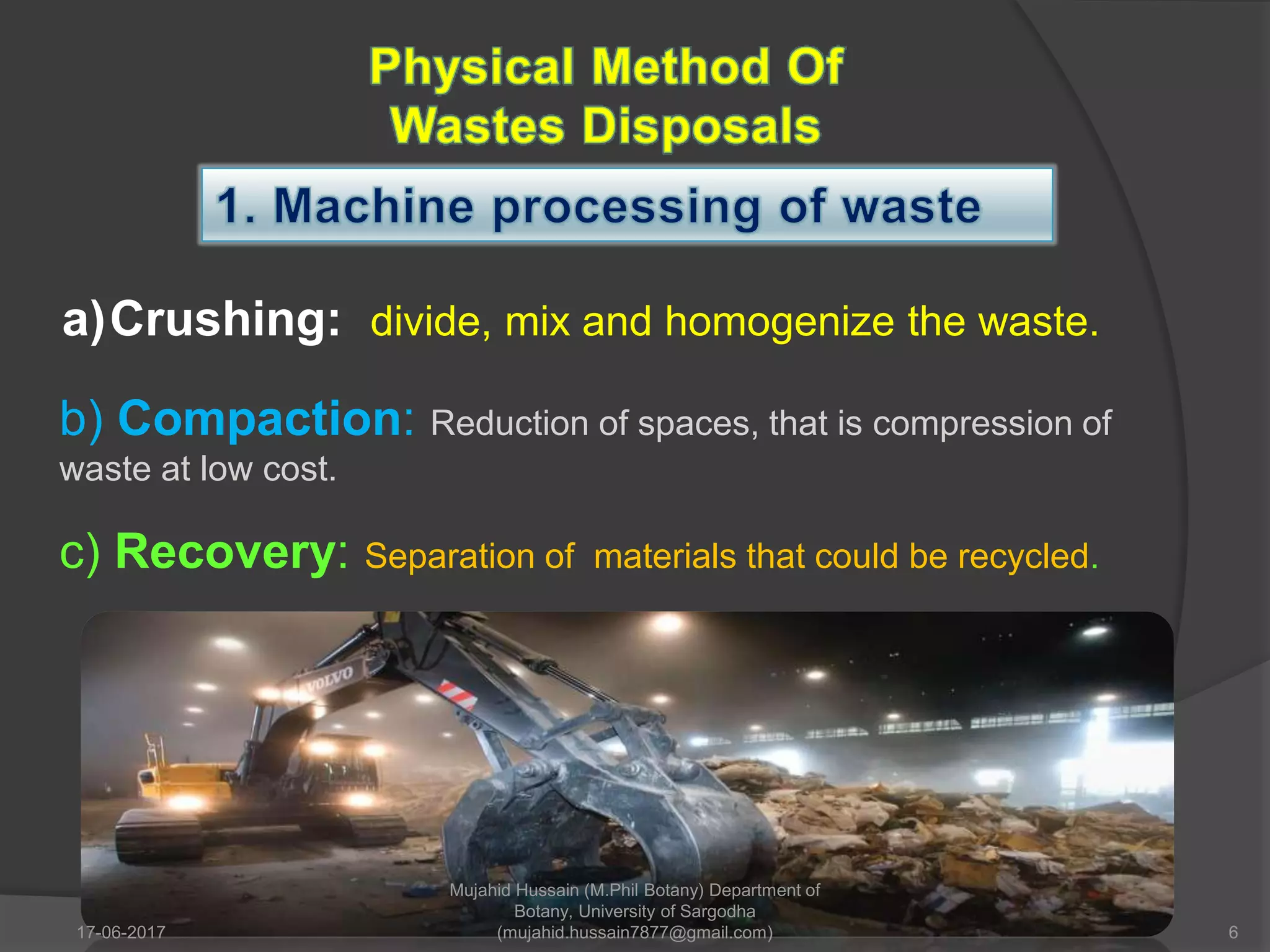
a)Crushing: divide, mix and homogenize the waste.
b) Compaction: Reduction of spaces, that is compression of
waste at low cost.
c) Recovery: Separation of materials that could be recycled.
17-06-2017 6
Mujahid Hussain (M.Phil Botany) Department of
Botany, University of Sargodha
(mujahid.hussain7877@gmail.com)
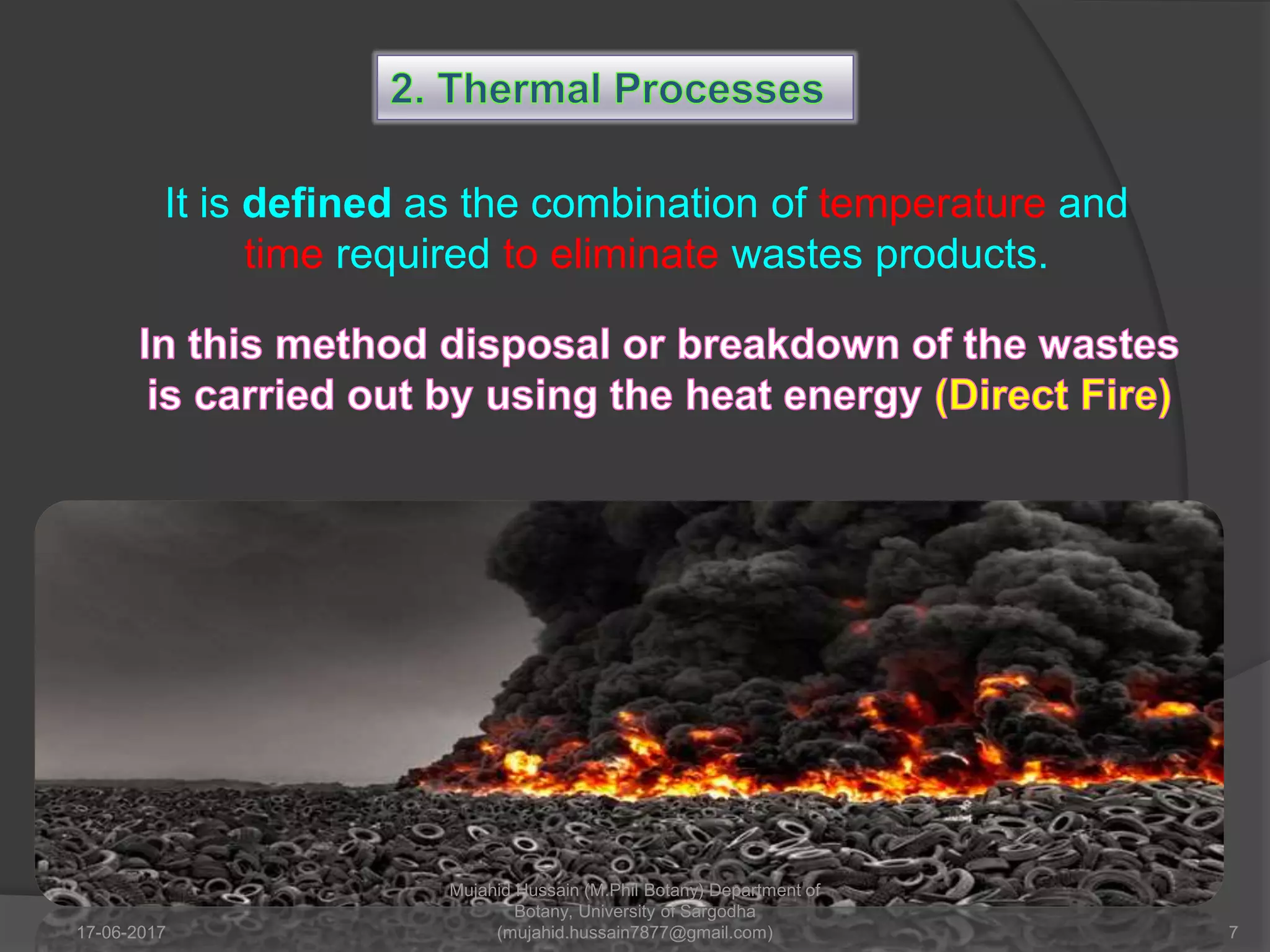
It is defined as the combination of temperature and
time required to eliminate wastes products.
17-06-2017 7
Mujahid Hussain (M.Phil Botany) Department of
Botany, University of Sargodha
(mujahid.hussain7877@gmail.com)
1. Thermal energy is produced that can be reuse.
2. Cost effective.
3. Easy mechanism.
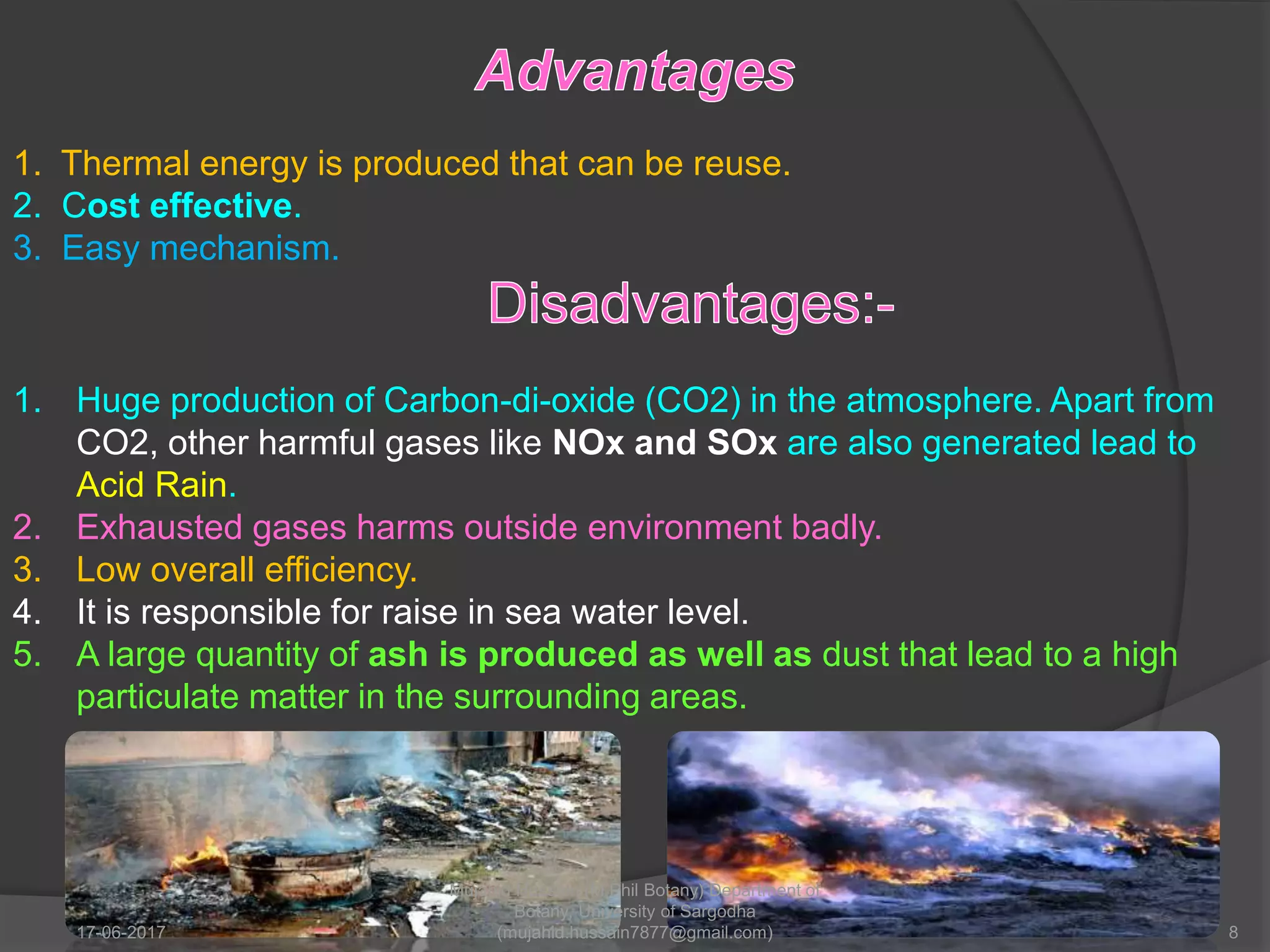
1. Huge production of Carbon-di-oxide (CO2) in the atmosphere. Apart from
CO2, other harmful gases like NOx and SOx are also generated lead to
Acid Rain.
2. Exhausted gases harms outside environment badly.
3. Low overall efficiency.
4. It is responsible for raise in sea water level.
5. A large quantity of ash is produced as well as dust that lead to a high
particulate matter in the surrounding areas.
17-06-2017 8
Mujahid Hussain (M.Phil Botany) Department of
Botany, University of Sargodha
(mujahid.hussain7877@gmail.com)
17-06-2017 9
Mujahid Hussain (M.Phil Botany) Department of
Botany, University of Sargodha
(mujahid.hussain7877@gmail.com)
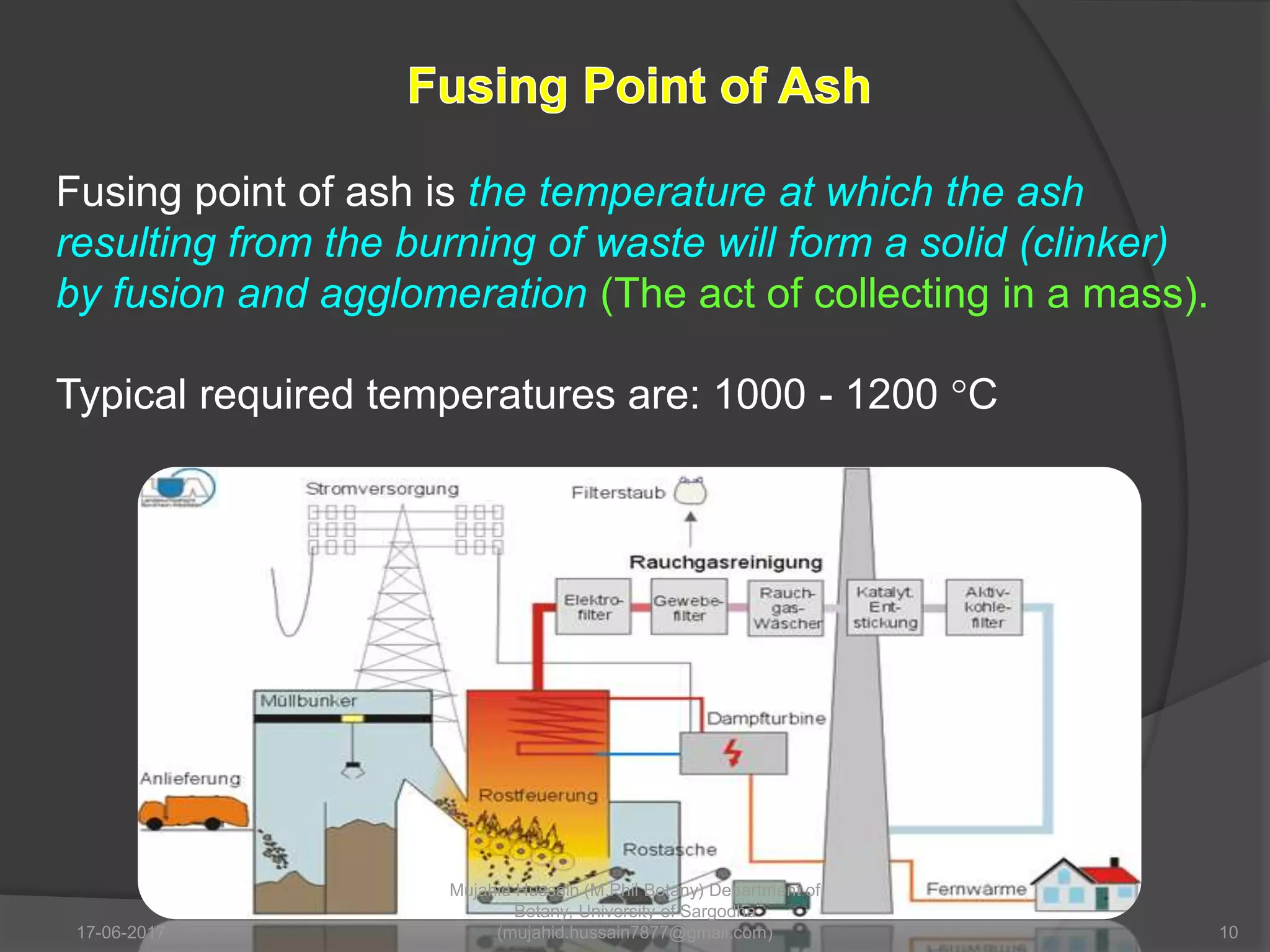
Fusing point of ash is the temperature at which the ash
resulting from the burning of waste will form a solid (clinker)
by fusion and agglomeration (The act of collecting in a mass).
Typical required temperatures are: 1000 - 1200 °C
17-06-2017 10
Mujahid Hussain (M.Phil Botany) Department of
Botany, University of Sargodha
(mujahid.hussain7877@gmail.com)
17-06-2017 11
Mujahid Hussain (M.Phil Botany) Department of
Botany, University of Sargodha
(mujahid.hussain7877@gmail.com)
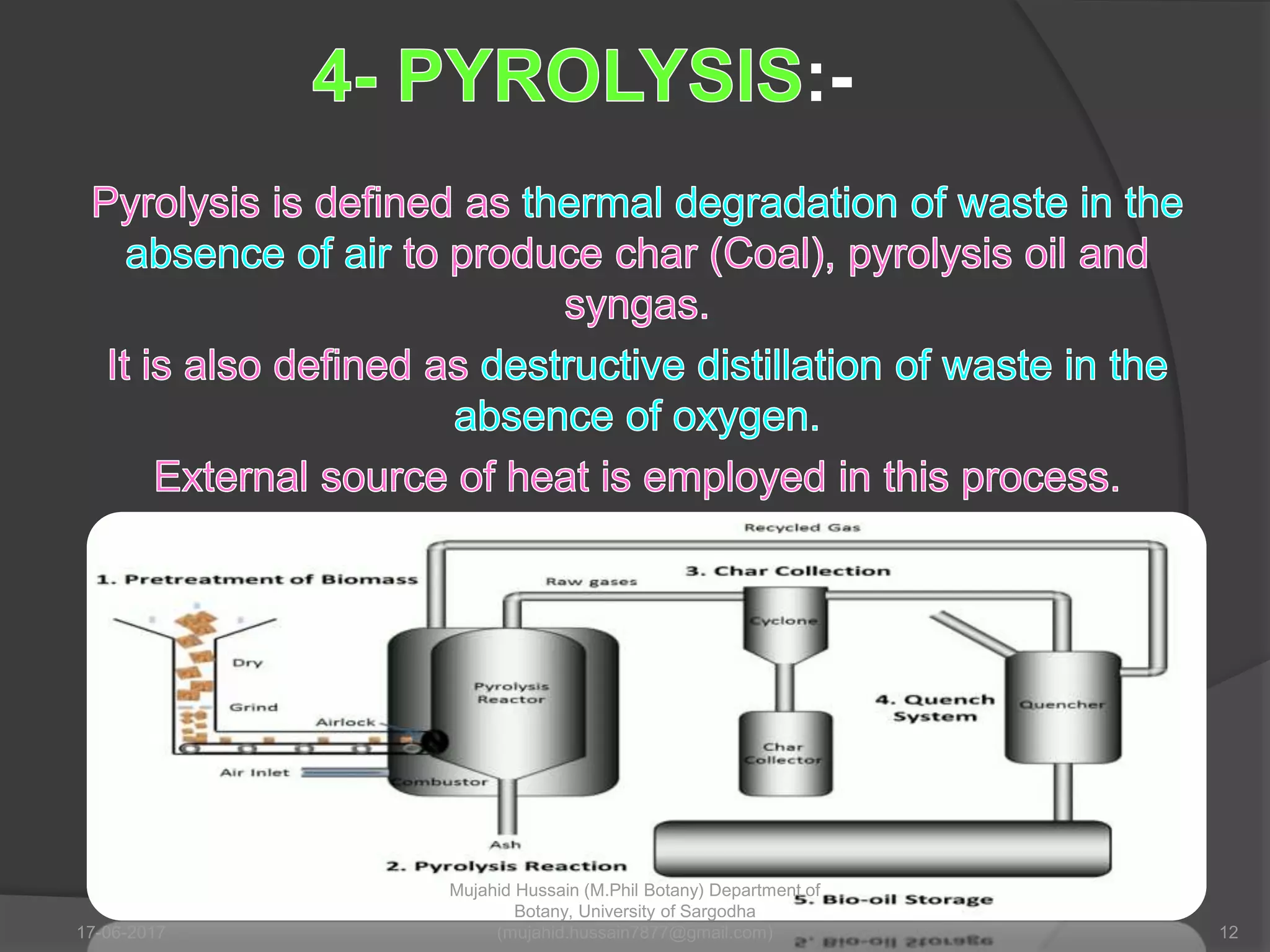
:-
17-06-2017 12
Mujahid Hussain (M.Phil Botany) Department of
Botany, University of Sargodha
(mujahid.hussain7877@gmail.com)
17-06-2017 13
Mujahid Hussain (M.Phil Botany) Department of
Botany, University of Sargodha
(mujahid.hussain7877@gmail.com)
17-06-2017 14
Mujahid Hussain (M.Phil Botany) Department of
Botany, University of Sargodha
(mujahid.hussain7877@gmail.com)
Sedimentation is the separation of undissolved substances from
water, by gravitational settling, of suspended particles that are
heavier than water.
Sedimentation is used for separation of;
 Particulate matter in water
 Separation of biological-floc (A small loosely aggregated mass) in the sludge
 Separation of chemical-floc in the sludge.
 It is also used for solids concentration in sludge thickeners.
Sedimentation basins are constructed in a variety of shapes and sizes, circular tanks or
rectangular tanks.
:
17-06-2017 15
Mujahid Hussain (M.Phil Botany) Department of
Botany, University of Sargodha
(mujahid.hussain7877@gmail.com)
 Separation is brought by introducing fine gas (usually air bubbles) into the
liquid phase.
 The bubbles attach to the particulate matter, and the buoyant force of the
combined particle and gas bubble is great enough to cause the particle to rise
to the surface to form a scum blanket, which is removed by a skimming
mechanism.
Principal advantage of flotation over sedimentation is that very small or light
particles that settle slowly can be removed more completely and in a shorter
time.
17-06-2017 16
Mujahid Hussain (M.Phil Botany) Department of
Botany, University of Sargodha
(mujahid.hussain7877@gmail.com)
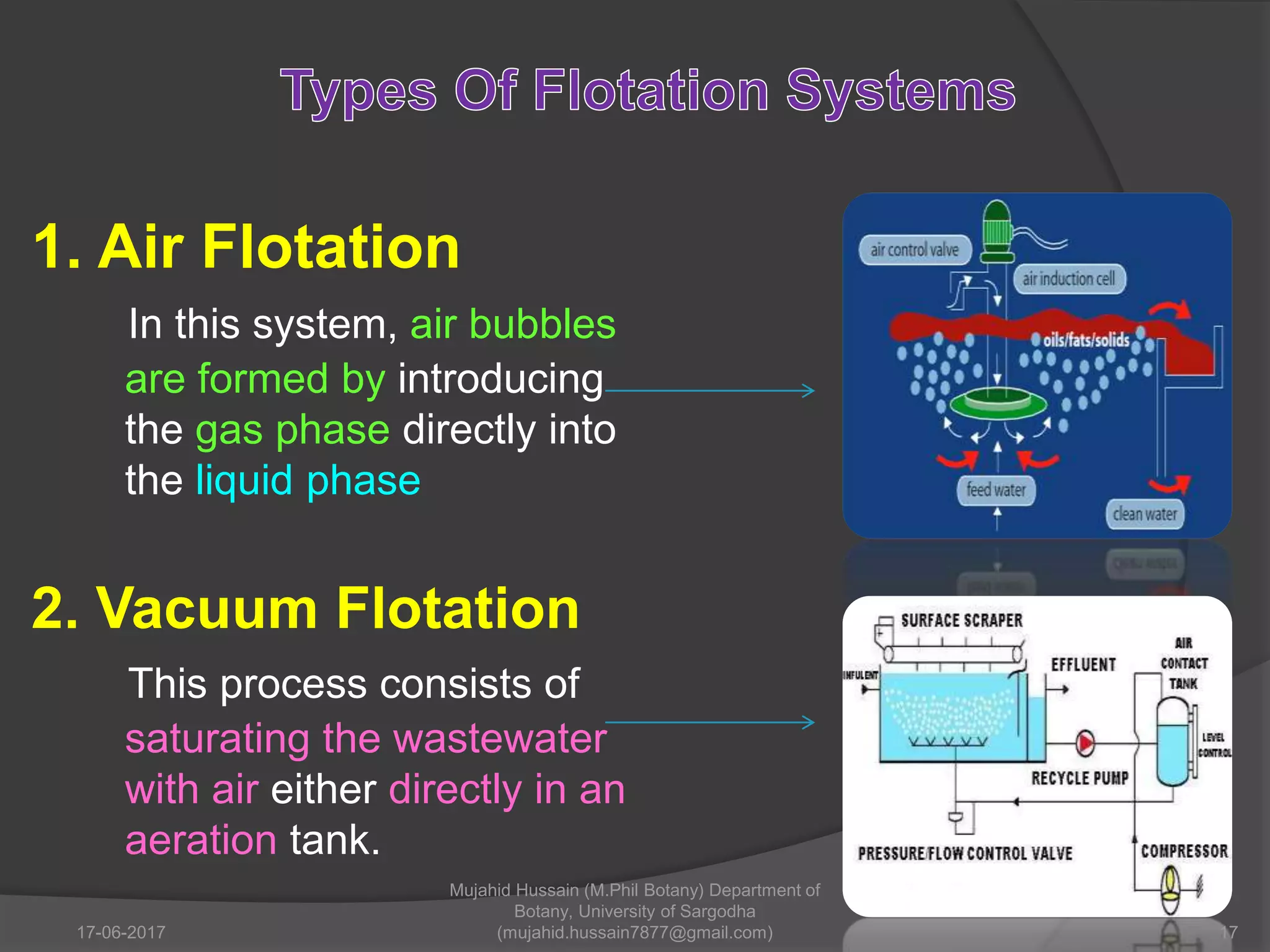
1. Air Flotation
In this system, air bubbles
are formed by introducing
the gas phase directly into
the liquid phase
2. Vacuum Flotation
This process consists of
saturating the wastewater
with air either directly in an
aeration tank.
17-06-2017 17
Mujahid Hussain (M.Phil Botany) Department of
Botany, University of Sargodha
(mujahid.hussain7877@gmail.com)
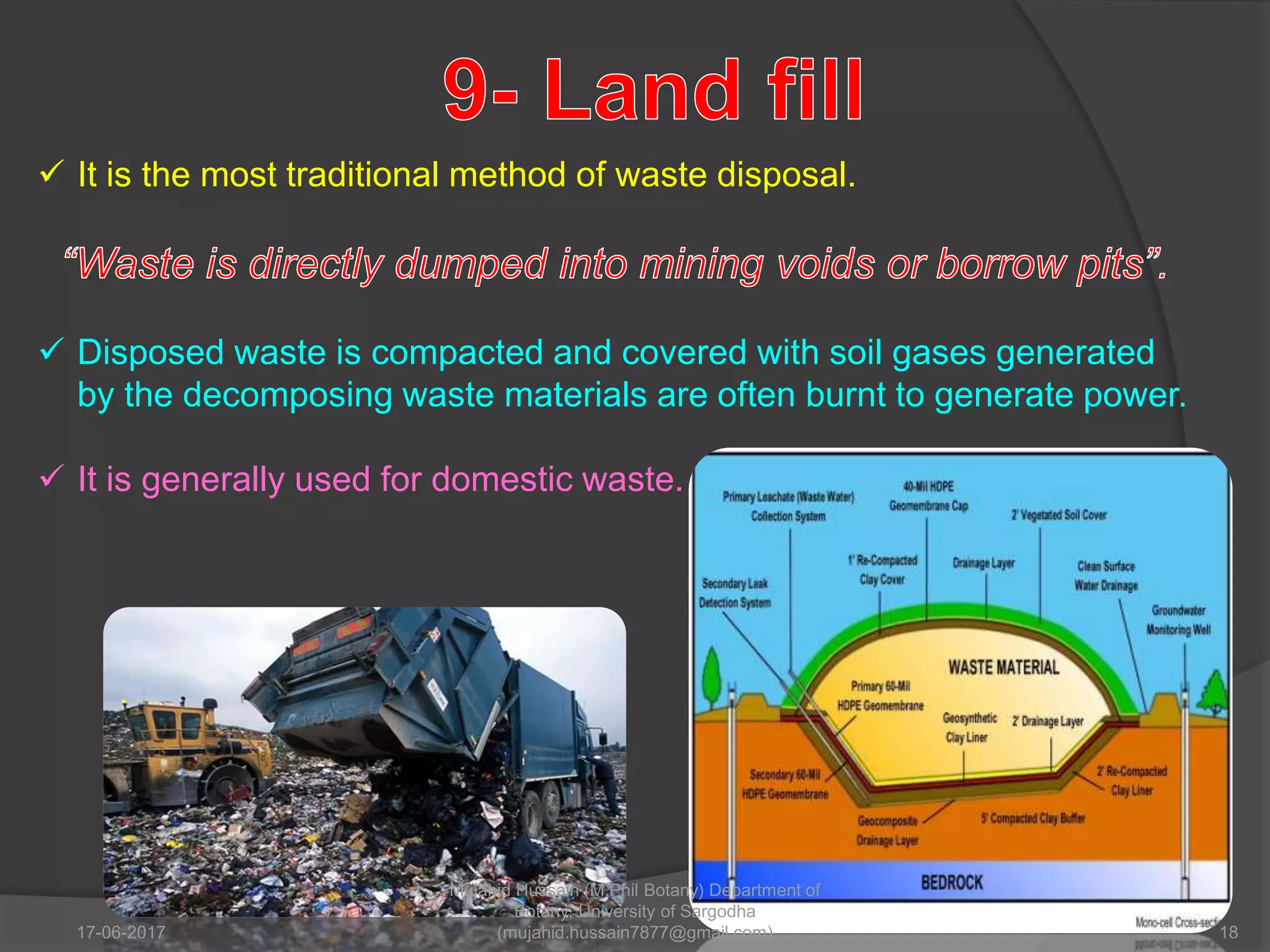
 It is the most traditional method of waste disposal.
 Disposed waste is compacted and covered with soil gases generated
by the decomposing waste materials are often burnt to generate power.
 It is generally used for domestic waste.
17-06-2017 18
Mujahid Hussain (M.Phil Botany) Department of
Botany, University of Sargodha
(mujahid.hussain7877@gmail.com)
ADVANTAGES
 Landfill site is a cheap waste disposal option for the local council.
 Lots of different types of waste can be disposed of by landfill in comparison
to other waste disposal methods.
 The gases given off by the landfill site could be collected and used for
generating power.
DISADVANTAGES
 The site will look ugly while it is being used for landfill.
 Dangerous gases are given off from landfill sites that cause local air pollution
and contribute to global warming.
 Local streams could become polluted with toxins seeping through the ground
from the landfill site.
 Once the site has been filled it might not be able to be used for
redevelopment as it might be too polluted.
17-06-2017 19
Mujahid Hussain (M.Phil Botany) Department of
Botany, University of Sargodha
(mujahid.hussain7877@gmail.com)
:
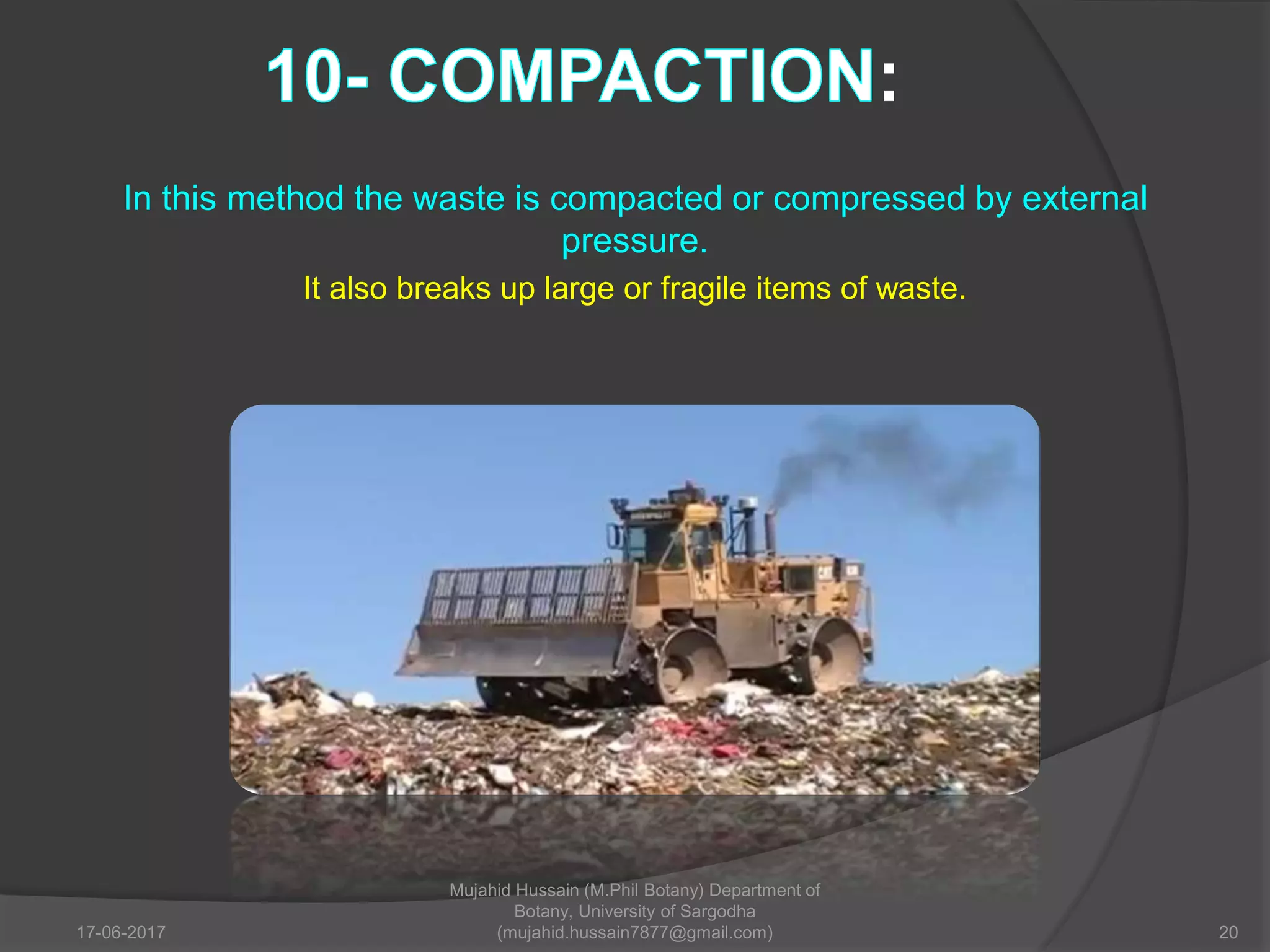
In this method the waste is compacted or compressed by external
pressure.
It also breaks up large or fragile items of waste.
17-06-2017 20
Mujahid Hussain (M.Phil Botany) Department of
Botany, University of Sargodha
(mujahid.hussain7877@gmail.com)
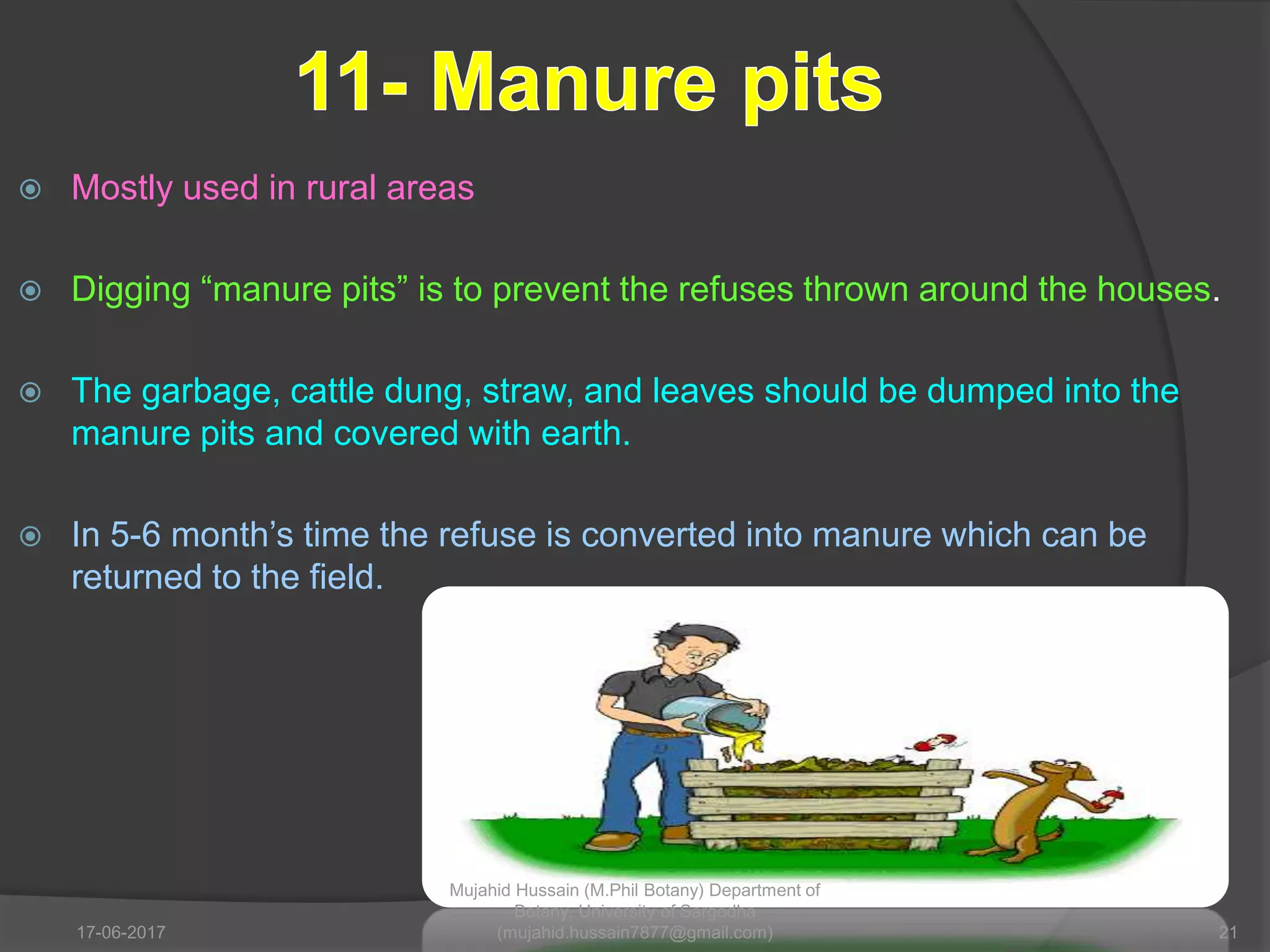
 Mostly used in rural areas
 Digging “manure pits” is to prevent the refuses thrown around the houses.
 The garbage, cattle dung, straw, and leaves should be dumped into the
manure pits and covered with earth.
 In 5-6 month’s time the refuse is converted into manure which can be
returned to the field.
17-06-2017 21
Mujahid Hussain (M.Phil Botany) Department of
Botany, University of Sargodha
(mujahid.hussain7877@gmail.com)
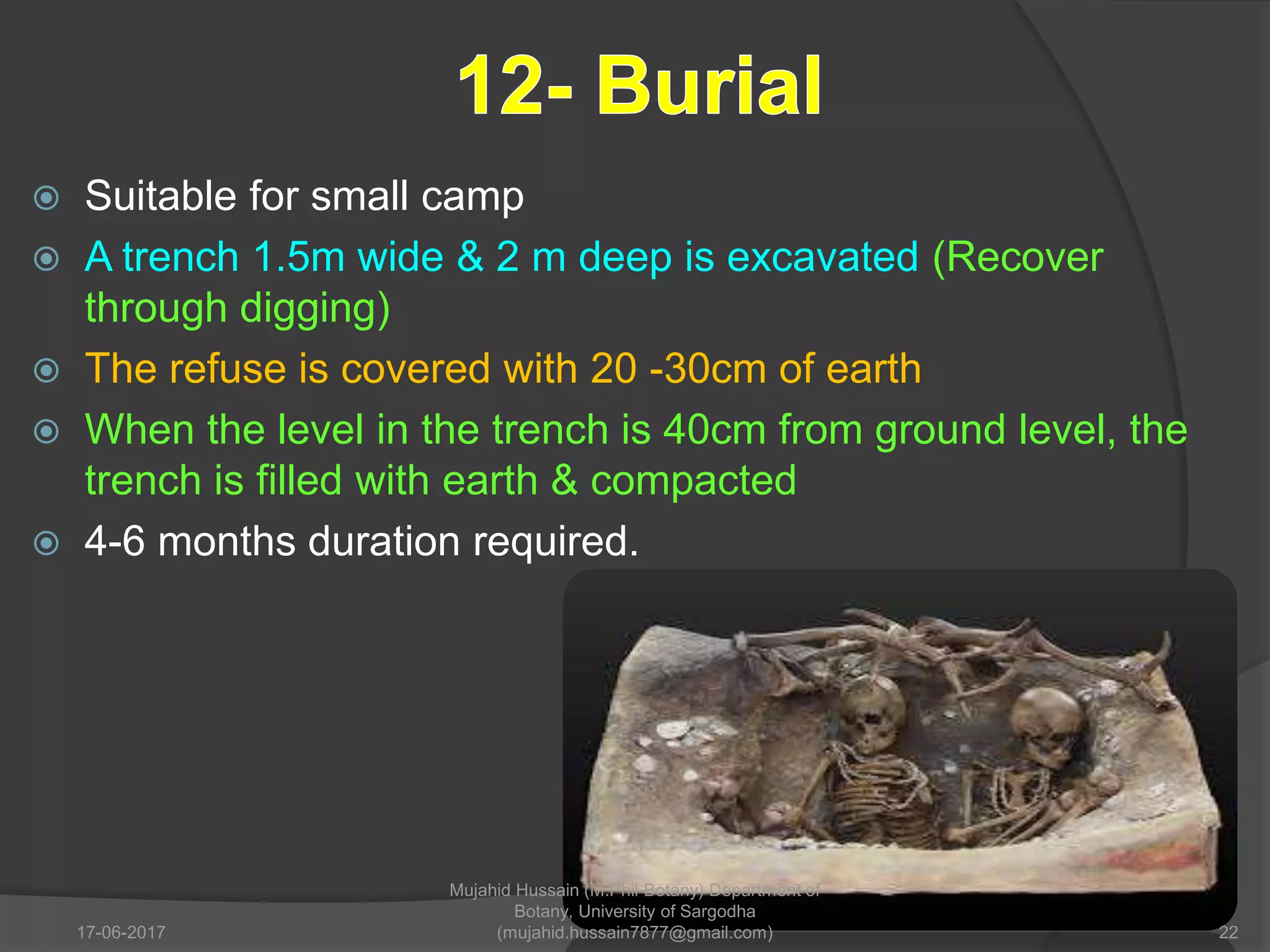
 Suitable for small camp
 A trench 1.5m wide & 2 m deep is excavated (Recover
through digging)
 The refuse is covered with 20 -30cm of earth
 When the level in the trench is 40cm from ground level, the
trench is filled with earth & compacted
 4-6 months duration required.
17-06-2017 22
Mujahid Hussain (M.Phil Botany) Department of
Botany, University of Sargodha
(mujahid.hussain7877@gmail.com)
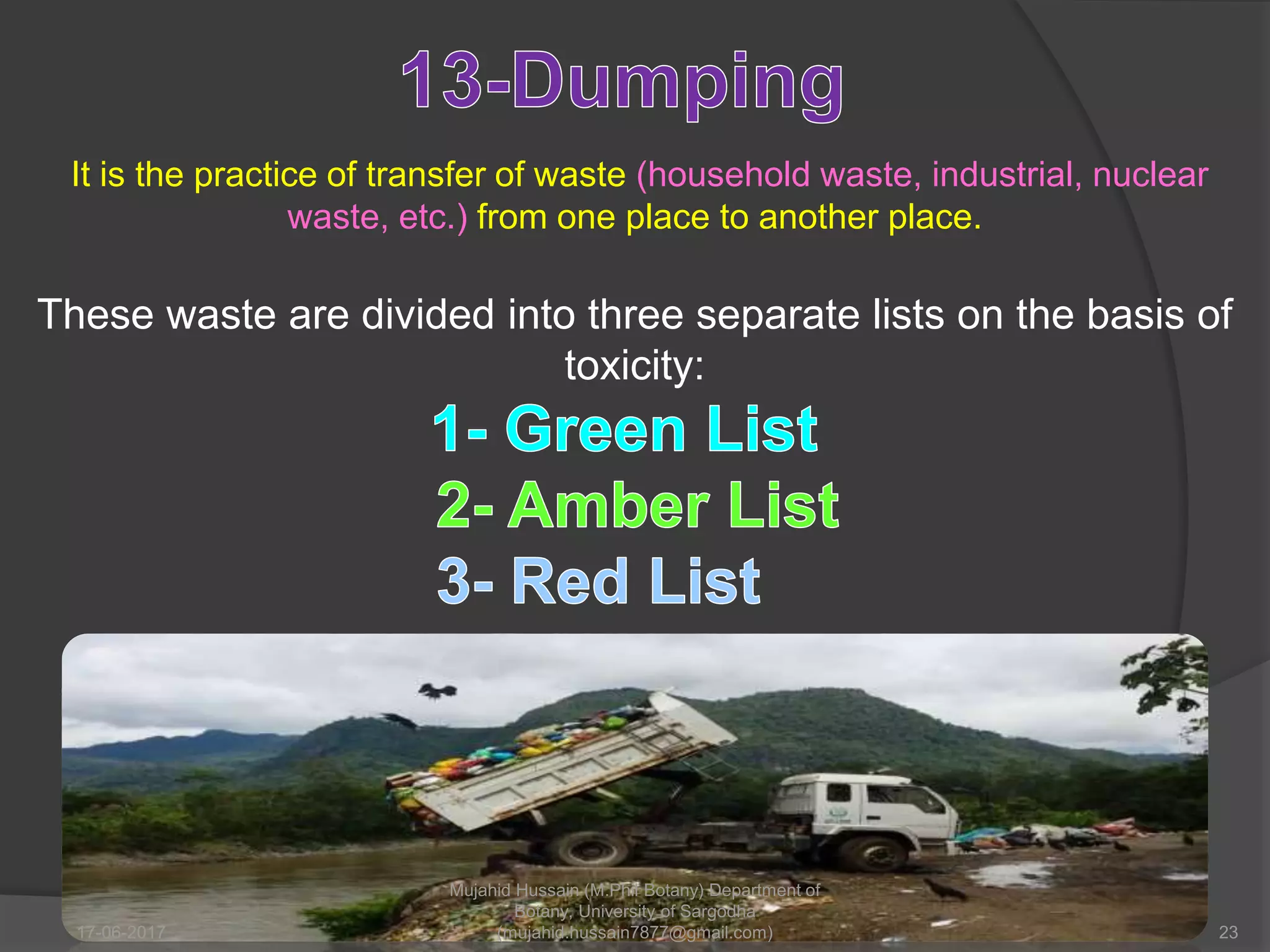
It is the practice of transfer of waste (household waste, industrial, nuclear
waste, etc.) from one place to another place.
These waste are divided into three separate lists on the basis of
toxicity:
17-06-2017 23
Mujahid Hussain (M.Phil Botany) Department of
Botany, University of Sargodha
(mujahid.hussain7877@gmail.com)

physical methods of waste disposal, mujahid hussain

  • 1.
    PHYSICAL METHOD OFWASTE DISPOSAL 17-06-2017 1 Mujahid Hussain (M.Phil Botany) Department of Botany, University of Sargodha (mujahid.hussain7877@gmail.com)
  • 2.
    17-06-2017 2 Mujahid Hussain(M.Phil Botany) Department of Botany, University of Sargodha (mujahid.hussain7877@gmail.com)
  • 3.
    Waste are generatedduring the extraction of raw materials, the processing of raw materials into intermediate and final products, the consumption of final products, or other human activities. 17-06-2017 3 Mujahid Hussain (M.Phil Botany) Department of Botany, University of Sargodha (mujahid.hussain7877@gmail.com)
  • 4.
    Mujahid Hussain (M.Phil Botany) Department of Botany, University of Sargodha (mujahid.hus sain7877@g mail.com) •Many different physical treatment processes are simple and low-cost. • • Choice depends on physical form of waste and its characteristics 17-06-2017 4
  • 5.
    7. Sedimentation 17-06-2017 5 MujahidHussain (M.Phil Botany) Department of Botany, University of Sargodha (mujahid.hussain7877@gmail.com)
  • 6.
    a)Crushing: divide, mixand homogenize the waste. b) Compaction: Reduction of spaces, that is compression of waste at low cost. c) Recovery: Separation of materials that could be recycled. 17-06-2017 6 Mujahid Hussain (M.Phil Botany) Department of Botany, University of Sargodha (mujahid.hussain7877@gmail.com)
  • 7.
    It is definedas the combination of temperature and time required to eliminate wastes products. 17-06-2017 7 Mujahid Hussain (M.Phil Botany) Department of Botany, University of Sargodha (mujahid.hussain7877@gmail.com)
  • 8.
    1. Thermal energyis produced that can be reuse. 2. Cost effective. 3. Easy mechanism. 1. Huge production of Carbon-di-oxide (CO2) in the atmosphere. Apart from CO2, other harmful gases like NOx and SOx are also generated lead to Acid Rain. 2. Exhausted gases harms outside environment badly. 3. Low overall efficiency. 4. It is responsible for raise in sea water level. 5. A large quantity of ash is produced as well as dust that lead to a high particulate matter in the surrounding areas. 17-06-2017 8 Mujahid Hussain (M.Phil Botany) Department of Botany, University of Sargodha (mujahid.hussain7877@gmail.com)
  • 9.
    17-06-2017 9 Mujahid Hussain(M.Phil Botany) Department of Botany, University of Sargodha (mujahid.hussain7877@gmail.com)
  • 10.
    Fusing point ofash is the temperature at which the ash resulting from the burning of waste will form a solid (clinker) by fusion and agglomeration (The act of collecting in a mass). Typical required temperatures are: 1000 - 1200 °C 17-06-2017 10 Mujahid Hussain (M.Phil Botany) Department of Botany, University of Sargodha (mujahid.hussain7877@gmail.com)
  • 11.
    17-06-2017 11 Mujahid Hussain(M.Phil Botany) Department of Botany, University of Sargodha (mujahid.hussain7877@gmail.com)
  • 12.
    :- 17-06-2017 12 Mujahid Hussain(M.Phil Botany) Department of Botany, University of Sargodha (mujahid.hussain7877@gmail.com)
  • 13.
    17-06-2017 13 Mujahid Hussain(M.Phil Botany) Department of Botany, University of Sargodha (mujahid.hussain7877@gmail.com)
  • 14.
    17-06-2017 14 Mujahid Hussain(M.Phil Botany) Department of Botany, University of Sargodha (mujahid.hussain7877@gmail.com)
  • 15.
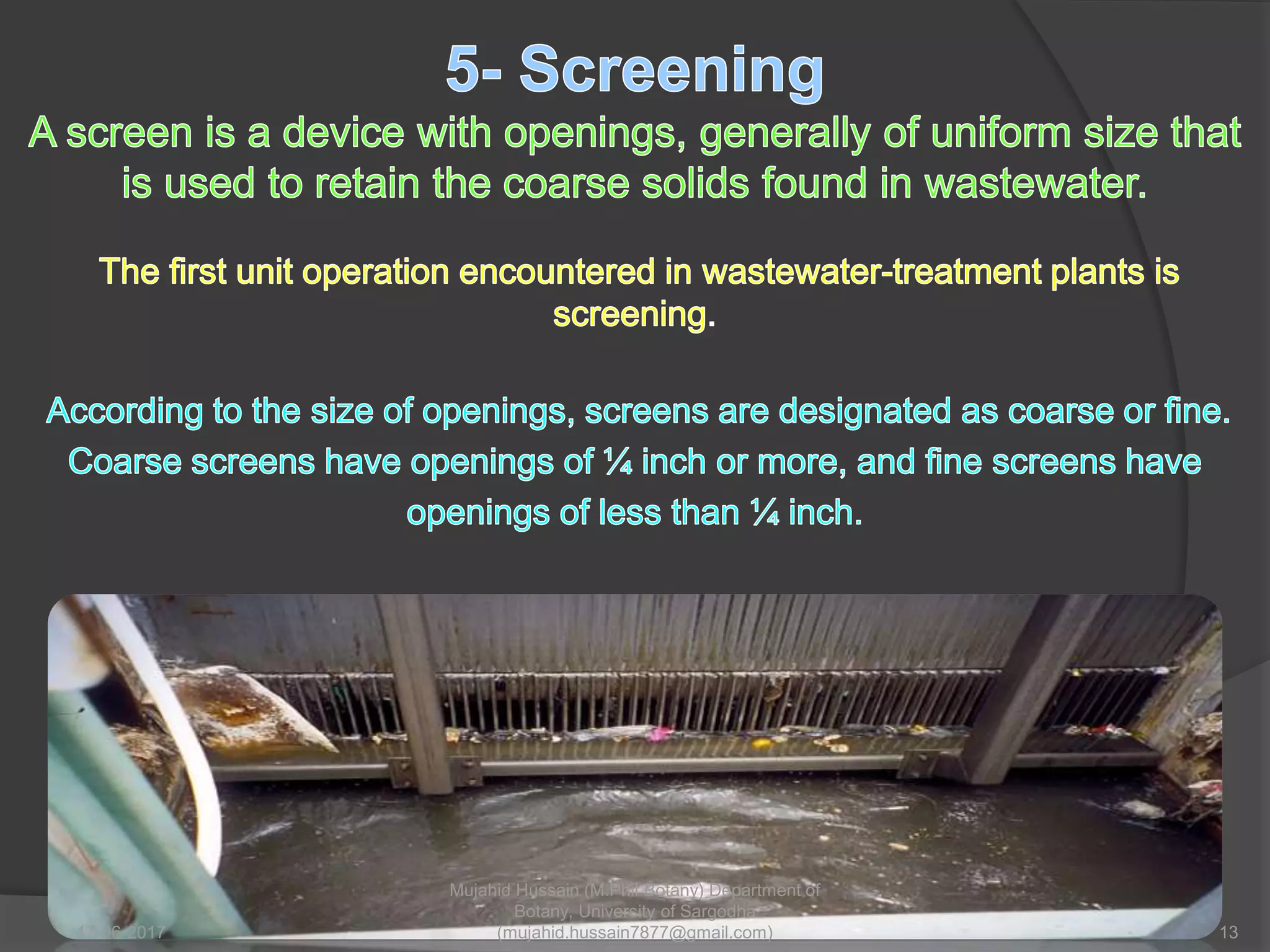
    Sedimentation is theseparation of undissolved substances from water, by gravitational settling, of suspended particles that are heavier than water. Sedimentation is used for separation of;  Particulate matter in water  Separation of biological-floc (A small loosely aggregated mass) in the sludge  Separation of chemical-floc in the sludge.  It is also used for solids concentration in sludge thickeners. Sedimentation basins are constructed in a variety of shapes and sizes, circular tanks or rectangular tanks. : 17-06-2017 15 Mujahid Hussain (M.Phil Botany) Department of Botany, University of Sargodha (mujahid.hussain7877@gmail.com)
  • 16.
     Separation isbrought by introducing fine gas (usually air bubbles) into the liquid phase.  The bubbles attach to the particulate matter, and the buoyant force of the combined particle and gas bubble is great enough to cause the particle to rise to the surface to form a scum blanket, which is removed by a skimming mechanism. Principal advantage of flotation over sedimentation is that very small or light particles that settle slowly can be removed more completely and in a shorter time. 17-06-2017 16 Mujahid Hussain (M.Phil Botany) Department of Botany, University of Sargodha (mujahid.hussain7877@gmail.com)
  • 17.
    1. Air Flotation Inthis system, air bubbles are formed by introducing the gas phase directly into the liquid phase 2. Vacuum Flotation This process consists of saturating the wastewater with air either directly in an aeration tank. 17-06-2017 17 Mujahid Hussain (M.Phil Botany) Department of Botany, University of Sargodha (mujahid.hussain7877@gmail.com)
  • 18.
     It isthe most traditional method of waste disposal.  Disposed waste is compacted and covered with soil gases generated by the decomposing waste materials are often burnt to generate power.  It is generally used for domestic waste. 17-06-2017 18 Mujahid Hussain (M.Phil Botany) Department of Botany, University of Sargodha (mujahid.hussain7877@gmail.com)
  • 19.
    ADVANTAGES  Landfill siteis a cheap waste disposal option for the local council.  Lots of different types of waste can be disposed of by landfill in comparison to other waste disposal methods.  The gases given off by the landfill site could be collected and used for generating power. DISADVANTAGES  The site will look ugly while it is being used for landfill.  Dangerous gases are given off from landfill sites that cause local air pollution and contribute to global warming.  Local streams could become polluted with toxins seeping through the ground from the landfill site.  Once the site has been filled it might not be able to be used for redevelopment as it might be too polluted. 17-06-2017 19 Mujahid Hussain (M.Phil Botany) Department of Botany, University of Sargodha (mujahid.hussain7877@gmail.com)
  • 20.
    : In this methodthe waste is compacted or compressed by external pressure. It also breaks up large or fragile items of waste. 17-06-2017 20 Mujahid Hussain (M.Phil Botany) Department of Botany, University of Sargodha (mujahid.hussain7877@gmail.com)
  • 21.
     Mostly usedin rural areas  Digging “manure pits” is to prevent the refuses thrown around the houses.  The garbage, cattle dung, straw, and leaves should be dumped into the manure pits and covered with earth.  In 5-6 month’s time the refuse is converted into manure which can be returned to the field. 17-06-2017 21 Mujahid Hussain (M.Phil Botany) Department of Botany, University of Sargodha (mujahid.hussain7877@gmail.com)
  • 22.
     Suitable forsmall camp  A trench 1.5m wide & 2 m deep is excavated (Recover through digging)  The refuse is covered with 20 -30cm of earth  When the level in the trench is 40cm from ground level, the trench is filled with earth & compacted  4-6 months duration required. 17-06-2017 22 Mujahid Hussain (M.Phil Botany) Department of Botany, University of Sargodha (mujahid.hussain7877@gmail.com)
  • 23.
    It is thepractice of transfer of waste (household waste, industrial, nuclear waste, etc.) from one place to another place. These waste are divided into three separate lists on the basis of toxicity: 17-06-2017 23 Mujahid Hussain (M.Phil Botany) Department of Botany, University of Sargodha (mujahid.hussain7877@gmail.com)

Editor's Notes

  • #5 Slide 6 Physical processes There are a large number of different physical treatment processes, most of which are simple and low-cost. They include the options shown on the slide. Many physical processes rely on gravity, but this basic principle may be adapted in different ways within different processes in an attempt to optimise its effects. Other physical treatment processes use the different properties of materials eg boiling points. particle sizes. The choice of process is dictated by the form of the waste (eg dry powder, liquid) as well as its characteristics. The next 7 slides look at some of the alternative physical treatment options.