SENSORY
EXAMINATION
Anand vaghasiya
SCREENING of SENSORY EXA.
โ—ฆScreenings consist of a series of brief tests that provide
the therapist an โ€œoverviewโ€ of the system of interest (e.g.,
musculoskeletal, neuromuscular).
โ—ฆTo perform a sensory screening, several easily
tested(i.e., requiring little or no specialized equipment)
modalities of sensation are selected. It is important to
select modalities from each of the general categories of
sensations.
โ—ฆFor example, the therapist might select pain and
light touch (superficial), kinesthesia and vibration
(deep), and two-point discrimination or
stereognosis (combined).
โ—ฆscreening tests for mental status (arousal,
attention, orientation, cognition, and memory),
vision, and hearing acuity should be performed
prior to the sensory examination.
PREPARATION FOR ADMINISTERING
THE SENSORY EXAMINATION
โ—ฆ Before initiating the examination of sensory function, the
testing environment should be identified and prepared,
needed equipment gathered, and consideration given to
patient preparation (i.e., what information and instruction will
be provided).
1. Testing Environment
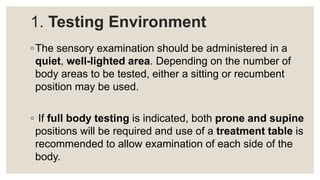
โ—ฆThe sensory examination should be administered in a
quiet, well-lighted area. Depending on the number of
body areas to be tested, either a sitting or recumbent
position may be used.
โ—ฆ If full body testing is indicated, both prone and supine
positions will be required and use of a treatment table is
recommended to allow examination of each side of the
body.
2. Equipment
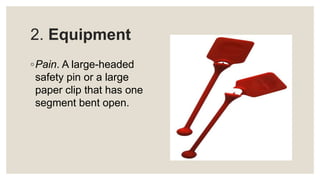
โ—ฆPain. A large-headed
safety pin or a large
paper clip that has one
segment bent open.
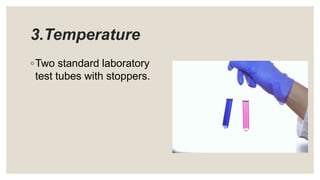
3.Temperature
โ—ฆTwo standard laboratory
test tubes with stoppers.
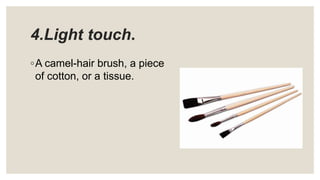
4.Light touch.
โ—ฆA camel-hair brush, a piece
of cotton, or a tissue.
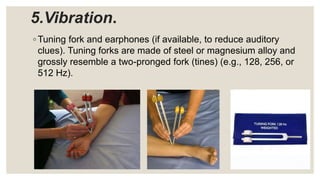
5.Vibration.
โ—ฆ Tuning fork and earphones (if available, to reduce auditory
clues). Tuning forks are made of steel or magnesium alloy and
grossly resemble a two-pronged fork (tines) (e.g., 128, 256, or
512 Hz).
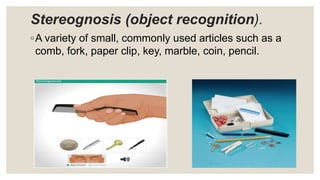
Stereognosis (object recognition).
โ—ฆA variety of small, commonly used articles such as a
comb, fork, paper clip, key, marble, coin, pencil.
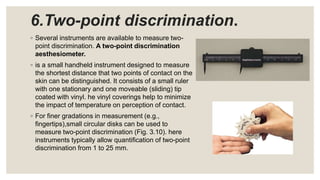
6.Two-point discrimination.
โ—ฆ Several instruments are available to measure two-
point discrimination. A two-point discrimination
aesthesiometer.
โ—ฆ is a small handheld instrument designed to measure
the shortest distance that two points of contact on the
skin can be distinguished. It consists of a small ruler
with one stationary and one moveable (sliding) tip
coated with vinyl. he vinyl coverings help to minimize
the impact of temperature on perception of contact.
โ—ฆ For finer gradations in measurement (e.g.,
fingertips),small circular disks can be used to
measure two-point discrimination (Fig. 3.10). here
instruments typically allow quantification of two-point
discrimination from 1 to 25 mm.
Patient preparation
โ—ฆ A full explanation of the purpose of the testing should be
provided. he patient also should be informed that cooperation
is necessary to obtain accurate test results. It is of
considerable importance that the patient be requested not to
guess if uncertain of the correct response.
โ—ฆ During the examination, the patient should be in a comfortable,
relaxed position. Preferably, the tests should be performed
when the patient is well rested. Considering the high level of
concentration required, it is not surprising that fatigue has been
noted to affect results of some sensory tests adversely.
THE SENSORY EXAMINATION
โ—ฆ The superficial (exteroceptive) sensations are usually ex-
โ—ฆ Eamined first, in as much as they consist of more primitive responses,
followed by the deep (proprioceptive), and then the combined cortical
sensations.
โ—ฆ If a test indicates impairment of the superficial responses, some
impairment of the more discriminative (deep and combined) sensations
also will be noted and is a contraindication to further testing (e.g., lack of
touch sensation would be a contraindication for testing
stereognosis). That is, the primary modality of sensation (touch) must be
sufficiently intact to permit meaningful testing of cor- tical sensory function
(ability to identify objects placed in the hand).
For each sensory test, the following data will be generated:
โ—ฆ the modality tested
โ—ฆ he quantity of involvement or body surface areas affected
(pattern identification)
โ—ฆ the degree or severity of involvement (e.g., absent, impaired,
or delayed responses)
โ—ฆ Localization of the exact boundaries of the sensory
impairment
โ—ฆ he patientโ€™s subjective feelings about changes in sensation
โ—ฆ he potential impact of sensory loss on function (i.e., activity
limitation, disability)
โ—ฆ During testing, the application of stimuli should be applied in a
random, unpredictable manner with variation in timing.
โ—ฆ This will improve accuracy of the test results by avoiding a
consistent pattern of application, which might provide the patient
with โ€œcluesโ€ to the correct response.
โ—ฆ During application of stimuli, consideration must be given
also to skin condition. Scar tissue or callused areas are
generally less sensitive and will demonstrate a diminished
response to sensory stimuli.
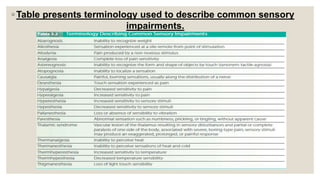
โ—ฆ Table presents terminology used to describe common sensory
impairments.
Superficial Sensations
โ—ฆPain Perception
โ—ฆTemperature Awareness
โ—ฆTouch Awareness
โ—ฆPressure Perception
Pain Perception
โ—ฆ his test is also referred to as sharp/dull discrimination and indicates function
of protective sensation.
โ—ฆ To test pain awareness, the sharp and dull ends of a large headed safety
pin, a reshaped paper clip (the segment pulled away from the body of the
paper clip provides a sharp end), or a single-use protected neurological pin
(Medipin) are used.
โ—ฆ he instrument should be carefully cleaned before administering the test and
disposed of immediately afterward
โ—ฆ The sharp and dull ends of the instrument are randomly applied
perpendicularly to the skin.
โ—ฆ To avoid summation of impulses, the stimuli should not be applied too close
to each other or in too rapid a succession.
โ—ฆ To maintain a uniform pressure with each successive
application of stimuli, the pin or reshaped paper clip should
be held firmly and the fingers allowed to โ€œslideโ€ down the pin
or paper clip once in contact with the skin.
โ—ฆ This will avoid the chance of gradually increasing pressure during
application. he instrument used to test pain perception should be
sharp enough to deflect the skin, but not puncture it.
โ—ฆResponse
โ—ฆ he patient is asked to verbally indicate sharp or dull when a
stimulus is felt. All areas of the body may be tested.
Temperature Awareness
โ—ฆ This test determines the ability to distinguish between warm and cool stimuli.
Two test tubes with stoppers are required for this examination;
โ—ฆ one should be filled with warm water and the other with crushed ice.
Ideal temperatures for cold are between 41ยฐF (5ยฐC) and 50ยฐF (10ยฐC) and for
warmth, between 104ยฐF (40ยฐC) and 113ยฐF (45ยฐC).
โ—ฆ Caution should be exercised to remain within these ranges, because
exceeding these temperatures may elicit a pain response and consequently
inaccurate test results. The side of the test tube should be placed in contact
with the skin (as opposed to only the distal end).
โ—ฆ This technique provides sufficient surface area contact to determine the
temperature. The test tubes are randomly placed in contact with the
skin area to be tested. All skin surfaces should be tested.
โ—ฆResponse
โ—ฆ The patient is asked to reply hot or cold after each stimulus application.
Touch Awareness
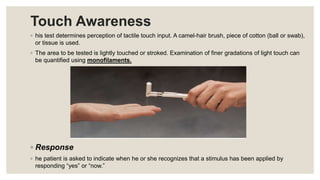
โ—ฆ his test determines perception of tactile touch input. A camel-hair brush, piece of cotton (ball or swab),
or tissue is used.
โ—ฆ The area to be tested is lightly touched or stroked. Examination of finer gradations of light touch can
be quantified using monofilaments.
โ—ฆ Response
โ—ฆ he patient is asked to indicate when he or she recognizes that a stimulus has been applied by
responding โ€œyesโ€ or โ€œnow.โ€
โ—ฆ Note: A quantitative score for pain perception, temperature,
and light touch awareness can be obtained by dividing the
number of correct responses by the number of stimuli
applied (normal response would be 100%).
Pressure Perception
โ—ฆ The therapistโ€™s fingertip or a double-tipped cotton swab is used
to apply a firm pressure on the skin surface.
โ—ฆ This pressure should be firm enough to indent the skin and to
stimulate the deep receptors.
โ—ฆ This test can also be administered using the thumb and fingers
to squeezee the Achilles tendon.
โ—ฆ Response
โ—ฆ he patient is asked to indicate when an applied stimulus is recognized by responding โ€œyesโ€ or โ€œnow.โ€
Sensory examination

Sensory examination

  • 1.
  • 2.
    SCREENING of SENSORYEXA. โ—ฆScreenings consist of a series of brief tests that provide the therapist an โ€œoverviewโ€ of the system of interest (e.g., musculoskeletal, neuromuscular). โ—ฆTo perform a sensory screening, several easily tested(i.e., requiring little or no specialized equipment) modalities of sensation are selected. It is important to select modalities from each of the general categories of sensations.
  • 3.
    โ—ฆFor example, thetherapist might select pain and light touch (superficial), kinesthesia and vibration (deep), and two-point discrimination or stereognosis (combined). โ—ฆscreening tests for mental status (arousal, attention, orientation, cognition, and memory), vision, and hearing acuity should be performed prior to the sensory examination.
  • 4.
    PREPARATION FOR ADMINISTERING THESENSORY EXAMINATION โ—ฆ Before initiating the examination of sensory function, the testing environment should be identified and prepared, needed equipment gathered, and consideration given to patient preparation (i.e., what information and instruction will be provided).
  • 5.
    1. Testing Environment โ—ฆThesensory examination should be administered in a quiet, well-lighted area. Depending on the number of body areas to be tested, either a sitting or recumbent position may be used. โ—ฆ If full body testing is indicated, both prone and supine positions will be required and use of a treatment table is recommended to allow examination of each side of the body.
  • 6.
    2. Equipment โ—ฆPain. Alarge-headed safety pin or a large paper clip that has one segment bent open.
  • 7.
  • 8.
    4.Light touch. โ—ฆA camel-hairbrush, a piece of cotton, or a tissue.
  • 9.
    5.Vibration. โ—ฆ Tuning forkand earphones (if available, to reduce auditory clues). Tuning forks are made of steel or magnesium alloy and grossly resemble a two-pronged fork (tines) (e.g., 128, 256, or 512 Hz).
  • 10.
    Stereognosis (object recognition). โ—ฆAvariety of small, commonly used articles such as a comb, fork, paper clip, key, marble, coin, pencil.
  • 11.
    6.Two-point discrimination. โ—ฆ Severalinstruments are available to measure two- point discrimination. A two-point discrimination aesthesiometer. โ—ฆ is a small handheld instrument designed to measure the shortest distance that two points of contact on the skin can be distinguished. It consists of a small ruler with one stationary and one moveable (sliding) tip coated with vinyl. he vinyl coverings help to minimize the impact of temperature on perception of contact. โ—ฆ For finer gradations in measurement (e.g., fingertips),small circular disks can be used to measure two-point discrimination (Fig. 3.10). here instruments typically allow quantification of two-point discrimination from 1 to 25 mm.
  • 12.
    Patient preparation โ—ฆ Afull explanation of the purpose of the testing should be provided. he patient also should be informed that cooperation is necessary to obtain accurate test results. It is of considerable importance that the patient be requested not to guess if uncertain of the correct response. โ—ฆ During the examination, the patient should be in a comfortable, relaxed position. Preferably, the tests should be performed when the patient is well rested. Considering the high level of concentration required, it is not surprising that fatigue has been noted to affect results of some sensory tests adversely.
  • 13.
    THE SENSORY EXAMINATION โ—ฆThe superficial (exteroceptive) sensations are usually ex- โ—ฆ Eamined first, in as much as they consist of more primitive responses, followed by the deep (proprioceptive), and then the combined cortical sensations. โ—ฆ If a test indicates impairment of the superficial responses, some impairment of the more discriminative (deep and combined) sensations also will be noted and is a contraindication to further testing (e.g., lack of touch sensation would be a contraindication for testing stereognosis). That is, the primary modality of sensation (touch) must be sufficiently intact to permit meaningful testing of cor- tical sensory function (ability to identify objects placed in the hand).
  • 14.
    For each sensorytest, the following data will be generated: โ—ฆ the modality tested โ—ฆ he quantity of involvement or body surface areas affected (pattern identification) โ—ฆ the degree or severity of involvement (e.g., absent, impaired, or delayed responses) โ—ฆ Localization of the exact boundaries of the sensory impairment โ—ฆ he patientโ€™s subjective feelings about changes in sensation โ—ฆ he potential impact of sensory loss on function (i.e., activity limitation, disability)
  • 15.
    โ—ฆ During testing,the application of stimuli should be applied in a random, unpredictable manner with variation in timing. โ—ฆ This will improve accuracy of the test results by avoiding a consistent pattern of application, which might provide the patient with โ€œcluesโ€ to the correct response. โ—ฆ During application of stimuli, consideration must be given also to skin condition. Scar tissue or callused areas are generally less sensitive and will demonstrate a diminished response to sensory stimuli.
  • 16.
    โ—ฆ Table presentsterminology used to describe common sensory impairments.
  • 17.
    Superficial Sensations โ—ฆPain Perception โ—ฆTemperatureAwareness โ—ฆTouch Awareness โ—ฆPressure Perception
  • 18.
    Pain Perception โ—ฆ histest is also referred to as sharp/dull discrimination and indicates function of protective sensation. โ—ฆ To test pain awareness, the sharp and dull ends of a large headed safety pin, a reshaped paper clip (the segment pulled away from the body of the paper clip provides a sharp end), or a single-use protected neurological pin (Medipin) are used. โ—ฆ he instrument should be carefully cleaned before administering the test and disposed of immediately afterward โ—ฆ The sharp and dull ends of the instrument are randomly applied perpendicularly to the skin. โ—ฆ To avoid summation of impulses, the stimuli should not be applied too close to each other or in too rapid a succession.
  • 19.
    โ—ฆ To maintaina uniform pressure with each successive application of stimuli, the pin or reshaped paper clip should be held firmly and the fingers allowed to โ€œslideโ€ down the pin or paper clip once in contact with the skin. โ—ฆ This will avoid the chance of gradually increasing pressure during application. he instrument used to test pain perception should be sharp enough to deflect the skin, but not puncture it. โ—ฆResponse โ—ฆ he patient is asked to verbally indicate sharp or dull when a stimulus is felt. All areas of the body may be tested.
  • 20.
    Temperature Awareness โ—ฆ Thistest determines the ability to distinguish between warm and cool stimuli. Two test tubes with stoppers are required for this examination; โ—ฆ one should be filled with warm water and the other with crushed ice. Ideal temperatures for cold are between 41ยฐF (5ยฐC) and 50ยฐF (10ยฐC) and for warmth, between 104ยฐF (40ยฐC) and 113ยฐF (45ยฐC). โ—ฆ Caution should be exercised to remain within these ranges, because exceeding these temperatures may elicit a pain response and consequently inaccurate test results. The side of the test tube should be placed in contact with the skin (as opposed to only the distal end).
  • 21.
    โ—ฆ This techniqueprovides sufficient surface area contact to determine the temperature. The test tubes are randomly placed in contact with the skin area to be tested. All skin surfaces should be tested. โ—ฆResponse โ—ฆ The patient is asked to reply hot or cold after each stimulus application.
  • 22.
    Touch Awareness โ—ฆ histest determines perception of tactile touch input. A camel-hair brush, piece of cotton (ball or swab), or tissue is used. โ—ฆ The area to be tested is lightly touched or stroked. Examination of finer gradations of light touch can be quantified using monofilaments. โ—ฆ Response โ—ฆ he patient is asked to indicate when he or she recognizes that a stimulus has been applied by responding โ€œyesโ€ or โ€œnow.โ€
  • 23.
    โ—ฆ Note: Aquantitative score for pain perception, temperature, and light touch awareness can be obtained by dividing the number of correct responses by the number of stimuli applied (normal response would be 100%).
  • 24.
    Pressure Perception โ—ฆ Thetherapistโ€™s fingertip or a double-tipped cotton swab is used to apply a firm pressure on the skin surface. โ—ฆ This pressure should be firm enough to indent the skin and to stimulate the deep receptors. โ—ฆ This test can also be administered using the thumb and fingers to squeezee the Achilles tendon. โ—ฆ Response โ—ฆ he patient is asked to indicate when an applied stimulus is recognized by responding โ€œyesโ€ or โ€œnow.โ€