POSTURE
GUIDED BY :~ DR. REECHA GUPTA
PRESENTED BY :~ ANAND VAGHASIYA
Topics to be covered
 Definition
 Types
 The postural mechanism
 The pattern of posture
 Principle and Technique of Re-education
 Presentation of good posture
 Patient education
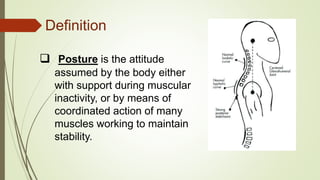
Definition
 Posture is the attitude
assumed by the body either
with support during muscular
inactivity, or by means of
coordinated action of many
muscles working to maintain
stability.
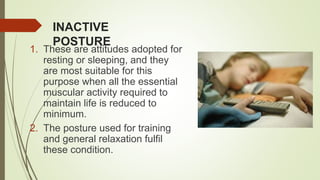
INACTIVE
POSTURE
1. These are attitudes adopted for
resting or sleeping, and they
are most suitable for this
purpose when all the essential
muscular activity required to
maintain life is reduced to
minimum.
2. The posture used for training
and general relaxation fulfil
these condition.
ACTIVE POSTURE
 the integrated action of
many muscles is required to
maintain active postures,
which may be static or
dynamic.
1. STATIC POSTURE
2. DYNAMIC POSTURE
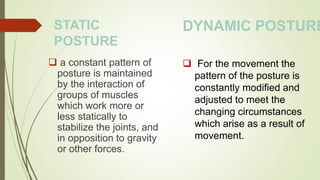
STATIC
POSTURE
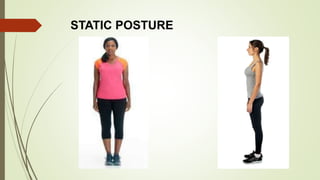
 a constant pattern of
posture is maintained
by the interaction of
groups of muscles
which work more or
less statically to
stabilize the joints, and
in opposition to gravity
or other forces.
DYNAMIC POSTURE
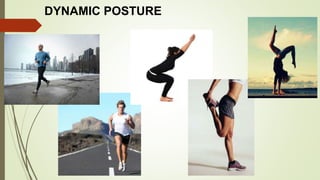
 For the movement the
pattern of the posture is
constantly modified and
adjusted to meet the
changing circumstances
which arise as a result of
movement.
STATIC POSTURE
DYNAMIC POSTURE
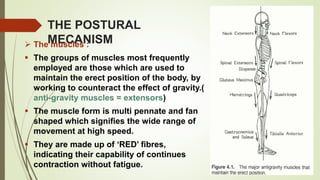
THE POSTURAL
MECANISM The muscles :
 The groups of muscles most frequently
employed are those which are used to
maintain the erect position of the body, by
working to counteract the effect of gravity.(
anti-gravity muscles = extensors)
 The muscle form is multi pennate and fan
shaped which signifies the wide range of
movement at high speed.
 They are made up of ‘RED’ fibres,
indicating their capability of continues
contraction without fatigue.
Nervous control : posture are maintained by
neuromuscular co-ordination, with the help
of very complex reflex mechanism.
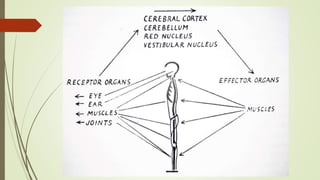
The postural Reflexes : an efferent response to an afferent
stimulus. Afferent stimuli arise from variety of sources all over the
body.
The muscles : Neuromuscular and neurotendinous spindles
within muscles record the changing tension. increase tension
results into the reflex contraction of muscle, like stretch reflex.
The eyes : visual sensation records any alteration in the body
position with regard to surrounding and help the restore body in
erect position by activating ‘righting reflexes’.
All the sensation and information are conveyed and co-
ordinate into CNS
The ears : stimulation of the receptor of the
vestibular nerve results from the movement of fluid of
semicircular canals of internal ear. each canal lies in
different plane and any movement of head disturb
fluid they contain. it gives knowledge of movement
and the direction.
Joint structures :In the weight bearing position
approximation of bones stimulates receptors in joint
structure and elicits reflex reaction to maintain the
position.
Tactile stimulation
THE PATTERN OF
POSTURE Patterns of posture both static and dynamic, are gradually
built up by integration of many reflexes which together make
up the Postural Reflex.
 Some of them are inborn and some are conditioned.
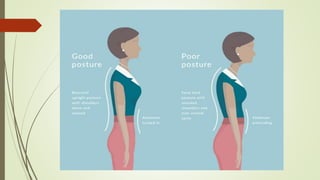
1.GOOD POSTURE
2.POOR POSTURE
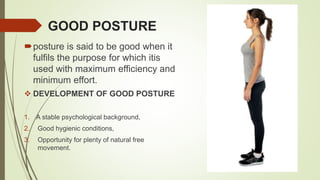
GOOD POSTURE
posture is said to be good when it
fulfils the purpose for which itis
used with maximum efficiency and
minimum effort.
 DEVELOPMENT OF GOOD POSTURE
1. A stable psychological background,
2. Good hygienic conditions,
3. Opportunity for plenty of natural free
movement.
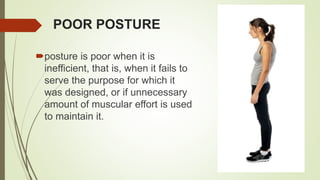
POOR POSTURE
posture is poor when it is
inefficient, that is, when it fails to
serve the purpose for which it
was designed, or if unnecessary
amount of muscular effort is used
to maintain it.
 Factors which predispose to poor
posture:
1. General causes: mental attitude, poor
hygienic conditions, prolonged fatigue etc.
2. Local factors: localized pain, muscular
weakness, occupational stresses
Principles of re-education
1. Cause must be treated first !
2. Success of any physical treatment invariably depends upon
ability to gain the co-operation of patient by
physiotherapist.
3. Remedied permanently by an alteration in mental attitude
by improving the hygienic condition.
4. Relaxation & Mobility exercise for improving and repeated
presentation of satisfactory postural pattern
5. Patient education on merits of good posture
6. Alleviation of pain
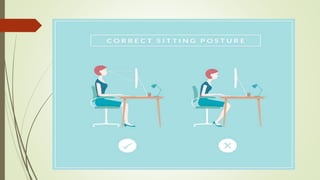
7. Analysis of work environment
TECHNIQUES OF RE-EDUCATION
RELAXATION Voluntary relaxation of specific group of
muscle can be taught and practiced so that
the patient learns to recognize tension and is
able to relax at will.
MOBILITY
Normally maintain by general free exercises.
MUSCLE POWER
General muscular weakness is there due to poor posture, with
the help of free movement and harmonious muscular
development it can be prevented
PRESENTATION
OF GOOD
POSTURE
The physiotherapist must ‘sell’ the patterns
of good posture
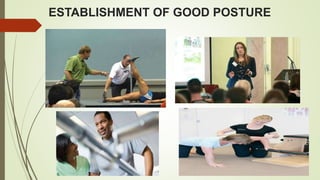
ESTABLISHMENT
OF GOOD
POSTURE
By using audio visual instruments and giving
seminar or presentation on good posture
ESTABLISHMENT OF GOOD POSTURE
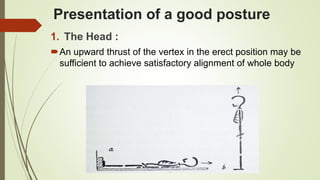
Presentation of a good posture
1. The Head :
An upward thrust of the vertex in the erect position may be
sufficient to achieve satisfactory alignment of whole body
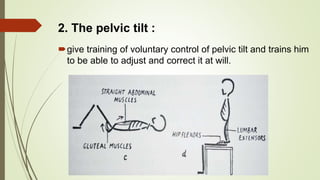
give training of voluntary control of pelvic tilt and trains him
to be able to adjust and correct it at will.
2. The pelvic tilt :
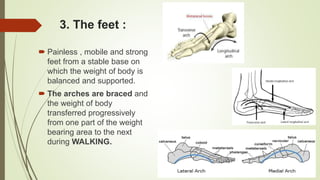
3. The feet :
 Painless , mobile and strong
feet from a stable base on
which the weight of body is
balanced and supported.
 The arches are braced and
the weight of body
transferred progressively
from one part of the weight
bearing area to the next
during WALKING.
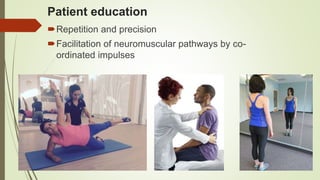
Patient education
Repetition and precision
Facilitation of neuromuscular pathways by co-
ordinated impulses
Reference book :
the principles of exercise therapy by M. dena gardiner

Posture- Physical Therapy [VNSGU]

  • 1.
    POSTURE GUIDED BY :~DR. REECHA GUPTA PRESENTED BY :~ ANAND VAGHASIYA
  • 2.
    Topics to becovered  Definition  Types  The postural mechanism  The pattern of posture  Principle and Technique of Re-education  Presentation of good posture  Patient education
  • 3.
    Definition  Posture isthe attitude assumed by the body either with support during muscular inactivity, or by means of coordinated action of many muscles working to maintain stability.
  • 4.
    INACTIVE POSTURE 1. These areattitudes adopted for resting or sleeping, and they are most suitable for this purpose when all the essential muscular activity required to maintain life is reduced to minimum. 2. The posture used for training and general relaxation fulfil these condition.
  • 5.
    ACTIVE POSTURE  theintegrated action of many muscles is required to maintain active postures, which may be static or dynamic. 1. STATIC POSTURE 2. DYNAMIC POSTURE
  • 6.
    STATIC POSTURE  a constantpattern of posture is maintained by the interaction of groups of muscles which work more or less statically to stabilize the joints, and in opposition to gravity or other forces. DYNAMIC POSTURE  For the movement the pattern of the posture is constantly modified and adjusted to meet the changing circumstances which arise as a result of movement.
  • 7.
  • 8.
  • 9.
    THE POSTURAL MECANISM Themuscles :  The groups of muscles most frequently employed are those which are used to maintain the erect position of the body, by working to counteract the effect of gravity.( anti-gravity muscles = extensors)  The muscle form is multi pennate and fan shaped which signifies the wide range of movement at high speed.  They are made up of ‘RED’ fibres, indicating their capability of continues contraction without fatigue.
  • 10.
    Nervous control :posture are maintained by neuromuscular co-ordination, with the help of very complex reflex mechanism.
  • 11.
    The postural Reflexes: an efferent response to an afferent stimulus. Afferent stimuli arise from variety of sources all over the body. The muscles : Neuromuscular and neurotendinous spindles within muscles record the changing tension. increase tension results into the reflex contraction of muscle, like stretch reflex. The eyes : visual sensation records any alteration in the body position with regard to surrounding and help the restore body in erect position by activating ‘righting reflexes’. All the sensation and information are conveyed and co- ordinate into CNS
  • 12.
    The ears :stimulation of the receptor of the vestibular nerve results from the movement of fluid of semicircular canals of internal ear. each canal lies in different plane and any movement of head disturb fluid they contain. it gives knowledge of movement and the direction. Joint structures :In the weight bearing position approximation of bones stimulates receptors in joint structure and elicits reflex reaction to maintain the position. Tactile stimulation
  • 14.
    THE PATTERN OF POSTUREPatterns of posture both static and dynamic, are gradually built up by integration of many reflexes which together make up the Postural Reflex.  Some of them are inborn and some are conditioned. 1.GOOD POSTURE 2.POOR POSTURE
  • 15.
    GOOD POSTURE posture issaid to be good when it fulfils the purpose for which itis used with maximum efficiency and minimum effort.  DEVELOPMENT OF GOOD POSTURE 1. A stable psychological background, 2. Good hygienic conditions, 3. Opportunity for plenty of natural free movement.
  • 16.
    POOR POSTURE posture ispoor when it is inefficient, that is, when it fails to serve the purpose for which it was designed, or if unnecessary amount of muscular effort is used to maintain it.
  • 19.
     Factors whichpredispose to poor posture: 1. General causes: mental attitude, poor hygienic conditions, prolonged fatigue etc. 2. Local factors: localized pain, muscular weakness, occupational stresses
  • 20.
    Principles of re-education 1.Cause must be treated first ! 2. Success of any physical treatment invariably depends upon ability to gain the co-operation of patient by physiotherapist. 3. Remedied permanently by an alteration in mental attitude by improving the hygienic condition. 4. Relaxation & Mobility exercise for improving and repeated presentation of satisfactory postural pattern 5. Patient education on merits of good posture 6. Alleviation of pain 7. Analysis of work environment
  • 21.
    TECHNIQUES OF RE-EDUCATION RELAXATIONVoluntary relaxation of specific group of muscle can be taught and practiced so that the patient learns to recognize tension and is able to relax at will. MOBILITY Normally maintain by general free exercises. MUSCLE POWER General muscular weakness is there due to poor posture, with the help of free movement and harmonious muscular development it can be prevented
  • 22.
    PRESENTATION OF GOOD POSTURE The physiotherapistmust ‘sell’ the patterns of good posture ESTABLISHMENT OF GOOD POSTURE By using audio visual instruments and giving seminar or presentation on good posture
  • 23.
  • 24.
    Presentation of agood posture 1. The Head : An upward thrust of the vertex in the erect position may be sufficient to achieve satisfactory alignment of whole body
  • 25.
    give training ofvoluntary control of pelvic tilt and trains him to be able to adjust and correct it at will. 2. The pelvic tilt :
  • 26.
    3. The feet:  Painless , mobile and strong feet from a stable base on which the weight of body is balanced and supported.  The arches are braced and the weight of body transferred progressively from one part of the weight bearing area to the next during WALKING.
  • 27.
    Patient education Repetition andprecision Facilitation of neuromuscular pathways by co- ordinated impulses
  • 28.
    Reference book : theprinciples of exercise therapy by M. dena gardiner