Motion in Two Dimensions
Section 6.2
Circular Motion
 How do I explain why an object that is moving in a
 circle at constant velocity has acceleration?

 How can I calculate centripetal acceleration?


 How can I identify the forces that cause centripetal
 acceleration?
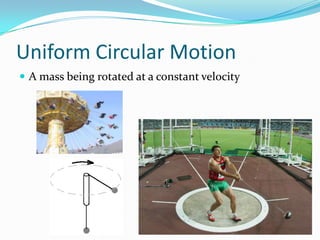
Uniform Circular Motion
 A mass being rotated at a constant velocity
Uniform Circular Motion
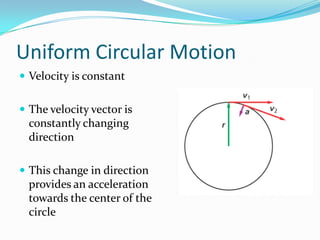
 Velocity is constant


 The velocity vector is
  constantly changing
  direction

 This change in direction
  provides an acceleration
  towards the center of the
  circle
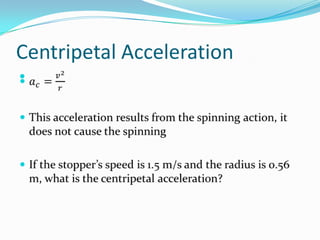
Centripetal Acceleration

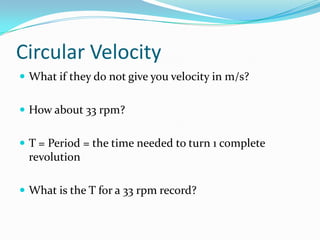
Circular Velocity
 What if they do not give you velocity in m/s?


 How about 33 rpm?


 T = Period = the time needed to turn 1 complete
 revolution

 What is the T for a 33 rpm record?
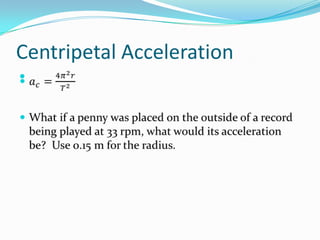
Centripetal Acceleration

Centripetal Force
 Since the acceleration points towards the center, the
  centripetal force points towards the center

 F = ma, so Fc = ?


 Fc is the result of another force that turns the object in
  a circle

 This force can be supplied by tension or friction
Centripetal Force
 Supplied by tension


 A 13 g stopper is attached to a 0.93 m string. The
 stopper is swung in a horizontal circle, making one
 revolution in 1.18 s. Find the tension force exerted by
 the string on the stopper.
Centripetal Force

Homework
 Page 156
 # 12 - 15

Physics/Notes 6.2