SIMPLE MACHINES
    SECTION 10.2
SIMPLE MACHINES

• How do I define a simple machine?

• How do I differentiate between an ideal and a real
  machine?

• How do I define and calculate efficiency?
MACHINES

• Machine: a device that changes the magnitude or
  direction of a force

• Should make things easier

• Simple machines: bottle openers, screwdrivers, …

• Complex machines: bikes, cars, …
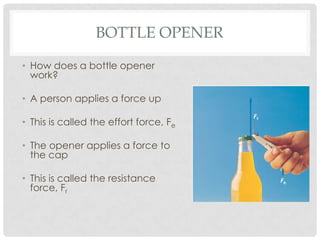
BOTTLE OPENER

• How does a bottle opener
  work?

• A person applies a force up

• This is called the effort force, Fe

• The opener applies a force to
  the cap

• This is called the resistance
  force, Fr
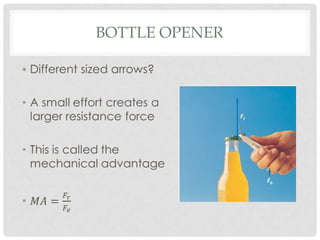
BOTTLE OPENER

•
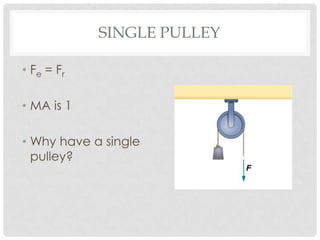
SINGLE PULLEY

• Fe = Fr

• MA is 1

• Why have a single
  pulley?
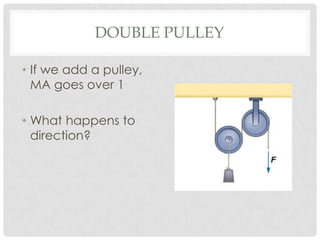
DOUBLE PULLEY

• If we add a pulley,
  MA goes over 1

• What happens to
  direction?
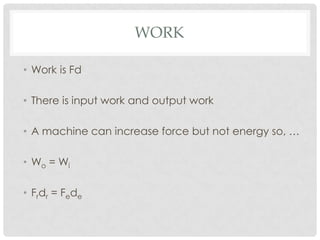
WORK

• Work is Fd

• There is input work and output work

• A machine can increase force but not energy so, …

• Wo = Wi

• Frdr = Fede
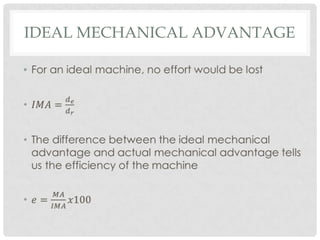
IDEAL MECHANICAL ADVANTAGE

•
MACHINES

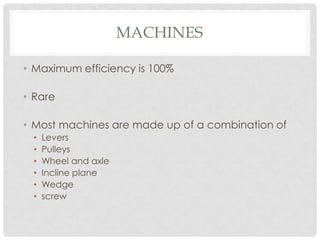
• Maximum efficiency is 100%

• Rare

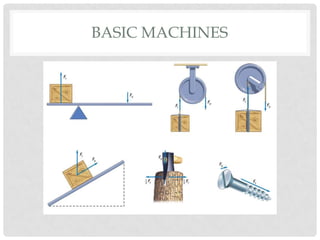
• Most machines are made up of a combination of
 •   Levers
 •   Pulleys
 •   Wheel and axle
 •   Incline plane
 •   Wedge
 •   screw
BASIC MACHINES
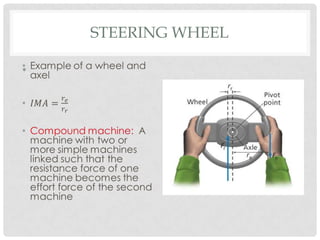
STEERING WHEEL

•
COMPOUND MACHINES

• Compound
  machine: A
  machine with two
  or more simple
  machines linked
  such that the
  resistance force of
  one machine
  becomes the effort
  force of the second
  machine
COMPOUND MACHINES

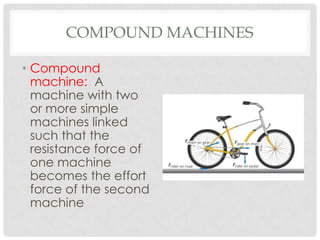
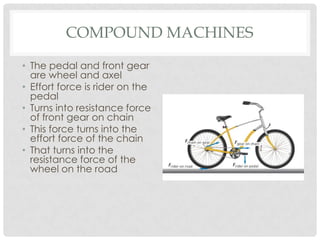
• The pedal and front gear
  are wheel and axel
• Effort force is rider on the
  pedal
• Turns into resistance force
  of front gear on chain
• This force turns into the
  effort force of the chain
• That turns into the
  resistance force of the
  wheel on the road
BICYCLE

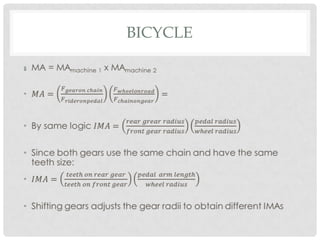
•
EXAMPLE
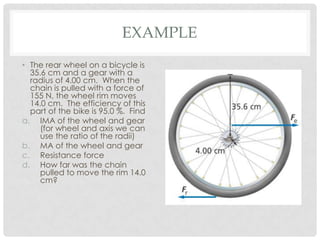
• The rear wheel on a bicycle is
  35.6 cm and a gear with a
  radius of 4.00 cm. When the
  chain is pulled with a force of
  155 N, the wheel rim moves
  14.0 cm. The efficiency of this
  part of the bike is 95.0 %. Find
a. IMA of the wheel and gear
     (for wheel and axis we can
     use the ratio of the radii)
b. MA of the wheel and gear
c. Resistance force
d. How far was the chain
     pulled to move the rim 14.0
     cm?
HOMEWORK

• Page 272, # 24 - 29

Physics/Notes 10.2

  • 1.
    SIMPLE MACHINES SECTION 10.2
  • 2.
    SIMPLE MACHINES • Howdo I define a simple machine? • How do I differentiate between an ideal and a real machine? • How do I define and calculate efficiency?
  • 3.
    MACHINES • Machine: adevice that changes the magnitude or direction of a force • Should make things easier • Simple machines: bottle openers, screwdrivers, … • Complex machines: bikes, cars, …
  • 4.
    BOTTLE OPENER • Howdoes a bottle opener work? • A person applies a force up • This is called the effort force, Fe • The opener applies a force to the cap • This is called the resistance force, Fr
  • 5.
  • 6.
    SINGLE PULLEY • Fe= Fr • MA is 1 • Why have a single pulley?
  • 7.
    DOUBLE PULLEY • Ifwe add a pulley, MA goes over 1 • What happens to direction?
  • 8.
    WORK • Work isFd • There is input work and output work • A machine can increase force but not energy so, … • Wo = Wi • Frdr = Fede
  • 9.
  • 10.
    MACHINES • Maximum efficiencyis 100% • Rare • Most machines are made up of a combination of • Levers • Pulleys • Wheel and axle • Incline plane • Wedge • screw
  • 11.
  • 12.
  • 13.
    COMPOUND MACHINES • Compound machine: A machine with two or more simple machines linked such that the resistance force of one machine becomes the effort force of the second machine
  • 14.
    COMPOUND MACHINES • Thepedal and front gear are wheel and axel • Effort force is rider on the pedal • Turns into resistance force of front gear on chain • This force turns into the effort force of the chain • That turns into the resistance force of the wheel on the road
  • 15.
  • 16.
    EXAMPLE • The rearwheel on a bicycle is 35.6 cm and a gear with a radius of 4.00 cm. When the chain is pulled with a force of 155 N, the wheel rim moves 14.0 cm. The efficiency of this part of the bike is 95.0 %. Find a. IMA of the wheel and gear (for wheel and axis we can use the ratio of the radii) b. MA of the wheel and gear c. Resistance force d. How far was the chain pulled to move the rim 14.0 cm?
  • 17.