Areas of Triangles, Trapezoids,
and Rhombi
Section 11.2
Areas of Triangles, Trapezoids, and
Rhombi
• How do I find the areas of triangles?
• How do I find the areas of trapezoids and
  rhombi?
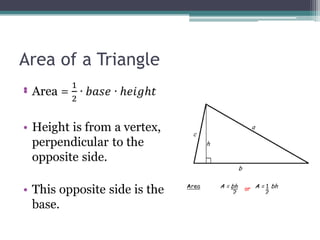
Area of a Triangle
•
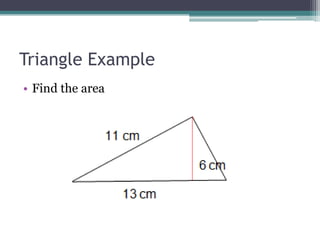
Triangle Example
• Find the area
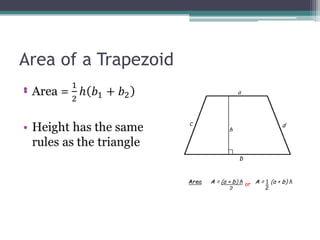
Area of a Trapezoid
•
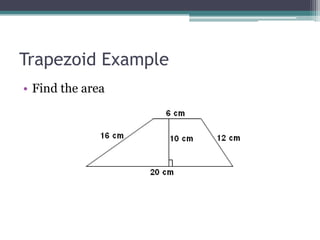
Trapezoid Example
• Find the area
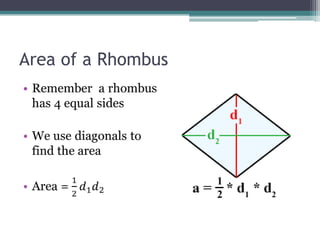
Area of a Rhombus
•
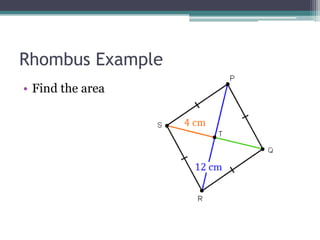
Rhombus Example
• Find the area
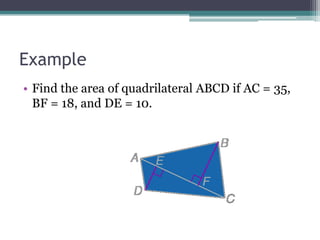
Example
• Find the area of quadrilateral ABCD if AC = 35,
  BF = 18, and DE = 10.
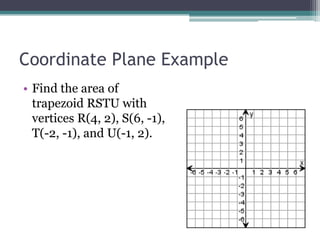
Coordinate Plane Example
• Find the area of
  trapezoid RSTU with
  vertices R(4, 2), S(6, -1),
  T(-2, -1), and U(-1, 2).
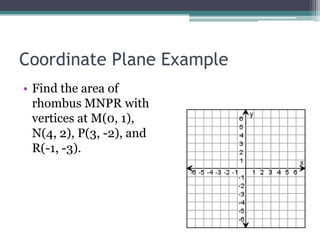
Coordinate Plane Example
• Find the area of
  rhombus MNPR with
  vertices at M(0, 1),
  N(4, 2), P(3, -2), and
  R(-1, -3).
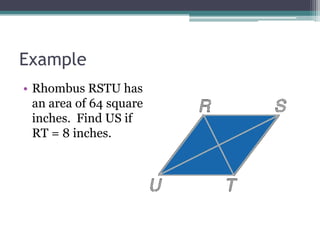
Example
• Rhombus RSTU has
  an area of 64 square
  inches. Find US if
  RT = 8 inches.
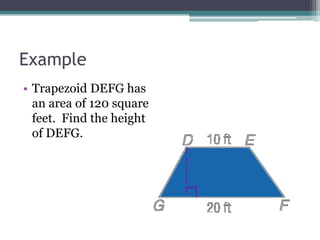
Example
• Trapezoid DEFG has
  an area of 120 square
  feet. Find the height
  of DEFG.
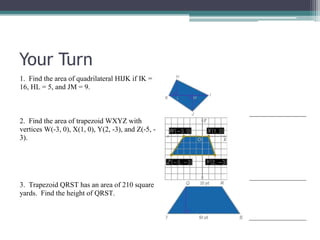
Your Turn
1. Find the area of quadrilateral HIJK if IK =
16, HL = 5, and JM = 9.


2. Find the area of trapezoid WXYZ with
vertices W(-3, 0), X(1, 0), Y(2, -3), and Z(-5, -
3).


3. Trapezoid QRST has an area of 210 square
yards. Find the height of QRST.
Homework
• Page 606
 ▫ 16 - 20 Even
 ▫ 30 – 34 Even
 ▫ 40 – 44 Even
Lesson Plan
• Intro
  ▫ Adding area of triangles, trapezoids and rhombi
• Standards- 10.2
• Supplies – slides, whiteboard, note sheets
• Timing: One day for notes, one day for a combined
  review of 10.1 and 10.2 followed by a quiz
• Day 1:
  ▫   Essential Questions- slides 2
  ▫   Input-slides 3, 5, 7
  ▫   Guided Practice - slides 4, 6, 8 - 14
  ▫   Independent Practice – bookwork

Geometry/Notes 11.2