   How can I solve problems using the law
    of conservation of energy?
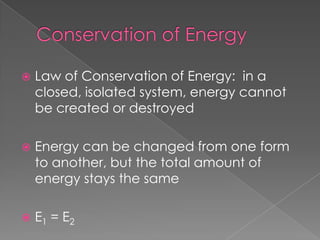
   Law of Conservation of Energy: in a
    closed, isolated system, energy cannot
    be created or destroyed

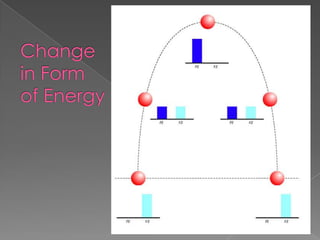
   Energy can be changed from one form
    to another, but the total amount of
    energy stays the same

   E1 = E2
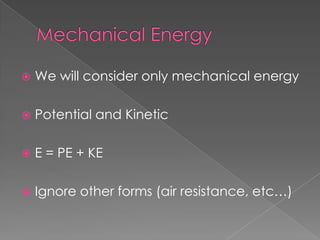
   We will consider only mechanical energy

   Potential and Kinetic

   E = PE + KE

   Ignore other forms (air resistance, etc…)
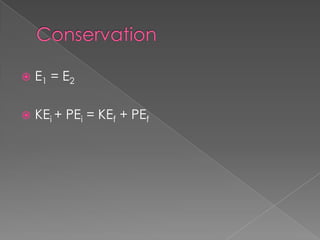
   E1 = E2

   KEi + PEi = KEf + PEf
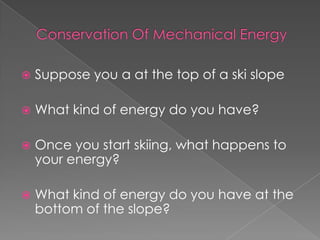
   Suppose you a at the top of a ski slope

   What kind of energy do you have?

   Once you start skiing, what happens to
    your energy?

   What kind of energy do you have at the
    bottom of the slope?
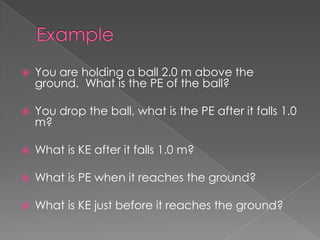
   You are holding a ball 2.0 m above the
    ground. What is the PE of the ball?

   You drop the ball, what is the PE after it falls 1.0
    m?

   What is KE after it falls 1.0 m?

   What is PE when it reaches the ground?

   What is KE just before it reaches the ground?
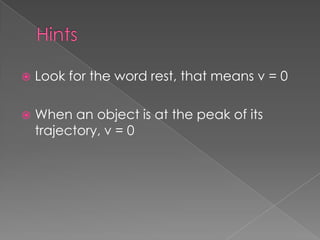
   Look for the word rest, that means v = 0

   When an object is at the peak of its
    trajectory, v = 0
During a hurricane, a large tree limb, with
a mass of 22.0 kg and a height of 13.3 m
above the ground, falls on a roof that is 6.0
m above the ground.
a. Ignoring air resistance, find the kinetic
   energy of the limb when it reaches the
   roof.
b. What is the speed of the limb when it
   reaches the roof?
   Page 297, # 15 - 18

   Page 308, # 73 - 77
The largest apple ever grown was 1.47 kg.
Suppose you hold such an apple in your
hand 1.50 m above the ground. You
accidentally drop the apple, then
manage to catch it when it is 0.5 m above
ground.
a. What was the apples KE at this point?
b. What was its velocity?
   In the real world, there is friction

   How do we account for it in our
    conservation of energy equation?

   E1 + Wf = E2
A 36.0 kg child slides down a slide that is
2.5 m high. At the bottom of the slide, she
is moving at 3.0 m/s. How much energy
was lost as she slid down the slide?
   Worksheet
   How can we analyze collisions to find the
    change in kinetic energy?
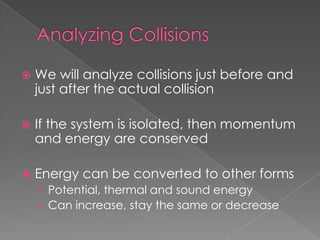
   We will analyze collisions just before and
    just after the actual collision

   If the system is isolated, then momentum
    and energy are conserved

   Energy can be converted to other forms
    › Potential, thermal and sound energy
    › Can increase, stay the same or decrease
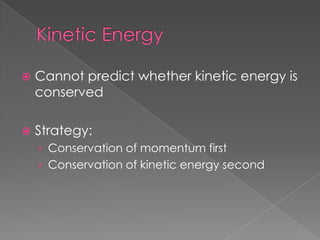
   Cannot predict whether kinetic energy is
    conserved

   Strategy:
    › Conservation of momentum first
    › Conservation of kinetic energy second
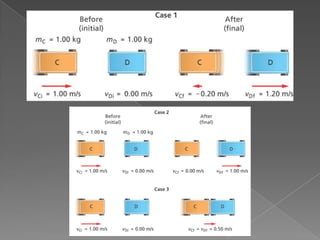
   KE increases: superelastic or explosive
    › A compressed spring was released


   KE remains the same: elastic collision
    › Hard elastic items such as marbles

   KE decreases: Inelastic
    › Energy is converted to other forms
    › Soft items, car crashes, when items stick
      together after the collision
   Momentum and energy are different

   Momentum is (almost) always conserved

   Energy is only conserved in elastic
    collisions

   Momentum is what makes objects stop
In an accident on a slippery road, a compact
car with a mass of 575 kg moving at 15.0 m/s
smashes into the rear end of a car with mass
1575 kg moving at 5.00 m/s in the same
direction.
a. What is the final velocity if the cars stick
   together?
b. How much kinetic energy was lost in the
   collision?
c. What fraction of the original kinetic energy
   was lost?
 Page 300, # 19 – 21
 Page 309, # 78 – 82, 85

General/Notes 11.2

  • 2.
    How can I solve problems using the law of conservation of energy?
  • 3.
    Law of Conservation of Energy: in a closed, isolated system, energy cannot be created or destroyed  Energy can be changed from one form to another, but the total amount of energy stays the same  E1 = E2
  • 4.
    We will consider only mechanical energy  Potential and Kinetic  E = PE + KE  Ignore other forms (air resistance, etc…)
  • 5.
    E1 = E2  KEi + PEi = KEf + PEf
  • 6.
    Suppose you a at the top of a ski slope  What kind of energy do you have?  Once you start skiing, what happens to your energy?  What kind of energy do you have at the bottom of the slope?
  • 8.
    You are holding a ball 2.0 m above the ground. What is the PE of the ball?  You drop the ball, what is the PE after it falls 1.0 m?  What is KE after it falls 1.0 m?  What is PE when it reaches the ground?  What is KE just before it reaches the ground?
  • 9.
    Look for the word rest, that means v = 0  When an object is at the peak of its trajectory, v = 0
  • 10.
    During a hurricane,a large tree limb, with a mass of 22.0 kg and a height of 13.3 m above the ground, falls on a roof that is 6.0 m above the ground. a. Ignoring air resistance, find the kinetic energy of the limb when it reaches the roof. b. What is the speed of the limb when it reaches the roof?
  • 11.
    Page 297, # 15 - 18  Page 308, # 73 - 77
  • 12.
    The largest appleever grown was 1.47 kg. Suppose you hold such an apple in your hand 1.50 m above the ground. You accidentally drop the apple, then manage to catch it when it is 0.5 m above ground. a. What was the apples KE at this point? b. What was its velocity?
  • 13.
    In the real world, there is friction  How do we account for it in our conservation of energy equation?  E1 + Wf = E2
  • 14.
    A 36.0 kgchild slides down a slide that is 2.5 m high. At the bottom of the slide, she is moving at 3.0 m/s. How much energy was lost as she slid down the slide?
  • 15.
    Worksheet
  • 16.
    How can we analyze collisions to find the change in kinetic energy?
  • 17.
    We will analyze collisions just before and just after the actual collision  If the system is isolated, then momentum and energy are conserved  Energy can be converted to other forms › Potential, thermal and sound energy › Can increase, stay the same or decrease
  • 18.
    Cannot predict whether kinetic energy is conserved  Strategy: › Conservation of momentum first › Conservation of kinetic energy second
  • 20.
    KE increases: superelastic or explosive › A compressed spring was released  KE remains the same: elastic collision › Hard elastic items such as marbles  KE decreases: Inelastic › Energy is converted to other forms › Soft items, car crashes, when items stick together after the collision
  • 21.
    Momentum and energy are different  Momentum is (almost) always conserved  Energy is only conserved in elastic collisions  Momentum is what makes objects stop
  • 22.
    In an accidenton a slippery road, a compact car with a mass of 575 kg moving at 15.0 m/s smashes into the rear end of a car with mass 1575 kg moving at 5.00 m/s in the same direction. a. What is the final velocity if the cars stick together? b. How much kinetic energy was lost in the collision? c. What fraction of the original kinetic energy was lost?
  • 23.
     Page 300,# 19 – 21  Page 309, # 78 – 82, 85