© Boardworks Ltd 2006
1 of 24
© Boardworks Ltd 2006
2 of 24
© Boardworks Ltd 2006
3 of 24
What are electromagnetic waves?
What’s the connection between
light, microwaves and X-rays?
Electromagnetic waves are
transverse waves made up
of electric and magnetic fields.
magnetic
field
electric
field
wave
direction
They are all different types of
electromagnetic radiation that
travel as waves and transfer
energy from one place to another.
All electromagnetic waves
travel at the same speed.
In a vacuum (space), they
travel at 300,000,000 m/s!
© Boardworks Ltd 2006
4 of 24
Some definitions…
1) Amplitude – this is “how
high” the wave is:
2) Wavelength () – this is the distance
between two corresponding points on the
wave and is measured in metres:
3) Frequency – this is how many waves pass by every second and is
measured in Hertz (Hz)
© Boardworks Ltd 2006
5 of 24
How do electromagnetic waves differ?
Different electromagnetic waves
carry different amounts of energy.
 The amount of energy carried by an electromagnetic wave
depends on the wavelength:
the shorter the wavelength, the higher its energy.
Do microwaves have a shorter wavelength than X-rays?
For example, microwaves carry
less energy that X-rays.
 Wavelength and frequency are linked properties of a wave:
the shorter the wavelength, the higher its frequency.
 So, frequency also tells you about the energy of a wave:
the higher its frequency, the higher the energy.
© Boardworks Ltd 2006
6 of 24
What happens when waves hit a surface?
When electromagnetic waves hit
a surface, they can be reflected,
absorbed or transmitted.
How the waves behave, depends on
their energy and the type of material.
For example, light waves are
reflected by skin but X-rays pass
straight through.
If electromagnetic waves are
absorbed, some of their energy is
absorbed by the material. This
usually increases the temperature
of the material.
© Boardworks Ltd 2006
7 of 24
What happens when waves are reflected?
Some surfaces can reflect
electromagnetic waves. Shiny
surfaces are good reflectors
of light waves.
A mirror reflects most of
the light waves that hit it.
When waves are reflected,
some of their energy may also
be absorbed by the material.
The curved satellite dish
reflects microwaves from
a satellite to the receiver.
How does reflection allow
us to see?
© Boardworks Ltd 2006
8 of 24
© Boardworks Ltd 2006
9 of 24
What is the electromagnetic spectrum?
The electromagnetic waves are grouped into types that
have similar wavelengths and so have similar properties.
Electromagnetic waves form a continuous series in order
of changing wavelength, frequency and energy.
This series is called the electromagnetic spectrum.
gamma
rays
X-rays
ultraviolet
visible
light
infrared
microwaves
radio
waves
0.01nm
100nm 1nm
0.01mm
1mm
10cm
100m
smaller wavelength
higher frequency, energy and hazard.
© Boardworks Ltd 2006
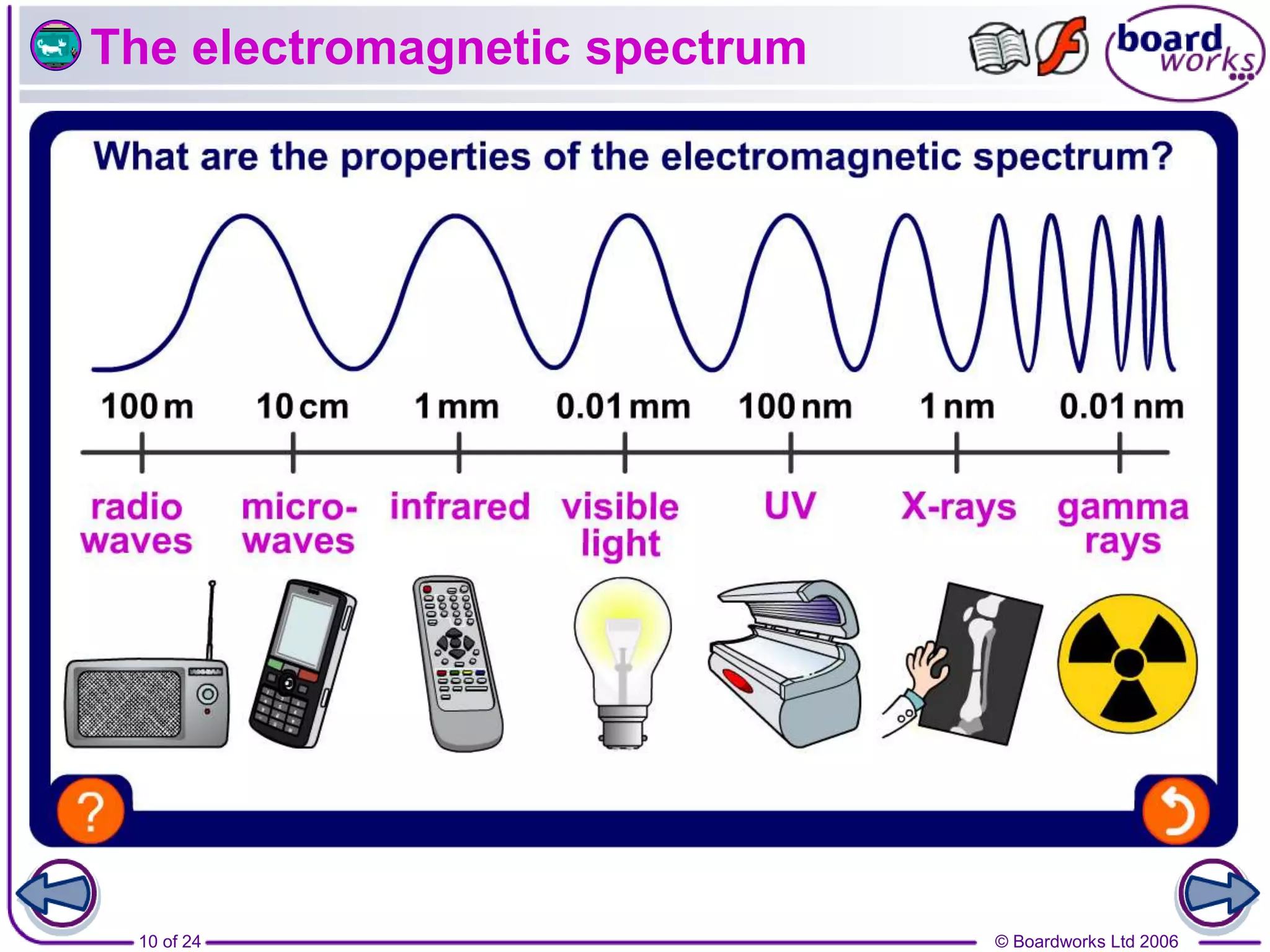
10 of 24
The electromagnetic spectrum
© Boardworks Ltd 2006
11 of 24
Wavelength of electromagnetic waves
© Boardworks Ltd 2006
12 of 24
© Boardworks Ltd 2006
13 of 24
Are electromagnetic waves dangerous?
The shorter the wavelength (and higher the frequency) of
electromagnetic waves, the more energy that they carry.
gamma
rays
X-rays
ultraviolet
visible
light
infrared
microwaves
radio
waves
energy increases
hazard increases
High-frequency electromagnetic waves, such as gamma rays,
are potentially more harmful because they have more energy.
0.01nm
100nm 1nm
0.01mm
1mm
10cm
100m
© Boardworks Ltd 2006
14 of 24
Energy of electromagnetic waves
© Boardworks Ltd 2006
15 of 24
How do radio waves affect humans?
Radio waves are the longest-
wavelength electromagnetic waves
and mostly pass through the body.
Microwaves are radio waves with
short wavelengths. They are very
slightly absorbed by the body and
can cause a minor heating effect.
They are not strongly absorbed
and are thought to have no effect
on the health of living tissue.
However, the microwaves
produced by mobile phones
have not yet been proved to
cause health problems.
© Boardworks Ltd 2006
16 of 24
How do infrared waves affect humans?
Infrared waves are absorbed
by skin to a limited depth. They
transfer their energy to the skin
tissue warming it up.
Infrared waves from this grill
heat the surface of the meat.
If the meat absorbs too much
energy, it will become burnt.
it will become burnt.
If skin is exposed to too many
high-energy infrared waves,
This heating effect is detected
by temperature-sensitive nerve
endings in the skin.
© Boardworks Ltd 2006
17 of 24
How does visible light affect humans?
Your eyes detect visible light, which does
not normally pose any health risk.
Lasers are very intense sources of
visible light. The lasers used in light
shows are not powerful enough to
cause harm but must be used safely.
However, very bright light can damage
your eyes and may even make you blind.
This is why you should not look at the
Sun through a telescope or binoculars.
Some very powerful lasers can cut
through materials such as metal.
These would also be able to burn
through living tissue.
© Boardworks Ltd 2006
18 of 24
How do ionizing waves affect humans?
Ionizing waves have enough energy to ionize the atoms in
materials. These waves can have a severe effect on living
tissue by killing cells or damaging DNA.
 Ultraviolet rays are absorbed by the
body. Skin tissues can be ionized and
damaged by the shortest-wavelength
ultraviolet radiation causing skin cancer.
 X-rays pass through soft body tissue,
such as skin and muscle, without being
absorbed. Denser tissue, such as bone,
absorb some X-rays and can be ionized.
 Gamma rays pass through the body
but very high energy waves can ionize
atoms in living tissue.
© Boardworks Ltd 2006
19 of 24
Effect of electromagnetic waves
© Boardworks Ltd 2006
20 of 24
© Boardworks Ltd 2006
21 of 24
Glossary (1/2)
 absorption – The process in which electromagnetic waves
hit a surface and their energy is transferred to the material.
 electromagnetic spectrum – The continuous series of
electromagnetic waves in order of wavelength or frequency.
 frequency – The number of waves passing a point every
second, measured in hertz (Hz).
 gamma rays – Electromagnetic waves with the shortest
wavelengths. Uses include sterilizing medical equipment and
cancer treatment.
 infrared waves – Electromagnetic waves given off by hot
objects. Uses include heating, cooking and remote controls.
 microwaves – Electromagnetic waves that are short-
wavelength radio waves. Uses include mobile phones, radar
and cooking.
© Boardworks Ltd 2006
22 of 24
Glossary (2/2)
 radio waves – Electromagnetic waves with the longest
wavelengths. Used for communications.
 reflection – The process in which electromagnetic waves
bounce back from a surface.
 wavelength – The distance between two matching points
on neighbouring waves, which is measured in metres.
 ultraviolet rays – Electromagnetic waves that can be
absorbed by certain chemicals and emitted as visible light.
Uses include tanning beds and security marking.
 visible light – Electromagnetic waves that are detected
by our eyes, allowing us to see. Other uses include optical
fibre communications and imaging.
 X-rays – Electromagnetic waves that pass through most
materials. Uses include medical imaging and security.
© Boardworks Ltd 2006
23 of 24
Anagrams
© Boardworks Ltd 2006
24 of 24
Multiple-choice quiz
© Boardworks Ltd 2006
25 of 24
The electromagnetic spectrum
How many different electromagnetic waves can you spot?
© Boardworks Ltd 2006
26 of 24
Some answers…
© Boardworks Ltd 2006
27 of 24
Some answers…
© Boardworks Ltd 2006
28 of 24
Some answers…
© Boardworks Ltd 2006
29 of 24
Some answers…

Electromagnetic Waves

  • 1.
    © Boardworks Ltd2006 1 of 24
  • 2.
    © Boardworks Ltd2006 2 of 24
  • 3.
    © Boardworks Ltd2006 3 of 24 What are electromagnetic waves? What’s the connection between light, microwaves and X-rays? Electromagnetic waves are transverse waves made up of electric and magnetic fields. magnetic field electric field wave direction They are all different types of electromagnetic radiation that travel as waves and transfer energy from one place to another. All electromagnetic waves travel at the same speed. In a vacuum (space), they travel at 300,000,000 m/s!
  • 4.
    © Boardworks Ltd2006 4 of 24 Some definitions… 1) Amplitude – this is “how high” the wave is: 2) Wavelength () – this is the distance between two corresponding points on the wave and is measured in metres: 3) Frequency – this is how many waves pass by every second and is measured in Hertz (Hz)
  • 5.
    © Boardworks Ltd2006 5 of 24 How do electromagnetic waves differ? Different electromagnetic waves carry different amounts of energy.  The amount of energy carried by an electromagnetic wave depends on the wavelength: the shorter the wavelength, the higher its energy. Do microwaves have a shorter wavelength than X-rays? For example, microwaves carry less energy that X-rays.  Wavelength and frequency are linked properties of a wave: the shorter the wavelength, the higher its frequency.  So, frequency also tells you about the energy of a wave: the higher its frequency, the higher the energy.
  • 6.
    © Boardworks Ltd2006 6 of 24 What happens when waves hit a surface? When electromagnetic waves hit a surface, they can be reflected, absorbed or transmitted. How the waves behave, depends on their energy and the type of material. For example, light waves are reflected by skin but X-rays pass straight through. If electromagnetic waves are absorbed, some of their energy is absorbed by the material. This usually increases the temperature of the material.
  • 7.
    © Boardworks Ltd2006 7 of 24 What happens when waves are reflected? Some surfaces can reflect electromagnetic waves. Shiny surfaces are good reflectors of light waves. A mirror reflects most of the light waves that hit it. When waves are reflected, some of their energy may also be absorbed by the material. The curved satellite dish reflects microwaves from a satellite to the receiver. How does reflection allow us to see?
  • 8.
    © Boardworks Ltd2006 8 of 24
  • 9.
    © Boardworks Ltd2006 9 of 24 What is the electromagnetic spectrum? The electromagnetic waves are grouped into types that have similar wavelengths and so have similar properties. Electromagnetic waves form a continuous series in order of changing wavelength, frequency and energy. This series is called the electromagnetic spectrum. gamma rays X-rays ultraviolet visible light infrared microwaves radio waves 0.01nm 100nm 1nm 0.01mm 1mm 10cm 100m smaller wavelength higher frequency, energy and hazard.
  • 10.
    © Boardworks Ltd2006 10 of 24 The electromagnetic spectrum
  • 11.
    © Boardworks Ltd2006 11 of 24 Wavelength of electromagnetic waves
  • 12.
    © Boardworks Ltd2006 12 of 24
  • 13.
    © Boardworks Ltd2006 13 of 24 Are electromagnetic waves dangerous? The shorter the wavelength (and higher the frequency) of electromagnetic waves, the more energy that they carry. gamma rays X-rays ultraviolet visible light infrared microwaves radio waves energy increases hazard increases High-frequency electromagnetic waves, such as gamma rays, are potentially more harmful because they have more energy. 0.01nm 100nm 1nm 0.01mm 1mm 10cm 100m
  • 14.
    © Boardworks Ltd2006 14 of 24 Energy of electromagnetic waves
  • 15.
    © Boardworks Ltd2006 15 of 24 How do radio waves affect humans? Radio waves are the longest- wavelength electromagnetic waves and mostly pass through the body. Microwaves are radio waves with short wavelengths. They are very slightly absorbed by the body and can cause a minor heating effect. They are not strongly absorbed and are thought to have no effect on the health of living tissue. However, the microwaves produced by mobile phones have not yet been proved to cause health problems.
  • 16.
    © Boardworks Ltd2006 16 of 24 How do infrared waves affect humans? Infrared waves are absorbed by skin to a limited depth. They transfer their energy to the skin tissue warming it up. Infrared waves from this grill heat the surface of the meat. If the meat absorbs too much energy, it will become burnt. it will become burnt. If skin is exposed to too many high-energy infrared waves, This heating effect is detected by temperature-sensitive nerve endings in the skin.
  • 17.
    © Boardworks Ltd2006 17 of 24 How does visible light affect humans? Your eyes detect visible light, which does not normally pose any health risk. Lasers are very intense sources of visible light. The lasers used in light shows are not powerful enough to cause harm but must be used safely. However, very bright light can damage your eyes and may even make you blind. This is why you should not look at the Sun through a telescope or binoculars. Some very powerful lasers can cut through materials such as metal. These would also be able to burn through living tissue.
  • 18.
    © Boardworks Ltd2006 18 of 24 How do ionizing waves affect humans? Ionizing waves have enough energy to ionize the atoms in materials. These waves can have a severe effect on living tissue by killing cells or damaging DNA.  Ultraviolet rays are absorbed by the body. Skin tissues can be ionized and damaged by the shortest-wavelength ultraviolet radiation causing skin cancer.  X-rays pass through soft body tissue, such as skin and muscle, without being absorbed. Denser tissue, such as bone, absorb some X-rays and can be ionized.  Gamma rays pass through the body but very high energy waves can ionize atoms in living tissue.
  • 19.
    © Boardworks Ltd2006 19 of 24 Effect of electromagnetic waves
  • 20.
    © Boardworks Ltd2006 20 of 24
  • 21.
    © Boardworks Ltd2006 21 of 24 Glossary (1/2)  absorption – The process in which electromagnetic waves hit a surface and their energy is transferred to the material.  electromagnetic spectrum – The continuous series of electromagnetic waves in order of wavelength or frequency.  frequency – The number of waves passing a point every second, measured in hertz (Hz).  gamma rays – Electromagnetic waves with the shortest wavelengths. Uses include sterilizing medical equipment and cancer treatment.  infrared waves – Electromagnetic waves given off by hot objects. Uses include heating, cooking and remote controls.  microwaves – Electromagnetic waves that are short- wavelength radio waves. Uses include mobile phones, radar and cooking.
  • 22.
    © Boardworks Ltd2006 22 of 24 Glossary (2/2)  radio waves – Electromagnetic waves with the longest wavelengths. Used for communications.  reflection – The process in which electromagnetic waves bounce back from a surface.  wavelength – The distance between two matching points on neighbouring waves, which is measured in metres.  ultraviolet rays – Electromagnetic waves that can be absorbed by certain chemicals and emitted as visible light. Uses include tanning beds and security marking.  visible light – Electromagnetic waves that are detected by our eyes, allowing us to see. Other uses include optical fibre communications and imaging.  X-rays – Electromagnetic waves that pass through most materials. Uses include medical imaging and security.
  • 23.
    © Boardworks Ltd2006 23 of 24 Anagrams
  • 24.
    © Boardworks Ltd2006 24 of 24 Multiple-choice quiz
  • 25.
    © Boardworks Ltd2006 25 of 24 The electromagnetic spectrum How many different electromagnetic waves can you spot?
  • 26.
    © Boardworks Ltd2006 26 of 24 Some answers…
  • 27.
    © Boardworks Ltd2006 27 of 24 Some answers…
  • 28.
    © Boardworks Ltd2006 28 of 24 Some answers…
  • 29.
    © Boardworks Ltd2006 29 of 24 Some answers…

Editor's Notes

  • #2 Boardworks GCSE Science: Physics Electromagnetic Waves
  • #3 Boardworks GCSE Science: Physics Electromagnetic Waves
  • #4 Boardworks GCSE Science: Physics Electromagnetic Waves
  • #6 Boardworks GCSE Science: Physics Electromagnetic Waves
  • #7 Boardworks GCSE Science: Physics Electromagnetic Waves
  • #8 Boardworks GCSE Science: Physics Electromagnetic Waves
  • #9 Boardworks GCSE Science: Physics Electromagnetic Waves
  • #10 Boardworks GCSE Science: Physics Electromagnetic Waves
  • #11 Boardworks GCSE Science: Physics Electromagnetic Waves
  • #12 Boardworks GCSE Science: Physics Electromagnetic Waves
  • #13 Boardworks GCSE Science: Physics Electromagnetic Waves
  • #14 Boardworks GCSE Science: Physics Electromagnetic Waves
  • #15 Boardworks GCSE Science: Physics Electromagnetic Waves
  • #16 Boardworks GCSE Science: Physics Electromagnetic Waves
  • #17 Boardworks GCSE Science: Physics Electromagnetic Waves
  • #18 Boardworks GCSE Science: Physics Electromagnetic Waves
  • #19 Boardworks GCSE Science: Physics Electromagnetic Waves
  • #20 Boardworks GCSE Science: Physics Electromagnetic Waves
  • #21 Boardworks GCSE Science: Physics Electromagnetic Waves
  • #22 Boardworks GCSE Science: Physics Electromagnetic Waves
  • #23 Boardworks GCSE Science: Physics Electromagnetic Waves
  • #24 Boardworks GCSE Science: Physics Electromagnetic Waves
  • #25 Boardworks GCSE Science: Physics Electromagnetic Waves
  • #26 Boardworks GCSE Science: Physics Electromagnetic Waves