



PREPARED BY
SANKARANARAYANAN. K. B
ASST. PROFESSOR
DEPARTMENT OF VISUAL COMMUNICATION
NEHRU ARTS AND SCIENCE COLLEGE
COIMBATORE
snkb@nasc2020
Course Code
Title
19U3VCC306
Core Paper VI
Audiography
Semester: III Credits: 4 CIA : 25 Marks ESE : 75 Marks
Instructional
Objective:
To demonstrate a basic professional level of accomplishment in the core areas of audio technology
including: non-linear digital audio recording and editing, sound design for music and film/ video, and the
mixing and mastering of audio projects.
snkb@nasc2020
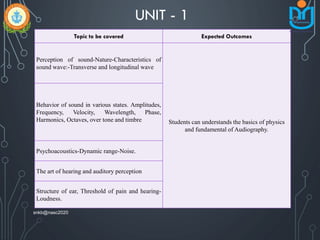
UNIT - 1
Topic to be covered Expected Outcomes
Perception of sound-Nature-Characteristics of
sound wave:-Transverse and longitudinal wave
Students can understands the basics of physics
and fundamental of Audiography.
Behavior of sound in various states. Amplitudes,
Frequency, Velocity, Wavelength, Phase,
Harmonics, Octaves, over tone and timbre
Psychoacoustics-Dynamic range-Noise.
The art of hearing and auditory perception
Structure of ear, Threshold of pain and hearing-
Loudness.
snkb@nasc2020
The ear has an enormous range of response,
both in frequency and in intensity. The
frequency range of human hearing extends
over three orders of magnitude, from about
20 hertz to about 20,000 hertz, or 20
kilohertz.
IMPORTANT POINT TO REMEMBER
snkb@nasc2020
1) SOUND
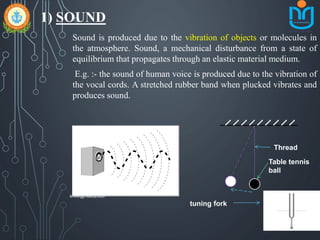
Sound is produced due to the vibration of objects or molecules in
the atmosphere. Sound, a mechanical disturbance from a state of
equilibrium that propagates through an elastic material medium.
E.g. :- the sound of human voice is produced due to the vibration of
the vocal cords. A stretched rubber band when plucked vibrates and
produces sound.
Thread
tuning fork
Table tennis
ball
snkb@nasc2020
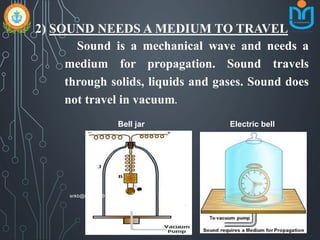
2) SOUND NEEDS A MEDIUM TO TRAVEL
Sound is a mechanical wave and needs a
medium for propagation. Sound travels
through solids, liquids and gases. Sound does
not travel in vacuum.
Bell jar Electric bell
snkb@nasc2020
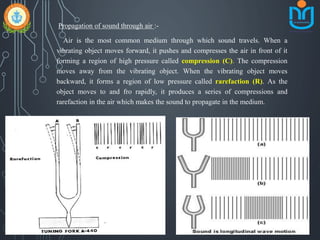
Propagation of sound through air :-
Air is the most common medium through which sound travels. When a
vibrating object moves forward, it pushes and compresses the air in front of it
forming a region of high pressure called compression (C). The compression
moves away from the vibrating object. When the vibrating object moves
backward, it forms a region of low pressure called rarefaction (R). As the
object moves to and fro rapidly, it produces a series of compressions and
rarefaction in the air which makes the sound to propagate in the medium.
snkb@nasc2020
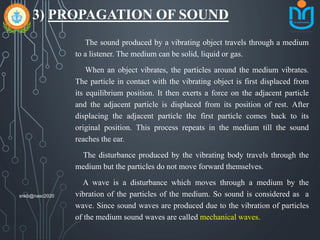
3) PROPAGATION OF SOUND
The sound produced by a vibrating object travels through a medium
to a listener. The medium can be solid, liquid or gas.
When an object vibrates, the particles around the medium vibrates.
The particle in contact with the vibrating object is first displaced from
its equilibrium position. It then exerts a force on the adjacent particle
and the adjacent particle is displaced from its position of rest. After
displacing the adjacent particle the first particle comes back to its
original position. This process repeats in the medium till the sound
reaches the ear.
The disturbance produced by the vibrating body travels through the
medium but the particles do not move forward themselves.
A wave is a disturbance which moves through a medium by the
vibration of the particles of the medium. So sound is considered as a
wave. Since sound waves are produced due to the vibration of particles
of the medium sound waves are called mechanical waves.
snkb@nasc2020
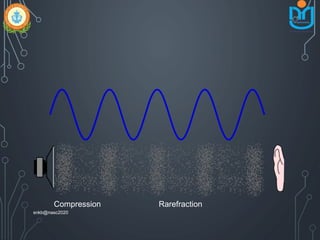
Compression Rarefraction
snkb@nasc2020
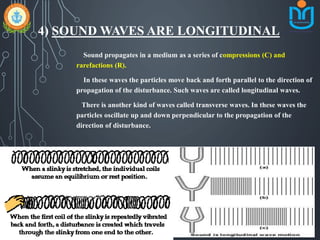
4) SOUND WAVES ARE LONGITUDINAL
Sound propagates in a medium as a series of compressions (C) and
rarefactions (R).
In these waves the particles move back and forth parallel to the direction of
propagation of the disturbance. Such waves are called longitudinal waves.
There is another kind of waves called transverse waves. In these waves the
particles oscillate up and down perpendicular to the propagation of the
direction of disturbance.
C C CR R Rsnkb@nasc2020
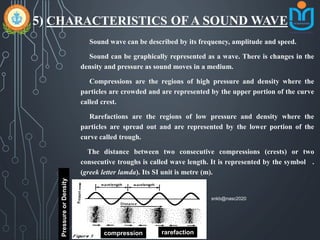
5) CHARACTERISTICS OF A SOUND WAVE
Sound wave can be described by its frequency, amplitude and speed.
Sound can be graphically represented as a wave. There is changes in the
density and pressure as sound moves in a medium.
Compressions are the regions of high pressure and density where the
particles are crowded and are represented by the upper portion of the curve
called crest.
Rarefactions are the regions of low pressure and density where the
particles are spread out and are represented by the lower portion of the
curve called trough.
The distance between two consecutive compressions (crests) or two
consecutive troughs is called wave length. It is represented by the symbol .
(greek letter lamda). Its SI unit is metre (m).
compression rarefaction
PressureorDensity
snkb@nasc2020
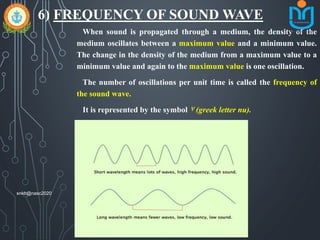
6) FREQUENCY OF SOUND WAVE
When sound is propagated through a medium, the density of the
medium oscillates between a maximum value and a minimum value.
The change in the density of the medium from a maximum value to a
minimum value and again to the maximum value is one oscillation.
The number of oscillations per unit time is called the frequency of
the sound wave.
It is represented by the symbol ٧ (greek letter nu).
Its si unit is hertz (hz).
snkb@nasc2020
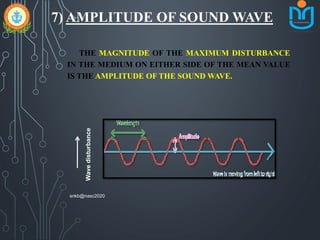
7) AMPLITUDE OF SOUND WAVE
THE MAGNITUDE OF THE MAXIMUM DISTURBANCE
IN THE MEDIUM ON EITHER SIDE OF THE MEAN VALUE
IS THE AMPLITUDE OF THE SOUND WAVE.
Wavedisturbance
snkb@nasc2020
ENVELOPE
• The envelope is a form of automation (automatic movement) built into synthesizers
to control the value of a parameter (usually volume or filter cutoff frequency) over
time. Envelopes are critical for giving synthesizers a more natural and interesting
sound, as they can be used to simulate the volume envelopes of a real instrument.
However, envelopes are also great for creating special effects. The most common
type of envelope is called ADSR (Attack, Decay, Sustain, Release), referring to the
different functions of each part of the envelope.
• Attack - The time it takes for the note to reach the maximum level.
• Decay - The time it takes for the note to go from the maximum level to the sustain
level (the next level in the ADSR chain).
• Sustain - The level while the note is held.
• Release - The time it takes for the note to fall from the sustain level to zero (silence)
when released.
snkb@nasc2020
8) LOUDNESS
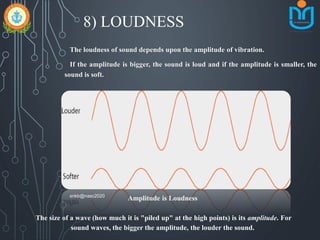
The loudness of sound depends upon the amplitude of vibration.
If the amplitude is bigger, the sound is loud and if the amplitude is smaller, the
sound is soft.
Amplitude is Loudness
The size of a wave (how much it is "piled up" at the high points) is its amplitude. For
sound waves, the bigger the amplitude, the louder the sound.
snkb@nasc2020
9) PITCH & HARMONICS
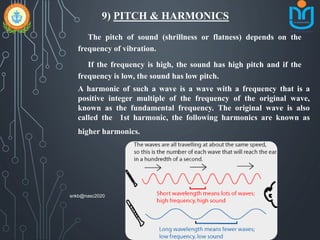
The pitch of sound (shrillness or flatness) depends on the
frequency of vibration.
If the frequency is high, the sound has high pitch and if the
frequency is low, the sound has low pitch.
A harmonic of such a wave is a wave with a frequency that is a
positive integer multiple of the frequency of the original wave,
known as the fundamental frequency. The original wave is also
called the 1st harmonic, the following harmonics are known as
higher harmonics.
snkb@nasc2020
TIME PERIOD OF SOUND WAVE
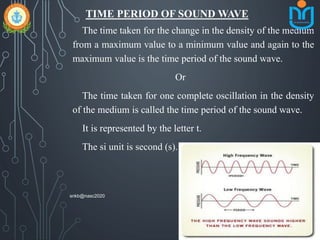
The time taken for the change in the density of the medium
from a maximum value to a minimum value and again to the
maximum value is the time period of the sound wave.
Or
The time taken for one complete oscillation in the density
of the medium is called the time period of the sound wave.
It is represented by the letter t.
The si unit is second (s).
snkb@nasc2020
10) SPEED OF SOUND
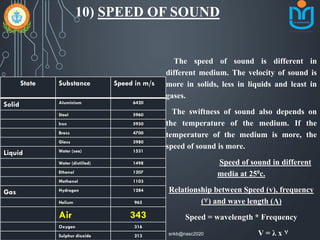
The speed of sound is different in
different medium. The velocity of sound is
more in solids, less in liquids and least in
gases.
The swiftness of sound also depends on
the temperature of the medium. If the
temperature of the medium is more, the
speed of sound is more.
Speed of sound in different
media at 250c.
Relationship between Speed (v), frequency
(٧) and wave length (Λ)
Speed = wavelength * Frequency
V = λ x ٧
State Substance Speed in m/s
Solid Aluminium 6420
Steel 5960
Iron 5950
Brass 4700
Glass 3980
Liquid Water (sea) 1531
Water (distilled) 1498
Ethanol 1207
Methanol 1103
Gas Hydrogen 1284
Helium 965
Air 343
Oxygen 316
Sulphur dioxide 213 snkb@nasc2020
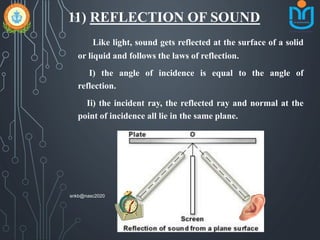
11) REFLECTION OF SOUND
Like light, sound gets reflected at the surface of a solid
or liquid and follows the laws of reflection.
I) the angle of incidence is equal to the angle of
reflection.
Ii) the incident ray, the reflected ray and normal at the
point of incidence all lie in the same plane.
snkb@nasc2020
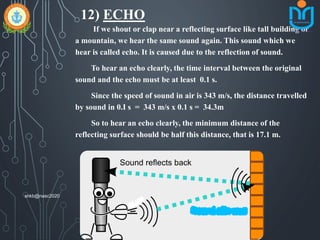
12) ECHO
If we shout or clap near a reflecting surface like tall building or
a mountain, we hear the same sound again. This sound which we
hear is called echo. It is caused due to the reflection of sound.
To hear an echo clearly, the time interval between the original
sound and the echo must be at least 0.1 s.
Since the speed of sound in air is 343 m/s, the distance travelled
by sound in 0.I s = 343 m/s x 0.1 s = 34.3m
So to hear an echo clearly, the minimum distance of the
reflecting surface should be half this distance, that is 17.1 m.
snkb@nasc2020
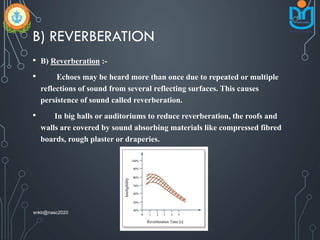
B) REVERBERATION
• B) Reverberation :-
• Echoes may be heard more than once due to repeated or multiple
reflections of sound from several reflecting surfaces. This causes
persistence of sound called reverberation.
• In big halls or auditoriums to reduce reverberation, the roofs and
walls are covered by sound absorbing materials like compressed fibred
boards, rough plaster or draperies.
snkb@nasc2020
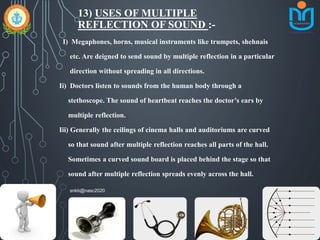
13) USES OF MULTIPLE
REFLECTION OF SOUND :-
I) Megaphones, horns, musical instruments like trumpets, shehnais
etc. Are deigned to send sound by multiple reflection in a particular
direction without spreading in all directions.
Ii) Doctors listen to sounds from the human body through a
stethoscope. The sound of heartbeat reaches the doctor’s ears by
multiple reflection.
Iii) Generally the ceilings of cinema halls and auditoriums are curved
so that sound after multiple reflection reaches all parts of the hall.
Sometimes a curved sound board is placed behind the stage so that
sound after multiple reflection spreads evenly across the hall.
snkb@nasc2020
14) RANGE OF HEARING
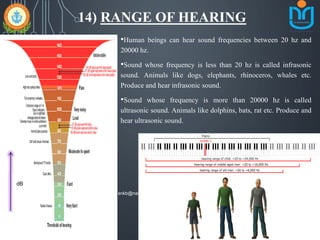
•Human beings can hear sound frequencies between 20 hz and
20000 hz.
•Sound whose frequency is less than 20 hz is called infrasonic
sound. Animals like dogs, elephants, rhinoceros, whales etc.
Produce and hear infrasonic sound.
•Sound whose frequency is more than 20000 hz is called
ultrasonic sound. Animals like dolphins, bats, rat etc. Produce and
hear ultrasonic sound.
dB
snkb@nasc2020
15) USES OF ULTRASONIC SOUND
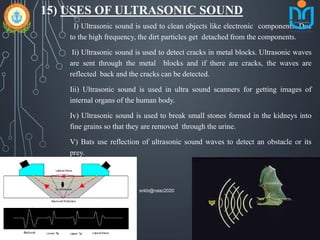
I) Ultrasonic sound is used to clean objects like electronic components. Due
to the high frequency, the dirt particles get detached from the components.
Ii) Ultrasonic sound is used to detect cracks in metal blocks. Ultrasonic waves
are sent through the metal blocks and if there are cracks, the waves are
reflected back and the cracks can be detected.
Iii) Ultrasonic sound is used in ultra sound scanners for getting images of
internal organs of the human body.
Iv) Ultrasonic sound is used to break small stones formed in the kidneys into
fine grains so that they are removed through the urine.
V) Bats use reflection of ultrasonic sound waves to detect an obstacle or its
prey.
snkb@nasc2020
16) SONAR
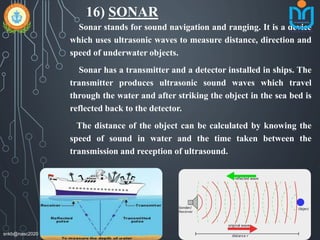
Sonar stands for sound navigation and ranging. It is a device
which uses ultrasonic waves to measure distance, direction and
speed of underwater objects.
Sonar has a transmitter and a detector installed in ships. The
transmitter produces ultrasonic sound waves which travel
through the water and after striking the object in the sea bed is
reflected back to the detector.
The distance of the object can be calculated by knowing the
speed of sound in water and the time taken between the
transmission and reception of ultrasound.
snkb@nasc2020
17) STRUCTURE OF THE HUMAN EAR
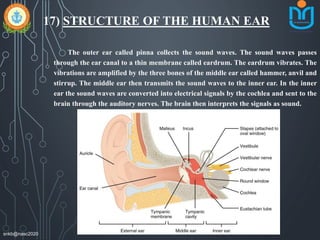
The outer ear called pinna collects the sound waves. The sound waves passes
through the ear canal to a thin membrane called eardrum. The eardrum vibrates. The
vibrations are amplified by the three bones of the middle ear called hammer, anvil and
stirrup. The middle ear then transmits the sound waves to the inner ear. In the inner
ear the sound waves are converted into electrical signals by the cochlea and sent to the
brain through the auditory nerves. The brain then interprets the signals as sound.
snkb@nasc2020
PSYCHOACOUSTICS
• It is the scientific study of sound perception and audiology. More
specifically, it is the branch of science studying the psychological and
physiological responses associated with sound (including noise, speech and
music). It can be further categorized as a branch of psychophysics.
Psychoacoustics received its name from a field within psychology—i.e.,
recognition science—which deals with all kinds of human perceptions. It is
an interdisciplinary field of many areas, including psychology, acoustics,
electronic engineering, physics, biology, physiology, and computer science.
snkb@nasc2020
TOPICS COVERED
• Basics of sound
• Frequency, Wavelength, Amplitude, Envelope, Time Period
• Loudness and human hearing range, Echo & Reverb
• Longitudinal and transverse waves
• Ultrasonic and infrasonic
• Sonar and Structure of Ear
snkb@nasc2020
SUMMARY
• Sound is a mechanical vibration caused due to the vibration of
objects on molecules in a medium(Solid/Liquid/Gas). It’s a perceived
sensation by our Ear and brain together. The characteristics of sound
are its frequency, wavelength, amplitude, speed, time period,
loudness and envelope. The reflective property of Sound is used for
many applications like Ultrasound scanning, Sonar, Cleaning of
electronic Instruments etc. The structure of ear helps to detect the
distance and position of sound. Phsychoacoustics is said to be the
science that deals with the study of audiology and sound perception.
snkb@nasc2020
REFERENCE BOOK/WEB-LINK/E-CONTENT
• Ronald.Mc.Donald, Home recording handbook, Frame
trees publications ,2004.
• modern-recording-techniques-seventh-edition-book.pdf
• https://www.youtube.com/watch?v=uJDDI9beju4
• https://www.youtube.com/watch?v=rkwS6vigSyE
• https://www.youtube.com/watch?v=ZbUTyMC8_X8
snkb@nasc2020
THANK YOU
snkb@nasc2020

Introduction to Audiography/Sound

  • 1.
    PREPARED BY SANKARANARAYANAN. K.B ASST. PROFESSOR DEPARTMENT OF VISUAL COMMUNICATION NEHRU ARTS AND SCIENCE COLLEGE COIMBATORE snkb@nasc2020
  • 2.
    Course Code Title 19U3VCC306 Core PaperVI Audiography Semester: III Credits: 4 CIA : 25 Marks ESE : 75 Marks Instructional Objective: To demonstrate a basic professional level of accomplishment in the core areas of audio technology including: non-linear digital audio recording and editing, sound design for music and film/ video, and the mixing and mastering of audio projects. snkb@nasc2020
  • 3.
    UNIT - 1 Topicto be covered Expected Outcomes Perception of sound-Nature-Characteristics of sound wave:-Transverse and longitudinal wave Students can understands the basics of physics and fundamental of Audiography. Behavior of sound in various states. Amplitudes, Frequency, Velocity, Wavelength, Phase, Harmonics, Octaves, over tone and timbre Psychoacoustics-Dynamic range-Noise. The art of hearing and auditory perception Structure of ear, Threshold of pain and hearing- Loudness. snkb@nasc2020
  • 4.
    The ear hasan enormous range of response, both in frequency and in intensity. The frequency range of human hearing extends over three orders of magnitude, from about 20 hertz to about 20,000 hertz, or 20 kilohertz. IMPORTANT POINT TO REMEMBER snkb@nasc2020
  • 5.
    1) SOUND Sound isproduced due to the vibration of objects or molecules in the atmosphere. Sound, a mechanical disturbance from a state of equilibrium that propagates through an elastic material medium. E.g. :- the sound of human voice is produced due to the vibration of the vocal cords. A stretched rubber band when plucked vibrates and produces sound. Thread tuning fork Table tennis ball snkb@nasc2020
  • 6.
    2) SOUND NEEDSA MEDIUM TO TRAVEL Sound is a mechanical wave and needs a medium for propagation. Sound travels through solids, liquids and gases. Sound does not travel in vacuum. Bell jar Electric bell snkb@nasc2020
  • 7.
    Propagation of soundthrough air :- Air is the most common medium through which sound travels. When a vibrating object moves forward, it pushes and compresses the air in front of it forming a region of high pressure called compression (C). The compression moves away from the vibrating object. When the vibrating object moves backward, it forms a region of low pressure called rarefaction (R). As the object moves to and fro rapidly, it produces a series of compressions and rarefaction in the air which makes the sound to propagate in the medium. snkb@nasc2020
  • 8.
    3) PROPAGATION OFSOUND The sound produced by a vibrating object travels through a medium to a listener. The medium can be solid, liquid or gas. When an object vibrates, the particles around the medium vibrates. The particle in contact with the vibrating object is first displaced from its equilibrium position. It then exerts a force on the adjacent particle and the adjacent particle is displaced from its position of rest. After displacing the adjacent particle the first particle comes back to its original position. This process repeats in the medium till the sound reaches the ear. The disturbance produced by the vibrating body travels through the medium but the particles do not move forward themselves. A wave is a disturbance which moves through a medium by the vibration of the particles of the medium. So sound is considered as a wave. Since sound waves are produced due to the vibration of particles of the medium sound waves are called mechanical waves. snkb@nasc2020
  • 9.
  • 10.
    4) SOUND WAVESARE LONGITUDINAL Sound propagates in a medium as a series of compressions (C) and rarefactions (R). In these waves the particles move back and forth parallel to the direction of propagation of the disturbance. Such waves are called longitudinal waves. There is another kind of waves called transverse waves. In these waves the particles oscillate up and down perpendicular to the propagation of the direction of disturbance. C C CR R Rsnkb@nasc2020
  • 11.
    5) CHARACTERISTICS OFA SOUND WAVE Sound wave can be described by its frequency, amplitude and speed. Sound can be graphically represented as a wave. There is changes in the density and pressure as sound moves in a medium. Compressions are the regions of high pressure and density where the particles are crowded and are represented by the upper portion of the curve called crest. Rarefactions are the regions of low pressure and density where the particles are spread out and are represented by the lower portion of the curve called trough. The distance between two consecutive compressions (crests) or two consecutive troughs is called wave length. It is represented by the symbol . (greek letter lamda). Its SI unit is metre (m). compression rarefaction PressureorDensity snkb@nasc2020
  • 12.
    6) FREQUENCY OFSOUND WAVE When sound is propagated through a medium, the density of the medium oscillates between a maximum value and a minimum value. The change in the density of the medium from a maximum value to a minimum value and again to the maximum value is one oscillation. The number of oscillations per unit time is called the frequency of the sound wave. It is represented by the symbol ٧ (greek letter nu). Its si unit is hertz (hz). snkb@nasc2020
  • 13.
    7) AMPLITUDE OFSOUND WAVE THE MAGNITUDE OF THE MAXIMUM DISTURBANCE IN THE MEDIUM ON EITHER SIDE OF THE MEAN VALUE IS THE AMPLITUDE OF THE SOUND WAVE. Wavedisturbance snkb@nasc2020
  • 14.
    ENVELOPE • The envelopeis a form of automation (automatic movement) built into synthesizers to control the value of a parameter (usually volume or filter cutoff frequency) over time. Envelopes are critical for giving synthesizers a more natural and interesting sound, as they can be used to simulate the volume envelopes of a real instrument. However, envelopes are also great for creating special effects. The most common type of envelope is called ADSR (Attack, Decay, Sustain, Release), referring to the different functions of each part of the envelope. • Attack - The time it takes for the note to reach the maximum level. • Decay - The time it takes for the note to go from the maximum level to the sustain level (the next level in the ADSR chain). • Sustain - The level while the note is held. • Release - The time it takes for the note to fall from the sustain level to zero (silence) when released. snkb@nasc2020
  • 15.
    8) LOUDNESS The loudnessof sound depends upon the amplitude of vibration. If the amplitude is bigger, the sound is loud and if the amplitude is smaller, the sound is soft. Amplitude is Loudness The size of a wave (how much it is "piled up" at the high points) is its amplitude. For sound waves, the bigger the amplitude, the louder the sound. snkb@nasc2020
  • 16.
    9) PITCH &HARMONICS The pitch of sound (shrillness or flatness) depends on the frequency of vibration. If the frequency is high, the sound has high pitch and if the frequency is low, the sound has low pitch. A harmonic of such a wave is a wave with a frequency that is a positive integer multiple of the frequency of the original wave, known as the fundamental frequency. The original wave is also called the 1st harmonic, the following harmonics are known as higher harmonics. snkb@nasc2020
  • 17.
    TIME PERIOD OFSOUND WAVE The time taken for the change in the density of the medium from a maximum value to a minimum value and again to the maximum value is the time period of the sound wave. Or The time taken for one complete oscillation in the density of the medium is called the time period of the sound wave. It is represented by the letter t. The si unit is second (s). snkb@nasc2020
  • 18.
    10) SPEED OFSOUND The speed of sound is different in different medium. The velocity of sound is more in solids, less in liquids and least in gases. The swiftness of sound also depends on the temperature of the medium. If the temperature of the medium is more, the speed of sound is more. Speed of sound in different media at 250c. Relationship between Speed (v), frequency (٧) and wave length (Λ) Speed = wavelength * Frequency V = λ x ٧ State Substance Speed in m/s Solid Aluminium 6420 Steel 5960 Iron 5950 Brass 4700 Glass 3980 Liquid Water (sea) 1531 Water (distilled) 1498 Ethanol 1207 Methanol 1103 Gas Hydrogen 1284 Helium 965 Air 343 Oxygen 316 Sulphur dioxide 213 snkb@nasc2020
  • 19.
    11) REFLECTION OFSOUND Like light, sound gets reflected at the surface of a solid or liquid and follows the laws of reflection. I) the angle of incidence is equal to the angle of reflection. Ii) the incident ray, the reflected ray and normal at the point of incidence all lie in the same plane. snkb@nasc2020
  • 20.
    12) ECHO If weshout or clap near a reflecting surface like tall building or a mountain, we hear the same sound again. This sound which we hear is called echo. It is caused due to the reflection of sound. To hear an echo clearly, the time interval between the original sound and the echo must be at least 0.1 s. Since the speed of sound in air is 343 m/s, the distance travelled by sound in 0.I s = 343 m/s x 0.1 s = 34.3m So to hear an echo clearly, the minimum distance of the reflecting surface should be half this distance, that is 17.1 m. snkb@nasc2020
  • 21.
    B) REVERBERATION • B)Reverberation :- • Echoes may be heard more than once due to repeated or multiple reflections of sound from several reflecting surfaces. This causes persistence of sound called reverberation. • In big halls or auditoriums to reduce reverberation, the roofs and walls are covered by sound absorbing materials like compressed fibred boards, rough plaster or draperies. snkb@nasc2020
  • 22.
    13) USES OFMULTIPLE REFLECTION OF SOUND :- I) Megaphones, horns, musical instruments like trumpets, shehnais etc. Are deigned to send sound by multiple reflection in a particular direction without spreading in all directions. Ii) Doctors listen to sounds from the human body through a stethoscope. The sound of heartbeat reaches the doctor’s ears by multiple reflection. Iii) Generally the ceilings of cinema halls and auditoriums are curved so that sound after multiple reflection reaches all parts of the hall. Sometimes a curved sound board is placed behind the stage so that sound after multiple reflection spreads evenly across the hall. snkb@nasc2020
  • 23.
    14) RANGE OFHEARING •Human beings can hear sound frequencies between 20 hz and 20000 hz. •Sound whose frequency is less than 20 hz is called infrasonic sound. Animals like dogs, elephants, rhinoceros, whales etc. Produce and hear infrasonic sound. •Sound whose frequency is more than 20000 hz is called ultrasonic sound. Animals like dolphins, bats, rat etc. Produce and hear ultrasonic sound. dB snkb@nasc2020
  • 24.
    15) USES OFULTRASONIC SOUND I) Ultrasonic sound is used to clean objects like electronic components. Due to the high frequency, the dirt particles get detached from the components. Ii) Ultrasonic sound is used to detect cracks in metal blocks. Ultrasonic waves are sent through the metal blocks and if there are cracks, the waves are reflected back and the cracks can be detected. Iii) Ultrasonic sound is used in ultra sound scanners for getting images of internal organs of the human body. Iv) Ultrasonic sound is used to break small stones formed in the kidneys into fine grains so that they are removed through the urine. V) Bats use reflection of ultrasonic sound waves to detect an obstacle or its prey. snkb@nasc2020
  • 25.
    16) SONAR Sonar standsfor sound navigation and ranging. It is a device which uses ultrasonic waves to measure distance, direction and speed of underwater objects. Sonar has a transmitter and a detector installed in ships. The transmitter produces ultrasonic sound waves which travel through the water and after striking the object in the sea bed is reflected back to the detector. The distance of the object can be calculated by knowing the speed of sound in water and the time taken between the transmission and reception of ultrasound. snkb@nasc2020
  • 26.
    17) STRUCTURE OFTHE HUMAN EAR The outer ear called pinna collects the sound waves. The sound waves passes through the ear canal to a thin membrane called eardrum. The eardrum vibrates. The vibrations are amplified by the three bones of the middle ear called hammer, anvil and stirrup. The middle ear then transmits the sound waves to the inner ear. In the inner ear the sound waves are converted into electrical signals by the cochlea and sent to the brain through the auditory nerves. The brain then interprets the signals as sound. snkb@nasc2020
  • 27.
    PSYCHOACOUSTICS • It isthe scientific study of sound perception and audiology. More specifically, it is the branch of science studying the psychological and physiological responses associated with sound (including noise, speech and music). It can be further categorized as a branch of psychophysics. Psychoacoustics received its name from a field within psychology—i.e., recognition science—which deals with all kinds of human perceptions. It is an interdisciplinary field of many areas, including psychology, acoustics, electronic engineering, physics, biology, physiology, and computer science. snkb@nasc2020
  • 28.
    TOPICS COVERED • Basicsof sound • Frequency, Wavelength, Amplitude, Envelope, Time Period • Loudness and human hearing range, Echo & Reverb • Longitudinal and transverse waves • Ultrasonic and infrasonic • Sonar and Structure of Ear snkb@nasc2020
  • 29.
    SUMMARY • Sound isa mechanical vibration caused due to the vibration of objects on molecules in a medium(Solid/Liquid/Gas). It’s a perceived sensation by our Ear and brain together. The characteristics of sound are its frequency, wavelength, amplitude, speed, time period, loudness and envelope. The reflective property of Sound is used for many applications like Ultrasound scanning, Sonar, Cleaning of electronic Instruments etc. The structure of ear helps to detect the distance and position of sound. Phsychoacoustics is said to be the science that deals with the study of audiology and sound perception. snkb@nasc2020
  • 30.
    REFERENCE BOOK/WEB-LINK/E-CONTENT • Ronald.Mc.Donald,Home recording handbook, Frame trees publications ,2004. • modern-recording-techniques-seventh-edition-book.pdf • https://www.youtube.com/watch?v=uJDDI9beju4 • https://www.youtube.com/watch?v=rkwS6vigSyE • https://www.youtube.com/watch?v=ZbUTyMC8_X8 snkb@nasc2020
  • 31.