Heat and Thermodynamics - Transmission of Heat
Ms Dhivya R
Assistant Professor
Department of Physics
Sri Ramakrishna College of Arts and Science
Coimbatore - 641 006
Tamil Nadu, India
1
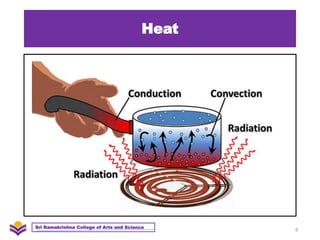
Heat
Heat transfer is a process by which internal energy from one
substance transfers to another substance.
Thermodynamics is the study of heat transfer and the
changes that result from it.
An understanding of heat transfer is crucial to analyzing
a thermodynamic process, such as those that take place
in heat engines and heat pumps.
 Conduction
 Convection
 Radiation
2
Sri Ramakrishna College of Arts and Science
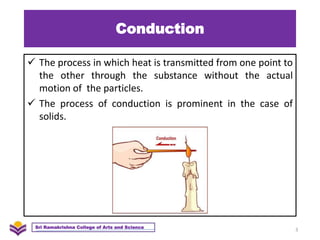
Conduction
 The process in which heat is transmitted from one point to
the other through the substance without the actual
motion of the particles.
 The process of conduction is prominent in the case of
solids.
3
Sri Ramakrishna College of Arts and Science
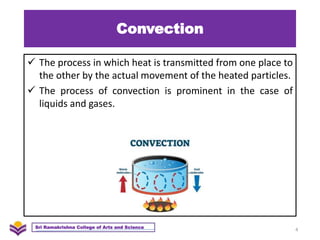
Convection
 The process in which heat is transmitted from one place to
the other by the actual movement of the heated particles.
 The process of convection is prominent in the case of
liquids and gases.
4
Sri Ramakrishna College of Arts and Science
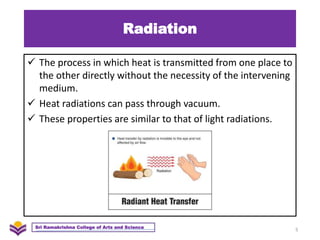
Radiation
 The process in which heat is transmitted from one place to
the other directly without the necessity of the intervening
medium.
 Heat radiations can pass through vacuum.
 These properties are similar to that of light radiations.
5
Sri Ramakrishna College of Arts and Science
Heat
6
Sri Ramakrishna College of Arts and Science
Coefficient of thermal
conductivity
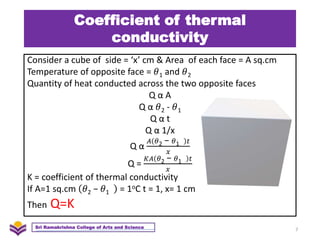
Consider a cube of side = ‘x’ cm & Area of each face = A sq.cm
Temperature of opposite face = 𝜃1 and 𝜃2
Quantity of heat conducted across the two opposite faces
Q α A
Q α 𝜃2 - 𝜃1
Q α t
Q α 1/x
Q α
𝐴 𝜃2 − 𝜃1 𝑡
𝑥
Q =
𝐾𝐴 𝜃2 − 𝜃1 𝑡
𝑥
K = coefficient of thermal conductivity
If A=1 sq.cm 𝜃2 − 𝜃1 = 1oC t = 1, x= 1 cm
Then Q=K
7
Sri Ramakrishna College of Arts and Science
Coefficient of thermal
conductivity
Definition: The coefficient of thermal conductivity is defined
as the amount of heat flowing in one second across the
opposite faces of a cube of side one cm maintained at a
different of temperature of 10C.
Temperature gradient : The quantity
𝜃2 − 𝜃1
𝑥
represents the
rate of fall of temperature with respect to distance. The
quantity
𝑑𝜃
𝑑𝑥
represents the rate of change of temperature
with respect to the distance. As temperature decreases with
increase in distance from the hot end, the quantity
𝑑𝜃
𝑑𝑥
is
negative and is called the temperature gradient.
8
Sri Ramakrishna College of Arts and Science
Coefficient of thermal
conductivity
Dimensions of K
K = -Q/A
𝑑𝜃
𝑑𝑥
𝑡
[Q] = [ML2T-2 ], [dx] = [L], [A] = [L2], [dθ] = [θ], [t]= [T]
Therefore
[K] = [MLT-3θ-1]
9
Sri Ramakrishna College of Arts and Science
Rectilinear flow of heat along a
bar
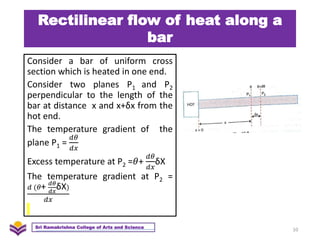
Consider a bar of uniform cross
section which is heated in one end.
Consider two planes P1 and P2
perpendicular to the length of the
bar at distance x and x+δx from the
hot end.
The temperature gradient of the
plane P1 =
𝑑𝜃
𝑑𝑥
Excess temperature at P2 =𝜃+
𝑑𝜃
𝑑𝑥
δX
The temperature gradient at P2 =
𝑑 (𝜃+ 𝑑𝜃
𝑑𝑥
δX)
𝑑𝑥
10
Sri Ramakrishna College of Arts and Science
Rectilinear flow of heat along a
bar
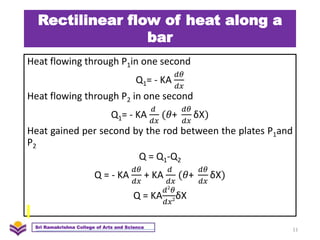
Heat flowing through P1in one second
Q1= - KA
𝑑𝜃
𝑑𝑥
Heat flowing through P2 in one second
Q1= - KA
𝑑
𝑑𝑥
(𝜃+
𝑑𝜃
𝑑𝑥
δX)
Heat gained per second by the rod between the plates P1and
P2
Q = Q1-Q2
Q = - KA
𝑑𝜃
𝑑𝑥
+ KA
𝑑
𝑑𝑥
(𝜃+
𝑑𝜃
𝑑𝑥
δX)
Q = KA
𝑑2
𝜃
𝑑𝑥2δX
11
Sri Ramakrishna College of Arts and Science
Rectilinear flow of heat along a
bar
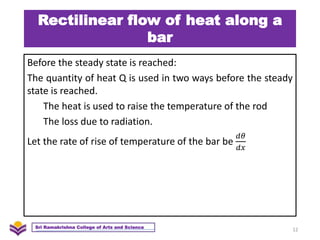
Before the steady state is reached:
The quantity of heat Q is used in two ways before the steady
state is reached.
The heat is used to raise the temperature of the rod
The loss due to radiation.
Let the rate of rise of temperature of the bar be
𝑑𝜃
𝑑𝑥
12
Sri Ramakrishna College of Arts and Science
Rectilinear flow of heat along a
bar
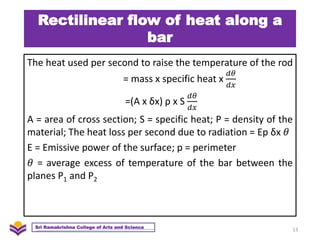
The heat used per second to raise the temperature of the rod
= mass x specific heat x
𝑑𝜃
𝑑𝑥
=(A x δx) ρ x S
𝑑𝜃
𝑑𝑥
A = area of cross section; S = specific heat; Ρ = density of the
material; The heat loss per second due to radiation = Ep δx 𝜃
E = Emissive power of the surface; p = perimeter
𝜃 = average excess of temperature of the bar between the
planes P1 and P2
13
Sri Ramakrishna College of Arts and Science
Rectilinear flow of heat along a
bar
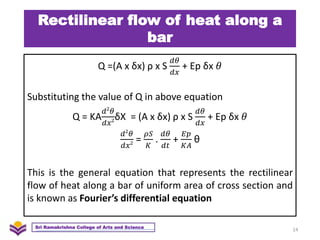
Q =(A x δx) ρ x S
𝑑𝜃
𝑑𝑥
+ Ep δx 𝜃
Substituting the value of Q in above equation
Q = KA
𝑑2
𝜃
𝑑𝑥2δX = (A x δx) ρ x S
𝑑𝜃
𝑑𝑥
+ Ep δx 𝜃
𝑑2
𝜃
𝑑𝑥2 =
𝜌𝑆
𝐾
.
𝑑𝜃
𝑑𝑡
+
𝐸𝑝
𝐾𝐴
θ
This is the general equation that represents the rectilinear
flow of heat along a bar of uniform area of cross section and
is known as Fourier’s differential equation
14
Sri Ramakrishna College of Arts and Science
Periodic flow of heat
Metallic bar is alternately heated and cooled (i.e) heat is
supplied periodically (and not continuously).
It is observed that the temperature at different points in the
bar also varies periodically.
Principle:
Whenever the end is heated, the heat waves flow
outward from it and when it is cooled, the heat waves travel
towards it and thus two waves are set up in the rod travelling
in opposite directions.
15
Sri Ramakrishna College of Arts and Science
Periodic flow of heat
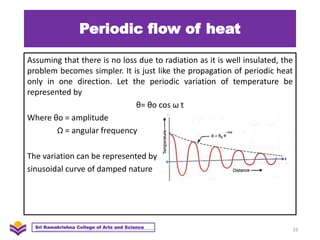
Assuming that there is no loss due to radiation as it is well insulated, the
problem becomes simpler. It is just like the propagation of periodic heat
only in one direction. Let the periodic variation of temperature be
represented by
θ= θo cos ω t
Where θo = amplitude
Ω = angular frequency
The variation can be represented by
sinusoidal curve of damped nature
16
Sri Ramakrishna College of Arts and Science
Thermal conductivity measurement
(angstrom’s method)
To determine the conductivity of a metal bar by using the
method of periodic flow.
Long metal bar- enclosed one end of it in a chamber through
which steam and cold water at known temperature could be
alternately passed.
The end of the bar is heated for 12 mins and cooled for 12
mins by passing cooled water. The periodic time of heat flow
is T = 24 mins.
Until steady state is reached.
17
Sri Ramakrishna College of Arts and Science
Thermal conductivity measurement
(angstrom’s method)
Then the maximum temperature at two consecutive points is
noted.
The distance between these two points is measured by using
thermo-couple.
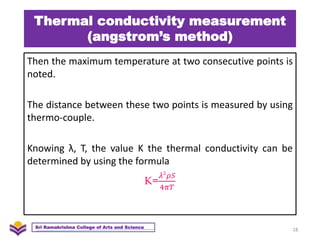
Knowing λ, T, the value K the thermal conductivity can be
determined by using the formula
K=
𝜆2
𝜌𝑆
4𝜋𝑇
18
Sri Ramakrishna College of Arts and Science
Propagation of heat waves in the
Earth’s Crust
Dirunal Wave – The periodic heating and cooling as a result a
heat or temperature wave with a period of 24 hrs is
propagated into the interior of the earth.
Annual Wave – Heat wave travelling into the interior of
earth for the period of 1 year.
19
Sri Ramakrishna College of Arts and Science
Searle’s method
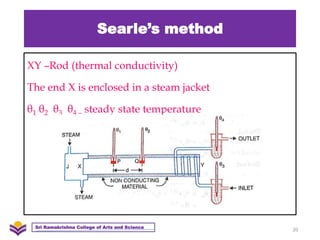
XY –Rod (thermal conductivity)
The end X is enclosed in a steam jacket
θ1 θ2 θ3 θ4 – steady state temperature
20
Sri Ramakrishna College of Arts and Science
Searle’s method
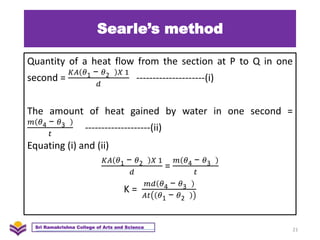
Quantity of a heat flow from the section at P to Q in one
second =
𝐾𝐴 𝜃1 − 𝜃2 𝑋 1
𝑑
---------------------(i)
The amount of heat gained by water in one second =
𝑚 𝜃4 − 𝜃3
𝑡
--------------------(ii)
Equating (i) and (ii)
𝐾𝐴 𝜃1 − 𝜃2 𝑋 1
𝑑
=
𝑚 𝜃4 − 𝜃3
𝑡
K =
𝑚𝑑 𝜃4 − 𝜃3
𝐴𝑡 𝜃1 − 𝜃2
21
Sri Ramakrishna College of Arts and Science
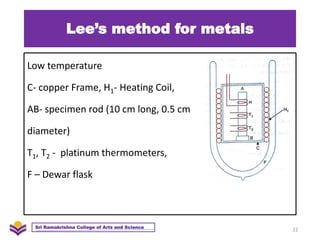
Lee’s method for metals
Low temperature
C- copper Frame, H1- Heating Coil,
AB- specimen rod (10 cm long, 0.5 cm
diameter)
T1, T2 - platinum thermometers,
F – Dewar flask
22
Sri Ramakrishna College of Arts and Science
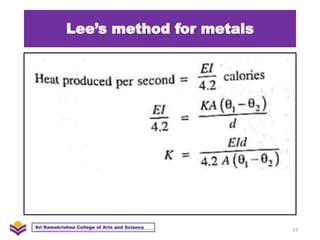
Lee’s method for metals
23
Sri Ramakrishna College of Arts and Science
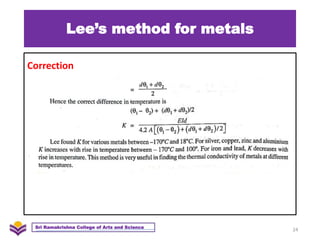
Lee’s method for metals
Correction
24
Sri Ramakrishna College of Arts and Science
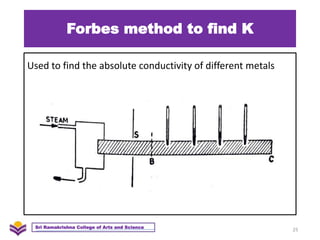
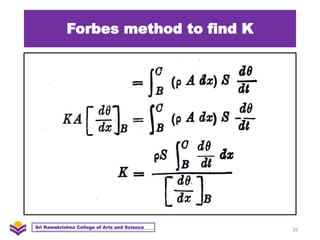
Forbes method to find K
Used to find the absolute conductivity of different metals
25
Sri Ramakrishna College of Arts and Science
Forbes method to find K
26
Sri Ramakrishna College of Arts and Science
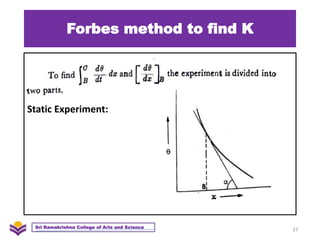
Forbes method to find K
Static Experiment:
27
Sri Ramakrishna College of Arts and Science
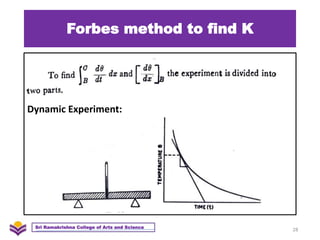
Forbes method to find K
Dynamic Experiment:
28
Sri Ramakrishna College of Arts and Science
Forbes method to find K
29
Sri Ramakrishna College of Arts and Science
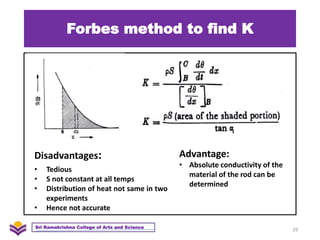
Advantage:
• Absolute conductivity of the
material of the rod can be
determined
Disadvantages:
• Tedious
• S not constant at all temps
• Distribution of heat not same in two
experiments
• Hence not accurate
Spherical Shell method to find K
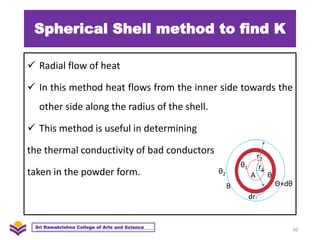
 Radial flow of heat
 In this method heat flows from the inner side towards the
other side along the radius of the shell.
 This method is useful in determining
the thermal conductivity of bad conductors
taken in the powder form.
30
Sri Ramakrishna College of Arts and Science
r1
r2
A
θ1
θ
θ2
B
dr
Θ+dθ
Spherical Shell method to find K
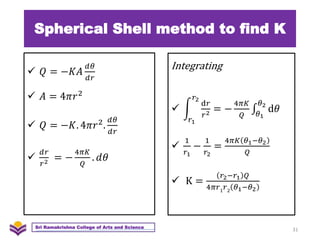
 𝑄 = −𝐾𝐴
𝑑𝜃
𝑑𝑟
 𝐴 = 4𝜋𝑟2
 𝑄 = −𝐾. 4𝜋𝑟2.
𝑑𝜃
𝑑𝑟

𝑑𝑟
𝑟2 = −
4𝜋𝐾
𝑄
. ⅆ𝜃
31
Sri Ramakrishna College of Arts and Science
Integrating

𝑟1
𝑟2
ⅆ𝑟
𝑟2 = −
4𝜋𝐾
𝑄 𝜃1
𝜃2
ⅆ𝜃

1
𝑟1
−
1
𝑟2
=
4𝜋𝐾 𝜃1−𝜃2
𝑄
 K =
𝑟2−𝑟1 𝑄
4𝜋𝑟1
𝑟2
𝜃1−𝜃2
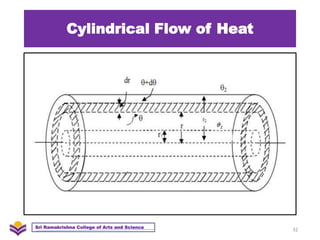
Cylindrical Flow of Heat
32
Sri Ramakrishna College of Arts and Science
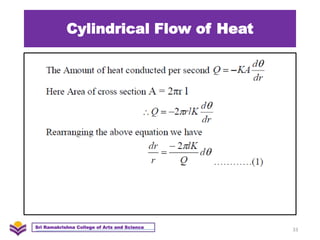
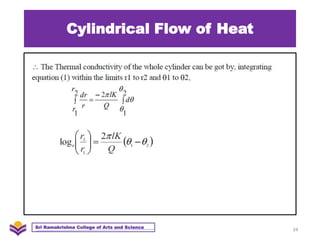
Cylindrical Flow of Heat
33
Sri Ramakrishna College of Arts and Science
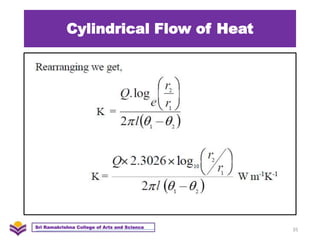
Cylindrical Flow of Heat
34
Sri Ramakrishna College of Arts and Science
Cylindrical Flow of Heat
35
Sri Ramakrishna College of Arts and Science
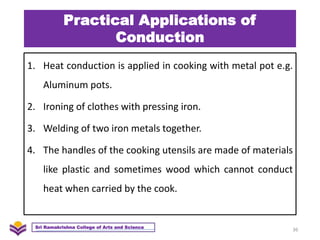
Practical Applications of
Conduction
1. Heat conduction is applied in cooking with metal pot e.g.
Aluminum pots.
2. Ironing of clothes with pressing iron.
3. Welding of two iron metals together.
4. The handles of the cooking utensils are made of materials
like plastic and sometimes wood which cannot conduct
heat when carried by the cook.
36
Sri Ramakrishna College of Arts and Science
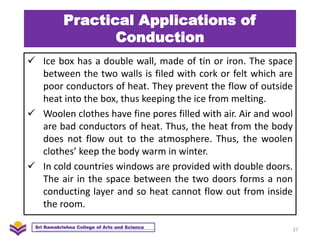
Practical Applications of
Conduction
 Ice box has a double wall, made of tin or iron. The space
between the two walls is filed with cork or felt which are
poor conductors of heat. They prevent the flow of outside
heat into the box, thus keeping the ice from melting.
 Woolen clothes have fine pores filled with air. Air and wool
are bad conductors of heat. Thus, the heat from the body
does not flow out to the atmosphere. Thus, the woolen
clothes’ keep the body warm in winter.
 In cold countries windows are provided with double doors.
The air in the space between the two doors forms a non
conducting layer and so heat cannot flow out from inside
the room.
37
Sri Ramakrishna College of Arts and Science
Practical Applications of
Conduction
 In hot countries as well, the windows are made with
double doors. Heat can not flow in from outside because
of the presence of air between the two doors.
 When a stopper, fitted tightly to the bottle is to be
removed, the neck of the bottle is gently heated. It
expands slightly on heating. Since glass is a bad conductor
of heat, the heat does not reach the stopper. Thus, it can
be removed easily.
38
Sri Ramakrishna College of Arts and Science
Practical Applications of
Conduction
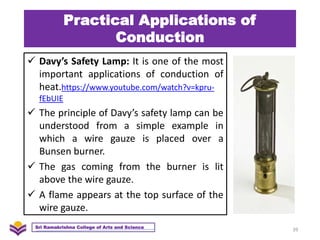
 Davy’s Safety Lamp: It is one of the most
important applications of conduction of
heat.https://www.youtube.com/watch?v=kpru-
fEbUIE
 The principle of Davy’s safety lamp can be
understood from a simple example in
which a wire gauze is placed over a
Bunsen burner.
 The gas coming from the burner is lit
above the wire gauze.
 A flame appears at the top surface of the
wire gauze.
39
Sri Ramakrishna College of Arts and Science
Practical Applications of
Conduction
 The gas coming out from the burner below the wire gauze does not
get sufficient heat for ignition.
 The reason is that the wire gauze conducts away the heat of the flame
above it and so the temperature at the lower surface of the gauze
does not reach the ignition point.
 In Davy’s safety lamp, a cylindrical metal gauze of high thermal
conductivity surround the flame.
 When this lamp is taken inside a mine, the explosive gases present in
the mine are not ignited because the wire gauze in the form a cylinder
conducts away the heat of the flame of the lamp.
 The result is that the temperature outside the gauze remains below
the ignition point of the gases. In absence of the wire gauze the gases
outside can explode.
40
Sri Ramakrishna College of Arts and Science
Practical Applications of
Conduction
41
Sri Ramakrishna College of Arts and Science

Physics - Heat and Thermodynamics - Basics

  • 1.
    Heat and Thermodynamics- Transmission of Heat Ms Dhivya R Assistant Professor Department of Physics Sri Ramakrishna College of Arts and Science Coimbatore - 641 006 Tamil Nadu, India 1
  • 2.
    Heat Heat transfer isa process by which internal energy from one substance transfers to another substance. Thermodynamics is the study of heat transfer and the changes that result from it. An understanding of heat transfer is crucial to analyzing a thermodynamic process, such as those that take place in heat engines and heat pumps.  Conduction  Convection  Radiation 2 Sri Ramakrishna College of Arts and Science
  • 3.
    Conduction  The processin which heat is transmitted from one point to the other through the substance without the actual motion of the particles.  The process of conduction is prominent in the case of solids. 3 Sri Ramakrishna College of Arts and Science
  • 4.
    Convection  The processin which heat is transmitted from one place to the other by the actual movement of the heated particles.  The process of convection is prominent in the case of liquids and gases. 4 Sri Ramakrishna College of Arts and Science
  • 5.
    Radiation  The processin which heat is transmitted from one place to the other directly without the necessity of the intervening medium.  Heat radiations can pass through vacuum.  These properties are similar to that of light radiations. 5 Sri Ramakrishna College of Arts and Science
  • 6.
    Heat 6 Sri Ramakrishna Collegeof Arts and Science
  • 7.
    Coefficient of thermal conductivity Considera cube of side = ‘x’ cm & Area of each face = A sq.cm Temperature of opposite face = 𝜃1 and 𝜃2 Quantity of heat conducted across the two opposite faces Q α A Q α 𝜃2 - 𝜃1 Q α t Q α 1/x Q α 𝐴 𝜃2 − 𝜃1 𝑡 𝑥 Q = 𝐾𝐴 𝜃2 − 𝜃1 𝑡 𝑥 K = coefficient of thermal conductivity If A=1 sq.cm 𝜃2 − 𝜃1 = 1oC t = 1, x= 1 cm Then Q=K 7 Sri Ramakrishna College of Arts and Science
  • 8.
    Coefficient of thermal conductivity Definition:The coefficient of thermal conductivity is defined as the amount of heat flowing in one second across the opposite faces of a cube of side one cm maintained at a different of temperature of 10C. Temperature gradient : The quantity 𝜃2 − 𝜃1 𝑥 represents the rate of fall of temperature with respect to distance. The quantity 𝑑𝜃 𝑑𝑥 represents the rate of change of temperature with respect to the distance. As temperature decreases with increase in distance from the hot end, the quantity 𝑑𝜃 𝑑𝑥 is negative and is called the temperature gradient. 8 Sri Ramakrishna College of Arts and Science
  • 9.
    Coefficient of thermal conductivity Dimensionsof K K = -Q/A 𝑑𝜃 𝑑𝑥 𝑡 [Q] = [ML2T-2 ], [dx] = [L], [A] = [L2], [dθ] = [θ], [t]= [T] Therefore [K] = [MLT-3θ-1] 9 Sri Ramakrishna College of Arts and Science
  • 10.
    Rectilinear flow ofheat along a bar Consider a bar of uniform cross section which is heated in one end. Consider two planes P1 and P2 perpendicular to the length of the bar at distance x and x+δx from the hot end. The temperature gradient of the plane P1 = 𝑑𝜃 𝑑𝑥 Excess temperature at P2 =𝜃+ 𝑑𝜃 𝑑𝑥 δX The temperature gradient at P2 = 𝑑 (𝜃+ 𝑑𝜃 𝑑𝑥 δX) 𝑑𝑥 10 Sri Ramakrishna College of Arts and Science
  • 11.
    Rectilinear flow ofheat along a bar Heat flowing through P1in one second Q1= - KA 𝑑𝜃 𝑑𝑥 Heat flowing through P2 in one second Q1= - KA 𝑑 𝑑𝑥 (𝜃+ 𝑑𝜃 𝑑𝑥 δX) Heat gained per second by the rod between the plates P1and P2 Q = Q1-Q2 Q = - KA 𝑑𝜃 𝑑𝑥 + KA 𝑑 𝑑𝑥 (𝜃+ 𝑑𝜃 𝑑𝑥 δX) Q = KA 𝑑2 𝜃 𝑑𝑥2δX 11 Sri Ramakrishna College of Arts and Science
  • 12.
    Rectilinear flow ofheat along a bar Before the steady state is reached: The quantity of heat Q is used in two ways before the steady state is reached. The heat is used to raise the temperature of the rod The loss due to radiation. Let the rate of rise of temperature of the bar be 𝑑𝜃 𝑑𝑥 12 Sri Ramakrishna College of Arts and Science
  • 13.
    Rectilinear flow ofheat along a bar The heat used per second to raise the temperature of the rod = mass x specific heat x 𝑑𝜃 𝑑𝑥 =(A x δx) ρ x S 𝑑𝜃 𝑑𝑥 A = area of cross section; S = specific heat; Ρ = density of the material; The heat loss per second due to radiation = Ep δx 𝜃 E = Emissive power of the surface; p = perimeter 𝜃 = average excess of temperature of the bar between the planes P1 and P2 13 Sri Ramakrishna College of Arts and Science
  • 14.
    Rectilinear flow ofheat along a bar Q =(A x δx) ρ x S 𝑑𝜃 𝑑𝑥 + Ep δx 𝜃 Substituting the value of Q in above equation Q = KA 𝑑2 𝜃 𝑑𝑥2δX = (A x δx) ρ x S 𝑑𝜃 𝑑𝑥 + Ep δx 𝜃 𝑑2 𝜃 𝑑𝑥2 = 𝜌𝑆 𝐾 . 𝑑𝜃 𝑑𝑡 + 𝐸𝑝 𝐾𝐴 θ This is the general equation that represents the rectilinear flow of heat along a bar of uniform area of cross section and is known as Fourier’s differential equation 14 Sri Ramakrishna College of Arts and Science
  • 15.
    Periodic flow ofheat Metallic bar is alternately heated and cooled (i.e) heat is supplied periodically (and not continuously). It is observed that the temperature at different points in the bar also varies periodically. Principle: Whenever the end is heated, the heat waves flow outward from it and when it is cooled, the heat waves travel towards it and thus two waves are set up in the rod travelling in opposite directions. 15 Sri Ramakrishna College of Arts and Science
  • 16.
    Periodic flow ofheat Assuming that there is no loss due to radiation as it is well insulated, the problem becomes simpler. It is just like the propagation of periodic heat only in one direction. Let the periodic variation of temperature be represented by θ= θo cos ω t Where θo = amplitude Ω = angular frequency The variation can be represented by sinusoidal curve of damped nature 16 Sri Ramakrishna College of Arts and Science
  • 17.
    Thermal conductivity measurement (angstrom’smethod) To determine the conductivity of a metal bar by using the method of periodic flow. Long metal bar- enclosed one end of it in a chamber through which steam and cold water at known temperature could be alternately passed. The end of the bar is heated for 12 mins and cooled for 12 mins by passing cooled water. The periodic time of heat flow is T = 24 mins. Until steady state is reached. 17 Sri Ramakrishna College of Arts and Science
  • 18.
    Thermal conductivity measurement (angstrom’smethod) Then the maximum temperature at two consecutive points is noted. The distance between these two points is measured by using thermo-couple. Knowing λ, T, the value K the thermal conductivity can be determined by using the formula K= 𝜆2 𝜌𝑆 4𝜋𝑇 18 Sri Ramakrishna College of Arts and Science
  • 19.
    Propagation of heatwaves in the Earth’s Crust Dirunal Wave – The periodic heating and cooling as a result a heat or temperature wave with a period of 24 hrs is propagated into the interior of the earth. Annual Wave – Heat wave travelling into the interior of earth for the period of 1 year. 19 Sri Ramakrishna College of Arts and Science
  • 20.
    Searle’s method XY –Rod(thermal conductivity) The end X is enclosed in a steam jacket θ1 θ2 θ3 θ4 – steady state temperature 20 Sri Ramakrishna College of Arts and Science
  • 21.
    Searle’s method Quantity ofa heat flow from the section at P to Q in one second = 𝐾𝐴 𝜃1 − 𝜃2 𝑋 1 𝑑 ---------------------(i) The amount of heat gained by water in one second = 𝑚 𝜃4 − 𝜃3 𝑡 --------------------(ii) Equating (i) and (ii) 𝐾𝐴 𝜃1 − 𝜃2 𝑋 1 𝑑 = 𝑚 𝜃4 − 𝜃3 𝑡 K = 𝑚𝑑 𝜃4 − 𝜃3 𝐴𝑡 𝜃1 − 𝜃2 21 Sri Ramakrishna College of Arts and Science
  • 22.
    Lee’s method formetals Low temperature C- copper Frame, H1- Heating Coil, AB- specimen rod (10 cm long, 0.5 cm diameter) T1, T2 - platinum thermometers, F – Dewar flask 22 Sri Ramakrishna College of Arts and Science
  • 23.
    Lee’s method formetals 23 Sri Ramakrishna College of Arts and Science
  • 24.
    Lee’s method formetals Correction 24 Sri Ramakrishna College of Arts and Science
  • 25.
    Forbes method tofind K Used to find the absolute conductivity of different metals 25 Sri Ramakrishna College of Arts and Science
  • 26.
    Forbes method tofind K 26 Sri Ramakrishna College of Arts and Science
  • 27.
    Forbes method tofind K Static Experiment: 27 Sri Ramakrishna College of Arts and Science
  • 28.
    Forbes method tofind K Dynamic Experiment: 28 Sri Ramakrishna College of Arts and Science
  • 29.
    Forbes method tofind K 29 Sri Ramakrishna College of Arts and Science Advantage: • Absolute conductivity of the material of the rod can be determined Disadvantages: • Tedious • S not constant at all temps • Distribution of heat not same in two experiments • Hence not accurate
  • 30.
    Spherical Shell methodto find K  Radial flow of heat  In this method heat flows from the inner side towards the other side along the radius of the shell.  This method is useful in determining the thermal conductivity of bad conductors taken in the powder form. 30 Sri Ramakrishna College of Arts and Science r1 r2 A θ1 θ θ2 B dr Θ+dθ
  • 31.
    Spherical Shell methodto find K  𝑄 = −𝐾𝐴 𝑑𝜃 𝑑𝑟  𝐴 = 4𝜋𝑟2  𝑄 = −𝐾. 4𝜋𝑟2. 𝑑𝜃 𝑑𝑟  𝑑𝑟 𝑟2 = − 4𝜋𝐾 𝑄 . ⅆ𝜃 31 Sri Ramakrishna College of Arts and Science Integrating  𝑟1 𝑟2 ⅆ𝑟 𝑟2 = − 4𝜋𝐾 𝑄 𝜃1 𝜃2 ⅆ𝜃  1 𝑟1 − 1 𝑟2 = 4𝜋𝐾 𝜃1−𝜃2 𝑄  K = 𝑟2−𝑟1 𝑄 4𝜋𝑟1 𝑟2 𝜃1−𝜃2
  • 32.
    Cylindrical Flow ofHeat 32 Sri Ramakrishna College of Arts and Science
  • 33.
    Cylindrical Flow ofHeat 33 Sri Ramakrishna College of Arts and Science
  • 34.
    Cylindrical Flow ofHeat 34 Sri Ramakrishna College of Arts and Science
  • 35.
    Cylindrical Flow ofHeat 35 Sri Ramakrishna College of Arts and Science
  • 36.
    Practical Applications of Conduction 1.Heat conduction is applied in cooking with metal pot e.g. Aluminum pots. 2. Ironing of clothes with pressing iron. 3. Welding of two iron metals together. 4. The handles of the cooking utensils are made of materials like plastic and sometimes wood which cannot conduct heat when carried by the cook. 36 Sri Ramakrishna College of Arts and Science
  • 37.
    Practical Applications of Conduction Ice box has a double wall, made of tin or iron. The space between the two walls is filed with cork or felt which are poor conductors of heat. They prevent the flow of outside heat into the box, thus keeping the ice from melting.  Woolen clothes have fine pores filled with air. Air and wool are bad conductors of heat. Thus, the heat from the body does not flow out to the atmosphere. Thus, the woolen clothes’ keep the body warm in winter.  In cold countries windows are provided with double doors. The air in the space between the two doors forms a non conducting layer and so heat cannot flow out from inside the room. 37 Sri Ramakrishna College of Arts and Science
  • 38.
    Practical Applications of Conduction In hot countries as well, the windows are made with double doors. Heat can not flow in from outside because of the presence of air between the two doors.  When a stopper, fitted tightly to the bottle is to be removed, the neck of the bottle is gently heated. It expands slightly on heating. Since glass is a bad conductor of heat, the heat does not reach the stopper. Thus, it can be removed easily. 38 Sri Ramakrishna College of Arts and Science
  • 39.
    Practical Applications of Conduction Davy’s Safety Lamp: It is one of the most important applications of conduction of heat.https://www.youtube.com/watch?v=kpru- fEbUIE  The principle of Davy’s safety lamp can be understood from a simple example in which a wire gauze is placed over a Bunsen burner.  The gas coming from the burner is lit above the wire gauze.  A flame appears at the top surface of the wire gauze. 39 Sri Ramakrishna College of Arts and Science
  • 40.
    Practical Applications of Conduction The gas coming out from the burner below the wire gauze does not get sufficient heat for ignition.  The reason is that the wire gauze conducts away the heat of the flame above it and so the temperature at the lower surface of the gauze does not reach the ignition point.  In Davy’s safety lamp, a cylindrical metal gauze of high thermal conductivity surround the flame.  When this lamp is taken inside a mine, the explosive gases present in the mine are not ignited because the wire gauze in the form a cylinder conducts away the heat of the flame of the lamp.  The result is that the temperature outside the gauze remains below the ignition point of the gases. In absence of the wire gauze the gases outside can explode. 40 Sri Ramakrishna College of Arts and Science
  • 41.
    Practical Applications of Conduction 41 SriRamakrishna College of Arts and Science