Thermal Physics - modes of heat transfer-
thermal conductivity –Lee’s disc method -
conduction through compound media –
thermal expansion – thermal stress –
laws of thermodynamics –entropy
Thermal expansion
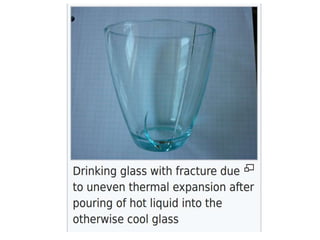
Thermal expansion is the tendency of matter to
change its shape, area, volume, and density in
response to a change in temperature.
Thermal expansion
 Most Material expand on heating and contract on
cooling
 Ex: A completely filled and tightly closed bottle of
water cracks due to thermal expansion of water
molecules
 The lid of a tightly closed metal jar can be opened
easily if its dipped in hot water
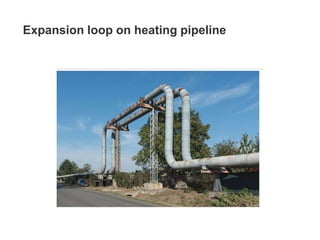
Expansion loop on heating pipeline
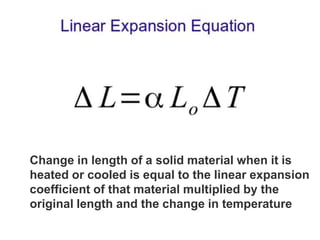
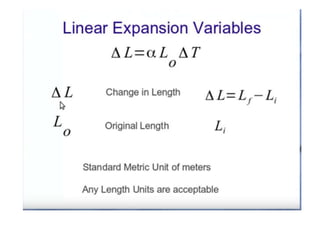
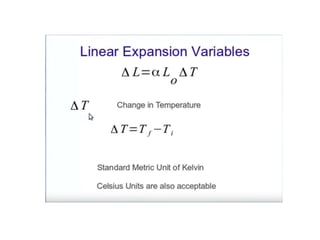
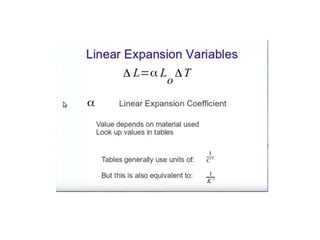
Change in length of a solid material when it is
heated or cooled is equal to the linear expansion
coefficient of that material multiplied by the
original length and the change in temperature
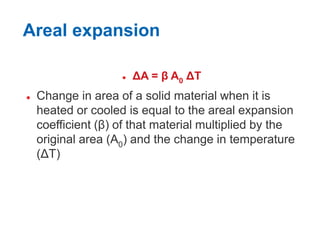
Areal expansion
 ΔA = β A0 ΔT
 Change in area of a solid material when it is
heated or cooled is equal to the areal expansion
coefficient (β) of that material multiplied by the
original area (A0) and the change in temperature
(ΔT)
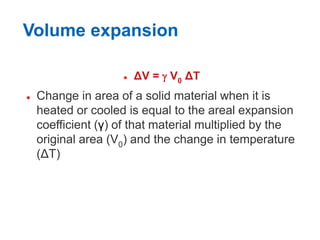
Volume expansion
 ΔV =  V0 ΔT
 Change in area of a solid material when it is
heated or cooled is equal to the areal expansion
coefficient (γ) of that material multiplied by the
original area (V0) and the change in temperature
(ΔT)
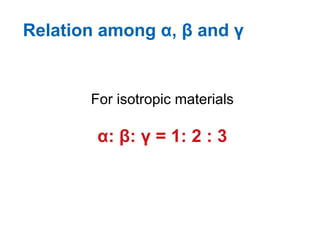
Relation among α, β and γ
For isotropic materials
α: β: γ = 1: 2 : 3
Points to remember
• Pendulum clocks lose or gain time as the length increases
during summer or decreases during winter respectively
• If a thin rod and a thick rod of same length and material are
heated to same rise in temperature, both expand equally
• If a thin rod and a thick rod of same length and material are
heated by equal quantities of heat, thin rod expands more
than thick rod
• A hole in the metal plate expands on heating just like a solid
plate of the same size. A piston inside a cylinder functions at all
temperatures only because of this
• A cavity of a solid object expands on heating just like a solid
object of the same volume
• The change in the volume of a body, when its temperature is
raised, does not depend on the cavities inside the body
• Platinum or monal is used to seal inside glass because both
have nearly equal coefficient of linear expansion
• Iron or steel is used for reinforcements in concrete because
both have nearly equal coefficients of expansion (12 x 10-6
C-1)
• Invar steel has very low . So, it is used in making
pendulum clocks, balancing wheels and measuring tapes
(composition of invar is 64% steel and 36% nickel)
• Pyrex glass has low . Hence combustion tubes and test
tubes for heating purposes are made out of it.
• Metal pipes carrying steam are provided with bends to
allow for expansion.
• To remove a tight metal cap of a glass bottle, it should be
warmed
Points to remember
Problems
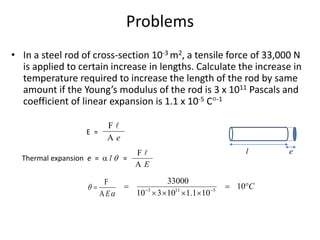
• In a steel rod of cross-section 10-3 m2, a tensile force of 33,000 N
is applied to certain increase in lengths. Calculate the increase in
temperature required to increase the length of the rod by same
amount if the Young’s modulus of the rod is 3 x 10¹¹ Pascals and
coefficient of linear expansion is 1.1 x 10⁻⁵ C-1
l e
F
A e
E =
Thermal expansion e =  l  =
F
A E
F
A E


 3 11 5
33000
10
10 3 10 1.1 10
C
 
  
   
Problems
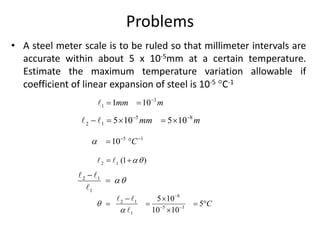
• A steel meter scale is to be ruled so that millimeter intervals are
accurate within about 5 x 10⁻⁵mm at a certain temperature.
Estimate the maximum temperature variation allowable if
coefficient of linear expansion of steel is 10-5 C-1
3
1 1 10
mm m

 
5 8
2 1 5 10 5 10
mm m
 
    
5 1
10 C
  
 
2 1 (1 )

 
2 1
1



8
2 1
5 3
1
5 10
5
10 10
C



 
 
   

Thermal Stress
l e
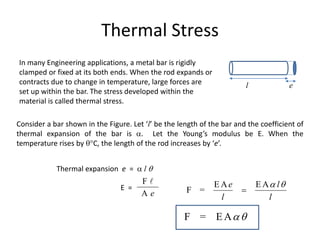
In many Engineering applications, a metal bar is rigidly
clamped or fixed at its both ends. When the rod expands or
contracts due to change in temperature, large forces are
set up within the bar. The stress developed within the
material is called thermal stress.
Consider a bar shown in the Figure. Let ‘l’ be the length of the bar and the coefficient of
thermal expansion of the bar is . Let the Young’s modulus be E. When the
temperature rises by C, the length of the rod increases by ‘e’.
Thermal expansion e =  l 
F
A e
E =
F = E A
E A E A
F =
e l
l l
 

Problems
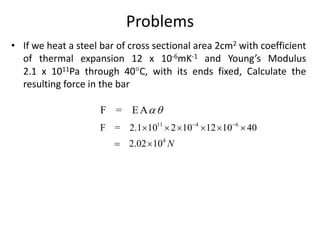
• If we heat a steel bar of cross sectional area 2cm2 with coefficient
of thermal expansion 12 x 10-6mK-1 and Young’s Modulus
2.1 x 10¹¹Pa through 40C, with its ends fixed, Calculate the
resulting force in the bar
F = E A
11 4 6
4
F = 2.1 10 2 10 12 10 40
2.02 10 N
 
     
 
Points related to thermal stress
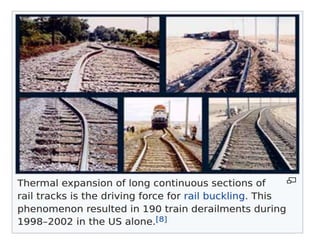
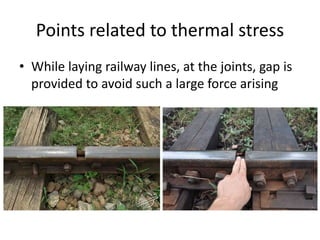
• While laying railway lines, at the joints, gap is
provided to avoid such a large force arising
Points related to thermal stress
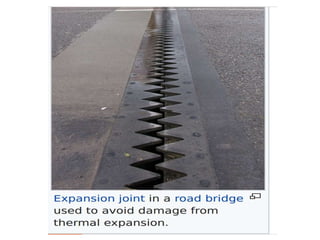
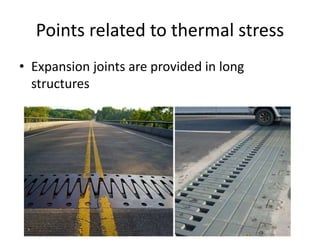
• Expansion joints are provided in long
structures
Points related to thermal stress
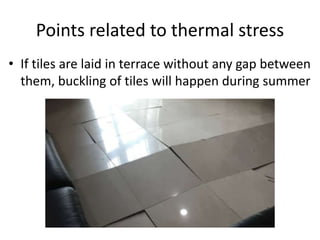
• If tiles are laid in terrace without any gap between
them, buckling of tiles will happen during summer
Points related to thermal stress
• In integrated circuits (IC), if the co ef. of thermal
expansion and Young’s modulus of the substrate and
the active layer deposited on the substrate are not
matching, micro cracks will be generated resulting in
failure
• Thermal stress is the primary contributor to head
gasket failure in internal combustion engines.
• Incandescent bulb while hot implode when cold
water is splashed on it due to sudden thermal stress
Points related to thermal stress
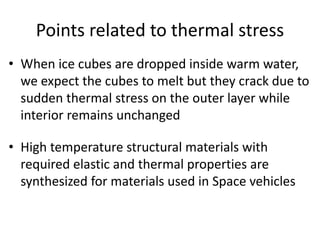
• When ice cubes are dropped inside warm water,
we expect the cubes to melt but they crack due to
sudden thermal stress on the outer layer while
interior remains unchanged
• High temperature structural materials with
required elastic and thermal properties are
synthesized for materials used in Space vehicles
Problems
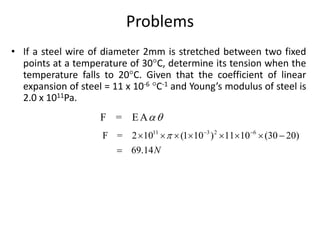
• If a steel wire of diameter 2mm is stretched between two fixed
points at a temperature of 30C, determine its tension when the
temperature falls to 20C. Given that the coefficient of linear
expansion of steel = 11 x 10-6 C-1 and Young’s modulus of steel is
2.0 x 10¹¹Pa.
F = E A
11 3 2 6
F = 2 10 (1 10 ) 11 10 (30 20)
69.14N
  
       

Bimetallic strips
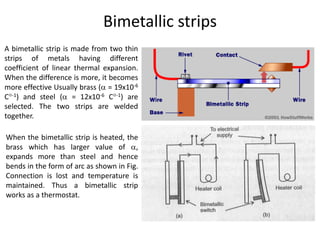
A bimetallic strip is made from two thin
strips of metals having different
coefficient of linear thermal expansion.
When the difference is more, it becomes
more effective Usually brass ( = 19x10-6
C-1) and steel ( = 12x10-6 C-1) are
selected. The two strips are welded
together.
When the bimetallic strip is heated, the
brass which has larger value of ,
expands more than steel and hence
bends in the form of arc as shown in Fig.
Connection is lost and temperature is
maintained. Thus a bimetallic strip
works as a thermostat.
Thermal Conductivity
The transfer of heat energy from one place to another through a substance without the
movement of the substance is known as thermal conduction.
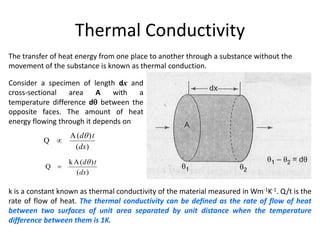
Consider a specimen of length dx and
cross-sectional area A with a
temperature difference d between the
opposite faces. The amount of heat
energy flowing through it depends on
A( )
Q
( )
d t
dx


k A( )
Q
( )
d t
dx


k is a constant known as thermal conductivity of the material measured in Wm-1K-1. Q/t is the
rate of flow of heat. The thermal conductivity can be defined as the rate of flow of heat
between two surfaces of unit area separated by unit distance when the temperature
difference between them is 1K.
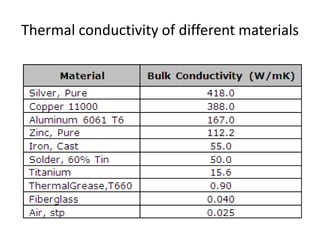
Thermal conductivity of different materials
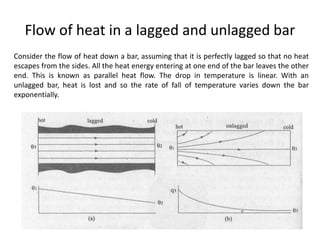
Flow of heat in a lagged and unlagged bar
Consider the flow of heat down a bar, assuming that it is perfectly lagged so that no heat
escapes from the sides. All the heat energy entering at one end of the bar leaves the other
end. This is known as parallel heat flow. The drop in temperature is linear. With an
unlagged bar, heat is lost and so the rate of fall of temperature varies down the bar
exponentially.
Mechanism of conduction(heat
transfer) in solids
1. Metals
– If one end of a metal rod is heated the atoms gain energy
and their vibrations increase. This energy is then passed
on to the other atoms and to the free electrons in the
metal. Since the electrons are very small in size, they can
travel rapidly around the specimen transferring their
energy by collision to other electrons and other atoms.
– In metals, heat is carried mainly by the motion of these
free electrons, although some energy is transferred by
interatomic vibration (phonons). The conductivity of
metals varies with temperatures and at very low
temperatures, conductivity is mainly due to lattice
vibrations.
Mechanism of conduction in solids
2. Non-metals
– There are very less number of free electrons in
non-metals. Therefore, the only way that heat
can travel through the specimen is by direct
transfer of energy from one atom to another.
Debye suggested that the energy was transferred
by an elastic wave propagated through the
specimen. These waves are called phonons, and
they travel with speed of sound through the
solid.
Theory of Rectilinear flow of heat
through a rod
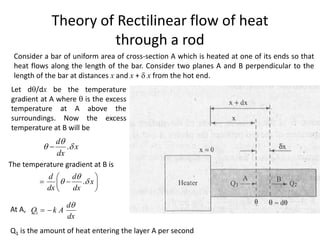
Consider a bar of uniform area of cross-section A which is heated at one of its ends so that
heat flows along the length of the bar. Consider two planes A and B perpendicular to the
length of the bar at distances x and x +  x from the hot end.
Let d/dx be the temperature
gradient at A where  is the excess
temperature at A above the
surroundings. Now the excess
temperature at B will be
.
d
x
dx

 

The temperature gradient at B is
.
d d
x
dx dx

 
 
 
 
 
1
d
Q k A
dx

 
At A,
Q1 is the amount of heat entering the layer A per second
Theory of Rectilinear flow of heat
through a rod
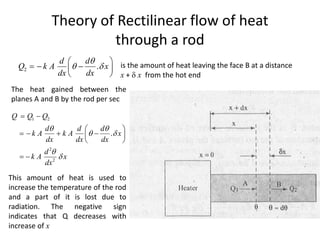
The heat gained between the
planes A and B by the rod per sec
This amount of heat is used to
increase the temperature of the rod
and a part of it is lost due to
radiation. The negative sign
indicates that Q decreases with
increase of x
2 .
d d
Q k A x
dx dx

 
 
  
 
 
is the amount of heat leaving the face B at a distance
x +  x from the hot end
1 2
2
2
.
Q Q Q
d d d
k A k A x
dx dx dx
d
k A x
dx
 
 


 
 
   
 
 
 
Theory of Rectilinear flow of heat
through a rod
The heat lost per second due to radiation = E p x  where p is the perimeter, E is the
emissive power of the surface and  is the average excess temperature of the rod between
the planes A and B. Therefore,
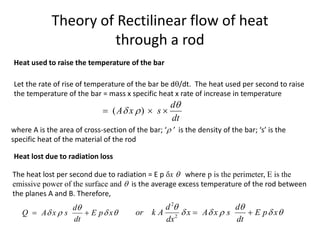
Heat used to raise the temperature of the bar
Let the rate of rise of temperature of the bar be d/dt. The heat used per second to raise
the temperature of the bar = mass x specific heat x rate of increase in temperature
( )
d
A x s
dt

 
  
where A is the area of cross-section of the bar; ‘ ’ is the density of the bar; ‘s’ is the
specific heat of the material of the rod
Heat lost due to radiation loss
d
Q A x s E p x
dt

   
 
2
2
d d
or k A x A x s E p x
dx dt
 
    
 
Theory of Rectilinear flow of heat
through a rod
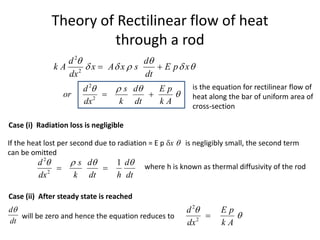
If the heat lost per second due to radiation = E p x  is negligibly small, the second term
can be omitted
Case (i) Radiation loss is negligible
2
2
d d
k A x A x s E p x
dx dt
 
    
 
2
2
d s d E p
or
dx k dt k A
  

 
is the equation for rectilinear flow of
heat along the bar of uniform area of
cross-section
2
2
1
d s d d
dx k dt h dt
   
  where h is known as thermal diffusivity of the rod
Case (ii) After steady state is reached
d
dt

will be zero and hence the equation reduces to
2
2
d E p
dx k A



Theory of Rectilinear flow of heat
through a rod
2
2
d E p
dx k A


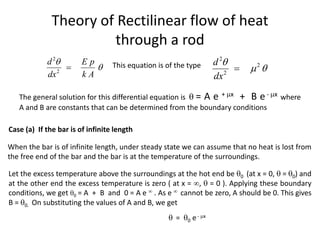
 This equation is of the type
2
2
2
d
dx

 

The general solution for this differential equation is  = A e + x + B e- x where
A and B are constants that can be determined from the boundary conditions
Case (a) If the bar is of infinite length
When the bar is of infinite length, under steady state we can assume that no heat is lost from
the free end of the bar and the bar is at the temperature of the surroundings.
Let the excess temperature above the surroundings at the hot end be 0 (at x = 0,  = 0) and
at the other end the excess temperature is zero ( at x = ,  = 0 ). Applying these boundary
conditions, we get 0 = A + B and 0 = A e  . As e  cannot be zero, A should be 0. This gives
B = 0. On substituting the values of A and B, we get
 = 0 e - x
Theory of Rectilinear flow of heat
through a rod
0
d
dx


0
2
0
0
x x
L L
L
A B
d
A e B e
dx
A e B e
A e B
 
 



 
 


 
 
 
 
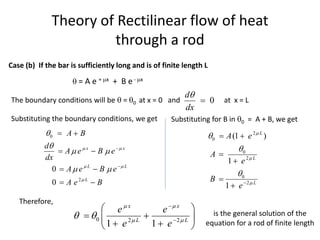
Case (b) If the bar is sufficiently long and is of finite length L
 = A e + x + B e- x
The boundary conditions will be  = 0 at x = 0 and at x = L
Substituting the boundary conditions, we get Substituting for B in 0 = A + B, we get
2
0
0
2
0
2
(1 )
1
1
L
L
L
A e
A
e
B
e







 




Therefore,
0 2 2
1 1
x x
L L
e e
e e
 
 
 


 
 
 
 
 
is the general solution of the
equation for a rod of finite length
Determination of thermal conductivity of a
good conductor – Forbe’s method
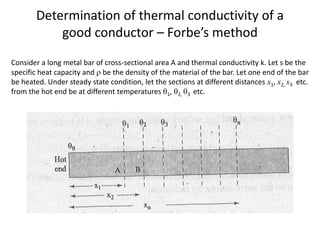
Consider a long metal bar of cross-sectional area A and thermal conductivity k. Let s be the
specific heat capacity and  be the density of the material of the bar. Let one end of the bar
be heated. Under steady state condition, let the sections at different distances x1, x2, x3 etc.
from the hot end be at different temperatures 1, 2, 3 etc.
Determination of thermal conductivity of a
good conductor – Forbe’s method
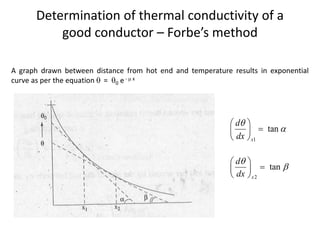
A graph drawn between distance from hot end and temperature results in exponential
curve as per the equation  = 0 e -  x
1
tan
x
d
dx


 

 
 
2
tan
x
d
dx


 

 
 
Determination of thermal conductivity of a
good conductor – Forbe’s method
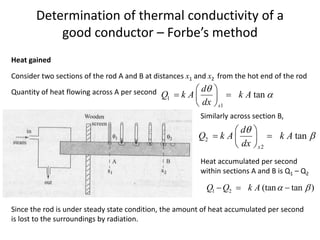
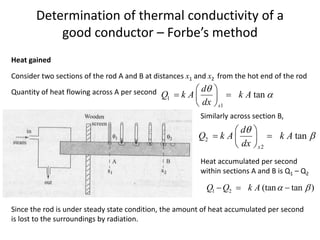
Heat gained
Consider two sections of the rod A and B at distances x1 and x2 from the hot end of the rod
Quantity of heat flowing across A per second
1
1
tan
x
d
Q k A k A
dx


 
 
 
 
Similarly across section B,
2
2
tan
x
d
Q k A k A
dx


 
 
 
 
Heat accumulated per second
within sections A and B is Q1 – Q2
1 2 (tan tan )
Q Q k A  
  
Since the rod is under steady state condition, the amount of heat accumulated per second
is lost to the surroundings by radiation.
Determination of thermal conductivity of a
good conductor – Forbe’s method
Heat gained
Consider two sections of the rod A and B at distances x1 and x2 from the hot end of the rod
Quantity of heat flowing across A per second
1
1
tan
x
d
Q k A k A
dx


 
 
 
 
Similarly across section B,
2
2
tan
x
d
Q k A k A
dx


 
 
 
 
Heat accumulated per second
within sections A and B is Q1 – Q2
1 2 (tan tan )
Q Q k A  
  
Since the rod is under steady state condition, the amount of heat accumulated per second
is lost to the surroundings by radiation.
Determination of thermal conductivity of a
good conductor – Forbe’s method
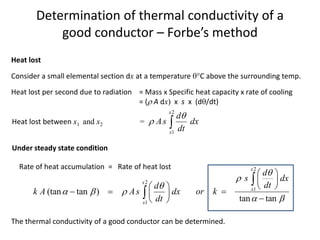
Heat lost
Consider a small elemental section dx at a temperature C above the surrounding temp.
Heat lost per second due to radiation = Mass x Specific heat capacity x rate of cooling
= ( A dx) x s x (d/dt)
2
1
(tan tan )
x
x
d
k A As dx
dt

  
 
   
 

The thermal conductivity of a good conductor can be determined.
Heat lost between x1 and x2 =
2
1
x
x
d
As dx
dt

 
Under steady state condition
Rate of heat accumulation = Rate of heat lost 2
1
tan tan
x
x
d
s dx
dt
or k


 
 
 
 



Experimental Determination – Forbe’s method
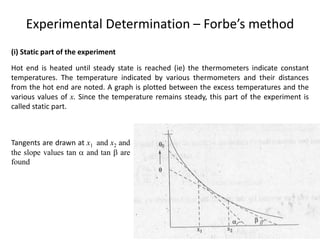
(i) Static part of the experiment
Hot end is heated until steady state is reached (ie) the thermometers indicate constant
temperatures. The temperature indicated by various thermometers and their distances
from the hot end are noted. A graph is plotted between the excess temperatures and the
various values of x. Since the temperature remains steady, this part of the experiment is
called static part.
Tangents are drawn at x1 and x2 and
the slope values tan  and tan  are
found
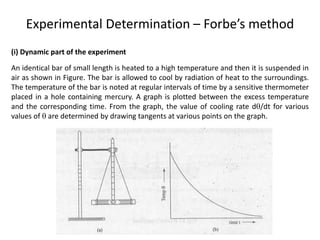
Experimental Determination – Forbe’s method
(i) Dynamic part of the experiment
An identical bar of small length is heated to a high temperature and then it is suspended in
air as shown in Figure. The bar is allowed to cool by radiation of heat to the surroundings.
The temperature of the bar is noted at regular intervals of time by a sensitive thermometer
placed in a hole containing mercury. A graph is plotted between the excess temperature
and the corresponding time. From the graph, the value of cooling rate d/dt for various
values of  are determined by drawing tangents at various points on the graph.
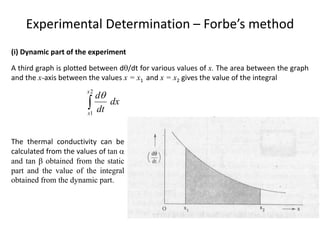
Experimental Determination – Forbe’s method
(i) Dynamic part of the experiment
A third graph is plotted between d/dt for various values of x. The area between the graph
and the x-axis between the values x = x1 and x = x2 gives the value of the integral
2
1
x
x
d
dx
dt


The thermal conductivity can be
calculated from the values of tan 
and tan  obtained from the static
part and the value of the integral
obtained from the dynamic part.
Forbe’s method – Merits and Demerits
Merits
1. Absolute thermal conductivity of the material can be determined
2. No specific law is assumed and all the relevant data are determined
experimentally
Demerits
1. The method requires a lot of time for the completion of experiment and for
drawing the three graphs
2. The specific heat of the material does not remain constant as assumed at
different temperatures
3. The temperature distribution along the bar is different in the static part from
that in the dynamic part of the experiment.
4. The loss of heat in the dynamic part is purely transverse whereas the heat
flows longitudinally in the static part of the experiment
5. Long bars of material have to be used.
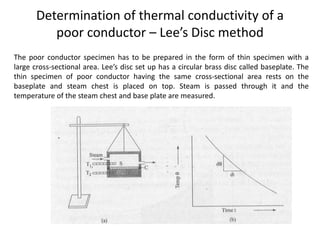
Determination of thermal conductivity of a
poor conductor – Lee’s Disc method
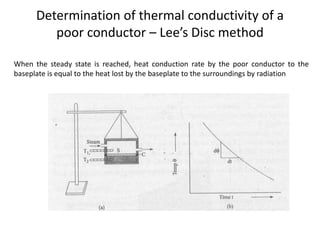
The poor conductor specimen has to be prepared in the form of thin specimen with a
large cross-sectional area. Lee’s disc set up has a circular brass disc called baseplate. The
thin specimen of poor conductor having the same cross-sectional area rests on the
baseplate and steam chest is placed on top. Steam is passed through it and the
temperature of the steam chest and base plate are measured.
Determination of thermal conductivity of a
poor conductor – Lee’s Disc method
When the steady state is reached, heat conduction rate by the poor conductor to the
baseplate is equal to the heat lost by the baseplate to the surroundings by radiation
Determination of thermal conductivity of a
poor conductor – Lee’s Disc method
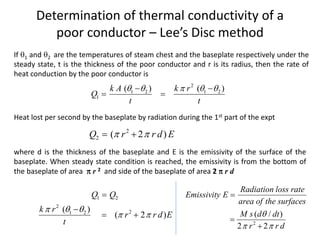
If 1 and 2 are the temperatures of steam chest and the baseplate respectively under the
steady state, t is the thickness of the poor conductor and r is its radius, then the rate of
heat conduction by the poor conductor is
2
1 2 1 2
1
( ) ( )
k A k r
Q
t t
    
 
 
Heat lost per second by the baseplate by radiation during the 1st part of the expt
2
2 ( 2 )
Q r r d E
 
 
where d is the thickness of the baseplate and E is the emissivity of the surface of the
baseplate. When steady state condition is reached, the emissivity is from the bottom of
the baseplate of area  r 2 and side of the baseplate of area 2  r d
1 2
2
2
1 2
( )
( 2 )
Q Q
k r
r r d E
t
  
 


 
2
( / )
2 2
Radiation loss rate
Emissivity E
area of the surfaces
M s d dt
r r d

 



Determination of thermal conductivity of a
poor conductor – Lee’s Disc method
2
2
1 2
2
2
( ) ( / )
( 2 )
(2 2 )
2
2 2
k r M s d dt
r r d
t r r d
d r d
M s
dt r d

   
 
 


 

 

 
  
 

   
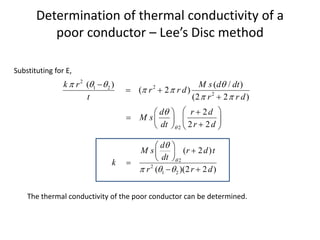
Substituting for E,
2
2
1 2
( 2 )
( )(2 2 )
d
M s r d t
dt
k
r r d


  
 

 
 

 
The thermal conductivity of the poor conductor can be determined.
Experimental Determination - Lee’s Disc method
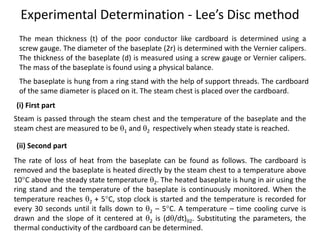
The mean thickness (t) of the poor conductor like cardboard is determined using a
screw gauge. The diameter of the baseplate (2r) is determined with the Vernier calipers.
The thickness of the baseplate (d) is measured using a screw gauge or Vernier calipers.
The mass of the baseplate is found using a physical balance.
The baseplate is hung from a ring stand with the help of support threads. The cardboard
of the same diameter is placed on it. The steam chest is placed over the cardboard.
Steam is passed through the steam chest and the temperature of the baseplate and the
steam chest are measured to be 1 and 2 respectively when steady state is reached.
(i) First part
(ii) Second part
The rate of loss of heat from the baseplate can be found as follows. The cardboard is
removed and the baseplate is heated directly by the steam chest to a temperature above
10C above the steady state temperature 2. The heated baseplate is hung in air using the
ring stand and the temperature of the baseplate is continuously monitored. When the
temperature reaches 2 + 5C, stop clock is started and the temperature is recorded for
every 30 seconds until it falls down to 2 – 5C. A temperature – time cooling curve is
drawn and the slope of it centered at 2 is (d/dt)2. Substituting the parameters, the
thermal conductivity of the cardboard can be determined.
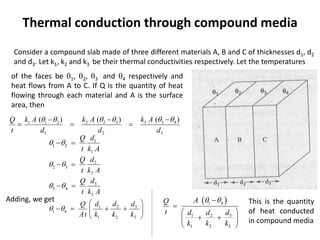
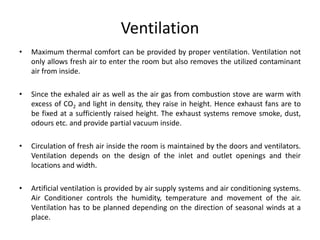
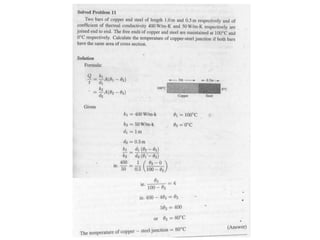
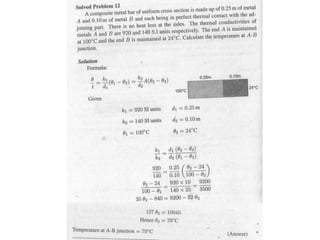
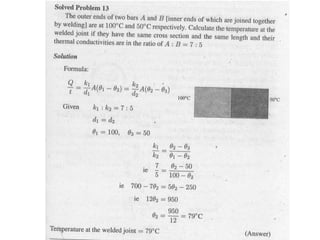
Thermal conduction through compound media
Consider a compound slab made of three different materials A, B and C of thicknesses d1, d2
and d3. Let k1, k2 and k3 be their thermal conductivities respectively. Let the temperatures
of the faces be 1, 2, 3 and 4 respectively and
heat flows from A to C. If Q is the quantity of heat
flowing through each material and A is the surface
area, then
2 2 3 3 3 4
1 1 2
1 2 3
( ) ( )
( ) k A k A
k A
Q
t d d d
   
   

  
1
1 2
1
d
Q
t k A
 
 
2
2 3
2
d
Q
t k A
 
 
3
3 4
3
d
Q
t k A
 
 
Adding, we get
3
1 2
1 4
1 2 3
d
d d
Q
At k k k
 
 
   
 
 
 
1 4
3
1 2
1 2 3
A
Q
t d
d d
k k k
 


 
 
 
 
This is the quantity
of heat conducted
in compound media
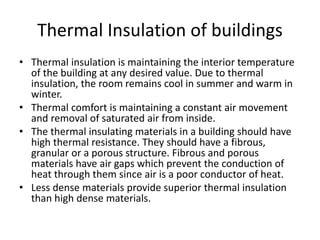
Thermal Insulation of buildings
• Thermal insulation is maintaining the interior temperature
of the building at any desired value. Due to thermal
insulation, the room remains cool in summer and warm in
winter.
• Thermal comfort is maintaining a constant air movement
and removal of saturated air from inside.
• The thermal insulating materials in a building should have
high thermal resistance. They should have a fibrous,
granular or a porous structure. Fibrous and porous
materials have air gaps which prevent the conduction of
heat through them since air is a poor conductor of heat.
• Less dense materials provide superior thermal insulation
than high dense materials.
Properties of thermal insulation materials
• They should have a low thermal conductivity
• They should be stable against environmental
influences
• They should be fire resistive
• Specific heat capacity should be large
• They should be cost effective
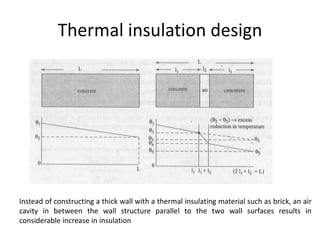
Thermal insulation design
Instead of constructing a thick wall with a thermal insulating material such as brick, an air
cavity in between the wall structure parallel to the two wall surfaces results in
considerable increase in insulation
Thermal insulation in floors and ceilings :
Effective control of floor temperature can be achieved by raising the ground
floor from the earth level. Covering the entire floor with carpets made of good thermal
insulating materials gives better insulation. As far as ceiling is concerned, constructing the
roof at a greater height provides excellent summer cool effect. The interior of the roof may
be covered with wood.
Dark colour finishing of the wall absorbs heat and increases the temperature.
Hence, it is better to finish the wall with light colour. House plan must be prepared in such
a way that the area of walls facing the direction of sun is minimal.
Thermal insulation in windows and doors :
The windows cover nearly 15 – 20% of the total wall area. The value of the
building is estimated based on the number of windows and doors in that building. They
allow natural ventilation. They allow sunlight to enter. Instead of single glazed windows,
multiple glazed windows with air space between glasses provide more thermal resistance.
Air in between the two doors form an insulating layer and it does not allow heat to flow.
Selecting suitable window material is also very important
Ventilation
• Maximum thermal comfort can be provided by proper ventilation. Ventilation not
only allows fresh air to enter the room but also removes the utilized contaminant
air from inside.
• Since the exhaled air as well as the air gas from combustion stove are warm with
excess of CO2 and light in density, they raise in height. Hence exhaust fans are to
be fixed at a sufficiently raised height. The exhaust systems remove smoke, dust,
odours etc. and provide partial vacuum inside.
• Circulation of fresh air inside the room is maintained by the doors and ventilators.
Ventilation depends on the design of the inlet and outlet openings and their
locations and width.
• Artificial ventilation is provided by air supply systems and air conditioning systems.
Air Conditioner controls the humidity, temperature and movement of the air.
Ventilation has to be planned depending on the direction of seasonal winds at a
place.
Laws of thermodynamics
Thermo means heat and dynamics deals with matter in
motion. Hence, thermodynamics deals with heat flow from one
system to another system. A thermodynamic system is one which
can be described by Pressure (P), Volume (V), Temperature (T), and
Entropy (S). The four laws of thermodynamics describe how these
parameters vary under various circumstances. The thermodynamic
systems in engineering are gas, vapour, steam, and mixture of
petrol/fuel vapour and air.
Several commonly studied thermodynamic process are
• Isobaric process : occurs at constant pressure
• Isochoric process : occurs at constant volume
• Isothermal process :occurs at constant temperature
• Adiabatic process : occurs suddenly without any loss or gain of
heat energy
Zeroth law of thermodynamics
If two systems are in thermal equilibrium with a third system,
they all must be in thermal equilibrium with each other.
A system is said to be in thermal equilibrium when the net
thermal energy does not change. If A, B and C are distinct
thermodynamic systems, the zeroth law of thermodynamics can
be expressed as:
If A and C are each in thermal equilibrium with B, A is also in
equilibrium with C (ie) If A is in thermal equilibrium with B and B
is in thermal equilibrium with C, then A is in thermal equilibrium
with C
(By the time the above statement was decided to number it as a
law, the other three laws had already been assigned numbers
and so it was called as the Zeroth law.
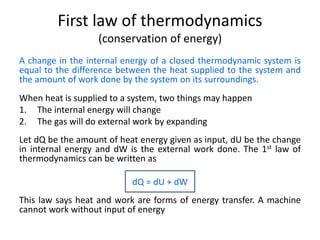
First law of thermodynamics
(conservation of energy)
A change in the internal energy of a closed thermodynamic system is
equal to the difference between the heat supplied to the system and
the amount of work done by the system on its surroundings.
When heat is supplied to a system, two things may happen
1. The internal energy will change
2. The gas will do external work by expanding
Let dQ be the amount of heat energy given as input, dU be the change
in internal energy and dW is the external work done. The 1st law of
thermodynamics can be written as
dQ = dU + dW
This law says heat and work are forms of energy transfer. A machine
cannot work without input of energy
Second law of thermodynamics
Heat cannot spontaneously flow from a colder location to
a hotter location
Clausius Statement
It is impossible to make heat to flow from a body at a
lower temperature to a body at a higher temperature
without doing external work on the working substance
Kelvin Statement
It is impossible to get a continuous supply of work from a
body by cooling it to a temperature lower than that of its
surroundings
Third law of thermodynamics
The 3rd law asserts the existence of a quantity called the entropy
of a system. Entropy is a measure of disorder of a body. It is the
energy not available for work in a thermodynamic process but
dissipates in the form of waste heat. Entropy always increases in
any closed system not in thermal equilibrium
As a system approaches absolute zero, all process cease and the
entropy of the system approaches a minimum value.
The law can also be stated as follows: The entropy of a system at
absolute zero is typically zero. The entropy of a pure crystalline
substance at absolute zero temperature is zero.
In other words, the entropy of a system approaches a constant
(minimum) value as the temperature approaches zero.
Work done by an ideal gas in expansion
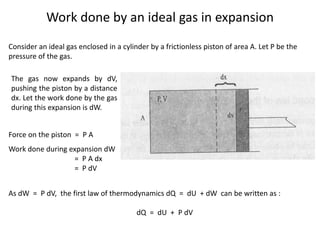
Consider an ideal gas enclosed in a cylinder by a frictionless piston of area A. Let P be the
pressure of the gas.
The gas now expands by dV,
pushing the piston by a distance
dx. Let the work done by the gas
during this expansion is dW.
Force on the piston = P A
Work done during expansion dW
= P A dx
= P dV
As dW = P dV, the first law of thermodynamics dQ = dU + dW can be written as :
dQ = dU + P dV
Specific heat capacities of gases
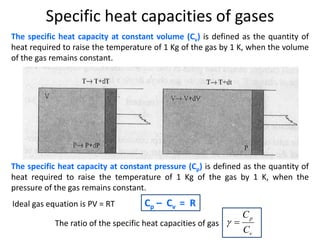
The specific heat capacity at constant volume (Cv) is defined as the quantity of
heat required to raise the temperature of 1 Kg of the gas by 1 K, when the volume
of the gas remains constant.
The specific heat capacity at constant pressure (Cp) is defined as the quantity of
heat required to raise the temperature of 1 Kg of the gas by 1 K, when the
pressure of the gas remains constant.
Ideal gas equation is PV = RT Cp – Cv = R
p
v
C
C
 
The ratio of the specific heat capacities of gas
Isothermal and Adiabatic changes
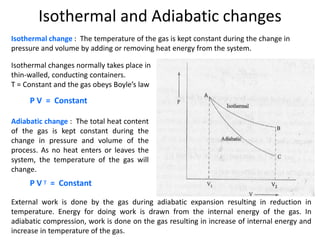
Isothermal change : The temperature of the gas is kept constant during the change in
pressure and volume by adding or removing heat energy from the system.
Isothermal changes normally takes place in
thin-walled, conducting containers.
T = Constant and the gas obeys Boyle’s law
P V = Constant
Adiabatic change : The total heat content
of the gas is kept constant during the
change in pressure and volume of the
process. As no heat enters or leaves the
system, the temperature of the gas will
change.
P V  = Constant
External work is done by the gas during adiabatic expansion resulting in reduction in
temperature. Energy for doing work is drawn from the internal energy of the gas. In
adiabatic compression, work is done on the gas resulting in increase of internal energy and
increase in temperature of the gas.
Entropy
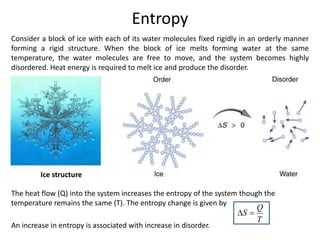
Consider a block of ice with each of its water molecules fixed rigidly in an orderly manner
forming a rigid structure. When the block of ice melts forming water at the same
temperature, the water molecules are free to move, and the system becomes highly
disordered. Heat energy is required to melt ice and produce the disorder.
Ice structure
The heat flow (Q) into the system increases the entropy of the system though the
temperature remains the same (T). The entropy change is given by
Q
S
T
 
An increase in entropy is associated with increase in disorder.
Entropy
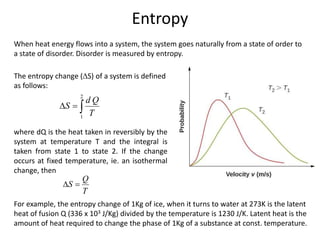
When heat energy flows into a system, the system goes naturally from a state of order to
a state of disorder. Disorder is measured by entropy.
The entropy change (S) of a system is defined
as follows:
2
1
d Q
S
T
  
where dQ is the heat taken in reversibly by the
system at temperature T and the integral is
taken from state 1 to state 2. If the change
occurs at fixed temperature, ie. an isothermal
change, then
Q
S
T
 
For example, the entropy change of 1Kg of ice, when it turns to water at 273K is the latent
heat of fusion Q (336 x 103 J/Kg) divided by the temperature is 1230 J/K. Latent heat is the
amount of heat required to change the phase of 1Kg of a substance at const. temperature.
Entropy for reversible cyclic processes
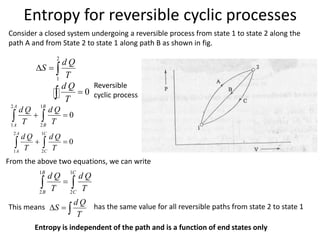
Consider a closed system undergoing a reversible process from state 1 to state 2 along the
path A and from State 2 to state 1 along path B as shown in fig.
2
1
d Q
S
T
  
0
d Q
T


Reversible
cyclic process
2 1
1 2
0
A B
A B
d Q d Q
T T
 
 
2 1
1 2
0
A C
A C
d Q d Q
T T
 
 
1 1
2 2
B C
B C
d Q d Q
T T

 
From the above two equations, we can write
d Q
S
T
  
This means has the same value for all reversible paths from state 2 to state 1
Entropy is independent of the path and is a function of end states only
Entropy for reversible cyclic processes
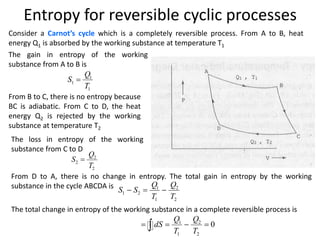
Consider a Carnot’s cycle which is a completely reversible process. From A to B, heat
energy Q1 is absorbed by the working substance at temperature T1
The gain in entropy of the working
substance from A to B is
1
1
1
Q
S
T

From B to C, there is no entropy because
BC is adiabatic. From C to D, the heat
energy Q2 is rejected by the working
substance at temperature T2
The loss in entropy of the working
substance from C to D
2
2
2
Q
S
T

From D to A, there is no change in entropy. The total gain in entropy by the working
substance in the cycle ABCDA is 1 2
1 2
1 2
Q Q
S S
T T
  
The total change in entropy of the working substance in a complete reversible process is
1 2
1 2
0
Q Q
dS
T T
   


App.Phy_1.pptx

  • 1.
    Thermal Physics -modes of heat transfer- thermal conductivity –Lee’s disc method - conduction through compound media – thermal expansion – thermal stress – laws of thermodynamics –entropy
  • 2.
    Thermal expansion Thermal expansionis the tendency of matter to change its shape, area, volume, and density in response to a change in temperature.
  • 3.
    Thermal expansion  MostMaterial expand on heating and contract on cooling  Ex: A completely filled and tightly closed bottle of water cracks due to thermal expansion of water molecules  The lid of a tightly closed metal jar can be opened easily if its dipped in hot water
  • 7.
    Expansion loop onheating pipeline
  • 8.
    Change in lengthof a solid material when it is heated or cooled is equal to the linear expansion coefficient of that material multiplied by the original length and the change in temperature
  • 12.
    Areal expansion  ΔA= β A0 ΔT  Change in area of a solid material when it is heated or cooled is equal to the areal expansion coefficient (β) of that material multiplied by the original area (A0) and the change in temperature (ΔT)
  • 13.
    Volume expansion  ΔV=  V0 ΔT  Change in area of a solid material when it is heated or cooled is equal to the areal expansion coefficient (γ) of that material multiplied by the original area (V0) and the change in temperature (ΔT)
  • 14.
    Relation among α,β and γ For isotropic materials α: β: γ = 1: 2 : 3
  • 15.
    Points to remember •Pendulum clocks lose or gain time as the length increases during summer or decreases during winter respectively • If a thin rod and a thick rod of same length and material are heated to same rise in temperature, both expand equally • If a thin rod and a thick rod of same length and material are heated by equal quantities of heat, thin rod expands more than thick rod • A hole in the metal plate expands on heating just like a solid plate of the same size. A piston inside a cylinder functions at all temperatures only because of this • A cavity of a solid object expands on heating just like a solid object of the same volume • The change in the volume of a body, when its temperature is raised, does not depend on the cavities inside the body
  • 16.
    • Platinum ormonal is used to seal inside glass because both have nearly equal coefficient of linear expansion • Iron or steel is used for reinforcements in concrete because both have nearly equal coefficients of expansion (12 x 10-6 C-1) • Invar steel has very low . So, it is used in making pendulum clocks, balancing wheels and measuring tapes (composition of invar is 64% steel and 36% nickel) • Pyrex glass has low . Hence combustion tubes and test tubes for heating purposes are made out of it. • Metal pipes carrying steam are provided with bends to allow for expansion. • To remove a tight metal cap of a glass bottle, it should be warmed Points to remember
  • 17.
    Problems • In asteel rod of cross-section 10-3 m2, a tensile force of 33,000 N is applied to certain increase in lengths. Calculate the increase in temperature required to increase the length of the rod by same amount if the Young’s modulus of the rod is 3 x 10¹¹ Pascals and coefficient of linear expansion is 1.1 x 10⁻⁵ C-1 l e F A e E = Thermal expansion e =  l  = F A E F A E    3 11 5 33000 10 10 3 10 1.1 10 C         
  • 18.
    Problems • A steelmeter scale is to be ruled so that millimeter intervals are accurate within about 5 x 10⁻⁵mm at a certain temperature. Estimate the maximum temperature variation allowable if coefficient of linear expansion of steel is 10-5 C-1 3 1 1 10 mm m    5 8 2 1 5 10 5 10 mm m        5 1 10 C      2 1 (1 )    2 1 1    8 2 1 5 3 1 5 10 5 10 10 C            
  • 19.
    Thermal Stress l e Inmany Engineering applications, a metal bar is rigidly clamped or fixed at its both ends. When the rod expands or contracts due to change in temperature, large forces are set up within the bar. The stress developed within the material is called thermal stress. Consider a bar shown in the Figure. Let ‘l’ be the length of the bar and the coefficient of thermal expansion of the bar is . Let the Young’s modulus be E. When the temperature rises by C, the length of the rod increases by ‘e’. Thermal expansion e =  l  F A e E = F = E A E A E A F = e l l l   
  • 20.
    Problems • If weheat a steel bar of cross sectional area 2cm2 with coefficient of thermal expansion 12 x 10-6mK-1 and Young’s Modulus 2.1 x 10¹¹Pa through 40C, with its ends fixed, Calculate the resulting force in the bar F = E A 11 4 6 4 F = 2.1 10 2 10 12 10 40 2.02 10 N          
  • 21.
    Points related tothermal stress • While laying railway lines, at the joints, gap is provided to avoid such a large force arising
  • 22.
    Points related tothermal stress • Expansion joints are provided in long structures
  • 23.
    Points related tothermal stress • If tiles are laid in terrace without any gap between them, buckling of tiles will happen during summer
  • 24.
    Points related tothermal stress • In integrated circuits (IC), if the co ef. of thermal expansion and Young’s modulus of the substrate and the active layer deposited on the substrate are not matching, micro cracks will be generated resulting in failure • Thermal stress is the primary contributor to head gasket failure in internal combustion engines. • Incandescent bulb while hot implode when cold water is splashed on it due to sudden thermal stress
  • 25.
    Points related tothermal stress • When ice cubes are dropped inside warm water, we expect the cubes to melt but they crack due to sudden thermal stress on the outer layer while interior remains unchanged • High temperature structural materials with required elastic and thermal properties are synthesized for materials used in Space vehicles
  • 26.
    Problems • If asteel wire of diameter 2mm is stretched between two fixed points at a temperature of 30C, determine its tension when the temperature falls to 20C. Given that the coefficient of linear expansion of steel = 11 x 10-6 C-1 and Young’s modulus of steel is 2.0 x 10¹¹Pa. F = E A 11 3 2 6 F = 2 10 (1 10 ) 11 10 (30 20) 69.14N            
  • 27.
    Bimetallic strips A bimetallicstrip is made from two thin strips of metals having different coefficient of linear thermal expansion. When the difference is more, it becomes more effective Usually brass ( = 19x10-6 C-1) and steel ( = 12x10-6 C-1) are selected. The two strips are welded together. When the bimetallic strip is heated, the brass which has larger value of , expands more than steel and hence bends in the form of arc as shown in Fig. Connection is lost and temperature is maintained. Thus a bimetallic strip works as a thermostat.
  • 28.
    Thermal Conductivity The transferof heat energy from one place to another through a substance without the movement of the substance is known as thermal conduction. Consider a specimen of length dx and cross-sectional area A with a temperature difference d between the opposite faces. The amount of heat energy flowing through it depends on A( ) Q ( ) d t dx   k A( ) Q ( ) d t dx   k is a constant known as thermal conductivity of the material measured in Wm-1K-1. Q/t is the rate of flow of heat. The thermal conductivity can be defined as the rate of flow of heat between two surfaces of unit area separated by unit distance when the temperature difference between them is 1K.
  • 29.
    Thermal conductivity ofdifferent materials
  • 30.
    Flow of heatin a lagged and unlagged bar Consider the flow of heat down a bar, assuming that it is perfectly lagged so that no heat escapes from the sides. All the heat energy entering at one end of the bar leaves the other end. This is known as parallel heat flow. The drop in temperature is linear. With an unlagged bar, heat is lost and so the rate of fall of temperature varies down the bar exponentially.
  • 31.
    Mechanism of conduction(heat transfer)in solids 1. Metals – If one end of a metal rod is heated the atoms gain energy and their vibrations increase. This energy is then passed on to the other atoms and to the free electrons in the metal. Since the electrons are very small in size, they can travel rapidly around the specimen transferring their energy by collision to other electrons and other atoms. – In metals, heat is carried mainly by the motion of these free electrons, although some energy is transferred by interatomic vibration (phonons). The conductivity of metals varies with temperatures and at very low temperatures, conductivity is mainly due to lattice vibrations.
  • 32.
    Mechanism of conductionin solids 2. Non-metals – There are very less number of free electrons in non-metals. Therefore, the only way that heat can travel through the specimen is by direct transfer of energy from one atom to another. Debye suggested that the energy was transferred by an elastic wave propagated through the specimen. These waves are called phonons, and they travel with speed of sound through the solid.
  • 33.
    Theory of Rectilinearflow of heat through a rod Consider a bar of uniform area of cross-section A which is heated at one of its ends so that heat flows along the length of the bar. Consider two planes A and B perpendicular to the length of the bar at distances x and x +  x from the hot end. Let d/dx be the temperature gradient at A where  is the excess temperature at A above the surroundings. Now the excess temperature at B will be . d x dx     The temperature gradient at B is . d d x dx dx            1 d Q k A dx    At A, Q1 is the amount of heat entering the layer A per second
  • 34.
    Theory of Rectilinearflow of heat through a rod The heat gained between the planes A and B by the rod per sec This amount of heat is used to increase the temperature of the rod and a part of it is lost due to radiation. The negative sign indicates that Q decreases with increase of x 2 . d d Q k A x dx dx             is the amount of heat leaving the face B at a distance x +  x from the hot end 1 2 2 2 . Q Q Q d d d k A k A x dx dx dx d k A x dx                    
  • 35.
    Theory of Rectilinearflow of heat through a rod The heat lost per second due to radiation = E p x  where p is the perimeter, E is the emissive power of the surface and  is the average excess temperature of the rod between the planes A and B. Therefore, Heat used to raise the temperature of the bar Let the rate of rise of temperature of the bar be d/dt. The heat used per second to raise the temperature of the bar = mass x specific heat x rate of increase in temperature ( ) d A x s dt       where A is the area of cross-section of the bar; ‘ ’ is the density of the bar; ‘s’ is the specific heat of the material of the rod Heat lost due to radiation loss d Q A x s E p x dt        2 2 d d or k A x A x s E p x dx dt         
  • 36.
    Theory of Rectilinearflow of heat through a rod If the heat lost per second due to radiation = E p x  is negligibly small, the second term can be omitted Case (i) Radiation loss is negligible 2 2 d d k A x A x s E p x dx dt          2 2 d s d E p or dx k dt k A       is the equation for rectilinear flow of heat along the bar of uniform area of cross-section 2 2 1 d s d d dx k dt h dt       where h is known as thermal diffusivity of the rod Case (ii) After steady state is reached d dt  will be zero and hence the equation reduces to 2 2 d E p dx k A   
  • 37.
    Theory of Rectilinearflow of heat through a rod 2 2 d E p dx k A    This equation is of the type 2 2 2 d dx     The general solution for this differential equation is  = A e + x + B e- x where A and B are constants that can be determined from the boundary conditions Case (a) If the bar is of infinite length When the bar is of infinite length, under steady state we can assume that no heat is lost from the free end of the bar and the bar is at the temperature of the surroundings. Let the excess temperature above the surroundings at the hot end be 0 (at x = 0,  = 0) and at the other end the excess temperature is zero ( at x = ,  = 0 ). Applying these boundary conditions, we get 0 = A + B and 0 = A e  . As e  cannot be zero, A should be 0. This gives B = 0. On substituting the values of A and B, we get  = 0 e - x
  • 38.
    Theory of Rectilinearflow of heat through a rod 0 d dx   0 2 0 0 x x L L L A B d A e B e dx A e B e A e B                      Case (b) If the bar is sufficiently long and is of finite length L  = A e + x + B e- x The boundary conditions will be  = 0 at x = 0 and at x = L Substituting the boundary conditions, we get Substituting for B in 0 = A + B, we get 2 0 0 2 0 2 (1 ) 1 1 L L L A e A e B e              Therefore, 0 2 2 1 1 x x L L e e e e                   is the general solution of the equation for a rod of finite length
  • 39.
    Determination of thermalconductivity of a good conductor – Forbe’s method Consider a long metal bar of cross-sectional area A and thermal conductivity k. Let s be the specific heat capacity and  be the density of the material of the bar. Let one end of the bar be heated. Under steady state condition, let the sections at different distances x1, x2, x3 etc. from the hot end be at different temperatures 1, 2, 3 etc.
  • 40.
    Determination of thermalconductivity of a good conductor – Forbe’s method A graph drawn between distance from hot end and temperature results in exponential curve as per the equation  = 0 e -  x 1 tan x d dx          2 tan x d dx         
  • 41.
    Determination of thermalconductivity of a good conductor – Forbe’s method Heat gained Consider two sections of the rod A and B at distances x1 and x2 from the hot end of the rod Quantity of heat flowing across A per second 1 1 tan x d Q k A k A dx           Similarly across section B, 2 2 tan x d Q k A k A dx           Heat accumulated per second within sections A and B is Q1 – Q2 1 2 (tan tan ) Q Q k A      Since the rod is under steady state condition, the amount of heat accumulated per second is lost to the surroundings by radiation.
  • 42.
    Determination of thermalconductivity of a good conductor – Forbe’s method Heat gained Consider two sections of the rod A and B at distances x1 and x2 from the hot end of the rod Quantity of heat flowing across A per second 1 1 tan x d Q k A k A dx           Similarly across section B, 2 2 tan x d Q k A k A dx           Heat accumulated per second within sections A and B is Q1 – Q2 1 2 (tan tan ) Q Q k A      Since the rod is under steady state condition, the amount of heat accumulated per second is lost to the surroundings by radiation.
  • 43.
    Determination of thermalconductivity of a good conductor – Forbe’s method Heat lost Consider a small elemental section dx at a temperature C above the surrounding temp. Heat lost per second due to radiation = Mass x Specific heat capacity x rate of cooling = ( A dx) x s x (d/dt) 2 1 (tan tan ) x x d k A As dx dt              The thermal conductivity of a good conductor can be determined. Heat lost between x1 and x2 = 2 1 x x d As dx dt    Under steady state condition Rate of heat accumulation = Rate of heat lost 2 1 tan tan x x d s dx dt or k             
  • 44.
    Experimental Determination –Forbe’s method (i) Static part of the experiment Hot end is heated until steady state is reached (ie) the thermometers indicate constant temperatures. The temperature indicated by various thermometers and their distances from the hot end are noted. A graph is plotted between the excess temperatures and the various values of x. Since the temperature remains steady, this part of the experiment is called static part. Tangents are drawn at x1 and x2 and the slope values tan  and tan  are found
  • 45.
    Experimental Determination –Forbe’s method (i) Dynamic part of the experiment An identical bar of small length is heated to a high temperature and then it is suspended in air as shown in Figure. The bar is allowed to cool by radiation of heat to the surroundings. The temperature of the bar is noted at regular intervals of time by a sensitive thermometer placed in a hole containing mercury. A graph is plotted between the excess temperature and the corresponding time. From the graph, the value of cooling rate d/dt for various values of  are determined by drawing tangents at various points on the graph.
  • 46.
    Experimental Determination –Forbe’s method (i) Dynamic part of the experiment A third graph is plotted between d/dt for various values of x. The area between the graph and the x-axis between the values x = x1 and x = x2 gives the value of the integral 2 1 x x d dx dt   The thermal conductivity can be calculated from the values of tan  and tan  obtained from the static part and the value of the integral obtained from the dynamic part.
  • 47.
    Forbe’s method –Merits and Demerits Merits 1. Absolute thermal conductivity of the material can be determined 2. No specific law is assumed and all the relevant data are determined experimentally Demerits 1. The method requires a lot of time for the completion of experiment and for drawing the three graphs 2. The specific heat of the material does not remain constant as assumed at different temperatures 3. The temperature distribution along the bar is different in the static part from that in the dynamic part of the experiment. 4. The loss of heat in the dynamic part is purely transverse whereas the heat flows longitudinally in the static part of the experiment 5. Long bars of material have to be used.
  • 48.
    Determination of thermalconductivity of a poor conductor – Lee’s Disc method The poor conductor specimen has to be prepared in the form of thin specimen with a large cross-sectional area. Lee’s disc set up has a circular brass disc called baseplate. The thin specimen of poor conductor having the same cross-sectional area rests on the baseplate and steam chest is placed on top. Steam is passed through it and the temperature of the steam chest and base plate are measured.
  • 49.
    Determination of thermalconductivity of a poor conductor – Lee’s Disc method When the steady state is reached, heat conduction rate by the poor conductor to the baseplate is equal to the heat lost by the baseplate to the surroundings by radiation
  • 50.
    Determination of thermalconductivity of a poor conductor – Lee’s Disc method If 1 and 2 are the temperatures of steam chest and the baseplate respectively under the steady state, t is the thickness of the poor conductor and r is its radius, then the rate of heat conduction by the poor conductor is 2 1 2 1 2 1 ( ) ( ) k A k r Q t t          Heat lost per second by the baseplate by radiation during the 1st part of the expt 2 2 ( 2 ) Q r r d E     where d is the thickness of the baseplate and E is the emissivity of the surface of the baseplate. When steady state condition is reached, the emissivity is from the bottom of the baseplate of area  r 2 and side of the baseplate of area 2  r d 1 2 2 2 1 2 ( ) ( 2 ) Q Q k r r r d E t          2 ( / ) 2 2 Radiation loss rate Emissivity E area of the surfaces M s d dt r r d      
  • 51.
    Determination of thermalconductivity of a poor conductor – Lee’s Disc method 2 2 1 2 2 2 ( ) ( / ) ( 2 ) (2 2 ) 2 2 2 k r M s d dt r r d t r r d d r d M s dt r d                              Substituting for E, 2 2 1 2 ( 2 ) ( )(2 2 ) d M s r d t dt k r r d                The thermal conductivity of the poor conductor can be determined.
  • 52.
    Experimental Determination -Lee’s Disc method The mean thickness (t) of the poor conductor like cardboard is determined using a screw gauge. The diameter of the baseplate (2r) is determined with the Vernier calipers. The thickness of the baseplate (d) is measured using a screw gauge or Vernier calipers. The mass of the baseplate is found using a physical balance. The baseplate is hung from a ring stand with the help of support threads. The cardboard of the same diameter is placed on it. The steam chest is placed over the cardboard. Steam is passed through the steam chest and the temperature of the baseplate and the steam chest are measured to be 1 and 2 respectively when steady state is reached. (i) First part (ii) Second part The rate of loss of heat from the baseplate can be found as follows. The cardboard is removed and the baseplate is heated directly by the steam chest to a temperature above 10C above the steady state temperature 2. The heated baseplate is hung in air using the ring stand and the temperature of the baseplate is continuously monitored. When the temperature reaches 2 + 5C, stop clock is started and the temperature is recorded for every 30 seconds until it falls down to 2 – 5C. A temperature – time cooling curve is drawn and the slope of it centered at 2 is (d/dt)2. Substituting the parameters, the thermal conductivity of the cardboard can be determined.
  • 53.
    Thermal conduction throughcompound media Consider a compound slab made of three different materials A, B and C of thicknesses d1, d2 and d3. Let k1, k2 and k3 be their thermal conductivities respectively. Let the temperatures of the faces be 1, 2, 3 and 4 respectively and heat flows from A to C. If Q is the quantity of heat flowing through each material and A is the surface area, then 2 2 3 3 3 4 1 1 2 1 2 3 ( ) ( ) ( ) k A k A k A Q t d d d             1 1 2 1 d Q t k A     2 2 3 2 d Q t k A     3 3 4 3 d Q t k A     Adding, we get 3 1 2 1 4 1 2 3 d d d Q At k k k               1 4 3 1 2 1 2 3 A Q t d d d k k k             This is the quantity of heat conducted in compound media
  • 54.
    Thermal Insulation ofbuildings • Thermal insulation is maintaining the interior temperature of the building at any desired value. Due to thermal insulation, the room remains cool in summer and warm in winter. • Thermal comfort is maintaining a constant air movement and removal of saturated air from inside. • The thermal insulating materials in a building should have high thermal resistance. They should have a fibrous, granular or a porous structure. Fibrous and porous materials have air gaps which prevent the conduction of heat through them since air is a poor conductor of heat. • Less dense materials provide superior thermal insulation than high dense materials.
  • 55.
    Properties of thermalinsulation materials • They should have a low thermal conductivity • They should be stable against environmental influences • They should be fire resistive • Specific heat capacity should be large • They should be cost effective
  • 56.
    Thermal insulation design Insteadof constructing a thick wall with a thermal insulating material such as brick, an air cavity in between the wall structure parallel to the two wall surfaces results in considerable increase in insulation
  • 57.
    Thermal insulation infloors and ceilings : Effective control of floor temperature can be achieved by raising the ground floor from the earth level. Covering the entire floor with carpets made of good thermal insulating materials gives better insulation. As far as ceiling is concerned, constructing the roof at a greater height provides excellent summer cool effect. The interior of the roof may be covered with wood. Dark colour finishing of the wall absorbs heat and increases the temperature. Hence, it is better to finish the wall with light colour. House plan must be prepared in such a way that the area of walls facing the direction of sun is minimal. Thermal insulation in windows and doors : The windows cover nearly 15 – 20% of the total wall area. The value of the building is estimated based on the number of windows and doors in that building. They allow natural ventilation. They allow sunlight to enter. Instead of single glazed windows, multiple glazed windows with air space between glasses provide more thermal resistance. Air in between the two doors form an insulating layer and it does not allow heat to flow. Selecting suitable window material is also very important
  • 58.
    Ventilation • Maximum thermalcomfort can be provided by proper ventilation. Ventilation not only allows fresh air to enter the room but also removes the utilized contaminant air from inside. • Since the exhaled air as well as the air gas from combustion stove are warm with excess of CO2 and light in density, they raise in height. Hence exhaust fans are to be fixed at a sufficiently raised height. The exhaust systems remove smoke, dust, odours etc. and provide partial vacuum inside. • Circulation of fresh air inside the room is maintained by the doors and ventilators. Ventilation depends on the design of the inlet and outlet openings and their locations and width. • Artificial ventilation is provided by air supply systems and air conditioning systems. Air Conditioner controls the humidity, temperature and movement of the air. Ventilation has to be planned depending on the direction of seasonal winds at a place.
  • 62.
    Laws of thermodynamics Thermomeans heat and dynamics deals with matter in motion. Hence, thermodynamics deals with heat flow from one system to another system. A thermodynamic system is one which can be described by Pressure (P), Volume (V), Temperature (T), and Entropy (S). The four laws of thermodynamics describe how these parameters vary under various circumstances. The thermodynamic systems in engineering are gas, vapour, steam, and mixture of petrol/fuel vapour and air. Several commonly studied thermodynamic process are • Isobaric process : occurs at constant pressure • Isochoric process : occurs at constant volume • Isothermal process :occurs at constant temperature • Adiabatic process : occurs suddenly without any loss or gain of heat energy
  • 63.
    Zeroth law ofthermodynamics If two systems are in thermal equilibrium with a third system, they all must be in thermal equilibrium with each other. A system is said to be in thermal equilibrium when the net thermal energy does not change. If A, B and C are distinct thermodynamic systems, the zeroth law of thermodynamics can be expressed as: If A and C are each in thermal equilibrium with B, A is also in equilibrium with C (ie) If A is in thermal equilibrium with B and B is in thermal equilibrium with C, then A is in thermal equilibrium with C (By the time the above statement was decided to number it as a law, the other three laws had already been assigned numbers and so it was called as the Zeroth law.
  • 64.
    First law ofthermodynamics (conservation of energy) A change in the internal energy of a closed thermodynamic system is equal to the difference between the heat supplied to the system and the amount of work done by the system on its surroundings. When heat is supplied to a system, two things may happen 1. The internal energy will change 2. The gas will do external work by expanding Let dQ be the amount of heat energy given as input, dU be the change in internal energy and dW is the external work done. The 1st law of thermodynamics can be written as dQ = dU + dW This law says heat and work are forms of energy transfer. A machine cannot work without input of energy
  • 65.
    Second law ofthermodynamics Heat cannot spontaneously flow from a colder location to a hotter location Clausius Statement It is impossible to make heat to flow from a body at a lower temperature to a body at a higher temperature without doing external work on the working substance Kelvin Statement It is impossible to get a continuous supply of work from a body by cooling it to a temperature lower than that of its surroundings
  • 66.
    Third law ofthermodynamics The 3rd law asserts the existence of a quantity called the entropy of a system. Entropy is a measure of disorder of a body. It is the energy not available for work in a thermodynamic process but dissipates in the form of waste heat. Entropy always increases in any closed system not in thermal equilibrium As a system approaches absolute zero, all process cease and the entropy of the system approaches a minimum value. The law can also be stated as follows: The entropy of a system at absolute zero is typically zero. The entropy of a pure crystalline substance at absolute zero temperature is zero. In other words, the entropy of a system approaches a constant (minimum) value as the temperature approaches zero.
  • 67.
    Work done byan ideal gas in expansion Consider an ideal gas enclosed in a cylinder by a frictionless piston of area A. Let P be the pressure of the gas. The gas now expands by dV, pushing the piston by a distance dx. Let the work done by the gas during this expansion is dW. Force on the piston = P A Work done during expansion dW = P A dx = P dV As dW = P dV, the first law of thermodynamics dQ = dU + dW can be written as : dQ = dU + P dV
  • 68.
    Specific heat capacitiesof gases The specific heat capacity at constant volume (Cv) is defined as the quantity of heat required to raise the temperature of 1 Kg of the gas by 1 K, when the volume of the gas remains constant. The specific heat capacity at constant pressure (Cp) is defined as the quantity of heat required to raise the temperature of 1 Kg of the gas by 1 K, when the pressure of the gas remains constant. Ideal gas equation is PV = RT Cp – Cv = R p v C C   The ratio of the specific heat capacities of gas
  • 69.
    Isothermal and Adiabaticchanges Isothermal change : The temperature of the gas is kept constant during the change in pressure and volume by adding or removing heat energy from the system. Isothermal changes normally takes place in thin-walled, conducting containers. T = Constant and the gas obeys Boyle’s law P V = Constant Adiabatic change : The total heat content of the gas is kept constant during the change in pressure and volume of the process. As no heat enters or leaves the system, the temperature of the gas will change. P V  = Constant External work is done by the gas during adiabatic expansion resulting in reduction in temperature. Energy for doing work is drawn from the internal energy of the gas. In adiabatic compression, work is done on the gas resulting in increase of internal energy and increase in temperature of the gas.
  • 70.
    Entropy Consider a blockof ice with each of its water molecules fixed rigidly in an orderly manner forming a rigid structure. When the block of ice melts forming water at the same temperature, the water molecules are free to move, and the system becomes highly disordered. Heat energy is required to melt ice and produce the disorder. Ice structure The heat flow (Q) into the system increases the entropy of the system though the temperature remains the same (T). The entropy change is given by Q S T   An increase in entropy is associated with increase in disorder.
  • 71.
    Entropy When heat energyflows into a system, the system goes naturally from a state of order to a state of disorder. Disorder is measured by entropy. The entropy change (S) of a system is defined as follows: 2 1 d Q S T    where dQ is the heat taken in reversibly by the system at temperature T and the integral is taken from state 1 to state 2. If the change occurs at fixed temperature, ie. an isothermal change, then Q S T   For example, the entropy change of 1Kg of ice, when it turns to water at 273K is the latent heat of fusion Q (336 x 103 J/Kg) divided by the temperature is 1230 J/K. Latent heat is the amount of heat required to change the phase of 1Kg of a substance at const. temperature.
  • 72.
    Entropy for reversiblecyclic processes Consider a closed system undergoing a reversible process from state 1 to state 2 along the path A and from State 2 to state 1 along path B as shown in fig. 2 1 d Q S T    0 d Q T   Reversible cyclic process 2 1 1 2 0 A B A B d Q d Q T T     2 1 1 2 0 A C A C d Q d Q T T     1 1 2 2 B C B C d Q d Q T T    From the above two equations, we can write d Q S T    This means has the same value for all reversible paths from state 2 to state 1 Entropy is independent of the path and is a function of end states only
  • 73.
    Entropy for reversiblecyclic processes Consider a Carnot’s cycle which is a completely reversible process. From A to B, heat energy Q1 is absorbed by the working substance at temperature T1 The gain in entropy of the working substance from A to B is 1 1 1 Q S T  From B to C, there is no entropy because BC is adiabatic. From C to D, the heat energy Q2 is rejected by the working substance at temperature T2 The loss in entropy of the working substance from C to D 2 2 2 Q S T  From D to A, there is no change in entropy. The total gain in entropy by the working substance in the cycle ABCDA is 1 2 1 2 1 2 Q Q S S T T    The total change in entropy of the working substance in a complete reversible process is 1 2 1 2 0 Q Q dS T T     