Transform plate boundary
By
Abd Al Rahman Ibrahim Soliman,
BSc of Geoscience,
Faculty of science, Alexandria University.
abdalrahmanibrahim209@gmail.com
2
Agenda
Transform plate boundary
Introduction
 Characteristics of transform plate boundaries
 Types of Transform Plate Boundaries
o Ridge-ridge transform faults
o Ridge-trench transforms
o Trench-trench transforms
 Oceanic transform plate boundaries and fracture zones
o Examples of Oceanic Fracture Zones
 Romanche Fracture Zone
 Clipperton Fracture Zone
 Transform Fault Zones in Ophiolites
 Processes at transform plate boundaries
o Contraction and Extension in Transform Fault Systems.
o Thermal Structure and the “Cold Wall.”
o Ridge Offset and Spreading Rate
 Continental transform faults
o Examples of Continental Transform Faults
 San Andreas–Gulf of California Transform System
 Dead Sea Transform System.
 Alpine Transform System of New Zealand.
 Earthquakes at transform boundaries
3
Introduction
Transform plate boundary
4
Introduction
Transform plate boundary
Transform plate boundaries are zones of
shearing, where two plates slide
horizontally past each other. Rocks in the
shear zone are strongly deformed, but no
new lithosphere is created and none is
consumed. Transform boundaries in
ocean basins and on the continents are
expressed by steep, linear ridges and
5
Introduction
Transform plate boundary
Transform plate boundaries are zones of
shearing, where two plates slide
horizontally past each other. Rocks in the
shear zone are strongly deformed, but no
new lithosphere is created and none is
consumed. Transform boundaries in
ocean basins and on the continents are
expressed by steep, linear ridges and
6
Agenda
Transform plate boundary
 Types of Transform Plate Boundaries
o Ridge-ridge transform faults
o Ridge-trench transforms
o Trench-trench transforms
 Oceanic transform plate boundaries and fracture zones
o Examples of Oceanic Fracture Zones
 Romanche Fracture Zone
 Clipperton Fracture Zone
 Transform Fault Zones in Ophiolites
 Processes at transform plate boundaries
o Contraction and Extension in Transform Fault Systems.
o Thermal Structure and the “Cold Wall.”
o Ridge Offset and Spreading Rate
 Continental transform faults
o Examples of Continental Transform Faults
 San Andreas–Gulf of California Transform System
 Dead Sea Transform System.
 Alpine Transform System of New Zealand.
 Earthquakes at transform boundaries
7
Types of Transform Plate Boundaries
Transform plate boundary
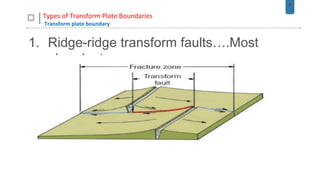
1. Ridge-ridge transform faults….Most
abundant
8
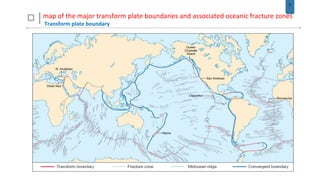
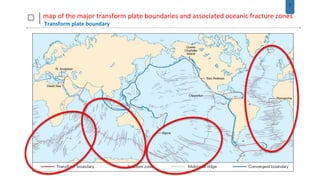
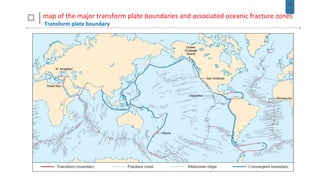
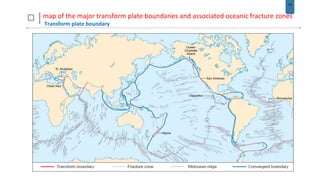
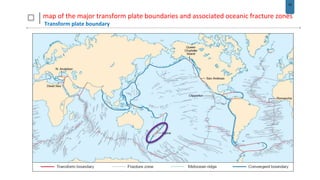
map of the major transform plate boundaries and associated oceanic fracture zones
Transform plate boundary
9
map of the major transform plate boundaries and associated oceanic fracture zones
Transform plate boundary
10
Types of Transform Plate Boundaries
Transform plate boundary
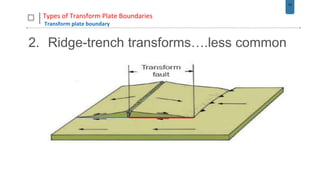
2. Ridge-trench transforms….less common
11
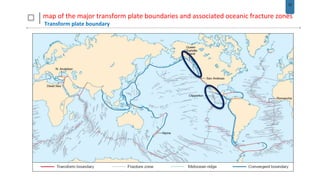
map of the major transform plate boundaries and associated oceanic fracture zones
Transform plate boundary
12
map of the major transform plate boundaries and associated oceanic fracture zones
Transform plate boundary
13
Types of Transform Plate Boundaries
Transform plate boundary
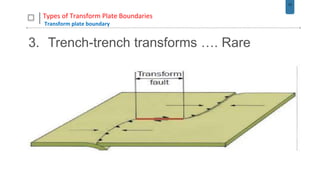
3. Trench-trench transforms …. Rare
14
map of the major transform plate boundaries and associated oceanic fracture zones
Transform plate boundary
15
map of the major transform plate boundaries and associated oceanic fracture zones
Transform plate boundary
16
Agenda
Transform plate boundary
 Oceanic transform plate boundaries and fracture zones
o Examples of Oceanic Fracture Zones
 Romanche Fracture Zone
 Clipperton Fracture Zone
 Transform Fault Zones in Ophiolites
 Processes at transform plate boundaries
o Contraction and Extension in Transform Fault Systems.
o Thermal Structure and the “Cold Wall.”
o Ridge Offset and Spreading Rate
 Continental transform faults
o Examples of Continental Transform Faults
 San Andreas–Gulf of California Transform System
 Dead Sea Transform System.
 Alpine Transform System of New Zealand.
 Earthquakes at transform boundaries
17
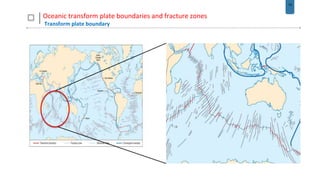
Oceanic transform plate boundaries and fracture zones
Transform plate boundary
Transform plate boundaries in the ocean
basins are prominent linear features that
are perpendicular to the midocean ridges.
They are the short, active parts of fracture
zones that may be several kilometers wide
and thousands of kilometers long.
18
Oceanic transform plate boundaries and fracture zones
Transform plate boundary
Transform plate boundaries in the ocean
basins are prominent linear features that
are perpendicular to the midocean ridges.
They are the short, active parts of fracture
zones that may be several kilometers wide
and thousands of kilometers long.
19
Oceanic transform plate boundaries and fracture zones
Transform plate boundary
20
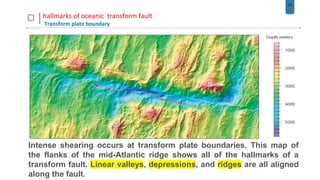
hallmarks of oceanic transform fault
Transform plate boundary
Intense shearing occurs at transform plate boundaries. This map of
the flanks of the mid-Atlantic ridge shows all of the hallmarks of a
transform fault. Linear valleys, depressions, and ridges are all aligned
along the fault.
21
Oceanic transform plate boundaries and fracture zones
Transform plate boundary
Oceanic transform plate boundaries are part
of even longer features called fracture zones
Fracture zones are enormous structures that
range up to 10,000 km long and may have a
vertical relief of 6 km.
22
Agenda
Transform plate boundary
o Examples of Oceanic Fracture Zones
 Romanche Fracture Zone
 Clipperton Fracture Zone
 Transform Fault Zones in Ophiolites
 Processes at transform plate boundaries
o Contraction and Extension in Transform Fault Systems.
o Thermal Structure and the “Cold Wall.”
o Ridge Offset and Spreading Rate
 Continental transform faults
o Examples of Continental Transform Faults
 San Andreas–Gulf of California Transform System
 Dead Sea Transform System.
 Alpine Transform System of New Zealand.
 Earthquakes at transform boundaries
23
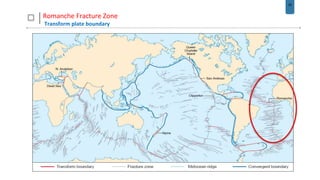
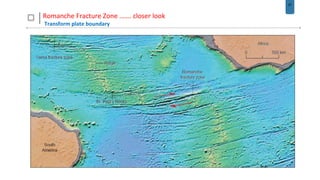
Romanche Fracture Zone
Transform plate boundary
• The most spectacular fracture in the
central Atlantic Ocean is the Romanche
fracture system, which lies almost on the
equator
• ridge-ridge transform fault between the
African plate on the north and the South
American plate on the south.
24
Romanche Fracture Zone
Transform plate boundary
25
Romanche Fracture Zone
Transform plate boundary
•
• ridge-ridge transform fault between the
African plate on the north and the South
American plate on the south.
26
Romanche Fracture Zone
Transform plate boundary
•
• ridge-ridge transform fault between the
African plate on the north and the South
American plate on the south.
27
Romanche Fracture Zone ……. closer look
Transform plate boundary
28
Romanche Fracture Zone ……. closer look
Transform plate boundary
• The Romanche fracture zone extends
across most of the Atlantic Ocean, forming
a huge ridge and trough system some
5000 km long and almost 100 km wide.
The active transform boundary lies
between the offset ridge axis.
29
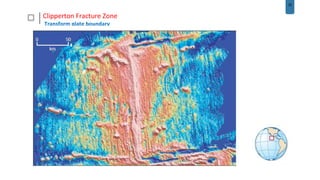
Clipperton Fracture Zone
Transform plate boundary
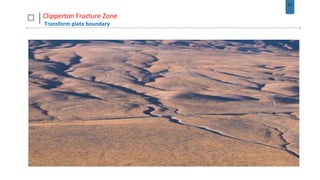
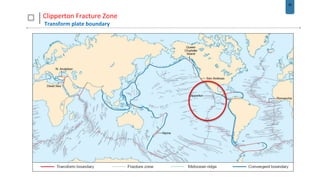
The Clipperton fracture zone stretches from
the coast of Central America to the middle of
the Pacific Ocean
30
Clipperton Fracture Zone
Transform plate boundary
31
Clipperton Fracture Zone
Transform plate boundary
The Clipperton transform fault cuts the East Pacific Rise,
in the northern part of this map. It is just west of the Centr
al American coast. The transform fault forms a series of ri
dges and troughs connecting two segments of the oceani
c ridge. The offset is about 85 km.
32
Clipperton Fracture Zone
Transform plate boundary
33
Transform Fault Zones in Ophiolites
Transform plate boundary
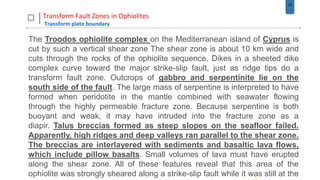
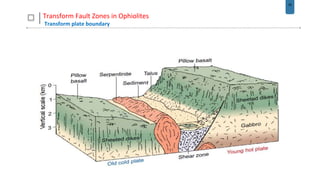
The Troodos ophiolite complex on the Mediterranean island of Cyprus is
cut by such a vertical shear zone The shear zone is about 10 km wide and
cuts through the rocks of the ophiolite sequence. Dikes in a sheeted dike
complex curve toward the major strike-slip fault, just as ridge tips do a
transform fault zone. Outcrops of gabbro and serpentinite lie on the
south side of the fault. The large mass of serpentine is interpreted to have
formed when peridotite in the mantle combined with seawater flowing
through the highly permeable fracture zone. Because serpentine is both
buoyant and weak, it may have intruded into the fracture zone as a
diapir. Talus breccias formed as steep slopes on the seafloor failed.
Apparently, high ridges and deep valleys ran parallel to the shear zone.
The breccias are interlayered with sediments and basaltic lava flows,
which include pillow basalts. Small volumes of lava must have erupted
along the shear zone. All of these features reveal that this area of the
ophiolite was strongly sheared along a strike-slip fault while it was still at the
34
Transform Fault Zones in Ophiolites
Transform plate boundary
35
Agenda
Transform plate boundary
 Processes at transform plate boundaries
o Contraction and Extension in Transform Fault Systems.
o Thermal Structure and the “Cold Wall.”
o Ridge Offset and Spreading Rate
 Continental transform faults
o Examples of Continental Transform Faults
 San Andreas–Gulf of California Transform System
 Dead Sea Transform System.
 Alpine Transform System of New Zealand.
 Earthquakes at transform boundaries
36
Contraction and Extension in Transform Fault Systems
37
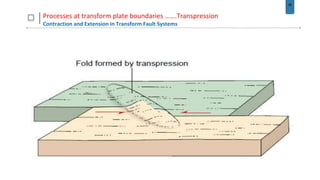
Processes at transform plate boundaries …….Transpression
Contraction and Extension in Transform Fault Systems
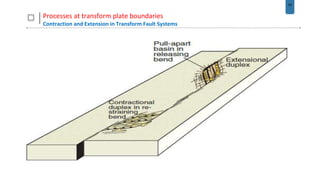
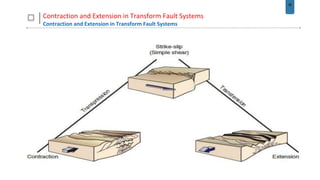
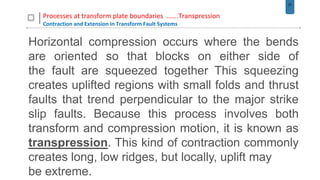
Horizontal compression occurs where the bends
are oriented so that blocks on either side of
the fault are squeezed together This squeezing
creates uplifted regions with small folds and thrust
faults that trend perpendicular to the major strike
slip faults. Because this process involves both
transform and compression motion, it is known as
transpression. This kind of contraction commonly
creates long, low ridges, but locally, uplift may
be extreme.
38
Processes at transform plate boundaries …….Transpression
Contraction and Extension in Transform Fault Systems
39
Processes at transform plate boundaries …….Transtension
Contraction and Extension in Transform Fault Systems
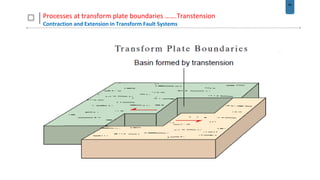
Areas of extension can also develop along bends
in the strike-slip faults. Transtension (transform
plus extension) produces small fault-bounded
troughs known as pull-apart basins
40
Processes at transform plate boundaries …….Transtension
Contraction and Extension in Transform Fault Systems
41
Processes at transform plate boundaries …….Transtension
Contraction and Extension in Transform Fault Systems
42
Processes at transform plate boundaries
Contraction and Extension in Transform Fault Systems
43
Flower structure
Contraction and Extension in Transform Fault Systems
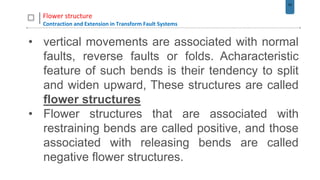
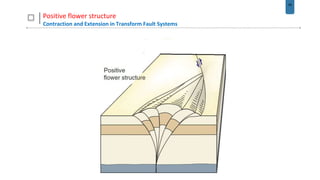
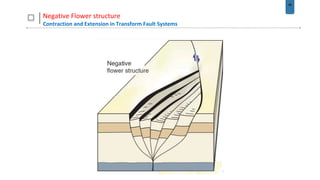
• vertical movements are associated with normal
faults, reverse faults or folds. Acharacteristic
feature of such bends is their tendency to split
and widen upward, These structures are called
flower structures
• Flower structures that are associated with
restraining bends are called positive, and those
associated with releasing bends are called
negative flower structures.
44
Flower structure
Contraction and Extension in Transform Fault Systems
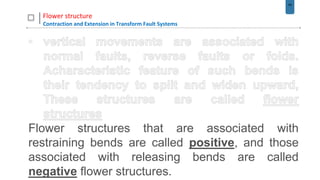
Flower structures that are associated with
restraining bends are called positive, and those
associated with releasing bends are called
negative flower structures.
45
Positive flower structure
Contraction and Extension in Transform Fault Systems
46
Negative Flower structure
Contraction and Extension in Transform Fault Systems
47
Agenda
Transform plate boundary
 Continental transform faults
o Examples of Continental Transform Faults
 San Andreas–Gulf of California Transform System
 Dead Sea Transform System.
 Alpine Transform System of New Zealand.
 Earthquakes at transform boundaries
48
Continental transform faults:
Transform plate boundary
• Transform faults that cut continental crust are not
nearly as common as oceanic transforms because
most transform faults develop at oceanic ridges.
• Continental transform faults typically have distinctive
linear topographic features These include relatively
straight fault scarps, linear ridges and troughs, and
streams and valleys that have been beheaded and
displaced horizontally. The individual faults in a
continental transform system therefore branch, join,
bend, and sidestep each other and even establish
zones of local contraction or extension.
49
The San Andreas Fault
Transform plate boundary
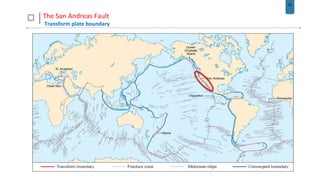
• The San Andreas Gulf of California transform
system is 3000 km long, extending from
the Mendocino fracture zone off the northern
coast of California southward to the tip of
Baja California .
50
The San Andreas Fault
Transform plate boundary
51
Clipperton Fracture Zone
Transform plate boundary
52
The San Andreas Fault
Transform plate boundary
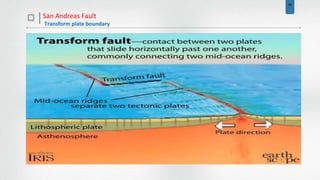
• The San Andreas Fault itself is more than 1000
km long, an active boundary between the
Pacific plate to the west and the North
American plate to the east. The Pacific plate is
moving northwestward at about 6 cm/yr. relative
to the North American plate. As stress builds
between the plates, sudden releases cause the
earthquakes for which California is noted.
Earthquakes occur along its entire length and
as deep as 15 km, but no deeper.
53
The San Andreas Fault
Transform plate boundary
• The San Andreas Fault system began to
develop about 30 million years ago (in
Oligocene time) and its location on the
continent may have been controlled by
preexisting fractures in the basement rocks.
Horizontal movement along the San Andreas
Fault has totaled about 300 km.
54
The San Andreas Fault
Transform plate boundary
• The net result of movement along the San
Andreas Gulf of California transform system
has been the opening of the Gulf of California
and the displacement of the western block of
the San Andreas northward approximately 300
km With continued movement, Baja
California and a narrow slice of western
California may become an elongate continental
fragment surrounded by oceanic crust.
55
San Andreas Fault
Transform plate boundary
56
Dead sea
Transform plate boundary
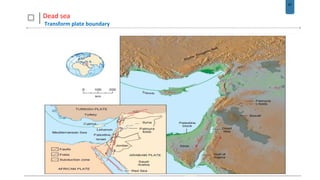
• The Dead Sea transform system extends from
the spreading ridge of the Red Sea northward
to a zone of continent-to-continent collision in
the Alpine orogenic belt in southern Turkey
57
Dead sea
Transform plate boundary
58
Dead sea
Transform plate boundary
• The structure, topography, and history of
the entire region are magnificent
expressions of continental plates moving
along a transform system. The transform
zone is about 1000 km long and marks the
boundary between the western edge of the
Arabian plate and the northern part of the
African plate.
59
Agenda
Transform plate boundary
.
 Earthquakes at transform boundaries
60
Earthquakes and magmatism at transform boundaries
Transform plate boundary

Transform plate boundary

  • 1.
    Transform plate boundary By AbdAl Rahman Ibrahim Soliman, BSc of Geoscience, Faculty of science, Alexandria University. abdalrahmanibrahim209@gmail.com
  • 2.
    2 Agenda Transform plate boundary Introduction Characteristics of transform plate boundaries  Types of Transform Plate Boundaries o Ridge-ridge transform faults o Ridge-trench transforms o Trench-trench transforms  Oceanic transform plate boundaries and fracture zones o Examples of Oceanic Fracture Zones  Romanche Fracture Zone  Clipperton Fracture Zone  Transform Fault Zones in Ophiolites  Processes at transform plate boundaries o Contraction and Extension in Transform Fault Systems. o Thermal Structure and the “Cold Wall.” o Ridge Offset and Spreading Rate  Continental transform faults o Examples of Continental Transform Faults  San Andreas–Gulf of California Transform System  Dead Sea Transform System.  Alpine Transform System of New Zealand.  Earthquakes at transform boundaries
  • 3.
  • 4.
    4 Introduction Transform plate boundary Transformplate boundaries are zones of shearing, where two plates slide horizontally past each other. Rocks in the shear zone are strongly deformed, but no new lithosphere is created and none is consumed. Transform boundaries in ocean basins and on the continents are expressed by steep, linear ridges and
  • 5.
    5 Introduction Transform plate boundary Transformplate boundaries are zones of shearing, where two plates slide horizontally past each other. Rocks in the shear zone are strongly deformed, but no new lithosphere is created and none is consumed. Transform boundaries in ocean basins and on the continents are expressed by steep, linear ridges and
  • 6.
    6 Agenda Transform plate boundary Types of Transform Plate Boundaries o Ridge-ridge transform faults o Ridge-trench transforms o Trench-trench transforms  Oceanic transform plate boundaries and fracture zones o Examples of Oceanic Fracture Zones  Romanche Fracture Zone  Clipperton Fracture Zone  Transform Fault Zones in Ophiolites  Processes at transform plate boundaries o Contraction and Extension in Transform Fault Systems. o Thermal Structure and the “Cold Wall.” o Ridge Offset and Spreading Rate  Continental transform faults o Examples of Continental Transform Faults  San Andreas–Gulf of California Transform System  Dead Sea Transform System.  Alpine Transform System of New Zealand.  Earthquakes at transform boundaries
  • 7.
    7 Types of TransformPlate Boundaries Transform plate boundary 1. Ridge-ridge transform faults….Most abundant
  • 8.
    8 map of themajor transform plate boundaries and associated oceanic fracture zones Transform plate boundary
  • 9.
    9 map of themajor transform plate boundaries and associated oceanic fracture zones Transform plate boundary
  • 10.
    10 Types of TransformPlate Boundaries Transform plate boundary 2. Ridge-trench transforms….less common
  • 11.
    11 map of themajor transform plate boundaries and associated oceanic fracture zones Transform plate boundary
  • 12.
    12 map of themajor transform plate boundaries and associated oceanic fracture zones Transform plate boundary
  • 13.
    13 Types of TransformPlate Boundaries Transform plate boundary 3. Trench-trench transforms …. Rare
  • 14.
    14 map of themajor transform plate boundaries and associated oceanic fracture zones Transform plate boundary
  • 15.
    15 map of themajor transform plate boundaries and associated oceanic fracture zones Transform plate boundary
  • 16.
    16 Agenda Transform plate boundary Oceanic transform plate boundaries and fracture zones o Examples of Oceanic Fracture Zones  Romanche Fracture Zone  Clipperton Fracture Zone  Transform Fault Zones in Ophiolites  Processes at transform plate boundaries o Contraction and Extension in Transform Fault Systems. o Thermal Structure and the “Cold Wall.” o Ridge Offset and Spreading Rate  Continental transform faults o Examples of Continental Transform Faults  San Andreas–Gulf of California Transform System  Dead Sea Transform System.  Alpine Transform System of New Zealand.  Earthquakes at transform boundaries
  • 17.
    17 Oceanic transform plateboundaries and fracture zones Transform plate boundary Transform plate boundaries in the ocean basins are prominent linear features that are perpendicular to the midocean ridges. They are the short, active parts of fracture zones that may be several kilometers wide and thousands of kilometers long.
  • 18.
    18 Oceanic transform plateboundaries and fracture zones Transform plate boundary Transform plate boundaries in the ocean basins are prominent linear features that are perpendicular to the midocean ridges. They are the short, active parts of fracture zones that may be several kilometers wide and thousands of kilometers long.
  • 19.
    19 Oceanic transform plateboundaries and fracture zones Transform plate boundary
  • 20.
    20 hallmarks of oceanictransform fault Transform plate boundary Intense shearing occurs at transform plate boundaries. This map of the flanks of the mid-Atlantic ridge shows all of the hallmarks of a transform fault. Linear valleys, depressions, and ridges are all aligned along the fault.
  • 21.
    21 Oceanic transform plateboundaries and fracture zones Transform plate boundary Oceanic transform plate boundaries are part of even longer features called fracture zones Fracture zones are enormous structures that range up to 10,000 km long and may have a vertical relief of 6 km.
  • 22.
    22 Agenda Transform plate boundary oExamples of Oceanic Fracture Zones  Romanche Fracture Zone  Clipperton Fracture Zone  Transform Fault Zones in Ophiolites  Processes at transform plate boundaries o Contraction and Extension in Transform Fault Systems. o Thermal Structure and the “Cold Wall.” o Ridge Offset and Spreading Rate  Continental transform faults o Examples of Continental Transform Faults  San Andreas–Gulf of California Transform System  Dead Sea Transform System.  Alpine Transform System of New Zealand.  Earthquakes at transform boundaries
  • 23.
    23 Romanche Fracture Zone Transformplate boundary • The most spectacular fracture in the central Atlantic Ocean is the Romanche fracture system, which lies almost on the equator • ridge-ridge transform fault between the African plate on the north and the South American plate on the south.
  • 24.
  • 25.
    25 Romanche Fracture Zone Transformplate boundary • • ridge-ridge transform fault between the African plate on the north and the South American plate on the south.
  • 26.
    26 Romanche Fracture Zone Transformplate boundary • • ridge-ridge transform fault between the African plate on the north and the South American plate on the south.
  • 27.
    27 Romanche Fracture Zone……. closer look Transform plate boundary
  • 28.
    28 Romanche Fracture Zone……. closer look Transform plate boundary • The Romanche fracture zone extends across most of the Atlantic Ocean, forming a huge ridge and trough system some 5000 km long and almost 100 km wide. The active transform boundary lies between the offset ridge axis.
  • 29.
    29 Clipperton Fracture Zone Transformplate boundary The Clipperton fracture zone stretches from the coast of Central America to the middle of the Pacific Ocean
  • 30.
  • 31.
    31 Clipperton Fracture Zone Transformplate boundary The Clipperton transform fault cuts the East Pacific Rise, in the northern part of this map. It is just west of the Centr al American coast. The transform fault forms a series of ri dges and troughs connecting two segments of the oceani c ridge. The offset is about 85 km.
  • 32.
  • 33.
    33 Transform Fault Zonesin Ophiolites Transform plate boundary The Troodos ophiolite complex on the Mediterranean island of Cyprus is cut by such a vertical shear zone The shear zone is about 10 km wide and cuts through the rocks of the ophiolite sequence. Dikes in a sheeted dike complex curve toward the major strike-slip fault, just as ridge tips do a transform fault zone. Outcrops of gabbro and serpentinite lie on the south side of the fault. The large mass of serpentine is interpreted to have formed when peridotite in the mantle combined with seawater flowing through the highly permeable fracture zone. Because serpentine is both buoyant and weak, it may have intruded into the fracture zone as a diapir. Talus breccias formed as steep slopes on the seafloor failed. Apparently, high ridges and deep valleys ran parallel to the shear zone. The breccias are interlayered with sediments and basaltic lava flows, which include pillow basalts. Small volumes of lava must have erupted along the shear zone. All of these features reveal that this area of the ophiolite was strongly sheared along a strike-slip fault while it was still at the
  • 34.
    34 Transform Fault Zonesin Ophiolites Transform plate boundary
  • 35.
    35 Agenda Transform plate boundary Processes at transform plate boundaries o Contraction and Extension in Transform Fault Systems. o Thermal Structure and the “Cold Wall.” o Ridge Offset and Spreading Rate  Continental transform faults o Examples of Continental Transform Faults  San Andreas–Gulf of California Transform System  Dead Sea Transform System.  Alpine Transform System of New Zealand.  Earthquakes at transform boundaries
  • 36.
    36 Contraction and Extensionin Transform Fault Systems Contraction and Extension in Transform Fault Systems
  • 37.
    37 Processes at transformplate boundaries …….Transpression Contraction and Extension in Transform Fault Systems Horizontal compression occurs where the bends are oriented so that blocks on either side of the fault are squeezed together This squeezing creates uplifted regions with small folds and thrust faults that trend perpendicular to the major strike slip faults. Because this process involves both transform and compression motion, it is known as transpression. This kind of contraction commonly creates long, low ridges, but locally, uplift may be extreme.
  • 38.
    38 Processes at transformplate boundaries …….Transpression Contraction and Extension in Transform Fault Systems
  • 39.
    39 Processes at transformplate boundaries …….Transtension Contraction and Extension in Transform Fault Systems Areas of extension can also develop along bends in the strike-slip faults. Transtension (transform plus extension) produces small fault-bounded troughs known as pull-apart basins
  • 40.
    40 Processes at transformplate boundaries …….Transtension Contraction and Extension in Transform Fault Systems
  • 41.
    41 Processes at transformplate boundaries …….Transtension Contraction and Extension in Transform Fault Systems
  • 42.
    42 Processes at transformplate boundaries Contraction and Extension in Transform Fault Systems
  • 43.
    43 Flower structure Contraction andExtension in Transform Fault Systems • vertical movements are associated with normal faults, reverse faults or folds. Acharacteristic feature of such bends is their tendency to split and widen upward, These structures are called flower structures • Flower structures that are associated with restraining bends are called positive, and those associated with releasing bends are called negative flower structures.
  • 44.
    44 Flower structure Contraction andExtension in Transform Fault Systems Flower structures that are associated with restraining bends are called positive, and those associated with releasing bends are called negative flower structures.
  • 45.
    45 Positive flower structure Contractionand Extension in Transform Fault Systems
  • 46.
    46 Negative Flower structure Contractionand Extension in Transform Fault Systems
  • 47.
    47 Agenda Transform plate boundary Continental transform faults o Examples of Continental Transform Faults  San Andreas–Gulf of California Transform System  Dead Sea Transform System.  Alpine Transform System of New Zealand.  Earthquakes at transform boundaries
  • 48.
    48 Continental transform faults: Transformplate boundary • Transform faults that cut continental crust are not nearly as common as oceanic transforms because most transform faults develop at oceanic ridges. • Continental transform faults typically have distinctive linear topographic features These include relatively straight fault scarps, linear ridges and troughs, and streams and valleys that have been beheaded and displaced horizontally. The individual faults in a continental transform system therefore branch, join, bend, and sidestep each other and even establish zones of local contraction or extension.
  • 49.
    49 The San AndreasFault Transform plate boundary • The San Andreas Gulf of California transform system is 3000 km long, extending from the Mendocino fracture zone off the northern coast of California southward to the tip of Baja California .
  • 50.
    50 The San AndreasFault Transform plate boundary
  • 51.
  • 52.
    52 The San AndreasFault Transform plate boundary • The San Andreas Fault itself is more than 1000 km long, an active boundary between the Pacific plate to the west and the North American plate to the east. The Pacific plate is moving northwestward at about 6 cm/yr. relative to the North American plate. As stress builds between the plates, sudden releases cause the earthquakes for which California is noted. Earthquakes occur along its entire length and as deep as 15 km, but no deeper.
  • 53.
    53 The San AndreasFault Transform plate boundary • The San Andreas Fault system began to develop about 30 million years ago (in Oligocene time) and its location on the continent may have been controlled by preexisting fractures in the basement rocks. Horizontal movement along the San Andreas Fault has totaled about 300 km.
  • 54.
    54 The San AndreasFault Transform plate boundary • The net result of movement along the San Andreas Gulf of California transform system has been the opening of the Gulf of California and the displacement of the western block of the San Andreas northward approximately 300 km With continued movement, Baja California and a narrow slice of western California may become an elongate continental fragment surrounded by oceanic crust.
  • 55.
  • 56.
    56 Dead sea Transform plateboundary • The Dead Sea transform system extends from the spreading ridge of the Red Sea northward to a zone of continent-to-continent collision in the Alpine orogenic belt in southern Turkey
  • 57.
  • 58.
    58 Dead sea Transform plateboundary • The structure, topography, and history of the entire region are magnificent expressions of continental plates moving along a transform system. The transform zone is about 1000 km long and marks the boundary between the western edge of the Arabian plate and the northern part of the African plate.
  • 59.
    59 Agenda Transform plate boundary . Earthquakes at transform boundaries
  • 60.
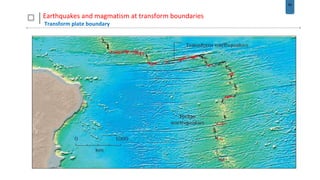
    60 Earthquakes and magmatismat transform boundaries Transform plate boundary