Chapter 11
Fluvial Geomorphology
Streams
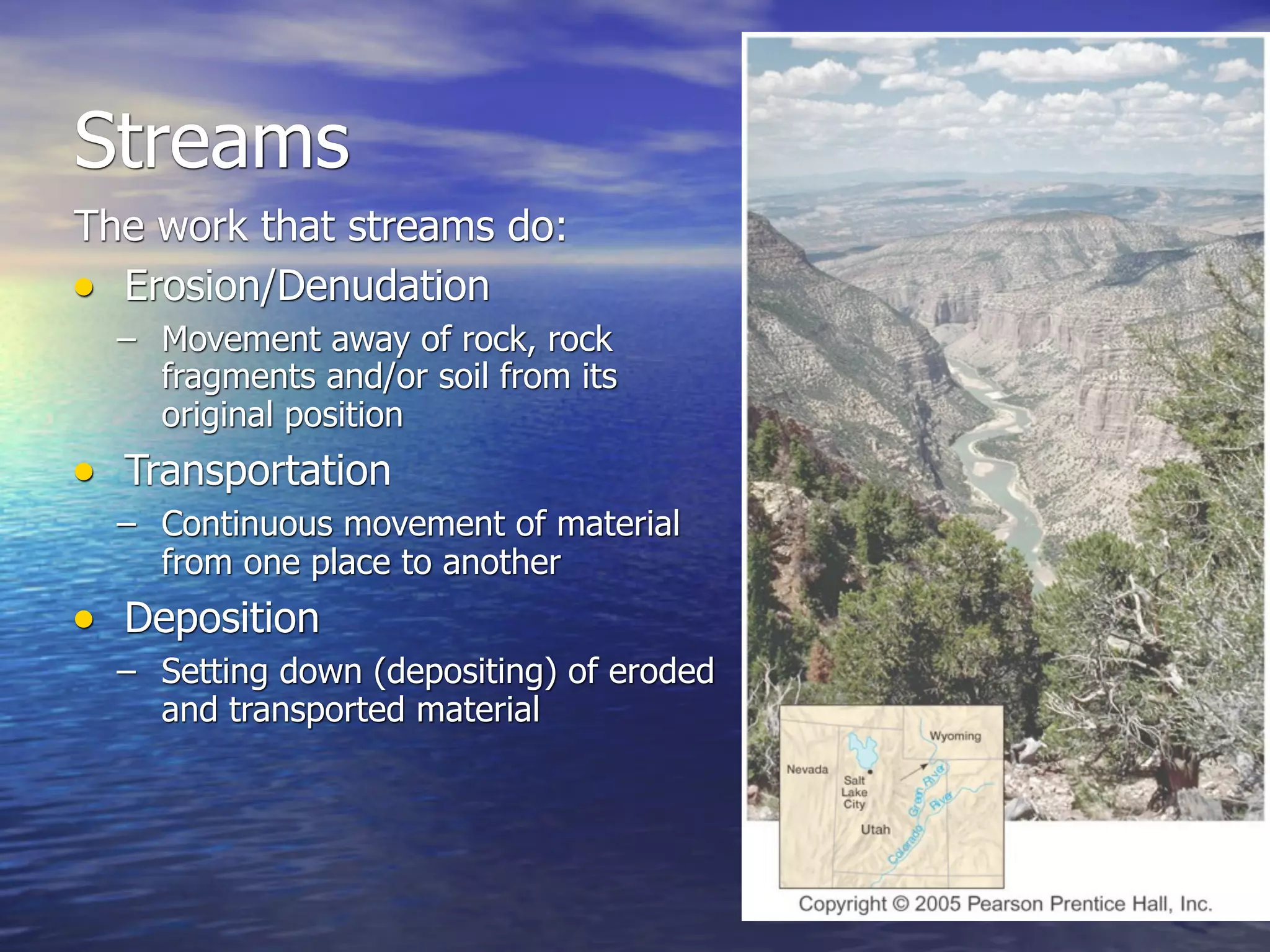
The work that streams do:
• Erosion/Denudation
  – Movement away of rock, rock
    fragments and/or soil from its
    original position
• Transportation
  – Continuous movement of material
    from one place to another
• Deposition
  – Setting down (depositing) of eroded
    and transported material
Drainage Systems
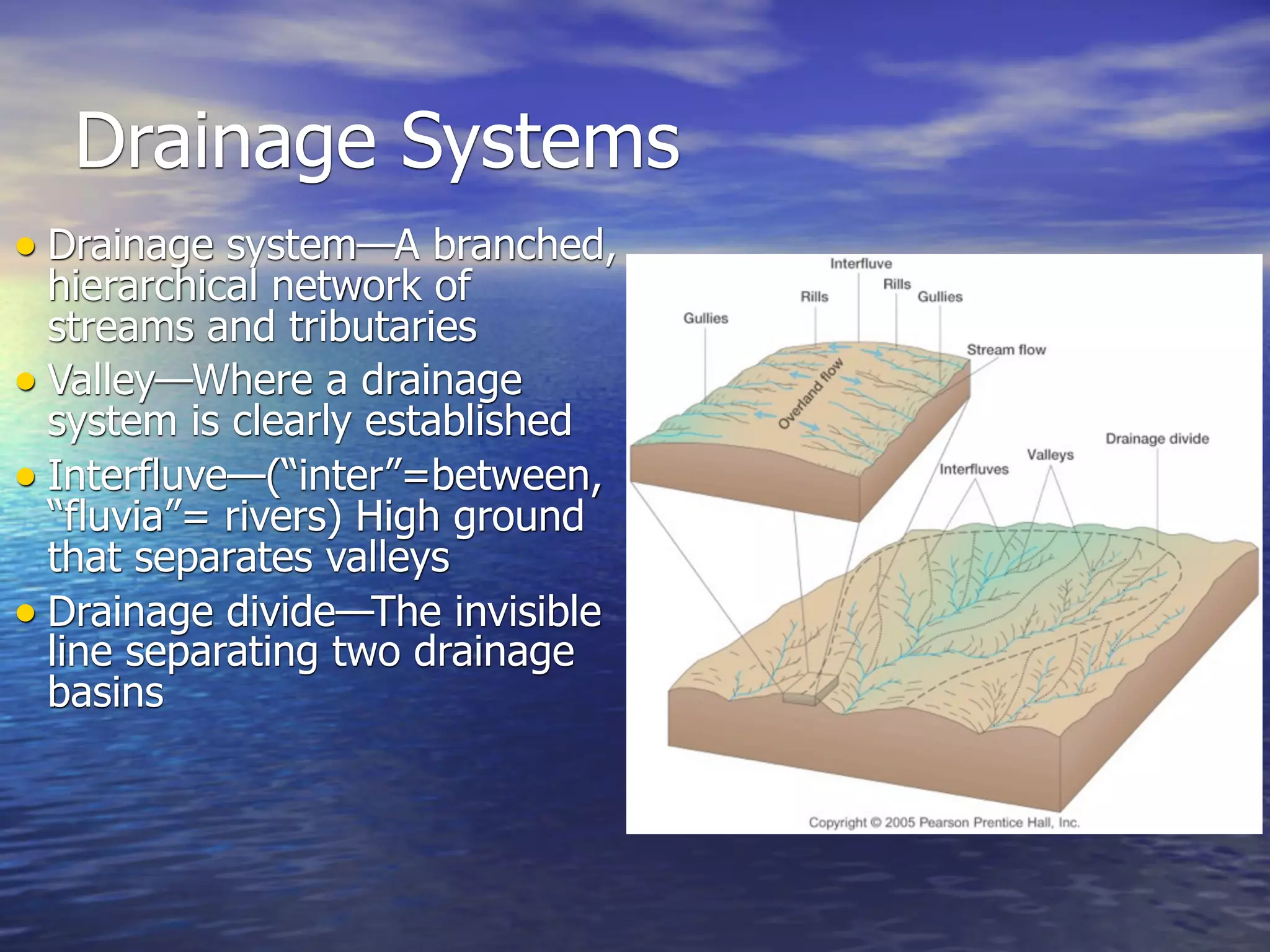
• Drainage system—A branched,
  hierarchical network of
  streams and tributaries
• Valley—Where a drainage
  system is clearly established
• Interfluve—(“inter”=between,
  “fluvia”= rivers) High ground
  that separates valleys
• Drainage divide—The invisible
  line separating two drainage
  basins
Drainage basin
or Watershed


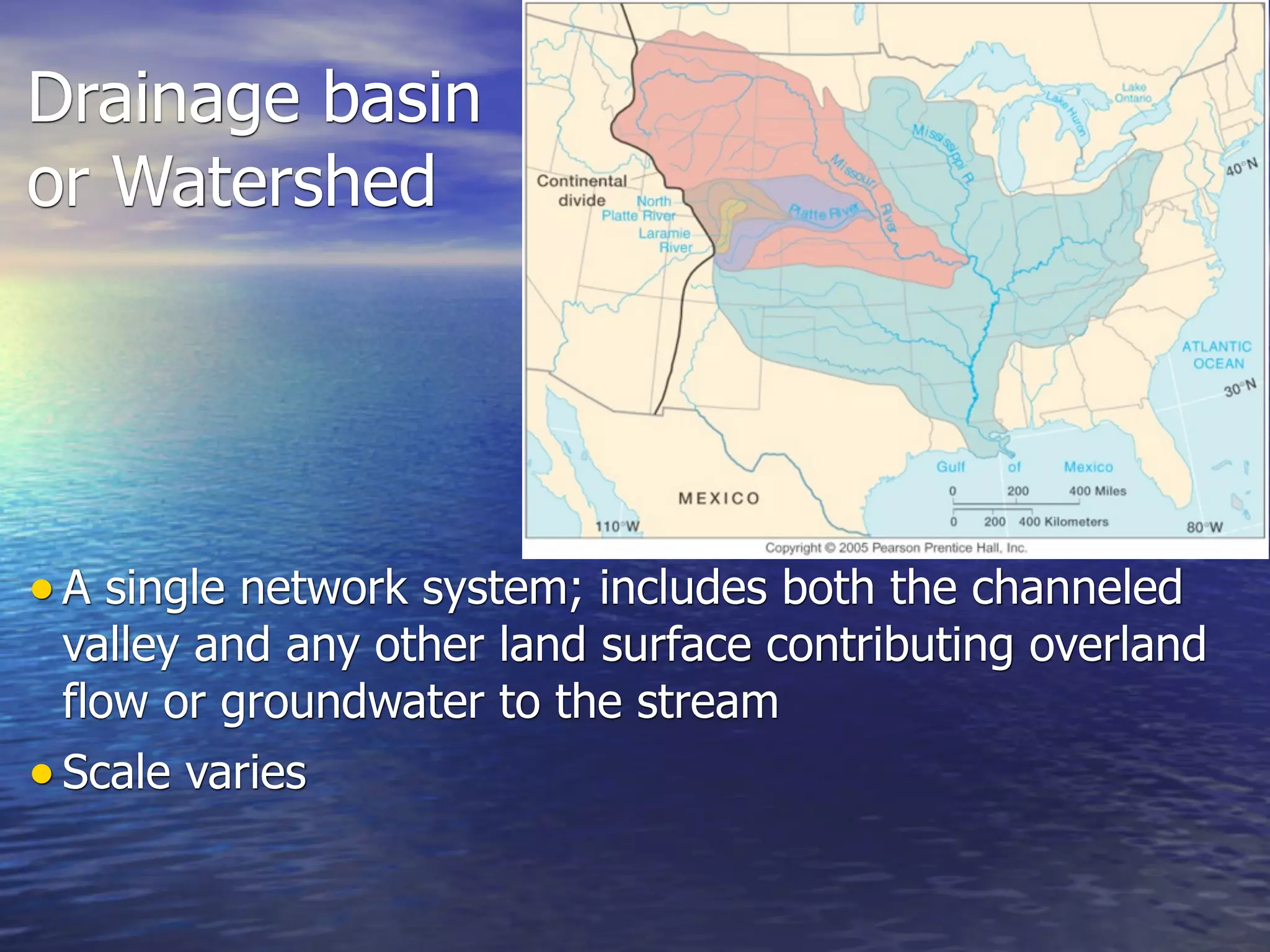
• A single network system; includes both the channeled
  valley and any other land surface contributing overland
  flow or groundwater to the stream
• Scale varies
Erosion
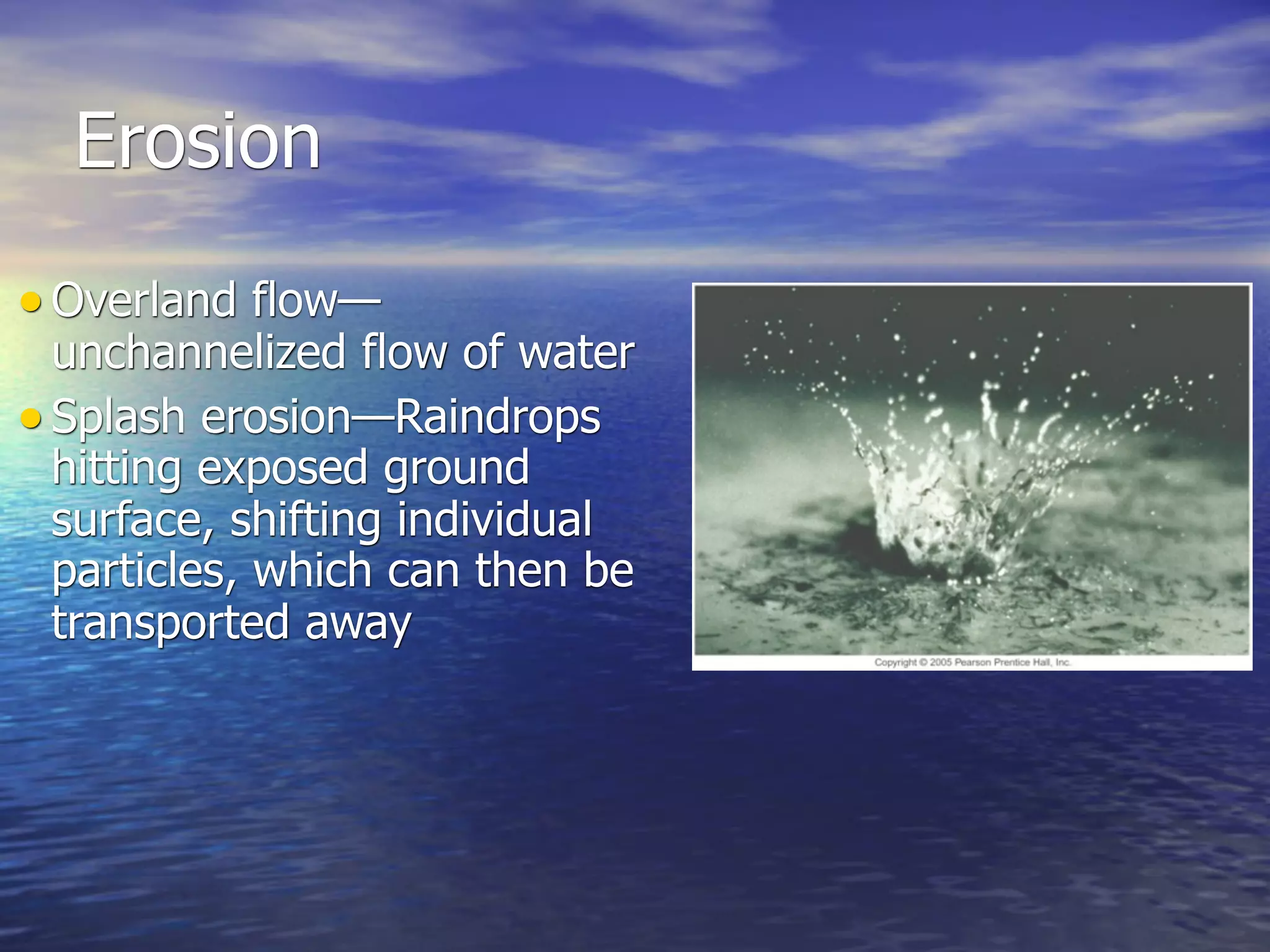
• Overland flow—
  unchannelized flow of water
• Splash erosion—Raindrops
  hitting exposed ground
  surface, shifting individual
  particles, which can then be
  transported away
Overland Flow

• Sheet erosion—if there is very little ground
  cover (vegetation), not much water may
  infiltrate and sheet flow can occur, moving
  particles downslope
Erosion
• Hydraulic action—The physical force of water
 pounding on rocks and land materials, breaking
 them apart

• Abrasion—Rock materials hitting the bed (bottom)
 of the river and its banks (sides)

• Corrosion—The chemical action of water dissolving
 minerals and rock material
How Quickly Erosion Occurs
Depends On…
• Flow Speed
• Turbulence
• Resistance of the bedrock
1. Flow Speed
1. Flow Speed

• Flow Speed
 –The faster the water, the more force it has
 –Faster water = more erosion
What makes the water go faster?

1. Steeper gradient
What makes the water go faster?

1. Steeper gradient
  – Gradient—The rate of fall in elevation of the stream
    surface in the downstream direction (as in 20 ft./mi.)
What makes the water go faster?

1. Steeper gradient
  – Gradient—The rate of fall in elevation of the stream
     surface in the downstream direction (as in 20 ft./mi.)
    • Steeper gradient = faster flow = more erosion
What makes the water go faster?

1. Steeper gradient
  – Gradient—The rate of fall in elevation of the stream
     surface in the downstream direction (as in 20 ft./mi.)
    • Steeper gradient = faster flow = more erosion
2. Volume of flow (discharge)
What makes the water go faster?

1. Steeper gradient
  – Gradient—The rate of fall in elevation of the stream
     surface in the downstream direction (as in 20 ft./mi.)
    • Steeper gradient = faster flow = more erosion
2. Volume of flow (discharge)
  – More water = higher speed = more erosion
What makes the water go faster?

1. Steeper gradient
  – Gradient—The rate of fall in elevation of the stream
     surface in the downstream direction (as in 20 ft./mi.)
    • Steeper gradient = faster flow = more erosion
2. Volume of flow (discharge)
  – More water = higher speed = more erosion
    • Flood events move bigger material—and more of it!
What makes the water go faster?

1. Steeper gradient
  – Gradient—The rate of fall in elevation of the stream
     surface in the downstream direction (as in 20 ft./mi.)
    • Steeper gradient = faster flow = more erosion
2. Volume of flow (discharge)
  – More water = higher speed = more erosion
    • Flood events move bigger material—and more of it!
3. Channel width—the narrower the channel, the
    swifter the flow, for the same volume of water
    (Remember the Venturi effect?)
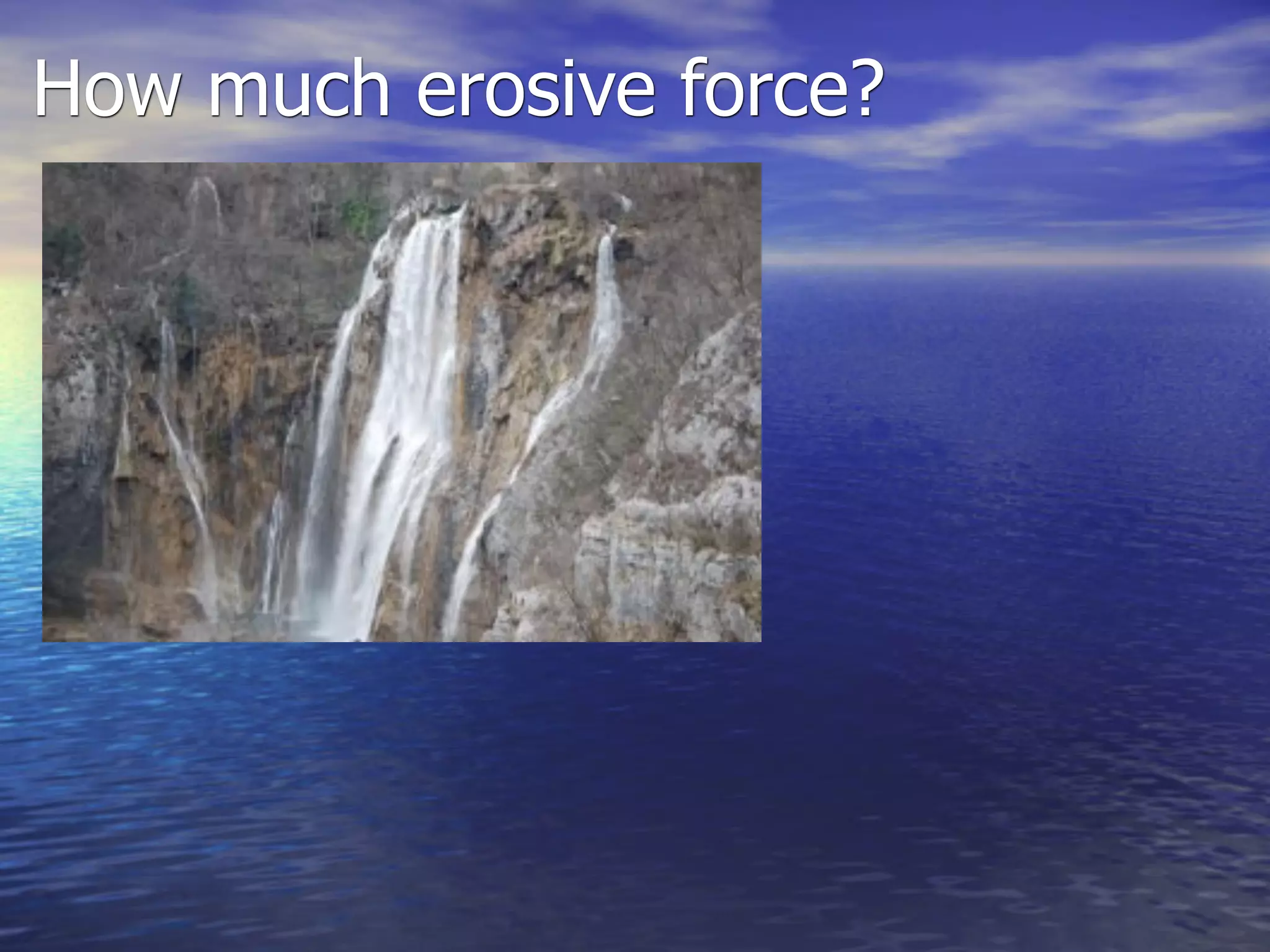
How much erosive force?
2. Turbulence
2. Turbulence

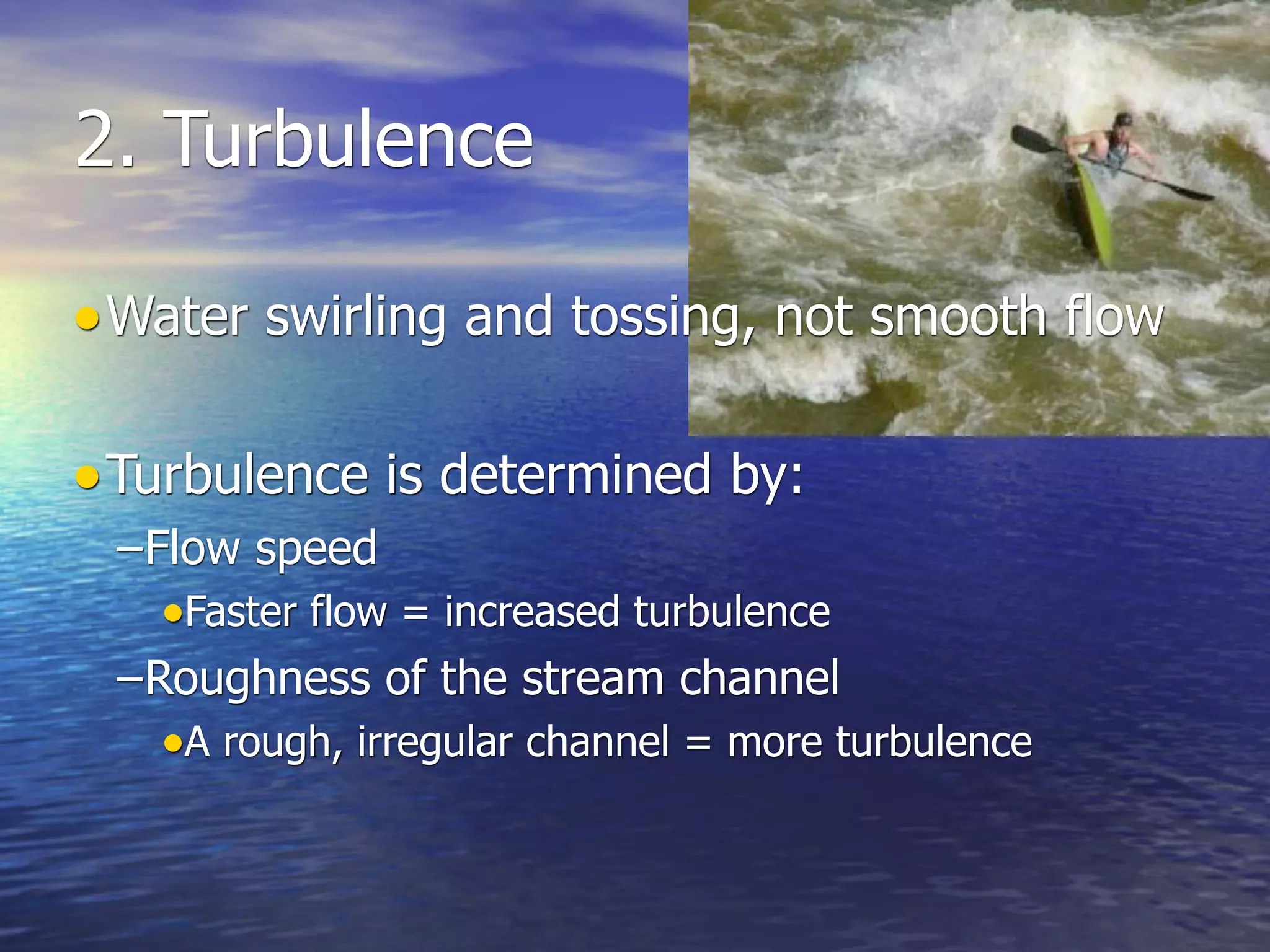
• Water swirling and tossing, not smooth flow
2. Turbulence

• Water swirling and tossing, not smooth flow

• Turbulence is determined by:
 –Flow speed
2. Turbulence

• Water swirling and tossing, not smooth flow

• Turbulence is determined by:
 –Flow speed
   •Faster flow = increased turbulence
2. Turbulence

• Water swirling and tossing, not smooth flow

• Turbulence is determined by:
 –Flow speed
   •Faster flow = increased turbulence
 –Roughness of the stream channel
2. Turbulence

• Water swirling and tossing, not smooth flow

• Turbulence is determined by:
 –Flow speed
   •Faster flow = increased turbulence
 –Roughness of the stream channel
   •A rough, irregular channel = more turbulence
2. Turbulence

• Water swirling and tossing, not smooth flow

• Turbulence is determined by:
 –Flow speed
   •Faster flow = increased turbulence
 –Roughness of the stream channel
   •A rough, irregular channel = more turbulence
3. Resistance of bedrock

• More resistance (harder rocks)
                               = less erosion
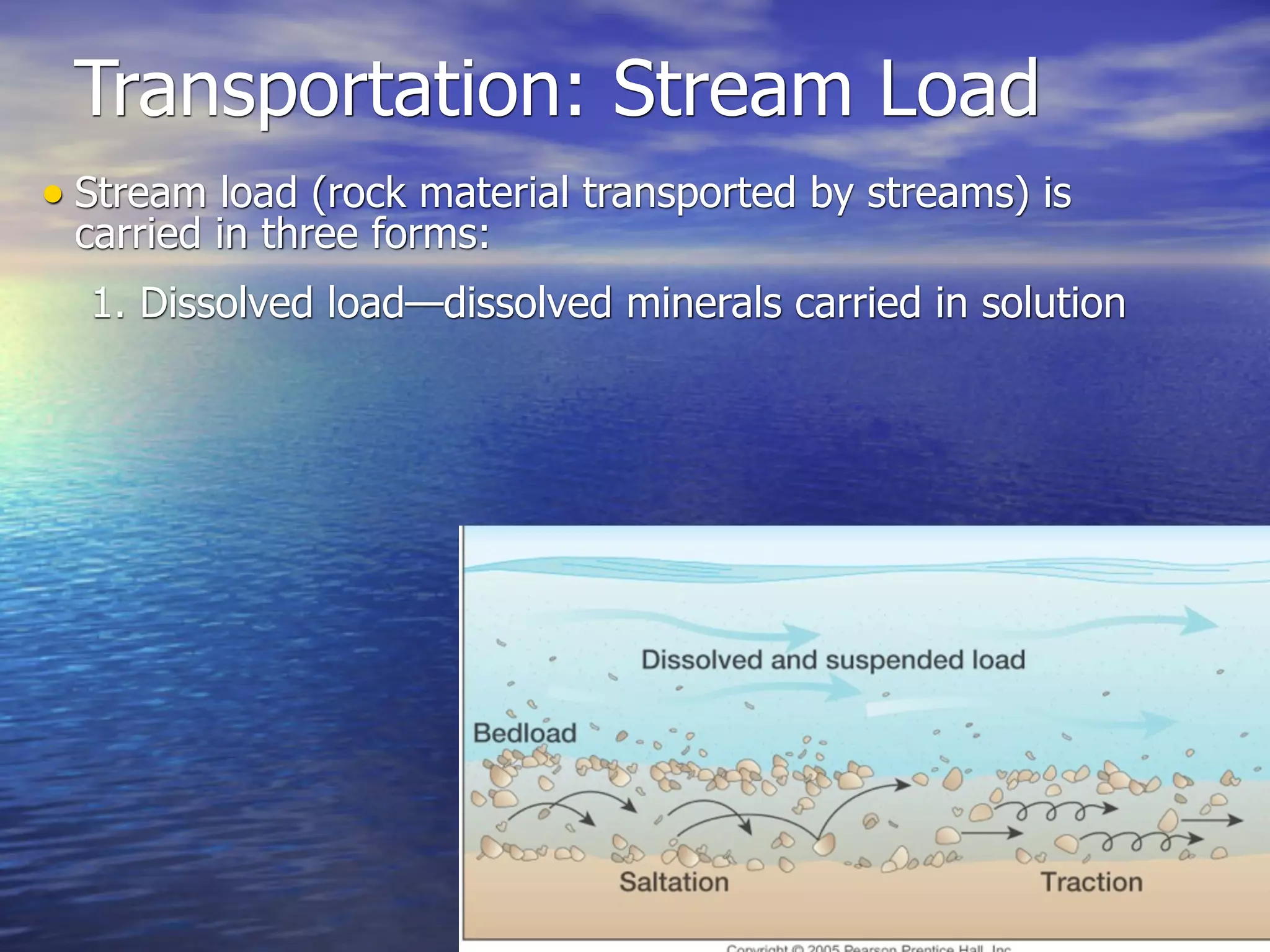
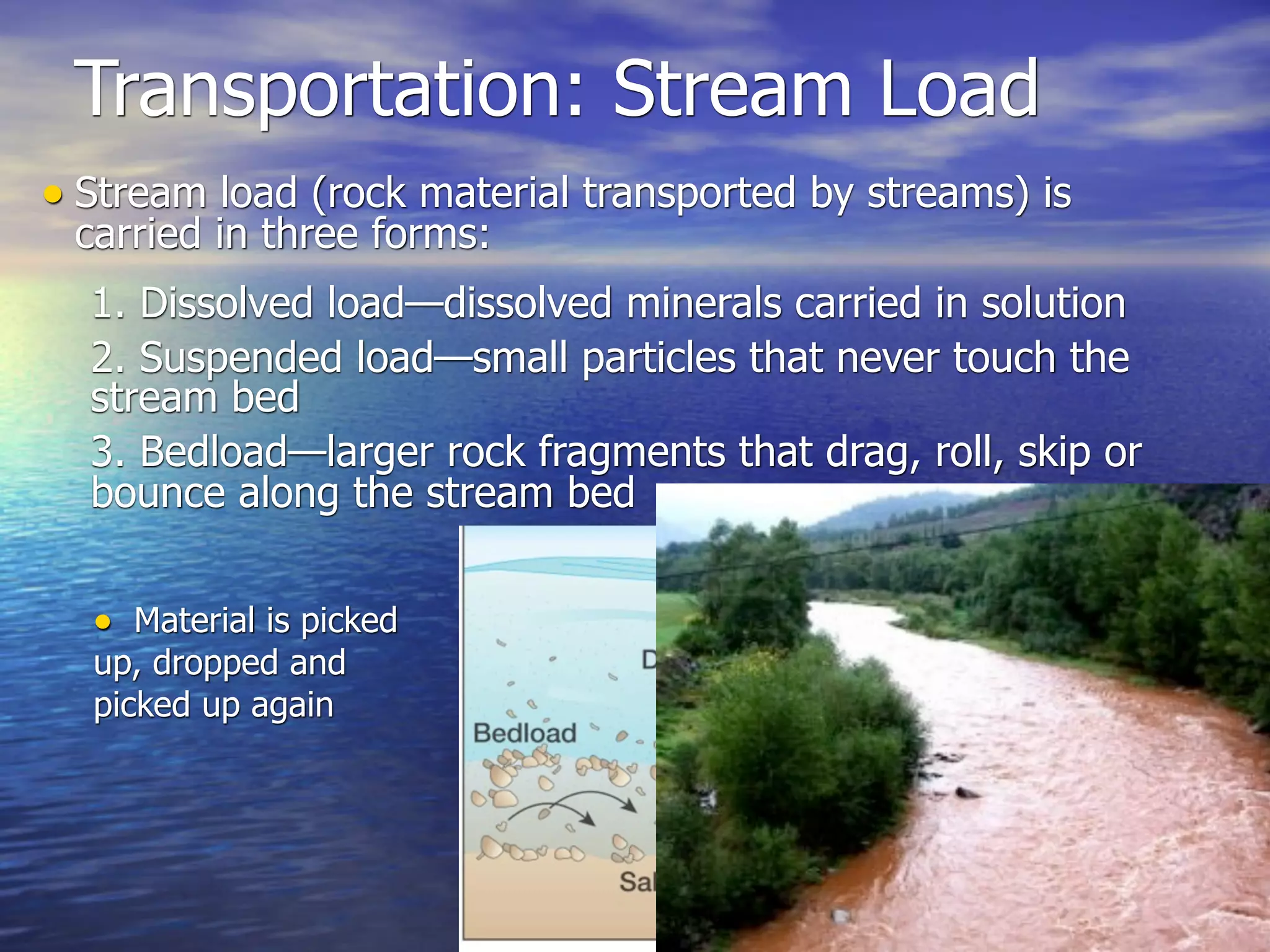
Transportation: Stream Load
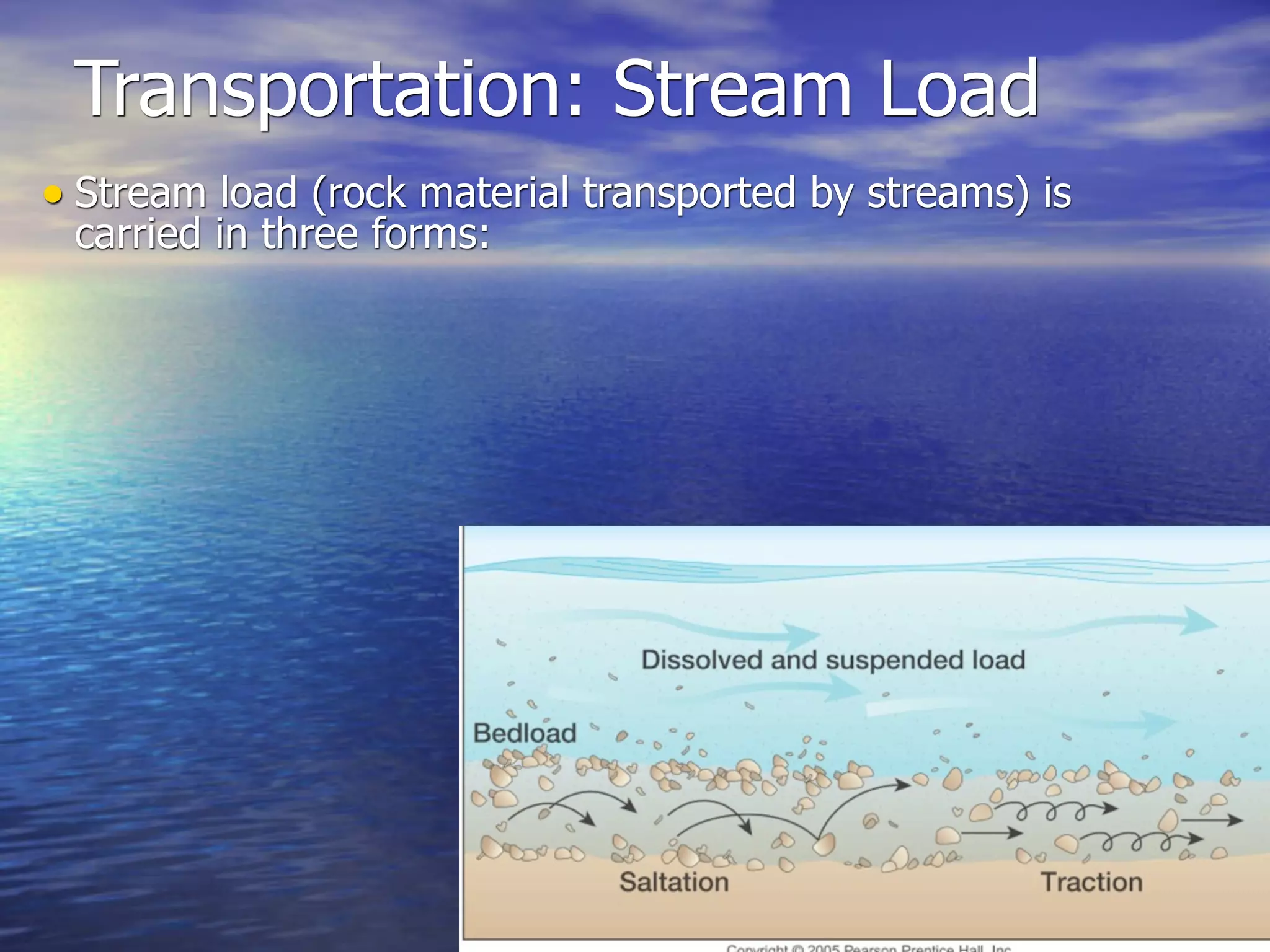
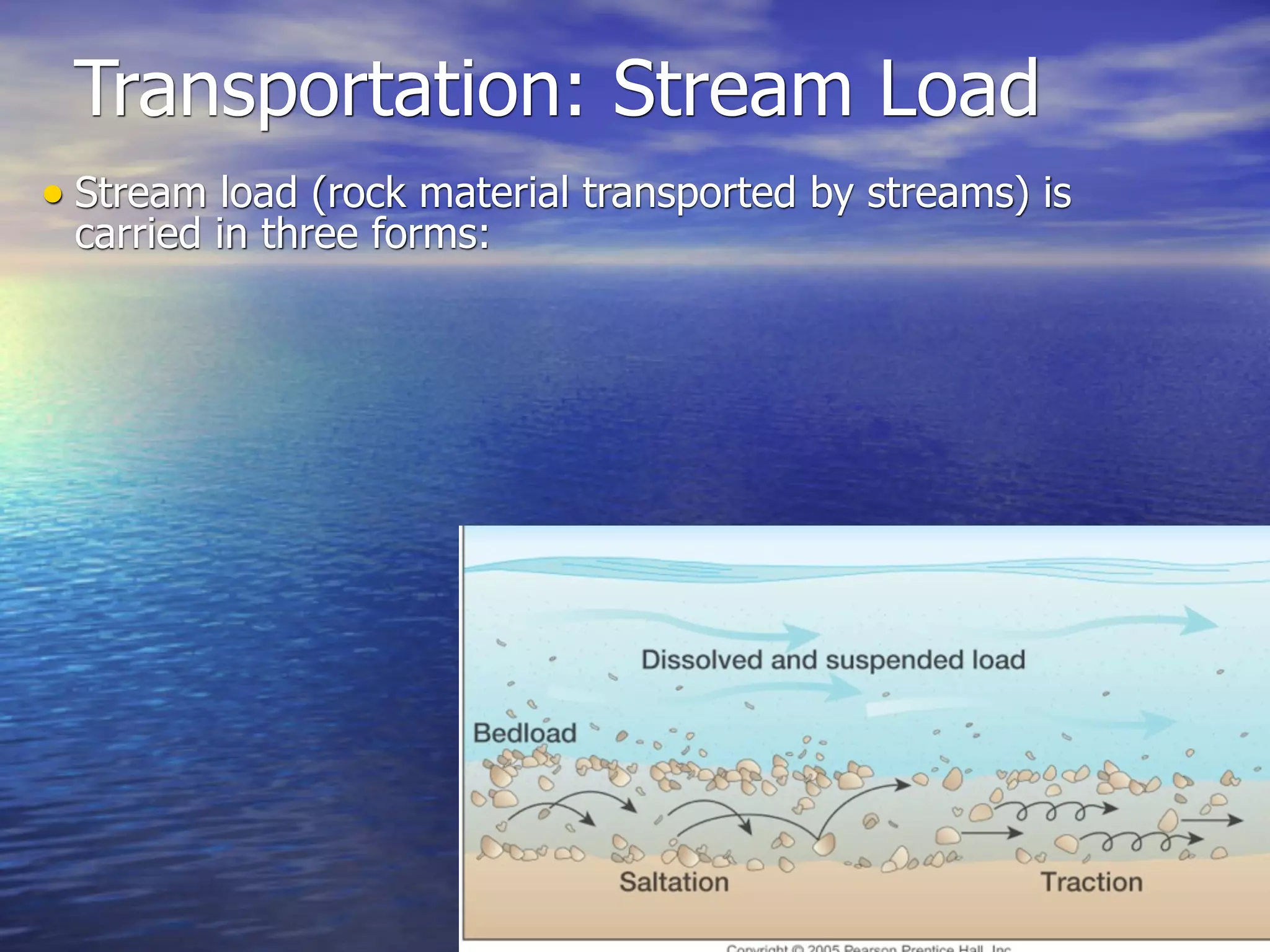
• Stream load (rock material transported by streams) is
 carried in three forms:
Transportation: Stream Load
• Stream load (rock material transported by streams) is
 carried in three forms:
Transportation: Stream Load
• Stream load (rock material transported by streams) is
 carried in three forms:
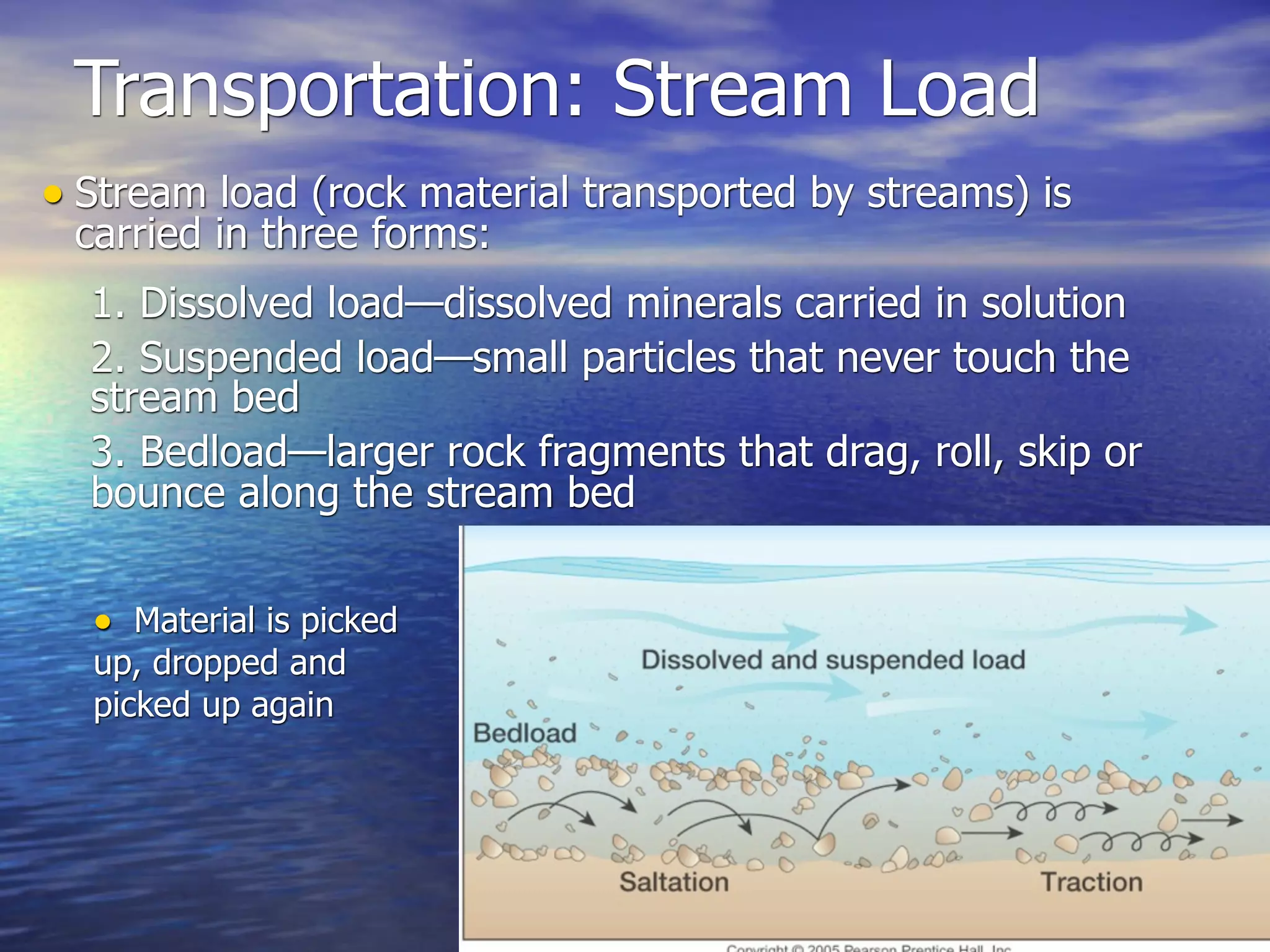
  1. Dissolved load—dissolved minerals carried in solution
Transportation: Stream Load
• Stream load (rock material transported by streams) is
 carried in three forms:
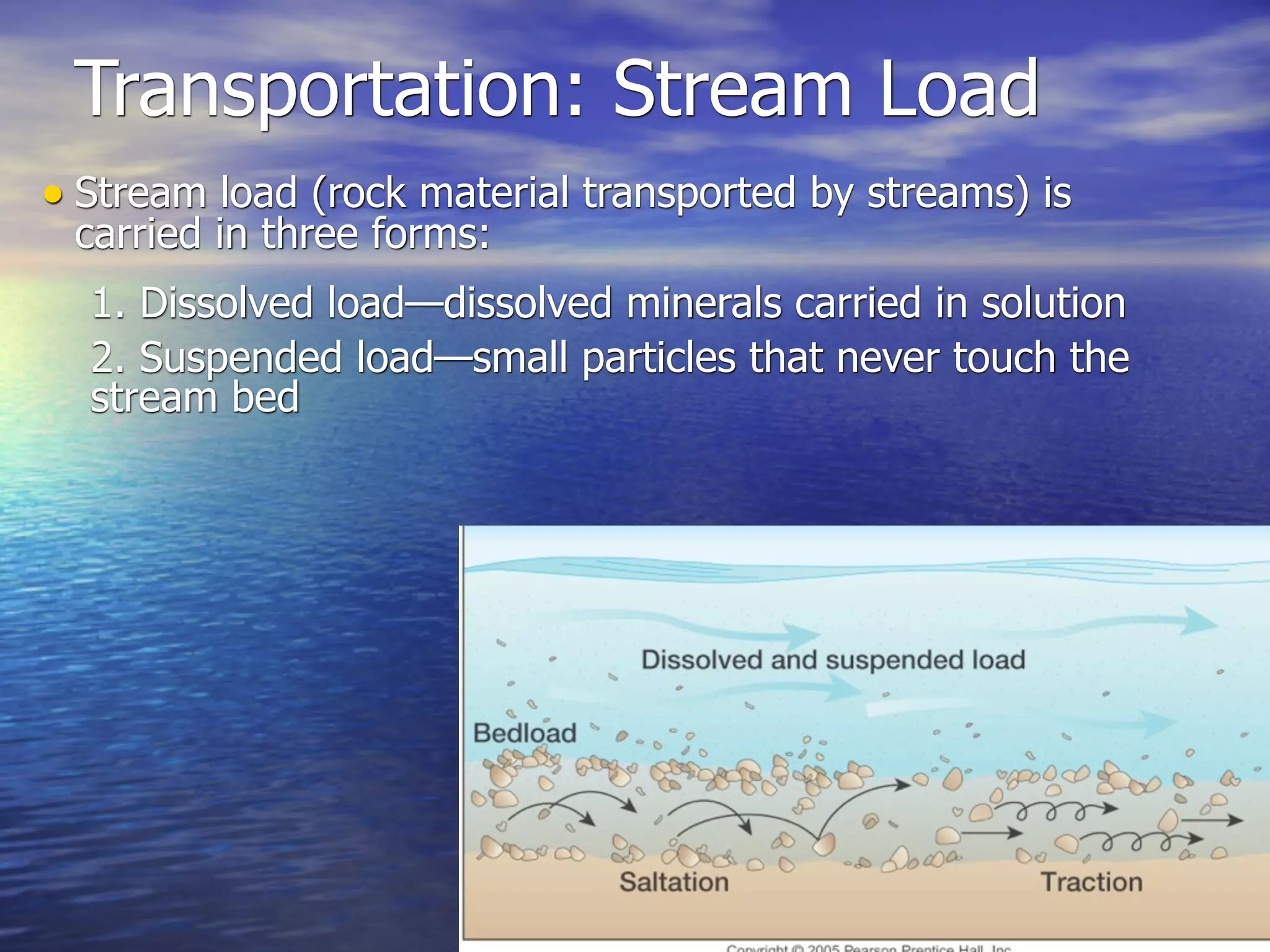
  1. Dissolved load—dissolved minerals carried in solution
  2. Suspended load—small particles that never touch the
  stream bed
Transportation: Stream Load
• Stream load (rock material transported by streams) is
 carried in three forms:
  1. Dissolved load—dissolved minerals carried in solution
  2. Suspended load—small particles that never touch the
  stream bed
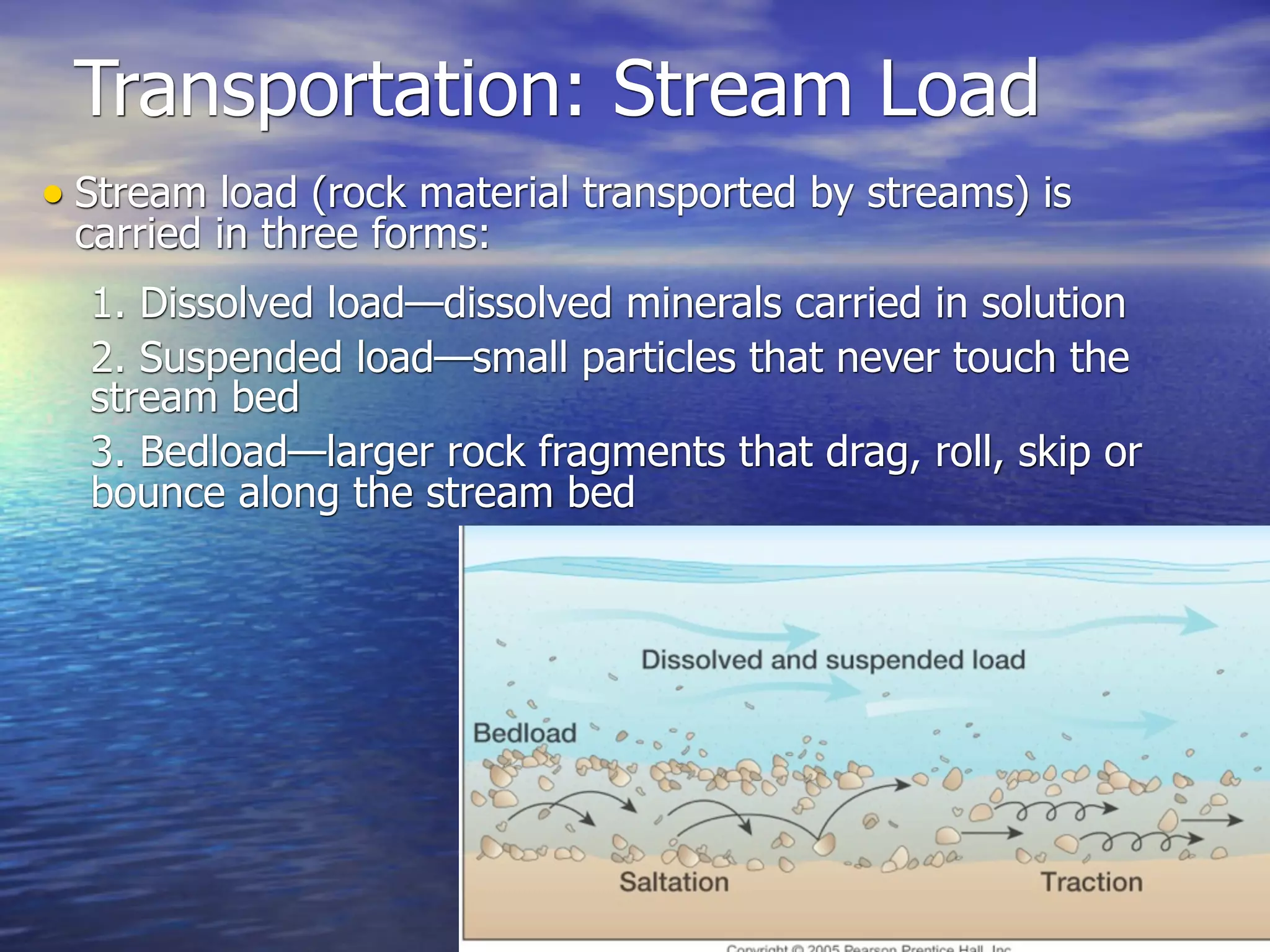
  3. Bedload—larger rock fragments that drag, roll, skip or
  bounce along the stream bed
Transportation: Stream Load
• Stream load (rock material transported by streams) is
 carried in three forms:
  1. Dissolved load—dissolved minerals carried in solution
  2. Suspended load—small particles that never touch the
  stream bed
  3. Bedload—larger rock fragments that drag, roll, skip or
  bounce along the stream bed


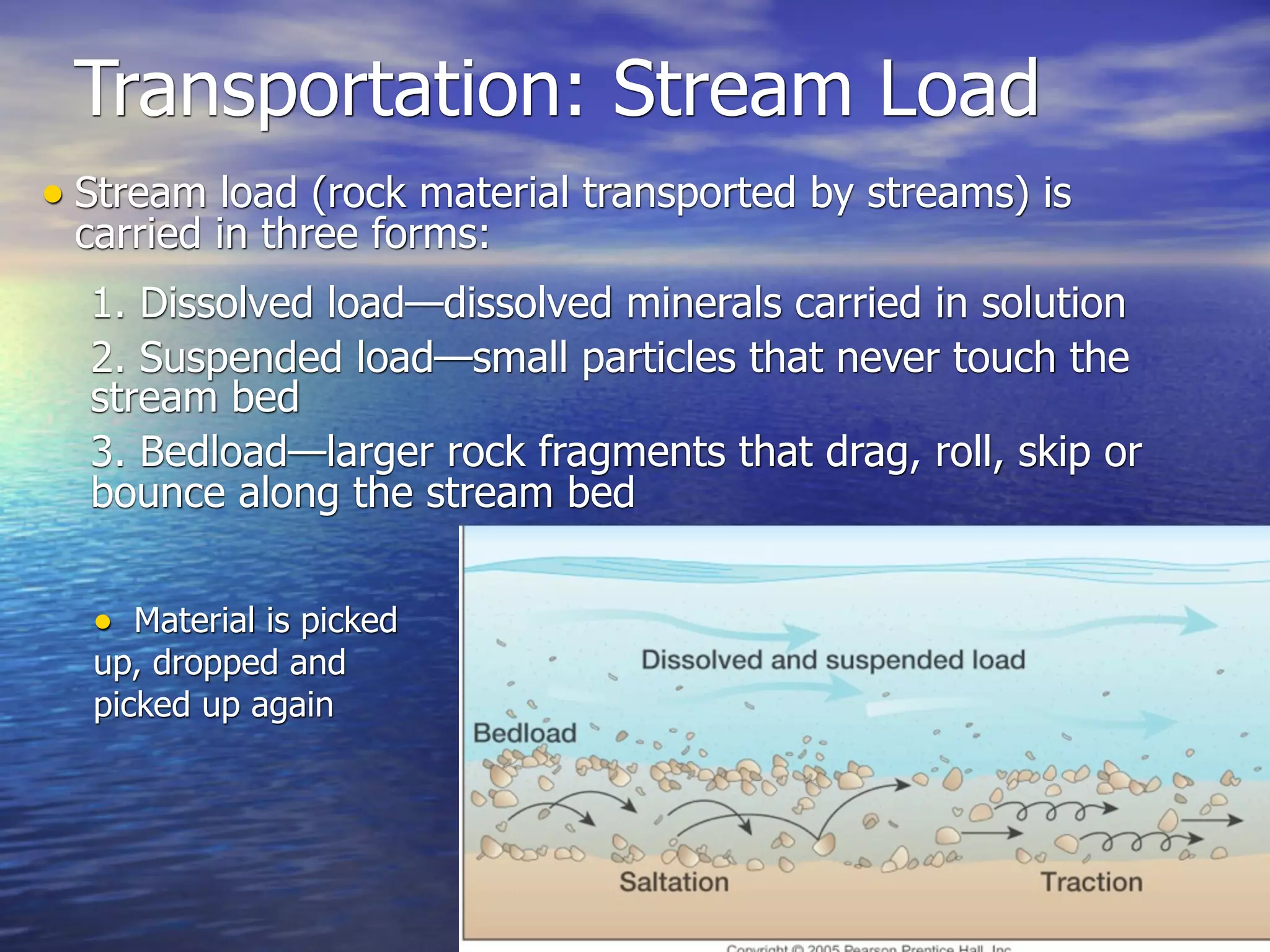
  • Material is picked
  up, dropped and
  picked up again
Transportation: Stream Load
• Stream load (rock material transported by streams) is
 carried in three forms:
  1. Dissolved load—dissolved minerals carried in solution
  2. Suspended load—small particles that never touch the
  stream bed
  3. Bedload—larger rock fragments that drag, roll, skip or
  bounce along the stream bed


  • Material is picked
  up, dropped and
  picked up again
Transportation: Stream Load
• Stream load (rock material transported by streams) is
 carried in three forms:
  1. Dissolved load—dissolved minerals carried in solution
  2. Suspended load—small particles that never touch the
  stream bed
  3. Bedload—larger rock fragments that drag, roll, skip or
  bounce along the stream bed


  • Material is picked
  up, dropped and
  picked up again
Transportation: Competence
• The faster the stream is flowing, the larger
  the particles it can transport
Transportation: Competence
• The faster the stream is flowing, the larger
  the particles it can transport
• This measurement is called competence
Transportation: Competence
• The faster the stream is flowing, the larger
  the particles it can transport
• This measurement is called competence
 – Competence varies to the sixth power of the
   water’s speed
Transportation: Competence
• The faster the stream is flowing, the larger
  the particles it can transport
• This measurement is called competence
 – Competence varies to the sixth power of the
   water’s speed
                If flow speed doubles:
Transportation: Competence
• The faster the stream is flowing, the larger
  the particles it can transport
• This measurement is called competence
 – Competence varies to the sixth power of the
   water’s speed
                If flow speed doubles:
                      26 = 64 times the size!
Transportation: Competence
• The faster the stream is flowing, the larger
  the particles it can transport
• This measurement is called competence
 – Competence varies to the sixth power of the
   water’s speed
                 If flow speed doubles:
                       26 = 64 times the size!
 – This is why flood events are so significant in
   stream transportation
Transportation: Capacity

• Capacity—A measure of the amount of solid
  material potentially transported (volume/time
  past a given point: gal/sec)
• The capacity of a given stream depends on:
Transportation: Capacity

• Capacity—A measure of the amount of solid
  material potentially transported (volume/time
  past a given point: gal/sec)
• The capacity of a given stream depends on:
  1. Water volume
     (volume↑, capacity↑)
Transportation: Capacity

• Capacity—A measure of the amount of solid
  material potentially transported (volume/time
  past a given point: gal/sec)
• The capacity of a given stream depends on:
  1. Water volume
     (volume↑, capacity↑)
  2. Flow speed
     (flow speed↑, capacity↑)
Transportation: Capacity

• Capacity—A measure of the amount of solid
  material potentially transported (volume/time
  past a given point: gal/sec)
• The capacity of a given stream depends on:
  1. Water volume
     (volume↑, capacity↑)
  2. Flow speed
     (flow speed↑, capacity↑)
  3. The type of load material
Transportation: Capacity

• Capacity—A measure of the amount of solid
  material potentially transported (volume/time
  past a given point: gal/sec)
• The capacity of a given stream depends on:
  1. Water volume
     (volume↑, capacity↑)
  2. Flow speed
     (flow speed↑, capacity↑)
  3. The type of load material
     (lighter material, capacity↑)
Deposition

• Deposition occurs when either flow speed or
  volume decrease
• Conditions that cause deposition:
 –Change in gradient
 –Channel widening
 –Change of direction
 –Flowing into less active water
Deposition: Alluvium

• Alluvium—Any stream-deposited debris
 –Sorting—Based on size (smaller particles carried
  farther than large ones; as stream flow decreases,
  larger particles will drop out of suspension first)
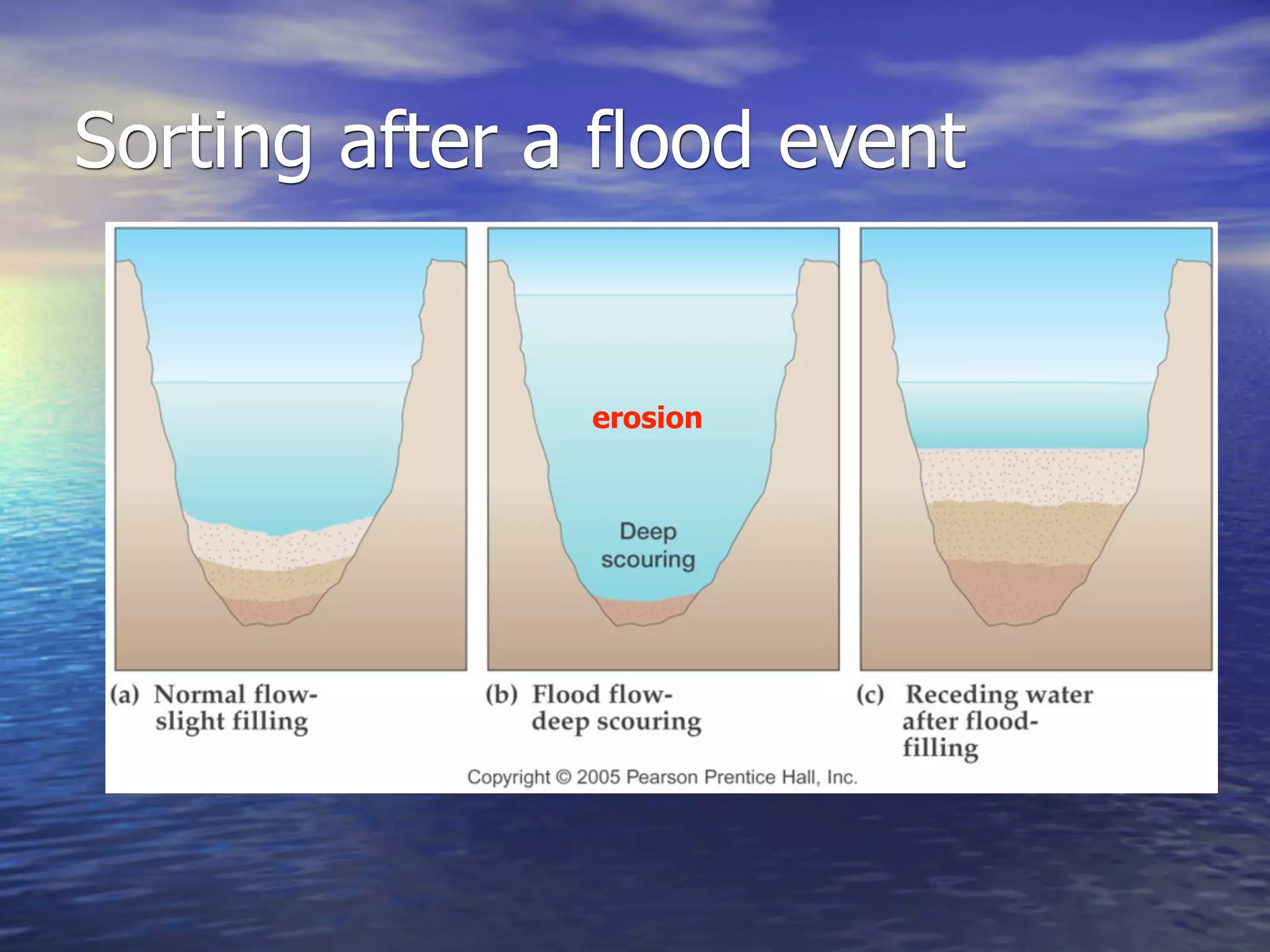
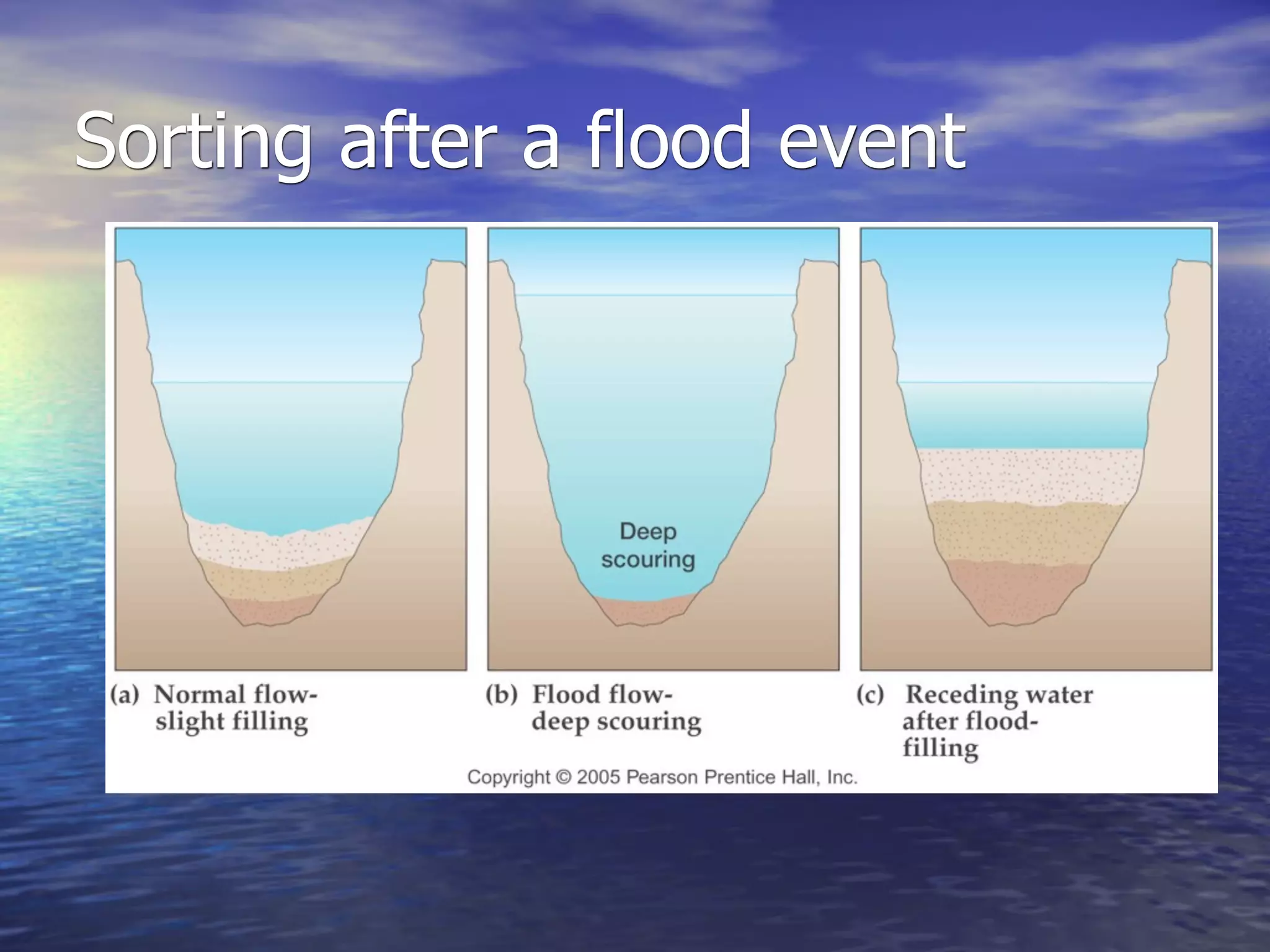
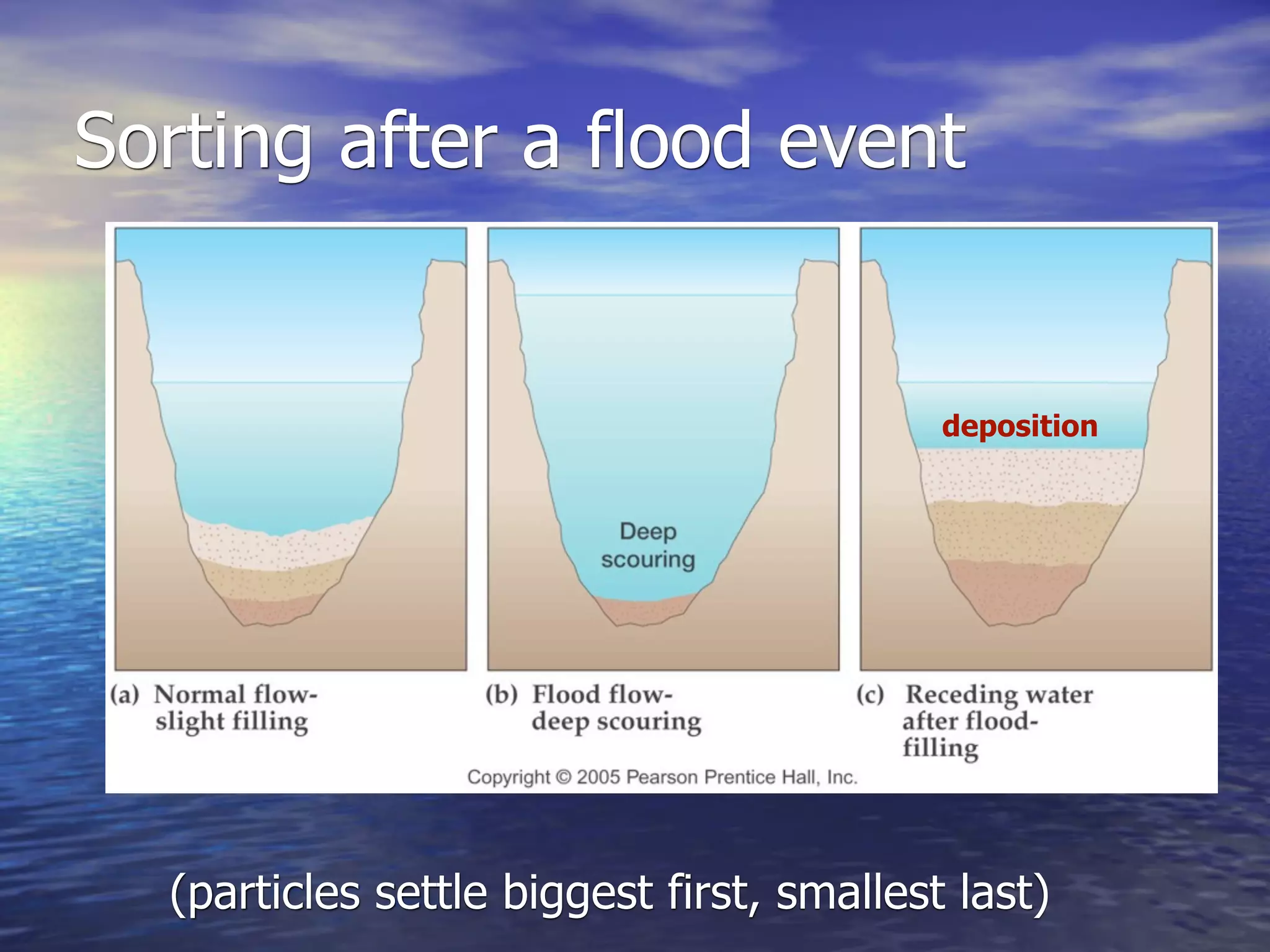
Sorting after a flood event


               erosion
Sorting after a flood event


                          deposition
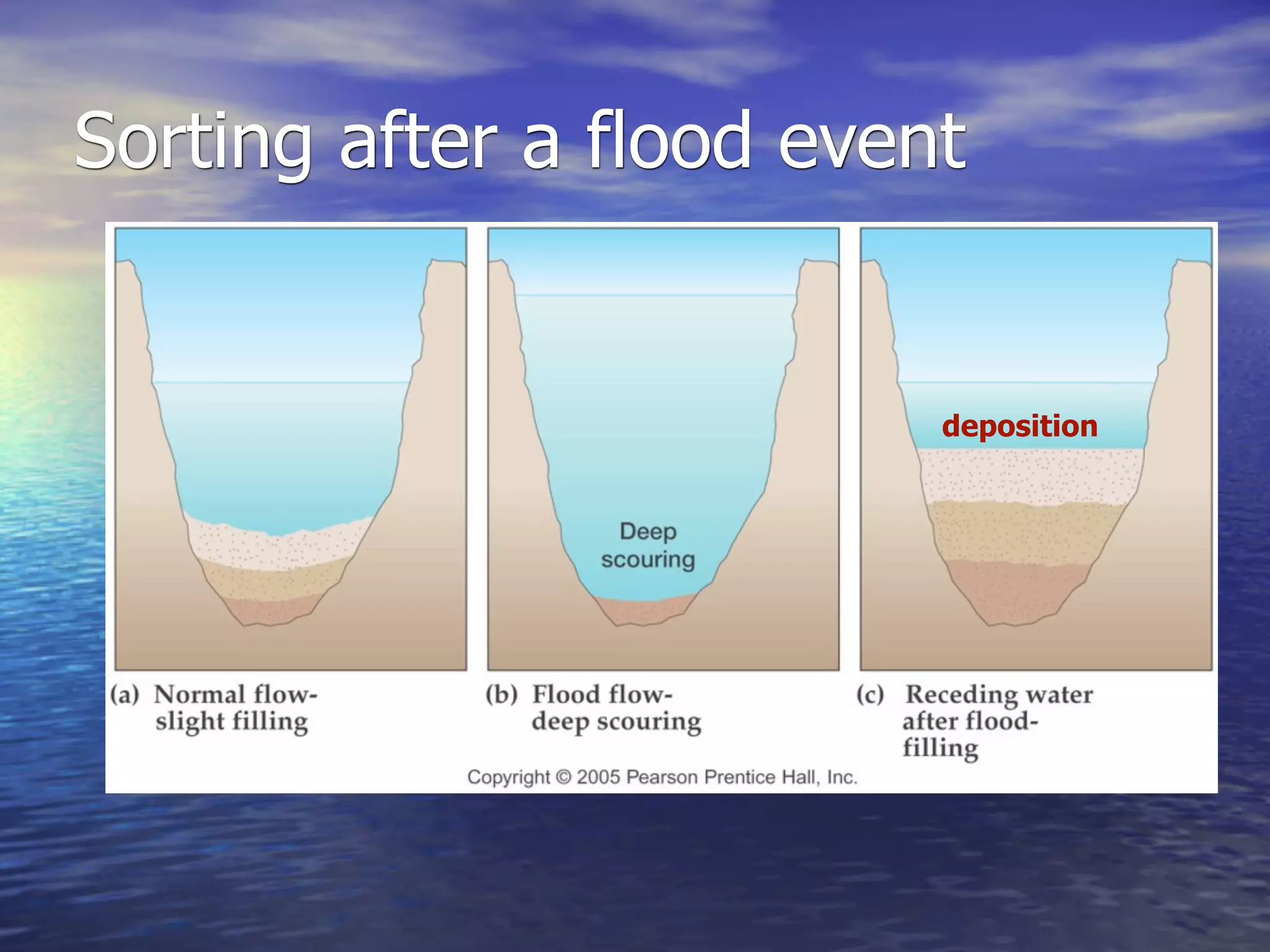
Sorting after a flood event


                                           deposition


  (particles settle biggest first, smallest last)
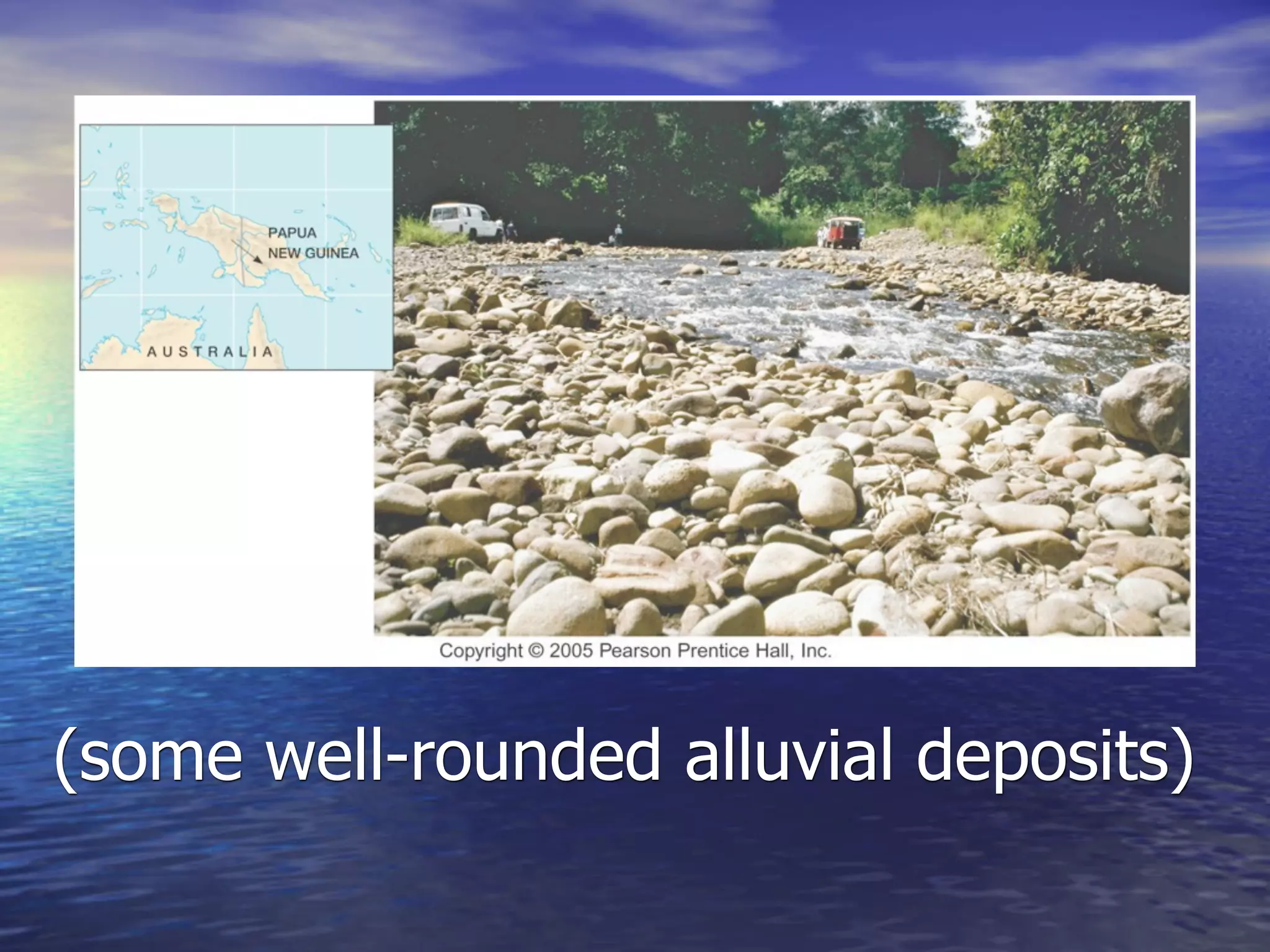
Deposition: Alluvium

• Alluvium
 –Particle shape—Alluvial material is generally
  smooth and round due to rocks hitting each other
  and the stream bed; the longer it’s transported in
  the stream, the more rounded and smooth a rock
  will become
(some well-rounded alluvial deposits)
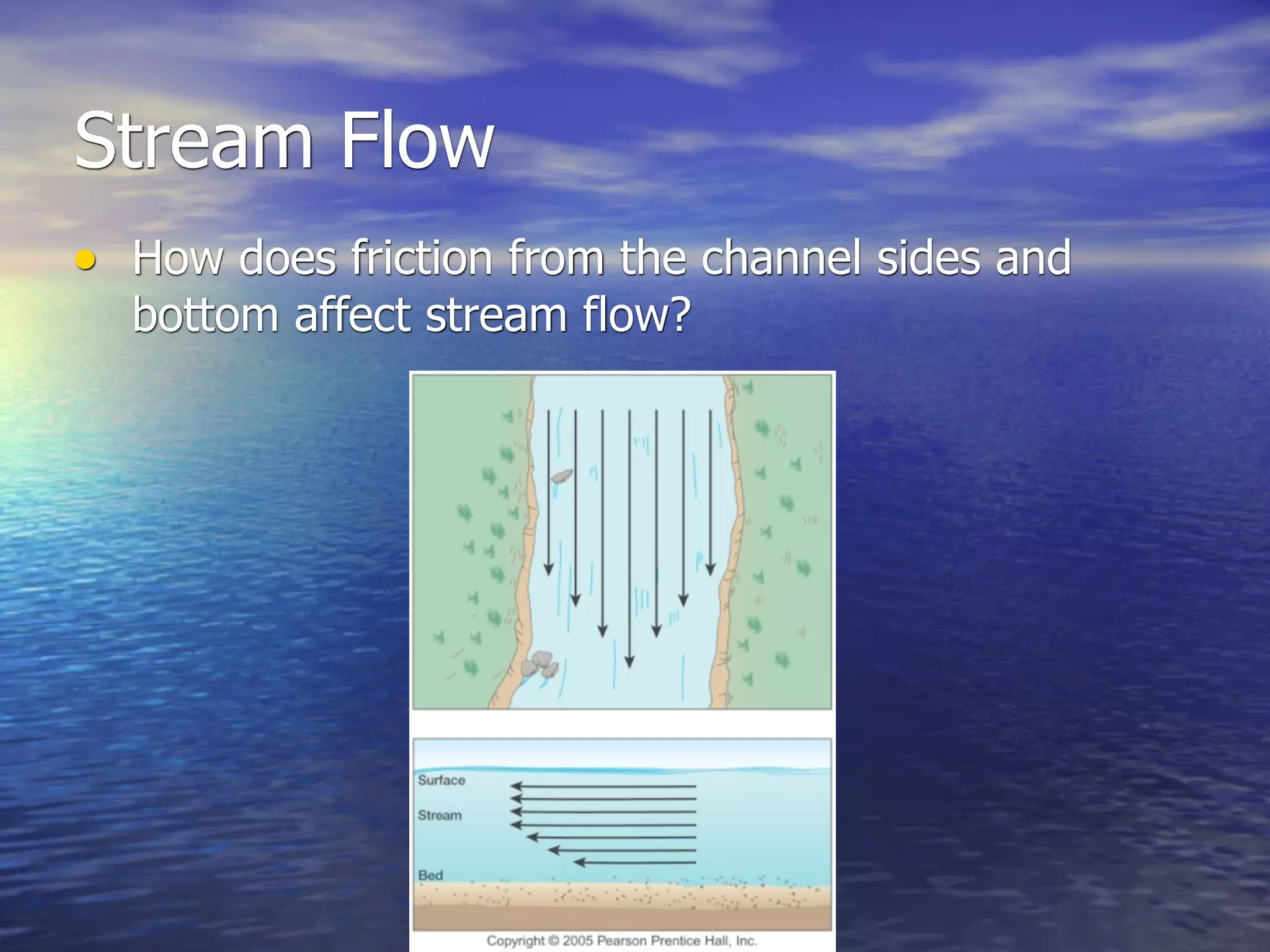
Stream Flow
• How does friction from the channel sides and
  bottom affect stream flow?
Stream Flow
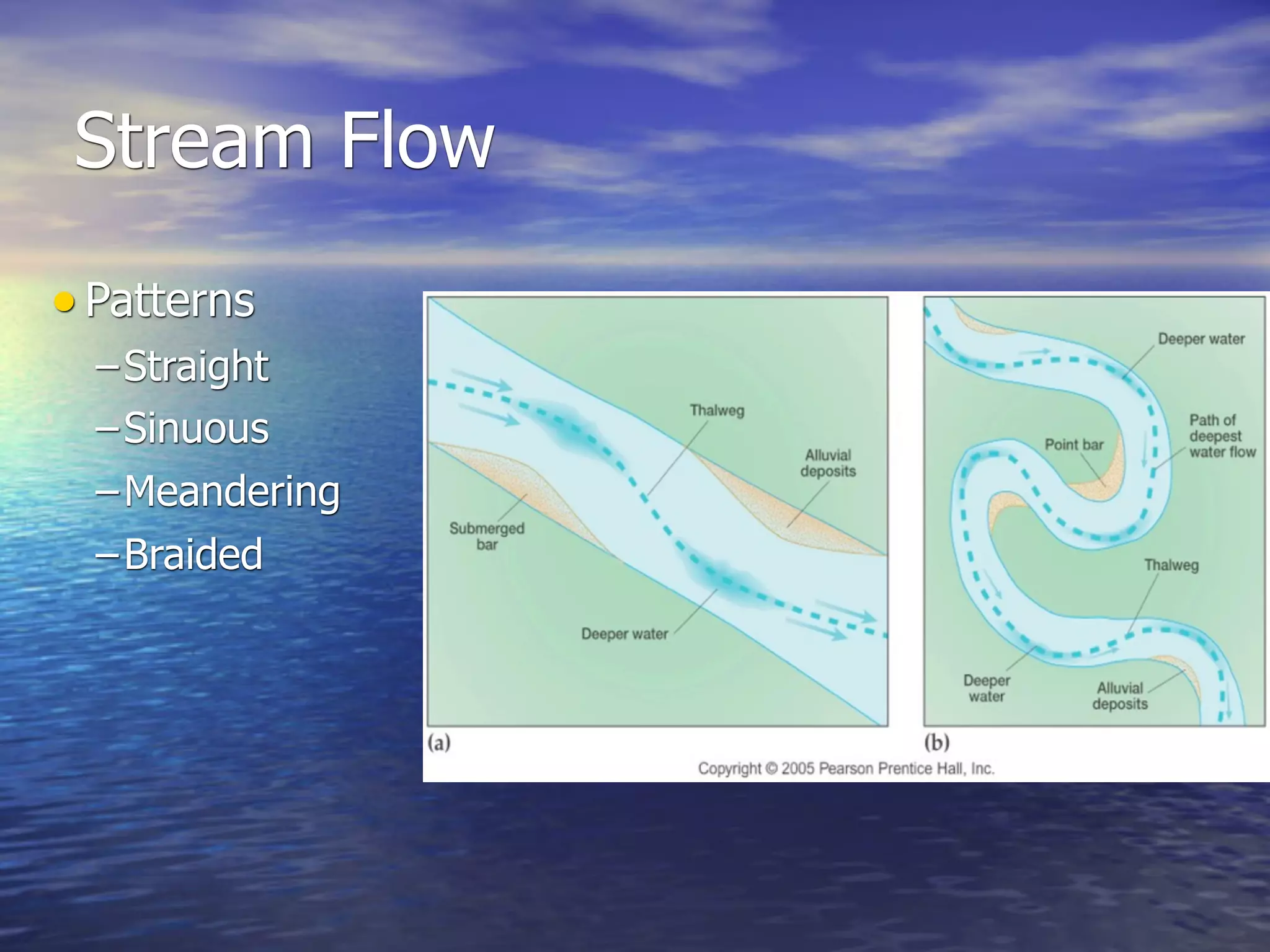
• Patterns
  – Straight
  – Sinuous
  – Meandering
  – Braided
Stream Flow
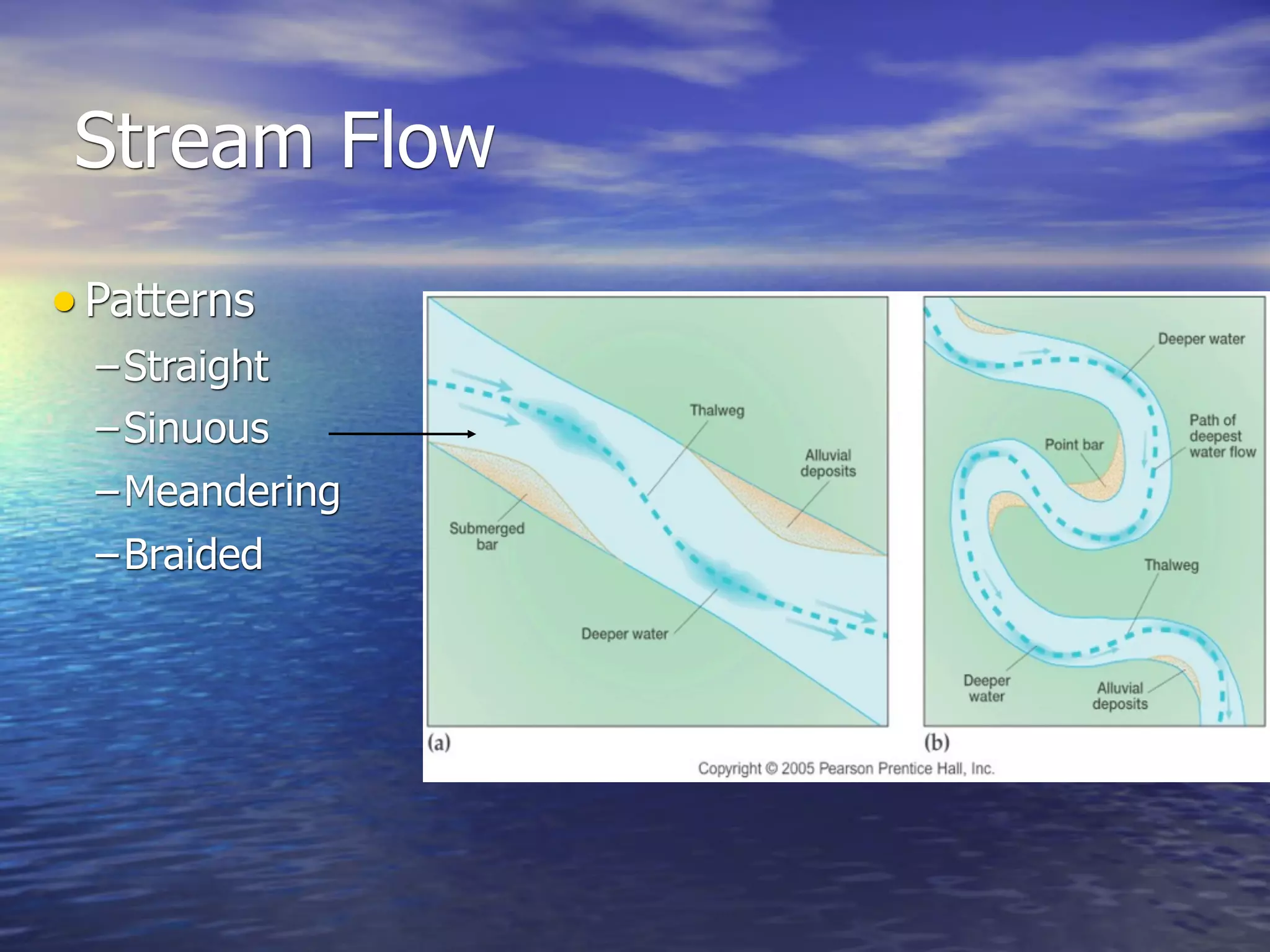
• Patterns
  – Straight
  – Sinuous
  – Meandering
  – Braided
Stream Flow
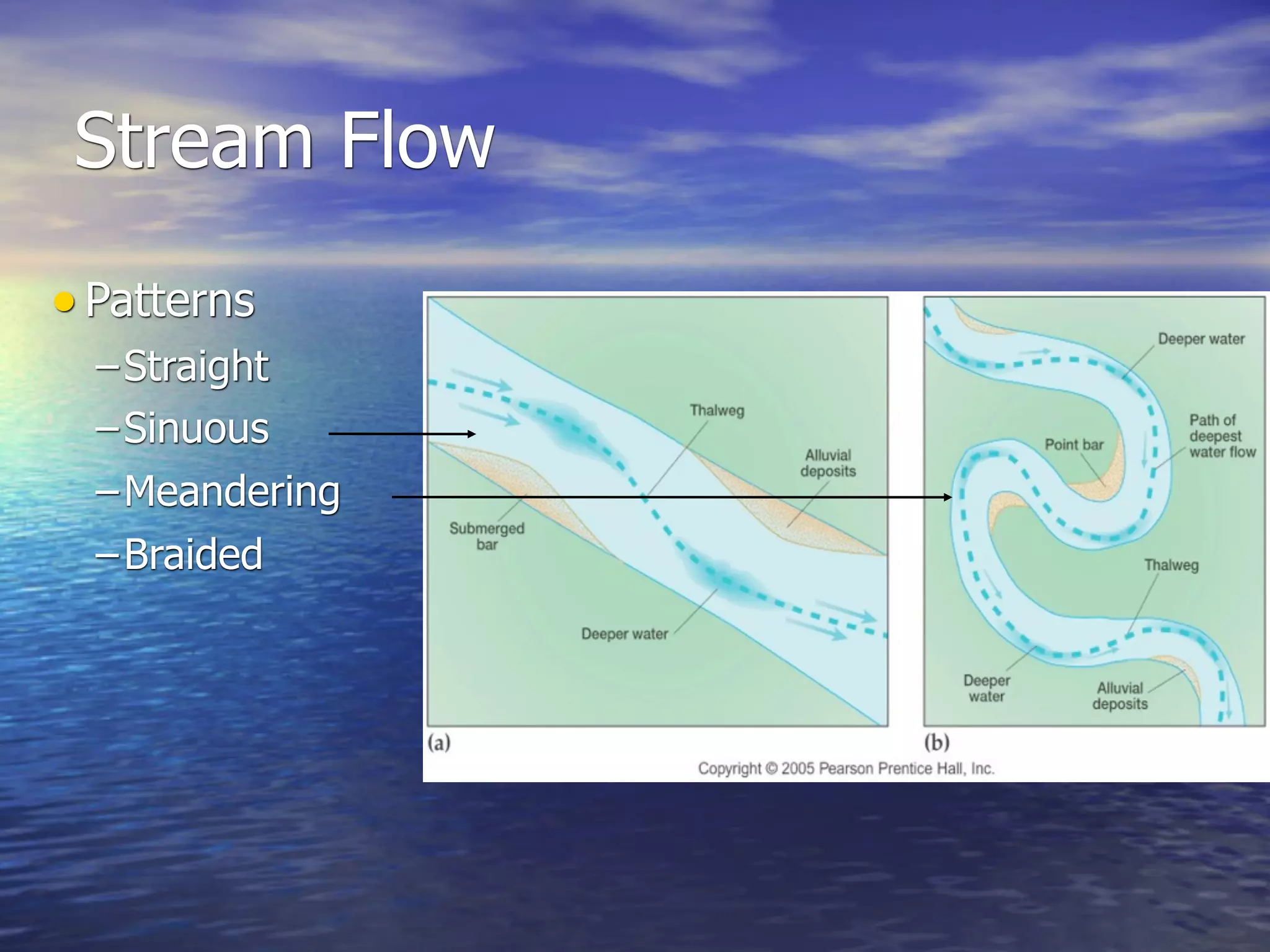
• Patterns
  – Straight
  – Sinuous
  – Meandering
  – Braided
Stream Flow
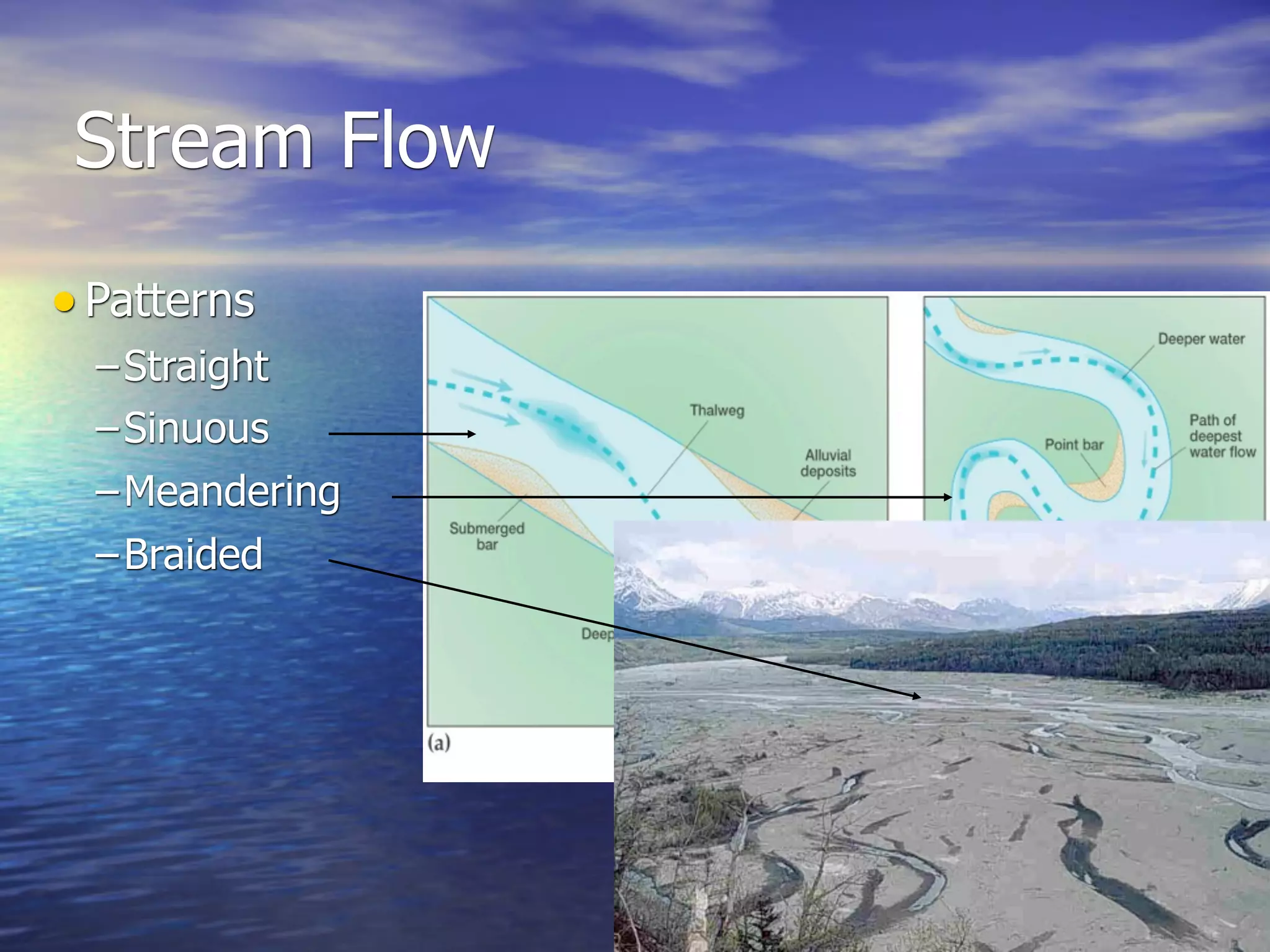
• Patterns
  – Straight
  – Sinuous
  – Meandering
  – Braided
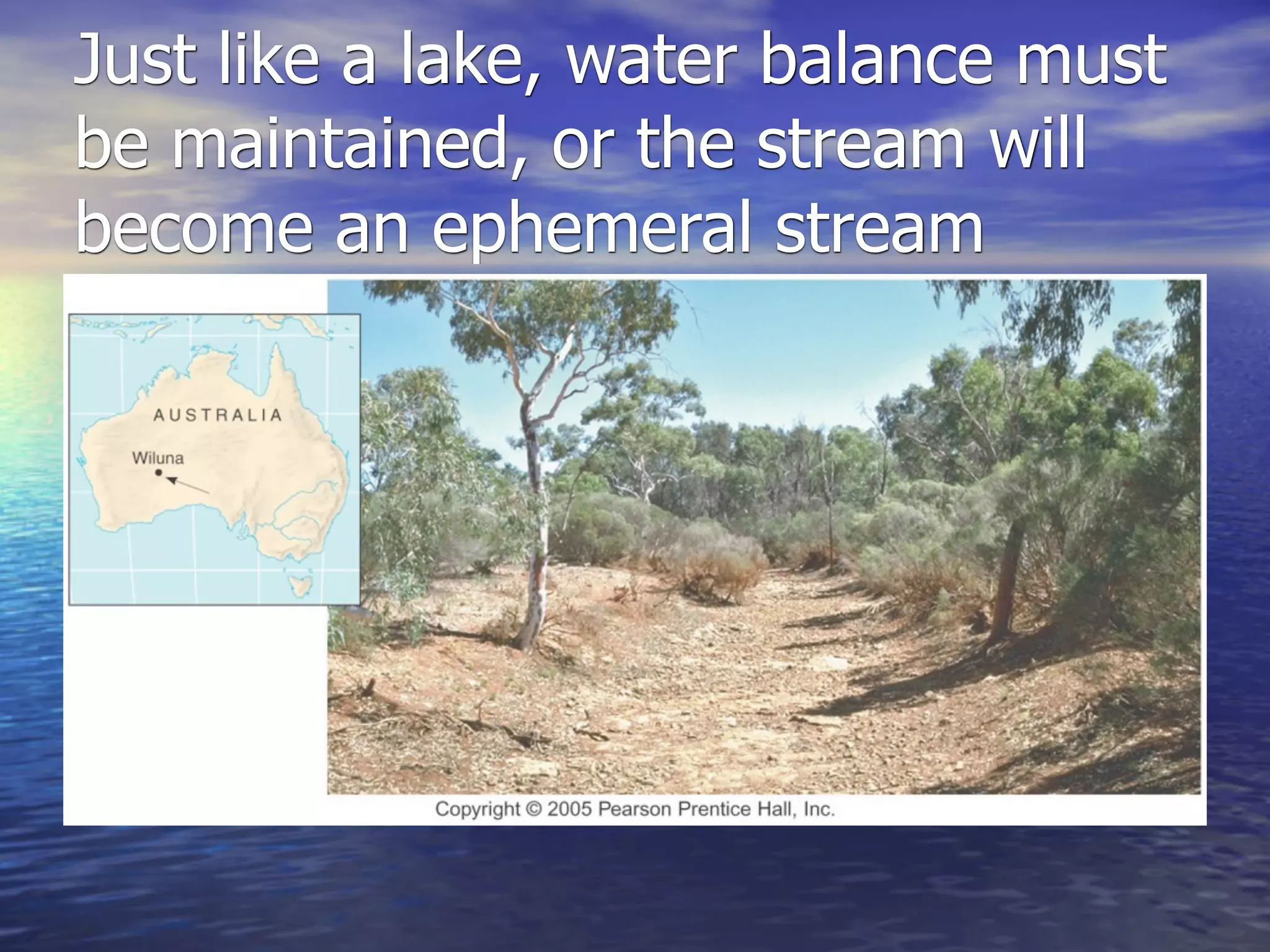
Just like a lake, water balance must
be maintained, or the stream will
become an ephemeral stream
Equilibrium: A Graded Stream

• All factors are balanced (gravity, stream
   load, deposition, down-cutting)

• A graded condition is more theoretical than
   actual, because equilibrium is so difficult to
   achieve—and maintain
Which processes happen as a stream
tries to attain a graded condition?
• Valley deepening
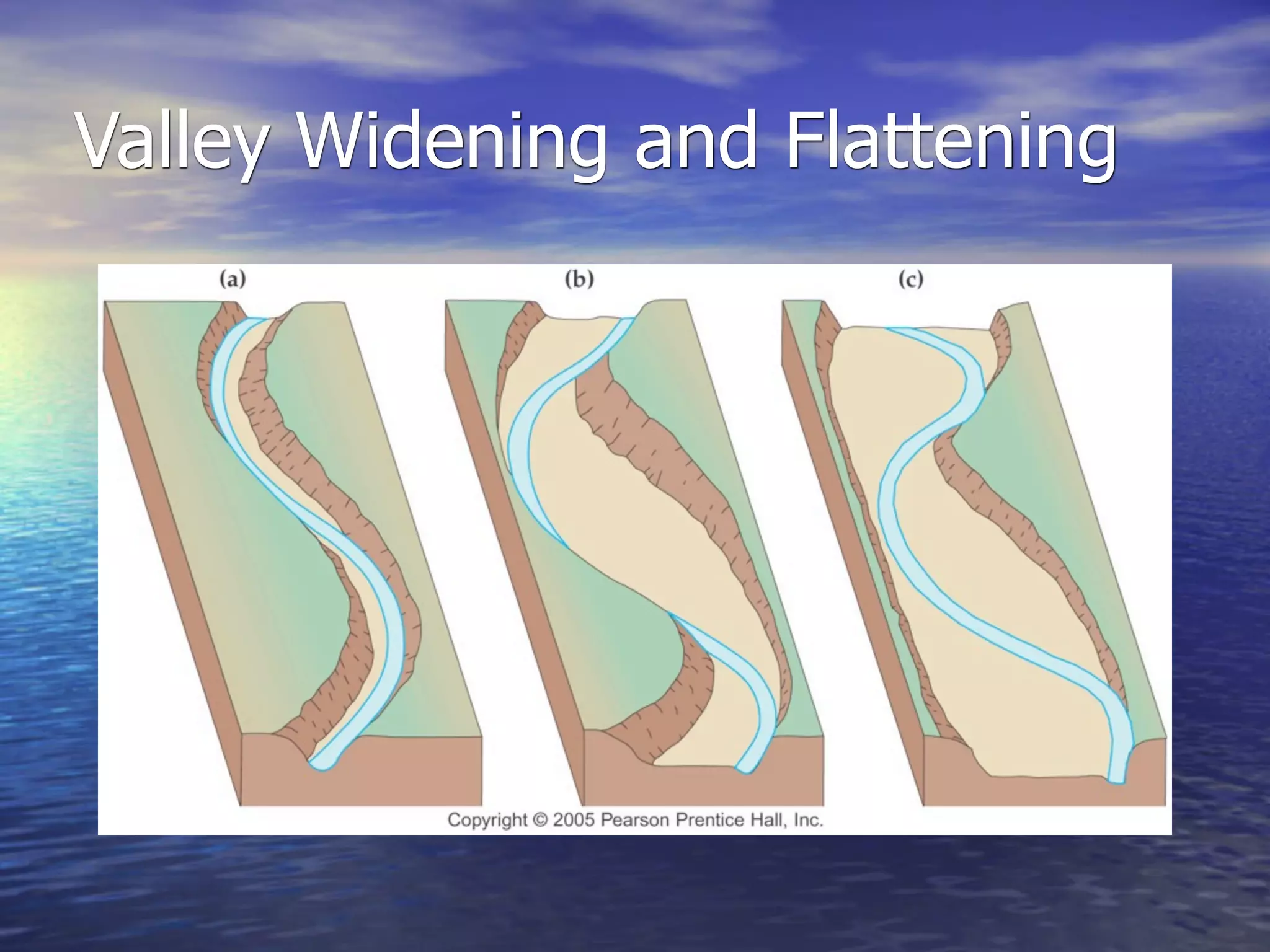
• Valley widening and flattening
• Valley lengthening
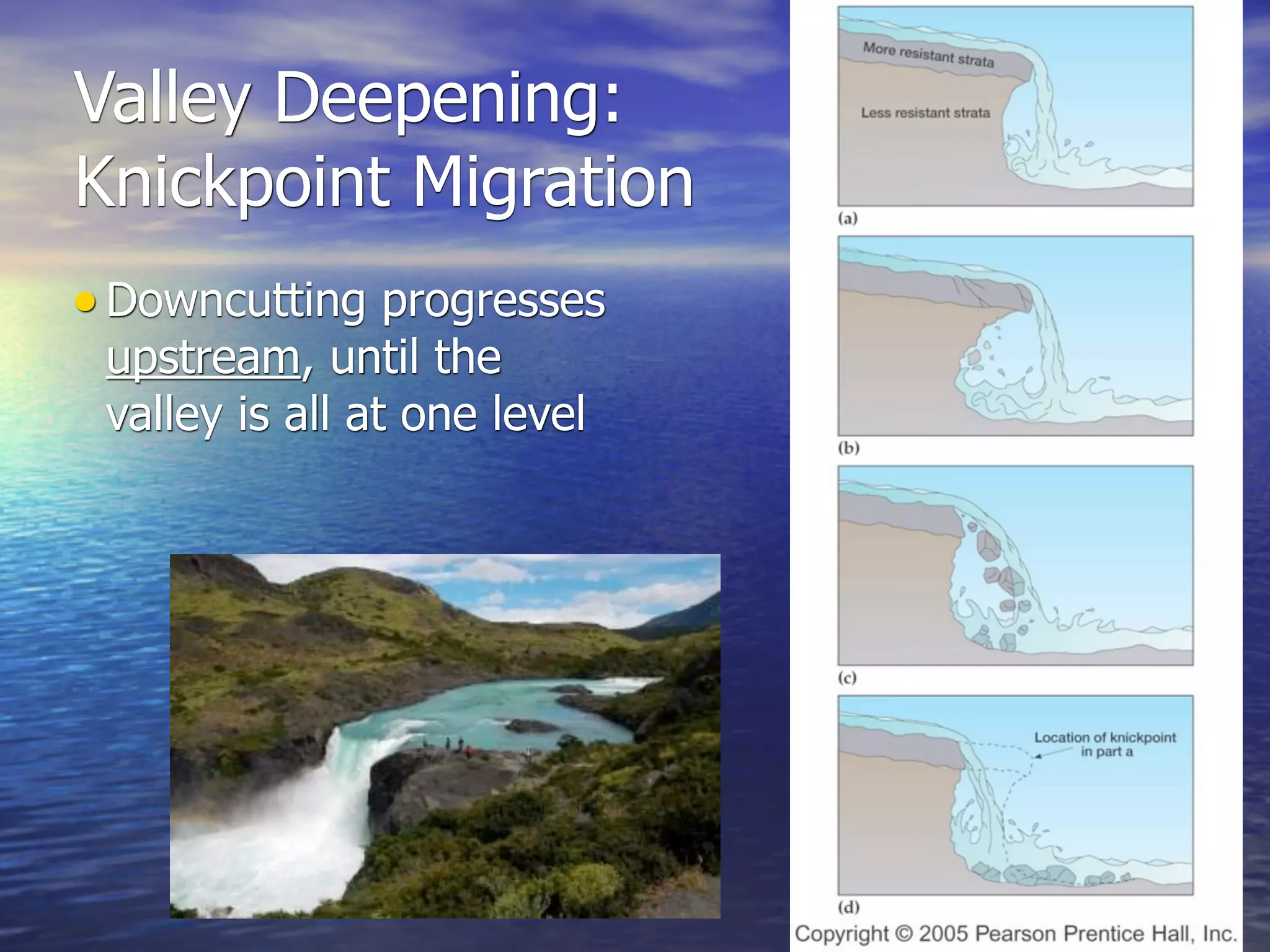
Valley Deepening:
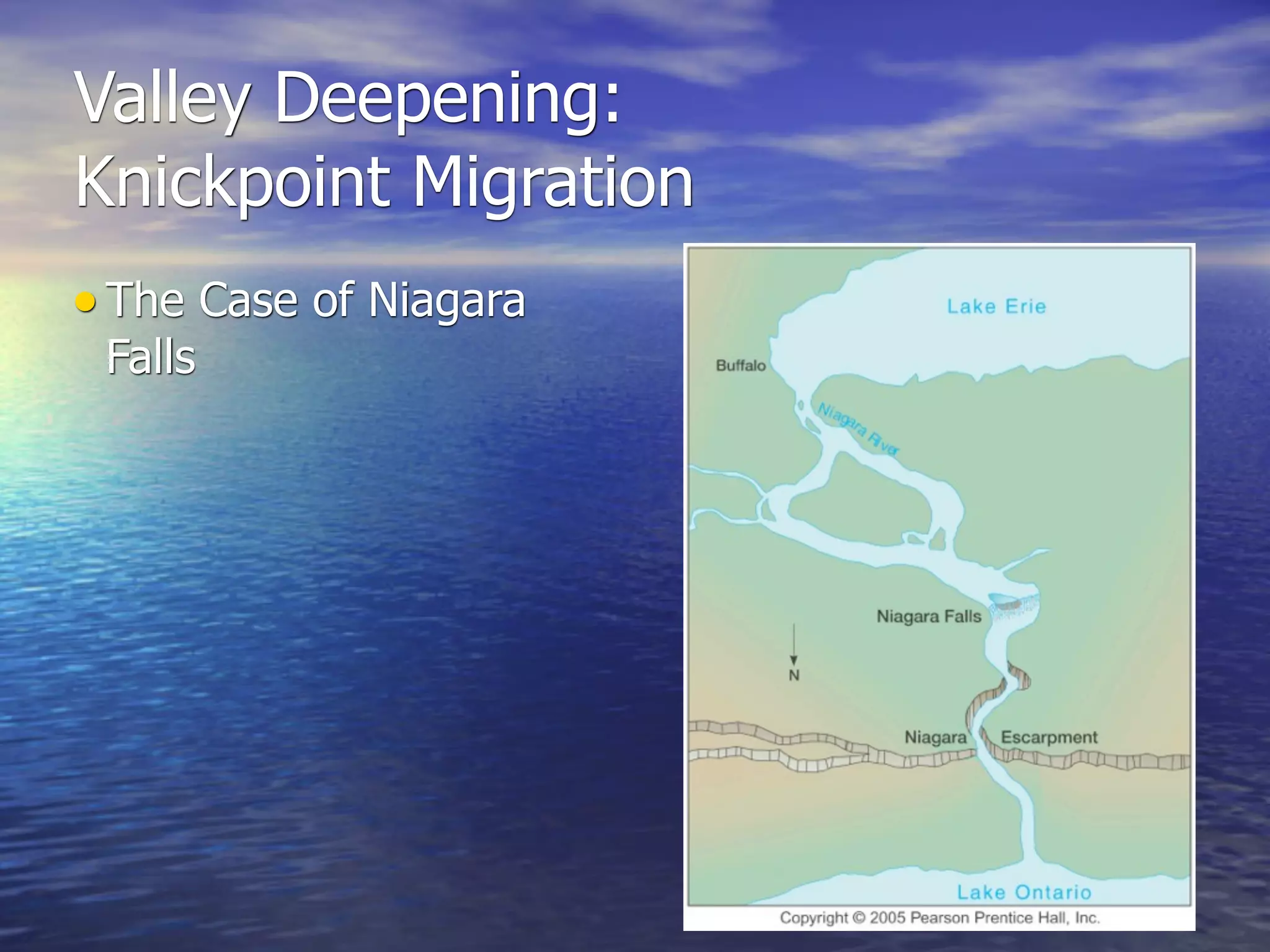
Knickpoint Migration
• Downcutting progresses
 upstream, until the
 valley is all at one level
Valley Deepening:
Knickpoint Migration
• The Case of Niagara
 Falls
Valley Widening and Flattening


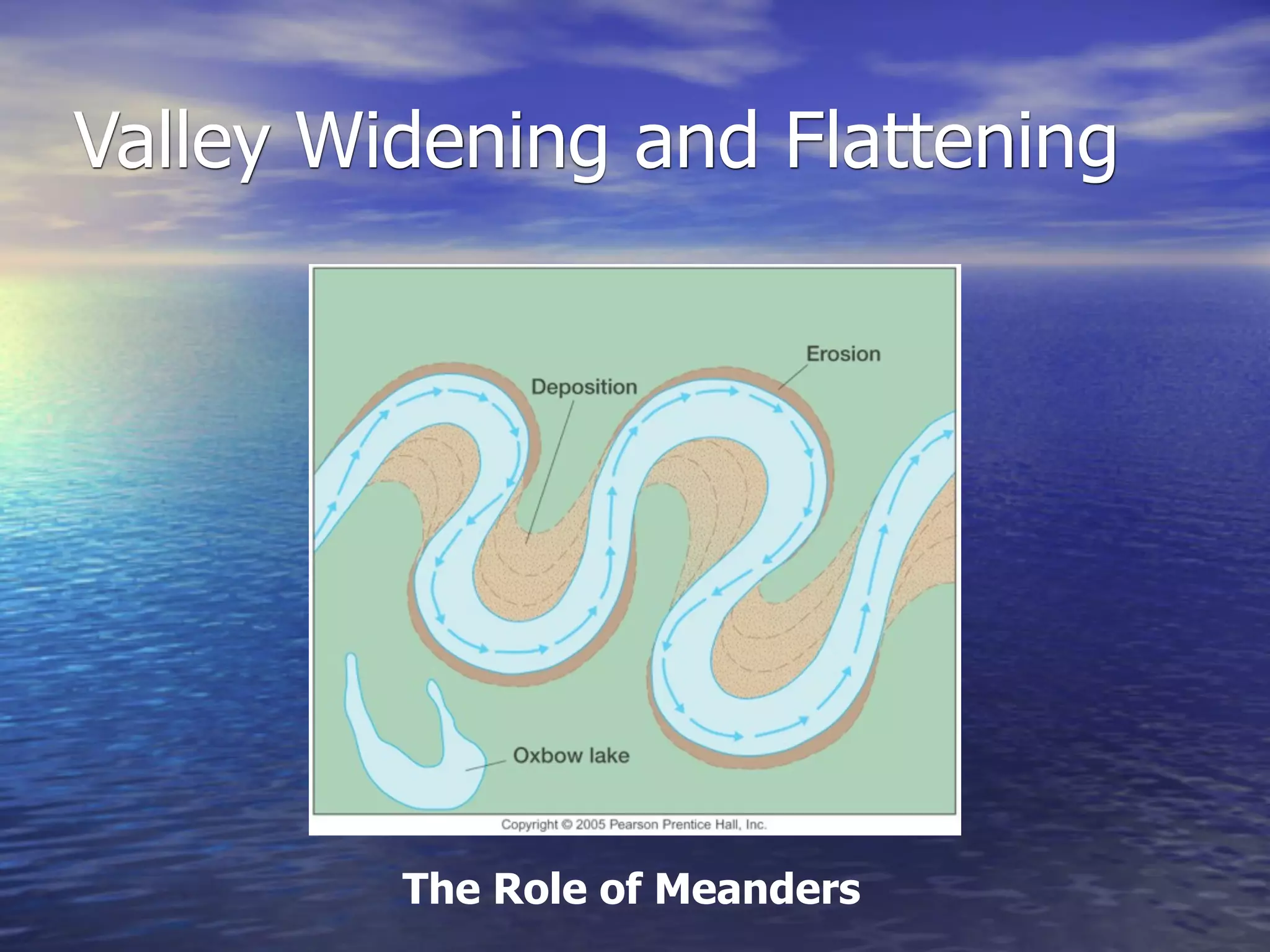
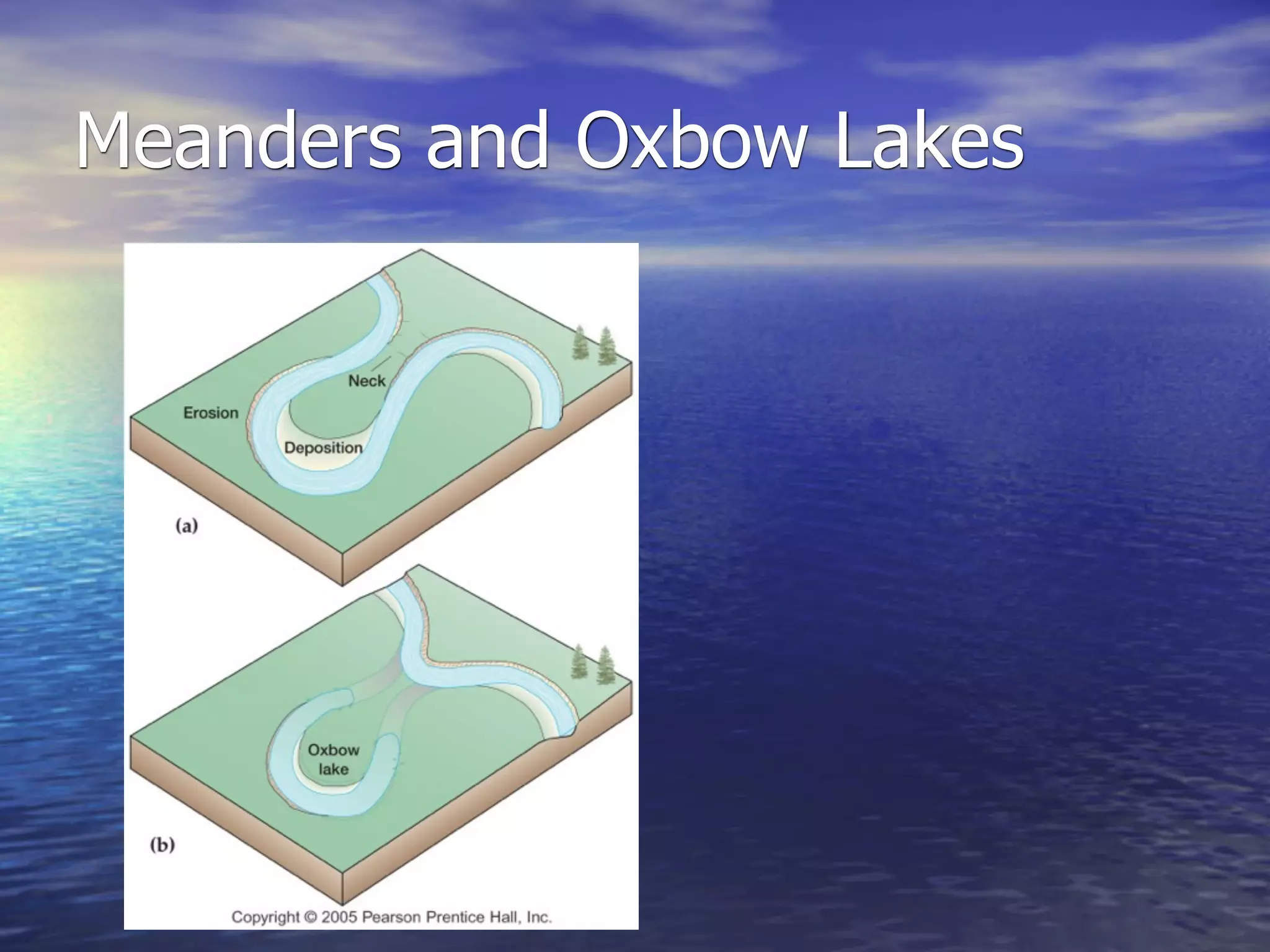
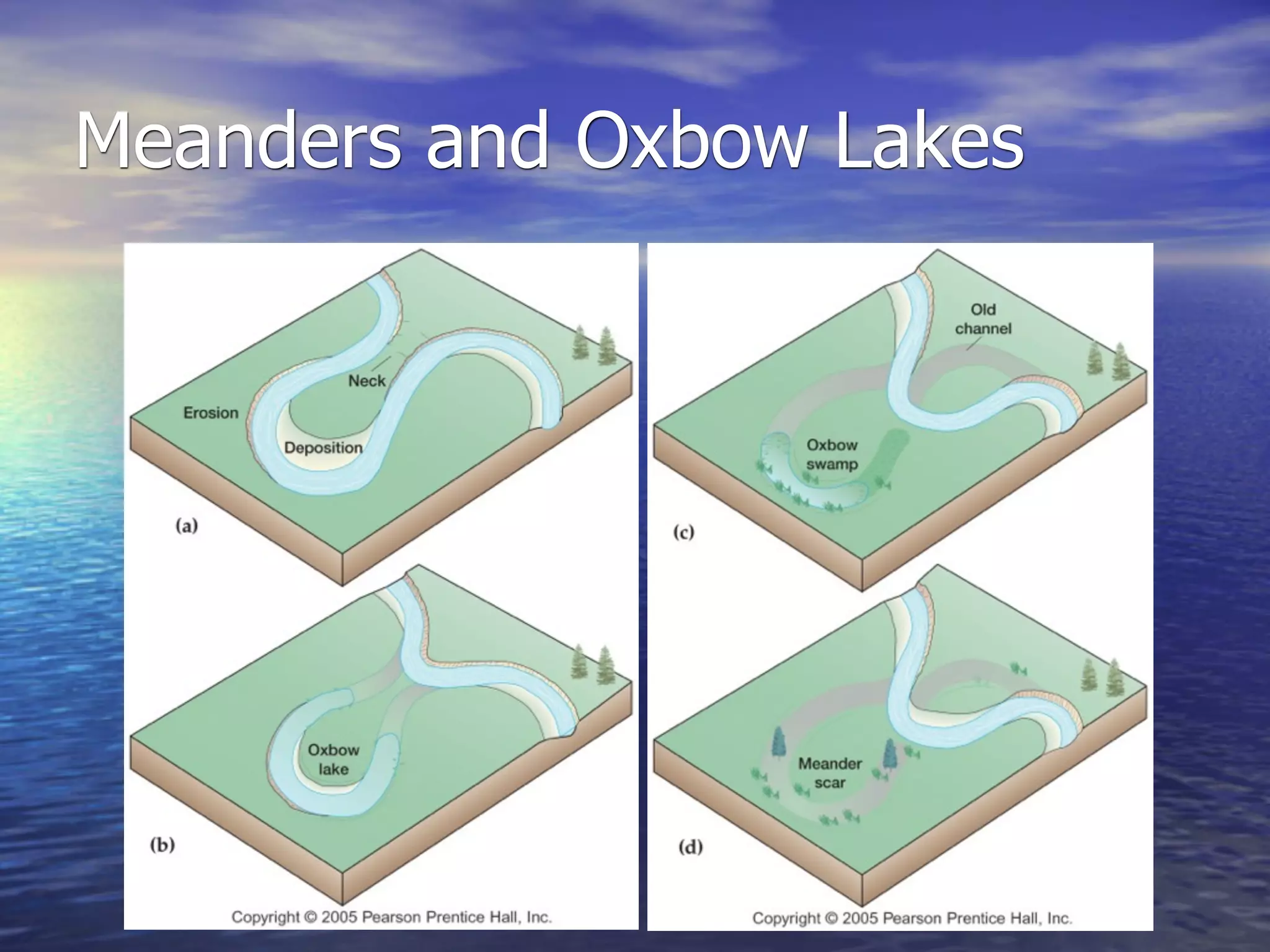
         The Role of Meanders
Meanders and Oxbow Lakes
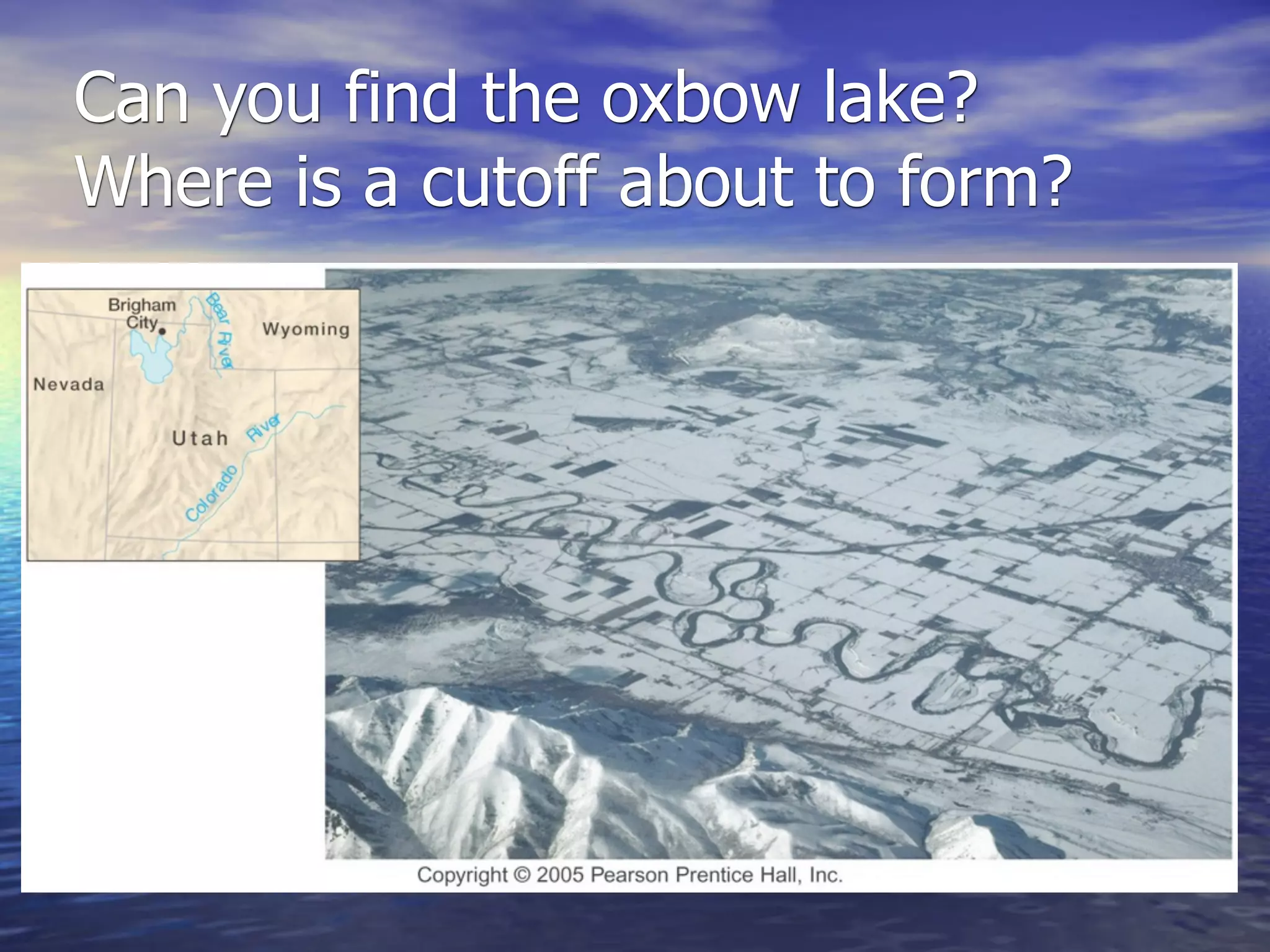
Can you find the oxbow lake?
Where is a cutoff about to form?
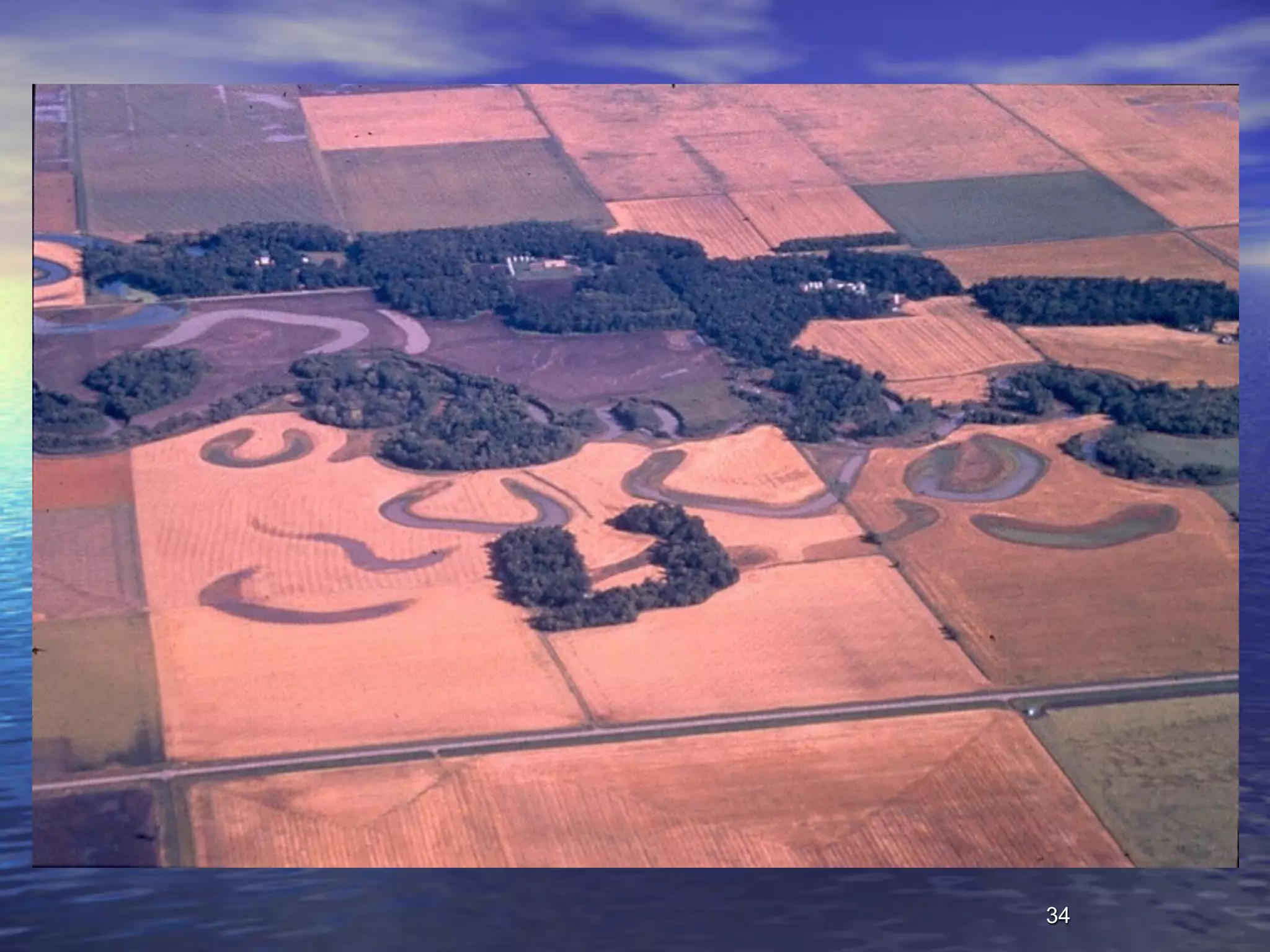
34
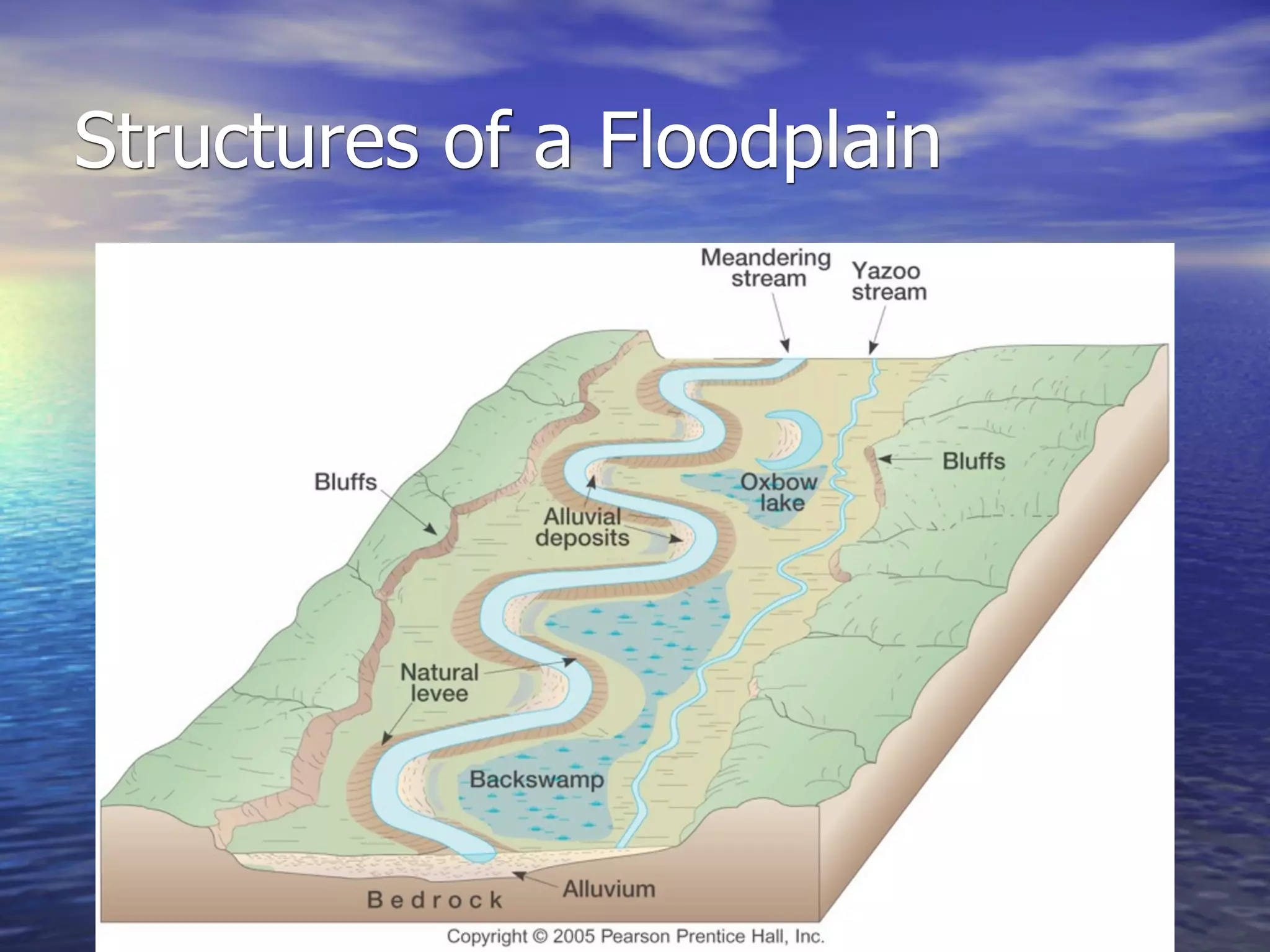
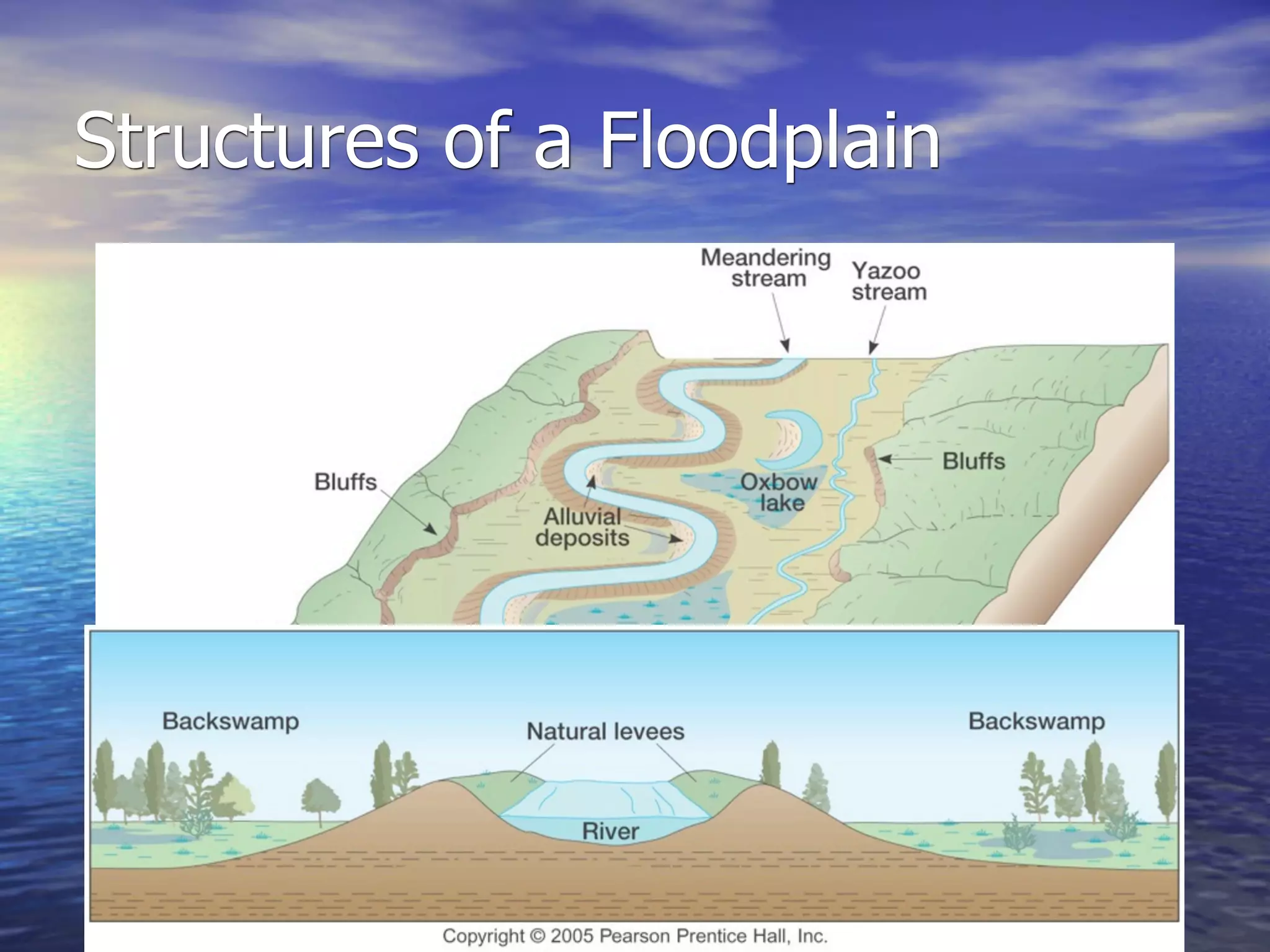
Structures of a Floodplain
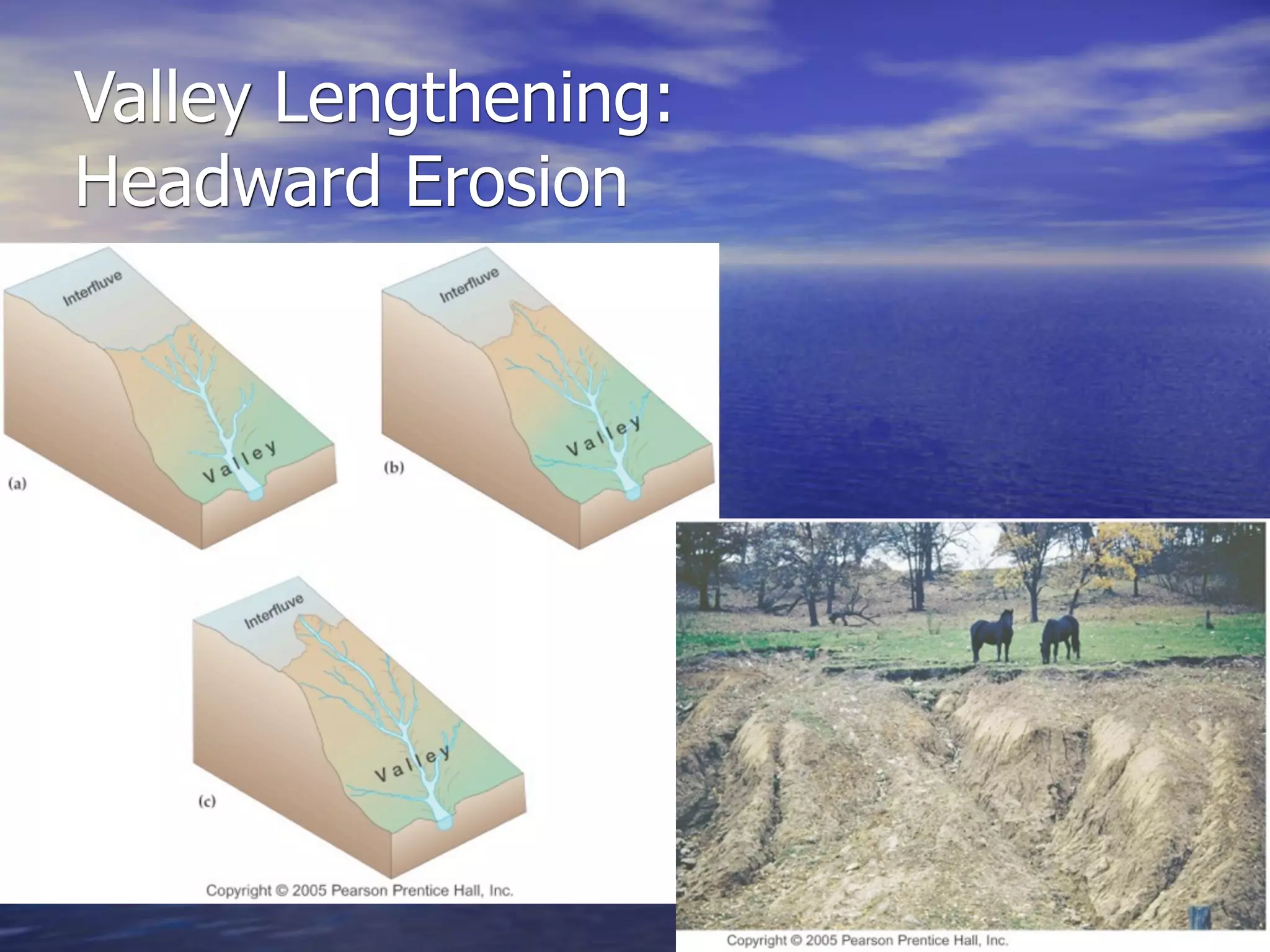
Valley Lengthening:
Headward Erosion
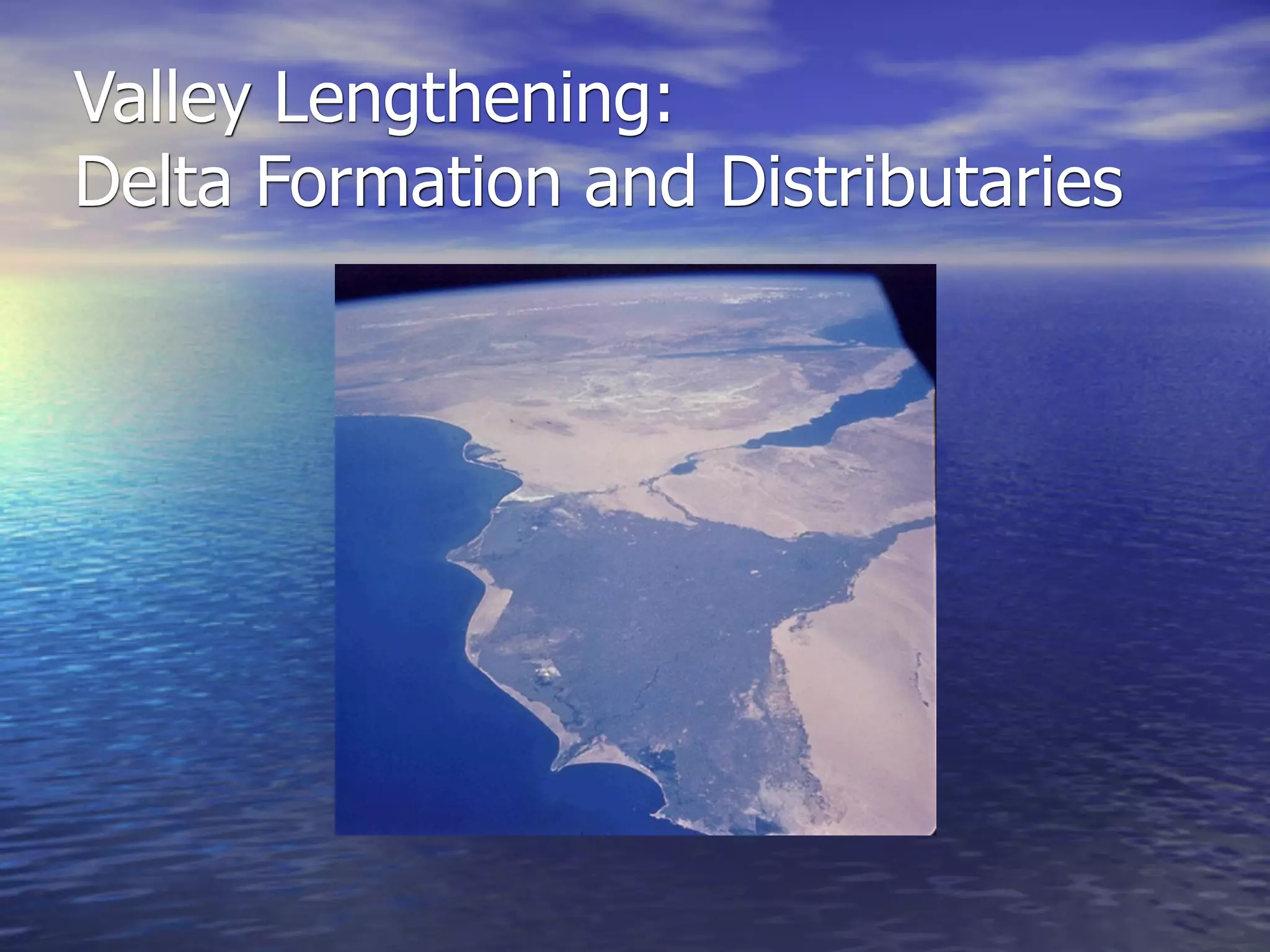
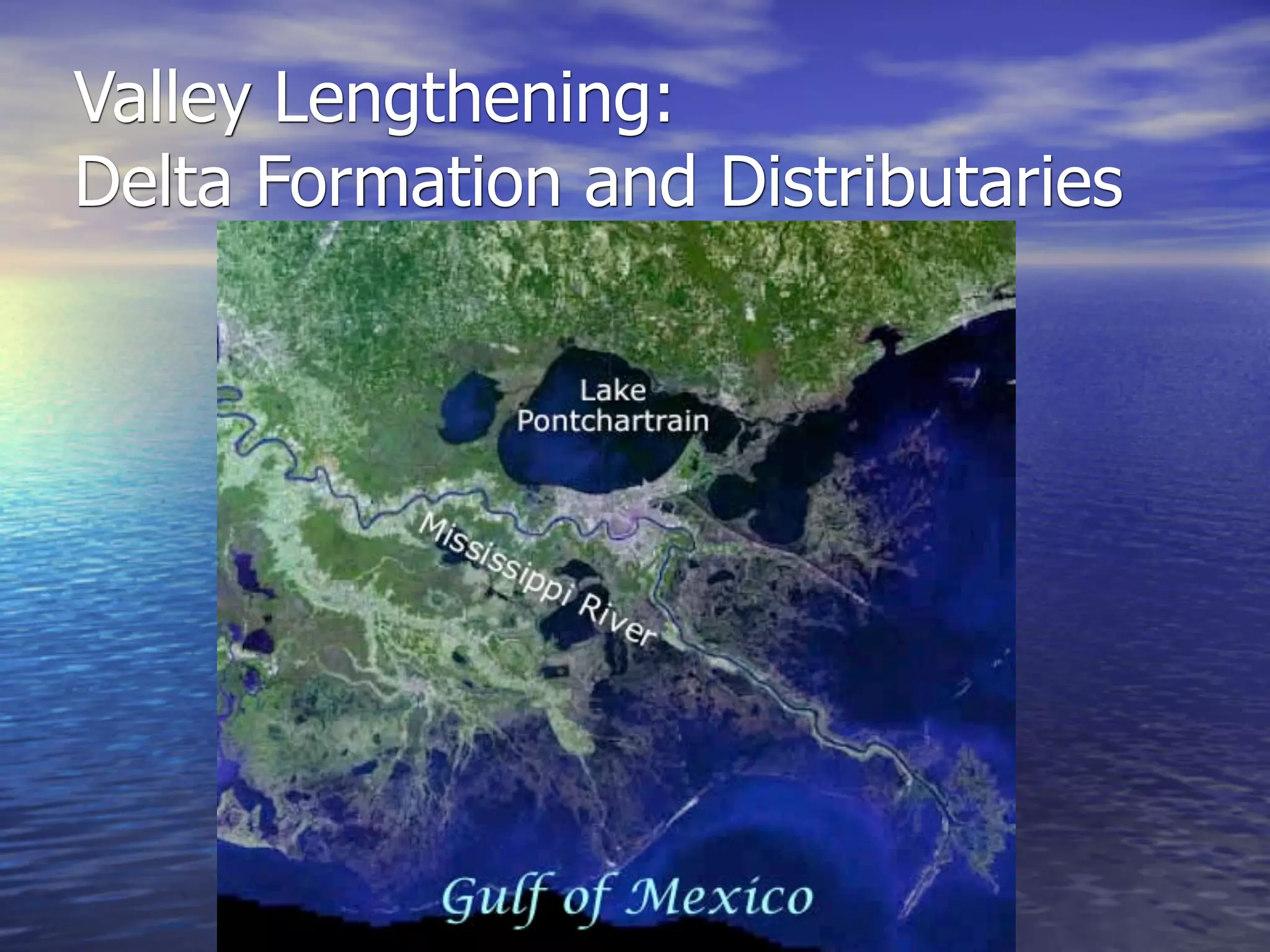
Valley Lengthening:
Delta Formation and Distributaries
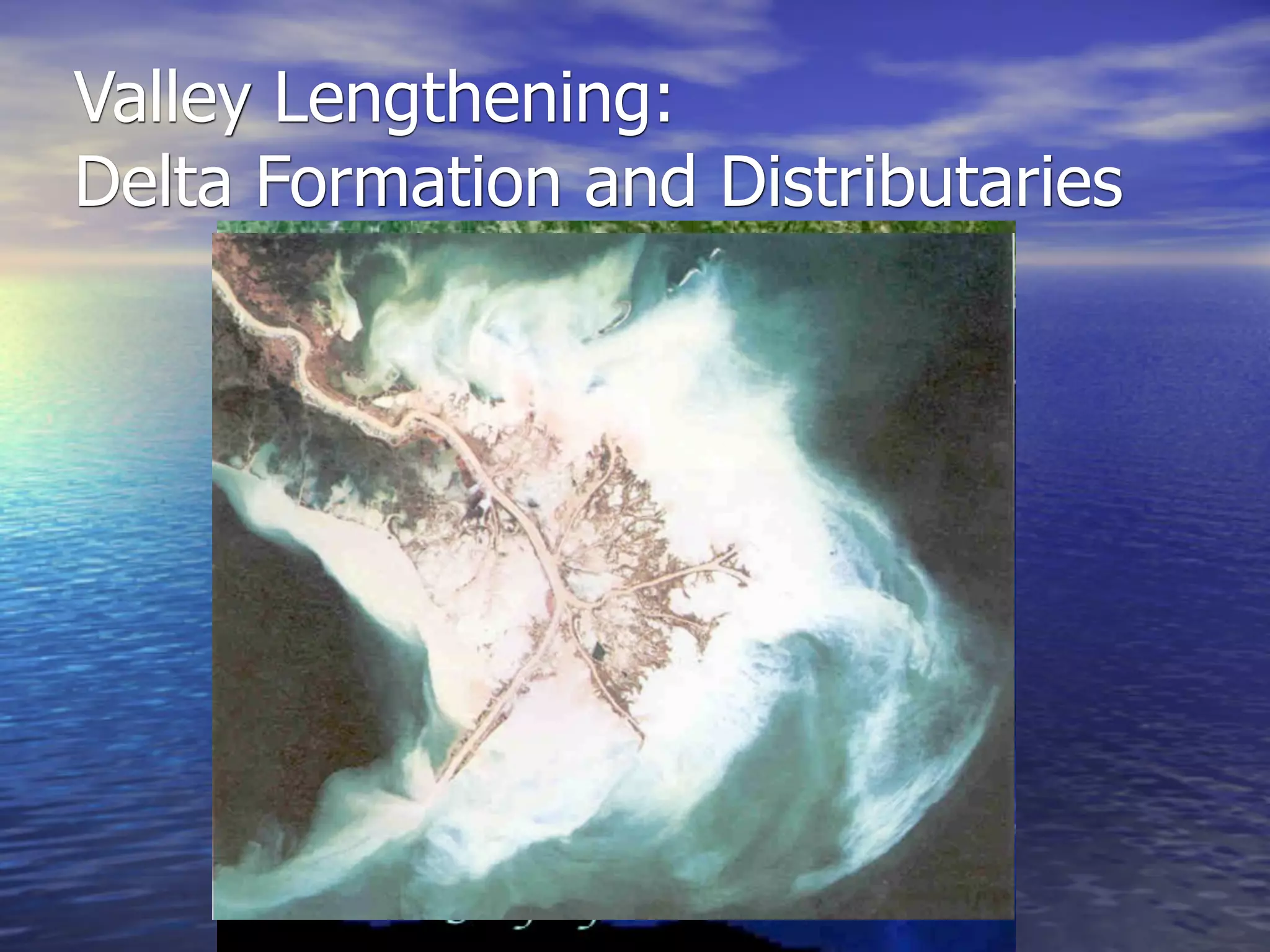
Valley Lengthening:
Delta Formation and Distributaries
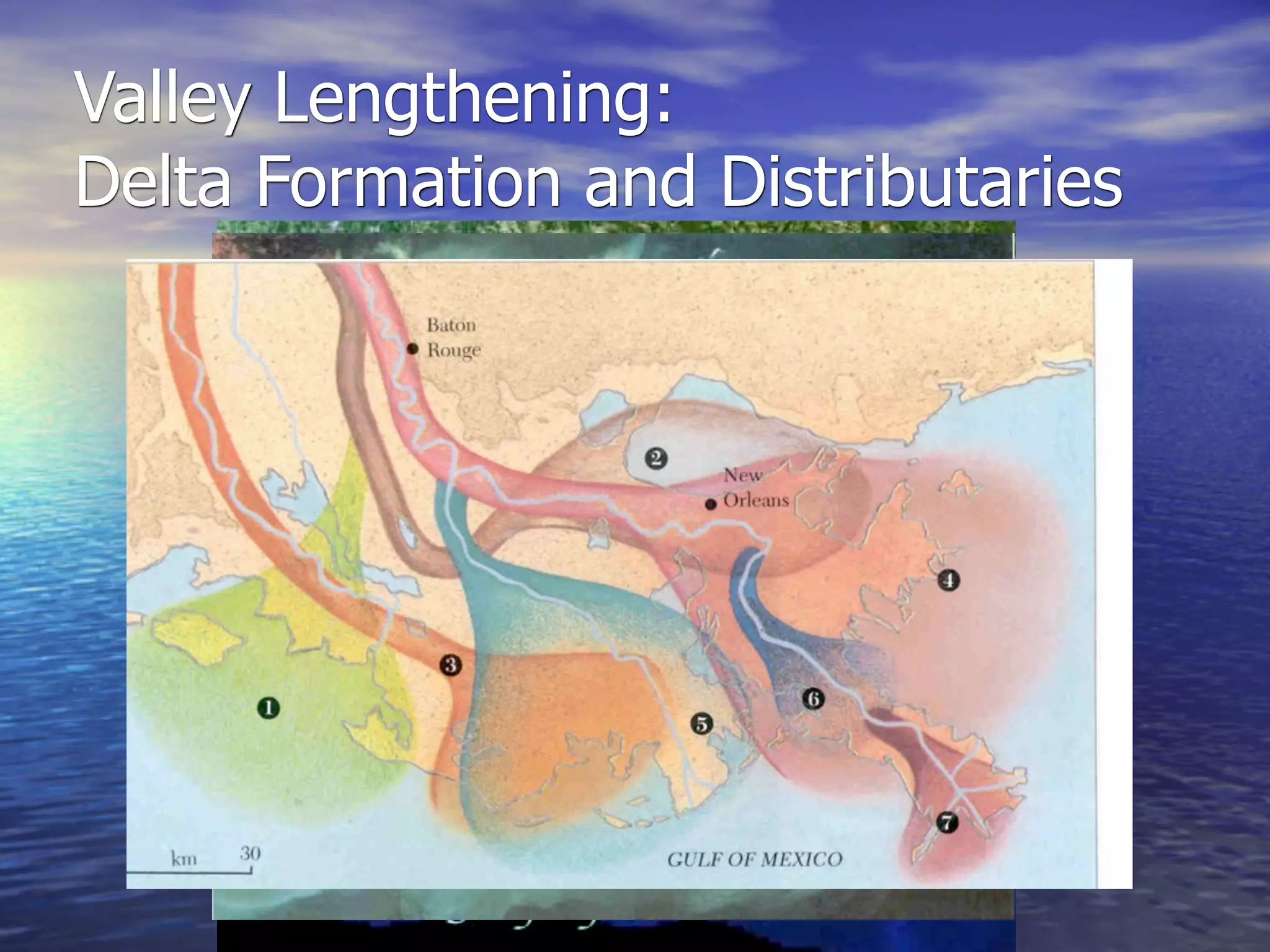
Valley Lengthening:
Delta Formation and Distributaries
Valley Lengthening:
Delta Formation and Distributaries
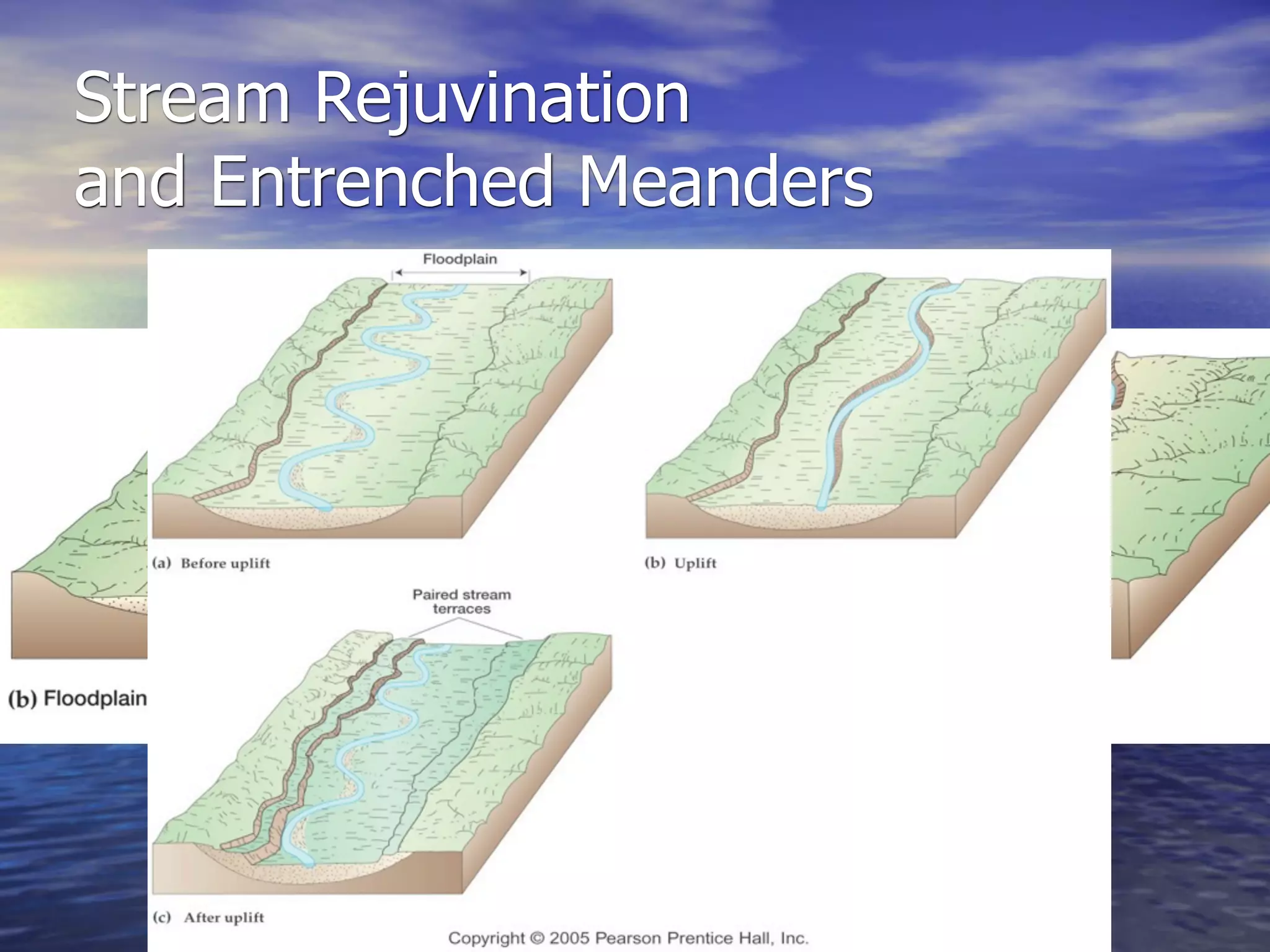
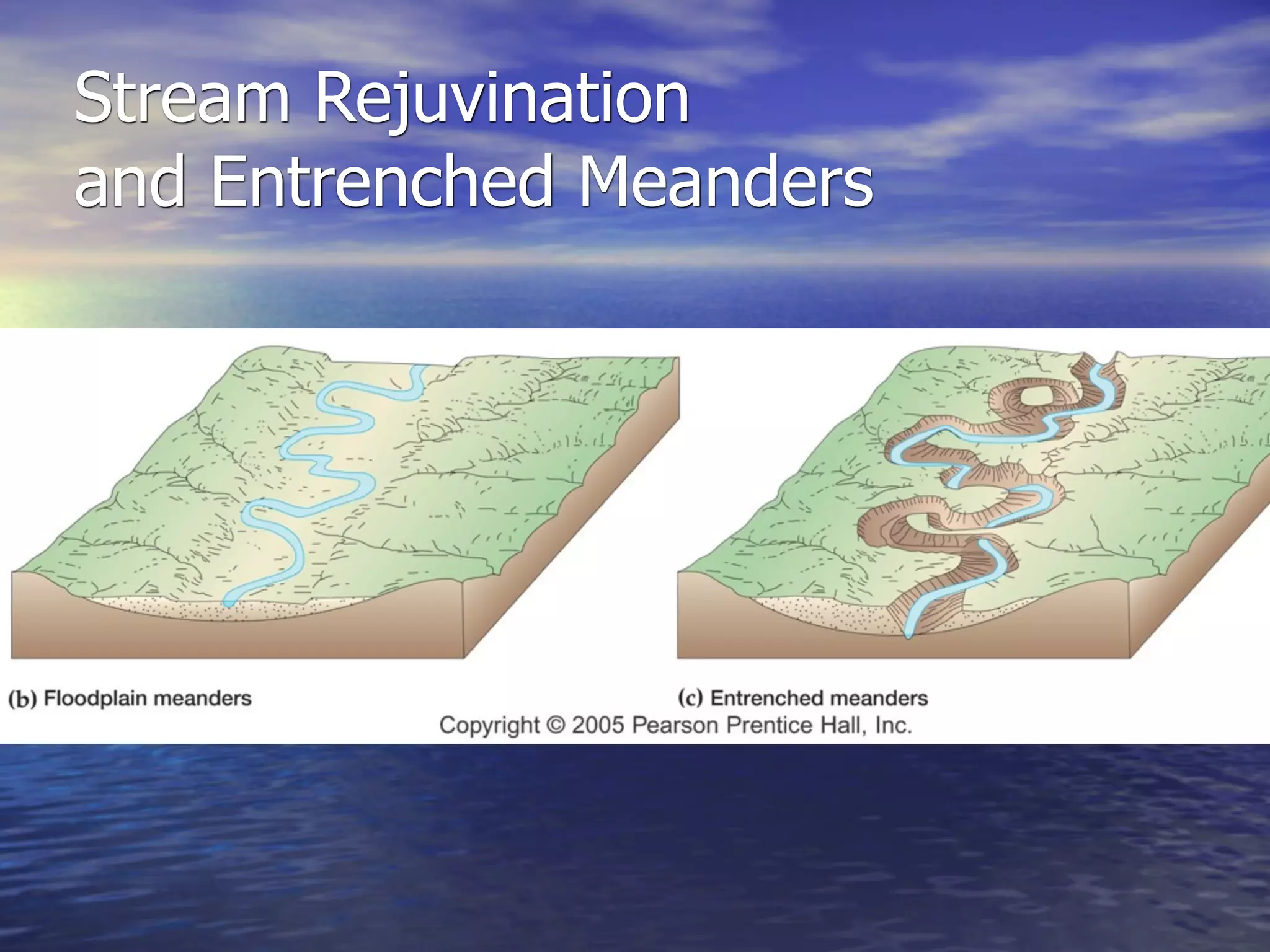
Stream Rejuvination
and Entrenched Meanders
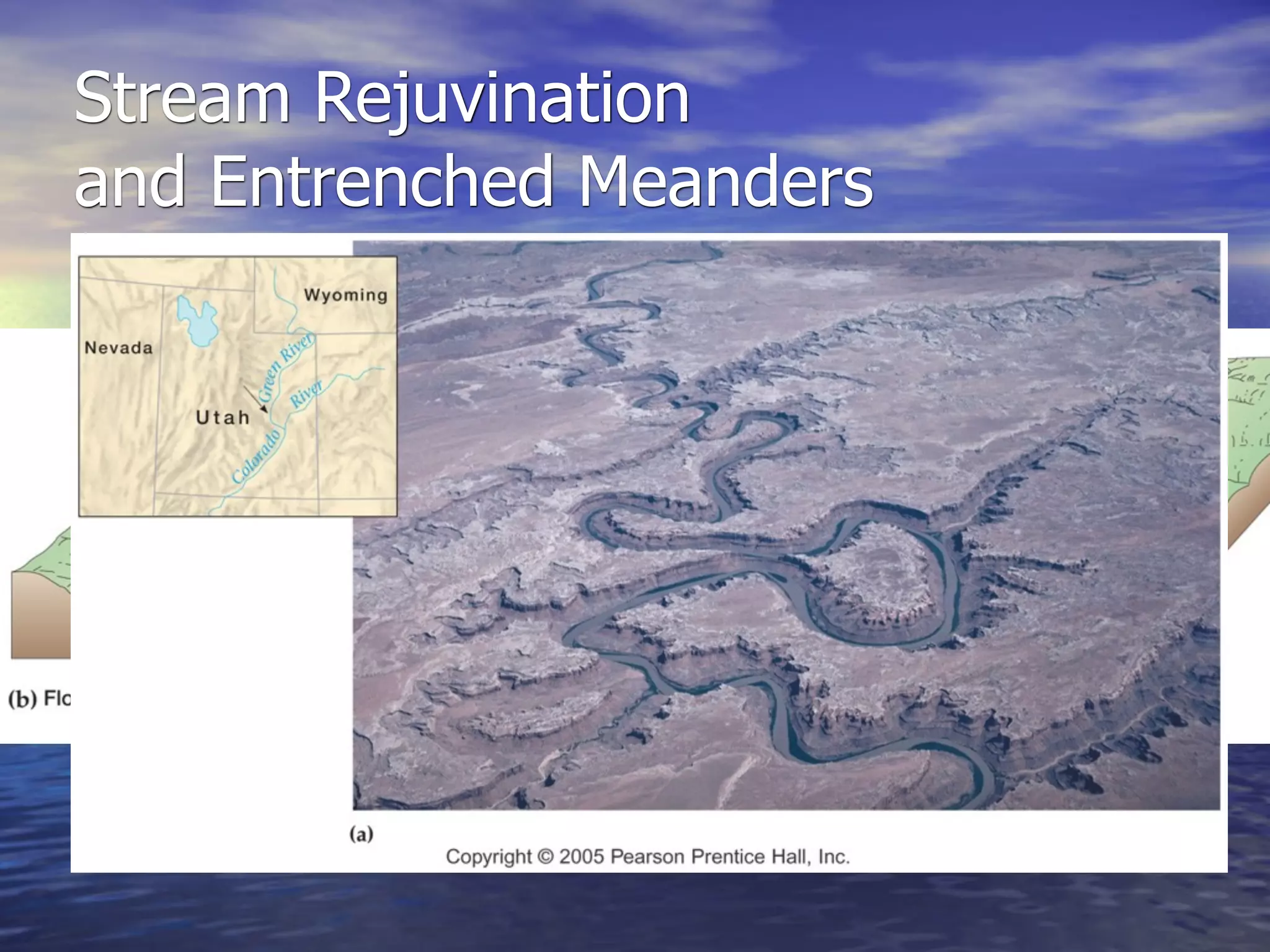
Stream Rejuvination
and Entrenched Meanders
Stream Rejuvination
and Entrenched Meanders
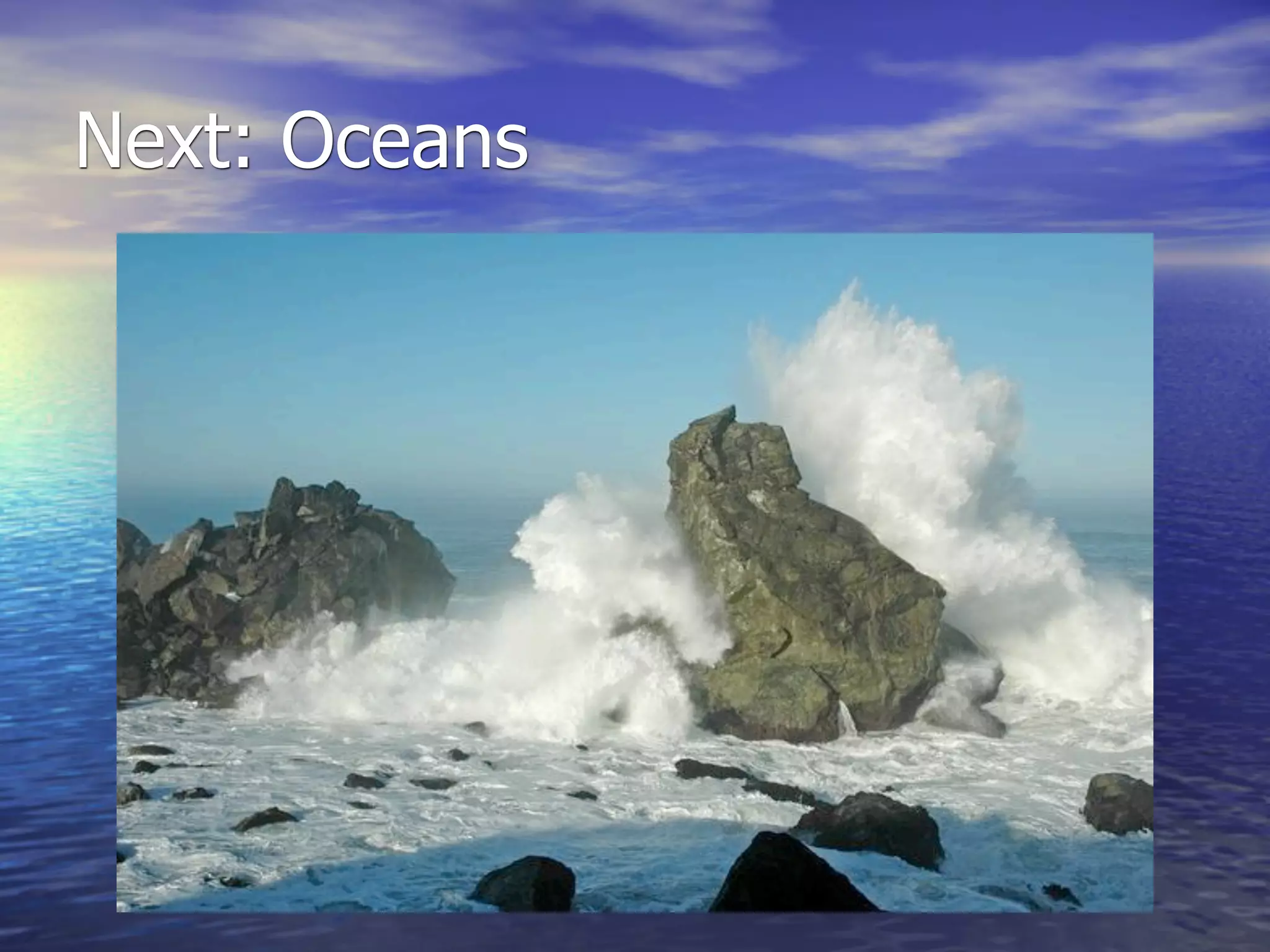
Next: Oceans

GEOG 100--Lecture 16--Streams

  • 1.
  • 2.
    Streams The work thatstreams do: • Erosion/Denudation – Movement away of rock, rock fragments and/or soil from its original position • Transportation – Continuous movement of material from one place to another • Deposition – Setting down (depositing) of eroded and transported material
  • 3.
    Drainage Systems • Drainagesystem—A branched, hierarchical network of streams and tributaries • Valley—Where a drainage system is clearly established • Interfluve—(“inter”=between, “fluvia”= rivers) High ground that separates valleys • Drainage divide—The invisible line separating two drainage basins
  • 4.
    Drainage basin or Watershed •A single network system; includes both the channeled valley and any other land surface contributing overland flow or groundwater to the stream • Scale varies
  • 5.
    Erosion • Overland flow— unchannelized flow of water • Splash erosion—Raindrops hitting exposed ground surface, shifting individual particles, which can then be transported away
  • 6.
    Overland Flow • Sheeterosion—if there is very little ground cover (vegetation), not much water may infiltrate and sheet flow can occur, moving particles downslope
  • 7.
    Erosion • Hydraulic action—Thephysical force of water pounding on rocks and land materials, breaking them apart • Abrasion—Rock materials hitting the bed (bottom) of the river and its banks (sides) • Corrosion—The chemical action of water dissolving minerals and rock material
  • 8.
    How Quickly ErosionOccurs Depends On… • Flow Speed • Turbulence • Resistance of the bedrock
  • 9.
  • 10.
    1. Flow Speed •Flow Speed –The faster the water, the more force it has –Faster water = more erosion
  • 11.
    What makes thewater go faster?
  • 12.
    What makes thewater go faster? 1. Steeper gradient
  • 13.
    What makes thewater go faster? 1. Steeper gradient – Gradient—The rate of fall in elevation of the stream surface in the downstream direction (as in 20 ft./mi.)
  • 14.
    What makes thewater go faster? 1. Steeper gradient – Gradient—The rate of fall in elevation of the stream surface in the downstream direction (as in 20 ft./mi.) • Steeper gradient = faster flow = more erosion
  • 15.
    What makes thewater go faster? 1. Steeper gradient – Gradient—The rate of fall in elevation of the stream surface in the downstream direction (as in 20 ft./mi.) • Steeper gradient = faster flow = more erosion 2. Volume of flow (discharge)
  • 16.
    What makes thewater go faster? 1. Steeper gradient – Gradient—The rate of fall in elevation of the stream surface in the downstream direction (as in 20 ft./mi.) • Steeper gradient = faster flow = more erosion 2. Volume of flow (discharge) – More water = higher speed = more erosion
  • 17.
    What makes thewater go faster? 1. Steeper gradient – Gradient—The rate of fall in elevation of the stream surface in the downstream direction (as in 20 ft./mi.) • Steeper gradient = faster flow = more erosion 2. Volume of flow (discharge) – More water = higher speed = more erosion • Flood events move bigger material—and more of it!
  • 18.
    What makes thewater go faster? 1. Steeper gradient – Gradient—The rate of fall in elevation of the stream surface in the downstream direction (as in 20 ft./mi.) • Steeper gradient = faster flow = more erosion 2. Volume of flow (discharge) – More water = higher speed = more erosion • Flood events move bigger material—and more of it! 3. Channel width—the narrower the channel, the swifter the flow, for the same volume of water (Remember the Venturi effect?)
  • 19.
  • 20.
  • 21.
  • 22.
  • 23.
  • 24.
    2. Turbulence • Waterswirling and tossing, not smooth flow
  • 25.
    2. Turbulence • Waterswirling and tossing, not smooth flow • Turbulence is determined by: –Flow speed
  • 26.
    2. Turbulence • Waterswirling and tossing, not smooth flow • Turbulence is determined by: –Flow speed •Faster flow = increased turbulence
  • 27.
    2. Turbulence • Waterswirling and tossing, not smooth flow • Turbulence is determined by: –Flow speed •Faster flow = increased turbulence –Roughness of the stream channel
  • 28.
    2. Turbulence • Waterswirling and tossing, not smooth flow • Turbulence is determined by: –Flow speed •Faster flow = increased turbulence –Roughness of the stream channel •A rough, irregular channel = more turbulence
  • 29.
    2. Turbulence • Waterswirling and tossing, not smooth flow • Turbulence is determined by: –Flow speed •Faster flow = increased turbulence –Roughness of the stream channel •A rough, irregular channel = more turbulence
  • 30.
    3. Resistance ofbedrock • More resistance (harder rocks) = less erosion
  • 31.
    Transportation: Stream Load •Stream load (rock material transported by streams) is carried in three forms:
  • 32.
    Transportation: Stream Load •Stream load (rock material transported by streams) is carried in three forms:
  • 33.
    Transportation: Stream Load •Stream load (rock material transported by streams) is carried in three forms: 1. Dissolved load—dissolved minerals carried in solution
  • 34.
    Transportation: Stream Load •Stream load (rock material transported by streams) is carried in three forms: 1. Dissolved load—dissolved minerals carried in solution 2. Suspended load—small particles that never touch the stream bed
  • 35.
    Transportation: Stream Load •Stream load (rock material transported by streams) is carried in three forms: 1. Dissolved load—dissolved minerals carried in solution 2. Suspended load—small particles that never touch the stream bed 3. Bedload—larger rock fragments that drag, roll, skip or bounce along the stream bed
  • 36.
    Transportation: Stream Load •Stream load (rock material transported by streams) is carried in three forms: 1. Dissolved load—dissolved minerals carried in solution 2. Suspended load—small particles that never touch the stream bed 3. Bedload—larger rock fragments that drag, roll, skip or bounce along the stream bed • Material is picked up, dropped and picked up again
  • 37.
    Transportation: Stream Load •Stream load (rock material transported by streams) is carried in three forms: 1. Dissolved load—dissolved minerals carried in solution 2. Suspended load—small particles that never touch the stream bed 3. Bedload—larger rock fragments that drag, roll, skip or bounce along the stream bed • Material is picked up, dropped and picked up again
  • 38.
    Transportation: Stream Load •Stream load (rock material transported by streams) is carried in three forms: 1. Dissolved load—dissolved minerals carried in solution 2. Suspended load—small particles that never touch the stream bed 3. Bedload—larger rock fragments that drag, roll, skip or bounce along the stream bed • Material is picked up, dropped and picked up again
  • 39.
  • 40.
    Transportation: Competence • Thefaster the stream is flowing, the larger the particles it can transport
  • 41.
    Transportation: Competence • Thefaster the stream is flowing, the larger the particles it can transport • This measurement is called competence
  • 42.
    Transportation: Competence • Thefaster the stream is flowing, the larger the particles it can transport • This measurement is called competence – Competence varies to the sixth power of the water’s speed
  • 43.
    Transportation: Competence • Thefaster the stream is flowing, the larger the particles it can transport • This measurement is called competence – Competence varies to the sixth power of the water’s speed If flow speed doubles:
  • 44.
    Transportation: Competence • Thefaster the stream is flowing, the larger the particles it can transport • This measurement is called competence – Competence varies to the sixth power of the water’s speed If flow speed doubles: 26 = 64 times the size!
  • 45.
    Transportation: Competence • Thefaster the stream is flowing, the larger the particles it can transport • This measurement is called competence – Competence varies to the sixth power of the water’s speed If flow speed doubles: 26 = 64 times the size! – This is why flood events are so significant in stream transportation
  • 46.
  • 47.
    Transportation: Capacity • Capacity—Ameasure of the amount of solid material potentially transported (volume/time past a given point: gal/sec) • The capacity of a given stream depends on:
  • 48.
    Transportation: Capacity • Capacity—Ameasure of the amount of solid material potentially transported (volume/time past a given point: gal/sec) • The capacity of a given stream depends on: 1. Water volume (volume↑, capacity↑)
  • 49.
    Transportation: Capacity • Capacity—Ameasure of the amount of solid material potentially transported (volume/time past a given point: gal/sec) • The capacity of a given stream depends on: 1. Water volume (volume↑, capacity↑) 2. Flow speed (flow speed↑, capacity↑)
  • 50.
    Transportation: Capacity • Capacity—Ameasure of the amount of solid material potentially transported (volume/time past a given point: gal/sec) • The capacity of a given stream depends on: 1. Water volume (volume↑, capacity↑) 2. Flow speed (flow speed↑, capacity↑) 3. The type of load material
  • 51.
    Transportation: Capacity • Capacity—Ameasure of the amount of solid material potentially transported (volume/time past a given point: gal/sec) • The capacity of a given stream depends on: 1. Water volume (volume↑, capacity↑) 2. Flow speed (flow speed↑, capacity↑) 3. The type of load material (lighter material, capacity↑)
  • 52.
    Deposition • Deposition occurswhen either flow speed or volume decrease • Conditions that cause deposition: –Change in gradient –Channel widening –Change of direction –Flowing into less active water
  • 53.
    Deposition: Alluvium • Alluvium—Anystream-deposited debris –Sorting—Based on size (smaller particles carried farther than large ones; as stream flow decreases, larger particles will drop out of suspension first)
  • 54.
    Sorting after aflood event erosion
  • 55.
    Sorting after aflood event
  • 56.
    Sorting after aflood event deposition
  • 57.
    Sorting after aflood event deposition (particles settle biggest first, smallest last)
  • 58.
    Deposition: Alluvium • Alluvium –Particle shape—Alluvial material is generally smooth and round due to rocks hitting each other and the stream bed; the longer it’s transported in the stream, the more rounded and smooth a rock will become
  • 59.
  • 60.
    Stream Flow • Howdoes friction from the channel sides and bottom affect stream flow?
  • 61.
    Stream Flow • Patterns – Straight – Sinuous – Meandering – Braided
  • 62.
    Stream Flow • Patterns – Straight – Sinuous – Meandering – Braided
  • 63.
    Stream Flow • Patterns – Straight – Sinuous – Meandering – Braided
  • 64.
    Stream Flow • Patterns – Straight – Sinuous – Meandering – Braided
  • 65.
    Just like alake, water balance must be maintained, or the stream will become an ephemeral stream
  • 66.
    Equilibrium: A GradedStream • All factors are balanced (gravity, stream load, deposition, down-cutting) • A graded condition is more theoretical than actual, because equilibrium is so difficult to achieve—and maintain
  • 67.
    Which processes happenas a stream tries to attain a graded condition? • Valley deepening • Valley widening and flattening • Valley lengthening
  • 68.
    Valley Deepening: Knickpoint Migration •Downcutting progresses upstream, until the valley is all at one level
  • 69.
  • 70.
  • 72.
    Valley Widening andFlattening The Role of Meanders
  • 73.
  • 74.
  • 75.
    Can you findthe oxbow lake? Where is a cutoff about to form?
  • 76.
  • 77.
    Structures of aFloodplain
  • 78.
    Structures of aFloodplain
  • 79.
  • 80.
  • 81.
  • 82.
  • 83.
  • 84.
  • 85.
  • 86.
  • 87.