PHYSICAL FITNESS
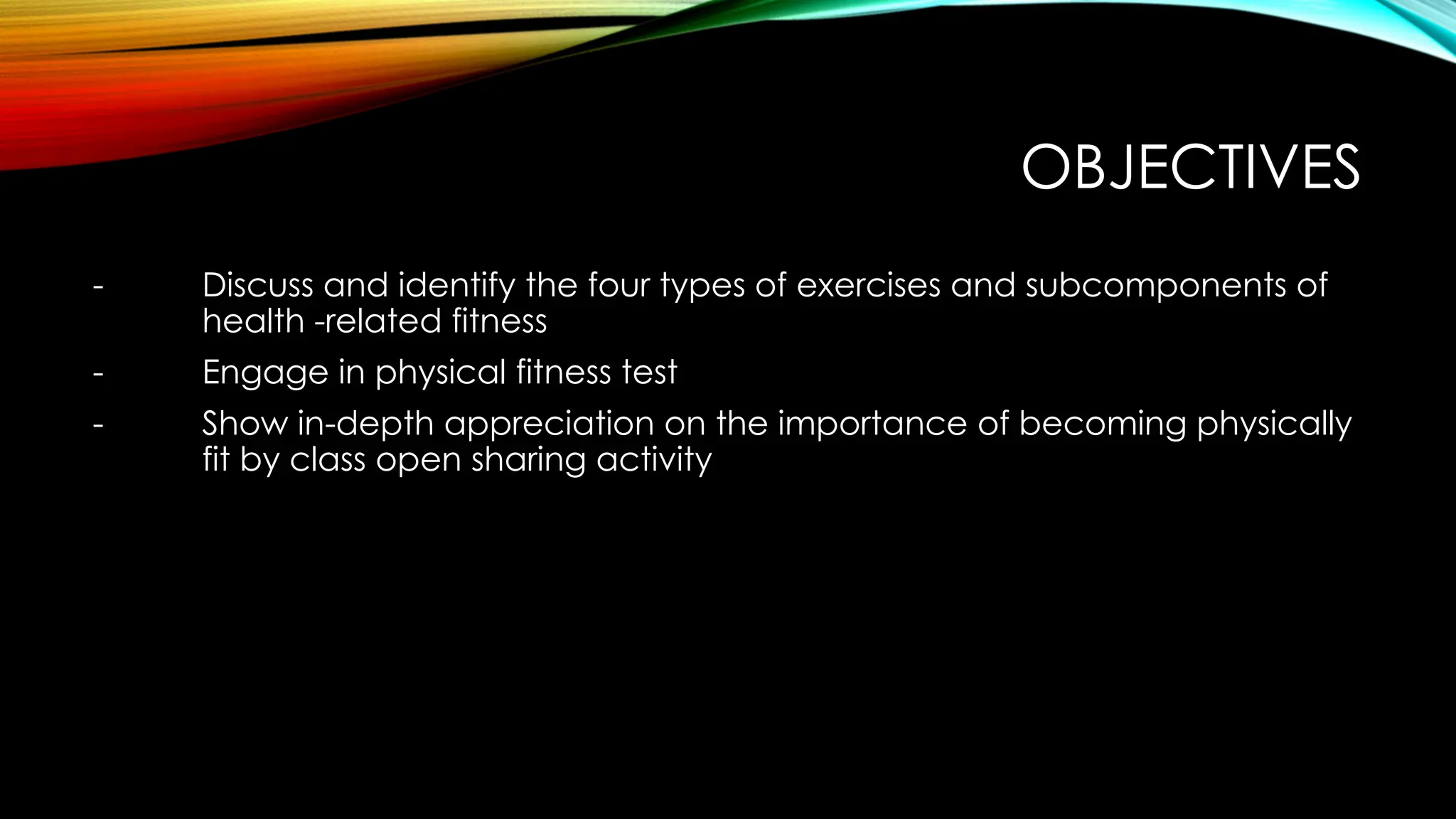
OBJECTIVES
- Discuss and identify the four types of exercises and subcomponents of
health -related fitness
- Engage in physical fitness test
- Show in-depth appreciation on the importance of becoming physically
fit by class open sharing activity
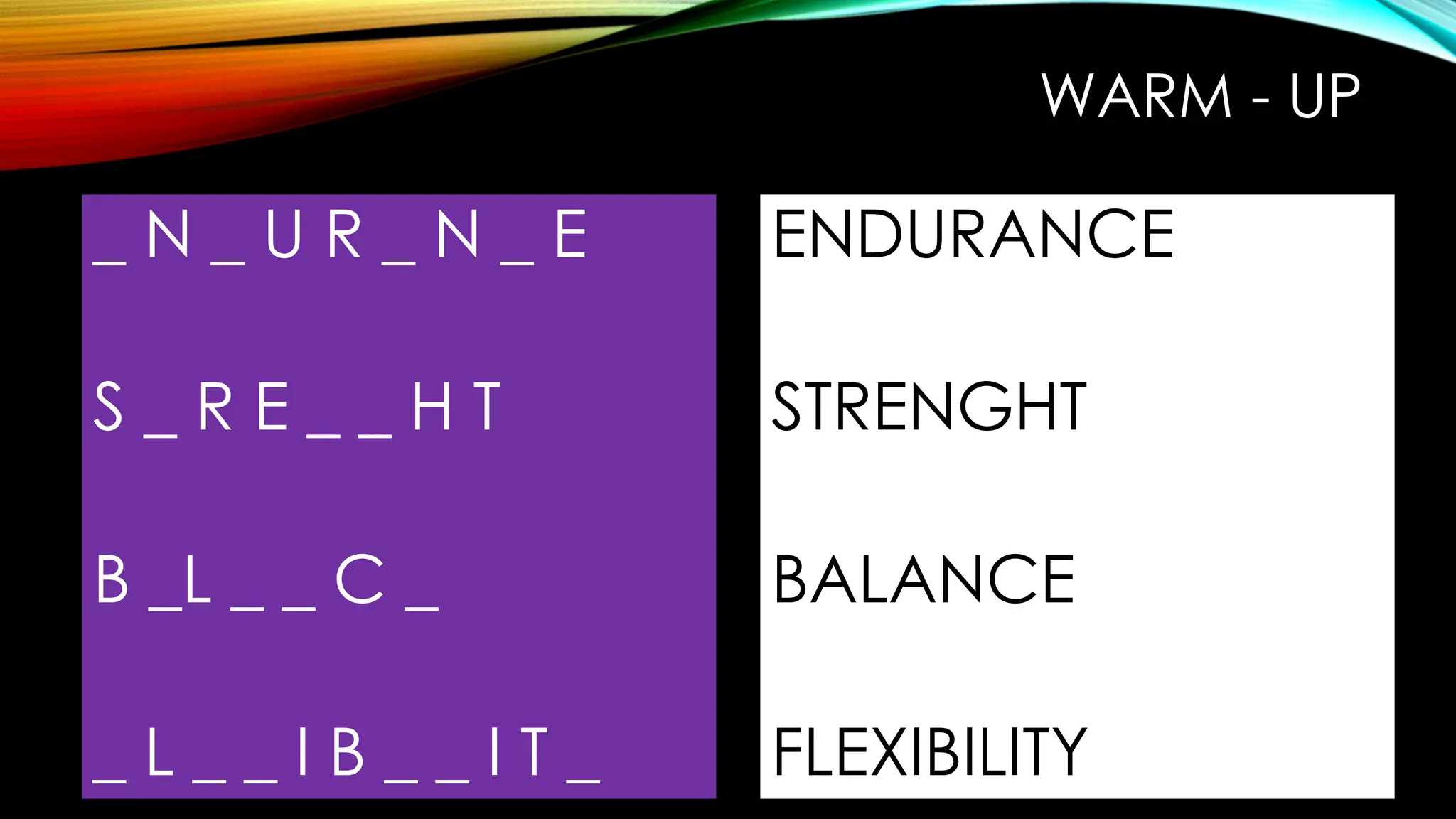
WARM - UP
_ N _ U R _ N _ E
S _ R E _ _ H T
B _L _ _ C _
_ L _ _ I B _ _ I T _
ENDURANCE
STRENGHT
BALANCE
FLEXIBILITY
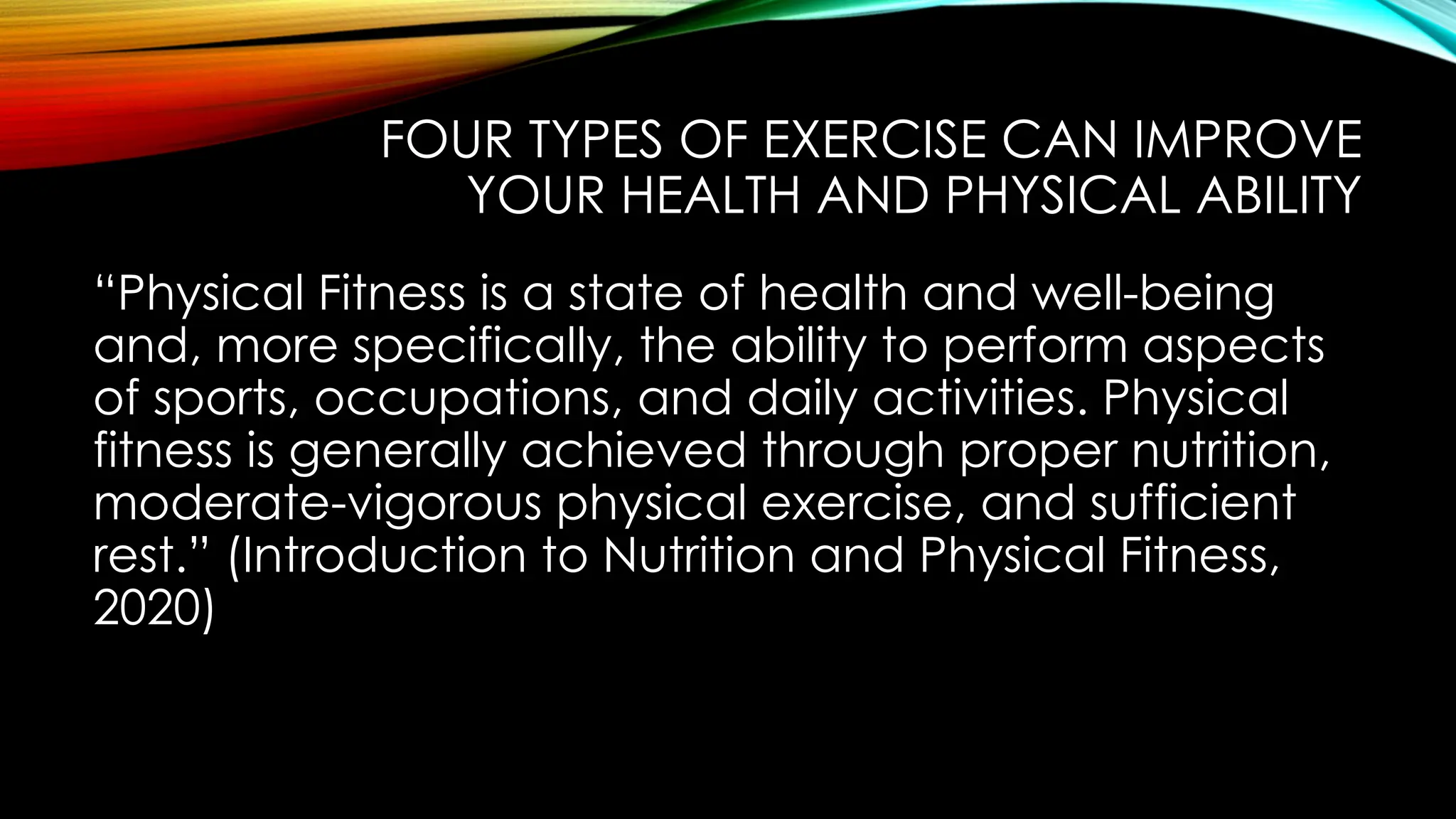
FOUR TYPES OF EXERCISE CAN IMPROVE
YOUR HEALTH AND PHYSICAL ABILITY
“Physical Fitness is a state of health and well-being
and, more specifically, the ability to perform aspects
of sports, occupations, and daily activities. Physical
fitness is generally achieved through proper nutrition,
moderate-vigorous physical exercise, and sufficient
rest.” (Introduction to Nutrition and Physical Fitness,
2020)
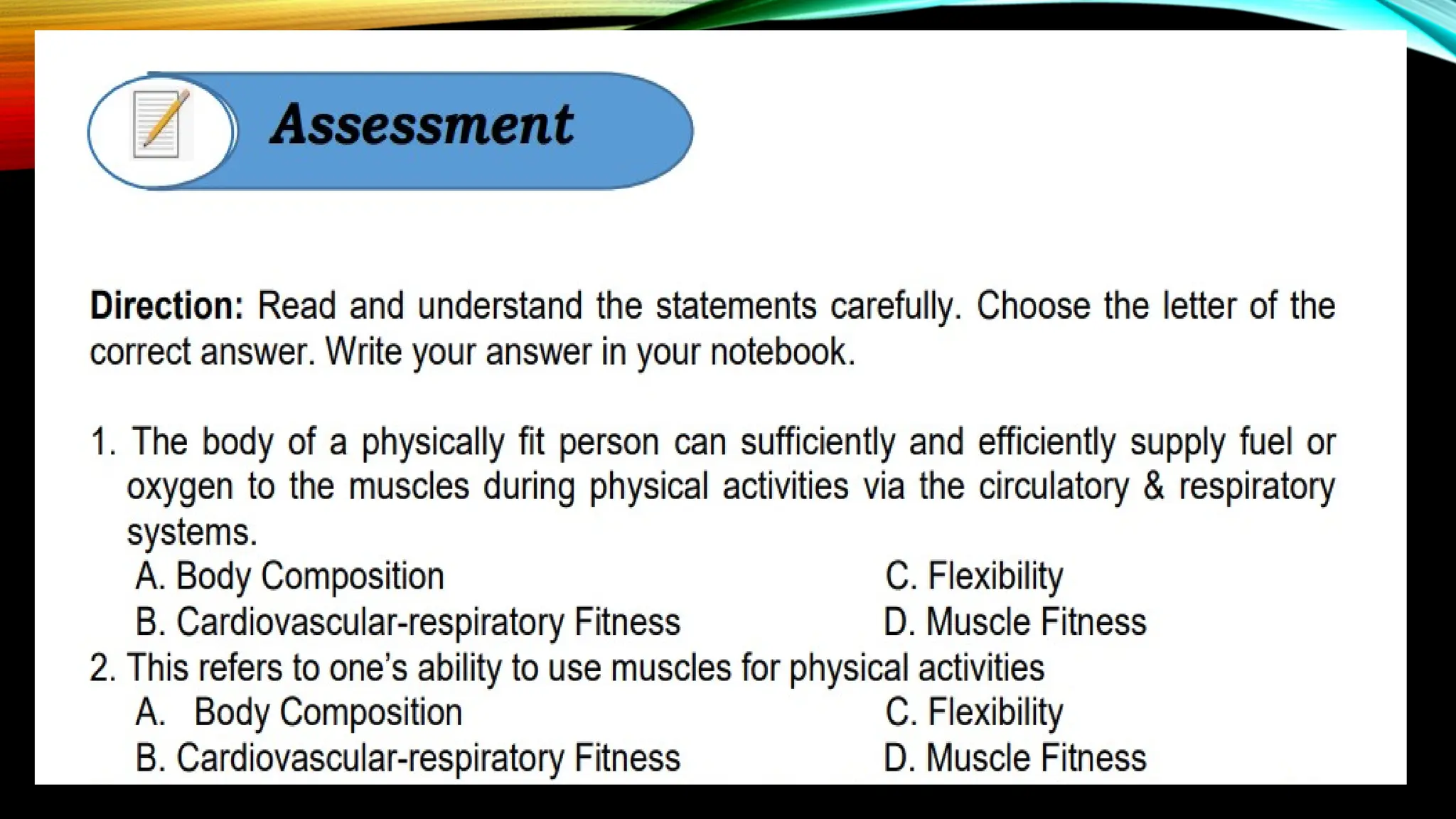
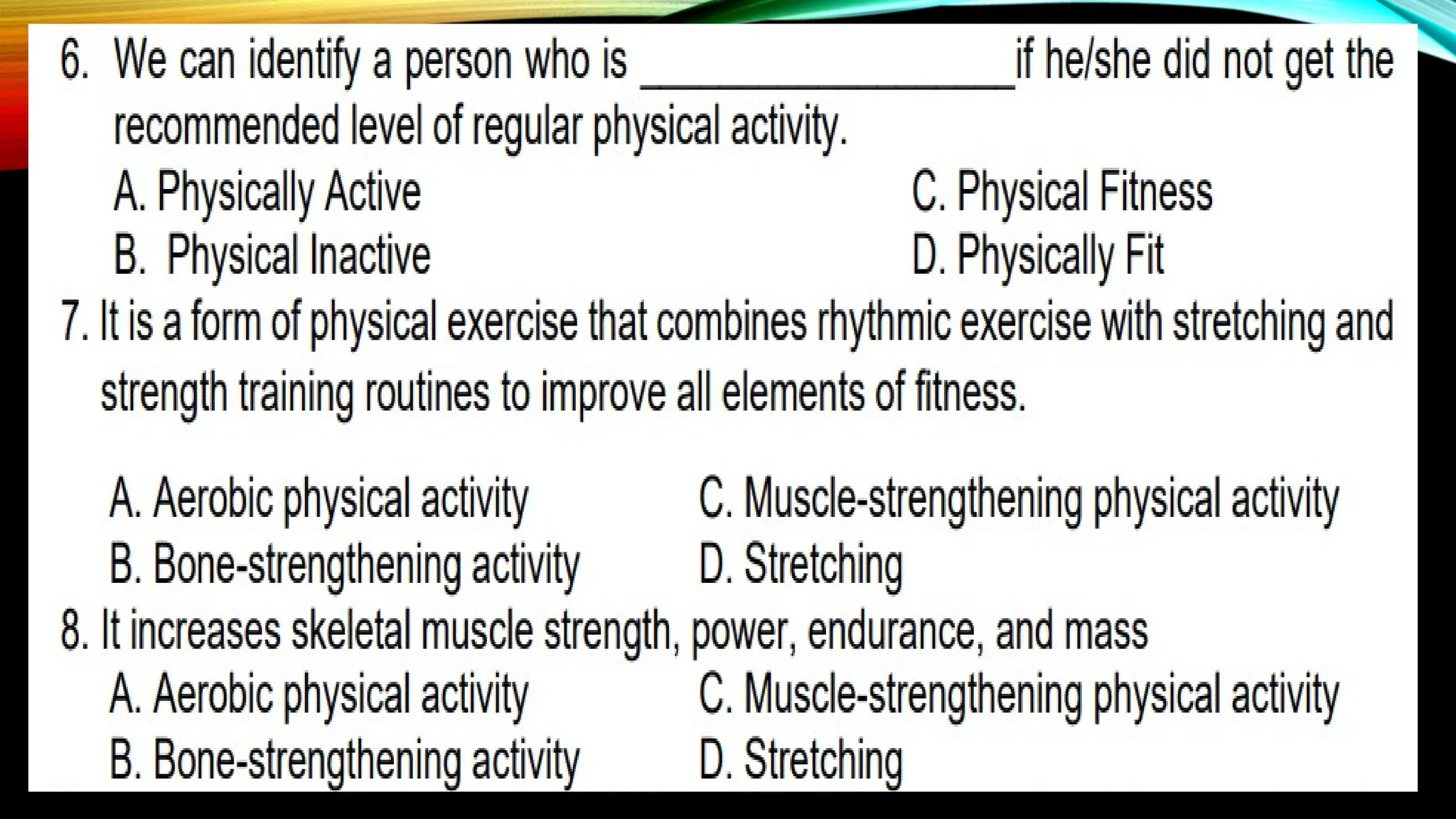
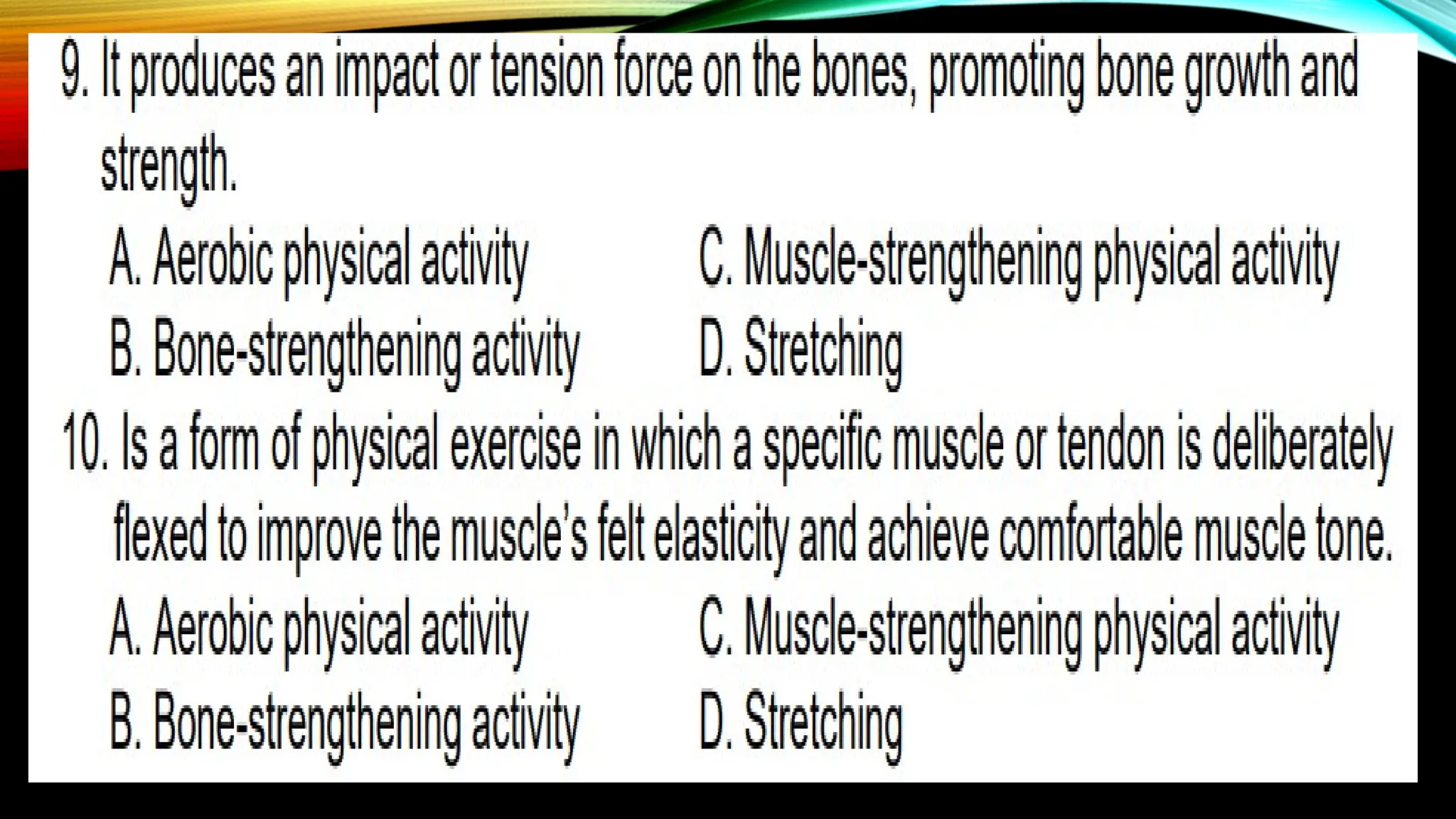
We can say that you are physically active if you
engage in bodily movement produced by skeletal
muscles that requires energy expenditures. On the
other hand, we can identify a person who is
physically inactive if he/she did not get
recommended level of regular physical activity.
THERE ARE FOUR TYPES OF PHYSICAL EXERCISE
ACCORDING TO NATIONAL INSTITUTE ON AGING. (NIA,
2021)
TYPES MEANING BENEFITS
Endurance
Exercise
It is often referred to
as aerobic,
increasing your
breathing and
heart rates.
It improves the health of
your heart, lungs, and
circulatory system. They
also can delay or prevent
many diseases that are
common in older adults
such as diabetes, colon
and breast cancers, heart
disease, and others.
THERE ARE FOUR TYPES OF PHYSICAL EXERCISE
ACCORDING TO NATIONAL INSTITUTE ON AGING. (NIA,
2021)
TYPES MEANING BENEFITS
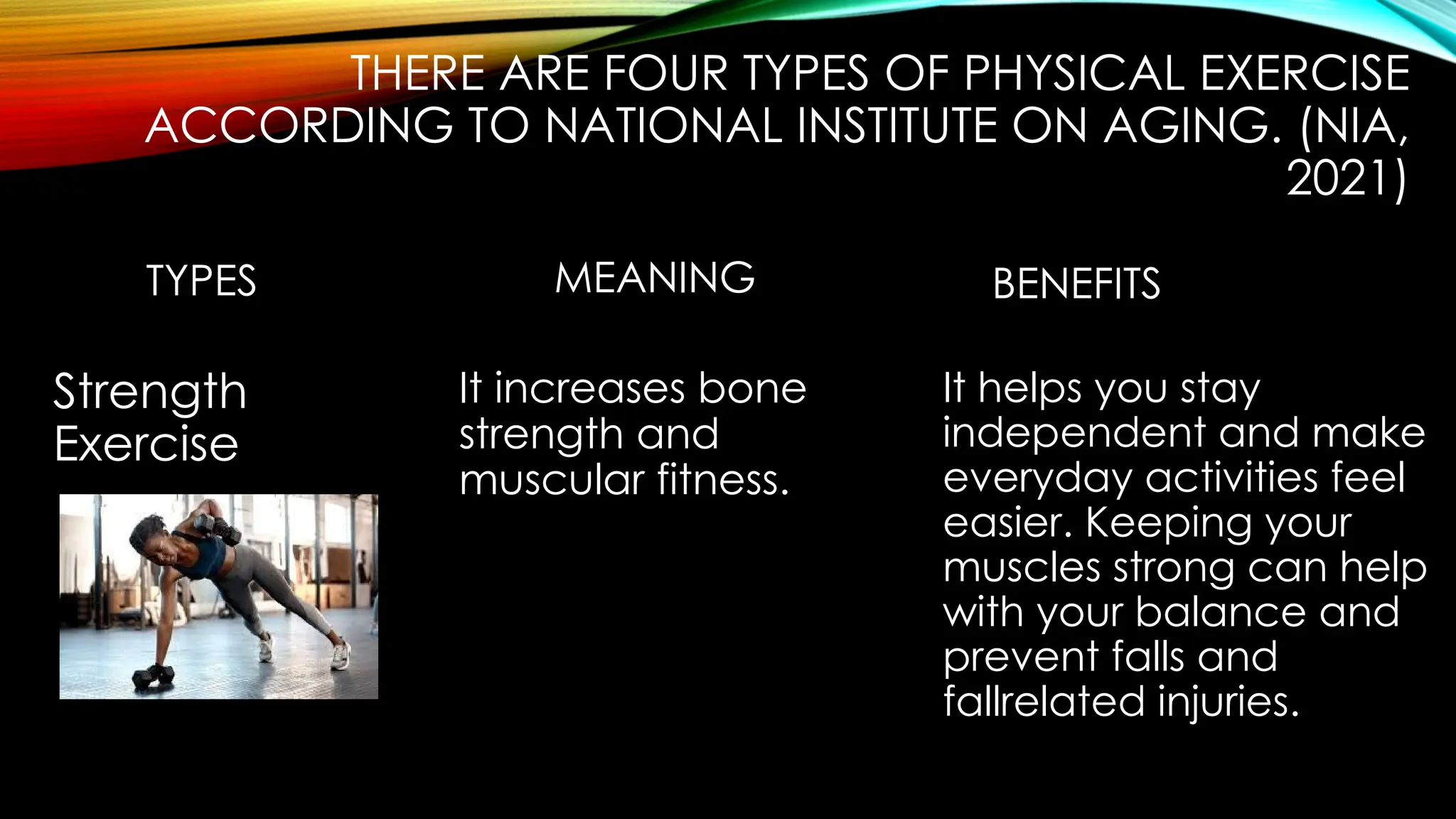
Strength
Exercise
It increases bone
strength and
muscular fitness.
It helps you stay
independent and make
everyday activities feel
easier. Keeping your
muscles strong can help
with your balance and
prevent falls and
fallrelated injuries.
THERE ARE FOUR TYPES OF PHYSICAL EXERCISE
ACCORDING TO NATIONAL INSTITUTE ON AGING. (NIA,
2021)
TYPES MEANING BENEFITS
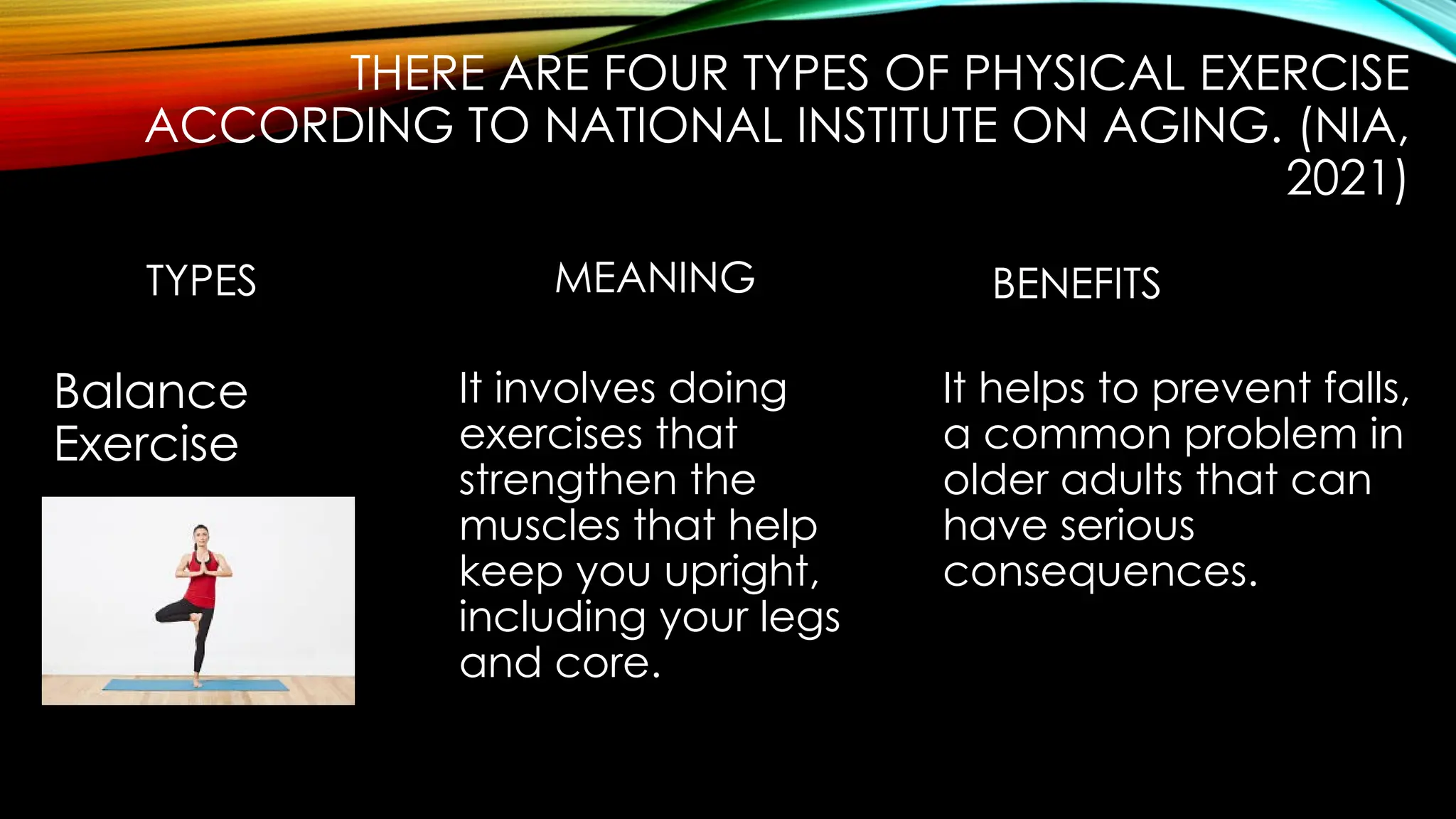
Balance
Exercise
It involves doing
exercises that
strengthen the
muscles that help
keep you upright,
including your legs
and core.
It helps to prevent falls,
a common problem in
older adults that can
have serious
consequences.
THERE ARE FOUR TYPES OF PHYSICAL EXERCISE
ACCORDING TO NATIONAL INSTITUTE ON AGING. (NIA,
2021)
TYPES MEANING BENEFITS
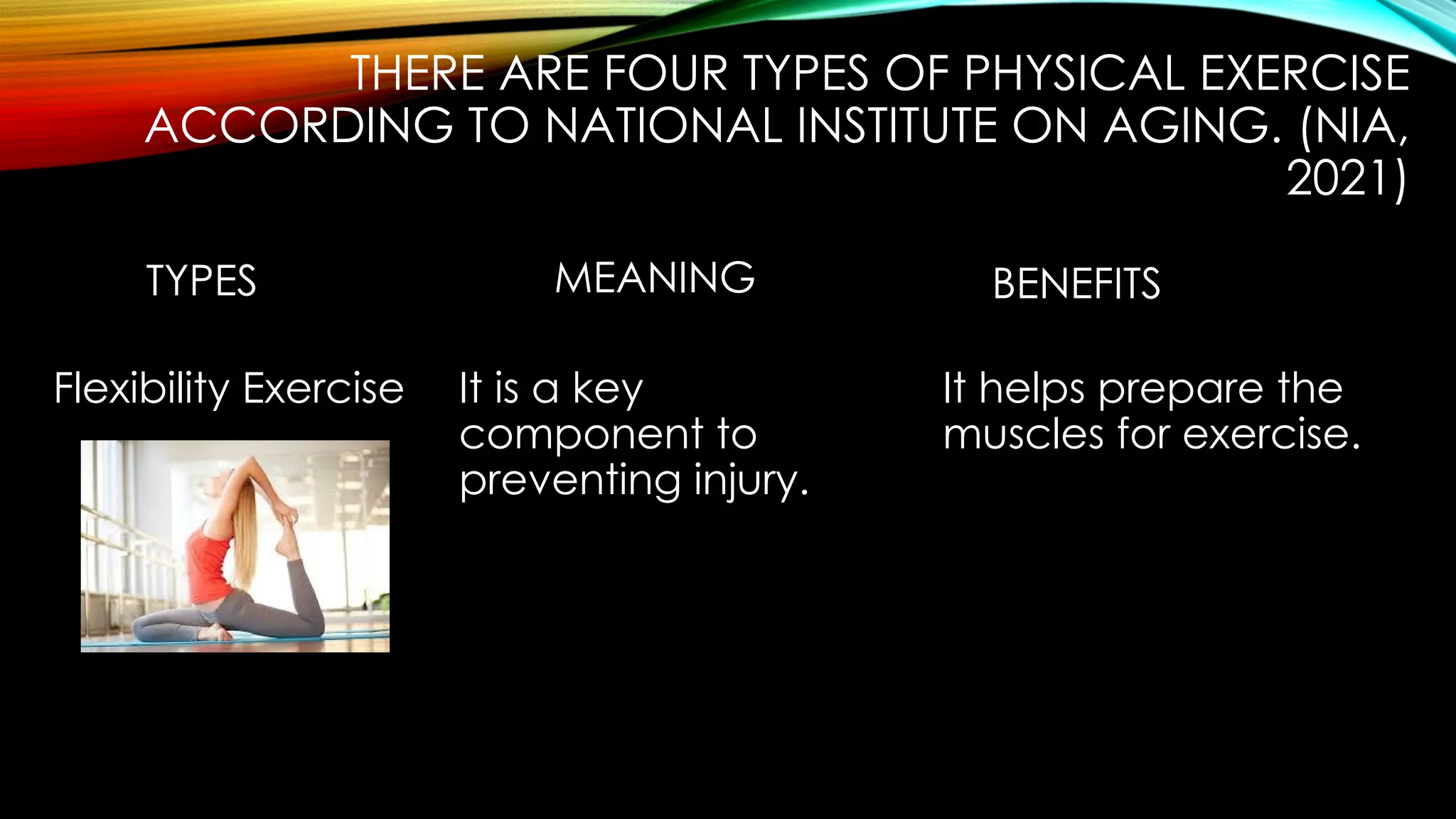
Flexibility Exercise It is a key
component to
preventing injury.
It helps prepare the
muscles for exercise.
HEALTH-RELATED PHYSICAL FITNESS
CRF
Cardiovascular-Respiratory Fitness - It refers to your body's
ability to efficiently and effectively intake oxygen and deliver it to
your body's tissues by way of the heart, lungs, arteries, vessels, and
veins.
ME
Muscular Endurance is one of two factors contributing to
overall muscular health. Think of muscular endurance as a
particular muscle group's ability to continuously contract against a
given resistance.
HEALTH-RELATED PHYSICAL FITNESS
MS
Muscular Strength refers to the amount of force a particular
muscle group can produce in one, all-out effort
F
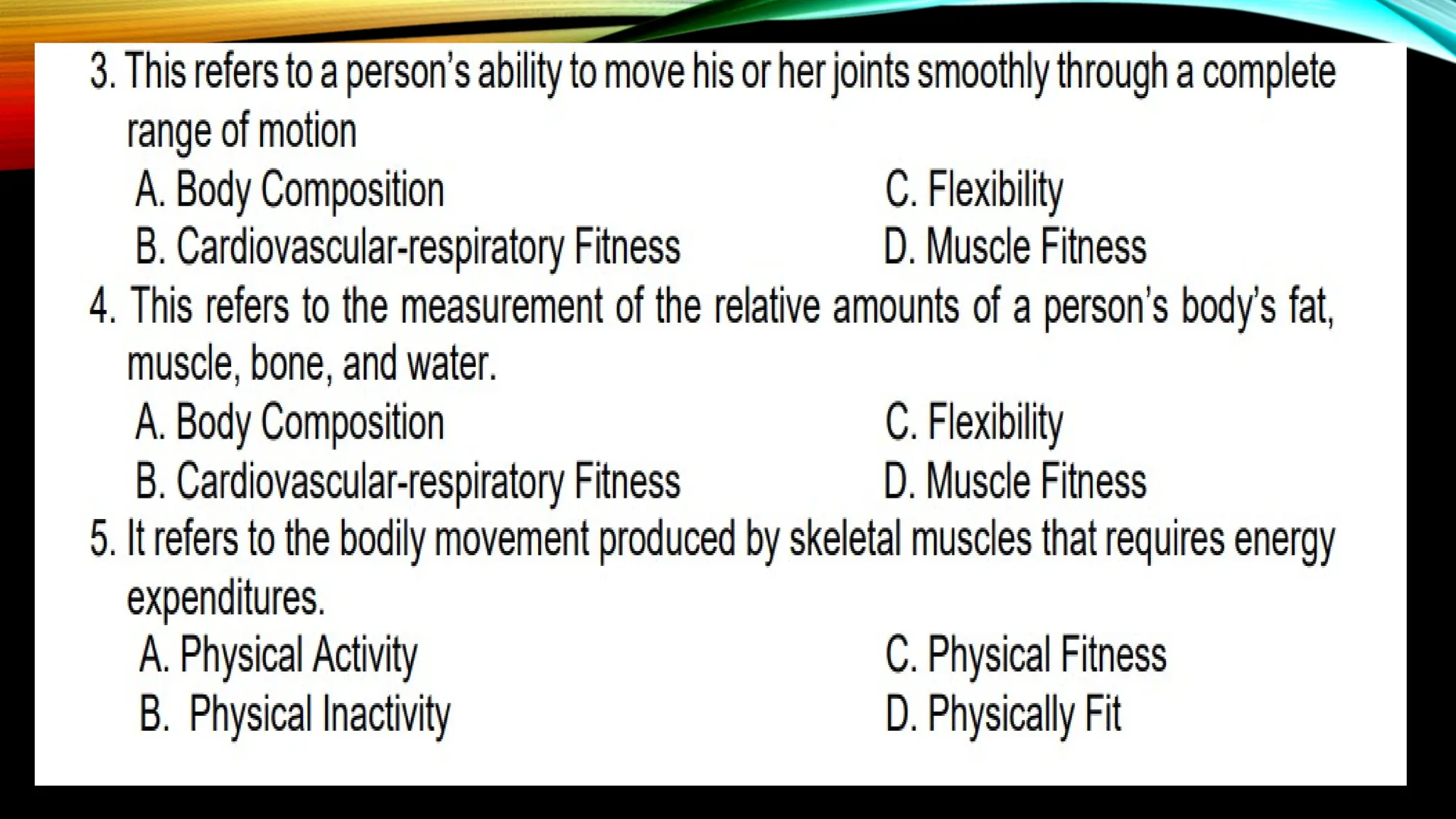
Flexibility- It refers to the range of motion you have around
a given joint.
HEALTH-RELATED PHYSICAL FITNESS
BC
Body Composition - This refers to the measurement of the
relative amounts of a person’s body’s fat, muscle, bone, and
water.
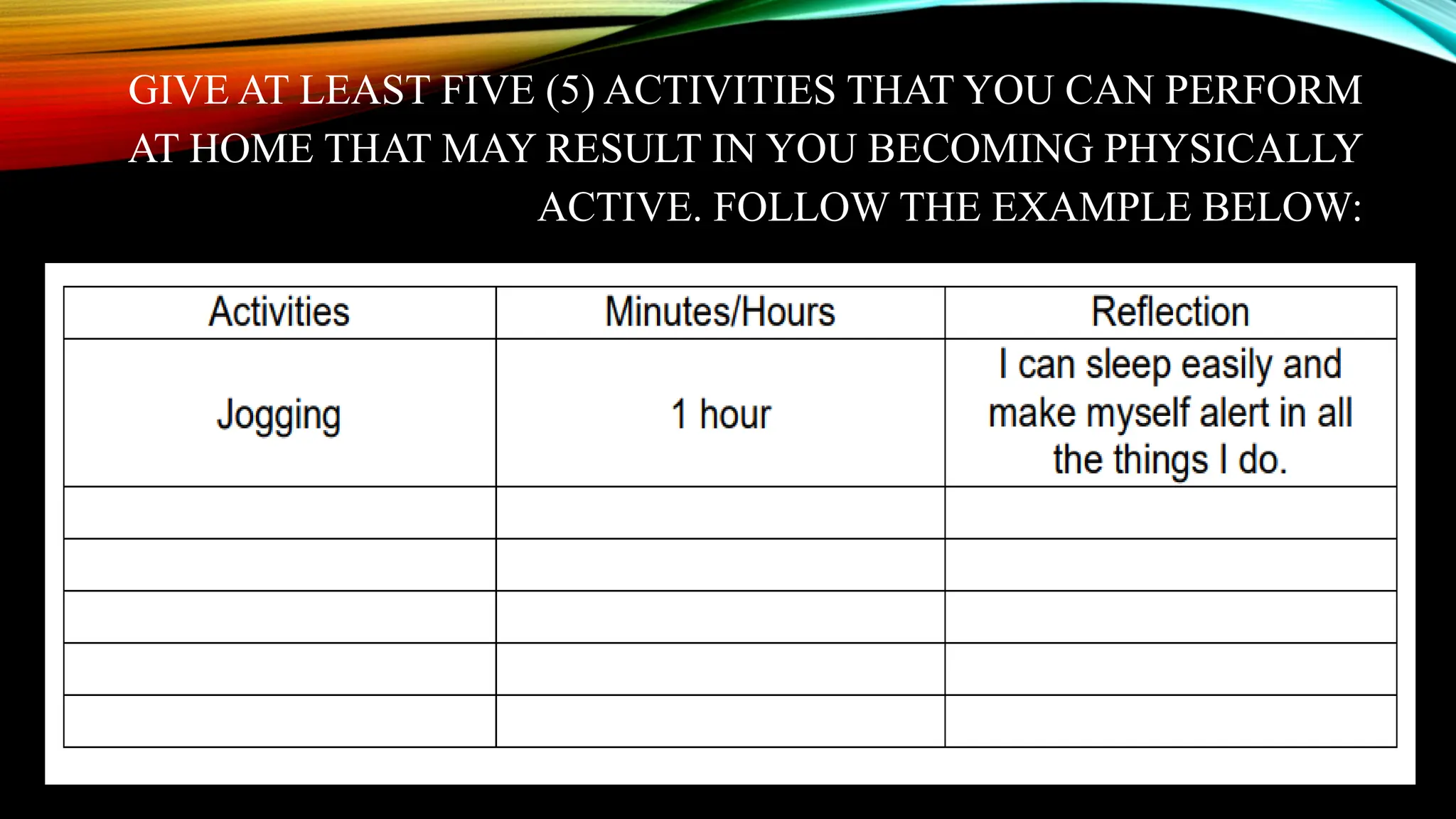
GIVE AT LEAST FIVE (5) ACTIVITIES THAT YOU CAN PERFORM
AT HOME THAT MAY RESULT IN YOU BECOMING PHYSICALLY
ACTIVE. FOLLOW THE EXAMPLE BELOW:
LET’S THINK OUT LOUD!!
- What have you learned from the lesson?
- What are the four types of exercise?
- What are the five subcomponents of health
related fitness?
REVIEW TIME!!
CLIPS
- what did you observe?
- What are the barriers that you commonly encountered
in your life?
An article by Lowe(n.d.) from Physiopedia,
emphasizes that “nowadays, there are technological
advances and conveniences that make our life
easier and less active. It refers to the barriers to
physical activity. Understanding these common
barriers and creating strategies to overcome them
may help make physical activity become part of
daily life”.
QUESTIONS!
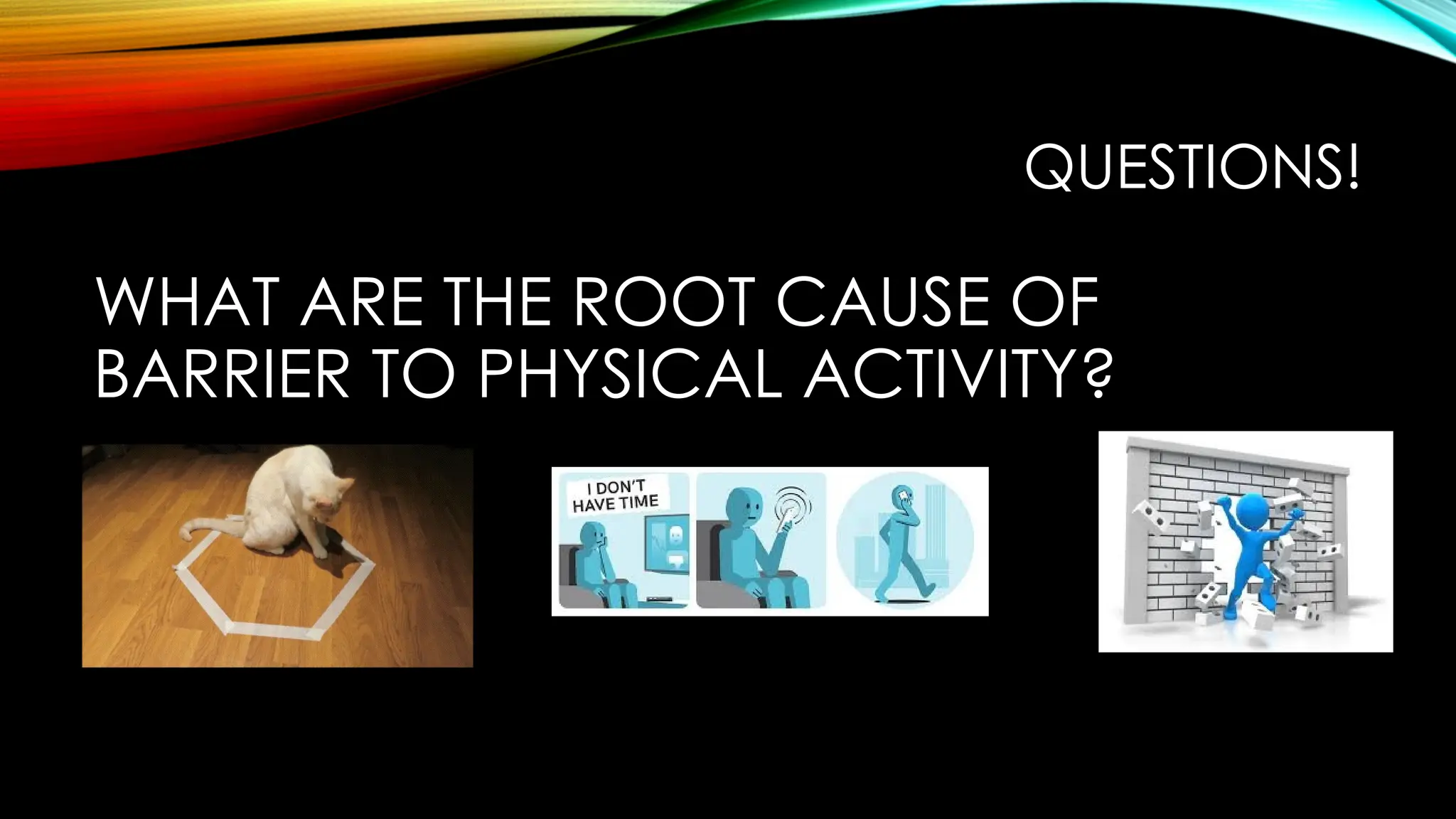
WHAT ARE THE ROOT CAUSE OF
BARRIER TO PHYSICAL ACTIVITY?
BARRIERS TO PHYSICAL ACTIVITY
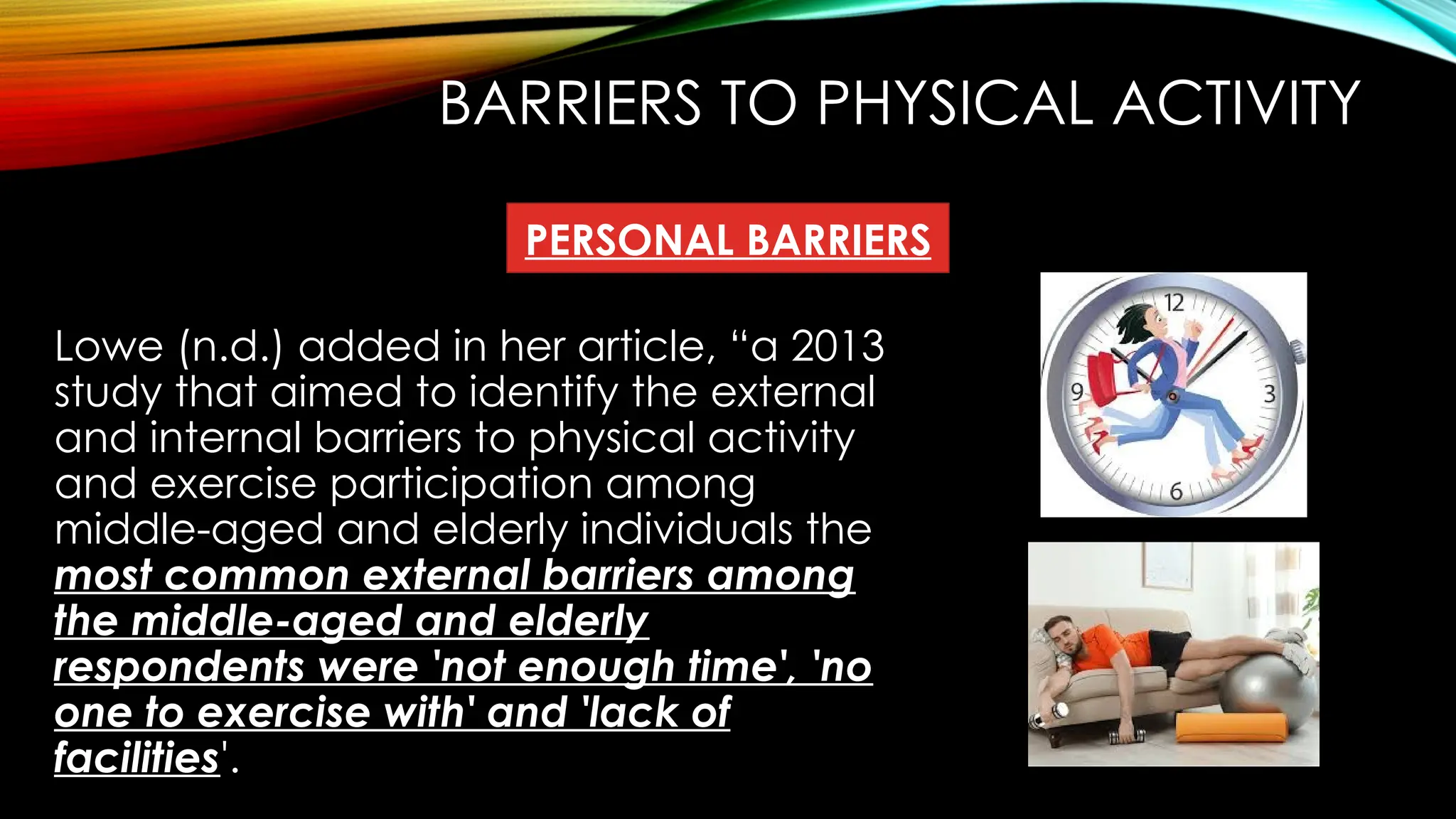
Lowe (n.d.) added in her article, “a 2013
study that aimed to identify the external
and internal barriers to physical activity
and exercise participation among
middle-aged and elderly individuals the
most common external barriers among
the middle-aged and elderly
respondents were 'not enough time', 'no
one to exercise with' and 'lack of
facilities'.
PERSONAL BARRIERS
BARRIERS TO PHYSICAL ACTIVITY
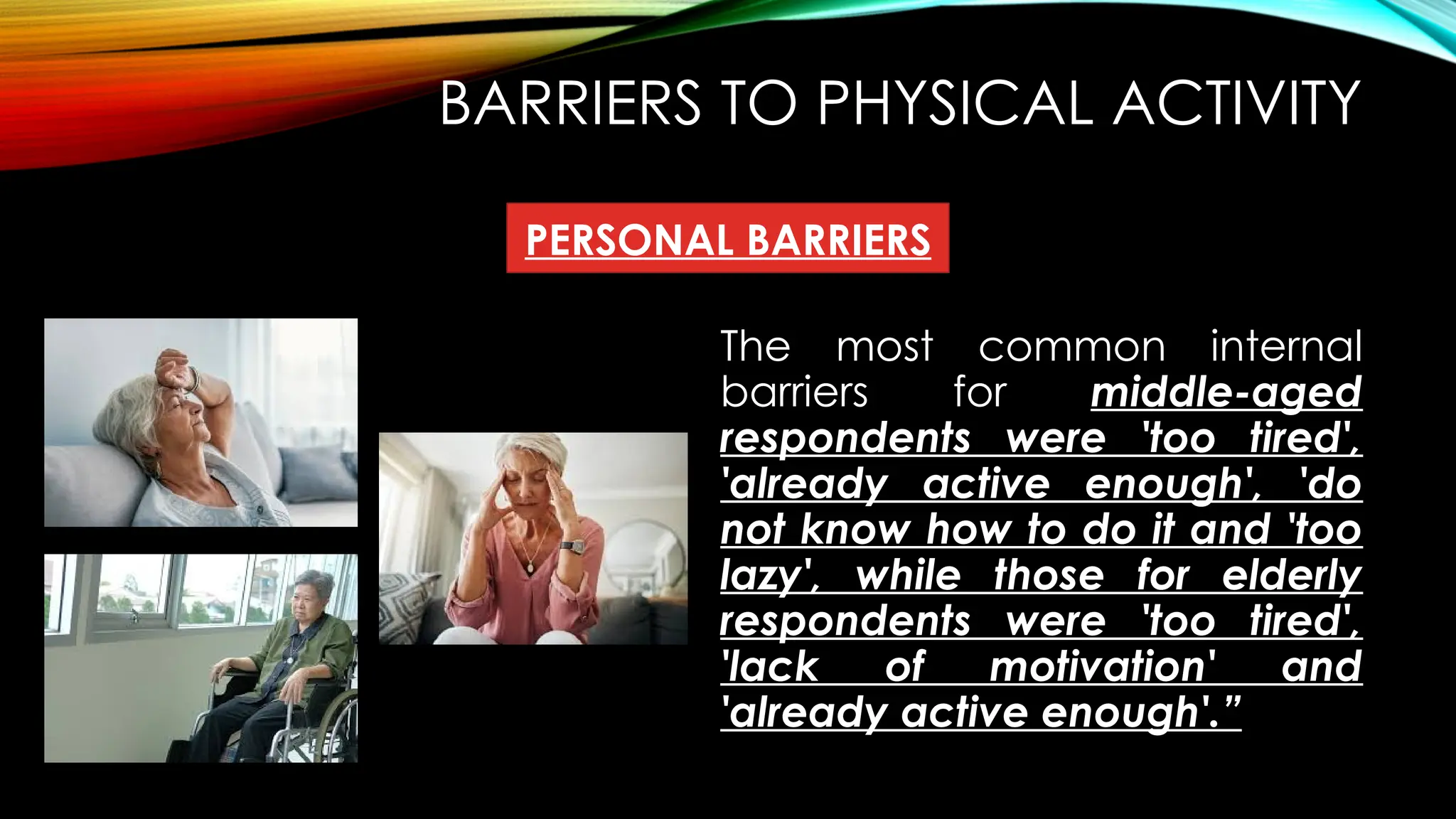
The most common internal
barriers for middle-aged
respondents were 'too tired',
'already active enough', 'do
not know how to do it and 'too
lazy', while those for elderly
respondents were 'too tired',
'lack of motivation' and
'already active enough'.”
PERSONAL BARRIERS
BARRIERS TO PHYSICAL ACTIVITY
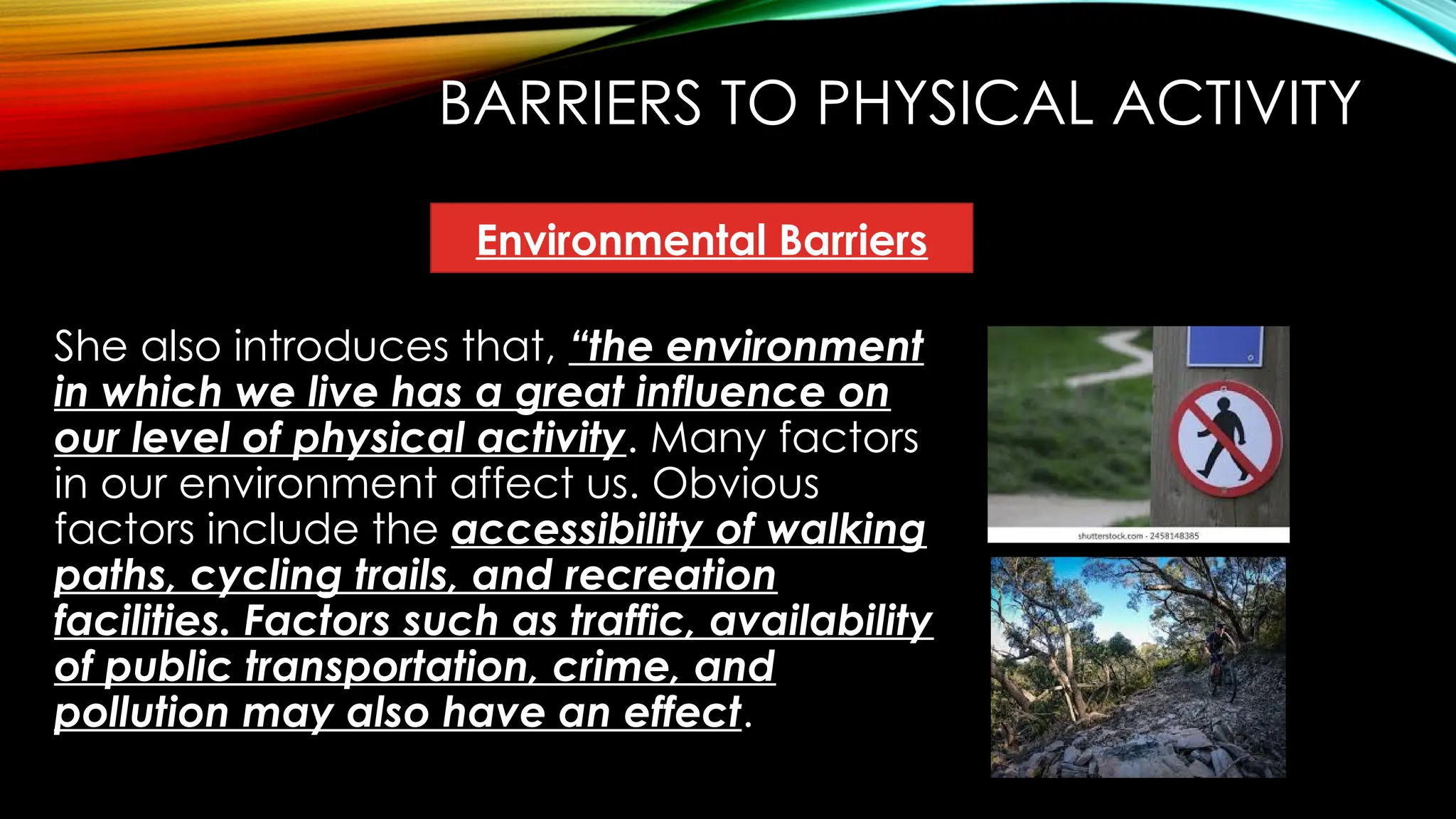
She also introduces that, “the environment
in which we live has a great influence on
our level of physical activity. Many factors
in our environment affect us. Obvious
factors include the accessibility of walking
paths, cycling trails, and recreation
facilities. Factors such as traffic, availability
of public transportation, crime, and
pollution may also have an effect.
Environmental Barriers
BARRIERS TO PHYSICAL ACTIVITY
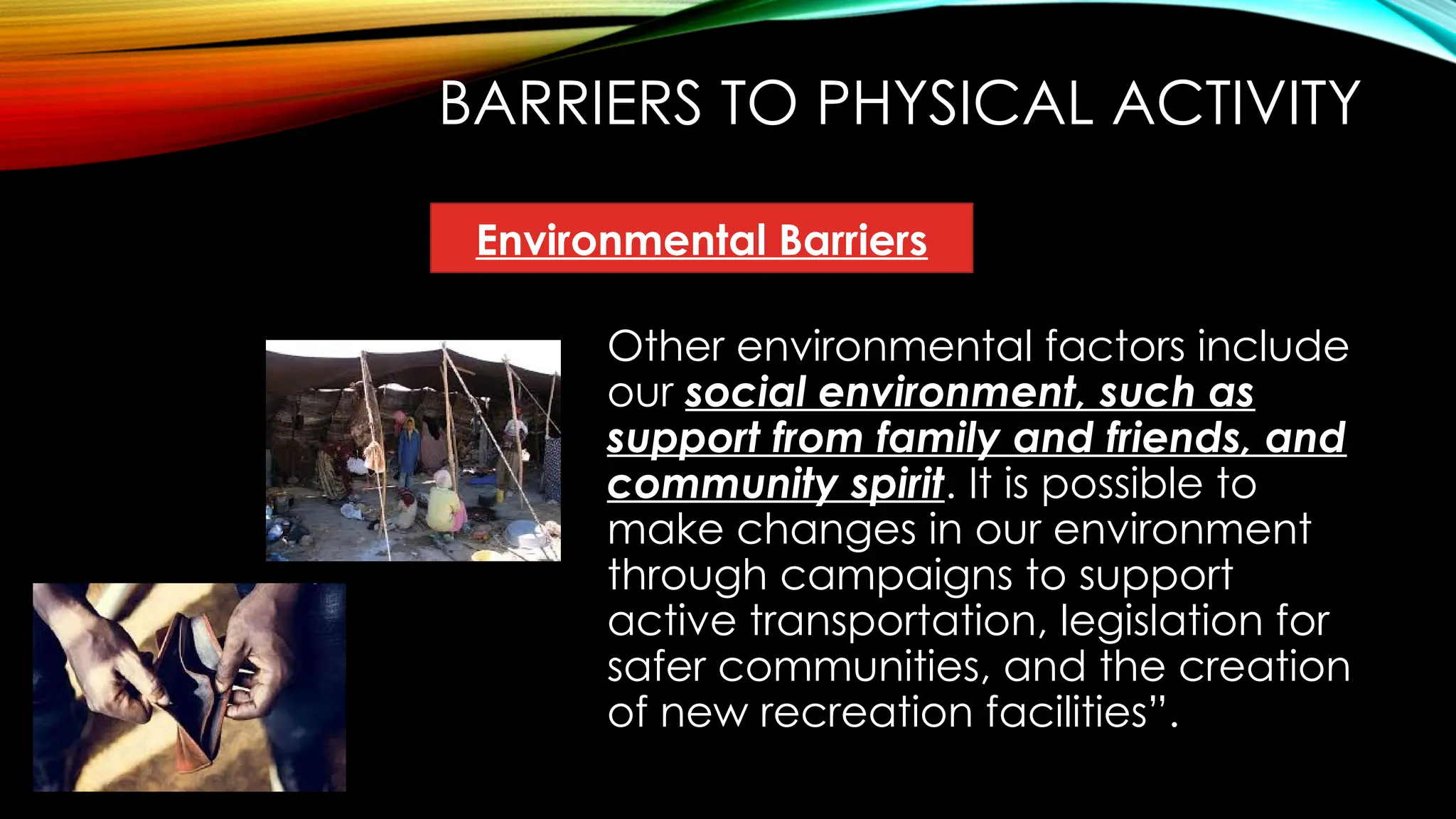
Other environmental factors include
our social environment, such as
support from family and friends, and
community spirit. It is possible to
make changes in our environment
through campaigns to support
active transportation, legislation for
safer communities, and the creation
of new recreation facilities”.
Environmental Barriers
HOW DO WE SOLVE THE COMMON
BARRIERS TO ADOPTING A PHYSICALLY
ACTIVE LIFESTYLE?
BARRIER SOLUTION
I do not have
the time
Prioritize activities and cut back
some time from the nonessential
activities to be able to exercise.
I am always
tired
Make a physical activity diary and
analyze which part of the day you
have more energy and schedule
your workout around that period.
BARRIER SOLUTION
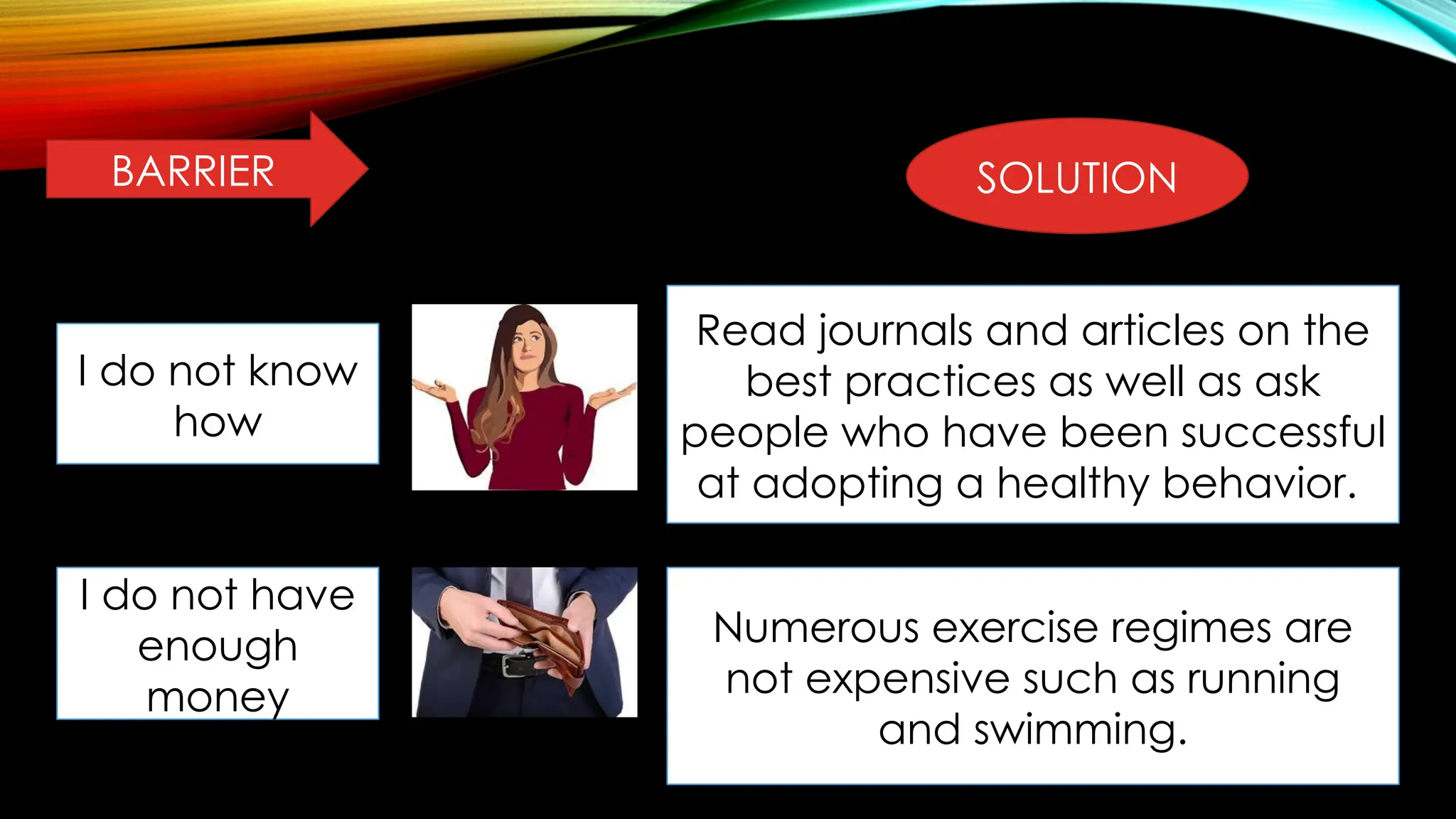
I do not know
how
Read journals and articles on the
best practices as well as ask
people who have been successful
at adopting a healthy behavior.
I do not have
enough
money
Numerous exercise regimes are
not expensive such as running
and swimming.
BARRIER SOLUTION
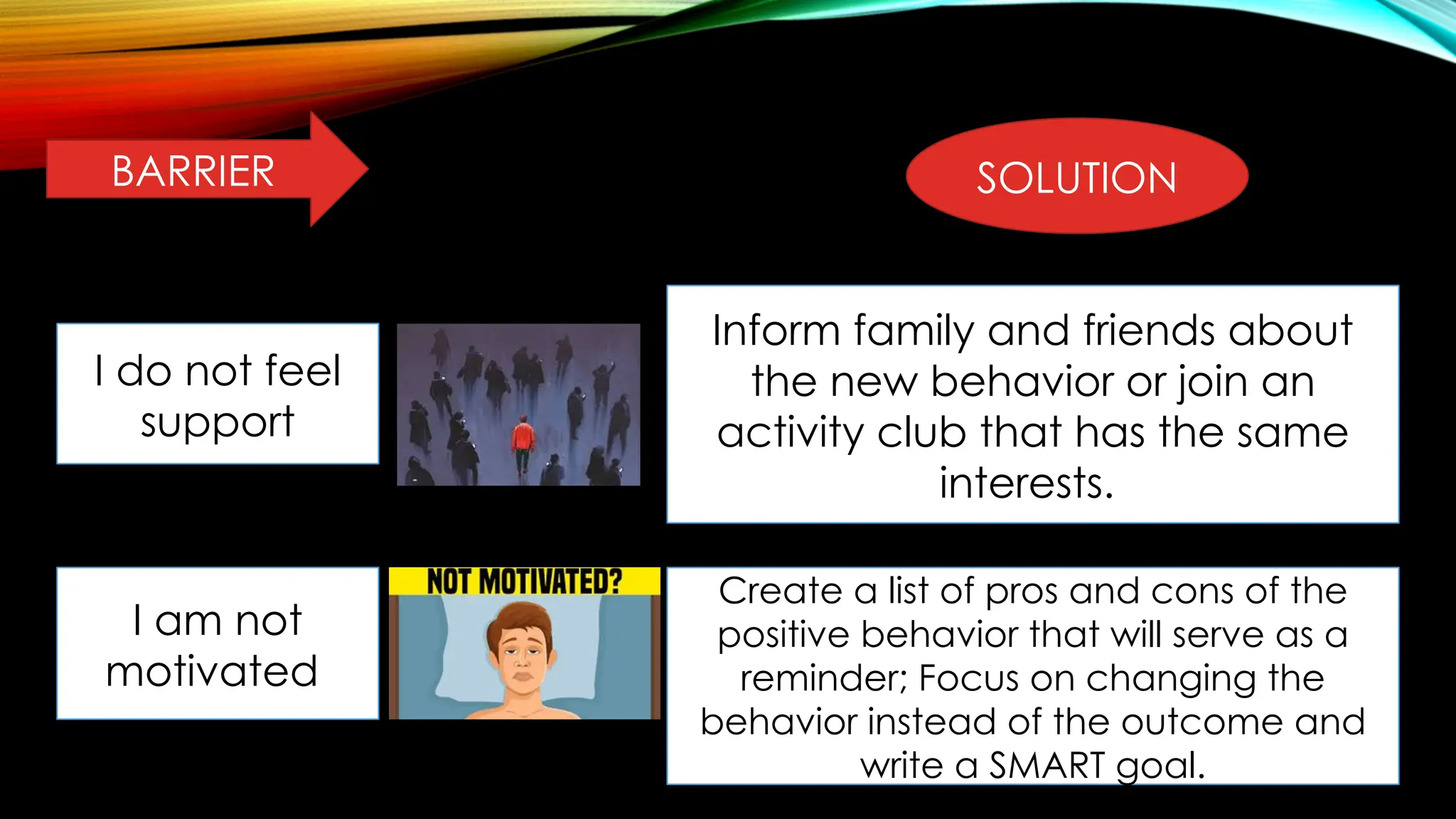
I do not feel
support
Inform family and friends about
the new behavior or join an
activity club that has the same
interests.
I am not
motivated
Create a list of pros and cons of the
positive behavior that will serve as a
reminder; Focus on changing the
behavior instead of the outcome and
write a SMART goal.
BARRIER SOLUTION
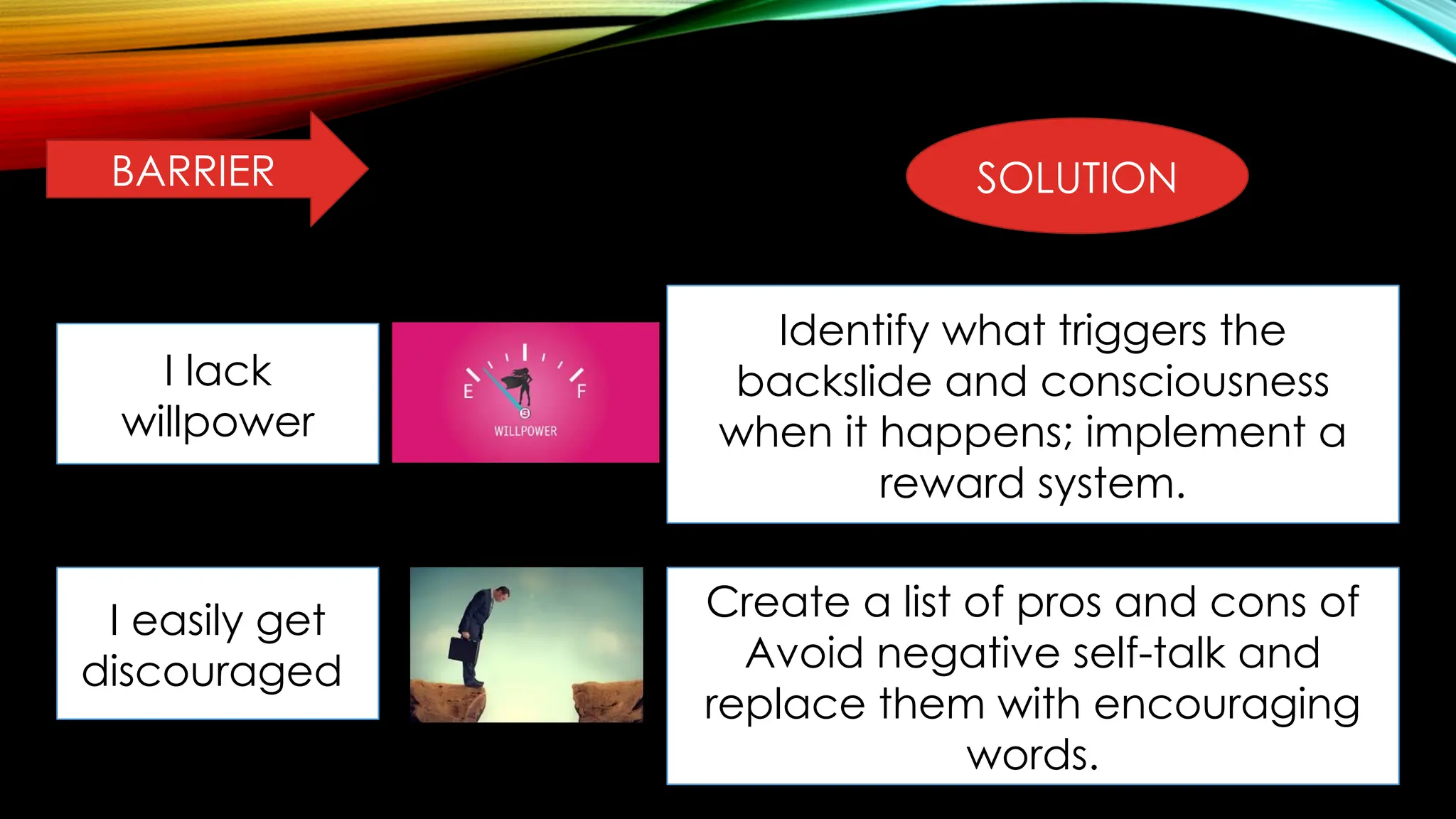
I lack
willpower
Identify what triggers the
backslide and consciousness
when it happens; implement a
reward system.
I easily get
discouraged
Create a list of pros and cons of
Avoid negative self-talk and
replace them with encouraging
words.
WHY DO WE NEED TO KEEP
OURSELVES FIT?
THE IMPORTANCE OF PHYSICAL
FITNESS
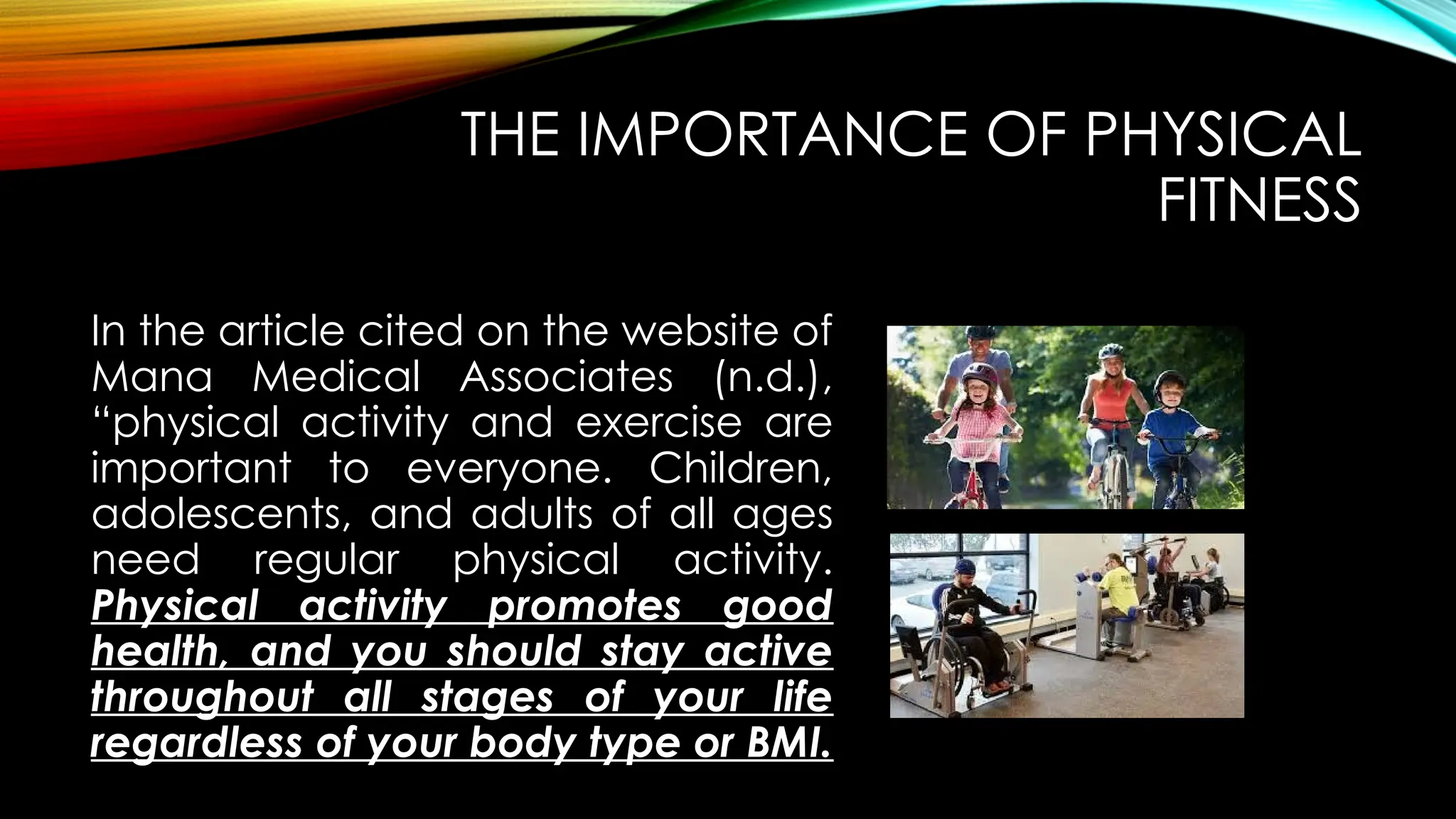
In the article cited on the website of
Mana Medical Associates (n.d.),
“physical activity and exercise are
important to everyone. Children,
adolescents, and adults of all ages
need regular physical activity.
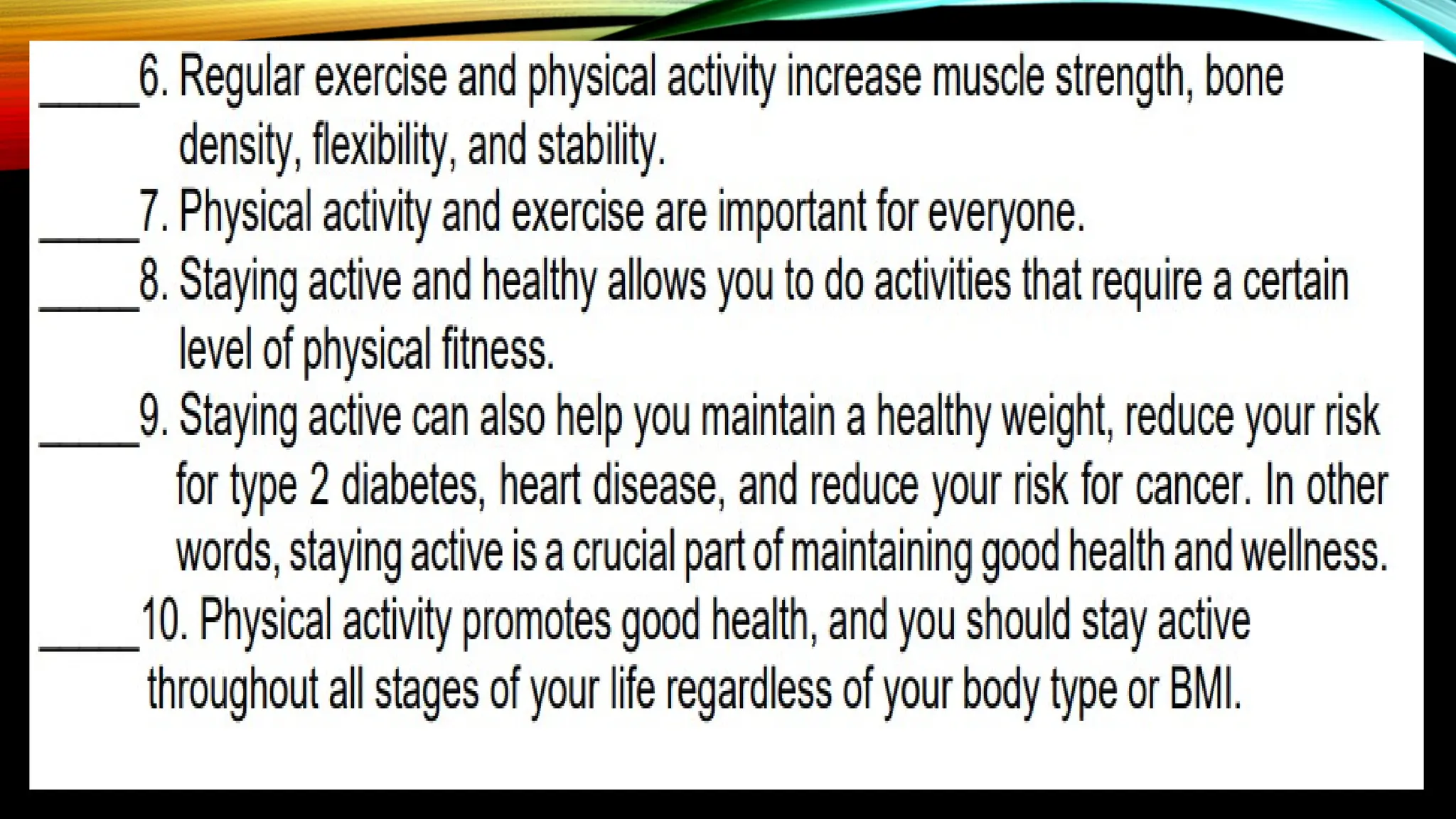
Physical activity promotes good
health, and you should stay active
throughout all stages of your life
regardless of your body type or BMI.
THE IMPORTANCE OF PHYSICAL
FITNESS
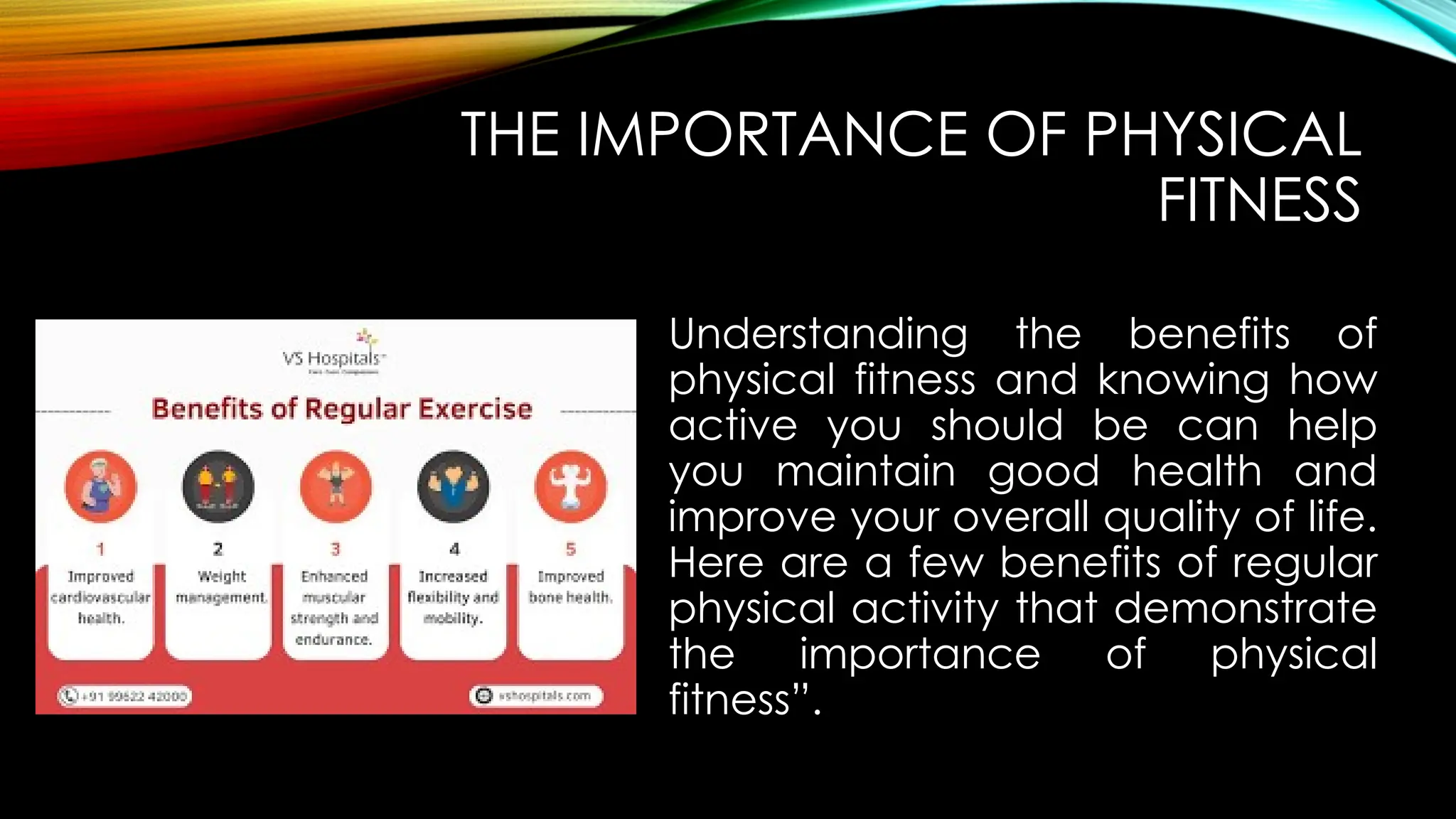
Understanding the benefits of
physical fitness and knowing how
active you should be can help
you maintain good health and
improve your overall quality of life.
Here are a few benefits of regular
physical activity that demonstrate
the importance of physical
fitness”.
Save money
THE IMPORTANCE OF PHYSICAL
FITNESS
According to the Centers for Disease Control
and Prevention, chronic diseases cause 7
out of 10 deaths in the U.S. and treating
chronic diseases accounts for 86% of U.S.
healthcare costs. While some diseases
cannot be prevented, you can reduce your
risk for certain diseases – such as heart
disease and diabetes – by reducing risky
behaviors and living a healthy lifestyle.
Save money
THE IMPORTANCE OF PHYSICAL
FITNESS
Making healthy choices,
such as engaging in
regular physical activity,
can reduce your risk for
many health issues and
complications that can
result in expensive
medical care. (Mana
Medical Associates, n.d.)
Save money
THE IMPORTANCE OF PHYSICAL
FITNESS
Numerous studies have shown that
regular physical activity increases life
expectancy and reduces the risk of
premature mortality. There’s not a
magic formula that translates hours of
physical activity into hours of life
gained, but research suggests that
people who are more active tend to
be healthier and tend to live longer.
(Mana Medical Associates, n.d.)
Reduce your risk of injury
THE IMPORTANCE OF PHYSICAL
FITNESS
Regular exercise and physical
activity increase muscle strength,
bone density, flexibility, and stability.
Physical fitness can reduce your risk
for and resilience to accidental
injuries, especially as you get older.
Reduce your risk of injury
THE IMPORTANCE OF PHYSICAL
FITNESS
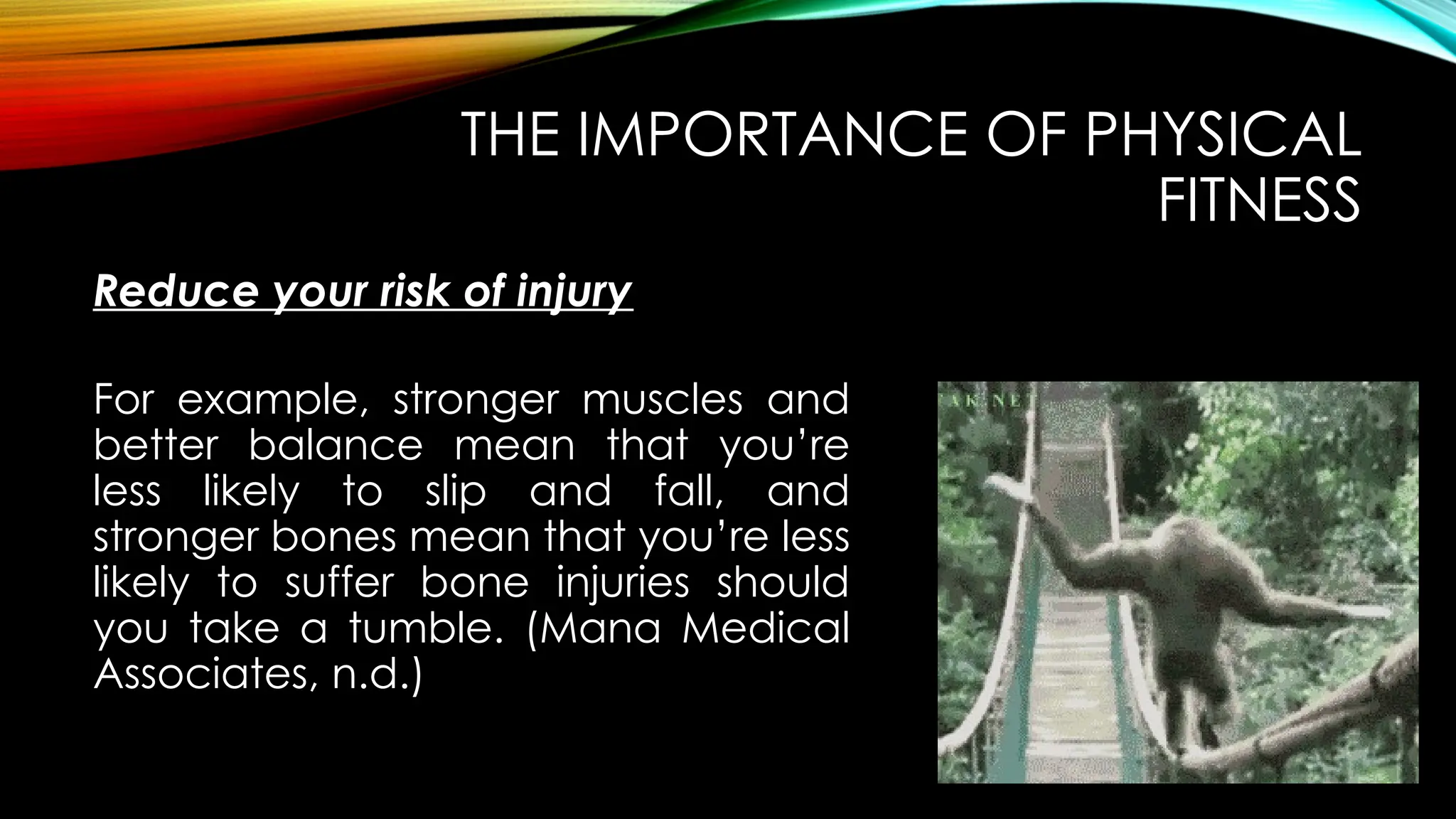
For example, stronger muscles and
better balance mean that you’re
less likely to slip and fall, and
stronger bones mean that you’re less
likely to suffer bone injuries should
you take a tumble. (Mana Medical
Associates, n.d.)
Improve your quality of life
THE IMPORTANCE OF PHYSICAL
FITNESS
A sedentary lifestyle and a lack
of physical activity can take a
toll on a person’s body. Physical
inactivity is associated with an
increased risk for certain types of
cancer, numerous chronic
diseases, and mental health
issues.
Improve your quality of life
THE IMPORTANCE OF PHYSICAL
FITNESS
Exercise, however, has been shown
to improve mood and mental
health and provides numerous
health benefits. Of course, physical
fitness also allows you to do things
that you may not otherwise be able
to do. (Mana Medical Associates,
n.d.)
Stay active
THE IMPORTANCE OF PHYSICAL
FITNESS
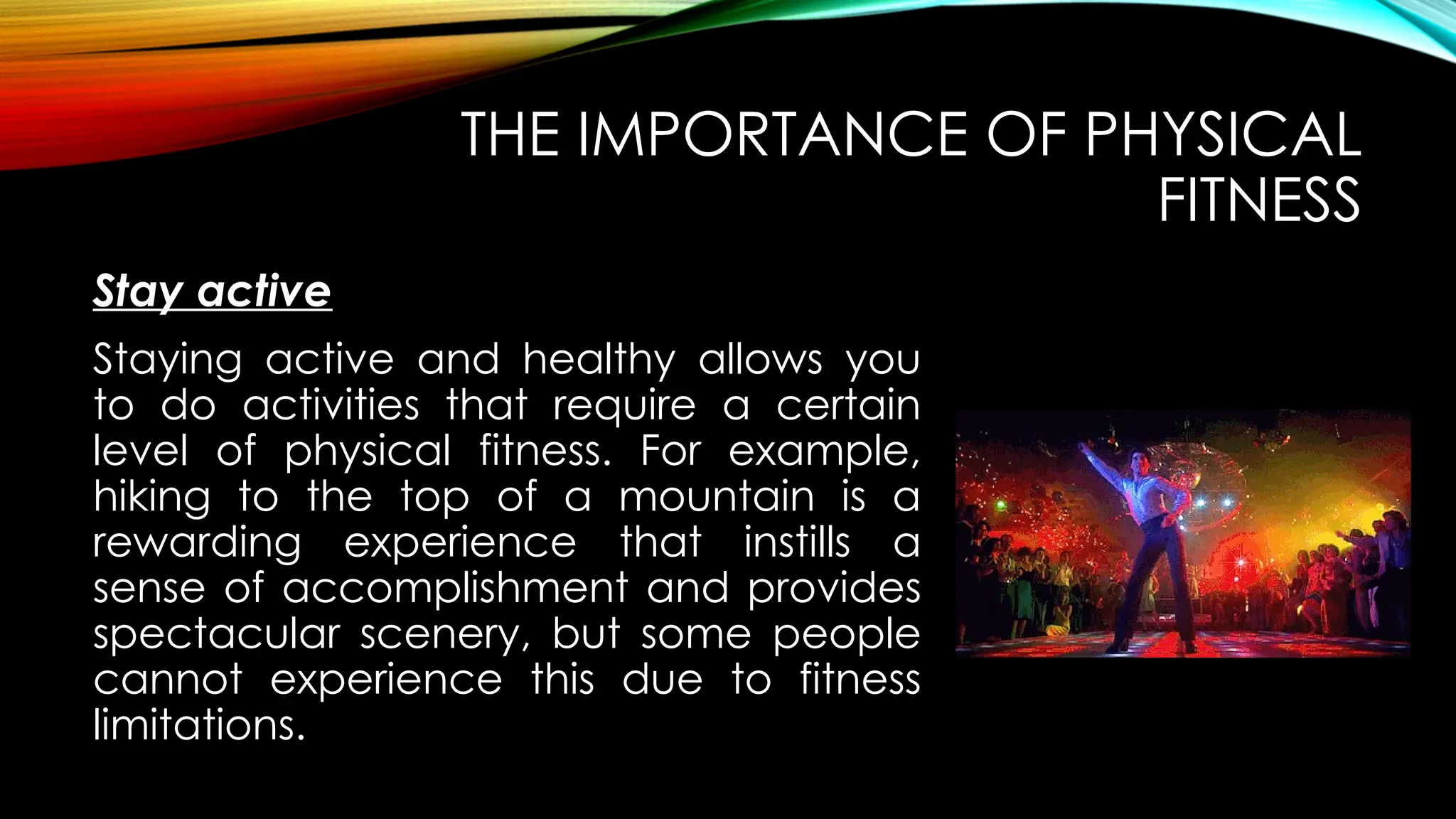
Staying active and healthy allows you
to do activities that require a certain
level of physical fitness. For example,
hiking to the top of a mountain is a
rewarding experience that instills a
sense of accomplishment and provides
spectacular scenery, but some people
cannot experience this due to fitness
limitations.
Improve your health
THE IMPORTANCE OF PHYSICAL
FITNESS
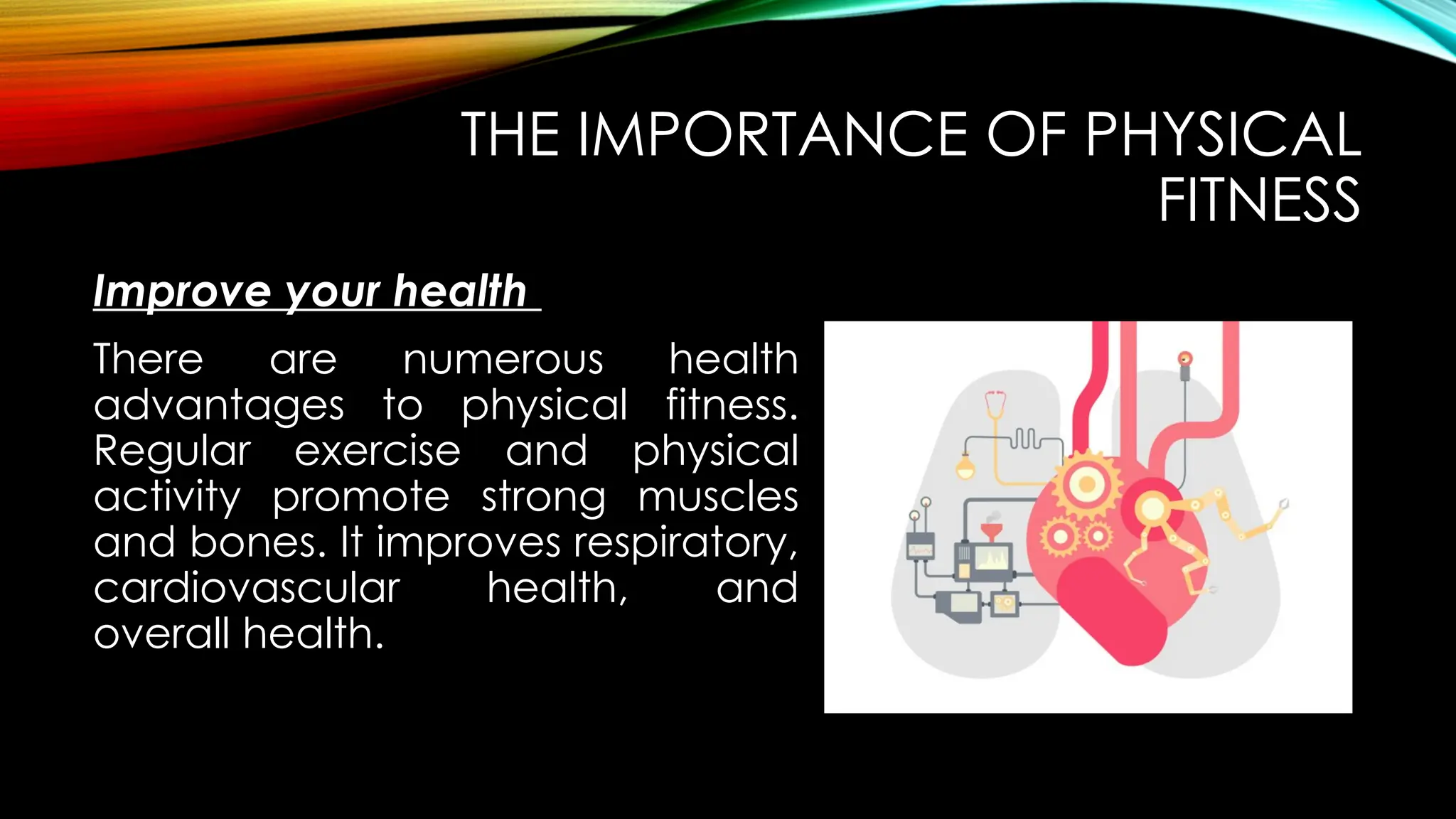
There are numerous health
advantages to physical fitness.
Regular exercise and physical
activity promote strong muscles
and bones. It improves respiratory,
cardiovascular health, and
overall health.
Improve your health
THE IMPORTANCE OF PHYSICAL
FITNESS
Staying active can also help you
maintain a healthy weight, reduce
your risk for type 2 diabetes, heart
disease, and reduce your risk for
some cancers. In other words,
staying active is a crucial part of
maintaining good health and
wellness. (Mana Medical
Associates, n.d.)
LET’S THINK OUT LOUD!!
What are the other barriers to physical activity that
you experienced and what are the solutions you
made?
What are the barriers to physical activity?
Why it is important to maintain fitness?
PHYSICAL FITNESS AND DIFFERENT EXERCISES

PHYSICAL FITNESS AND DIFFERENT EXERCISES

  • 1.
  • 3.
    OBJECTIVES - Discuss andidentify the four types of exercises and subcomponents of health -related fitness - Engage in physical fitness test - Show in-depth appreciation on the importance of becoming physically fit by class open sharing activity
  • 4.
    WARM - UP _N _ U R _ N _ E S _ R E _ _ H T B _L _ _ C _ _ L _ _ I B _ _ I T _ ENDURANCE STRENGHT BALANCE FLEXIBILITY
  • 5.
    FOUR TYPES OFEXERCISE CAN IMPROVE YOUR HEALTH AND PHYSICAL ABILITY “Physical Fitness is a state of health and well-being and, more specifically, the ability to perform aspects of sports, occupations, and daily activities. Physical fitness is generally achieved through proper nutrition, moderate-vigorous physical exercise, and sufficient rest.” (Introduction to Nutrition and Physical Fitness, 2020)
  • 6.
    We can saythat you are physically active if you engage in bodily movement produced by skeletal muscles that requires energy expenditures. On the other hand, we can identify a person who is physically inactive if he/she did not get recommended level of regular physical activity.
  • 7.
    THERE ARE FOURTYPES OF PHYSICAL EXERCISE ACCORDING TO NATIONAL INSTITUTE ON AGING. (NIA, 2021) TYPES MEANING BENEFITS Endurance Exercise It is often referred to as aerobic, increasing your breathing and heart rates. It improves the health of your heart, lungs, and circulatory system. They also can delay or prevent many diseases that are common in older adults such as diabetes, colon and breast cancers, heart disease, and others.
  • 8.
    THERE ARE FOURTYPES OF PHYSICAL EXERCISE ACCORDING TO NATIONAL INSTITUTE ON AGING. (NIA, 2021) TYPES MEANING BENEFITS Strength Exercise It increases bone strength and muscular fitness. It helps you stay independent and make everyday activities feel easier. Keeping your muscles strong can help with your balance and prevent falls and fallrelated injuries.
  • 9.
    THERE ARE FOURTYPES OF PHYSICAL EXERCISE ACCORDING TO NATIONAL INSTITUTE ON AGING. (NIA, 2021) TYPES MEANING BENEFITS Balance Exercise It involves doing exercises that strengthen the muscles that help keep you upright, including your legs and core. It helps to prevent falls, a common problem in older adults that can have serious consequences.
  • 10.
    THERE ARE FOURTYPES OF PHYSICAL EXERCISE ACCORDING TO NATIONAL INSTITUTE ON AGING. (NIA, 2021) TYPES MEANING BENEFITS Flexibility Exercise It is a key component to preventing injury. It helps prepare the muscles for exercise.
  • 11.
    HEALTH-RELATED PHYSICAL FITNESS CRF Cardiovascular-RespiratoryFitness - It refers to your body's ability to efficiently and effectively intake oxygen and deliver it to your body's tissues by way of the heart, lungs, arteries, vessels, and veins. ME Muscular Endurance is one of two factors contributing to overall muscular health. Think of muscular endurance as a particular muscle group's ability to continuously contract against a given resistance.
  • 12.
    HEALTH-RELATED PHYSICAL FITNESS MS MuscularStrength refers to the amount of force a particular muscle group can produce in one, all-out effort F Flexibility- It refers to the range of motion you have around a given joint.
  • 13.
    HEALTH-RELATED PHYSICAL FITNESS BC BodyComposition - This refers to the measurement of the relative amounts of a person’s body’s fat, muscle, bone, and water.
  • 15.
    GIVE AT LEASTFIVE (5) ACTIVITIES THAT YOU CAN PERFORM AT HOME THAT MAY RESULT IN YOU BECOMING PHYSICALLY ACTIVE. FOLLOW THE EXAMPLE BELOW:
  • 16.
    LET’S THINK OUTLOUD!! - What have you learned from the lesson? - What are the four types of exercise? - What are the five subcomponents of health related fitness?
  • 21.
  • 22.
  • 23.
    - what didyou observe? - What are the barriers that you commonly encountered in your life?

  • 24.
    An article byLowe(n.d.) from Physiopedia, emphasizes that “nowadays, there are technological advances and conveniences that make our life easier and less active. It refers to the barriers to physical activity. Understanding these common barriers and creating strategies to overcome them may help make physical activity become part of daily life”.
  • 25.
    QUESTIONS! WHAT ARE THEROOT CAUSE OF BARRIER TO PHYSICAL ACTIVITY?
  • 26.
    BARRIERS TO PHYSICALACTIVITY Lowe (n.d.) added in her article, “a 2013 study that aimed to identify the external and internal barriers to physical activity and exercise participation among middle-aged and elderly individuals the most common external barriers among the middle-aged and elderly respondents were 'not enough time', 'no one to exercise with' and 'lack of facilities'. PERSONAL BARRIERS
  • 27.
    BARRIERS TO PHYSICALACTIVITY The most common internal barriers for middle-aged respondents were 'too tired', 'already active enough', 'do not know how to do it and 'too lazy', while those for elderly respondents were 'too tired', 'lack of motivation' and 'already active enough'.” PERSONAL BARRIERS
  • 28.
    BARRIERS TO PHYSICALACTIVITY She also introduces that, “the environment in which we live has a great influence on our level of physical activity. Many factors in our environment affect us. Obvious factors include the accessibility of walking paths, cycling trails, and recreation facilities. Factors such as traffic, availability of public transportation, crime, and pollution may also have an effect. Environmental Barriers
  • 29.
    BARRIERS TO PHYSICALACTIVITY Other environmental factors include our social environment, such as support from family and friends, and community spirit. It is possible to make changes in our environment through campaigns to support active transportation, legislation for safer communities, and the creation of new recreation facilities”. Environmental Barriers
  • 30.
    HOW DO WESOLVE THE COMMON BARRIERS TO ADOPTING A PHYSICALLY ACTIVE LIFESTYLE?
  • 31.
    BARRIER SOLUTION I donot have the time Prioritize activities and cut back some time from the nonessential activities to be able to exercise. I am always tired Make a physical activity diary and analyze which part of the day you have more energy and schedule your workout around that period.
  • 32.
    BARRIER SOLUTION I donot know how Read journals and articles on the best practices as well as ask people who have been successful at adopting a healthy behavior. I do not have enough money Numerous exercise regimes are not expensive such as running and swimming.
  • 33.
    BARRIER SOLUTION I donot feel support Inform family and friends about the new behavior or join an activity club that has the same interests. I am not motivated Create a list of pros and cons of the positive behavior that will serve as a reminder; Focus on changing the behavior instead of the outcome and write a SMART goal.
  • 34.
    BARRIER SOLUTION I lack willpower Identifywhat triggers the backslide and consciousness when it happens; implement a reward system. I easily get discouraged Create a list of pros and cons of Avoid negative self-talk and replace them with encouraging words.
  • 35.
    WHY DO WENEED TO KEEP OURSELVES FIT?
  • 36.
    THE IMPORTANCE OFPHYSICAL FITNESS In the article cited on the website of Mana Medical Associates (n.d.), “physical activity and exercise are important to everyone. Children, adolescents, and adults of all ages need regular physical activity. Physical activity promotes good health, and you should stay active throughout all stages of your life regardless of your body type or BMI.
  • 37.
    THE IMPORTANCE OFPHYSICAL FITNESS Understanding the benefits of physical fitness and knowing how active you should be can help you maintain good health and improve your overall quality of life. Here are a few benefits of regular physical activity that demonstrate the importance of physical fitness”.
  • 38.
    Save money THE IMPORTANCEOF PHYSICAL FITNESS According to the Centers for Disease Control and Prevention, chronic diseases cause 7 out of 10 deaths in the U.S. and treating chronic diseases accounts for 86% of U.S. healthcare costs. While some diseases cannot be prevented, you can reduce your risk for certain diseases – such as heart disease and diabetes – by reducing risky behaviors and living a healthy lifestyle.
  • 39.
    Save money THE IMPORTANCEOF PHYSICAL FITNESS Making healthy choices, such as engaging in regular physical activity, can reduce your risk for many health issues and complications that can result in expensive medical care. (Mana Medical Associates, n.d.)
  • 40.
    Save money THE IMPORTANCEOF PHYSICAL FITNESS Numerous studies have shown that regular physical activity increases life expectancy and reduces the risk of premature mortality. There’s not a magic formula that translates hours of physical activity into hours of life gained, but research suggests that people who are more active tend to be healthier and tend to live longer. (Mana Medical Associates, n.d.)
  • 41.
    Reduce your riskof injury THE IMPORTANCE OF PHYSICAL FITNESS Regular exercise and physical activity increase muscle strength, bone density, flexibility, and stability. Physical fitness can reduce your risk for and resilience to accidental injuries, especially as you get older.
  • 42.
    Reduce your riskof injury THE IMPORTANCE OF PHYSICAL FITNESS For example, stronger muscles and better balance mean that you’re less likely to slip and fall, and stronger bones mean that you’re less likely to suffer bone injuries should you take a tumble. (Mana Medical Associates, n.d.)
  • 43.
    Improve your qualityof life THE IMPORTANCE OF PHYSICAL FITNESS A sedentary lifestyle and a lack of physical activity can take a toll on a person’s body. Physical inactivity is associated with an increased risk for certain types of cancer, numerous chronic diseases, and mental health issues.
  • 44.
    Improve your qualityof life THE IMPORTANCE OF PHYSICAL FITNESS Exercise, however, has been shown to improve mood and mental health and provides numerous health benefits. Of course, physical fitness also allows you to do things that you may not otherwise be able to do. (Mana Medical Associates, n.d.)
  • 45.
    Stay active THE IMPORTANCEOF PHYSICAL FITNESS Staying active and healthy allows you to do activities that require a certain level of physical fitness. For example, hiking to the top of a mountain is a rewarding experience that instills a sense of accomplishment and provides spectacular scenery, but some people cannot experience this due to fitness limitations.
  • 46.
    Improve your health THEIMPORTANCE OF PHYSICAL FITNESS There are numerous health advantages to physical fitness. Regular exercise and physical activity promote strong muscles and bones. It improves respiratory, cardiovascular health, and overall health.
  • 47.
    Improve your health THEIMPORTANCE OF PHYSICAL FITNESS Staying active can also help you maintain a healthy weight, reduce your risk for type 2 diabetes, heart disease, and reduce your risk for some cancers. In other words, staying active is a crucial part of maintaining good health and wellness. (Mana Medical Associates, n.d.)
  • 49.
    LET’S THINK OUTLOUD!! What are the other barriers to physical activity that you experienced and what are the solutions you made? What are the barriers to physical activity? Why it is important to maintain fitness?