SPECIAL
CONSIDERA TION
ADVANCE DIRECTIVES
EUTHANASIA WILL
DYING DECLARATION
By
Ms. Preeti
SMVDCoN
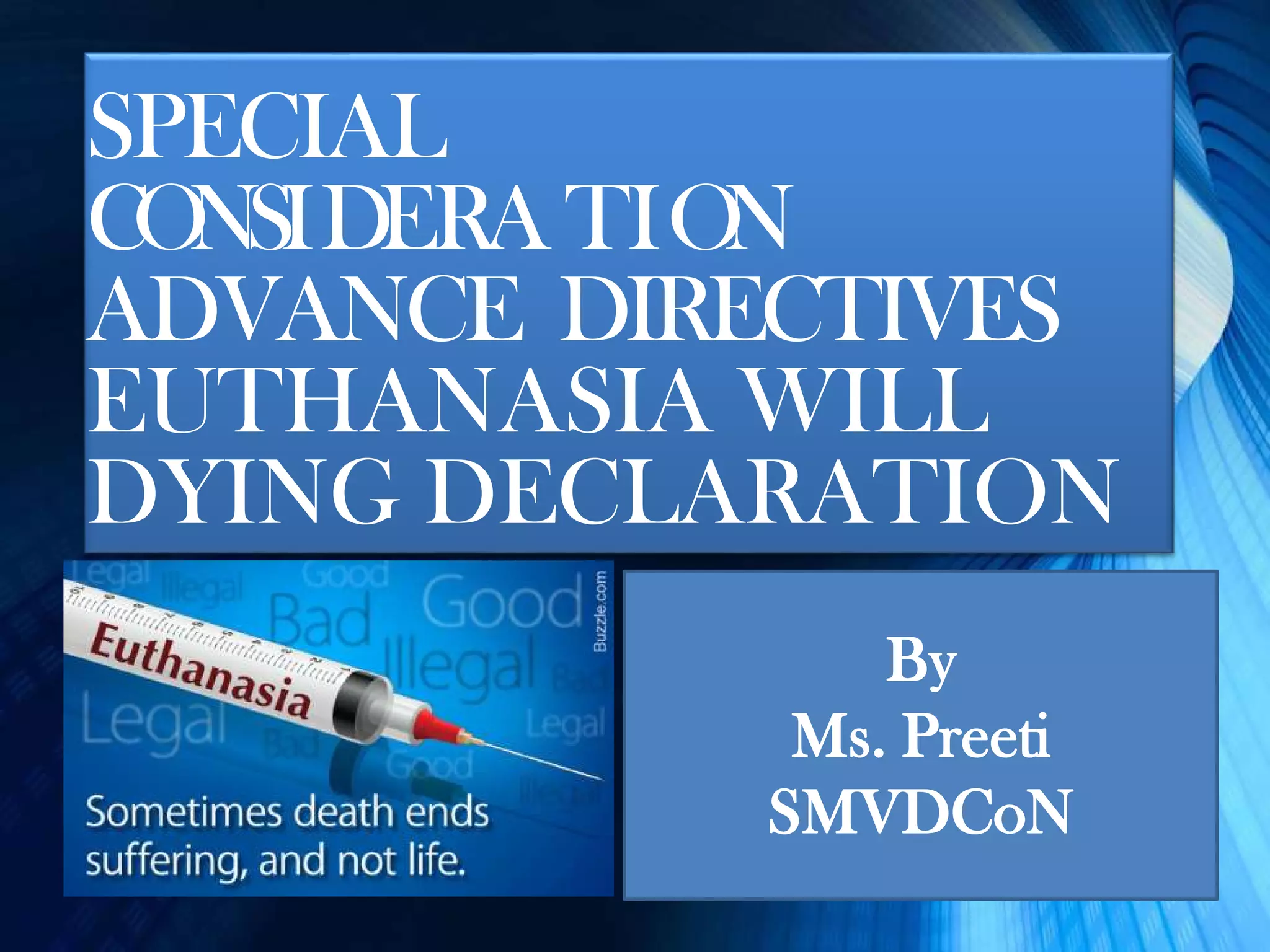
Euthanasia
CONTENT
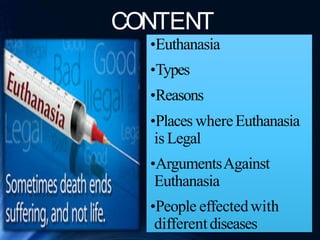
•Euthanasia
•Types
•Reasons
•Places whereEuthanasia
is Legal
•ArgumentsAgainst
Euthanasia
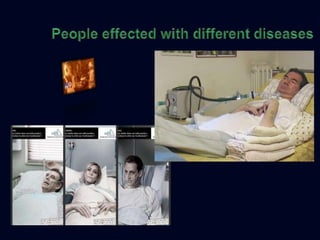
•People effectedwith
differentdiseases
INTRODUCTION
• Euthanasia comes from the Greek
words:
Eu (good) and Thanatosis (death) and it
means "Good Death, "Gentle and Easy
Death." This word has come to be usedfor
"mercy killing.
• It is the act or practice of ending a life ofa
person either by a lethal injection or
suspension of medical treatment.
• The word "euthanasia" was first used in a
medical context by Francis Bacon in the
17th century, to refer to an easy, painless,
happy death, during which it was a
"physician's responsibility to alleviatethe
'physical sufferings' of the body
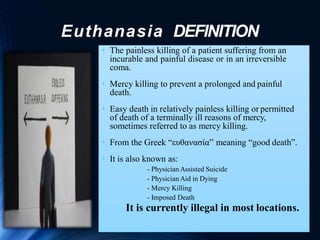
Euthanasia DEFINITION
• The painless killing of a patient suffering from an
incurable and painful disease or in an irreversible
coma.
• Mercy killing to prevent a prolonged and painful
death.
• Easy death in relatively painless killing or permitted
of death of a terminally ill reasons of mercy,
sometimes referred to as mercy killing.
• From the Greek “ευθανασία” meaning “good death”.
• It is also known as:
- Physician Assisted Suicide
- Physician Aid in Dying
- Mercy Killing
- Imposed Death
It is currently illegal in most locations.
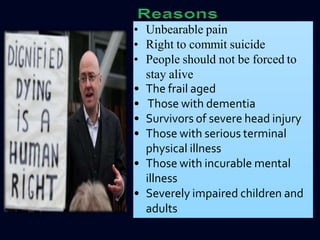
• Unbearable pain
• Right to commit suicide
• People should not be forced to
stay alive
• The frail aged
• Those with dementia
• Survivors of severe head injury
• Those with serious terminal
physical illness
• Those with incurable mental
illness
• Severely impaired children and
adults
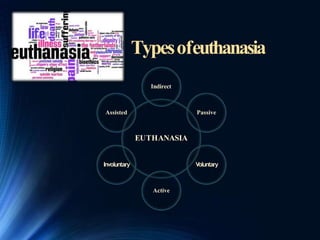
Typesofeuthanasia
EUTHANASIA
Indirect
Passive
Voluntary
Active
Involuntary
Assisted
TYPE OF EUTHANASIA
• 1. voluntary euthanasia -
The person wants to die and says
so. This includes:
Refusing medical treatment
Asking for medical treatment to
be stopped
Asking for life support to be
switched off
 Refusing to eat
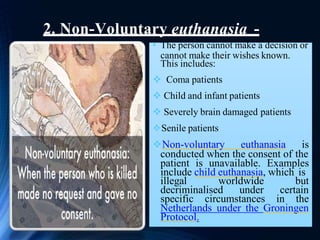
2. Non-Voluntary euthanasia -
• The person cannot make a decision or
cannot make their wishes known.
This includes:
 Coma patients
 Child and infant patients
 Severely brain damaged patients
Senile patients
Non-voluntary euthanasia is
conducted when the consent of the
patient is unavailable. Examples
include child euthanasia, which is
illegal worldwide but
decriminalised under certain
specific circumstances in the
Netherlands under the Groningen
Protocol.
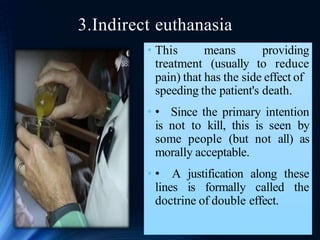
3.Indirect euthanasia
• This
treatment
means providing
(usually to reduce
pain) that has the side effect of
speeding the patient's death.
• • Since the primary intention
is not to kill, this is seen by
some people (but not all) as
morally acceptable.
• • A justification along these
lines is formally called the
doctrine of double effect.
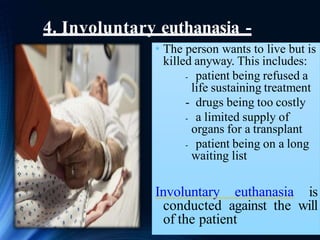
4. Involuntary euthanasia -
• The person wants to live but is
killed anyway. This includes:
- patient being refused a
life sustaining treatment
- drugs being too costly
- a limited supply of
organs for a transplant
- patient being on a long
waiting list
Involuntary euthanasia is
conducted against the will
of the patient
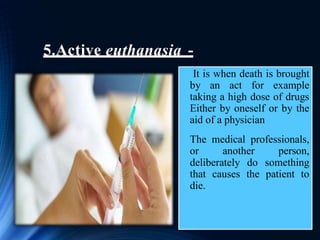
5.Active euthanasia -
It is when death is brought
by an act for example
taking a high dose of drugs
Either by oneself or by the
aid of a physician
The medical professionals,
or another person,
deliberately do something
that causes the patient to
die.
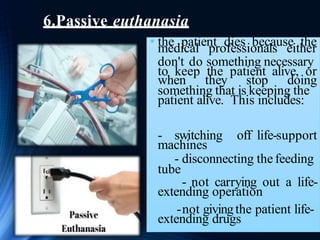
6.Passive euthanasia
• the patient dies because themedical professionals either
don't do something necessary
to keep the patient alive, or
when they stop doing
something that is keeping the
patient alive. This includes:
- switching off life-support
machines
- disconnecting thefeeding
tube
- not carrying out a life-
extending operation
-not givingthe patient life-
extending drugs
Importance of Euthanasia:
Importance o f Euthanasia:
• Shuffle off our responsibility upon the
shoulders of God or nature. We must shoulder
it ourselves. It is our responsibility.” - Arnold
J. Toynbee
• If we are free to make the our own choices of
how to live, we should also be able to make
our own choices of how to die. The power
belongs to the patient.
• Debilitating illnesses, such as cancer, are
currently on the rise. The more people
diagnosed with these illnesses directly
correlates to the number of people faced with
the euthanasia issue.
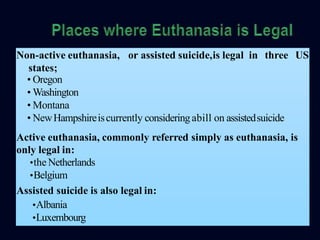
or assisted suicide,is legal in three USNon-active euthanasia,
states;
• Oregon
• Washington
• Montana
• NewHampshireiscurrently consideringabill on assistedsuicide
Active euthanasia, commonly referred simply as euthanasia, is
only legal in:
•the Netherlands
•Belgium
Assisted suicide is also legal in:
•Albania
•Luxembourg
Arguments ForEuthanasia:
It provides awayto relieve extremepain
It provides awayof relief when aperson's quality of life islow
Freesup medical funds to help otherpeople
It is another caseof freedomofchoice
ArgumentsAgainstEuthanasia
Euthanasiadevalueshumanlife
Euthanasiacanbecomeameansof health carecostcontainment
Physicians and other medical carepeople should not be involvedin directly
causingdeath
Thereisa"slippery slope" effect that hasoccurred where euthanasia
hasbeenfirst beenlegalizedfor only
the terminally ill and later laws are changedto allow it for other people
or to bedonenon-voluntarily.
Cases
Special consideration advance directives,Euthanasia

Special consideration advance directives,Euthanasia

  • 1.
    SPECIAL CONSIDERA TION ADVANCE DIRECTIVES EUTHANASIAWILL DYING DECLARATION By Ms. Preeti SMVDCoN
  • 2.
  • 3.
  • 4.
    INTRODUCTION • Euthanasia comesfrom the Greek words: Eu (good) and Thanatosis (death) and it means "Good Death, "Gentle and Easy Death." This word has come to be usedfor "mercy killing. • It is the act or practice of ending a life ofa person either by a lethal injection or suspension of medical treatment. • The word "euthanasia" was first used in a medical context by Francis Bacon in the 17th century, to refer to an easy, painless, happy death, during which it was a "physician's responsibility to alleviatethe 'physical sufferings' of the body
  • 5.
    Euthanasia DEFINITION • Thepainless killing of a patient suffering from an incurable and painful disease or in an irreversible coma. • Mercy killing to prevent a prolonged and painful death. • Easy death in relatively painless killing or permitted of death of a terminally ill reasons of mercy, sometimes referred to as mercy killing. • From the Greek “ευθανασία” meaning “good death”. • It is also known as: - Physician Assisted Suicide - Physician Aid in Dying - Mercy Killing - Imposed Death It is currently illegal in most locations.
  • 6.
    • Unbearable pain •Right to commit suicide • People should not be forced to stay alive • The frail aged • Those with dementia • Survivors of severe head injury • Those with serious terminal physical illness • Those with incurable mental illness • Severely impaired children and adults
  • 7.
  • 8.
    TYPE OF EUTHANASIA •1. voluntary euthanasia - The person wants to die and says so. This includes: Refusing medical treatment Asking for medical treatment to be stopped Asking for life support to be switched off  Refusing to eat
  • 9.
    2. Non-Voluntary euthanasia- • The person cannot make a decision or cannot make their wishes known. This includes:  Coma patients  Child and infant patients  Severely brain damaged patients Senile patients Non-voluntary euthanasia is conducted when the consent of the patient is unavailable. Examples include child euthanasia, which is illegal worldwide but decriminalised under certain specific circumstances in the Netherlands under the Groningen Protocol.
  • 10.
    3.Indirect euthanasia • This treatment meansproviding (usually to reduce pain) that has the side effect of speeding the patient's death. • • Since the primary intention is not to kill, this is seen by some people (but not all) as morally acceptable. • • A justification along these lines is formally called the doctrine of double effect.
  • 11.
    4. Involuntary euthanasia- • The person wants to live but is killed anyway. This includes: - patient being refused a life sustaining treatment - drugs being too costly - a limited supply of organs for a transplant - patient being on a long waiting list Involuntary euthanasia is conducted against the will of the patient
  • 12.
    5.Active euthanasia - Itis when death is brought by an act for example taking a high dose of drugs Either by oneself or by the aid of a physician The medical professionals, or another person, deliberately do something that causes the patient to die.
  • 13.
    6.Passive euthanasia • thepatient dies because themedical professionals either don't do something necessary to keep the patient alive, or when they stop doing something that is keeping the patient alive. This includes: - switching off life-support machines - disconnecting thefeeding tube - not carrying out a life- extending operation -not givingthe patient life- extending drugs
  • 14.
  • 15.
    Importance o fEuthanasia: • Shuffle off our responsibility upon the shoulders of God or nature. We must shoulder it ourselves. It is our responsibility.” - Arnold J. Toynbee • If we are free to make the our own choices of how to live, we should also be able to make our own choices of how to die. The power belongs to the patient. • Debilitating illnesses, such as cancer, are currently on the rise. The more people diagnosed with these illnesses directly correlates to the number of people faced with the euthanasia issue.
  • 16.
    or assisted suicide,islegal in three USNon-active euthanasia, states; • Oregon • Washington • Montana • NewHampshireiscurrently consideringabill on assistedsuicide Active euthanasia, commonly referred simply as euthanasia, is only legal in: •the Netherlands •Belgium Assisted suicide is also legal in: •Albania •Luxembourg
  • 18.
    Arguments ForEuthanasia: It providesawayto relieve extremepain It provides awayof relief when aperson's quality of life islow Freesup medical funds to help otherpeople It is another caseof freedomofchoice ArgumentsAgainstEuthanasia Euthanasiadevalueshumanlife Euthanasiacanbecomeameansof health carecostcontainment Physicians and other medical carepeople should not be involvedin directly causingdeath Thereisa"slippery slope" effect that hasoccurred where euthanasia hasbeenfirst beenlegalizedfor only the terminally ill and later laws are changedto allow it for other people or to bedonenon-voluntarily.
  • 19.