Subhanjan Das
What is Geriatrics Geriatrics is the branch of medicine that focuses on health care of the elderly. It aims to promote health and to prevent and treat diseases and disabilities in older adults. Geriatrics was separated from internal medicine as a distinct entity in the same way that pediatrics is separated from adult internal medicine and neonatology is separated from pediatrics.
Gerontology  Gerontology is the branch of biomedical sciences that studies aging. The term "geriatrics“ is used to refer specifically to the medical study of diseases and problems of the elderly.
Changes with ageing SKIN: Epidermis thinner and fragile Dermis less elastin and flexible Hypodermis thinner and less padding UV light accelerates skin ageing Senile purpura
Changes with ageing EYE Ptosis Dry eye Tearing  Flatten & uneven cornea with light scattering Hyperopia (farsightedness) Smaller pupil requiring brighter light to read Slower dark adaptation Reduced contrast sensitivity
Changes with ageing EAR Reduced sweat glands with increased ear wax affecting hearing Cochlea degeneration causing high tone loss
Changes with ageing KIDNEYS Reduced ability to excrete water, waste products and drugs Less tolerate water depletion Loss of circadian rhythm with nocturia Smaller and less expansible bladder with frequency of urine Less contractable bladder with hesitancy Bigger prostate with fair urine stream
Changes with ageing BONE Continual loss of bone mass from the 4th decade Hormonal change with more bone resorption than formation Less Ca absorption Shorter and stoop Brittle with easy fracture New bone formation at the verge of joints Cartilage thinner
Changes with ageing NERVOUS SYSTEM 30,000-50,000 neurons die each day with diminishing reserve IQ slowly decline after the age of 25 Reduced short term memory Decreased retrieval ability Interrupted and less deep sleep Reduced pain, touch, temperature, and vibration sensations Reduced postural control and balance
Changes with ageing HEART Heart becomes more rigid with decreased output Heart beat less responsive to stress Heart beat less variable with each breathing Irregular heart beat more common with ageing Systolic blood pressure increases with age Pulse pressure widened with hardened vessels Less efficient venous return prone to postural hypotension
Changes with ageing LUNGS Lungs become more rigid with early closure of small airways Less efficient blood gas exchange Chest wall becomes more rigid too Reduced Lung Volume and Vital Capacity Bronchial villi thinner and cough reflex less effective Reduced ability to cope with challenges like climbing stairs, running Reduced immunity prone to chest infection
Changes with ageing GIT Saliva glands secret less with dry mouth Taste and smell senses decline Less heathy teeth affecting chewing/nutrition Stomach muscle weakened and less hungry Small intestine villi absorb less calcium, vitamin B12, folic acid Large intestine muscle weakened and secrets less mucus prone to constipation Less liver blood flow and function with fall in toxic substance/drug clearance Bile thicker with cholesterol prone to gallstones
Diseases in old age
Diseases in old age
Geriatric physiotherapy Geriatric physiotherapy became a specialty of physical therapy study in 1989. Since then, physiotherapists have worked to understand the problems of the aging. There is a long list of problems dealt with in geriatric physiotherapy.
Alzheimer's arthritis balance disorders  cancer cardiovascular disease incontinence joint replacement pulmonary disease stroke
3 major groups 1. deconditioning 2. cardiovascular diseases 3.  musculoskeletal problems
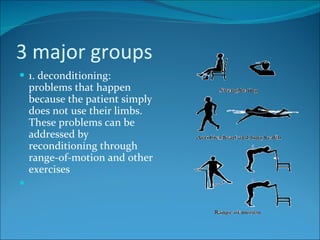
3 major groups 1. deconditioning: problems that happen because the patient simply does not use their limbs. These problems can be addressed by reconditioning through range-of-motion and other exercises
2. cardiovascular diseases: like heart disease and stroke. Exercise, aqua therapy, electrical stimulation and more can be used.
3.  musculoskeletal problems: such as osteoporosis and osteoarthritis. These problems require special attention as osteoporosis makes patients frailer, and osteoarthritis is very painful.
Because falls are such a problem, the osteoporosis therapy is crucial. Along with that, geriatric physiotherapy is responsible for preventing many falls because of work with balance and gait. Some clinics focus entirely on balance issues for the elderly.
Qualities of geriatric physiotherapist Profound knowledge Caring attitude Good communication skill Ability to think out of the box

Geriatric pt

  • 1.
  • 2.
    What is GeriatricsGeriatrics is the branch of medicine that focuses on health care of the elderly. It aims to promote health and to prevent and treat diseases and disabilities in older adults. Geriatrics was separated from internal medicine as a distinct entity in the same way that pediatrics is separated from adult internal medicine and neonatology is separated from pediatrics.
  • 3.
    Gerontology Gerontologyis the branch of biomedical sciences that studies aging. The term "geriatrics“ is used to refer specifically to the medical study of diseases and problems of the elderly.
  • 4.
    Changes with ageingSKIN: Epidermis thinner and fragile Dermis less elastin and flexible Hypodermis thinner and less padding UV light accelerates skin ageing Senile purpura
  • 5.
    Changes with ageingEYE Ptosis Dry eye Tearing Flatten & uneven cornea with light scattering Hyperopia (farsightedness) Smaller pupil requiring brighter light to read Slower dark adaptation Reduced contrast sensitivity
  • 6.
    Changes with ageingEAR Reduced sweat glands with increased ear wax affecting hearing Cochlea degeneration causing high tone loss
  • 7.
    Changes with ageingKIDNEYS Reduced ability to excrete water, waste products and drugs Less tolerate water depletion Loss of circadian rhythm with nocturia Smaller and less expansible bladder with frequency of urine Less contractable bladder with hesitancy Bigger prostate with fair urine stream
  • 8.
    Changes with ageingBONE Continual loss of bone mass from the 4th decade Hormonal change with more bone resorption than formation Less Ca absorption Shorter and stoop Brittle with easy fracture New bone formation at the verge of joints Cartilage thinner
  • 9.
    Changes with ageingNERVOUS SYSTEM 30,000-50,000 neurons die each day with diminishing reserve IQ slowly decline after the age of 25 Reduced short term memory Decreased retrieval ability Interrupted and less deep sleep Reduced pain, touch, temperature, and vibration sensations Reduced postural control and balance
  • 10.
    Changes with ageingHEART Heart becomes more rigid with decreased output Heart beat less responsive to stress Heart beat less variable with each breathing Irregular heart beat more common with ageing Systolic blood pressure increases with age Pulse pressure widened with hardened vessels Less efficient venous return prone to postural hypotension
  • 11.
    Changes with ageingLUNGS Lungs become more rigid with early closure of small airways Less efficient blood gas exchange Chest wall becomes more rigid too Reduced Lung Volume and Vital Capacity Bronchial villi thinner and cough reflex less effective Reduced ability to cope with challenges like climbing stairs, running Reduced immunity prone to chest infection
  • 12.
    Changes with ageingGIT Saliva glands secret less with dry mouth Taste and smell senses decline Less heathy teeth affecting chewing/nutrition Stomach muscle weakened and less hungry Small intestine villi absorb less calcium, vitamin B12, folic acid Large intestine muscle weakened and secrets less mucus prone to constipation Less liver blood flow and function with fall in toxic substance/drug clearance Bile thicker with cholesterol prone to gallstones
  • 13.
  • 14.
  • 15.
    Geriatric physiotherapy Geriatricphysiotherapy became a specialty of physical therapy study in 1989. Since then, physiotherapists have worked to understand the problems of the aging. There is a long list of problems dealt with in geriatric physiotherapy.
  • 16.
    Alzheimer's arthritis balancedisorders cancer cardiovascular disease incontinence joint replacement pulmonary disease stroke
  • 17.
    3 major groups1. deconditioning 2. cardiovascular diseases 3. musculoskeletal problems
  • 18.
    3 major groups1. deconditioning: problems that happen because the patient simply does not use their limbs. These problems can be addressed by reconditioning through range-of-motion and other exercises
  • 19.
    2. cardiovascular diseases:like heart disease and stroke. Exercise, aqua therapy, electrical stimulation and more can be used.
  • 20.
    3. musculoskeletalproblems: such as osteoporosis and osteoarthritis. These problems require special attention as osteoporosis makes patients frailer, and osteoarthritis is very painful.
  • 21.
    Because falls aresuch a problem, the osteoporosis therapy is crucial. Along with that, geriatric physiotherapy is responsible for preventing many falls because of work with balance and gait. Some clinics focus entirely on balance issues for the elderly.
  • 22.
    Qualities of geriatricphysiotherapist Profound knowledge Caring attitude Good communication skill Ability to think out of the box