UNIT - V
PrinciplesofEductaion&
Teaching Learning Proess
Meaningofeducation
The term education has its origin in the
Latin words educo, educare & educatum.
Etymologically, the w o r d education is
derived from the Latin words educo where e
m e a n s ‘ o u t o f ’ duco m e a n s ‘ I l e a d . ’
Accorsing to this view, education means ‘I
lead out darkness into brightness’.
DefinitionOf Education
Education means the training for the country &
love for the nation.
- Chanakya
Education is realization of self
- Shankaracharya
Education is an all-round drawing out of the
best in child & man-body, mind & spirit.
-Mahatma Gandhi
Education is the natural, harmonious &
progressive development of man’s innate
power.
- Pestalozzi
N u r s i n g e d u c a t i o n i s a p r o f e s s i o n a l
e d u c a t i o n w h i c h i s c o n s c i o u s l y &
systematically planned & implemented
through instruction & discipline & aims the
harmonious development of the physical,
intellectual, social, emotional, spiritual &
aesthetic powers or abilities of the students
in order to tender professional nursing care
to people of all ages, in all phases of health
& illness, in a variety of setting, in the best
or highest possible manner.
Definition of Nursing Education
Aims of
education
Individual
aim
Social
aim
Spiritual
aim
Vocational
aim
Cultural
aim
Moral
aim
Intellectual
aim
Aims given by
different
commissions
9
Aims of Education
Individual aim:
 Development as an individual of a human being.
 Moral & spiritual development.
 Cultural development.
 Harmonious development
 Promote positive physical development
 Development of a right personality
 Development of good citizenship
 Development of good leadership
 Emotional & mental development
 Character building, etc.
10
Aims of Education
Social Aims
Social aim:
 Through education the individual child
should be provided with the require
assistance to become a useful member of
the society, irrespective of the socio-
economic status.
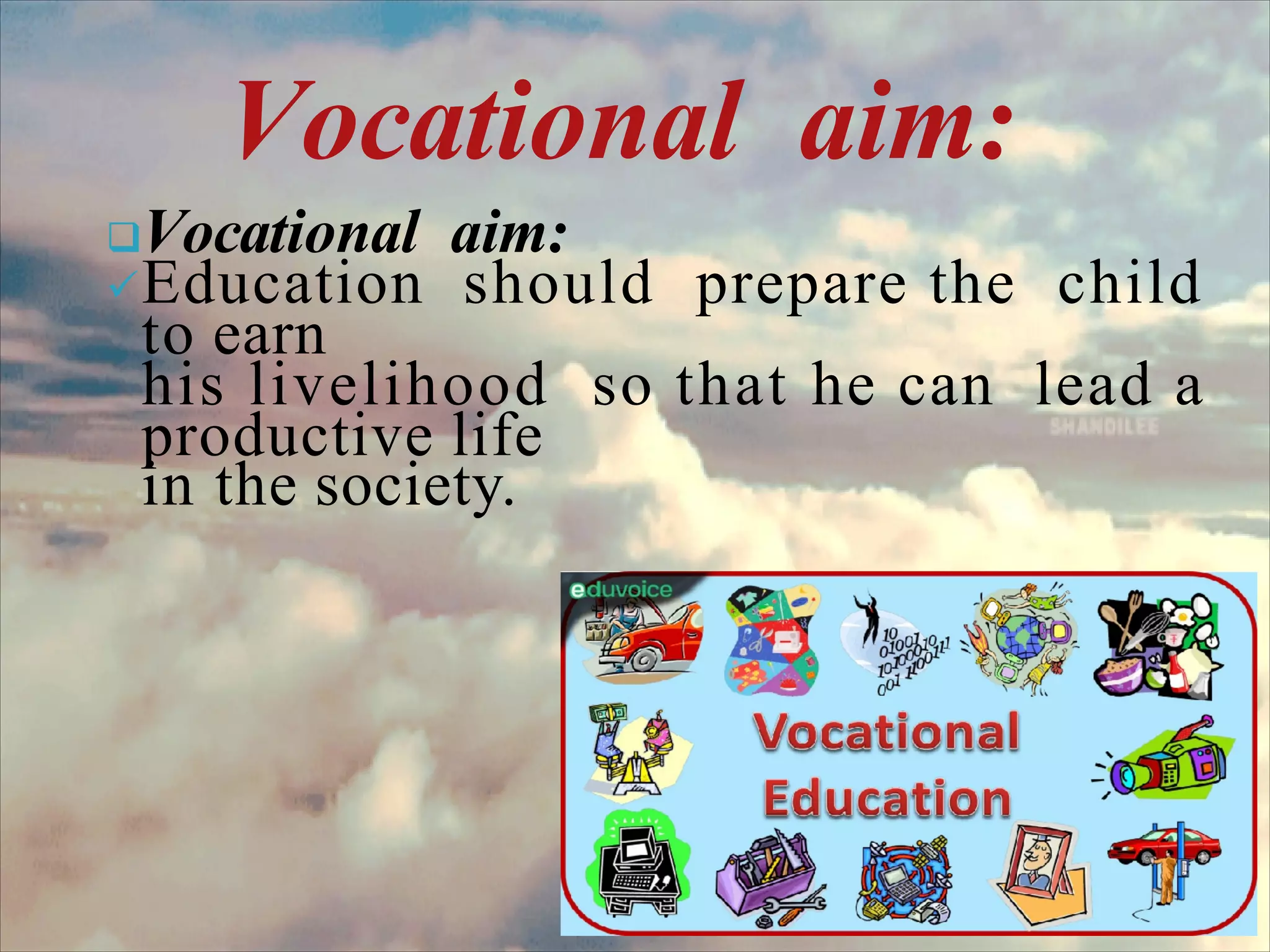
Vocational aim:
Vocational aim:
Education should prepare the child
to earn
his livelihood so that he can lead a
productive life
in the society.
Intellectual aim:
Intellectual aim:
Development of intelligence
through education will enable the
child to lead an independent life
with confidence.
Cultural aim:
Cultural aim:
By undergoing education child becomes
cultured & civilized.
Cultural development is through
development of aesthetic sense & respect for
others’ culture
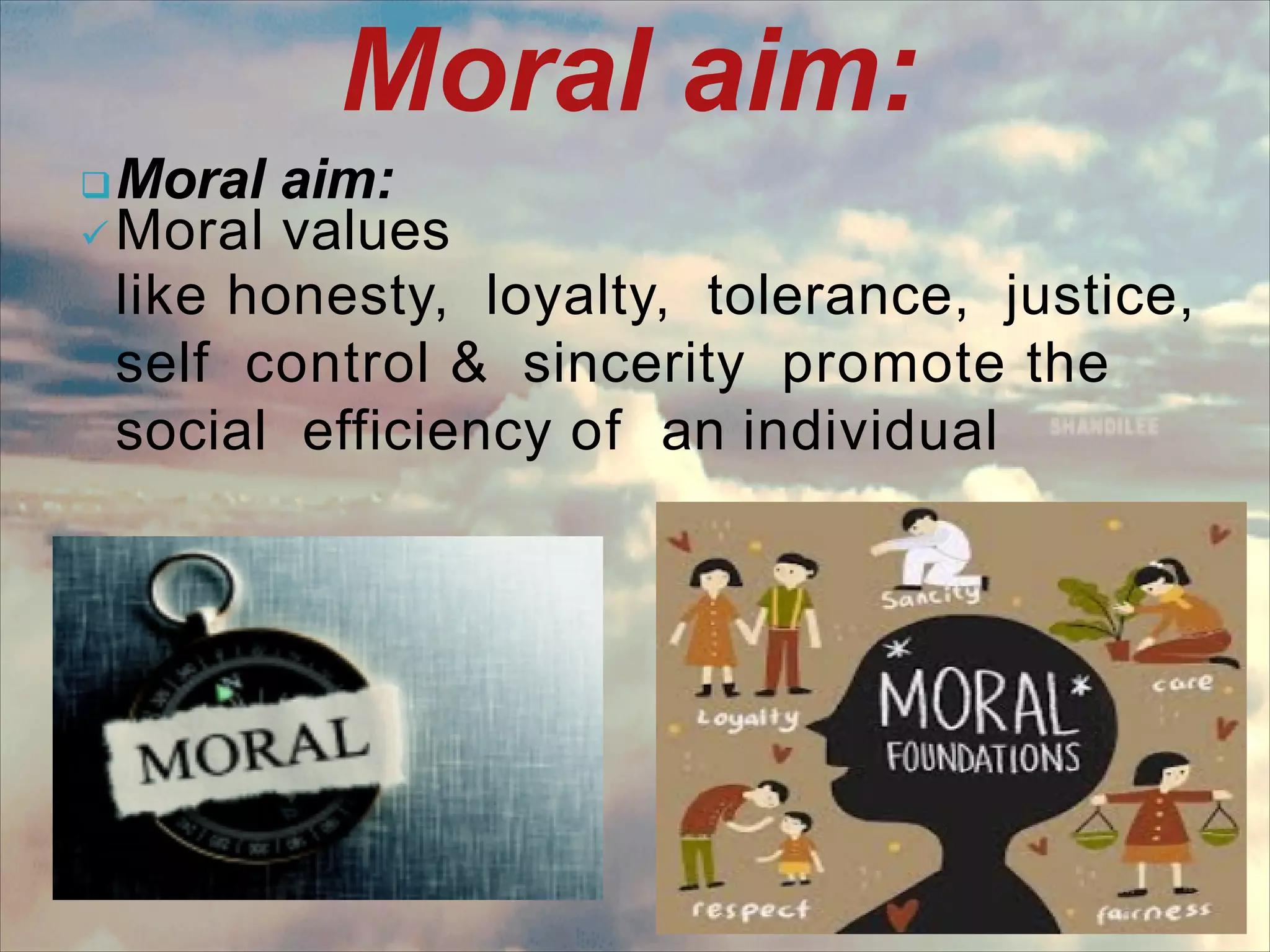
Moral aim:
Moral aim:
 Moral values
like honesty, loyalty, tolerance, justice,
self control & sincerity promote the
social efficiency of an individual
Citizenship
Citizenship
 Education enable the children to grow as
productive citizens by following the
social & m o r a l standards set by the
society.
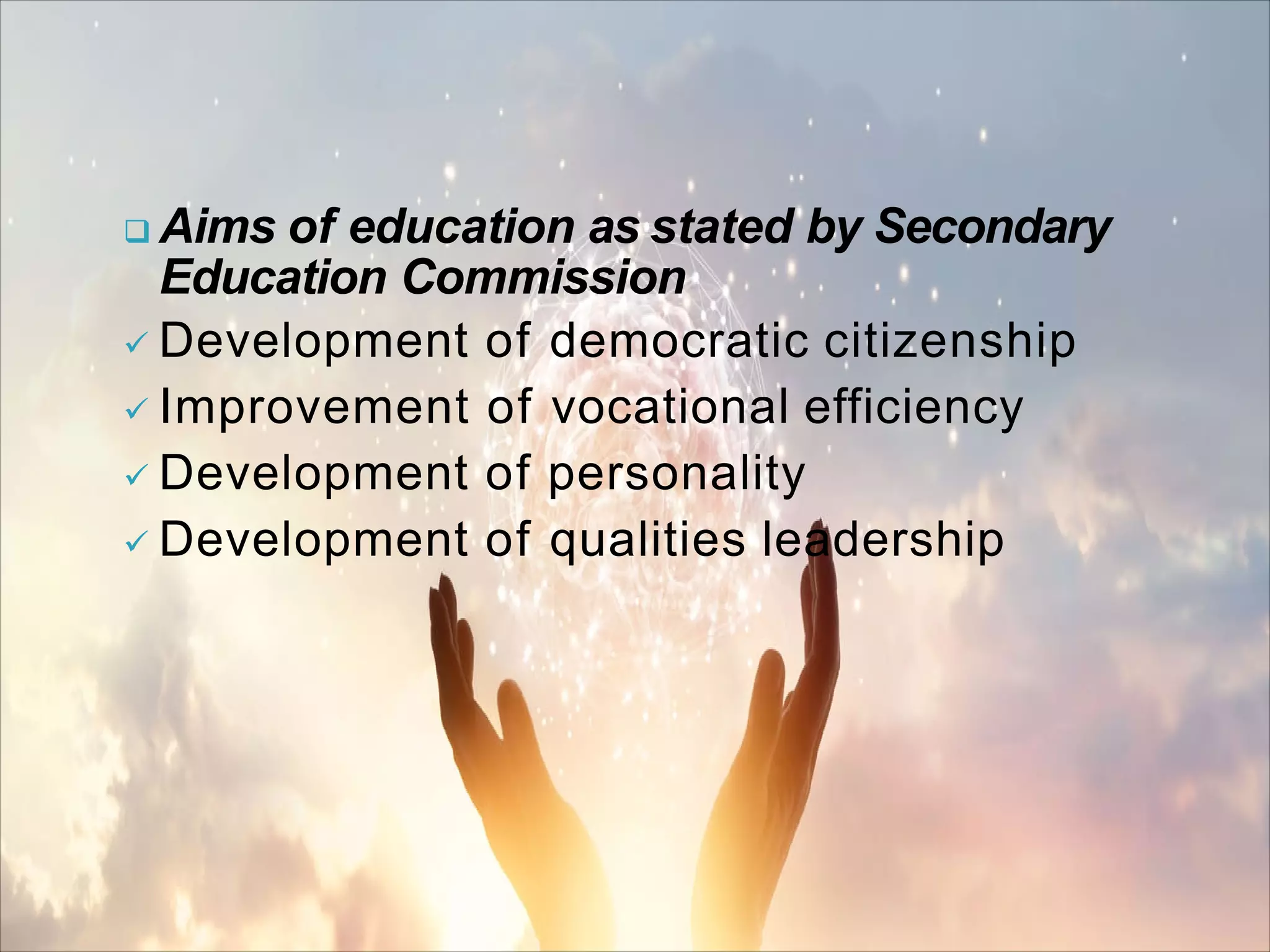
 Aims of education as stated by Secondary
Education Commission
 Development of democratic citizenship
 Improvement of vocational efficiency
 Development of personality
 Development of qualities leadership
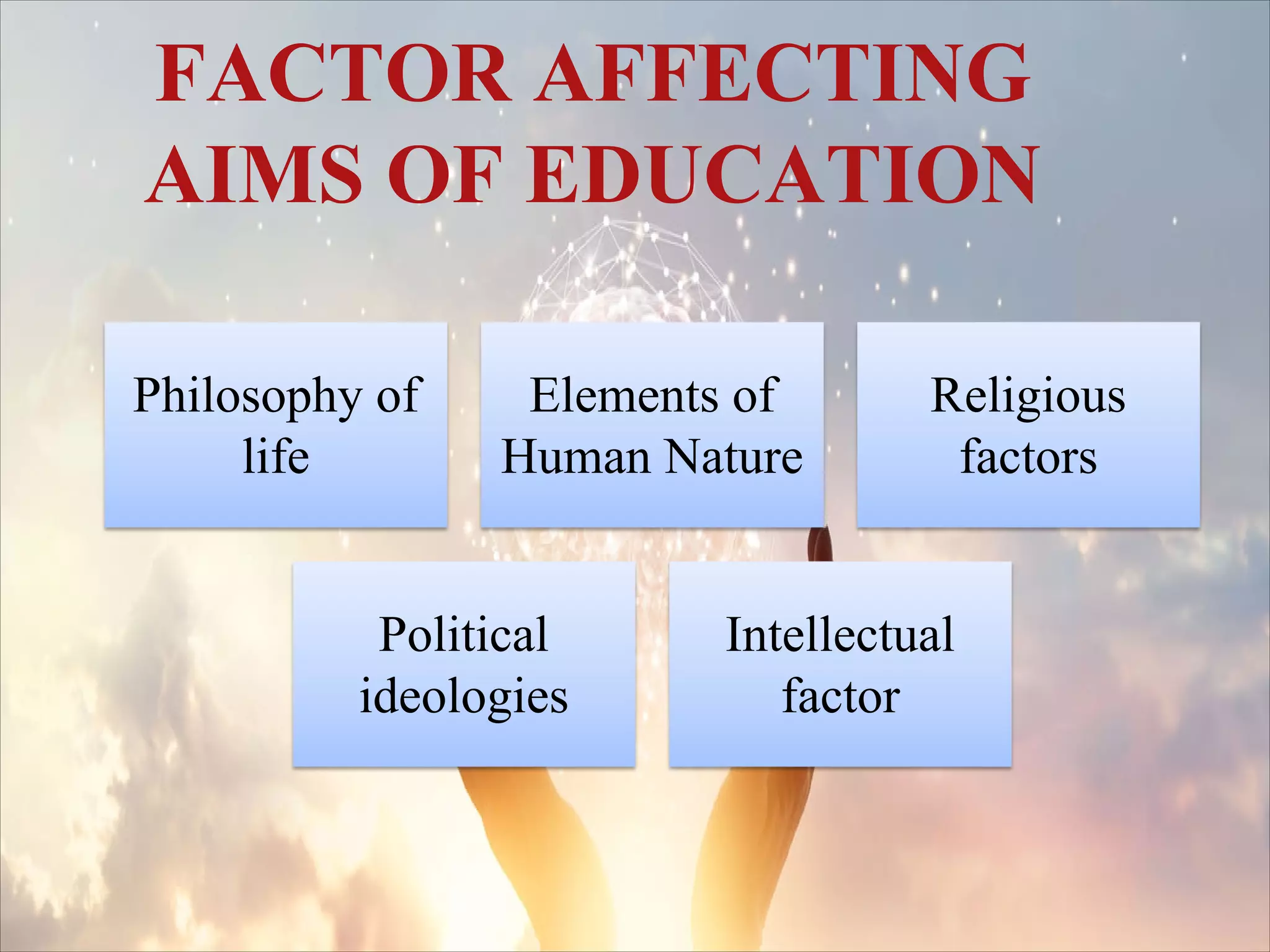
FACTOR AFFECTING
AIMS OF EDUCATION
Philosophy of
life
Elements of
Human Nature
Religious
factors
Political
ideologies
Intellectual
factor
• Harmoniousde
velopment
• Inculcating right
attitude
• Knowledge & skill
aim
• Emphasis on high-
tech-high-touch
approach
• Prepare students to
take up a proactive
role in nursing
• P r o f e s s i o n a l
development
• Assist to build a
promising career
• Social aim
• citizenship
• To prepare global
nurses
• Leadership aim
19
Aims of Nursing Education
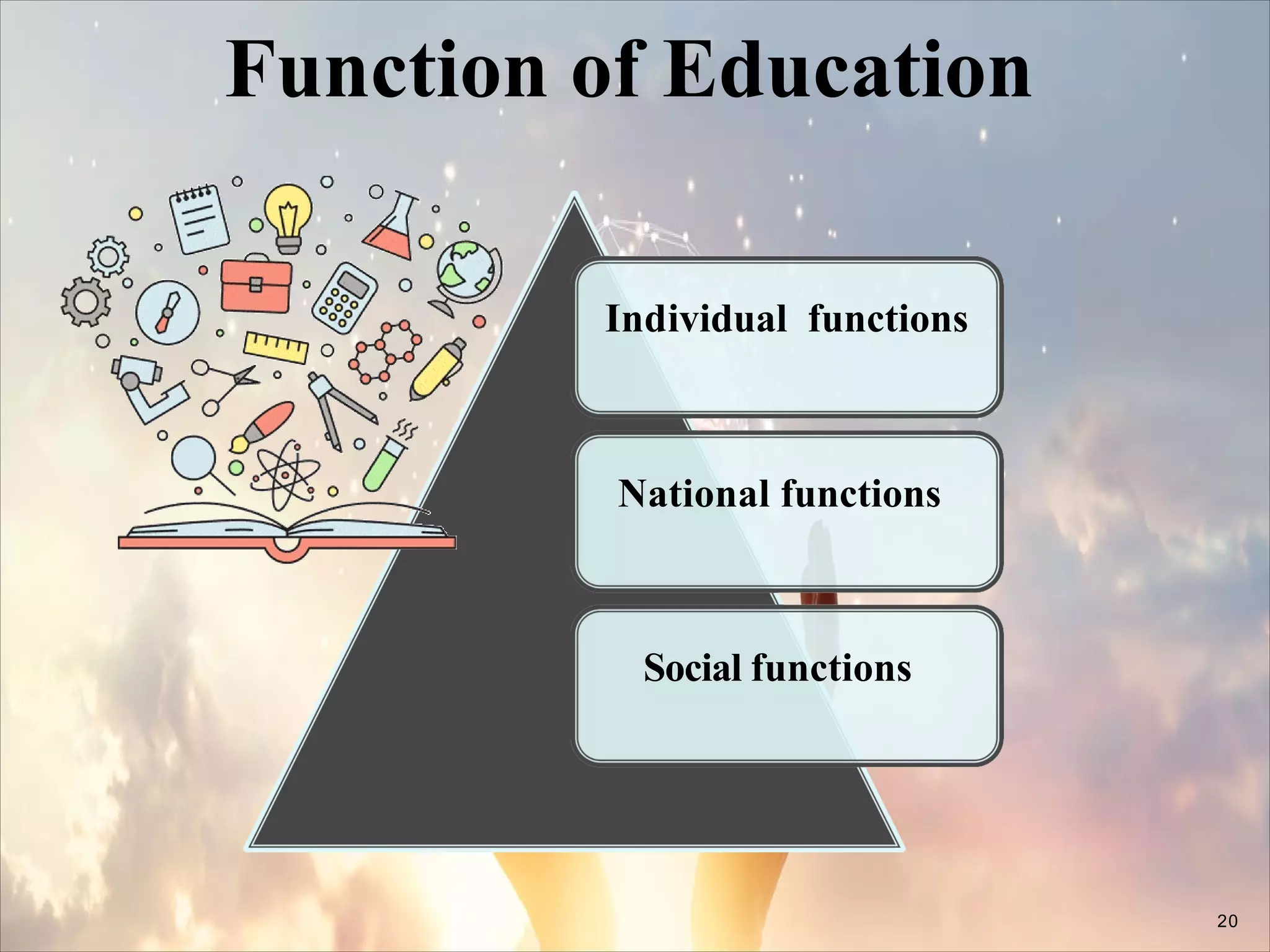
Individual functions
20
National functions
Social functions
Function of Education
Growth & development of individual
Direction & guidance
Preparation for adult life
Conservation of traditional knowledge
Transmission of culture
Progressive development
Achievement of self-sufficiency
Holistic personality development
Moral & character development
Develop vocational efficiency
Awareness of past & present & preparing for future
21
Indivdual Functions
Ensuring
national
development
Promoting
national
integrity
Continuous
supply of
skilled
workforce
Developing
leaders for
nation
22
National Functions
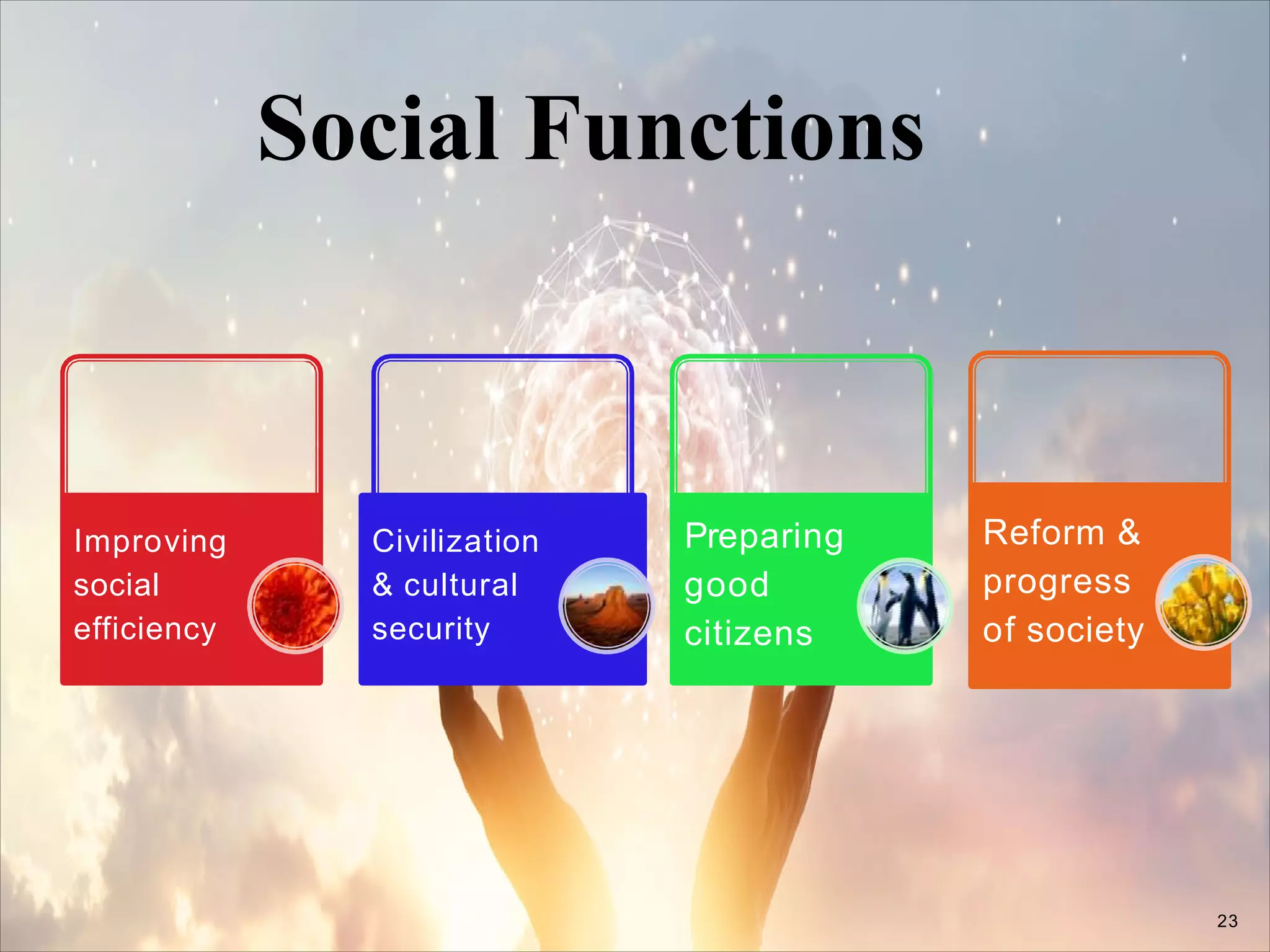
Improving
social
efficiency
Civilization
& cultural
security
Preparing
good
citizens
Reform &
progress
of society
23
Social Functions
The term philosophy has a Greek origin,
i.e. philosophia, which is made up of
two words, viz. phileo &.
Phileo means ‘love & sophia means
‘wisdom’.
The literal meaning of philosophy is
‘love of wisdom’ or ‘passion of
learning’.
Philosphy of Education
Definition of Philosphy
Philosophy is the science of knowledge.
- Fitch
Philosophy is the science of sciences.
- Coleridge
Philosophy is a search for comprehensive
view of nature, an attempt at a universal
explanation of the nature of things.
- Alfred Weber
Educational
philosophies
Traditional philosophies
Naturalism
Idealism
Pragmatism
Realism
Modern contemporary
philosophies
P e r e n n i a l i s m
E s s e n t i a l i s m
Existentialism
Reconstructionism
Progressivism
27
Classification of Educational Philosphy
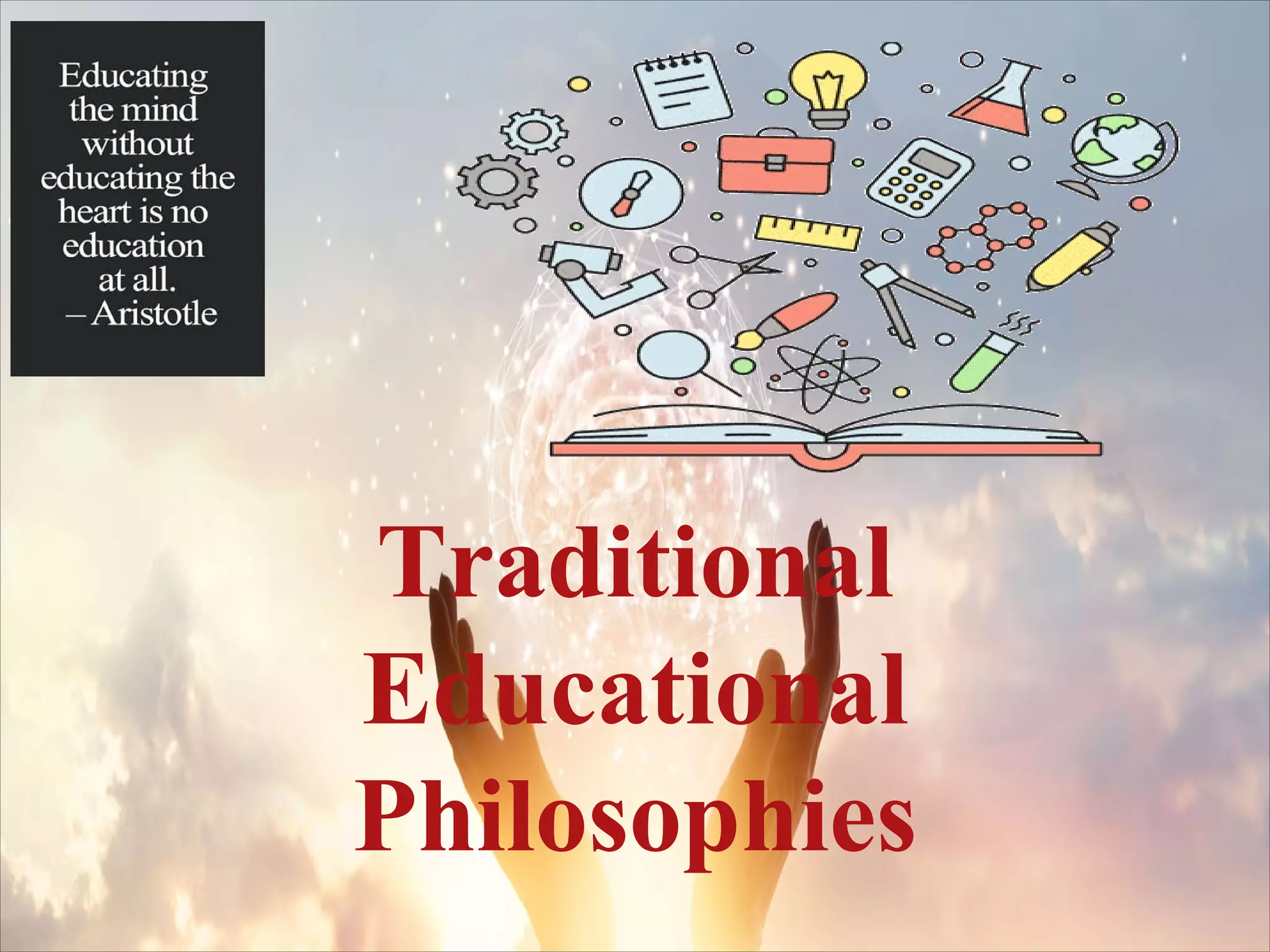
Traditional
Educational
Philosophies
Traditional Educational
Philosophies
Chief proponents: Rabindranath Tagore, Jean
Jacques Rousseau, Johann Heinrich
Concept: Educating the human generation
about & in the nature rather than artificial
environment by keeping i n m i n d the
individuality of each child.
Organization & Aims of education: Nature is
considered the classroom. Emphasis on open
a i r s c h o o l s t o t e a c h t h r o u g h d i r e c t
experience with nature.
C u r r i c u l u m : B a s i s o f c u r r i c u l u m
development was child’s nature, interest &
needs.
Stressed o n s u b j e c t s d e a l i n g w i t h n a t u r e
s u c h a s p h y s i c s , c h e m i s t r y , b i o l o g y ,
l a n g u a g e & m a t h e m a t i c s . Ta g o r e a l s o
s t r e s s e d o n t e a c h i n g s p i r i t u a l v a l u e s o f
nature.
Methods of Education: As natural as possible
considering individual differences. Noble efforts
f o r p l a n n e d l i v i n g w i t h n a t u r e . D i r e c t
experience o f nature t h r o u g h observation,
excursion, experimentation, play-way.
Role of teacher: Teacher is an observe
& facilitator of the child to develop in
nature; teacher facilitates best possible
natural environment for prompt
learning.
Discipline: No emphasis on external
rigid discipline; recommended free
discipline to child in nature for
optimum desired learning.
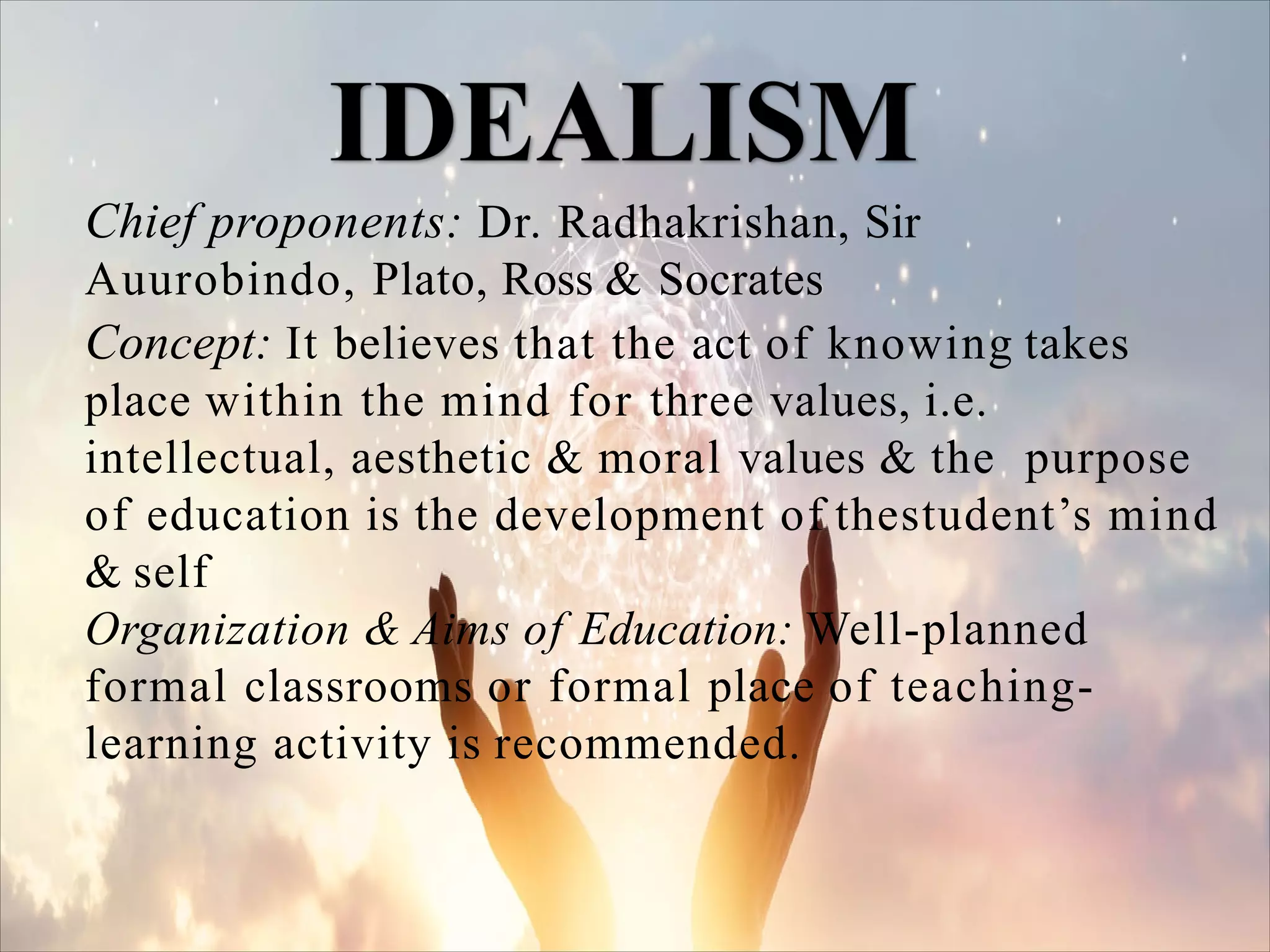
Chief proponents: Dr. Radhakrishan, Sir
Auurobindo, Plato, Ross & Socrates
Concept: It believes that the act of knowing takes
place within the mind for three values, i.e.
intellectual, aesthetic & moral values & the purpose
of education is the development of thestudent’s mind
& self
Organization & Aims of Education: Well-planned
formal classrooms or formal place of teaching-
learning activity is recommended.
Curriculum: The basis of curriculum is inculcating
intellectual, aesthetic & moral values or discipline.
The intellectual value is represented by subjects such
as language, literature, science, mathematics, history
& geography; aesthetic through arts & poetry &
moral through religion, ethics. Dr. Radhakrishan
also advocated for physical education.
Methods of Education: Idealism recommended
f o r m a l c l a s s r o o m t e a c h i n g m e t h o d s s u c h as
l e c t u r e , d i s c u s s i o n , p r e s e n t a t i o n , & g r o u p
interaction. Knowledge is transferred from the
m o r e m a t u r e person (teacher) t o less m a t u r e
person (pupil) through formal & well-planned
teaching-learning methods.
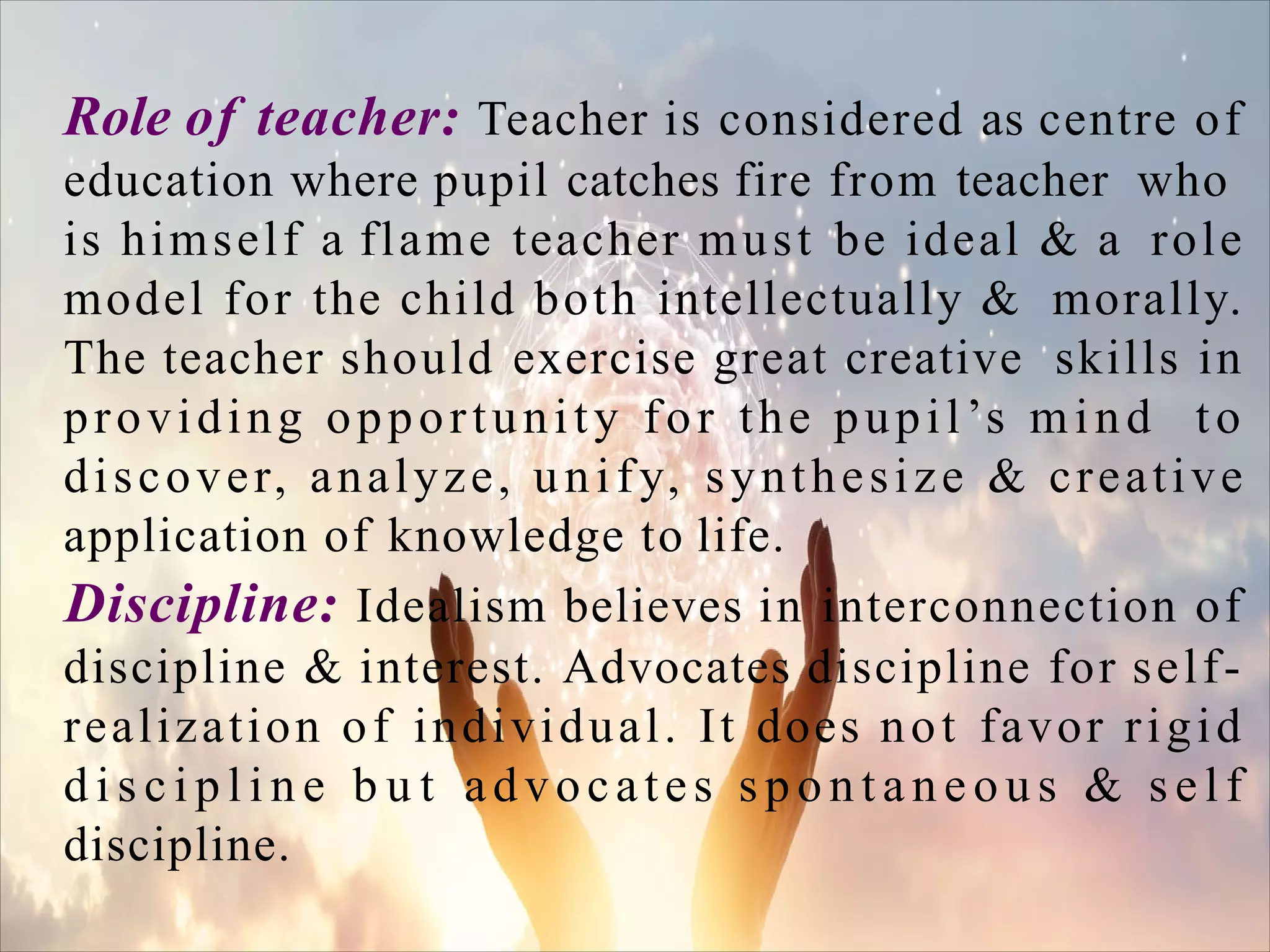
Role of teacher: Teacher is considered as centre of
education where pupil catches fire from teacher who
is himself a flame teacher must be ideal & a role
model for the child both intellectually & morally.
The teacher should exercise great creative skills in
providing opportunity for the pupil’s mind to
discover, analyze, unify, synthesize & creative
application of knowledge to life.
Discipline: Idealism believes in interconnection of
discipline & interest. Advocates discipline for self-
realization of individual. It does not favor rigid
d i s c i p l i n e b u t advocates s p o n t a n e o u s & s e l f
discipline.
Chief proponents: Williams James,
John Dewey, Charles Sanders Pierce
Concept: It considers self-activity as the
basis of all teaching-learning processes in
context of cooperative activity; to create
optimistic men, who are the architects of
their own fate by the process of their efforts.
Educationshould be according to the child’s
aptitudes & abilities; where he is respected &
education is planned to cater to his
inclinations & capacities.
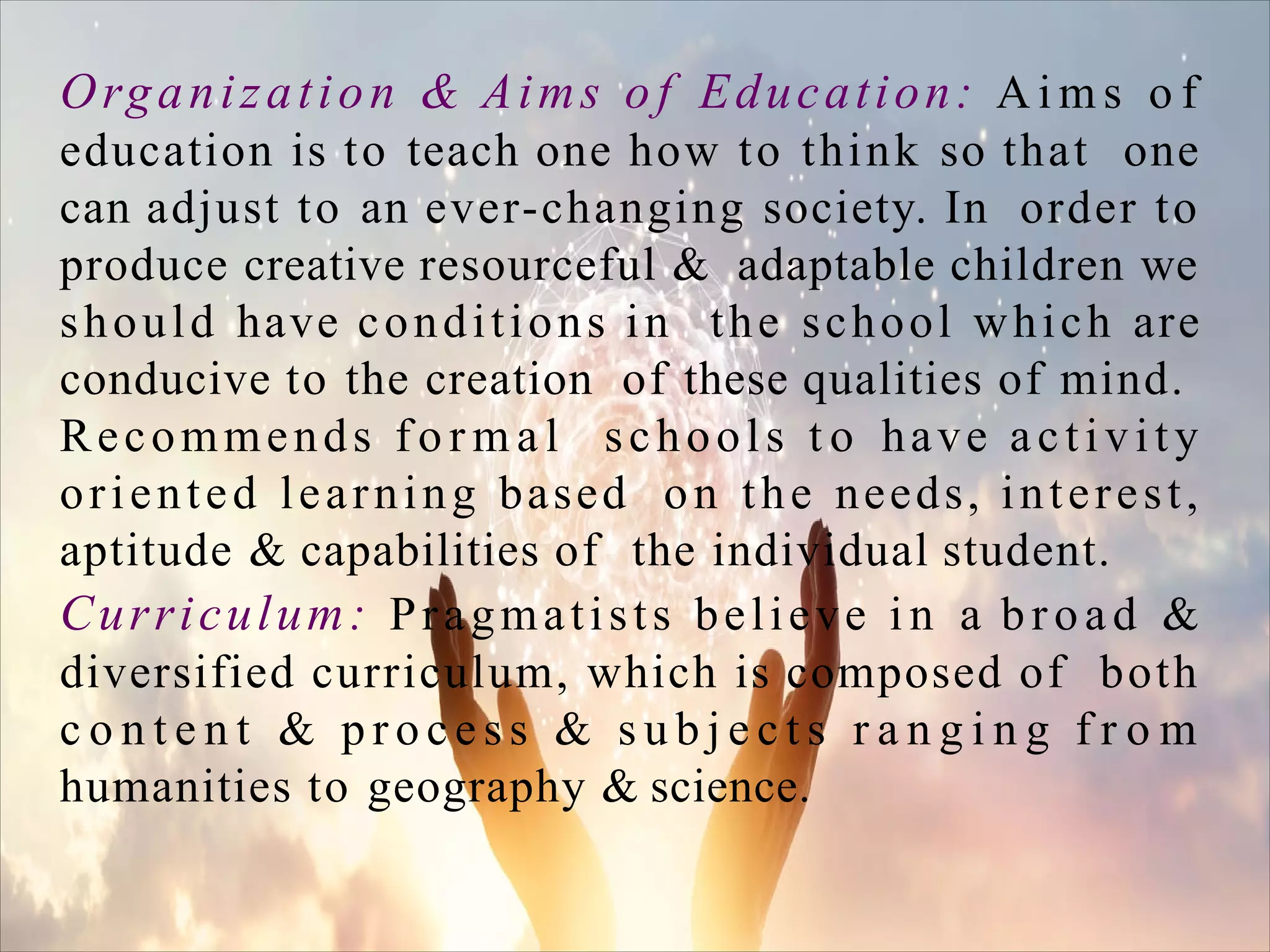
Organization & Aims of Education: A i m s o f
education is to teach one how to think so that one
can adjust to an ever-changing society. In order to
produce creative resourceful & adaptable children we
should have conditions in the school which are
conducive to the creation of these qualities of mind.
Recommends f o r m a l schools t o have activity
oriented learning based on the needs, interest,
aptitude & capabilities of the individual student.
Curriculum: Pragmatists believe i n a broad &
diversified curriculum, which is composed of both
c o n t e n t & p r o c e s s & s u b j e c t s r a n g i n g f r o m
humanities to geography & science.
Methods of education: Teaching-learning processis
a social process where the sharing of experiences
between the teacher & the student takes place.
Preferred methods are project method & activity
oriented learning.
Role of teacher: Role of a teacher is not that of a
dictator or a task master but as a leader of group
activities. Teacher acts as catalyst where he suggests a
problem to students & stimulates them to find a
solution. Teacher is a mentor with resources to guide
the students
Discipline: P r a g m a t i s m d o e s n o t b e l i e v e i n
t r a d i t i o n a l f i r m d i s c i p l i n e . I t advocates f o r
freedom of self-discipline in a free & conducive
teaching-learning environment.
Chief proponents: Aristotle, Johann Friedrich Herbart,
Herbert Spencer
Concept: Realism makes the human being understand &
e n j o y soc i e t y i n t h e t r u e sense b y g e t t i n g t h e
multidimensional real joy of life in reality. It also aims
for education to make the life of a man useful; where a
m a n c a n e n j o y h i s a c t i v i t i e s & c o m f o r t i n
reality.Education should equip individuals to a best
possible meaningful life through vocational skills
REALISM
Organization & Aims of Education:
Realismemphasizes on scientific attitude based on
realistic principles, where the child can extend his
knowledge, which he learns through books. It has
given due emphasis on formal schools, which
provides adequate opportunity for learners to learn
the vocational skills through observation,
experimentations & examinations.
Curriculum: Selection of the curriculum for the
students must based on their abilities, interest &
capabilities so that education helps the student to
adjust to changing circumstances of the society. It
also emphasis on subject matter of real-life use such
as science, mathematics, hygiene & vocational
subjects.
Methods of Education: Realism believe in objectivity,
knowledge of scientific evidences & reality. Methods of
teaching should be according to needs, interest &
capabilities of students. Vocational education should
equip the individual with capacities to earn livelihood
such as experimentation, examination & observation,
etc.
Role of Teacher: Teacher must focus on the
development of vocational skills in the learners, so that
they can be equipped with qualities of race
preservation & vocational behavior activities. Teacher
acts as a mentor, & must be a role model & skilled to
demonstrate vocational skills to the learners
Discipline: Realism believes in an optimum level of
discipline without imposing undue stress on the
learners
Perennialism
Chief proponents: Thomas Aquinas, Robert
Hutchins & Mortimer Adler
Concept: Education ensures that students
acquire an understanding about the great
ideas of civilization. These ideas have the
potential for solving problems in any era.
The focus is to teach ideas that are
everlasting to seek ensuring truths which are
constant, as the natural & human worlds at
their most essential level.
Organization & Aims of Education: The aim of
education is to develop the rational person, who has
intellectual abilities to uncover universal truth.
Character training is also important for moral &
spiritual development of an individual
Curriculum: Accepts little flexibility in the
curriculum that emphasizes on language,
literature, mathematics, arts &
sciences.Common curriculum for all the
students with minimal opportunities for
elective subjects.
Teaching-learning process must create
liberalism, tolerance & discretion among
learners.
Methods of Education: Perennialism portages for the
educational methods, which promotes constant teacher-
taught interaction such as oral exposition, lecture &
explication. Emphasis is placed on teacher- guided
seminars, where students & teachers engage in mutual
inquiry sessions. Students may also learn directly from
reading & analyzing the great books.
Role of teacher: Teacher must be competent & master of
his subject so that he can help their students to develop
the power to think deeply, analytically, flexibly &
imaginatively. Teacher is also authoritative & a guide of
the students.
Discipline: Education should be organized &
conducted in a manner that problem of indiscipline
does not arise at all.
Traditional Educational
Philosophies
Essentialism
Chief proponents: William Bagley, Arthur Bestor,
Admiral Hyman Rickover, James D. Koermer
Concept: Essentialism believe that there is
common core of knowledge that needs to e
transmitted to students in a systematic,
disciplined way. The emphasis placed on
intellectual & moral standards that schools
should teach & preparing students to become
valuable members of society.
Organization & Aims of Education:
Essentialism has recommended for the formal
schools or teaching-learning places. The aims
of education is to promote intellectual growth
& academic competitiveness of the individual
to become a model citizen.
Curriculum: This philosophy recommended
intellectual content with quality & capacity of
the learner. The recommended subjects are
English, mathematics, natural science, history
& foreign languages.
M e t h o d s o f E d u c a t i o n : E s s e n t i a l i s m
r e c o m m e n d e d f o r m a l & w e l l - p l a n n e d
classroom teaching methods such as lectures,
discussions, presentations & group interaction
Role of Teacher: Teacher must be a master of
subject matter & role model for learners with
high level of authority & control over teaching-
learning process & learner.
Discipline: Essentialism believes i n r i g i d
discipline & devoted hard work of learners in
his studies.
Traditional Educational
Philosophies
Existentialism
Chief proponents: Soren Kierkegaard, Friedrich Nietzsche,
Maxine Greene
Concept: This philosophy believes that education must
develop the consciousness about the freedom of
choices among learners because a man becomes what
he chooses for his self. Education must equip the
individual for better choices
Organization & Aims of Education: The ultimate aim of
education is to develop child’s knowledge about
human conditions & the choices that person has to
make for self. Therefore organization of education
must be formal with sufficient opportunities of choices
Curriculum: Curriculum must be that which providesthe
free opportunities for children to select from many
available learning situations & choosing the subjects
that learner wish to learn. Humanities are commonly
given tremendous emphasis, which helps the student to
unleash their own creativity & self- expression.
Methods of Education: Existentialism promotes the
methods o f education which emphasizes o n s e l f -
activity of the learner such as self-expressive activities,
experimentation, methods & media that illustrate
emotions feelings & insight
Role of Teacher: Teacher must promote freedom for a
learner to make personal choices & individual self-
definition
Discipline: Existentialism believe in self-discipline
b u t not in the strict discipline. Teacher creates an
environment in which students may freely choose
their own preferred way
Traditional Educational
Philosophies
Reconstructionism
Chief proponents: Theodore Brameld, George
Counts & Paulo Freire
Concept: This philosophy of education believes on
r e o rg a n i z i n g & r e s t r u c t u r i n g t h e process o f
e d u c a t i o n t o b e i n g a b o u t social & c u l t u r a l
contrastive changes in community, society & country,
where emphasis is placed on cultural pluralism,
equality, futurism, national interest oriented
education
Organization & Aims of Education: This philosophy
recommended for formal as well as informal ways of
organizing the education so that desired aim of
e d u c a t i o n c a n b e a c h i e v e d t o b r i n g t h e
reconstruction
Curriculum: Curriculum should be conceived with
anew socioeconomic & political interest. The
subject content must be oriented towards aspects
of new changes expected social, economic &
political discipline such as sociology, economics,
science & technology, etc.
Methods of Education: This philosophy of education
believes that teaching methods must be organized in
manner that student become self-reliant, education
must be activity oriented to develop necessary
activities & abilities
Role of Teacher: The role of a teacher is to take the
social responsibilities & along with students must
become the agent to improve society.
D i s c i p l i n e : T h i s p h i l o s o p h y o f e d u c a t i o n
propagates about optimum level of discipline but
not arigid
Chief proponents: Horace Mann, Henry Barnard
&Johan Dewey
Concept: Progressivism believe that learning must
be through problem solving & scientific inquiry
in a cooperative & self-discipline way, which
promote democratic living & transmits the culture
of society while preparing students to adapt in
changing world
Organization & Aims of Education:
Progressivism recommended democratic school
procedures, which promote the community &
social reforms. The aim of education is to
promote the democratic social living
Curriculum: Progressivism recommended
curriculum, which is interdisciplinary in nature,
which promotes written textbooks subject content
that are the part & process of learning rather than
ultimate source of knowledge. Further curriculum is
based on child’s interest, problems & life affairs
Methods of Education: Child is considered as learner
rather than subject, who primarily learned through
cooperative group activities & experiences
Role of Teacher: Teacher m u s t act as gu i d e f o r
problem solving, leader f o r g r o u p activities &
partner in planning the learning activities
Discipline: Has n o t r e c o m m e n d e d any s o r t o f
specific formal discipline
Principles & philosophies of Education

Principles & philosophies of Education

  • 3.
  • 5.
    Meaningofeducation The term educationhas its origin in the Latin words educo, educare & educatum. Etymologically, the w o r d education is derived from the Latin words educo where e m e a n s ‘ o u t o f ’ duco m e a n s ‘ I l e a d . ’ Accorsing to this view, education means ‘I lead out darkness into brightness’.
  • 6.
    DefinitionOf Education Education meansthe training for the country & love for the nation. - Chanakya Education is realization of self - Shankaracharya Education is an all-round drawing out of the best in child & man-body, mind & spirit. -Mahatma Gandhi Education is the natural, harmonious & progressive development of man’s innate power. - Pestalozzi
  • 7.
    N u rs i n g e d u c a t i o n i s a p r o f e s s i o n a l e d u c a t i o n w h i c h i s c o n s c i o u s l y & systematically planned & implemented through instruction & discipline & aims the harmonious development of the physical, intellectual, social, emotional, spiritual & aesthetic powers or abilities of the students in order to tender professional nursing care to people of all ages, in all phases of health & illness, in a variety of setting, in the best or highest possible manner. Definition of Nursing Education
  • 9.
  • 10.
    Individual aim:  Developmentas an individual of a human being.  Moral & spiritual development.  Cultural development.  Harmonious development  Promote positive physical development  Development of a right personality  Development of good citizenship  Development of good leadership  Emotional & mental development  Character building, etc. 10 Aims of Education
  • 11.
    Social Aims Social aim: Through education the individual child should be provided with the require assistance to become a useful member of the society, irrespective of the socio- economic status.
  • 12.
    Vocational aim: Vocational aim: Educationshould prepare the child to earn his livelihood so that he can lead a productive life in the society.
  • 13.
    Intellectual aim: Intellectual aim: Developmentof intelligence through education will enable the child to lead an independent life with confidence.
  • 14.
    Cultural aim: Cultural aim: Byundergoing education child becomes cultured & civilized. Cultural development is through development of aesthetic sense & respect for others’ culture
  • 15.
    Moral aim: Moral aim: Moral values like honesty, loyalty, tolerance, justice, self control & sincerity promote the social efficiency of an individual
  • 16.
    Citizenship Citizenship  Education enablethe children to grow as productive citizens by following the social & m o r a l standards set by the society.
  • 17.
     Aims ofeducation as stated by Secondary Education Commission  Development of democratic citizenship  Improvement of vocational efficiency  Development of personality  Development of qualities leadership
  • 18.
    FACTOR AFFECTING AIMS OFEDUCATION Philosophy of life Elements of Human Nature Religious factors Political ideologies Intellectual factor
  • 19.
    • Harmoniousde velopment • Inculcatingright attitude • Knowledge & skill aim • Emphasis on high- tech-high-touch approach • Prepare students to take up a proactive role in nursing • P r o f e s s i o n a l development • Assist to build a promising career • Social aim • citizenship • To prepare global nurses • Leadership aim 19 Aims of Nursing Education
  • 20.
  • 21.
    Growth & developmentof individual Direction & guidance Preparation for adult life Conservation of traditional knowledge Transmission of culture Progressive development Achievement of self-sufficiency Holistic personality development Moral & character development Develop vocational efficiency Awareness of past & present & preparing for future 21 Indivdual Functions
  • 22.
  • 23.
  • 25.
    The term philosophyhas a Greek origin, i.e. philosophia, which is made up of two words, viz. phileo &. Phileo means ‘love & sophia means ‘wisdom’. The literal meaning of philosophy is ‘love of wisdom’ or ‘passion of learning’. Philosphy of Education
  • 26.
    Definition of Philosphy Philosophyis the science of knowledge. - Fitch Philosophy is the science of sciences. - Coleridge Philosophy is a search for comprehensive view of nature, an attempt at a universal explanation of the nature of things. - Alfred Weber
  • 27.
    Educational philosophies Traditional philosophies Naturalism Idealism Pragmatism Realism Modern contemporary philosophies Pe r e n n i a l i s m E s s e n t i a l i s m Existentialism Reconstructionism Progressivism 27 Classification of Educational Philosphy
  • 28.
  • 29.
  • 30.
    Chief proponents: RabindranathTagore, Jean Jacques Rousseau, Johann Heinrich Concept: Educating the human generation about & in the nature rather than artificial environment by keeping i n m i n d the individuality of each child. Organization & Aims of education: Nature is considered the classroom. Emphasis on open a i r s c h o o l s t o t e a c h t h r o u g h d i r e c t experience with nature.
  • 31.
    C u rr i c u l u m : B a s i s o f c u r r i c u l u m development was child’s nature, interest & needs. Stressed o n s u b j e c t s d e a l i n g w i t h n a t u r e s u c h a s p h y s i c s , c h e m i s t r y , b i o l o g y , l a n g u a g e & m a t h e m a t i c s . Ta g o r e a l s o s t r e s s e d o n t e a c h i n g s p i r i t u a l v a l u e s o f nature. Methods of Education: As natural as possible considering individual differences. Noble efforts f o r p l a n n e d l i v i n g w i t h n a t u r e . D i r e c t experience o f nature t h r o u g h observation, excursion, experimentation, play-way.
  • 32.
    Role of teacher:Teacher is an observe & facilitator of the child to develop in nature; teacher facilitates best possible natural environment for prompt learning. Discipline: No emphasis on external rigid discipline; recommended free discipline to child in nature for optimum desired learning.
  • 34.
    Chief proponents: Dr.Radhakrishan, Sir Auurobindo, Plato, Ross & Socrates Concept: It believes that the act of knowing takes place within the mind for three values, i.e. intellectual, aesthetic & moral values & the purpose of education is the development of thestudent’s mind & self Organization & Aims of Education: Well-planned formal classrooms or formal place of teaching- learning activity is recommended.
  • 35.
    Curriculum: The basisof curriculum is inculcating intellectual, aesthetic & moral values or discipline. The intellectual value is represented by subjects such as language, literature, science, mathematics, history & geography; aesthetic through arts & poetry & moral through religion, ethics. Dr. Radhakrishan also advocated for physical education. Methods of Education: Idealism recommended f o r m a l c l a s s r o o m t e a c h i n g m e t h o d s s u c h as l e c t u r e , d i s c u s s i o n , p r e s e n t a t i o n , & g r o u p interaction. Knowledge is transferred from the m o r e m a t u r e person (teacher) t o less m a t u r e person (pupil) through formal & well-planned teaching-learning methods.
  • 36.
    Role of teacher:Teacher is considered as centre of education where pupil catches fire from teacher who is himself a flame teacher must be ideal & a role model for the child both intellectually & morally. The teacher should exercise great creative skills in providing opportunity for the pupil’s mind to discover, analyze, unify, synthesize & creative application of knowledge to life. Discipline: Idealism believes in interconnection of discipline & interest. Advocates discipline for self- realization of individual. It does not favor rigid d i s c i p l i n e b u t advocates s p o n t a n e o u s & s e l f discipline.
  • 38.
    Chief proponents: WilliamsJames, John Dewey, Charles Sanders Pierce Concept: It considers self-activity as the basis of all teaching-learning processes in context of cooperative activity; to create optimistic men, who are the architects of their own fate by the process of their efforts. Educationshould be according to the child’s aptitudes & abilities; where he is respected & education is planned to cater to his inclinations & capacities.
  • 39.
    Organization & Aimsof Education: A i m s o f education is to teach one how to think so that one can adjust to an ever-changing society. In order to produce creative resourceful & adaptable children we should have conditions in the school which are conducive to the creation of these qualities of mind. Recommends f o r m a l schools t o have activity oriented learning based on the needs, interest, aptitude & capabilities of the individual student. Curriculum: Pragmatists believe i n a broad & diversified curriculum, which is composed of both c o n t e n t & p r o c e s s & s u b j e c t s r a n g i n g f r o m humanities to geography & science.
  • 40.
    Methods of education:Teaching-learning processis a social process where the sharing of experiences between the teacher & the student takes place. Preferred methods are project method & activity oriented learning. Role of teacher: Role of a teacher is not that of a dictator or a task master but as a leader of group activities. Teacher acts as catalyst where he suggests a problem to students & stimulates them to find a solution. Teacher is a mentor with resources to guide the students Discipline: P r a g m a t i s m d o e s n o t b e l i e v e i n t r a d i t i o n a l f i r m d i s c i p l i n e . I t advocates f o r freedom of self-discipline in a free & conducive teaching-learning environment.
  • 42.
    Chief proponents: Aristotle,Johann Friedrich Herbart, Herbert Spencer Concept: Realism makes the human being understand & e n j o y soc i e t y i n t h e t r u e sense b y g e t t i n g t h e multidimensional real joy of life in reality. It also aims for education to make the life of a man useful; where a m a n c a n e n j o y h i s a c t i v i t i e s & c o m f o r t i n reality.Education should equip individuals to a best possible meaningful life through vocational skills REALISM
  • 43.
    Organization & Aimsof Education: Realismemphasizes on scientific attitude based on realistic principles, where the child can extend his knowledge, which he learns through books. It has given due emphasis on formal schools, which provides adequate opportunity for learners to learn the vocational skills through observation, experimentations & examinations. Curriculum: Selection of the curriculum for the students must based on their abilities, interest & capabilities so that education helps the student to adjust to changing circumstances of the society. It also emphasis on subject matter of real-life use such as science, mathematics, hygiene & vocational subjects.
  • 44.
    Methods of Education:Realism believe in objectivity, knowledge of scientific evidences & reality. Methods of teaching should be according to needs, interest & capabilities of students. Vocational education should equip the individual with capacities to earn livelihood such as experimentation, examination & observation, etc. Role of Teacher: Teacher must focus on the development of vocational skills in the learners, so that they can be equipped with qualities of race preservation & vocational behavior activities. Teacher acts as a mentor, & must be a role model & skilled to demonstrate vocational skills to the learners Discipline: Realism believes in an optimum level of discipline without imposing undue stress on the learners
  • 46.
    Perennialism Chief proponents: ThomasAquinas, Robert Hutchins & Mortimer Adler Concept: Education ensures that students acquire an understanding about the great ideas of civilization. These ideas have the potential for solving problems in any era. The focus is to teach ideas that are everlasting to seek ensuring truths which are constant, as the natural & human worlds at their most essential level.
  • 47.
    Organization & Aimsof Education: The aim of education is to develop the rational person, who has intellectual abilities to uncover universal truth. Character training is also important for moral & spiritual development of an individual Curriculum: Accepts little flexibility in the curriculum that emphasizes on language, literature, mathematics, arts & sciences.Common curriculum for all the students with minimal opportunities for elective subjects. Teaching-learning process must create liberalism, tolerance & discretion among learners.
  • 48.
    Methods of Education:Perennialism portages for the educational methods, which promotes constant teacher- taught interaction such as oral exposition, lecture & explication. Emphasis is placed on teacher- guided seminars, where students & teachers engage in mutual inquiry sessions. Students may also learn directly from reading & analyzing the great books. Role of teacher: Teacher must be competent & master of his subject so that he can help their students to develop the power to think deeply, analytically, flexibly & imaginatively. Teacher is also authoritative & a guide of the students. Discipline: Education should be organized & conducted in a manner that problem of indiscipline does not arise at all.
  • 49.
  • 50.
    Essentialism Chief proponents: WilliamBagley, Arthur Bestor, Admiral Hyman Rickover, James D. Koermer Concept: Essentialism believe that there is common core of knowledge that needs to e transmitted to students in a systematic, disciplined way. The emphasis placed on intellectual & moral standards that schools should teach & preparing students to become valuable members of society.
  • 51.
    Organization & Aimsof Education: Essentialism has recommended for the formal schools or teaching-learning places. The aims of education is to promote intellectual growth & academic competitiveness of the individual to become a model citizen. Curriculum: This philosophy recommended intellectual content with quality & capacity of the learner. The recommended subjects are English, mathematics, natural science, history & foreign languages.
  • 52.
    M e th o d s o f E d u c a t i o n : E s s e n t i a l i s m r e c o m m e n d e d f o r m a l & w e l l - p l a n n e d classroom teaching methods such as lectures, discussions, presentations & group interaction Role of Teacher: Teacher must be a master of subject matter & role model for learners with high level of authority & control over teaching- learning process & learner. Discipline: Essentialism believes i n r i g i d discipline & devoted hard work of learners in his studies.
  • 53.
  • 54.
    Existentialism Chief proponents: SorenKierkegaard, Friedrich Nietzsche, Maxine Greene Concept: This philosophy believes that education must develop the consciousness about the freedom of choices among learners because a man becomes what he chooses for his self. Education must equip the individual for better choices Organization & Aims of Education: The ultimate aim of education is to develop child’s knowledge about human conditions & the choices that person has to make for self. Therefore organization of education must be formal with sufficient opportunities of choices
  • 55.
    Curriculum: Curriculum mustbe that which providesthe free opportunities for children to select from many available learning situations & choosing the subjects that learner wish to learn. Humanities are commonly given tremendous emphasis, which helps the student to unleash their own creativity & self- expression. Methods of Education: Existentialism promotes the methods o f education which emphasizes o n s e l f - activity of the learner such as self-expressive activities, experimentation, methods & media that illustrate emotions feelings & insight Role of Teacher: Teacher must promote freedom for a learner to make personal choices & individual self- definition Discipline: Existentialism believe in self-discipline b u t not in the strict discipline. Teacher creates an environment in which students may freely choose their own preferred way
  • 56.
  • 57.
    Reconstructionism Chief proponents: TheodoreBrameld, George Counts & Paulo Freire Concept: This philosophy of education believes on r e o rg a n i z i n g & r e s t r u c t u r i n g t h e process o f e d u c a t i o n t o b e i n g a b o u t social & c u l t u r a l contrastive changes in community, society & country, where emphasis is placed on cultural pluralism, equality, futurism, national interest oriented education Organization & Aims of Education: This philosophy recommended for formal as well as informal ways of organizing the education so that desired aim of e d u c a t i o n c a n b e a c h i e v e d t o b r i n g t h e reconstruction
  • 58.
    Curriculum: Curriculum shouldbe conceived with anew socioeconomic & political interest. The subject content must be oriented towards aspects of new changes expected social, economic & political discipline such as sociology, economics, science & technology, etc. Methods of Education: This philosophy of education believes that teaching methods must be organized in manner that student become self-reliant, education must be activity oriented to develop necessary activities & abilities Role of Teacher: The role of a teacher is to take the social responsibilities & along with students must become the agent to improve society. D i s c i p l i n e : T h i s p h i l o s o p h y o f e d u c a t i o n propagates about optimum level of discipline but not arigid
  • 60.
    Chief proponents: HoraceMann, Henry Barnard &Johan Dewey Concept: Progressivism believe that learning must be through problem solving & scientific inquiry in a cooperative & self-discipline way, which promote democratic living & transmits the culture of society while preparing students to adapt in changing world Organization & Aims of Education: Progressivism recommended democratic school procedures, which promote the community & social reforms. The aim of education is to promote the democratic social living
  • 61.
    Curriculum: Progressivism recommended curriculum,which is interdisciplinary in nature, which promotes written textbooks subject content that are the part & process of learning rather than ultimate source of knowledge. Further curriculum is based on child’s interest, problems & life affairs Methods of Education: Child is considered as learner rather than subject, who primarily learned through cooperative group activities & experiences Role of Teacher: Teacher m u s t act as gu i d e f o r problem solving, leader f o r g r o u p activities & partner in planning the learning activities Discipline: Has n o t r e c o m m e n d e d any s o r t o f specific formal discipline