DIFFERENT TYPES OF EXERCISES AMONG
ELDERLY
Outlines
-:
Introduction
Common terminology
Benefits of Exercise for Elderly
Contraindications of exercises among elderly
Types of exercises among elderly
Safety recommendations for elderly during exercise
Common examples of each basic types
Introduction
The frail elderly people present a clinical syndrome which comprises
of unintentional body weight loss, muscle weakness, slow walking,
self-reported exhaustion and low level of physical activity among the
elderly people who are over the age of 65. It is of importance to note
that some aging changes can be controlled feasible in many of the
body organs through exercise
.
Common terminology
Physical Activity (PA): is defined as any bodily movement
produced by skeletal muscles that result in energy
expenditure. PA encompasses exercise, sports, and physical
activities performed as part of daily living, occupation,
leisure, or active transportation
.
Exercise: is a subcategory of PA that is planned, structured,
and repetitive and that has as a final or intermediate objective
for improvement or maintenance of physical fitness
.
Physical function: is the capacity of an individual to perform
the physical activities of daily living. Physical function
reflects motor function and control, physical fitness, and
habitual PA
Benefits of Exercise to the Elderly
Improvements in mental health, emotional, psychological, and social well-
being and cognitive function
PA is a protective factor for non-communicable diseases such as cardiovascular
disease, stroke, diabetes, and some types of cancer
.
Delay in the onset of dementia and improved quality of life and wellbeing
.
Attain a high level of cardiorespiratory fitness and have benefits for the brain
centers
.
PA and exercise play an important role to counteract sarcopenia and falls as
well as improving physical performance and activities of daily living
.
Improve the elderly balance, flexibility, coordination, endurance, mental health,
cognitive function and muscle tone. This greatly enhances functional
independence
.
Significant reduction of body fat which lowers the probability of obesity
.
Regular exercise also decreases blood pressure; improves lipid profile hence
reduced risk of hypertension
.
.
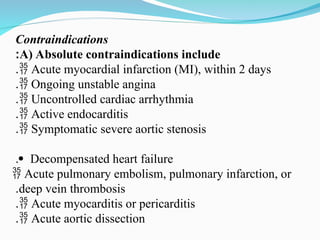
Contraindications
A) Absolute contraindications include
:
 Acute myocardial infarction (MI), within 2 days
.
 Ongoing unstable angina
.
 Uncontrolled cardiac arrhythmia
.
 Active endocarditis
.
 Symptomatic severe aortic stenosis
.
Decompensated heart failure
.
 Acute pulmonary embolism, pulmonary infarction, or
deep vein thrombosis
.
 Acute myocarditis or pericarditis
.
 Acute aortic dissection
.
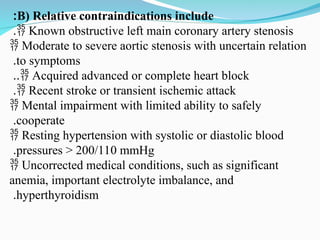
B) Relative contraindications include
:
 Known obstructive left main coronary artery stenosis
.
 Moderate to severe aortic stenosis with uncertain relation
to symptoms
.
 Acquired advanced or complete heart block
..
 Recent stroke or transient ischemic attack
.
 Mental impairment with limited ability to safely
cooperate
.
 Resting hypertension with systolic or diastolic blood
pressures > 200/110 mmHg
.
 Uncorrected medical conditions, such as significant
anemia, important electrolyte imbalance, and
hyperthyroidism
.
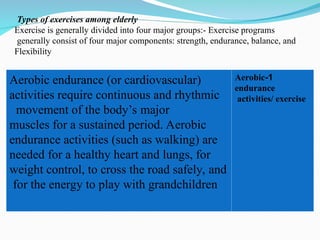
Types of exercises among elderly
Exercise is generally divided into four major groups:- Exercise programs
generally consist of four major components: strength, endurance, balance, and
Flexibility
1
-
Aerobic
endurance
activities/ exercise
Aerobic endurance (or cardiovascular)
activities require continuous and rhythmic
movement of the body’s major
muscles for a sustained period. Aerobic
endurance activities (such as walking) are
needed for a healthy heart and lungs, for
weight control, to cross the road safely, and
for the energy to play with grandchildren
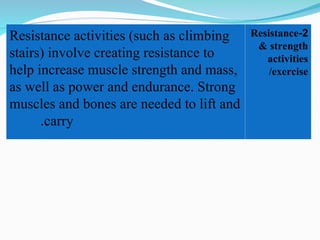
2
-
Resistance
& strength
activities
/exercise
Resistance activities (such as climbing
stairs) involve creating resistance to
help increase muscle strength and mass,
as well as power and endurance. Strong
muscles and bones are needed to lift and
carry
.
3
-
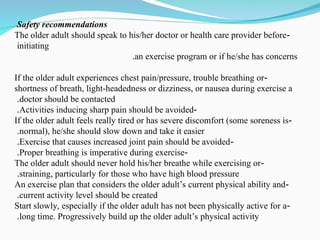
Flexibility
activities
/exercise
Flexibility activities (such as stretching) improve
the range of movement possible at a joint by gently
stretching the muscles, tendons and ligaments.
Flexibility is specific to each joint and depends on
a number of key variables such as the tightness of
tendons and ligaments. Flexibility is required on a
daily basis to tie shoelaces, wash hair and hang up
washing
.
4
-
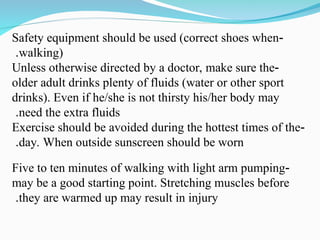
Balance
activities
/exercise
Balance activities improve a person’s ability to
prevent falls caused by self-motion, the
environment or other objects. Balance is required to
climb stairs or get on and off a bus
.
Safety recommendations
-
The older adult should speak to his/her doctor or health care provider before
initiating
an exercise program or if he/she has concerns
.
-
If the older adult experiences chest pain/pressure, trouble breathing or
shortness of breath, light-headedness or dizziness, or nausea during exercise a
doctor should be contacted
.
-
Activities inducing sharp pain should be avoided
.
-
If the older adult feels really tired or has severe discomfort (some soreness is
normal), he/she should slow down and take it easier
.
-
Exercise that causes increased joint pain should be avoided
.
-
Proper breathing is imperative during exercise
.
-
The older adult should never hold his/her breathe while exercising or
straining, particularly for those who have high blood pressure
.
-
An exercise plan that considers the older adult’s current physical ability and
current activity level should be created
.
-
Start slowly, especially if the older adult has not been physically active for a
long time. Progressively build up the older adult’s physical activity
.
-
Safety equipment should be used (correct shoes when
walking)
.
-
Unless otherwise directed by a doctor, make sure the
older adult drinks plenty of fluids (water or other sport
drinks). Even if he/she is not thirsty his/her body may
need the extra fluids
.
-
Exercise should be avoided during the hottest times of the
day. When outside sunscreen should be worn
.
-
Five to ten minutes of walking with light arm pumping
may be a good starting point. Stretching muscles before
they are warmed up may result in injury
.
Common examples of each basic types with pictures
A.Aerobic exercise
A. Exercise timing/ schedule for older adults: it is
recommended to do at least 30 minutes of activity on
most days of the week
B. Strength Training
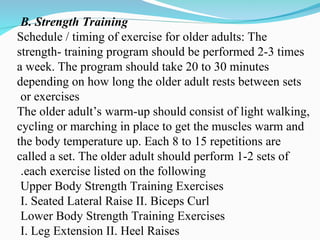
Schedule / timing of exercise for older adults: The
strength- training program should be performed 2-3 times
a week. The program should take 20 to 30 minutes
depending on how long the older adult rests between sets
or exercises
The older adult’s warm-up should consist of light walking,
cycling or marching in place to get the muscles warm and
the body temperature up. Each 8 to 15 repetitions are
called a set. The older adult should perform 1-2 sets of
each exercise listed on the following
.
Upper Body Strength Training Exercises
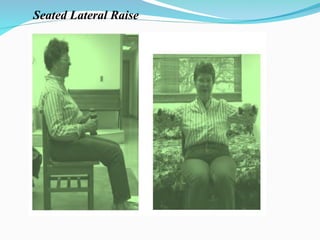
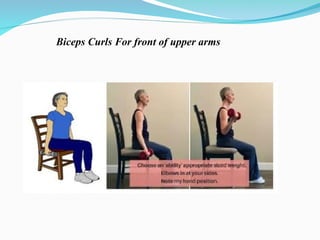
I. Seated Lateral Raise II. Biceps Curl
Lower Body Strength Training Exercises
I. Leg Extension II. Heel Raises
Seated Lateral Raise
Biceps Curls For front of upper arms
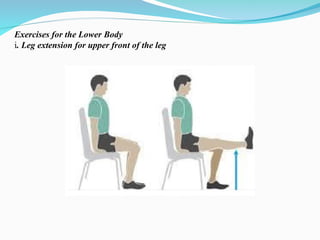
Exercises for the Lower Body
i. Leg extension for upper front of the leg
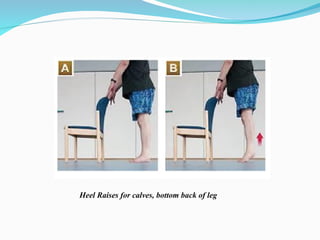
Heel Raises for calves, bottom back of leg
C. Flexibility Training
Stretching improves range of motion for activities of
daily living, such as combing hair, getting dressed, or
picking up objects from the floor. Stretching may also
prevent pain or injury
.
Schedule/ timing of stretching for elderly people:
Encourage the older adult to stretch at least 2-3
days/week, ideally 5-7 days / week, preferably after
an aerobic or strengthening workout
.
Each 8 to 15 repetitions are called a set. The older
adult should perform 1-2 sets of each exercise listed
on the following
Stretching Exercises types
:
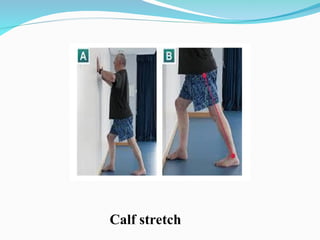
Lower Body Stretches
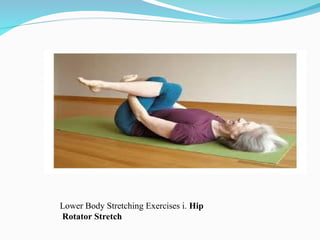
I. Hip Rotator Stretch II. Calf Stretch
Upper Body Stretches
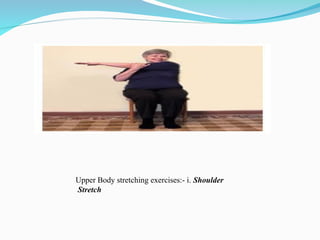
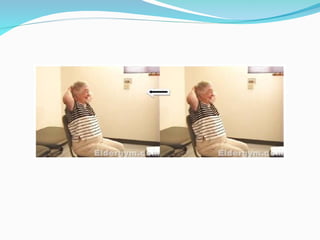
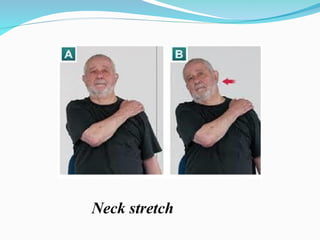
I. Shoulder Stretch II. Neck Stretch
Upper Body stretching exercises:- i. Shoulder
Stretch
Neck stretch
Lower Body Stretching Exercises i. Hip
Rotator Stretch
Calf stretch
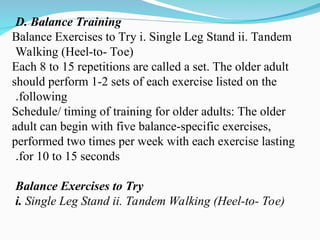
D. Balance Training
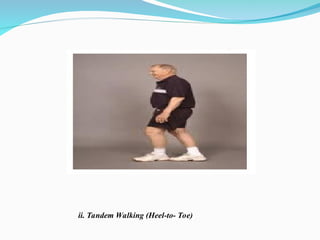
Balance Exercises to Try i. Single Leg Stand ii. Tandem
Walking (Heel-to- Toe)
Each 8 to 15 repetitions are called a set. The older adult
should perform 1-2 sets of each exercise listed on the
following
.
Schedule/ timing of training for older adults: The older
adult can begin with five balance-specific exercises,
performed two times per week with each exercise lasting
for 10 to 15 seconds
.
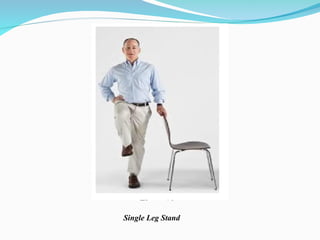
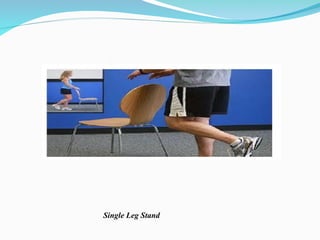
Balance Exercises to Try
i. Single Leg Stand ii. Tandem Walking (Heel-to- Toe)
Single Leg Stand
Single Leg Stand
ii. Tandem Walking (Heel-to- Toe)
exercise 123456789123456789123456789.ppt

exercise 123456789123456789123456789.ppt

  • 1.
    DIFFERENT TYPES OFEXERCISES AMONG ELDERLY Outlines -: Introduction Common terminology Benefits of Exercise for Elderly Contraindications of exercises among elderly Types of exercises among elderly Safety recommendations for elderly during exercise Common examples of each basic types
  • 2.
    Introduction The frail elderlypeople present a clinical syndrome which comprises of unintentional body weight loss, muscle weakness, slow walking, self-reported exhaustion and low level of physical activity among the elderly people who are over the age of 65. It is of importance to note that some aging changes can be controlled feasible in many of the body organs through exercise .
  • 3.
    Common terminology Physical Activity(PA): is defined as any bodily movement produced by skeletal muscles that result in energy expenditure. PA encompasses exercise, sports, and physical activities performed as part of daily living, occupation, leisure, or active transportation . Exercise: is a subcategory of PA that is planned, structured, and repetitive and that has as a final or intermediate objective for improvement or maintenance of physical fitness . Physical function: is the capacity of an individual to perform the physical activities of daily living. Physical function reflects motor function and control, physical fitness, and habitual PA
  • 4.
    Benefits of Exerciseto the Elderly Improvements in mental health, emotional, psychological, and social well- being and cognitive function PA is a protective factor for non-communicable diseases such as cardiovascular disease, stroke, diabetes, and some types of cancer . Delay in the onset of dementia and improved quality of life and wellbeing . Attain a high level of cardiorespiratory fitness and have benefits for the brain centers . PA and exercise play an important role to counteract sarcopenia and falls as well as improving physical performance and activities of daily living . Improve the elderly balance, flexibility, coordination, endurance, mental health, cognitive function and muscle tone. This greatly enhances functional independence . Significant reduction of body fat which lowers the probability of obesity . Regular exercise also decreases blood pressure; improves lipid profile hence reduced risk of hypertension . .
  • 5.
    Contraindications A) Absolute contraindicationsinclude :  Acute myocardial infarction (MI), within 2 days .  Ongoing unstable angina .  Uncontrolled cardiac arrhythmia .  Active endocarditis .  Symptomatic severe aortic stenosis . Decompensated heart failure .  Acute pulmonary embolism, pulmonary infarction, or deep vein thrombosis .  Acute myocarditis or pericarditis .  Acute aortic dissection .
  • 6.
    B) Relative contraindicationsinclude :  Known obstructive left main coronary artery stenosis .  Moderate to severe aortic stenosis with uncertain relation to symptoms .  Acquired advanced or complete heart block ..  Recent stroke or transient ischemic attack .  Mental impairment with limited ability to safely cooperate .  Resting hypertension with systolic or diastolic blood pressures > 200/110 mmHg .  Uncorrected medical conditions, such as significant anemia, important electrolyte imbalance, and hyperthyroidism .
  • 7.
    Types of exercisesamong elderly Exercise is generally divided into four major groups:- Exercise programs generally consist of four major components: strength, endurance, balance, and Flexibility 1 - Aerobic endurance activities/ exercise Aerobic endurance (or cardiovascular) activities require continuous and rhythmic movement of the body’s major muscles for a sustained period. Aerobic endurance activities (such as walking) are needed for a healthy heart and lungs, for weight control, to cross the road safely, and for the energy to play with grandchildren
  • 8.
    2 - Resistance & strength activities /exercise Resistance activities(such as climbing stairs) involve creating resistance to help increase muscle strength and mass, as well as power and endurance. Strong muscles and bones are needed to lift and carry .
  • 9.
    3 - Flexibility activities /exercise Flexibility activities (suchas stretching) improve the range of movement possible at a joint by gently stretching the muscles, tendons and ligaments. Flexibility is specific to each joint and depends on a number of key variables such as the tightness of tendons and ligaments. Flexibility is required on a daily basis to tie shoelaces, wash hair and hang up washing .
  • 10.
    4 - Balance activities /exercise Balance activities improvea person’s ability to prevent falls caused by self-motion, the environment or other objects. Balance is required to climb stairs or get on and off a bus .
  • 11.
    Safety recommendations - The olderadult should speak to his/her doctor or health care provider before initiating an exercise program or if he/she has concerns . - If the older adult experiences chest pain/pressure, trouble breathing or shortness of breath, light-headedness or dizziness, or nausea during exercise a doctor should be contacted . - Activities inducing sharp pain should be avoided . - If the older adult feels really tired or has severe discomfort (some soreness is normal), he/she should slow down and take it easier . - Exercise that causes increased joint pain should be avoided . - Proper breathing is imperative during exercise . - The older adult should never hold his/her breathe while exercising or straining, particularly for those who have high blood pressure . - An exercise plan that considers the older adult’s current physical ability and current activity level should be created . - Start slowly, especially if the older adult has not been physically active for a long time. Progressively build up the older adult’s physical activity .
  • 12.
    - Safety equipment shouldbe used (correct shoes when walking) . - Unless otherwise directed by a doctor, make sure the older adult drinks plenty of fluids (water or other sport drinks). Even if he/she is not thirsty his/her body may need the extra fluids . - Exercise should be avoided during the hottest times of the day. When outside sunscreen should be worn . - Five to ten minutes of walking with light arm pumping may be a good starting point. Stretching muscles before they are warmed up may result in injury .
  • 13.
    Common examples ofeach basic types with pictures A.Aerobic exercise A. Exercise timing/ schedule for older adults: it is recommended to do at least 30 minutes of activity on most days of the week
  • 14.
    B. Strength Training Schedule/ timing of exercise for older adults: The strength- training program should be performed 2-3 times a week. The program should take 20 to 30 minutes depending on how long the older adult rests between sets or exercises The older adult’s warm-up should consist of light walking, cycling or marching in place to get the muscles warm and the body temperature up. Each 8 to 15 repetitions are called a set. The older adult should perform 1-2 sets of each exercise listed on the following . Upper Body Strength Training Exercises I. Seated Lateral Raise II. Biceps Curl Lower Body Strength Training Exercises I. Leg Extension II. Heel Raises
  • 15.
  • 16.
    Biceps Curls Forfront of upper arms
  • 17.
    Exercises for theLower Body i. Leg extension for upper front of the leg
  • 18.
    Heel Raises forcalves, bottom back of leg
  • 19.
    C. Flexibility Training Stretchingimproves range of motion for activities of daily living, such as combing hair, getting dressed, or picking up objects from the floor. Stretching may also prevent pain or injury . Schedule/ timing of stretching for elderly people: Encourage the older adult to stretch at least 2-3 days/week, ideally 5-7 days / week, preferably after an aerobic or strengthening workout . Each 8 to 15 repetitions are called a set. The older adult should perform 1-2 sets of each exercise listed on the following
  • 20.
    Stretching Exercises types : LowerBody Stretches I. Hip Rotator Stretch II. Calf Stretch Upper Body Stretches I. Shoulder Stretch II. Neck Stretch
  • 21.
    Upper Body stretchingexercises:- i. Shoulder Stretch
  • 23.
  • 24.
    Lower Body StretchingExercises i. Hip Rotator Stretch
  • 25.
  • 26.
    D. Balance Training BalanceExercises to Try i. Single Leg Stand ii. Tandem Walking (Heel-to- Toe) Each 8 to 15 repetitions are called a set. The older adult should perform 1-2 sets of each exercise listed on the following . Schedule/ timing of training for older adults: The older adult can begin with five balance-specific exercises, performed two times per week with each exercise lasting for 10 to 15 seconds . Balance Exercises to Try i. Single Leg Stand ii. Tandem Walking (Heel-to- Toe)
  • 27.
  • 28.
  • 29.
    ii. Tandem Walking(Heel-to- Toe)