12-1
Phylum Porifera
-Sponges-
12-2
A Caribbean
demosponge
Phylum Porifera
 Characteristics of Sponges:
 Multicellular
 Heterotrophic
 No cell Walls
 Few specialized cells (choanocytes)
 No germ layers (no gastrulation- no gut)
12-4
Phylum Porifera
General Features
 Sessile (immobile) sponges are filter feeders
 Porifera means “pore-bearing”
 Sac-like bodies with many pores
 Use flagellated “collar cells”, or
choanocytes, to move water to help
filter/feed
 Body is efficient aquatic filter
 Approximately 15,000 species of sponges
 Most are marine
 Few live in brackish water, 150 in fresh water
Phylum Porifera
Porifera do not have a circulatory, respiratory, excretory
system.
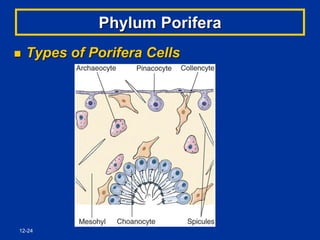
Porifera Cell Types: (VOCAB)
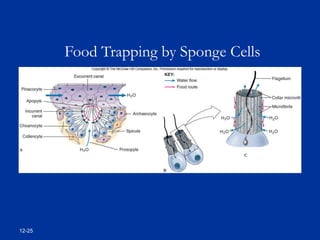
•Choanocytes (also known as "collar cells") - sponge's digestive system. Are
used to filter particles out of the water. The beating of the choanocytes’ flagella
creates the sponge’s water current.
•Porocytes are cells that make up the pores entering into the sponge’s body
through the mesohyl (gelatinous non-cellular matrix that holds cells).
•Pinacocytes (pinacoderm), the outer epidermal layer of cells.
•Myocytes are modified pinacocytes which control the size of the osculum
and pore openings and thus the water flow.
Phylum Porifera
CELL TYPES CONT
Archaeocytes (or amoebocytes) have many functions; They also have a role in
nutrient transport and sexual reproduction, they are cells which can transform
into: :
Sclerocytes secrete calcareous siliceous (silicon/oxygen based) spicules which
reside in the mesohyl.
Spongocytes secrete spongin; fibers which make up the mesohyl.
Collencytes secrete collagen.
Spicules are stiffened rods or spikes made of calcium carbonate or silica which
are used for structure and defense.
12-7
Sessile Sponges - do not move
12-8
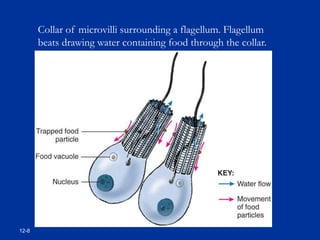
Collar of microvilli surrounding a flagellum. Flagellum
beats drawing water containing food through the collar.
12-9
Phylum Porifera
 Marine sponges found in all seas at all
depths and vary greatly in size
 Many species are brightly colored because of
pigments in dermal cells
 Embryos are free-swimming, adult sponges
always attached
 Irregular shaped
12-10
Phylum Porifera
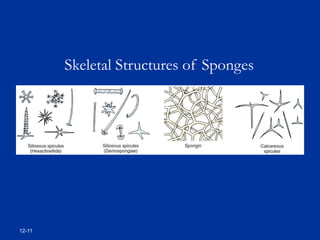
 Skeletal structure of a sponge can be fibrous
and rigid
 Rigid skeleton consists of spicules
 Fibrous portion consists of spongin
 Sponge Classification is based on the
composition and shape the spicules
12-11
Skeletal Structures of Sponges
12-12
Phylum Porifera
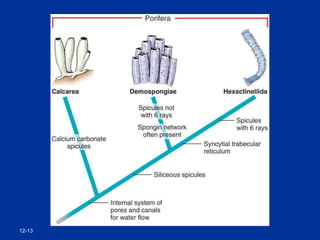
 Fossil record of sponges dates back to the
early Cambrian (540 mya)
 Living sponges traditionally assigned to 3
classes: Calcarea, Hexactinellida, and
Demospongiae
12-13
12-14
Phylum Porifera
Form and Function
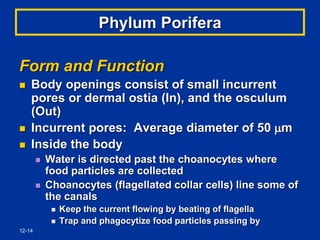
 Body openings consist of small incurrent
pores or dermal ostia (In), and the osculum
(Out)
 Incurrent pores: Average diameter of 50 m
 Inside the body
 Water is directed past the choanocytes where
food particles are collected
 Choanocytes (flagellated collar cells) line some of
the canals
 Keep the current flowing by beating of flagella
 Trap and phagocytize food particles passing by
12-15
Phylum Porifera
 Types of Canal Systems
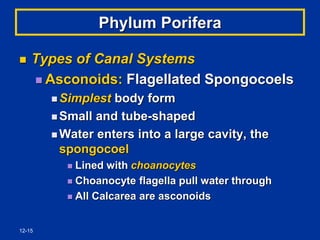
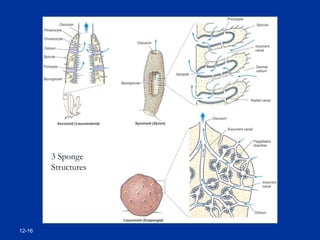
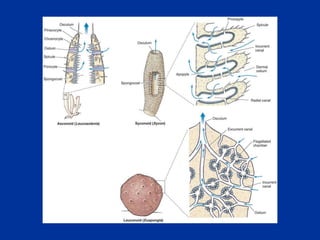
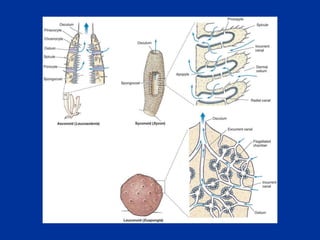
 Asconoids: Flagellated Spongocoels
 Simplest body form
 Small and tube-shaped
 Water enters into a large cavity, the
spongocoel
 Lined with choanocytes
 Choanocyte flagella pull water through
 All Calcarea are asconoids
12-16
3 Sponge
Structures
12-17
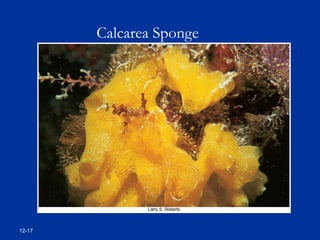
Calcarea Sponge
12-18
Phylum Porifera
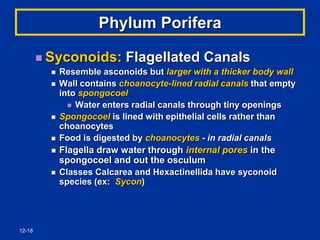
 Syconoids: Flagellated Canals
 Resemble asconoids but larger with a thicker body wall
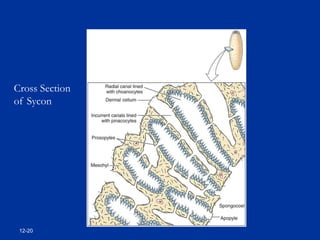
 Wall contains choanocyte-lined radial canals that empty
into spongocoel
 Water enters radial canals through tiny openings
 Spongocoel is lined with epithelial cells rather than
choanocytes
 Food is digested by choanocytes - in radial canals
 Flagella draw water through internal pores in the
spongocoel and out the osculum
 Classes Calcarea and Hexactinellida have syconoid
species (ex: Sycon)
12-20
Cross Section
of Sycon
12-21
Phylum Porifera
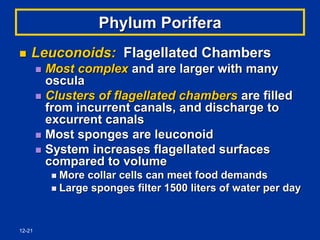
 Leuconoids: Flagellated Chambers
 Most complex and are larger with many
oscula
 Clusters of flagellated chambers are filled
from incurrent canals, and discharge to
excurrent canals
 Most sponges are leuconoid
 System increases flagellated surfaces
compared to volume
 More collar cells can meet food demands
 Large sponges filter 1500 liters of water per day
12-23
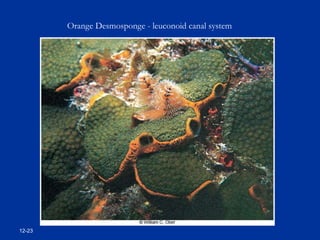
Orange Desmosponge - leuconoid canal system
12-24
Phylum Porifera
 Types of Porifera Cells
12-25
Food Trapping by Sponge Cells
12-26
Phylum Porifera
 Cell Independence: Regeneration
Sponges have a great ability to
regenerate lost parts and repair injuries
 Regeneration following fragmentation is
one means of asexual reproduction
12-27
Phylum Porifera
 Asexual reproduction can occur by bud
formation
 External buds
 Small individuals that break off after
attaining a certain size
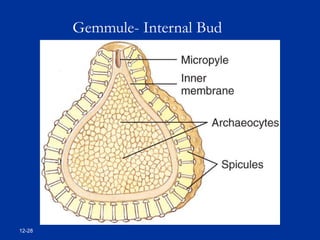
 Internal buds or gemmules
 Formed by archaeocytes that collect in
mesohyl
 Coated with tough spongin and spicules
 Survive harsh environmental conditions
12-28
Gemmule- Internal Bud
12-29
Phylum Porifera
 Sexual Reproduction
 Most are monoecious (have both sexes)
 Sperm and eggs sometimes arise from
choanocytes or archaeocytes
12-30
Phylum Porifera
 In some, one sponge releases sperm
which enter the pores of another sponge
 Sponges provide nourishment to zygote
until it is released as a ciliated larva
 Some sponges release both sperm and
oocytes into water
 The free-swimming larva of sponges is a
solid parenchymula
12-31
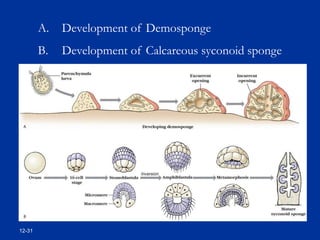
A. Development of Demosponge
B. Development of Calcareous syconoid sponge
12-32
Phylum Porifera
 Classification
 Class Calcarea
 Class Hexactinellida
 Class Demospongiae
12-33
Phylum Porifera
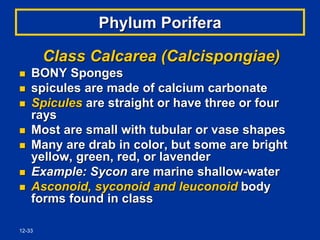
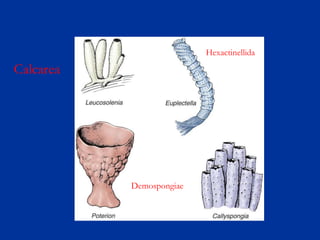
Class Calcarea (Calcispongiae)
 BONY Sponges
 spicules are made of calcium carbonate
 Spicules are straight or have three or four
rays
 Most are small with tubular or vase shapes
 Many are drab in color, but some are bright
yellow, green, red, or lavender
 Example: Sycon are marine shallow-water
 Asconoid, syconoid and leuconoid body
forms found in class
12-34
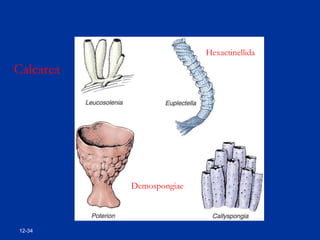
Calcarea
Demospongiae
Hexactinellida
12-35
Phylum Porifera
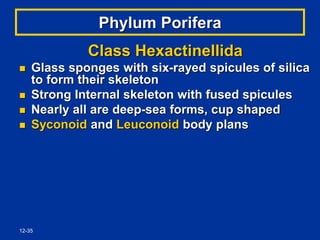
Class Hexactinellida
 Glass sponges with six-rayed spicules of silica
to form their skeleton
 Strong Internal skeleton with fused spicules
 Nearly all are deep-sea forms, cup shaped
 Syconoid and Leuconoid body plans
Calcarea
Demospongiae
Hexactinellida
12-37
Phylum Porifera
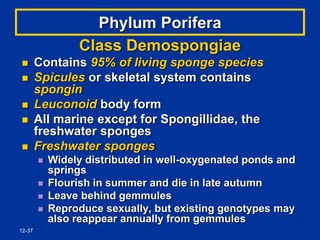
Class Demospongiae
 Contains 95% of living sponge species
 Spicules or skeletal system contains
spongin
 Leuconoid body form
 All marine except for Spongillidae, the
freshwater sponges
 Freshwater sponges
 Widely distributed in well-oxygenated ponds and
springs
 Flourish in summer and die in late autumn
 Leave behind gemmules
 Reproduce sexually, but existing genotypes may
also reappear annually from gemmules
12-38
Phylum Porifera
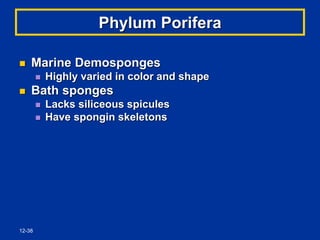
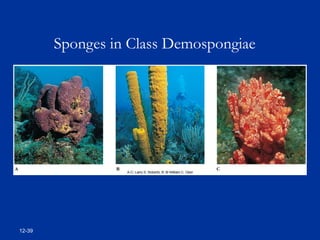
 Marine Demosponges
 Highly varied in color and shape
 Bath sponges
 Lacks siliceous spicules
 Have spongin skeletons
12-39
Sponges in Class Demospongiae
12-40
Phylum Porifera
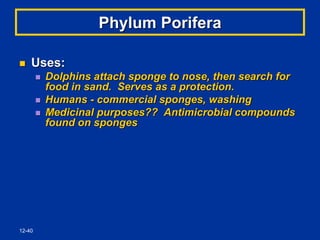
 Uses:
 Dolphins attach sponge to nose, then search for
food in sand. Serves as a protection.
 Humans - commercial sponges, washing
 Medicinal purposes?? Antimicrobial compounds
found on sponges

4 Porifera.pptx

  • 1.
  • 2.
  • 3.
    Phylum Porifera  Characteristicsof Sponges:  Multicellular  Heterotrophic  No cell Walls  Few specialized cells (choanocytes)  No germ layers (no gastrulation- no gut)
  • 4.
    12-4 Phylum Porifera General Features Sessile (immobile) sponges are filter feeders  Porifera means “pore-bearing”  Sac-like bodies with many pores  Use flagellated “collar cells”, or choanocytes, to move water to help filter/feed  Body is efficient aquatic filter  Approximately 15,000 species of sponges  Most are marine  Few live in brackish water, 150 in fresh water
  • 5.
    Phylum Porifera Porifera donot have a circulatory, respiratory, excretory system. Porifera Cell Types: (VOCAB) •Choanocytes (also known as "collar cells") - sponge's digestive system. Are used to filter particles out of the water. The beating of the choanocytes’ flagella creates the sponge’s water current. •Porocytes are cells that make up the pores entering into the sponge’s body through the mesohyl (gelatinous non-cellular matrix that holds cells). •Pinacocytes (pinacoderm), the outer epidermal layer of cells. •Myocytes are modified pinacocytes which control the size of the osculum and pore openings and thus the water flow.
  • 6.
    Phylum Porifera CELL TYPESCONT Archaeocytes (or amoebocytes) have many functions; They also have a role in nutrient transport and sexual reproduction, they are cells which can transform into: : Sclerocytes secrete calcareous siliceous (silicon/oxygen based) spicules which reside in the mesohyl. Spongocytes secrete spongin; fibers which make up the mesohyl. Collencytes secrete collagen. Spicules are stiffened rods or spikes made of calcium carbonate or silica which are used for structure and defense.
  • 7.
  • 8.
    12-8 Collar of microvillisurrounding a flagellum. Flagellum beats drawing water containing food through the collar.
  • 9.
    12-9 Phylum Porifera  Marinesponges found in all seas at all depths and vary greatly in size  Many species are brightly colored because of pigments in dermal cells  Embryos are free-swimming, adult sponges always attached  Irregular shaped
  • 10.
    12-10 Phylum Porifera  Skeletalstructure of a sponge can be fibrous and rigid  Rigid skeleton consists of spicules  Fibrous portion consists of spongin  Sponge Classification is based on the composition and shape the spicules
  • 11.
  • 12.
    12-12 Phylum Porifera  Fossilrecord of sponges dates back to the early Cambrian (540 mya)  Living sponges traditionally assigned to 3 classes: Calcarea, Hexactinellida, and Demospongiae
  • 13.
  • 14.
    12-14 Phylum Porifera Form andFunction  Body openings consist of small incurrent pores or dermal ostia (In), and the osculum (Out)  Incurrent pores: Average diameter of 50 m  Inside the body  Water is directed past the choanocytes where food particles are collected  Choanocytes (flagellated collar cells) line some of the canals  Keep the current flowing by beating of flagella  Trap and phagocytize food particles passing by
  • 15.
    12-15 Phylum Porifera  Typesof Canal Systems  Asconoids: Flagellated Spongocoels  Simplest body form  Small and tube-shaped  Water enters into a large cavity, the spongocoel  Lined with choanocytes  Choanocyte flagella pull water through  All Calcarea are asconoids
  • 16.
  • 17.
  • 18.
    12-18 Phylum Porifera  Syconoids:Flagellated Canals  Resemble asconoids but larger with a thicker body wall  Wall contains choanocyte-lined radial canals that empty into spongocoel  Water enters radial canals through tiny openings  Spongocoel is lined with epithelial cells rather than choanocytes  Food is digested by choanocytes - in radial canals  Flagella draw water through internal pores in the spongocoel and out the osculum  Classes Calcarea and Hexactinellida have syconoid species (ex: Sycon)
  • 20.
  • 21.
    12-21 Phylum Porifera  Leuconoids:Flagellated Chambers  Most complex and are larger with many oscula  Clusters of flagellated chambers are filled from incurrent canals, and discharge to excurrent canals  Most sponges are leuconoid  System increases flagellated surfaces compared to volume  More collar cells can meet food demands  Large sponges filter 1500 liters of water per day
  • 23.
    12-23 Orange Desmosponge -leuconoid canal system
  • 24.
  • 25.
  • 26.
    12-26 Phylum Porifera  CellIndependence: Regeneration Sponges have a great ability to regenerate lost parts and repair injuries  Regeneration following fragmentation is one means of asexual reproduction
  • 27.
    12-27 Phylum Porifera  Asexualreproduction can occur by bud formation  External buds  Small individuals that break off after attaining a certain size  Internal buds or gemmules  Formed by archaeocytes that collect in mesohyl  Coated with tough spongin and spicules  Survive harsh environmental conditions
  • 28.
  • 29.
    12-29 Phylum Porifera  SexualReproduction  Most are monoecious (have both sexes)  Sperm and eggs sometimes arise from choanocytes or archaeocytes
  • 30.
    12-30 Phylum Porifera  Insome, one sponge releases sperm which enter the pores of another sponge  Sponges provide nourishment to zygote until it is released as a ciliated larva  Some sponges release both sperm and oocytes into water  The free-swimming larva of sponges is a solid parenchymula
  • 31.
    12-31 A. Development ofDemosponge B. Development of Calcareous syconoid sponge
  • 32.
    12-32 Phylum Porifera  Classification Class Calcarea  Class Hexactinellida  Class Demospongiae
  • 33.
    12-33 Phylum Porifera Class Calcarea(Calcispongiae)  BONY Sponges  spicules are made of calcium carbonate  Spicules are straight or have three or four rays  Most are small with tubular or vase shapes  Many are drab in color, but some are bright yellow, green, red, or lavender  Example: Sycon are marine shallow-water  Asconoid, syconoid and leuconoid body forms found in class
  • 34.
  • 35.
    12-35 Phylum Porifera Class Hexactinellida Glass sponges with six-rayed spicules of silica to form their skeleton  Strong Internal skeleton with fused spicules  Nearly all are deep-sea forms, cup shaped  Syconoid and Leuconoid body plans
  • 36.
  • 37.
    12-37 Phylum Porifera Class Demospongiae Contains 95% of living sponge species  Spicules or skeletal system contains spongin  Leuconoid body form  All marine except for Spongillidae, the freshwater sponges  Freshwater sponges  Widely distributed in well-oxygenated ponds and springs  Flourish in summer and die in late autumn  Leave behind gemmules  Reproduce sexually, but existing genotypes may also reappear annually from gemmules
  • 38.
    12-38 Phylum Porifera  MarineDemosponges  Highly varied in color and shape  Bath sponges  Lacks siliceous spicules  Have spongin skeletons
  • 39.
  • 40.
    12-40 Phylum Porifera  Uses: Dolphins attach sponge to nose, then search for food in sand. Serves as a protection.  Humans - commercial sponges, washing  Medicinal purposes?? Antimicrobial compounds found on sponges