NAME =TANAY TARUN
ROLL NO.=141
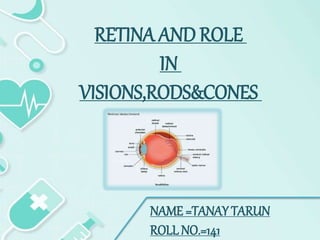
RETINA AND ROLE
IN
VISIONS,RODS&CONES
RETINA
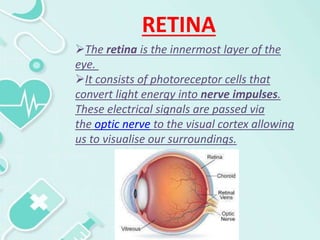
The retina is the innermost layer of the
eye.
It consists of photoreceptor cells that
convert light energy into nerve impulses.
These electrical signals are passed via
the optic nerve to the visual cortex allowing
us to visualise our surroundings.
RETINA LAYERS
The retina consists of layers, which can be
subcategorized into retinal pigmented
epithelium (RPE) and neural retina.
The RPE is a single layer of cuboidal
epithelial cells and located in the outermost
layer of the retina. It is responsible for the
nourishment and support of the neural
retina.
 The tight junctions between the RPE cells
form part of the blood-retinal barrier, which
helps to prevent molecules passing from the
choroid into the retina. The RPE is also
involved in a visual cycle as it regenerates
photosensitive pigments.
LAYERS OF NEURAL RETINA
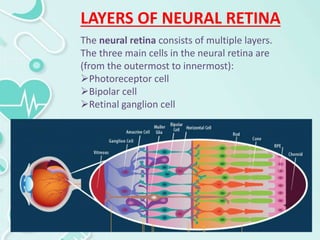
The neural retina consists of multiple layers.
The three main cells in the neural retina are
(from the outermost to innermost):
Photoreceptor cell
Bipolar cell
Retinal ganglion cell
The photoreceptors are involved
in phototransduction, a process of converting
light photons to an electrical impulse.
The impulse is then relayed by the bipolar
cell to the ganglion cell.
The axons of the ganglion cells then form
the nerve fibre layer of the retina, which exits
the eye as an optic nerve.
PHOTORECEPTOR CELL
Types of Photoreceptor
There are three main types of photoreceptors in the
human eyes called
Rods
cones
intrinsically photosensitive retinal ganglion cells
RODES
Rods are much more sensitive to light than cones.
They can signal the absorption of a single photon!
Hence, they are mainly responsible for scotopic
vision (in low-light levels). However, as the light levels
increase their phototransduction cascades become
saturated and are unable to reflect changes in light
intensity.
In terms of their distribution, rods are found on the
outside of the fovea and contribute
to peripheral vision. Thus, patients with degenerative
changes of rod cells, such as retinitis pigmentosa, may
present with a symptom of night-blindness known as
nyctalopia and peripheral vision loss.
CONES
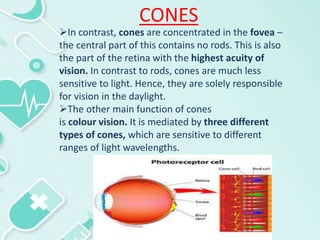
In contrast, cones are concentrated in the fovea –
the central part of this contains no rods. This is also
the part of the retina with the highest acuity of
vision. In contrast to rods, cones are much less
sensitive to light. Hence, they are solely responsible
for vision in the daylight.
The other main function of cones
is colour vision. It is mediated by three different
types of cones, which are sensitive to different
ranges of light wavelengths.
Intrinsically photosensitive retinal
ganglion cells:-
Intrinsically photosensitive retinal ganglion
cells (ipRGCs), also called photosensitive
retinal ganglion cells (pRGC), or melanopsin-
containing retinal ganglion cells (mRGCs), are
a type of neuron in the retina of
the mammalian eye.
THANK
YOU...

retina and role in vision

  • 1.
    NAME =TANAY TARUN ROLLNO.=141 RETINA AND ROLE IN VISIONS,RODS&CONES
  • 2.
    RETINA The retina isthe innermost layer of the eye. It consists of photoreceptor cells that convert light energy into nerve impulses. These electrical signals are passed via the optic nerve to the visual cortex allowing us to visualise our surroundings.
  • 3.
    RETINA LAYERS The retinaconsists of layers, which can be subcategorized into retinal pigmented epithelium (RPE) and neural retina. The RPE is a single layer of cuboidal epithelial cells and located in the outermost layer of the retina. It is responsible for the nourishment and support of the neural retina.  The tight junctions between the RPE cells form part of the blood-retinal barrier, which helps to prevent molecules passing from the choroid into the retina. The RPE is also involved in a visual cycle as it regenerates photosensitive pigments.
  • 4.
    LAYERS OF NEURALRETINA The neural retina consists of multiple layers. The three main cells in the neural retina are (from the outermost to innermost): Photoreceptor cell Bipolar cell Retinal ganglion cell
  • 5.
    The photoreceptors areinvolved in phototransduction, a process of converting light photons to an electrical impulse. The impulse is then relayed by the bipolar cell to the ganglion cell. The axons of the ganglion cells then form the nerve fibre layer of the retina, which exits the eye as an optic nerve. PHOTORECEPTOR CELL Types of Photoreceptor There are three main types of photoreceptors in the human eyes called Rods cones intrinsically photosensitive retinal ganglion cells
  • 6.
    RODES Rods are muchmore sensitive to light than cones. They can signal the absorption of a single photon! Hence, they are mainly responsible for scotopic vision (in low-light levels). However, as the light levels increase their phototransduction cascades become saturated and are unable to reflect changes in light intensity. In terms of their distribution, rods are found on the outside of the fovea and contribute to peripheral vision. Thus, patients with degenerative changes of rod cells, such as retinitis pigmentosa, may present with a symptom of night-blindness known as nyctalopia and peripheral vision loss.
  • 7.
    CONES In contrast, conesare concentrated in the fovea – the central part of this contains no rods. This is also the part of the retina with the highest acuity of vision. In contrast to rods, cones are much less sensitive to light. Hence, they are solely responsible for vision in the daylight. The other main function of cones is colour vision. It is mediated by three different types of cones, which are sensitive to different ranges of light wavelengths.
  • 8.
    Intrinsically photosensitive retinal ganglioncells:- Intrinsically photosensitive retinal ganglion cells (ipRGCs), also called photosensitive retinal ganglion cells (pRGC), or melanopsin- containing retinal ganglion cells (mRGCs), are a type of neuron in the retina of the mammalian eye.
  • 9.