Course: Photonic Integrated Circuit
Course Coordinator: Arpan Deyasi
1/27/2021 1
Arpan Deyasi, RCCIIT, India
Photonic Integrated Circuit
Integrated circuits with optic and electronic
components
made by photolithography and other new forms of
integration
Materials used
• Lithium Niobate
• Gallium Arsenide
• Indium Phosphide
• Silica on Silicon
1/27/2021 2
Arpan Deyasi, RCCIIT, India
A circuit, or group of interconnected circuits, consisting of
miniature solid-state optical components on
semiconductor or dielectric substrates
Photonic Integrated Circuit
Classified as either hybrid or monolithic
Optoelectronic integrated circuits refers to the integration
of electric and optical components and optical
interconnection
Optoelectronic devices makes electrons and photons to
perform single function. These devices are capable of
converting optical to electric form and vice versa
1/27/2021 3
Arpan Deyasi, RCCIIT, India
Objective of PIC
bring fiber systems to home and individual subscribers
in the form of telephone links and broadcast cable TV.
In order to extend optoelectronic technologies to
subscriber, the systems need the development of lasers
with precise frequency control and tenability and
wavelength-selective detectors and receivers.
Data transmission rates of several tens of Gbps will be
attained by these circuits and systems
1/27/2021 4
Arpan Deyasi, RCCIIT, India
Why optical spectra?
Fiber Optics have
[i] Minimal loss
[ii] Minimal noise
[iii] Lower Voltage and Power input
[iv] Higher data transfer rate
[v] Higher speed
1/27/2021 5
Arpan Deyasi, RCCIIT, India
Comparison between photon and electron
Photon
Small interaction between photons
Propagate outside the medium and for longer distances
Electron
Larger interaction between electrons
Propagate only inside or on the material
1/27/2021 6
Arpan Deyasi, RCCIIT, India
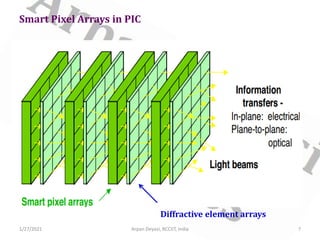
Smart Pixel Arrays in PIC
Diffractive element arrays
1/27/2021 7
Arpan Deyasi, RCCIIT, India
What are the components inside it?
 Lasers
 Photodetectors
 Waveguides
 Power Splitters
 Optical Amplifiers
1/27/2021 8
Arpan Deyasi, RCCIIT, India
Problem with PIC’s so far ……………..
 requires a variety of integration techniques and materials
 larger feature size
 lower Integration density
 expensive
 software is not powerful for testing purpose
None of these technologies is fully developed, but
limited hybrid integration is available
commercially
1/27/2021 9
Arpan Deyasi, RCCIIT, India
Applications of PIC
 Fiber-Optic communications
 Biomedical engineering
 Photonic computing
 Big data computing
1/27/2021 10
Arpan Deyasi, RCCIIT, India

Photonic integrated circuit

  • 1.
    Course: Photonic IntegratedCircuit Course Coordinator: Arpan Deyasi 1/27/2021 1 Arpan Deyasi, RCCIIT, India
  • 2.
    Photonic Integrated Circuit Integratedcircuits with optic and electronic components made by photolithography and other new forms of integration Materials used • Lithium Niobate • Gallium Arsenide • Indium Phosphide • Silica on Silicon 1/27/2021 2 Arpan Deyasi, RCCIIT, India
  • 3.
    A circuit, orgroup of interconnected circuits, consisting of miniature solid-state optical components on semiconductor or dielectric substrates Photonic Integrated Circuit Classified as either hybrid or monolithic Optoelectronic integrated circuits refers to the integration of electric and optical components and optical interconnection Optoelectronic devices makes electrons and photons to perform single function. These devices are capable of converting optical to electric form and vice versa 1/27/2021 3 Arpan Deyasi, RCCIIT, India
  • 4.
    Objective of PIC bringfiber systems to home and individual subscribers in the form of telephone links and broadcast cable TV. In order to extend optoelectronic technologies to subscriber, the systems need the development of lasers with precise frequency control and tenability and wavelength-selective detectors and receivers. Data transmission rates of several tens of Gbps will be attained by these circuits and systems 1/27/2021 4 Arpan Deyasi, RCCIIT, India
  • 5.
    Why optical spectra? FiberOptics have [i] Minimal loss [ii] Minimal noise [iii] Lower Voltage and Power input [iv] Higher data transfer rate [v] Higher speed 1/27/2021 5 Arpan Deyasi, RCCIIT, India
  • 6.
    Comparison between photonand electron Photon Small interaction between photons Propagate outside the medium and for longer distances Electron Larger interaction between electrons Propagate only inside or on the material 1/27/2021 6 Arpan Deyasi, RCCIIT, India
  • 7.
    Smart Pixel Arraysin PIC Diffractive element arrays 1/27/2021 7 Arpan Deyasi, RCCIIT, India
  • 8.
    What are thecomponents inside it?  Lasers  Photodetectors  Waveguides  Power Splitters  Optical Amplifiers 1/27/2021 8 Arpan Deyasi, RCCIIT, India
  • 9.
    Problem with PIC’sso far ……………..  requires a variety of integration techniques and materials  larger feature size  lower Integration density  expensive  software is not powerful for testing purpose None of these technologies is fully developed, but limited hybrid integration is available commercially 1/27/2021 9 Arpan Deyasi, RCCIIT, India
  • 10.
    Applications of PIC Fiber-Optic communications  Biomedical engineering  Photonic computing  Big data computing 1/27/2021 10 Arpan Deyasi, RCCIIT, India