PRESENTED BY : AZLEEN KAZI
INTRODUCTION
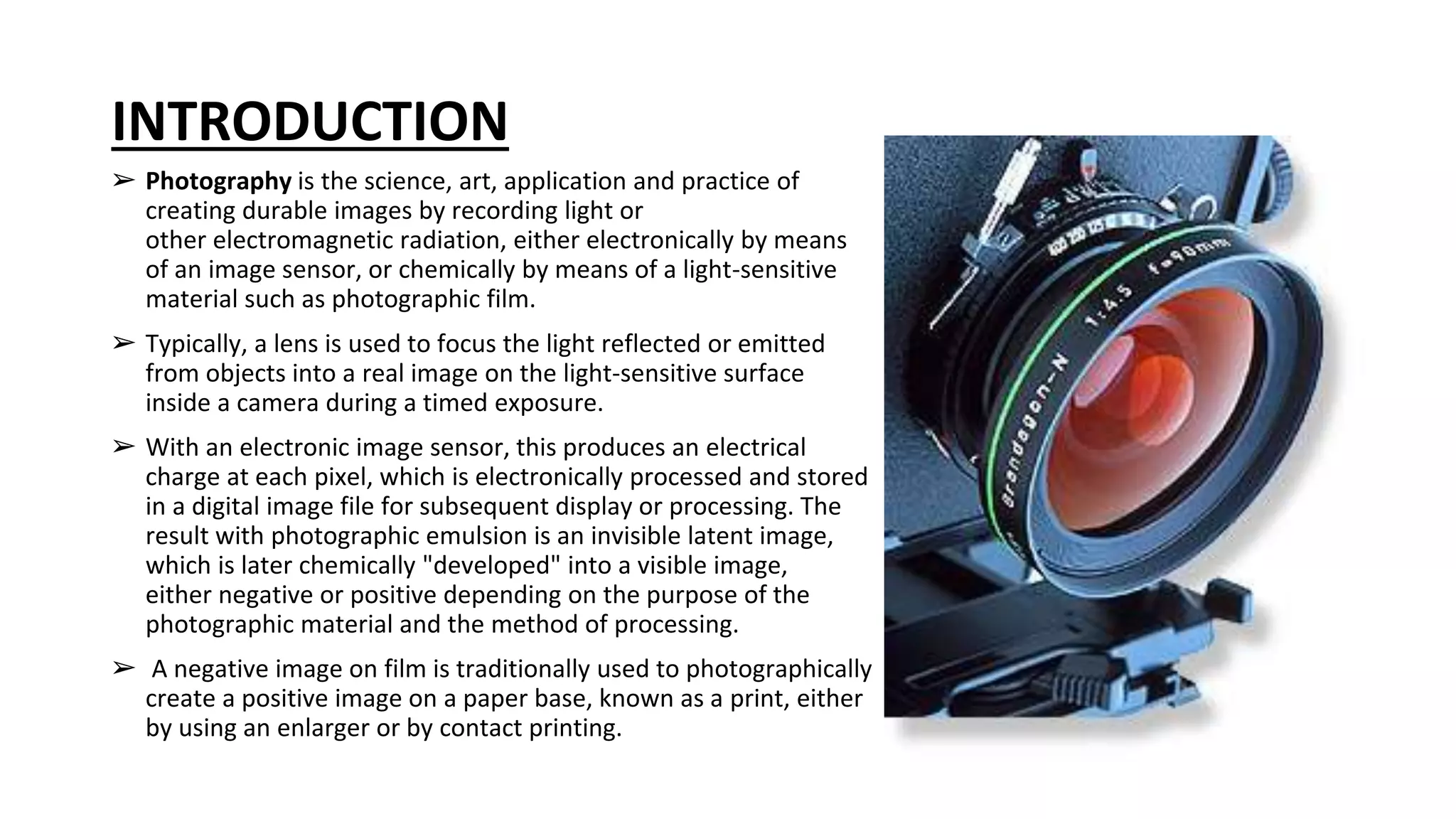
➢ Photography is the science, art, application and practice of
creating durable images by recording light or
other electromagnetic radiation, either electronically by means
of an image sensor, or chemically by means of a light-sensitive
material such as photographic film.
➢ Typically, a lens is used to focus the light reflected or emitted
from objects into a real image on the light-sensitive surface
inside a camera during a timed exposure.
➢ With an electronic image sensor, this produces an electrical
charge at each pixel, which is electronically processed and stored
in a digital image file for subsequent display or processing. The
result with photographic emulsion is an invisible latent image,
which is later chemically "developed" into a visible image,
either negative or positive depending on the purpose of the
photographic material and the method of processing.
➢ A negative image on film is traditionally used to photographically
create a positive image on a paper base, known as a print, either
by using an enlarger or by contact printing.
Etymology
➢ The word "photography" was created from the Greek roots φωτός
(phōtos), genitive of φῶς (phōs), "light" and γραφή (graphé)
"representation by means of lines" or "drawing",together meaning
"drawing with light“
➢ The German newspaper Vossische Zeitung of 25 February 1839
contained an article entitled Photographie, discussing several
priority claims - especially Talbot's - regarding Daguerre's claim of
invention. The article is the earliest known occurrence of the word
in public print.
➢ It was signed "J.M.", believed to have been Berlin
astronomer Johann von Maedler. Credit has traditionally been given
to Sir John Herschel both for coining the word and for introducing it
to the public. His uses of it in private correspondence prior to 25
February 1839 and at his Royal Society lecture on the subject in
London on 14 March 1839 have long been amply documented and
accepted as settled facts.
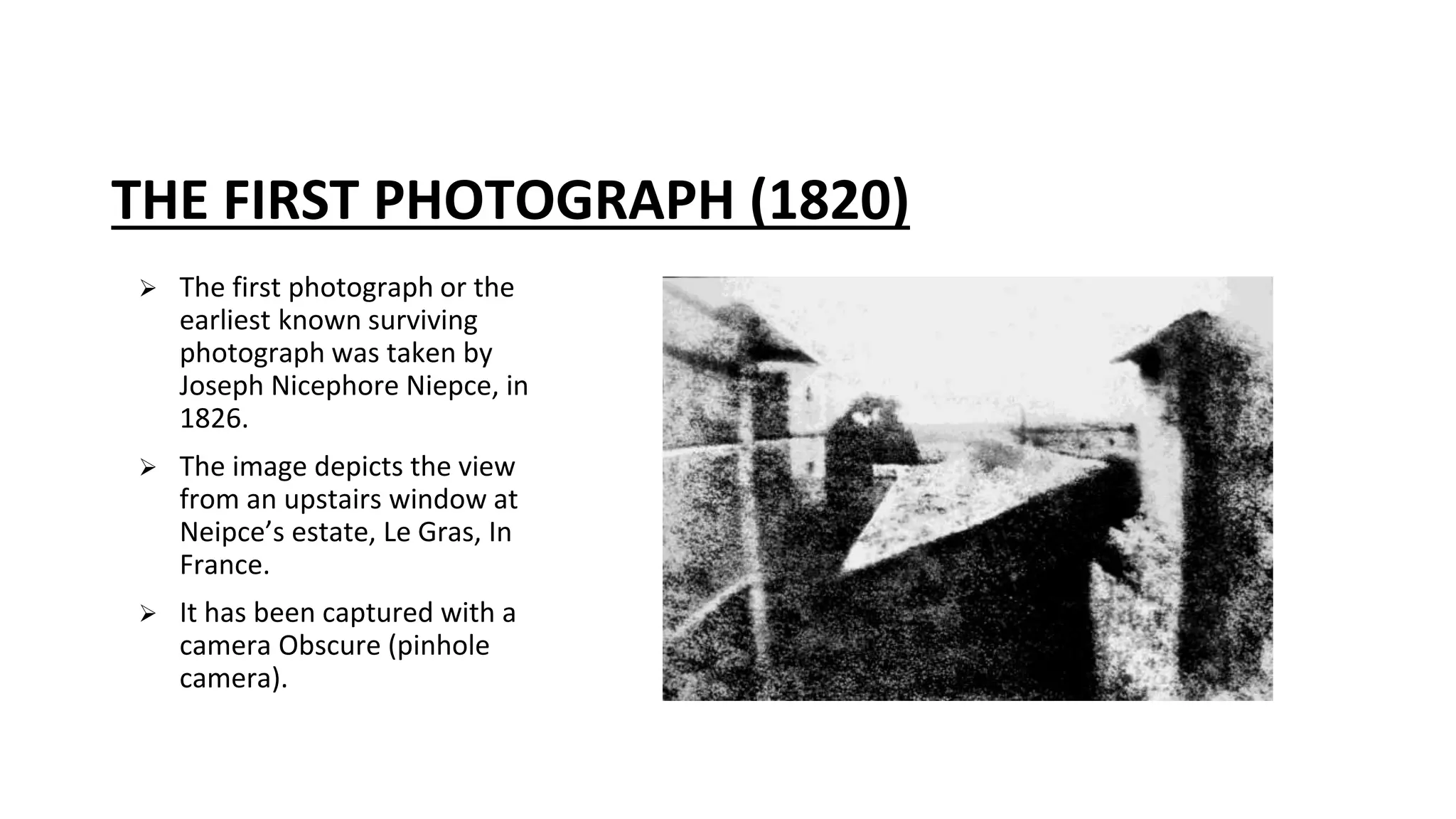
THE FIRST PHOTOGRAPH (1820)
 The first photograph or the
earliest known surviving
photograph was taken by
Joseph Nicephore Niepce, in
1826.
 The image depicts the view
from an upstairs window at
Neipce’s estate, Le Gras, In
France.
 It has been captured with a
camera Obscure (pinhole
camera).
The Earliest Camera (1840)
 The first camera invented was made by
Alexander Wolcott - his camera design was
patented on May 8th, 1840.
 His inventions made it possible to take candid
photographs and does not fade away with
time.
 He also has the distincton of opening the
earliest photography shop – that was known as
an Dagurran Parlor.
FILM PHOTOGRAPHY
➢ Hurter and Driffield began pioneering work on the light sensitivity of photographic emulsions in 1876.
Their work enabled the first quantitative measure of film speed to be devised.
➢ The first flexible photographic roll film was marketed by George Eastman in 1885, but this original "film"
was actually a coating on a paper base.
➢ As part of the processing, the image-bearing layer was stripped from the paper and transferred to a
hardened gelatin support. The first transparent plastic roll film followed in 1889. It was made from highly
flammable nitrocellulose ("celluloid"), now usually called "nitrate film”.
➢ Although cellulose acetate or "safety film" had been introduced by Kodak in 1908,[25] at first it found only
a few special applications as an alternative to the hazardous nitrate film, which had the advantages of
being considerably tougher, slightly more transparent, and cheaper.
BLACK & WHITE
➢ Originally, all photography was monochrome, or black-and-white. Even after color film was readily available,
black-and-white photography continued to dominate for decades, due to its lower cost and its "classic"
photographic look.
➢ The tones and contrast between light and dark areas define black-and-white photography.
➢ It is important to note that monochromatic pictures are not necessarily composed of pure blacks, whites, and
intermediate shades of gray but can involve shades of
one particular hue depending on the process.
➢ The cyanotype process, for example, produces an
images composed of blue tones.
➢ The albumen print process first used more than
170 years ago, produces brownish tones.
A photographic dark room with safe light
Stereoscopic Photography
➢ Photographs, both monochrome and color,
can be captured and displayed through
two side-by-side images that emulate
human stereoscopic vision.
➢ Stereoscopic photography was the first
that captured figures in motion.
➢ While known colloquially as "3-D"
photography, the more accurate term is
stereoscopy.
➢ Such cameras have long been realized by
using film and more recently in digital
electronic methods (including cell phone
cameras).
Full-spectrum, ultraviolet and infrared
➢ Ultraviolet and infrared films have been available for many decades and employed in a variety of
photographic avenues since the 1960s.
➢ New technological trends in digital photography have opened a new direction in full spectrum
photography, where careful filtering choices across the ultraviolet, visible and infrared lead to new
artistic visions.
➢ Modified digital cameras can detect some ultraviolet, all of the visible and much of the near infrared
spectrum, as most digital imaging sensors are sensitive from about 350 nm to 1000 nm
Infrared FilmingUltraviolet filming
Light field photography
➢ Digital methods of image capture and display processing have enabled the new technology of
"light field photography" (also known as synthetic aperture photography).
➢ This process allows focusing at various depths of field to be selected after the photograph has
been captured these additional vector attributes can be captured optically through the use of
micro lenses at each pixel point within the 2-dimensional image sensor.
➢ Every pixel of the final image is actually a selection from each sub-array located under each micro
lens, as identified by a post-image capture focus algorithm.
Devices other than cameras can be used to record images. Trichome of Arabidopsis thaliana seen via scanning
electron microscope. Note that image has been edited by adding colors to clarify structure or to add an
aesthetic effect. Heiti Paves from Tallinn University of Technology.
Commercial
Photography
➢ Commercial photography is probably best defined as
any photography for which the photographer is paid
for images rather than works of art.
➢ In this light, money could be paid for the subject of the
photograph or the photograph itself.
➢ Wholesale, retail, and professional uses of photography
would fall under this definition
Commercial
Photography
ADVERTISING
CRIME SCENE
STILL LIFE
FOOD
WILDLIFE
PORTRAIT
PAPARAZZI
LANDSCAPE
EDITORIAL
FASHION &
GLAMOUR
CONCERT
Advertising photography
photographs made to illustrate and usually sell a service or product. These images, such as pack shots,
are generally done with an advertising agency, design firm or with an in-house corporate design team.
Fashion and glamour photography
➢ usually incorporates models and is a form of advertising photography.
➢ Fashion photography, like the work featured in Harper's Bazaar, emphasizes clothes and other
products; glamour emphasizes the model and body form.
➢ Glamour photography is popular in advertising and men's magazines.
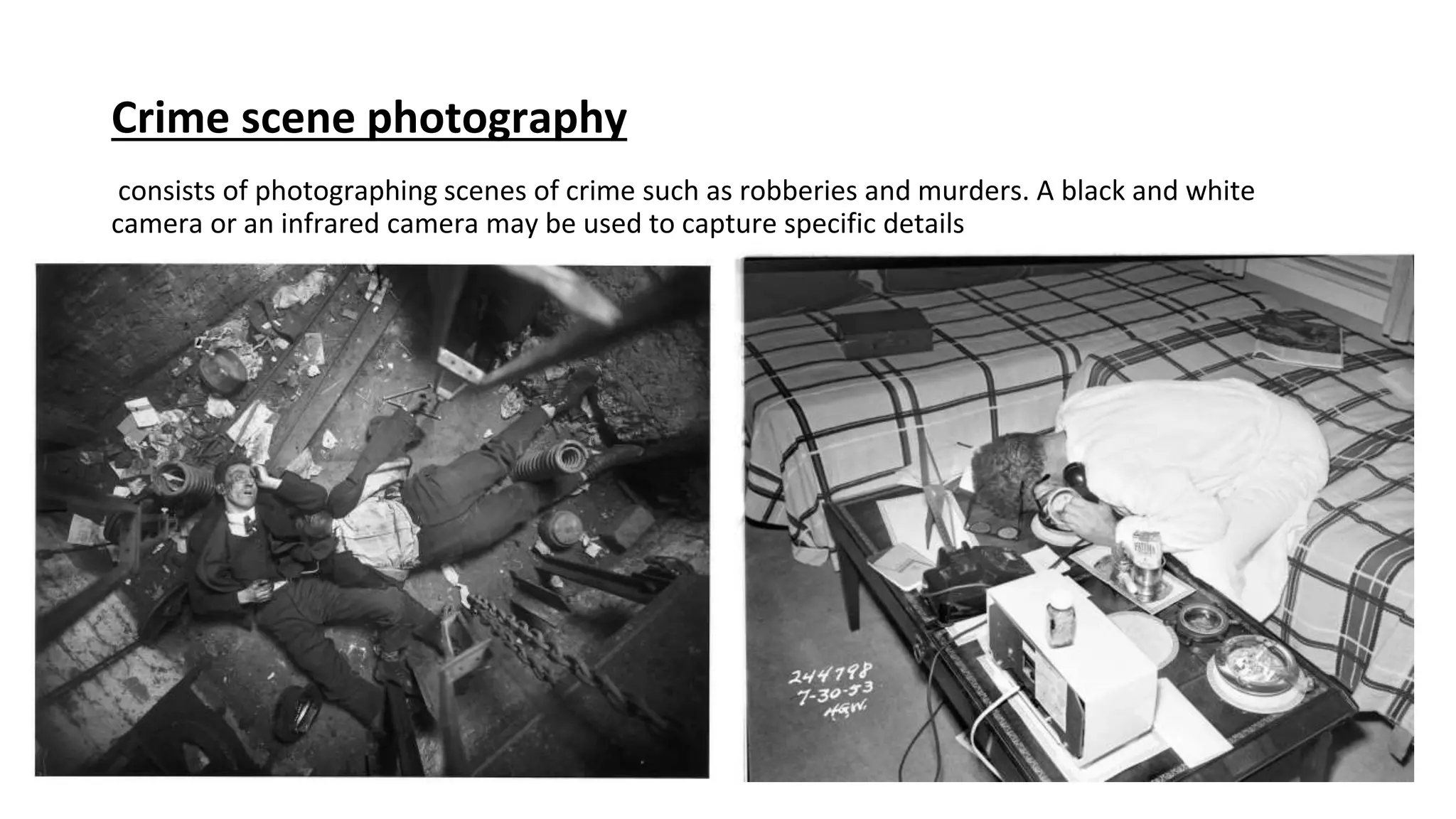
Crime scene photography
consists of photographing scenes of crime such as robberies and murders. A black and white
camera or an infrared camera may be used to capture specific details
Still life photography
usually depicts inanimate subject matter, typically commonplace objects which may be either
natural or man-made. Still life is a broader category for food and some natural photography and
can be used for advertising purposes
Food photography
can be used for editorial, packaging or advertising use. Food photography is similar to still life
photography but requires some special skills
Editorial photography
➢ illustrates a story or idea within the context of a magazine. These are usually assigned by the
magazine and encompass fashion and glamour photography features.
➢ Photojournalism can be considered a subset of editorial photography. Photographs made in this
context are accepted as a documentation of a news story
Portrait photography
➢ Portrait photography or portraiture in photography is a photograph of a person or
group of people that captures the personality of the subject by using effective lighting,
backdrops, and poses.
➢ A portrait picture might be artistic, or it might be clinical, as part of a medical
study. Frequently, portraits are commissioned for special occasions, such as weddings
or school events.
Landscape Photography
Landscape photography shows spaces within the world, sometimes vast and unending, but
other times microscopic. Landscape photographs typically capture the presence
of nature but can also focus on man-made features or disturbances of landscapes.
Wildlife photography
➢ Wildlife photography is a genre of photography concerned with documenting various forms
of wildlife in their natural habitat. It is one of the more challenging forms of photography.
➢ As well as requiring sound technical skills, such as being able to expose correctly, wildlife
photographers generally need good field craft skills.
Paparazzi
➢ It is a form of photojournalism in which the photographer captures candid images of athletes,
celebrities, politicians, and other prominent people
➢ Paparazzi tend to make a living by selling their photographs to media outlets focusing on tabloid
journalism and sensationalism (such as gossip magazines).
Aerial Photography
➢ The images that are captured from above is known as
aerial photography.
➢ French photographer and balloonist, Gaspar Felix
Tournachon, took the first aerial photograph in1858.
➢ He experimented for three years before he could
produce the photograph. He had captured the French
village, Petit-Becetre, from a hot-air balloon, 80 metres
above the ground.
Camera
 A camera is an optical instrument for
recording or capturing images, which may be
stored locally, transmitted to another
location, or both.
 The images may be individual
still photographs or sequences of images
constituting videos or movies. The camera is
a remote sensing device as it senses subjects
without any contact .
 The word camera comes from camera
obscura, which means "dark chamber" and is
the Latin name of the original device for
projecting an image of external reality onto a
flat surface.
Parts of camera
TYPES
OF
CAMERA
FOLDING
CAMERA
VIEW
CAMERA
BROWNIE
BOX
CAMERA
DIGITAL
CAMERA
POLAROID
INSTANCE
CAMERA
A 1966 Canon FT camera with a 135mm
1:3.5 lens
A 2016 Nikon D810

Photography

  • 1.
    PRESENTED BY :AZLEEN KAZI
  • 2.
    INTRODUCTION ➢ Photography isthe science, art, application and practice of creating durable images by recording light or other electromagnetic radiation, either electronically by means of an image sensor, or chemically by means of a light-sensitive material such as photographic film. ➢ Typically, a lens is used to focus the light reflected or emitted from objects into a real image on the light-sensitive surface inside a camera during a timed exposure. ➢ With an electronic image sensor, this produces an electrical charge at each pixel, which is electronically processed and stored in a digital image file for subsequent display or processing. The result with photographic emulsion is an invisible latent image, which is later chemically "developed" into a visible image, either negative or positive depending on the purpose of the photographic material and the method of processing. ➢ A negative image on film is traditionally used to photographically create a positive image on a paper base, known as a print, either by using an enlarger or by contact printing.
  • 3.
    Etymology ➢ The word"photography" was created from the Greek roots φωτός (phōtos), genitive of φῶς (phōs), "light" and γραφή (graphé) "representation by means of lines" or "drawing",together meaning "drawing with light“ ➢ The German newspaper Vossische Zeitung of 25 February 1839 contained an article entitled Photographie, discussing several priority claims - especially Talbot's - regarding Daguerre's claim of invention. The article is the earliest known occurrence of the word in public print. ➢ It was signed "J.M.", believed to have been Berlin astronomer Johann von Maedler. Credit has traditionally been given to Sir John Herschel both for coining the word and for introducing it to the public. His uses of it in private correspondence prior to 25 February 1839 and at his Royal Society lecture on the subject in London on 14 March 1839 have long been amply documented and accepted as settled facts.
  • 4.
    THE FIRST PHOTOGRAPH(1820)  The first photograph or the earliest known surviving photograph was taken by Joseph Nicephore Niepce, in 1826.  The image depicts the view from an upstairs window at Neipce’s estate, Le Gras, In France.  It has been captured with a camera Obscure (pinhole camera).
  • 5.
    The Earliest Camera(1840)  The first camera invented was made by Alexander Wolcott - his camera design was patented on May 8th, 1840.  His inventions made it possible to take candid photographs and does not fade away with time.  He also has the distincton of opening the earliest photography shop – that was known as an Dagurran Parlor.
  • 6.
    FILM PHOTOGRAPHY ➢ Hurterand Driffield began pioneering work on the light sensitivity of photographic emulsions in 1876. Their work enabled the first quantitative measure of film speed to be devised. ➢ The first flexible photographic roll film was marketed by George Eastman in 1885, but this original "film" was actually a coating on a paper base. ➢ As part of the processing, the image-bearing layer was stripped from the paper and transferred to a hardened gelatin support. The first transparent plastic roll film followed in 1889. It was made from highly flammable nitrocellulose ("celluloid"), now usually called "nitrate film”. ➢ Although cellulose acetate or "safety film" had been introduced by Kodak in 1908,[25] at first it found only a few special applications as an alternative to the hazardous nitrate film, which had the advantages of being considerably tougher, slightly more transparent, and cheaper.
  • 7.
    BLACK & WHITE ➢Originally, all photography was monochrome, or black-and-white. Even after color film was readily available, black-and-white photography continued to dominate for decades, due to its lower cost and its "classic" photographic look. ➢ The tones and contrast between light and dark areas define black-and-white photography. ➢ It is important to note that monochromatic pictures are not necessarily composed of pure blacks, whites, and intermediate shades of gray but can involve shades of one particular hue depending on the process. ➢ The cyanotype process, for example, produces an images composed of blue tones. ➢ The albumen print process first used more than 170 years ago, produces brownish tones.
  • 8.
    A photographic darkroom with safe light
  • 9.
    Stereoscopic Photography ➢ Photographs,both monochrome and color, can be captured and displayed through two side-by-side images that emulate human stereoscopic vision. ➢ Stereoscopic photography was the first that captured figures in motion. ➢ While known colloquially as "3-D" photography, the more accurate term is stereoscopy. ➢ Such cameras have long been realized by using film and more recently in digital electronic methods (including cell phone cameras).
  • 10.
    Full-spectrum, ultraviolet andinfrared ➢ Ultraviolet and infrared films have been available for many decades and employed in a variety of photographic avenues since the 1960s. ➢ New technological trends in digital photography have opened a new direction in full spectrum photography, where careful filtering choices across the ultraviolet, visible and infrared lead to new artistic visions. ➢ Modified digital cameras can detect some ultraviolet, all of the visible and much of the near infrared spectrum, as most digital imaging sensors are sensitive from about 350 nm to 1000 nm Infrared FilmingUltraviolet filming
  • 11.
    Light field photography ➢Digital methods of image capture and display processing have enabled the new technology of "light field photography" (also known as synthetic aperture photography). ➢ This process allows focusing at various depths of field to be selected after the photograph has been captured these additional vector attributes can be captured optically through the use of micro lenses at each pixel point within the 2-dimensional image sensor. ➢ Every pixel of the final image is actually a selection from each sub-array located under each micro lens, as identified by a post-image capture focus algorithm.
  • 12.
    Devices other thancameras can be used to record images. Trichome of Arabidopsis thaliana seen via scanning electron microscope. Note that image has been edited by adding colors to clarify structure or to add an aesthetic effect. Heiti Paves from Tallinn University of Technology.
  • 13.
    Commercial Photography ➢ Commercial photographyis probably best defined as any photography for which the photographer is paid for images rather than works of art. ➢ In this light, money could be paid for the subject of the photograph or the photograph itself. ➢ Wholesale, retail, and professional uses of photography would fall under this definition Commercial Photography ADVERTISING CRIME SCENE STILL LIFE FOOD WILDLIFE PORTRAIT PAPARAZZI LANDSCAPE EDITORIAL FASHION & GLAMOUR CONCERT
  • 14.
    Advertising photography photographs madeto illustrate and usually sell a service or product. These images, such as pack shots, are generally done with an advertising agency, design firm or with an in-house corporate design team.
  • 15.
    Fashion and glamourphotography ➢ usually incorporates models and is a form of advertising photography. ➢ Fashion photography, like the work featured in Harper's Bazaar, emphasizes clothes and other products; glamour emphasizes the model and body form. ➢ Glamour photography is popular in advertising and men's magazines.
  • 16.
    Crime scene photography consistsof photographing scenes of crime such as robberies and murders. A black and white camera or an infrared camera may be used to capture specific details
  • 17.
    Still life photography usuallydepicts inanimate subject matter, typically commonplace objects which may be either natural or man-made. Still life is a broader category for food and some natural photography and can be used for advertising purposes
  • 18.
    Food photography can beused for editorial, packaging or advertising use. Food photography is similar to still life photography but requires some special skills
  • 19.
    Editorial photography ➢ illustratesa story or idea within the context of a magazine. These are usually assigned by the magazine and encompass fashion and glamour photography features. ➢ Photojournalism can be considered a subset of editorial photography. Photographs made in this context are accepted as a documentation of a news story
  • 20.
    Portrait photography ➢ Portraitphotography or portraiture in photography is a photograph of a person or group of people that captures the personality of the subject by using effective lighting, backdrops, and poses. ➢ A portrait picture might be artistic, or it might be clinical, as part of a medical study. Frequently, portraits are commissioned for special occasions, such as weddings or school events.
  • 21.
    Landscape Photography Landscape photographyshows spaces within the world, sometimes vast and unending, but other times microscopic. Landscape photographs typically capture the presence of nature but can also focus on man-made features or disturbances of landscapes.
  • 22.
    Wildlife photography ➢ Wildlifephotography is a genre of photography concerned with documenting various forms of wildlife in their natural habitat. It is one of the more challenging forms of photography. ➢ As well as requiring sound technical skills, such as being able to expose correctly, wildlife photographers generally need good field craft skills.
  • 23.
    Paparazzi ➢ It isa form of photojournalism in which the photographer captures candid images of athletes, celebrities, politicians, and other prominent people ➢ Paparazzi tend to make a living by selling their photographs to media outlets focusing on tabloid journalism and sensationalism (such as gossip magazines).
  • 24.
    Aerial Photography ➢ Theimages that are captured from above is known as aerial photography. ➢ French photographer and balloonist, Gaspar Felix Tournachon, took the first aerial photograph in1858. ➢ He experimented for three years before he could produce the photograph. He had captured the French village, Petit-Becetre, from a hot-air balloon, 80 metres above the ground.
  • 25.
    Camera  A camerais an optical instrument for recording or capturing images, which may be stored locally, transmitted to another location, or both.  The images may be individual still photographs or sequences of images constituting videos or movies. The camera is a remote sensing device as it senses subjects without any contact .  The word camera comes from camera obscura, which means "dark chamber" and is the Latin name of the original device for projecting an image of external reality onto a flat surface.
  • 26.
  • 27.
  • 28.
    A 1966 CanonFT camera with a 135mm 1:3.5 lens A 2016 Nikon D810