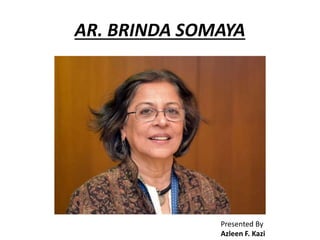
AR. BRINDA SOMAYA
Presented By
Azleen F. Kazi
BIOGRAPHY
1) Brinda Somaya is an Indian Architect.
2) Somaya completed her Bachelor of Architecture
degree from Mumbai University and her Master of
Arts from Smith College in Northampton, MA,
USA.
3)She started her practice in 1975 in Mumbai,
India.
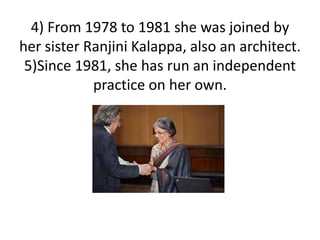
4) From 1978 to 1981 she was joined by
her sister Ranjini Kalappa, also an architect.
5)Since 1981, she has run an independent
practice on her own.
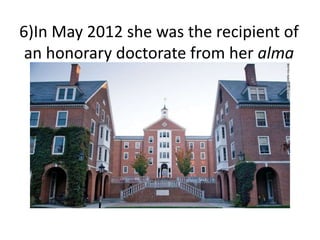
6)In May 2012 she was the recipient of
an honorary doctorate from her alma
mater, Smith College.
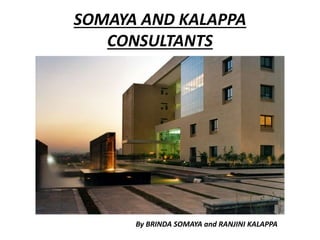
SOMAYA AND KALAPPA
CONSULTANTS
By BRINDA SOMAYA and RANJINI KALAPPA
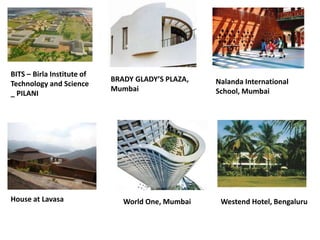
BITS – Birla Institute of
Technology and Science
_ PILANI
BRADY GLADY’S PLAZA,
Mumbai
Nalanda International
School, Mumbai
House at Lavasa World One, Mumbai Westend Hotel, Bengaluru
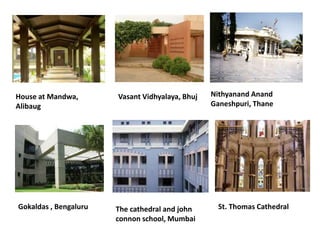
House at Mandwa,
Alibaug
Vasant Vidhyalaya, Bhuj Nithyanand Anand
Ganeshpuri, Thane
Gokaldas , Bengaluru St. Thomas CathedralThe cathedral and john
connon school, Mumbai
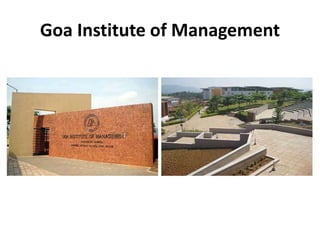
Goa Institute of Management
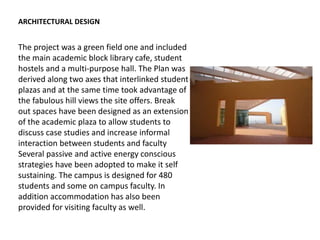
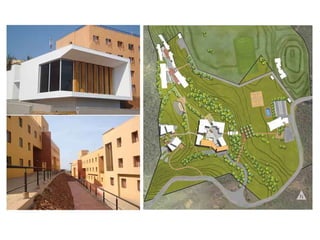
The project was a green field one and included
the main academic block library cafe, student
hostels and a multi-purpose hall. The Plan was
derived along two axes that interlinked student
plazas and at the same time took advantage of
the fabulous hill views the site offers. Break
out spaces have been designed as an extension
of the academic plaza to allow students to
discuss case studies and increase informal
interaction between students and faculty
Several passive and active energy conscious
strategies have been adopted to make it self
sustaining. The campus is designed for 480
students and some on campus faculty. In
addition accommodation has also been
provided for visiting faculty as well.
ARCHITECTURAL DESIGN
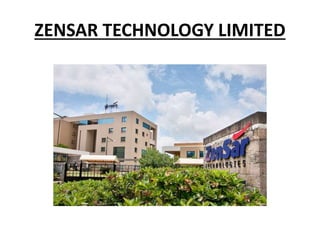
ZENSAR TECHNOLOGY LIMITED
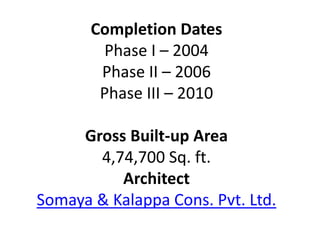
Completion Dates
Phase I – 2004
Phase II – 2006
Phase III – 2010
Gross Built-up Area
4,74,700 Sq. ft.
Architect
Somaya & Kalappa Cons. Pvt. Ltd.
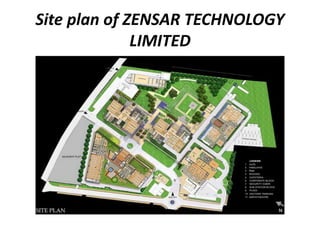
Site plan of ZENSAR TECHNOLOGY
LIMITED
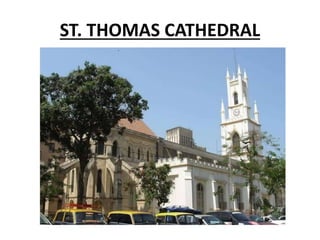
ST. THOMAS CATHEDRAL
Architecture
The building is a nice blend of Classical & Gothic
style of architecture. Church's tall steeple is the
cynosure of many eyes. Though the building has
undergone subsequent changes but most of
these are additions with no or less subtractions.
In this way the original form of the building has
been preserved.
Interior
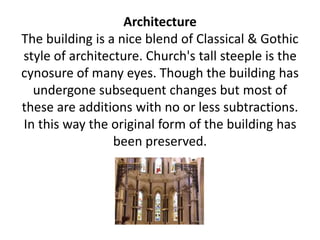
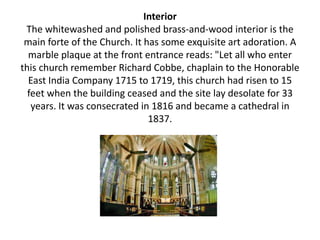
The whitewashed and polished brass-and-wood interior is the
main forte of the Church. It has some exquisite art adoration. A
marble plaque at the front entrance reads: "Let all who enter
this church remember Richard Cobbe, chaplain to the Honorable
East India Company 1715 to 1719, this church had risen to 15
feet when the building ceased and the site lay desolate for 33
years. It was consecrated in 1816 and became a cathedral in
1837.
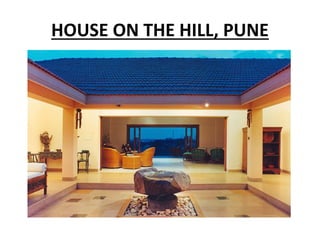
HOUSE ON THE HILL, PUNE
ARCHITECTURE
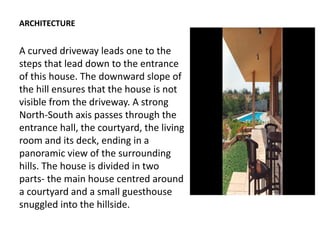
A curved driveway leads one to the
steps that lead down to the entrance
of this house. The downward slope of
the hill ensures that the house is not
visible from the driveway. A strong
North-South axis passes through the
entrance hall, the courtyard, the living
room and its deck, ending in a
panoramic view of the surrounding
hills. The house is divided in two
parts- the main house centred around
a courtyard and a small guesthouse
snuggled into the hillside.
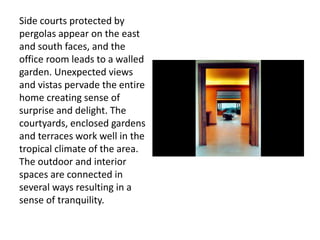
Side courts protected by
pergolas appear on the east
and south faces, and the
office room leads to a walled
garden. Unexpected views
and vistas pervade the entire
home creating sense of
surprise and delight. The
courtyards, enclosed gardens
and terraces work well in the
tropical climate of the area.
The outdoor and interior
spaces are connected in
several ways resulting in a
sense of tranquility.
BRADY GLADY’S PLAZA
ARCHITECTURE
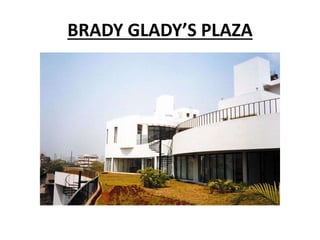
The building was designed to house the
offices and workshops of five different
companies.
To combine varying requirements and
integrate them into a single 6000 sq.m.
buildings was the challenging task.
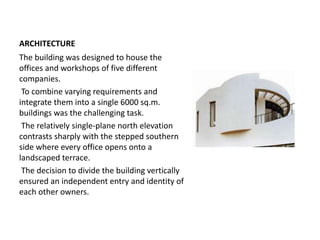
The relatively single-plane north elevation
contrasts sharply with the stepped southern
side where every office opens onto a
landscaped terrace.
The decision to divide the building vertically
ensured an independent entry and identity of
each other owners.
PARLE BISCUIT’S FACTORY,
BANGALORE
ARCHITECTURE
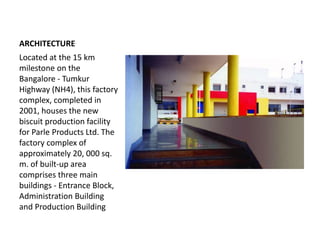
Located at the 15 km
milestone on the
Bangalore - Tumkur
Highway (NH4), this factory
complex, completed in
2001, houses the new
biscuit production facility
for Parle Products Ltd. The
factory complex of
approximately 20, 000 sq.
m. of built-up area
comprises three main
buildings - Entrance Block,
Administration Building
and Production Building
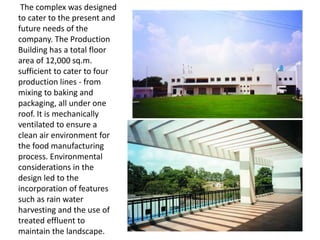
The complex was designed
to cater to the present and
future needs of the
company. The Production
Building has a total floor
area of 12,000 sq.m.
sufficient to cater to four
production lines - from
mixing to baking and
packaging, all under one
roof. It is mechanically
ventilated to ensure a
clean air environment for
the food manufacturing
process. Environmental
considerations in the
design led to the
incorporation of features
such as rain water
harvesting and the use of
treated effluent to
maintain the landscape.
Brinda somaya

Brinda somaya

  • 1.
    AR. BRINDA SOMAYA PresentedBy Azleen F. Kazi
  • 2.
    BIOGRAPHY 1) Brinda Somayais an Indian Architect. 2) Somaya completed her Bachelor of Architecture degree from Mumbai University and her Master of Arts from Smith College in Northampton, MA, USA. 3)She started her practice in 1975 in Mumbai, India.
  • 3.
    4) From 1978to 1981 she was joined by her sister Ranjini Kalappa, also an architect. 5)Since 1981, she has run an independent practice on her own.
  • 4.
    6)In May 2012she was the recipient of an honorary doctorate from her alma mater, Smith College.
  • 5.
    SOMAYA AND KALAPPA CONSULTANTS ByBRINDA SOMAYA and RANJINI KALAPPA
  • 6.
    BITS – BirlaInstitute of Technology and Science _ PILANI BRADY GLADY’S PLAZA, Mumbai Nalanda International School, Mumbai House at Lavasa World One, Mumbai Westend Hotel, Bengaluru
  • 7.
    House at Mandwa, Alibaug VasantVidhyalaya, Bhuj Nithyanand Anand Ganeshpuri, Thane Gokaldas , Bengaluru St. Thomas CathedralThe cathedral and john connon school, Mumbai
  • 8.
    Goa Institute ofManagement
  • 9.
    The project wasa green field one and included the main academic block library cafe, student hostels and a multi-purpose hall. The Plan was derived along two axes that interlinked student plazas and at the same time took advantage of the fabulous hill views the site offers. Break out spaces have been designed as an extension of the academic plaza to allow students to discuss case studies and increase informal interaction between students and faculty Several passive and active energy conscious strategies have been adopted to make it self sustaining. The campus is designed for 480 students and some on campus faculty. In addition accommodation has also been provided for visiting faculty as well. ARCHITECTURAL DESIGN
  • 11.
  • 12.
    Completion Dates Phase I– 2004 Phase II – 2006 Phase III – 2010 Gross Built-up Area 4,74,700 Sq. ft. Architect Somaya & Kalappa Cons. Pvt. Ltd.
  • 13.
    Site plan ofZENSAR TECHNOLOGY LIMITED
  • 14.
  • 15.
    Architecture The building isa nice blend of Classical & Gothic style of architecture. Church's tall steeple is the cynosure of many eyes. Though the building has undergone subsequent changes but most of these are additions with no or less subtractions. In this way the original form of the building has been preserved.
  • 16.
    Interior The whitewashed andpolished brass-and-wood interior is the main forte of the Church. It has some exquisite art adoration. A marble plaque at the front entrance reads: "Let all who enter this church remember Richard Cobbe, chaplain to the Honorable East India Company 1715 to 1719, this church had risen to 15 feet when the building ceased and the site lay desolate for 33 years. It was consecrated in 1816 and became a cathedral in 1837.
  • 17.
    HOUSE ON THEHILL, PUNE
  • 18.
    ARCHITECTURE A curved drivewayleads one to the steps that lead down to the entrance of this house. The downward slope of the hill ensures that the house is not visible from the driveway. A strong North-South axis passes through the entrance hall, the courtyard, the living room and its deck, ending in a panoramic view of the surrounding hills. The house is divided in two parts- the main house centred around a courtyard and a small guesthouse snuggled into the hillside.
  • 19.
    Side courts protectedby pergolas appear on the east and south faces, and the office room leads to a walled garden. Unexpected views and vistas pervade the entire home creating sense of surprise and delight. The courtyards, enclosed gardens and terraces work well in the tropical climate of the area. The outdoor and interior spaces are connected in several ways resulting in a sense of tranquility.
  • 20.
  • 21.
    ARCHITECTURE The building wasdesigned to house the offices and workshops of five different companies. To combine varying requirements and integrate them into a single 6000 sq.m. buildings was the challenging task. The relatively single-plane north elevation contrasts sharply with the stepped southern side where every office opens onto a landscaped terrace. The decision to divide the building vertically ensured an independent entry and identity of each other owners.
  • 22.
  • 23.
    ARCHITECTURE Located at the15 km milestone on the Bangalore - Tumkur Highway (NH4), this factory complex, completed in 2001, houses the new biscuit production facility for Parle Products Ltd. The factory complex of approximately 20, 000 sq. m. of built-up area comprises three main buildings - Entrance Block, Administration Building and Production Building
  • 24.
    The complex wasdesigned to cater to the present and future needs of the company. The Production Building has a total floor area of 12,000 sq.m. sufficient to cater to four production lines - from mixing to baking and packaging, all under one roof. It is mechanically ventilated to ensure a clean air environment for the food manufacturing process. Environmental considerations in the design led to the incorporation of features such as rain water harvesting and the use of treated effluent to maintain the landscape.