PSYCHOLOGICAL
STRUCTURES BY
AR. PETER ZUMTHOR
Presented by
- Azleen Kazi
BIOGRAPHY
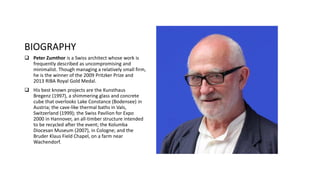
 Peter Zumthor is a Swiss architect whose work is
frequently described as uncompromising and
minimalist. Though managing a relatively small firm,
he is the winner of the 2009 Pritzker Prize and
2013 RIBA Royal Gold Medal.
 His best known projects are the Kunsthaus
Bregenz (1997), a shimmering glass and concrete
cube that overlooks Lake Constance (Bodensee) in
Austria; the cave-like thermal baths in Vals,
Switzerland (1999); the Swiss Pavilion for Expo
2000 in Hannover, an all-timber structure intended
to be recycled after the event; the Kolumba
Diocesan Museum (2007), in Cologne; and the
Bruder Klaus Field Chapel, on a farm near
Wachendorf.
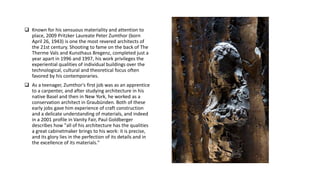
 Known for his sensuous materiality and attention to
place, 2009 Pritzker Laureate Peter Zumthor (born
April 26, 1943) is one the most revered architects of
the 21st century. Shooting to fame on the back of The
Therme Vals and Kunsthaus Bregenz, completed just a
year apart in 1996 and 1997, his work privileges the
experiential qualities of individual buildings over the
technological, cultural and theoretical focus often
favored by his contemporaries.
 As a teenager, Zumthor's first job was as an apprentice
to a carpenter, and after studying architecture in his
native Basel and then in New York, he worked as a
conservation architect in Graubünden. Both of these
early jobs gave him experience of craft construction
and a delicate understanding of materials, and indeed
in a 2001 profile in Vanity Fair, Paul Goldberger
describes how "all of his architecture has the qualities
a great cabinetmaker brings to his work: it is precise,
and its glory lies in the perfection of its details and in
the excellence of its materials."
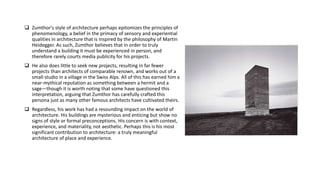
 Zumthor's style of architecture perhaps epitomizes the principles of
phenomenology, a belief in the primacy of sensory and experiential
qualities in architecture that is inspired by the philosophy of Martin
Heidegger. As such, Zumthor believes that in order to truly
understand a building it must be experienced in person, and
therefore rarely courts media publicity for his projects.
 He also does little to seek new projects, resulting in far fewer
projects than architects of comparable renown, and works out of a
small studio in a village in the Swiss Alps. All of this has earned him a
near-mythical reputation as something between a hermit and a
sage—though it is worth noting that some have questioned this
interpretation, arguing that Zumthor has carefully crafted this
persona just as many other famous architects have cultivated theirs.
 Regardless, his work has had a resounding impact on the world of
architecture. His buildings are mysterious and enticing but show no
signs of style or formal preconceptions. His concern is with context,
experience, and materiality, not aesthetic. Perhaps this is his most
significant contribution to architecture: a truly meaningful
architecture of place and experience.
CAREER
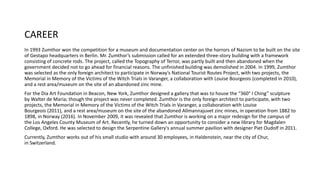
In 1993 Zumthor won the competition for a museum and documentation center on the horrors of Nazism to be built on the site
of Gestapo headquarters in Berlin. Mr. Zumthor’s submission called for an extended three-story building with a framework
consisting of concrete rods. The project, called the Topography of Terror, was partly built and then abandoned when the
government decided not to go ahead for financial reasons. The unfinished building was demolished in 2004. In 1999, Zumthor
was selected as the only foreign architect to participate in Norway’s National Tourist Routes Project, with two projects, the
Memorial in Memory of the Victims of the Witch Trials in Varanger, a collaboration with Louise Bourgeois (completed in 2010),
and a rest area/museum on the site of an abandoned zinc mine.
For the Dia Art Foundation in Beacon, New York, Zumthor designed a gallery that was to house the “360° I Ching” sculpture
by Walter de Maria; though the project was never completed. Zumthor is the only foreign architect to participate, with two
projects, the Memorial in Memory of the Victims of the Witch Trials in Varanger, a collaboration with Louise
Bourgeois (2011), and a rest area/museum on the site of the abandoned Allmannajuvet zinc mines, in operation from 1882 to
1898, in Norway (2016). In November 2009, it was revealed that Zumthor is working on a major redesign for the campus of
the Los Angeles County Museum of Art. Recently, he turned down an opportunity to consider a new library for Magdalen
College, Oxford. He was selected to design the Serpentine Gallery's annual summer pavilion with designer Piet Oudolf in 2011.
Currently, Zumthor works out of his small studio with around 30 employees, in Haldenstein, near the city of Chur,
in Switzerland.
Peter Zumthor: Seven Personal Observations on Presence In
Architecture
1: Spring 1951
“[It] was a beautiful day. There was no school. It must have
been early spring - I could smell it [...] I remember myself
running as a boy, and I had this lightness and elegance
which I don’t have anymore.”
Zumthor, born the son of a cabinet-maker in 1943, began by recounting a seminal
experience from his childhood: “I didn’t know it then, but as an old man now,
looking back, I realize this was my first experience of presence.” As he defines it:
“Presence is like a gap in the flow of history, where all of [a] sudden it is not past
and not future.”
How can presence be translated or achieved in architecture? This question is a key
motive in Zumthor’s atelier in the Swiss region of Graubünden. Founded in 1979,
his home-based studio is located in the valley of the Rhein, where many of his
seminal works - ranging from small-scale projects, such as home renovations and
village chapels, to large-scale, monumental museums - have been built. Zumthor
purposefully maintains his Atelier in this humble, remote location in order to
ensure his experience of “presence”: “Every once in a while, I get this feeling of
presence. Sometimes in me, but definitely in the mountains. If I look at these
rocks, those stones, I get a feeling of presence, of space, of material.”
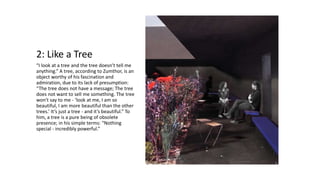
2: Like a Tree
“I look at a tree and the tree doesn’t tell me
anything.” A tree, according to Zumthor, is an
object worthy of his fascination and
admiration, due to its lack of presumption:
“The tree does not have a message; The tree
does not want to sell me something. The tree
won't say to me - ‘look at me, I am so
beautiful, I am more beautiful than the other
trees.’ It’s just a tree - and it’s beautiful.” To
him, a tree is a pure being of obsolete
presence; in his simple terms: “Nothing
special - incredibly powerful.”
3. Constructing presence in architecture: First attempt - Pure Construction
Zumthor recalls a 1993 competition to design a museum and documentation
center of the Holocaust, The Topography of Terror Museum, located in the former
Gestapo headquarters in Berlin. He describes the difficulties of creating
architecture in such a historically charged site: “All that had happened
there came into my mind. [It was] a center for destruction [… ] I
can not do anything here. [...] How can you find the form?”
Rather than making a bold, controversial statement, as many of his fellow
architects would do, Zumthor instead decides to translate his inability to react to
the site by withholding architectural metaphors and symbolism. He decides to
design a building with “no meaning, no comment” by inventing a building of pure
construction.
Although Zumthor’s design was chosen as the winner of the competition,
construction was halted in 1994 and the building’s bare, concrete core stood
vacant for a decade. When funding was regained, political shifts called for a new
architectural competition, which led to the destruction of Zumthor’s unfinished
museum.Though the building was demolished, the idea for a construction-
inspired memorial site was not.
3. Constructing presence in
architecture: First attempt - Pure
Construction
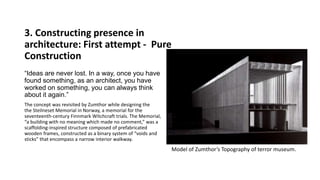
“Ideas are never lost. In a way, once you have
found something, as an architect, you have
worked on something, you can always think
about it again.”
The concept was revisited by Zumthor while designing the
the Steilneset Memorial in Norway, a memorial for the
seventeenth-century Finnmark Witchcraft trials. The Memorial,
“a building with no meaning which made no comment,” was a
scaffolding-inspired structure composed of prefabricated
wooden frames, constructed as a binary system of “voids and
sticks” that encompass a narrow interior walkway.
Model of Zumthor’s Topography of terror museum.
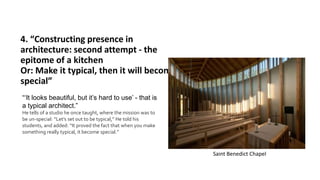
4. “Constructing presence in
architecture: second attempt - the
epitome of a kitchen
Or: Make it typical, then it will become
special”
“‘It looks beautiful, but it’s hard to use’ - that is
a typical architect.”
He tells of a studio he once taught, where the mission was to
be un-special: “Let’s set out to be typical,” He told his
students, and added: “It proved the fact that when you make
something really typical, it become special.”
Saint Benedict Chapel
5. Constructing presence in architecture: Third attempt - Form
follows anything
Or: The body of architecture
“For me, architecture is not primarily about form, not at
all.”
“Form FollowsAnything” was a title of a symposium
Zumthor attended some twenty years ago. “I think that’s a
great title. Architecture can be used to do anything.The
form is open.”
As Zumthor presents the next slide, the audience gasps - it is an
interior shot of what is perhaps his most celebrated and praised
project to date, theTherme Vals
“We actually never talk about form in the office.
we talk about construction, we can talk about
science, and we talk about feelings [...] From the
beginning the materials are there, right next to
the desk […] when we put materials together, a
reaction starts [...] this is about materials, this is
about creating an atmosphere, and this is about
creating architecture.”
In the case of theVals, the materials used were a mixed of locally
quarried stones along with Italian stones: “trust your materials.”
Following the prolonged seven years design process of the Vals, he
could gladly say: “I found out that stone and water have a love
relationship.”
Thermae Vals
6. Constructing presence in architecture: Fourth attempt - The house
without a form
While teaching at Harvard, Zumthor tasked his
students with designing “The house without a
form,” for someone whom they share a close,
emotional relationship with. They were to present
the site with no plans, sections or models. The
objective was to inspire a new sort of space,
described by sounds, smells and verbal description:
“When I look at this kind of house
without a form, what interests me the
most is emotional space. If a space
doesn’t get to me, then I am not
interested [...] I want to create emotional
spaces which get to you.”
Bruder Klaus Field chapel
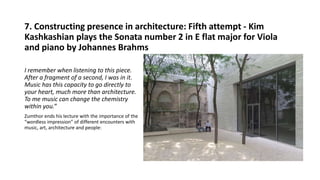
7. Constructing presence in architecture: Fifth attempt - Kim
Kashkashian plays the Sonata number 2 in E flat major for Viola
and piano by Johannes Brahms
I remember when listening to this piece.
After a fragment of a second, I was in it.
Music has this capacity to go directly to
your heart, much more than architecture.
To me music can change the chemistry
within you.”
Zumthor ends his lecture with the importance of the
“wordless impression” of different encounters with
music, art, architecture and people:
In a fragment of a second you can understand:
Things you know, things you don’t know, things
you don’t know that you don’t know, conscious,
unconscious, things which in a fragrant of a
second you can react to: we can all imagine why
this capacity was given to us as human beings - I
guess to survive. Architecture to me has the
same kind of capacity. It takes longer to capture,
but the essence to me is the same. I call this
atmosphere. When you experience a building and
it gets to you. It sticks in your memory and your
feelings. I guess thats what I am trying to do.”
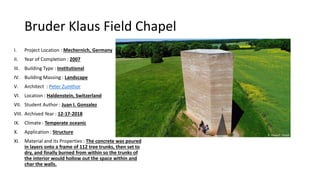
Bruder Klaus Field Chapel
I. Project Location : Mechernich, Germany
II. Year of Completion : 2007
III. Building Type : Institutional
IV. Building Massing : Landscape
V. Architect : Peter Zumthor
VI. Location : Haldenstein, Switzerland
VII. Student Author : Juan I. Gonzalez
VIII. Archived Year : 12-17-2018
IX. Climate : Temperate oceanic
X. Application : Structure
XI. Material and its Properties : The concrete was poured
in layers onto a frame of 112 tree trunks, then set to
dry, and finally burned from within so the trunks of
the interior would hollow out the space within and
char the walls.
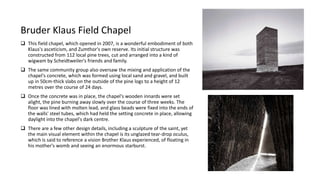
Bruder Klaus Field Chapel
 This field chapel, which opened in 2007, is a wonderful embodiment of both
Klaus's asceticism, and Zumthor's own reserve. Its initial structure was
constructed from 112 local pine trees, cut and arranged into a kind of
wigwam by Scheidtweiler's friends and family.
 The same community group also oversaw the mixing and application of the
chapel's concrete, which was formed using local sand and gravel, and built
up in 50cm-thick slabs on the outside of the pine logs to a height of 12
metres over the course of 24 days.
 Once the concrete was in place, the chapel's wooden innards were set
alight, the pine burning away slowly over the course of three weeks. The
floor was lined with molten lead, and glass beads were fixed into the ends of
the walls' steel tubes, which had held the setting concrete in place, allowing
daylight into the chapel's dark centre.
 There are a few other design details, including a sculpture of the saint, yet
the main visual element within the chapel is its unglazed tear-drop oculus,
which is said to reference a vision Brother Klaus experienced, of floating in
his mother's womb and seeing an enormous starburst.
Bruder Klaus Field
Chapel
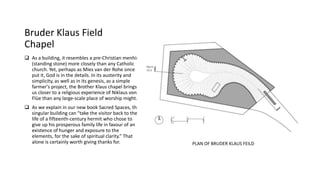
 As a building, it resembles a pre-Christian menhir
(standing stone) more closely than any Catholic
church. Yet, perhaps as Mies van der Rohe once
put it, God is in the details. In its austerity and
simplicity, as well as in its genesis, as a simple
farmer's project, the Brother Klaus chapel brings
us closer to a religious experience of Niklaus von
Flüe than any large-scale place of worship might.
 As we explain in our new book Sacred Spaces, this
singular building can “take the visitor back to the
life of a fifteenth-century hermit who chose to
give up his prosperous family life in favour of an
existence of hunger and exposure to the
elements, for the sake of spiritual clarity.” That
alone is certainly worth giving thanks for. PLAN OF BRUDER KLAUS FEILD
Bruder Klaus Field Chapel
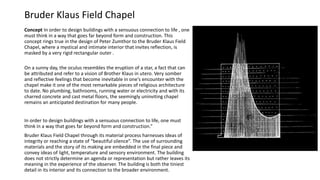
Concept In order to design buildings with a sensuous connection to life , one
must think in a way that goes far beyond form and construction. This
concept rings true in the design of Peter Zumthor to the Bruder Klaus Field
Chapel, where a mystical and intimate interior that invites reflection, is
masked by a very rigid rectangular outer .
On a sunny day, the oculus resembles the eruption of a star, a fact that can
be attributed and refer to a vision of Brother Klaus in utero. Very somber
and reflective feelings that become inevitable in one's encounter with the
chapel make it one of the most remarkable pieces of religious architecture
to date. No plumbing, bathrooms, running water or electricity and with its
charred concrete and cast metal floors, the seemingly uninviting chapel
remains an anticipated destination for many people.
In order to design buildings with a sensuous connection to life, one must
think in a way that goes far beyond form and construction.”
Bruder Klaus Field Chapel through its material process harnesses ideas of
integrity or reaching a state of “beautiful silence”. The use of surrounding
materials and the story of its making are embedded in the final piece and
convey ideas of light, temperature and sensory environment. The building
does not strictly determine an agenda or representation but rather leaves its
meaning in the experience of the observer. The building is both the tiniest
detail in its interior and its connection to the broader environment.
SOURCES
https://www.archdaily.com/19389/peter-zumthor-pritzker-2009-laureate/
https://www.scirp.org/html/2-1250213_95912.htm
https://www.dezeen.com/tag/peter-zumthor/
https://www.archdaily.com/364856/happy-70th-birthday-peter-zumthor
https://etd.ohiolink.edu/!etd.send_file?accession=ucin1112128327&disposition=inline
https://www.scirp.org/html/2-1250213_95912.htm
https://archello.com/project/bruder-klaus-field-chapel
https://uk.phaidon.com/agenda/architecture/articles/2015/february/04/sacred-stories-bruder-klaus-field-chapel/

Peter zumthor

  • 1.
    PSYCHOLOGICAL STRUCTURES BY AR. PETERZUMTHOR Presented by - Azleen Kazi
  • 2.
    BIOGRAPHY  Peter Zumthoris a Swiss architect whose work is frequently described as uncompromising and minimalist. Though managing a relatively small firm, he is the winner of the 2009 Pritzker Prize and 2013 RIBA Royal Gold Medal.  His best known projects are the Kunsthaus Bregenz (1997), a shimmering glass and concrete cube that overlooks Lake Constance (Bodensee) in Austria; the cave-like thermal baths in Vals, Switzerland (1999); the Swiss Pavilion for Expo 2000 in Hannover, an all-timber structure intended to be recycled after the event; the Kolumba Diocesan Museum (2007), in Cologne; and the Bruder Klaus Field Chapel, on a farm near Wachendorf.
  • 3.
     Known forhis sensuous materiality and attention to place, 2009 Pritzker Laureate Peter Zumthor (born April 26, 1943) is one the most revered architects of the 21st century. Shooting to fame on the back of The Therme Vals and Kunsthaus Bregenz, completed just a year apart in 1996 and 1997, his work privileges the experiential qualities of individual buildings over the technological, cultural and theoretical focus often favored by his contemporaries.  As a teenager, Zumthor's first job was as an apprentice to a carpenter, and after studying architecture in his native Basel and then in New York, he worked as a conservation architect in Graubünden. Both of these early jobs gave him experience of craft construction and a delicate understanding of materials, and indeed in a 2001 profile in Vanity Fair, Paul Goldberger describes how "all of his architecture has the qualities a great cabinetmaker brings to his work: it is precise, and its glory lies in the perfection of its details and in the excellence of its materials."
  • 4.
     Zumthor's styleof architecture perhaps epitomizes the principles of phenomenology, a belief in the primacy of sensory and experiential qualities in architecture that is inspired by the philosophy of Martin Heidegger. As such, Zumthor believes that in order to truly understand a building it must be experienced in person, and therefore rarely courts media publicity for his projects.  He also does little to seek new projects, resulting in far fewer projects than architects of comparable renown, and works out of a small studio in a village in the Swiss Alps. All of this has earned him a near-mythical reputation as something between a hermit and a sage—though it is worth noting that some have questioned this interpretation, arguing that Zumthor has carefully crafted this persona just as many other famous architects have cultivated theirs.  Regardless, his work has had a resounding impact on the world of architecture. His buildings are mysterious and enticing but show no signs of style or formal preconceptions. His concern is with context, experience, and materiality, not aesthetic. Perhaps this is his most significant contribution to architecture: a truly meaningful architecture of place and experience.
  • 5.
    CAREER In 1993 Zumthorwon the competition for a museum and documentation center on the horrors of Nazism to be built on the site of Gestapo headquarters in Berlin. Mr. Zumthor’s submission called for an extended three-story building with a framework consisting of concrete rods. The project, called the Topography of Terror, was partly built and then abandoned when the government decided not to go ahead for financial reasons. The unfinished building was demolished in 2004. In 1999, Zumthor was selected as the only foreign architect to participate in Norway’s National Tourist Routes Project, with two projects, the Memorial in Memory of the Victims of the Witch Trials in Varanger, a collaboration with Louise Bourgeois (completed in 2010), and a rest area/museum on the site of an abandoned zinc mine. For the Dia Art Foundation in Beacon, New York, Zumthor designed a gallery that was to house the “360° I Ching” sculpture by Walter de Maria; though the project was never completed. Zumthor is the only foreign architect to participate, with two projects, the Memorial in Memory of the Victims of the Witch Trials in Varanger, a collaboration with Louise Bourgeois (2011), and a rest area/museum on the site of the abandoned Allmannajuvet zinc mines, in operation from 1882 to 1898, in Norway (2016). In November 2009, it was revealed that Zumthor is working on a major redesign for the campus of the Los Angeles County Museum of Art. Recently, he turned down an opportunity to consider a new library for Magdalen College, Oxford. He was selected to design the Serpentine Gallery's annual summer pavilion with designer Piet Oudolf in 2011. Currently, Zumthor works out of his small studio with around 30 employees, in Haldenstein, near the city of Chur, in Switzerland.
  • 6.
    Peter Zumthor: SevenPersonal Observations on Presence In Architecture 1: Spring 1951 “[It] was a beautiful day. There was no school. It must have been early spring - I could smell it [...] I remember myself running as a boy, and I had this lightness and elegance which I don’t have anymore.” Zumthor, born the son of a cabinet-maker in 1943, began by recounting a seminal experience from his childhood: “I didn’t know it then, but as an old man now, looking back, I realize this was my first experience of presence.” As he defines it: “Presence is like a gap in the flow of history, where all of [a] sudden it is not past and not future.” How can presence be translated or achieved in architecture? This question is a key motive in Zumthor’s atelier in the Swiss region of Graubünden. Founded in 1979, his home-based studio is located in the valley of the Rhein, where many of his seminal works - ranging from small-scale projects, such as home renovations and village chapels, to large-scale, monumental museums - have been built. Zumthor purposefully maintains his Atelier in this humble, remote location in order to ensure his experience of “presence”: “Every once in a while, I get this feeling of presence. Sometimes in me, but definitely in the mountains. If I look at these rocks, those stones, I get a feeling of presence, of space, of material.”
  • 7.
    2: Like aTree “I look at a tree and the tree doesn’t tell me anything.” A tree, according to Zumthor, is an object worthy of his fascination and admiration, due to its lack of presumption: “The tree does not have a message; The tree does not want to sell me something. The tree won't say to me - ‘look at me, I am so beautiful, I am more beautiful than the other trees.’ It’s just a tree - and it’s beautiful.” To him, a tree is a pure being of obsolete presence; in his simple terms: “Nothing special - incredibly powerful.”
  • 8.
    3. Constructing presencein architecture: First attempt - Pure Construction Zumthor recalls a 1993 competition to design a museum and documentation center of the Holocaust, The Topography of Terror Museum, located in the former Gestapo headquarters in Berlin. He describes the difficulties of creating architecture in such a historically charged site: “All that had happened there came into my mind. [It was] a center for destruction [… ] I can not do anything here. [...] How can you find the form?” Rather than making a bold, controversial statement, as many of his fellow architects would do, Zumthor instead decides to translate his inability to react to the site by withholding architectural metaphors and symbolism. He decides to design a building with “no meaning, no comment” by inventing a building of pure construction. Although Zumthor’s design was chosen as the winner of the competition, construction was halted in 1994 and the building’s bare, concrete core stood vacant for a decade. When funding was regained, political shifts called for a new architectural competition, which led to the destruction of Zumthor’s unfinished museum.Though the building was demolished, the idea for a construction- inspired memorial site was not.
  • 9.
    3. Constructing presencein architecture: First attempt - Pure Construction “Ideas are never lost. In a way, once you have found something, as an architect, you have worked on something, you can always think about it again.” The concept was revisited by Zumthor while designing the the Steilneset Memorial in Norway, a memorial for the seventeenth-century Finnmark Witchcraft trials. The Memorial, “a building with no meaning which made no comment,” was a scaffolding-inspired structure composed of prefabricated wooden frames, constructed as a binary system of “voids and sticks” that encompass a narrow interior walkway. Model of Zumthor’s Topography of terror museum.
  • 10.
    4. “Constructing presencein architecture: second attempt - the epitome of a kitchen Or: Make it typical, then it will become special” “‘It looks beautiful, but it’s hard to use’ - that is a typical architect.” He tells of a studio he once taught, where the mission was to be un-special: “Let’s set out to be typical,” He told his students, and added: “It proved the fact that when you make something really typical, it become special.” Saint Benedict Chapel
  • 11.
    5. Constructing presencein architecture: Third attempt - Form follows anything Or: The body of architecture “For me, architecture is not primarily about form, not at all.” “Form FollowsAnything” was a title of a symposium Zumthor attended some twenty years ago. “I think that’s a great title. Architecture can be used to do anything.The form is open.” As Zumthor presents the next slide, the audience gasps - it is an interior shot of what is perhaps his most celebrated and praised project to date, theTherme Vals “We actually never talk about form in the office. we talk about construction, we can talk about science, and we talk about feelings [...] From the beginning the materials are there, right next to the desk […] when we put materials together, a reaction starts [...] this is about materials, this is about creating an atmosphere, and this is about creating architecture.” In the case of theVals, the materials used were a mixed of locally quarried stones along with Italian stones: “trust your materials.” Following the prolonged seven years design process of the Vals, he could gladly say: “I found out that stone and water have a love relationship.” Thermae Vals
  • 12.
    6. Constructing presencein architecture: Fourth attempt - The house without a form While teaching at Harvard, Zumthor tasked his students with designing “The house without a form,” for someone whom they share a close, emotional relationship with. They were to present the site with no plans, sections or models. The objective was to inspire a new sort of space, described by sounds, smells and verbal description: “When I look at this kind of house without a form, what interests me the most is emotional space. If a space doesn’t get to me, then I am not interested [...] I want to create emotional spaces which get to you.” Bruder Klaus Field chapel
  • 13.
    7. Constructing presencein architecture: Fifth attempt - Kim Kashkashian plays the Sonata number 2 in E flat major for Viola and piano by Johannes Brahms I remember when listening to this piece. After a fragment of a second, I was in it. Music has this capacity to go directly to your heart, much more than architecture. To me music can change the chemistry within you.” Zumthor ends his lecture with the importance of the “wordless impression” of different encounters with music, art, architecture and people:
  • 14.
    In a fragmentof a second you can understand: Things you know, things you don’t know, things you don’t know that you don’t know, conscious, unconscious, things which in a fragrant of a second you can react to: we can all imagine why this capacity was given to us as human beings - I guess to survive. Architecture to me has the same kind of capacity. It takes longer to capture, but the essence to me is the same. I call this atmosphere. When you experience a building and it gets to you. It sticks in your memory and your feelings. I guess thats what I am trying to do.”
  • 15.
    Bruder Klaus FieldChapel I. Project Location : Mechernich, Germany II. Year of Completion : 2007 III. Building Type : Institutional IV. Building Massing : Landscape V. Architect : Peter Zumthor VI. Location : Haldenstein, Switzerland VII. Student Author : Juan I. Gonzalez VIII. Archived Year : 12-17-2018 IX. Climate : Temperate oceanic X. Application : Structure XI. Material and its Properties : The concrete was poured in layers onto a frame of 112 tree trunks, then set to dry, and finally burned from within so the trunks of the interior would hollow out the space within and char the walls.
  • 16.
    Bruder Klaus FieldChapel  This field chapel, which opened in 2007, is a wonderful embodiment of both Klaus's asceticism, and Zumthor's own reserve. Its initial structure was constructed from 112 local pine trees, cut and arranged into a kind of wigwam by Scheidtweiler's friends and family.  The same community group also oversaw the mixing and application of the chapel's concrete, which was formed using local sand and gravel, and built up in 50cm-thick slabs on the outside of the pine logs to a height of 12 metres over the course of 24 days.  Once the concrete was in place, the chapel's wooden innards were set alight, the pine burning away slowly over the course of three weeks. The floor was lined with molten lead, and glass beads were fixed into the ends of the walls' steel tubes, which had held the setting concrete in place, allowing daylight into the chapel's dark centre.  There are a few other design details, including a sculpture of the saint, yet the main visual element within the chapel is its unglazed tear-drop oculus, which is said to reference a vision Brother Klaus experienced, of floating in his mother's womb and seeing an enormous starburst.
  • 17.
    Bruder Klaus Field Chapel As a building, it resembles a pre-Christian menhir (standing stone) more closely than any Catholic church. Yet, perhaps as Mies van der Rohe once put it, God is in the details. In its austerity and simplicity, as well as in its genesis, as a simple farmer's project, the Brother Klaus chapel brings us closer to a religious experience of Niklaus von Flüe than any large-scale place of worship might.  As we explain in our new book Sacred Spaces, this singular building can “take the visitor back to the life of a fifteenth-century hermit who chose to give up his prosperous family life in favour of an existence of hunger and exposure to the elements, for the sake of spiritual clarity.” That alone is certainly worth giving thanks for. PLAN OF BRUDER KLAUS FEILD
  • 18.
    Bruder Klaus FieldChapel Concept In order to design buildings with a sensuous connection to life , one must think in a way that goes far beyond form and construction. This concept rings true in the design of Peter Zumthor to the Bruder Klaus Field Chapel, where a mystical and intimate interior that invites reflection, is masked by a very rigid rectangular outer . On a sunny day, the oculus resembles the eruption of a star, a fact that can be attributed and refer to a vision of Brother Klaus in utero. Very somber and reflective feelings that become inevitable in one's encounter with the chapel make it one of the most remarkable pieces of religious architecture to date. No plumbing, bathrooms, running water or electricity and with its charred concrete and cast metal floors, the seemingly uninviting chapel remains an anticipated destination for many people. In order to design buildings with a sensuous connection to life, one must think in a way that goes far beyond form and construction.” Bruder Klaus Field Chapel through its material process harnesses ideas of integrity or reaching a state of “beautiful silence”. The use of surrounding materials and the story of its making are embedded in the final piece and convey ideas of light, temperature and sensory environment. The building does not strictly determine an agenda or representation but rather leaves its meaning in the experience of the observer. The building is both the tiniest detail in its interior and its connection to the broader environment.
  • 19.