History of Photography 
By Haydn Hamilton
What is Photography? 
• Photography is an art format in which pictures 
are taken of a specific area of interest depending 
on the artists style. 
• Can differ from 
• Glamorization 
• Space 
• Urban 
• Fantasy 
• Architecture
Photography uses 
• This format of art was used for keeping 
memories. As they are a capture of a specific 
moment in history. 
• This can differ from person family photos to 
historical events such as buildings being made or 
historical disputes. 
• Dr. Wendle Homes “A mirror with memory.”
Photography Vs Art 
• 20 centaury artists have argued that photography is not a 
direct experience as there is an editing process. Where as a 
painters accuracy is purely based on skill for any sort of 
picture. This could be portrait or landscape. 
• It is believed that photography creates a physically imprint 
of an accurate representation. However a painters is merely 
an impression. 
• However it is also believed that the invention of 
photography made artists see the world in a more abstract 
way. It was a way to deconstruct the idea of realism in art 
itself by making objects look unrealistic.
Giphante 
• A book written a man with an amazing imagination. His 
name was De La Rouche. The premise of his book was 
that pictures would appear onto a canvas once a 
strange liquid substance was coated onto it. Once the 
substance was left to dry in the dark images from the 
surrounding environment would stick to the canvas to 
create a photo. 
• This idea was written about in the 18th century nearly 
two hundred years before photography was even 
considered to be created.
Greek Roots 
φωτός (photos) and γραφή (graphy) 
meaning lines or drawing. 
• This word was first said by a man by the name 
of John F.W. Herschel in 1839. 
• The idea of recording images by the action of 
light.
The Camera Obscura 
• This device was created out of a simple “Pin-hole 
camera”. Which was used perhaps a 1000 years 
ago. 
• The device was a way in which to project an 
image of something onto a canvas so it could be 
traced. It was first used as away to look at the 
eclipse safely. 
• The use of light created a much brighter image. 
• There is speculation that Vermeer used a camera 
obscura for his paintings
The first ever photograph 
• Photography as a useable format was first 
implemented in the 1820s. With the 
development of chemical photography. 
• The first image was taken by the French 
inventor Nicéphore Niépce in 1826. 
• However the image took 8 hours to expose.
Daguerreotypes 
• Louis Daguerre the inventor of the Daguerreotype experimented 
with chemicals and compounds until he discovered that a silver 
substance mixed with chalk makes an effect to darken images when 
exposed to light creating a black and white effect. 
• The silver was coted onto a copper plate which later had the chalk 
added to it. 
• The exposure time on this was only half hour which is a giant 
improvement to before. 
• This format created a very fine detailed 
photos. 
Although this format was a good accurate piece of work the photo was 
a one and only original. If the photo needed to be copied two cameras 
would have been set up side by side.
Calotype 
• Invented by Hennery William Fox. 
• the calotype negative provided the first practical 
method of producing prints on paper from a 
camera exposure. 
• The earliest paper negative we know of was 
produced in August 1835. 
• The paper negative was of Lacock Abbey 
Hennerys home. 
• Used to sharpen many images it was used in 
many pictures of nature to get the finer detail in 
photos.
the collodion 
• Frederick Scott Archer created this process known as the 
wet plate process. Similar to the calotype however 
producing the image on a glass background rather then a 
paper background it produced much sharper and clearer 
images. 
• Using the collodion method, French painter and 
photographer Adolphe Disdéri in 1854 invented the carte-de- 
visite, a form of photographic calling card, which soon 
became the new rage. 
• Photographers who used this process travelled all over 
Europe to take photos of clients. Carrying there cameras 
and tripods on carts all over the country.
The Civil War 
• The civil war was the first war that documented the events 
through photography. As industrialization became more in 
use in the 19th century. Industries employed photographers 
to take photos of there new inventions that would 
revolutionize western culture. 
• For example, in 1857 British photographer Robert Howlett 
took pictures of the British steamship. 
• Also used to document medicine and medical notes for 
doctors. Photographers took photos of soldiers who lost 
limbs in the civil war.
Psychology 
• Psychologists studied photos of people who 
looked like they had mental problems. In 
doing this they believed if you looked like this 
you would of also had mental problems or 
would be a convicted criminal.
Science Impact 
• With the invention of faster camera scientists used 
photographs as away of experimentation for such 
studies as animal movement. 
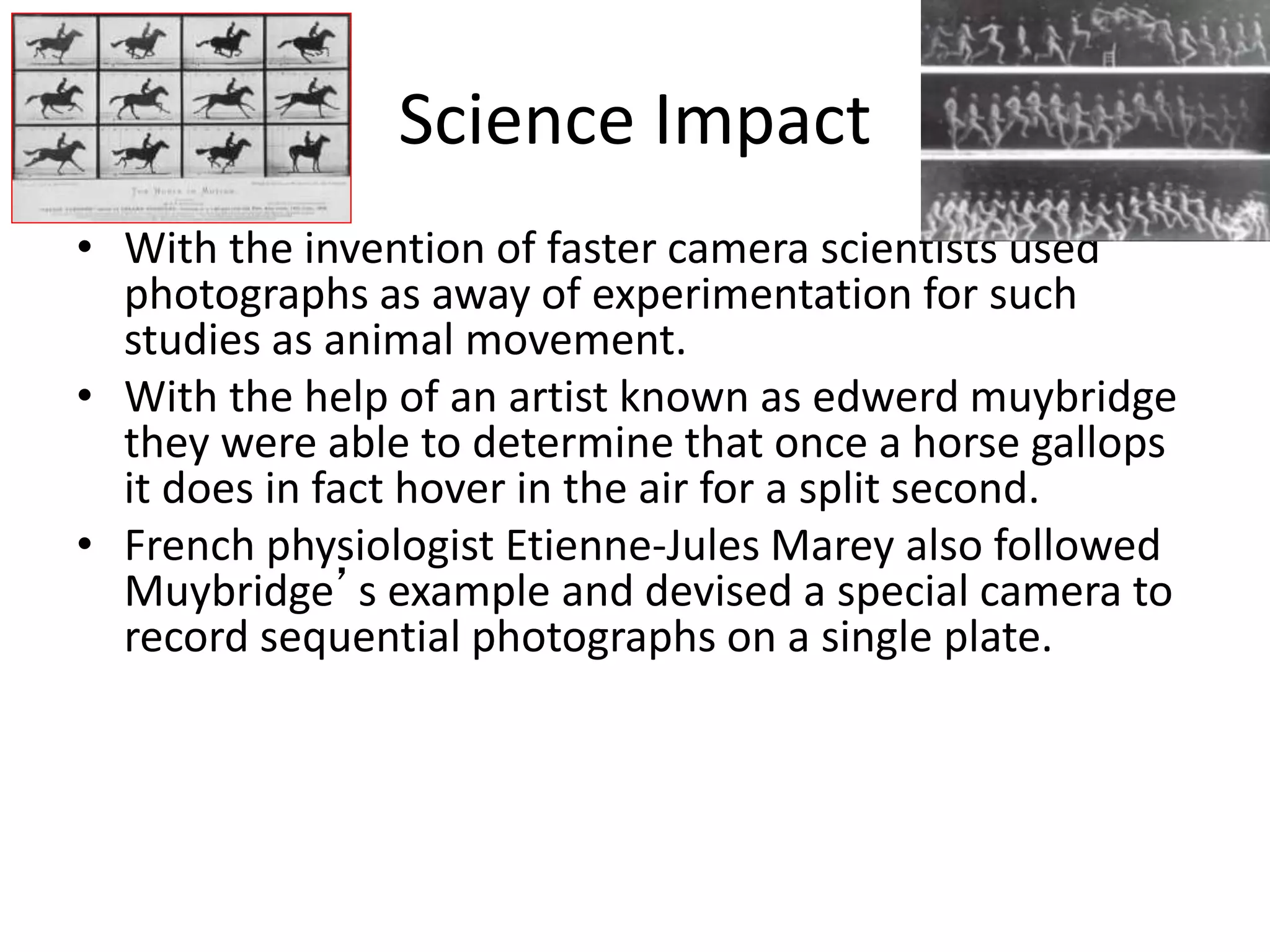
• With the help of an artist known as edwerd muybridge 
they were able to determine that once a horse gallops 
it does in fact hover in the air for a split second. 
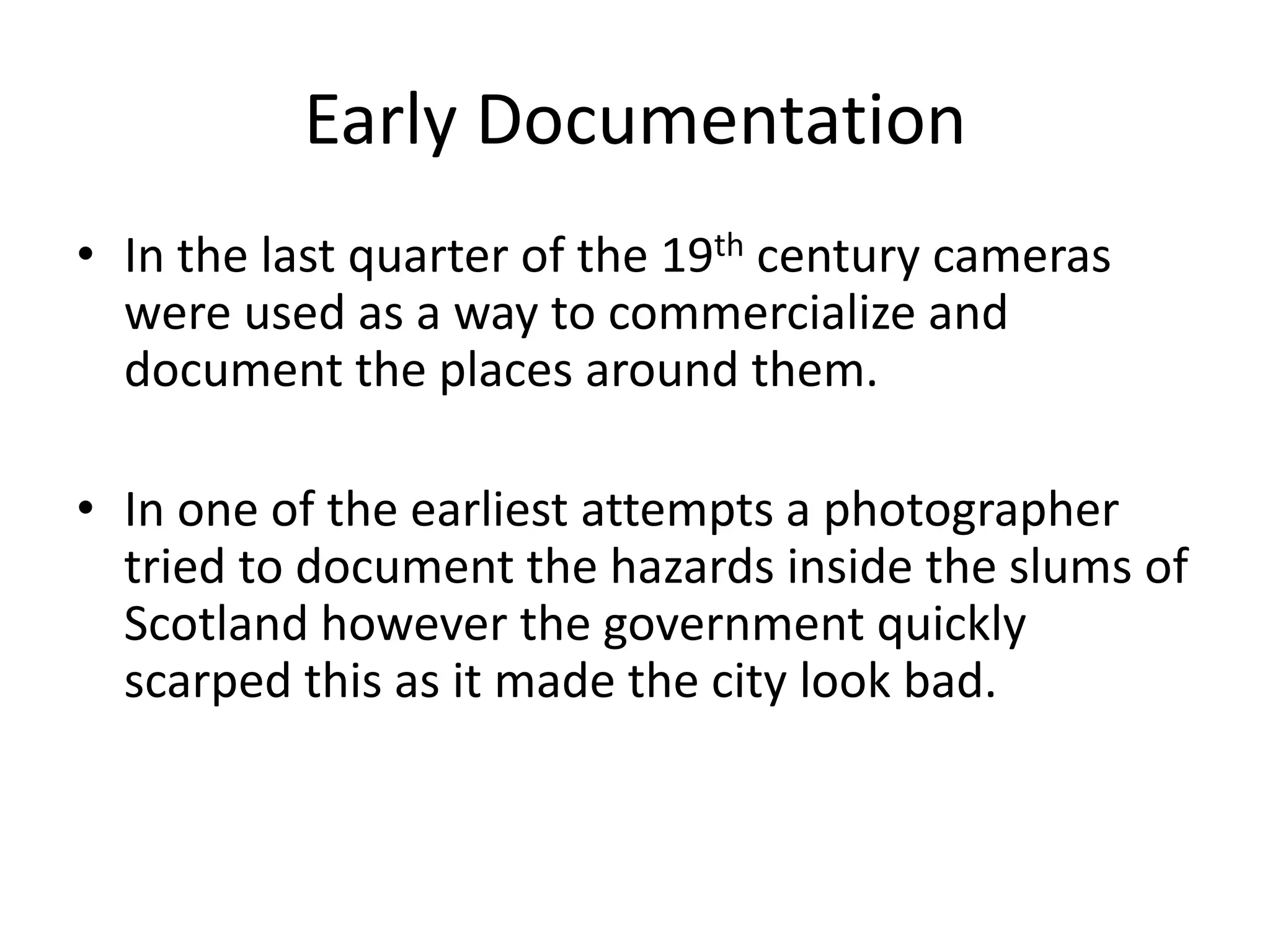
• French physiologist Etienne-Jules Marey also followed 
Muybridge’s example and devised a special camera to 
record sequential photographs on a single plate.
Early Documentation 
• In the last quarter of the 19th century cameras 
were used as a way to commercialize and 
document the places around them. 
• In one of the earliest attempts a photographer 
tried to document the hazards inside the slums of 
Scotland however the government quickly 
scarped this as it made the city look bad.
Kodak Camera 
• As photography celebrated 50 years of success. Modern family's 
wanted to take there own photos as it would make things more 
easier for money. 
• The use of photographic film was pioneered by George Eastman, 
who started manufacturing paper film in 1885 before switching to 
celluloid in 1889. 
• His first camera was called the Kodak.It was a very simple box 
camera with a fixed focus lens with the film already set up inside 
the box camera. 
• In 1900, Eastman took mass-market photography one step further 
with the Brownie, a simple and very inexpensive box camera that 
introduced the concept of the snapshot. The Brownie was 
extremely popular and various models remained on sale until the 
1960s.
The snapshot 
• The snapshot is a simple concept in which you 
take photos instantly to capture movement in 
a photo such as running and jumping. 
• But being able to freeze time to capture this 
moment.
35MM 
• Oscar Barnack had the idea of reducing the format of 
negatives and then enlarging the photographs after 
they had been exposed. As development manager at 
Leica, he was able to put his theory into practice. He 
took an instrument for taking exposure samples for 
cinema film and turned it into the world's first 35 mm 
camera: the 'Ur-Leica'. 
• Along with motion pictures, which the Lumière brothers of 
France introduced to the world in 1895, photographs in 
reproduction led to new concepts of celebrity, culture, 
advertising, and entertainment.
Digital Photography 
• Photography is now a digital process as photos 
are taken digitally on a hand held device. 
• They are saved onto small memory cards and 
digital memory units which can hold up to 
thousands of photos. 
• Pictures are now taken on mobile phones and 
have made editing easy with such applications as 
Photoshop, instagram and various cheap ones on 
the internet.

History of photography

  • 1.
    History of Photography By Haydn Hamilton
  • 2.
    What is Photography? • Photography is an art format in which pictures are taken of a specific area of interest depending on the artists style. • Can differ from • Glamorization • Space • Urban • Fantasy • Architecture
  • 3.
    Photography uses •This format of art was used for keeping memories. As they are a capture of a specific moment in history. • This can differ from person family photos to historical events such as buildings being made or historical disputes. • Dr. Wendle Homes “A mirror with memory.”
  • 4.
    Photography Vs Art • 20 centaury artists have argued that photography is not a direct experience as there is an editing process. Where as a painters accuracy is purely based on skill for any sort of picture. This could be portrait or landscape. • It is believed that photography creates a physically imprint of an accurate representation. However a painters is merely an impression. • However it is also believed that the invention of photography made artists see the world in a more abstract way. It was a way to deconstruct the idea of realism in art itself by making objects look unrealistic.
  • 5.
    Giphante • Abook written a man with an amazing imagination. His name was De La Rouche. The premise of his book was that pictures would appear onto a canvas once a strange liquid substance was coated onto it. Once the substance was left to dry in the dark images from the surrounding environment would stick to the canvas to create a photo. • This idea was written about in the 18th century nearly two hundred years before photography was even considered to be created.
  • 6.
    Greek Roots φωτός(photos) and γραφή (graphy) meaning lines or drawing. • This word was first said by a man by the name of John F.W. Herschel in 1839. • The idea of recording images by the action of light.
  • 7.
    The Camera Obscura • This device was created out of a simple “Pin-hole camera”. Which was used perhaps a 1000 years ago. • The device was a way in which to project an image of something onto a canvas so it could be traced. It was first used as away to look at the eclipse safely. • The use of light created a much brighter image. • There is speculation that Vermeer used a camera obscura for his paintings
  • 8.
    The first everphotograph • Photography as a useable format was first implemented in the 1820s. With the development of chemical photography. • The first image was taken by the French inventor Nicéphore Niépce in 1826. • However the image took 8 hours to expose.
  • 9.
    Daguerreotypes • LouisDaguerre the inventor of the Daguerreotype experimented with chemicals and compounds until he discovered that a silver substance mixed with chalk makes an effect to darken images when exposed to light creating a black and white effect. • The silver was coted onto a copper plate which later had the chalk added to it. • The exposure time on this was only half hour which is a giant improvement to before. • This format created a very fine detailed photos. Although this format was a good accurate piece of work the photo was a one and only original. If the photo needed to be copied two cameras would have been set up side by side.
  • 10.
    Calotype • Inventedby Hennery William Fox. • the calotype negative provided the first practical method of producing prints on paper from a camera exposure. • The earliest paper negative we know of was produced in August 1835. • The paper negative was of Lacock Abbey Hennerys home. • Used to sharpen many images it was used in many pictures of nature to get the finer detail in photos.
  • 11.
    the collodion •Frederick Scott Archer created this process known as the wet plate process. Similar to the calotype however producing the image on a glass background rather then a paper background it produced much sharper and clearer images. • Using the collodion method, French painter and photographer Adolphe Disdéri in 1854 invented the carte-de- visite, a form of photographic calling card, which soon became the new rage. • Photographers who used this process travelled all over Europe to take photos of clients. Carrying there cameras and tripods on carts all over the country.
  • 12.
    The Civil War • The civil war was the first war that documented the events through photography. As industrialization became more in use in the 19th century. Industries employed photographers to take photos of there new inventions that would revolutionize western culture. • For example, in 1857 British photographer Robert Howlett took pictures of the British steamship. • Also used to document medicine and medical notes for doctors. Photographers took photos of soldiers who lost limbs in the civil war.
  • 13.
    Psychology • Psychologistsstudied photos of people who looked like they had mental problems. In doing this they believed if you looked like this you would of also had mental problems or would be a convicted criminal.
  • 14.
    Science Impact •With the invention of faster camera scientists used photographs as away of experimentation for such studies as animal movement. • With the help of an artist known as edwerd muybridge they were able to determine that once a horse gallops it does in fact hover in the air for a split second. • French physiologist Etienne-Jules Marey also followed Muybridge’s example and devised a special camera to record sequential photographs on a single plate.
  • 15.
    Early Documentation •In the last quarter of the 19th century cameras were used as a way to commercialize and document the places around them. • In one of the earliest attempts a photographer tried to document the hazards inside the slums of Scotland however the government quickly scarped this as it made the city look bad.
  • 16.
    Kodak Camera •As photography celebrated 50 years of success. Modern family's wanted to take there own photos as it would make things more easier for money. • The use of photographic film was pioneered by George Eastman, who started manufacturing paper film in 1885 before switching to celluloid in 1889. • His first camera was called the Kodak.It was a very simple box camera with a fixed focus lens with the film already set up inside the box camera. • In 1900, Eastman took mass-market photography one step further with the Brownie, a simple and very inexpensive box camera that introduced the concept of the snapshot. The Brownie was extremely popular and various models remained on sale until the 1960s.
  • 17.
    The snapshot •The snapshot is a simple concept in which you take photos instantly to capture movement in a photo such as running and jumping. • But being able to freeze time to capture this moment.
  • 18.
    35MM • OscarBarnack had the idea of reducing the format of negatives and then enlarging the photographs after they had been exposed. As development manager at Leica, he was able to put his theory into practice. He took an instrument for taking exposure samples for cinema film and turned it into the world's first 35 mm camera: the 'Ur-Leica'. • Along with motion pictures, which the Lumière brothers of France introduced to the world in 1895, photographs in reproduction led to new concepts of celebrity, culture, advertising, and entertainment.
  • 19.
    Digital Photography •Photography is now a digital process as photos are taken digitally on a hand held device. • They are saved onto small memory cards and digital memory units which can hold up to thousands of photos. • Pictures are now taken on mobile phones and have made editing easy with such applications as Photoshop, instagram and various cheap ones on the internet.